
中文存在句的定指詞分析
132
0
0
全文
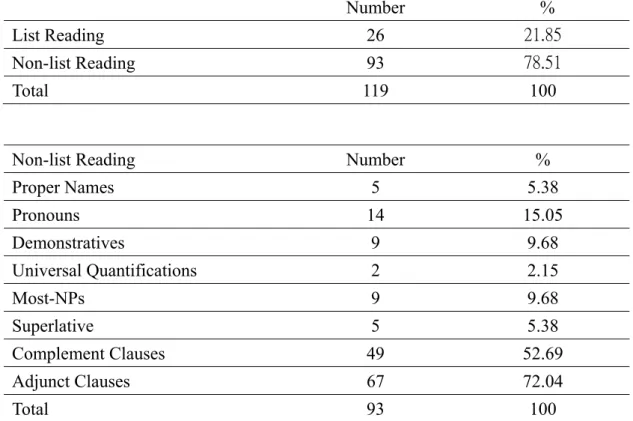
(2) 摘要. 本 文 主 要 以 語 用 的 觀 點 來 探 討 中 文 存 在 句 中 的 有 定 限 制 (the Definiteness Effect),並以聯合知識庫中的書面語資料為真實語料來源。本文以不被允許出現 於存在句中的定指詞為研究範疇,檢視專有名詞、代名詞, 指示詞、全稱量化詞 (universal quantifications)、most-NPs 和最高級詞語在真實語境中的使用情形。研 究發現定指詞可出現於存在句中,且其最常出現的環境為附屬子句或是主要動詞 之後的補語結構。此外,中文存在句可用來表達事物或是事件的存在,並允許舊 訊息的表達。本文指出,有定限制是個誤稱,然而定指詞的使用並非毫無限制, 主要限制是這類的存在句必須具有用來識別(identify)人或事物的功能,而非是介 紹或呈現新的事物進入篇章中的存在句。另一方面,因為存在句允許表達舊訊 息,而且功能上可用來吸引聽者的注意,本文提出中文存在句本身亦可成為主題 結構,而非只限於主題引入的功能。. i.
(3) ABSTRACT. This study deals with the Definiteness Effect (DE) in Chinese you existential sentences from pragmatic perspectives and the scope is confined to the formal written style with discourse environments. The data used for analysis is the United Daily News Corpus and the data selection is restricted to the definite NPs which are considered unacceptable in you existential sentences: proper names, pronouns, demonstratives, universal quantifications, most-NPs, and superlative. The data for analysis in this study consist of 119 natural occurrences and the results reveal that definite NPs can occur in you existential sentences and the contexts where they appear consist of adjunct clauses and complement clauses embedded under the matrix verb. It is also observed that you existential sentences can assert the existence of entities or events and definite NPs can represent given information. I suggest that the Definiteness Effect is a misnomer and the restriction imposed on you existential sentences is derived from the non-application of “identification” in existential sentences. Definite NPs are only allowed in you existential sentences when they are used to identify the entities. If the postverbal NPs are to introduce or present the entities into the discourse, definite NPs are ruled out. In addition, it is argued that if the definite NPs are anaphoric and thus given information, they are used to draw the addressee’s attention to the presence of entities or events; namely, they serve as focusing topics. It seems odd to view them only as topic-introducing constructions.. ii.
(4) ACKNOWLEDGEMENTS. When I look back on the process of my academic research, I feel so grateful to a number of people for their being generous with their constant help and guidance. I feel so fortunate since this thesis can never be accomplished by myself without their support. First of all, I would like to dedicate an expression of thankfulness to my advisor, Dr. Shu-ing Shyu, who trained me strictly and inspirationally into a more serious academic thinker. Most of what is worthwhile in this thesis is due to her influence and her concern and generosity helped me go through the difficult time. I would also like to pay my respect to my thesis committee. It is Dr. Yu-fang Wang and Dr. Mei-chih Tsai who gave me their critical advice on my study that made my research more organized and robust. Special thanks are given to my dear classmates and friends — Hsiang-lin Chen, Maio-tzo Chen, Sami Ho, Po-Chin Ho, Chia-hui Lee, Wu-min Kang, Xiao-qi Wang, Yi-ting Cai, Zhi-jie Lin, Hui-jun Chen, Qing-song Cai, Xin-ying He, Wei-ting Liu, and Wen-jun Liu. They have been the encouragement and support as well. Last but not least, I want to thank my parents and brother for their total support and sacrifice. I finished this thesis with love and gratitude to them.. iii.
(5) TABLE OF CONTENTS. ABSTRACT ................................................................................................................. II ACKNOWLEDGEMENTS ..................................................................................... III LIST OF TABLES ..................................................................................................... VI. CHAPTER 1. INTRODUCTION ........................................................................... 1. 1.1 STUDIES OF THE DEFINITENESS EFFECT IN EXISTENTIAL SENTENCES .............. 1 1.2 PURPOSE OF THE STUDY ...................................................................................... 8 1.3 ORGANIZATION OF THE THESIS........................................................................... 9 CHAPTER 2. LITERATURE REVIEW ............................................................. 10. 2.1 CHARACTERISTICS OF THERE-BE EXISTENTIAL SENTENCES ........................... 10 2.2 THE DEFINITENESS EFFECT IN THERE-BE EXISTENTIAL SENTENCES ............. 12 2.2.1 The Definiteness Effect from a Syntactic Perspective ................................ 14 2.2.2 The Definiteness Effect from a Semantic Perspective ................................ 15 2.2.3 The Definiteness Effect from a Pragmatic perspective ............................... 24 2.2.4 There as a Strategy Assigning Focus .......................................................... 39 2.3 GENERAL PROPERTIES OF CHINESE YOU EXISTENTIAL SENTENCES ............... 40 2.4 THE DEFINITENESS EFFECT IN CHINESE YOU EXISTENTIAL SENTENCES ....... 42 2.4.1. The Definiteness Effect from a Syntactic Perspective ............................... 48 2.4.2. The Definiteness Effect from a Semantic Perspective ............................... 50 2.4.3 The Definiteness Effect from a Pragmatic Perspective ............................... 52 CHAPTER 3. CORPUS RESULTS AND DISCUSSION ................................... 66. 3.1 DATA ANALYSIS .................................................................................................. 66 3.2 RESULTS AND DISCUSSION ................................................................................. 67 3.2.1 List Reading ................................................................................................ 68 3.2.2 Non-list Reading ......................................................................................... 78 3.2.2.1 Assertions of Entities and Events ............................................................. 87 3.2.2.2 You Sentences as Adjunct Clauses and Complement Clauses ................. 89 3.2.2.3 Topic and Focus Constructions in You Sentences .................................... 93 CHAPTER 4. CONCLUSION ............................................................................ 103. 4.1. CONCLUDING REMARKS ................................................................................. 103 4.2 IMPLICATIONS .................................................................................................. 105 iv.
(6) 4.3 LIMITATIONS AND SUGGESTIONS .................................................................... 106 REFERENCES......................................................................................................... 107 APPENDIX ............................................................................................................... 111. v.
(7) LIST OF TABLES. TABLE 1 TYPES OF DETERMINERS .............................................................................. 15 TABLE 2 PROHIBITED POST-VERBAL NP ARGUMENTS OF EXISTENTIAL SENTENCES .. 23 TABLE 3 THE SUMMARY OF EXPLANATIONS OF THE DE FROM A SEMANTIC PERSPECTIVE ........................................................................................................ 24 TABLE 4 THE DISTRIBUTION OF THE DEFINITE NPS IN YOU SENTENCES .................... 67. vi.
(8) CHAPTER 1. INTRODUCTION. 1.1 Studies of the Definiteness Effect in Existential Sentences As Martinez Insua (2004) indicates, when English there-be existential constructions are investigated, it is very difficult to find discussions that do not concern what is known in the literature as the Definiteness Effect (henceforth, DE). As regards the Definiteness Effect, it means only indefinite NPs are allowed to be subjects in existential sentences. Formally definite NPs, including proper names, most-NPs, demonstratives, pronouns as well as certain quantifiers (such as every, each) are prohibited as subjects in existential sentences. Consider the following sentences: (1) *There is the cat in the garden. (2) *There is Mary in the room. (3) *There is her/she in the room. However, there are obvious counterexamples in the actual usage of language, where definite NPs do occur in existential sentences. For example: (4) There are those who find North Norway attractive. (from Martinez Insua, 2004:47, ex. 2.95) (5) There is the possibility that he might go back to England. (from Martinez Insua, 2004:47, ex. 2.96) Explanations abound for the issue of (in)definiteness in English there-be existential sentences: syntactic accounts, as in Milsark (1974, 1977); semantic standpoints, as in Rando and Napoli (1978) and Holmback (1984), to name only a few; and the pragmatic perspectives based on the concept of contexts and information structure, as in Abbott (1993) and Ward and Birner (1995, 1998), among others. Regarding semantic accounts, many scholars ground their postulations on 1.
(9) concepts such as quantification, inclusiveness, specificity, and anaphoricity. For example, Rando and Napoli (1978) assert that the restriction imposed on there-be existential sentences is the notion of anaphoricity, claiming that only non-anaphoric NPs can occur in there-be existential sentences. Abbott (1993) resorts to the context to explain the DE and distinguishes two types. of. existential. sentences:. non-contextualized. existentials. (NEs). and. contextualized existentials (CEs), contending that the sentences that are considered ungrammatical from a syntactic or a semantic view will become felicitous if appropriate contexts are given, as illustrated in (6) and (7). (6) *There is everyone in the room. (from Abbott, 1993:47, ex. 19b) (7) A: Is there anybody we can get to help clean up? B: Well, there’s everyone in the room, for a start; and maybe we can get some of the people down the hall, too. (from Abbott, 1993:47, ex. 20a) Ward and Birner (1995,1998) appeal to the dichotomy of new and given information to account for the DE, asserting that existential postverbal NPs should represent a hearer-new entity based on naturally occurring data. Five types of formally definite but hearer-new NPs are proposed by them to felicitously occur in there-be existential sentences. Similar to English existential sentences, the DE is also present in Chinese sentences, as claimed by Huang (1987), who argues that the DE applies to you existential constructions and the postverbal NPs must be indefinite. Like scholars who investigate English existential sentences, Chinese linguists also account for the DE with syntactic perspectives (as in Li, 1996), semantic standpoints (as in Huang, 1987), and pragmatic approaches (as in Chang 2004a, 2004b). 2.
(10) Li (1996) postulates that you existential constructions have two structures: one is [you NP] […VP], which asserts the existence of an individual/entity, which is termed by her the Indefinite type, and the other is [you [NP VP]], which asserts the existence of an event, which is called the Definite type. The Definite type existentials, according to Li, do not exhibit the DE; namely, if one uses a you sentence to assert the existence of an event, the DE does not hold, as illustrated in (8). (8) Ruguo you if. Zhangsan zhaogu Lisi, ta yiding. mashang. keyi. fuyan. have Zhangsan care Lisi, he certainly immediately can recover. ‘If there is Zhangsan taking care of Lisi, he can certainly recover immediately.’ (from Li, 1996:178, ex. 7b) Li contends that a definite type existential sentence generally appears as a sentential subject or in the adjunct clauses, whereas it cannot occur as a matrix clause or a complement clause embedded under the matrix verb. For example: (9). * You. Wangwu. zai. zhaogu Lisi. have. Wangwu. at. care. Lisi. ‘There is Wangwu taking care of Lisi.’ (10) You have. ren. zai. zhaogu Lisi. people. at. care. Lisi. ‘There are people taking care of Lisi.’ (11) *Wo renwei/xiangxin you Wangwu zai zhaogu Lisi I. think/believe. have Wangwu. at. care. Lisi. ‘I think/believe there is Wangwu taking care of Lisi.’ (12) Wo renwei/xiangxin I. think/believe. you. ren. zai. zhaogu Zhangsan. have people at. care Zhangsan. ‘I think/believe there are people taking care of Zhangsan.’ 3.
(11) (13) Ruguo you. Wangwu. zhaogu Lisi,na. if. Wangwu. care. have. jiu tai. hao. le. Lisi,that just very good Par.. ‘If there is Wangwu taking care of Lisi, it is very good.’ Huang (1987) claims that if the subject position is lexically filled with an NP, the DE will not be present. Consider the following two sentences. (14) Zheli you-mei-you zheben shu? here have-not-have this. book. ‘Is there (a copy of) this book here?’ (from Huang, 1987:240, ex. 53b) (15) * You-mei-you zheben shu have-not-have this. zai zheli?. book. at. here. ‘Is there this book here?’ (from Huang, 1987:240, ex. 54b) Huang asserts that the DE obtains without restriction when predicate phrases occur and if Definite NPs appear in you existential sentences, they are semantically indefinite even though the subject position is filled. (16) You yige/*neige ren have one/that. hen youqian. man very rich. ‘There is a/*the man very rich’ (from Huang, 1987:243, ex. 67) In agreement with Abbott’s (1993) NEs and CEs models, Chang (2004a, 2004b) accounts for the DE and claims that as long as some context information is given, definite NPs are allowed in existential sentences. From her perspectives, there seems to be no restriction about the types of clauses in which definite NPs can appear. For example:. 4.
(12) (17) A: You shei keyi zhaogu Lisi? have who can care. Lisi. ‘Who can take care of Lisi?’ B: You. Zhangsan. a!. have Zhangsan SP ‘There’s Zhangsan.’ (from Chang, 2004b:7, ex. 27) Furthermore, objected to Ward and Birner’s (1995) postulations that existential there-be sentences require hearer-new NPs, Chang claims that Mandarin existential sentences may introduce both hearer-new and hearer-old entities, as illustrated in (18) A:. You. Lisi zai jiaoshi. li, laoshi. jiu. bu neng fangxin. have. Lisi at classroom in, teacher then not can rest assured. ‘(If) there is Lisi in the classroom, then the teacher cannot be rest assured.’ B:. Shei. shi. Lisi?. who. be. Lisi. ‘Who is Lisi?’ (from Chang, 2004b:10, ex. 35) In (18A), according to Chang, the entity Lisi can be either hearer-new or hearer-old. It can express knowledge shared by the addresser and the addressee and thus hearer-old. On the other hand, Lisi can also be hearer-new information, as seen in the hearer’s question in (18B). As stated above, we can see that the explanations of the DE are of different facets and the assertions proposed by different linguists are lack of concord; namely, they may conflict one another. My observation is as follows. First of all, with regard to the status of predicate phrases, Huang (1987) asserts that as long as predicate phrases occur, the DE obtains without restriction, whereas 5.
(13) predicate phrases seem not to pose problems in Li’s (1996) indefinite and definite types of you existential sentences and Abbott’s (non-)contextualized existential sentences. Secondly, speaking of the assertion of existential sentences, the existence of entities are generally to be asserted, as Ziv (1982) points out “it has been generally assumed that existential sentences always assert the existence of some entity” (Ziv, 1982:73). Abbott (1993) also postulates that “the function of existential sentences is to draw the addressee’s attention to the existence and/or location of the entity or entities denoted by the focus NP” (Abbott, 1993:41). However, Li asserts that Chinese you sentences can assert the existence of events, whereby the DE does not occur. As mentioned above, we can see that there is a lack of consensus in the assertion of postverbal NPs and that the assertion of existence of an entity or existence of an event may influence the application of the DE. Thirdly, considering new and given information, to the best of my knowledge, general views hold that existential sentences introduce new information in discourse. For instance, according to Lambrecht (1994), English there-be and Chinese existential constructions are examples of presentational clauses, which are topic-promoting constructions and exclusively or strongly prefer the introduction of brand-new (unidentifiable) referents. He indicates that mainly indefinite NPs are tolerated in these constructions because the discourse function of a presentational clause is to “promote unused referents to active status”, namely, “to present or introduce a referent into the ‘place’ or ‘scene’ of the discourse and thereby raise it into the addressee’s consciousness” (Lambrecht, 1994:179). In Wang’s (1981) study of Chinese existential sentences, he points out that when the speaker uses a you sentence to introduce the existence of certain entities, he presumes that his hearer is unaware of such of an existence, and “the addressee’s actual knowledge or ignorance plays no 6.
(14) role in speaker’s assumption whether the information is old or new” (Wang, 1981: 129). Consider: (19) Jintian zaoshang this. morning. you. ji. tong. you several. CL. nide your. dianhua phone-call. ‘There were several phone calls for you this morning.’ (from Wang 1981: 128, ex. 3) In (19), the existence of “several phone calls” is treated by Wang as new information. In addition, in his account for the DE in existential sentences, he contends that the definite NP can constitute new information, as exemplified in (20): (20) Man raging. niu. yi. bull one. pian. zhong. film inside. you you. laobodiniluo Robert DeNiro. ‘Robert DeNiro is in the film Raging Bull.’ (from Wang 1981: 130, ex. 6) In (20), a definite NP ‘Robert DeNiro’, according to Wang, represents new information. Ward and Birner (1995, 1998) ground their postulations on the general views that existential sentences present new information, and in order to explain the DE, they resort to hearer-newness as the principle to account for existential sentences. Rejecting Ward and Birner’s claim, Chang (2004b), nevertheless, postulates that hearer-old information can occur in Chinese you existential sentences. Last but not least, as mentioned by Lambrecht (1994), English there-be and Chinese existential constructions are examples of presentational clauses, which are topic-promoting constructions. Similar to Lambrecht, Wang (1981) indicates that Chinese you existential sentences exhibit an introductory function and refers to existential you as a topic introducer. He asserts that you serves as a linguistic device for “informing the existence of an NP (i.e. the discourse topic) to the hearer” (Wang, 7.
(15) 1981:131). However, it is seen in Abbott’s (1993) assertions that “the function of existential sentences is to draw the addressee’s attention to the existence and/or location of the entity or entities denoted by the focus NP” (Abbott, 1993:41) and she also indicates that “a constituent can be focused in a sentence without being new information” when she discusses the definite NP that in there-be existential sentences (Abbott, 1997:107). In the light of Abbott’s accounts, it could be inferred that existential sentences may function as focus constructions. Moreover, since definite NPs can appear as given information in you existential sentences in our study, it is open to doubt that existential sentences only serve as topic-introducing constructions.. 1.2 Purpose of the Study In this study, it is attempted to deal with the DE in you existential sentences. From section 1.1, we see that there exists a lack of consensus in the assertions of linguists who deal with existential sentences. The purpose of this study, therefore, is to discover some facts about Chinese you existential sentences according to the natural occurring data in the corpus and to gain some insight into their nature. Further, since to the best of my knowledge, not much attention has been paid to (non)usage of definite NPs in Chinese you existential sentences in real language, special consideration will be granted to their pragmatic functions within contexts. Four research questions are addressed in this study: (1) Does the Definiteness Effect (DE) constrain Chinese you existential sentences and how is this distribution of the DE in you existential sentences to be explained? (2) Can Li’s (1996) assertion of you constructions explain the DE in you existential sentences in the natural language? Can her postulations of existence of 8.
(16) events/entities be verified? (3) Can Abbott’s pragmatic accounts, as Chang claims, effectively explain the DE in you existential sentences? (4) Do you existential sentences introduce only new information and functions only as topic-introducing constructions? Can they present given information and function as topic constructions? These questions will be taken up in the three chapters that follow.. 1.3 Organization of the Thesis The thesis is organized as follows. The first chapter provides a general review of studies on the DE in English there-be and Chinese you existential sentences and address the research questions. Chapter two will review the investigations on the DE undertaken from different perspectives (syntactic, semantic, and pragmatic) that are available in the literature. Chapter three will concentrate on the analysis of you existential sentences from a corpus-driven perspective and the explanations of the results. Chapter four will be devoted to the conclusion of this thesis and suggestions for further work.. 9.
(17) CHAPTER 2. LITERATURE REVIEW. 2.1 Characteristics of There-be Existential Sentences In English, existential sentences have been used to designate those sentences which contain unstressed, non-deictic there, the verb form to be, an indefinite NP and a locative adverbial following there (Ziv, 1982: 73). According to Hannay (1985), the surface structure of existential sentences is presented as: (1) There. +. be. +. NP +. X. X is the possible structure that can occur to the right of the NP, which is termed by Hannay (1985) ‘the Extension’. For example, (2) There were no spiders. (3) There were a number of drunks standing on the corner. (from Hannay,1985:6, ex. 3) Functionally speaking, existential sentences are regarded by a number of linguists as a type of presentative construction and introduce new information in the discourse. For instance, Lambrecht (1994) asserts that English there-be presentational clauses are topic-promoting constructions and strongly prefer the introduction of brand-new (unidentifiable) referents. He indicates that mainly indefinite NPs can occur in these constructions because the discourse function of a presentational clause is “to introduce or present referents into the ‘place’ or‘scene’ of the discourse and thereby raise it to the addressee’s consciousness” (Lambrecht, 1994:179). Similar views are held by Bolinger (1977), who seeks to show that existential sentences are constructions that “bring something into awareness” (Bolinger, 1977:92). The ‘bringing into’, according to Bolinger, is provided by the position of there in the presentative construction and ‘awareness’ is regarded as ‘abstract location’ and also. 10.
(18) comes from the meaning of there itself.. Bolinger attempts to pin down the notion of. abstract location by contrasting sentences with and without there. He postulates that if fronted locative phrases are accompanied by there in presentative constructions, the object is being presented to our mind, namely, being brought into consciousness. However, when without there, they present something vivid ‘on the immediate stage’. Consider (4-8) below in this respect, taken from Bolinger (1977): (4) As I recall, across the street is a grocery. (5) As I recall, across the street there’s a grocery. (6) As you can see, across the street is a grocery. (7) I can see that across the street is a grocery. (8) I can see that across the street there’s a grocery. Bolinger points out that (5) and (8) with there involve the information-granting, whereas (6) without there is deictic and could well be accompanied by pointing one’s finger. Furthermore, when the existence of NPs asserted is not in the addressee’s view, there is more likely to be used, as illustrated in (9). (9) In my right hand is a pencil, and in my left there’s an eraser. As Bolinger indicates, if one has a pencil in his open palm, extended forward, and an eraser in the other hand, clenched shut behind his back, he will tend to say the sentence (9). Similar to Bolinger’s argument of ‘on the immediate stage’, Breivik (1981) introduces the ‘visual impact constraint’, whereby a lack of visual impact makes obligatory the use of there. Rejects that there has any semantic content as claimed by Bolinger, Breivik concludes that there can perform essentially pragmatic functions as a presentative signal.. 11.
(19) 2.2 The Definiteness Effect in There-be Existential Sentences In addition to the properties stated above, the so-called Definiteness Effect (DE) is discussed in many studies on English existential sentences. The DE stands for the restriction that definite posterverbal NPs are ruled out in existential sentences. Lyons (1999) states that the term Definiteness Effect is commonly used in relation to existential sentences. Hannay (1985) points out that if one attempts to give a detailed analysis of existential sentences in English, the most tantalizing problem he has to confront is the DE. Consider the two sentences borrowed from Hannay (1985): (10) There’s a fly in my soup. (11) *There’s the fly in my soup. According to Hannay (1985), (10) is appropriate but (11) is excluded because in (11) the referent of the fly is thought to be given in the context and it is meaningless to assert the existence of things already known to exist. Namely, given NPs are not allowed to occur postverbally in existential sentences. However, there are obvious counterexamples to the DE. Consider the following sentences drawn from Breivik (1990:154): (12) There are those who find North Norway attractive. (13) There is the possibility that he might go back to England. From formal points of view, the only explanation for such cases of acceptance of definite NPs in existential sentences is that they should be regarded as exceptions. For instance, list reading, termed by Milsark (1976) and Rando and Napoli (1978), is the most commonly asserted exceptions to the DE, as shown (14): (14) For a start, there’s the fly in my soup. (from Hannay, 1985:18, ex. 90) (14) is acceptable if it is uttered in a setting where an angry restaurant customer is giving the waiter a list of grievances. What’s more, the whole list may be given, 12.
(20) despite how many members the list contains: (15) A Were there many of your friends at the party? B No. There was only Fred and Harry, that’s all. (from Hannay,1985:111, ex. 42) Other exceptions are what Bolinger (1977) calls ‘reminders’, as illustrated in (16). (16) Don’t go yet. There’s still the football coupons to be filled in. Bolinger asserts that if something is known in the previous context, it can be ‘recalled’ onto the scene and that the existential is possible because something is presented again in a new context. Another type is definite NPs with the so-called ‘remarkable’ reading and superlatives are concerned here, such as (17) There was the most beautiful sunset this evening. (from Hannay, 1985:110, ex. 37) (18) There was the ugliest looking woman reading the news tonight. (from Hannay, 1985:110, ex. 38) Cited from Hannay (1985), Lumsden (1983) interprets them as a kind of ‘type reading’ and indicates that they can be paraphrased with an indefinite NP: (19) There was a sunset of the most beautiful kind this evening. (from Hannay 1985:110, ex. 39) Neverthelesss, the great number of the so-called “exceptions” and the increase of semantic and pragmatic approaches to the existential sentences may suggest that there is not really a definiteness restriction at all. For instance, Hannay (1985) points out that in specific contexts, definite NPs can be acceptable in existential sentences and in them, not the list reading is involved or the definite NP can be interpreted as indefinite as mentioned above. Consider:. 13.
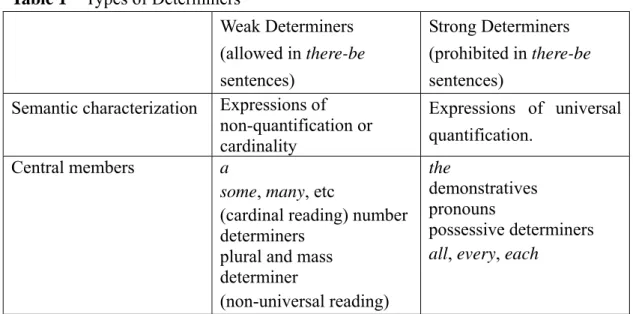
(21) (20) I looked out of the window and noticed that there was John standing at the door. (21) It was five o’clock and there was still most of the shopping to do. For Hannay, he claims that pragmatic accounts are accordingly required to gain more insight into the DE in existential sentences as he indicates that a reappraisal of the definiteness restriction is required in the light of a number of unexplained exceptions to this restriction, and that the pragmatic status of the NP may be relevant in this respect. Since the main idea underlying this study is that if some sentences are studied in isolation and out of contexts, namely, from formal perspectives, they may become ungrammatical or infelicitous, but when studied in contexts, they may find an explanation of their form and become appropriate. The following sections will grant a brief review of syntactic standpoints to the DE and devote more attention to those approaches which seek to explain the DE from the semantic and pragmatic perspectives.. 2.2.1 The Definiteness Effect from a Syntactic Perspective Cited from Hannay (1985), Milsark (1976:117) notes that apart from NPs with the definite article, there are other NPs which do not occur freely in existential sentences: pronominals, proper names, demonstratives, universally quantified NPs, etc and he suggests that these NP types may be all be classified under the heading of universal quantification if one accepts the claim in Chomsky (1975:100) that the definite determiner is a kind of universal quantifier expression. Milsark (1977) claims the DE is a Universality Restriction, rather than definiteness; for him, it is not the definite articles that are prohibited in there-be 14.
(22) sentences, but the universally quantified NPs, namely, the strong determiners. He proposes quantification and cardinality distinctions and group two types of determiner expressions: weak and strong determiners. According to him, those acceptable in existential sentences are termed ‘weak’ determiners, also characterized as expressions of cardinality. On the other hand, strong determiners seen as expressions of quantification are prohibited. Milsark provides the strong and weak determiners in the following list (Milsark, 1977:8).. Table 1 Types of Determiners. Semantic characterization Central members. Weak Determiners (allowed in there-be sentences) Expressions of non-quantification or cardinality a some, many, etc (cardinal reading) number determiners plural and mass determiner (non-universal reading). Strong Determiners (prohibited in there-be sentences) Expressions of universal quantification. the demonstratives pronouns possessive determiners all, every, each. 2.2.2 The Definiteness Effect from a Semantic Perspective Several scholars have pointed out, the syntactic explanations, on which the DE are traditionally based, cannot adequately account for the existential sentences, while semantic and pragmatic analyses seem to be able to provide more felicitous explanations of the issue under discussion. Among those scholars, Rando and Napoli (1978) distinguish existential sentences into two categories: existentials and list existential sentences, asserting that. 15.
(23) existential sentences allow only indefinite NPs, whereas list existential sentences permit indefinite NPs and definite ones. List sentences emerge typically as answers to questions as in example (22) where the definite NP is admissible. (22) What’s worth visiting here? There is the park, a very nice restaurant, and the library. That’s all as far as I’m concerned. (from Rando and Napoli, 1978:300, ex. 4) Rando and Napoli assert that the restriction imposed on there-be existential sentences is the notion of anaphoricity, not the traditional definite and indefinite distinction, rejecting universal quantification proposed by Milsark to explain the DE and claiming that only non-anaphoric NPs can occur in there-be existential sentences. Cited from Ward and Birner (1995), Kuno (1972) indicates that for Rando and Napoli, “anaphoricity” is defined in terms of what is familiar to both speaker and hearer. To account for definite NPs in list sentences such as example (22) mentioned above, similar to Milsark’s (1974, 1977) treatment of list reading in there-be existentials where the DE applies not to the individual items in the list but the list itself, Rando and Napoli argue the requirement of “non-anaphoricity” apply to the list itself rather than individual definite entities contained. Though postverbal NPs in the list sentences may be formally definite, they are treated as semantically indefinite and therefore are nonanphoric lists and accordingly satisfy Rando and Nopoli’s assertion. Even though Rando and Napoli explain “anaphoricity” with a semantic standpoint, they also hint the need to analyze this issue from a pragmatic perspective when they resort to new and old information and they indicate that “an NP is considered anaphoric only if it has been introduced in the (fairly immediately) preceding discourse” (Rando and Napoli, 1978:309). Holmback (1984) accounts for the DE in existential sentences, postulating that 16.
(24) the semantic differences in indefinite and definite determiners make them receive different interpretation in existential sentences and the “inclusiveness” condition associated with definite descriptions restricts what kind of definite NPs can occur in existential sentences. According to her accounts, compared with a/an, the definite determiner the has the extra feature of “inclusiveness” which she defines as a “reference to the totality of objects or mass which satisfy the descriptive predicate relative to some pragmatically defined speaker-hearer shared set of entities” (Holmback, 1984:203). This characterization, according to Holmback, assumes that there exist a number of speaker-hearer shared sets of information in communication and inclusiveness in the meaning of the“amounts to the claim that reference must be made to all and those entities which could satisfy the descriptive predicate relative to some pragmatically defined speaker-hearer shared set of entities” (Holmback, 1984:204). Consider (23): (23) Beware of the dog. Sentence (23), according to Holmback, must be used in a situation that there is only one relevant dog in some set of shared knowledge between the speaker and the hearer and a definite description could only be used or interpreted properly when the inclusiveness condition is satisfied. On the other hand, indefinite articles do not have the feature of inclusiveness, which is what distinguishes them from definite descriptions, as shown in (24a) and (24b). (24) a. A unicorn is in the garden. b. The unicorn is in the garden. (from Holmback, 1984:206, ex. 40a and 40b) (24a) means there exists some entity and it is a unicorn and appears in the garden. In (24b), however, it means only there is some set shared by the speaker and the hearer (from previous discourse or shared experience), where the reference of unicorn 17.
(25) is inclusive. Accordingly, the unicorn is seen as known or familiar. The “familiarity”, according to Holmback, is then an inferred property of the, which is the definite description associated with “inclusiveness” condition. With regard to there-be existential sentences, following Milsark (1977), Holmback sees there as an existential quantifier and argues that “there+ be introduces the existence of some entity into the discourse as relevant in a way which becomes specified by the discourse setting or the information in the containing sentence” (Holmback, 1984:208). As regards the DE in existential sentences, for her, the unacceptance of definite NPs is due to the incompatibility between presentational meaning of a there-be sentence and inclusiveness condition on definite descriptions. When a there-be sentence introduces an entity, it functions to assert the existence of an entity rather than assume it and the entity is presented first-mention; accordingly, it is incompatible with the definite descriptions which must be inferred inclusively. If the inclusiveness condition on a definite description can be met and meanwhile can be compatible with there-be sentences, for Holmback, there must be a shared set independent of current context or discourse within which inclusiveness can be satisfied (Homlback,1984: 208) and the description can refer inclusively independent of the current context. That is, the definite description must render the entity ‘uniquely identifiable’ (Ward and Birner, 1998). An illustration of this can be seen as follows. (25) a. ? There is the beautiful view from my window. b. There is the most beautiful view from my window. (from Holmback, 1984:209, ex. 45) (26) a. ? There is the unicorn in the garden. b. There is the only unicorn in captivity in the garden. (from Holmback, 1984:209, ex. 47a and 47b) 18.
(26) (27) a. ? There is the gas station attendant at the front door. b. There is the village idiot at the front door. (from Holmback, 1984:209, ex. 49b) Holmback asserts that what makes the (a) sentences inappropriate and the (b) sentences acceptable is: the definite postverbal NPs in a there-be sentence must have inclusive reference independently of current situational context (Holmback, 1984:209). The hearer can understand that there is only one entity that fits the description and therefore inclusiveness will be satisfied and the definite descriptions in (b) have this kind of unique reference independently of the immediate context. Holmback asserts that the description implies a unique entity, and even though the existence of the referent is being introduced, inclusiveness condition is fulfilled. In the (a) sentences, the descriptive predicate of the definite descriptions could be related to many individuals, and therefore, a shared set where inclusiveness can be satisfied is not available. Like Rando and Nopoli (1977), Holmback’s proposal is also related to pragmatic grounds, referring to the interlocutors’ shared knowledge especially when she defined the concept of inclusiveness. Using her words, As long as context and real-world knowledge allow the existence of a shared set in which the inclusiveness condition can be satisfied relative to that shared set, a sentence containing a definite description will receive an interpretation. But if the inclusiveness condition can not be satisfied for some reason then the sentence containing the definite descriptive will not receive an interpretation. Notice that if the sentence is used in a context where the speaker and the hearer do not share and can not infer a relevant pragmatic set in which the description can refer inclusively, then the sentence may be merely inappropriate in that context. (Holmback, 1984:205). 19.
(27) She also differentiates list existential from existentials with pragmatic perspectives: List TS’s [There sentences] are simply TS’s that occur in a context in which the discourse requires that those entities which are relevant to the current topic be made known. Existential TS’s are TS’s where the discourse environment is not requiring such information but where the existence of some entity is being introduced into the discourse, usually along with its location or state of current existence (Holmback, 1984:213).. Ward and Birner (1998) criticize the term ‘uniquely identifiable’ by Holmback as misleading in that it suggests that a hearer must be able to identify the actual object in the world. They advocate that the felicitous use of the definite article is that “the speaker must believe that the hearer is able to individuate the referent in question from all others within the discourse model” (Ward and Birner, 1998:122) and thus they abandon the term ‘uniquely identifiable’ and use ‘undividable within the discourse model’ as the more accurate constraint on definiteness. Martinez Insua (2004) also criticizes that Holmback’s reliance on pragmatics is incomplete and inconsistent because she makes no reference to the communicative situations where they are used, asserting that the examples she offered might be acceptable if analyzed in the appropriate context. (28) and (29) are cited from Martinez Insua, ex. 2.107 and ex. 2.108. (28) ? There is the unicorn in the garden. (29) ? There was the handsome man in the party. According to Martinez Insua, (28) and (29) may be acceptable if appropriate context are offered. In addition, some authors (e.g., Lakoff, 1987 and Aniya, 1992) try to associate old and new information (usually associated with indefinite NPs) to account for the DE. Maintaining that NPs in existential is normally associated with new referents, they conclude that existential sentences fit well with “the general tendency for new 20.
(28) material to be introduced later rather than earlier within the linear progression of the clause” (Huddleston, 1984:468), cited from Martinez Insua (2004). Among them, cited from Martinez Insua (2004), Lakoff (1987) argues for the newness of the postverbal NPs, resorting to the concept of “specificity” and contending that only those definite NPs that are not specific may be allowed in existential sentences. According to him, the addressee “must not have been aware of the referent, or he must have forgotten about it” (Lakoff, 1987:545), given that the function of existential sentences is to focus the addressee’ attention on the non-specific referent of the construction. If the definite NPs are specific, this functional constraint will be violated. Some of the examples he provided are illustrated as follows. (30) There was the usual argument in the class today. (from Martinez Insua, 2004:64, ex. 2.110) (31) There’s the strange smell coming from the refrigerator. (from Martinez Insua, 2004:64, ex. 2.111) (32) *There wasn’t the man in the room. (from Martinez Insua, 2004:64, ex. 2.113) However, Lakoff also accepts that postverbal NPs in existential may be both specific and definite, only it serves a “remembering function”, as in the case of (33) below. (33) There are the children to consider, remember? (from Martinez Insua 2004:64, ex. 2.114) Lakoff’s explanations of the DE in existential sentences associate with Bolinger’s (1977) assertion of appropriateness of definite NPs as reminders. However, like other syntactic and semantic accounts of the DE in existential sentences, criticized by Martinez Insua (2004:64), Lakoff’s contentions fail to pay due attention 21.
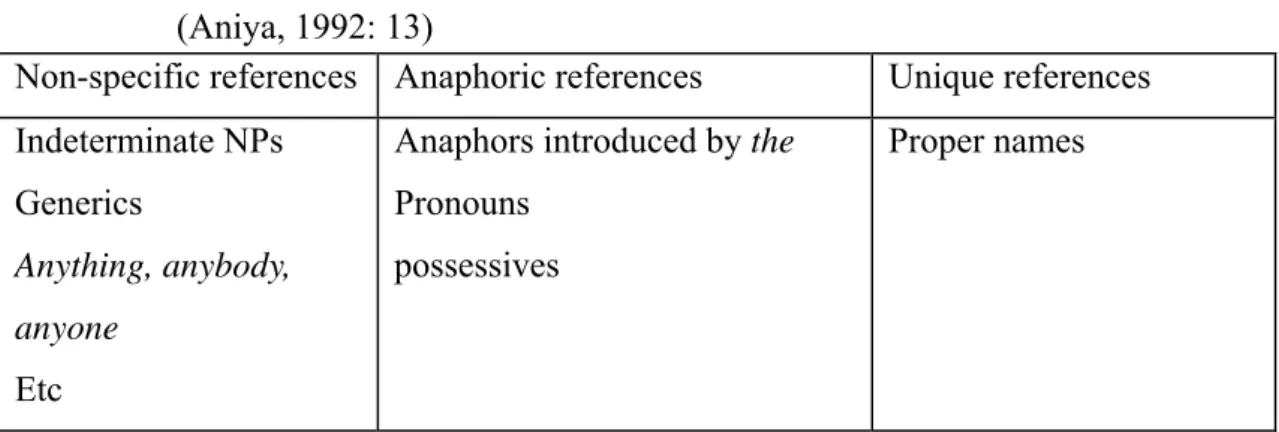
(29) to the context and to the possibility that postverbal definite NPs may become acceptable and grammatical while an appropriate context is offered. Similar to Lakoff, Aniya (1992) provides a specificity approach to account for the DE. She presents a Specific vs. Non-Specific Hypothesis and distinguishes three groups of NPs which are not admissible in the post-verbal position of existential sentences: non-specific references, anaphoric references, and unique references. From Aniya’s perspective, non-specific references denote any non-specific entity or entities, which include nonspecific determiners anything, anyone, anybody, etc. as well as generic NPs. The non-specific type is not allowed because the reference would be too vague for the hearer to establish its identity since Aniya asserts that “the function of existential sentences is to inform the hearer for the first time of the existence of some entity or entities and state the existence of something that is not specific would be odd” (Aniya, 1992:163). Anaphoric references denote either to previously mentioned entities or entity known explicitly and unambiguously by both speaker and hearer in a discourse. She contends that the function of an existential sentence is to introduce new information; thus, the postverbal NPs of existentials cannot refer to given information and accordingly anaphoric NPs are ruled out. Similarly, unique references are prohibited because unique referents are automatically uniquely identifiable to the hearer, and therefore are excluded since they are against the function of existential sentences that only introduce new information, as shown in Table 2:. 22.
(30) Table 2 Prohibited Post-verbal NP Arguments of Existential Sentences (Aniya, 1992: 13) Non-specific references Anaphoric references Unique references Indeterminate NPs. Anaphors introduced by the. Generics. Pronouns. Anything, anybody,. possessives. Proper names. anyone Etc. Nonetheless, as regards list existential sentences, Aniya admits that all the three prohibited types of references are allowed if entity and entities in them are listed as an answer to a question. She contends that list existential sentences are speaker-oriented propositions since they consist of items that may not be familiar to the hearer, whereas existential sentences, according her, are hearer-oriented propositions, which means that they introduce some entity that the speaker believes new to the hearer. Again, though presented on semantic grounds, Martinez Insua (2004) indicates that her proposals are on the borderline between semantics and pragmatics, as shown in her own words: In our study of ESs [Existential Sentences] and list there-sentences, let us suppose that the speaker is an ‘informer’ of what he believes is new information to the hearer, an ‘informee’. Let us suppose further that the speaker observes a general restriction of discourse and introduces the information as if the hearer were exposed to it for the first time, even though it might happen that this information may not turn out to be new information to the hearer (Aniya, 1992:159).. To sum up, the scholars who cope with the Definiteness Effect based on semantic grounds often address differences between existential sentences and list existentials and it is considered that list sentences are where the DE does not be observed. They often resort to the newness of information status of posteverbal NPs to define the DE. 23.
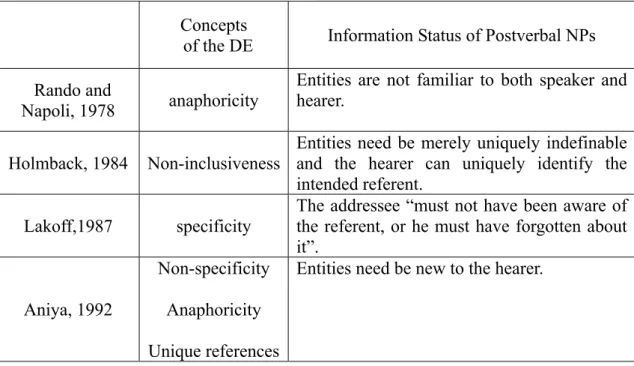
(31) Besides, even though presented with semantic accounts, their proposals are usually on the borderline between semantics and pragmatics. Table 3 summarizes the assertions of the authors who discuss the DE with semantic standpoints.. Table 3. The Summary of Explanations of the DE from a Semantic Perspective Concepts of the DE. Rando and Napoli, 1978 Holmback, 1984 Lakoff,1987. Aniya, 1992. anaphoricity. Information Status of Postverbal NPs Entities are not familiar to both speaker and hearer.. Entities need be merely uniquely indefinable Non-inclusiveness and the hearer can uniquely identify the intended referent. The addressee “must not have been aware of specificity the referent, or he must have forgotten about it”. Non-specificity Entities need be new to the hearer. Anaphoricity Unique references. 2.2.3 The Definiteness Effect from a Pragmatic perspective Unlike syntactic and semantic accounts of there-be existential sentences, those scholars who use pragmatic perspectives seek to explain their actual use in natural languages and uncover the pragmatic motivation and context that condition the form. Many of them restrict their area to account for the DE with a pragmatic approach. In opposition to the indefinite NPs views toward definite NPs in existential sentences (as in Milsark, 1977 and Rando and Napoli, 1978), Hannay (1985) points out “the formal definiteness of a term actually means something: that the use of the definite as against the indefinite article is indeed a motivated one on the part of the. 24.
(32) speaker” (Hannay, 1985:112). Hannay (1985) reanalyzes and rejects the term of the Definiteness Effect and proposes a Full-Topic Restriction, whereby only full topic terms would be blocked to occur in existential sentences. On the contrary, sub-topic and focus constituents which refer to entities that are salient in the given setting, are acceptable in existential sentences. A postverbal NP may be definite in existential sentences, provided that their pragmatic status goes along with the function of the existential predication, that is, not subject topic. Hannay (1985) asserts that definite terms are perfectly acceptable if they present salient information in the given setting. Abbott (1993) treats there in existential sentences as a dummy element and claims that it is put at the beginning of a sentence while the addressee is alert to the coming of new information, a conventionalized ahem (Abbott, 1993:41). From Abbott’s perspective, existential sentences are presentative sentences and their function is to “draw the addressee’s attention to the existence and/or location of the entity or entities denoted by the focus NP” (Abbott, 1993:41). With regard to the DE in existential sentences, Abbott applies pragmatic perspectives to explain it and contends that the sentences that are considered ungrammatical from a syntactic or a semantic view will become felicitous if appropriate contexts are given, as illustrated in (34) and (35). (34) *There is everyone in the room. (from Abbott, 1993:47, ex. 19b) (35) *There is the strange book in the room. (from Abbott, 1993:47, ex. 19c) Anaphoric definites (such as everyone and strange book), according to Abbott, requires a predicational slot in the existing discourse, and the locational phrase in the room must be interpretable as part of the focus NP. (34) and (35) are acceptable when they are contextualized as (36) and (37). 25.
(33) (36) Is there anybody we can get to help clean up? Well, there’s everyone in the room, for a start; and maybe we can get some of the people down the hall, too. (from Abbott, 1993:47, ex. 20a) (37) Where do you think that awful smell is coming from? Well, there’s the strange book in the living room. (from Abbott, 1993:47, ex. 20b) Abbott. distinguishes. two. kinds. of. English. existential. sentences:. noncontextualized existential sentences (NEs) and contextualized existential sentences (CEs). According to her, the former “should be perfectly natural in the focus position of an existential” (Abbott, 1993:42) and can occur at the outset of a discourse. Indefinite NPs belong to this type of NPs, as in (38). (38) There is a fire outside the window. On the other hand, definite NPs fall into the latter category and often occur in cases where “addressee may have forgotten about the existence of some entity, or may be unsure about its continued existence, or may not be thinking of the entity as suitable for some purpose at hand” (Abbott, 1993:42). Examples are taken from Abbott, 1993:42, ex. 4 and ex. 5, as follows: (39) A: Is there anything to eat? B: There is the leftover chicken from last night. (40) A: I guess we’ve called everybody. B: No, there’s still Mary and John. Moreover, list sentences are not treated a sub-set of existential sentences by Abbott as proposed by Rando and Napoli (1978), who argue that what is asserted to exist is not the referent of the member of the list but the whole list itself.. Abbott. argues that such list sentences can focus on the items of the list and they are 26.
(34) contextualized existentials, requiring only an appropriate context for their felicity. Thus, consider (41) where (40) is repeated here: (41) A: I guess we’ve called everybody. B: No, there’s still Mary and John. For Abbott, sentence (40) does not seem to assert the existence of a list with Mary and John on it, but rather simply draw the addressee’s attention to the existence of Mary and John as filling the predicational slot ‘people for us to call’. Abbott further elaborates on the difference between CE and NEs: the NP in NEs typically has a locational or other predicative phrase following it, whereas proper names and anaphoric definites in CEs do not. Thus the PP is a separate constituent as in (41), whereas it is a part of the focus NP in (42), taken from Abbott, 1993:44, ex.9a and 9b. (42) There’s a book on the table. (43) There’s the book on the table. With regard to proper names and anaphoric definites in CEs, Abbott asserts that the predicative slot must be fixed before they are introduced and it is only appropriate to include them in an existential which has the “reminding function”. On the other hand, as for indefinite NPs, Abbott points out that they typically require a specification of their location, or other relevance to the discourse, in addition to simply being pointed out (Abbott, 1993:43). ‘Cataphoric’ definites and the universally quantified NPs belong to NEs since they do not denote entities already introduced to the discourse, but instead they specify a uniquely identifiable entity which is newly introduced. See the following examples. (44) There was the smell of pot all over the apartment. (from Abbott, 1993:44, ex. 10c) 27.
(35) (45) There was the usual crowd at the beach last Sunday. (from Abbott, 1993:44, ex. 10d) (46) There were all kinds of pies and cakes for sale. (from Abbott, 1993:45, ex. 11a) (47) There is every reason to be suspicious. (from Abbott, 1993:45, ex. 1b) With regard to the ‘exclamatory’ superlatives, Abbott views them as NEs and semantically indefinite, following Bolinger (1977) and Rando and Napoli (1978). Consider: (48) There is the most beautiful house for sale in the next block! (from Abbott, 1993:45, ex. 12) Prince (1992) asserts that there-be existential sentences do not require indefinite NPs but hearer-new NPs. She contrasts old information with new information on the basis of (the speaker’s beliefs about) the hearer’s beliefs. For her, ‘new’ information is about an entity assumed not to be already known to the hearer and by contrast, ‘old’ information means something ‘in the permanent registry’ and ‘unused’. As regards the linguistic form, Prince points out that hearer-old entities typically correlate with definite NPs, while hearer-new entities are indefinite. However, she suggests this correlation is not perfect, claiming that not all definite NPs are hearer-old and they can represent hearer-new entities. Consider the examples taken from Prince, 1992:299, 5a, 5b, 5c. (49) There were the same people at both conferences. (50) There was the usual crowd at the beach. (51) There was the stupidest article on the reading list. Prince contends that these definite NPs ‘behave like’ indefinites and occur felicitously in there-be sentences (Prince, 1992: 302); for example, the same people in (49), 28.
(36) evokes an entity that is hearer-new. As regards the vagueness of distinctions of definiteness/indefiniteness, Prince associates them with a formal property of NPs and a conceptual property of entities in a discourse model. Formal definiteness pertains to the marking of the NP as definite or indefinite and in English, the marking of definite NPs is relevant to definite articles (the), demonstrative articles (this, that, etc.), possessive adjectives (e.g. my house, her work), pronouns (e.g. they, he), proper nouns, and certain quantifiers (e.g. all, every). On the other hand, the marking of indefinite NP is related to the indefinite articles, and quantifiers such as numerals. Prince points out that in there-be existential sentences, it is often claimed that only indefinite NPs are allowed as the subjects, as illustrated in the following: (52) There was a girl in the room. (53) *There was the girl in the room. However, the definite NPs in (49-51) mentioned above are regarded as ‘semantically indefinite’ by Rando and Napoli (1978) and Milsark (1977). In addition, Prince indicates that there is a problem with plural generics, which are formally indefinite but can not occur in there-be sentences. Only the indefinite NP with the non-generic meaning is available in there-be sentences, as shown in (54): (54) There are unicorns in front of College Hall. Since some scholars claim that certain indefinites are ‘really’ definite and that certain definites are ‘really’ indefinite, Prince resorts to the information status to explain the definite/indefinite terms and their usage, not exclusively based on the linguistic form. Following Prince’s (1992) hearer-new claims on there-be sentences, based on a corpus of naturally occurring data, Ward and Birner (1995, 1998) resort to information status of newness to account for the DE, asserting that definite NPs may 29.
(37) appear felicitously in this position just in case they represent hearer-new information, as in (55). (55) A: I’m home. Anything interesting happens today? B: Not really. There’s the funniest-looking dog running loose somewhere in the neighborhood. (from Ward and Birner, 1998:104:, ex. 120) The definite NP, the funnies-looking dog, is fully appropriate in the existential because the NP is hearer-new and the funniest–looking dog is not used to refer to a particular dog that the hearer is expected to know of. Ward and Birner resort to hearer-newness and categorize five types of definite postverbal NPs in existential sentences: I. Hearer-old entities treated as hearer-new Ward and Birner assert that if the speaker believes that the entity has been forgotten, he will treated certain entities mentioned earlier as hearer-new. That is, definite NPs can function as “reminders”, as in (56). (56) Almanzo liked haying-time. From dawn till long after dark every day he was busy, always doing different things. It was like play, and morning and afternoon there was the cold egg-nog. (Wilder 1933:232, from Ward and Birner, 1998:123, ex.144) In (56), according to Ward and Birner, although the cold egg-nog is mentioned two pages earlier, “there are sufficient grounds for the writer to believe that the entity has been (temporarily) forgotten by the reader and thus license her to reintroduce it and treat it as hearer-new” (Ward and Birner, 1998:124). They suggest that when existentials and the definite NP are used simultaneously, the referent is treated as both hearer-new and individuable. Also, they indicate that the mixed marking leads the hearer to interpret the utterance as a reminder. That, is even though the entity seems to be hearer-new, the hearer can infer that it is the knowledge shared by the speaker and 30.
(38) the hearer. If an indefinite NP is used in this context, the hearer will be misleaded to construct a brand-new discourse entity for what is a previously-evoked referent. II. Hearer-new tokens of hearer-old types It is asserted by Ward and Birner that definite NP representing a new instance of a known type is possible in existential sentences. In such cases, an adjective within the NP indicates that the NP denotes a type that is either known (e.g. same, usual. regular, traditional, obligatory, and expected) or inferable (e.g. ideal, correct, perfect, necessary, and required) (Ward and Birner, 1998:126). For example, in (57) and (58): (57) The real trouble is, of course, that there isn’t the necessary intelligence. (Erdmann 1976:276, cited from Ward and Birner, 1998:127, ex. 152a) (58) There is the perfect man for Mary in my 210 class. (Holmback 1984, ex.25, cited from Ward and Birner, 1998:127, ex.152b) For Ward and Birner, in (57) and (58), the definite NP has dual reference, both to a type and a token. They assert that the definite is licensed by the unique individuation of the (hearer-old) type, while the existential is licensed by the hearer-new status of the current instantiation of that type (Ward and Birner, 1998:127). III. Hearer-old entities newly instantiating a variable The third type corresponds to the ‘list’ interpretation. Ward and Birner assert that it consists of one or more hearer-old entities newly instantiating a variable, as illustrated in (59) and (60). (59) is taken from Ward and Birner, 1998:130, ex. 162a. (59) And there’s two components in [ Division H], which is the operations division: the people that do the flight activity planning procedures work, provide for the crew activity planning and the time line support and integrated procedures development and overall flight data file management; and then there is the payload support folks, who provide for customer operations integration and support of their onboard interfaces. 31.
(39) (60) A: What could I give my sister for her birthday? B: There’s John’s book on birdwatching. (from Ward and Birner, 1998:131, ex.162b) In both cases, according to Ward and Birner, the postverbal NP represents familiar information to the hearer. In (59), the NP the payload support folks denotes a hearer-old group which is made up of one of the previously- mentioned components in Division H. In (60B), the postverbal NP represents a book that the hearer is presumably familiar with and thus, the entity is individuable and thus licenses the use of the definite. However, in (59) and (60), according to Ward and Birner, the postverbal NP also instantiates the variable of a salient or inferable open proposition, and thereby constitutes hearer-new information within that open proposition. An open proposition, from Ward and Birner’s perspective, sets a narrower context into which the entity is to be introduced as new, as they put it: An open opposition represents salient or inferrable information and is obtained by replacing the constituent bearing nuclear accent with a variable in the semantic representation of the sentence. The element instantiating the variable constituents the new information or focus of the utterance” (Ward and Birner, 1998:131). For example, in (61), there’s two components in [Division H] evokes an open proposition of the form: (61) X is a member of {components in Division H}. (from Ward and Birner, 1998:131, ex.163) Ward and Birner indicate that X is a variable, one instantiation of which is represented by the payload support folk in the existential sentence and this entity is nevertheless hearer-new in terms of its role as a component in Division H although the hearer has been familiar with it.. 32.
(40) IV. Hearer-new entities with individuating descriptions According to Ward and Birner, definite NPs which contain individuating descriptions do not depend on the prior context for their felicity. They are equally felicitous outside of there-be sentences in first- mention contexts. Consider (62) (62) Postponing the investigation will increase the chance that we’ll uncover something additional that is significant. (from Ward and Birner, 1998:134, ex. 168b) In (62), the referent of the chance that… may be new to the hearer. But Ward and Birner point out that the description provided by the NP in (62) is sufficient to uniquely individuate the chance in question and thus license the definite NP. Since NPs like the chance that which represent new information can occur in non-existential sentences, Ward and Birner contend that they may also appear as the postverbal NP in existential sentences, as illustrated in (63). (63) In addition, as the review continues, there is always the chance that we’ll uncover something additional that is significant. (Challenger Commission transcripts, 3/18/86, from Ward and Birner, 1998:134, ex.169b) In (63), though the hearer may assume that the NP the chance represents new information, the embedded clause within the NP can provide sufficient information to individuate the chance in question, and thereby satisfy the felicity of the definite NP. V. False definites (formally definite yet cognitively indefinite) The formally definite NPs behaving functionally like indefinite NPs can occur felicitously in there-be sentences. For example, according to Ward and Birner, the demonstrative this can be used to non-deictically introduce a hearer-new entity, as shown in (64).. 33.
(41) (64) One day last year on a cold, clear, crisp, afternoon, I saw this huge sheet of ice in the street. (Terkel 1974:505, from Ward and Birner, 1998:139, ex.179a) Ward and Birner contend that demonstrative this used in this way can be fully felicitous in there-be existential sentences. Consider: (65) One day last year on a cold, clear, crisp, afternoon, there was this huge sheet of ice in the street. (from Ward and Birner, 1998:139, ex.180) For Ward and Birner, the entity being referred is not individuated by the NP this huge sheet of ice and there may be any number of other entities in the context that are depicted by huge sheet of ice. Therefore, the corresponding there-be sentences are felicitous. In addition, with regard to the term ‘false definite’, it is used by Ward and Birner to “refer to a formal definite used to represent an entity not assumed to be individuated by the use of the NP in context” (Ward and Birner, 1998:140). With regard to Ward and Birner’s hearer-new principle, Abbott (1997) challenges them and points out the weakness of the notion of hearer-newness. She indicates that there-be sentences may not convey hearer-new information, as exemplified in (66). (66) I think there was one flight where we had one problem. It wasn’t ours, but there was that one flight. (Challenger commission transcripts, 4/2/86; Ward & Birner, 1995:727, ex.10) For Abbott, Ward and Birner’s momentary forgetting claim is less plausible in (66). In addition, hearer-new notion is not applicable in the list-type example, either. Consider: (67) OK, let’s finish up this guest list. There’s you and me. Who else is coming? (from Abbott, 1997:106, ex.6) 34.
(42) In addition, Abbott indicates that it would be incorrect to consider that there-be sentences have only one function, namely, introducing new entities into the discourse. She indicates that there are many possible functions served by there-be sentences, as she puts it: Making the addressee aware of the existence (or absence) of entities, introducing them into the discourse, drawing the addressee’s attention to their presence (or absence), or even simply acknowledging the existence of certain entities, are possible functions served by there-be sentences. (Abbott, 1997:107) Similarly, Martinez Insua (2004) embraces the functional framework to account for existential sentences. There-be sentences are regarded as “constructions that bring entities into the mental space of participants, by means of designating a conceptual space in the speaker’s presence” (Martinez Insua, 2004:124). Martinez Insua indicates that when speakers decide to use existential sentences, they have a pragmatic aim: “basically and initially, the introduction of an entity into the discourse, presenting it as a New Topic”, as shown in the words from Dik (1997) quoted by Martinez Insua (2004): When the NewTop is introduced thorough the first argument or the subject position, use is often made of existential or locative-existential constructions.(…) In certain languages, such as English and French, ‘presentative’ constructions are characterized by ‘expletive’ or ‘dummy’ pronouns or adverbials taking the position which would otherwise be occupied by the Subject (Dik 1997: 315-317).. In the study of English existential sentences, Zhang and Yu (2005) advocate that from pragmatic perspectives, the Definiteness Effect does not exist and postverbal NPs can be indefinite and definite and they can be anaphoric and cataphoric as well. The anaphoric usage of definite NPs is illustrated in (68).. 35.
(43) (68) …for goodness sake, there are these issues, we can resolve these issues. (The Times, from Zhang and Yu, 2005:2, ex.10) Sentence (68), according to Zhang and Yu, appeared in the article “Blair mission to heal rift between US and Europe”, and it has been mentioned in the preceding context that there exist some discrepancies between US and Europe and accordingly “these issues” refer to the discrepancies already mentioned. Another example is (69), where “the money” in (69B) refers back to “cash” in (69A) and therefore, it is anaphoric. (69) A: Have we any loose cash in the house? B: Well, there is the money in the box over there. (Quirk et al. from Zhang and Yu, 2005:2, ex.11) Zhang and Yu suggest that Milsark’s semantic indefinite explanations toward definite NPs in existential sentences will neglect the anaphoric usage. For example, (70) A: Is there anyone coming to dinner? B: Yes, there’s Harry and there’s also Mrs. Jones. (from Zhang and Yu, 2005:2, ex.13) As for Zhang and Yu, if one considers Harry and Mrs. Jones as new information and indefinite semantically, it is against the truth that proper names are definite by themselves. Zhang and Yu discuss the compatibility of definiteness with existential sentences. They indicate that many scholars view the function of existential sentences as introducing new existents into the discourse and from a functional perspective, existents in existential sentences represent new information. Zhang and Yu (2005) indicate that the first-mention entity represents new information in the discourse. According to Zhang and Yu, if definite NPs fulfill the “first-time-mentioned” requirement, they can represent new information and be compatible with the “introducing” function of existential sentences. To illustrate this proposal, they point out that definite article “the” not only can refer to anaphoric information but also has 36.
(44) five “first-mention’ functions: I. The usage of “the” is determined by the modifier before the NP. The modifiers include same, usual, and the superlatives. For example: (71) There was the usual delay over the official clearance forms. (Wain Hurry, from Zhang and Yu, 2005:4, ex. 23) (72) There wasn't even the faintest sound of breathing to break the silence. (Greene, Consul, from Zhang and Yu, 2005:4, ex. 24) II. “The” is used because the post modifier restricts the referring scope of NPs. The modifiers include appositive clauses, restrictive clauses and prepositional phrases. Consider: (73) Meanwhile, there was the problem of avoiding contact. (Wain Hurry: 38, from Zhang and Yu: 5, 2005, ex. 27) III. Definite article “the” in associated clauses guides a list. For instance: (74) There was only the drone of a car and the sound of a branch in the wind... (Amis Take a girl, from Zhang and Yu:5, 2005, ex. 28) IV. Definite article “the” is used to restrict the referents of NPs in context. (75) Pass me the bucket, please. (Hawkins, from Zhang and Yu, 2005:5, ex. 28). V. Definite article “the” is used to restrict the referents of NPs in certain social culture context.. 37.
(45) (76) Sometimes I passed out and then I came to myself and there was the sun, filling the sky, everything hot and glittering. (Lessing City, from Zhang and Yu, 2005:5, ex. 31) (77) Even if the two Houses have passed the bill, there is still the president. (Economist, from Zhang and Yu, 2005:5, ex. 32) It is seen that first-mentioned definite article “the” can be used in existential sentences and represent new information; Zhang and Yu extend this concept to pronouns, proper names, referring expressions in certain social cultural context and cataphoric usage, asserting that these terms can satisfy the “first-mention” criterion and represent new information in existential sentences. Consider: (78) There was this to be said for New York: it was not dull. (Burgess Testament, from Zhang and Yu, 2005:5, ex. 33) (79) We are not alone; there is Leopold. (Bowen House, from Zhang and Yu, 2005:5, ex. 35) (80) For one thing, there was our decision that so many links with mental hospital was a mistake. (Lessing City, from Zhang and Yu, 2005:5, ex. 37) (81) … in all of us brought up in a Western democracy there is this built–in belief that freedom and liberty will strengthen, will survive pressures. (Lessing Notebook, from Zhang and Yu, 2005:5, ex. 38) These examples, according to Zhang and Yu, support Hannay’s (1985) proposal of topic restriction, namely, if the definite NP is not a topic, it can occur in existential sentences. On the other hand, Zhang and Yu explicate the compatibility of anaphoric function of definite NPs with existential sentences. Since anaphoric information can not be new information, Zhang and Yu resort to their definition of new information, in 38.
(46) which Zhang and Yu assert that the decision of new or old information lies in the speaker’s intention. Zhang and Yu argue that if one accepts Halliday’s definition, the second-time-mention information (the anaphoric information) can represent new information and then satisfy the introducing function of existential sentences. They suggest that the speaker can re-mention the entity if he wants to remind the hearer to pay attention to the existence of someone or something, or if the speaker wants to emphasize the information because he considers the information important. In sum, Zhang and Yu contend that whether the entities are first-mentioned or second-time-mentioned (anaphoric), they are allowed in existential sentences as long as they are compatible with the introducing function of existential sentences.. 2.2.4 There as a Strategy Assigning Focus As noted by Martinez Insua (2004), the view of there-be existential sentences as the result of movements from their canonical position is common in literature. There-be existential is viewed by Martinez Insua as a strategy where word order is used for pragmatic purpose: “the function of there is to shift notional subjects towards a position where it carries end-focus, at the same time that the end-weight principle is fulfilled”(Martinez Insua, 2004:126). The End-Weight Principle, according to Martinez Insua, designates that heavier elements which contain new information tend to come toward the end of the sentence, whereas the elements containing given information tend to come first. Martinez Insua quotes Downing and Lock’s (1995) words, stating that “unmarked focus falls on the last item of the information unit” (Downing and Lock, 1995: 237) and “the neutral position for information focus is therefore towards the end of the information unit” (Downing and Lock, 1995:244). Accordingly, it can be inferred from the foregoing statements that the postverbal NPs 39.
數據
相關文件
The purposes of this research are to find the factors of raising pets and to study whether the gender, age, identity, marital status, children status, educational level and
This paper aims to study three questions (1) whether there is interaction between stock selection and timing, (2) to explore the performance of "timing and stock
This study aims to explore whether the service quality and customer satisfaction have a positive impact on the organizational performance of the services and whether the
Therefore, in this project, to explore whether using Perusall combined with Zuvio IRS can help to strengthen the learning effect of flipped teaching and improve students'
Based on the Technology Acceptance Model (TAM), the study was undertaken to understand whether the characteristics of social networking, which are defined as external variables
The purpose of this study was to explore the effects of learning organization culture on teachers’ study and teaching potency in Public Elementary Schools.. The research tool of
The purposes of this research are to find the factors of affecting organizational climate and work stress, to study whether the gender, age, identity, and
The purpose of this research is to study the cross-strait visitor’s tourist experience.With the research background and motives stated as above, the objectives of this research
