Thermal and mechanical properties of polyimide/nano-silica hybrid
films
Mei-Hui Tsai
a,⁎
, Yi-Chia Huang
a, I-Hsiang Tseng
a, Hsin-Pei Yu
a, Yin-Kai Lin
b, Shih-Liang Huang
a aDepartment of Chemical and Materials Engineering, National Chin-Yi University of Technology, Taichung 41101, Taiwan b
Department of Materials Science and Engineering, National Chiao Tung University, Hsinchu 30010, Taiwan
a b s t r a c t
a r t i c l e i n f o
Available online 22 January 2011
Keywords: Polyimide Silica
Coefficient of thermal expansion Hybridfilms
Transmittance
A novel route to synthesize polyimide (PI)/silica hybrid films with improved thermal and mechanical properties was developed. Low-molecular-weight poly(amic acid) (PAA), which is the precursor of PI, was successfully synthesized by controlling the molar ratio of monomers, [4,4′-(4,4′-isopropylidenediphenoxy) bis(phthalic anhydride)] (IDPA) and 2,2′-bis(4-(4-aminophenoxy)phenyl)propane (BAPP). The PAA with its low-molecule-weight feature showed good compatibility with silica-sol and dispersed well within the network of silica-sol. Silica nanoparticles with an average size of 20 nm were obtained without adding coupling agents and dispersed homogenously within the resulting PI/silica hybridfilms due to the hydrogen bonding between Si–OH groups and C=O in imide rings of polyimide. The improvement in the storage modulus and the coefficient of thermal expansion (CTE) by hybrid films was revealed. With the presence of 50 wt.% silica in hybridfilms, the storage modulus was 5857 MPa and the CTE was 18.1 ppm/°C, compared with 1620 MPa and 76.5 ppm/°C for pure PI. Most importantly, the transmission at 550 nm was 81.4% for the hybridfilm with 50 wt.% silica, which is close to 87.5% for pure PI. The CTE of the hybrid film dropped to the level comparable with that of copper without sacrificing its transparency, which was associated with the well-dispersed silica nanoparticles and the semi-interpenetrating polymer network (semi-IPN) structure within the PI matrix.
Crown Copyright © 2011 Published by Elsevier B.V. All rights reserved.
1. Introduction
Organic/inorganic hybrid materials have been considered as a new class of advanced materials due to the combination of organic and inorganic characteristics. Polyimide (PI) is known for its good thermal stability, excellent chemical resistance and high mechanical proper-ties, such as low creep, low stress relaxation, high yield stress and high tensile strength[1–6]. PI has been widely used in electronics industries for packaging and large scale integrated circuits, as well as applied in dielectricfilms, soft print circuit boards and alignment films within displays. However, materials with higher thermal and dimensional stability are essential for those electronic applications[7–9].
During the past decade, PI/inorganic hybrid materials have attracted much attention because improved mechanical and/or thermal proper-ties can be achieved through specific arrangement of two phases. Dispersion of inorganic materials in PI matrix is a challenge and a key factor for the resultant properties of hybrid materials. Adding coupling agents is a solution to overcome the dispersion issue. With the addition of coupling agents, organic and inorganic materials can be connected via covalent bonding and the compatibility between these two phases will be improved[4,6,10]. In previous study[10], the silica content of hybrid films can be increased with the usage of coupling agents; however,
hybridfilms with high silica content showed lower optical transmit-tance and weaker mechanical strength than pure PI did.
PI hybridfilms with improved thermal and mechanical properties were attempted to achieve by employing silica in PI matrix in this work. Instead of using silica powders, nanosized silica-sol was selected as the precursor of silica. No coupling agent was applied but a novel procedure was developed in order to well disperse silica in PI matrix. Silica-sol was mixed with diamine-dissolved solvent, rather than poly (amic acid) (PAA) solution, as a more homogeneous mixture will be obtained[11]. The effects of silica particles on optical, thermal and mechanical properties of synthesized hybridfilms were investigated in this paper.
2. Experimental 2.1. Materials
2,2′-bis(4-(4-aminophenoxy)phenyl)propane (BAPP, 97%, TCI) was vacuum-dried at 110 °C for 24 h prior to use. 4,4 ′-(4,4′-isopropylidenediphenoxy)bis(phthalic anhydride) (IDPA, 97%, Aldrich) was purified by recrystallization using acetic anhydride (99.8%, Tedia). Molecular sieves (4 Å) was used to remove water from the solvent, N, N ′-dimethylacetamide (DMAc, HPLC, Tedia). The silica-sol (DMAC-ST) with the silica content of 20 wt.% and the average diameter of 20 nm was acquired from Nissan Chemical, Japan.
⁎ Corresponding author.
E-mail address:[email protected](M.-H. Tsai).
0040-6090/$– see front matter. Crown Copyright © 2011 Published by Elsevier B.V. All rights reserved. doi:10.1016/j.tsf.2011.01.167
Contents lists available atScienceDirect
Thin Solid Films
2.2. Preparation of polyimide/silica hybridfilms
To synthesize pure PI, stoichiometric amount of diamine, BAPP was first dissolved in a given amount of DMAc in a flask. Equimolar monomer of dianhydride, IDPA, was then slowly added to the solution. The polymerization reaction was kept for 24 h at room temperature to produce a PAA solution. The resulting PAA solution was transformed into PI by thermal imidization at 300 °C.
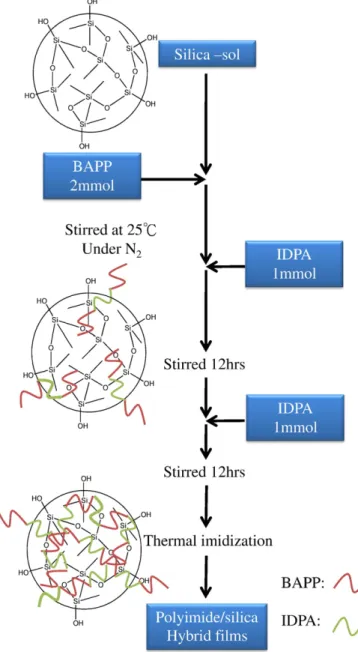
The PI/silica hybridfilms were synthesized using BAPP, IDPA and silica-sol. The preparation procedure of PI/silica hybridfilms is shown in
Fig. 1. An example for synthesizing the hybridfilm containing 50 wt.% silica is given as follows: 1.8620 g of silica-sol was added in the mixture containing 1 g of DMAc and 2 mmol (0.8210 g) of BAPP. After the solution had been thoroughly stirred at N2atmosphere for 6 h, 2 mmol of IDPA was then mixed with the above solution in 2 sequences. That is, 1 mmol (0.5205 g) of IDPA wasfirst mixed with the above solution for 12 h, followed by mixing the remaining amount of IDPA with the solution for another 12 h in order to control the molecular weight of PAA. IDPA will react with BAPP, which had diffused homogeneously into the network of silica-sol, and the PAA/silica-sol solution was thus
obtained. The above solution was coated on a glass substrate with a doctor blade and thermal imidized at 300 °C to obtain the PI/silica hybridfilm. The sample code is denoted PI−x, where x represents the weight percentage of silica in each sample.
2.3. Measurements
Fourier transform infrared spectra (FTIR) of pure PI and PI/silica hybrid films were acquired by using a Fourier transform infrared spectrophotometer (Nicolet, Protégé-460). Transparency of thefilms was determined from the transmittance measured at 550 nm using a UV–vis spectroscopy (Shimadzu, UV1800). Contact angles of water on films were examined by using a contact angle meter. The shapes of water droplets on films were photographed to determine the hydrophobicity of the surface of PI and the hybridfilms. Field emission scanning electron microscopy (FE-SEM, JEOL JSM-7401F) and trans-mission electron microscopy (TEM, JEOL JEM-2010) were employed to observe the morphology of samples. Dynamic mechanical analysis (DMA) was conducted using a dynamic mechanical analyzer (TA Instruments, DMA 2980) to determine the storage modulus (E′) and damping (Tanδ) of samples. DMA experiments were performed in tensilefilm mode, at the frequency of 1 Hz and at the heating rate of 3 °C min−1from 60 °C to 300 °C. The dimension stability offilms was probed by a thermal mechanical analyzer (TA Instruments, Q400) at the heating rate of 10 °C min−1from 30 °C to 400 °C. The coefficient of thermal expansion (CTE) of prepared films was obtained from the dimension change within the temperature range of 50 °C to 190 °C, which was acquired from TMA. In order to determine the thermal stability offilms, thermal gravimetric analysis (TGA) was performed with a thermal gravimetric analyzer (TA Instruments, Q500) under N2 using a heating rate of 20 °C min− 1from 30 °C to 800 °C.
3. Results and discussion
The FTIR spectra of PI and hybridfilms are shown inFig. 2(a). The characteristic peaks of polyimide were observed at 1780 cm−1(C=O asymmetric stretch), 1380 cm−1 (C–N stretch), 1720 cm−1 (C=O symmetric stretch) and 725 cm−1(C=O bending), indicating the PI matrix had successfully synthesized. The characteristic silica absorption peaks at 805 cm−1 (Si–O–Si symmetric stretch), 960 cm−1 (Si–OH stretch) and 1060–1100 cm−1 (Si–O–Si asymmetric stretch) were revealed for hybridfilms[1,12–16]. The peak intensity of Si–OH at 960 cm−1and Si–O–Si at 1060 cm−1increased substantially with the silica content in hybridfilms. As illustrated inFig. 2(b), the position of the characteristic peak of C=O symmetric stretch significantly varied with the silica content. The effect of silica content on the position of this peak was also illustrated in the inset ofFig. 2(b). The position of this C=O symmetric stretch band was 1714 cm−1for pure PI and moved to higher wavenumber with the increase of silica in hybridfilms, being 1720 cm−1 for PI-50 hybridfilm. The shift of this C=O symmetric stretch band is considered as the presence of interactions between polyimide and silica, that is, the hydrogen bonding between the Si–OH and the C=O of imide group[17]. The hydrogen bonding may lead to better dispersion of silica in PI matrix[18].
The hydrophilicity of the surface of PI and PI/silica hybridfilms was characterized by contact angle measurements and the results were listed inTable 1. Silica content infilms affected the contact angle. The contact angle increased from 77° for pure PI, to 98° for PI-30, and then decreased to 42° for PI-50 hybridfilm. With the presence of silica, the surface of hybridfilms initially became more hydrophobic than pure PI but changed to hydrophilic for hybridfilms with high silica content (50 wt.%). In general, the addition of inorganic components into polyimide can largely increase hydrophobicity of the hybrid materials. The hydrophilic surface of PI-50 hybridfilm was associated with the presence of large amount of hydrophilic Si–OH groups in the film as confirmed with FTIR spectra.
UV–vis absorption spectra of films with various silica contents are shown inFig. 3. The cut-off wavelength of hybridfilms was observed in the range of 360 nm to 370 nm. The transmittance of hybridfilms at
550 nm was recorded inTable 1. The transmittance of pure PI and hybrid films was compatible, that is, the transparency maintained in spite of high silica content in the hybridfilms. The high transparency of hybrid films indicates well-dispersed silica nanoparticles within PI matrix. SEM and TEM images shown inFig. 4confirmed that silica nanoparticles with an average particle size of 20 nm dispersed homogenously in the hybrid Pure PI PI-10 PI-20 PI-30 PI-40 PI-50
Wavenumber (cm
-1)
Wavenumber (cm
-1)
C=O Si-O-SiAbsorbance (a.u)
(a)
(b)
2000 1500 1000 1800 1750 1700 1650 Pure PI PI-10 PI-20 PI-30 PI-40 PI-50Absorbance
(a.u)
0 10 20 30 40 50 1714 1716 1718 1720 1722 Peak Position ( cm -1 ) Silica Content (%)Fig. 2. FTIR spectra of polyimide and polyimide /silica hybridfilms in the range of (a) 2250 to 600 cm−1; (b) 1800 to 1650 cm−1. The inset in (b) shows the effect of silica content on the position of C=O symmetric stretch band in the range of 1714 cm−1to 1722 cm−1.
Table 1
Physical, thermal and mechanical properties of pure PI and PI/silica hybridfilms with different silica contents.
Sample name UV–visa Contact Angle DMA TMA Tg (°C)b E′ (MPa)c Tanδd CTE (ppm/°C)e PI 87.5 77 207.9 1620 1.47 76.5 PI-10 87.0 84 208.9 1788 1.24 60.9 PI-20 87.9 97 210.4 2493 0.78 51.2 PI-30 86.1 98 211.1 3570 0.46 44.0 PI-40 75.8 95 210.2 4688 0.20 32.9 PI-50 81.4 42 208.9 5857 0.13 18.1
aThe transmittance of polyimide/silica hybridfilms at 550 nm. b
The temperature at maximum of Tanδ curve was designated as Tg. c
Storage modulus of hybridfilms was measured at 60 °C. d
The peak intensity of Tanδ. e
CTE was determined as the dimension change over a temperature range of 50 to 190 °C. 300 400 500 600 700 800 0 20 40 60 80 100 pure PI PI-10 PI-20 PI-30 PI-50
T
ransmittance (%)
Wavelength (nm)
Fig. 3. UV–vis spectra of pure polyimide and polyimide/silica hybrid films with various silica contents.
Fig. 4. (a) Morphology of polyimide/silica hybridfilms PI-50 by TEM; (b) Cross-section of polyimide/silica hybridfilms PI-40 by SEM.
films. The compatibility of PI and silica particles in hybrid films was improved due to the developed unique synthesis route. The low-molecular-weight PI precursor, PAA, was formed because stoichiometric amount of diamine was well-distributed in silica-sol network and then reacted with half stoichiometric amount of anhydride. Accordingly, large amount (50 wt.%) of silica particles can disperse well in PI matrix by semi-interpenetrating polymer network (semi-IPN) structure without the addition of coupling agent.
The glass transition temperature (Tg), storage modulus (E′) and damping (Tanδ) of the PI and PI/silica hybrid films were determined by DMA and the results are shown inFig. 5andTable 1. The temperature at the maximum of Tan δ curve was designated as Tg. Without the presence of coupling agent, no covalent bonding existed within the hybridfilms, and in consequence, the Tg value of hybrid films was compatible with that of pure PI. The slight increase in Tg with silica content indicated the stereo hindrance of silica in PI matrix. In contrary, the storage modulus of the hybridfilms enhanced distinctively with the increase of the silica content as shown inFig. 5(a). Noticeably, the increase in storage modulus of hybrid films occurred at both high temperature (300 °C) and low temperature (60 °C). The storage modulus at 60 °C increased from 1620 MPa for pure PI to 5857 MPa for PI-50 hybridfilm.
The effect of silica content on the peak intensity of damping (Tanδ) is shown in Fig. 5(b). The peak intensity of Tan δ (damping value) decreased as the silica content increased. As listed inTable 1, the damping
value was 1.47 for pure PI and 0.13 for PI-50 hybridfilm. Tan δ is the ratio of the intensity of the dissipated to the stored energy (E″/E′), that is, the ratio of the viscosity to the elasticity of the sample. A very large value of Tanδ (NN1) indicates liquid-like materials and a very small value (bb1) indicates solid-like materials[19]. Moreover, the damping value of hybrid films is an indicator to determine weakly associated (Tan δ N1) or strongly associated (Tanδ b 1) dispersed particles in hybrid films[19]. Accordingly, the synthesized polyimide/silica hybridfilms with higher silica content became more solid-like as well as the dispersed silica particles became more strongly associated in the hybridfilms.
Fig. 6presents the TMA curves of the preparedfilms as well as the effect of silica content on the calculated CTE values. The CTE of the preparedfilms declined progressively as the silica content increased. The CTE was 76.5 ppm/°C for pure PI and dropped to 18.1 ppm/°C for PI-50 hybridfilm, indicating the CTE of PI hybrid film was close to that of copper. The match of CTE of polyimide and copper can prevent the delamination in layered PI-Cu composites for microelectronic applica-tions. The huge difference in CTE of the preparedfilms is presumably because of the amount of the ridge structure of Si–O–Si groups in samples. Hybrid film PI-50 exhibited the smallest CTE due to the highest amount of Si–O–Si groups as confirmed with FTIR spectra.
The TGA curves of synthesized films are shown in Fig. 7. The temperature at 5% weight loss was defined as the thermal decomposition temperature (Td) in this study. The Td value and the residue ash amount
100 150 200 250 300 0 1000 2000 3000 4000 5000 6000
Storage Modulus (MPa)
Pure PI PI-10 PI-20 PI-30 PI-40 PI-50 190 200 210 220 230 0.0 0.5 1.0 1.5 Pure PI PI-10 PI-20 PI-30 PI-40 PI-50
T
an delta
(a)
(b)
Fig. 5. The dynamic mechanical analysis for (a) storage modulus and (b) Tanδ of polyimide/silica hybridfilms with various silica contents.
100 200 300 0 500 1000 1500 2000 Pure PI PI-10 PI-20 PI-30 PI-40 PI-50
Dimension Change (ppm)
0 10 20 30 40 50 20 40 60 80 Silica Content (%)Fig. 6. Thermal expansion of polyimide/silica hybridfilms with various silica contents. The inset shows the effect of silica content on the coefficient of thermal expansion (CTE). 300 400 500 600 40 50 60 70 80 90 100 pure PI PI-10 PI-20 PI-30 PI-40 PI-50
W
eight (%)
Fig. 7. The thermogravimetric curve for polyimide/silica hybridfilms with various silica contents.
of hybrid films increased markedly with silica content. The results indicate the chain scission of the polyimide moiety during thermal decomposition could be effectively restrained by silica particles in PI matrix.
4. Conclusion
Transparent PI/silica hybridfilms with low CTE were successfully prepared via a simple and unique synthesis procedure without using coupling agents. The high transparency of PI-50 hybridfilm is associated with the improved compatibility between PI and silica. The hydrogen bonding between silica and PI leads to a better dispersion of silica in hybridfilms, limits the mobility of polyimide moiety, and in consequence, decreases the CTE of hybridfilms. The CTE of prepared PI-50 hybrid film is 18.1 ppm/°C, which is close to that of copper. The addition of silica to PI hybridfilms can effectively improve the thermal property and maintain the optical transmittance. Moreover, the synthesis method is simple and easily applied to large-scale production.
Acknowledgements
The authors would like to acknowledge thefinancial support of the Ministry of Economic Affairs, Republic of China, Taiwan, through
the project onflexible polymeric materials for electronic application (99-EC-17-A-07-S1-120), and National Science Council through project NSC (99-2221-E-167-001-).
References
[1] M.K. Ghosh, K.L. Mittal, Polyimides Fundamentals and Applications, Marcel Dekker Press, New-York, 1996.
[2] K.L. Mittal, Polyimides:Synthesis, Characterization and Applications, Plenum Press, New-York, 1991.
[3] J. Wen, G.L. Wilkes, Chem. Mater. 8 (1996) 1667. [4] M.H. Tsai, W.T. Whang, J. Polym. Res. 8 (2001) 77.
[5] D.M. Delozier, R.A. Orwoll, J.F. Cahoon, N.J. Johnston, J.G. Smith, J.W. Connell, Polymer 43 (2002) 813.
[6] M.H. Tsai, W.T. Whang, J. Appl. Polym. Sci. 81 (2001) 2500. [7] H.H. Huang, G.L. Ilkes, J.G. Carlson, Polymer 30 (1989) 2001.
[8] A. Morikawa, H. Yamaguchi, M.A. Kakimoto, Y. Imai, Chem. Mater. 6 (1994) 913. [9] J.T. Wu, S.Y. Yang, S.Q. Gao, A.J. Hu, J.G. Liu, L. Fan, Eur. Polym. J. 41 (2005) 73. [10] M.H. Tsai, W.T. Whang, Polymer 42 (2001) 4197.
[11] Y. Li, S.Y. Fu, Y.Q. Li, G.S. Xu, C.Y. Yue, Compos. Sci. Technol. 61 (2007) 2408. [12] Y. Chen, J.O. Iroh, Chem. Mater. 11 (1999) 1218.
[13] J.A. Kreuz, A.L. Endrey, F.P. Gay, C.E. Sroog, J. Polym. Sci. A 1 (1966) 2607. [14] C.A. Pyrde, J. Polym. Sci. A 27 (1989) 711.
[15] P. Innocenzi, J. Non-Cryst. Solids 316 (2003) 309. [16] C.J. Cornelius, E. Marand, Polymer 43 (2002) 2385.
[17] S. Cheng, D. Shen, X. Zhu, X. Tian, D. Zhou, L.J. Fan, Eur. Polym. J. 45 (2009) 2767. [18] C.T. Yen, W.C. Chen, D.J. Liaw, H.Y. Lu, Polymer 44 (2003) 7079.