Electrochemical activity and durability of platinum
nanoparticles supported on ordered mesoporous carbons for
oxygen reduction reaction
Shou-Heng Liu
a, Chien-Chang Chiang
a,b, Min-Tsung Wu
a,b, Shang-Bin Liu
a,b,*
aInstitute of Atomic and Molecular Sciences, Academia Sinica, P.O. Box 23-166, Taipei 10617, Taiwan bDepartment of Chemistry, National Taiwan Normal University, Taipei 11677, Taiwan
a r t i c l e
i n f o
Article history:
Received 1 September 2009 Received in revised form 25 December 2009
Accepted 30 December 2009 Available online 2 February 2010 Keywords:
Pt nanocatalyst Mesoporous carbon Electrocatalytic properties Fuel cell
Oxygen reduction reaction
a b s t r a c t
A facile procedure for synthesizing platinum nanoparticles (NPs) studded in ordered mes-oporous carbons (Pt–OMCs) based on the organic–organic self-assembly (one-pot) approach is reported. These Pt–OMCs, which can be easily fabricated with controllable Pt loading, were found to possess high surface areas, highly accessible and stable active sites and superior electrocatalytic properties pertinent as cathode catalysts for hydrogen–oxygen fuel cells. The enhanced catalytic activity and durability observed for the Pt–OMC electrocatalysts are attributed to the strengthened interactions between the Pt catalyst and the mesoporous carbon that effectively precludes migration and/or agglomeration of Pt NPs on the carbon support.
ª2010 Professor T. Nejat Veziroglu. Published by Elsevier Ltd. All rights reserved.
1.
Introduction
Highly dispersed noble metal (Pt, Ru) nanoparticles (NPs) sup-ported on conductive materials with high surface areas, such as carbon blacks[1,2], carbon nanotubes[3–5], and mesoporous carbons[6–9]are pertinent anodic/cathodic electrocatalysts for direct methanol fuel cells (DMFCs) and proton-exchange membrane fuel cells (PEMFCs). Nonetheless, the durability of the Pt on carbon catalysts, especially those for oxygen reduc-tion reacreduc-tion (ORR) at cathode, remains as one of the most critical issues to be resolved for practical commercialization of DMFCs/PEMFCs[10–12]. Alloying of Pt with a second metal is one of the most common strategies invoked for the improve-ment of catalyst stability[13–17]. However, these bifunctional
catalysts were still handicapped by severe dissolution and diffusion of alloy NPs into the PEMFC membrane, leading to a decrease in proton conductivity[18]. As such, strengthening of Pt–carbon support interaction may be a more convenient, cost-down effective, and hence favorable way to enhance the catalytic properties and stabilities of the electrocatalysts[10].
Previously, we developed a novel method to synthesize mono- (Pt)[19]and bifunctional (PtRu)[20]NPs supported on ordered mesoporous carbons (OMCs) based on the pyrolysis of co-fed carbon sources and Pt/Ru precursors in a mesoporous silica template. Subsequent polymerization, carbonization, silica template removal, and proper washing and drying, thus leading to the formation of well-dispersed and highly stable Pt/PtRu NPs (ca. 2–3 nm) on OMCs. The Pt- and PtRu–OMC
* Corresponding author. Institute of Atomic and Molecular Sciences, Academia Sinica, P.O. Box 23-166, Taipei 10617, Taiwan. Tel.: þ886 2 23668230; fax: þ886 2 23620200.
E-mail address:[email protected](S.-B. Liu).
A v a i l a b l e a t w w w . s c i e n c e d i r e c t . c o m
j o u r n a l h o m e p a g e : w w w . e l s e v i e r . c o m / l o c a t e / h e
i n t e r n a t i o n a l j o u r n a l o f h y d r o g e n e n e r g y 3 5 ( 2 0 1 0 ) 8 1 4 9 – 8 1 5 4
0360-3199/$ – see front matter ª 2010 Professor T. Nejat Veziroglu. Published by Elsevier Ltd. All rights reserved. doi:10.1016/j.ijhydene.2009.12.183
to repeated oxidation and reduction cycles at elevated temperatures.
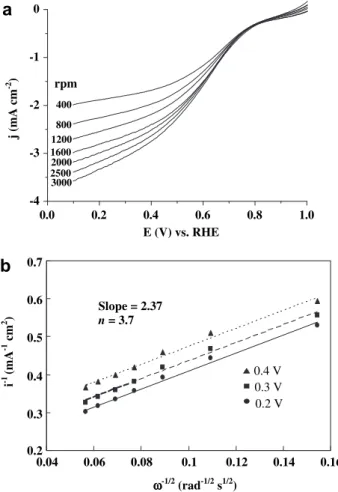
The ORR performance of the Pt–OMC-4.5T catalyst was further studied by RDE voltammetry (seeFig. 7). Accordingly, the number of electron (n) involved during ORR was deduced to be 3.7, which is close to the theoretical value for four-electron reduction, excluding the existence of hydrogen
peroxide radicals whose presence prone to attack the carbon support and the proton-exchange membrane, resulting undesirable degradation of the fuel cell[25].
4.
Conclusions
In summary, the physical/chemical properties and electro-catalytic performance of ordered mesoporous carbon sup-ported Pt electrocatalyst synthesized by the self-assembly method are reported. It is found that the Pt–OMCs so fabricated possess not only well-dispersed and highly stable Pt nano-particles but also superior catalytic activities and durabilities, which may be attributed to the strengthened interactions between the Pt catalyst and the mesoporous carbon that effectively precludes migration and/or agglomeration of Pt NPs on the carbon support. These Pt–OMCs should render practical cost-down effective commercial applications in hydrogen-energy related areas, for examples, as adsorbents for hydrogen fuel storage and as supported electrocatalysts for PEMFCs and DMFCs. Further efforts have been undertaken in fabricating an MEA (membrane electrode assembly) for possible single cell testing.
Acknowledgments
The supports of this work by the National Science Council, Taiwan (NSC95-2113-M-001-040-MY3 and NSC98-2113-M-001-017-MY3) are gratefully acknowledged.
r e f e r e n c e s
[1] Shanahan PV, Xu LB, Liang CD, Waje M, Dai S, Yan YS. Graphitic mesoporous carbon as a durable fuel cell catalyst support. J Power Sources 2008;185:423–7.
[2] Nores-Pondal FJ, Vilella IMJ, Troiani H, Granada M, de Miguel SR, Scelza OA, et al. Catalytic activity vs. size correlation in platinum catalysts of PEM fuel cells prepared on carbon black by different methods. Int J Hydrogen Energy 2009;34:8193–203.
[3] Wang X, Li WZ, Chen ZW, Waje M, Yan YS. Durability investigation of carbon nanotube as catalyst support for proton exchange membrane fuel cell. J Power Sources 2006; 158:154–9.
[4] Guo SJ, Dong SJ, Wang E. Gold/platinum hybrid nanoparticles supported on multiwalled carbon nanotube/silica coaxial nanocables: Preparation and application as electrocatalysts for oxygen reduction. J Phys Chem C 2008;112:2389–93. [5] Jafri RI, Sujatha N, Rajalakshmi N, Ramaprabhu S. Au-MnO2/
MWNT and Au-ZnO/MWNT as oxygen reduction reaction electrocatalyst for polymer electrolyte membrane fuel cell. Int J Hydrogen Energy 2009;34:6371–6.
[6] Chang H, Joo SH, Pak CH. Synthesis and characterization of mesoporous carbon for fuel cell applications. J Mater Chem 2007;17:3078–88.
[7] Kim HT, You DJ, Yoon HK, Joo SH, Pak CH, Chang H, Song IS. Cathode catalyst layer using supported Pt catalyst on ordered mesoporous carbon for direct methanol fuel cell. J Power Sources 2008;180:724–32. 0 20 40 60 0 50 100 150 200 0 5 10 15 20 mc A( I 2-g ) t P Cycle number mc A( I 2-g ) t P Pt-OMC-4.5T Pt/OMC-8.7I
Fig. 6 – Durability tests observed during ORR for the Pt–OMC-4.5T and Pt/OMC-8.7I catalysts.
0.0 0.2 0.4 0.6 0.8 1.0 -4 -3 -2 -1 0 j( mc A m 2- ) E (V) vs. RHE 400 800 1200 1600 2000 2500 3000 rpm 0.2 V 0.3 V 0.4 V 0.2 0.3 0.4 0.5 0.6 0.7 0.04 0.06 0.08 0.1 0.12 0.14 0.16 Slope = 2.37 n = 3.7 -1/2 (rad-1/2 s1/2) i 1-A m( 1- mc 2 )
a
b
ωFig. 7 – (a) RDE voltammograms and (b) their corresponding Koutecky-Levich plots of the Pt–OMC-4.5T electrocatalyst.
[8] Fang B, Kim JH, Lee C, Yu JS. Hollow macroporous core/ mesoporous shell carbon with a tailored structure as a cathode electrocatalyst support for proton exchange membrane fuel cells. J Phys Chem C 2008;112:639–45. [9] Ambrosio EP, Francia C, Manzoli M, Penazzi N, Spinelli P.
Platinum catalyst supported on mesoporous carbon for PEMFC. Int J Hydrogen Energy 2008;33:3142–5.
[10] Shao YY, Yin GP, Gao YZ. Understanding and approaches for the durability issues of Pt-based catalysts for PEM fuel cell. J Power Sources 2007;171:558–66.
[11] Yu XW, Ye SY. Recent advances in activity and durability enhancement of Pt/C catalytic cathode in PEMFC-Part I. Physico-chemical and electronic interaction between Pt and carbon support, and activity enhancement of Pt/C catalyst. J Power Sources 2007;172:133–44.
[12] Chung CG, Kim L, Sung YW, Lee J, Chung JS. Degradation mechanism of electrocatalyst during long-term operation of PEMFC. Int J Hydrogen Energy 2009;34:8974–81.
[13] Colo´n-Mercado HR, Popov BN. Stability of platinum based alloy cathode catalysts in PEM fuel cells. J Power Sources 2006;155:253–63.
[14] Wang JJ, Yin GP, Wang GJ, Wang ZB, Gao YZ. A novel Pt/Au/C cathode catalyst for direct methanol fuel cells with simultaneous methanol tolerance and oxygen promotion. Electrochem Commun 2008;10:831–4.
[15] Garcı´a-Contreras MA, Ferna´ndez-Valverde SM, Vargas-Garcı´a JR, Corte´s-Ja´come MA, Toledo-Antonio JA, A´ ngeles-Chavez C. Pt, PtCo and PtNi electrocatalysts prepared by mechanical alloying for the oxygen reduction reaction in 0.5 M H2SO4. Int J Hydrogen Energy 2008;33:6672–80.
[16] Chen S, Gasteiger HA, Hayakawa K, Tada T, Shao-Horn Y. Platinum-alloy cathode catalyst degradation in proton exchange membrane fuel cells: Nanometer-scale compositional and morphological changes. J Electrochem. Soc 2010;157:A82–97.
[17] Gupta G, Slanac DA, Kumar P, Wiggins-Camacho JD, Wang XQ, Swinnea S, et al. Highly stable and active Pt-Cu oxygen reduction electrocatalysts based on mesoporous graphitic carbon supports. Chem Mater 2009;21:4515–26. [18] Okada T, Ayato Y, Satou H, Yuasa M, Sekine I. The effect of
impurity cations on the oxygen reduction kinetics at platinum electrodes covered with perfluorinated ionomer. J Phys Chem B 2001;105:6980–6.
[19] Liu SH, Lu RF, Huang SJ, Lo AY, Chien SH, Liu SB. Controlled synthesis of highly dispersed platinum nanoparticles in ordered mesoporous carbon. Chem Commun 2006:3435–7. [20] Liu SH, Yu WY, Chen CH, Lo AY, Hwang BJ, Chien SH, Liu SB.
Fabrication and characterization of well-dispersed and highly stable PtRu nanoparticles on carbon mesoporous material for applications in direct methanol fuel cell. Chem Mater 2008;20:1622–8.
[21] Zhang FQ, Meng Y, Gu D, Yan Y, Chen ZX, Tu B, et al. An aqueous cooperative assembly route to synthesize ordered mesoporous carbons with controlled structures and morphology. Chem Mater 2006;18:5279–88.
[22] Liu CY, Li LX, Song HH, Chen XH. Facile synthesis of ordered mesoporous carbons from F108/resorcinol-formaldehyde composites obtained in basic media. Chem Commun 2007: 757–9.
[23] Joo SH, Choi SJ, Oh I, Kwak J, Liu Z, Terasaki O, Ryoo R. Ordered nanoporous arrays of carbon supporting high dispersions of platinum nanoparticles. Nature 2001;412: 169–72.
[24] Wang H, Wang AQ, Wang XD, Zhang T. One-pot synthesized MoC imbedded in ordered mesoporous carbon as a catalyst for N2H4decomposition. Chem Commun 2008:2565–7. [25] Sarapuu A, Kasikov A, Laaksonen T, Kontturi K,
Tammeveski K. Electrochemical reduction of oxygen on thin-film Pt electrodes in acid solutions. Electrochim Acta 2008;53: 5873–80.
i n t e r n a t i o n a l j o u r n a l o f h y d r o g e n e n e r g y 3 5 ( 2 0 1 0 ) 8 1 4 9 – 8 1 5 4