PLEASE SCROLL DOWN FOR ARTICLE
Informa Ltd Registered in England and Wales Registered Number: 1072954 Registered office: Mortimer House, 37-41 Mortimer Street, London W1T 3JH, UK
Media Psychology
Publication details, including instructions for authors and subscription information:
http://www.informaworld.com/smpp/title~content=t775653678
The Impacts of Emotion Elicited By Print Political Advertising on Candidate Evaluation
Chingching Chang a
a Department of Advertising National Chengchi University.
Online Publication Date: 01 May 2001
To cite this Article Chang, Chingching(2001)'The Impacts of Emotion Elicited By Print Political Advertising on Candidate Evaluation',Media Psychology,3:2,91 — 118
To link to this Article: DOI: 10.1207/S1532785XMEP0302_01
URL: http://dx.doi.org/10.1207/S1532785XMEP0302_01
Full terms and conditions of use: http://www.informaworld.com/terms-and-conditions-of-access.pdf
This article may be used for research, teaching and private study purposes. Any substantial or systematic reproduction, re-distribution, re-selling, loan or sub-licensing, systematic supply or distribution in any form to anyone is expressly forbidden.
The publisher does not give any warranty express or implied or make any representation that the contents will be complete or accurate or up to date. The accuracy of any instructions, formulae and drug doses should be independently verified with primary sources. The publisher shall not be liable for any loss, actions, claims, proceedings, demand or costs or damages whatsoever or howsoever caused arising directly or indirectly in connection with or arising out of the use of this material.
Requests for reprints should be sent to Chingching Chang, Department of
Advertising, National Chengchi University, 64, Sec. 2, Chinan Rd, Wenshan, Taipei 116, Taiwan. E-mail: [email protected]
MEDIAPSYCHOLOGY, 3, 91–118.
Copyright © 2001, Lawrence Erlbaum Associates, Inc.
The Impacts of Emotion Elicited
By Print Political Advertising
on Candidate Evaluation
Chingching Chang
Department of Advertising National Chengchi University
This study examines viewers’ emotional responses to print political advertising. It demonstrates that positive and negative direct (attack) political advertising differ in the emotional responses that they elicit. Consistent with prior research on emotion, positive and direct attack political advertising generate different amounts of message recall and produce different quantities of positive and negative cognitive responses. Most importantly, this study establishes the importance of ad-evoked emotion in the formation process of ad exposure and candidate evaluation. Integrating findings from this study, a model is proposed that establishes the relationship of four import a n t variables: ad valence, ad-evoked emotion, attitude toward the ad, and candidate liking. It suggests that (1) ad valence has an impact on attitude toward the candidate via the mediation of ad-evoked emotion; (2) ad valence has an impact on attitude toward the ad via the mediation of ad-evoked emotion; (3) attitude toward the ad has an impact on candidate evaluation; and (4) ad-evoked emotion can explain variations of candidate evaluations beyond that which can be accounted for by attitude toward the ad.
Most studies that explore the effects of political advertising pay more attention to consequences than processes. The process of how campaign stimuli, such as political advertising, are transformed into voters’candidate preference is still not clear (e.g., Lodge & Stroh, 1993). In the process of being exposed to political advertising, viewers may exhibit many different responses, emotional responses (e.g., Kaid & Tedesco, 1999b). Emotional responses have been examined to explain why negative political advertising messages are remembered better than positive versions (e.g., Lang, 1991; Newhagen & Reeves, 1991). Although a
9 2 CHANG
correlation between ad-evoked emotional responses and candidate image, or candidate evaluation, has been demonstrated (Kaid, 1991; Kaid & Chanslor, 1995; Kaid & Tedesco, 1999b), how viewers’ emotional responses exert an impact on candidate evaluation has not been thoroughly examined.
Toward that end, this study extensively explores the impacts of ad-evoked emotional responses. First, it specifically tests whether or not emotional responses can be evoked by either positive or direct attack advertising. Second, based on findings from the emotion literature (see Schwarz, 1990; Schwarz & Bless, 1991; Schwarz, Bless, & Bohner, 1991, for reviews), it suggests that emotional responses elicited by political advertising determine the degree of detail with which viewers process ad messages and lead to different amounts of message recall. In addition, findings from the emotion literature (e.g., Erber, 1991; A. M. Isen, Shalker, Clark, & Karp, 1978) indicate that ad-evoked emotional states are likely to determine whether positive or negative aspects of political candidates in general will be retrieved from long-term memory. Therefore, this study argues that a voter’s emotional state induced by political advertising can have an impact on what thoughts he or she generates about candidates.
Adopting a similar approach to that of the product-advertising literature, this study examines the mediating roles that ad-evoked emotion plays in the formation of candidate evaluation and ad evaluation. In addition, it tries to disentangle and clarify the relationships among ad-evoked emotion, ad attitude, and candidate liking on the basis of findings in the product-advertising literature. In the product-advertising literature, attitude toward the ad is believed to be an important mediator between ad content and product evaluation (e.g., MacKenzie, Lutz, & Belch, 1986). However, corresponding studies of political advertising seem to ignore this relationship. This study thus seeks to make a contribution to our understanding of the impact that attitude toward political advertising may exert on candidate evaluation.
This article first briefly defines positive and negative political advertising. Then it reviews past studies that explore emotional appeals employed in political advertising, as well as past literature that investigates voters’ e m o t i o n a l responses elicited by political advertising. In order to argue that ad-evoked affective responses may mediate acceptance of persuasion messages, the article also presents a review of past literature that examines the effects of political advertising on ad recall and candidate evaluation. The review specifically applies emotion theory to highlight the proposition that emotional responses evoked by positive and negative political advertising can be explored to understand the superiority of negative advertising in generating recall and, at the same time, be
introduced to explain the impacts of political advertising on candidate evaluations.
The importance of exploring the mechanism behind the exposure to political advertising of different valences and the candidate evaluation process are also discussed after reviewing related findings in product advertising. Throughout the review, hypotheses regarding the impacts of ad-elicited emotional responses are developed. Following the review, the article discusses the experiment conducted to test these hypotheses.
LITERATURE REVIEW Emotional Appeals in Positive and Negative Advertising
Political advertising is often divided into one of two categories: positive advertising or negative advertising. Positive advertising generally can be referred to as those ads via which candidates promote their merits and highlight their strengths (Tinkham & Weaver-Lariscy, 1993). The sole focus on the sponsoring candidate is well expressed by Shapiro and Rieger (1992), who defined a positive ad as an ad “that promotes the virtues of the sponsoring candidate and ignores that candidate’s opponent” (p. 135).
Greater controversy exists on the topic of negative advertising. Initially, Stewart (1975) identified a type of ad that attacked a political opponent and called it “a mudslinging ad” (p. 279). Surlin and Gordon (1977) emphasized a negative ad’s focus on the opponent’s weaknesses and referred to it as “the direct reference or attacking political advertisement” (p. 97). Garramone (1984) endorsed Surlin and Gordon’s definition of direct reference/attack ads but called them “negative political ads.” Moreover, Johnson-Cartee and Copeland (1991) suggested that different argumentation modes of attack exist: direct attack ads, direct comparison ads, and implied comparison ads. Basil, Schooler, and Reeves (1991) and Kaid and Davidson (1986) also categorized rebuttal ads, which charge as false the claims of other candidates, as one type of negative advertising. Because different types of negative attacks may yield different effects, this article explicitly focuses on one type of negative advertising, the direct attack, to test the impacts of ad-evoked emotion.
Political advertising is one form of political communication that relies heavily on emotional appeals. Kaid and Johnston’s (1991) study of presidential campaign advertising from 1960 to 1988 indicated that 86% of all positive ads employed emotional appeals. In the 1996 presidential election, 63% of Dole’s campaign advertising and 83% of Clinton’s campaign advertising utilized emotional appeals (Kaid & Tedesco, 1999a).
EMOTION & CANDIDATE EVA L U AT I O N 9 3
9 4 CHANG
It is well recognized that uses of affect-laden symbols, such as a child, a place or an object, can easily trigger voters’ emotional responses (Kaid, Leland & W h i t n e y, 1992; Kern, 1989). Because positive advertising and negative advertising attempt to achieve different goals , they have been shown to employ different emotional appeals (Johnson-Cartee & Copeland, 1997; Kern, 1989). Among the emotional appeals commonly identified by researchers as prevalent in positive political advertising are hope, pride, reassurance (Johnson-Cartee & Copeland, 1997; Kern, 1989), trust (Kern, 1989), and compassion and empathy (Johnson-Cartee & Copeland, 1997). Among the emotional appeals that are likely to emerge in negative political advertising are guilt, anger, uncertainty (Kern, 1989), and fear (Johnson-Cartee & Copeland, 1997; Kern, 1989).
This study did not test any specific type of emotional appeal, but it 0suggests instead that political advertising, even that featuring issue policies, is likely to contain affect-laden symbols and, as a result, evoke voters’emotional responses. The following section is thus devoted to a review of past studies on viewers’ emotional responses to political advertising.
Voters’ Ad-Evoked Emotional Responses
In addition to content differences, positive advertising and negative advertising should differ from each other in terms of the responses they tend to evoke. Emotional response is one of the responses that can be generated by ad exposure (Kaid, 1991; Kaid & Chanslor, 1995; Kaid & Tedesco, 1999b). However, emotional responses have drawn less attention in political advertising literature than in product advertising literature.
In political advertising research, Kaid and her colleagues have systematically examined the impacts of ad-evoked emotion and candidate evaluation. Kaid and Chanslor (1995) showed that emotional responses elicited by political advertising are significantly correlated with candidate image ratings. The more optimistic, confident, excited, secure, and patriotic emotions the ad evoked, the higher voters rated the candidates, whereas the more fearful or bored voters felt, the more negative were their evaluations of candidates. Similarly, Kaid and Tedesco (1999b) documented positive correlations between voters’ positive emotional responses and candidate evaluations, and significant negative correlations between their negative emotional responses and candidate evaluations in the 1996 U.S. presidential election.
Emotional responses elicited by political advertising can be either positive or negative. Based on results of content analyses showing a heavy reliance on hope, pride, and reassurance as emotional appeals in positive advertising and an
EMOTION & CANDIDATE EVA L U AT I O N 9 5 orientation toward guilt, anger, and uncertainty as emotional appeals in negative advertising, this study suggests that positive advertising, in general, is more likely to evoke positive feelings, whereas direct attack advertising is more likely to induce negative feelings.
Hypothesis 1: Direct attack advertising will generate more negative emotional responses than will positive advertising, whereas positive advertising will generate more positive emotional responses than will direct attack advertising.
The Impact of Ad-Evoked Emotional Responses on Persuasion The Impacts on Ad Message Recall
Emotion theory has been used to explain why negative political messages are more easily recalled than positive political messages1(Lang, 1991; Newhagen &
Reeves, 1991). Survey studies consistently show that the majority of respondents remember seeing negative ads (Garramone, 1984; Johnson-Cartee & Copeland, 1989) or remember seeing more negative ads than positive ads (Merritt, 1984). Experimental studies indicate that materials from negative ads are recalled much faster and with higher accuracy than information from positive ads (Lang, 1991; Newhagen & Reeves, 1991), and more information from negative ads is recalled than from positive ads (Shapiro & Rieger, 1992).
Lang (1991) and Newhagen and Reeves (1991) suggested that political advertising messages of different valence evoke different emotional responses. When participants are in different emotional states, they engage in different levels of processing (for reviews, see Schwarz, 1990; Schwarz & Bless, 1991; Sinclair & Mark, 1992). It is generally held that when people are in a positive mood, they are more likely to ignore details and rely on heuristics, whereas when they are in a negative mood, they engage in detail-oriented and step-by-step analytical processing (Schwarz, 1990; Schwarz & Bless, 1991; Sinclair & Mark, 1992). People in positive moods reduce the complexity of information and simplify their judgment and decision making processes (A. Isen, Means, Patrick, & Nowicki, 1982). As a result of reducing information load, “happy” people usually discriminate less between strong and weak arguments than do sad participants (e.g., Bless, Bohner, Schwarz, & Strack, 1990; Mackie & Worth, 1989; Worth & Mackie, 1987). By contrast, sad participants generally engage in systematic processing to capture a more accurate and detailed picture of the situation (Forgas & Bower, 1987; Kuykendall & Keating, 1990; Ruehlman, West, & Pasahow, 1985).
9 6 CHANG
Explanations for processing differences mainly derive from motivational views of emotional states (for reviews, see Schwarz, 1990; Schwarz & Bless, 1991; Schwarz, Bless, & Bohner, 1991). Within this view, it is postulated that positive emotional states inform participants that their current situation is satisfactory and, therefore, reduce their vigilance threshold. As a result, more heuristic and analytical processing will ensue. On the other hand, negative emotional states serve as signals to respondents that the current situation will bring negative outcomes and thus deserves more attention. The enhanced attention therefore involves participants in more explorations and elaboration of details. Due to these differences, negative information is more likely to be remembered. To replicate past studies, this study tested the following hypothesis.
Hypothesis 2: Direct attack ads will generate more recall than will positive ads.
The Impacts on Candidate Evaluation
Research on the impacts of political advertising on voters’evaluations of candidates shows that positive political advertising and negative political advertising work in d i fferent patterns. Positive political ads have been shown to exert a positive impact on viewers’ perceptions and evaluations of candidates. Although Patterson and McClure (1976) found that ad viewing generated no change in perceptions of c a n d i d a t e s ’ images, a number of scholars have since demonstrated that ad viewing has a positive impact on candidates’ images (e.g., Atkin & Heald, 1976; Cundy, 1986; Kaid & Sanders, 1978; Mulder, 1979; West, 1993).
Negative advertising has been shown to have an impact on candidate evaluation, but the patterns of its influence are very complex (Johnson-Cartee & Copeland, 1991). Johnson-Cartee and Copeland identified three patterns of results of negative political advertising: the boomerang, the victim syndrome, and the double impairment. Evidence was documented for the boomerang effect (e.g., Garramone, 1984; Thorson, Christ, & Caywood, 1991) and the double impairment effect (e.g., Basil et al., 1991; Merritt, 1984; Shapiro & Rieger, 1992). However, insufficient empirical evidence was provided to substantiate the existence of the victim syndrome. It seems that evaluations of both candidates are lower after exposure to negative ad messages even though the image of the targeted candidate typically is reduced to a much greater extent than the image of the sponsoring candidate.
It is interesting to note that emotion theory has been introduced to explain how message-evoked emotion affects viewers’memories of advertising content.
Ad-induced emotion’s contribution to candidate evaluation has not been thoroughly explored, however. This article argues that voters’ affective states will have an impact on how they evaluate candidates. Emotion literature shows that when a candidate can be depicted with both a positive and negative characteristic, a perceiver’s mood can determine which characteristic category will be retrieved from memory (e.g., Erber, 1991). A positive mood primes the positive category and leads to a more positive evaluation of the candidate. On the other hand, a negative mood activates negative knowledge about the candidate and results in an inferior assessment of the party. According to Erber (1991), trait categories are imbedded with affect, which is stored along with category labels. Thus, a person’s affective state will increase the accessibility of categories that have consistent affect tags.
In a similar vein, A. M. Isen et al. (1978) showed that an individual’s affective state will determine what he/she will retrieve from memory. Knowledge about a certain domain is structured based on its valence. A positive element of a specific knowledge domain is more likely to be connected closely with other positive elements, and negative information is more likely be clustered together in memory. Therefore, a positive affective state will serve as a retrieval cue for positive material in memory, whereas a negative affective state will function as a retrieval guide for negative information. This theory implies that emotional states will bias evaluation of a stimulus by influencing the accessibility of mood-congruent valenced information in memory.
Based on the same reasoning, this study suggests that a respondent’s affective state induced by exposure to advertising may prime different information about candidates and lead to different candidate appraisals. Prior to advertising exposure, most people already have general knowledge or schemata regarding what a prototypical political candidate is like (Miller, Wattenberg, & Malanchuk, 1986). This general knowledge includes positive attributes associated with a typical candidate as well as negative ones. When viewing mudslinging ads, people experience negative feelings, namely being annoyed. This is especially true when people are not familiar with candidates in the race. Their negative affective state can easily prime negative knowledge about prototype candidates and, thus, lead to generation of more negative thoughts about the candidate who is attacking or is being attacked. On the other hand, when participants see ads portraying a candidate promoting him/herself, participants are more likely to feel positive. Their positive affective state is likely to prime positive knowledge about candidates and result in more positive thoughts of candidates.
EMOTION & CANDIDATE EVA L U AT I O N 9 7
Hypothesis 3a: Direct attack ads will generate more negative thoughts about both candidates than will positive ads.
Hypothesis 3b: Positive ads will generate more positive thoughts about both candidates than will direct attack ads.
The Mediating Role of Ad-Evoked Emotional Responses in the Formation Process of Candidate Evaluation
Researchers in product advertising identify ad-evoked emotions as important mediators of consumer responses to product advertising (e.g., Batra & Ray, 1986; Burke & Edell, 1989; Edell & Burke, 1987; Moore & Hutchinson, 1983). These studies have exposed participants to ads of various kinds for new or existing products. Respondents were asked to rate or list how they felt while viewing or reading product ads and to estimate their attitudes toward ads and brands. Most of these studies demonstrate that ad-evoked emotion is the mediator between ad exposure and ad attitude, which has direct impact on brand attitude. These findings have been shown to be robust across different contexts, such as frequency of exposure (e.g., Burke & Edell, 1989), measurement delay periods (Burke & Edell, 1989; Moore & Hutchinson, 1983), ad content (e.g., Edell & Burke, 1987), and product categories (Batra & Ray, 1986).
Only a few studies have explored the mediating role of ad-evoked emotion in the processing of political advertising. For example, Thorson, Christ, and Caywood (1991) examined processing of political advertising using models established in the product-advertising literature. They identified three mediating variables in the process: affect elicited by advertising, judgments about the candidates, and attitudes toward the advertising itself. The results of their experiments indicate that these three variables uniquely and jointly contributed to variance in voting intentions.
In the product-advertising literature, research on the mediating role that ad-evoked emotion plays in the relationship between ad content and ad evaluation has provided supporting results (e.g., Batra & Ray, 1986; Edell & Burke, 1987). These findings in product advertising may shed some light on our understanding of political advertising’s effects. In addition, by integrating findings by Kaid and her colleagues (Kaid, 1991; Kaid & Chanslor, 1995; Kaid & Tedesco, 1999b) that suggest a positive correlation between voters’ emotional responses and findings in product advertising literature, this study proposes the following hypothesis.
9 8 CHANG
Hypothesis 4: Ad-evoked emotion is the mediator in the relationship between ad valence and candidate evaluation (Acan).
Several studies have demonstrated that the affective states of individuals affect viewers’ responses to product commercials and brands (e.g., Srull, 1984). Studying viewers’ positive affective responses generated by advertising, Batra and Ray (1986) found that affective responses were the antecedents of the attitude toward the ad. Edell and Burke (1987) showed that ad-evoked feelings made a unique contribution to attitude toward the ad (Aad). Holbrook and Batra (1987) proposed a model that suggested that ad-evoked emotion mediates the relationship between advertising content and attitude toward the ad or attitude toward the brand (Abr). However, this relationship has not yet been tested within the context of political advertising. This study tests the supposition that ad-evoked emotion operates as the mediator in the ad-valence and Aad relationship in political advertising.
Hypothesis 5: Ad-evoked emotion is the mediator between the valence of political advertising and Aad.
Past studies of product advertising have shown that attitude toward the ad functions as the mediator of advertising effects on brand attitudes. For example, MacKenzie et al. (1986) demonstrated that Aad influences brand attitude directly and also indirectly through its impact on brand cognition. Gardner (1985) showed that attitude toward the ad affects attitude toward the advertised product both when the audience is under brand evaluation and under nonbrand evaluation processing sets. In short, most studies have demonstrated the impact of Aad on Abr across various kinds of situations. However, the relationship between attitude toward political advertising and attitude toward the candidate is less explored. The author expects that the same relationship found in product advertising will apply to voters’ responses to political advertising and political candidates.
Hypothesis 6: Aad has an impact on candidate evaluation.
Even though the direct impact of Aad on brand attitude is well established in advertising literature, whether Aad has the power to mediate the effects of ad-evoked emotion on brand evaluation is still not clear. Some studies provided support for the complete mediating role Aad plays in the ad-evoked emotion and brand attitude relationship (e.g., Batra & Ray, 1986; Edell & Burke, 1987;
EMOTION & CANDIDATE EVA L U AT I O N 9 9
Holbrook & Batra, 1987). Other studies showed that, even when ads were equally liked, they generated different effects (Gardner, 1985).
According to Stayman and Aaker (1988), this discrepancy seemed to suggest that the mediating effect of Aad in the ad-evoked emotion and brand evaluation relationship was not robust. Employing an empirical study, Stayman and Aaker (1988) demonstrated that the mediating effect of Aad varied across different conditions. In some conditions, Aad cannot explain all of the variances that evoked emotion contributed to product evaluation. This seems to suggest that ad-evoked emotion may have an indirect impact on brand evaluation via its influence on Aad, as well as a direct impact on brand evaluation. Applying this to political advertising, this article hypothesizes that ad-evoked emotion will exert additional direct effects above and beyond their indirect effects via the intervening mediation of Aad.
Hypothesis 7: Ad-evoked emotion will have an indirect impact on candidate evaluations, as well as a direct impact on candidate evaluations.
METHODOLOGY Design
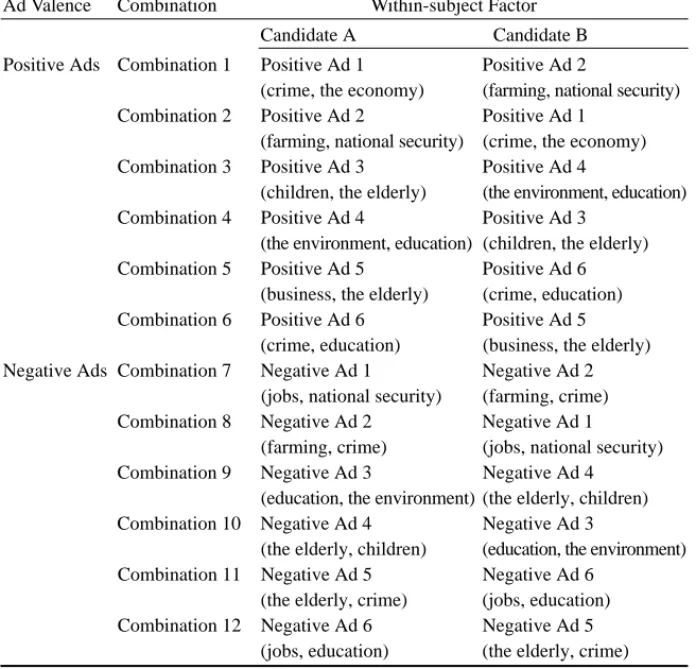
An experimental study was employed to investigate the hypotheses stated earlier. This is a mixed experimental design. There is one within-subject factor: Candidate Difference (two levels: Candidate A vs. Candidate B). There is one between-subject factor: Ad Valence (two levels: negative vs. positive; see Table 1). In addition, there are six ads for each positive and negative condition. Each ad features different issue content. The purpose of creating ads with different issue content is to make better generalizations about the effects of ad valence. Because the effect observed for message content in one ad can be caused by the inadvertent idiosyncrasy of the message the researcher selected, it was important to manipulate more than one single operationalization of a treatment condition (Jackson & Jacobs, 1983).
Respondents were randomly assigned to two different between-subject conditions (positive ad vs. negative ad). In each condition, they were exposed to an ad for/against Candidate A and an ad for/against Candidate B. The ads in each ad valence condition could have been any of the six ad combinations. The order of the two ads to which participants were exposed in each combination was rotated to counterbalance any primacy or recency effects.
1 0 0 CHANG
TABLE 1 Research Design
Ad Valence Combination Within-subject Factor
Candidate A Candidate B
Positive Ads Combination 1 Positive Ad 1 Positive Ad 2
(crime, the economy) (farming, national security) Combination 2 Positive Ad 2 Positive Ad 1
(farming, national security) (crime, the economy) Combination 3 Positive Ad 3 Positive Ad 4
(children, the elderly) (the environment, education) Combination 4 Positive Ad 4 Positive Ad 3
(the environment, education) (children, the elderly) Combination 5 Positive Ad 5 Positive Ad 6
(business, the elderly) (crime, education) Combination 6 Positive Ad 6 Positive Ad 5
(crime, education) (business, the elderly) Negative Ads Combination 7 Negative Ad 1 Negative Ad 2
(jobs, national security) (farming, crime) Combination 8 Negative Ad 2 Negative Ad 1
(farming, crime) (jobs, national security) Combination 9 Negative Ad 3 Negative Ad 4
(education, the environment) (the elderly, children) Combination 10 Negative Ad 4 Negative Ad 3
(the elderly, children) (education, the environment) Combination 11 Negative Ad 5 Negative Ad 6
(the elderly, crime) (jobs, education) Combination 12 Negative Ad 6 Negative Ad 5
(jobs, education) (the elderly, crime)
Participants
This study recruited 165 participants from undergraduate classes at a midwestern university. Thirty-eight percent of them had voted in the latest state-level election. They showed moderate interest in politics, at M = 4.07 (SD = 1.57) on a 7-point, one-item scale. Among them, 5.5% were strong Democrats, 19.1% were weak Democrats, 24% were independent Democrats, 4.3% were strong Republicans, 9.8% were weak Republicans, 17% were independent Republicans, and 20% were independents.
EMOTION & CANDIDATE EVA L U AT I O N 1 0 1
Stimuli
An editing software program was used to create printed ads. The author clipped pictures representing fictitious candidates and their endorsers from various magazines, scanned them, and inserted them into the ads by employing Adobe Photoshop software. All ad copy was written by a professional news writer. The ad stimuli contained descriptions about each candidate’s personality and issue competency. As recognized in the literature review, various forms of negative political advertising have been identified by Johnson-Cartee and Copeland (1991). In order to reduce the confounding influence of different forms of negative advertising, this article simply focuses on one form of negative political advertising: direct attack advertising.
Procedures
Participants were seated and read brief instructions about the procedures and the purpose of the study. They were told that the study involved research about how different layouts of printed ads impact viewers’ information processing. Then they were asked to read two political ads, one for each candidate. Participants were told that the two candidates ran against each other. After reading the two ads, respondents were asked to do the investigator a favor. They were told that one of the investigator’s colleagues was conducting a short survey for the Campus Assistance Center and would like them to answer a short questionnaire for him/her. This distraction task was used to reduce the ceiling effect of their recall. After the distraction task, respondents wrote down what they could remember about the two ads and the two candidates and any thoughts they had when they read the two ads. Respondents rated how each ad made them feel on a 30-item bipolar scale. They also rated how they liked each candidate and assessed how they liked each ad. The same procedure applied for both positive ad and negative ad conditions.
Independent Variables
Ad Valence: Positive Versus Direct Attack Ads. A positive ad for a candidate addressed the strengths of the candidate. It also contained a positive testimonial from one or two of his/her supporters and a picture of those who testified for the candidate. Indication that the ad was sponsored by the candidate’s supporters was at the end of the ad copy.
1 0 2 CHANG
A direct attack ad for a candidate (the attacker) criticized the wrongdoing or the weakness of the attacked opponent. It also contained complaints from voters about the attacked candidate and a picture of the voters who complained. Indication that the ad was sponsored by the attacking candidate’s supporters was at the end of the ad copy.
Candidate Difference. Candidate difference is a within-subject factor. Because in an actual political campaign, there are usually two or more candidates attacking one another, respondents in each condition were exposed to one ad for candidate A and one ad for candidate B for a sense of reality. No hypotheses were specified for candidate difference in this paper. Responses to the two candidates were collapsed in the analyses.
Dependent Measures
Recall and Thoughts. Participants were asked to provide their open-ended recall of the ads and their thoughts. Their responses were coded by two coders. Coding procedures recommended by Kolbe and Burnett (1991) were employed to improve the objectivity of the coding. The primary coder coded all the open-ended responses, and the second coder coded 36% of them. Recalls were coded either ad-execution-related or candidate-related recalls. Thoughts were coded into either positive, neutral, or negative categories. Including the neutral category was only for coding purposes, because thoughts could be neither positive nor negative. No hypothesis was specified for neutral thoughts. Krippendorff’s α ( K r i p p e n d o r ff, 1980) was employed to assess intercoder reliability. T h e Krippendorff’sα for all coding categories ranged from .81 to .91, which was deemed satisfactory.
Attitude Toward the Candidate (Acan). Respondents rated their general attitudes toward each candidate on a three-item 7-point bipolar scale. The three items in the scale were like–dislike, pleasant–not pleasant, and good–bad. The scale has been used in past literature and was considered reliable (e.g., Hitchon, Chang, & Harris, 1997). Cronbach’s α for the candidate evaluation scale was estimated as satisfactory at .83.
Attitude Toward the Ad (Aad). Participants rated their general attitude toward each ad on an eight-item 7-point bipolar scale. The eight items in this scale were effective–not effective, credible–not credible, seemed truthful–did not
seem truthful, persuasive–not persuasive, believable–not believable, did not
EMOTION & CANDIDATE EVA L U AT I O N 1 0 3
seem deceptive–seemed deceptive, like–dislike, and good–bad. Most of the items
were derived from Thorson et al. (1991). When only factors with eigenvalues greater than one were extracted, the factor analysis produced a factor with an eigenvalue of 5.30. Thus, the ad evaluation scale was not divided into subscales. The reliability αfor the ad evaluation scale was estimated as satisfactory at .93.
Ad-Evoked Emotion. Participants rated how each ad made them feel on a 30-item, 7-point bipolar scale.2Most of the items were derived from Edell and
Burke (1987) and Mehrabian and Russell (1974). Factor analysis with varimax rotation produced four factors with eigenvalues of more than 1.0. Factor 1, with an eigenvalue of 10.57, was labeled positive feelings. Factor 2, with an eigenvalue of 5.02, was labeled negative feelings. Factor 3, with an eigenvalue of 1.94, was labeled alertness. Factor 4, with an eigenvalue of 1.46, was labeled calmness. In short, four subscales emerged from the emotion measures. The first scale, positive feelings, which was composed of 11 items, had a satisfactory α value assessed at .92. The second scale, negative feelings, which was composed of 12 items, had a satisfactory αvalue assessed at .92. The third scale, alertness, which included five items, had a satisfactory αvalue assessed at .72. The fourth factor, calmness, comprised two items, and the correlation between the two items was .66 (p < .01).
RESULTS AND ANALYSES Checks for Combination within Ad Valence Effects
Averaged candidate evaluations were used to run analyses to check for combination within-ad valence effects. Combination was run as a nested factor within ad valence. MANOVA results showed that the combination within-ad valence effects was not significant (Wilks’λ= .67, approximate F = .94, p = .61). In addition, univariate combination within-ad valence effects for each variable were insignificant (for Acan, F(10, 138) = .34, p < .97; for Aad, F(10, 138) = .47,
p < .91; for positive feelings, F(10, 138) = .36, p < .96; for negative feelings, F(10, 138) = .97, p < .47; for calmness, F(10, 138) = .65, p < .77; for alertness, F(10, 138) = .51, p < .88). Therefore, the responses of the participants who were
exposed to different combinations of ads were collapsed together in the following analyses.
1 0 4 CHANG
Hypotheses Testing
Hypothesis 1 proposes that negative and positive political advertising generate different emotional responses. Repeated-measure ANOVAs showed that positive ads elicited significantly more positive feelings, F(1,151) = 67.36, p < .01;
Mpositive = 3.57, Mattack = 2.48; whereas negative ads induced significantly more
negative feelings, F(1,154) = 103.85, p < .01; Mpositive = 2.86, Mattack = 4.51.
Positive and negative ads elicited significantly different levels of calmness,
F(1,162) = 31.09, p < .01; Mpositive = 4.25, Mattack = 3.19. However, positive and
negative ads did not generate different levels of alertness, F(1,161) = .01, p < .98;
Mpositive = 3.59, Mattack = 3.69, see Table 2.3Therefore, hypothesis 1 is generally
supported.
TABLE 2
Ad Valence Effects on Emotional Responses
Mpositive Mnegative F value p <
Positive Feelings 3.57 2.84 67.36 .01 Negative Feelings 2.86 4.51 103.85 .01 Alertness 3.59 3.69 .01 .98 Calmness 3.76 3.69 31.09 .01
Hypothesis 2 suggests that direct attack ads will generate more recall than positive ads. ANOVA showed that a main effect of ad valence for ad-related recall, F(1,159) = 32.53, p < .001, Mpositive = .74, Mattack = 2.43, as well as a main
effect for candidate related recall, F(1,159) = 9.22, p = .003, Mpositive = 4.75,
Mattack = 6.29. Therefore, hypothesis 2 is supported.
Hypothesis 3a proposes that direct attack ads will generate more negative thoughts about candidates than positive ads. ANOVA showed that participants in the direct attack ad condition expressed significantly more negative thoughts than participants in the positive ad condition, F(1,159) = 45.47, p < .001; Mpositive
= 1.55, Mattack = 3.82. Furthermore, as proposed by hypothesis 3b, participants in
the positive ad condition expressed significantly more positive thoughts than did participants in the direct attack ad condition, F(1,159) = 23.63, p < .001; Mpositive
= 2.13, Mattack = .79. Therefore, Hypotheses 3a and 3b are supported.
Hypothesis 4 suggests that ad-evoked emotion is the mediator between ad valence and Aad. To test Research Hypothesis 4, a series of regression analyses were carried out (see Table 3). Because alertness and calmness did not significantly account for variations of ad attitude and candidate evaluations, they
EMOTION & CANDIDATE EVA L U AT I O N 1 0 5
were not included in the analyses. If the relationships among those variables could be demonstrated as specified by Baron and Kenny (1986), the mediating role of ad-evoked emotion in the ad-valence and candidate evaluation relationship can be established.
TABLE 3
Regressions for Each Research Question
Research Question Regressions that are needed to answer the research questions
A. Valence →Emotion 1. Valence* on Emotion B. Valence →Emotion →Acan 1. Valence* on Emotion
2. Emotion* on Acan
3. Valence, Emotion* on Acan C. Valence →Emotion →Aad 1. Valence* on Emotion
2. Emotion* on Aad
3. Valence, Emotion* on Aad D. Aad →Acan 1. Aad* on Acan
E. Emotion →Aad →Acan 1. Emotion* on Aad 2. Aad* on Acan
3. Emotion, Aad* on Acan
Note. An asterisk sign indicates that the p-value should be significant to provide
confirmatory evidence for the predictions of the research questions.
The results revealed the following: (a) Ad valence exerted a significant impact on evoked positive feelings and negative feelings (p < .01); (b) ad-evoked positive feelings and negative feelings contributed significantly to the variation of Acan (p < .01); and (c) when both ad valence and ad-evoked emotion were in the equation, the impacts of ad valence on Acan disappeared (p < .35), but the impact of positive feelings and negative feelings was still significant (see Table 4). These results provided confirmatory evidence for the fourth hypothesis. 1 0 6 CHANG
TABLE 4
The Mediating Effect of Ad-Evoked Emotion on Candidate Attitude
β t statistic p value
Positive Feelings = β0 + β1 * Valence .28 –.28 2.95 Negative Feelings = β0 + β1 * Valence –2.97 .01 .01 Acan = β0 + β1 * Positive Feelings .41 –.34 3.94 +β2 * Negative Feelings –4.04 .01 .01 Acan = β0 + β1 * Valence .10 .40 .15 +β2 * Positive Feelings .40 4.87 .01 +β3 * Negative Feelings -.37 -4.56 .01
Note. Ad Valence was a dummy code. The dummy code was created by assigning +1 to
each of the positive ads and 0 to each of the negative ads.
Hypothesis 5 suggests that ad-evoked emotion plays a mediating role in the ad valence and Aad relationship. The regression analyses showed the following: (a) Ad valence exerted a significant impact on ad-evoked positive feelings and negative feelings (p < .01); (b) ad-evoked positive feelings and negative feelings contributed significantly to the variation of Aad (p < .01); and (c) when both ad valence and ad-evoked emotion were in the equation, the impact of ad valence on Aad disappeared (p < .10) (see Table 5). Therefore, hypothesis 5 is supported.
TABLE 5
The Mediating Effect of Ad-Evoked Emotion on Ad Attitude
β t statistic p value
Positive Feelings = β0 + β1 * Valence .28 2.95 .01 Negative Feelings = β0 + β1 * Valence –.28 –2.97 .01 Aad = β0 + β1 * Positive Feelings .48 4.25 .01 +β2 * Negative Feelings –.33 –3.75 .01 Aad = β0 + β1 * Valence .12 1.64 .10 +β2 * Positive Feelings .45 3.98 .01 +β3 * Negative Feelings –.31 –3.54 .01 Hypothesis 6 suggests that Aad has an impact on candidate evaluation. Regression analyses indicated that the impact of Aad on candidate evaluation is significant. Therefore, hypothesis 6 is supported.
EMOTION & CANDIDATE EVA L U AT I O N 1 0 7
Hypothesis 7 proposes that ad-evoked emotion exerts additional direct effects above and beyond their indirect effects via the intervening mediation of Aad. The results indicate the following: (a) Ad-evoked positive and negative feelings exerted significant impacts on Acan (p < .01); (b) Aad contributed significantly to the variation of Acan (p < .01); and (c) when both Aad and ad-evoked emotion (positive feelings and negative feelings) were in the equation, the impact of ad-evoked emotion on Acan was still significant (p < .01) (see Table 6). These results show that ad-evoked positive and negative feelings had direct impacts on Acan as well as indirect impacts on Acan via its influence on Aad.
TABLE 6
The Mediating Effect of Ad Attitude on Candidate Attitude
β t statistic p value
Aad = β0 + β1 * Positive Feelings .48 4.25 .01 +β2 * Negative Feelings –.33 –3.75 .01 Acan = β0 + β1 * Aad .44 4.87 .01 Acan = β0 + β2 * Positive Feelings .46 4.04 .01 +β3 * Negative Feelings –.44 –4.82 .01 +β1 * Aad -.09 -.96 .34
DISCUSSION
The most important contribution of this study is to integrate emotion theories and findings in product advertising to help develop a better understanding of the impacts of emotional responses elicited by political advertising. Political scientists suggest that voters’ emotional responses have strong predictive effects on candidate appraisals (Abelson, Kinker, Peters, & Fiske, 1982; Sullivan & Masters, 1988). As discussed in the literature review, it is not unusual for political advertising to appeal to voters’ emotions by utilizing affect-laden symbols (Johnson-Cartee & Copeland, 1997; Kern, 1989). Thus, it is important to explore viewers’ emotional responses to political advertising and their possible impacts. Given that a positive correlation between candidate evaluation and voting intention has been established through previouse research (e.g., West, 1993), what is of focal concern in this study, as well as for political consultants, is how ad-evoked emotional responses affect participants’ evaluations of candidates.
Indeed, this study shows that positive advertising and direct attack advertising generated different emotional responses. After examining past studies that 1 0 8 CHANG
explored the effects of political advertising, this study suggests that emotion theory can contribute to our understanding of how political advertising aff e c t s candidate evaluations. Results of this study support the hypotheses that were derived from emperical generalizations from the emotion literature. Specifically, the results indicate that negative emotional responses evoked by direct attack advertising increase participants’ attention to advertising messages and lead to better message recall. Moreover, this study shows that respondents in positive and direct attack advertising conditions generate different thoughts about candidates due to mood-congruency retrieval. These findings provide important implications for theoretical conceptualization of ad-elicited emotional responses.
This study also establishes the importance of ad-evoked emotion in the formative process of ad exposure and candidate evaluation. After integrating the findings for Hypotheses 4, 5, 6, and 7, this study proposes a model that is specified in Figure 1. This model establishes the relationships of four important variables: ad valence, ad-evoked emotion, Aad, and Acan. It suggests the following: (a) Ad valence has an impact on candidate evaluations via the mediation of ad-evoked emotion; (b) ad valence has an impact on Aad via the mediation of ad-evoked emotion; (c) Aad has an impact on candidate evaluation; and (d) ad-evoked emotion can explain variations of candidate evaluation beyond that which can be accounted for by Aad.
Ad Valence Ad-Evoked Emotion Aad
Acan
Figure 1. The mediating process of ad-evoked emotion.
It is important to note that, in this study, four dimensions of emotional responses were identified. They were positive feelings, negative feelings, alertness, and calmness. However, in none of the analyses did either alertness or calmness significantly account for variations of ad attitude and candidate evaluations. It was the other two dimensions of emotional responses, positive feelings and negative feelings, that contributed significantly to variations of ad attitude and candidate evaluations. This seems consistent with the author’s earlier a rgument that positive/negative emotional states, not arousal, facilitate
EMOTION & CANDIDATE EVA L U AT I O N 1 0 9
1 1 0 CHANG
p a r t i c i p a n t s ’ retrieval of different aspects of political candidates, which results in d i fferent candidate evaluations. However, it should be noted that this finding is contradictory to past literature, which suggests that negative feelings are associated with higher arousal, which, in turn, impacts people’s attention allocation.
The most important implications of this study may be for consultants of political campaigns. They should be aware of the possible effects to which voters’ emotional responses lead in order to create more effective campaign strategies. H o w e v e r, given the fictitious race used in this study, the aforementioned a rguments and explanations may be more appropriately applied to the early campaign period when voters do not know much about the candidates, or to those races in which voters do not have much information about candidates.
It is not uncommon to have races feature candidates with low recognition. West (1994) showed that in the 1992 California U.S. Senate campaign, only about one-third of the voters could recognize the runners in the race in the primary stage. In the 1988 presidential election, recognition of Dukakis and Gore was low at 40% and 38% in the nominating campaigns. Recognition of candidates in local elections is even lower. In addition, even some important races featured unknown challengers. For example, Mann and Wolfinger (1980) found that in 1978, an average of 37% of voters could not recognize names of challengers for congressional elections in their district. Hinckley (1980) showed that 56% of voters could not recognize and rate challengers in contests for the House. As West (1994) argued, campaign effects are determined by several aspects of political context. For example, it is in the early stages of campaigns, and for races with unknown challengers, when campaign communication is more likely to show substantial influence. If this is the case, then what this study found may have much more important implications for campaigners than it otherwise appears.
Even though this study shows the significance of investigating ad-evoked emotional responses, it does not suggest that ad-evoked feelings will exert the same influence on the attacking candidate and the attacked target. Other possible factors may complicate the influence, such as voters’ existing candidate preference, partisanship, involvement levels, and general attitudes toward negative ads (e.g., Ansolabhere & Iyengar, 1995; Christ, Thorson, & Caywood, 1994; Faber, Tims, & Schmitt, 1990; Garramone, 1984) or the nature of the attacks (e.g., Garramone, 1984, 1985a, 1985b; Garramone & Smith, 1984; Kahn & Geer, 1994; Kaid & Boydston, 1987; Kaid & Sanders, 1978; Roddy & Garramone, 1988; Shapiro & Rieger, 1992; Sonner, 1998). Given the study design, wherein both candidates attack the other and get attacked at the same
time, it is impossible to detect any different impacts emerging for the attacking candidate or the attacked candidate specifically. This warrants future investigation. In addition, future research should explore emotional responses generated by voters with different party orientations or existing preferences. It is likely that those who see their favorite candidates being criticized will generate either more sympathetic or upset feelings.
Consultants should also be aware of the importance of voters’ attitudes toward the political advertisements to which they are exposed. The impact of attitude toward the political ad on candidate evaluation is less explored in the past literature, even though it is well recognized that negative political advertising in general is impugned by voters (e.g., Roberts, 1992). This study indicates that attitude toward the ad is likely to be carried over to the candidates. Therefore, ad execution should be very carefully considered to assure that ads are favorably evaluated. Ads of low-quality production or unethical attacks are likely to generate lower ratings, and even hurt the sponsoring candidate.
There are limitations to this study. The first limitation involves the use of an experiment for operationalization. One of the most important reasons for using an experiment is that experiments can offer more control, ensure that viewers receive the same information, reduce noise from other factors, and allow us to make causal inferences. Nevertheless, it is important to be aware of the limitations involving the problems inherent in experimental studies. First, this experimental study ignores the contextual factors in real campaigns. Second, the two candidates in this experiment are fictitious. Participants relied completely on advertising for information about “candidates” whom they knew nothing about otherwise. However, it can be argued that in some lower level elections, or for some less involved voters, political advertising is sometimes the voters’ sole source of information. Third, the participants were students. Students are less involved in politics, and they may rely more on emotional cues for candidate evaluation.
Another limitation involves the execution of stimuli ads. Three concerns regarding this limitation should be raised. First, this study employed print advertising as stimuli. Past studies on emotional responses evoked by political advertising have focused on television spots. Compared to television spots, print ads are less likely to induce emotional responses. Therefore, employing print ads to verify hypotheses provides a more conservative test. Second, this study only explores one type of negative advertising. Future studies should explore whether different emotional responses can be induced by other types of negative advertising. Third, in order to test the research questions, the author tried to equate most of the executions in positive and negative advertising except for the
EMOTION & CANDIDATE EVA L U AT I O N 1 1 1
attacking tone. However, it is important to note that a positive ad and a negative ad not only differ from each other in terms of whether they attack or not, but they are also characterized by their uses of different types of appeals, strategies, or special effects (Kaid & Johnston, 1991). Thus, in the future, it is crucial to examine whether different formats or characteristics associated with negative political advertising will generate different responses.
Finally, in this study, how variables of ad-evoked emotion, Aad and Acan, were related to voting intention was not examined. Past studies of product advertising have shown that Aad and Abr are positively related to purchase intention. Studies of political advertising have also indicated that higher candidate evaluations led to increased voting intentions (e.g., West, 1993). However, how ad-evoked emotion is related to voting intention was not explored in this study. More studies are necessary to shed light on this aspect.
What we can certainly conclude from this study is that voters are not always rational. Emotional responses play important roles in individuals’ processing of political advertising messages. Ad-evoked emotional states determine what voters think and feel about candidates and how they evaluate candidates.
NOTES
1 Other nonemotional explanations have been offered to explain why greater weight is
given to negative information than positive information. For example, Lau (1982, 1985) proposed two explanations for negativity effects: the figure-ground perceptual hypothesis and the cost-orientation motivation hypothesis.
2The scale was composed of the following 30 items: cheerful–not cheerful, contented–not
contented, elated–not elated, excited–not excited, happy–not happy, hopeful–not hopeful, inspiring–not inspiring, pleased–not pleased, satisfied–not satisfied, upbeat–not upbeat, warmhearted–not warmhearted, angry–not angry, annoyed–not annoyed, anxious–not anxious, bad–not bad, depressed–not depressed, disgusted–not disgusted, fearful–not fearful, fed-up–not fed-up, offended–not offended, sad–not sad, skeptical–not skeptical, sluggish–not sluggish, alert–not alert, aroused–not aroused, bored–not bore d , passive–not passive, stimulating–not stimulating, calm–not calm, and re l a x e d – n o t relaxed.
3 When MANOVA was conducted to examine the impacts of ad valence on all the
emotional response measures, the results indicate that the impact of ad valence is significant (Wilks’λ= .30, approximate F = 9.83, p = .01). In addition, all the univariate analyses were significant except for the following items: excited, sluggish, bored, alert, aroused, and stimulating.
1 1 2 CHANG
REFERENCES
Abelson, R. P., Kinder, D. R., Peters, M. D., & Fiske, S. T. (1982). Affective and semantic components in political person perception. Journal of Personality
and Social Psychology, 42, 619–630.
Ansolabehere, S., & Iyengar, S. (1995). Going negative. New York: Free Press. Atkin, C., & Heald, G. (1976). Effects of political advertising. Public Opinion
Quarterly, 40, 216–228.
Baron, R. M., & Kenny, D. A. (1986). The moderator–mediator variable distinction in social psychological research: Conceptual, strategic, and statistical considerations. Journal of Personality and Social Psychology, 51, 1173–1182.
Basil, M., Schooler, C., & Reeves, B. (1991). Positive and negative political advertising: Effectiveness of ads and perceptions of candidates. In F. Biocca (Ed.), Television and political advertising: Vol. 1. Psychological processes (pp. 245–262). Hillsdale, NJ: Lawrence Erlbaum Associates.
Batra, R., & Ray, M. L. (1986). Affective responses mediating acceptance of advertising. Journal of Consumer Research, 13, 234–249.
Bless, H., Bohner, G., Schwarz, N., & Strack, F. (1990). Mood and persuasion: A cognitive response analysis. Personality and Social Psychology Bulletin,
16, 331–345.
Burke, M. C., & Edell, J. A. (1989). The impacts of feelings on ad-based affect and cognition. Journal of Marketing Research, 26, 69–83.
Christ, W. G., Thorson, E., & Caywood, C. (1994). Do attitudes toward political advertising affect information processing of televised political commercials? Journal of Broadcasting and Electronic Media, 38, 251–270. Cundy, D. T. (1986). Political commercials and candidate image: The effect can be substantial. In L. L. Kaid, D. Nimmo, & K. R. Sanders (Eds.), New
perspectives on political advertising (pp. 210–234). Carbondale: Southern
Illinois University Press.
Edell, J. A., & Burke, M. C. (1987). The power of feelings in understanding advertising effects. Journal of Consumer Research, 14, 421–433.
Erber, R. (1991). Affective and semantic priming: Effects of mood on category accessibility and inference. Journal of Experimental Social Psychology, 27, 480–498.
EMOTION & CANDIDATE EVA L U AT I O N 1 1 3
Faber, R. J., Tims, A. R., & Schmitt, K. G. (1990). Accentuate the negative? The impact of negative political appeals on voting intent. In P. Stout (Ed.),
Proceedings of the American Academy of Advertising (pp. 10–16). Austin,
TX: American Academy of Advertising.
Forgas, J. P., & Bower, G. H. (1987). Mood effects on person perception. Journal
of Personality and Social Psychology, 53, 53–60.
Gardner, M. P. (1985). Does attitude toward the ad affect brand attitude under a brand evaluation set? Journal of Marketing Research, 22, 192–198. Garramone, G. M. (1984). Voter responses to negative political ads. Journalism
Quarterly, 61, 250–259.
Garramone, G. M. (1985a). Effects of negative political advertising: The roles of sponsor and rebuttal. Journal of Broadcasting and Electronic Media, 29, 147–159.
Garramone, G. M. (1985b). Motivation and political information processing: Extending the gratification approach. In S. Kraus & R. M. Perloff (Ed.),
Mass media and political thought: An information-processing approach (pp.
201–219). Beverly Hills: Sage.
Garramone, G. M., & Smith, S. J. (1984). Reactions to political advertising: Clarifying sponsor effects. Journalism Quarterly, 61, 771–775.
H i n c k l e y, B. (1980). House re-elections and senate defeats: The role of challenger. British Journal of Political Science, 10, 441–460.
Hitchon, J. C., Chang, C., & Harris, R. (1997). Should women emote? Perceptual bias and opinion change in response to political ads for candidates of different genders. Political Communication, 14(1), 49–69.
Holbrook, M. B., & Batra, R. (1987). Assessing the role of emotions as mediators of consumer responses to advertising. Journal of Consumer
Research, 14, 404–420.
Isen, A., Means, B., Patrick, R., & Nowicki, P. (1982). Some factors influencing decision-making strategy and risk-taking. In M. S. Clark & S. T. Fiske (Eds.), Affect and cognition: The 17th Annual Carnegie Symposium on
Cognition (pp. 243–261). Hilldale, NJ: Lawrence Erlbaum Associates.
Isen, A. M., Shalker, T., Clark, M., & Karp, L. (1978). Affect, accessibility of material in memory and behavior: A cognitive loop? Journal of Personality
and Social Psychology, 36, 1–12.
Jackson, S., & Jacobs, S. (1983). Generalizing about messages: Suggestions for the design and analysis of experiments. Human Communication Research,
9, 169–181.
1 1 4 CHANG
Johnson-Cartee, K. S., & Copeland, G. A. (1989). Southern voters’ reaction to negative political ads in the 1986 election. Journalism Quarterly, 66, 888–893, 986.
Johnson-Cartee, K. S., & Copeland, G. A. (1991). Negative political advertising:
Coming of age. Hillsdale, NJ: Lawrence Erlbaum Associates.
Johnson-Cartee, K. S., & Copeland, G. A. (1997). Manipulation of the American
voter. New York: Praeger.
Kahn, K. F., & Geer, J. G. (1994). Creating impressions: An experimental investigation of political advertising on television. Political Behavior, 16, 93–116.
Kaid, L. L. (1991). The effects of television broadcasts on perceptions of presidential candidates in the United States and France. In L. L. Kaid, J. Gerstel, & K. R. Sanders (Eds.), Mediated politics in two cultures (pp. 247–260). New York: Praeger.
Kaid, L. L., & Boydston, J. (1987). An experimental study of the effectiveness of negative political advertisements. Communication Quart e r l y, 35, 193–201.
Kaid, L. L., & Chanslor, M. (1995). Changing candidate images: The effects of political advertising. In K. L. Hacker (Ed.), Candidate images in
presidential elections (pp. 83–97). New York: Praeger.
Kaid, L. L., & Davidson, D. K. (1986). Elements of videostyle: Candidate presentation through television advertising. In L. L. Kaid, D. Nimmo, & K. R. Sanders (Eds), New perspectives on political advertising (pp. 184–209). Carbondale: Southern Illinois University Press.
Kaid, L. L., & Johnston, A. (1991). Negative versus positive television advertising in U.S. presidential campaigns, 1960–1988. Journal of
Communication, 41(3), 53–64.
Kaid, L. L., Leland, C. M., & Whitney, S. (1992). The impact of televised political ads: Evoking viewer responses in the 1988 presidential campaign.
The Southern Communication Journal, 57, 285–295.
Kaid, L. L., & Sanders, K. R. (1978). Political television commercials: An experimental study of type and length. Communication Research, 5, 57–70. Kaid, L. L., & Tedesco, J. C. (1999a). Presidential candidate presentation:
Videostyle in the 1996 presidential spots. In L. L. Kaid & D. G. Bystrom (Eds.), The electronic election (pp. 209–221). Hillsdale, NJ: Lawrence Erlbaum Associates.
EMOTION & CANDIDATE EVA L U AT I O N 1 1 5
Kaid, L. L., & Tedesco, J. C. (1999b). Tracking voter reactions to television advertising. In L. L. Kaid & D. G. Bystrom (Eds.), The electronic election (pp. 233–245). Hillsdale, NJ: Lawrence Erlbaum Associates.
Kern, M. (1989). 30-second politics: Political advertising in the 1980s. New York: Praeger.
Kolbe, R., & Burnett, M. (1991). Content-analysis research: An examination of applications with directives for improving research reliability and objectivity. Journal of Consumer Research, 18, 243–250.
Krippendorff, K. (1980). Content analysis: An introduction to its methodology. Beverly Hills, CA: Sage.
Kuykendall, D., & Keating, J. P. (1990). Mood and persuasion: Evidence for the differential influence of positive and negative states. Psychology and
Marketing, 7(1), 1–9.
Lang, A. (1991). Emotion, formal features, and memory for televised political advertisements. In F. Biocca (Ed.) Television and political advertising: Vol.
1. Psychological process (pp. 221–243). Hillsdale, NJ: Lawrence Erlbaum
Associates.
Lau, R. R. (1982). Negativity in political perception. Political Behavior, 4, 353–378.
Lau, R. R. (1985). Two explanations for negativity effects in political behavior.
American Journal of Political Science, 29, 119–138.
Lodge, M., & Stroh, P. (1993). Inside the mental voting booth: An impression-driven process model of candidate evaluation. In S. Iyengar & W. J. McGuire (Eds.), Explorations in political psychology (pp. 225–263). Durham, NC: Duke University Press.
Mackenzie, S. E., Lutz, R. J., & Belch, G. E. (1986). The role of attitude toward the ad as a mediator of ad effectiveness: A test of competing explanations.
Journal of Marketing Research, 23, 130–143.
Mackie, D. M., & Worth, L. T. (1989). Processing deficits and the mediation of positive affect in persuasion. Journal of Personality and Social Psychology,
57, 27–40.
Mann, T. E., & Wolfinger, R. E. (1980). Candidates and parties in congressional elections. American Political Science Review, 74, 617–632.
Mehrabian, A., & Russell, J. A. (1974). An approach to enviro n m e n t a l
psychology. Cambridge, MA: MIT Press.
1 1 6 CHANG
Merritt, S. (1984). Negative political advertising: Some empirical findings.
Journal of Advertising, 13, 27–38.
M i l l e r, A. H., Wa t t e n b e rg, M. P., & Malanchuk, O. (1986). Schematic assessments of presidential candidates. American Political Science Review,
80, 521–540.
Moore, D. L., & Hutchinson, J. W. (1983). The effects of ad affect on advertising effectiveness. Advances in Consumer Research, 10, 526–531.
Mulder, R. (1979). The effects of televised political ads in the 1975 Chicago mayoral election. Journalism Quarterly, 56, 336–349.
Newhagen, J. E., & Reeves, B. (1991). Emotion and memory responses for negative political advertising: A study of television commercials used in the 1988 presidential election. In F. Biocca (Ed.), Television and political
advertising: Vol. 1. Psychological processes (pp. 197–220). Hillsdale, NJ:
Lawrence Erlbaum Associates.
Patterson, T. E., & McClure R. D. (1976). The unseeing eye: The myth of
television power in national elections. New York: B. P. Putnam’s Sons.
Roberts, M. (1992). The fluidity of attitudes toward political advertising. In L. R. Reid (Ed.), Proceedings of the 1992 Conference of The American
Academy of Advertising (pp. 134–143). Athens, GA: American Academy of
Advertising.
Roddy, B., & Garramone, G. M. (1988). Appeals and strategies of negative political advertising. Journal of Broadcasting & Electronic Media, 32, 415–427.
Ruehlman, L. S., West, S., & Pasahow, R. J. (1985). Depression and evaluative schemata. Journal of Personality, 53, 46–92.
Schwarz, N. (1990). Feelings as information: Informational and motivational functions of affective states. In E. T. Higgins & R. Sorrentino (Eds.),
Handbook of motivation and cognition: Foundations of social behavior
(Vol. 2, pp. 527–561). New York: Guilford.
Schwarz, N., & Bless, H. (1991). Happy and mindless, but sad and smart? The impact of affective states on analytic reasoning. In J. P. Forgas (Ed.),
Emotion and social judgment (pp. 55–71). Oxford, England: Pergamon.
Schwarz, N., Bless, B., & Bohner, G. (1991). Mood and persuasion: Affective states influence the processing of persuasive communications. Advances in
Experimental Social Psychology, 24, 161–199.
EMOTION & CANDIDATE EVA L U AT I O N 1 1 7
Shapiro, M. A., & Rieger, R. H. (1992). Comparing positive and negative advertising on radio. Journalism Quarterly, 69, 135–145.
Sinclair, R. C., & Mark, M. M. (1992). The influence of mood state on judgment and action: Effects on persuasion, categorization, social justice, person perception, and judgmental accuracy. In L. L. Martin & A. Tesser (Eds.), The
construction of social judgments (pp. 165–193). Hillsdale, NJ: Lawrence
Erlbaum Associates.
Sonner, B. S. (1998). The effectiveness of negative political advertising: A case study. Journal of Advertising Research, 38(6), 37–42.
Srull, T. (1984). The effects of subjective affective states on memory and judgment. In T. Kinnear (Ed.), Advances in consumer research, Vol. 11 (pp. 530–533). Provo, UT: Association for Consumer Research.
Stayman, D. M., & Aaker, D. A. (1988). Are all the effects of ad-induced feelings mediated by Aad? Journal of Consumer Research, 15, 368–373.
Stewart, J. C. (1975). Voter perception of mudslinging in political communication. Central State Speech Journal, 26, 279–289.
Sullivan, D. G., & Masters, R. D. (1988). Happy warriors: Leaders’ facial displays, viewers emotions, and political support. American Journal of
Political Science, 32, 345–368.
Surlin, S. H., & Gordon, T. F. (1977). How values affect attitudes toward direct reference political advertising. Journalism Quarterly, 54, 89–98.
Thorson, E., Christ, W. C., & Caywood, C. (1991). Effects of issue–image strategies, attack and support appeals, music and visual content in political commercials. Journal of Broadcasting & Electronic Media, 35, 465–486. Tinkham, S. F., & Weaver-Lariscy, R. A. (1993). A diagnostic approach to
assessing the impact of negative political television commercials. Journal of
Broadcasting and Electronic Media, 37, 377–399.
West, D. M. (1993). Air war. Washington DC: Congressional Quarterly. West, D. M. (1994). Political advertising and news coverage in the 1992
California U. S. senate campaigns. The Journal of Politics, 56, 1053–1075. Worth, L., & Mackie, D. M. (1987). Cognitive mediation of positive affect in
persuasion. Social Cognition, 5(1). 76–94. 1 1 8 CHANG