國立交通大學
英語教學研究所
碩士論文
A Master Thesis
Presented to
Institute of TESOL,
National Chiao Tung University
In Partial Fulfillment of the Requirements
for the Degree of
Master of Arts
同步線上同儕互評:以一門大學英語寫作課為例
Peer Revision via a Synchronous CMC Mode in an English
Writing Course
研究生:蕭志億
Graduate: Chih-Yi Hsiao
指導教授:張靜芬博士
Advisor: Dr. Ching-Fen Chang
中華民國 九十八 年 七 月
論文名稱:同步線上同儕互評:以一門大學英語寫作課為例 校所組別:國立交通大學英語教學研究所 畢業時間:九十七學年度第二學期 指導教授:張靜芬博士 研究生:蕭志億 中文摘要 近年來由於過程寫作法的發展,同儕互評 (peer revision) 成為第二語言寫作中不 可或缺的角色之ㄧ。而由於網路和電腦科技的普及,線上同儕互評彌補了第二語言寫 作課程中課堂時間不足的缺點。儘管已有許多研究探討面對面和線上同儕互評,但很 少研究探討學生對於線上同儕互評的感受。另外,有部分文獻探討線上互動中所出現 社交訊息 (social cues) 的類型及功能,但很少研究檢視社交訊息在線上同儕互評中 扮演的功能。本研究以台灣北部一所國立大學非英語系的大學生為對象,探討學生在 為期一學期英語寫作課程中,進行同步線上同儕互評所使用的評論類型、社交訊息在 同步線上同儕互評中的功能、以及學生對於同步線上同儕互評的感受。本研究資料取 擷自線上對話 MSN 記錄、寫作草稿、訪談、問卷調查表,以及課程文件(如課程大綱、 上課投影片和講義)。MSN 對話記錄先依據 de Guerrero 和 Villamil (1994) 所提出的 對話模式分成三種類型:與主題相關、相關主題以及與主題無關。與主題相關的對話 內容再依據 Liu 和 Sadler (2003) 所提出之分析表格分析出不同類型的評語。最後, 社交訊息依據 Henri (1992) 所提出之社交訊息分析模式來探討其在同步線上同儕互 評中的功能。 本研究結果發現學生給予的意見大多是關於單字或句子方面的評論和正確答 案。社交訊息幫助學生進行同步線上同儕互評,並使得線上文字溝通變得更加生動。 學生們認為同步線上同儕互評可幫助他們培養友誼,並幫助他們獨立自主學習。此 外,由於學生對 MSN 很熟悉且其對話紀錄可當作修正參考等優點,使得 MSN 對於 同步線上同儕互評的進行有助益。然而,本結果亦發現同步線上同儕互評產生一些缺 點,例如同學在進行線上討論時會不專心,並因考慮同儕自尊問題而保留該給的意 見。另外,打字過於麻煩會使學生不想深入討論過於複雜的問題。最後,在同步線上 同儕互評中會發生同儕失約的問題。
本研究結果提供四個在英語教學實務上的應用。首先,MSN 對話紀錄可幫助老 師了解同學的評語,也幫助學生複習同步線上同儕互評時所提及之問題以方便修改文 章。第二,進行同步線上同儕互評時,老師可建議學生把同學的文章和評語列印下來, 以方便進行討論。或可使用專業之線上寫作/互評系統,使得同步線上同儕互評的進 行更加順暢。第三,老師應要求學生確實按照約定時間進行同步線上同儕互評。最後, 老師可先示範同步線上同儕互評的活動,以教導學生如何有效地進行同步線上同儕互 評。
ABSTRACT
With the development of the process writing approach, peer revision has become an essential activity in second language (L2) writing. With the popularity of networked computers in education, peer revision via computer-mediated communication (CMC) may compensate for the disadvantage of insufficient time for instruction. A plethora of studies have examined peer revision via face-to-face and online modes. However, little research has explored students’ perceptions of peer revision via CMC. Furthermore, previous studies have investigated the categories and functions of social cues in online communication, but few studies have been done to explore functions of social cues especially in online peer revision. The study was conducted in an 18-week EFL writing course at a public university in Northern Taiwan. The study attempted to investigate comment patterns generated from synchronous online peer revision, functions of social cues in online peer revision, and students’ perceptions of online peer revision. Data were collected from a questionnaire, MSN logs, writing drafts, an interview, and course
documents (a course syllabus, slides, and handouts). Online logs were first categorized into three types of episodes: on-, about, and off-task (de Guerrero & Villamil, 1994). On-task episodes were further analyzed based on Liu and Sadlers’ (2003) analytical scheme by their nature (revision-oriented versus non-revision-oriented), areas (global versus local), and types (evaluation, clarification, suggestion, and alteration). Finally, functions of social cues in online peer revision were analyzed based on Henri’s (1992) analytical scheme of social cues.
The results of the study revealed that the majority of the comments were local evaluations and alterations. Also, social cues were found to facilitate the students’ online peer revision and invigorate the text-based communication. The students perceived that online peer revision helped them enhance their friendship with peers and acquire autonomous learning. In addition, because the students were familiar with the MSN
environment and MSN logs could be kept for revision reference, MSN was found to be beneficial to the process of online peer revision. The outcomes also uncovered some shortcomings of online peer revision. For example, the students were not concentrated on the discussions and may hesitate providing their comments due to consideration of peers’ dignity. Moreover, laborious typing and time-consuming nature prevented the students from in-depth discussions. Finally, some students failed to show up in the online peer revision.
Based on the study results, four pedagogical implications were provided. First, MSN logs helps teachers to understand the comments provided by students. Students can also review their English writing problems and revise their drafts. Second, teachers may require students to prepare hard copies of their peers’ drafts while undertaking online peer revision, or teachers may adopt advanced online systems to facilitate the process of online peer revision. Third, teachers should urge students to show up in their online peer revision. Finally, teachers may demonstrate how to conduct online peer revision effectively.
ACKNOWLEDGEMENTS
This thesis would have not been possible without the support and help from many people. Thus, I would like to recognize and appreciate those who supported and helped me considerably in writing my thesis.
First and foremost, I would like to give special thanks to my thesis advisor, Dr. Ching-Fen Chang for her continuous advice and help during all stages of my research. She has been incredibly patient in reading my problem-strewn thesis and offering insightful and useful advice for my thesis. Her guidance and instruction not only accomplished the Herculean task of improving and expanding my limited capabilities in the academic field, but changed my thoughts of how to be a researcher as well. Despite her tight schedule, she always tries her best to discuss and revise my thesis. Without her support, it would have been impossible to complete this thesis.
I am also grateful to my committee members, Dr. Stephanie W. Cheng and Dr. Chih-Hua Kuo, for their guidance and encouragement. Their invaluable comments and constructive suggestions contributed a great deal to the revision of the thesis.
Third, I must thank all the participants in the study. Their generous participation in the interview provided the study with substantial data. Without the data, it was impossible to carry out the study. Their participation accomplished my graduation.
Finally, I saved the deepest gratitude to my parents and girlfriend. With their support and encouragement, I was able to concentrate on the thesis and overcome many formidable difficulties during the three years at NCTU. They are no doubt the most important people in my life.
TABLE OF CONTENTS 中文摘要 ... i ABSTRACT ... iii ACKNOWLEDGEMENTS ... v TABLE OF CONTENTS ... vi List of Tables ... ix List of Figures ... x
CHAPTER ONE INTRODUCTION ... 1
Research Questions ... 4
Organization of the Thesis ... 4
CHAPTER TWO LITERATURE REVIEW ... 6
Theoretical Framework of Peer Revision ... 6
Process Writing Approach ... 6
Collaborative Learning Theory ... 8
Sociocultural Theory ... 10
Zone of proximal development ... 11
Scaffolding ... 12
Merits of Peer Revision Activities ... 14
Demerits of Peer Revision Activities ... 17
Training in Peer Revision ... 18
Peer and Teacher Feedback ... 19
CMC in Second Language Learning ... 21
Comparison between Face-to-face and CMC ... 24
Language Learning in CMC ... 25
Collaborative Learning in CMC ... 27
CMC and Online Peer Revision Activities ... 29
CHAPTER THREE METHODOLOGY ... 35
Description of Course ... 35
Online System ... 37
Participants ... 39
Data Collection ... 40
Questionnaire ... 41
MSN Logs and the Students’ Writing Drafts ... 41
Course Syllabus, Class Slides and Handouts ... 42
Data Analysis ... 43
Analysis of MSN Logs ... 43
Analysis of the Interview Transcripts ... 53
Trustworthiness ... 55
CHAPTER FOUR RESULTS ... 56
Research Question 1: What Comments Emerge from Synchronous Online Peer Revision in terms of Nature (Revision-Oriented versus Non-Revision-Oriented), Areas (Global versus Local), and Types (Evaluation, Clarification, Suggestion, Alteration)? ... 56
Revision-Oriented versus Non-Revision-Oriented Nature ... 57
Global versus Local Area ... 58
Four Types—Evaluation, Clarification, Suggestion, and Alteration ... 59
Online Peer Comments by Nature, Areas, and Types ... 60
Research Question 2: What Roles Do Social Cues Play in the Process of Peer Revision in a Synchronous Online Mode? ... 61
The Use of Symbolic Icons ... 61
Thanks and Compliments to Peers Closure ... 63
Self-Introduction and Greeting ... 64
Closure ... 64
Research Question 3: How Do College Students Perceive Peer Revision via a Synchronous Online Mode? ... 65
Perceptions of Peer Revision ... 65
Perceptions of Online Peer Revision ... 67
Positive perceptions ... 67
Negative perceptions ... 70
CHAPTER FIVE DISCUSSION AND CONCLUSION ... 74
Discussion ... 74
Comment Patterns of Online Peer Revision in the Synchronous CMC Context ... 74
Different Roles of Social Cues in Online Peer Revision ... 76
Social cues as a positive role ... 76
Social cues as a negative role ... 77
Students’ Perceptions of Online Peer Revision ... 77
Physical distance ... 77
Conclusion ... 80
Limitations of the Study ... 81
Suggestions for Future Research ... 82
Pedagogical Implications ... 82
REFERENCES ... 84
APPENDIXES ... 97
Appendix A Consent Form ... 97
Appendix B Questionnaire ... 98
Appendix C The Interview Questions ... 100
Appendix D Peer revision checklist ... 102
LIST OF TABLES
Table 2.1 Types and Examples of Social Cues ... 23
Table 3.1 Demographic Information of the Participants ... 40
Table 3.2 Data Recourses and Collection Time ... 41
Table 3.3 Types of Episodes ... 43
Table 3.4 Grid for Analyzing Data ... 52
Table 3.5 Comparison of Henri’s (1992) and Modified Version of Social Cues ... 53
Table 3.6 Types, Definition, and Examplesof Social Cues ... 54
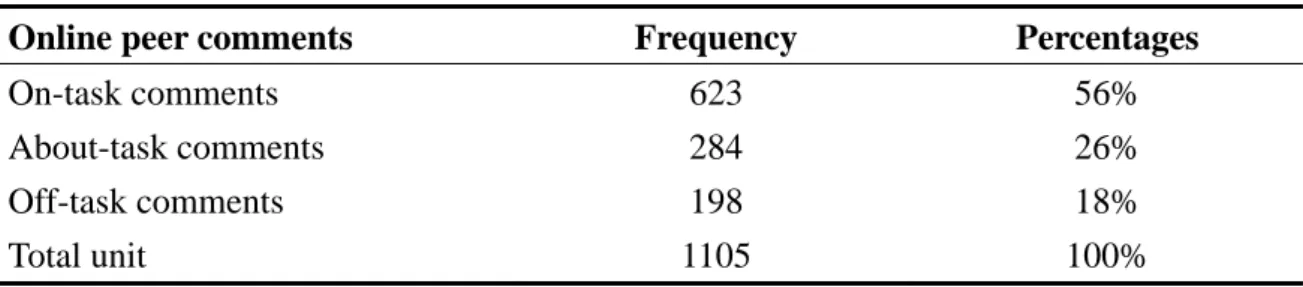
Table 4.1 Percentages of Online Peer Comments by On-task, About-task, and Off-task Comments ... 56
Table 4.2 Distribution of Peer Comments by Nature ... 57
Table 4.3 Distribution of Online Peer Comments by Areas ... 59
Table 4.4 Distribution of Online Peer Comments by Types ... 60
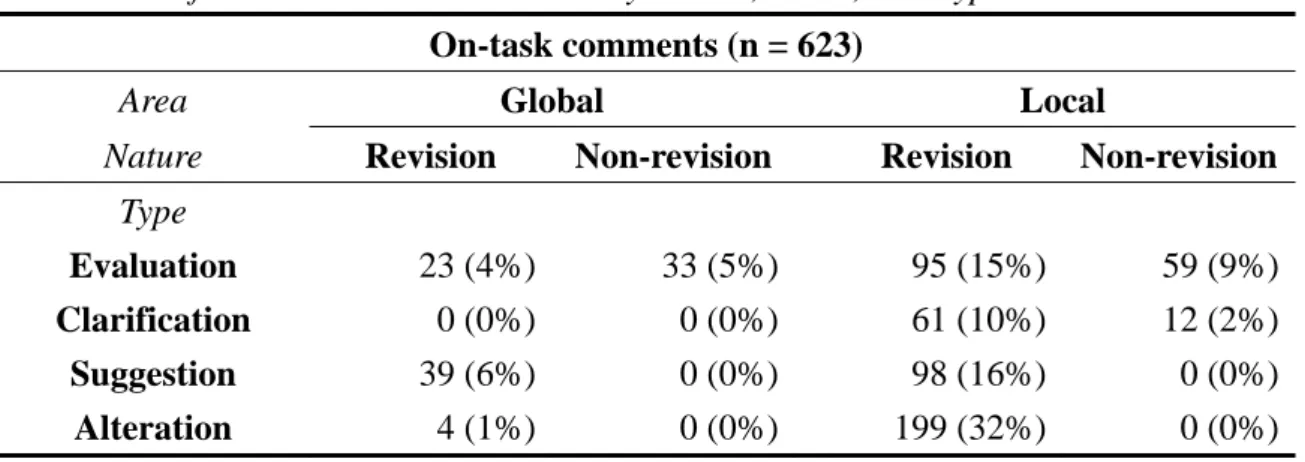
Table 4.5 Distribution of the Online Peer Comments by Nature, Areas, and Types ... 60
LIST OF FIGURES
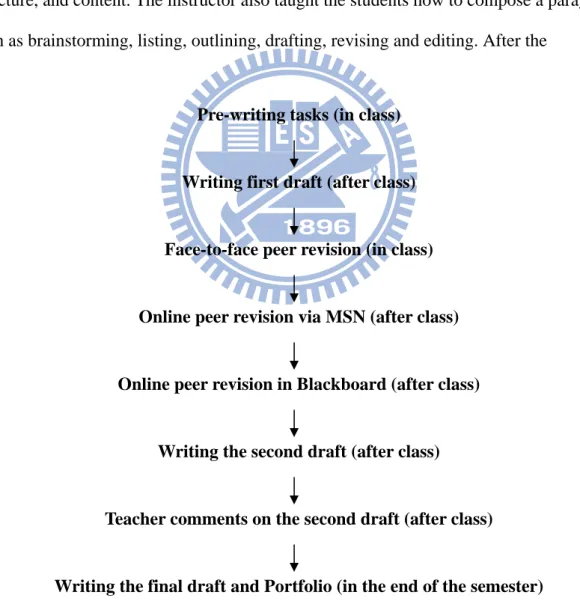
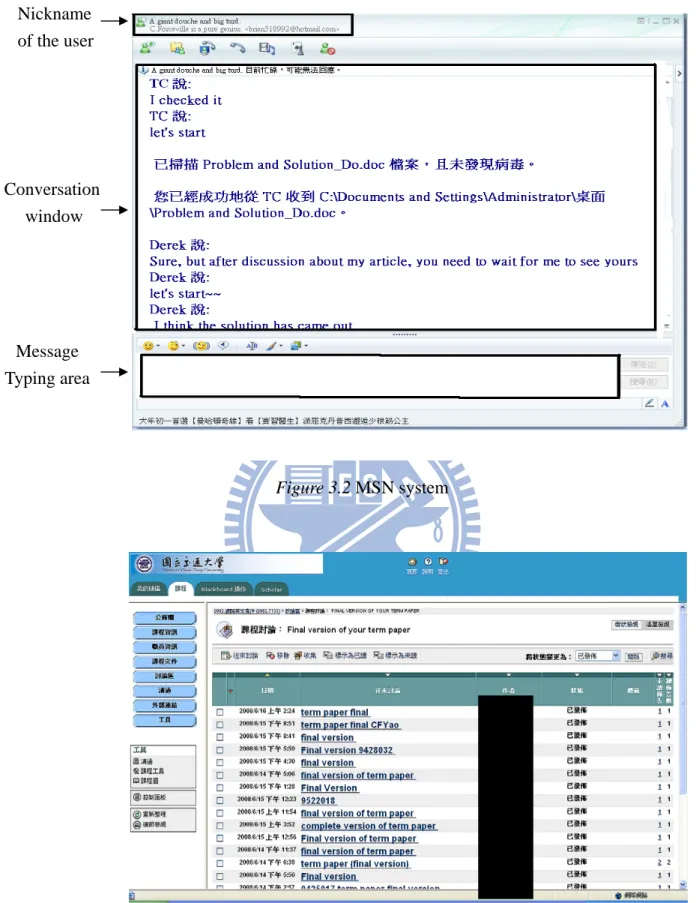
Figure 3.1 The writing cycles of the course ... 36 Figure 3.2 MSN system ... 38 Figure 3.3 Blackboard Academic Suite ... 38
CHAPTER ONE
INTRODUCTION
In the last two decades, there has been a paradigm shift in English writing pedagogy. Traditionally, English writing teachers are interested in product writing which focuses on form over meaning and on the final products (e.g., Elbow, 1973; Emig, 1971). However, evaluation of the final products often ignores the importance and benefits of the writing process. Therefore, with the development of learner-centered approaches to writing instruction, writing teachers have become more interested in the process of writing, which does not view writing as a product-oriented activity but as a dynamic and recursive process. Process writing not only emphasizes the importance of teacher-student conferencing, but also encourages students to go through different stages of composing—prewriting, drafting, and revision—and adopt strategies for better outcomes (Liu & Hansen, 2002; Villamil & de Guerrero, 1996).
To help students improve their writing in the process, one frequently used technique is peer revision. Many second language (L2) writing instructors have begun to use peer revision and viewed it as an essential component of L2 writing (Leki, 1990; Mangelsdorf, 1989; Zamel, 1985). A large body of research has examined peer revision in face-to-face mode in various aspects such as effects of peer revision (Berg, 1999; Mangelsdorf,1992; Nelson & Murphy, 1993; Tsui & Ng, 2000), types of negotiations during peer revision (Mendonça & Johnson,1994; Storch, 2002), effects of training peer revision (Faigley & Witte, 1981; Mendonça & Johnson,1994; Min, 2005, 2006), and comparison of peer and teacher feedback (Connor & Asenavage, 1994; Hedgcock & Lefkowitz, 1992; Miao, Badger, & Zhen, 2006; Tsui & Ng, 2000; Zhang, 1995). From the results of these studies, some pedagogical implications of peer revision have been discovered. For example, it was found that peer revision can foster a sense of ownership of the text (Tsui & Ng, 2000),
generate more positive attitudes toward writing (Min, 2005), enhance audience awareness (Mendonça & Johnson, 1994), and facilitate their L2 acquisition (Lockhart & Ng, 1995) and oral fluency development (Mangelsdorf, 1989).
Despite the advantages of peer revision found in face-to-face mode, one common problem of implementing peer revision lies in the limited time in in-class sessions. With the integration of computer-mediated communication (CMC), peer revision can be more efficient in some ways. First, writing instructors can carry out peer revision out of class sessions, thus increasing time and opportunities for students to offer feedback to their peers (Sullivan & Pratt, 1996). Second, another advantage of CMC is the provision of a less threatening and anxiety-provoking environment than face-to-face communication, which can encourage more silent and less capable students to offer their advice to their peers (Belcher, 1999). Finally, some researchers (e.g., Anton, 1999; Pellettieri, 2000) have identified synchronous CMC (SCMC), a real-time online communication, as one of the important factors to offer learners a fertile learning environment for language acquisition (Sotillo, 2000). For example, Breuch (2004) found that synchronous technologies may be more useful for brainstorming or quick feedback to specific queries. Freiermuth (2002) suggested that SCMC provides an ideal medium for language learners to benefit from collaboration. The evidence was corroborated by DiGiovanni and Nagaswami (2001). They found that students in pre-college ESL writing classes participated comfortably in online peer revision sessions. Accordingly, with the benefits of time flexibility, less anxiety-provoking means of learner-to-learner communication, and collaboration, peer revision via CMC may serve as an alternative to face-to-face peer revision.
As Breuch (2004) indicated, “virtual peer revision has appeared only haphazardly in writing studies and has not been discussed in any substantial way” (p. 16). Most of these studies have been concerned with the comparison of peer revision in face-to-face and online modes. For example, DiGiovanni and Nagaswami (2001) analyzed types of
negotiations by 32 ESL students in peer review through online and face-to-face modes, and examined students’ perceptions in both modes of peer revision. Moreover, Liu and Sadler (2003) examined whether comments and interaction via online and face-to-face triggered different comments in terms of areas (global and local), types (evaluation, clarification, suggestion, and alteration), and nature of feedback (revision-oriented and
non-revision-oriented) generated from peer reviewers in L2 writing. Although Liu and Sadler found some essential results with respect to peer revision via face-to-face and CMC modes, an in-depth understanding of the distributions of peers’ comments in terms of global and local areas merits further attention.
An interesting issue that is revealed from studies on peer revision through CMC lies in the lack of paralinguistic cues in online peer revision. Paralinguistic cues, such as fundamental voice frequency, vocal intensity, speech duration, speech rate, pauses, and response latency, are usually used to declare a speaker’s intention in face-to-face
communication (Street, 1990). However, peer revision in CMC mode, as result of a lack of paralinguistic cues, may fail to transfer speakers’ emotional intentions and then cause some problems during their communication. For example, students’ feedback may be considered to be overly critical, hostile, and unkind to their peers’ writing (Nelson & Murphy, 1992). Thus, students need to be more sensitive to the peers’ intentions and offer a clear, concise, and informative turns to facilitate their communication. Henri (1992) found that the social cues, which can be defined as a “statement or part of a statement not related to formal content of subject matter” (p.126), can facilitate learners’ communication not only in face-to-face interactions via verbal or nonverbal messages (Kaiser & Wehrle, 2001) but also in online contexts with words or special symbols in text messages (Walther & D’Addario, 2001). Reading social cues not only facilitates the understanding of the transmitted message, but also helps define the message style from which receivers may infer certain impressions about the communicator’s intentions (Lea & Spears, 1992).
Hence, it seems that further investigation is needed to exanimate how students engage in the online peer revision with the help of social cues.
Given the rapid increase of networked computers in language classrooms, peer revision via CMC has become a new tactic for EFL writing. However, to answer the question of whether online peer revision can be an alternative to face-to-face peer revision, most of the studies have focused on the effects of peer revision in face-to-face and online modes (DiGiovanni & Nagaswami, 2001; Liu and Sadler, 2003; Schultz, 2000; Wang, 2004). As Leki (2001) indicated, it is of importance to understand students’ voices about the problems students have in online peer revision, students’ acceptance of online peer feedback, and their experiences of online peer revision. Therefore, studies concerning students’ perceptions of peer revision via CMC merit more attention.
To explore an in-depth understanding of online peer revision, this present study aims to explore how college students engage in peer revision in a synchronous online
environment, how social cues function in the process of online peer revision, and how they perceive online peer revision. Three research questions are generated as follows.
1. What comments emerge from synchronous online peer revision in terms of nature (revision-oriented versus non-revision-oriented), areas (global versus local), and types (evaluation, clarification, suggestion, and alteration)?
2. What roles do social cues play in the process of peer revision via a synchronous online mode?
3. How do college students perceive peer revision via a synchronous online mode?
Organization of the Thesis
In addition to Chapter 1, which contains the background, purpose and research questions, this thesis is organized based on the following structure. In Chapter 2, I review existing literature related to peer revision and CMC in detail. In Chapter 3, I propose the
method of the study, including setting, participants, online system, and the means for data collection and analysis. In Chapter 4, I display the results in response to the research questions. The thesis ends with Chapter 5 where I discuss and summarize the study findings as well as mention implications derived from the findings.
CHAPTER TWO
LITERATURE REVIEW
This chapter introduces the theories and studies for implementing peer revision activities in L2 education. Two major themes—peer revision and CMC—will be reviewed and discussed in this chapter. Each theme comprises several subthemes and is discussed based on language learning and teaching. A combination of the two themes is presented at the end of the review as a gap statement for the present study.
Theoretical Framework of Peer Revision
Research based on theoretical stances of peer revision activities has offered
substantial evidence that peer revision activities facilitate L2 learners to develop not only their L2 writing skills but also their overall L2 language abilities through the negotiation of meaning during peer revision activities (Liu & Hansen, 2002). There are some theoretical stances that support the use of peer revision in writing classrooms—process writing approach, collaborative learning theory, and sociolcultural theory.
Process Writing Approach
Process approach to writing, or process writing, has gained considerable attention from writing educators worldwide. The approach stems from “the snowballing recognition that recursiveness is a major characteristic of the natural process of composing and that, in the process, the writer repeatedly revises his/her drafts” (Li, 1992, cited in Cheong, 1994, p. 63). This process approach does not view writing as a product-oriented activity but it regards writing a dynamic and recursive process leading to the end product. Hence, the emphasis of writing pedagogy has shifted to the process of writing in which students are highly encouraged to go through different stages of composing and adopted strategies for
better outcomes (Liu & Hansen, 2002; Villamil & de Guerrero, 1996). According to Tompkins (1990), the emphasis of the process writing focuses on the process of creating writing rather than the final product. The initial focus is on creating quality content and learning the genres of writing. When writing, students work through the stages of the writing process. The creation of writing occurs in basically five stages: prewriting, drafting, revising, editing, and publishing. Prewriting is the planning and idea-gathering stage. Drafting refers to the process of composing a rough draft. Revising is the process of improving the draft. Students reread their work and share it with a partner or small group; they then make changes in the writing based on the feedback from their peers. Editing is the process of correcting mechanical errors. Publishing, or sharing, is accomplished in a wide variety of ways when the work is in final form. Student of all ages move back and forth among these stages while writing (Gardner & Johnson, 1997).
The process approach to teaching writing has been the object of substantive research within second and foreign language contexts (Cumming, 1989; Krapels, 1990). Taylor (1981) described writing as “a discovery procedure which relies heavily on the power of revision to clarify and refine that discovery” (p. 8). As such, on the basis of process writing theory, revision or editing processes of text through multiple drafts is regarded as a crucial factor that helps learners achieve higher quality in their final written work. Hence, over the past decades, peer revision has been employed as an effective strategy to develop skills in self-expressing and writing composition in both L1 (Nystrand, 1986) and L2 (Mangeldorf & Schlumberger, 1992; Witbeck, 1976).
In higher education, the use of peer feedback currently forms a significant part of the pedagogical practice. One of the reasons for this is the increasing attention for the
development of complex competencies that ask for more, and more differentiated feedback to support the learning process of students. Peer revision can be defined as “the use of learners as sources of information and interactants for each other in such a way that
learners assume roles and responsibilities normally taken on by a formally trained teacher, tutor, or editor in commenting on and critiquing each other’s drafts in both written and oral formats in the process of writing” (Liu & Hansen, 2002, p. 1). According to Caulk (1994), writing instructors are to help students develop the skills to stimulate ideas, explore ways of expressing them, and examine and refine their writing during the process of composing. Thus, many ESL writing teachers have incorporated peer revision activities, in which students read each other’s drafts and make suggestions for revision, into their
process-oriented curriculum in recent years. Peers engage in a process over multiple drafts during which learners work together to offer feedback on one another’s texts in both written and oral fashions. Accordingly, it has generally been assumed that students, when working together, are able to help one another and provide input for each other on the issue under discussion (Amores, 1997).
Therefore, on the basis of process writing theory, peer revision activities which enable students to get multiple sources of feedback across various drafts strongly underpin process writing with a focus on drafting and revision.
Collaborative Learning Theory
Another theoretical framework that promotes the use of peer revision is collaborative learning theory. Bruffe (1984) defined collaborative learning as “the type of learning that takes place through communication with peers and stated that there are certain kinds of knowledge that are best acquired in this manner (p. 642).” Based on the collaborative learning theory, knowledge is socially constructed (Liu & Hansen, 2002; Lantolf, 2000; Warschauer, 1997).
Collaborative learning theories have begun to impact on L2 writing. For example, in writing groups, students negotiate meaning when they help each other revise their papers (Gere, 1987). Learning in writing groups is reciprocal and improves students work
(Bruffee, 1984). Moreover, L2 writing researchers have found a number of linguistic gains from collaborative writing and revising. For example, collaborative writing groups can lead to decision making, “allow learners to compare notes on what they have learned and how to use it effectively and offer learners increased opportunities to review and apply their knowledge of L2 writing through dialogue and interaction with their peers in the writing group” (Hirvela, 1999, p. 8).
L2 research has shown that in the process of co-authoring, L2 learners consider not only grammatical accuracy but also discourse (e.g., Donato, 1988; DiCamilla & Antón, 1997; Storch, 2002; Swain & Lapkin, 1998). Furthermore, depending on the kind of group/pair dynamics formed (Donato, 1988; Storch, 2002, 2003), collaborative writing may encourage a pooling of knowledge about language, a process Donato termed
collective scaffolding (Donato, 1988, 1994), which refers to the way the environment may be structured in order to facilitate learning. These results are not surprising since peer revision activities are one kind of collaborative group work which may result in more opportunities for learners to negotiate meaning when they work with peers. Additionally, in the field of L2 acquisition, researchers have found that negotiations of meaning
occurring during peer revision of writing shape L2 learners’ revising strategies, increase their responsibility for the learning process and allow them to develop audience awareness (de Guerrero & Villamil, 1994; Mangelsdorf, 1992; Mendonça & Johnson, 1994).
Therefore, due to the advantages mentioned above, peer revision has become a common writing activity.
Through collaborative learning, students create a discourse community in which they negotiate with one another so as to assist their peers to better express their thought in writing. It has been shown that, as a form of collaborative learning, peer revision groups contribute to critical thinking (Hyland, 2003; Nelson & Murphy, 1992), to better quality of written products (Nelson & Carson, 1998), to an enhancement in writing confidence (Fox,
1980), and to an increase in overall language proficiency (Liu & Hansen, 2002). Students practice the target language in authentic and meaningful communicative contexts as they interact with each other while accomplishing collaborative tasks.
To sum up, through collaborative peer revision activities, language learners are learning and using the target language at the same time. They can develop not only their writing ability but also other language skills, for example, communicative competence (Lee, 2004) and critical reading ability (Hyland, 2003; Nelson & Murphy, 1992).
Sociocultural Theory
Sociocultural theory, according to Vygotsky (1978), is characterized by the belief that human cognitive functions, such as voluntary memory, reasoning, and language learning are mediated mental activities (Donato, 2000). Vygotsky argued that “these mental
functions could not study properly through controlled experiments or through introspective methods; instead, he believed that mental activities could only be fully understood when observed either in its formation over time, or when it is disturbed” (Lantolf & Pavlenko, 1995, p. 108).
Social interaction is believed to be a fundamental issue of a learner’s everyday life and thus the most basic locus where learning takes place. In this view, learning is not something an individual does alone but is a collective endeavor which necessarily involves other individuals (Aljaafreh & Lantolf, 1994; Swain, 2000). One key factor of social interaction is the context in which it is situated as what Wertsch (1998) explained that “human mental functioning is inherently situated in social, interactional, cultural,
institutional, and historical contexts” (p.3). Therefore, human cognitive functioning cannot be separated from the given larger context (Oxford, 1997). In this sense, some researchers who are interested in the filed of peer revision hope to test the hypothesis. For example, Villamil and de Guerrero (1996) described the social behaviors during the peer revision
process. They concluded that collaborative writing groups are a complex process that fosters a myriad of communication activities, including collaboration, taking and
relinquishing authority and providing scaffolding. Students in their study tried to establish an environment full of camaraderie and compromise. Hence, peer responses can be a catalyst to L2 development (Mittan, 1989).
Sociocultural theory, as an encompassing paradigm, consists of various concepts, of which two related to peer revision activities will be further discussed in the following: a) zone of proximal development and b) scaffolding.
Zone of proximal development
First theoretical stance supporting the use of peer revision in writing courses is based on Vygotsky’s (1978) Zone of Proximal Development (ZPD). According to Vygotsky, ZPD refers to the difference between one learner’s actual and potential levels of development. To verify the relationship between ZPD and language learning, Vygotsky (1978)
contended that “learners benefit most from social interactions concerning tasks that they cannot do alone but can do in collaboration with more knowledgeable or more experienced individuals” (p. 86). Also, ZPD is conceived of as “the collaborative construction of
opportunities for individuals to develop their mental ability” (Lantolf, 2000, p. 17). Central to the definition is the appearance of expert-novice interaction, which was identified as the most effective among four interactive patterns in creating conditions conducive to learning (Storch, 2002).
In addition, from Vygotsky’s viewpoint, human learning and development result from social interaction where an individual learns to expand his or her current competence through the guidance of an expert or a more experienced individual. In other words, to encourage ZPD for learning, negotiation between an expert and a novice is required so that learners may engage in cognitive restructuring or elaboration for cognitive growth. There
are also various interpretations of ZPD with its application to different teaching and learning settings. For example, Antón (1999) investigated devices the teacher used to foster negotiated collaboration with students of French and to help the students advance through their own linguistic ZPDs. Ohta (2000) examined interactive process between adult L2 Japanese dyads in form-focused tasks and found that the learner’s sensitivity to subtle interactional cues plays a crucial role in assisting the other to reach the potential level of development. Moreover, Donato (1994) uncovered that via analysis of the expert/novice dialogue, they show how the learner was able to assume responsibility (self-regulation) for her L2 performance by appropriating the assistance negotiated between herself and the expert.
Although individuals can often come together in a collaborative posture and jointly construct a ZPD where everyone contributes something to the interaction, however, some researchers argue that ZPD does not require the presence of expertise. Assistance should be provided only when needed, and withdrawn as soon as the learner shows signs of self-control or ability to function independently. Thus, Aljaafreh and Lantolf (1994) contended that optimal assistance is the one which is both graduated and contingent. That is, help should start at a highly strategic, implicit level and gradually become more specific until the appropriate level is accomplished.
Scaffolding
The concept of scaffolding was developed along with ZPD, which was first used by Vygotsky and Luria in reference to how adults introduce children to cultural means (de Guerrero & Villamil, 2000). Scaffolding can be defined as a process in which “a
knowledgeable participant creates, by means of speech, supportive conditions in which the novice can participate and extend current skill and knowledge to higher levels of
are drawn by scaffolded help from more capable others into another more advanced space where they are able to solve problems or perform tasks independently (Storch, 2002). For Aljaafreh and Lantolf (1994), it is “the idea to offer just enough assistance” (p. 469) that constitutes the key to the occurrence of scaffolding.
Employing the concept of scaffolding, many L2 writing researchers have investigated the influence of interaction of group work in writing classrooms (e.g., de Guerrero & Villamil, 1994; Donato, 1994; Villamil & de Guerrero, 1996).
These research results indicate that collective scaffolding takes place in collaborative work (Donato, 1994; Guerrero & Villamil, 1994; Villamil & de Guerrero, 1996) and would lead to long-term language development of both expert and novice learners (Donato, 1994). Therefore, peer revision activities which emphasize the necessity of interaction and
communication among students for mental processing may benefit all members of a group. The way the expert establishes scaffolding has been explicitly shown in studies of language teaching and learning. For example, de Guerrero and Villamil (2000)
corroborated mutual scaffolding by bringing together two novice ESL learners in a
revision task. Although the reader played a dominant role at the very beginning, the writer gradually developed his own revising strategies and ended up coming to make a reciprocal endeavor with the reader.
These theoretical foundations, process writing, collaborative learning theory, and sociocultural theory, underpin the value of peer revision activities for the writing
instruction since it offers opportunities for learners to test their knowledge and learn from peers through negotiation of meaning. In the following, we will focus on four main areas of the literature review on a) benefits of peer revision activities, b) drawbacks of peer revision activities, c) training in peer revision, and d) studies of peer and teacher feedback.
Merits of Peer Revision Activities
Some studies addressed the effectiveness of peer response groups regarding writing improvement and students’ perceptions. Proponents of peer revision have made a number of claims about its cognitive, social, and linguistic benefits, most of which have been substantiated by extant empirical evidence.
On the cognitive level, Mendonça and Johnson (1994) found that the students tended to actively initial negotiations during the process of peer revision and helped the writers become more aware of their audience and encouraged them to change their written text in light of peers’ responses. The suggestions and explanations provided during the peer revision activities enable the students to show what they know about writing and to use that information in their following revision. In addition, peer revision activities allow the students to develop audience awareness (Zamel, 1982) and allow them to modify their written texts to meet the needs of their audience.
In terms of social benefits, the students constantly receive “reactions, questions, and responses from authentic readers during the process of peer revision” (Mittan, 1989, p. 209), and therefore they can understand what has been done well and what remains puzzled. Peer revision enhances the students’ communicative power by encouraging learners to express and negotiate their ideas (Mendonça & Johnson, 1994). Peer revision activities also result in the enhancement of confidence and abatement of apprehension by allowing students in this study to see peers’ strengths and weaknesses in writing (Leki, 1990). Mendonça and Johnson (1994) found that all students in this study perceived peer revision helpful because it helped the writers become more aware of their audience and provide more ideas with the writer. During the process of peer revision, the students may obtain opportunities to establish collegial ties with one another and thus they may cement their friendship via students’ collaboration (Hirvela, 1999).
invaluable opportunities to sharpen their reading and writing abilities by drawing on peers’ strengths and resources since peer revision activities entail recursive processes. Students can also practice their target language in authentic and meaningful communicative
contexts during the process of collaborative discussions. For example, Mangelsdorf (1989) argued that the students can gain a chance to discuss issues such as appropriate word choice and grammatical structures. In addition, to accomplish the task of peer revision, the learners have to go beyond sentential levels and engage in unplanned conversations in discoursal levels and even practice turn-taking strategies to facilitate the peer revision activities. Accordingly, the L2 learners can negotiate their ideas and contribute to their development of L2 learning through peer interactions.
In Taiwan context, Chou (2003) found that the English-major students were able to utilize different language functions, such as informing, eliciting, directing and restating, to engage in various topics about the coherence of the essays, the content and the
organization, grammar, and so on. Moreover, the most often discussed topics were those regarding the content of the essays and grammatical problems, which showed that the students were concerned much about both the ideas and form in writing. The results also reflected that the students actually could be well-informed peers to help others solve problems in writing. They informed each other not only knowledge of the language and writing but world knowledge which they acquired from their own particular experiences as well and therefore improved and better their essays after the peer revision.
In addition, some other studies have been launched to investigate students’ perceptions of the peer revision and its impact on the enhancement of English writing quality (Mangelsdorf, 1992; Mendonça & Johnson, 1994; Zhang, 1995) but generated mixed results. Mangelsdorf (1992) reported on a study to investigate advanced ESL students’ attitudes toward peer revision and found that 69% of the learners had positive reactions to peer revision. Finally, the students appeared to be working harder to impress
their classmates, possibly because they had a lot of respect for their classmates. The students did better work when they knew their work would be made public. Reciprocally, the poorer performing students seemed to accept the feedback from their peers even if it was sometimes harsh, and to view their teacher as a resource who could help them. This makes for a much nicer teacher-student relationship with more teaching, and less judging (Wolfe, 2004).
Similarly, Mendonça and Johnson (1994) interviewed 12 ESL college students participating in peer reviews in a writing course. All of the 12 students in the study reported that they found the peer review activity beneficial. Having another reader to examine their drafts helped them see the advantages in their essays and the points which needed revision. Likewise, in Jacobs, Curtis, Braine, and Huang’s paper
(1998), 111 first-and second-year undergraduate ESL students (44 Hong Kong and 7 from Taiwan) were enrolled in writing courses in which peer, self, and teacher feedback was employed. To analyze students’ preference to different types of feedback, a questionnaire was administrated. The results indicated that 93% of the participants preferred to have peer feedback on their writing.
In summary, peer comments has been found to be beneficial to both college (de Guerrero & Villamil, 1994; Mendonça & Johnson, 1994; Villamil & de Guerrero, 1996) and secondary (Tsui & Ng, 2000) learners in terms of their writing and revision processes. In addition, peer revision enhances a sense of audience (Mendonça & Johnson, 1994; Tsui & Ng, 2000; Zamel, 1982), helps develop students’ critical reading and analysis skills (Chaudron, 1984), raises learners’ awareness of their own strengths and weaknesses, encourages collaborative learning, and fosters ownership of text (Tsui & Ng, 2000), even oral fluency development (Mangelsdorf, 1989), and possesses positive perceptions of peer revision (Jacobs et al., 1998; Mangelsdorf, 1992; Mendonça & Johnson, 1994).
Demerits of Peer Revision Activities
Although there benefits put forth in the literature, there are also a number of
criticisms against peer revision being used in L2 writing. For example, some researchers have indicated that peer revision may cause some problems among many L2 writers in two major aspects—linguistic, affective domains, and practical problems in the classrooms (Amores, 1997; Leki, 1990; Nelson & Murphy, 1992, 1993; Wolfe, 2004).
First of all, in terms of linguistic constraints, the students sometimes focus only on “surface concerns” instead of semantic or textual ones and tend to offer vague and even unhelpful comments (Leki, 1990). Second, some researchers contended that the most recurring concern among practitioners is the belief that the students are not capable of detecting and correcting errors in the L2 (Leki, 1990; Nelson & Murphy, 1992, 1993) and are unable to offer concrete and useful feedback. Some researchers claimed that the learners tended to offer rubber stamp advice when revising peers’ works (Mendonça & Johnson, 1994; Tsui & Ng, 2000). Third, a serious question that has been posed is whether peer revision yields the type of quality product that the teacher-guided revision might produce and whether it leads to enough quality revisions to warrant the class time that is required (Berger, 1990). Finally, due to a lack of formal L2 rhetorical schemata, the students may misunderstand the content and structure of peers’ texts, leading to counterproductive feedback (Liu & Hansen, 2002).
On the affective level, Nelson & Murphy (1992) found that if the students are too overtly critical to their classmates’ writing while doing peer revision, they may become antagonistic and thus interactions of the group are at times unpleasant. In fact, “the nature of responding to peers’ drafts sometimes generates a sense of discomfort and uneasiness among the participants. The students can become rather defensive when their work is criticized, especially by their peers” (Amores, 1997, p. 519). Furthermore, while doing peer revision, some students may be uncertain about the value and validity of their
classmates’ responses (Leki, 1990). The students may not feel their classmates, who are still learning the language, are qualified to critique their works and may doubt their recommendations (Allei & Connor, 1990; Mangelsdorf, 1992; Nelson & Murphy, 1993). In this sense, the students may prefer teacher feedback to peer feedback, which does not mean that peer revision refers to a waste of time (Nelson & Carson, 1998; Zhang, 1995).
The final problem is that the students may be late or missing their homework. One way to motivate the student to be on time is to threaten a reduced grade, but this puts the teacher in the role of “enforcer”, which can lead to a very negative student-teacher relationship (Wolfe, 2004).
Training in Peer Revision
A fundamental question all L2 writing researchers and teachers have concerning peer revision is the extent to which peer revision is incorporated into students’ following revision (Connor & Asenavage, 1994; Mendonça & Johnson, 1994; Tsui & Ng, 2000). Connor and Asenavage (1994) indicated that the students employ only a small percentage of their peers’ feedback into their subsequent revision. One of the possible reasons lies in students’ inability to furnish concrete and helpful feedback (Mendonça & Johnson, 1994; Tsui & Ng, 2000). Inexperienced writers and readers often get caught in the subject of an essay and end up spending too much time discussing ideas rather than how there ideas are presented and expressed in writing.
Another very important aspect of peer revision to writing and its implementation in the ESL/EFL classroom lies in the role of training, which could be defined as “the
preparation of students for participation in the peer revision activity” (Berg, 1999, p. 216). Hence, some researchers have found that students, especially those who have been trained in peer revision, are able to make useful suggestions about their peers’ drafts since they are able to give specific comments and advice on their peers’ writing and to pinpoint their
problems with content and rhetoric by responding to larger issues of clarity of ideas, organization, and development (e.g., Berg, 1999; Min, 2005, 2006; Paulus, 1999; Stanley, 1992; Villamil & de Guerrero, 1998).
Furthermore, Min (2005) found that “students were able to generate significantly more comments containing two or three characteristics—clarifying writers’ intentions, identifying problems, explaining the nature of problems, and making specific
suggestions—and were able to produce more relevant and specific comments on global issues” (p. 293). In Faigley and Witte’s study (1981), it was found that the experienced writers made meaning changes more frequently, while most of the inexperienced writers only made surface revision. Consequently, detailed information and guidelines in
instructing students to become effective peer responders are needed since instructed students tend to make more revision and instruction also results in a greater level of student engagement in the task of evaluation, in more productive communication about writing, and in clearer guidelines for the revision of drafts (Stanley, 1992).
Peer and Teacher Feedback
Apart from studies on merits and demerits of peer comments, a number of comparative studies on the relative effectiveness of teacher and peer feedback in
facilitating revision have been conducted. Research comparing peer and teacher feedback has yielded mixed findings.
Some studies in L2 writing research, although scant and inconclusive, seemed to cast doubt on the value of peers’ comments. For example, Tusi and Ng’s study (2000) found that learners incorporated significantly more teacher comments than peer comments in their revisions and that teacher comments were considered significantly more effective than peer comments since students perceived the teacher as more experienced and more authoritative. Furthermore, teacher comments were considered to be of better quality and
they were more specific to students because the teacher was capable of explaining what the problems were and making concrete suggestions for revisions. Connor and Asenavage (1994) found that only 5 percent of revisions done were based on peer group collaboration and that most of the revisions incorporated were prompted by the teacher and tutors. Zhang’s study (1995) showed that ESL learners unequivocally prefer teacher feedback over peer feedback when they are asked to make a choice between teacher feedback and non-teacher feedback. Miao, Badger, and Zhen (2006) argued that learners employed both teacher and peer comments into their writing, with the teacher feedback being favored since it brought about greater improvement. For these reasons, students prefer teacher feedback to peer feedback, but this does not mean students perceive peer revision as a waste of time (Nelson & Carson, 1998).
Other studies, on the contrary, have presented opposing results. For example,
Mangelsdorf (1992), in her study of advanced ESL students’ attitudes toward peer revision, discovered 69% positive reactions to peer revision. Hedgcock and Lefkowitz’s (1992) conducted a comparative study of teacher and peer feedback in two intact FL groups: the experimental group—peer revision—performed on an equal level as that of the control group—teacher feedback. It was found that “peer revision can help student writers to separate the meaning expressed by their written words from the supplemental knowledge they bring to their writing and discover the gulf between intended and understood meaning of their text” (Berg, 1999, p. 231). Similar results were obtained in Mendonça and
Johnson’s study (1994). They found that all the students, through interviews, considered peer revision helpful in terms of audience perspective and idea development. Caulk (1994) also found that intermediate and advanced ESL learners seemed to offer as many
comments as their instructor did and that even when students made the point as the teacher, they phrased it differently or from a different perspective, giving the writer an alternative way to think about the suggestion (p. 186). Teachers’ comments were often aimed at the
whole piece, whereas the students’ comments were more specific and rarely contained suggestions for the whole piece of the writing. Miao et al. (2006) also found that while peer feedback seemed to result in more meaning-change revision, teacher feedback focused on surface changes. Furthermore, although peer feedback had less influence than teacher feedback, it seemed to increase students’ autonomy. Over-reliance on teacher feedback may reduce self-correction partly because students considered the teacher to be more authoritative than peers in terms of giving feedback.
This section mainly centers on the discussion of peer revision in a face-to-face environment and accounts for the popularity of peer revision in composition courses. In the following, we will focus on research of CMC in language education.
CMC in Second Language Learning
With the advances of Internet technology and widespread of students’ electronic literacy in their daily activities, and the rapid increase in computerized classrooms at universities, new communication tools that stimulate new writing pedagogies have been advocated. Computer-mediated communication (CMC), which has appeared in primitive form since the 1960s and has been widely used since the late 80s, is probably one of the most influential and momentous CALL applications to date on language teaching and learning (Warschauer, 1996). CMC can be defined as “the process by which people create, exchange, and perceive information using networked telecommunication systems (or non-networked computers) that facilitate encoding, transmitting, and decoding messages” (Murray, 1997, p. 1) or more specifically as “use of computer systems and networks for the transfer, storage, and retrieval of information among humans” (Santoro, cited in Salaberry, 1996, p. 17). Unlike many individual CALL applications, CMC promotes meaningful human interaction that fosters the language learning process. This advantage may result in collaborative, meaningful, and cross-cultural human interactions among members of a
discourse community created in cyberspace (Salaberry, 1996; Warschauer, 1997). Warschauer (1997) found that CMC encompasses such five features as text and computer-based interaction, many-to-many communication, time- and space- independent communication, long distance exchanges, and hypermedia links. In addition to affording individualized practice, network-based computers also provide learners with opportunities for interpersonal contacts and communicative engagement and then changes the way learners use language in interaction with one another (Kern, 1995). In addition,
Kamhi-Stein (2000) also summarized advantages common to CMC over face-to-face oral exchanges as follows: “a) a text-based medium that amplifies students’ attention to linguistic form, b) a stimulus for increased written L2 production, c) a less stressful environment for L2 practice, and d) a more equitable and non-threatening forum for L2 discussion, especially those involving minorities” (p. 428).
Accordingly, as revealed the benefits of CMC, more and more writing teachers have begun conducting networked labs or combined writing activities with the use of computers (Warschauer, 1996). An amount of research has proved to be useful for language learning since CMC offers enhanced motivation for learners (Kern, 1995), a student-centered classroom (Beauvois, 1998; Gonzalez-Bueno, 1998), authentic audience and tasks (Gonzalez-Bueno, 1998, Zeiss & Isabelli-Gracia, 2005), balanced participation
(Warschauer, 1996), reduce of anxiety (Kern, 1992), and improvement of proficiency and increase of self-confidence (Beauvois & Eledge, 1996).
To analyze the interaction during CMC, many studies have attempted to analyze the social effects of conferencing exchange because social cues are important in this form of analysis (Henri, 1992; Walther, 1996). The social cues of a message differ from the formal content of subject matter (Henri, 1992). According to Henri (1992), social cues could be defined as “those comments which are not related to formal content of subject matter” (p. 126). They reflect a person’s feeling and involvement when responding. In face-to-face
discussions, social cues occur via verbal or nonverbal messages (Kaiser & Wehrle, 2001). In online discussions, words or special symbols (Walther & D’Addario, 2001) in text messages can express social cues. Table 2.1 shows types and examples of Henri’s (1992) social cues (p. 126).
Table 2.1
Types and Examples of Social Cues (Henri, 1992, p. 126)
The effects of social cues on messages in face-to-face and online discussions are similar. Social cues expressing positive feelings often trigger reciprocation of positive social cues. This positive reciprocation pattern can help build friendships between group members and facilitate cooperation. Likewise, negative social cues tend to produce reciprocation of negative social cues, which can obstruct cooperation among group members. In addition, negative social cues may cause some members to withhold important contributions (or withdraw entirely) rather than possibly receive a rude disagreement, and thereby losing face (Chiu & Khoo, 2003).
Both positive and negative social cues can be harmful. In both face-to-face and online
Social cues Example
A self-introduction and Greeting Hi, I am Brian. Closure That’s it for now. Expressions of positive feedback I’m feeling great… Thanks Thanks for your answer! Compliments to others You are so smart!
Anger My solution is not wrong!!! Regret I should have learned it before.
Shyness =^_^= (blushing)
Apologies I’m sorry for having given you the wrong answer.
Condescension Your answer is ridiculous. The use of symbolic icons : ) or : -)
discussions, if participants use too many social cues, they might focus on their social interaction rather than the discussion of the task (Walther, 1996). While excessive social cues might distract from attention on the task and reduce the number of subsequent contributions, negative social cues might show a stronger negative effect than positive social cues.
Comparison between Face-to-face and CMC
Earlier CMC research is to compare learning outcomes obtained respectively in CMC and face-to-face classrooms. The resemblance between CMC and face-to-face
conversation in terms of spontaneity and discourse functions has convinced some researchers that certain communicative competence demonstrated in CMC would be gradually transferred to learners’ spoken discourse (Chun, 1994). Felix & Lawson (1996) also found that students scored higher on the logical linking of ideas when using
networked writing environments as opposed to face-to-face instruction. Moreover, both quantitative and qualitative studies of synchronous writing environments in the foreign language classroom have shown the positive impact of CMC (Warschauer, 1997). To test the claim, Payne and Whitney (2002) engaged university students of Spanish in either electronic or face-to-face discussions and compared their speaking performances in pre- and post speaking tests. The finding showed a significant improvement in speaking ability of the students involved in electronic discussions.
Comparing to face-to-face environment, L2 speakers have been found to participate more actively and with greater motivation when provided the chance to share their writing through online discussions (Sullivan & Pratt, 1996; Warschauer, 1996). For example, Warschauer (1996) found that 16 advanced ESL students in a composition course demonstrated a tendency toward more equal participation in computer mode than in face-to-face discussion. Moreover, the reasons to cause greater quality are that “CMC (a)
reduces social context clues related to race, gender, handicap, accent, and status; (b) reduces nonverbal cues, such as frowning and hesitating, which can intimate people, especially those with less power and authority; and (c) allows individuals to contribute at their own time and pace” (Finholt, Kiesler, & Sproull; Sproull & Kiesler, cited in
Warschauer, 1997, p. 473).
CMC also presents a number of advantages over traditional writing environments. For example, Eisenberg and Ely (1993) state that the “interaction through networks helps break down communication barriers and inhibitions that often stifle the open exchange of ideas in traditional classrooms” (p. 2). A study by Kelm (1996), for example, showed that in computer-networked writing environments, the L2 students can participate anonymously in on-line discussions and, to some extent, overcome inhibitions encountered in
face-to-face settings.
Language Learning in CMC
Research on CMC for improving FL performance have sparked some researchers to compare learning results in terms of discourse functions and syntactic complexity (Sotillo, 2000), quantity of generated discourse (Abrams, 2003; Pérez, 2003; Warschauer, 1997), and quality of discourse (Chun, 1994; Kelm, 1992; Kern, 1995; Stockwell, 1998;
Warschauer, 1996). For example, Sotillo (2000) found real-time NetMeeting greatly facilitated graduate students’ thesis composing since the less skilled students were acquiring the skills and rhetoric of academic writing by imitating the format and style of the more experienced writers in the group and then gradually learning to solve problems independently.
As for quantity of generated discourse, Abrams (2003) investigated whether CMC can help learners improve their oral proficiency in intermediate German courses. More
output in terms of fluency and general proficiency, a richer lexicon and syntactically more sophisticated language. The results showed that students in synchronous CMC (SCMC) eclipsed those in the face-to-face group in terms of amount of output.
In addition, online results have also been found to be positive with regard to quality of discourse. Investigating whether computer-assisted class discussion (CACD) can be effectively for beginning learners to increase their spoken and written communicative language proficiency (CLP), Chun (1994) found that over two semesters from first- and second-semester German classes through the use of a synchronous CACD, InterChange, class discussions on a computer network, more specifically the CACD, offered excellent opportunities for foreign language learners to cultivate discourse skills and interactive competence because students asked more questions, gave feedback to others, and used leave-taking expressions and farewells to end conversations.
Moreover, in a comparison of discourse produced by two groups of university-level French learners, Kern (1995) found an increase in both the number of turns and length of utterances in the group using real-time InterChange. He also found that students in
InterChange sessions produced more sophisticated language output than in oral
discussions in terms of morphosyntactic features and discourse functions and more equal student participation was observed inthe electronic discussion. Warschauer (1996) compared electronic discussions with the face-to-face discussions on two measure of complexity—lexical and syntactic complexity. The results showed that the electronic discussions involved significantly more complex language than the face-to-face ones, with more salient differences in syntactic area. Stockwell (1998) reported that the length of text produced by L2 students of Japanese increased considerably, from an average of
approximately two lines of text in the first week to about nine to ten lines by the fifth week.
Sproull and Kiesler (1991), Belcher (1999), and Liu and Sadler (2003). Sproull and Kiesler (1991) found that electronic discussion tended to reduce conformity and convergence rather than enhancement of collaboration and the prevalence of hostile language known as “flaming,’ which occurs due to the same features that encourage free expression and can have negative effects on classroom interaction, could hinder cooperative learning. Belcher (1999) cautioned that a lack of face-to-face communication and the time pressure may also have a negative effect on the quality of peer interaction in the CMC mode. Liu and Sadler (2003) pointed out the limitations of synchronous technologies: frequent problematic turn-taking or chaotic multiple comments might impede comprehension or revision.
Nevertheless, despite its disadvantages, CMC still carves out its niche in language education as an innovative and popular device. Many language practitioners and
researchers are enthusiastically and approvingly embracing the networked technology and utilizing it in various ways. In the following, we will center on four different kinds of empirical studies of CMC in foreign/second language teaching and learning settings: collaborative learning in CMC and CMC versus online peer revision.
Collaborative Learning in CMC
As Internet technologies become widely used today, CMC has been reinvigorated with the enhancement of electronic communication recently and has changed the role of the computer in the classroom by enabling collaborative learning. Thus, Warschauer (1997) provided a review of computer-mediated collaborative language learning based on a
sociocultural perspective. Freiermuth (2002) discussed merits and demerits of
computer-mediated collaborative language learning and suggested proper ways to employ collaborative tasks via Internet chat.
The application to computer-mediated collaborative learning has been widely made to enhance learners’ writing performance. For example, Sotillo (2002) engaged five graduate
students of applied linguistics in a task of composing and revising their thesis
collaboratively in a wireless university campus. With the use of real-time software of
NetMeeting, the students were able to receive critical feedback, provide corrective input,
and negotiate meaning while reading the same document on their computers at the same time. Sotillo discovered that the teacher decreasingly dominated the classroom talk and processes and the students made more inquiry, received more critical input, and
collaboratively work to construct their products. In addition, a wireless community formed a set of supportive relationships which facilitated the provision of corrective peer and instructor feedback, and its incorporation into the revised texts. During the writing
processes, the more experienced writers, by coaching novice student writers, helped them apply new knowledge about writing conventions to the process of writing and revising. Finally, students developed learner autonomy and controlled after a period of intense collaboration and they all made great strides on their thesis work after 16 weeks’ collaboration.
Furthermore, comparing effects on writing performance by electronic and
face-to-face discussions, Schultz (2000) pointed out that the collaborative task of peer revision was better enhanced by real-time InterChange. The InterChange discussion increased the students’ feedback by allowing them to exchange messages at the same time whereas they had to wait for their turns in face-to-face mode. The generated scripts also offered them a better opportunity to pay attention to and reflect on discussion points and further to act on the suggestions in the following compositions.
However, although CMC was reported to be a beneficial medium for collaborative learning, Freiermuth (2002) argued that task design played a crucial role in determining the type and quality of the resulting collaboration. Hence, she proposed two questions as a reminder to better ensure the occurrence of sound computer-mediated collaborative tasks: “a) did the tasks offer the students sufficient opportunities to learn language, or were they
merely an opportunity for the learners to enhance their technological savvy? and b) did the tasks offer the students interaction with other students” (p. 36)? In addition, some aspects of electronic discussion could possibly mitigate against collaboration. Weisband (1992) indicated that it was more difficult to achieve consensus in online discussion than in face-to-face interaction. This suggested that electronic discussion reduced conformity and convergence (Sproull & Kiesler, 1991). Moreover, another main obstacle to a collaborative classroom was “the teacher-dominated nature of discussion, with classroom discourse dominated by the ubiquitous IRF sequence of an initiating move by the teacher, a
responding move by a student, and a follow-up move by the teacher” (Mehan, cited in
Warschauer, 1997, p. 474).
Accordingly, CMC environment appears to be a double-edged blade because of its facilitative and debilitative features attributed to collaboration. Research on how to achieve collaboration with the help of online tools in the classroom still merits some attention.
CMC and Peer Revision Activities
In recent years, the process of providing peer feedback is increasingly facilitated by using electronic learning environments. Exchanging peer feedback online also makes it easier for teachers to monitor the process and to intervene. Thus, a new form of feedback is emerging with the expansion of the Internet, electronic feedback (e-feedback). It refers to feedback in digital, written form and transmitted via the web, which transfers the concepts of oral response into the electronic arena (Tuzi, 2004). More specifically, electronic feedback, according to Ware and Warschauer (2006), means that human feedback, particularly peer revision, can be offered via technology.
Additionally, although research on oral peer feedback for L2 writers indicated benefits and drawbacks, it did not consider the electronic environment as a locale for communicating. Accordingly, differences between oral (face-to-face) and written (online)