Phymatosorus longissimus (Bl.) Pic. Serm. (Polypodiaceae):
Rediscovered in Taiwan
Yea-Chen Liu
(1)and Chen-Meng Kuo
(2,3)(Manuscript received 20 November, 2006; accepted 25 March, 2007)
ABSTRACT: The fern, Phymatosorus longissimus (Bl.) Pic. Serm., was believed to be locally extinct in Taiwan. However, we recently rediscovered this species in Mudan, Pingtung County and Lanyu Island, Taitung County of Taiwan. The species has currently been found in wetlands neighboring cultivated fields. These habitats are prone to the disturbance of human activities, which may lead to another future extinction of the species in Taiwan. Based on the IUCN criteria, we proposed Phymatosorus longissimus (Bl.) Pic. Serm. to be a critically endangered species in Taiwan. We also discussed the taxonomy and the distribution of this species.
KEY WORDS: Phymatosorus longissimus, Phymatosorus suisha-stagnale, Polypodiaceae, rare species, Taiwan.
INTRODUCTION
The first discovery of Phymatosorus longissimus (Bl.) Pic. Serm. (Polypodiaceae, Pteridophyta) in Taiwan was from the floating island in Suisha Lake (now known as the Sun-Moon Lake of Nantou County, Taiwan). That plant was given the name
Polypodium suisha-stagnale Hayata; it was believed
to be closely related to Polypodium longissimus Bl., just with thinner texture and deeper sunken sori (Hayata, 1916). The name P. suisha-stangnale was later transferred to the genus Phymatosorus, but was still recognized as a distinct species (Pichi Sermolli, 1973). However, later studies treated it as a synonym of Phymatosorus longissimus (Bl.) Pic. Serm. [under the name Phymatodes longissimus (Bl.) J. Sm. or
Microsorum rubidum (J. Sm.) Copel. (misspelled as Microsorium rubidum (Kunze) Copel.)] (DeVol and
Kuo, 1975; Shieh et al., 1994). The genus status of
Phymatosorus is doubtful. Some taxonomists placed
it in the genus Microsorum, but the molecular phylogeny shows Microsorum being polyphyletic (Smith et al., 2006). We followed Kramer’s scheme (Kramer and Green, 1990), which placed this taxon under the genus Phymatosorus of the family Polypodiaceae.
___________________________________________ 1. Department of Biological Sciences, National Sun Yat-sen
University, 70, Lien-hai Rd.Kaohsiung 804, Taiwan. Email: [email protected]
2. Institute of Ecology and Evolutionary Biology, National Taiwan University. 1, Roosevelt Rd., Sec. 4, Taipei 106, Taiwan. 3.Corresponding author. Tel: 886-2-33662465. Email: kuocm
@ntu.edu.tw
Collections in Sun-Moon Lake region were few during 1929 to 1934 (Sasaki, 1930; DeVol and Kuo, 1975). After 1934, the floating island disappeared and no more collections were made around the Sun-Moon Lake. In 1959, the fern was found again in the nearby Chingshuikuo area of Nantou County (DeVol and Kuo, 1975); however, this habitat was destroyed and no voucher specimens were collected from these areas for the following 50 years (Tseng-Chieng Huang per. comm.). In 1981, the species was found again in Loshan area of Hualian County by Mr. Chin-Wen Tsai (National Taiwan University Herbarium, TAI). Later, the species was suggested to be locally extinct in Taiwan according to the extinct species definition of Groombridge (Kuo, 1998).
REDISCOVERY
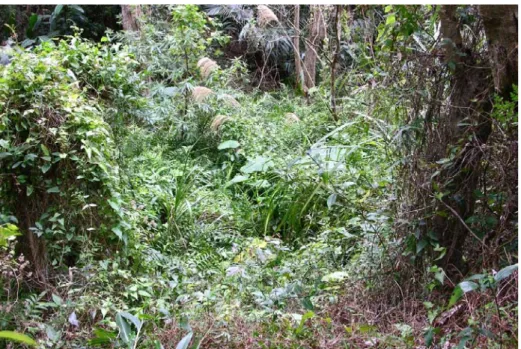
The first author and Mr. Chun-Yih Lin rediscovered this species in Mudan, Pingtung County in autumn 2002. The population in Mudan, Pingtung County was found mostly in wetlands at the shore of streams, where the rhizomes formed a dense submerged mat. The site was located in the low-hills in the understory of secondary forest - the habitat was approximately 20×40 m2 where P. longissimus was one of the dominating herb species. We found no more populations in the neighboring area.
The species was also rediscovered in Lanyu Island by Mr. Wei-Chao Leong and Mr. Shin-Ming Ku in autumn 2002; they found the plant growing on the
ridge side near taro paddies. A small native population in wetland near the taro paddies of Lanyu was also found by Knapp Ralf in autumn 2005. However, these populations in Lanyu Island disappeared when revisited in 2006 - the species might have become extinct again in Lanyu.
Specimens were collected from each sites and deposited in the Herbarium of National Sun Yat-sen University (SYSU). Fresh planting materials were transplanted to the greenhouses of SYSU and National Taiwan University (NTU).
TAXONOMY TREATMENTS
Phymatosorus longissimus (Bl.) Pic. Serm., Webbia 28 (2): 459. 1973; Polypodium longissimum Bl., Enum. Pl. Javae 2: 127. 1828; Phymatodes
longissima (Bl.) J. Sm., Cult. Ferns 10. 1857;
DeVol & Kuo, Fl. Taiwan 1: 199. pl. 69. 1975. Figs. 1-3 Drynaria rubida J. Sm., J. Bot. (Hook.) 3: 397. 1841; Microsorum rubidum (J. Sm.) Copel., Gen. Fil. (Ann. Cryptog. Phytopathol. 5) 197. 1947; Shieh et al., Fl. Taiwan 2nd ed. 1: 502. 1994. Polypodium suisha-stagnale Hayata, Icon. Pl. Formos. 6: 160. 1916; Phymatosorus suisha-stagnalis (Hayata) Pic. Serm., Webbia 28(2): 460. 1973.
Rhizome 4-8 mm wide, long creeping, approaching to 2 or more meters long, not white waxy. Scales ovate or triangular, 3-5 by 1-2 mm, margin entire but sometimes with glandular hairs, apex acute, thinly clathrate, pseudopeltately attached, sparsely distributed on rhizome and densely on the tip of the rhizome and basal stipe. Fronds deeply pinnatifid, herbaceous; stipe 10-80 cm long, green;
lamina elliptic, 30-120 cm long, 30-100 cm wide, the
ratio of length divided by width 1.5 to 5; with a rachis wing 0.1-1 cm; lobes 10-30 at each side, longest lobes located at the lower 1/3 of lamina, 7-40 by 0.7-3.5 cm, the ratio of length divided by width 8-12, base narrowly angustate, decurrent to a rachis wing, apex acute to acuminate, or rounded; margin entire. Sori round, deeply sunken, visible as protrusions on the upper surface, 3-5 mm in diameter; sori usually distributed on the whole surface except lower portion of the lamina.
Examined specimens: TAIWAN: Nantou Co.: Sun-Moon Lake, Hayata s. n. Apr. 20 1916 (TAIF); same loc., S.
Sasaki, s. n. Sep. 12 1929 (TAIF); same loc., Kudo et Sasaki s. n.
Sep. 19 1929 (TAI); same loc., Kudo et Sasaki s. n. Sep. 22 1929 (TAI); same loc., S. Sasaki, s. n. Sep. 1934 (TAI); same loc., S.
Sasaki s. n. Dec. 15 1930 (TAI); Chingshuikou, Huang, T. C. et al.
1100 (TAI, HAST). Pingtung Co. Mudan. Liu, Y. C. 3165 (SYSU).
Hualian Co. Loshan. Tsai 37 (TAI). Taitung Co. Lanyu. Leong, W.
C. 3329 (HAST).
Distribution: China (Yunnan and Hainan); Vietnam; Thailand; India; Philippine; Indonesia; Malaya; S. Japan (Amami Islands and southwards); and Pacific Islands. Taiwan, recently rediscovered only at Mudan, Pingtung Co. (N 22º 09’, E 120º 48’; elevation ca. 260 m.) and Lanyu Island, Taitung Co. (N 22º 02’, E, 121º 32’; elevation ca. 70 m). Taiwan locates on the north limitation of this species (Fig. 1).
DISCUSSION
Leaf texture variance
Blume (1828) described the frond texture of P.
longissimus as membranous in his protologue.
Nooteboom (1997) treated this name on the type specimen collected by Blume (Lectotype: Blumea 35. L.) as the synonym of Microsorum rubidum (Kunze) Copel. However, Polypodium suisha-stagnale has a thinner frond texture and deeper sunken sori than
Polypodium longissimus Blume (Hayata, 1916).
We examined the specimen of P. suisha-stagnale collected by Hayata in the Sun-Moon Lake (Hayata,
s. n. 1916 Sep. 20, TAIF), as well as other specimens
collected by others from the Sun-Moon Lake and the neighboring area. We found all of these specimens resembling the type specimen of M. rubidium (Cuming 241, photograph from National Herbarium Nederland website), which has thicker and narrower pinnae. The material from Mudan has much thinner and broader pinnae, matching the description of P.
longissimus and lectotype specimen (Blume 35,
photograph from National Herbarium Nederland website).
To study the variations between different habitats, the fresh planting materials from greenhouses were examined. After a few months, the plants grew in the semi-shaded greenhouse showed larger and thinner laminae and boarder pinnae; the plants grew in sunny outdoor environment on the campus of NTU had thicker laminae and narrower pinnae. These morphological variationscan be found as well in the wild populations of this species in Taiwan. The plants found in the wetland under a secondary forest in Mudan showed thinner laminae; and plants found near the sunny taro paddy of Lanyu Island showed thicker laminae. Transplanting demonstrated that the textures of lamina, pinnae sizes, degree of sori sunken into the lamina were variable depending on environmental conditions. These findings support the combination of P. suisha-stagnale into P.
Fig. 1. Distribution map of Phymatosorus longissimus (Bl.) Pic. Serm. ★: New distribution. ☆: Historic collected location.
longissimus. The habitat descriptions of P. longissimus are different in some references (Kuo
and Wang, 1985; Fraser-Jenkins, 1997; Iwatsuki, 1995; Lu, 2000), which suggested the species can adapt to various environments.
Evaluation of endangered status
P. longissimus was mainly found in Malaysiana
and is not rare in that region. But in Japan, Taiwan and China (Hainan Island), this species was rare and endangered. In Japan, it was only found in Okinawa
Fig. 2. Natural population of Phymatosorus longissimus in Mudan, Pingtung Co.
Fig. 3. Plants of Phymatosorus longissimus in Mudan, Pingtung Co. Islands (Iwatsuki, 1995) and was classified by Japan Integrated Biodiversity Information System as vulnerable (VU) (30 Sep. 2006; seen in the web,
http://www.biodic.go.jp/english/rdb/rdb_f.html). Dong et al. (2003) also classified it as a vulnerable species in Hainan, China; they suggested the reason caused endangered was the north limitation of distribution of this species.
P. longissimus has high spore germination rate
and proceeding young sporophytes successfully in Taiwan (Chiou et al. unpublished data). However, in Taiwan, P. longissimus has currently been found in wet places, which are easily disturbed or even destroyed by human activities. Besides, the invasive species, Mikania sp. favors the same habitats and competes strongly for space. Previous populations of the species have disappeared in the Sun-Moon Lake, Chingshuikuo, Loshan and Lanyu Island. We suggested that, unless steps are taken to conserve the habitat, the species would soon be extinct again in Taiwan.
According to the distribution information and field observation for more than five years, authors evaluate this threatened species by recent categories and criteria (IUCN 2001) as Critically Endangered (CR), A1d; B2ac (ii+iii); C2a (ii) in Taiwan.
ACKNOWLEDGEMENTS
We wish to thank Dr. Hoyih Liu of the Department of Biological Sciences, National Sun Yat-sen University especially for his valuable suggestions to this manuscript. We also wish to thank the curators of TAI, TAIF and HAST for providing
specimens; Mr. Chun-Yih Lin, Mr. Chih-Kai Yang and Ms. Mei-Fang Kao for assisting in the field investigation; and Prof. Tseng-Chieng Huang who provides his field notes. Thanks also go to Ms. Theresa Tsao, Queensland University of Technology, for correcting English text. The information on Lanyu Island population, provided by Mr. Wei-Chao Leong, Mr. Shin-Ming Ku and Mr. Knapp Ralf, was also appreciated.
LITERATURE CITED
Blume, C. L. 1828. Enumeratio plantarum Javae et insularum adjacentium fasc. 2. Filicea. Lugduni Batavorum. Leiden, Netherlands. 277pp.
DeVol, C. E. and C.-M. Kuo. 1975. Polypodiaceae. In: Li, H.-L., T.-S. Liu, T.-C. Huang, T. Koyama and C. E. DeVol, (eds.), Flora of Taiwan, 1st ed. 1: 165-215. Epoch Publishing, Taipei, Taiwan. Dong, S.-Y., Z.-C. Chen and X.-C. Zhang. 2003.
Biodiversity and conservation of the pteridophytes from Diaoluo Mountain, Hainan Island. Biod. Sci. 11: 422-431.
Fraser-Jenkins, C. R. 1997. New Species Syndrome in Indian Pteridology and the ferns of Nepal. International Book Distributors, Dehra Dun, India. 361pp.
Groombridge, B. 1992. Global Biodiversity. Status of the Earth’s Living Resources. Chapman & Hall, London, UK. 234pp.
Hayata, B. 1916. Icones Plantarum Formosanarum. 6. Taihoku: Bureau of Productive Industries, Taihoku, Taiwan. 168pp.
Iwatsuki, K. 1995. Polypodiaceae. In: Iwatsuki, K. et al. (eds.), Flora of Japan, 1: 234-253. Kodansha Ltd. Tokyo, Japan.
IUCN. 2001. IUCN Red List Categories and Criteria: Version 3.1. IUCN Species Survival Commission. IUCN, Gland, Switzerland and Cambridge, UK. 30pp.
Kramer, K. U. and P. S. Green (eds). 1990. The families and genera of vascular plants. I. Pteridophytes and Gymnosperms. Springer-Verlag, New York, USA. pp. 203-230.
Kuo, C.-M. 1998. The rare and threatened pteridophytes of Taiwan. In: Peng, C.-I and P. P. Lowry II (eds.), Rare, threatened, and endangered floras of Asia and the Pacific rim. Inst. Bot. Acad. Sinica, Taipei, Taiwan. pp. 65-88.
Kuo, C.-M. and B.-J. Wang. 1985. Phymatosorus
nigrescens (Blume) Pichi Sermolli - a new
record. Biol. Bull. Nat. Taiwan Normal Univ. 20: 11-20.
Lu, S.-G. 2000. Phymatosorus In: Lin, Y.-X. (ed.), Flora of Reipublicae Popularis Sinica 6: 155-161. Nooteboom, H. P. 1997. The Microsoroid ferns
(Polypodiaceae). Blumea 42: 261-395.
Pichi Sermolli, R. E. G. 1973. Fragmenta Pteridologiae (IV). Webbia 28: 445-477.
Sasaki, S. 1930. A Catalog of the Government Herbarium. Department of Forestry, Government Research Institute, Taihoku, Formosa. 592pp. Shieh, W.-C., C. E. DeVol and C.-M. Kuo. 1994.
Polypodiaceae. In: Huang, T.-C. et al. (eds.), Flora of Taiwan, 2nd ed. 1: 469-519. Editorial Committee, Dept. Bot., NTU, Taipei, Taiwan. Smith, A. R., K. M. Pryer, E. Schuettpelz, P. Korall,
H. Schneider and P. G. Wolf. 2006. A classification for extant ferns. Taxon 55: 705-731.