行政院國家科學委員會專題研究計畫 期末報告
競合動態與績效: 行動研究法(第 2 年)
計 畫 類 別 : 個別型 計 畫 編 號 : NSC 99-2410-H-004-016-MY2 執 行 期 間 : 100 年 08 月 01 日至 101 年 08 月 31 日 執 行 單 位 : 國立政治大學企業管理學系 計 畫 主 持 人 : 彭朱如 計畫參與人員: 博士班研究生-兼任助理人員:李山 博士班研究生-兼任助理人員:陳柏元 報 告 附 件 : 移地研究心得報告 公 開 資 訊 : 本計畫涉及專利或其他智慧財產權,2 年後可公開查詢中 華 民 國 101 年 10 月 05 日
中 文 摘 要 : 近十幾年來競合已漸漸成為策略管理領域中的重要議題,僅 管競合現象在實務上已愈來愈多見,但從競爭動態的研究領 域觀之,競合動態相對而言是為較新的概念。本研究詳細回 顧自 1996 以來有關競合的相關研究,發現多數研究探討影響 競合的前置因素,以及競合對聯盟形成的影響,較少研究探 討競合動態與績效,因此本研究期能從三個部份來延伸有關 競合的研究議題:一為聚焦於競合動態與績效,有助於瞭解 競合是如何運作以及競合是否能創造更好的績效;二為透過 對於競合動態及績效指標的探究,有助於提供策略制定執行 以及評估與競爭者合作之效益等意涵;三為透過行動研究法 收集深度的質性資料,有助於掌握競合動態的本質,以提供 有價值的實務知識。本研究針對一個由十四家公司所組成的 競合網絡,並收集個案公司之績效資料,分析該公司與競爭 者合作之前中後期的績效變化,以探討與競爭者合作的動態 過程與績效結果。本研究計劃第一年為研究架構訂定及績效 指標確認,第二年為績效資料收集,由於受訪個案公司及受 訪者之高度配合,比預定進度提前完成資料收集。同時,本 研究與英國學者合作,將本研究投稿至國科會推薦之管理類 SSCI 國際學術期刊-British Journal of Management,已接 受刊登,目前正在出刊中。
中文關鍵詞: 競合動態、競合績效、行動研究、策略網絡
英 文 摘 要 : Coopetition has become a heated issue in the last decade. Stemming from the competitive dynamic, the coopetition dynamic is a relatively new construct that has remained relatively unstudied even though the phenomenon is increasingly common in practice. In this proposal, a scrutinized literature review on coopetition since 1996 finds that previous research has emphasized the antecedents driving to coopetition and how coopetition affects alliance formation; less attention has been paid to coopetition dynamics and performance. This study extends the research on coopetition in three ways. Firstly, by focusing on coopetition dynamics and performance it may be possible to determine how coopetition works and whether coopetition creates better performance. Secondly, by investigating the nature of coopetition dynamics and performance, this study provides
valuable implications for evaluating the benefits from cooperation with competitors. Thirdly,
conducting by the action-research approach and
collecting in-depth and reliable data, the case study provides the opportunity to capture the very real nature of coopetition in practice and to develop a valuable practical knowledge of performance
evaluation. The result of this study has been submitted to a SSCI journal- British Journal of Management. By cooperating with scholars in UK, this paper has been accepted and is in the process of publication.
英文關鍵詞: coopetition dynamics, coopetition performance, strategic networks
1
競合動態與績效:行動研究法
摘 要 近十幾年來競合已漸漸成為策略管理領域中的重要議題,僅管競合現象在實務上 已愈來愈多見,但從競爭動態的研究領域觀之,競合動態相對而言是為較新的概念。本 研究詳細回顧自 1996 以來有關競合的相關研究,發現多數研究探討影響競合的前置因 素,以及競合對聯盟形成的影響,較少研究探討競合動態與績效,因此本研究期能從三 個部份來延伸有關競合的研究議題:一為聚焦於競合動態與績效,有助於瞭解競合是如 何運作以及競合是否能創造更好的績效;二為透過對於競合動態及績效指標的探究,有 助於提供策略制定執行以及評估與競爭者合作之效益等意涵;三為透過行動研究法收集 深度的質性資料,有助於掌握競合動態的本質,以提供有價值的實務知識。本研究針對 一個由十四家公司所組成的競合網絡,並收集個案公司之績效資料,分析該公司與競爭 者合作之前中後期的績效變化,以探討與競爭者合作的動態過程與績效結果。本研究計 劃第一年為研究架構訂定及績效指標確認,第二年為績效資料收集,由於受訪個案公司 及受訪者之高度配合,比預定進度提前完成資料收集。同時,本研究與英國學者合作, 將 本 研 究 投 稿 至 國 科 會 推 薦 之 管 理 類 SSCI 國 際 學 術 期 刊 -British Journal of Management,已接受刊登,目前正在出刊中。關鍵詞:競合動態、競合績效、行動研究、策略網絡 ABSTRACT
Coopetition has become a heated issue in the last decade. Stemming from the competitive dynamic, the coopetition dynamic is a relatively new construct that has remained relatively unstudied even though the phenomenon is increasingly common in practice. In this proposal, a scrutinized literature review on coopetition since 1996 finds that previous research has emphasized the antecedents driving to coopetition and how coopetition affects alliance formation; less attention has been paid to coopetition dynamics and performance. This study extends the research on coopetition in three ways. Firstly, by focusing on coopetition dynamics and performance it may be possible to determine how coopetition works and whether coopetition creates better performance. Secondly, by investigating the nature of coopetition dynamics and performance, this study provides valuable implications for evaluating the benefits from cooperation with competitors. Thirdly, conducting by the action-research approach and collecting in-depth and reliable data, the case study provides the opportunity to capture the very real nature of coopetition in practice and to develop a valuable practical knowledge of performance evaluation. The result of this study has been submitted to a SSCI journal- British Journal of Management. By cooperating with scholars in UK, this paper has been accepted and is in the process of publication.
2
INTRODUCTION
Coopetition is a strategy for “cooperation and competition” and for “cooperation with competitors”. Most scholars consider coopetition the phenomenon of simultaneous competition and cooperation (e.g., Brandenburger and Nalebuff, 1996; Lado, Boyd and Hanlon, 1997; Gimeno, 2004; Madhavan, Gnyawali, and He, 2004; Luo, 2007; Chen, 2008; Peng and Bourne, 2009; Kim and Parkhe, 2009), under which two counter-actors could be either cooperators or competitors. On the other hand, coopetition denotes cooperation with competitors (e.g. Dussauge, Garrette and Mitchell, 2000; Bengtsson and Kock, 2000; Luo, Rindfleisch and Tse, 2007; Ritala and Hurmelinna-Laukkanen, 2009; Gnyawali and Park, 2009), which highlights an aggressive strategy of "sleeping with the enemy" (Quint, 1997). This study regards coopetition as “cooperation with competitors” in which they compete in the same market and cooperate in other areas.
I firstly undertake a literature review on coopetition, going back to when the term was first proposed in 1996. I also address the implications and propose a framework from theoretical review. The literature review finds that previous research has three veins on coopetition including the antecedents driving to coopetition, the coopetition dynamics, and the outcome of coopetition. In order to extend previous research on coopetition, the implications were derived from these three veins and a framework is proposed.
As coopetition has become a heated issue both in practice and in research, it is clear that some questions remain unanswered. (1) What is the real nature of coopetition dynamics and cooperative strategy with competitors? (2) Does cooperation with competitors generate superior performance? If yes, how can we evaluate the performance of coopetition in practice? The goal of this study is to reveal the dynamics and consequences of such a coopetition strategy and determine whether there are any significant temporary advantages with coopetition.
THEORETICAL REVIEWS AND FRAMEWORK
This study reviews the research on coopetition since its introduction into the strategic management field in 1996. Based on the theoretical review, a focus on antecedents, dynamics, and outcome is significant in understanding the research streams of this growing phenomenon. Some implications derived from the theoretical reviews. We develop a framework to understand the rationale, dynamics, and performance of coopetition.
Firstly, in the vein of coopetition antecedents, scholars have indicated multi-level factors that influence coopetition. At the firm level, inwardly, heterogeneous or complementary resources (Bengtsson and Kock, 2000; Gnyawali and Park, 2009; Peng and Bourne, 2009), similar or common resources (Ritala and Hurmelinna-Laukkanen, 2009; Gnyawali and Park, 2009), and management commitment, relationship development (Chin, Chan, and Lam, 2008); outwardly, closeness of an activity to the customer, competitors' (Bengtsson and Kock, 2000), competitive position or pressure in the markets (Bengtsson and Kock, 2000; Ritala and Hurmelinna-Laukkanen, 2009), higher market diversity (Gnyawali, He, and Madhavan, 2006), and centrality and structural autonomy in the network (Gnyawali and Madhavan, 2001; Gnyawali et al., 2006) influence coopetition. At the industry level, short product life cycle, technological convergence, and high R&D cost (Gnyawali and Park, 2009) may affect coopetition for technological innovation. The above-mentioned factors can be categorized into two types of antecedents both inwardly and outwardly: resource similarity and market commonality.
The concept of resource similarity and market commonality were derived from the theoretical perspective of competitive dynamics in Chen’s (1996) study. Market commonality is defined as the degree of presence that a competitor manifests in the market is overlaps with
3
the focal firm; whereas resource similarity is defined as the extent to which a given competitor possesses strategic endowments comparable to those of the focal firm (Chen, 1996: 106, 107). Prior studies such as Silverman and Baum (2002), Gimeno (2004), Gnyawali et al. (2006), Luo (2007) have taken competitive dynamic perspective as the theoretical focus on coopetition. We contend that resource similarity and market commonality may affect not only competitive dynamics but also competition-cooperation dynamics.
Secondly, in the vein of competition-cooperation dynamics, both competition and cooperation are integral parts of a firm’s overall strategy. The relationship between competition and cooperation is very dynamic. However, the strategy literature has yet to investigate the fundamental question of the conceptual relationship between competition and cooperation (Chen, 2008: 289). Lado et al. (1997) began to propose a four-cell typology of rent-seeking behaviors with competitive orientation and cooperative orientation. Following their typology, scholars examined the horizontal relationships either in two relations (e.g., Gimeno, 2004; Madhavan et al., 2004) or four types (e.g., Luo, 2007). Their typologies of competition-cooperation dynamics reflect the Western thinking that competition and cooperation are regarded as two opposite ends on a spectrum, unlike the Eastern polar thinking that the relationship between competition and cooperation is harmony (Peng and Bourne, 2009), interrelated or interdependent and together they may form a new theoretical construct or phenomenon (Chen, 2008). We consider that the dynamics of competition-cooperation relationships in different periods can be depicted based on Chen’s (2008) transparadox framework. In the early period, the coopetition dynamics represented as independent opposites in which competition and cooperation are regarded as two independent, opposites, and separate parts. In the later period, competitors identified collaborative strategy regarding the common areas where competitors would work together, representing the interconnected opposites in which the individual forces of competition and cooperation are independent, but there is a common area where competition and cooperation connect and coexist between firms.
Thirdly, in the vein of coopetition performance, in order to measure the coopetition outcome, some have focused on survival, such as failure rate (e.g. Park and Ungson, 2001; Park and Russo, 1996), exit rate (e.g. Silverman and Baum, 2002) and alliance outcome of reorganize, takeover, continue, and dissolve (Dussauge, Garrette and Mitchell, 2000) rather than on performance. Ketchen et al. (2004) stressed that instead of using termination as an outcome measurement, intermediate outcomes may include variables such as trust levels achieved or the relationship's duration. Final outcomes may include perceived success, concurrent financial gain, coopetitive relationship goal achievement, product or process improvement, and/or resource sharing. There are some empirical studies examining the effect of coopetition on firm performance by measuring from single financial indicator to multiple measurements (e.g., Oum, Parke, Kim and Yu, 2004; Luo, Slotegraaf and Pan, 2006; Luo, Rindfleisch and Tse, 2007; Kim and Parkhe, 2009). They were limited to view performance in a wide variety of performance areas because of using archival data or survey. However, the consequences of inter-firm competition-cooperation relationships encompass both social and economic outcomes, thus a broader view of business performance than just the maximization of profits is necessary. To gain a multidimensional conceptualization of business performance, research and managers must pay equal attention to various aspects of a firm’s conduct (Lado et al., 1997). We therefore adopt a comprehensive view to examine the performance in some key areas such as cost/efficiency, quality, choice/convenience and sales volume.
Figure 1 shows a conceptual framework to analyze the relationships among resource similarity, market commonality, the competition-cooperation dynamics, and performance. We
4
argue that resource similarity and market commonality will affect the competition-cooperation relationship between competitors. Each firm has a unique market profile and strategic-resource endowment and that a pair-wise comparison using these two dimensions (resource similarity and market commonality) will help to predict how they might interact in the market (Chen, 2009: 11). As Luo (2007) argued, market commonality contributed more to competition whereas resource asymmetry contributed more to cooperation. In addition, the competition-cooperation relationship between rivals may affect performance.
METHODOLOGY Research approach
Given the novelty of construct/phenomenon, appropriate and well-developed measures do not exist to perform large sample studies of coopetition. Gnyawali and Park (2009: 324) suggested that in-depth case study could examine coopetition more systematically and deeply. In-depth case in the context of coopetition could provide additional understanding of phenomenon and help with operationalizing collective value creation through coopetition (Dussauge et al., 2000; Ritala et al., 2009). Therefore, this study is conducted by case study approach to gather more rich data, which makes possible multifaceted descriptions of coopetition.
Research setting
The research investigates a focal supermarket company and its coopetitive network in a specific geographic area in central Taiwan. The focal company was established in 1955 and has extended its business from a single business unit in agricultural pesticides to multiple business units. The distribution group is the leading business unit. The focal supermarket company, which belongs to the distribution group, was launched in 1988 and is operated on a chain-store business model with 34 chain stores. In order to acquire more competitive advantages, the focal company formed a strategic network with 13 other companies, including both competitors and other partners. One of the major partners, the X Supermarket, is its main competitor, which owns 278 chain stores island-wide. Three other smaller competitors also joined the network. In addition, vertical linkages incorporated strategic partners from various industries, such as the Meat Product Association, the Supermarket Association, the Software Association, two information technology companies, the catering division, the agricultural pesticide supply center, suppliers and two other Japanese companies. The network formation comprised three periods: pre-network, network formation, and post-network, and these are described in the later section. This project is designed to investigate the coopetition dynamics and performance within the three periods.
Action research and performance measurement
The data collection is conducted by action research approach. In common with other forms of qualitative research, action research has become increasing prominent among management researchers as an espoused paradigm used to justify the validity of a range of research output (Eden and Huxham, 1996). Rather than just through interviews or questionnaires, the action research is more similar to ethnographic form of research that derive their insights from naturally occurring data (Tetlock, 2000). The research output resulting from an involvement with practitioners of an organization over a matter provides a
5
richness of insight that could not be gained in other ways (Whyte, 1991; Eden and Huxham, 1996).
This project is conducted by intensive data collections with fourteen CEOs and top managers, one from each company in the network. The interviewees were senior people who held top positions including two board chairmen, one board director, five chief executive officers (CEOs), one vice-CEO, and five top managers. They were all representatives of their companies in the network and involved in their firms’ strategic decision-making.The fourteen CEOs and top managers in the network are relatively inaccessible informants who are highly accurate because of their deep and frequent involvement in the network decision-making.
All of the fourteen major network members had been involved in intensive meetings for identifying the areas they can cooperate to gain competitive advantages for joint value creation. They together identified five key cooperative strategies and 31 performance indicators for evaluating the outcome of the five strategies.
Performance data of the focal company between 1991 and 2005 was collected. Five timeframes including 1991-1993 and 1993-1995 in pre-network period, 1995-2000 in network formation period, and 2000-2002 and 2002-2005 in post-network-formation period were used. Of particular interest was the change between each adjoining pair of timeframes. The data was collected from the focal company’s internal database of financial and operating statistics and reports. In order to preserve confidentiality, absolute figures for each year are not disclosed but are instead reported as changes in each timeframe and the differences between each pair of successive timeframes are analyzed. Appendix 1 shows the performance changes between timeframes.
RESULTS Coopetition dynamics
Following our framework, we demonstrate the rationale and dynamics in each of the three periods. Each period represents different competition-cooperation relationship, which was driven by different rationale of market commonality and resource similarity.
1991-1995: Pre-network period
Competition and cooperation. During this period, supermarket players in central Taiwan suffered intensive competitive not only from their major supermarket rivals but also from traditional markets, night markets and convenience stores. Geographic proximity, combined with density of existing stores, led to highly intensive competition. It is clear to observe the competition strategies in the battles of pricing, promotion campaigns, distribution channels and product delivery and diversification.
In 1990, the focal company sent a team of top managers to visit a leading supermarket company in Japan to learn their management skills and business models. They learned that the division of labor among food-processing, logistics and sales activities enabled the supermarket to control costs, which allowed even small supermarkets to survive. At that time, players in Taiwanese supermarket industry suffered from high costs due to un-integrated logistic, delivery and transportation activities. Therefore, the knowledge learning from Japan facilitated the focal company’s efforts in upstream diversification and integration. In 1991, the focal company established its transportation center and recruited suppliers to join a co-transportation system. Benefiting from co-transportation, the focal company was inspired to form a strategic network. Thus, a plan for integrating partners to forme a strategic network was launched. In the pre-network period, the competition between focal company and its rivals is intensive. Cooperation existed only between the focal company and non-rival
6
partners in upstream activities. Thus, the competition-cooperation relationship represents as independent opposites in this period.
Market commonality and resource similarity. During this period, the extent of market commonality between the focal firm and its competitors was high. Due to intensive competition between rivals, the focal firm’s network was confined to forming partnerships with vertical but not horizontal connections; the focal firm shared no market commonality with its vertical partners. On the other hand, the resources between the focal company and its competitors were highly homogeneous and symmetric in human resources, financial resources, R&D capabilities, logistic resources, marketing resources and information systems, which led to intensive competition. On the contrary, the resources between the focal company and its vertical network partners were heterogeneous and asymmetric, resulting in cooperation. This echoes the resource-based view (RBV) that firms acquire complementary resources from an alliance, which provides opportunities to create re-deployable resources. In this case, the transportation center established by the focal firm made it possible to integrate suppliers into a strategic network with vertical connections.
1995-2000: Network-formation period
Competition and cooperation. During this period, a low-pricing strategy was widely adopted among competing players, which not only reduced their profitability but also blocked them from exerting the "high-quality” strategy. However, the focal company was able to perform not low pricing but a different competitive strategy by improving its management and business model. For example, success in the integration of transportation and distribution activities with suppliers ensure fast turnover on fresh food delivery. In addition, the connections with two Japanese companies enable the focal firm to transfer know-how and to benefit from a better reputation in Taiwanese market. Therefore, , a small competitor, JJL supermarket, joined the network in 1995, then was followed by the joining of SC Supermarket in 1996, opening the gateway to cooperation with competitors, although they were not major rivals. In 2000, a large-scale competitor, the X supermarket, joined the network with its 278 chain stores. Thus, the journey of "coopetition" started. In this period, the competition was still a dominant force in the marketplace despite the emergence of cooperation between competitors. The competition-cooperation relationship has been moving from independent opposites towards interconnected opposites.
Market commonality and resource similarity. Competition in this period was even more intensive, inducing rivals to collaborate. As Luo (2005) indicates that players with high market-overlap are more likely to cooperate more than those with low market-overlap. It is important to interact with competitors and learn from them because collaboration provides a way of getting close enough to rivals to predict how they would behave (Clarke-Hill et al., 2003). They could also benchmark themselves and prepare for the consequences of competition. In this network, the major rival partner, X supermarket owned a large chain-store system. Collaboration as a whole in the geographic market in central Taiwan allowed them to strive for increased power over suppliers and to reach a better position in the market. They realized that the ability to maintain both the structure of the industry and the firm's position within it could be enhanced by cooperation with competitors.
In addition, competitors can cooperate if they develop shared resources that tie them together to enhance their competitive advantage. Particularly when located in the same geographic market, competitors are more likely to cooperate because geographic proximity permits more frequent contact between them, facilitating knowledge transfer, coordination and sharing of activities (Madhavan et al., 2004). During this period, due to the success of supplier integration to share the resources in food-processing center, distribution center and
7
transportation team, the focal firm and its competitors did benefit from cooperation in these common activities. This reflects Luo’s (2005) argument that resource similarity such as product similarity implies that competitors share more commonality in product development, process innovation, and quality control, all important collaborative areas. Thus, intensive competition in this period did foster cooperation among competitors, which not only enhance their powerful market positions but also enlarge economic benefits by sharing similar resources.
2000-2005: Post-network-formation period
Competition and cooperation. During this period, intensive competition still exists in the battle of pricing and promotion. The JJF Supermarket, another small competitor, joined the network in 2002. The more complicated interactions (competition and cooperation) between and among rival and non-rival partners, the more coordination and integration in an efficient way is needed. The rival partners compete intensively in the geographic market while they work closely together to identify activities where they could cooperate and areas where they remain competition. To foster cooperation, a series of discussion and coordination meetings were launched by network members. Together they identified five cooperative strategies including co-procurement, co-marketing, co-distribution, chain store co-management, and integrated information system.
The co-procurement strategy is to enlarge the economy of scale in procurement and to control purchasing costs and items. They formed a co-procurement committee, which was composed of the representatives from the focal firm and rival partners. They designed a procedure to collect and pool all the network members’ purchasing orders based on a shared information system. Then the committee is responsible for negotiation with suppliers on behalf of all the network members. The co-distribution strategy is to reduce cost, to enlarge the economy of scale, and to increase efficiency in distribution, delivery and transportation. All of the stores could make their orders directly from the distribution center via POS system, which were then pooled and placed ordered with suppliers by EOS system in the distribution center.
The co-marketing strategy is to offer a variety of products and services for customers. They organize a co-marketing expertise team with experts from the focal company and network members. The co-marketing team is responsible for creating and initiating joint promotion campaigns, in which the team selects product items for promotion and co-marketing activities. The chain-store co-management strategy is to decrease operating costs, to increase sales profits and growth rate, to improve product layout and management, and to enhance chain-store staffs’ capabilities. Similarly, they formed an expertise team with a group of well-experienced experts and senior staff from the network partners. The team is responsible for mentoring and coaching various kinds of chain-store activities and plans.
The integrated information system is designed to support the cooperative strategies and to manage joint programs efficiently. Benefiting from the integrated information system, network members could not only control expenditure on hardware and software but also access information timely and accurately.
In the post-network-formation period, competition was no longer the dominant force and cooperation emerged as a stronger force, showing the interconnected opposites. The focal company and its rival partners identified five common areas for cooperation, whereas they kept competing in the marketplace other than the common areas.
Market commonality and resource similarity. Although competitors compete in the same geographic marketplace, they cooperate because of encountering with similar market situations and resource constraints. Both resource heterogeneity and homogeneity can explain
8
cooperation with competitors based on the resource-based view. With resource homogeneity, horizontal alliances involve the exchange, sharing or co-development of products, technologies or services among firms engaged at the same stage in the value chain (Gimeno, 2004). On the other hand, resource heterogeneity can foster cooperation while unique resources can be advantageous for both cooperation and competition (Bengtsson and Kock, 2000). In this period, the five cooperative areas were driven by resource similarity and asymmetry among rival and non-rival partners.
Resource similarity among rival partners provides the opportunity for sharing more common activities of procurement, food processing, warehouse, transportation and distribution. These are all important collaborative areas to enlarge the economies of scale and to reduce costs. In addition, joint human resource programs not only improve employees' skills and knowledge but also enlarge the economy of scale in human resource training and development.
From a resource asymmetry perspective, because the focal firm belongs to a multiunit enterprise with business in agricultural pesticide products, it is characterized as R&D-focused, particularly in agricultural pesticide residue testing. This advantage was shared with its partners. In addition, the focal firm used to be a powerful member of the supermarket industrial association before the network formation and held a key position in designing the IT standardization of the supermarket association. The focal firm worked with its IT partners to develop the IT platform and standardization, which made a fundamental base for cooperation strategies.
Performance
The research sought to answer two specific questions concerning about the benefits of cooperation with competitors, these were:
• Whether the adoption of coopetition permits the attainment of performance levels beyond those possible with the conventional approach to competition and cooperation and;
• Whether the adoption of coopetition merely changes the timeframe permitting the earlier achievement of higher performance levels.
In order to address the two questions above, the analysis necessarily involved the analysis of trends and changes in the performance data over the 15-year period. To remove subjectivity, the data was initially analyzed from a mathematical standpoint alone without reference to cause. If the first proposition were correct then an accelerated rate of improvement in the indicators would be seen. If the second proposition were correct then the nature of change would be such that extrapolated improvements from before network formation would eventually catch up with what actually occurred.
Although there were three distinct time periods, pre-network, network formation and post-network formation, it would be wrong to assume that the data should be analyzed on that basis. In order to look for patterns in the data it was necessary to determine the trends in 31 performance measurements. Non-linear regression analysis was undertaken using polynomial best fit. As there were five longitudinal data points for each factor, polynomials of order 4 could always be found that would fit the data perfectly. However, lower order polynomials were sought since they are less prone to Runge’s phenomena (Boyd, 2005), and will reduce the impact of rogue data and conform to the spirit of Occam’s razor (Domingos, 1999). Furthermore, the data come from a longitudinal study with each point being, to an extent, dependent on the previous points through the causality of management. Thus, for several orders of polynomial, R2 and, in the manner of “studentised” residuals, the standard deviation in R2 for the 31 data streams was also taken. The data in Table 1 gives the data and shows that it is correct to analyze the data further using 3rd order polynomial function.
9
- Insert Table 1 here -
Depending on the subject of the individual data streams, four types of curves are possible, two that show decreases such as in costs and two that show increases such as in variety. These are illustrated in figure 2 and are called “Increasing Type 1”, “Increasing Type 2”, “Decreasing Type 1” and “Decreasing Type 2”.
- Insert Figure 2 here -
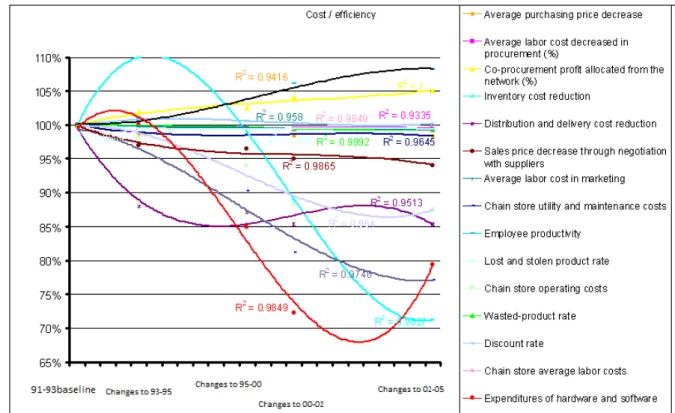
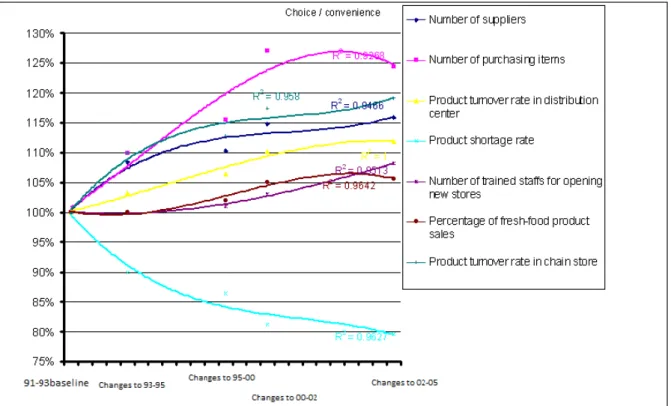
Figures 3-6 show the types and trend lines for all the indicators. In the diagrams and in the results presented later, each data stream is plotted with its initial point at 1. Since the experimental data was collected for the most part based on a percentage change between performance at one time and performance at another there is no absolute starting value. To overcome this, a starting value of 1 was set arbitrarily and the performance changes expressed relative to 1. The x-axis shows the changes in strategies over the period of the study. The changes are spaced to correspond with the dates at which those changes occurred.
- Insert Figure 3, 4, 5, 6 here -
Each performance attribute has an expected profile. For example, in the absence of other factors it was expected that staff productivity would increase over time as continuous but relatively minor improvements were made to processes. The adoption of coopetition can be seen as a major improvement in processes and could be expected to make a disproportionately large change in productivity. There are two scenarios that need exploration and which cover the results for the majority of the indicators. The first is that the adoption of coopetition permits the attainment of performance levels beyond those possible with the conventional approach to competition and cooperation; the second is that the adoption of coopetition merely changes the timeframe permitting the earlier achievement of higher performance levels.
The case for the attainment of performance levels beyond what would otherwise have been possible is typified by the Type 1 profiles where there is an early transition from the first section of the curve to the second section in which the gradient is small. This equates to stagnation in performance levels. The final section of the regression curve then takes performance to the levels beyond those otherwise obtainable. The condition for this is that the first turning point, calculated from its first derivative, is less than average and corresponds to a time at or before the instigation of the coopetition arrangements.
The case for the early attainment of expected performance is a feature of Type 2 profiles only. Here, low gradients early in the study period, if produced, would yield similar performance levels to those achieved with coopetition but at a later date. The time difference is calculated by producing a linear regression based on the first three points and finding the last point of intersection with the polynomial regression line.
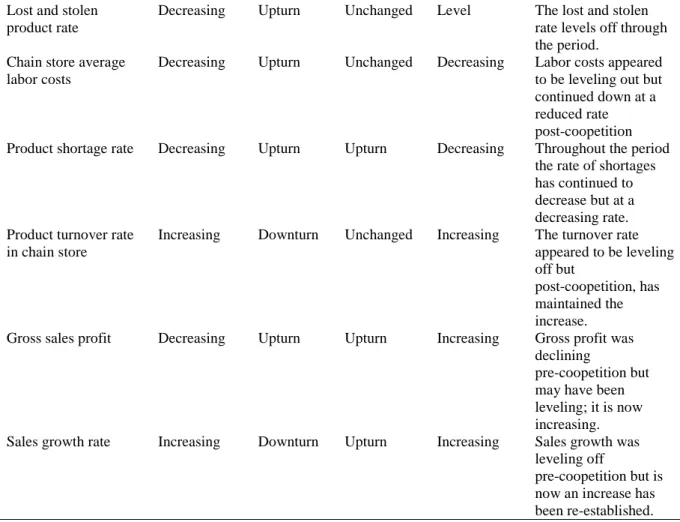
With such a diverse set of measurements and subsequent grouping by strategic area or category, it is impossible to take any one group and give a general appreciation of the changes in performance levels. Instead, all that can be done is to treat measurements separately. For Decreasing Type 1 and Increasing Type 1 behaviors, Table 2 sets out the measure, its behavior between 1991 and 1995 and compares this with the corresponding data at 2000 and between 2000 and 2005. Note that the sign of the second derivative of the regression curve shows whether a maximum or a minimum has been encountered. From Table 2 it can be seen that the rate of change in the indicators was slowing down towards the end of the pre-network stage but that the trend of improvements had in general been reinstated by the end of the network formation stage.
For Decreasing Type 2 and Increasing Type 2 behaviors, Table 3 sets out the same data as shown in Table 2 but in addition the comments column also contains an estimate of when
10
(if ever) the pre-coopetition performance would have matched the performance with coopetition. It should be noted that while a 3rd order polynomial regression curve has been used, it is unwise to extend predictions much beyond the data and dates shown. The reason for this is that there are many exogenous factors that are unknown and which would affect the results. Thus to the results presented should be added the caveat that exogenous factors, while present, are ignored. From Table 3 it can be seen that the instigation of the coopetition network has led to both changes in rates of improvement and to a step change in value. On average, this is equivalent to a 3-year advancement in performance.
The results of 31 performance indicators by analyzing their Increasing Type 1 and Type 2, and Decreasing Type 1 and Type 2 behavior confirms that cooperation with competitors did lead to better performance at least in a period of time in the following ways: (1) adoption of coopetition permits the attainment of performance levels beyond what would otherwise have been possible; (2) adoption of coopetition changes the timeframe permitting the earlier achievement of higher performance. On average, the time advantage was 3 years but ranged from 6 months to 7½ years; and (3) adopting coopetition can reinvigorate performance improvement when indicators show pre-network performance improvements to be slowing down.
- Insert Table 2 and 3 here – DISCUSSION AND IMPLICATIONS
By investigating a focal company and its coopetition network, this study describes the dynamics and performance of cooperation with competitors from the focal firm’s perspective. We found that firms benefited from coopetition. We also discuss how market commonality and resource similarity can be used to explain coopetition dynamics.
The presence of coopetition dynamics demonstrates that in the pre-network period, the focal company cooperated with vertical but not horizontal partners due to competition. The competitive advantages obtained from vertical cooperation further attract small-scale competitors to join the network. The cooperative scale was enlarged by collaboration between the focal firm and its small competitors, which then in turn forced the large competitor to cooperate in the same geographic market, driving the formation of coopetitive network in the next period. Previous study on the competitive dynamic (e.g., Chen, Su, and Tsai, 2007) asserts that relative scale is one of the important contingent variables affecting firms' action-response strategies. The greater the relative scale, the greater the perceived competitive tension. Large-scale firms are more likely to initiate massive attacks on their rivals. Here, we extend their argument from competitive dynamics toward coopetition dynamics. We argue that while the major competitor (X supermarket) perceived competitive tension from the enlarged collective scale constituted by the focal firm and its smaller rivals, X supermarket reacted not by launching head-on attacks but by cooperating with competitors. This demonstrates the importance of keeping strategic balance between rivals. Under intensive competitive tension, instead of competing to the dead end, cooperation is obviously a better strategy to keep balance and to stay alive for both parties. This phenomenon reflects the Yin-Yang philosophy in Ancient Chinese culture, in which co-existence of Yin and Yang is the core ontological statement. Yin and Yang are reciprocally rooted in and mutually promoted with each other, unlike polar eastern thinking in which patterns such as good or bad are predominant. What we observed in this case shows that competition (yang) and cooperation (yin) are mutually rooted and fostered. Competition triggers cooperation between the focal company and its vertical partners and small competitors, enlarging the collaborative scale, which then escalats competitive tension between the focal firm and its major competitor. This tension further triggers the major competitor to react by cooperation rather
11
than head-on competition. As the traditional Yin-Yang philosophy suggests, opposites define and are defined by each other. Any action or relationship may contain the seeds of its opposite. A competitive action may elicit a cooperative response, and similarly, cooperation will often provoke competition, demonstrating an array of competition-cooperation interplays (Chen, 2008: 299). We therefore derive the first implication.
Implication 1: Competition and cooperation are mutually rooted in and promoted with each other. Cooperation increases the relative scale of market power, resulting in higher intensive competition. Conversely, intensive competition fosters more cooperation between rivals.
In the post-network-formation period, the coopetiton dynamics moves from balancing market power between rivals toward balancing strategies between competition and cooperation. Despite the ongoing competitive battles, competitors work together to find common areas for cooperation. Chen et al. (2007) argues that two major opponents would experience greater competitive tension if they rely on similar resources for operation. However, we argue that the greater the dependence on the same resources for both opponents, the greater the possibility of cooperation and coordination for resource sharing because they are both confronted with similar resource constraints. The best partner for a firm is its strong competitor in many cases. In this case, by cooperating with competitors, the focal company and its rivals can not only maintain both their market power and position but also initiate organizational change and improvement, which was stimulated by pooling and sharing resources from competitors. However, in the circumstance of coopetition, the balance between competition and cooperation becomes a more significant and challenging strategic issue. Here competitors’ coordination of common cooperative areas leads to the strategies for balancing competition and cooperation, which is fostered by the prior experience of cooperation and balancing market power between rivals. The analysis of 15-year performance demonstrates how the focal firm can maintain a temporary balance between competition and cooperation to generate better performance in the short term.
This reflects the principle interaction between yin and yang, which concerns the dynamic balance between two forces. Accordance to I-Ching: Book of Changes, sustainability could never be forever but can exist only in a certain period of time. Here, we argue that the change between cooperation (Yin) and competition (Yang) concerns the temporary or dynamic balance and harmony. It appears that there is always a new equilibrium point where coopetition will work, at least for a period, until the dynamics are disrupted again by other endogenous and exogenous forces (Peng and Bourne, 2008). However, the results of coopetition performance in this case confirm that firms can achieve better performance in the short-term by using a temporary coopetition strategy and maintaining a balance in the changes between competition and cooperation. Thus, we can derive a second implication.
Implication 2: Coopetition strategy and balancing competition and cooperation leads to better performance in a certain period by: (a) permitting the attainment of performance levels beyond what would have been possible; (b) changing the timeframe permitting the earlier achievement of higher performance.
CONCLUSIONS
Coopetition has attracted more attention from both practice and research. This study explores a series of temporary or dynamic strategies between 1991 and 2005 to reveal the
12
temporary change and advantage of cooperating with competitors. The results based on the analysis of 15-year performance confirm that cooperation with competitors leads to better performance than would have been expected. Our findings imply that competition and cooperation are mutually rooted in and promoted by each other. Cooperation increases the relative scale of market power, resulting in higher intensive competition. Conversely, intensive competition fosters more cooperation between rivals. We also found that coopetition strategy leads to better performance at least for a certain period. Cooperating with competitors can permit the attainment of performance levels beyond what would have been possible, by changing the timeframe to permit the earlier achievement of higher performance, and by reinvigorating performance improvement when indicators show that pre-network performance improvements are slowing down. However, our findings have evoked two critical issues.
Firstly, whether cooperation with competitors involves anti-competitive policy issues? When competitors collaborate mainly for price-discriminating conducts, it is considered a collusive problem because coopetition breaks the perfect competition model thus hinders consumers’ benefits (Levin and McDonald, 2006). However, the proliferation of coopetition challenges the anti-competitive policy. Coopetition could be beneficial to consumers by lowering costs and improving the value of market offerings (Levin and McDonald, 2006). Coopetition in price-discriminating conducts is problematic but coopetition in R&D and technological innovation may not be problematic because it is likely to help bring unique products and create new markets for consumers (Gynawali and Park, 2009). Here, what we observed is that cooperation between competitors focuses on value creation rather than on collusion. They cooperate in the activities of co-procurement, co-marketing, co-distribution, chain store co-management and integrated information systems for creating value to the customers by lowering costs, increasing efficiency, improving quality, and providing convenience and choices. However, they remain inter-store competition in variety of goods offerings, price, customer services, and geographic coverage. Therefore in this study, competition triggers vertical cooperation that enhances the focal company’s value creation, which then escalates competitive tension between the focal firm and rivals. This tension further evokes rivals to react by cooperation for joint value creation rather than pricing collusion. Thus, coopetition in this supermarket setting does not violate the antitrust issue but is more beneficial to customers.
Secondly, whether performance changes are accountable to coopetition only? Key benefits of coopetition include a pooling of expertise and resources to create synergy, to enlarge the economies of scale, to reduce cost and risk, to develop products and deliver better services by learning and working together. In this study, the fourteen top managers together choose 31 performance measures in five key cooperative areas. These indicators are considered very important and relevant to gauge the performance of cooperation with competitors. The reasoning behind picking these measures (as described earlier) is based on strategic goals of cooperative areas. However, we found that coopetition did lead to better firm-level performance. There must be other contingencies or strategic activities that are responsible for firm-level performance changes across time. This reflects that the motivation and benefit of the engagement in alliances is to acquire external resources and to combine them with internal resources in order to gain competitive advantages and therefore generating firm performance. Thus, coopetition might not be the only factor accountable for better performance, but it did influence a firm’s resource combination and synergy acceleration to the attainment of superior performance.
As an extension to previous research on coopetition, this research contributes to current research in both theoretical and practical ways. Theoretically, this study provides a
13
scrutinized review of recent research on coopetition regarding three veins, from which we derived the implications and proposed a framework to analyze the phenomenon. The analysis of coopetition dynamics and performance and the discussions based on Chinese Yin-Yang philosophy has derived two implications that extend our knowledge of coopetition. Practically, this study demonstrates the evolutionary picture of coopetition dynamics and examines the performance by multidimensional measurement. This practice-oriented study provides rich data and a reference for executives to understand the coopetition benefits and to gauge coopetition performance. However, the study is also limited, remaining the need for further research.
Firstly, trade-offs are inevitable in data disclosure. This study does not disclose the absolute performance figures of each year but uses data related to the changes between each pair of adjacent timeframes because it is necessary to preserve confidentiality. In addition, deciding how to measure performance across networks rather than within organizations is a substantial issue in performance measurement (Neely, 2005). This study examines only the performance of the focal company and not those of the other partner companies. Future research may also determine the nature of coopetition at different levels, such as intra-organizational, dyadic level and network level.
Secondly, given the complex nature of coopetition, the field research method is useful to determine coopetition performance (Ketchen et al., 2004). This research is exploratory. However, we do not intend to generalize our findings. The goal of this study is more limited and is confined to demonstrating how coopetition works and how to know it works well in practice.
Lastly, some issues related to coopetition merit further research. These include determining the nature of any drawbacks in coopetition. Despite the proliferation of coopetition in practice, previous research has shown that coopetition is detrimental to performance. For example, cooperation with competitors in a JV has a significant chance of failure (Park and Russo, 1996). There are dark sides of coopetition such as technological risks, management challenges, and loss of control (Gnyawali and Park, 2009). Therefore, future research should examine not only the positive influence but also the negative effects on performance.
As far as the coopetition strategy is concerned, this study answered the question: is cooperation with competitors a good idea? We argue that while there may be even better strategies to follow, coopetition is a good idea in practice. Cooperation with competitors generates a temporary improvement in performance at least for a certain period. This study uses a rich and in-depth database, contributing a more complete exploration and explanation for coopetition in both practice and research.
計畫成果報告自評
本研究獲得兩位在英國學者的支持,Dr. Stephan Pike and Professor Goran Roos,本 人過去與該兩位學者有多篇文章發表於智慧資本相關的國際學術期刊及研討會論文。另 外,基於個人先前與另一位英國學者 Professor Mike Bourne 曾有一篇共同發表於 British Journal of management (IF=1.839)文章,該文係探討"網絡層次之競合"的議題,此計畫延 續先前對於"競合"的研究主流,透過與英國學者的長期密切互動,本研究預期在理論面 能更深入探討"競合動態與績效"之議題。在實務面,藉由對於一個競合網絡在聯盟形成 之前中後期的績效分析,說明與競爭者合作的動態過程及結果,期能提供實務界對於競 合網絡之參考價值。
14
於受訪個案公司及受訪者之高度配合,比預定進度提前完成資料收集。並將研究與英國 學 者 合 作 , 投 稿 至 國 科 會 推 薦 之 管 理 類 SSCI 國 際 學 術 期 刊 British Journal of Management,在投稿過程中,針對審查委員之意見回覆,與兩位共同作者有多次的互 動討論,終獲得該期刊接受刊登,目前已進入 Early review 階段。
References
Barretta, A. (2008). 'The functioning of coopetition in the healthcare sector: An explorative analysis',
Scandinavian Journal of Management, 24, pp. 209-220.
Baum, J. A. C. and H. J. Korn (1999). 'Dynamics of dyadic competitive interaction', Strategic Management
Journal, 20, pp. 251-278.
Bengtsson, M. and S. Kock (2000). 'Coopetition in business networks - to cooperate and compete simultaneously', Industrial Marketing Management, 29, pp. 411-426.
Bengtsson, M. and S. Kock (1999). 'Cooperation and competition in relationships between competitors in business networks', Journal of Business & Industrial Marketing, 14(3), pp. 178-193.
Brandenburger, A. M. and B. J. Nalebuff (1996). Co-opetition. Doubleday, New York.
Boyd, J. P. (2005). 'Trouble with Gegenbauer reconstruction for defeating Gibbs phenomenon: Runge phenomenon in the diagonal limit of Gegenbauer polynomial approximations', Journal of Computational
Physics, 204, pp. 253-264.
Chen, M. J. (1993). 'An exploration of the expertness of outside informants', Academy of Management Journal, 36(6), pp. 1614-1632.
Chen, M. J. (1996). 'Competitor analysis and interfirm rivalry: toward a theoretical integration', Academy of
Management Review, 21(1), pp. 100-134.
Chen, M. J., K. H. Su and W. Tsai (2007). 'Competitive tension: the awareness-motivation-capability perspective', Academy of Management Journal, 50(1), pp. 101-118.
Chen, M. J. (2008). 'Reconceptualizing the competition-coperation relationship: A transparadox perspective',
Journal of Management Inquiry, 17(4), pp. 288-304.
Chen, M. J. (2009). 'Competitive dynamics research: An insider’s odyssey', Asia Pacific Journal of Management, 26(4), pp. 5-15.
Chin, K., B. Chan and P. Lam (2008). 'Identifying and prioritizing critical success factors for coopetition strategy', Industrial Management & Data Systems, 108(4), pp. 437-454.
Clarke-Hill C., H. Li and B. Davies (2003). 'The paradox of cooperation and competition in strategic alliances: Towards a multi-paradigm approach'. Management Research News 26(1), pp. 1-20.
Domingos, P. (1999). 'The Role of Occam’s Razor in Knowledge Discovery', Data Mining and Knowledge
Discovery , 3, pp. 409-425.
Dussauge, P., B. Garrette and W. Mitchell (2000). 'Learning from competing partners: Outcomes and durations of scale and link alliances in Europe, North America and Asia', Strategic Management Journal, 21(2), pp. 99-126.
Gimeno, J. (2004). 'Competition within and between networks: The contingent effect of competitive embeddedness on alliance formation', Academy of Management Journal, 47(6), pp. 820-842.
Gnywali, D. and R. Madhavan (2001). 'Cooperative networks and competitive dynamics: A structural embeddedness perspective', Academy of Management Review, 26(3), pp. 431-445.
Gnyawali, D. R., J. He and R. Madhavan (2006). 'Impact of co-opetition on firm competitive behaviour: An empirical examination', Journal of Management, 32, pp. 507-530.
15
Gnyawali, D. R. and B.-J. Park (2009). 'Co-opetition and technological innovation in small and medium-sized enterprises: A multilevel conceptual model', Journal of Small Business Management, 47(3), pp. 308-330. Inkpen, A. C. and E. W. K. Tsang (2005). 'Social capital, networks, and knowledge transfer', Academy of
Management Review, 30(1), pp. 146-165.
Jorde, T. M. and D. J. Teece (1989). 'Competition and cooperation: striking the right balance', California
Management Review, 31(3), pp. 25-37.
Ketchen Jr., D. J., C. C. Snow and V. L. Hoover (2004). 'Research on competitive dynamics: Recent accomplishments and future challenges', Journal of Management, 30(6), pp. 779-804.
Khanna, T., R. Gulati and N. Nohria (1998). 'The dynamics of learning alliances: Competition, cooperation, and relative scope', Strategic Management Journal, 19, pp. 193-210.
Kilduff, G. J., H. A. Elfenbein, and B. M. Staw (2010) 'The psychology of rivalry: A relationally dependent analysis of competition', Academy of Management Journal, 53(5), pp. 943-969.
Kim, J. and A. Parkhe (2009). 'Competing and cooperating similarity in global strategic alliances: An exploratory examination', British Journal of Management, 20, pp. 363-376.
Lado, A. A., N. G. Boyd and S. G. Hanlon (1997). 'Competition, cooperation, and the search for economic rents: A syncretic model', Academy of Management Review, 22(1), pp. 110-141.
Legge, J. (translator) (1966). I Ching: Book of Changes. New York: University Books.
Levin, M. A. and R. E. McDonald (2006). 'Resource advantage theory as a post-Chicago argument for legal coopetition: The role of imperfect information among competing firms of an alliance', American Marketing
Association, Conference proceedings, 17, pp. 175-176.
Luo, X., A. Rindfleisch and D. Tse (2007). 'Working with rivals: The impact of competitor alliances on financial performance', Journal of Marketing Research, 44(1), pp. 73-83.
Luo, Y., R. J. Slotegraaf and X. Pan (2006). 'Cross-functional coopetition: The simultaneous role of cooperation and competition within firms', Journal of Marketing, 70 (April), pp. 67-81.
Luo, Y. (2007). 'A coopetition perspective of global competition', Journal of World Business, 42, pp. 129-144. Luo, Y. (2005). 'Toward coopetition within a multinational enterprise: A perspective from foreign subsidiaries',
Journal of World Business, 40, pp. 71-90.
Madhavan, R., D. R. Gnyawali and J. He (2004). 'Two’s company, three’s a crowd? Triads in cooperative-competitive networks', Academy of Management Journal, 47(6), pp. 918-927.
Neely, A. (2005). 'The evolution of performance measurement research: developments in the last decade and a research agenda for the next', International Journal of Operations and Production Management, 25(12), pp. 1264-1277.
Oum, T. H., J.-H. Park, K. Kim and C. Yu (2004). 'The effect of horizontal alliances on firm productivity and profitability: Evidence from the global airline industry', Journal of Business Research, 57(8), pp. 844-853. Park, S. H. and M. V. Russo (1996). 'When competition eclipses cooperation: an event history analysis of Joint
venture failure', Management Science, 42(6), pp.875-890.
Park, S. H. and G. R. Ungson (2001). 'Interfirm rivalry and managerial complexity: a conceptual framework of alliance failure', Organization Science, 12(1), pp. 37-53.
Peng, T. –J. A. and M. Bourne (2009). 'The coexistence of competition and cooperation between networks: implications from two Taiwanese healthcare networks', British Journal of Management, 20, pp. 377-400. Quint, B. (1997). 'Coopetition: Sleeping with the enemy', Information today, 14(1), pp.7-8.
16
innovation-related coopetition', Technovation, 29(12), pp. 819-828.
Silverman, B. S. and J. A. Baum (2002). 'Alliance-based competitive dynamics', Academy of Management
Journal, 45(4), pp. 791-806.
Weick, C. 1969. The social psychology of organizing. Reading, MA: Addison-Wesley.
Zeng, M. and X. Cheng (2003). 'Achieving cooperation in multiparty alliances: A social dilemma approach to partnership management', Academy of Management Journal 28(4), pp. 587-605.
Figure 1. Conceptual framework
Figure 2. Generic curve types for 3rd order polynomial trend lines Market commonality
Coopetition Dynamics Coopetition Performance Resource similarity Time Time P e rf o rma n ce P e rf o rma n ce Increasing Type 1 Decreasing Type 1 Decreasing Type 2 Increasing Type 2 Time Time P e rf o rma n ce P e rf o rma n ce Increasing Type 1 Decreasing Type 1 Decreasing Type 2 Increasing Type 2
17
Figure 3. Cooperative performance for the cost/efficiency group
18
Figure 5. Cooperative performance for the choice/convenience group
19 Table 1. Characteristics of polynomial trend lines
Order = 1 Order = 2 Order = 3 Mean of the R2 figures 0.8428 0.9268 0.9755 Standard deviation of the R2 figures 0.1854 0.0864 0.0266
Table 2. Description of the behaviors of Type 1 performance curves Measure Performance 1992-1995 2nd derivative at 1995 2nd derivative at 2000 Performance 2000-2005 Comment Average purchasing price Declining slowly
Upturn Downturn Level Purchase prices had been declining but showed an unwanted upturn in 1995. Post-coopetition the increasing profile had been leveled off. Average labor cost
decreased in procurement
Declining slowly
Upturn Downturn Decreasing Labor costs in procurement had been declining but showed an unwanted upturn in 1995. Post-coopetition the decreasing profile had resumed. Co-procurement profit
allocated from the network
Increasing Downturn Upturn Increasing By 1995 the level of network profits was slowing but
post-coopetition had resumed their upward profile.
Number of suppliers Increasing Downturn Downturn Increasing While still increasing, the rate of supplier increase continues to slow. There are a finite number of suppliers. Distribution and
delivery cost reduction
Decreasing Upturn Unchanged Increase Efficiency increases had run out by 1995 but cost reduction is increasing
post-coopetition. Sales price decrease
through negotiation with suppliers based on cost pricing
Decreasing Upturn Unchanged Decreasing The rate of sales price decrease was slowing but coopetition appears to have halted the decline.
Average labor cost in marketing
Decreasing Upturn Downturn Decreasing The decline in labor costs was slowing in 1995 but post-coopetition they have stabilized on a decrease. Number of customer visits
Increasing Downturn Downturn Increasing Throughout the period, the rate of increase in customer visits has slowed – see later for spend/visit.
20 Lost and stolen
product rate
Decreasing Upturn Unchanged Level The lost and stolen rate levels off through the period.
Chain store average labor costs
Decreasing Upturn Unchanged Decreasing Labor costs appeared to be leveling out but continued down at a reduced rate post-coopetition Product shortage rate Decreasing Upturn Upturn Decreasing Throughout the period
the rate of shortages has continued to decrease but at a decreasing rate. Product turnover rate
in chain store
Increasing Downturn Unchanged Increasing The turnover rate appeared to be leveling off but
post-coopetition, has maintained the increase. Gross sales profit Decreasing Upturn Upturn Increasing Gross profit was
declining
pre-coopetition but may have been leveling; it is now increasing. Sales growth rate Increasing Downturn Upturn Increasing Sales growth was
leveling off
pre-coopetition but is now an increase has been re-established.
Table 3. Description of the behaviors of Type 2 performance curves Measure Performance 1991-1995 2nd derivative at 1995 2nd derivative at 2000 Performance 2000-2005 Comment Time (Yrs) Number of purchasing items
Increasing Upturn Downturn Increasing Choice had begun to increase more strongly with coopetition but the rate of increase has now slackened. Equivalent to a 0.5yr advantage. 0.5 Inventory cost reduction
Level Downturn Upturn Decreasing Inventory costs had been rising but decreased during coopetition and have since steadied on a downward path. 3.5 Product turnover rate in distribution center
Increasing Upturn Downturn Increasing The turnover rate increased strongly during coopetition formation and has resumed the previous rate.
21 Average purchasing
amount per customer visit
Increasing Upturn Unchanged Increasing The amount spent per customer increased strongly during coopetition formation and continues to grow strongly. 4.75
Chain store utility and maintenance costs
Decreasing Downturn Unchanged Decreasing Coopetition has led to reduced
maintenance costs and the rate of decrease has been maintained.
1.5
Employee productivity
Increasing Upturn Downturn Increasing The already increasing productivity was further increased by coopetition but the rate has slackened but is still above pre-coopetition.
3.75
Chain store operating costs
Decreasing Downturn Upturn Decreasing Coopetition has resulted in a downward step in the cost of opening stores.
1.75
Wasted-product rate
Decreasing Downturn Upturn Decreasing Coopetition has resulted in a downward step in the waste rate. Despite the upturn around 2000 the down rate has increased.
2.5
Discount rate Increasing Downturn Downturn Decreasing The discount rate was increasing but through coopetition has first levelled and is now decreasing to the benefit of profit.
3.5
Rate of qualification of employee’s in service manner and professional capability
Increasing Upturn Downturn Increasing Despite the recent slowdown, the rate post coopetition is still well in excess of the
pre-coopetition level.
3
Product return rate Decreasing Downturn Upturn Decreasing Despite the recent slowdown, the rate of product return post coopetition is still well in below of the pre-coopetition level.
2
Expired products and default rate
Decreasing Downturn Upturn Decreasing The current rate of returns is below the pre-coopetition rate and the formation of
22
the network has put a down-step in the profile.
Number of trained staffs for opening new stores
Increasing Upturn Upturn Increasing The ability to open new stores has continued to increase and is doing so much more strongly post-coopetition. 7.5 Percentage of fresh-food-product sales
Increasing Upturn Unchanged Increasing Although strongly dependent on exogenous factors, coopetition has increased the ability to sell and the volume of sales.
3.25
Attainment rate of sales targets
Increasing Increasing Unchanged Increasing Although dependent on the targets set, there has been an increasing ability to meet the targets set post-coopetition.
3
Expenditures on hardware and software
Decreasing Downturn Upturn Decreasing Coopetition has led to a downward step in the expenditure necessary on both hardware and software. 2 Number of consumer complaints
Decreasing Downturn Upturn Decreasing Coopetition has led to a downward step in the number of complaints received. The final rate is lower than the pre-coopetition rate.
Appendix 1: Performance changes between timeframes Performance indicators Difference
between 1993-1995 and 1991-1993 Difference between 1995-2000 and 1993-1995 Difference between 2000-2002 and 1995-2000 Difference between 2002-2005 and 2000-2002 Cost/ efficiency
Average purchasing price decreased -1.20% -0.10% -0.20% -0.10% Average labor cost in procurement -0.40% 0 -0.10% 0 Co-procurement profit allocated from the
network 2% 0.50% 1.50% 1% Inventory cost 10% -10% -10% -20% Distribution and delivery cost -12% -1% -2% 0 Sales price through negotiation with suppliers
based on cost pricing
-3% -0.50% -1.50% -1.00% Average labor cost in marketing -0.30% -0.10% -0.10% -0.20% Chain store utility and maintenance cost -5% -5% -10% -5% Employee productivity 1% 2% 3% 2% Lost and stolen product rate -0.50% 0 -0.10% 0 Chain store operating cost -2% -4% -6% -1% Wasted-product rate -0.10% -0.20% -0.30% -0.10% Discount rate 0.80% -0.20% -0.30% -0.10% Chain store average labor cost -0.30% -0.10% -0.10% -0.10% Expenditures of hardware and software 0 -15% -15% 10% Quality
Rate of qualification of employee’s examination in service manner and professional capability
5% 5% 15% 10% Product return rate -5% -5% -10% -5% Expired products and default rate 0 -20% -30% -10% Number of consumer complaints -5% -15% -15% -25% Choice/ Convenience
Number of suppliers 8.50% 1.70% 4% 1% Number of purchasing items 10% 5% 10% -2% Product turnover rate in distribution center 3.30% 3.10% 3.50% 1.50% Product shortage rate -10% -4% -6% -2% Number of trained staffs for opening new stores 0 1% 2% 5% Percentage of fresh-food-product sales 0 2% 3% 0.50% Product turnover rate in chain store 10% 2.60% 4% 1.50% Sales Volume
Number of customer visits 10% 2% 3% 0.50% Average purchasing amount per customer visit 0.50% 0.50% 1.50% 2.50% Gross sales profit 0.30% 0.20% 0.50% 10% Sales growth rate 2.80% 1.00% 1.20% 1.50% Attainment rate of sales target 0 2% 3% 1%
國科會補助專題研究計畫項下赴國外(或大陸地區)出差或
研習心得報告
日期:101 年 10 月 01 日計畫編號
NSC-99-2410-H-004-016-MY2計畫名稱
競合動態與績效:行動研究法出國人員姓名
彭朱如服務機構及職稱
政治大學企管系出國時間
2012/07/26-2012/08/22出國地點
英國倫敦地區 Cranfield University一、 國外研究過程
本研究獲國科會補助赴英國倫敦地區進行研究,本人於 2012 年 7月 26 日至 08 月 22 日期間出國,停留地點為 Cranfield University (Centre for Business Performance, School of Management)。由於本人過去在該中心以訪 問研究員之身份停留一年,之後多年迄今一直是該中心的訪問研究員,此 次停留其間,除了與英國學者針對研究合作發表共同討論,亦參與該中心每 週定期的行政及研究相關會議。自 7/26 抵達至 7/29 安頓,接下來有三週 完整停留期間,主要的工作內容如下: (一)第一週(7/30~8/3): 1. 向中心報到。
2. 於 7 月 31 日參加 CBP 行政會議:Professor Mike Bourne (Director of CBP) 於會中正式介紹,認識中心各位同仁。
3. 於 8/2 參加 CBP 研究會議:報告個人此次的研究主題及結果。 (二)第二週(8/6~8/10):
1. 於 8 月 6 日與 Dr. Steven Pike 及 Professor Goran Roos 開會討論有關研究內 容,並針對投稿過程文章修改檢討及交換心得。
2. 於 8 月 8 日與 Professor Mike Bourne 及 Dr. Veronica Martinez 開會,討論 下一個合作研究案之可能議題。