行政院國家科學委員會專題研究計畫成果報告
半導體供應往路決策促成技術研究(I)子計畫三 - 半導體生產網路中之
需求規劃策略(1/2)
Demand Planning Strategies for Semiconductor
Manufacturing Networks
計畫編號:NSC 89-2213-E-002-116
執行期限:89 年 8 月 1 日至 90 年 7 月 31 日
主持人:陳正剛
(e-mail:
[email protected])
共同主持人:郭瑞祥
執行機構及單位名稱:國立台灣大學工業工程學研究所
中文摘要 半導體代工製造網路是由 IC 設計公司或 IDM 公司、 代工晶圓廠、電訊測試、組裝廠及測試廠所組成,需 求規劃在整個製造網路的規劃中為一極關鍵的步驟, 其規劃結果為每一個網路中規劃活動的基礎且決定整 個網路規劃決策的品質,一個需求規劃的正確與否最 終影響的是整個製造網路作業的效率。然而,需求資 訊卻是在整個規劃過程中最不可靠的資訊,尤其是經 過供應鏈層層傳遞後,需求資訊時常因此變得更不穩 定,這種不確定的需求資訊為傷害製造網路規劃決策 品質的主要因素。在本研究的第一年,我們已仔細研 究需求規劃對於整個供應鏈規劃行為的影響,我們也 重新定義需求規劃在供應鏈系統中的角色,我們因此 從不同的觀點來建構一完整的需求規劃組織架構,此 架構包含下列四種必要的基礎功能:(1)多元需求規劃 策略(2)統計需求預測(3)需求規劃與預測之複合與解 析(4)製造網路間的需求協調規劃。每一功能的目的與 詳細要點將會在本研究中明確的定義或列出。 關鍵詞:需求規劃、需求預測、供應鏈規劃 AbstractSemiconductor manufacturing network consists of IC design houses/IDM, foundry fabs, probing, assembly, and final test processes. Demand planning is the very first critical task for the planning of the entire manufacturing network. Its result serves as the basis of every planning activity and ultimately determines the quality of the planning decisions and thus the efficiency of operations in the network. Nevertheless, the demand information propagated through the network is the most uncertain information that plagues the planning quality. In the first year of this research, we
have re-defined the new role of demand planning in supply chain planning (SCP) by investigating its effects on the planning activities in the network. Existing solutions provided by application vendors are also reviewed and discussed. This provides a global perspective and helps the construction of a complete framework of demand planning. The framework consists of at least the following function elements: multidimensional demand planning, statistical demand forecast, demands aggregation/granularity, and synchronization of demand signals in the network. Each function’s purpose and detailed requirement will be characterized and defined.
Keywords:demand planning, demand forecast, supply chain
planning (SCP)
INTRODUCTION
Manufacturing planning technologies are progressing dramatically in recent years. Many ideas and methodologies previously proposed are now able to realize due to the revolutionary advance of computing technology. In addition, the globalization of supply and demand has commanded development of novel, sophisticated planning technologies that cannot be possibly conceived in early years. Because of the urgent demand from industries and the breakthrough of information technologies, many application software vendors are racing to provide total solutions intended to streamline and even add values to the complicated logistics operations in the global supply network. Taiwan’s semiconductor foundry industry is the largest in the world and has the most advanced foundry manufacturing technologies. However, the industry is now facing a great challenge, that is, the planning effectiveness of the complicated manufacturing network.
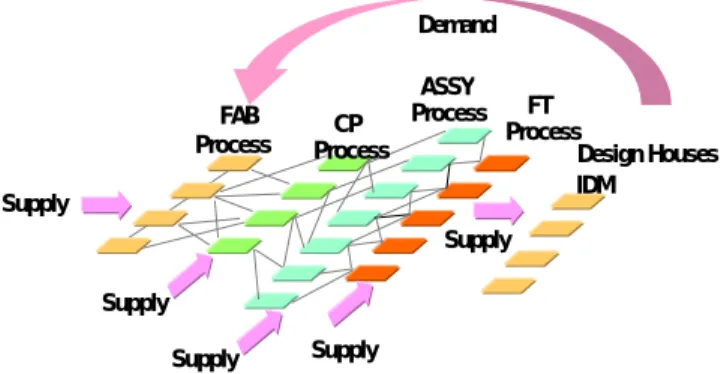
Semiconductor manufacturing network consists of IC design houses/IDM, fabs, probing process, assembly process, and final test process, as shown in Fig. 1.
FAB Process ProcessCP ASSY Process FT Process Demand Supply Supply Supply Supply Design Houses IDM Supply
Fig. 1 Semiconductor Manufacturing Network Supply chain planning (SCP) technologies are required to achieve the logistic efficiency in a manufacturing network as in Fig. 1. Recent reviews on the supply chain logistics models and coordination can be found in Thomas and Griffin (1996) [1] and Vidal and Goetschalckx (1997) [2]. The authors of both review papers gave pretty complete surveys on how OR/MS methodologies, such as mixed integer programming (MIP) and decomposition methods (first modeled and solved by Geoffrion and Graves in 1974 [3]), are applied in the supply chain planning problems. Both noted that there were still many realistic features not considered or unpractically assumed in the literature. In particular, uncertainty factors, such as demands of products and parts, were mostly missing in the formulation.
Demand planning is one of the most critical challenges facing semiconductor manufacturers given the multidimensional natures of products and the complicated manufacturing network. In fact, successful determination of where, when, and in what quantities the products will be needed can have an enormous impact on the manufacturer’s ability to maximize its competitiveness, revenues and profits. Although it is agreed that demand forecasting is an important subject and is taught in every course of production and operations management ([4]-[5]), it remains overlooked by the research community. Despite its claim to have “an up-to-date overview of demand forecasting”, a newly published text of demand forecast and inventory control [6] collects only those forecast methods proposed in 1950’s and 60’s [7]-[11].
Recognized as the very first crucial task for the planning of the entire manufacturing network, demand planning however becomes a core module in many vendors’ SCP solutions. The demand planning result serves as the basis of every planning activity in the supply network and ultimately determines the quality of the planning decisions and thus the effectiveness of logistic operations in the network. In light of the great needs from SCP and with the help of modern information technology, traditional function, mainly the statistical forecasting function, of demand planning has been
expanded to a demand management system with complete decision support functions. The role of demand planning is now very different and becomes even more critical for planning the entire supply chain.
In the first year of this research, we have re-defined the new role of demand planning in supply chain planning (SCP) by investigating its effects on the planning activities in the network. Existing solutions provided by application vendors were also reviewed and discussed. This provides a global perspective and helps the construction of a complete framework of demand planning. The framework consists of the following functions: multidimensional demand planning, statistical demand forecast, demands aggregation/granularity, and synchronization of demand signals in the network.
Demand information propagated over the network is, however, the most unreliable information that plagues the planning quality of the entire supply chain. The subject of bullwhip effect has recently drawn many researchers’ attentions [12]-[14], though it has been known for some time [15] and was very well exemplified in the “Beer Distribution Game” reported by Sterman (1989) [16]. Demand fluctuation and corresponding inventory policies have been attributed to cause the bullwhip phenomenon [17]. Other causes reported by researchers are order batching, fluctuated price, rationing game. Examining the natures of semiconductor foundry manufacturing, the demand fluctuation appears to be the dominant factor and will be the focus of this research as an important tackle point for improving the quality of planning decisions.
In the second year, each function of the planning framework proposed in the first year will be further investigated and new methodologies or enhancements will be developed to improve the planning quality. First, the demand can be perceived from different aspects: product, customer, time, etc. Enhanced multidimensional planning strategies will be proposed to better handle the complicated supply-demand relationships in the network. The core of demand planning is the statistical demand forecast that enables the planning horizon extended into the future. Advanced multivariate forecast together with aggregation/granularity techniques will be developed. Finally, strategies will be developed to synchronize the demand signals propagated in the network and thus minimize the information distortion and uncertainty amplification.
THE NEW ROLE OF DEMAND PLANNING Unlike traditional demand planning systems that provide single-number results through statistical routines and limited data views. A new demand planning system should be able to support all aspects of demand management needs for the entire manufacturing network. In a semiconductor manufacturing network, demand planning is the process of uniting planning input from individuals who span the different functional areas within an organization, as well as
input from external sources.
In the dynamic semiconductor industry, the technology level and its corresponding manufacturing capacity are changing constantly. Such information, though extremely dynamic, is required and should be provided by the R&D and manufacturing divisions to make accurate forecasts and to create effective demand plans. In addition, the spectrum of product types spans particularly wide for foundry manufacturers and demands from IC design houses or integrated devise manufacturers are also very dynamic. A new role of demand planning is, therefore, to integrate multiple functional perspectives into the demand plan.
The supply-demand relationships at each manufacturing stage can be represented as shown in Fig. 2. There are four stages of supply-demand relationships:
(1) Design house or IDM and foundry fabs, (2) Foundry fabs and probing process,
(3) Probing process and assembly process, and (4) Assembly process and final test process.
Additionally, capacity sharing among fabs is also an important factor to be considered in demand planning.
60 ~ 70 days
1 - 2 days 9 - 14 days 15 - 20 days
Fabrication Probing Assembly Testing
die bank F/G FAB I FAB 2 C/P F/T wafer bank Sub ASSY Sub F/T (source: Adexa)
Fig. 2 Analyis of semiconductor manufacturing network CURRENT INDUSTRIAL PRACTICE
Taiwan’s two largest foundry manufacturers are: TSMC and UMC. Both have their own approaches to the order fulfillment process. To achieve the goal of becoming a “service” company, as very well put by Dr. Morris Chang, the CEO of TSMC, both companies have invested great efforts in developing their order management systems. The most well known system is TSMC’s Total Order Management system (nickname: TOM). The task of demand planning, however, remains as a transactional process rather than a planning process. As the capacity utilization exceeds 100%, the role of demand planning is no longer just making short-term forecast. Rather, it becomes an import part of business strategic planning to maximize the company’s profit and to help define the company’s future mission. Both companies have recently expressed their concerns on their capability in the larger scale planning and are investing efforts to build a more integral planning system. We learned that UMC is currently using i2’s solution for their Master Planning and Demand Planning and has successfully
implemented the solution in a couple of manufacturing facilities. In the mean time, TSMC has launched a massive project to adopt an integrated planning system (Adexa’s solution) for their complicated lower-level manufacturing network and, very recently, has just announced a plan to cooperate with i2 technology for their higher-level integral planning solution,
Because of the increasing important role played by demand planning in supply chain planning, many solution vendors have come up their own integrated planning system with the demand planning module as the core of the system. As learned from our interviews with two major semiconductor manufacturers, UMC and TSMC, two vendors appear to be the dominant solution providers: i2 technologies and Adexa (formerly known as Paragon).
Demand Planning C o ll a bor a tion Long Term Forecast MES Data Strategic Planning - Capacity Expansion - Inventory Planning - Capacity Allocation Factory Planning Master Planning - Demand/Supply Match - Logistics Optimization - Allocations Management Collaboration Real Time Dispatching Factory Planning Constrained Forecast Demand Plan Request Starts/Outs Actual Starts Lot Due Dates Netted Forecast MES Capacity Allocations Demand Fulfillment - Order Promising - Orders Fulfillment - Internet Fulfillment - Allocations Mgmt. - Forecast Netting Allocations ATP Orders (New/Changed) Order Entry Customer Management - eCommerce - eConfig - eMarketing - eCare - Collaboration Order Status Optimal Portfolio Transition Planning Portfolio Planning Capacity Plan Transition Triggers Transition Plans
Fig. 3 Demand planning in i2’s planning architecture (source: Adeel Najmi, i2 semi-industry solutions)
Customers
Customers SalesSales Planning/Site
Scheduling Site Planning/ Scheduling Central Planning Central Planning Demand Planning Demand Planning Demand Entry Demand Entry SCP SCP Order Promising Order Promising Order Execution MPS Site Site Planning & Planning & Scheduling Scheduling Enterprise Enterprise Supply Chain Supply Chain Management Management Virtual Virtual Supply Chain Supply Chain Management Management Total Total Supply Chain Supply Chain Management Management Adexa Adexa CDP CDP Adexa Adexa SCP SCP Adexa Adexa MCP MCP Adexa Adexa MCP MCP Adexa Adexa GRA GRA Adexa Adexa GRA GRA Adexa Adexa SCP SCP Adexa Adexa GRA GRA Demand Promising Demand Promising Adexa Adexa CDP CDP Order Promising Order Promising Supply Chain Planning Supply Chain Planning Data Warehouse Data Warehouse
Fig.4 Demand planning in Adexa’s planning system (source: Allen Hong, Adexa)
As shown in Figs. 3 and 4, two major vendors place the demand planning module in the beginning of the entire planning system as an essential self-content function module. The functionality of the two demand planning solutions will be summarized in the final report.
Following the earlier studies on the role of demand planning, current industrial practice and existing solution provisions, we proposed an integrated framework for demand planning. The framework is comprised of the following four important functions:
Multidimensional demand planning strategies, Statistical demand forecast,
Aggregation and granularity of demand information, and
Synchronization of demand signals in the planning network. Detailed Mid-level aggr. High-level aggr. Customer Product Technology Plan horizon Ind epe nd en t S ign al coo rd. P lan coo rd. Synchronization customer view product view technology view time view customer view product view technology view time view customer view product view technology view time view Independent short-term demand plan Independent mid-term demand plan Independent long-term demand plan Coordinated short-term demand signal Coordinated short-term demand plan Coordinated mid-term demand signal Coordinated mid-term demand plan Coordinated long-term demand signal Coordinated long-term demand plan Signal coordinated Customer Product Technology Plan horizon Detailed M id-level aggregation High-level aggregation For e ca st Aggrega tion Pers pect ives Plan coordinated Plan independent
Fig. 5 Proposed integrated demand planningframework Fig. 5 illustrates the proposed framework consisting of the above four functions. The purpose and requirements of each function in the planning framework will be summarized in the final report.
REFERENCES
[1] Thomas, D.J. and P.M. Griffin, “Coordinated supply chain management,” European Journal of Operational Research, 94, pp. 1-15, 1996.
[2] Vidal, C.J. and M. Goetschalckx, “Strategic
production-distribution models: A critical review with emphasis on global supply chain models,” European
Journal of Operational Research, 98, pp. 1-18, 1997. [3] Geoffrion, A.M. and G.W. Graves, “Multicommodity
distribution system design by Benders decoposition,” Management Sceince, 20, 5, pp. 822-844, 1974.
[4] Krajewski, L. J. and L.P. Ritzman, Operations Managment: Strategy and Management, 5th ed. 1999, Addison-Wesley
[5] Vollmann, T. V., W.L. Berry, and D.C. Whybark, Manufacturing Planning and Control Systems, 4th ed. 1997, McGraw-Hill
[6] Lewis, C.D., Demand Forecasting and Inventory Control, John Wiley and Sons, N.Y., 1997.
[7] Holt, C.C., “Forecasting seasonals by exponentially weighted moving averages,” Office of Naval Research Memo, 52, 1957.
[8] Winters, P. R., “Forecasting sales by exponentially weighted moving averages,” Management Science, 6, 1960.
[9] Brown, R.G., Smoothing, forecasting and the prediction of discrete time series, Prentice Hal, Englewood Cliffs, 1962.
[10] Trigg, D.W., “Monitoring a forecasting system,”
Operational Research Quarterly, 15, 1964.
[11] Trigg, D.W. and A.G. Leach, “Exponential smoothing with an adaptive response rate,” Operational Research Quarterly, 18, 1967.
[12] Lee, H. L., V. Padmanabhan, and S. Whang, “The bullwhip effect in supply chains,” Sloan Management review, Spring, 1997.
[13] Lee, H. L., V. Padmanabhan, and S. Whang,
“Information distortion in a supply chain: the bullwhip effect,” Management Science, 43, 4, 546-558, 1997.
[14] Cachon, G. P., “Managing supply chain demand
variability with scheduled ordering policies,” Management Science, 45, 6, 843-856, 1999.
[15] Forrester, J., Industrial Dynamics, MIT Press, and John Wiley & Sons, N.Y., 1961.
[16] Sterman, J. D., “Modeling Managerial Behavior:
Misperceptions of feedback in a dynamic decision making experiment,” Management Science, 35, 3, 321-339, 1989.
[17] Caplin, A. S., “The variability of aggregate demand with (s, S) inventory policies,” Econometrica, 53, 1395-1409, 1985.