行政院國家科學委員會補助專題研究計畫成果報告
計劃名稱: Characterization of the HMG-containing transcription
factor TCF3
(T 細胞特異性因子【TCF3】之基因選殖與蛋白性質探討)
計畫類別:個別型計畫
計畫編號:NSC89-2314-B-039-027
執行期間:
89 年
8 月
1 日至 90
年
7
月
31
日
計畫主持人:
莊淨媛
共同主持人:無
執行單位:中國醫藥學院醫事技術學系
中
華
民
國
90
年
11
月
15
日
中文摘要:
關鍵詞:TCF/LEF 轉錄因子, β-catenin 蛋白, WNT 訊息傳遞路徑, 腫瘤抑制蛋白 APC,同功脢 TCF/LEF 轉錄因子在動物的發育上扮 演重要的調控角色而且其功能失當經常與 腫瘤發生有密切關係。研究顯示脊椎動物 細胞的 T 細胞特異性因子(TCF)與 WNT 訊息 傳遞路徑中的β-catenin 蛋白結合形成 轉錄偶體,參與兩棲動物胚胎發育時期腹 背軸的形成。另一方面,TCF 蛋白也與腫 瘤形成有關。腫瘤抑制蛋白 APC 存在於細 胞質中,它能與β-catenin 蛋白結合進而 促進後者代謝,在某些缺乏 APC 蛋白之大 腸癌中發現β-catenin 蛋白累積於細胞 內,同時與 TCF 蛋白結合;而在 APC 蛋白 正常之大腸癌及黑色素瘤細胞,則是因β -catenin 基因突變導致蛋白穩定度增加 而使 TCF 所調控之基因大量表達。 最初認為人類的 TCF/LEF 基因家族包 括四個成員 TCF1, TCF3, TCF4 和 LEF1, 當時有關 TCF3 的研究最少,而今在 TCF4 的基因序列大白之後發現原來當初所謂的 TCF3 只是 TCF4 的 RNA 形成時作另類切 割所致。在儘可能尋求 TCF4 的各種另類 切割方式之際,至少有六種 TCF4 同功脢 被純化,分別命名為:TCF4E、 TCF4E*、 TCF4Ed17 、 TCF4E*d17 、 TCF4B 和 TCF4bI17,六種同功脢之胺基酸序列相異 處均集中在負責 與 DNA 結合之 HMG domain 附近。經基因轉入老鼠 IIA1.6 細胞 株實驗得知:各種 TCF4 同功脢均可在 β-catenin 協同下促進調控基因之轉錄作 用,唯獨 TCF4E*d17 例外,經電泳訊號轉 移實驗證明-TCF4E*d17 無法促進轉錄作 用的原因在於它無法結合核酸序列。英文摘要:
Keywor ds:TCF/LEF transcription factors,
ß-catenin, tumor-suppressor protin APC, WNT pathway, isoform
TCF/LEF transcription factors are important regulators of animal development and their deregulation usually results in neoplasia. It has become evident that TCFs interact with the vertebrate WNT pathway effector ß-catenin to resulting bipartite tanscription factor to mediate axis formation in xenopus.
Originally, the human TCF/LEF family was proposed to consists of four members: TCF-1, TCF3, TCF4 and LEF-1. With the genomic sequence of TCF4 at hands immediately after the completion of human genome sequence, it was realized that TCF3 is actually one of the alternative splicing forms of TCF4. To investigate the functional differences among various TCF4 alternative splicing forms, we tried to cloned as many TCF4 isoforms as possible. At least six TCF4 isomers are cloned, named TCF4E, TCF4E* , TCF4Ed17, TCF4E*d17, TCF4B and TCF4BI17. The differences between TCF4 isomers are limited to regions very close to the HMG domain which mediates the DNA binding activity of TCF factors. With gene transfection and in vivo transcriptional activation assay system, most of the isomers, except TCF4E*d17, can augment gene transcription in the presence of β- catenin. Interestingly, TCF4E*d17 failed to stimulate β- catenin-mediated gene transcription. Expressed in E coli translation
system and assayed by band-shift, TCF4Ed17 formed a protein-DNA complex. But, TCF4E*d17 failed to do so. We thus concluded that TCF4E*d17 cannot stimulate gene transcription simply because it failed to bind DNA.
計劃緣由與目的:
TCF/LEF transcription factors are important regulators of animal development and their deregulation usually results in neoplasia. It has become evident that TCFs interact with the vertebrate WNT pathway effector ß-catenin to resulting bipartite tanscription factor to mediate axis formation in xenopus. The cytoplasmic tumor-suppressor protin APC binds to ß-catenin causing its destruction. In APC-deficient colon carcinoma cells, ß-catenin accumulates and is constitutively complexed with TCF factors. In APC-positive colon carcinomas and melanomas, unusual splicing and missense mutatuons in the ß-catenin gene that result in stabilization of the protein, providing an alternative mechanism to activate transcription of TCF target genes inappropriately.
The human TCF/LEF family was proposed to consist of four members: TCF-1, TCF3, TCF4 and LEF-1. TCF1 was cloned as a gene that encodes a T-cell –specific DNA-binding protein with the affinity for the AACAAG motif in the CD3ε enhancer. The gene encoding LEF1 was independently cloned by two groups: murine LEF1 was isolated in a subtractive screen for
precursor B-cell-specific factors and was subsequently found to be expressed by T cells as well. Mouse LEF1 binds to the TTCAAAGG sequence element in the TCRα enhancer. The partial sequences of two additional human family members, TCF3 and TCF4, were cloned by guessmer PCR using primers based on the conserved DNA-binding domain of TCF1 and LEF1. Among them, TCF-3 is the less studied and only its HMG domain is cloned. Since the Xenopus homolog of human TCF-3 plays a crucial role during the animal development, it is thus important to understand the biological and biochemical activities of human TCF-3. The specific aims of our proposal are: 1. To clone the full-length cDNAs of TCF3 and its derivatives of alternative splicing isoforms. 2. To characterize the biochemical and biological activities of TCF3 and its splicing isoforms, including DNA binding specificity, transcriptional stimulation activity and protein stability.
結果與討論:
Originally, the family was proposed to consist of TCF1, TCF3, TCF4 and LEF1. With the genomic sequence of TCF4 at hands immediately after the completion of human genome sequence, it was realized that TCF3 is actually one of the alternative splicing forms of TCF4. Thus, to understand the complexity of TCF4 gene expression and to investigate the functional differences among various TCF4 alternative splicing forms, we tried to clones as many TCF4
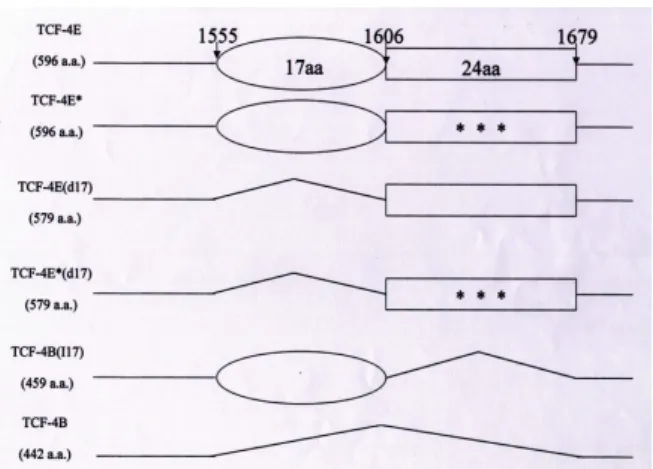
isomers as possible. At least six TCF4 isomers are expressed in Hela cells (figure 1), named TCF4E, TCF4E*, TCF4Ed17, TCF4E*d17, TCF4B and TCF4BI17.
We then asked whether these TCF4 isomers function similarly with regard to
β-catenin-mediated transcriptional activation. The murine cell line IIA1.6 was used for the study because it expresses no TCF activity. As shown in figure 2, most of the isomers, except TCF4E*d17, can augment gene transcription in the presence of β-catenin, although with certain degree of variations. Interestingly, TCF4E*d17 failed to stimulate
β-catenin-mediated gene transcription. Since the differences between TCF4 isomers are limited to regions very close to the HMG domain which mediates the DNA binding activity of TCF factors, we suspected that the inability of TCF4E*d17 to augment transcription is probably due to its failure to bind DNA. To test this hypothesis, TCF4Ed17 and TCF4E*d17 were expressed and purified from E. coli and assayed by band-shift using a DNA oligo containing a consensus binding site of TCF4. As shown in figure 3, TCF4Ed17interacted with the oligo to form a protein-DNA complex. In contrast, TCF4E*d17 failed to do so. We thus concluded that TCF4E*d17 cannot stimulate gene transcription simply because it failed to bind DNA.
Future study is required to illucidate the mechanism why TCF4E*d17 cannot bind DNA and what are the physiological roles of this isoforms plays.
Fig 1. TCF-4E and TCF-4E* have 596 amino acids. TCF-4E(d17)and TCF-4E(d17) have a deletion from 1555th a.a. to 1606th a.a.TCF-4B(I17) has a deletion from 1606th a.a. to 1679th a.a. TCF-4B has a deletion from 1555th a.a. to 1679th a.a.
0 2 4 6 8 10 12 TOPFLASH b-catenin TCF4E + b-catenin TCF4E* + b-catenin TCF4B + b-catenin TCF4E*(d17) + b-catenin TCF4E(d17) + b-catenin TCF4B(I17) + b-catenin
1.0E+03 Light units (luciferase)
fig2. Transactivational properties of TCF4 splicing isoforms co-transfected with
β-catenin. Reporter gene assays in IIA 1.6 B cells. Cells were transfected by electroporation and normalized transfection activity by β-gal assay.
fig3. The band-shift assay for DNA binding activity of TCF4Ed17(lane3∼5)and TCF4E*d17(lane7∼10). Lane1,2 and 6 contain DNA oligo only which contains a consensus binding site of TCF4.