【附件三】教育部教學實踐研究計畫成果報告格式(系統端上傳 PDF 檔)
教育部教學實踐研究計畫成果報告
Project Report for MOE Teaching Practice Research Program (Cover Page)
計畫編號/Project Number:PSL107031 學門分類/Division:社會 執行期間/Funding Period:2018/8/1~2019/7/31 面對多國及多文化學生時之教學方法研究 台灣經濟與全球化 計畫主持人(Principal Investigator):佘志民 共同主持人(Co-Principal Investigator): 執行機構及系所(Institution/Department/Program):國立高雄大學應用經 濟學系
面對多國及多文化學生時之教學方法研究
台灣經濟與全球化
國立高雄大學應用經濟學系 佘志民 副教授摘 要
本研究探討以英語為媒介的教學,應該如何設計教學方法來有效提升教學成效?藉由開設” 台灣經濟與全球化”之課程,交互運用問題導向學習、關鍵思考學習以及分組辯論三種教學方 法,並分析該三種教學方法是否有效?以及其成效是否會有差異?根據蒐集資料可得以下結論: 1,關鍵思考優於問題導向學習; 2,辯論之教學活動之教學成效表現穏定,雖並不特別突出; 3,遊 戲的教學活動對教學成效是正向的;及4,微電影及分組報告兩項教學活動能增進教學成效 關鍵字: 英語媒介教學,教學成效,教學方法目錄
頁次 一,報告內文 ... 1 1,研究動機與目的 ... 1 2,文獻探討 ... 1 3,研究方法 ... 1 4, 教學暨研究成果 ... 2 二,參考文獻 ... 6 三,附件. ... 7 附件一:課程大綱. ... 7 附件二:課程前後測 ... 12 附件三:第 9 週遊戲 ... 47面對多國及多文化學生時之教學方法研究 – 台灣經濟與全球化 一. 報告內文(Content)
1. 研究動機與目的(Research Motive and Purpose)
近年來國內高等教育受到少子化影響,並在過度設立大專院校的背景下,競爭日趨 激烈,挑戰日益嚴峻。政策方面試圖將危機化為轉機,輔導各院校突破既有格局,加強 競爭力,並嘗試順應全球化之潮流,開拓更廣大的教育市場。其中一個方向即為鼓勵開 設全英語教學之課程。 然而,純就教學面而言,以對學生及老師來說非母語之英語為教學媒介的利弊得 失,頗引起教育界人士之討論,正反意見之人皆有。本研究從較積極的角度出發,假設 全英語教學為台灣高等教育未來重要的一個發展方向,則以英語為媒介的教學,應該如 何設計教學方法來有效提升教學成效? 因而,本研究之目的如下:針對全英語教學之教學情境,利用多種教學活化及深化 策略,配合相應設計之教學活動組合,顧及語言溝通面的限制,選擇適當主題及範圍, 研究並設計適當的教學方法,以期提升教學成效及強化台灣高等教育輸出之競爭力。 2. 文獻探討(Literature Review) 有關於全英語教學之文獻相當地多。Williams (2015)一文相當完整地整理了針對 EMI (English as a medium of instruction) 課程所做之研究。得出 EMI 對學習效果的影響 並沒有一致的簡單答案。在不同文化背景的學生,或是一些相關於教師,或是一些其他 因素影響之下,EMI 時而產生一些正面效果,時而卻又可能是種限制。而一項關於 EMI 重要的附屬議題為如何為了非母語人士適當地調整英文內容。文獻中提出了許多建議。 例如 Kao & Wang (2014)即特別為了多文化情境中之教學提出了 14 點建議。
本研究嘗試了以下數種教學活動或策略:問題導向學習 (problem-based learning, PBL); 關鍵思考 (critical thinking, CT); 經濟實驗 (economic experiment) 以及辯論 (debate)。關於這些教學活動及策略的意涵、操作及效果評估等,文獻中相關的討論如 Van den Brink-Budgen (2000) 的專書關注在關鍵思考教學策略內容的設計上。而 Hunter (2009)的書中介紹了關鍵思考的操作法則。Zhang and Head (2009) 則針對語言表達能力 培養的課程中如何處理學生不主動的情形。而 Keller and Warner (1994) 的書中則探討了 增進會話品質的一些觀念和操作。 3. 研究方法(Research Methodology) “A. 實驗場域描述”: 透過”台灣經濟與全球化”通識課程之開設,在 70 人中型教室中實施。以電腦講桌 及投影機播放多媒體教材,並分組進行各項課程活動。大部份課程活動若有需求皆由教 師走下講臺與學生互動。若有學生需要報告則至講臺上。於辯論時則分正反雙方,將椅 子轉向呈相對兩方排列。本課程亦運用網路即時互動軟體及 APP“Zuvio”。 “B. 研究對象描述”:
修課學生 18 人,其中 16 位為大一之本地生,皆就讀應用經濟學系。2 人為外國交 換生,皆為 3 年級。其中一位來自印尼,另一位來自蒙古。皆為經選課系統自主選課而 來。先前研究計畫希望能有 25 位學生,本、外生各半,亦於選課階段保留相對名額予 外籍生修習,並委請國際處積極宣傳。然而由於並無強制選課規定,且課程大綱呈現出 之豐富課程活動,可能反而使國際交換生認為負擔過大,故並未有預期外籍生人數修 課。 英語程度方面,18 位學生中有 8 位未曾接受過任何英語能力測試。其餘學生中有 一位通過全民英檢中高級,兩位中級,一位初級。7 位有 TOEIC 成績,從 390 至 625 分。印尼同學則通過該校英語一級檢定。整體而言,學生門英語能力的分佈稍參差。然 而,全班僅有 5 位同學未曾有出國經驗,其餘 13 位同學有 7 位出國超過一週以上 “C. 研究架構”: 圖 1:研究架構 圖一為本研究之架構圖。第一階段為研究計畫撰寫至開學前。於接獲通知獲得補助 後,著手設計課程及教學方法之細節,依設定的主題,總共設計了 2 次問題導向學習, 2 次關鍵思考及 5 次分組辯論,並且進一步設計了課程之前後測,以及每一週個別之前 後測問卷。(各週主題等請見附件一:課程大綱) 第二階段為執行及資料蒐集。於開學後逐週實施已計畫好的課程,並全時錄影,並 在助教協助之下進行前後測,以及將相關填答資訊匯入 Excel 檔案中,供第三階段分析 使用。課程結束後即進入第三階段,除了將資料匯整,並做預訂的分析之外,亦逐步形 成結論,撰寫成果報告。(前後測問卷請見附件二) “D. 資料收集方法與工具”: 以每堂課進行前後測蒐集學習成效資料,並區分為主、客觀指標及開放意見之質性 資料。另外佐以全時課程錄影以輔助判斷學生學習興趣程度。 “E. 研究分析方法”: 量化分析方面計算每週教學成效指標,並根據教學方法之不同觀察該等指標是否顯 著差異,並作合理推論。質化分析方面則深入探討相關資料以歸納出可能的模式。
4. 教學暨研究成果(Teaching and Research Outcomes)
“A. 教學過程與成果”:
18 週課程中總共包含了三大主題,各包含若干次主題。並依主題特性進行了 2 次 問題導向學習(第 3 及 12 週),2 次關鍵思考(第 2 及 11 週)、及 5 次分組辯論(第 13 至 17 週)。各週除了進行上述的教學方法外,亦安排適當的時間講述基本概念。另外,也 依主題安排適當的輔助教學活動如下:第 9 週以遊戲使學生體會貿易之基本原理(見附
告選定國家之貿易狀況及競爭力分析。
本研究目的在於分析各種不同教學方法之教學成效,而教學成效之指標包括了以下 出現在各週前後測的問題:
問題1,”How much do you understand today's topic?”:此題為主觀之意見, 藉由前後測的差距來衡量上課後理解程度的增加反映教學成效。結果如圖 2。
圖 2:理解程度增加
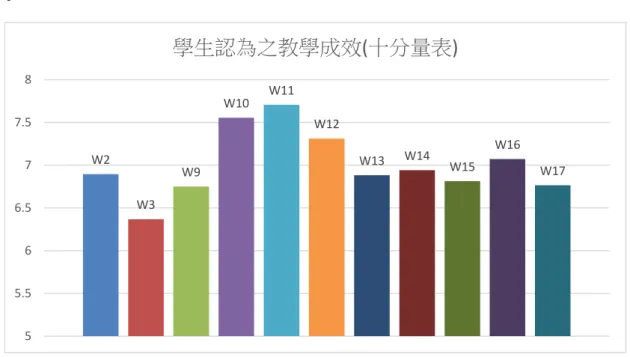
問題 2,”How do you rate your general learning effectiveness in today's class?”:此題為主觀之意見,藉由後測的平均來衡量學生認為的教學成效。結果如圖 3。
圖 3:學生認為之教學成效
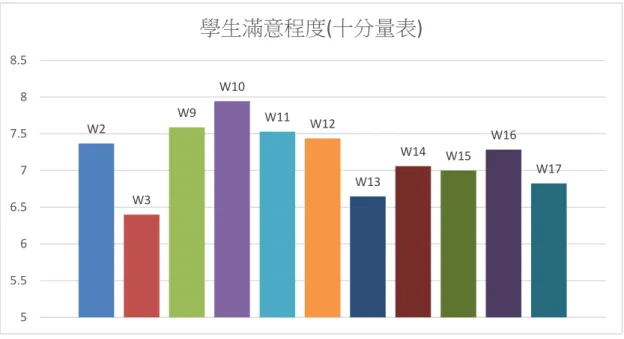
問題 3,”How do you rate your satisfaction to the class today?””:此題 詢問學生對當週課程之整體滿意程度,藉以觀察滿意程度與教學成效是否有關係。結果 如圖 4。 W2 W3 W9 W10 W11 W12 W13 W14 W15 W16 W17 0 0.5 1 1.5 2 2.5
各週理解程度增加表(十分量表)
W2 W3 W9 W10 W11 W12 W13 W14 W15 W16 W17 5 5.5 6 6.5 7 7.5 8學生認為之教學成效(十分量表)
圖 4:學生滿意程度 歸納學期中蒐集之資訊,關於各教學方法及活動之教學成效比較,大致上可以形成 以下幾個結論: 1,關鍵思考優於問題導向學習:雖然在理解程度增加這個指標方面,兩者表現不穏 定,但是在學生認為之教學成效以及滿意程度兩指標上,關鍵思考平均而言表現較問題 導向學習為優。 2,辯論之教學活動之教學成效表現穏定,雖並不特別突出:表現穩定方面可從上述 指標在五週之間皆大致持平而見。然而,平均而言,辯論之教學效果在學生認為的教學 成效指標上介於關鍵思考與問題導向學習之間,而在滿意度方面則僅約略與問題導向學 習相同,遜於關鍵思考。 3,遊戲的教學活動對教學成效是正向的:此可由第 9 週表現在理解程度的增加及滿 意度方面皆相對較高得到。然而,在學生認為之教學成效上卻是表現最差的一週。 4,微電影及分組報告兩項教學活動能增進教學成效:此可由第 10 及 11 週之各指標 表現皆優於平均而得。然而,分組報告在理解程度增加一項上卻是各週表現最差的。 “B. 教師教學反思”: 在進行不同的教學方法時,時間的掌握須要靠經驗累積,也要審慎地衡量教授內容 的多寡,以免流於倉促。全英文教學也普遍地讓各種教學方法困難度因學生較怯於表達 而增加。然而,全英文對何種教學方式之教學成效影響較大,則必須要與對照組比較才 能得知,也就是相同的課程及學生素質組成,但是以中文授課。 “C. 學生學習回饋”:
邱同學:”I think these weeks really are good experience to improve my critical thinking.” 郭同學:”英語能力,且還有很多在這個世代應被拿出來討論的議題,不僅提升我 對於未來世界走向的判斷力,也增加許多未曾接觸過的世界面向。” Iqva:” W2 W3 W9 W10 W11 W12 W13 W14 W15 W16 W17 5 5.5 6 6.5 7 7.5 8 8.5
學生滿意程度(十分量表)
“D. 研究成果”:
教案/教材發展共 1 件 18 週、創新教具發展 1 項、量化測驗/評量工具發展 1 件 18 週前後測問卷。
二. 參考文獻(References)
Van den Brink-Budgen R., (2000) “Critical thinking for students – how to content” 3rd ed.
Hofstede, G. J., (2002). “Exploring culture: exercises, stories, and synthetic cultures”,
Intercultural Press
Hunter D. (2009) “A practical guide to critical thinking: deciding what to do and believe” John Wiley
Kao, S-M. & Wang, W-C. (2014) Lexical and organizational features in novice and experienced
ELF presentations. JELF, 3(1), 49-79.
Lewis, Richard. 2006. When Cultures Collide: Leading Across Cultures. Nicholas Brealey.
Dylan Williams (2015). ‘A Systematic Review of English Medium Instruction (EMI) and
Implications for the South Korean Higher Education Context’. ELT World Online. Special Issue
on CLIL.
Xie, X. (2009). ‘Why are students quiet? Looking at the Chinese context and beyond’. ELT Journal. 64/1. Jan. 2010. 1-9
Zhang, X. and Head, K. (2009) ‘Dealing with learner reticence in the speaking class’. ELT Journal. 64/1. Jan. 2010. 10-20
三. 附件(Appendix) 附件一:課程大綱
Taiwan Economy and Globalization, Fall 2018
Credit hours: 3 Time: 9:05A – 12P, W Place: M208
Instructor: 佘志民
Office Hours: By appointment LINE ID: chihminshe E-mail: [email protected]
Textbook:
No textbook, but supplemental handouts will be given, in paper or electronic file, as necessary. Applied International Trade (AIT): diagrams there possibly helpful (https://g.co/kgs/RX2C58)
Course objectives: This course is designed to give both international and local students an outline of Taiwanese economy, how Taiwan fits into the world economic map, and what globalization implies to Taiwan. Depending on where students come from, they will be encouraged to think about how their countries and Taiwan can cooperate in seeking prosperity. Then a short, practical training program of presentation skill is provided which will benefit the rest part of the course and the future careers of students. Lastly, important issues of globalization will be introduced.
Language: English.
Tentative Course Structure:
Unit Week Topics (PBL: problem based learning; CT:
critical thinking)
Activities (teaming) (competitive C or not NC)
1 1 Welcome and ice-breaking Use “Hofstede 的 網 站
(http://geert-hofstede.com/countries.html)”
Knowing-each-other game (50) Teaming: mixed and pure (20)
Culture and cultural difference in class (brief + game 30)
Introduction (syllabus) (20)
Next week…(no handout, showing next row and assessment criteria, 15)
Unit Week Topics (PBL: problem based learning; CT:
critical thinking)
Activities (teaming) (competitive C or not NC)
2 2 Is Taiwan small? Economic indices and world rankings (CT1)
Before-class survey (10) Lecture (40+30)
Find and share interesting numbers about Taiwan and make a statement (mixed team, on the spot, NC) (20+30)
After-class survey (10)
Next week…(no handout, show next row and assessment) (10)
3 Taiwan, a major player in world economy (international competitiveness analysis,
PBL1)
Before-class survey (10)
PBL: how to measure the competitiveness of a country? (“Maastricht Seven-jump Process”1 –
5, the whole class, individual participation is tallied for grade, 40 + 40)
Assign 6 and 7 for after class activity and report 7 in week 11 on the topic, “what does (a chosen country) produce and how competitive is (a chosen country)?”, 10)
Lecture (40, IMD website about Taiwan, IMD methods, and WEF website)
After-class survey (5)
Next week…(show next row and assessment) (5) 4 Double-tenth day
3 5 Presentation skill I structure, key ideas
6 Presentation skill II visual aids, numbers
7 Talk: How businessmen from Taiwan do business with the world?
Presentation part I: My country on the economic world map
Talk for two hours.
Each student presents for 10 minutes. 5 students.
8 Presentation part II: My country on the economic world map
Each student presents for 10 minutes. 15 students. Next week…
Unit Week Topics (PBL: problem based learning; CT:
critical thinking)
Activities (teaming) (competitive C or not NC)
4 9 Why trade – a game played by all mankind
What is traded? – trade map
Before-class survey (10)
Let’s play (game of trade) (print: orientation) (make toys) (85)
Trade and trade map (40)
Next week…(remind week 11 presentation, show next row and small project a video clip to be peer evaluated next week, 10)
After-class survey (5) 10 What do Taiwan produce? An
industrial outlook
Before-class survey (10)
Have you consumed a product made in Taiwan? Share with us a short video (to be peer evaluated, 60).
Lecture (70)
Next week…(show next row and assessment of presentation, reminding next week again 5) After-class survey (5)
11 What do your country produce? How competitive is your country?
Before-class survey (10)
Group presentation (team, a continuation of week 3, prep, NC, 60)
A forum, “How to improve the economic performance of your chosen country” (CT2, 70) Next week…(show next row and assessment, 5;) After-class survey (5)
5 12 Globalization (barrier)? WTO and various types of trade agreement (PBL2)
Before-class survey (10)
Lecture (the idea of globalization; a brief of trade agreements, check WTO website 40)
PBL (find a problem about globalization and
discuss by the steps of “Maastricht Seven-jump Process”. By team and use zuvio. Assessments by me. 90)
Next week…(show next row, how the debate goes and assessment of peer review, 5)
Unit Week Topics (PBL: problem based learning; CT:
critical thinking)
Activities (teaming) (competitive C or not NC)
13 Taiwan, globalization and environment (debate)
Before-class survey (10)
Lecture (40; handout:《Global Public Goods》: “ Montreal versus Kyoto: International cooperation and the global environment”, pp 192 – 219, and 《一口氣讀懂全球化》ch 11) Debate (80)
Discuss the learning report – a reminder: what have you learned; what made you think the most? How would you introduce it? Etc. (10)
Next week…(show next row and assessment, 5, handouts: reading, rules of debate and 2 others) After-class survey (5)
14 Taiwan, globalization and culture (debate)
Before-class survey (10)
Lecture (40; handout: 《Global Public Goods》: “Cultural Heritage as public good”, pp 240 - 263, and 《一口氣讀懂全球化》ch 9)
Debate (C, 90)
Next week…(show next row and assessment, 5) After-class survey (5)
6 15 Taiwan, globalization and health (debate)
Before-class survey (10)
Lecture (40; handout: 《Global Public Goods》: “Health as a global public good ”, pp284 – 305, and《Introduction to international political economy, 4th ed.》, Ch19)
Debate (C)
Next week…(show next row and assessment, 5) After-class survey (5)
16 Taiwan, globalization and democracy (debate)
Before-class survey (10)
Lecture (40; 《The spirit of democracy》: Ch1-3, and 《一口氣讀懂全球化》ch 8)
Debate (C)
Next week…(reminding learning report; show next row and assessment, 5)
Unit Week Topics (PBL: problem based learning; CT:
critical thinking)
Activities (teaming) (competitive C or not NC)
17 Taiwan, globalization, internet and knowledge
Before-class survey (10)
Lecture (40; handout: 《Global Public Goods》: “Knowledge and information”, pp 306 - 363) Debate (C)
Next week…(show next row and assessment, 5) After-class survey (5)
7 18 What have you learned? A reflection
Presenting your learning report After test
Evaluation of student:
Students are evaluated by two parts. The major part is class activities that takes 70% of the score, assessed each week by team or individual in a way depending on class activities. The other 30% is a learning report submitted at the end of the course.
附件二:課程前後測 學期初前測
Pretest
Taiwan Economy and Globalization, Fall 2018, NUKWelcome to Taiwan. I hope you have found this country a good place to visit and people here warm-hearted and friendly. Thank you for taking the course of “Taiwan Economy and
Globalization”. To gauge how effective the course design and pedagogical methods are, NUK needs to collect some data from you before the class begin. Please answer the following questions. Thank you.
1. Name: _____________________
2. Age: _____________________
3. Nationality: _____________________
4. Major (department): ______________________
5. Have you been to Taiwan before? (skip to question 6. if you are local): Yes No (skip to question 6)
---- how many times: once twice more than twice ---- for how long in total: less than a week 1~2 weeks
3~4 weeks 1~3 months more than 3 months 6. Have you been to other foreign countries? Yes No (skip to question 7)
---- what are those foreign countries: ________________________________ ---- for how long in total: less than a week 1~2 weeks
3~4 weeks 1~3 months more than 3 months
7. How confident, in a scale of 1 (very lowly) to 10 (very highly), are you with your English as a medium of learning? 1 (Very lowly) 2 3 4 5 6 7 8 9 10 (Very highly)
8. Do you have any certificate of English proficiency? Score? (e.g., TOEFL iBT 80) : ___________________________________
(continue to the back side…)
9. What is the population of Taiwan?
less than 10 millions
10~20 millions 20~30 millions 30~50 millions over 50 millions
10. What is the world ranking of the size of Taiwan economy measured by GDP (adjusted by PPP)?
Top 10 11th ~20th 21st ~ 30th 31st ~50th 51st ~80th after 81st
11. How is Taiwan ranked according to the “World Competitive Rankings 2018” by IMD?
Top 10 11th ~20th 21st ~ 30th 31st ~50th 51st ~80th after 81st
12. How is Taiwan ranked in the world by export?
Top 10 11th ~20th 21st ~ 30th 31st ~50th 51st ~80th after 81st 13. What is WTO? World Tax Organization World Trade Organization World Teacher Organization I don’t know.
14. What do you think the term “globalization” means?
__________________________________________________________________
__________________________________________________________________
__________________________________________________________________
15. Tell us what you expect from this class?
__________________________________________________________________
__________________________________________________________________
第二週前、後測
Before-class survey, week 2
Taiwan Economy and Globalization, Fall 2018
Name: _______________________________
1. How much time did you spend on preparing for today’s class?
Reading handouts? __________________ minutes
Collecting information related to the topic? _______________________ minutes
Meeting with your team? ____________________ minutes
2. In a scale of 1 (very low) to 10 (very high),
how much are you interested in the topic of today’s class?
1 2 3 4 5 6 7 8 9 10
how much do you understand today’s topic?
1 2 3 4 5 6 7 8 9 10
3. How much at most would you pay for today’s class, if you had to (in NT$)?
_____________________ NT$
4. Among all the countries in the world, the amount of electricity generated in Taiwan a year is ranked among
Top 20 21st to 50th 51st to 75th 76th to 100th beyond 100th
5. Among all the countries in the world, the GDP per capita of Taiwan is ranked among
Top 20 21st to 50th 51st to 75th 76th to 100th beyond 100th
6. How much does service industry take out of the GDP of Taiwan?
After-class survey, week 2
Taiwan Economy and Globalization, Fall 2018
Name: ________________________________
7. In a scale of 1 (very low) to 10 (very high),
how much are you interested in the topic of today’s class?
1 2 3 4 5 6 7 8 9 10
how do you rate your general learning effectiveness in today’s class?
1 2 3 4 5 6 7 8 9 10
how much do you understand today’s topic?
1 2 3 4 5 6 7 8 9 10
how do you rate your satisfaction to the class today.
1 2 3 4 5 6 7 8 9 10
_____________________ NT$
9. Among all the countries in the world, the amount of electricity generated in Taiwan a year is
ranked among (to the backside after this one)
Top 20 21st to 50th 51st to 75th 76th to 100th beyond 100th
10. Among all the countries in the world, the GDP per capita of Taiwan is ranked among
Top 20 21st to 50th 51st to 75th 76th to 100th beyond 100th
11. How much does service industry take out of the GDP of Taiwan?
< 20% 20%t to 40% 40% to 60% 60% to 80% > 80%
12. Any feedback, comment, or reflection?
________________________________________________________________________________
________________________________________________________________________________
________________________________________________________________________________
Before-class survey, week 3
Taiwan Economy and Globalization, Fall 2018
Name: ____________________________
13. How much time did you spend on preparing for today’s class?
Reading handouts? __________________ minutes
Collecting information related to the topic? _______________________ minutes
Meeting with your team? ____________________ minutes
14. In a scale of 1 (very low) to 10 (very high),
how much are you interested in the topic of today’s class?
1 2 3 4 5 6 7 8 9 10
how much do you understand today’s topic?
1 2 3 4 5 6 7 8 9 10
15. How much at most would you pay for today’s class, if you had to (in NT$)?
_____________________ NT$
16. How many criteria are included in the computation of the IMD world competitive measures?
< 50 51 to 100 101 to 200 201 to 300 > 300
17. Which one(s) of the following properties do you think a good international competitiveness measure should possess?
Clear indication of strong industries Comparability among countries Implication on trends
Reliability of data sources Simplicity of computation
After-class survey, week 3
Name: ________________________________
18. In a scale of 1 (very low) to 10 (very high),
how much are you interested in the topic of today’s class?
1 2 3 4 5 6 7 8 9 10
how do you rate your general learning effectiveness in today’s class?
1 2 3 4 5 6 7 8 9 10
how much do you understand today’s topic?
1 2 3 4 5 6 7 8 9 10
how do you rate your satisfaction to the class today.
1 2 3 4 5 6 7 8 9 10
19. How much at most would you pay for today’s class, if you had to (in NT$)?
_____________________ NT$
< 50 51 to 100 101 to 200 201 to 300 > 300
21. Which one(s) of the following properties do you think a good international competitiveness
measure should possess?
Clear indication of strong industries
Comparability among countries
Implication on trends
Reliability of data sources
Simplicity of computation
22. Any feedback, comment, or reflection?
________________________________________________________________________________
________________________________________________________________________________
________________________________________________________________________________
____________________________________
第九週前、後測
Before-class survey, week 9
Taiwan Economy and Globalization, Fall 2018
23. How much time did you spend on preparing for today’s class?
Reading handouts? __________________ minutes
Collecting information related to the topic? _______________________ minutes
Meeting with your team? ____________________ minutes
24. In a scale of 1 (very low) to 10 (very high),
how much are you interested in the topic of today’s class?
1 2 3 4 5 6 7 8 9 10
how much do you understand today’s topic?
1 2 3 4 5 6 7 8 9 10
25. How much at most would you pay for today’s class, if you had to (in NT$)?
_____________________ NT$
26. Why is international trade generally mutually beneficial for both countries?
It facilitate the development of new products. Pollution can be mitigated by trade.
Trade stimulates migration of people.
It presents more opportunities for both sides.
After-class survey, week 9
Taiwan Economy and Globalization, Fall 2018
Name: ________________________________
27. In a scale of 1 (very low) to 10 (very high),
how much are you interested in the topic of today’s class?
1 2 3 4 5 6 7 8 9 10
how do you rate your general learning effectiveness in today’s class?
1 2 3 4 5 6 7 8 9 10
how much do you understand today’s topic?
1 2 3 4 5 6 7 8 9 10
how do you rate your satisfaction to the class today.
1 2 3 4 5 6 7 8 9 10
28. How much at most would you pay for today’s class, if you had to (in NT$)?
_____________________ NT$
29. Why is international trade generally mutually beneficial for both countries?
It facilitate the development of new products. Pollution can be mitigated by trade.
Trade stimulates migration of people.
It presents more opportunities for both sides.
30. Any feedback, comment, or reflection? ________________________________________________________________________________ ________________________________________________________________________________ ________________________________________________________________________________ ____________________________________ 第十週前、後測
Before-class survey, week 10 (11/21)
Taiwan Economy and Globalization, Fall 2018
Name: ____________________________
31. How much time did you spend on preparing for today’s class?
Reading handouts? __________________ minutes
Collecting information related to the topic? _______________________ minutes
Meeting with your team? ____________________ minutes
32. In a scale of 1 (very low) to 10 (very high),
how much are you interested in the topic of today’s class?
1 2 3 4 5 6 7 8 9 10
how much do you understand today’s topic?
1 2 3 4 5 6 7 8 9 10
33. How much at most would you pay for today’s class, if you had to (in NT$)?
_____________________ NT$
34. How big is trade (export plus import) relative to GDP for Taiwan?
<50% of GDP
between 50% to 100% of GDP
35. How big is the service sector (retailing, finance, etc) in Taiwan? <25% of GDP
between 25% to 50% of GDP between 50% to 75% of GDP >75% of GDP
After-class survey, week 10 (11/21)
Taiwan Economy and Globalization, Fall 2018
Name: ________________________________
36. In a scale of 1 (very low) to 10 (very high),
how much are you interested in the topic of today’s class?
1 2 3 4 5 6 7 8 9 10
how do you rate your general learning effectiveness in today’s class?
1 2 3 4 5 6 7 8 9 10
how much do you understand today’s topic?
1 2 3 4 5 6 7 8 9 10
1 2 3 4 5 6 7 8 9 10
37. How much at most would you pay for today’s class, if you had to (in NT$)?
_____________________ NT$
38. How big is trade (export plus import) relative to GDP for Taiwan?
<50% of GDP
between 50% to 100% of GDP between 100% to 200% of GDP >200% of GDP
(continue to the back side…)
39. How big is the service sector (retailing, finance, etc) in Taiwan?
<25% of GDP
between 25% to 50% of GDP between 50% to 75% of GDP >75% of GDP
40. Any feedback, comment, or reflection?
________________________________________________________________________________
________________________________________________________________________________
第十一週前、後測
Before-class survey, week 11 (11/28)
Taiwan Economy and Globalization, Fall 2018
Name: ____________________________
41. How much time did you spend on preparing for today’s class?
Reading handouts? __________________ minutes
Collecting information related to the topic? _______________________ minutes
Meeting with your team? ____________________ minutes
42. In a scale of 1 (very low) to 10 (very high),
how much are you interested in the topic of today’s class?
1 2 3 4 5 6 7 8 9 10
how much do you understand today’s topic?
1 2 3 4 5 6 7 8 9 10
43. How much at most would you pay for today’s class, if you had to (in NT$)?
_____________________ NT$
44. What do you think is the most effective way to improve the economic performance of a country?
After-class survey, week 11 (11/28)
Taiwan Economy and Globalization, Fall 2018
45. In a scale of 1 (very low) to 10 (very high),
how much are you interested in the topic of today’s class?
1 2 3 4 5 6 7 8 9 10
how do you rate your general learning effectiveness in today’s class?
1 2 3 4 5 6 7 8 9 10
how much do you understand today’s topic?
1 2 3 4 5 6 7 8 9 10
how do you rate your satisfaction to the class today.
1 2 3 4 5 6 7 8 9 10
46. How much at most would you pay for today’s class, if you had to (in NT$)?
_____________________ NT$
47. What do you think is the most effective way to improve the economic performance of a country?
(continue to the back side…)
48. Any feedback, comment, or reflection?
________________________________________________________________________________
________________________________________________________________________________
________________________________________________________________________________
____________________________________
第十二週前、後測
Before-class survey, week 12 (12/5)
Taiwan Economy and Globalization, Fall 2018
Name: ____________________________
49. How much time did you spend on preparing for today’s class?
Reading handouts? __________________ minutes
Collecting information related to the topic? _______________________ minutes
Meeting with your team? ____________________ minutes
50. In a scale of 1 (very low) to 10 (very high),
how much are you interested in the topic of today’s class?
1 2 3 4 5 6 7 8 9 10
how much do you understand today’s topic?
1 2 3 4 5 6 7 8 9 10
51. How much at most would you pay for today’s class, if you had to (in NT$)?
52. Which one below about WTO is not correct
It is an international organization of bilateral trade agreements. Its full name is World Trade Organization.
GATT (General Agreements of Tariffs and Trade) was largely overthrown by it.
It has over 160 member coutries. 53. What do you think globalization means?
After-class survey, week 12 (12/5)
Taiwan Economy and Globalization, Fall 2018
Name: ________________________________
54. In a scale of 1 (very low) to 10 (very high),
how much are you interested in the topic of today’s class?
1 2 3 4 5 6 7 8 9 10
how do you rate your general learning effectiveness in today’s class?
1 2 3 4 5 6 7 8 9 10
1 2 3 4 5 6 7 8 9 10
how do you rate your satisfaction to the class today.
1 2 3 4 5 6 7 8 9 10
55. How much at most would you pay for today’s class, if you had to (in NT$)?
_____________________ NT$
56. Which one below about WTO is not correct
It is an international organization of bilateral trade agreements. Its full name is World Trade Organization.
GATT (General Agreements of Tariffs and Trade) was largely overthrown by it.
It has over 160 member coutries.
(continue to the back side…)
58. Any feedback, comment, or reflection? ________________________________________________________________________________ ________________________________________________________________________________ ________________________________________________________________________________ ____________________________________ 第十三週前、後測
Before-class survey, week 13 (12/12)
Taiwan Economy and Globalization, Fall 2018
Name: ____________________________
59. How much time did you spend on preparing for today’s class?
Reading handouts? __________________ minutes
Collecting information related to the topic? _______________________ minutes
Meeting with your team? ____________________ minutes
60. In a scale of 1 (very low) to 10 (very high),
how much are you interested in the topic of today’s class?
1 2 3 4 5 6 7 8 9 10
how much do you understand today’s topic?
1 2 3 4 5 6 7 8 9 10
61. How much at most would you pay for today’s class, if you had to (in NT$)?
_____________________ NT$
62. Do you think that globalization damages the environment? No, I don’t think so.
Yes, I do think so.
different effects on the environment. 63. The Montreal Protocol
is aimed at the reducing the emission of green-house gases. was a failure.
represented an international effort to deal with the depletion of the ozone layer.
was signed by less than 20 nations.
After-class survey, week 13 (12/12)
Taiwan Economy and Globalization, Fall 2018
Name: ________________________________
64. In a scale of 1 (very low) to 10 (very high),
how much are you interested in the topic of today’s class?
1 2 3 4 5 6 7 8 9 10
how do you rate your general learning effectiveness in today’s class?
1 2 3 4 5 6 7 8 9 10
how much do you understand today’s topic?
1 2 3 4 5 6 7 8 9 10
1 2 3 4 5 6 7 8 9 10
65. How much at most would you pay for today’s class, if you had to (in NT$)?
_____________________ NT$
66. Which one below about WTO is not correct
It is an international organization of bilateral trade agreements. Its full name is World Trade Organization.
GATT (General Agreements of Tariffs and Trade) was largely overthrown by it.
It has over 160 member coutries.
(continue to the back side…)
67. The Montreal Protocol
is aimed at the reducing the emission of green-house gases. was a failure.
represented an international effort to deal with the depletion of the ozone layer.
was signed by less than 20 nations.
68. Any feedback, comment, or reflection?
________________________________________________________________________________
____________________________________
第十四週前、後測
Before-class survey, week 14 (12/19)
Taiwan Economy and Globalization, Fall 2018
Name: ____________________________
69. How much time did you spend on preparing for today’s class?
Reading handouts? __________________ minutes
Collecting information related to the topic? _______________________ minutes
Meeting with your team? ____________________ minutes
70. In a scale of 1 (very low) to 10 (very high),
how much are you interested in the topic of today’s class?
1 2 3 4 5 6 7 8 9 10
how much do you understand today’s topic?
1 2 3 4 5 6 7 8 9 10
71. How much at most would you pay for today’s class, if you had to (in NT$)?
_____________________ NT$
72. How do you think we should evaluate a historical site? By its revenue generated by tourism.
Should depend on how long has the site existed. We should include all benefits, tangible or not, into the
evaluation.
A historical site should be preserved, no matter how much its value is.
73. Do you agree that globalization destroys regional, local and indigenous cultures? Yes, it has swiped them out entirely.
Yet, but to different degrees depending on how robust the local culture is.
Not really, globalization tends to blend cultures into new cultures and people choose what they want to keep and accept.
After-class survey, week 14 (12/19)
Taiwan Economy and Globalization, Fall 2018
Name: ________________________________
74. In a scale of 1 (very low) to 10 (very high),
how much are you interested in the topic of today’s class?
1 2 3 4 5 6 7 8 9 10
how do you rate your general learning effectiveness in today’s class?
1 2 3 4 5 6 7 8 9 10
how much do you understand today’s topic?
1 2 3 4 5 6 7 8 9 10
how do you rate your satisfaction to the class today.
75. How much at most would you pay for today’s class, if you had to (in NT$)?
_____________________ NT$
76. Which one below about WTO is not correct
It is an international organization of bilateral trade agreements. Its full name is World Trade Organization.
GATT (General Agreements of Tariffs and Trade) was largely overthrown by it.
It has over 160 member coutries.
(continue to the back side…)
77. Do you agree that globalization destroys regional, local and indigenous cultures? Yes, it has swiped them out entirely.
Yet, but to different degrees depending on how robust the local culture is.
No, most of them remain intact.
Not really, globalization tends to blend cultures into new cultures and people choose what they want to keep and accept.
78. Any feedback, comment, or reflection?
________________________________________________________________________________
________________________________________________________________________________
________________________________________________________________________________
____________________________________
Before-class survey, week 15 (12/26)
Taiwan Economy and Globalization, Fall 2018
Name: ____________________________
79. How much time did you spend on preparing for today’s class?
Reading handouts? __________________ minutes
Collecting information related to the topic? _______________________ minutes
Meeting with your team? ____________________ minutes
80. In a scale of 1 (very low) to 10 (very high),
how much are you interested in the topic of today’s class?
1 2 3 4 5 6 7 8 9 10
how much do you understand today’s topic?
1 2 3 4 5 6 7 8 9 10
81. How much at most would you pay for today’s class, if you had to (in NT$)?
_____________________ NT$
82. Which one below do you think is not a way globalization affects health? More international travels
Larger foreign direct investment Global marketing campaign More international trade 83. What causes famine in some parts of the world?
Insufficient food production World income distribution Population pressure A combination of reasons
After-class survey, week 15 (12/26)
Name: ________________________________
84. In a scale of 1 (very low) to 10 (very high),
how much are you interested in the topic of today’s class?
1 2 3 4 5 6 7 8 9 10
how do you rate your general learning effectiveness in today’s class?
1 2 3 4 5 6 7 8 9 10
how much do you understand today’s topic?
1 2 3 4 5 6 7 8 9 10
how do you rate your satisfaction to the class today.
1 2 3 4 5 6 7 8 9 10
85. How much at most would you pay for today’s class, if you had to (in NT$)?
_____________________ NT$
86. Which one below do you think is not a way globalization affects health?
Larger foreign direct investment Global marketing campaign More international trade
(continue to the back side…)
87. What causes famine in some parts of the world? Insufficient food production World income distribution Population pressure A combination of reasons
88. Any feedback, comment, or reflection?
________________________________________________________________________________
________________________________________________________________________________
________________________________________________________________________________
____________________________________
第十六週前、後測
Before-class survey, week 16 (1/2)
Taiwan Economy and Globalization, Fall 2018
Name: ____________________________
89. How much time did you spend on preparing for today’s class?
Reading handouts? __________________ minutes
90. In a scale of 1 (very low) to 10 (very high),
how much are you interested in the topic of today’s class?
1 2 3 4 5 6 7 8 9 10
how much do you understand today’s topic?
1 2 3 4 5 6 7 8 9 10
91. How much at most would you pay for today’s class, if you had to (in NT$)?
_____________________ NT$
92. Which one below do you think is not a way globalization affects democracy? Economic development generates the middle income class. Immigration changes the political power distribution. Information sets the farmer class free.
Public spending is restricted. 93. What do you think the world democracy has evolved?
Less and less countries are democratic. More and more countries are democratic.
More countries are democratic, but the number has ups and downs.
It has not changed much.
After-class survey, week 16 (1/2)
Taiwan Economy and Globalization, Fall 2018
Name: ________________________________
94. In a scale of 1 (very low) to 10 (very high),
how much are you interested in the topic of today’s class?
how do you rate your general learning effectiveness in today’s class?
1 2 3 4 5 6 7 8 9 10
how much do you understand today’s topic?
1 2 3 4 5 6 7 8 9 10
how do you rate your satisfaction to the class today.
1 2 3 4 5 6 7 8 9 10
95. How much at most would you pay for today’s class, if you had to (in NT$)?
_____________________ NT$
96. Which one below do you think is not a way globalization affects democracy?
Economic development generates the middle income class. Immigration changes the political power distribution. Information sets the farmer class free.
Public spending is restricted.
(continue to the back side…)
Less and less countries are democratic. More and more countries are democratic.
More countries are democratic, but the number has ups and downs.
It has not changed much.
98. Any feedback, comment, or reflection?
________________________________________________________________________________
________________________________________________________________________________
________________________________________________________________________________
____________________________________
第十七週前、後測
Before-class survey, week 17 (1/9)
Taiwan Economy and Globalization, Fall 2018
Name: ____________________________
99. How much time did you spend on preparing for today’s class?
Reading handouts? __________________ minutes
Collecting information related to the topic? _______________________ minutes
Meeting with your team? ____________________ minutes
100. In a scale of 1 (very low) to 10 (very high),
how much are you interested in the topic of today’s class?
1 2 3 4 5 6 7 8 9 10
how much do you understand today’s topic?
101. How much at most would you pay for today’s class, if you had to (in NT$)?
_____________________ NT$
102. Which one below about globalization and knowledge do you think is incorrect? Knowledge is important for development.
In the era of globalization, knowledge is transmitted more easily.
Easy transmission of knowledge in globalization could increase or decrease the inequality of global income distribution.
None of the above.
103. What is the relation between internet and globalization?
Internet speed up the globalization process. They are not related.
Internet drags the feet of globalization.
Globalization was triggered by the invention of internet.
After-class survey, week 17 (1/9)
Taiwan Economy and Globalization, Fall 2018
Name: ________________________________
104. In a scale of 1 (very low) to 10 (very high),
how much are you interested in the topic of today’s class?
1 2 3 4 5 6 7 8 9 10
how do you rate your general learning effectiveness in today’s class?
how much do you understand today’s topic?
1 2 3 4 5 6 7 8 9 10
how do you rate your satisfaction to the class today.
1 2 3 4 5 6 7 8 9 10
105. How much at most would you pay for today’s class, if you had to (in NT$)?
_____________________ NT$
106. Which one below about globalization and knowledge do you think is incorrect?
Knowledge is important for development.
In the era of globalization, knowledge is transmitted more easily.
Easy transmission of knowledge in globalization could increase or decrease the inequality of global income distribution.
None of the above.
(continue to the back side…)
107. What is the relation between internet and globalization?
Internet speed up the globalization process. They are not related.
Globalization was triggered by the invention of internet.
108. Any feedback, comment, or reflection?
________________________________________________________________________________ ________________________________________________________________________________ ________________________________________________________________________________ ____________________________________ 學期後測
After-test
Taiwan Economy and Globalization, Fall 2018, NUKThank you for taking the course of “Taiwan Economy and Globalization”. To gauge how effective the course design and pedagogical methods are, NUK needs to collect some data from you as the course is coming to an end. Please answer the following questions. Thank you.
16. Name: _____________________
17. At the end of the semester, how confident, in a scale of 1 (very lowly) to 10 (very highly), are you with your English as a medium of learning?
1 (Very lowly) 2 3 4 5 6 7 8 9 10 (Very highly)
18. What is the population of Taiwan?
less than 10 millions
10~20 millions 20~30 millions 30~50 millions over 50 millions
Top 10 11th ~20th 21st ~ 30th 31st ~50th 51st ~80th after 81st
20. How is Taiwan ranked according to the “World Competitive Rankings 2018” by IMD?
Top 10 11th ~20th 21st ~ 30th 31st ~50th 51st ~80th after 81st
21. How is Taiwan ranked in the world by export?
Top 10 11th ~20th 21st ~ 30th 31st ~50th 51st ~80th after 81st 22. What is WTO? World Tax Organization World Trade Organization World Teacher Organization I don’t know.
23. What do you think the term “globalization” means?
__________________________________________________________________ __________________________________________________________________ __________________________________________________________________ __________________________________________________________________ __________________________________________________________________ __________________________________________________________________
24. Tell us what you learned from this class?
__________________________________________________________________
__________________________________________________________________
__________________________________________________________________
__________________________________________________________________
__________________________________________________________________
__________________________________________________________________
__________________________________________________________________
附件三:第 9 週遊戲
A game of trade
2018/11/14
Orientation: Environment
Your team is a country. There are two types of countries in the world – A and B, and two commodities – steak and T-shirt.
Each member (of five) has 2 units of resource. The two commodities can be produced
in
country A
according to:+
In
country B
, however, two commodities are produced by:
+
randomly from 1 ~ 10. A consumer is limited to at most 1 unit consumption of each commodity.
Objective
Try to achieve as much surplus as possible for your country.
You will need to decide what to produce and who to consume those produced commodities.
Game rules
Each member is provided with 2 resource cards and 2 randomly drawn surplus cards. Then the game begins.
Session I
(10 minutes or all cleared)
Go to the factory (秀琪) and produce your commodities by exchanging commodity card with resource cards. You can regret and redo the production.
Discuss and allocate the commodities to members by attaching the commodity card to the surplus card.
When time is up, the total surplus will be calculated.
Session II
(15 minutes or all cleared)
Start all over. Everything is the same except that now you are allowed to trade with other teams.
Your score
The team participation scores is the average of two scores from the session I and session II according to the highest to lowest total team surplus getting 90, 85, 80, 75 in each session.