行政院國家科學委員會專題研究計畫 成果報告
利用紫外光可聚合液晶單體製備偏極化電激發光元件(3/3)
計畫類別: 個別型計畫 計畫編號: NSC93-2216-E-009-001- 執行期間: 93 年 08 月 01 日至 94 年 07 月 31 日 執行單位: 國立交通大學應用化學研究所 計畫主持人: 許千樹 報告類型: 完整報告 報告附件: 出席國際會議研究心得報告及發表論文 處理方式: 本計畫可公開查詢 中 華 民 國 94 年 8 月 23 日行政院國家科學委員會專題研究計劃結案報告 計畫編號:NSC 92-2216-E-009-015 全程執行期間:民國91 年 08 月 01 日起至民國 94 年 07 月 31 日 計畫主持人:許千樹 教授 執行單位:國立交通大學應用化學研究所 中華民國 94 年 8 月 8 日 利用紫外光可聚合液晶單體製備偏極化電激發光元件 Polarized Electroluminescence Based on the UV-curable Liquid
中英文摘要 本研究主要目的是要製備偏極化的電激發光元件,並應用在液晶 顯示器(LCD)背光板上。第一年合成出紫外光可聚合之三苯基雙乙炔 (bistolane)液晶單體,第二年合成出紫外光可聚合之三苯基雙α-甲基 乙 烯( α -methylbisstilbene) 液 晶 單 體 , 第 三 年 合 成 出 聚 芴 高 分 子 (polyfluorenes),並利用表面配向方法,將這些液晶發光材料於液晶 相下排列,形成規則排列之聚合物,並將此聚合物製備成單層或多層 偏極化電激發光元件,最後評估這些元件之發光效率及其偏極化特 性。 關鍵詞:液晶材料;偏極化電激發光
The goal of this proposal is aimed to study the fabrication of polarized electroluminescence (EL) devices which have potential application in the LCD backlight. In the first year, a series of UV-curable bistolane liquid crystal monomers were synthesized and characterized. In the second year, a series of UV-curable α-methylbisstilbene liquid crystal monomers were synthesized and characterized. In the third year, a series of polyfluorene liquid crystal polymers were synthesized and characterized. The light emitting materials were oriented by a surface alignment method and cured by UV radiation to form the oriented LC crosslinked networks. The oriented LC networks were fabricated to form the single or multi-layers polarized EL devices. The PL and EL efficiencies as well as dichroic ratios of the polarized EL devices were also evaluated.
一、 緒論
自從 Dyreklev 等人在 1995 年首先提出共軛高分子的 EL 元件
可發出偏極化光(polarized light)的觀念以後,將 PLED 應用在 LCD 背光源的想法開始被提出。由於傳統的液晶顯示器背光源至少需先 經過一片偏光板,將背光源轉變成線性偏極光,再穿過顯示器各層結 構,而傳統的偏光板將吸收掉背光源直交二方向中一個方向的線性偏 極光,以得到線性偏極光源,因此背光源在能源上的利用效率不高。 而偏極化有機電激發光材料則可提供一個高效率的 LCD 背光源, 因此,偏極化電激發光的概念極具商業上的潛力。一般液晶顯示器 所需要的偏極化背光源其偏極化的比例要大於 30-40 以上才合乎 實用,若是以偏極化背光源再搭配一片偏光板,則背光源的偏極化 比例只要在 10 以上就有實用價值。 二、計畫之第一年部份 1.液晶單體與聚合物之合成: 本實驗室在過去幾年內合成過許多三苯基雙乙炔液晶分子,建立 良好的合成技巧,因此第一年部分主要在三苯基雙乙炔液晶單體二 端接上可聚合之丙醯酸酯基團(M1-M5),其主要合成方法如 Scheme 1 所示。
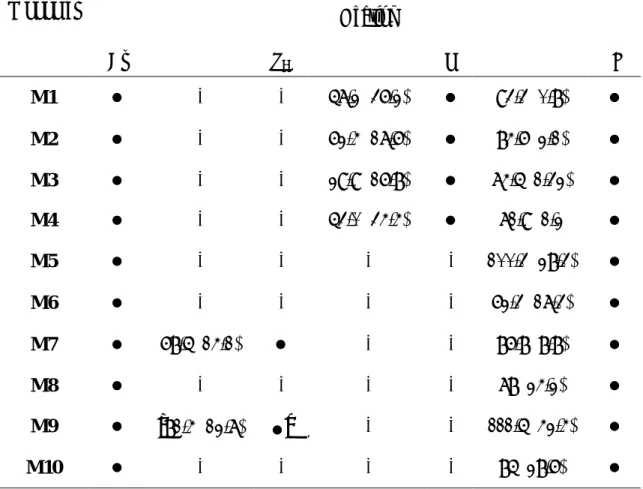
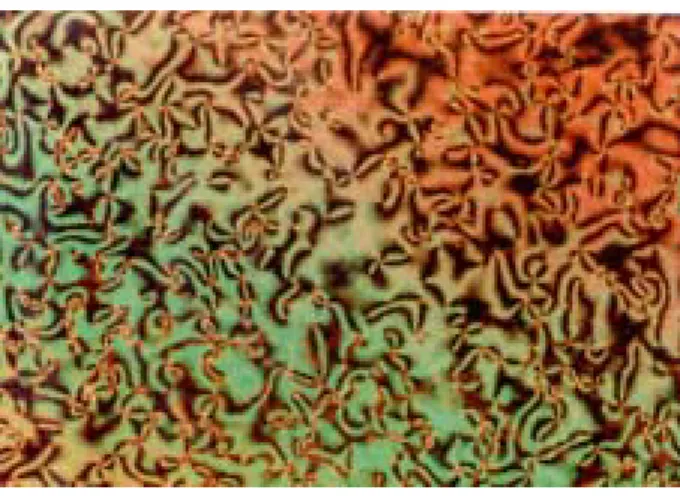
聚合物之合成是將液晶單體先加入 1% 重量百分比之平坦劑, 與1% 重量百分比 benzophenone 作為紫外光聚合起始劑。混合物 再以 5 mg/mL 濃度溶解於 THF 溶劑中,旋轉塗佈於已配向好之導 電玻璃(ITO glass)上,其轉速控制如下:第一階段為 600 rpm 維持 10 秒鐘,第二階段為 1200 rpm 維持 30 秒鐘,之後於液晶相溫度下 進行迴火一小時,再降溫至室溫(25℃)迴火一小時,得到具方向性 排列的發光層薄膜。迴火完成之後的液晶薄膜再經紫外光照光聚合 交聯。 2.熱性質: 我們用微差掃描卡計(DSC)及偏光顯微鏡(POM)來辨別其液晶相 種類與相變化溫度範圍,所有液晶單體的相變化溫度皆列於 Table 1, 其中M1-M4 是屬於向列型(Nematic)的液晶相 (Fig. 1),M5 則不具有 液晶相,推測是結構對稱所造成。 3.偏極化光學性質: 我們利用表面配向方法,將這些單體於液晶相下排列,經紫外光 聚合後,形成規則排列之網狀聚合物,並將此網狀聚合物製備成異方 向(anisotropic)的薄膜,量測平行與垂直方向的強度,並計算極化值 (polarized ratio=平行強度/垂直強度),所得結果列於 Table 2,其中 M1-M4 的 PL 在 425-429nm,是屬於藍光材料。另外 UV 吸收光譜的
極化值介於11.7-14.0,PL 放射光譜極化值介於 10.8-11.5,Fig. 2 為 M1 的偏極化 UV 吸收、偏極化 PL 放射光譜。
4. 偏極化元件性質:
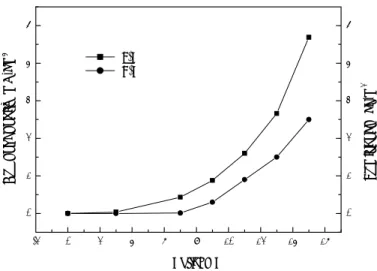
我們將液晶單體製備成雙層的偏極化電激發光元件,元件結構為 (ITO / rubbed-PEDOT / polymer / Al)。先在 ITO 玻璃上塗佈一層 PEDOT,並摩擦過,來當配向層。再將溶液以旋轉塗佈的方式塗佈 於 PEDOT 上,其轉速控制為 1500 rpm 維持 30 秒鐘,之後於 100℃ 之真空烘箱中烘烤 1 小時,再用紫外光聚合做成配向的高分子薄膜, 最後再鍍上鋁電極,封裝,做成偏極化的發光元件。測量元件性質, EL=430 nm,極化值約 7.0 (Fig. 3),驅動電壓為 7V,最大亮度為 2.5 cd/m2 (Fig. 4)。
Scheme 1. + I I R2 R3 R1 OC6H12OH R1 = H, C2H5, CH(CH3)2 R2 = OCH3, CH3, C2H5 R3 = H, OCH3 R1 OC6H12OH R2 R3 R1 HOH12C6O R1 OC6H12O O R2 R3 R1 OH12C6O O M1: R1=H, R2=C2H5, R3=H M2: R1=C2H5, R2=CH3, R3=C2H5 M3: R1=CH(CH3)2, R2=CH3, R3=H M4: R1=CH(CH3)2, R2=C2H5, R3=H M5: R1=C2H5, R2=OCH3, R3=OCH3 Pd(PPh3)2Cl2, PPh3, CuI, Et3N O Cl THF, Et3N 1a: R1=H, R2=C2H5, R3=H 1b: R1=C2H5, R2=CH3, R3=C2H5 1c: R1=CH(CH3)2, R2=CH3, R3=H 1d: R1=CH(CH3)2, R2=C2H5, R3=H 1e: R1=C2H5, R2=OCH3, R3=OCH3
Table 1. Phase transition temperatures and corresponding enthalpy changes of monomers M1 - M10
Phase transition temperatures(℃)and corresponding enthalpies(KJ/mol)
Heating Monomer Cr SA N I M1 ● - - 57.2 (36.2) ● 93.3 (0.8) ● M2 ● - - 62.4 (17.6) ● 84.6 (2.1) ● M3 ● - - 29.9 (16.8) ● 74.5 (1.32) ● M4 ● - - 53.0 (34.4) ● 71.9 (1.2 ● M5 ● - - - - 100.3 (28.3) ● M6 ● - - - - 62.3 (17.3) ● M7 ● 68.5 (14.1) ● - - 86.8 (8.8) ● M8 ● - - - - 78 (24.2) ● M9 ● [81.4 (12.7) ●] - - 111.5 (42.4) ● M10 ● - - - - 85 (28.6) ●
Cr : crystalline, SA : smectic A, N : nematic, I : isotropic
Table 2. The UV-visible absorption, PL emission and polarized ratio of monomers in thin film state.
Polarized ratio Monomer UVmax-visible absorption(nm) PLmax emission(nm) UV-vis (UV///UV⊥) PL (PL///PL⊥) EL (EL///EL⊥) M1 343 428 11.7 10.8 7.0 M2 344 427 12.0 11.1 6.9 M3 343 429 13.3 11.5 6.8 M4 340 425 14.0 11.1 6.2 M7 362 455 4.6 3.5 - M9 447 544 4.2 3.4 -
300 350 400 450 500 550 600 0.0 0.2 0.4 0.6 0.8 1.0 0.0 0.2 0.4 0.6 0.8 1.0 P L I nte ns it y ( ar b. u n its ) A bsor pt ion ( ar b . uni ts ) Wavelength (nm) (//) (⊥) (//) (⊥)
Fig. 1. Photomicrographs of the N phase schlieren texture of M1 at 75℃
Fig. 2. Polarized optical spectra of LC network of M1 on rubbed PEDOT film.
350 400 450 500 550 600 650 0.0 0.2 0.4 0.6 0.8 1.0 E L In te ns it y (a rb . un it s) Wavelength (nm) (//) (⊥) -2 0 2 4 6 8 10 12 14 16 0 1 2 3 4 5 0 1 2 3 4 5 C u rr ent de ns ity (mA /cm 2 ) Lu mi nance (cd/m 2 ) Voltage(V) (J-V) (L-V)
Fig. 3. Polarized EL spectra of an ITO/rubbed PEDOT/LC network of M1/Al device.
Fig. 4. The J-V (■) and L-V (●) curves of ITO/rubbed PEDOT/M1/ Al/ device.
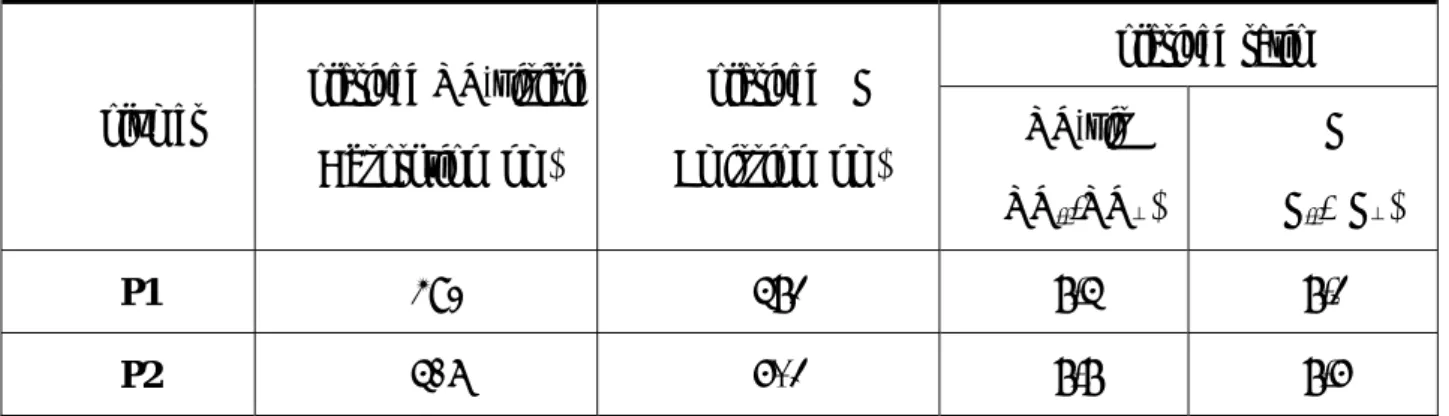
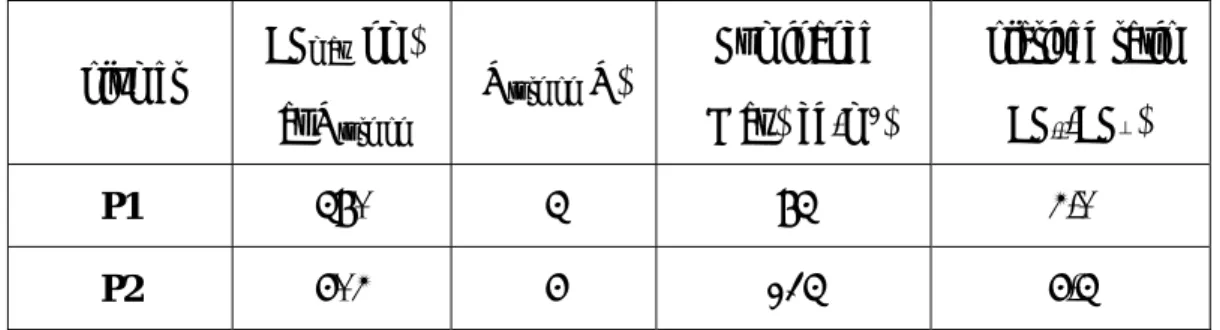
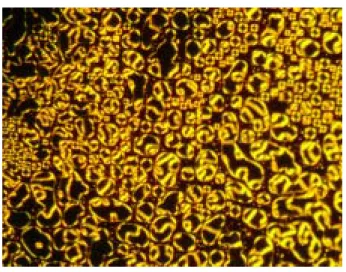
三、計畫之第二年部份 1.液晶單體與聚合物之合成: 本年度主要合成出含α-甲基取代之三苯基雙乙烯液晶單體與 側鏈高分子液晶材料,其中小分子液晶單體的合成方法為利用鈀(Pd) 作為催化劑進行 Heck coupling 反應,並在末端接上可聚合之丙醯酸 酯基團,合成方法如Scheme 2 所示。而高分子液晶材料則是用 Suzuki coupling 來合成液晶單體,並用自由基聚合來形成高分子,其合成方 法如 Scheme 3、4 所示。 2.熱性質: 我們用微差掃描卡計(DSC)及偏光顯微鏡(POM)來辨別其液晶相 種類與相變化溫度範圍,所有小分子液晶單體的相變化溫度皆列於 Table 1,其中 M7、M9 具有層列型 SA(Smectic)液晶相(Fig. 5),M6、 M8、M10 則不具有液晶相,推測是結構末端甲氧基太大所造成。 側鏈高分子液晶材料的相變化溫度皆列於Table 3,高分子 P1、 P2 皆具有向列型(Nematic)的液晶相(Fig. 6)。 3.偏極化光學性質: 我們利用表面配向方法,將這些液晶材料於液晶相下排列,製備 成異方向(anisotropic)的薄膜,量測平行與垂直方向的強度來計算極化 值,小分子液晶材料(M7、M9)資料列於 Table 2,側鏈高分子(P1-P2)
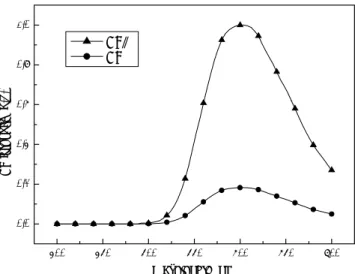
資料列於Table 4。了解液晶單體所發出光的顏色,並將液晶材料做 成具有異方性的薄膜,並計算極化值,UV 吸收光譜的極化值介於 4.2-8.8,PL 放射光譜的極化值介於 3.4-8.6,M7、M9 因不具向列型 (Nematic)的液晶相,使所得的極化值較低。另外 M7 的 PL 在 455 nm, 是屬於藍光材料; M9 的 PL 在 544 nm,是屬於黃綠光材料; P1 的 PL 在583 nm (Fig. 7),是屬於黃光材料; P2 的 PL 在 603 nm,是屬於橘 光材料。 4.偏極化元件性質: 我們取極化值較高的側鏈高分子液晶材料來製備成偏極化電激
發光元件,元件結構為ITO / rubbed-PEDOT / polymer / Ca / Al。所得
的偏極化元件性質列於Table 5,其中 P2 的元件性質較佳,EL=604 nm
Scheme 2. H3CO HO CH3 H3CO HOH12C6O CH3 + Pd(OAc)2 P(o-tol)3 Et3N O Cl THF, Et3N CH3CN HOH12C6Cl KI K2CO3 Ar Br Br Br Br I I S Br Br Br Br = 2 3a - 3e M6 - M10 a b c d e S M6= M7= M8= M9= M10 = H3CO HOH12C6O H3C CH3 OCH3 OC6H12OH Ar H3CO OH12C6O H3C O CH3 OCH3 OC6H12O O Ar
HOH12C6O HOH12C6O B O O N S N Br Br + C5H11 HOH12C6O N S N Br C5H11 B O O C5H11 HOH12C6O N S N toluene H B O O Pd(PPh3) K2CO3 H2O / toluene toluene H B O O Pd(PPh3) K2CO3 H2O / toluene THF Et3N Acryloyl chloride C5H11 OH12C6O O N S N Polymer 1 Scheme 3.
HOH12C6O H N S N Br Br + + HOH12C6O N S N Br C5H11 C5H11 HOH12C6O N S N C5H11 OH12C6O O N S N Pd(PPh3)Cl2 PPh3 / CuI ET3N Pd(PPh3)Cl2 PPh3 / CuI ET3N O Cl THF / ET3N THF AIBN Polymer 2 Scheme 4.
Table 3. Polymerization results and phase transition temperatures of polymers.
Polymers Yield (%) Mn Mw Mw / Mn Phase transition temperatures(℃)
G 92℃ N 170℃ I P1 76 8600 15600 1.81 I 156℃ N 65℃ G G 79℃ N 126℃ I P2 80 9600 18400 1.92 I 124℃ N 59℃ G G:glassy state, N:nematic phase, I:isotropic
Table 4. The polarized UV-visible absorption, polarized PL emission and polarized ratio of polymers. Polarized ratio Polymer Polarized UV-visible Absorption (nm) Polarized PL Emission (nm) UV-vis (UV///UV⊥) PL (PL///PL⊥) P1 492 583 8.5 8.3 P2 517 603 8.8 8.6
Table 5. Device properties of polarized device using P1 and P2 as active layer. Polymer ELmax(nm) at Vturn on Vturn on(V) Luminance (Max)(cd/m2) Polarized ratio (EL///EL⊥) P1 580 5 85 4.0 P2 604 6 235 6.5
Fig. 5. Photomicrographs of the SA phase focal-conic texture of
M7 at 75℃.
Fig. 6. Polarizing optical micrograph of polymer P1: nematic droplet texture obtained at 150℃ 0 6 0.8 1.0 .) UV∥ UV⊥ PL∥ PL⊥
Fig. 7. Polarized UV-vis absorption spectra and polarized PL emission spectra of P1
Fig. 8. Polarized EL spectra of P2 in the ITO / aligned PEDOT / P2 / Ca / Al device. 400 450 500 550 600 650 700 0.0 0.2 0.4 0.6 0.8 1.0 EL∥ EL┴ EL int ens ity (a. u. ) Wavelength (nm)
Fig. 9. J-V(□) and L-V(˙) curves of P2 in the ITO / aligned PEDOT / P2 / Ca / Al device. 四、計畫之第三年部份 0 2 4 6 8 10 12 14 0 100 200 300 J - V L - V Voltage (V) C
urrent density (mA
/cm 2 ) 0 100 200 300 Lumi nance ( cd/ m 2 )
1.液晶單體與聚合物之合成:
本年度主要是合成出藍光、綠光、紅光之液晶發光材料,並利 用摻混(blending)的方法製備偏極化白光電激發光元件,所設計之液
晶材料結構如 Scheme 5 所示,用 Suzuki coupling 來進行聚合得到高
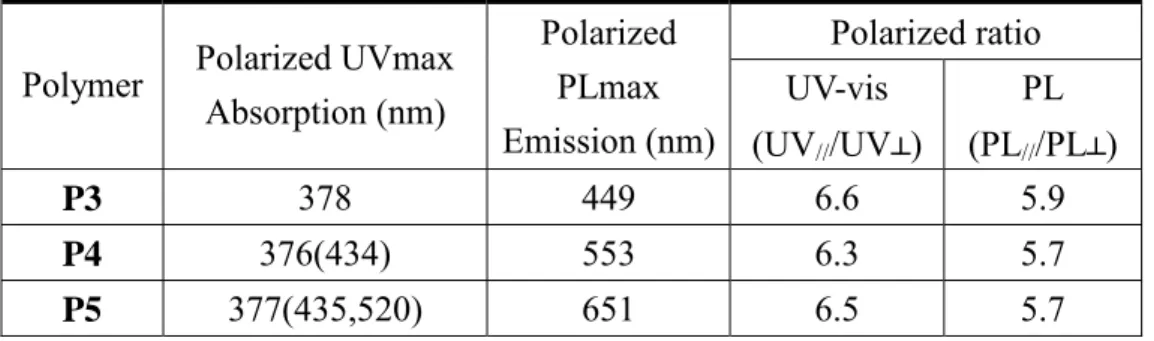
分子,三個高分子液晶材料皆為聚芴高分子(polyfluorene)的衍生物, 其中 P3 為藍光材料; P4 為綠光材料; P5 為紅光材料。 2.熱性質: 我們用微差掃描卡計(DSC)及偏光顯微鏡(POM)來辨別其液晶相 種類與相變化溫度範圍,所有高分子液晶材料的相變化溫度皆列於 Table 6,皆具有向列型(Nematic)的液晶相(Fig. 10)。 3.偏極化光學性質: 發光高分子材料(P3-P5)偏極化光學性質列於 Table 7,其中 P3 的 PL 在 449 nm,P4 的 PL 在 553 nm,是屬於綠光材料,P5 的 PL 在 651 nm,是屬於紅光材料。UV 吸收光譜的極化值介於 6.3-6.6,PL 放射光譜的極化值介於 5.7-5.9(Fig. 11)。 4. 偏極化元件性質: 我們利用高分子液晶材料來製備成偏極化電激發光元件,元件結
構為ITO / rubbed-PEDOT / polymer / Ca / Al。所得的偏極化元件性質
壓為 7V,極化值約 6.4,最大亮度為 430 cd/m2 (Fig. 13)。
之後用摻混的方法來提升元件性質,將藍光材料P3 摻混 5%的綠
光材料P4 及 5%紅光材料 P5,其中 P3 當作主體(Host),P4、P5 當作
客體(Guest),利用其分子鏈間的能量轉移(intrachain energy transfer),
來提升元件性質,摻混後的元件性質列於 Table 8。在摻混後,綠光 材料P4 偏極化亮度由原來的 1039 cd/m2提升至 2205 cd/m2,提高至2 倍,效率提升至 0.60 cd/A; 紅光材料 P5 偏極化亮度由原來的 284 cd/m2提升至1146 cd/m2,提高至4 倍,效率提升至 0.22 cd/A,摻混 的方法確實達到提升元件性質的效果。 最後利用藍光 P3 做為主體,摻混綠光 P4、紅光 P5 材料,來製 備偏極化白光元件,總共有三種不同的比例,分別製作出白光元件 A、B、C,Fig. 14 為偏極化白光元件 A 的 EL 光譜,最大亮度可達 581 cd/m2 (Fig. 15),由圖中可看出藍光、綠光、紅光三元色的波峰, 且波長涵蓋 400 nm 至 700 nm 之間,確實有構成白光的要件,並且有 極化的效果。所有的偏極化白光元件性質皆列於 Table 9,其中元件 C 性質最佳,偏極化白光亮度可達1895 cd/m2、效率為0.24 cd/A、極化 值為 4.4。白光元件 A 的 CIE 1931(x,y)座標為(0.332,0.363),非常接 近純白光(0.333,0.333)。
N SN C8H17 H17C8 8 5 1 5 N C5H11 8 0 2 0 C8H17 H17C8 N SN S S C8H17 H17C8 N S N 8 5 1 0 5 P1 P2 P3 Scheme 5
Table 6. Polymerization results and phase transition temperatures of polymers.
a) The temperatures were observed by DSC. b) The temperatures were observed by TGA.
c) The temperatures were observed by POM; G: glassy state, N: nematic phase, I: isotropic.
Polymers Yield (%) Mn Mw Mw / Mn Tg (℃)a) Td (℃)b) Phase transition temperatures (℃)c)
P3 68.8 12200 18200 1.49 71.7 373 G 101 N >300 I
P4 63.5 10700 15600 1.45 106.3 410 G 125 N >300 I
Table 7. Polarized UV-vis absorption, polarized PL emission and polarized ratio of polymers.
Polarized ratio Polymer Polarized UVmax
Absorption (nm) Polarized PLmax Emission (nm) UV-vis (UV///UV┴) PL (PL///PL┴) P3 378 449 6.6 5.9 P4 376(434) 553 6.3 5.7 P5 377(435,520) 651 6.5 5.7
Table 8. Polarized device properties. Polymer ELmax (nm) V turn on (V) Luminance (Max) (cd/m2) Efficiency (Max) (cd/A) Polarized ratio (EL///EL┴) CIE 1931 (x,y) P3 456 7 430 0.08 6.4 (0.186,0.208) P4 540 6 1039 0.40 6.3 (0.382,0.573) P5 652 7 284 0.05 5.4 (0.672,0.322) P3+P4 (5%) 538 7 2205 0.60 5.5 (0.352,0.559) P3+P5 (5%) 644 7 1146 0.22 5.2 (0.620,0.323)
Table 9. Properties of polarized white emission devices. Device P3 : P4 : P5 (mg) ELmax (nm) Vturn on (V) Luminance (Max) (cd/m2) Polarized ratio (EL///EL┴) CIE 1931(x,y) A 100:0.08:0.10 528 6 581 4.0 (0.332,0.363) B 100:0.06:0.12 525 6 1358 4.6 (0.343,0.361) C 100:0.04:0.12 534 6 1895 4.4 (0.322,0.368)
300 350 400 450 500 550 600 0.0 0.2 0.4 0.6 0.8 1.0 1.2 In tens ity (arb. unit s) Wavelength (nm) P1-UV∥ P1-UV⊥ P1-PL∥ P1-PL⊥
Fig. 10. DSC thermogram of polymer P3.
Fig. 11. Polarized UV-vis absorption and polarized PL emission spectra of P3.
Fig. 12. Polarized EL spectra of P3 in ITO/aligned PEDOT/P1/Ca/Al device.
Fig. 13. J-V (□) and L-V (•) curves of P1 in ITO/aligned PEDOT /P3/Ca/Al device. 400 450 500 550 600 650 700 0.0 0.2 0.4 0.6 0.8 1.0 EL∥ EL⊥ In tens ity (arb. unit s) Wavelength (nm) 0 2 4 6 8 10 12 0 200 400 Voltage (V) C urrent den sity (mA /cm 2 ) 0 100 200 300 400 500 600 J-V L-V Lu minan ce (cd/m 2 )
Fig. 14. Polarized EL spectra of device A in ITO/aligned PEDOT/ polymer P1+P2+P3/Ca/Al device.
Fig. 15. J-V (□) and L-V (•) curves of device A in ITO/aligned PEDOT /polymer P1+P2 +P3/Ca/Al device.
350 400 450 500 550 600 650 700 750 0.0 0.2 0.4 0.6 0.8 1.0 EL∥ EL┴ In tens ity (arb. unit s) Wavelength (nm) 0 2 4 6 8 10 12 14 0 200 400 600 J-V L-V Voltage (V) C u rr en t den si ty (m A /c m 2 ) 0 200 400 600 800 Lum in anc e (c d/ m 2 )
五、結論: 於三年計畫過程中,本實驗室合成出各種不同系列的小分子、高 分子液晶材料,皆可製作成偏極化電激發光元件,其熱性質或光電性 質結果亦已逐年發表於國際期刊中。本實驗室也成功地製備出偏極化 的藍光、綠光、紅光電激發光元件,並且用摻混的方法來製備出偏極 化白光元件,最大偏極化白光亮度可達1895 cd/m2、效率為0.24
cd/A、極化值為 4.4,另外白光元件 A 的 CIE 1931(x,y)座標為(0.332, 0.363),非常接近純白光(0.333,0.333),非常有潛力應用在液晶顯示器 的背光板上。
六、已發表論文
1. S. W. Chang, A. H. Li, C. W. Liao and C. S. Hsu, Jpn. J. Appl. Phys. 41, 2002, 1374.
2. S. W. Chang and C. S. Hsu, J. Polym. Res. 9, 2002, 1.
3. Y. H. Yao, L. R. Kung and C. S. Hsu accepted in Jpn. J. Appl. Phys. 4. Y. H. Yao, L. R. Kung and C. S. Hsu submitted in Journal of Polymer
Science Part A: Polymer Chemistry.
參考文獻:
1) R. H. Friend, R. W. Gymer, A. B. Holmes, J. H. Burroughes, R. N. Marks, C. Taliani, D. D. C. Bradley, D. A. Dos Santos, J. L. Brédas, M. Lögdlund and W. R. Salaneck: Nature 397 (1999) 121.
2) G. Hadziioannou and P. F. van Hutten, eds.: Semiconducting Polymers
Chemistry, Physics and Engineering (Wiley-VCH, Weinheim, 2000).
3) D. T. McQuade, A. E. Pullen and T. M. Swager: Chem. Rev. 100 (2000) 2537.
4) C. K. Chiang, C. R. Fincher, Jr., Y. W. Park, A. J. Heeger, H.
Shirakawa, E. J. Louis, S. C. Gau and A. G. MacDiarmid: Phys. Rev. Lett. 39 (1977) 1098.
5) T. Virgili, D. G. Lidzey and D. D. C. Bradley: Adv. Mater. 12 (2000) 58.
6) T. F. Guo, S. S. Chang, Y. Yang, R. C. Kwong and M. E. Thompson: Org. Electron. 1 (2000) 15.
7) V. Cleave, G. Yahioglu, P. Le Barny, D. H. Hwang, A. B. Holmes, R. H. Friend and N. Tessler: Adv. Mater. 13 (2001) 44.
8) Y. Ohmori, M. Uchida, K. Muro and K. Yoshino: Jpn. J. Appl. Phys. 30 (1991) 1941.
9) A. W. Grice, D. D. C. Bradley, M. T. Bernius, M. Inbasekaran, W. W. Wu and E. P. Woo: Appl. Phys. Lett. 73 (1998) 629.
10) M. Gross, D. C. Muller, H. G. Nothofer, U. Scherf, D. Neher, C. Brauchle and K. Meerholz: Nature 405 (2000) 661.
11) T. Miteva, A. Meisel, W. Knoll, H. G. Nothofer, U. Scherf, D. C. Mller, K. Meerholz, A. Yasuda and D. Neher: Adv. Mater. 13 (2001) 565.
12) M. Grell, W. Knoll, D. Lupo, A. Meisel, T. Mikeva, D. Neher, H. G. Nothofer, U. Scherf and A. Yasuda: Adv. Mater. 11 (1999) 671.
13) T. Miteva, A. Meisel, M. Grell, H. G. Nothofer, D. Lupo, A. Yasuda, W. Knoll, L. Klopperburg, U. H. F. Bunz, U. Scherf and D. Nehr: Synth. Met. 111-112 (2000) 173.
14) K. S. Whitehead, M. Grell, D. D. C. Bradley, M. Jandke and P. Strohriegl: Appl. Phys. Lett. 76 (2000) 2946.
15) M. T. Bernius, M. Inbaskekaran, J. O’Brien and W. Wu: Adv. Mater. 12 (2000) 1737.
16) C. D. Müller, A. Falcou, N. Reckefuss, M. Rojahn, V. Wiederhirn, P. Rudati, H. Frohne, O. Nuyken, H. Becker and K. Meerholz: Nature 421 (2003) 829.
17) C. Ego, D. Marsitzky, S. Becker, J. Zhang, A. C. Grimsdale, K.
Müller, J. D. Mackenzie, C. Silva and R. H. Friend: J. Am. Chem. Soc. 125 (2003) 437.
18) M. S. Liu, X. Jiang, S. Liu, P. Herguth and A. K. Y. Jen: Macromolecules 35 (2002) 3532.
19) D. M. Johansson, M. Theander, T. Granlund, O. Inganäs and M. R. Andersson: Macromolecules 34 (2001) 1981.
20) E. Lim, B. J. Jung and H. K. Shim: Macromolecules 36 (2003) 4288. 21) B. Liu, W. L. Yu, Y. H. Lai and W. Huang: Macromolecules 33 (2000) 8945.
22) M. Strukelj, R. H. Jordan and A. Dodabalapur: J. Am. Chem. Soc. 118 (1996) 1213.
23) Z. Shen, P. E. Burrows, V. Bulvic, S. R. Forrest and M. E. Thompson: Science 276 (1997) 2009.
24) J. Kido, H. Shionoya and K. Nagai: Appl. Phys. Lett. 67 (1995) 2281. 25) J. Kido, H. Hongawa, K. Okuyama and K. Nagai: Appl. Phys. Lett. 64
(1994) 815.
26) F. Hide, P. Kozodoy, S. P. DenBaars and A. J. Heeger: Appl. Phys. Lett. 70 (1997) 2664.
27) C. Zhang and A. J. Heeger: Appl. Phys. Lett. 84 (1998) 1579. 28) Y. Hamada, T. Sano, H. Fujii and Y. Nishio: Jpn. J. Appl. Phys. 35
(1996) 1339.
29) C. L. Chao and S. A. Chen: Appl. Phys. Lett. 73 (1998) 426.
30) Y. Z. Wang, R. G. Sun, F. Meghdadi and G. Leising: Appl. Phys. Lett. 74 (1999) 3613.
31) C. W. Tang, S. A. Vanslyke and C. H. Chen: Appl. Phys. Lett. 65 (1989) 3610.
32) J. Shi and C. W. Tang: Appl. Phys. Lett. 70 (1997) 1665.
33) B. P. Lyons, K. S. Wong and A. P. Monkman: J. Chem. Phys. 118 (2003) 4707.
34) H. J. Egelhaaf, J. Gierchner and D. Oelkrug: Synth. Met. 127 (2002) 221.
35) R. Buckley, M. D. Rahn, J. Hill, J. Cabanillas-Gonzalez, A. M. Fox and D. D. C. Bradley: Chem. Phys. Lett. 339 (2001) 331.
36) A. Dogariu, R. Gupta, A. J. Heeger and H. Wang: Synth. Met. 100 (1999) 95.
37) Y. H. Niu, J. Huang and Y. Cao: Adv. Mater. 15 (2003) 807.
Spreitzer, F. Weissörtel and J. Salbeck: Adv. Mater. 12 (2000) 130. 39) C. H. Chuen and Y. T. Tao: Appl. Phys. Lett. 81 (2002) 4499. 40) R. S. Deshpande, V. Bulovic and S. R. Forest: Appl. Phys. Lett. 75 (1999) 888.
41) B. W. D’ Andrade, J. Brooks, V. Adamovich, M. E. Thompson and S. R. Forrest: Adv. Mater. 14 (2002) 1032.
42) B. W. D’ Andrade, M. E. Thompson and S. R. Forrest: Adv. Mater. 14 (2002) 147.
43) D. Neher: Macromol. Rapid Commun. 22 (2001) 1365. 44) U. Scherf and E. J. W. List: Adv. Mater. 14 (2002) 477. 45) M. Grell and D. D. C. Bradley: Adv. Mater. 11 (1999) 895. 46) M. Grell, D. D. C. Bradley, E. P. Woo and M. Inbasekaran: Adv.
Mater. 9 (1997) 798.
47) D. Sainova, A. Zen, H. G. Nothofer, U. Asawapirom, U. Scherf, R. Hagen, T. Bieringer, S. Kostromine and D. Neher: Adv. Funct. Mater. 12 (2002) 49.
48) X. H. Yang, D. Neher, S. Lucht, H. Nothofer, R. Güntner, U. Scherf, R. Hagen and S. Kostromine: Appl. Phys. Lett. 81 (2002) 2319. 49) M. Jandke, D. Hanft, P. Strohriegl, K. Whitehead, M. Grell and D. D.
C. Bradley: Proc. SPIE 4105 (2001) 338.
50) A. Bolognesi, C. Botta, D. Facchinetti, M. Jandke, K. Kreger, P. Strohriegl, A. Relini, R. Rolandi and S. Blumstengel: Adv. Mater. 13 (2001) 1072.
51) K. S. Whitehead, M. Grell, D. D. C. Bradley, M. Inbasekaran and E. P. Woo: Synth. Met. 111-112 (2000) 181.
52) A. C. A. Chen, S. W. Culligan, Y. G.eng, S. H. Chen, K. P. Klubek, K. M. Vaeth and C. W. Tang: Adv. Mater. 16 (2004) 783.
53) M. Ranger, D. Rondeau and M. Leclerc: Macromolecules 30 (1997) 7686.
54) H. B. Goodbrand and N. X. Hu: J. Org. Chem. 64 (1999) 670.
55) P. Herguth, X. Jiang, M. S. Liu and A. K.Y. Jen: Macromolecules 35 (2002) 6094.
56) Q. Hou, Q. Zhou, Y. Zhang, W. Yang, R. Yang and Y. Cao: Macromolecules 37 (2004) 6299.
57) A. R. Buckley, M. D. Rahn, J. Hill, J. Cabanillas-Gonzalez, A. M. Fox and D. D. C. Bradley: Chem. Phys. Lett. 339 (2001) 331.
58) X. Gong, D. Moses, A. J. Heeger and S. Xiao: J. Phys. Chem. B 108 (2004) 8601.