87 .
B uIletin of Educational Psychology, 2∞ 1 , 33(1), 87叫 NationaI Taiwan Normal University, Taipei, Taiwan, R.O.
c.
Career Decision-Making Difficulties
Perceived
by
College Students in
Taiwan申
HSIU-LAN SHELLEY TIEN Department of Elementary Education
National Pingtung Teachers College
The purposes of the study were 也reefold:(1) to construct the Chinese version of
“
Career Decision-making Difficulties Inventory;" (2) to investigate the career-related problems encountered by college students; and (3) to test a classification system for career decision difficulties for college students. Four hundred and sixty-seven college students comple削 theCareer Decision-making Difficulties Questionnaire. Data obtained was analyzed by Chi-square, ANOVA, factor analysis, and ADDTREE. The results indicated the significant differences between decided and undecided students on their perceptions of career difficulties. The three-group classification system for career decision difficulties was general1y speaking supported by the data in 血isstudy.KEY WORDS: Career Decision-making, Career Difficulti郎,Career Problems
During the process of career development, an individual mak:es numerous important decisions that a位'ectmajor areas of his or her life. For some of the college students ,也eyneed little time to decide. Some of them even have decided for a number of years prior to entering the world of work. However, many of them lack essential elements necessary to mak:e a right decision. The empirical studies on the construct of career indecision provided us with a vehic1e to realíze the difficulties our c1ients might encounter. Gati, Krau凹, and Osipow (1996) presented a model to explain career difficulties people might encounter.
The author of the present study concems the difficulties college students perceived in Taiwan. To examine the career-related difficulties perceived by college students, the c1assification system proposed by Gati et al. (1996) was adapted in this study. The c1assification system is hierarchic, in which broad categories of career difficulties are separated into categories and then subcategories based on finer distinctions. Therefore each difficu1ty can be c1assified into one major categ。可 and
* This project was supported by a grant from the National Science Council (NSC87-24 日 -H-153-004). ltamar Gati's (professor at the Hebrew Universíty of Jerusalem) help ín ADDTREE analysís is deeply apprecíated
88 教育心理學報
then into finer categories and subcategories.
Gati et al. (1996) developed the Career Decision-making Difficulty Questionnaire (CDDQ) to evaluate the difficulties perceived by individuals. The validity and reliability of the CDDQ were then tested in several studies after the theoretical model was proposed. Osipow and Gati (1998) examine the construct validity of the career decision making difficulties questionnaire and found that undecided students had significantly higher scores on the CDDQ. Similar to this finding,
Lancaster, Rudol戶, Perkins, and Patten (1999) found 也at decided students have a tendency to present themselves as having less difficulties in decision making than undecided students.
The central question of the present study concemed what kinds of difficulty college students encountered or perceived. One of the pu中osesof career counseling is to facilitate decision-making process, in particular, to help them overcome the difficulti自由ey encounter during 也e process. However, several studies indicated that the dichotomous grouping of “decided-undecided" is too simplistic and leaves out other areas of concern (Brooks, 1984; Fuqua & Hartman, 1983; Salomone, 1982). In this study, students were c1assified into one of the five categories of decision status. The difficulties perceived by them will be exarnined.
Vondracek, Schulenberg, Skorikov, and Gillespie (1995) exarnined the relationship between identity statuses and different kinds of career decisions. The findings showed 也atmembership in a specific identity status group was significantly related to the nature and amount of career indecision. Achievement responders had significantly lower career indecision scores than respondents in other t趾eestatus groups.
Cohen, Chartrand, and Jowdy (1995) divided students who have not yet made a career decision into four groups: (1) Ready to decide- low anxiety, high self-esteem, good vocational identity; (2) Developmentally undecided-- emotionally stable, but do not yet have a c1ear picture of themselves or the world of work; (3) Choice anxious-- high choice anxiety, little need for career information, low vocational identity; and (4) Chronically indecisiveness-- low vocational identity,
high need for career and self information, low goal directness, and low self-esteem. In this study,
career difficulties experienced by students in different status of career decision will be exarnine
Method
Participants
In the stage of Questionnaire development, the p位世cipants were 307 college students (149 males and 158 females) from five universities in southem Taiwan. The age ranged from 18 to 29 with a mean of 2l.23. All of them participated in career-related courses.
大專學生對生涯決定困難的知覺分析 89
To test the difficulty c1assification system, the participants consisted of 172 male and 295 female students from 11 universities in Taiwan. They came from different majors across the six categories classified by Holland (1997). Among them, 25% were freshmen, 15% were sophomores, 26% were juniors, 30% were seniors, and 4% were graduate students. They were between the ages of 18 and 29 with the mean of21.18.
Instrument
The Chinese version of the Career Decision-making Difficulties Questionnaire (CDDQ) were developed based on the 44 difficulties listed in the Appendix in Gati et al. (1996). The author added 6 items specific to the cultural context in Taiwan. The author believe those items might influence the col1ege students' career decision making. Those items inc1uded the concepts of family members' involvement in making a decision, the col1ege entrance examination system, and economic and political development of the coun甘y,etc. However, those items were not inc1uded in the fina1 ana1ysis because a factor analysis for the 50 items did not show a convergent of the six ltems.
According to Gati et al. (1996), the 44 items represented 10 distinct types of problems and subsumed three major categories of career difficulties. The first category, Lack of Readiness,
inc1udes three categories of difficulties: (1) lack of motivation; (2) indecisiveness; and (3) dysfunctional beliefs. The second catego句, Lack of Information, inc1udes four subcategories: (1)
lack of knowledge about the steps involved in the process of career decision making; (2) lack of information about the self; (3) lack of information about the various occupations; and (4) lack of information about the ways of obtaining additional information. The third major category is Inconsistent Information which is the results of (1) unreliable information; (2) intemal conflicts; and (3) extemal conflicts. The intemal consistent reliability of the 10 scales based on a 307 col1ege students (149 ma1es and 158 females) ranged from .53 to .9l. To respond to the questionnaire, the participants were asked to rate from 1 to 9 according to the degree of difficulty they perceived on each difficulty item.
In addition to the items on the CDDQ, all participants were asked to choose among five altematives. Those five statements represented respectively five different decision status or identity development: (1) Identity diffusion; (2) Anxious type of indecision; (3) Explorative type of indecision; (4) Forec1osure; and (5) Identity achievement. The five statements were developed based on Marcia's (1966) c1assification of adolescent identity status. She divided the identity status into four groups: achievement, forec1osure, moratorium, and diffusion. In this study, we adapt the ideas of differences between indecision and indecisiveness (Herr & Cramer, 1996) and divided
Procedure
The participants responded to the questionnaire in c1asses of 20 to 45 students in career-planning related courses. The questionnaires were mailed to 11 university counseling centers and the counselors helped with the administrative procedure.
90 . 教育心理學報
Data analysis
In the stage of instrument development, me徊,standard deviati凹, item-total correlation, and
reliability coefficient of each item were calculated to examine the appropriateness of the items. To test the differences between decided and undecided groups of students on their perceptions of career difficulty, ANOVA was used. The decided group included students with identity achieved and foreclosure status. The undecided group, on the other hand, included the explorative/anxious undecided and identity diffusion students. Homogeneity of different grade groups was tested to cope with the problem caused by different cell numbers. In addition, factor analysis was administered to examine the factor structure of the career difficulties perceived by college students.
In order to examine the empirical structure of the 10 scales of the CDDQ, we used ADDTREE (Sattath & Tversky, 1977), a kind of cluster analysis algorithm used by Gati et al.
(1996). ADDTREE is compelling because it represents the proximity matrix in the form of an additive or
“
path length" tree, in which the variables are divided into clusters according to 也eproximity between them (Osipow & Gati, 1998).
Results
Psychometric properties 01 the Chinese version 01 the CDDQ
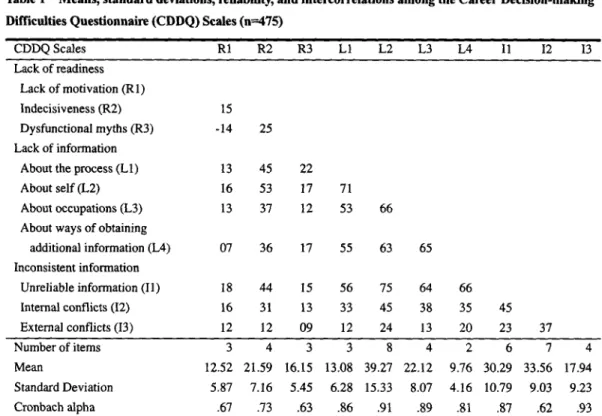
The means, standard deviations, and reliabilities of the scale scores were listed in Table 1. The table also presents the number of items for each scale. The intercorrelations among the scale scores are also presented in Table 1. The means for the 10 scales seem reasonable and the standard deviations show an acceptable variability.
As far as the intercorrelations among the scale scores, intercorrelations within the Lack of Information categ。可 aremuch closer to each other. The unreliable information in the category of Inconsistent Information seems closer to the scale scores on the category of Lack of Information. Hence, we categorized the unreliable information into the category of Lack of Information.
大專學生對生涯決定困難的知覺分析 . 91
Table 1 Means, standard deviations, reliability, and intercon可elationsamong the Career Decision-making
Diffic叫組的 Questionnaire(CDDQ) Scales (n=475) CDDQ Scales Lack of readinωs Lack ofmotivation (Rl) Indecisiveness (R2) Dysfunctional myths (R3) Lack of information
About the proc旭ss(L1)
About self (L2) About 0心cupations(L3) About ways of obtaining
additional information (L4) Inconsistent information
Unreliable information (II) Intemal conflicts (12) Extemal conflicts (13) Number of items Mean Standard Deviation Cronbach alpha Rl R2 R3 L1 L2 L3 L4 II 12 13 15 -14 25 ζu z0 , 1 句3 呵,, eJ 272 勻,旬,且, -a ζJ 弓 3 句 J A 且可 εJ 句且 可 VZO 司 u lll 。7 36 17 55 63 65 18 44 15 56 75 16 31 13 33 45 1212 09 12 24 3 4 3 3 8 12.52 21.59 16.15 13.08 39.27 5.87 7.16 5.45 6.28 15.33 .67 .73 .63 .86 .91 64 66 38 35 45 13 20 23 37 4 2 6 7 4 22.12 9.76 30.29 33.56 17.94 8.07 4.16 10.79 9.03 9.23 .89 .81 .87 .62 .93
Cαreer dífficulties perceived by college students
The numbers of participants' decision status in each of the five categories are listed in Table 2. The result of Chi-square t巴stindicated that most of the students were in the status of explorative type of undecided (x 2
4
=
1 0.68). For college seniors and graduate students, most of them belong tothe category of identity achievement. However, for freshmen, sophomores, and juniors, most of them are in the status of explorative undecided. In addition, one fifth (over 20%) of the freshmen were confused about their future.
Career di缸iculties perceived by college students were exarnined in terms of gender, grade,
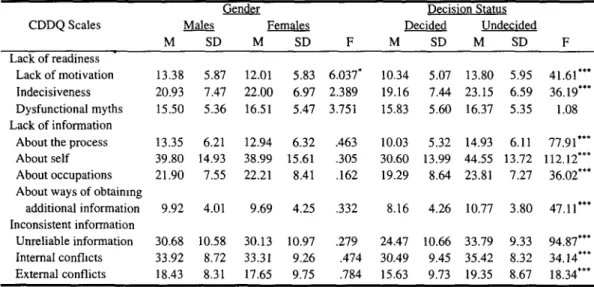
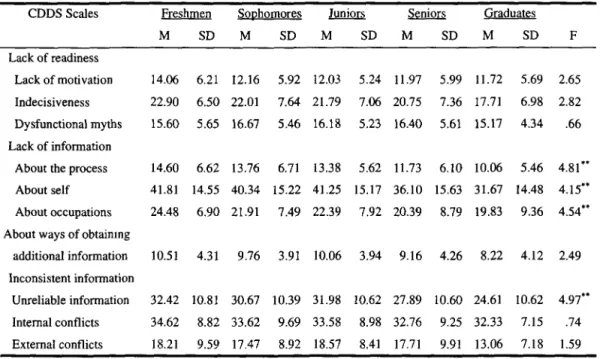
and decision status differences. Table 3 and Table 4 are summaríes of ANOVA tests for gender,
status, and grade differences. For the gender variable, male and female students' scores on the scales are not significant except for the scale, lack of motivation. Males' average score on the lack of motivation scale are significantly higher than that of females.
92 教育心理學報
Table 2 Career decision-making status of all participants
Identìty Foreclosure Explorat1ve Anxious Identity
achieved Undecided Undecided Diffusion Total
x
2Gender Males 33(19.2) 22(12.8) 74(43.0) 16(9.3) 27(15.7) 172 10.68* Feales 93(31.5) 30(10.2) 110(37.3) 32(10.8) 30(10.2) 295 Grade Freshmen 20(17.7) 13(11.5) 43(38.1) 14(12.4) 23(20.4) 113 42.17* Sophomore 16(23.5) 6(8.8) 31(45.6) 8((11.8) 7(10.3) 68 Juniors 22(17.9) 13(10.6) 61(49.6) 14(11.4) 13(10.6) 123 Seniors 58(40.0) 19(13.1) 45(31.0) 11(7.6) 12(8.3) 145 Graduate 10(55.6) 1(5.6) 4(22.2) 1(5.6) 2(11.1) 18 Total 126(27.0) 52(11.1) 184(39.4) 48(10.3) 57(12.2) 467 Notes: 1. Figures in the parentheses represented percentage. 2.
x
2=10.68 ;x
2,,=42.17 ; *p<.05Table 3 Means
,
Standard Devia值。ns,and ANOVA test of the CDDS scales in different gender and different decision status已包車E De氾isionStatus
CDDQ Scales 也迅星星 區且越且主 旦旦追星巫 Undecided M SD M SD F M SD M SD F Lack of readiness Lack of motivation 13.38 5.87 12.01 5.83 6.037' 10.34 5.07 13.80 5.95 41.61'.. Indecisiveness 20.93 7.47 22.00 6.97 2.389 19.16 7.44 23.15 6.59 36.19... Dysfunctional myths 15.50 5.36 16.51 5.47 3.751 15.83 5.60 16.37 5.35 1.08 Lack of information
About the process 13.35 6.21 12.94 6.32 .463 10.03 5.32 14.93 6.11 77.91." About self 39.80 14.93 38.99 15.61 305 30.60 13.99 44.55 13.72 112.12料*
About occupations 21.90 7.55 22.21 8.41 .162 19.29 8.64 23.81 7.27 36.02". About ways of obtainmg
additional information 9.92 4.01 9.69 4.25 .332 8.16 4.26 10.77 3.80 47.11." Inconsistent information
Unreliable information 30.68 10.58 30.13 10.97 .279 24.47 10.66 33.79 9.33 94.87'.' Internal confllcts 33.92 8.72 33.31 9.26 474 30.49 9.45 35.42 8.32 34.14抖* Externa1 conflicts 18.43 8.31 17.65 9.75 .784 15.63 9.73 19.35 8.67 18.34材*
As far as the differences between decided and undecided students, the F values of the ANOVA tests on the questionnaire were significant1y di旺'erentexcept for the scale, dysfunctional myths. The results indicated 出atdecided students have a tendency to present themselves as having less difficulty than undecided students have.
Finally, in different grade levels, the results of ANOVA tests indicate mainly the differences in the category of Lack of Information. The post hoc tests general1y showed that seniors perceived less difficulty than other group students perceive except for the scale of obtaining additional information.
大專學生對生涯決定困難的知覺分析 93
Table 4 Means
,
Standard Deviations,
and ANOVA test ofthe CDDS scales in different grade groups COOS Scales Ereshmen Sophomores 包旦旦且 起旦旦且 GraduatesM SO M SO M SO M SO M SO F Lack of readiness Lack of motivation 14.06 6.21 12.16 5.92 12.03 5.24 11.97 5.99 11.72 5.69 2.65 Indecisiveness 22.90 6.50 22.01 7.64 21.79 7.06 20.75 7.36 17.71 6.98 2.82 Dysfunctional myths 15.60 5.65 16.67 5.46 16.18 5.23 16.40 5.61 15.17 4.34 .66 Lack of information
About the process 14.60 6.62 13.76 6.71 13.38 5.62 11.73 6.10 10.06 5.46 4.81.'
About self 41.81 14.55 40.34 15.22 41.25 15.17 36.10 15.63 31.67 14.48 4.15"
About occupations 24.48 6.90 21.91 7.49 22.39 7.92 20.39 8.79 19.83 9.36 4.54"
About ways of obtaimng
additional information 10.51 4.31 9.76 3.91 10.06 3.94 9.16 4.26 8.22 4.12 2.49
Inconsistent information
Unreliable information 32.42 10.81 30.67 10.39 31.98 10.62 27.89 10.60 24.61 10.62 4.97**
Internal conflicts 34.62 8.82 33.62 9.69 33.58 8.98 32.76 9.25 32.33 7.15 .74
External conflicts 18.21 9.59 17.47 8.92 18.57 8.41 17.71 9.91 13.06 7.18 1.59
The intemal structure of the Chinese version of the CDDQ
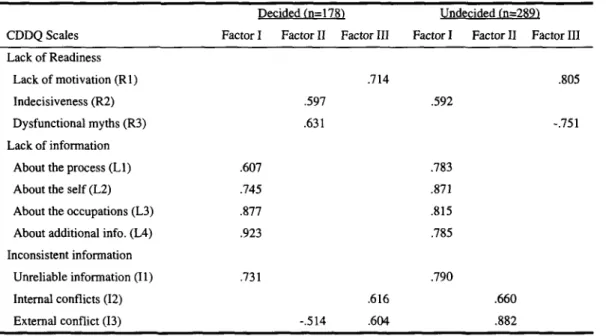
Since the difficulty scores perceived by college students are different in terms of their decision-making status, the separate factor analyses for decided and undecided students were conducted to examine the factor structure of the 10 scales.
For students who have decided the future directions, three factors were observed with eigenvalues greater than 1.0. Five of the 10 scales loaded on Factor 1. Loadings heavily on 也is
factor were scales related to Information, such as information of decision-making process,
information about self, about the occupations, about obtaining additional information, and unreliable information. Loadings heavily on Factor 2 include Readiness scales, indecisiveness and dysfunctional myths. The third factor, named as Conflict, includes three scales: motivation,
intemal conflicts and extemal conflicts. The three Factors accounted for about 64.43% of the total vanance.
For those undecided students, there were also three factors with eigenvalues greater than 1.0. Sirnilar to the resu1ts for decided group of students, loadings heavily on Factor 1 include the sarne five scales related to Information plus indecisiveness in Readiness category. The scales loaded on Factor 2 are intemal and extemal Conflicts. The third factor inc1udes motivation and dysfunctional
my血 scales in the category of Readiness. The three Factors accounted for about 63.06% of the total variance.
94 . 教育心理學報
Table 5 Factorial structure ofthe CDDQ 00 two groups
Decided (n=178) Undecided (n=289) CDDQ Scales Factor 1 Factor II Factor III Factor 1 Factor II Factor III Lack of Readiness
Lack of motivation (R 1) .714 .805 Indecisiveness (R2) .597 .592
Dysfunctional myths (R3) .631 -.751 Lack of information
About the process (L1) .607 .783 About the self (L2) .745 .871 About the occupations (L3) .877 .815 About additional info. (L4) .923 785 Inconsistent information
Unreliable information (11) .731 .790
Intemal conflicts (12) .616 .660 Extemal conflict (13) -.514 .604 .882
Note. Factor loadings under .5 were not Iisted.
In addition to the factor analysis, a clustering algorithm called ADDTREE was conducted to test the empirical model proposed by Gati et al. (1996). Figure 1 presents the emp仕icalstructure of the 10 scales obtained by an ADDTREE analysis of the intercorrelation matrix shown in Table 1.
The clustering structure in Figure 1 adequately summarizes the empirical relations among the scales: The linearly accounted-for variance by the distances in the clustering structures was 98.9%. The distance between any pair of scales in 也isclustering structure is represented by the sum of the horizontal segments on the shortest path connecting them. Thus, scales within the same cluster are generally more closely related to each other than those belonging to different clusters.
As can be seen in Figure 1, the 10 scales are group巴dinto three clusters except for the sCale Lack of Motivation. The three major clusters, as proposed by Gati et al. (1996) are: “Lack of Readiness, Lack of Information, and Inconsistent Information." The cluster of Lack of readiness includes, as expected, the scales of indecisiveness and dysfunctional myths. The cluster of Lack of Information includes the scales of lack of knowledge about the decision-making process, lack of information about self, lack of information about occupations, lack of information about obtaining additional information, and unre1iable information. Finally, the cluster of Inconsistent Information includes two scales, internal conflicts and external conflicts.
大專主要生對生涯決定困難的知覺分析 95
R - - - Indecisiveness
一- --一-一- -一---切---一---一-- - - Dysfunctional myths - - - Lack of know ledge about the process
可 ---1 一- -一-- Lack of infonnation about self LoI 1
一- --一-- - -1 一呵,一- --一-- - - - Lack of infonnatlOn about occupations
1 - - - - I
- - - 1 - - - -Lack of infonnation about obtainíng additional ínfonnation
-- - - Unrelíable ínfonnation
1 - - - Lack of motivation ---旬----明- Intemal conflicts
II ---咱自 - --- -- --- ---- --- ---- - -- -- - ---- --- --- Extemal conflicts Figure 1. The empirical structure ofthe 10 difficulty scales (n=467).
Note. R= Readiness; LoI= Lack of infonnation; II= Inconsistent infonnation
Discussion
One of the main purposes of the study was to examine the properties and structure of the Chìnese Versìon of the CDDQ. 甘leresults suggest that the empìrìcal structure of the 10 CDDQ scales was sìmìlar to the theoretical model. The Chinese version of the CDDQ can be used for counselìng and research purposes. More specìfìcally, ìt can be used to obtain a global assessment of dìfficulty, or a more specìfìc evaluation of the three m句 orcategories of difficulty.
In contrast to the theoretical model proposed by Gatì et al. (1996), the scale
“
Lack of Motivatìon" in the current data was isolated from the other three major groups. lt seems that motivation ìs not less ìmportant than ìnformatìon ìn makìng a career decìsìon. However, the low correlatìons among motìvatìon and other scales indicated that Motivatìon mìght not be appropriate to be included as one categ。可 ofthe career dìfficuIties.As far as the decision status and difficulties perceived by college students, the study indicated that over 20% of the freshmen were in the status of identity diffusion. They have not decided future directìons, neither are they worried about their future. Buckh紅n(1998) investìgated 24 紅t
undergraduates about their career planning. The results indicated that many of the students are lack of expectation about their futures. The attitude of unwilling to be in the labor market also lead to the negative culture amongst undergraduates. It mìght be necess訂yfor college freshmen to engage more opportunitìes to think about their future.
However, students who have not decided about their future mìght be divided into several categories. ln the present study, diffusion type of students have not made any decision for the
96 教育心理學報
future career, neither do they wor可 abouttheir future. Explorative type of students needs further information for making decision. However, for anxious type of undecided students, further information about the occupations might not be enough to enable them reach a good decision. Career difficulties perceived by these students need to be further ex缸nined.
Conclusions and Suggestions
The author of the present study developed the Chinese version of the “Career Decision-making Difficulties Questionnaire," investigated the career-related problems encountered by college students, and tested the theoretical model of classification system for career decision difficulties. Four hundred and sixty-seven college students completed the Chinese version of the Career Decision-making Difficulties Questionnaire. Data obtained was analyzed by Chi-square,
ANOVA, factor analysis, and ADDτ'REE. The results indicated the significant differences between decided and undecided students on their perceptions of career difficulties. The three-group classification system for career decision difficulties was generally supported by the data in 也is
study. The three groups of career difficulties were renamed as Readiness, Information, and Conflicts.
As far as suggestions for future research, the relationship between anxiety and career difficulty perception could be examined. It's strongly suggested that anxiety correlated with career indecision (Stead & Watson, 1993). Further studies were suggested to examine the relationships between those variables in Chinese culture.
In addition, Valde (1996) indicated 也atthere might be three subtypes of identity achievement,
exploration, tentative commitrnent, and openness to altematives. For those who have decided future career directions, the process of making a decision might be di旺.erent. It's necess訂Y to further examine their perceptions of career difficulties and influences of those perceptions on career decision-making process.
For counseling practitioners, the Career Decision-making Difficulties Questionnaire has the potential to serve as a diagnostic instrument in career counseling. The reliability and construct validity of the Chinese version of the CDDQ are good and could be applied for further research and counseli月 practiceas well.
References
Brooks, L. (1984). Career counseling methods and practice. In D. Brown, L. Brooks, & Associates (Eds.), Career choice and development (pp. 337-354) San Francisco: Jossey-Bass.
Buc區1位n, L. (1998). 'Perhaps we're thinking there isn't a career out there for us': A study of undergraduates' attitudes to their future prospects. British Journal 01 Guidance and
大專學生對生瀝決定困難的知覺分析 97
Counseling, 26(3),47-433.
Cohen, C.良, Chartrand, J. M, & Jowdy, D. P. (1995). Relationship between career indecision subtypes and ego identity development. Journal ofCounseling Psychology, 42,440-447. Fuqua, D. R., & H紅包1姐, B. W. (1983). Differential diagnosis and treatment of career indecision.
Personnel and Guidance Journ叫" 62, 27-29.
Gati, 1., Krausz, M., & Osipow, S.H. (1996). A taxonomy of difficulties in career decision making.
Journal of Counseling Psychology, 的(4), 510-526.
He汀,E. L.,
&
Cramer, S. H. (1996). Career guidance and counseling through the life-span. NewYork: Harper Collins.
Holland, J. L. (1997). Makìng vocational choices: A theo η of personalitìes and work environments (3rd ed.). Odessa, FL: Psychologica1 Assessment Resources.
Lancaster, B. P., Rudolph, C. E., Perkins, T. S., & Patten, T. G. (1999). The reliability and validity of the Career Decision DifficuIties Questionnaire. JOUlηal ofCareer Assessment, 7(4), 393-413.
Marc詞, J. E. (1966). Development and validation of ego-identity status. Journal of Personality and Social Psychology, 3, 551-558.
Osipow, S. 旺,& Gati, 1. (1998). Construct and concurrent validity of the Career Decision-making Difficulties Questionnaire. Joun的1ofCareer Assessment, 6(3),347-364.
Salomone, P. R. (1982). DifficuIt cases in career counseling II: The indecisive client. Personnel and Guidance Journal, 60,496-500.
Sattath,丘,& Tvers旬,A. (1977). Additive similarity 缸ees. Psychometri妞, 42, 319-345.
Stead, G. B., & Watson, M. B. (1993). How similar are the factor structures ofthe Career Decision Scale, the Career Decision Profile, and the Career Factors Inventory? Educational and Psychological Measurement, 刃, 281-290.
Val缸, G. A. (1996). Identity closure: A fifth identity status. Journal of Genetic Psychology,
157(3),245-254.
Vondracek, F. w., Schulenberg, J., Skorikov, v., & Gillespie, L. K. (1995). The relationship of
iden位tystatus to career indecision during adolescence. Journal of Adolescence, 18(1), 17-29.
收稿日期: 2001 年 3 月 16 日 接受刊登日期: 2∞1 年 6 月 12 日
98 教育心理學報 國立臺灣自而範大學教育心理與輔導學系 教育心理學報,民喲, 33 卷, 1 期, 87-98 頁