RSC Advances
This is an Accepted Manuscript, which has been through the
Royal Society of Chemistry peer review process and has been
accepted for publication.
Accepted Manuscripts are published online shortly after
acceptance, before technical editing, formatting and proof reading.
Using this free service, authors can make their results available
to the community, in citable form, before we publish the edited
article. This Accepted Manuscript will be replaced by the edited,
formatted and paginated article as soon as this is available.
You can find more information about Accepted Manuscripts in the
Information for Authors
.
Please note that technical editing may introduce minor changes
to the text and/or graphics, which may alter content. The journal’s
standard
Terms & Conditions
and the
Ethical guidelines
still
apply. In no event shall the Royal Society of Chemistry be held
responsible for any errors or omissions in this Accepted Manuscript
or any consequences arising from the use of any information it
contains.
This article can be cited before page numbers have been issued, to do this please use: M. Adineh, P. Tahay, W. Huang, H. Wu, E. W. Diau and N. Safari, RSC Adv., 2016, DOI: 10.1039/C6RA23882C.
Journal Name
COMMUNICATION
a.
Department of Chemistry, ShahidBeheshti University, Evin, 1983963113 Tehran, Iran
b.
Department of Applied Chemistry and Institute of Molecular Science, National Chiao Tung University, Hsinchu 300, Taiwan
c.
E-mail: [email protected]; Tel: +9821-2990-2886
d.
E-mail: [email protected]; Fax: +886 3-572-3764;
e.
Tel: +886 3-513-1524
f.
Electronic Supplementary Information (ESI) available: [details of any supplementary information available should be included here]. See DOI: 10.1039/x0xx00000x Received 00th January 20xx, Accepted 00th January 20xx DOI: 10.1039/x0xx00000x www.rsc.org/
Synthesis of push–pull porphyrin dyes with dimethylaminonaphthalene electron-donating groups and their application to dye-sensitized solar cells
MaryamAdineh,aPooyaTahaya ,
Wei-Kai Huang
b, Hui-Ping Wu,bEric Wei-Guang
Diau*b and Nasser Safari*aTwo new donor-π-bridge-acceptor zinc porphyrins with dimethylaminonaphthalene electron donating moiety, coded T1 and T2, were synthesized and used as sensitizersin dye sensitized solar cells (DSSCs). Both dyes showed excellent photovoltaic properties with power conversion efficiencies of 8.0 and 9.6% for T1 and T2 respectively, for which the device performance of T2 dye is superior to that of N719 dye. Dye sensitized solar cells(DSSCs) are the third generation of solar cells which have been attracted much attention because of low prices, flexibility, low weight, short energy payback times compared with conventional solar cells. A typical DSSC is composed of photoanode, electrolyte and counter electrode. Photoanode is generally made of a semiconductor and sensitizer (dye molecules) on transparent conducting oxide (TCO) substrate; therefore dye plays a crucial role in DSSCs applications1. Ruthenium polypyridyl sensitizers have been widely studied in past two decades2-7. Broad absorption spectrum through metal-to-ligand charge transfer (MLCT), long exciton lifetime, and long-term chemical stability make them very efficient for DSSC applications.However, many factors such as the high cost of noble metal ruthenium, the requirement for careful synthesis, difficult purification steps and low molar extinction coefficients and so on, limit ruthenium polypyridyl complexes to be uses in DSSC applications8.To solve these problems, many researchers were seeking for alternative sensitizers. Porphyrins and their derivatives have attracted remarkable attentionsas sensitizers for DSSCs by virtue of their high molar extinction coefficients, ease of modification, photochemical stability and low toxicity as a promising alternative to replace for the ruthenium polypyridyl complexes9-17. Considerable breakthrough has been made in the past few years and a record
efficiency as high as 13% has been achieved by molecular engineering methodology based on porphyrin SM315 and a Cobalt (II/III) redox electrolyte15. Similar to the structures of the most organic dyes18-20, the porphyrin dyes are designed according to basic structures of Donor- π-conjugated bridge-Acceptor (simplified as D-π-A) which are beneficial to intramolecular electron transportation8, 21-24. Most of highly efficient porphyrin sensitizers have such a structural design13, 15, 17, 25-31. It is known that the photovoltaic performance of certain planar porphyrin dyes might be further improved by decreasing the degree of dye aggregation32.lin et al. designed porphyrin derivatives with long alkoxyl for less dye aggregation and increasing the solubility of chromophore14. Inspiring by these works we designed two new D-π–A porphyrins, coded T1 and T2, with dimethylamino naphthalene donor moiety and long alkoxy chain, as sensitizers for DSSCs. To determine the potential energy levels, cyclic voltammetry, diffrensial pulse voltammetery, UV-Vis and fluorescence spectroscopy were used. To investigate application of these sensitizers in DSSCs, cells were fabricated using these dyes to compare with the N719 dye. The current-voltage characteristics are provided for the DSSCs with the synthesized photosensitizers. The IPCE action spectra also were taken for cells. To obtain further evidences on frontier orbitals of these dyes, density functional theory (DFT) calculations were carried out. We found that the device made of T2 dye attained power conversion efficiency (PCE) 9.6 %, which is superior to that of the N719 device due to the greater light-harvesting ability for the T2 dye than for the N719 dye.
Result and discussion:
The molecular structures of porphyrin T1 and T2 are presented in Scheme 1. To reduce the charge recombination reaction induced by molecule aggregation, long alkoxyl chains are attached to porphyrinmeso phenyls. As shown in Scheme 1, the only difference for the two porphyrins structures is the triple bond between electron donor moiety and porphyrin core. The detailed synthetic procedure for preparing T1 and T2 porphyrins is described in the supporting online material.
RSC
Advances
Accepted
Manuscript
Journal Name
COMMUNICATION
Fig. 1 displays UV-Vis spectra of T1 and T2 in ethanolic solution. As expected, the absorption of T2 (λmax = 453 nm, ɛ= 2.2 × 10
5
; 654 nm, ɛ = 3.2 × 10⁴) is red-shifted and broadened compared to that of T1 (λmax =445 nm, ɛ = 2.7 × 10
5
; 575nm, ɛ = 1.0×10⁴; 627 nm, ɛ = 1.8×10⁴) due to elongation of π system33. A distinct difference in the spectra of the two dyes is the redshift and increase in molar absorptivity of the lowest-energy Q-band for T2. The increased conjugation along the x-axis of T2 strongly shifted absorbance from the Qx transition to produce a maximum at 654 nm. The significant
increase in molar absorption coefficient is accordant with the greater oscillator strength of the Qx transition from increased x-axis
polarizability within the T2 upon introduction of the acetylene unit15.
Scheme1 The molecular structures of porphyrin T1 and T2
Figure 1-Uv-Vis spectra of T1 and T2 in ethanolic solution (0.5mM)
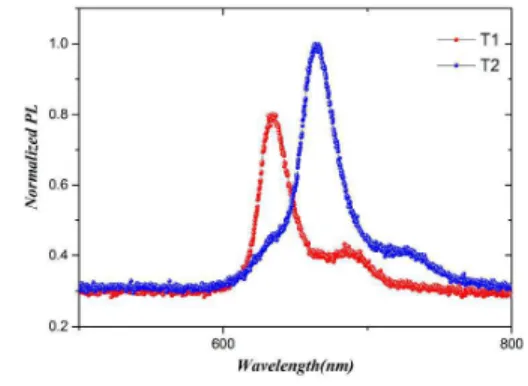
Fig. 2 shows the fluorescence spectra of two porphyrins. The fluorescence bands of both dyes show the mirror images of the corresponding Q bands, inferring that the gap between vibrational energy levels for the ground and excited states are similar, and the same transitions are desirable for both absorption and emission27 The fluorescent maximum of T2 is also red-shifted by 30 nm with respect to that of T1.
The oxidation and reduction potentials of the two dyes were determined by means of cyclic voltammetry (CV). The electrochemical data (Fig. S1) are summarized in Table 1. T2 showed two oxidation waves at half-wave potential (E1/2) = +0.94
and +1.44 V and two reduction waves at half-wave potential (E1/2) = -0.51 and -1.03 V versus normal hydrogen electrode (NHE). The oxidation values are higher and reduction values are lower than the corresponding potentials of T1 (table 1). These results indicate that
T2 is more difficult to reduce and more difficult to oxidize than T1 which means T2 has a stable structure and has less tendency to be oxidized or reduced. The HOMO and LUMO energy levels for T2 (-5.34eV and -3.34eV respectively) are stabilized compared to HOMO and LUMO energy levels for T1 (-5.1eV and -3.06eV)
Figure 2. Fluorescence spectra of T1 and T2in ethanolic solution (0.5mM) at 460nm excitation wavelength
Table 1. The electrochemical data of T1 and T2
Dye Eox(1) Eox(2) Ered(1) Ered(2) EHOMO ELUMO Eg*
T1 +0.69 +0.98 -0.42 - -5.2 -3.16 2.03
T2 +0.94 +1.44 -0.51 -1.03 -5.44 -3.44 2.00
*Estimated from the intersection wavelengths of the normalized UV-vis absorption and the fluorescence spectra;
To gain further insight into the molecular properties, DFT calculations for T1 and T2 werecarried out at the B3LYP/6-31G level. The calculatedstructures do not show negative frequencies, inferring that theoptimized geometries are in the global energy minima. Fig. 3 shows the frontier molecular orbitals of each porphyrin. Mizusekiet et al proposed that the charge transport was connected with the spatial distribution of the frontier orbitals34. For efficient charge transfer the HOMO should be localized in the donor moiety and the LUMO in the acceptor moiety35. As shown in Fig. 3, electron distribution of T1 porphyrins, in the HOMO is mostly over the porphyrin core and acetylene bond and there is little distribution on electron donor moiety which is likely due to the fact that the dimethyamino naphthalene is perpendicular to the porphyrin core ( Dihedral angle= 84ͦ ) and do not contribute to electron distributions. As displayed in Fig. 3 on the case of T2 porphyrin naphthalene moiety is planar with porphyrin core the HOMO and is mostly localized over the donor (dimethylaminonaphthalene) and macrocycle moieties; However, the LUMO is populated largely on the macrocycle and the acceptor moieties (π-spacer and carboxyl acid). It is well known that the electron density distribution ofLUMO around an anchoring group ,affect the electronic coupling between the excited adsorbeddye and 3d orbital of TiO2
36
. For both of our studied porphyrins there is noticeable electron distribution around anchoring group at LUMO energy level.
RSC
Advances
Accepted
Manuscript
Figure 3. Frontier molecular orbitals of T1 and T2
By using of tetrahydrofurane and ethanol (volume ratio 4:1) solvent mixture in the presence of Cheno acid, T1 and T2 porphyrins were sensitized onto a bilayer (active layer 7.5µm + scattering layer 5.0 µm) titania film to act as a working electrode. These porphyrins were evaluated in DSSC devices in combination with iodine-based electrolyte.
The difference between the redox potential of I¯/I3¯ and HOMO energy level is given by ΔE. To have fast electron transfer and dye regeneration , ΔE must be positive37, 38; HOMO energy levels are -5.2 and -5.44 for T1 and T2, respectively; considering that I¯ /I3¯electrolyte potential is -4.85 eV 39, the differences between electrolyte and HOMO energy level (ΔE) are 0.35 and 0.57 for T1 and T2, respectively.These results show that both of T1 and T2 dyes have sufficient thermodynamic driving force for dye regeneration. On the other hand, electron injection appears to be energetically favorable from the first excited state (LUMO) of both T1 and T2 when compared to the conduction band of TiO2because the LUMO
energy levelsare higherthan that of the TiO2 conduction band (ECB=
-4.0 eV)to make efficient electron transfer from the dye excited state into the TiO2 conduction band ).
The current-voltage (J-V) characteristics and the corresponding action spectra of incident photons to electrons conversion efficiency (IPCE) of the devices are shown in Figs. 4 and 5 respectively. Detailed photovoltaic parameters such as open circuit voltage (VOC), short circuit photocurrent density (JSC), filling factor
(FF) and power conversion efficiency (ƞ) for these dyes under AM 1.5 G one-sunillumination are summarized in Table 2. The higher efficiency as well as short circuit photocurrent density (JSC) for T2
maybe ascribed to its extended π-system which results in more efficient light harvesting abilityfor the T2 dye than for the T1 dye. The Voc values show the positive shift of the TiO2 Fermi level in the
cell made by T2. This could be because of more dye aggregation due to more planar structure for T2 than for T1. It is well known that dye aggregation and charge recombination can be efficiently reducedfor nonplanar and distorted dyes, also the conjugation extension may bring out dye aggregation 40, 41.
Table 2. Photovoltaic parameters of T1 and T2 a
Dye Voc (mV) Jsc (mAcm-2) Fill factor (%) Efficiency (%) T1 730 (720±15) 16.6 (16.7±0.1) 67 (66±2) 8.1 (7.9±0.2) T2 712 (710±10) 20.4 (20.3±0.1) 66 (66±2) 9.6 (9.4±0.2) N719 720 (720±10) 19.4 (19.4±0.1) 65 (66±1) 9.1 (9±0.1) a
Values given are the photovoltaic parameters for which the highest efficiency was observed. The average value from eight independent experiments is shown in parenthesis in each case.
Figure 4. The current-voltage (J-V) characteristics of T1 and T2
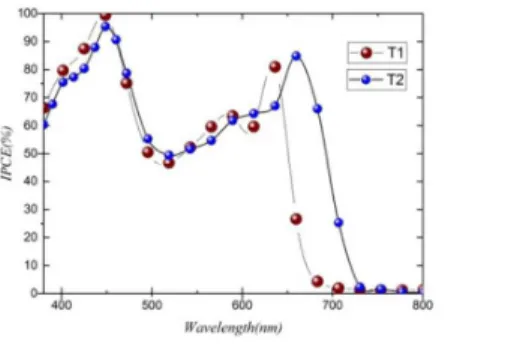
The IPCEs for DSSCs based on two dyes are presented in Fig. 5. As shown in Fig. 5, the IPCE action spectra follow the corresponding UV-visible absorption spectra of the two porphyrins. Both dyes show broad IPCE spectra in the visible region. Despite large gap between the Soret and the Q bands of the absorption spectra of porphyrins (Fig. 1), this feature is not noticeable in the IPCE spectra because the effect of light scattering by TiO2
42
shows the whole IPCE spectra with a broad-band feature. Jsc calculated from integration of the IPCE values are 17.1 and 21.2 for T1 and T2 respectively showing that there are less than 5% mismatch with experimental values in both cases. The IPCE spectrum of device made by T1 displays photocurrent responses with maximum efficiency of almost 100% at 450 nm but The IPCE spectrum of device made by T2 slightly less than those of the T1 device at this wavelength that could be the extinction coefficient of the soret band with is higher for T1 than for T2. In comparison with T1, the insertion of an ethynylene bridge in T2 red shifted the onset wavelength of photocurrent response from 730 to 750 nm, resulting in an increase of Jsc from 16.6 to exceeding 20 mA cm-2.
RSC
Advances
Accepted
Manuscript
Journal Name
COMMUNICATION
Figure 5 The IPCE action spectra for DSSCs based on T1 and T2
In conclusion, two new porphyrins, T1 and T2, with dimethylaminonaphthalene electron donating moiety were designed and synthesizedfor dye sensitized solar cells. We characterized the photophysical and electrochemical properties of the two dyes and investigated theirphotovoltaic performance. We found that power conversion efficiency of the T2 device is greater than the T1 device.The higher efficiency observed for T2 maybe ascribed to a better extended π-system which results in more efficient light harvesting abilityfor the T2 dye than for the T1 dye. The VOC values of cells have the reversed trend (T1 > T2), andthis
could be due to dye aggregation for which T2 is more significant than T1 due to the molecular structure, for which T2 is more planar than T1. However, the T2 device exhibited a great performance with PCE 9.6 %, which is superior to that of the N719 device (9.1 %) fabricated under the same experimental conditions.
AcknowledgementsThis work was supported by ShahidBeheshti University Research Affaires and National Chiao TungUniversity (NCTU).
Notes and references
1. A. Hagfeldt, G. Boschloo, L. Sun, L. Kloo and H. Pettersson, Chemical Reviews, 2010, 110, 6595-6663.
2. B. O'Regan and M. Gratzel, Nature, 1991, 353, 737-740. 3. M. K. Nazeeruddin, P. Pechy and M. Gratzel, Chemical
Communications, 1997, 1705-1706.
4. R. Argazzi, C. A. Bignozzi, G. M. Hasselmann and G. J. Meyer, Inorganic Chemistry, 1998, 37, 4533-4537. 5. L. Zhang, Y. Yang, R. Fan, P. Wang and L. Li, Dyes and
Pigments, 2012, 92, 1314-1319.
6. H. Shahroosvand, F. Nasouti and A. Sousaraei, Dalton Transactions, 2014, 43, 5158-5167.
7. M. Ameri and E. Mohajerani, RSC Advances, 2015. 8. J. Chen, S. Ko, L. Liu, Y. Sheng, H. Han and X. Li, New
Journal of Chemistry, 2015, 39, 2889-2900.
9. M. K. Nazeeruddin, R. Humphry-Baker, D. L. Officer, W. M. Campbell, A. K. Burrell and M. Grätzel, Langmuir, 2004, 20, 6514-6517.
10. W. M. Campbell, K. W. Jolley, P. Wagner, K. Wagner, P. J. Walsh, K. C. Gordon, L. Schmidt-Mende, M. K.
Nazeeruddin, Q. Wang and M. Grätzel, The Journal of Physical Chemistry C, 2007, 111, 11760-11762.
11. Y. Liu, N. Xiang, X. Feng, P. Shen, W. Zhou, C. Weng, B. Zhao and S. Tan, Chemical Communications, 2009, 2499-2501.
12. Y.-C. Chang, C.-L. Wang, T.-Y. Pan, S.-H. Hong, C.-M. Lan, H.-H. Kuo, C.-F. Lo, H.-Y. Hsu, C.-Y. Lin and E. W.-G. Diau, Chemical Communications, 2011, 47, 8910-8912. 13. A. Yella, H. W. Lee, H. N. Tsao, C. Yi, A. K. Chandiran, M. K.
Nazeeruddin, E. W. G. Diau, C. Y. Yeh, S. M. Zakeeruddin and M. Grätzel, Science, 2011, 334, 629-634.
14. C.-L. Wang, C.-M. Lan, S.-H. Hong, Y.-F. Wang, T.-Y. Pan, C.-W. Chang, H.-H. Kuo, M.-Y. Kuo, E. W.-G. Diau and C.-Y. Lin, Energy & Environmental Science, 2012, 5, 6933-6940. 15. S. Mathew, A. Yella, P. Gao, R. Humphry-Baker, B. F.
Curchod, N. Ashari-Astani, I. Tavernelli, U. Rothlisberger, M. K. Nazeeruddin and M. Grätzel, Nature chemistry, 2014, 6, 242-247.
16. H.-H. Chou, K. S. K. Reddy, H.-P. Wu, B.-C. Guo, H.-W. Lee, E. W.-G. Diau, C.-P. Hsu and C.-Y. Yeh, ACS Applied Materials & Interfaces, 2016, 8, 3418-3427.
17. T. Higashino and H. Imahori, Dalton Transactions, 2015, 44, 448-463.
18. Z. Yao, M. Zhang, H. Wu, L. Yang, R. Li and P. Wang, Journal of the American Chemical Society, 2015, 137, 3799-3802.
19. S. M. Feldt, E. A. Gibson, E. Gabrielsson, L. Sun, G. Boschloo and A. Hagfeldt, Journal of the American Chemical Society, 2010, 132, 16714-16724.
20. G. Zhang, H. Bala, Y. Cheng, D. Shi, X. Lv, Q. Yu and P. Wang, Chemical Communications, 2009, 16, 2198-2200. 21. D. Arteaga, R. Cotta, A. Ortiz, B. Insuasty, N. Martin and L.
Echegoyen, Dyes and Pigments, 2015, 112, 127-137. 22. W. M. Campbell, A. K. Burrell, D. L. Officer and K. W.
Jolley, Coordination Chemistry Reviews, 2004, 248, 1363-1379.
23. T. Bessho, S. M. Zakeeruddin, C.-Y. Yeh, E. W.-G. Diau and M. Grätzel, Angewandte Chemie International Edition, 2010, 49, 6646-6649.
24. C.-P. Hsieh, H.-P. Lu, C.-L. Chiu, C.-W. Lee, S.-H. Chuang, C.-L. Mai, W.-N. Yen, S.-J. Hsu, E. W.-G. Diau and C.-Y. Yeh, Journal of Materials Chemistry, 2010, 20, 1127-1134. 25. P. Wu, Z.-W. Ou, T.-Y. Pan, C.-M. Lan, W.-K. Huang,
H.-W. Lee, N. M. Reddy, C.-T. Chen, H.-W.-S. Chao, C.-Y. Yeh and E. W.-G. Diau, Energy & Environmental Science, 2012, 5, 9843-9848.
26. C.-L. Wang, J.-Y. Hu, C.-H. Wu, H.-H. Kuo, Y.-C. Chang, Z.-J. Lan, H.-P. Wu, E. Wei-Guang Diau and C.-Y. Lin, Energy & Environmental Science, 2014, 7, 1392-1396.
27. C.-L. Wang, M. Zhang, Y.-H. Hsiao, C.-K. Tseng, C.-L. Liu, M. Xu, P. Wang and C.-Y. Lin, Energy & Environmental Science, 2015, DOI: 10.1039/C5EE02505B.
28. J. Luo, M. Xu, R. Li, K.-W. Huang, C. Jiang, Q. Qi, W. Zeng, J. Zhang, C. Chi, P. Wang and J. Wu, Journal of the American Chemical Society, 2014, 136, 265-272.
29. T. Higashino, Y. Fujimori, K. Sugiura, Y. Tsuji, S. Ito and H. Imahori, Angewandte Chemie International Edition, 2015, 54, 9052-9056.
30. K. Kurotobi, Y. Toude, K. Kawamoto, Y. Fujimori, S. Ito, P. Chabera, V. Sundström and H. Imahori, Chemistry – A European Journal, 2013, 19, 17075-17081.
31. R. Zong and R. P. Thummel, Journal of the American Chemical Society, 2005, 127, 12802-12803.
RSC
Advances
Accepted
Manuscript
32. L. Luo, C.-J. Lin, C.-Y. Tsai, H.-P. Wu, L.-L. Li, C.-F. Lo, C.-Y. Lin and E. W.-G. Diau, Physical Chemistry Chemical Physics, 2010, 12, 1064-1071.
33. H. Imahori, T. Umeyama and S. Ito, Accounts of Chemical Research, 2009, 42, 1809-1818.
34. H. Mizuseki, K. Niimura, C. Majumder, R. V. Belosludov, A. A. Farajian, Y. Kawazoe and C. Majumder, Molecular Crystals and Liquid Crystals, 2003, 406, 11-17. 35. H. Shahroosvand, S. Zakavi, A. Sousaraei and M.
Eskandari, Physical Chemistry Chemical Physics, 2015, 17, 6347-6358.
36. H. Imahori, Y. Matsubara, H. Iijima, T. Umeyama, Y. Matano, S. Ito, M. Niemi, N. V. Tkachenko and H. Lemmetyinen, The Journal of Physical Chemistry C, 2010, 114, 10656-10665.
37. Handbook of Photovoltaic Science and Engineering, second edn.
38. J. Lu, H. Li, S. Liu, Y.-C. Chang, H.-P. Wu, Y.-B. Cheng, E. W.-G. Diau and M. Wang, Physical Chemistry Chemical Physics, 2016, DOI: 10.1039/C5CP05658F. 39. G. Boschloo and A. Hagfeldt, Accounts of Chemical
Research, 2009, 42, 1819-1826.
40. Y. Wang, X. Li, B. Liu, W. Wu, W. Zhu and Y. Xie, RSC Advances, 2013, DOI: 10.1039/c3ra40788h.
41. Y. Xie, Y. Tang, W. Wu, Y. Wang, J. Liu, X. Li, H. Tian and W.-H. Zhu, Journal of the American Chemical Society, 2015, DOI: 10.1021/jacs.5b09665.
42. S.-L. Wu, H.-P. Lu, H.-T. Yu, S.-H. Chuang, C.-L. Chiu, C.-W. Lee, E. W.-G. Diau and C.-Y. Yeh, Energy & Environmental Science, 2010, 3, 949-955.