行政院國家科學委員會專題研究計畫 成果報告
利用多種類浮游有孔蟲氧碳同位素比值重建過去 16 萬年南
海溫躍層之水文結構
計畫類別: 整合型計畫 計畫編號: NSC92-2116-M-002-008- 執行期間: 92 年 08 月 01 日至 93 年 07 月 31 日 執行單位: 國立臺灣大學地質科學系暨研究所 計畫主持人: 魏國彥 共同主持人: 米泓生 計畫參與人員: 鄭郁豫 報告類型: 精簡報告 處理方式: 本計畫可公開查詢中 華 民 國 93 年 12 月 31 日
Sea-surface hydrographic variations during the past 165,000 years in the
southeastern South China Sea (near Palawan Island)
Kuo-Yen Weia,*, Ee-Ee Teha Liang-Jian Shiaob, Min-Te Chenb
1. Department of Geosciences, National Taiwan University, Taipei 106, Taiwan, R.O.C. 2. Institute of Applied Geophysics, National Ocean University, Keelung 20224, Taiwan,
R.O.C.
* Corresponding author, P.O. Box 13-318, Dept. of Geosciences, National Taiwan University, Taipei, Taiwan, ROC, 106.
E-mail address: [email protected] (K.-Y. Wei).
Abstract
Using Mg/Ca ratios of planktonic foraminifer Globigerinoides sacculifer and alkenone unsaturation index of bulk sediments from the deep-sea core MD972142, we reconstructed sea-surface paleotemeratures of the past 165 thousand years for the southeastern South China Sea near the Palawan Island. The paleo-SSTs fluctuated between ~24oC and 29oC through the past two glacial-interglacial cycles with the coldest SSTs of ~24oC at the last glacial
maximum. The SSTs during the late Holocene are comparable to the peak values of the marine oxygen isotope stage 5.
To examine the salinity/hydrographic variation, the effects of temperature and
ice-volume were subtracted from the δ18O values of planktonic foraminifer Globigerinoides
sacculifer. The resultant residual δ18O profiles indicate that the surface oceans have been
fresher than today’s for most of the time during the past 165 thousand years. In general, during the low sea-level periods in glacial stages, the corrected δ18O values tend to deviate
from the current value, signifying various degrees of freshening. Contrarily, when the sea-levels were high, the surface waters tend to be as salty as it is today. Nevertheless, at millennial scale, the surface waters were more stratified during the interstadial than in the stadial intervals due to stronger fresh-water input and higher surface temperature.. Keywords: South China Sea, SSTs, Hydrograph, Paleotemperature.
Introduction
The tropical oceans play an important role in controlling the Earth’s climate, as the distribution of warm tropical waters largely affects the amount of heat and moisture
contributed to the atmosphere. Therefore, reconstruction of past SSTs of tropical oceans is essential for understanding the past climate changes. Foraminiferal Mg/Ca ratio, faunal transfer functions and unsaturated alkenone (Uk’37) have been the most widely used proxies.
Among them, foraminiferal Mg/Ca ratio offers a major advantage over existing SST proxies because it can be measured from the same sample set or specimens as δ18O does, and
therefore, providing a means of estimating simultaneously temperature and oxygen isotopic composition of the seawater. This allows for a direct comparison between the Mg/Ca-derived SST and the δ18O of sea water without the potential complication introduced by subtracting
temperature effect imprinted during different seasons, at different depths of water column (Mashiotta et al., 1999). This paper reports the Mg/Ca-derived SSTs and δ18O of seawater
(reflecting the balance between precipitation and evaporation) for the past 165,000 years of the southeastern South China Sea. For an additional check, we also derived SSTs using unsaturated alkenone (Uk’37) from bulk sediments and calculated the δ18O of seawater. Both
methods yielded consistent patterns of hydrological (temperature and salinity) variations through the last 170,000 years.
The South China Sea (SCS; Figure 1) is the largest marginal sea in the tropical western Pacific and overlaps a part of the Western Pacific Warm Pool (WPWP) (Yan et al., 1992; Miao et al., 1994). Its critical location between the East Asian landmass and the western Pacific makes this marginal sea very sensitive to climate changes especially to the monsoon system. The surface water circulation in SCS is mainly driven by the annually reversing monsoon winds that create large volumetric changes in surface water flow (Wyrtki, 1961). One of the most distinctive characteristics of the monsoon climate is the alternating wet and dry seasons. In wet seasons, warm and moist winds blow inland from the oceans, bringing precipitation over vast areas of Asia, Africa and Australia and adjacent marine realm. In contrast, during dry seasons, the wind reverses direction, bringing cold and dry air seaward from the interiors of the winter continents. In each season, there are two principal rainfall maxima: one over Africa, the other, the larger one, over the Southeast Asia and Australia (Webster, 1987). In either case, the southern South China Sea receives large quantity of fresh water from river run-off and precipitation. The salt budget of the southern South China Sea therefore is heavily influenced by the precipitation brought about by monsoons. The other factor that controls the salt budget is the exchange efficiency of the basin water with the open-ocean waters, either from the Indian Ocean or the Pacific. It is expected that during the last glacial maximum at about 20,000 years ago, when sea levels dropped by 120 to 140 m
(Fairbanks, 1989; Lambeck et al., 2002), the southern South China Sea would become a semi-enclosed inner sea because of the shoaling of most of the seawater passages connecting to open oceans, the salinity in this region would reflect more faithfully the influence of
precipitation, and hence a good gauge of the strength of monsoons during the glacial periods. In this study, based upon high-resolution records derived from a deep-sea core adjacent to the Palawan Island, we attempt to examine the hydrological changes of the southeastern South China Sea over the past 165 kyrs, roughly covering the last two glacial-interglacial cycles. During this period, the sea level rose and dropped as polar ice-sheets waxed and waned, sea-surface temperatures (SSTs) fluctuated and monsoon intensity varied concomitantly. The interplay between sea-level, sea-surface temperature and monsoon intensity (which affects precipitation) must have resulted in a dynamic change of salt budget; and hence the sea-surface salinity, which, in turn, may exert also influence on density of seawater and cause variation in circulation and ventilation of the South China Sea.
Materials and Analytical Methods
MaterialsPlanktonic foraminifera Globigerinoides sacculifer from the top 11 m of Core MD972142 (12o41.33’N, 119o27.90’E, 1557m water depth, Fig. 1) was selected for the Mg/Ca and δ 18O analyses. This core was recovered from the southeastern region of SCS during the IMAGES-III-IPHIS-Leg II cruise. Because the water depth of this site is well above the calcite lysocline, the calcareous foraminifera in this core are well preserved. In addition, surface dwelling planktic forminifera G. ruber and thermocline dwellers,
Neogloboquadrina dutertrei, were also analyzed. The longerδ 18O record of Globigerinoides
ruber of the same core in its whole length has been reported by Wei et al (2000, 2003).
Foraminifera were obtained by washing and sieving (>63 µm) bulk sediments several times in distilled deionized water to remove clays and fines. The dried sediments were then sieved into different size fractions, and specimens of G. sacculifer were handpicked from the 300-355 µm size fraction. After the picking process, all operations were performed using trace-metal cleaning techniques in a HEPA laminar flow hood to avoid contamination. The trace-metal cleaning techniques used were modifications of previously developed cleaning methods (Shen, 1996). Briefly, 0.5-1 mg of foraminiferal tests were gently crushed and cleaned. The samples were first subjected to an oxidizing solution followed by a reducing solution, and then rinsed
Figure 1. Bathymetric map of the South China Sea showing the location of Core MD972142 and other cores mentioned in this study.
three times with distilled deionized water using ultrasonication at the beginning and between all steps. Subsequently, the cleaned samples were dissolved and diluted in HNO3 for Mg and
Ca analyses. Mg and Ca were measured using a Perkin Elmer flame atomic absorption spectrophotometer. The measurement precision was <± 3%. G. sacculifer from the same size fraction was also picked for δ18O analysis using a Finnigan MAT DeltaPlus mass spectrometer
with Kiel Device housed in the Institute of Geosciences, National Taiwan University. Also analyzed were specimens of G. ruber from the 300-355 µm size fraction and N. dutertrei from the 300-355 µm size fraction. All the δ18O values were converted to Pee Dee Belemnite (PDB)
scale using NBS-19, an international standard, the precision of δ18O measurement was
±0.08o/oo. To independently check the validity of the Mg/Ca ratios measured by atomic
absorption spectrometer, some left-over G. sacculifer specimens in the previously washed
samples were also analyzed using a newly installed ICP-MS at the Dept. of Geosciences, National Taiwan University. The results are consistent with each other in the given range of analytical uncertainty and intra-sample variability (Fig.2)
Figure 2 Correlation between the oxygen isotope stratigraphy of Globigerinoides
sacculifer (this study) and Globigerinoides ruber (Wei et al., 2000) in Core
MD972142, and the Low-latitude stack (Bassinot et al., 1994).
We also reconstructed the sea-surface temperatures using Uk’37 measured from the bulk
sediments.
Sea-surface Paleo-temperature Reconstruction
For temperature calibration, we used the species-specific Mg/Ca SST calibration curve for G. sacculifer (Anand et al., 2003). An exponential fit was adopted:
ToC = 11.111 * ln((Mg/Ca)/0.347) ………..……….(1)
The reconstruction of paeleotemperatures from U37k’ index was based upon Pelejero and
Grimalt (1997):
U37k’ = 0.031T + 0.092 ………….……….(2)
Where U37k’ = [C37:2] / ( [C37:2] + [C37:3]) (Prahl and Wakeham, 1987).
The calculation of δ 18O
seawater at the PDB scale was based upon the equation proposed
by Mulitza et al (2003): ToC = 14.91 - 4.35(δ18O
C- δ18Ow) ……….……….(3)
A conversion between PDB and SMOW scales was made: δ18O
w-SMOW = δ18OC-PDB + 0.27………..………….……….(4)
Alternatively, the δ 18O
seawater was also calculated using the equation suggested by Spero
et al (2003):
ToC = 12.0 - 5.67(δ18O
C- δ18Ow) ………..……….(5)
Calculation of Oxygen Isotopic Compositions of Surface Seawater
The difference in oxygen isotopic composition between two foraminiferal samples (∆18O
f) can be attributed to quite a few factors, including temperature, ice-volume,
precipitation, evaporation, differential dissolution of foraminiferal tests and vital effects of living planktic foraminifera (Berger, 1979). Such multiple effects on the ∆18O
f can be
expressed in the following equation: ∆18O
f = ∆18Otemp. + ∆18Oice + ∆18Oprecip. - evap. + ∆18Odissol. + ∆18Ovital ….(6)
This study aims to examine the hydrological variation through the past two
interglacial-glacial cycles (the past 165 kyrs), particularly the effects of precipitation and evaporation. Therefore, the ∆18O
precip. - evap term in eq. 6 will be regarded as a surrogate, and all
other terms be separated. In calculating the δ18O w using equation 4 we have removed only
the temperature effect ( ∆18O
temp.).Because we have confined the size fraction of analyzed G.
sacculifer tests within a relatively narrow range (300-355µm), the vital effects can be ignored. Attributing to the shallow water depth of the studied core, the picked foraminiferal tests were also well-preserved; consequently, the effect caused by differential dissolution can also be ruled out. To extract the ∆18O
precip. - evap, the only term needed to be removed is the global
ice-volume effect (∆18O
ice). The ice-volume effect was calculated by converting the sea
level variation constructed by Lea et al (2002) into equivalent δ18O change in sea-water. Each
meter change in sea level was assumed to cause a change of 0.01 o/oo in ocean water δ18O (Lea
et al., 2002).
Results and Discussion Chronological Framework
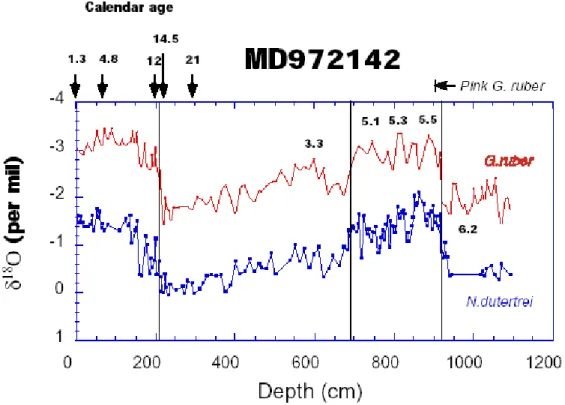
The age model was constructed mainly by correlating the δ18O profiles of G. sacculifer
and G. dutertrei (Fig. 3) to the low-latitude oxygen isotopic stack of Bassinot (1994). The last appearance datum of pinked G. ruber was used to independently mark the Termination II. The age of the top section of the core is constrained by five carbon-14 dated samples (for detail, see Wei et al., 2003). The studied section spans the last 164.3 kyrs, extending back to the upper part of the marine oxygen isotope stage (MIS) 6. The average sedimentation rate for the studied section (top 1096cm) is about 6.6 cm/kyrs while the temporal resolution of this study is about 2 kyrs in average.
Figure 3 (a) Planktonic δ18O stratigraphy derived from G.sacculifer in Core MD972142; (b)
Mg/Ca SST record of Core MD972142, corresponding Mg/Ca ratio was shown on the right axis; (c) Sea-surface salinity (SSS) record calculated from δ18O of
G.sacculifer and Mg/Ca SST after subtracting the global ice volume effect. The modern SSS is taken as 33.4o/oo (Levitus and Boyer, 1994).
Sea-surface Temperatures of the Southeastern South China Sea
The Mg/Ca ratios fluctuate between ~3.0 and ~5.0 mmol/mol, corresponding to a temperature range of ~23 to 28.4oC (Figure 4a). Clear glacial-interglacial oscillations in Mg/Ca are observed. Comparison of the Mg/Ca record and theδ 18O record of the same core (Figure 4b) indicates that oscillations in both records match fairly well, with a r = -0.83. The Mg/Ca ratios of G. sacculifer are considered to record the annual mean SST (Hastings et al., 1998). In Core MD972142, this is supported by the core top Mg/Ca SST of ~28.4oC, which corresponds well to the observed sea surface temperature in this region (summer SST: >29oC, winter SST: ~27oC; Levitus and Boyer, 1994). Further support is found by comparing both the Mg/Ca SST record and the annual mean SST record derived from foraminiferal
assemblages (Yu et al., 2000). The reconstructed paleo-SST record of MD972142 reveals an average Holocene SST of ~27.0oC and a LGM SST of ~23oC, showing a ~4oC
glacial-interglacial SST warming. Our LGM-Holocene SST difference is in good consistence with the estimations made by Miao et al., (1994) in the near-by sites by planktic foraminiferal fauna canges. The calculated annual mean SSTs in the LGM range from 24.2oC to 25.3oC, and the annual mean SSTs in Holocene range between ~28-29oC, leading to a LGM-Holocene warming of ~3-4.5oC. Similar LGM-Holocene warming amplitude was also reported in the western part of SCS and a core from west of Luzon (Wang et al., 1999). On the other hand, our result is larger than the ~2.8oC SST change estimated for southern SCS using Uk’37
(Pelejero et al., 1999).
On-site comparison of the Mg/Ca-derived SSTs with the Uk’37-derived shows that there is a
good agreement for the topmost 600 cm, but the two records differ from each other in the lower part of the record (Fig. 4a). A closer examination reveals that the Mg/Ca-derived SSTs tend to yield colder temperatures during the glacial or stadial intervals. The discrepancy in the lower section suggests that the Mg/Ca derived SST tends to underestimate paleo-temperature due to dissolution. It is because Mg-enriched part of the foraminiferal tests is more
susceptible to dissolution, any differential dissolution would cause to a lower Mg/Ca ratio preserved in the robust tests and lead to a lower estimation of the SST. It has been reported that the dissolution effect becomes stronger during the glacial period in the South China Sea (Chen et al., 1999, and other Refs.), probably due to stronger disgenesis seen in the glacial sections in which the biogenic calcite was diluted by terrigenous input (Chen et al., 1999). However, the mg/Ca-derived SSTs for the MIS6 are comparable to that for the LGM,
suggesting a consistent result, whereas the –derived SSTs show big discrepancy between the
LGM and the MIS6. (Fig. 4a),
On the other hand, this temperature offset between the Mg-SST and Uk’37 might be
explained by the difference in the time of signal generation and the depth habitats of the Uk’37
signal producing coccolithophorids and foraminifera during the glacial and statdial periods. We envision that during the glacial and stadial periods, the coccolithophorid flora in the South China Sea would be dominated by Gephyrocapsa oceanica (because E. huxleyi became dominated only after 470 ka, Ref. Y ) because of its inner sea setting; and the U37k’ values
generated by G. ocenica tend to be higher (due to its lower abundance of C37:3, Ref. Z),
therefore the SSTs were over-estimated by eq. 2 for the older sections.
The SSTs during oxygen isotope stage 5 are comparable to those in Holocene, while the SSTs during stage 6 are slightly warmer than those in stage 2. Notably, the SSTs in substages 5.1 and 5.3 were as high as those in substage 5.5, despite the cut off of warm water inflow
from Indian Ocean through Sunda Shelf which might be caused by a sea level lowering of ~20-60m (Shackleton, 1987; Chappell et al., 1996; Lea et al., 2002). Furthermore, the consistent high temperatures of the substages 5.1, 5.3 and 5.5 (~27.5-28oC) are consistent with the similar high δ18O values (Fig. 4b). Such a δ18O profile of MIS5 at Site MD972142
differs remarkably from the δ18O profile in the SPECMAP stack which shows cascading steps
from substages 5.5 to 5.1. This pattern has also been observed from other cores in southern SCS (Lee et al., 1999; Pelejero et al., 1999). Both the Mg/Ca SST record and fauna
assemblages-derived SST record (Yu et al., 2000) show consistent, comparable high SSTs during substages 5.1, 5.3 and 5.5, implying the warm pool of the western Pacific extended persistently to this region during substages 5.1, 5.3 and 5.5.
The Mg/Ca SST in Core MD972142 shows a ~1.4oC cooling at about 10-11ka which is associated with a ~0.7o/oo increase in the oxygen isotope record. This short-lived cooling
event corresponds to the Younger-Dryas (YD) event originally documented in the high-latitudes in and around the Atlantic Ocean (e.g. Ruddiman and McIntyre, 1981; Dansgaard et al., 1989). This event was initially thought to occur at the high latitudes, however, it has now been established that the Younger Dryas event is also found in the tropical regions based upon planktic foraminiferal fauna changes (e.g. Linsley and Thunell, 1990). Wei et al. (1998) reported a temperature drop by ~1oC in the northeast SCS based upon foraminifera-derived SST and Uk’37 SST. Wang et al. (1999) reported also the occurrence of
Younger Dryas event in Core 17940 and Core 17927, which showed synchronous cooling signals in SST andδ18O records. As augmented by our Mg/Ca-derived SST profile for site MD972142, the occurrence of the Younger Dryas in SCS confirms that this event is not only characteristic in high-latitude records, but also manifested in the tropical regions as a global cooling event.
Oxygen Isotopic Composition of Surface Sea Water During the past 165,000 Years The oxygen isotopic compositions of sea water during the past 165,000 years (lower half of Fig. 5a) were calculated by subtracting temperature effect (Fig. 5b) from the δ18O of
planktic foraminifera G. sacculifer (upper half of Fig. 5a). The global ice-volume effect is shown in Fig. 5c, and the ice-volume corrected δ18Ow is shown in Fig. 5d. As mentioned in
the methodology section, such a ice-volume corrected δ18Ow curve can be also alternatively
calculated using –derived SST using equation proposed by either Mulitza et al (2003) or Spero et al (2003), we did all the combinations and result in four estimates of δ18O
w for the
past 165,000 years (Fig. 6). Those four curves are basically similar to each other. For the
following discussion, we chose the curve as a representative derived from Mg/Ca-SST and Multiza et al (2003) equation.
Fig5_142 170k mgca 18O
Fig6_142 corrected 18Os age
Several factors have contributed to the variation in this “residual” curve, including fresh-water input from rivers and meteoritic precipitation, salt-water input from open-ocean as well as local evaporation. Generally speaking, this curve can be viewed as a surrogate of salinity variation of the past 165 kyrs. However, the amount effect on precipitation during summer monsoon in this area can be amount to -1.4 o/oo per 100 mm/month increase (Wei et
al., 2003), and therefore, part of the δ18O
w variation should be ascribed to precipitation
intensity of summer monsoons (Wei et al., 2003). On the other hand, the changing efficacies of water exchange between the South China Sea and the open ocean (Indian and Pacific) would also play a significant role in regulating the local δ18O
w values. For the sake of
simplicity, the “residual” values of δ18O
w-smow shown in Fig. 5d is considered as a proxy of
salinity in the following discussion.
The ice-corrected δ18Ow-smow values at Site MD972142 range from approximately
-0.1 to 1.2o/oo (Figure 5d). Most of such residual values during the past 165 kyrs are lighter
than the core-top value (~0.7o/oo) except for intervals of 125-130 ka and 100-110 ka,
corresponding roughly to Termination II and MIS 5.4 (Fig. 5). Both time intervals are marked by low SSTs. Otherwise, no obvious systematic glacial-interglacial variations are observed. The overall ‘sea-surface salinity (SSS)” fluctuation at Site MD972142 is different from those found in the open ocean, which shows systematically high salinity values during glacial periods and lower salinity values during interglacial time (e.g. Rostek et al., 1993). The “SSS” fluctuation in our result is more or less similar to those calculated in Core 17954 (Wang et al., 1999) from northwestern part of SCS, suggesting a different scenario in the record of SCS compared to the open ocean.
The SSSs are particularly low in substage 6.1 and 6.3 with a minimum δ18O
w value of
-0.1o/oo. Low SSSs are also found during substages 5.3, 5.1 and during stage 3, stage 2 and the
early Holocene. It is interesting to note that the SSSs during substage 5.5 are higher than those during substages 5.3 and 5.1 (Fig. 5d), probably reflecting a better efficacy of water exchange with the open ocean owing to higher sea-level. The higher SSSs during substage 5.5, in fact, represent the signals of saltier water from the open ocean at high sea level stand. In
comparison, during substages 5.3 and 5.1, as the sea level dropped and the SCS was semi-isolated, amplification of local environment changes was recorded, resulting in lower SSSs. For termination II and substage 5.4 which show higher SSSs than today, again, the high salinity values during termination II and substage 5.4 may reflect increased evaporation and/or decreased precipitation during a time when water-exchange with the open oceans was restricted.
The salinity variations in Core MD972142 are closely related to the changes in local evaporation and freshwater input in the southeastern SCS. Because the location of Site MD972142 is quite distant from the major rivers of the Indochina Peninsula, the riverine freshwater input is less significant to the salinity variations at this site. We consider that the evaporation-precipitation (E-P) balance and amount effect of precipitation largely controls the δ18O
w variations at this site, especially during the low sea-level periods. As shown by modern
monsoon studies, the precipitation in this area is mainly brought by the southwest monsoon and the highest precipitation rate is obtained in August (from web site of Goddard Space Flight Center, NASA; http://dao.gsfc.nasa.gov/). Hence, the δ18Ow variation during the
glacial period is indicative of summer monsoon intensity that strongly controlled the precipitation in this area.
On the other hand, at high sea level stand, when the SCS is connected to the open ocean,
the δ18O
w in SCS has been influenced by saltier water inflow from the Pacific and Indian
Oceans. The local precipitation-evaporation changes might be obscured and would not accurately register the salinity variation caused by monsoon precipitation. In contrast, during glacial periods or any sea level drop exceeding 40m, such as from substage 5.4 until the beginning of Holocene (Shackleton, 1987; Chappell et al., 1996; Lea et al., 2002), the Sunda Shelf was exposed and the water inflow to southern SCS was cut off. The only connection to the open ocean is through Luzon Strait in northeastern SCS and resulting in semi-isolated environment for the SCS. The SCS was then under a stronger influence of local hydrological and precipitation conditions. Under such a semi-isolated condition, with the size reduction of sea surface and the SST decline, the evaporation rate was lower and the vapor supply from sea surface was reduced. According to P. Wang (1999), during the LGM when the SSTs in SCS were 2-5oC cooler than today, the evaporation rate was assumed to be reduced by
10-25% due to the SST decrease. This will strongly affects the E-P balance and reflects in the local salinity variation. And this might be the case for the salinity lows seen in the δ18Ow
record of Core MD972142, especially during stages 2, 3, and 6. However, those salinity lows may be signals of the increased water discharge from the Mekong River and Molengraaff River in the southern part of SCS. Result from pollen studies revealed that during the last glaciation, the exposed Sunda Shelf experienced a humid climate under the enhanced Winter Monsoon (Sun et al., 2000). The freshwater discharged to the southern SCS might then be driven to the northern part by surface water circulation and affected the δ18O
w values there.
Limited to the few SSS records in SCS, the δ18O
w variations in this region are not yet fully
understood. Other independent proxies for monsoon intensity or monsoon moisture are needed to further interpret the monsoon history in the past.
Conclusions
Foraminiferal Mg/Ca- and Uk’37 –derived estimations of sea-surface temperatures at
Site MD972142 show clear glacial-interglacial variation, which corresponds well with oxygen isotope record. The calculated core-top Mg/Ca SST is close to the modern observed SST in this region and reveals compellingly its utility for paleo-temperature reconstruction. The LGM-Holocene SST difference of ~4oC is quite close to the result from faunal-derived SST records, and also matches fairly well with the UK’37, faunal-derived SST results from the same
core and other previous results in the SCS. The SST and δ18O
f values at substages 5.1, 5.3
and 5.5 are comparable to those in Holocene, indicating a warmer condition and/or lower
salinity in the southeastern part of SCS, and confirming the western extent of the Western Pacific Warm Pool throughout stage 5. The Younger Dryas event, which is a characteristic feature in high-latitude climate records, is also registered in both the δ18O and Mg/Ca SST
records at ~11ka.
The calculated δ18O
w of core MD972142 are mostly lower than the modern value for
the past 165 kyrs. During glacial periods or any sea level lowering which exceeds 40m, the SCS was more isolated and was very sensitive to the influence of local hydrological and precipitation conditions. The salinity variations have been mainly controlled by the
evaporation-precipitation (E-P) balance in this region, and thus serve as a sensitive climate indicator. Consequently, the variations in sea surface δ18O
w were sensitive to reflect the
regional evaporation and precipitation changes related to the East Asian monsoon system. The salinity lows during glacial periods might be caused by low evaporation rate due to SST decrease and/or the mixing of less saline water from the southern SCS. On the other hand, the heavier values of δ18O
w during the high sea-level stands reflect more or less situations
analogous to today, namely, good connection with open-ocean and similar hydrological regime.
ACKNOWLEDGEMENTS
This study is a contribution to the Taiwan IMAGES Program. Dr. David Lee provided us data of sea-level change and associated ice-volume effect on sea-water’s δ18O. We thank
the scientific party and crew of IMAGES-III-IPHIS-Leg II Cruise for a successful coring in the SCS. The support offered by French MENRT, TAFF, CNRS/INSU and IFRTP to the operation of the cruise vessel Marion Dufrense and the IMAGES Program is highly appreciated. The study has been supported by Grants NSC-88-2116-002-012 and NSC-92-XXX-FF-FF to KYW and YGC.
Reference
Anand, P., Elderfield, H. and Conte, M. H. 2003. alibration of Mg/Ca thermometry in
planktonic foraminifera from a sediment trap time series. Paleoceanography, 18(2), 1050, doi:10.1029/2002PA000846.
Bassinot, F.C., Labeyrie, L.D., Vincent, E., Quidelleur, X., Shackleton, N.J., and Lancelot, Y., 1994, The astronimical theory of climate and the age of the Brunhes-Matuyama magnetic reversal: Earth and Planetary Science Letters, v.126, p.91-108.
Broecker, W.S., Andress, M., Klas, M., Bonani, G., Wolfi, W., and Oeschger, H., 1988, New evidence from the South China Sea for an abrupt termination of the last glacial period: Nature, 333, 156-158.
Chappell, J., Omura, A., Esat, T., McCulloch, M., Pandolfi, J., Yoko, O., and Pillans, B., 1996, Reconciliation of late Quaternary sea levels derived from coral terraces at Huon Peninsula with deep sea oxygen isotope records: Earth and Planetary Science Letter, 141: 227-236. Chen, M.-T., Huang, C.-Y. and Wei, K.-Y. (1997) 25,000-year late Quaternary records of
carbonate preservation and climatic change in the South China Sea. Palaeogeography, Palaeoclimatology, Palaeoecology, 129, 155-169.
Climate: Long-Range Investigation, Mapping, and Prediction (CLIMAP), 1981, Seasonal reconstructions of the Earth’s surface at the last glacial maximum, GSA Map and Chart Ser. MC-36, Boulder, Colorado, Geological Society of America.
Dansgaard, W., White, J., and Johnsen, S., 1989, The abrupt termination of the Younger Dryas climate event: Nature, v.339, p.532-534.
Epstein, S., and Mayeda, T., 1953, Variation of Oxygen-18 content of waters from natural sources: Geochimica et Cosmochimica Acta, 4, 213-224.
Hastings, D.W., Russell, A.D., and Emerson, S., 1998, Foraminiferal magnesium in Globigerinoides sacculifer as a paleotemperature proxy: Paleoceanography, v.13, p.161-169.
Lea D. W., Martin P. A., Pak D. K., and Spero H. J., 2002, Reconstructing a 350 ky history of sea level using planktonic Mg/Ca and oxygen isotopic records from a Cocos Ridge core.
Quat. Sci. Rev. 21(1-3), 283-293.
Lee, M.Y., Wei, K.Y., and Wang, C.H., 1997, Reconstruction of paleosalinity based upon empirical relationship between seawater oxygen isotope composition and salinity: A re-evaluation, Annual meeting of the Geological society of China, abstract, p.106-108. Lee, M.Y., Wei, K.Y., and Chen, Y.G., 1999, High resolution oxygen isotope stratigraphy for
the last 150,000 years in the southern South China Sea: Core MD972151: Terrestrial, Atmospheric and Oceanic Sciences, v.10, p.239-254.
Levitus, S., and Boyer, T., 1994, World Ocean Atlas, Temperature, NOAA Atlas NESDIS, v.4, Washington, D.C., U.S. Department of Commerce, 117p.
Linsley, B., and Thunell, R., 1990, The record of deglaciation in the Sulu Sea: Evidence for the Younger Dryas event in the tropical western Pacific: Paleoceanography, v.5,
p.1025-1039.
Mashiotta, T.A., Lea, D.W., and Spero, H.J., 1999, Glacial-interglacial changes in
Subantarctic sea surface temperature and δ 18O-water using foraminiferal Mg: Earth and
Planetary Science Letters, v.170, p.417-432.
Miao Q., Thunell, R.C., and Anderson, D.M., 1994, Glacial-Holocene carbonate dissolution and sea surface temperatures in the South China and Sulu seas: Paleoceanography, v.9, no.2, p.269-290.
Mulitza, S., Boltovxkoy, D., Donner, B., Meggers, H., Paul, A., Wefer, G., 2003. Temperature: δ18O relationships of planktonic foraminifera collected from surface waters. Palaeogeogr.,
Palaeoclimatol., Palaeoecol., 202: 143-152.
Nürnberg, D., Bijma, J., and Hemleben, C., 1996a, Assessing the reliability of magnesium in foraminiferal calcite as a proxy for water mass temperatures: Geochimica et
Cosmochimica Acta, v.60, p.803-814.
Nürnberg, D., Bijma, J., and Hemleben, C., 1996b, Erratum: Assessing the reliability of magnesium in foraminiferal calcite as a proxy for water mass temperatures: Geochimica et Cosmochimica Acta, v.60, p.2483-2484.
Nürnberg, D., Müller, A., and Schneider, R.R., 2000, Paleo-sea surface temperature
calculations in the equatorial east Atlantic from Mg/ca ratios in planktic foraminifera: A comparison to sea surface temperature estimates from UK’37, oxygen isotopes, and
foraminiferal transfer function: Paleoceanography, v.15, no.1, p.124-134.
Pelejero, C., Grimalt, J.O., Heilig, S., Kienast, M., and Wang Luejiang, 1999, High-resolution UK37 temperature reconstructions in the South China Sea over the past 220 kyr:
Paleoceanography, v.14, no.2, p.224-231.
Rostek, F., Ruhland, G., Bassinot, F.C., Müller, P.J., Labeyrie, L.D., Lancelot, Y., and Bard, E., 1993, Reconstructing sea surface temperature and salinity using δ18O and alkenone
records: Nature, v.364, p.319-321.
Ruddiman, W., and McIntyre, A., 1981, The North Atlantic Ocean during the last deglaciation:
Palaeogeography, Palaeoclimatology, Palaeoecology, v.35, p.145-214.
Shackleton, N.J., 1987, Oxygen isotopes, ice volume and sea level: Quaternary Science Review, v.6, p183-190.
Shen, C.C., 1996, High precision analysis of Sr/Ca ratio and its environmental application [PhD. thesis]: Taiwan R.O.C., National Ching Hua University, , 187p.
Sikes, E.L., Farrington, J.W., and Keigwin, L.D., 1991, Use of the unsaturation ratio UK37 to
determine past sea surface temperatures: core-top SST calibrations and methodology considerations: Earth and Planetary Science Letters, v.104, p.36-47.
Spero1, H. J., Mielke, K. M., Kalve, E. M., Lea, D. W. and Pak. D. K. 2003, Multispecies approach to reconstructing eastern Equatorial Pacific thermocline hydrography during the past 360 ky. Paleoceanography,
Sun, X., Li, X., Luo, Y., and Chen, X., 2000, The vegetation and climate at the last glaciation on the emerged continental shelf of the South China Sea: Palaeogeography,
Palaeoclimatology, Palaeoecology, v.160, p.301-316.
Wang, C.C., 1999, High-resolution Paleomonsoon / Paleoceanography fluctuation of the South China Sea in the last 150kyrs: records of IMAGES MD972151 core [Master thesis]: Taiwan R.O.C., National Taiwan University, , 83p.
Wang, L., and Wang, P., 1990, Late Quaternary paleoceanography of the South China Sea: glacial-interglacial contrasts in an enclosed basin: Paleoceanography, v.5, p.77-90. Wang, L., Sarnthein, M., erlenkeuser, H., Grimalt, J., Grootes, P., Heilig, S., Ivanova, E.,
Kienast, M., Pelejero, C, and Pflaumann, U., 1999, East Asian monsoon climate during the Late Pleistocene: high-resolution sediment records from the South China Sea: Marine Geology, v.156, p.245-282.
Wang, P., 1999, Response of Western Pacific marginal seas to glacial cycles:
paleoceanographic and sedimentological features: Marine Geology, v.156, p.5-39. Wei, K.Y., Lee, M.Y., Duan, W., Chen, C., and Wang, C.H.,1998, Paleoceanographic change
in the northern South China Sea during the last 15000 years: Journal of Quaternary Science, v.13, p.55-64.
Wei, K.Y., Chiu, T.C., and Chen, Y.G., 2000, Planktic foraminiferal oxygen isotope record of the last 350 thousand years of Core MD972142, southeastern South China Sea:
Chronostratigraphy, orbital forcing and paleoceanographic implications: Journal of the Geological Society of China, v.43, no.3, p.393-408.
Wei, K.-Y., Chiu, T.C. and Chen, Y.-G., 2003, Toward Establishing a maritime proxy record of
the East Asian summer monsoons for the late Quaternary. Marine Geology 201: 67-79. Wyrtki, K., 1961, Scientific results of marine investigations of the South China Sea and the
Gulf of Thailand: Physical oceanography of the Southwest Asian waters, Rep.2, 195p., Scripps Institute of Oceanography, La Jolla, California.
Yan, X.H., Ho, C.R., Zheng, Q., and Klemas, V., 1992, Temperature and size variability of the Western Pacific Warm Pool: Science, v.258, p.1643-1645.
Yu, P.S., Chiu, T.C., Chen, M.T., Wei, K.Y., and Chen, Y.G., 2000, Planktic foraminifer faunal assemblage and sea-surface temperature variations in a “warm-pool” South China Sea record of the past 400,000 years: IMAGES Core MD972142: Journal of the Geological Society of China, v.43, no.3, p.467-496.