Synthesis of 1,3,4-Oxadiazole-Based Aromatic and Heterocyclic/Phenylpyrazole Derivatives
Li-Ya Wang,1,2,5 En-Chiuan Chang,3,5 Mou-Yung Yeh,3 Yu Hsuan Chung,4 Jiann-Jyh Huang,*,4 and Fung Fuh Wong*,2
1The Ph.D. Program for Cancer Biology and Drug Discovery, China Medical University, No. 91, Hsueh-Shih Rd., Taichung, Taiwan 40402, R.O.C.
2Graduate Institute of Pharmaceutical Chemistry, China Medical University, No. 91, Hsueh-Shih Rd., Taichung, Taiwan 40402, R.O.C.
3Department of Chemistry, National Cheng Kung University, No. 1, Ta Hsueh Rd., Tainan, Taiwan 70101, R. O. C.
4Department of Applied Chemistry, National Chiayi University, No. 300, Syuefu Rd., Chiayi City, Taiwan 60004, R.O.C.
5These authors contributed equally to this work.
*Corresponding author. Tel.: +886 4 2205 3366 ext. 5603; Fax: +886 4 2207 8083.
E-mail address: [email protected], [email protected] (F. F.
Wong).
ABSTRACT: A new series of 1,3,4-oxadiazole-based aromatic and heterocyclic/phenylpyrazole derivatives 6a–c, 7a–d, and 8 were synthesized via sequential 1,3-dipolar cyclization, hydrazidation, benzoylation, dehydrative cyclization, and Suzuki coupling reaction. Among the derivatives, compounds 7a and 7c with the corresponding 2-thienyl and 2-benzo[b]thienyl (Ar) at the phenyl group that located at the N-1 position of pyrazole showed better conjugation range.
Keywords: 1,3-dipolar, phenylpyrazole, 1,3,4-oxadiazole, Suzuki coupling reaction, thienyl
INTRODUCTION
π-Conjugated 1,3,4-oxadiazole derivatives have been widely exploited as electron-transporting and hole-blocking (ETHB) materials in electroluminescent (EL) devices because of their high florescence efficiency, thermal stability, photoluminescence quantum yield (PLQL), and semiconducting property [1].
Therefore, the development of new π-conjugated 1,3,4-oxadiazole-based heterocyclic compounds as electroluminescent materials attracts attentions [2–4], particularly in the blue region [1]. Representative examples include 1,3,4-oxadiazole hybridized with pyridine [5], pyrimidine [5], carbazole [6], 1,2,3-triazole [7], 1,2,3-triazole–pyridine [7], triazolopyridinone [8], triazolopyridinone–carbazole [9], and spirobifluorene [10].
In our previous study, we have coupled various aryllpyrazoles, the electron-rich heterocycles that have excellent thermal and morphological stability [11], in the conjugation main chain of 1,3,4-oxadiazoles to generate 1,3,4-oxadiazole-based arylpyrazole derivatives with improved electron-transporting properties [12]. To further improve the conjugation range, we connected the phenyl group in the pyrazole with an additional aryl or heteroaryl group in this study. The aryl and heteroaryl groups included m-CF3-C6H4, 2,6-di-CF3-C6H3, p-OMe-C6H4, 2-thienyl, 3-thienyl, 2- benzo[b]thienyl, dibenzo[b,d]thiophene-4-yl, and dibenzo[b,d]furane-4-yl that have important properties to form conducting polymers [13–18]. These new 1,3,4- oxadiazole-based aromatic and heterocyclic/phenylpyrazole derivatives 6a–6c, 7a–7d and 8 were obtained by use of sequential 1,3-dipolar cycloaddition, substitution, benzoylation, dehydrative cyclization, and Suzuki coupling reaction.
RESULTS AND DISCUSSION
Synthesis of 1,3,4-Oxadiazole-Based Heterocyclic and Aromatic/Phenylpyrazole Derivatives 6a–c, 7a–d, and 8
Scheme 1 shows the synthetic route for 1,3,4-oxadiazole-based aromatic and heterocyclic/phenylpyrazole derivatives 6a–c, 7a–d, and 8. N1-p- Bromophenylsydnone 1, prepared according to the literature procedure [19], was reacted with dimethyl acetylenedicaboxylate (DMAD) to give the corresponding dimethyl 1-(p-bromophenyl)-1H-pyrazole-3,4-dicarboxylate (2) in 92% yield [20].
This reaction proceeded through an efficient 1,3-dipolar cycloaddition that can prepare pyrazole derivatives from sydnone in even industrial scale [21–22]. Treatment of compound 2 with hydrazine hydrate afforded the corresponding dihydrazide 3 in 94% yield [23].Dihydrazide 3 was then reacted with benzoyl chloride in pyridine to give the corresponding dibenzoyl dihydrazide 4 in 85% yield. Reaction of compounds 4 with POCl3 formed the pyrazole–1,3,4-oxadiazole 5 in 81% yield [24].
SCHEME 1 Synthesis of 1,3,4-oxadiazole-based heterocyclic and aromatic/phenylpyrazole derivatives 6a–c, 7a–d, and 8.
Compound 5 was then cross-coupled with various arene- and heteroarene-boronic acids, including m-CF3-C6H4-, 2,6-di-CF3-C6H3-, p-OMe-C6H4-, 2-thienyl-, 3-thienyl-, 2-benzo[b]thienyl, dibenzo[b,d]thiophene-4-yl- and dibenzo[b,d]furane-4-yl-boronic acids (see Scheme 1) [25] using Suzuki coupling [26]. The reaction provided the corresponding 1,3,4-oxadiazole-based aromatic and heterocyclic/phenylpyrazole derivatives 6a–c, 7a–d, and 8 in 72–87% yields (see Scheme 1 and Table 1).
TABLE 1 Synthesis of 1,3,4-oxadiazole-based aromatic and
heterocyclic/phenylpyrazole derivatives 6a–c, 7a–d, and 8 from 5 with various boronic acids
Entry ArB(OH)2
Ar = Product No. Yield (%)
1 m-CF3-C6H4- 6a 82
2 2,6-di-CF3-C6H3- 6b 72
3 p-OMe-C6H4- 6c 86
4 2-thienyl- 7a 81
5 3-thienyl- 7b 87
6 2-benzo[b]thienyl- 7c 74
7 dibenzo[b,d]thiophene-4-yl- 7d 83
8 dibenzo[b,d]furane-4-yl- 8 85
Optical Properties
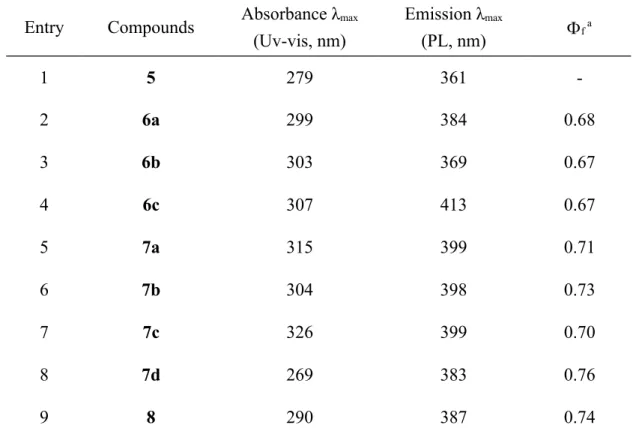
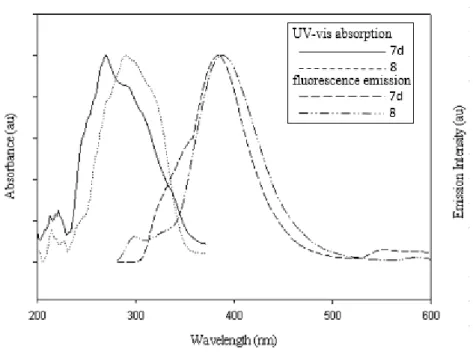
1,3,4-Oxadiazole-based aromatic and heterocyclic/phenylpyrazole derivatives 6a–c, 7a–d, and 8 showed similar λmax (at 299–307, 269–326, and 290 nm, respectively) in the UV-vis spectra measured in CH2Cl2 (Table 2). For the UV-vis spectra of 6a–c and 7a–c as shown in Figure 1 and 2, the main absorption bands at ~290 nm were contributed from the conjugation of phenyl and pyrazole moieties as indicated in our previously published results [12]. Compounds 6a–c has a slightly red shift (299–307 nm) in comparison of 5, possibly due to the conjugation resulting from the additional aryl group connected to the N1-phenyl group in pyrazolic ring. Compounds 7a–c with 2-thienyl, 3-thienyl, and 2-benzo[b]thienyl groups at the para-position of the N1- phenylpyrazole also showed a slightly red shift with λmax values of 304–326 nm. For compounds 7d and 8, they showed very similar absorption peaks (at 269 and 290 nm,
respectively) to that of the starting material 5 in the visible region (see Figure 3). We thought that the steric repulsion between bulky dibenzo[b,d]thiophene-4-yl or dibenzo[b,d]furane-4-yl substituents with 1,3,4-oxadiazole-based phenylpyrazole core structure may exist. As a result, dibenzo[b,d]thiophene-4-yl and dibenzo[b,d]furane-4- yl groups may not favor to conjugate with phenylpyrazole.
TABLE 2 Spectroscopic data of 5 and the new 1,3,4-oxadiazole-based aromatic and heterocyclic/phenylpyrazole derivatives 6a–c, 7a–d, and 8 in CH2Cl2.
Entry Compounds Absorbance λmax
(Uv-vis, nm)
Emission λmax
(PL, nm) f a
1 5 279 361 -
2 6a 299 384 0.68
3 6b 303 369 0.67
4 6c 307 413 0.67
5 7a 315 399 0.71
6 7b 304 398 0.73
7 7c 326 399 0.70
8 7d 269 383 0.76
9 8 290 387 0.74
af: Fluorescence quantum efficiency, relative to 2-phenyl-5-(4-biphenyl)-1,3,4-oxadiazole in benzene (f = 0.8).
FIGURE 1 The UV-vis and PL Spectra of 6a–c in CH2Cl2 solution.
FIGURE 2 The UV-vis and PL Spectra of 7a–c in CH2Cl2 solution.
FIGURE 3 The UV-vis and PL Spectra of 7d and 8 in CH2Cl2 solution.
Table 2 also shows the emission λmax of compounds 5, 6a–c, 7a–d, and 8 in their photoluminescence (PL) spectra measured in CH2Cl2. Except for compound 6b, these compounds showed a red shift in λmax by ≥15 nm in comparison with 5 (λmax for 5: 361 nm). For 6a–c bearing substituted phenyl group at the phenylpyrazole moiety, the emission λmax were observed at 369–413 nm (see Figure 1). Compounds 6c bearing two strong electron-withdrawing CF3 groups showed the strongest red shift in the PL emission spectrum (at ~413 nm, see Figure 1). For compounds 7a–d and 8 containing the corresponding 2-thienyl, 3-thienyl, 2-benzo[b]thiophenyl, dibenzofuranyl and dibenzothiophenyl groups, their PL showed a slightly red shift with λmax at 383–399 nm. Following the results from Uv-vis and PL, we assumed the different substituents at the para position of the phenyl ring locating at the phenylpyrazole group, including aryl, 4-dibenzofuranyl, 2-, or 3-thiophenyl, 2-benzo[b]thiophenyl, 4-dibenzofuranyl and 4-dibenzothiophenyl groups, seemed to conjugate with 1,3,4-oxadiazole-based phenylpyrazole core backbone, especially for 2-thiophenyl and 2-benzo[b]thiophenyl groups. In the other hands, the solution fluorescence quantum yields (f) of 5, 6a–c,
7a–d, and 8, all of which fall in the range 0.67–0.76, were determined relative to that
of 2-phenyl-5-(4-biphenyl)-1,3,4-oxzdiazole in benzene (f = 0.80, see Table 2).
In conclusion, a series of 1,3,4-oxadiazole-based aromatic and heterocyclic/phenylpyrazole derivatives have been successfully synthesized by sequential 1,3-dipolar cycloaddition, hydrazidation, benzoylation, dehydrative cyclization, and Suzuki coupling reaction. Aryl, dibenzofuranyl, 2-thiophenyl, 3- thiophenyl, 2-benzo[b]thiophenyl, and dibenzothiophenyl were introduced to the 1,3,4-oxadiazole–phenylpyrazole main structure to promote the conjugation range.
Based on spectroscopic studies including Uv-vis and PL, compounds 7c and 7d with the respective 2-thiophenyl and 2-benzo[b]thiophenyl groups possessed the more conjugation efficiency.
EXPERIMENTAL
General. All chemicals were reagent grade and used as purchased. All reactions were carried out under nitrogen atmosphere and monitored by thin-layer chromatography.
Flash column chromatography was carried out on silica gel (230–400 mesh).
Tetrakis(triphenylphosphine)palladium, toluene, silica gel and p-xylene were purchased from Merck Chemical Co. Dichloromethane, chloroform, ethanol, hydrazine hydrate, methanol, and tetrahydrofuran were purchased from Fluka &
Aldrich. benzoyl chloride, benzo[b]thien-2-ylboronic acid, 4-dibenzothienylboronic acid, 4-(dibenzofuranyl)boronic acid, dimethyl acetylenedicaboxylate, diphenylacetylene, phenylacetylene, potassium carbonate, pyridine, phosphorus oxychloride, 2-thienylboronic acid, and 3-thienylboronic acid were purchased from Acros Chemical Co. Potassium carbonate was purchased from TCI Chemical Co.
Infrared (IR) spectra were measured on a Bomem Michelson Series FT-IR spectrometer. The wavenumbers reported are referenced to the polystyrene 1601 cm–1
absorption. Absorption intensities are recorded by the following abbreviations: s, strong; m, medium; w, weak. UV-visible spectra were measured with a HP 8452A diode-array spectrophotometer. Photoluminescence (PL) spectra were obtained on a PerkinElemer fluorescence spectrophotometer (LS 55). Proton NMR spectra were obtained on a Bruker AC-300 (300 MHz) spectrometer by use of DMSO-d6 as the solvent. Carbon-13 NMR spectra were obtained on a Bruker AC-300 (75 MHz) spectrometer by used of DMSO-d6 as solvent. Carbon-13 chemical shifts are referenced to the center of the DMSO-d6 sextet (δ 39.6 ppm). Multiplicities are recorded by the following abbreviations: s, singlet; d, doublet; t, triplet; q, quartet; m, multiplet; J, coupling constant (hertz).
The UV-VIS spectra of the samples were measured in NMP by a Shimadzu Model UV-160 spectrophotometer. The fluorescence spectra were recorded by a Hitach F- 4500 fluorescence spectrometer. Elemental analyses were carried out on a Heraeus CHN–O RAPID element analyzer.
Synthesis of Dimethyl 1-(4-Bromophenyl)-1H-pyrazole-3,4-dicarboxylate (2) [20]. A solution of sydnone 1 (0.20 g, 1.0 equiv) in 4.0 mL p-xylene was added dimethyl acetylenedicaboxylate (DMAD, 1.05 equiv). The reaction mixture was heated at reflux for 6.0 h. After the reaction was completed, the solution was concentrated under reduced pressure to remove p-xylene. The residue was purified by column chromatography on silica gel to give 2 in 92% yield: 1H NMR (DMSO-d6, 300 MHz) δ 3.76 (s, 3 H, OCH3), 3.84 (s, 3 H, OCH3), 7.66 (d, J = 7.8 Hz, 2 H, ArH), 7.83 (d, J
= 7.8 Hz, 2 H, ArH), 9.08 (s, 1 H, ArH); 13C NMR (75 MHz, DMSO-d6) δ 52.1, 52.7, 115.6, 120.9, 121.6, 132.7, 132.9, 137.7, 144.7, 161.6, 162.2; Anal. Calcd for C13H11BrN2O4: C: 46.04; H: 3.27; N: 8.26; Found: C: 46.10; H: 3.24; N: 8.21.
Synthesis of 1-(p-Bromophenyl)-1H-pyrazole-3,4-dicarbohydrazide (3) [23]. A
solution of 2 (0.51 g, 1.5 mmol, 1.0 equiv) and hydrazine monohydrate (0.76 g, 6.0 mmol, 4.0 equiv) in EtOH was heated at reflux for 12 h. After the reaction was completed, the solution was concentrated under reduced pressure and precipitated by EtOAc (15 mL). The resulting solution was kept at –5 °C for 4.0 h. The precipitate was filtered and washed with cold EtOH (10 mL). The solids were dried in a vacuum oven for 12 h to give the desired 3 in 94% yield: 1H NMR (DMSO-d6, 300 MHz) δ 4.68 (br, 4 H, NH2), 7.61 (d, J = 8.9 Hz, 2 H, ArH), 8.06 (d, J = 8.9 Hz, 2 H, ArH), 9.09 (s, 1 H, ArH), 10.36 (s, 1 H, NH), 11.19 (br, 2 H, NH); 13C NMR (75 MHz, DMSO-d6) δ 119.3, 120.6, 121.4, 132.6, 132.2, 138.0, 141.9, 160.1, 161.1; Anal.
Calcd for C11H11BrN6O2: C: 38.96; H: 3.27; N: 24.78; Found: C: 38.89; H: 3.22; N:
24.85.
Synthesis of N'3,N'4-Dibenzoyl-1-(4-bromophenyl)-1H-pyrazole-3,4-dicarbohydrazide (4). To a solution of 3 (2.0 g, 5.9 mmol, 1.0 equiv) in pyridine (20 mL) in an ice bath was added benzoyl chloride (2.7 g, 23.7 mmol, 4.0 equiv). The reaction mixture was stirred at 80 oC for 5.0 h. After the reaction was completed, the reaction mixture was concentrated under reduced pressure. The residue was recrystallized from EtOH to give the desired 4 in 85% yield: 1H NMR (DMSO-d6, 300 MHz) δ 7.48–7.56 (m, 6 H, ArH), 7.80–7.96 (m, 4 H, ArH), 8.05 (d, J = 8.4 Hz, 2 H, ArH), 8.18 (d, J = 8.7 Hz, 2 H, ArH), 9.33 (s, 1 H, ArH), 10.73 (s, 1 H, NH), 10.76 (s, 1 H, NH), 11.20 (s, 1 H, NH), 11.90 (s, 1 H, NH); 13C NMR (75 MHz, DMSO-d6) δ 117.0, 119.2, 121.7, 127.7, 128.7, 128.8, 132.1, 132.7, 132.4, 134.3, 134.7, 137.7, 137.8, 141.0, 141.3, 159.7, 162.1, 165.9, 167.0; Anal. Calcd for C25H19BrN6O4: C: 54.86; H: 3.50; N: 15.35;
Found: C: 54.81; H: 3.51; N: 15.38.
Synthesis of 5,5'-(1-(4-Bromophenyl)-1H-pyrazole-3,4-diyl)bis(2-phenyl-1,3,4- oxadiazole) (5) [25]. Compound 4 (2.3 g, 4.2 mmol, 1.0 equiv) was dissolved in
POCl3 (10 mL) and the resultant solution was heated at 90 °C for 12 h. After the reaction was completed, the reaction mixture was added with cold water (10 mL) and neutralized with aqueous NaHCO3 (10 mL). The precipitate was filtrated and washed with cold water (5.0 mL). The solids were recrystallized from EtOH to give the desired 5 in 81% yield: 1H NMR (DMSO-d6, 300 MHz) δ 7.60–7.83 (m, 10 H, ArH), 7.86 (d, J = 7.5 Hz, 2 H, ArH), 8.07 (d, J = 6.9 Hz, 2 H, ArH), 9.69 (s, 1 H, ArH); 13C NMR (75 MHz, DMSO-d6) δ 109.1, 122.1, 123.5, 123.6, 127.0, 127.4, 129.1, 129.6, 130.0, 131.8, 132.0, 132.1, 135.0, 136.2, 137.0, 158.1, 158.3, 165.0, 166.2; Anal.
Calcd for C25H15BrN6O2: C: 58.72; H: 2.96; N: 16.44; Found: C: 58.67; H: 2.92; N:
16.50.
Standard Procedure for the Synthesis of 1,3,4-Oxadiazole-Based Aromatic and Heterocyclic/Phenylpyrazole Derivatives 6a–c, 7a–d, and 8 [25]. Compound 5 (~5.0 mmol, 1.0 equiv), aryl- or heteroaryl-boronic acid (~10 mmol, 2.0 equiv), tetrakis(triphenylphosphine)palladium (~0.20 mmol, 0.04 equiv), potassium carbonate (2.0 M in H2O, ~15 mmol, 3.0 equiv) in p-xylene/EtOH (40/20 mL) was heated at reflux for 24 h under N2. The solution was concentrated, added with water (10 mL), and extracted with dichloromethane (3 × 50 mL). The combined organic layer was washed with a saturated aqueous NaHCO3 (20 mL) and brine (20 mL). The solution was dried over MgSO4(s) and concentrated under reduced pressure. The residue was purified by column chromatography on silica gel using hexanes as eluent. The collected compounds were recrystallized from a mixture of EtOAc and EtOH to afford the corresponding 6a–c, 7a–d, and 8.
5,5'-(1-(3'-(Trifluoromethyl)-[1,1'-biphenyl]-4-yl)-1H-pyrazole-3,4-diyl)bis(2-phenyl- 1,3,4-oxadiazole) (6a). 1H NMR (CDCl3, 300 MHz) δ 7.44–7.57 (m, 6 H, ArH), 7.62–
7.67 (m, 2 H, ArH), 7.76–7.82 (m, 3 H, ArH), 7.86 (s, 1 H, ArH), 7.98 (d, J = 8.4 Hz,
2 H, ArH), 8.11 (d, J = 7.2 Hz, 2 H, ArH), 8.18 (d, J = 7.2 Hz, 2 H, ArH), 8.78 (s, 1 H, ArH); 13C NMR (75 MHz, CDCl3) δ 108.9, 120.3, 123.4, 123.5, 123.7, 123.8, 124.6, 127.0, 127.3, 128.5, 129.1, 129.5, 130.0, 130.3, 131.2, 131.6, 131.9, 132.1, 136.3, 138.2, 140.0, 140.2, 158.1, 158.5, 165.0, 165.3; Anal. Calcd for C32H19F3N6O2: C: 66.67; H: 3.32; N: 14.58; Found: C: 66.71; H: 3.22; N: 14.65.
5,5'-(1-(3',5'-Bis(trifluoromethyl)-[1,1'-biphenyl]-4-yl)-1H-pyrazole-3,4-diyl)bis(2- phenyl-1,3,4-oxadiazole) (6b). 1H NMR (CDCl3, 300 MHz) δ 7.45–7.60 (m, 6 H, ArH), 7.82 (d, J = 8.4 Hz, 2 H, ArH), 7.92 (s, 1 H, ArH), 8.04–8.06 (m, 4 H, ArH), 8.12 (d, J = 7.2 Hz, 2 H, ArH), 8.19 (d, J = 7.2 Hz, 2 H, ArH), 8.90 (s, 1 H, ArH); 13C NMR (75 MHz, CDCl3) δ 109.1, 120.5, 121.6, 123.4, 123.5, 125.0, 127.1, 127.3, 128.7, 129.1, 130.1, 131.9, 132.1, 132.7, 136.5, 138.4, 138.9, 141.6, 153.1, 154.1, 158.1, 158.4, 165.1, 165.3; Anal. Calcd for C33H18F6N6O2: C: 61.50; H: 2.81; N:
13.04; Found: C: 61.59; H: 2.85; N: 13.01.
5,5'-(1-(4'-Methoxy-[1,1'-biphenyl]-4-yl)-1H-pyrazole-3,4-diyl)bis(2-phenyl-1,3,4- oxadiazole) (6c). 1H NMR (CDCl3, 300 MHz) δ 3.87 (s, 3 H, OCH3), 7.01 (d, J = 8.4 Hz, 2 H, ArH), 7.48–7.60 (m, 8 H, ArH), 7.73 (d, J = 8.1 Hz, 2 H, ArH), 7.92 (d, J = 8.1 Hz, 2 H, ArH), 8.13 (d, J = 7.2 Hz, 2 H, ArH), 8.20 (d, J = 7.2 Hz, 2 H, ArH), 8.83 (s, 1 H, ArH); 13C NMR (75 MHz, CDCl3) δ 55.0, 108.2, 114.0, 119.8, 123.0, 123.1, 125.8, 126.7, 126.9, 127.4, 127.7, 128.7, 129.6, 131.4, 131.5, 131.6, 135.7, 136.7, 140.9, 148.9, 158.1, 159.3, 164.5, 164.8; Anal. Calcd for C32H22N6O3: C: 71.37;
H: 4.12; N: 15.60; Found: C: 71.29; H: 4.16; N: 15.51.
5,5'-(1-(4-(Thiophen-2-yl)phenyl)-1H-pyrazole-3,4-diyl)bis(2-phenyl-1,3,4-
oxadiazole) (7a). 1H NMR (CDCl3, 300 MHz) δ 7.10–7.13 (m, 1 H, ArH), 7.34–7.39 (m, 2 H, ArH), 7.47–7.57 (m, 6 H, ArH), 7.77 (d, J = 7.2 Hz, 2 H, ArH), 7.89 (d, J = 7.5 Hz, 2 H, ArH), 8.12 (d, J = 6.6 Hz, 2 H, ArH), 8.19 (d, J = 7.2 Hz, 2 H, ArH),
8.83 (s, 1 H, ArH); 13C NMR (75 MHz, CDCl3) δ 108.7, 120.3, 123.4, 123.5, 124.0, 125.8, 127.0, 127.1, 127.3, 128.3, 128.6, 129.1, 130.0, 131.9, 132.1, 134.8, 136.1, 137.4, 142.5, 158.2, 158.5, 164.9, 165.2; Anal. Calcd for C29H18N6O2S: C: 67.69; H:
3.53; N: 16.33; Found: C: 67.62; H: 3.47; N: 16.41.
5,5'-(1-(4-(Thiophen-3-yl)phenyl)-1H-pyrazole-3,4-diyl)bis(2-phenyl-1,3,4-
oxadiazole) (7b). 1H NMR (CDCl3, 300 MHz) δ 7.44–7.59 (m, 9 H, ArH), 7.78 (d, J = 8.4 Hz, 2 H, ArH), 7.90 (d, J = 8.4 Hz, 2 H, ArH), 8.13 (d, J = 7.2 Hz, 2 H, ArH), 8.20 (d, J = 7.5 Hz, 2 H, ArH), 8.83 (s, 1 H, ArH); 13C NMR (75 MHz, CDCl3) δ 108.6, 120.4, 120.6, 123.8, 123.8, 126.8, 127.0, 127.5, 127.7, 128.1, 128.3, 128.7, 130.1, 131.4, 133.6, 134.7, 136.6, 136.9, 140.6, 158.2, 158.9, 165.2, 165.5; Anal.
Calcd for C29H18N6O2S: C: 67.69; H: 3.53; N: 16.33; Found: C: 67.60; H: 3.58; N:
16.25.
5,5'-(1-(4-(Benzo[b]thiophen-2-yl)phenyl)-1H-pyrazole-3,4-diyl)bis(2-phenyl-1,3,4- oxadiazole) (7c). 1H NMR (CDCl3, 300 MHz) δ 7.26–7.60 (m, 8 H, ArH), 7.64 (s, 1 H, ArH), 7.80–8.01 (m, 6 H, ArH), 8.13 (d, J = 7.2 Hz, 2 H, ArH), 8.20 (d, J = 7.2 Hz, 2 H, ArH), 8.84 (s, 1 H, ArH); 13C NMR (75 MHz, CDCl3) δ 108.7, 119.3, 120.9, 122.4, 123.7, 123.8, 124.0, 124.2, 125.0, 127.5, 127.7, 127.9, 128.8, 130.2, 132.1, 132.5, 132.6, 133.2, , 138.2, 139.1, 140.3, 141.4, 143.2 158.3, 158.7, 164.4, 164.7;
Anal. Calcd for C33H20N6O2S: C: 70.20; H: 3.57; N: 14.88; Found: C: 70.11; H: 3.48;
N: 14.96.
5,5'-(1-(4-(Dibenzothiophen-4-yl)phenyl)-1H-pyrazole-3,4-diyl)bis(2-phenyl-1,3,4- oxadiazole) (7d). 1H NMR (CDCl3, 300 MHz) δ 7.44–7.61 (m, 10 H, ArH), 7.86–7.89 (m, 1 H, ArH), 7.96 (d, J = 8.7 Hz, 2 H, ArH), 8.05 (d, J = 8.4 Hz, 2 H, ArH), 8.15 (d, J = 7.2 Hz, 2 H, ArH), 8.22 (d, J = 8.1 Hz, 4 H, ArH), 8.90 (s, 1 H, ArH); 13C NMR (75 MHz, CDCl3) δ 108.5, 120.3, 121.1, 121.8, 122.7, 123.5, 123.6, 124.6, 125.3,
126.9, 127.0, 127.1, 127.3, 129.1, 129.8, 130.2, 131.9, 132.1, 132.3, 135.3, 135.6, 136.5, 138.1, 138.4, 139.3, 141.1, 158.1, 158.5, 164.8, 165.0; Anal. Calcd for C37H22N6O2S: C: 72.30; H: 3.61; N: 13.67; Found: C: 72.26; H: 3.67; N: 13.74.
5,5'-(1-(4-(Dibenzofuran-4-yl)phenyl)-1H-pyrazole-3,4-diyl)bis(2-phenyl-1,3,4- oxadiazole) (8). 1H NMR (CDCl3, 300 MHz) δ 7.38–7.44 (m, 2 H, ArH), 7.49–7.55 (m, 5 H, ArH), 7.62–7.67 (m, 3 H, ArH), 7.97–8.05 (m, 5 H, ArH), 8.11–8.15 (m, 4 H, ArH), 8.21 (d, J = 6.9 Hz, 2 H, ArH), 8.88 (s, 1 H, ArH); 13C NMR (75 MHz, CDCl3) δ 108.4, 111.4, 119.6, 120.0, 120.3, 122.6, 122.9, 123.5, 123.7, 124.7, 126.1, 126.7, 126.9, 127.0, 128.2, 128.7, 129.7, 131.4, 131.5, 131.6, 131.7, 136.5, 137.4, 152.8, 153.7, 155.7, 157.8, 158.1, 164.6, 164.8; Anal. Calcd for C37H22N6O3: C: 74.24;
H: 3.70; N: 14.04; Found: C: 74.28; H: 3.65; N: 14.10.
ACKNOWLEDGMENT
We are grateful to the National Science Council of Republic of China for financial support (NSC-102-2113-M-039-003).
REFERENCES
[1] Tang, C. W.; van Slyke, S. A. Appl Phys Lett 1987, 51, 913–915.
[2] (a) Brunner, K.; van Dijken, A.; Börner, H.; Bastiaansen, J. J. A. M.; Kiggen, N. M. M.; Langeveld, B. M. W. J Am Chem Soc 2004, 126, 6035–6042; (b) Kim, Y. H.; Lee, S. J.; Byeon, K. N.; Kim, J. S.; Shin, S. C.; Kwon, S. K. Bull Korean Chem Soc 2007, 28, 443–444.
[3] (a) Wong, K.-T.; Chien, Y.-Y.; Chen, R.-T.; Wang, C.-F.; Lin, Y.-T.; Chiang, H.-H.; Hsieh, P.-Y.; Wu, C.-C.; Chou, C. H.; Su, Y. O.; Lee, G. H.; Peng, S.- M. J Am Chem Soc 2002, 124, 11576–11577; (b) Jia,W.-L.; McCormick, T.;
Liu, Q.-D.; Fukutani, H.; Motala, M.; Wang, R.-Y.; Tao, Y.; Wang, S. J Mater Chem 2004, 14, 3344–3350.
[4] (a) Wu, C.-H.; Chien, C.-H.; Hsu, F.-M.; Shih, P.-I.; Shu, C.-F. J Mater Chem 2009, 19, 1464–1470; (b) Kim, Y.-H.; Jeong, H.-C.; Kim, S.-H.; Yang, K.;
Kwon, S.-K. Adv Funct Mater 2005, 15, 1799–1805; (c) Hughes, G.; Bryce, M. R. J Mater Chem 2005, 15, 94–107; (d) Adachi, C.; Tsutsui, T.; Saito, S.;
Appl Phys Lett 1990, 56, 799–801.
[5] Wang, C.; Jung, G.-Y.; Batsanov, A. S.; Bryce, M. R.; Petty, M. C. J Mater Chem 2002, 12, 173–180.
[6] (a) Guan, M.; Bian, Z. Q.; Zhou, F. Y.; Li, Z. J.; Haung, C. H. Chem Commun 2003, 2708–2709. (b) Zhang, Q.; Chen, J.; Cheng, Y.; Wang, L.; Ma, D.; Jing, X.; Wang, F. J Mater Chem 2004, 14, 895–900.
[7] Zhou, J.-X.; Wong, F. F.; Chen, C.-Y.; Yeh, M.-Y. Heteroatom Chem 2006, 17, 322–328.
[8] (a) Shin, M.-H.; Wong, F. F.; Lin, C.-M.; Chen, W.-Y.; Yeh, M.-Y.
Heteroatom Chem 2007, 18, 212–219; (b) Chiang, K.-C.; Wong, F. F.; Chang, C.-S.; Hour, M.-J.; Wang, Y.-L.; Wen, S.-B.; Yeh, M.-Y. J Heterocyclic Chem 2007, 44, 591–596.
[9] (a) Shin, M.-H.; Wong, F. F.; Lin, C.-M.; Chen, W.-Y.; Yeh, M.-Y.
Heteroatom Chem 2006, 17, 160–165; (b) Chang, H.-T.; Chiang, K.-C.;
Wong, F. F.; Yeh, M.-Y. Heterocyles 2006, 68, 1585–1594.
[10] Chien, Y.; Wong, K.; Chou, P.; Cheng, Y. Chem Commun 2002, 2874–2875.
[11] Tao, Y. T.; Chuen, C. H.; Ko, C. W.; Peng, J. W. Chem Mater 2002, 14, 4256–4261.
[12] Chang, E.-M.; Lin, C.-J.; Wong, F. F.; Yeh, M.-Y. Heterocyles 2006, 68, 733–
748.
[13] Ng, C.; Xu, S. J. M.; Chan, H. S. O. Synth Met 1998, 92, 33–37.
[14] Ng, S. C.; Xu, L. G.; Chan, S. O. Synth Met 1998, 94, 185–191.
[15] Sato, T.; Fujitsuka, M.; Segawa, H.; Shimidzu, T.; Tanaka, K. Synth Met 1998, 95, 107–112.
[16] Fall, M.; Aaron, J. J.; Dieng, M. M.; Parkanyi, C. Polymer 2000, 41, 4047–
4055.
[17] Aaron, J. J.; Fall, M. Spectrochim Acta A 2000, 56, 1391–1397.
[18] Fall, M.; Aaron, J. J.; Gningue-Sall, D. J Fluoresc 2000, 10, 107–112.
[19] (a) Yeh, M.-Y.; Tien, H.-J.; Huang, L.-Y.; Chen, M.-H. J Chin Chem Soc 1983, 30, 29–37; (b) Chang, E.-M.; Chen, T.-H.; Wong, F. F.; Chiang, K.-C.;
Yeh, M.-Y. Heterocyles 2006, 68, 1007–1015; (c) Chang, E.-M.; Chen, T.-H.;
Wong, F. F.; Chang, E.-C. Yeh, M.-Y. Synlett 2006, 6, 901–904.
[20] Dumitrascu, F.; Mitan, C. I.; Dumitrescu, D.; Drãghici, C.; Cãproiu, M. T.
Arkivoc 2002, 80–86.
[21] Chang, E.-M.; Lee, C.-T.; Chen, C.-Y.; Wong, F. F.; Yeh, M.-Y. Aust J Chem 2008, 61, 342–349.
[22] Chang, E.-M.; Huang, S.-L.; Lee, C.-T.; Lin, H. C.; Chen, C.-Y.; Huang, Y.- Y.; Wong, F. F. Aust J Chem 2009, 62, 1355–1362.
[23] (a) Mayer, H.; Staffen, F. Monatsh Chem 1913, 34, 525–18; (b) Shinohara, H.;
Ichimiya, Y.; Yoshimura, T.; Okawara M. Kobunshi Kagaku 1958, 15, 839;
Chem Abstr 1960, 54, 22636i.
[24] Wang, C.; Jung, G.-Y.; Hua, Y.; Pearson, C.; Bryce, M. R.; Petty, M. C. A.;
Batsanov, S.; Goeta, A. R.; Howard, J. A.; Chem Mater 2001, 13, 1167–1173.
[25] Miyaura, N.; Suzuki, A. Chem Rev 1995, 95, 2457–2483.
[26] Qian, Y.; Marugan, J. J.; Fossum, R. D.; Vogt, A.; Sebti, S. M.; Hamilton, A.
D. Bioorg Med Chem 1999, 7, 3011–3024.