國立臺灣大學管理學院商學研究所 碩士論文
Graduate Institute of MBA College of Management
National Taiwan University Master Thesis
Alibaba 和 Amazon 的全方位通路策略比較與分析 Comparative Analysis of Omnichannel Strategy
Differences between Alibaba and Amazon
曾子軒 Tseng, Simon
指導教授:陳家麟博士 Advisor: Chen, Chialin Ph.D.
中華民國 106 年 7 月
July, 2017
中文摘要
隨著互聯網設備的廣泛應用,現代零售業已逐漸轉向電子商務領域。阿里巴巴和亞 馬遜分別是在北美和亞洲市場的電子商務龍頭,兩間企業現階段皆致力於國際市 場擴張,因此在未來,兩間企業勢必會彼此競爭。我們使用個案研究方法分析阿里 巴巴與亞馬遜兩間公司,在全方位通路策略之間的差異,以了解其各自的優勢與劣 勢。
研究結果顯示,有關技術、運營、產品策略,亞馬遜採用內部開發,因此,亞 馬遜在內部投資相當高,也為此舉債。相較之下,阿里巴巴只有在技術相關的策略 採用內部開發,其他有關運營和產品策略的部分,則偏好採用與其他企業合作的模 式達成。合夥的模式使的阿里巴巴能夠盡量減少對實體設施和庫存的投資,並保持 更彈性、更健康的財務狀況。總結兩間公司目前的策略差異在於,阿里巴巴透過充 分利用合夥來保持更加靈活的狀態,而亞馬遜則以長遠發展的能力為目標,全力投 資於自身的全方位通路能力。
關鍵字:全方位通路 、零售策略、電子商務、電子市場、阿里巴巴、亞馬遜
ABSTRACT
In the modern retail industry, the widespread adoption of internet-capable devices brought
the rapid growth of ecommerce markets and the establishment of large ecommerce
marketplaces. Amazon and Alibaba are both ecommerce giants that are dominating the
North American and Asian markets respectively. However, both are working towards
expanding into multiple international markets and the possibility of direct competition
between the two is inevitable. Case study research method is used to analyze the
differences between Alibaba’s and Amazon’s omnichannel retail strategy using in order
to understand each company’s respective strengths and weaknesses.
The research in this paper concludes that Amazon favors in-house development of
all technology, operation, and product strategies. The financial structure analysis suggests
that Amazon has taken on a lot more debt than Alibaba, possibly to support the in-house
development of these areas of focus. In contrast, Alibaba favors in-house development
for technology related strategies while aligning operation and product strategies with
partners. The partnerships allow Alibaba to minimize investments in physical facilities
and inventory and to retain a better financial position.
Ultimately, Alibaba currently holds a more flexible position by fully utilizing
partnerships, while Amazon is fully invested in developing their own omnichannel retail
capabilities for the long run.
Keywords: Omnichannel retail strategy; ecommerce platform; online marketplace;
Alibaba; Amazon
CONTENTS
中文摘要 ... I
ABSTRACT ... II
1. INTRODUCTION ... 1
1.1 Background ... 2
1.2 Motivation ... 3
1.3 Objective ... 4
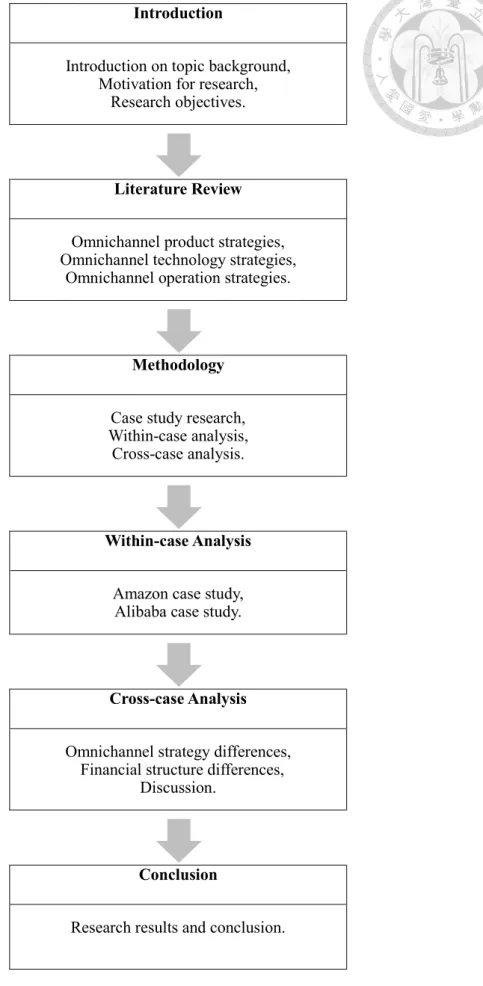
1.4 Research Framework ... 4
2. LITERATURE REVIEW ... 7
2.1 Omnichannel Strategy Framework ... 7
2.1.1 Product Strategies ... 10
2.1.2 Technology Strategies ... 10
2.1.3 Operation Strategies ... 11
3. METHODOLOGY ... 14
3.1 Case Study Research ... 14
3.1.1 Within-case Analysis ... 16
3.1.2 Cross-case Analysis ... 17
4. WITHIN-CASE ANALYSIS ... 19
4.1 Amazon Case Study ... 19
4.2 Alibaba Case Study ... 29
5. CROSS-CASE ANALYSIS ... 38
5.1 Financial Structure Differences ... 38
5.2 Omnichannel Strategy Differences ... 41
5.3 Discussion on Innovation Capabilities ... 45
6. CONCLUSIONS ... 49
REFERENCES ... 52
LIST OF FIGURES
Figure 1.1. Research Structure ... 6
Figure 2: Working capital ratio of Amazon and Alibaba ... 39
Figure 3: Debt ratio of Amazon and Alibaba ... 40
Figure 4: ROA of Amazon and Alibaba... 41
Figure 5: Types of innovation mapping ... 47
LIST OF TABLES
Table 1: Summary of literature with respect to the omnichannel strategy framework ... 13
Table 2: Classification of different research methods ... 15
Table 3: Omnichannel Strategy Framework ... 17
Table 4: Summary of case study findings ... 41
Table 5: Innovation Choice Mapping ... 48
1. Introduction
The online ecommerce retail industry has evolved and grown rapidly over the last two
decades. Capitalizing the success of online marketplaces such as Ebay, new retailers and
existing retailers have taken their market to the web with ecommerce channels. As the
demand of online shoppers grew, large traditional brick-and-mortar retailers have been
pressured to fully adopt a dual-channel strategy to seamlessly integrate online shopping
with physical retail shopping. With the increased number of competitors leveraging both
the ecommerce and physical retail channels, online marketplace giants such as Amazon
and Alibaba are constantly seeking to find ways to increase their competitive advantage
in order to keep customers on their platform.
One particular development from these ecommerce giants is the strategic focus on
omnichannel retail shopping. In order for Amazon and Alibaba to compete with dual-
channel retailers, the ecommerce giants align their core strategies to develop technology
behind supporting multiple different types of retail channels. However, technology is not
the only concern in omnichannel retail; in order for customers to perceive a smooth cross-
platform shopping experience, these marketplaces must also focus on delivering on
various key omnichannel retail factors. These key factors are the backbone to a successful
omnichannel retail strategy.
This paper will provide an overall view on how the two ecommerce giants, Amazon
and Alibaba, have structured themselves for omnichannel retail. In 1.1, background
information about the market is presented. Motivation for research and research
objectives are discussed in 1.2 and 1.3. Lastly, the framework for the paper will be laid
out in 1.4.
1.1 Background
This section discusses the progression of technologies that gave birth to the various
channels of omnichannel retail. The mainstream availability of these technologies in the
hands of the consumers stimulated the demand for a better shopping experience.
With the increased number of competitors in the ecommerce space, online
marketplaces such as Amazon and Alibaba are constantly seeking to find ways to increase
their competitive advantage in order to keep customers on their platform. In recent years,
a large focus has been placed on omnichannel retail shopping. Consumers have grown
accustom to being able to browse online and purchase instore or the vice versa. A number
of different ways of browsing merchandise such as mobile shopping, VR shopping have
been created to stimulate more demand and decrease the risks and costs associated with
online shopping. Along with these new shopping channels, retailers also are constantly
adding different processes for the customer to order and receive the goods.
Implementations such as the Amazon Dash buttons and pick-up-instore delivery options
are continuously decreasing the consumer efforts and fulfillment time.
1.2 Motivation
In the highly-contested space of ecommerce and physical retail, any successful strategy
that gives a competitive advantage over the competitors is exceedingly favorable. In the
case of Amazon and Alibaba, a clear effort is made on supporting the omnichannel retail
shopping experience in order to stand out from the crowd of competitors. In order to be
successful at omnichannel retail, companies must rely on a mixture of marketing, strategic,
and operational strategies to ensure a smooth seamless operation throughout all channels.
First, this portfolio of omnichannel strategies might differ from company to company.
It is important to analyze the which strategies a company is strong in and which it is weak
in. This analysis puts the company’s omnichannel strengths into perspective and gives
insights to how the company can be successful in providing certain technologies or
supporting certain channels in the omnichannel network. It will also be possible to
understand the business decisions made by the company regarding the direction it utilizes
to provide the omnichannel retail shopping experience for its customers.
Second, ecommerce retail giants such as Alibaba and Amazon have made distinctly
diverse decisions in their financial structure. The financial structure of a company also
greatly influences which combination of strategies can be implemented in the retail
business.
With these key drivers in omnichannel strategy, we can make conclusions about
which company structure and strategy implementations are designed to work best under
which type of market situations.
1.3 Objective
Given the research motivation listed above, this paper’s research will focus on identifying
the key differences in omnichannel strategy and how the two companies structure
themselves to support their different strategy focuses.
The objectives of this research are listed as follows:
(1). Compare and analyze the different implementations in omnichannel retail strategies by Alibaba and Amazon.
(2). Analyze the financial status of the two companies to draw observations into the differences in financial structure.
(3). Draw conclusions about which company can excel under different scenarios based on the differences in strategy implementation and financial structure.
1.4 Research Framework
The paper is organized into the sections outlined in Figure 1.1. In Chapter 2, literature
review is provided to put current related research into perspective of the context in this
paper. Chapter 3 states the methodology used to establish the analysis research in this
paper. Chapter 4 and 5 performs the analysis methods on the strategy implementations of
Alibaba and Amazon. At the end, Chapter 6 provides a summary of the analysis and draws
conclusions on the possible strengths each company has under different retail scenarios
given the difference in strategy focus and company financial structure.
Introduction
Introduction on topic background, Motivation for research,
Research objectives.
Literature Review
Omnichannel product strategies, Omnichannel technology strategies,
Omnichannel operation strategies.
Methodology
Case study research, Within-case analysis,
Cross-case analysis.
Within-case Analysis
Amazon case study, Alibaba case study.
Cross-case Analysis
Omnichannel strategy differences, Financial structure differences,
Discussion.
Conclusion
Research results and conclusion.
Figure 1.1. Research Structure
2. Literature Review
In this chapter, we will categorize contemporary studies on ecommerce and omnichannel
retail into three sections: (1) pricing strategies, (2) product strategies, (3) operation
strategies. In addition to this categorization, we will also compare the literature to the
framework proposed by Brynjolfsson et al. (2013) which illustrates 7 key omnichannel
strategies for a successful omnichannel implementation. We have added two additional
strategies to this framework that further reinforce omnichannel operations specific to
large scale ecommerce companies. In Chapter 3, we will use this framework of 9 key
strategies to analyze the differences between Amazon and Alibaba’s implementation of
omnichannel retail.
2.1 Omnichannel Strategy Framework
Brynjolfsson et al. (2013) analyzes the shifting landscape of retail as more and more
retailers cross over to cover both physical and online retail channels with the help of
technology. The article proposes 7 major success strategies for omnichannel retailing:
1. Provide attractive pricing and curated content – attractive pricing ensures consumers visit the retailer while curated merchandise and consumer-generated
content and reviews encourage consumers to purchase with the retailer.
2. Harness the power of data and analytics – omnichannel brings a wealth of data from various channels. The success of integrating these channels comes from
analyzing data from across social channels, mobile channels, and local channels.
With careful analysis, retailers can better understand the consumers’ behavior and
better tailor advertising to specific consumer groups.
3. Avoid price comparisons – consumers have learned to search online to find the best price available. Retailers have to focus on offering distinguishing their
products or suffer from losing out on the sale to another retailer with a lower price.
Ways to distinguish products include: (1) offering a distinctive version of a
product with minor modifications from the manufacturer that cannot be directly
comparable to the products from other retailers, (2) developing exclusive products
through partnerships or innovation, (3) creating bundles of products that make it
hard to directly compare the value of the bundle to products offered by competing
retailers.
4. Learn to sell niche products – long-tail products that are not economical to carry in physical stores should be sold online exclusively. Mid-tail products with
unpredictable and moderate demand should be sold as a mix through online and
in physical store in order to maximize product availability reliability of after-sales
service to the customers.
5. Emphasize product knowledge – To minimize consumer frustration, product knowledge should be shared across platform to promote a smooth multi-channel
shopping experience.
6. Establishing switching costs – To discourage customers from switching to a competitor, retailers should encourage loyalty by incentivizing consumers with
membership discounts and exclusive user experiences.
7. Embrace competition – retailers should acknowledge the advantages offered by their competitors and strive to improve their own products, services, and prices.
In addition to the 7 strategies proposed by Brynjolfsson et al. (2013), our paper proposes
two addition strategies to add to the framework:
8. Invest in complementary services – retailers should invest in services that would ultimately add value in supporting their main business either through added cash
flow or better technology advancement. Services like 3rd party payment systems
and cloud infrastructure services complement the daily operations of a
omnichannel retailer very well.
9. Build scalable logistics network – in an omnichannel retail environment, companies must build a solid logistics network in order to support their daily
operations. Companies must also ensure this network is easily scalable to
accommodate larger operating scales and new multinational markets.
2.1.1 Product Strategies
Gallino and Moreno (2014) analyzes the effects of online and offline channel integration
with “buy-online, pick-up-in-store”. They show that the implementation results in a
reduction in online sales and increase in in-store traffic and sales. They argue that this
observation is due to two shifts in consumer behavior: consumers buying additional items
when picking up their online orders in store, and the conversion of non-customers to in-
store customers after online research. Gallino and Moreno argues that multichannel
implementations brings these unanticipated shifts in consumer behavior that cannot be
observed by independently analyzing the performance of each channel. Retailers must be
aware of these shifts and redesign their inventory policies to effectively support the
increase of sales in certain channels as dictated by the consumers.
2.1.2 Technology Strategies
Piotrowicz and Cuthbertson (2014) discusses the role of technology in the age of
omnichannel retailing, new business models, and role of traditional retailers as
ecommerce continues to take more market share. The article found that with the increased
use of mobile devices and social media, the boundary between online and physical retail
is no longer distinct but rather blurred by technology. Retailers who want to capitalize on
this cross-channel integration must first implement an omnichannel strategy by (1)
focusing on mobile and social channels, (2) find a balance between privacy and
customization of the consumers’ shopping experience, and (3) redesigning their supply
channel network to support the omnichannel.
Woods (2016) compares the respective efforts made by Amazon and Alibaba in their
logistics networks as the ecommerce giants vie for competitive advantage in this fast-
evolving retail landscape. In the crusade to be the lowest-cost provider in ecommerce,
Amazon is taking a competitive stand against its current logistics partners and developing
its own forwarding capabilities. Alibaba on the other hand is taking a more partnered
approach with the Cainiao Network, providing its logistics partners the IT structure they
need to integrate and build a singular cooperative logistics network for China. Woods
shows that ecommerce giants are focused on investing in their logistics and forwarding
network for their global strategy going forward.
2.1.3 Operation Strategies
Rigby (2011) argues that in the world of evolving retail industry, retailers should adopt a
omnichannel strategy and fully take advantage of both physical and digital channels in
order to be positioned for success. Modern day consumers have access to limitless number
of retailers through the internet and their demand for a good omnichannel shopping
experience is constantly increasing. Rigby explores that consumers want both the
advantages of physical stores and the advantages from digital channels; demand for cross-
channel services are also on the rise. Retailers that cannot offer innovation to keep up
with these demands risk losing market leadership and scale.
Benedicktus et al. (2010) study how pure etailors can avoid losing market share as
more and more brick-and-mortar stores start to sell products online. They propose that
etailors must convey trustworthiness to the consumers to offset the general suspicion that
is associated with a retailer having no physical presence. The study studies how
trustworthiness can be conveyed through a combination of three factors: (1) improving
retailer reputation through brand familiarity, (2) providing consumer access on consensus
information on products with rating and feedback systems, and (3) increasing physical
presence for the etailor. Benedicktus et al. concludes that all three factors positively
influence the consumers’ intent to purchase, with consensus information being the
broadest cue to signaling trustworthiness. However, if physical presence is missing, a
combination of consensus information and brand familiarity is necessary to combat active
general suspicion.
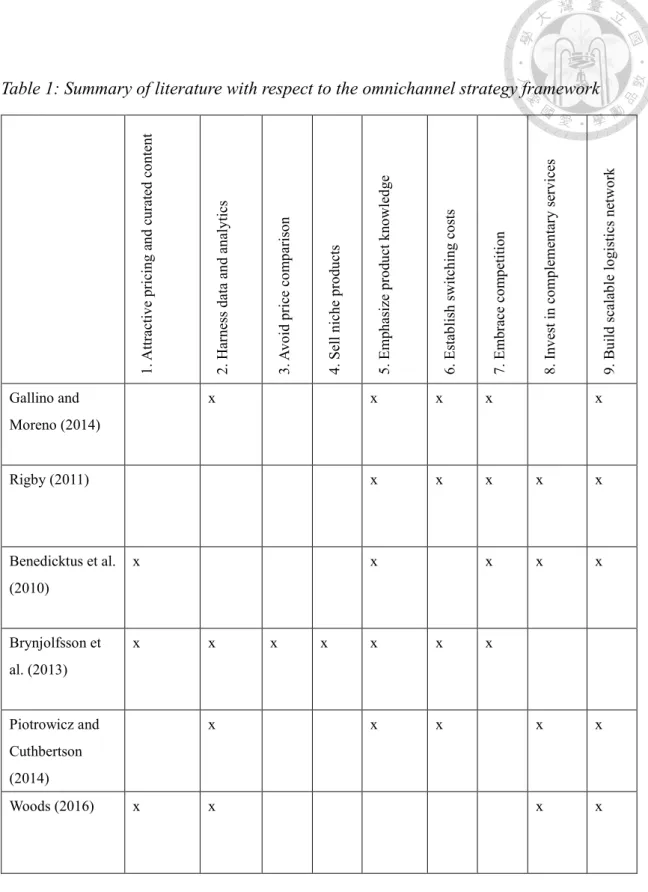
Table 1: Summary of literature with respect to the omnichannel strategy framework
1. Attractive pricing and curated content 2. Harness data and analytics 3. Avoid price comparison 4. Sell niche products 5. Emphasize product knowledge 6. Establish switching costs 7. Embrace competition 8. Invest in complementary services 9. Build scalable logistics network
Gallino and Moreno (2014)
x x x x x
Rigby (2011) x x x x x
Benedicktus et al.
(2010)
x x x x x
Brynjolfsson et al. (2013)
x x x x x x x
Piotrowicz and Cuthbertson (2014)
x x x x x
Woods (2016) x x x x
3. Methodology
This chapter presents the methodologies utilized in this research paper. The main structure
will take form as a comparative case study research. The scope of the analysis in the case
study research will contain a within-case study on Alibaba and Amazon. The within-case
analysis will use the omnichannel strategy framework proposed by Brynjolfsson et al.
(2013) with a few additional points to place more emphasis on the operations part of
omnichannel. Second part of the case study research is a cross-case analysis to study the
differences in omnichannel strategy found in the within-case analysis. In addition, we will
also analyze the differences in financial structure to augment our comparison.
3.1 Case Study Research
Case study research as described by Yin (2003) is a research strategy using both
qualitative evidence as well as quantitative evidence. This type of research is especially
adept at answering the How and Why questions in research. There are two specific criteria
to consider when choosing to use case study as the primary form for research:
1. Does the research require control of behavior events?
2. Does the research focus on contemporary events?
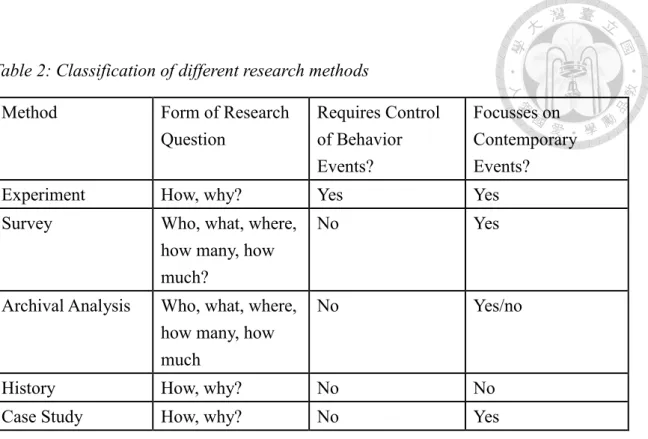
Below is a chart proposed by Yin on the classification of each type of research based on
the answer to the above two criteria:
Table 2: Classification of different research methods
Method Form of Research
Question
Requires Control of Behavior Events?
Focusses on Contemporary Events?
Experiment How, why? Yes Yes
Survey Who, what, where,
how many, how much?
No Yes
Archival Analysis Who, what, where, how many, how much
No Yes/no
History How, why? No No
Case Study How, why? No Yes
For case study research to be used, the research must be focused on contemporary
events and does not require control of behavior events. If these two criteria then case
study research will optimally be able to answer the How and Why questions set out by
the research.
In this paper, indeed we are exploring the contemporary events faced by two
contemporary companies, Alibaba and Amazon. As well, this research does not require
certain control of behavior events to make observations; the research in this paper will
primarily be aligned towards studying the contemporary findings from academic studies
and literature about omnichannel strategy and the two companies.
Through the research and analysis presented in this paper, we set out to explore:
1. How do Amazon and Alibaba support their omnichannel strategies?
2. Why does Amazon or Alibaba excel in certain scenarios and retail aspects given their omnichannel strategy mix?
1. How should Amazon and Alibaba respectively focus their efforts in omnichannel retail in order to fully utilize their strengths?
We will be answering these research questions by the combination of qualitative and
quantitative analysis. In the qualitative analysis, we will utilize a within-case analysis
comparison on the two companies’ omnichannel strategy implementation. In the
quantitative analysis part, we will present the two companies’ financial structure and
analyze the differences.
3.1.1 Within-case Analysis
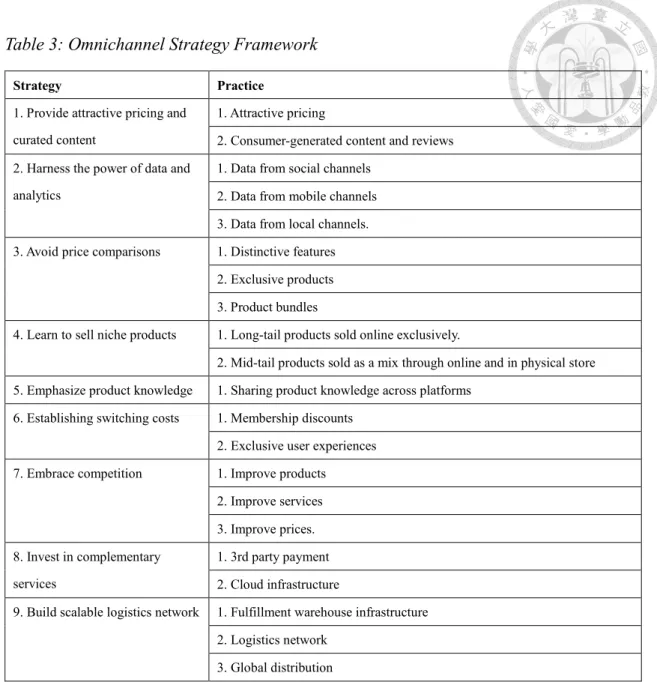
The framework as discussed in section 2.1 will be used as our basis for investigation in
our within-case analysis. A brief summary of the points is listed in Table 3. Our case
study analysis will determine whether Alibaba or Amazon has implemented these
practices. Each practice will be evaluated to be either not implemented, partially
implemented, or fully implemented based on the degree of completeness.
Table 3: Omnichannel Strategy Framework
Strategy Practice
1. Provide attractive pricing and curated content
1. Attractive pricing
2. Consumer-generated content and reviews 2. Harness the power of data and
analytics
1. Data from social channels 2. Data from mobile channels 3. Data from local channels.
3. Avoid price comparisons
1. Distinctive features 2. Exclusive products 3. Product bundles
4. Learn to sell niche products 1. Long-tail products sold online exclusively.
2. Mid-tail products sold as a mix through online and in physical store 5. Emphasize product knowledge 1. Sharing product knowledge across platforms
6. Establishing switching costs 1. Membership discounts 2. Exclusive user experiences 7. Embrace competition 1. Improve products
2. Improve services 3. Improve prices.
8. Invest in complementary services
1. 3rd party payment 2. Cloud infrastructure
9. Build scalable logistics network 1. Fulfillment warehouse infrastructure 2. Logistics network
3. Global distribution
3.1.2 Cross-case Analysis
In this section’s analysis, we will cross examine the main differences between Alibaba
and Amazon in their omnichannel strategies. We anticipate many of the differences in
implementation will be between whether the company chooses an in-house
implementation (vertical-integration) or an outsource implementation (virtual-
enterprise). We will also compare our findings about the different implementations to
the companies’ financial structure. Financial ratio analysis shows evidence of whether a
company is more heavily invested in in-house implementation or has less debt from
utilizing strategic alliances to outsource the omnichannel practices.
Lastly, we will discuss whether a strategy is intended for systemic innovation and
autonomous innovation. Chesbrough and Teece (2002) suggested that strategies that
achieve systemic innovation are better suited for an in-house implementation, while
strategies that target autonomous innovation is more efficiently achieved with outsouce
implementation. Based on the classification, we can then conclude which company has
the better mix of strategy and position to achieve omnichannel retail innovation.
4. Within-case Analysis
In this chapter, we will perform within-case analysis on Amazon and Alibaba using the
framework of 9 key strategies for successful omnichannel retail as detailed in section
3.1.1. For each of the strategies and associated implementation, we will present the
qualitative data regarding each company’s related efforts to measure each’s strength in
that strategy. However, the within-case analysis only serves as a precursor and analytic
data for the cross-case analysis. Any conclusions about the comparative strengths between
the two companies’ omnichannel strategy should be made with the cross-case analysis.
4.1 Amazon Case Study
4.1.1 Provide attractive pricing and curated content
For the first practice regarding attractive pricing, Amazon has a long history of providing
very competitive pricing over their competition. Due to the focus on inventory technology
and efficient fulfillment process, Amazon has always been able to offer cheaper prices
than its ecommerce competitors and brick-and-mortar competitors. For this reason, many
competitors have been forced to offer price match guarantees specifically for Amazon.
Furthermore, competitors also enlist price detection programs so they can be notified
whenever Amazon offers sales and to decide whether to follow suite or not. In 2017
however, Amazon has actively blocked these types of programs from accessing its
website, effectively making it harder for competitors to match its pricing.
Beyond providing attractive pricing on the products, they were also one of the first
ecommerce sites to offer free shipping for orders over $25. In 2004 Amazon launched the
Prime membership that offered free shipping regardless of order size for a simple annual
subscription fee of $99. This simplification of shipping fees lowers the cost per order and
attracts customers to continually return to Amazon to make additional orders. According
to Amazon, customers that previously only made a few purchases a year now makes
multiple orders per month on the Prime membership.
In the second practice of user generated content, Amazon has very well organized
layout featuring product selection that is curated specific for the visiting user. The
algorithm behind suggested products provides a degree of accessibility to so that the user
will always know what to shop for on Amazon. Furthermore, Amazon also showcase
consumer reviews for each individual product, allowing other consumers to access
reliable product information and to buy with confidence.
4.1.2 Harness the power of data and analytics
With regards to the first practice of gathering data from social media channels, Amazon
is very actively managing their social media platforms. The method they use social media
data is to drive consumer engagement and ultimately more sales on their platform. They
analyze data relating to the reactions and interactions to various ads or deals they post
through their social media to understand more about their consumers. However, since
Amazon does not directly control these social media outlets, their data analysis will only
be confined to the reactions to their social media posts. Therefore, they cannot directly
analyze their target market unless the market interacts with the posts; hence we specify
that Amazon has only partially implemented this practice.
In the second practice of analyzing data from mobile channels, Amazon is able to
fully implement this practice through gathering data from their mobile website as well as
Amazon apps. Amazon is able to build detailed individual customer profiles from
browsing history and better market products for that user. In recent years, Amazon has
introduced a voice assistant software called Alexa which is designed to help consumers
with their daily tasks. Through Alexa, Amazon is able to collect even more data from the
user to understand their daily preferences.
When it comes to the third practice, gathering consumer data from local channels,
Amazon has only a small sample to work from. As of early 2017, Amazon has only
opened 6 bookstores and one grocery store. However, this number will soon grow
exponentially due to Amazon’s acquisition of Wholefoods, which will bring onboard
more than 460 stores. This injection of new data sources will help Amazon fast-track its
consumer data mining efforts. In this practice, Amazon is only currently partially
implementing of gathering local channel data.
4.1.3 Avoid price comparisons
The first and second practice of selling products with distinctive features and exclusive
products, Amazon has fully implemented these two approaches in its retail strategy. For
example, the Prime membership allows customers to purchase smartphones at a cheaper
than market price. These Prime exclusive phones have distinctive features of being able
to provide a personalized shopping interface from the lockscreen.
Amazon also sell exclusive products that they manufacture such as the Kindle e-
book. This e-book also taps into the biggest e-book marketplace that Amazon has created
which is exclusive to the Kindle devices. Aside from products manufactured by Amazon,
there are also Amazon Exclusive products that features products that other manufacturers
make exclusive to the Amazon platform.
Further discouraging customers from trying to price compare, Amazon implements
the third practice by frequently combines products on their platform into bundles.
Customers are able to save on the bundle as well as be eligible for the free shipping. These
bundle suggestions often appear in the individual product page that the customer is
looking.
4.1.4 Learn to sell niche products
For the first practice of selling long-tail products exclusively online, Amazon has fully
implemented this practice. As a business that is online first, Amazon sells everything
online. When it comes to selling long-tail and mid-tail products online, Amazon makes
an interesting distinction: long-tail products are usually sold exclusively via independent
sellers while mid-tail products are placed into the Fulfilled by Amazon program.
For the second practice of selling mid-tail products as a mix through online and
physical stores, Amazon only has a partial implementation. Currently Amazon only has a
small number physical stores for books and groceries. Other genres of mid-tail products
have not yet made its way into physical channels from Amazon. However, with the
acquisition of Wholefoods groceries chain, the mix of online and physical store channels
will be more of a focus for Amazon in the near future.
4.1.5 Emphasize product knowledge
For the practice under this strategy, sharing product knowledge across platforms, Amazon
has fully implemented the practice. Not only has Amazon unified product knowledge
across its website and mobile platforms, it has done the same for its physical bookstores
as well. In the bookstores, instead of a price tag, each book has a displayed Amazon
customer review. This allows for a uniform shopping experience for customers, regardless
whether or not they choose to shop in-store or to shop through the website or app.
4.1.6 Establishing switching costs
The first practice of providing discounts for members is fully reflected in the Amazon
Prime program. Customers under the Prime membership has access to free shipping
regardless of order size. Prime members also get early access to special limited-time deals.
In addition to discounts, members are also eligible to apply for a Prime credit card that
offers additional cash back when shopping at Amazon.
For the second practice of offering exclusive user experiences, Amazon has also fully
implemented this practice through various services exclusive to Prime members.
Members have unlimited access to video and music streaming in Amazon’s vast library
of video and audio content. Also, Amazon offers members unlimited access to its e-book
and audible tape library. These services and experiences combined presents a compelling
case for members to keep staying as Prime members.
4.1.7 Embrace competition
With the first practice of constantly improving products, Amazon has is utilizing the full
powers of data analytics to accomplish that. Amazon continually monitors the products
that are sold on the platform. When there is a particular product that is selling very well
on the platform, Amazon will source a similar product and release it on the platform under
the AmazonBasics brand. The intention of the AmazonBasics is creating basic necessity
products that customers are just looking for more value at a cheap price. In this practice,
Amazon maintains competitiveness and improves their product selection for their
customers.
In the second practice of improving services, Amazon is constantly improving its
services to give consumers more value. One good example of this is the amount of
services Amazon has added to the Prime membership. In the beginning, Prime is only
intended to give members free shipping on all their orders. However, over the years,
Amazon has added various services that are all free to access by the Prime members.
Members have unlimited access to video and music streaming in Amazon’s vast library
of video and audio content. To keep contents competitive over other video streaming
services, Amazon also produces a number of shows for streaming exclusively on Prime.
Also, Amazon offers members unlimited access to its large e-book library and to
Audibles.com, a subsidiary of Amazon, for unlimited access to their audible tape library.
Amazon also implements fully the third practice of improving prices. In providing
the best price for consumers, Amazon constantly look to technology to cut down their
costs. This is especially evident in their efforts in fulfillment. In fulfillment technology, a
subsidiary of Amazon, Amazon Robotics, continues to pioneer its technology in
fulfillment automation. Amazon Robotics has produced systems of robotic machines that
can automate the manual labour of fulfillment employees and reduce the cost and space
required for fulfillment. The reduced cost translates to an overall lower price for the
consumers at the end of the supply chain.
4.1.8 Invest in complementary services
In the first practice of investing in 3rd party payment service, Amazon is only partially
implemented this practice. Amazon Pay is a 3rd party payment system that can be used by
merchants in their own ecommerce sites to allow customers to pay via their Amazon
account. However, as of 2017, only a small number of merchants that have adopted this
system. Furthermore, there is no direct evidence from Amazon to suggest that Amazon
Pay is a main focus for the company.
Amazon has been one of the leading companies in developing cloud services. In
2000, Amazon Web Services (AWS) began as a need for robust cloud infrastructure to
host the growing Amazon platform. The scope of AWS quickly expanded in 2003 to be a
cloud infrastructure service provider to any companies looking for a robust and scalable
cloud service and data center. The continual investment in this complementary service
enabled AWS to become to top cloud service provider in the world. As of Q4 2016,
Amazon owns about 40% of the cloud service provider market, which is almost double
of the next three providers’ market share combined.
4.1.9 Build scalable logistics network
Amazon has fully implemented the first practice of building a scalable fulfillment
warehouse infrastructure. Its state-of-the-art fulfillment centers are filled with technology
made by its subsidiary Amazon Robotics to automate most of the fulfillment process. This
system of technology makes the fulfillment cost very low and very scalable without
incurring extra labor costs with the increased merchandise.
In building a scalable logistics network, Amazon currently does not operate its own
full logistics operations. Currently the majority of the logistics from Amazon is handled
by FedEx and UPS. However, Amazon is currently starting to build its own logistics
capability and logistics technology. AmazonFresh is a subsidiary under Amazon that is
operating in select cities in the US and UK, delivering grocery merchandise to consumers
on a same-day basis. The venture into logistics shows Amazon’s resilient will to research
ways to cut down on costs in every aspect in its supply chain. We find that Amazon is
only partially implemented the practice of building its logistics network.
As for key partnerships and technology in global distribution, Amazon has only
partially implemented this practice. As of 2017, Amazon operates in 14 different countries
around the world. All of these countries have Amazon fulfillment centers established in
the area. In order for sellers to reach multi-national markets, sellers must actively choose
to have their product shipped to the specific country’s Amazon fulfillment center. Another
option is for sellers to ship their products independent of Amazon’s support. This practice
means Amazon does not currently hold the means to quickly enter the global market;
instead Amazon relies on slowly establishing fulfillment centers in new countries one by
one. However, Amazon is also recently looking into developing their own ocean and air
freight capabilities. These added options could help Amazon establish a global
distribution network in the future.
4.2 Alibaba Case Study
4.2.1 Provide attractive pricing and curated content
For the first practice of providing attractive pricing, Alibaba is currently fully
implementing this practice. Alibaba focuses on providing shared-revenue platform for
merchants to list their products for sale, and to provide technologies that help merchants
operate their business on Alibaba. This attractive service pricing to merchants in turn
allows merchants to operate with a lower cost and to sell products at an attractive pricing.
In the second practice of providing consumer-generated content and reviews,
Alibaba has fully implemented this practice into their ecommerce site. Customer reviews
for products are easily found on product pages, providing an additional level of trust for
the product quality. In addition, there are curated product promotions found throughout
the platform regularly to promote a more personalized shopping experience. These
curated promotions are especially visible during special holidays like the annual Singles
Day created by Alibaba on November 11th. Merchants are encouraged to offer products
at steep discounts in order to gain exposure for their shops on the Singles Day curated
sales.
4.2.2 Harness the power of data and analytics
In the first and second practices, Alibaba is currently fully in control of the data from
social channels and mobile channels. Aside from the usual social media marketing
analytics, Alibaba also incorporate social aspects into their mobile applications. In
Alibaba’s B2C subsidiary, Taobao, Taobao’s app enable customers to chat in interest
specific groups and also read news specific to the users’ interests. This social aspect
encourages customers to actively check the app on a daily basis and promotes more
possibility of buying items on Taobao. In the data perspective, the more users interact in
the app the more data Alibaba collects on its customers and will be able to build a more
complete profile to market to those customers.
For the practice of collecting data from local channels, Alibaba is fully implementing
this practice. Since 2014, Alibaba has started focusing on strengthening their reach in the
physical retail channels; Alibaba made a $692 million stake in Intime Retail, a department
store chain with 30 outlets across China in April 2014. In August 2015, Alibaba purchased
one-fifth of Suning.com, a retailer with 1600 stores across 298 Chinese cities. In 2016,
Alibaba bought into a 32% stake of Sanjiang Retail, a high-end supermarket chain in east
China. Also in 2016, Alibaba completed a deal worth $2.6 billion for 74% of Intime Retail.
These series of acquisitions positions Alibaba to be able to influence data flow to the
parent company for analysis of local channels’ customers.
4.2.3 Avoid price comparisons
In avoiding price comparisons, Alibaba does not directly employ the first two practices
of sourcing products with distinctive features and exclusive produces to the platform.
Alibaba also does not manufacture any products themselves and hence does not directly
control any of the product selection on the site. The selection is mainly left in the hands
of the merchants, who are likely to post the same items across various different
ecommerce platforms. We conclude that the first two practices are not implemented by
Alibaba.
In the third practice of using product bundles to avoid price comparisons, again
Alibaba does not directly influence if bundles are being sold on the platform. However,
merchants do regularly bundle popular items together for sale on Alibaba. Combined with
automatic product suggestions, Alibaba only achieves a partial implementation on
product bundles.
4.2.4 Learn to sell niche products
The practice of selling long-tail products online exclusively is fully implemented at
Alibaba. Sellers that list products on Alibaba have a huge incentive to list long-tail
products online since Alibaba operates with a shared revenue model. Sellers do not have
to worry about listing fees that will eat away the revenue stream from items that take a
long time to be sold.
With mid-tail products, Alibaba has partially implemented the practice of selling
these products through a mix of online and offline. Along with the acquisitions and
investments in various offline retailers, in early 2017 Alibaba also announced a new
partnership with Bailian Group, a large retail conglomerate in China. This new
partnership gives Alibaba access to the 5000 retail outlets owned by Bailian Group across
200 cities in China. Fully utilizing these physical channels will eventually allow Alibaba
to fully implementing this practice of mixing online and physical channels for mid-tail
products.
4.2.5 Emphasize product knowledge
Alibaba has exemplified the practice of sharing product knowledge across platforms. One
of the key goals the company has is to redefine the way consumers view retail. This at a
very simple level includes sharing the same product knowledge across different channels
such as website, mobile site, and mobile app. In addition to this, the company plans on
adding ordering systems and real time service solutions to the physical stores in the
Bailian Group retail outlets. This augmentation of information systems in physical stores
aims to unify product information online and offline in order to create a more seamless
shopping experience for the consumers.
4.2.6 Establishing switching costs
For the first practice of establishing switching costs, Alibaba has fully implemented this
practice on their consumer platforms, Taobao and Tmall. In these two platforms,
consumers may rack up points through purchases and positive ratings to achieve different
levels of VIP status. The higher the VIP status, the more discounts and perks the member
can receive. Perks include guaranteed returns, instant fund reimbursements and special
holiday discounts. Aside from discounts, members can use the accumulated points in
place of cash to purchase items.
In the second practice of creating exclusive user experiences for members, Alibaba
is currently fully implementing this practice. Aside from the membership perks and
discounts mentioned above, Alibaba also offer a social aspect with their online shopping
experience. Being able to chat and share interesting purchases with members of similar
interest is something that keeps members visiting the site on a daily basis. Furthermore,
Alibaba is aiming to break the barrier between offline-shopping and online-shopping by
designing technology specific to aid omnichannel retail in outlets owned by the Bailian
Group. When this redesign of retail is completed, it will further confirm Alibaba’s
commitment to providing an exclusive shopping experience.
4.2.7 Embrace competition
For the strategy of embracing the competition, Alibaba has only partially implemented
the first practice of improving products. One of the main complaints about shopping on
the platforms of Alibaba is the complaint of low quality items and merchants selling
imitational goods in the place of brand name goods. To combat this widespread negative
experience, in 2016 Alibaba has enlisted brands to open their own flagship online stores
on Alibaba and Tmall to give consumers an official channel for authentic brand name
products. In addition, Alibaba has also taken a zero-tolerance stance against companies
selling counterfeit items and actively removing listings found to be illegitimate. However,
due to the fact that Alibaba does not directly influence the products improvements, we
deem this practice to be only partially implemented.
With the second practice of improving services, Alibaba is currently fully
implementing this practice. Another complaint with the Alibaba platform is the reliability
of being able to negotiate a return with individual sellers on the platform. To help with
improve this process, Alibaba has introduced an exclusive return guarantee for their VIP
members, effectively making sure the sellers follow through with their after-sales services.
Another area of improvement is Alibaba’s dedication to changing the retail experience.
Their pioneering of technology to merge online and offline shopping experience will be
soon seen in the outlets in China as part of the deal with the Bailian Group.
As for the third practice of embracing competition through improving prices,
Alibaba has always been fully implementing this practice. From the beginning, Alibaba
has focused on developing technology to help merchants easily manage their business
online. Through making their platform service easy to use and accessible to merchants of
all sizes, Alibaba encourages a high level of competition and massive number of active
merchants on their ecommerce platforms. With the increased number of competitors and
practices to encourage lower prices for better visibility, Alibaba has continued to push
lower prices for the consumers.
4.2.8 Invest in complementary services
In the first practice of investing in complementary services such as 3rd party payment,
Alibaba currently implements this fully with Alipay. With 400 million users and just under
half of China’s online payment market, Alipay is the largest 3rd party payment system
used in China. Alipay not only helps Alibaba inject cash flow into operations, but it is
also one of the reasons Alibaba and online shopping became prevalent in China. Due to
the counterfeit culture in China, there is a great deal of wariness from consumers in the
Chinese online ecommerce industry. Alipay solved this dilemma with its transaction
process where Alipay only releases the funds to the seller when the buyer confirms the
products are satisfactory. This escrow-like process generates even more cash flow
compared to other 3rd party payment systems that transfers funds immediately.
For cloud infrastructure investments, Alibaba has also been heavily investing in their
cloud services arm, Aliyun in the last few years. Alibaba announced a one-billion-dollar
investment into building up the Aliyun business in the US back in 2015. Although Aliyun
is a new comer to the cloud service provider industry, Alibaba has made a number of
partnership deals that will allow Aliyun to quickly expand to new regions and markets.
For example, an agreement was announced in June 2015 with Equinix, an internet service
provider, to provide access to Aliyun in Hong Kong, China, Silicon Valley, and California.
A joint venture was also announced in December 2016 between Alibaba and Softbank, a
Japanese telecom conglomerate, to launch Aliyun in Japan. For these partnerships and
aligned strategy behind Aliyun, we conclude that this practice of investing in cloud
infrastructure is fully implemented at Alibaba.
4.2.9 Build scalable logistics network
Although Alibaba does not directly operate the fulfillment and logistics part of their
supply chain process, they have various investments and partnerships in companies that
take care of those processes. In China, the logistics industry is very fragmented by the
enormous geographical area that the country covers. Launched in 2013, Cainiao Network,
the logistics technology company under Alibaba, aimed to consolidate the various
different logistics providers and fulfillment centers together to form a singular unified
service. Through providing these providers with a data platform and end-to-end logistics
solutions, Cainiao Network is able to support logistics operation across 12 major Chinese
cities, and support rural areas in China through 1200 village-based service centers and
more than 100,000 delivery stations. In this practice of building a scalable fulfillment
warehouse infrastructure and logistics network, Alibaba has fully implemented both these
two practices.
For building key partnerships for global distribution, Alibaba has been hard at work
signing agreements with various logistics providers of the international markets they seek
to enter. For example, in 2014 Alibaba bought 10% stake in SingPost, the national postal
service provider of Singapore for $249 million. Additionally, in 2015 Cainiao Network
partners with U.S. Postal Service to develop shipping solutions specific for cross-border
ecommerce orders. Partnerships and investments like these strengthen Alibaba’s global
distribution network and their position in an ecommerce market moving towards
globalization. We find that Alibaba has fully implemented the practice of building key
partnerships for global distribution.
5. Cross-case Analysis
In this section, we will conduct a cross-case analysis on Alibaba and Amazon. The
analysis will be broken down to analyzing the financial structure differences and
omnichannel strategy differences between the two companies. For each company, we will
also highlight which omnichannel practice is completed in-house and which is outsourced
to partners. The last part of this analysis is a discussion on the practices that Amazon and
Alibaba implements differently, if these practices support systemic innovation or
autonomous innovation, and which company chose the better implementation.
5.1 Financial Structure Differences
The first financial ratio we will use for the financial analysis comparison between the two
companies is working capital ratio. Working capital measures whether or not a company
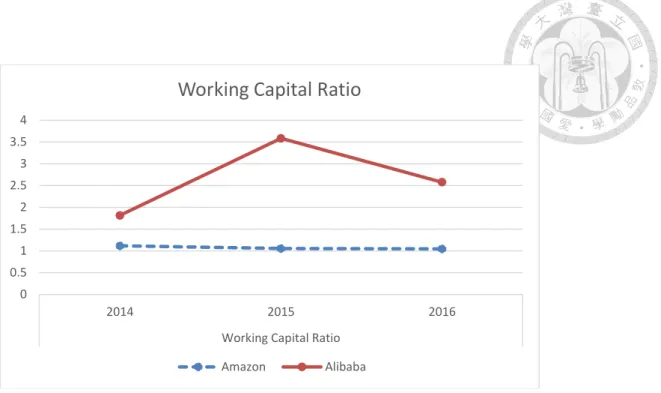
has enough short term assets that can cover its short-term debt. In figure 2, we find that
Alibaba has a much higher working capital ratio than Amazon. Amazon’s ratio is hovering
just above 1, showing a positive working capital and an efficient investing of excess cash.
Alibaba’s ratio ranges from 2 to 3.5, showing also a positive working capital but a
possibility of excess cash not being invested. The analysis suggests that Alibaba can cover
their short-term debt much easier than Amazon, while Amazon might be better at
investing their excess cash.
Figure 2: Working capital ratio of Amazon and Alibaba
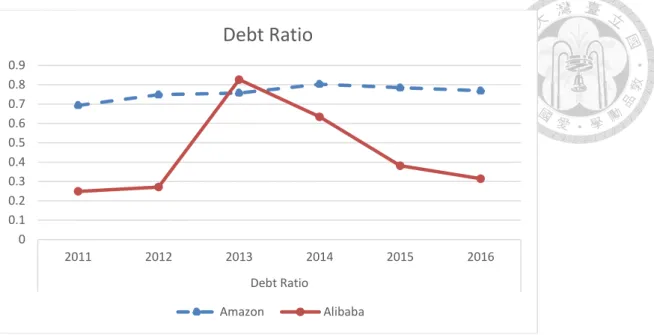
The second ratio we will analyze is the debt ratio. Debt ratio illustrates the balance of a
company’s short term and long term debt to its total assets. This ratio can show what
percentage of the company’s assets are financed by debt. In our analysis shown in figure
3, from 2011 to 2016 Amazon showed a debt ratio ranging from 0.7 to 0.8. In the same
period, Alibaba’s debt ratio ranges from 0.25 to 0.4 with the exception of 2013 which
peaked to 0.83 due to a repurchasing of ordinary shares back from Yahoo. This analysis
shows that Amazon has financed their assets using more debt compared to Alibaba. When
compared with Amazon, Alibaba is also in a better position and has more financial
leverage to take on more debt in the near future.
0 0.5 1 1.5 2 2.5 3 3.5 4
2014 2015 2016
Working Capital Ratio
Working Capital Ratio
Amazon Alibaba
Figure 3: Debt ratio of Amazon and Alibaba
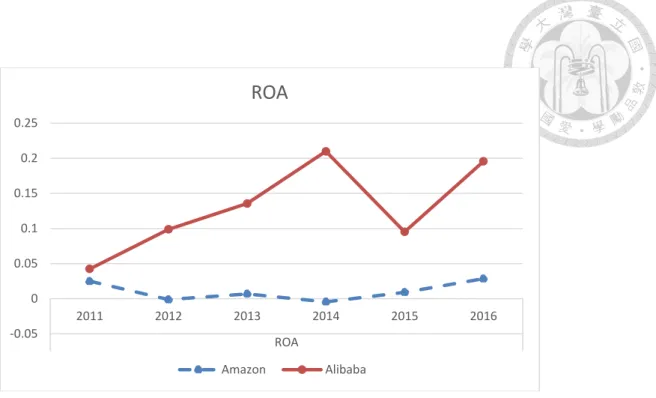
The third ratio we will analyze is ROA. Knowing the working capital and debt structure
of the two companies, we analyze ROA to see how efficiently these two different
structures are affecting the efficiency in using assets to generate earnings. Shown in figure
4, we observe that for the period between 2011 to 2016, Alibaba’s ROA is higher, ranging
from 0.05 to 0.2, than Amazon’s ROA, which ranges from 0 to 0.03. In this analysis, we
see Amazon’s ROA is maintained low, possibly signifying a significant investment into
research and development in technology that does not see any short term return. Note that
Alibaba’s ROA dropped significantly in 2015 due to increased total assets from going
IPO on NYSE. However, even with that drop, the ROA quickly returned to pre-IPO levels
in 2016, possibly signifying that the company is under greater pressure from investors to
show a good investment return on the financial statements.
0 0.1 0.2 0.3 0.4 0.5 0.6 0.7 0.8 0.9
2011 2012 2013 2014 2015 2016
Debt Ratio
Debt Ratio
Amazon Alibaba
Figure 4: ROA of Amazon and Alibaba
5.2 Omnichannel Strategy Differences
On the omnichannel strategy differences between Alibaba and Amazon, Table 4
summarizes our findings from the within-case analysis.
Table 4: Summary of case study findings
Strategy Practice Alibaba Amazon
1. Provide attractive pricing
and curated content 1. Attractive pricing Fully
Implemented Fully Implemented 2. Consumer-generated content and
reviews Fully
Implemented Fully Implemented 2. Harness the power of data
and analytics 1. Data from social channels Fully
Implemented Partially Implemented 2. Data from mobile channels Fully
Implemented Fully Implemented 3. Data from local channels. Fully
Implemented Partially Implemented -0.05
0 0.05 0.1 0.15 0.2 0.25
2011 2012 2013 2014 2015 2016
ROA
ROA
Amazon Alibaba
3. Avoid price comparisons 1. Distinctive features Not
Implemented Fully Implemented
2. Exclusive products Not
Implemented Fully Implemented
3. Product bundles Partially
Implemented Fully Implemented 4. Learn to sell niche products 1. Long-tail products sold online
exclusively. Fully
Implemented Fully Implemented 2. Mid-tail products sold as a mix
through online and in physical store Partially
Implemented Partially Implemented 5. Emphasize product
knowledge 1. Sharing product knowledge
across platforms Fully
Implemented Fully Implemented 6. Establishing switching costs 1. Membership discounts Fully
Implemented Fully Implemented 2. Exclusive user experiences Fully
Implemented Fully Implemented 7. Embrace competition 1. Improve products Partially
Implemented Fully Implemented
2. Improve services Fully
Implemented Fully Implemented
3. Improve prices. Fully
Implemented Fully Implemented 8. Invest in complementary
services 1. 3rd party payment Fully
Implemented Partially Implemented 2. Cloud infrastructure Fully
Implemented Fully Implemented 9. Build scalable logistics
network 1. Fulfillment warehouse
infrastructure Fully
Implemented Fully Implemented
2. Logistics network Fully
Implemented Partially Implemented 3. Global distribution Fully
Implemented Partially Implemented
As shown in the table, the differences between the two companies mainly revolves around
5 different strategies: harness the power of data and analytics, avoid price comparisons,
embrace competition, invest in complementary services, build scalable logistics network.
For harness the power of data and analytics, Alibaba has fully implemented an in-
house technology solution while Amazon has only a partial implementation in the social
and local channels. This indicates that Alibaba is more focused on working on mining
data from all of the omnichannel retail sources than Amazon. Alibaba has made more
partnerships in local channels and developed technology to integrate data flow
specifically to link up offline and online channels. Amazon on the other hand is more
focused on gathering data mainly from its own directly managed retail sources and not
from partnered sources. The difference in this strategy direction shows that Alibaba is
more willing to invest in developing long term partnerships while Amazon prefers
developing technology for their own channels.
On the other hand, for the strategies avoid price comparisons and embrace
competition, the differences lie with practices involving product improvement and
produce exclusiveness. Amazon has fully implemented these two strategies in-house
through managing their own private-label line of products, while Alibaba has a partial
implementation of these strategies. This shows Amazon is fully committed to beating the
competition through in-house product development and to offering their customer the best
value possible. In comparison, Alibaba’s approach to not do any product development
themselves seem to suggest that they value the partnership with their merchants more
than the competitive edge obtainable from products produced exclusively by Alibaba.
In the strategy of invest in complementary services, Alibaba has been successful in
the practice of supporting and developing in-house technology for a 3rd party payment
while Amazon has only partially implemented this strategy. The popularity of Alipay has
helped Alibaba inject a significant amount of cash flow into the company. With Amazon,
there has not been enough drive behind popularizing their version of the 3rd party payment.
The disparity in this practice between the two companies could explain why the working
capital ratio is much higher for Alibaba when compared to Amazon. We could even go
one step further in saying the full implementation of this practice has had a positive effect
in helping Alibaba achieve the higher ROA than Amazon’s ROA.
For building scalable logistics network, Amazon and Alibaba took two different
approaches. For the practices under this strategy, Amazon is taking mixed approach. For
fulfillment warehouse infrastructure, Amazon fully implements this practice with an in-
house approach to the operations and technology. Although Amazon currently outsources
the logistics network and global distribution for a partial implementation, they are
heading towards a fully in-house implementation. For Alibaba, the practices under this
strategy are fully implemented. However, the technology and operations behind these
practices are separated respectively into an in-house implementation and an virtual
implementation. Again, the approach difference is that Alibaba favors partnerships in the
in-house development for technology and partnerships for practices involving physical
operations, while Amazon prefers to develop everything in-house. The dissimilarity could
imply why Amazon has a much higher debt ratio and a lower working capital ratio than
Alibaba since Amazon would need to take on more debt to invest in more fields of
research and development.
In this section, we summarized and compared the differences in omnichannel
strategies from Alibaba and Amazon. These differences offer some further insights to why
the two companies have distinctive financial structures from one another. Amazon tends
to invest more in the in-house research and development of omnichannel strategy
practices; they are also actively exploring fields they currently have partners in to see if
it is possible to create more value by bringing those fields in-house. Alibaba on the other
hand favors building long term partnerships and forgoes practices that might jeopardize
those relationships. The partnerships in turn allow Alibaba to hold a more favorable
financial position by not having to invest in physical facilities and inventory.
5.3 Discussion on Innovation Capabilities
In section 5.2 we showed how Alibaba and Amazon varied in strengths of
implementation for each strategy. In this section, we set to discuss how well each
company has positioned themselves using the definitions by Chesbrough and Teece (2002)
about which types of innovation is better for virtual implementation or vertical integration.
To discuss these strategies in terms of types of innovation, we will further classify
the differentiating strategies into three categories: product strategies, technology
strategies, operation strategies. Based on the definitions given by Chesbrough and Teece
(2002), we mapped out each of the 3 categories of strategies with respect to their type of
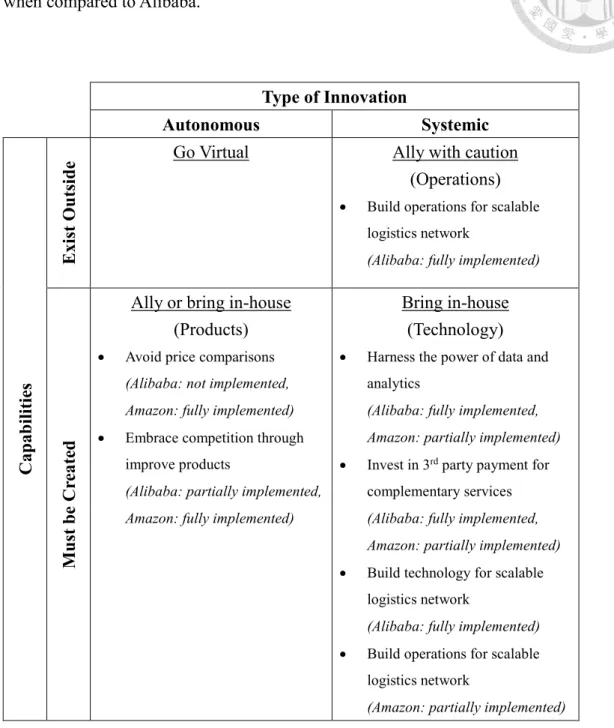
innovation and capability. Strategies related to products should be achieved through
allying or bringing in-house due to products strategies being autonomous innovations but
these capabilities must be created. We find that technology related strategies should be
brought in-house as and technology is a systemic innovation and these capabilities must
be created. Lastly, strategies related to operation should be achieved through allying with
caution since operation strategies being systemic innovations but these capabilities exist
outside.
In Figure 5, we mapped the entire implementation differences from both companies
in the respective capability and type of innovation. As we can see, although Alibaba
currently is weaker in implementation with product strategies, Alibaba should be able to
quickly catch up with Amazon if it takes an allied approach and virtualize
implementations in this field. An interesting finding is that although operation strategies
are found to be better implemented through allying with caution, Amazon has chosen to
bring this capability in-house. Table 5 further breaks down the mapping and indicates that