行政院國家科學委員會專題研究計畫 成果報告
於一維奈米結構物上的異質化學氣相沈積-形態與結構的控 制(第 2 年)
研究成果報告(完整版)
計 畫 類 別 : 個別型
計 畫 編 號 : NSC 95-2221-E-011-168-MY2
執 行 期 間 : 96 年 08 月 01 日至 97 年 10 月 31 日 執 行 單 位 : 國立臺灣科技大學化學工程系
計 畫 主 持 人 : 洪儒生
計畫參與人員: 碩士班研究生-兼任助理人員:黃柏舜 碩士班研究生-兼任助理人員:林政明 碩士班研究生-兼任助理人員:郭芷昀 博士班研究生-兼任助理人員:劉智生
報 告 附 件 : 出席國際會議研究心得報告及發表論文
處 理 方 式 : 本計畫涉及專利或其他智慧財產權,2 年後可公開查詢
中 華 民 國 97 年 12 月 17 日
行政院國家科學委員會補助專題研究計畫 行政院國家科學委員會補助專題研究計畫 行政院國家科學委員會補助專題研究計畫
行政院國家科學委員會補助專題研究計畫 ■ 成 果 報 告 成 果 報 告 成 果 報 告 成 果 報 告
□
□
□
□期中進度報告 期中進度報告 期中進度報告 期中進度報告
於一維奈米結構物上的異質化學氣相沈積 -形態與結構的控制
計畫類別: ■ 個別型計畫 □ 整合型計畫 計畫編號:NSC 95-2221-E-011-168-MY2
執行期間: 95 年 8 月 1 日至 97 年 10 月 31 日
計畫主持人: 洪儒生 共同主持人:
計畫參與人員: 郭芷昀、林政明、黃柏舜、劉智生
成果報告類型(依經費核定清單規定繳交):□精簡報告 ■ 完整報告
本成果報告包括以下應繳交之附件:
□赴國外出差或研習心得報告一份
□赴大陸地區出差或研習心得報告一份
■ 出席國際學術會議心得報告及發表之論文各一份
□國際合作研究計畫國外研究報告書一份
處理方式:除產學合作研究計畫、提升產業技術及人才培育研究計畫、
列管計畫及下列情形者外,得立即公開查詢
□涉及專利或其他智慧財產權,□一年 ■ 二年後可公開查詢
執行單位:
國立臺灣科技大學化學工程研究所中 華 民 國 97 年 12 月 1 日
1 中文摘要中文摘要
中文摘要中文摘要::::
本報告為一兩年期計畫”於一維奈米結構物上的異質化學氣相沈積-形態與結構的控 制”的成果報告,具體而言,我們選擇一具有特定晶面結構的氮化銦奈米帶作為基材,以鉑 -釕(Pt-Ru)二元金屬的有機化學氣相沈積系統將鉑-釕合金觸媒鍍在此一獨特的基材上探討
重點置於了解如何使兩個沈積條件不相同的二元 CVD 反應系統,能共沈積鉑-釕於所選用
的一維奈米結構基材上。此外我們也進一步以原子層沉積(Atomic Layer Deposition, ALD) 法來控制鉑於此一氮化銦奈米帶模板上沉積。
考慮作為以甲醇或乙醇為燃料的燃料電池之電極,需具有優越的導電性質及大比表面 積,以及對多碳數醇類分解所要求的斷鍵選擇性,本報告中選擇了帶狀平面為±( 001 )與側 邊 為±(110) 晶 面 的 氮 化 銦 奈 米 帶 為 沉 積 金 屬 觸 媒 的 模 板 , 以 MOCVD 法 將 原 料 C5H5Pt(CH3)3及 Ru(hfac)2(CO)2反應並均勻沉積出 Pt-Ru 合金觸媒在此一維氮化銦奈米帶 上,我們也更進一步嘗試以原子層沉積法來控制鉑於此一獨特的基板上沉積。探討的重點 置於沈積物於一維結構上的異質化學氣相沈積之形態與結晶的控制,利用高解析的穿透式 電子顯微鏡觀察金屬觸媒沉積的形貌;以X 射線繞射儀的繞射圖譜觀察 Pt-Ru 的金屬鍵結 狀態。
實驗結果發現,以MOCVD 法將 Pt 及 Ru 均勻沉積在一維氮化銦奈米帶上可形成雙觸 媒合金的反應窗口,即在原料供給比[Pt/Ru] = 1/10、反應溫度 400°C 下共沈積出厚度約 15 nm 的 Pt-Ru 合金觸媒層,且具[111]方向則優晶面。藉由循環伏安法評估甲醇在其上的反應 特性發現,催化甲醇的電流密度最高可達70 mA/cm2。此結果說明在Pt-Ru/InN 奈米帶的系 統下確實能有效地催化甲醇進行氧化反應,並提供連續穩定的電化學特性。
此外,以原子層沉積法可以控制出形態更均勻且尺寸小(大約為 5 nm)及密度高的鉑觸 媒成長在一維氮化銦奈米帶模板上。值得注意的是,在不添加Ru 金屬觸媒時,單一 Pt 金 屬觸媒於InN 奈米帶上即可獲得不錯的抗 CO 毒化效果。
關鍵字: 有機金屬化學氣相沉積,原子層沉積,氮化銦奈米帶,鉑-釕合金觸媒
2 英文摘要英文摘要
英文摘要英文摘要::::
The subject of this research is focused on investigating the morphology and crystalline property for co-depositing Pt-Ru bimetal catalyst on InN nanobelts by using metal organic chemical vapor deposition (MOCVD) technique and atomic layer deposition (ALD). Emphasis was placed upon finding the growth window of binary Pt-Ru alloy in a complex MOCVD reaction system using two different precursors. The chemical composition, morphology and electrochemical characteristics which were applicable for the anode electrode for direct methanol fuel cell (DMFC) were investigated.
InN nanobelts grown along [110 ] direction, with a rectangular cross section enclosed by
±( 001) and ±(110) planes were chosen as templates for the bimetal deposition because of their high surface area with specific crystal plane, and high electrical conductivity. C5H5Pt(CH3)3 and Ru(hfac)2(CO)2 were used as precursors for the deposition of Pt-Ru on InN nanobelts. The aim of this study is to find the way to control the morphology and crystalline properties of the heterogeneously grown Pt-Ru deposits on InN nanobelts. High resolution TEM, XRD, and XPS techniques were used to characterize the deposits.
The result showed that Pt-Ru (1:1) alloy catalyst layer of about 15 nm is formed on the surface of InN nanobelts at a precursor feed ratio of [Pt/Ru] = 1/10 and 400°C. The catalyst layer prepared showed [111] preferred orientation, consistent with the preferred stacking sequence on the hexagonal [001] InN nanobelt surface orientation. Moreover, the electrochemical behavior of the specific Pt-Ru catalyst layers was evaluated by cyclic voltammetry (CV) measurement with respective to methanol. The result showed quite a high ratio of the forward anodic peak current density (If) to the reverse one (Ib) for the sample with Pt60Ru40 composition, indicating an evident CO eliminating effect of this alloy catalyst system. Also, due to the large surface area of the catalyst dispersed on InN nanobelts, a current density as high as 70 mA/cm2 is obtained.
In the final part, we deposited single Pt catalysts on InN nanobelts by ALD technique. We found that the small grain size of Pt particles on InN nanobelts surface exhibits an evident CO eliminating effect. The result suggested that ± (001) belt-surfaced InN nanostructure as a template can prevent Pt catalysts being poisoned from adsorbed CO, by which better electrochemical characteristics can be manifested.
Keywords: Metal organic chemical vapor deposition, InN nanobelts, Pt-Ru catalysts, Atomic layer deposition
3 目錄目錄
目錄目錄
中文摘要……….……….1
英文摘要……….……….2
1. 前言………..……….……….4
2. 研究方法………5
3. 結果與討論………5
3.1 於 氮 氣 氣 氛 下 的 Pt-Ru CVD 沉 積 ……….5
3.2 以 等 量 氫 氣 及 氮 氣 混 合 下 的 Pt-Ru CVD 沉 積 ………5
3.3 於 氫 氣 氣 氛 下 的 Pt-Ru CVD 沉 積 ………6
3.4 以 ALD 法 沉 積 Pt 單 一 金 屬 觸 媒 ……….………6
4. 結論………....………7
5. 參考資料………..…13
附件一:出席國際學術會議發表之論文………...………..………..…………14 Chie-Sheng Liu, Chih-Yun Kuo, Cheng-Ming Lin, and Lu-Sheng Hong, “Well-Oriented Pt-Ru Catalysts on Single Crystalline Indium Nitride Nanobelts with High Electrochemical Activity”, ASCON-IEEChE, Hokkaido (2008)
4 1 、、、、 前 言前 言前 言 前 言
燃料電池(fuel cell)是一種將燃料化學能直接轉換成電能的裝置,因為動作時無須經由 熱循環,因此理論效率極高。以質子交換膜為電解質並且使用甲醇為燃料的直接甲醇燃料 電池(direct methanol fuel cell, DMFC)具有高能量轉換及低工作溫度且可使用再生燃料能源 是十分被看好的選擇[1]。在高效能的甲醇燃料電池中,金屬觸媒的活性對甲醇氧化反應扮 演一重要的功能。現階段以雙觸媒白金/釕(Pt/Ru)並以碳為載體為陽極時有不錯的觸媒特性 表現,一般咸信Ru 的加入除了可降低 Pt 的使用量外,更可藉由 Ru 上的 OH 基與被毒化之 Pt 原子上的 CO 結合達到氧化 CO 為 CO2的效果[2-4]。但由於 Pt 的稀有及價昂,若能減少 Pt 的使用量並保有相同的催化活性,對於這類燃料電池的普及化是相當有幫助的。而有研 究指出,不同晶面的金屬觸媒具有不同的催化活性[5]。因此,若能控制成長出最大活性的 觸媒晶面,即可使用最少量的Pt 及發揮其最大的催化活性。
在具奈米結構的材質上進行二次奈米加工,藉由其高表面積及特殊晶面的特性,在增 進燃料電池電極特性上,十分值得期待。如使用一維奈米管(nanotubes)或奈米線(nanowires) 作為模版(templates),於其上沉積適當的觸媒,已成為一研究重要議題。其技術重點包括:
一維模版的合成及高活性、大面積化的觸媒形態控制等,為本研究擷取的研究對象。之前 我們在這一方面已經有一些預備研究的成果,如成功的以有機金屬化學氣相沈積法在奈米 金觸媒催化下成功的製造出單晶的纖鋅礦氮化銦奈米帶(wurzite InN nanobelts )(如圖一所示) [6],此獨特的氮化銦奈米帶在高解析穿透式電子顯微鏡分析下發現具有完美纖鋅礦單晶結 構且具有特定表面晶向(well-faceted)的一維帶狀表面形態。此外也發現到在氮化銦奈米帶表 面所觀察到自我選擇(self-selectivity)的特定晶面(帶面部分為c軸方向)其實是由該晶面所具 有的表面能量大小所控制。這樣獨特的氮化銦一維奈米結構不但是首次被成功的合成出來 且具有相當優越的近紅外光發光的光學特性,並具一定的導電性,可作為一些應用的建構 區塊。特別是結構具特有晶面的特性將提供之後的機能性材質沈積成長於之上時的結晶面 控制最好的依據。這一部份特別是在觸媒的反應選擇性及活性控制上十分重要[7,8]。
本計畫中,我們以本實驗室合成出具獨特性的氮化銦奈米帶(InN nanobelts)為金屬觸媒 的一維模板,先討論在此種具特殊晶面且有十分巨大的比表面積的奈米結構上,如何以二 元金屬的有機金屬化學氣相沉積法(chemical vapor deposition , MOCVD)沈積上觸媒層,我們 也利用原子層沉積法(atomic layer deposition, ALD)來更進一步控制鉑金屬成長在此一奈米 帶模板上的晶相及其均勻性。並以循環伏安法的半電池反應機構來分析所沉積的 Pt-Ru 雙 金屬觸媒對甲醇的電化學活性。
圖一 所採用的一維氮化銦奈米帶模板[6]
5 2 、、、、 研究方法研究方法研究方法 研究方法
我們使用一氮化銦奈米帶(InN nanobelt)為金屬觸媒的一維模板,如圖一所示,奈米帶 的平均寬度約 80 nm,帶狀平面為±( 001 )與側邊為±(110)晶面。並使用 C5H5Pt(CH3)3 及 Ru(hfac)2(CO)2 分別作為 Pt 與 Ru 的原料先驅物(precursor),在有機金屬化學氣相沉積 (chemical vapor deposition , MOCVD)系統內進行金屬觸媒 Pt-Ru 的共沉積。此外,我們也採
用了原子層沉積法來沉積Pt 金屬觸媒於一維奈米帶模板上。圖二為原子層沉積所採用的每
一週期原料通入順序。
沈積後,利用 X-射線光電子能譜儀(X-ray Photoelectron Spectroscope, XPS)來分析試片 表面鍵結原子狀態以及組成。以X 射 線 繞 射 儀 (X-Ray Diffraction, XRD)來鑑定物種與結 晶情形,掃瞄式電子顯微鏡(scanning electron microscope, SEM)搭配能量散佈光譜儀(Energy Dispersive Spectrometer, EDS)來觀察奈米帶的形態與大致的元素組成分析;進一步使用穿透 式電子顯微鏡(Transmission Electron Microscopy, TEM) 來分析單根奈米帶的生長方向、晶 面。最後,將試片封裝得到試片電極,再利用循環伏安法(cyclic voltammetry)來了解此試片 上觸媒材料的電化學特性。
圖二 原子層沉積法所採用的每一週期原料通入順序示意圖。
3 、、、、 結 果 與 討 論結 果 與 討 論結 果 與 討 論 結 果 與 討 論
3. 1 於 氮 氣 氣 氛 下 的於 氮 氣 氣 氛 下 的於 氮 氣 氣 氛 下 的於 氮 氣 氣 氛 下 的 Pt-Ru CVD 沉 積沉 積沉 積 沉 積
圖三顯示於 N2氣氛及反應溫度 400oC 下,反應時間分別為 90 及 120 min 的沈積後 Pt-Ru/InN 的 SEM 與 TEM 的顯微影像圖。由在 90 min 沉積後的樣品 TEM 影像圖可看出有 部份裸露的金屬顆粒結構,聚集的金屬團(cluster)直徑約小於 10 nm,隨著沉積時間的增長,
SEM 影像圖顯現奈米帶表面變為粗糙許多。於 120 min 沉積後的樣品 TEM 影像圖可看出 金屬顆粒於奈米帶上具有較佳的披覆性,所形成的金屬團直徑亦小於10 nm。然而,由 XPS 的分析下可發現,在此氮氣氣氛下所成長出來的金屬觸媒表面會有氟的污染,主要是因為 我 們 所 採 用 的 Ru 原 料 本 身 即 含 有 氟 原 子 。 Cheng 等 人 [9] 提 出 填 加 氫 氣 在 Ru(hfac)2(CO)2-CVD 的系統可以有效降低氟的污染。
3. 2 以 等 量 氫 氣 及 氮 氣 混 合 下 的以 等 量 氫 氣 及 氮 氣 混 合 下 的以 等 量 氫 氣 及 氮 氣 混 合 下 的以 等 量 氫 氣 及 氮 氣 混 合 下 的 Pt-Ru CVD 沉 積沉 積沉 積沉 積
圖四顯示以稀釋氣體[H2]/[N2] = 1/1 時經 120 min 所成長出的 Pt-Ru/InN 奈米帶的表面 SEM 與 TEM 顯微影像。由於填加了氫氣,造成長速率較快,而有較厚的金屬沉積,此外,
沉積也避免了氟的污染。為得到不同比例的 Pt-Ru 組成的金屬觸媒,我們以不同的 Pt/Ru 原料比來進行反應。圖五顯示於不同組成的Pt-Ru 觸媒的 XRD 圖譜。由圖五(a),我們可以 發現除了InN 奈米帶的繞射峰外,只有一個 Pt(111)的繞射峰,顯示出成長的金屬具有(111)
6
的擇優晶相。由圖五(b)的 XRD 細掃描圖可以發現,當增加 Ru 的含量由 0 到 63 %時,Pt(111) 繞射峰的位置由 39.4o 轉變至 40.5o。這個結果顯示出 Ru 原子融入到 Pt 的 FCC 晶格位置 [10]。
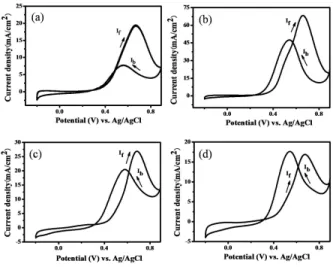
圖六為沈積後的Pt-Ru/InN 奈米帶樣品對甲醇的催化觸媒活性之循環伏安圖譜。測試條 件為於0.5 M 甲醇/0.5 M 硫酸水溶液中,以掃描速率 10 mV/s 做掃瞄。圖七為將正逆陽極 峰電流密度比(If/Ib)對樣品中 Ru 組成百分比做出的關係圖。可發現到,正逆陽極峰電流密 度比(If/Ib)會因 Pt-Ru 觸媒層中不同的 Pt-Ru 原子比例,即隨著 Ru 量的增多而增加,如當 Ru 含量由 0 增加至 63%時,If/Ib由0.9 增加到 2.5。此一結果正顯示了 Ru 發揮了避免 Pt 被 CO 所毒化的功效。此外,由圖五的 CV 圖譜可以發現起始電位(onset potential)皆小於 0.4 V,
顯示出所沉積的 Pt-Ru 雙金屬觸媒具有較佳的催化活性,可能是這些觸媒具有(111)擇優晶 相所致[5]。此一批樣品中獲得了催化甲醇高達的 70 mA/cm2電流密度,說明了在具有一維 奈米結構的模板上沉積金屬觸媒,提供了廣大的接觸面積,對燃料發揮了極佳的催化效果。
3. 3 於 氫 氣 氣 氛 下 的於 氫 氣 氣 氛 下 的於 氫 氣 氣 氛 下 的於 氫 氣 氣 氛 下 的 Pt-Ru CVD 沉 積沉 積沉 積 沉 積
圖八為在H2氣氛下所沉積出的Pt-Ru/InN 奈米帶 TEM 影像圖。不同於圖三為在 N2氣 氛下沈積的結果,即使沈積時間為120 min 的樣品表面,亦是呈現非常平滑的結構,從 TEM 觀測的結果也可發現Pt-Ru 金屬粒子完整緻密地堆疊於奈米帶表面,且沈積的厚度亦較厚。
由於沈積Ru 所使用的原料先驅物 Ru(hfac)2(CO)2的分子結構中CO 會先脫離,而之後 hfac
在有H 的供給下容易形成穩定物種而脫離。氫氣存在的功能除了促進該原料解離外,還有
防止生成的金屬 Ru 進一步氧化。這可從 ESCA 分析於 N2氣氛下的沈積物殘留有 F 及 Ru 訊號中呈現部分的氧化態,而於H2氣氛下的沈積物卻無F 訊號且都為金屬 Ru 鍵結狀態而 得到印證。
圖九為沈積後的 Pt-Ru/InN 奈米帶樣品對甲醇的催化觸媒活性循環伏安圖譜。測試條件 為於0.5 M 甲醇/0.5 M 硫酸水溶液中,以掃描速率 10 mV/s 做掃瞄。圖七中的為將正逆陽 極峰電流密度比(If/Ib)高達 3.53,顯示出在氫氣氣氛下所沉積出來的等量 Pt-Ru 金屬觸媒具 有相當優越的抗CO 毒化的功效。此外,催化甲醇更高達 60.5 mA/cm2的電流密度,說明了 在具有一維奈米結構的模板上沉積金屬觸媒,提供了廣大的接觸面積,對燃料發揮了極佳 的催化效果。
3. 4 以以以以 ALD 法 沉 積法 沉 積法 沉 積法 沉 積 Pt 單 一 金 屬 觸 媒單 一 金 屬 觸 媒單 一 金 屬 觸 媒單 一 金 屬 觸 媒
圖十為以C5H5Pt(CH3)3Pt 為原料的 ALD 法於 SiO2/Si 晶片上沉積單一金屬觸媒的成長 速率與成長溫度的關係圖。圖九顯示出當沉積溫度低於250oC 時,原料 C5H5Pt(CH3)3Pt 上 的三個甲基可能未完全分解,而產生立體障礙,導致成長速率下降。而當沉積溫度高於300oC
時,原料上的甲基可能完全分解,而導致多層吸附及金屬顆粒聚集。當沉積溫度為 250 至
300oC 之間,具有原子層沉積的窗口,即每一週期的成長速率為 2.6 Å,接近(111)晶面的 Pt 晶格間距(2.3 Å)。不同溫度下反應之示意圖如圖十一所示。
圖十二為在300 oC 下於 SiO2/Si 晶片上以不同氧氣供給濃度下沉積 Pt 金屬層的表面形 態圖。當氧氣供給濃度增加由16.7%增加到 28.6%,所沉積出來的 Pt 金屬顆粒大小會隨之 增加,而增加至28.6%時,所成長 Pt 金屬顆粒略有聚集,可能是因為添加氧氣會增加反應 速率,而形成較大的金屬顆粒聚集。圖十三為Pt 沉積後的 XRD 圖譜。由 XRD 圖譜顯示出 以ALD 法沉積的 Pt 金屬觸媒具有(111)擇優晶相。
圖十四為在成長溫度為 300 oC 及氧氣供給濃度為 28.6%下於一維氮化銦奈米帶上以 ALD 法沉積 Pt 15 個週期後的表面結構 TEM 照片圖。由圖十四(a)低倍率 TEM 照片圖中可
7
以發現所沉積出來的Pt 具有相當大的顆粒,且密度相當高。由圖十四(b)的選區繞射圖顯示 出所沉積的Pt 具有(111)晶面的擇優晶相。由圖十四(c)的高倍率 TEM 照片圖顯示出沉積的 Pt 金屬顆粒大小約為 10 nm,且具有 Pt(111)及 Pt(200)的晶面,並由圖十四(d)的粒徑分佈圖 顯示出所沉積的金屬顆粒尺寸大約為10 nm,如此大的金屬顆粒其相對的比表面積會降低。
因此我們降低成長溫度至280oC,一樣沉積 15 個週期,其結果如圖十五所示。由圖十五(a) 的低倍率TEM 照片圖顯示出在較低反應溫度下以 ALD 法沉積所出來的 Pt 金屬顆粒相當均 勻且密度相當高。並且具有5 nm 左右的顆粒大小。由圖十五(b)的選區繞射圖顯示出所沉積 的Pt 主要具有(111)及較少數的(220)晶面。由圖十五(c)的高倍率 TEM 照片圖顯示出沉積的 Pt 金屬顆粒大小約僅有 5 nm,並由圖十五(d)的粒徑分佈圖顯示出所沉積的金屬顆粒尺寸小 至約為4~5 nm。這個結果顯示出在較低溫度下以 ALD 法沉積的 Pt 顆粒(較接近每一供氣週 期成長一層Pt 膜)具有較高結晶指向和均勻的觸媒金屬結構。
圖十六為在InN 奈米結構上以 ALD 法於不同基板溫度下沉積了 15 個週期後的 CV 曲 線圖。掃描速率為 20 mV/s,氧氣供給濃度為 28.6%。圖十六(a)顯示出當在成長溫度 300oC 下的Pt-ALD 沉積後對甲醇的催化具有 0.5 V 的起始電位,且 If/Ib僅有0.67,相對的在成長 溫度280oC 下的 Pt-ALD 沉積後對甲醇的催化具有 0.34 V 的起始電位,且 If/Ib高至1.67(圖 十六(b)),這個結果顯示出較低溫度所沉積出來的 Pt 金屬顆粒具有較接近單晶 Pt(111)面的 電化學特性以及較佳的抗CO 毒化效果,特別值得注意的是我們在較低溫度以 ALD 法僅沉 積單一Pt 金屬觸媒,在沒有額外添加具抗 CO 毒化效果極佳的 Ru 等貴重金屬於 Pt/InN 奈 米帶上,即有此一抗CO 毒化的效果。而在較高溫度下所沉積出來的 Pt/InN 並沒有這樣抗 CO 毒化的功能。這可能是因為我們所採用的一維 InN 奈米帶表面原子有部分氧化的情形,
使得對Pt 表面上吸附的 CO 扮演一提供再氧化的角色。一般咸信在 Pt-Ru 的雙金屬觸媒系 統中,等比例的Pt-Ru 會具有較好的抗毒化功能,這可能是因為具有抗毒化的 Ru 原子需要 與Pt 原子接近,才能對 Pt 原子吸附的 CO 具有反應的效果[2-4]。而我們在高溫(300oC)所 沉積出來的Pt 金屬顆粒較大,造成甲醇在 Pt/InN 奈米結構上的反應時,Pt 與 InN 裸露之表 面原子接觸的界面相當有限,相對的在顆粒較小的Pt 粒子原子卻能與裸露出來的 InN 奈米
帶模板有較多接觸界面。這個結果顯示出,在不添加其他貴重金屬下,採用 InN 奈米模板
即可對Pt 原子具有抗毒化效果。
4 、、、、 結 論結 論結 論結 論
本計劃為利用二元複合MOCVD 反應系統共沈積 Pt 及 Ru 觸媒層於一維的氮化銦奈米 帶模板上。發現在等量氫氣和氮氣氣氛下、反應溫度400°C 下可共沈積出厚度約 20 nm 的 Pt-Ru 合金觸媒層,且具[111]方向的擇優晶面。由 XRD 圖譜可發現 Pt 繞射峰訊號的偏移,
這個結果顯示出 Pt-Ru 是以合金態共沉積在 InN 奈米帶上。並藉由循環伏安法評估甲醇在 其上的反應特性,我們發現催化甲醇的電流密度最高可達70 mA/cm2,且在Ru 含量為 60%
時的If/Ib比更高達2.5,具有較好的抗 CO 毒化效果。在氫氣氣氛下所沉積出來的 Pt-Ru 雙 金屬觸媒對甲醇氧化的CV 圖譜顯示出 If/Ib比更高達3.53,具有極佳的抗毒化活性。
在以ALD 法沉積單一 Pt 金屬於 InN 奈米帶上的研究顯示出具有較高結晶指向和均勻 的觸媒金屬結構,又 Pt 觸媒結構於 InN 奈米帶模板上一樣具有不錯抗 CO 毒化的效果,可
能是因為InN 奈米帶本身或其氧化態即扮演著重要的抗毒化功能。本計劃的研究結果顯示
了具有特定晶面具高比表面積的一維氮化銦奈米帶對於以Pt 觸媒為主的 DMFC 應用上是一 個相當優越的金屬觸媒沉積之模板。
8
圖三 於 N2氣氛下不同沉積時間之Pt-Ru/InN 的表面 SEM 與 TEM 顯為影像。(a)、(b) 90 min, (c)、(d) 120 min。
(a) (b)
圖四 於等比例之氫氣和氮氣氣氛下沉積 120 min 後的 Pt-Ru/InN 表面(a)SEM 與(b)TEM 照 片圖。
30 40 50 60 70 80 90
Si(100) InN(104)
2θθθθ (degrees)
Intensity (a.u.)
Pt60Ru40 Pt64Ru36
Pt37Ru63 Pt
Pt(111) InN(114)
InN(200)
InN(100) InN(002) InN(102) InN(110) InN(103) InN(112) InN(201) InN(203) Pt(222)
(a)
Intensity (a. u.)
2θ (degree)
InN(002) InN(101) Si(400)
37 38 39 40 41 42
Pt60Ru40
2θθθθ (degrees)
Intensity (a.u.)
Pt64Ru36
Pt37Ru63 Pt
(b)
2θ (degree)
Intensity (a. u.)
圖五 於等量之氫氣和氮氣氣氛下沉積不同比例之 Pt-Ru 觸媒的 XRD 圖譜。(a)大範圍圖 譜,(b)細部掃描。
9
圖六 不同組成的 Pt-Ru 觸媒對 0.5 M 甲醇氧化的循環伏安圖譜。 (a) Pt37Ru63, (b) Pt60Ru40, (c) Pt64Ru36, (d) Pt . sweep rate of 10 mV/s。
0 10 20 30 40 50 60 70
1.0 1.5 2.0 2.5
If/Ib ratio (a. u.)
Ru (%)
圖七 不同組成的 Pt-Ru 觸媒對 0.5 M 甲醇氧化的If /Ib關係圖。
圖八 於氫氣氣氛下沉積 120 min 後的 Pt-Ru/InN 表面(a)TEM 圖及(b)選區繞射圖。
10
0.0 0.4 0.8
-10101520253035404550556065-505
Potential (V) vs. Ag/AgCl
Current density(mA/cm2 ) If
Ib
Current density (mA/cm2) 60 20 40
0
0.0 0.4 0.8
Potential (V vs. Ag/AgCl )
圖九 於氫氣氣氛下沉積 120 min 後的 Pt-Ru/InN 對 0.5 M 甲醇氧化的循環伏安圖譜。
圖十 以 C5H5Pt(CH3)3Pt 為原料的 ALD 法在 SiO2/Si 上以不同基材溫度下沉積 Pt 金屬的每 個週期之成長速率關係圖。
圖十一 以 C5H5Pt(CH3)3Pt 為原料的 ALD 法於不同溫度下的分解示意圖。
(a) (b) (c)
圖十二 300 oC 下在 SiO2/Si 上以不同 ALD 氧氣供給濃度下沉積 Pt 金屬的表面形態。氧氣 濃度分別為(a) 16.7%、(b) 23%、(c) 28.6%。
11
20 40 60
intensity (a.u.)
2θ θ θ θ ((((degree)
[O2]=28.6%
[O2]=23%
[O2]=16.7%
Pt(111)
圖十三 300oC 下在不同氧氣濃度沉積 Pt 金屬的 XRD 圖譜。
圖十四 在InN 奈米結構上於溫度為 300 oC、氧氣供給濃度為 28.6%下以 ALD 沉積 Pt 金屬 15 個週期後的 (a)低倍率 TEM 電鏡圖,(b) SAED 繞射圖,(c) 原子排列影像圖,(d)粒徑分 布圖。
12
圖十五 在InN 奈米結構上於溫度為 280 oC、氧氣供給濃度為 28.6%下以 ALD 沉積 Pt 金屬 15 個週期後的 (a)低倍率 TEM 電鏡圖,(b) SAED 繞射圖,(c) 原子排列影像圖,(d)粒徑分 布圖。
圖十六 在InN 奈米結構上以 ALD 沉積 Pt 金屬 15 個週期後的 CV 曲線圖。掃描速率: 20 mV/s,氧氣供給濃度為 28.6%。(a)成長溫度為 300oC,(b)成長溫度為 280 oC。
13 5、參考文獻
1. Steele, B. C. H., Heinzel, A. Materials for Fuel-Cell Technologies. Nature, 414:345 -352 (2001)
2. Lin, S.D., Hsiao, T.C., Chang, J.R., Lin, A.S. Morphology of Carbon Supported Pt-Ru Electrocatalyst and the CO Tolerance of Anodes for PEM Fuel Cells. J. Phys. Chem. B, 103:97-103 (1999)
3. Zhang. Y.J., Maroto-Valiente, A., Rodriguez-Ramos, I., Xin, Q., Guerrero-Ruiz, A. Synthesis and Characterization of Carbon Black Supported Pt–Ru Alloy as a Model Catalyst for Fuel Cells. Catalysis Today, 93-95: 619-626 (2004)
4. Chen, Z., Qiu, X., Lu, B., Zhang, S., Zhu, W., Chen, L. Synthesis of Hydrous Ruthenium Oxide Supported Platinum Catalysts for Direct Methanol Fuel Cells. Electrochemistry Communications, 7:593-596 (2005)
5. Habas, S.E., Lee, H., Ramilovic, V., Somorjai, G.A., Yang, P. Shaping Binary Metal Nanocrystals Epitaxial Seeded Growth. Nat. Mater., 6:692-697 (2007)
6. Hu, M. S., Wang, W. M., Chen, T. T., Hong, L. S., Chen, C. W., Chen, C. C., Chen, Y. F, Chen, K. H., Chen, L. C. Sharp Infrared Emission from Single-crystalline Indium Nitride Nanobelts Prepared using by Guided-Stream Thermal Chemical Vapor Deposition. Adv. Funct. Mater., 16:537-541 (2006)
7. Y. Cong, V. van Spaendonk, R. I. Masel, Surf. Sci., 385, 146 (1997).
8. Y. F. Ke, D. S. Tsia, and Y. S. Huang, J. Mater. Chem., 15, 2122 (2005)
9. Cheng, W. Y., Hong, L. S., Jiang, J. C., Chi, Y., Lin, C. C. Initial Growth of Chemical-Vapor- Deposited Ru from bis(Hexafluoroacetylacetonate)dicarbonyl Ruthenium. Thin solid Films, 483:31-37 (2005)
10. M. -S. Löffler, H. Natter, R. Hempelmann and K. Wippermann, Electrochimica Acta, 2003, 48, 3047.
14
Well-Oriented Pt-Ru Catalysts on Single Crystalline Indium Nitride Nanobelts with High Electrochemical Activity
Chie-Sheng Liu, Cheng-Ming Lin, Chih-Yun Kuo, and Lu-Sheng Hong Department of Chemical Engineering, National Taiwan University of Science and Technology
43, Keelung Road, Section 4, Taipei, 106 Taiwan
Abstract
One-dimensional InN nanobelts with large specific surface area were used as templates for the co-deposition of Pt-Ru bimetal catalysts using metal organic chemical vapor deposition technique.
The chemical composition, morphology and electrochemical characteristics which were
applicable for the anode electrode for direct methanol fuel cell (DMFC) were investigated. Cyclic voltammograms showed a high catalytic current of 60.47 mA/cm2 and If/Ib ratio of 3.53 (the forward anodic peak current density (If) versus the reverse one (Ib)), for a sample deposited with about 10 nm thick catalysts. The result suggested that (111) preferred-oriented catalysts can be obtained through using a ± (0001) belt-surfaced InN nanostructure as a template, by which better electrochemical characteristics can be manifested.
1. Introduction
Fuel cell is a high efficiency electrochemical conversion device with low emissions. Among many kinds of fuel cells, direct methanol fuel cell (DMFC) has received much attention due to its high energy density, low working temperature, and renewable fuel source1. In DMFC, the catalyst activity for methanol oxidation plays an important role in obtaining a high efficient cell.
Recently, Pt-Ru binary alloy catalysts were found to exhibit a high electrochemical activity for methanol oxidation and an ability to prevent Pt poison by the adsorbed CO2–4. Another noticeable fact is that catalyst surface of various
crystal planes exhibits different catalytic activities5. Therefore, it is highly desirable to design a catalyst system that can show the most active crystal plane under the least amount usage of the noble metals. One dimensional (1D) nanostructure with both well defined facet and high surface area is therefore a good choice as a deposition template for Pt-Ru catalysts.
In this study, we investigated the morphology of Pt-Ru bimetal catalysts deposited on 1-D InN nanobelts using metal organic chemical vapor deposition (MOCVD) technique. A half cell reaction of cyclic voltammetry (CV) was also performed to evaluate the electro-catalytic activities of the Pt-Ru catalysts thus
---
--- Fig. 1. Images of Pt-Ru binary catalysts deposited onto InN nanobelt under N2 ambient : (a) SEM image and (b) TEM image after 90-min CVD deposition; (c) SEM image and (d) TEM image after 120-min CVD deposition.
附件一
15 prepared with respect to methanol oxidation.
2. Experimental
Binary Pt-Ru catalysts were deposited using a cold-wall type MOCVD reactor. InN nanobelts with ± (0001) belt-surfaces6 were used as the template. C5H5Pt(CH3)3 and Ru(hfac)2(CO)2 were used as the precursors for Pt and Ru, respectively. After deposition, scanning electron microscope (SEM) was used to investigate the morphology of the deposited Pt-Ru bimetal catalysts. The catalyst layer thickness and dispersion state were examined by transmission electron microscopy (TEM). The crystalline properties of the deposited catalysts were characterized using X-ray diffraction (XRD).
The chemical composition of the binary alloy were investigated by XPS using Al Kα radiation (hv = 1486.68 eV). Finally, cyclic voltammetry (CV) was applied to evaluate the electrochemical activities with respect to methanol oxidation for the prepared Pt-Ru/InN-nanobelt catalyst system. Pt foil was used as the counter electrode and Ag/AgCl in saturated KCl (0.197 V versus standard hydrogen electrode) was used as the reference electrode.
3. Results and Discussion
Figs. 1a and 1c display the SEM images of the Pt-Ru binary catalysts deposited under N2 ambient at 90 and 120 min, respectively.
Figs. 1b and 1d present the corresponding TEM image. The catalysts disperse on InN nanobelts more uniformly after 120-min deposition than that after 90-min deposition.
However, fluoride contamination was found
on the catalyst surface according to a measurement result of XPS. The carbon contamination is most plausibly ascribable to the incomplete decomposition of Ru precursor that has a F-containing ligand-hfac under N2 atmosphere. Cheng et al.7 reported that H2 addition into the Ru(hfac)2(CO)2-CVD system can assist in reducing the F contamination.
---
(a) (b)
--- Fig. 2. Images of the Pt-Ru binary catalysts deposited on InN nanobelts under a H2/N2 equally-mixed ambient: (a) SEM image and (b) TEM image after 120-min deposition.
---
37 38 39 40 41 42
Pt60Ru
40
2θθθθ (degrees)
Intensity (a.u.)
Pt64Ru
36
Pt37Ru
63
Pt
30 40 50 60 70 80 90
Si(100) InN(104)
2θθθθ (degrees)
Intensity (a.u.)
Pt60Ru40 Pt64Ru36
Pt37Ru63 Pt
Pt(111) InN(114)
InN(200)
InN(100) InN(002) InN(102) InN(110) InN(103) InN(112) InN(201) InN(203) Pt(222)
(a)
(b)
Intensity (a. u.)
2θ (degree)
2θ (degree)
Intensity (a. u.)
--- Fig. 3. XRD spectra of the deposited Pt-Ru catalysts with various compositions. (a) Wide scan and (b) narrow scan.
16
Figs. 2a and 2b shows the SEM and the TEM images of the Pt-Ru bimetal catalysts deposited at a H2/N2 equally-mixed atmosphere for 120-min deposition. An evident catalyst layer is observed, suggesting an increase of
deposition rate because of H2 addition.
Moreover, the deposit is free of F contamination. To obtain Pt-Ru alloys with various compositions, we performed deposition experiments at various Pt/Ru precursor feeding ratios. Figs. 3a and 3b show the wide scan and narrow scan of the XRD spectra, respectively, of the deposited Pt-Ru catalysts with various compositions. In Fig. 3a, only Pt(111) peak was observed except the diffraction peaks originated from InN nanobelts. Furthermore, the Pt(111) peak position shifted from 39.4o to 40.5o for the samples of increasing Ru composition from 0 to 63 %. The deviation of the XRD peak position indicates that Ru atoms have been incorporated into Pt FCC lattice.
Fig. 4 presents the cyclic voltammetry results for the Pt-Ru/InN-nanobelt catalyst system with various compositions. The CV was performed for oxidation of 0.5 M methanol in 0.5 M H2SO4. The ratio of forward and reverse current density (If/Ib), defined as an index to represent the degree of Pt surface poison due to adsorbed CO, was furthermore plotted as a function of Ru atomic ratio (Fig. 5). The If/Ib ratio increased from 1.0 to 2.5 when the composition ratio of the Ru in the Pt-Ru catalysts varies from of 0 to 63 %. This result indicated that the alloyed Pt-Ru binary system did inhibit CO poison relieving effect.
We also performed the deposition under a 100% H2 ambient. Fig. 6a shows the TEM image of a binary catalyst deposited in H2 ambient. It displays quite a smooth morphology. A (111) preferred-oriented crystalline characteristics was obtained as suggested from the SAED pattern illustrated in Fig. 6b. Fig. 7 shows the corresponding CV measurement result for oxidation of 0.5 M methanol in 0.5 M H2SO4. It shows a low reaction on-set potential at 0.44 V and a high catalytic current density at 60.47 mA/cm2. Moreover, If/Ib ratio is as high as 3.53 for the sample deposited with about 10 nm thick catalysts. These results suggested that (111) preferred-oriented ---
--- Fig. 4. CVs of the various Pt-Ru catalysts obtained for the oxidation of 0.5 M methanol in 0.5 M H2SO4
at sweep rate of 10 mV/s. (a) Pt37Ru63, (b) Pt60Ru40, (c) Pt64Ru36, (d) Pt .
---
0 10 20 30 40 50 60 70
1.0 1.5 2.0 2.5
I f/I ratio (a. u.)b
Ru (%)
--- Fig. 5. The ratio of forward current density (If) and reverse one (Ib) of the various Pt-Ru catalysts by CV.
17
binary catalysts can be formed on the ± (0001) belt-surfaced InN and exhibits quite a good electrochemical characteristic.
4. Conclusion
In summary, we have used SEM, TEM and XRD to investigate the Pt-Ru binary alloy catalysts deposited on ± (0001) belt-surfaced InN nanostructures using MOCVD. The electrochemical activities of deposited binary catalysts were characterized by cyclic voltammetry. The Pt-Ru alloys with various composition were successfully fabricated by changing the Pt/Ru precursor feeding ratio. Cyclic voltammetry measurement results showed that the ratio of forward and reverse current density (If/Ib) increased with increasing Ru composition ratio in the alloy, indicating that Ru plays an important role in inhibiting Pt poison by the adsorbed CO. A highest current density up to 60.47 mV/cm2 was obtained. The experimental results suggest that one dimensional (1D) nanostructure with well-defined facet and high surface area is promising template materials for fabricating highly active Pt-Ru alloy catalysts in DMFC application.
References
1. Steele, B. C. H., Heinzel, A. Materials for Fuel-Cell Technologies. Nature, 414:345 -352 (2001) 2. Lin, S.D., Hsiao, T.C., Chang, J.R., Lin, A.S. Morphology of Carbon Supported Pt-Ru Electrocatalyst
and the CO Tolerance of Anodes for PEM Fuel Cells. J. Phys. Chem. B, 103:97-103 (1999)
3. Zhang. Y.J., Maroto-Valiente, A., Rodriguez-Ramos, I., Xin, Q., Guerrero-Ruiz, A. Synthesis and Characterization of Carbon Black Supported Pt–Ru Alloy as a Model Catalyst for Fuel Cells.
Catalysis Today, 93-95: 619-626 (2004)
4. Chen, Z., Qiu, X., Lu, B., Zhang, S., Zhu, W., Chen, L. Synthesis of Hydrous Ruthenium Oxide Supported Platinum Catalysts for Direct Methanol Fuel Cells. Electrochemistry Communications, 7:593-596 (2005)
5. Habas, S.E., Lee, H., Ramilovic, V., Somorjai, G.A., Yang, P. Shaping Binary Metal Nanocrystals Epitaxial Seeded Growth. Nat. Mater., 6:692-697 (2007)
6. Hu, M. S., Wang, W. M., Chen, T. T., Hong, L. S., Chen, C. W., Chen, C. C., Chen, Y. F, Chen, K. H., ---
--- Fig. 6. TEM images of Pt-Ru binary catalysts deposited onto InN nanobelt under H2 ambient (a) and the SAED pattern (b).
---
0.0 0.4 0.8
-10101520253035404550556065-505
Potential (V) vs. Ag/AgCl
Current density(mA/cm2 ) If
Ib
Current density (mA/cm2) 60 20 40
0
0.0 0.4 0.8
Potential (V vs. Ag/AgCl )
--- Fig. 7. CV of the Pt-Ru binary catalysts deposited in H2 ambient, obtained for the oxidation of 0.5 M methanol in 0.5 M H2SO4 at sweep rate of 10 mV/s.
18
Chen, L. C. Sharp Infrared Emission from Single-crystalline Indium Nitride Nanobelts Prepared using by Guided-Stream Thermal Chemical Vapor Deposition. Adv. Funct. Mater. , 16:537-541 (2006) 7. Cheng, W. Y., Hong, L. S., Jiang, J. C., Chi, Y., Lin, C. C. Initial Growth of Chemical-Vapor-
Deposited Ru from bis(Hexafluoroacetylacetonate)dicarbonyl Ruthenium. Thin solid Films, 483:31-37 (2005)
出席國際學術會議心得報告 出席國際學術會議心得報告 出席國際學術會議心得報告 出席國際學術會議心得報告
計畫編號 NSC 95-2221-E-011-168-MY2
計畫名稱 於一維奈米結構物上的異質化學氣相沈積-形態與結構的控制(第 2 年)
出國人員姓名
服務機關及職稱 洪儒生 台灣科技大學化工系 教授
會議時間地點 2008 年 8 月 31 日至 9 月 3 日,札幌市,北海道,日本
會議名稱 第一屆亞洲創新能源及環境化工會議(1st Asian Conference on Innovative Energy & Environmental Chemical Engineering (10 th ASCON-IEEChE)) 發表論文題目
以單晶氮化銦奈米帶為模版於其上成長結晶配向性一致的鉑-釕觸媒及其 高電化學特性之研究 (Well-Oriented Pt-Ru Catalysts on Single Crystalline Indium Nitride Nanobelts with High Electrochemical Activity)
參加會議經過 參加會議經過 參加會議經過
參加會議經過及與及與及與會心得及與會心得會心得會心得
第一屆亞洲創新能源及環境化工會議(1st Asian Conference on Innovative Energy &
Environmental Chemical Engineering (10 th ASCON-IEEChE))於 2008 年 8 月 31 日至 9 月 3 日於日本北海道第一大城市札幌舉行。本人在貴會的經費補助下有幸參加此一盛會,並進行 論文發表,在此分享心得如下。
我們一行人(含台大化工系呂理平教授)於8 月31 號抵達會場。本次會議地點在札幌市 近郊,坐巴士約50分鐘的Gateaux Kingdom Sapporo,這是一個飯店及辦理國際會議的地方。
辦理報到註冊手續後,及已接近傍晚六點,於是參加了第一天歡迎來賓的盛會。在歡迎會中 遇到該ASCON創始人東京大學名譽教授吉田邦夫,由於他是筆者當年留學日本東京大學時恩 師的老師,在留學的那一段時間亦受到他相當的照顧,因此與他的寒暄倍感親切。他並談及 今年一月受邀到台灣演講,因主辦單位的不周到讓他覺得不方便之一事。筆者雖不是該次會 議的邀請單位,但仍代替跟他說抱歉。筆者認為比起本次會議主辦國的用心,我們未來更應 要虛心學習,不要再有拿國家的補助但不用心籌劃會議安排,而讓國外來的貴賓有怨言的情 況發生。
ASCON-IEEChE會議今年已經是邁入第二十個年頭, 最早是在1988年於東京舉行,當時 為以三相反應器及流體化床為會議重點,但隨著年代演進,諸多能源議題已成為這個會議的 中心議題。本次特別以”第一屆亞洲創新能源及環境化工”為會議抬頭來舉辦,即是有轉型的