Research Express@NCKU - Articles Digest
Research Express@NCKU Volume 18 Issue 2 - April 22, 2011 [ http://research.ncku.edu.tw/re/articles/e/20110422/4.html ]
The Research on an Evaluation Framework of Indicator
System for a Liveable Urban District : Regeneration of
Taiwanese Old Urban Centres
Hsien-Hsin Cheng
*, Chao-Chih Lin
Dept. of Urban Planning, National Cheng Kung University [email protected]
NCKU Landmark Project《C0174》
T
aiwanese old urban centres have experienced deterioration under the impact of urban sprawl and suburbanization since 1980’s. Some serious urban core development problems are obvious, such as the inappropriate conventional mixed use, the traffic burden of historical blocks, the chaos of urban landscape, and the poor old living standards. These factors undermine the liveability of old urban districts. Based on this analysis, the researchers then develops an evaluation framework of indicator system, which is composed of four main constructs for a livable urban districts. The four constructs are Land use sustainability, TODpattern, District composition, and Architectural typology and estate; the further developments of these four constructs are 16 indicators as the second level of this framework. These indicators mainly derived from the Urban Village1
concept from the western countries and the principles of historical district conservation and regeneration from Taiwanese scholars2.
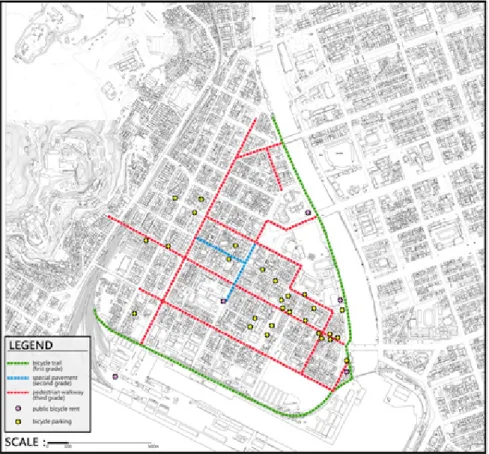
From field survey, this research evaluates the performance of livability in Yanchengpu district (Kaohsiung City). There are 37 policy-making indicators for the performance evaluation concerning livability. Figure 1~5 are the analyses of some policy-making indicators based on field survey, which respectively represent the four constructs. Figure 1 illustrates architectural mixed use intensity (Land use sustainability) in yengchengpu district; figure 2 analyze the pedestrian shed of bus stops and transit station (TOD), which examine the accessibility of public transportation in the district; figure 3 investigate the development of bicycle network (District composition) of the whole Yengchengpu district; figure 4 clarify the relationship of the old and new buildings (Architectural typology and estate) in the district; figure 5 explore the Urban renewal potential by surveying private land ratio.
Figure 1. Architectural mixed use intensity Figure 2. Pedestrian sheds of bus stops and transit station
Research Express@NCKU - Articles Digest
Figure 3. Bicycle Network
Figure 4. Continuity between old and new Figure 5. Private land distribution
Table 1 summarize thirty-seven policy-making indicators, the arithmetic mean score is 5.77. This research assumes all the policy-making indicators are equally weighted, thus, construct score can be calculated as follow:
● Construct Land use sustainability - 7.25 (Good, score between 6~8) ● Construct TOD - 7.2 (Good, score between 6~8)
● Construct District composition – 5.75 (Fair, score between 4~6) ● Construct Architectural typology – 4.33 (Fair, score between 4~6)
Score level above 8 can be classified as excellent, and score level below 4 is poor. In Yengchengpu district, the livability of Construct Land use sustainability and TOD are good, whilst Construct District composition and architectural typology and estate are poor based on this performance evaluation framework.
Table 1. Score list of 37 policy-making indicators
Research Express@NCKU - Articles Digest
1. Neal, Peter (2003), Urban Villages and the Making of Communities, London : Spon Press.
2. Hsien-Hsin Cheng&Shuichi Matsumura, 2004.9, 'A Historical Study on the Development of RC Building Construction Adapting to the Climate in Taiwan', University of Trenro, Italy.