教育研究集刊
第六十輯第二 期 2014年6月 頁41-76
美國高中特殊教育教師之機構間合作 態度於參與轉銜服務的模式探討
李貞儀 摘要
本研究以結構方程模式探討高中特殊教育教師參與轉銜服務的程度,以及此 參與程度與教師對機構間合作認知、教師個人背景及學校特性之間的關聯性。在 此問卷研究中,回應者中有53%是特殊教育教師和轉銜專業人員。探索和驗證的 因素分析被運用來考驗測驗量表的信度和效度。在本文中,研究者先提供測驗工 具四個測驗量表的信度與效度證據,然後以結構方程模式考驗四個潛在變項之間 的關係。本研究結果區分了特殊教育教師個人特質的作用不同於學校特質和教師 本身對跨機構合作的認知的作用,肯定了特殊教育教師專業訓練背景的重要性遠 大於模式中的其他因素。高中特殊教育教師有愈完整的專業訓練背景,愈會認同 跨機構間合作的重要性,也愈願意參與轉銜服務相關活動。根據本研究結果,提 出高中特殊教育教師專業培訓規劃及對於進一步研究之建議。
關鍵詞:特殊教育、教師培育、結構方程模式、轉銜
李貞儀,新加坡南洋理工大學國立教育學院幼兒與特殊教育學系助理教授 電子郵件:[email protected]
投稿日期:2013年10月11日;修改日期:2014年03月17日;採用日期:2014年04月23日
Bulletin of Educational Research June, 2014, Vol. 60 No. 2 pp. 41-76
American Secondary School Special Educators’ Interagency Collaboration and
Transition Practices
Jen-Yi Li A b s t r a c t
This study applied structural equation modeling to investigate perceived level of involvement in transition services among secondary school special educators, in relation to their perceptions of interagency collaboration, as well as special educators’
personal and school characteristics. Fifty-three percent of recipients who responded to the survey were special education teachers and transition coordinators/specialists in the United States. Exploratory and confirmatory factor analyses were used to refine and validate the measurement scales applied. The evidence of reliability and validity of four measurement scales were provided first, followed by an analysis of structural relationships among four latent constructs. Results of the study distinguished the effects of personal characteristics of secondary special educators from the effects of school characteristics and educators’ perceptions of interagency collaboration.
Personal characteristics of secondary school special educators are the key to educators’
perceptions of interagency collaboration and their transition involvement, and also
Jen-Yi Li, Assistant Professor, Department of Early Childhood and Special Education, National Institute of Education, Nanyang Technological University (Singapore)
Email: [email protected]
Manuscript received: Oct. 11, 2013; Modified: Mar. 17, 2014; Accepted: Apr. 23, 2014.
overshadow the relationships among other factors in the model. Secondary school special educators with higher levels of professional preparation perceive a greater importance in interagency collaboration, and are more likely to be involved in interagency collaboration activities in their transition practices. Accordingly, the author of this paper provides suggestions for teacher training and preparation as well as recommendations for future studies.
Keywords: special education, teacher education, structural equation modeling,
transition
Introduction
The field of special education in America has adopted the term “transition” to specifically refer to a changing process for students with disabilities from secondary to post-secondary lives. The Individuals with Disabilities Education Act (IDEA) has since 1990 mandated the provision of transition services and described the transition outcomes for students with disabilities, including community and independent living, further education, employment and instruction, and mandatory linkage with vocational rehabilitation and other adult service agencies. Adjustments to the world beyond secondary school, students with disabilities need structured planning and substantial support to help them prepare needed skills. The planning process should be focused on the future, delivered consistently by both transition and school staff, and tracked and monitored in relation to the goals for positive-school results. Transition services, then, indicate a series of various dimensions and activities and increase the emphasis on post- school results.
A number of researchers examined the types of transition services for secondary school students with disabilities, as well as characteristics of the providers of transition services. Usually, two types of school personnel are involved with transition planning and service delivery. They include transition coordinators/specialists and secondary special education teachers (Morningstar & Clark, 2003). Research has suggested that consistent support from school personnel significantly contributes to students’ positive postschool outcomes (Benz, Lindstrom, & Yovanoff, 2000). A special educator is frequently identified as the individual who should provide transition related services such as vocational education instruction, coordinated work experiences, and contacts with the community (Asselin, Todd-Allen, & deFur, 1998; Conderman & Katsiyannis, 2002; Knott, 1997; Knott & Asselin, 1999; Retzlaff, 1999). These findings indicate the importance of a special educator’s involvement in transition services, including collaborative activities, which will facilitate a student’s transition from school to post- school lives. To allow the successful postsecondary outcomes to become a reality,
secondary special educators play an influential role in this transition process (Benz et al., 2000; Fox, Wandry, Pruitt, & Anderson, 1998).
The ultimate goal of transition services is to insure successful community integration for students with disabilities. The community integration philosophy incorporates such concepts as “civil liberty,” “least restrictive environment,” “right to treatment and to refuse treatment,” “quality of life,” “engaging natural helpers,” and coordination among the system of services (Kochhar-Bryant & Greene, 2009, p. 83).
The value system of transition service coordination models is rooted in the principle of normalization (Wolfensberger & Thomas, 1983), which is relevant to human services in general, rather to a narrow specialty. Since the 1980s, there has been a remarkable increase in collaboration among human service agencies, government, and community organizations (Abramson & Rosenthal, 1995; Mattessich & Monsey, 1992).
A major impetus for collaboration in the modern time is from the supporters of service integration for children and families (Bronstein, 2002). Service integration derives from the need of systematic efforts to solve problems of service fragmentation and fracture, in which services are usually developed and delivered in a disjointed and uneven way.
When services are uncoordinated, resources are wasted and such lack of coordination is harmful to individuals or families with needs (Kahn & Kamerman, 1992).
Interdisciplinary/interagency communication is essential in systems of services for specialists from diverse fields. A special educator alone cannot accomplish the requisite desired transition outcomes for students with disabilities without collaborating with others (Eber, Nelson, & Millers, 1997; Wasburn-Moses, 2006). Inter-agency collaborations between special educators and other professionals will form when they share collective ownership of goals. Departments may need to pursue the resources of the other department; thus, encourages members’ participation in newly created professional activities (i.e., participants acknowledge their dependence on others’
expertise to reach their goals). In some situations, external mandates from legislation or regulatory agencies impose individuals to engage in collaborative activities (Abramson
& Rosenthal, 1995; Farmakopoulou, 2002; Intriligator, 1992; Swan & Morgan,
1993). The level of power and security of the various departments, organizations, or professional groups greatly influences the degree of flexibility for collaborative participants (Li, 2002). Values, attitudes, and skills related to professional roles are also factors that can enhance or impede collaboration (Abramson & Rosenthal, 1995;
Carter, Prater, Jackson, & Marchant, 2009; Intriligator, 1992; Mattessich & Monsey, 1992; Zigmond, 2003).
While the collaborative role of special educators in secondary school has been further expanded with the development of comprehensive systems of care and the advent of new laws (Asselin et al., 1998; Conderman & Katsiyannis, 2002; Knott &
Asselin, 1999; Simpson, Whelan, & Zabel, 1993; Zhang, Ivester, Chen, & Katsiyannis, 2005), little direct empirical research has been conducted to define these roles in collaboration with other professionals. The primary focus of past research has been on the skills and competencies that contribute to effectively coordinating and facilitating transition services with little attention to the interplay of special educators with other professionals in collaborative work. Foley and Mundschenck (1997) conducted a national survey to investigate collaboration activities and competencies of secondary special educators. The findings revealed that self-perceived professional weakness in interagency collaboration explained the dysfunction of interagency collaboration at school. Special educators were lacking of opportunities to develop such a collaborative role from their limited interaction with community service providers. The self- perceived professional weakness can be due to the structural differences, lack of joint training, and scarcity of human and material resources (Farmakopoulou, 2002).
To understand how expectations, standards, and training assist in shaping secondary special educators’ perspectives and behaviors when it comes to the interface of collaborating with professionals from multidisciplinary settings, this study proposed a hypothesized model. Based on the findings consistently revealed among previous studies, many factors contributed to this understanding. For example, the personal and institutional factors suggested in the multidisciplinary literature (Abramson &
Rosenthal, 1995; Bronstein, 1999; Knott & Asselin, 1999) and categorized by the
author of this article stand in relation to the ways in which individuals and agencies work together. The characteristics of individuals and agencies appear to be interwoven in the collaborative process and impact the outcome of interagency collaboration (Bemak, 2000), and ultimately impact the level of secondary special educator’s involvement in transition services.
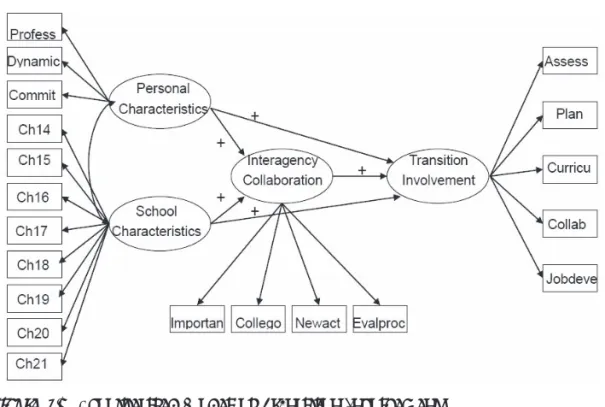
The main purpose of this study was to investigate perceptions of interagency collaboration by secondary special educators in relation to their self-reported involvement in the transition process. As mentioned earlier, multiple factors contributed to this relationship. The hypothesized model of transition involvement was therefore tested for its goodness of fit with four factors: personal and professional characteristics, educators’ perceptions of interagency collaboration, and educators’ transition involvement (see Figure 1). The following research question was addressed as: Do the hypothesized relationships in the model of transition involvement fit the data? And accordingly, five hypotheses were proposed as follows:
H1: There is a positive relationship between the perceptions of interagency
collaboration of secondary special educators and their personal and professional characteristics.H2: There is a positive relationship between the perceptions of interagency
collaboration of secondary special educators and their school characteristics.H3: There is a positive relationship between personal and professional
characteristics and transition involvement among secondary special educators.H4: There is a positive relationship between school characteristics and transition
involvement among secondary special educators.H5: There is a positive relationship between the perceptions of interagency
collaboration of secondary special educators and their transition involvement.Figure 1.
Hypothesized Model of Transition InvolvementNote. Profess: Transition professional background; Dynamic: Interpersonal dynamics; Commit:
of special educators; Importan: Importance of interdisciplinary collaboration; Collego:
Collective ownership of goals; Newact: Newly creative professional activities; Evalproc:
Evaluation on collaborative process; Assess: Transition assessment; Plan: Transition planning; Curricu: Transition instruction & curriculum; Collab: Program evaluation and interagency collaboration; Jobdeve: Job development. CH14-CH21: question items of school characteristics.
Method
Sem and Research Framewrok
Structural Equation Modeling (SEM) was chosen in the present study to achieve two major goals. First, the measurement errors are considered in the respective observed indicators measuring the constructs. Second, structural relationships among latent constructs are estimated. These two estimation processes used the LISREL 8.52 and PRELIS 2.52 package for structural equation analysis and procedures (Jöreskog
& Sörbom, 2002). These two estimation stages are important components of SEM and integral parts of Kaplan’s (2000) diagram.
The structural model of Transition Involvement in this study was conceptually developed based on theories and extant literature. As in previous discussions, the personal and institutional factors suggested in the multidisciplinary literature, therefore these two factors were included as exogenous variables. The factor of Interagency Collaboration was identified to the success of transition practices and mediated the interaction between exogenous factors and Transition Involvement (the endogenous factor). Next, secondary special educators in the United States were targeted as the study population, from which members of Council for Exceptional Children were selected as the sample of this survey study. Appropriate measures were identified based on this sample. The estimation procedure was then performed to evaluate both the measurement model and structural relationships among four latent variables in the developed structural model. The hypothesized model of transition involvement was presented as follows (see Figure 1).
Participants
The target population for this study consisted of two groups of secondary special educations: (a) secondary special education teachers engaged in IEP transition planning and/or actual instruction in transition competency areas for students, and (b) transition education and services coordinators or specialists who are expected to assure “a coordinated set of activities” as required under IDEA. One thousand potential participants of this study were randomly selected through SPSS (10.0) statistical software package from the member list of the Council for Exceptional Children (CEC). A total of 551 survey questionnaires were returned for a response rate of 55%.
Participants of this study were geographically distributed over 50 states in the United States. A majority of 6.5% of participants lived in California; followed by 6.2% each living in Illinois and South Carolina, 5.3% each in Florida and Pennsylvania, and 4.1%
each in Georgia and Virginia. The fewest numbers of participants came from Alabama,
District of Columbia, Delaware, Hawaii, Maine, Oregon, and Rhode Island, each of which participated at 0.3%, respectively. Based on the information of participants’
geographical distributions, it was identified that the survey questionnaires were collected from a wide range of different states.
Most of respondents were female (83%), with the majority being older than 40 years old (76%), 18% held a bachelor’s degree, approximately 79% of them held a Masters degree, and 3% of them possessed a doctoral degree. The roles of respondents included special educators (70%), transition coordinators (17%), and those with both roles (13%). The majority of respondents had been involved in providing transition services more than 13 years (34%). Most respondents also reported devoting less than 10 hours (49%) per week to transition-related responsibilities. For the years of experience with interagency collaboration (i.e., vocational rehabilitation counselor, community college, mental health), the majority of respondents had more than 13 years of experience with interagency collaboration (30%).
Instrumentation and Measurements
The survey has four scales with a total of 70 items, including 13 items for the scale of personal and professional characteristics, 8 items for the subscale of school characteristics, 21 items for the scale of interagency collaboration, and 28 items for the scale of transition involvement. Eleven demographic questions are also included in the final section. The 5-point Likert scale for the first three scales is ranging from Strongly Disagree to Strongly Agree. In the fourth scale, special educators are asked to indicate their level of transition involvement on the following choices: Never, Hardly Ever, Occasionally, With Some Frequency, and With Very High Frequency. As Interagency Collaboration and Transition Involvement were main factors in the model, more comprehensive details were already published in respective papers with evidence of validity and reliability (Li, Bassett, & Hutchinson, 2009; Li & Lin, 2009). The four measurement scales are described in the following section.
Interagency collaboration
This measurement model is comprised of four indicators including: Importance of Interdisciplinary Collaboration, Collective Ownership of Goals, Newly Created Professional Activities, and Evaluation on Collaborative Process. The internal consistency reliability (Cronbach’s α) for subscales ranged from .76 to .83. The 4-factor measurement model fit was good, χ2 (113, n = 338) = 213.59, p < .05; RMSEA = .051;
NNFI = .96; NFI = .93; CFI = .97; SRMR = .054.
Transition involvement
This 5-factor model was established including indicators as: Transition Assessment, Transition Planning, Transition Instruction and Curriculum, Interagency Collaboration, and Job Development. The internal consistency reliability (Cronbach’s α) for these subdomains ranged from .82 to .95. The overall measurement model fit provided evidence of adequacy, χ2 (340, n = 333) = 1472.69, p < .05; RMSEA = .100;
NNFI = .96; NFI = .95; CFI = .96; SRMR = .071.
Personal and professional characteristics
This measurement model is comprised of three indicators: Transition Professional Background, Interpersonal Dynamics, and Commitment of Special Educators. Using information compiled from various studies (deFur & Taymans, 1995; Division on Career Development and Transition [DCDT], 2000; Wolfe, Boone, & Blanchett, 1998), six areas of transition competencies were transformed into six items to measure special educators’ transition professional background. In addition, five question items for interpersonal dynamics and two items for commitment of special educators were adapted from the scale of personal characteristics in Bronstein’s (1999) questionnaires, which were used to measure professional social workers’ experience of their collaboration with other professionals. The internal consistency reliability (Cronbach’s α) for the subscale of professional background was .93 and for interpersonal dynamics and commitment of special educators respectively were .73 and .62. The 3-factor measurement model fit was good, χ2 (30, n = 250) = 70.56, p < .05; RMSEA = .057;
NNFI = .98; NFI = .97; CFI = .98; SRMR = .034.
School characteristics
One-factor measurement model was established with eight items mainly adapted from Bronstein’s (1999) questionnaires. We revised the questions in terms of wording and format, after the discussion with researchers, scholars, and practitioners in the field of transition. The internal consistency reliability (Cronbach’s α) for this initial developed scale of school characteristics was .68. The model fit was good, χ2 (8, n = 250) = 10.62,
p < .05; RMSEA = .045; NNFI = .97; NFI = .96; CFI = .99; SRMR = .031.
Testing the exogenous measurement model
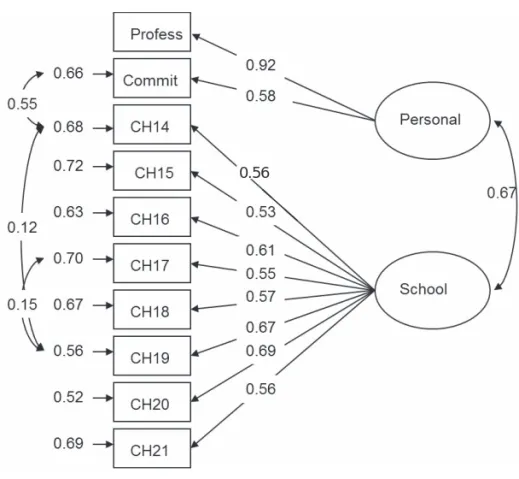
Personal and school characteristics variables comprised the exogenous measurement model together (see Figure 2). The measurement models of these two exogenous variables have been examined individually and respectively in the previous sections. In this section, these two exogenous latent variables were examined as a 2-factor exogenous latent model in the process of confirmatory factor analysis.
The results of the estimation of the CFA of this hypothesized 2-factor exogenous measurement model indicated a reasonable fit. The specified model resulted in a chi- square (χ2 ) of 92.66 with 34 degrees of freedom that is significant at a level of .05 (p < .05). Because of the strong sensitivity of the likelihood ratio chi-square test to the sample size, the fit of the model was also investigated with other goodness-of-fit indices to help with model evaluation (Hu & Bentler, 1999). A Root Mean Square Error of Approximation (RMSEA) of .072 indicated a reasonable fit for this hypothesized exogenous model (Hu & Bentler, 1999). All other fit indices were NNFI = .96; NFI
= .95; CFI = .97; SRMR = .047, suggesting adequate fit. However, RMSEA was still higher than a good model fit; further adjustment was sought by checking the modification index.
Three sets of correlated errors in the exogenous model were determined to estimate the error covariance together. The three sets of correlated errors in the exogenous model were between the indicator of commitment of special educators and
0.56
Figure 2.
Exogenous Measurement ModelNote. Profess: transition professional background; Commit: special education commitment.
CH14 -CH21: items of school characteristics.
item 14; items 14 and 19; items 17 and 19. By looking at the statement of items 14, 17, and 19, it was found that school commitment and administrative support in items 14 and 17 were all related to the commitment and support of the school principal for transition services asked in item 19. As a result, school commitment and support of school principal for transition services further influence teachers’ commitment in transition services. The re-specified model with adjustments in these three sets of correlated errors had a significant improvement from the previous model (see Table 1).
The final specified model resulted in a chi-square (χ2 ) of 56.68 with 31 degrees of freedom, which was statistically significant at a .05 significance level and a Root Mean Square Error of Approximation (RMSEA) of .05 indicating a reasonable model fit. All
Table 1
Fit Indices of Exogenous Model
Model df χ
2△df △ χ
2RMSEA NNFI NFI CFI SRMR
Hypothesized 34 92.66 — — .072 .96 .95 .97 .047
After 1st adjustment (correlate special Ed. commitment and item 14)
33 80.69 1 11.97* .066 .96 .96 .97 .044
After 2nd adjustment (correlate items 17 and 19)
32 68.02 1 12.67* .058 .97 .96 .98 .040
Final model
(correlate items 14 and 19)
31 56.68 1 11.34* .050 .98 .97 .99 .038
Note: RMSEA: Root Mean Square Error of Approximation; NNFI = Non-Normed Fit Index;
NFI = Normed Fit Index; CFI = Comparative Fit Index; SRMR = Standardized Root Mean Square.
*
p < .05.
other fit indices showed that the model fit the data well with NNFI = .98; NFI = .97;
CFI = .99; SRMR = .038. The t values for the observed variables were all significant.
The values of the squared multiple correlations ranged from .28 to .84. Further, the completely standardized loadings ranged from .53 to .92.
Testing the endogenous measurement model
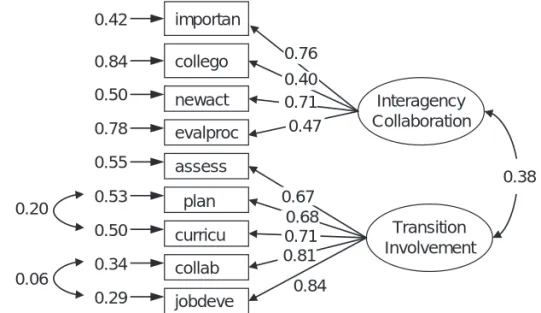
The endogenous measurement model included a mediating endogenous latent variable and an ultimate endogenous latent variable: perceptions of interagency collaboration and transition involvement (see Figure 3). This 2-factor latent model was examined by conducting confirmatory factor analysis and adjusted statistically to adequately represent the observed indicators in this measurement model.
As the other 1-factor measurement models examined previously, the measurement models of these two exogenous variables were examined individually and respectively
importan collego newact evalproc assess
plan curricu collab jobdeve
Interagency Collaboration
Transition Involvement 0.42
0.84 0.50 0.78 0.55 0.53 0.50 0.34 0.29
0.38 0.20
0.06
0.76 0.40
0.84 0.71
0.47
0.67 0.68 0.71 0.81
Figure 3.
Endogenous Measurement ModelNote. Importan: importance of interdisciplinary collaboration; collego: collective ownership of
goals; newact: newly creative professional activities; evalproc: evaluation on collaborative process; assess: transition assessment; plan: transition planning; curricu: transition instruction & curriculum; collab: interagency collaboration; jobdeve: job development.in the previous sections. In this section, the results of the initial estimation of the CFA of this endogenous measurement model were not acceptable since there was a chi- square value of 113.88 with 26 degrees of freedom (p < 0.05) and a RMSEA of .102, suggesting that estimated parameters should be adjusted. Other fit indices indicated an almost adequate model fit with NNFI = .92; NFI = .93; CFI = .94; SRMR = .053. With the results of the combination of fit indices, further adjustments for a better model fit were sought using the modification index.
According to the results of the modification index, two pairs of correlated errors were determined to estimate the error covariance together. They occurred between transition planning and transition instruction and curriculum (MI = 51.90), and interagency collaboration and job development (MI = 25.69). For teachers in secondary schools, these two sets of indicators are conceptually and empirically related in that they establish transition components in the individualized transition planning for each
student with special needs. Therefore, the error covariance between the indicators in these two sets of correlated errors were specified and estimated in the modified model (see Table 2).
Table 2
Fit Indices of Endogenous Model
Model df χ
2△df △ χ
2RMSEA NNFI NFI CFI SRMR
Hypothesized 26 113.88 — — .102 .92 .93 .94 .053
After 1st adjustment (correlate transition planning and transition curriculum errors)
25 85.32 1 28.56* .086 .94 .94 .96 .054
Final model (correlate job development and interagency collaboration errors)
24 60.46 1 24.86* .068 .96 .96 .97 .046
Note. RMSEA: Root Mean Square Error of Approximation; NNFI= Non-Normed Fit Index; NFI
= Normed Fit Index; CFI = Comparative Fit Index; SRMR = Standardized Root Mean Square
*
p < .05.
The re-specified model resulted in a chi-square (χ2 ) of 60.46 with 24 degrees of freedom, which was statistically significant at a .05 significance level and a RMSEA of .068 indicating a reasonable model fit. All other fit indices showed that the model fit the data well with NNFI = .96; NFI = .96; CFI = .97; SRMR = .046. The t values for observed variables were all significant. The values of the squared multiple correlations ranged from .16 to .81. Further, the completely standardized loadings ranged from .40 to .84.
Results
Analyses of Hypotheses Testing and the Initial Hypothesized Model
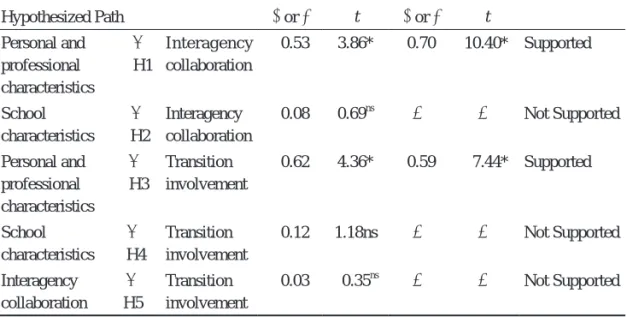
The hypothesized theoretical model and proposed five research hypotheses in this study were tested using the LISREL program. The results only supported partially the relations between latent constructs proposed in the hypothesized model. The summary of the hypothesis testing was reported in Table 1. A total of five hypotheses were tested using structural equation modeling and are detailed as follows.
Hypotheses 1 and 2 postulated that there are direct, and positive relationships between personal and professional characteristics and perceptions of interagency collaboration, as well as school characteristics and perceptions of interagency collaboration. The results of the structural equation modeling analysis indicated that only the path from personal and professional characteristics to the perceptions of interagency collaboration of secondary special educators was significant (t-value = 3.85,
p < .05). Personal and professional characteristics included two indicators of transition
professional background and special education commitment. Hence, the transition professional training teachers received had a positive relationship with teachers’perceptions of interagency collaboration. In this study, special education teachers or transition coordinators reported that school policy and administrative support did not directly relate to their perceptions of interagency collaboration.
Hypotheses 3 and 4 posited a positive relationship between personal and professional characteristics and transition involvement, as well as between school characteristics and transition involvement. Again, the relationship between personal and professional characteristics and transition involvement was the only significant path (t-value = 4.35, p < .05).
Hypothesis 5 investigated the relationship between the perceptions of interagency collaboration of secondary special educators and their transition involvement. The
standardized coefficient and t-value associated with these two constructs were not positively significant (t-value = -0.35, p < .05). Accordingly, hypothesis 5 was not supported.
The results of analyses for this initial model resulted in a chi-square value of 343.65 with 141 degrees of freedom, which was statistically significant at a .05 significance level and a RMSEA value of .067, suggesting a reasonable fit. Other fit indices revealed that the initial, hypothesized model fit the data well with NNFI = .95;
NFI = .94; CFI = .96; SRMR = .067. Overall, the results of analyses indicated that the hypothesized model fit the collected data well in the study.
Simplified Structural Model
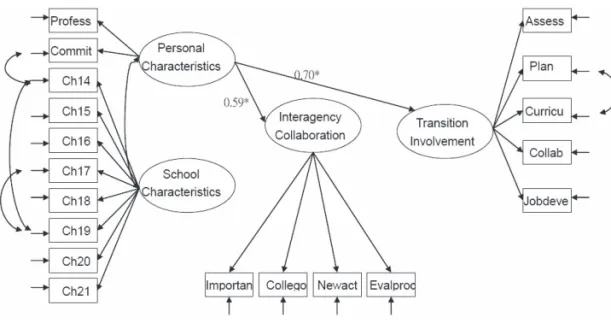
The review of the estimation results revealed that three direct paths were not significantly explained by the hypothesized model. They were: school characteristics to transition involvement; school characteristics to interagency collaboration; and interagency collaboration to transition involvement (see Table 3). These three non- significant paths were removed based on the principal of parsimony and the simplified model with three paths removed still fit well with the collected data. The value of the chi-square dropped to 341.77 with 144 degrees of freedom and the value of RMSEA dropped a little bit to .066. Other fit indices stayed the same except the SRMR increased a little bit from .067 to .068. The results of the t-tests also indicated a non- significant error covariance between interagency collaboration and job development in the endogenous model. Therefore, this correlated error path was also removed. After these adjustments, the final model with the value of chi-square increased slightly to 345.52 with 145 degrees of freedom but other fit indices stayed the same. The chi- square difference tests between the previous model and the simplified model showed that there were no statistically significant differences at the .05 significance level, indicating that dropping these parameters from the model did not reduce the fit of the model.
Indirect effects of exogenous latent variables on transition involvement were also
examined. Indirect influences of personal and professional characteristics and school characteristics on transition involvement were found not significant, respectively (standardized indirect effect = -0.02, t = -0.34; standardized indirect effect = 0, t
= -0.35). Eventually, this final model explained 50% of the variance of transition involvement, and 35% of the variance of interagency collaboration (see Table 3 &
Figure 4 for the simplified structural model).
Table 3
Standardized Coefficients of Model Paths
Initial estimation After adjustment Results
Hypothesized Path β or γ
t
β or γt
Personal and → professional H1 characteristics
Interagency collaboration
0.53 3.86* 0.70 10.40* Supported
School → characteristics H2
Interagency collaboration
0.08 0.69ns — — Not Supported
Personal and → professional H3 characteristics
Transition involvement
0.62 4.36* 0.59 7.44* Supported
School → characteristics H4
Transition involvement
0.12 1.18ns — — Not Supported
Interagency → collaboration H5
Transition involvement
-0.03 -0.35ns — — Not Supported
Note.
β = standardized path coefficient between endogenous latent variables; γ = standardized path coefficient between exogenous and endogenous latent variables; ns: non-significant atp > .05.
*
p < .05.
Supplemental Analyses
After a series of analyses, the areas of misspecification in the hypothesized model were found. The results indicated that educators’ involvement in the transition practice is neither a function of their school characteristics nor a function of their perceptions
Figure 4.
Simplified Structural Model of Transition InvolvementNote. Profess: Transition professional background; Dynamic: Interpersonal dynamics; Commit:
of special educators; Importan: Importance of interdisciplinary collaboration; Collego:
Collective ownership of goals; Newact: Newly creative professional activities; Evalproc:
Evaluation on collaborative process; Assess: Transition assessment; Plan: Transition planning; Curricu: Transition instruction & curriculum; Collab: Program evaluation and interagency collaboration; Jobdeve: Job development. CH14-CH21: question items of school characteristics.
of interagency collaboration. There was no mediating effect of educators’ perceptions of interagency collaboration between school characteristics and educators’ transition involvement. After the findings of the analyses used to answer the research questions were revealed, supplemental analyses of structural relationships among the latent variables were further conducted in an exploratory manner.
The results of the hypothesized model testing revealed that the factor of personal characteristics was key in affecting educators’ perceptions of interagency collaboration and their transition involvement. Although the effects of school characteristics in the model on both educators’ perceptions of interagency collaboration and transition involvement were not significant in the present study, school characteristics and personal and professional characteristics had been found to correlate with each other
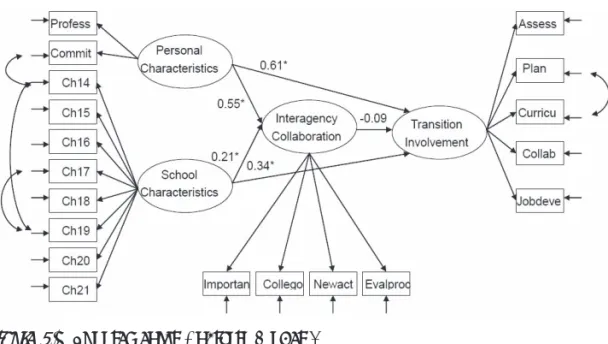
in prior research (Benz et al., 2000; Foley & Lewis, 1999; Foley & Mundschenck, 1997; Miller, 1990). The results of this study also indicated a statistically significant bivariate correlation between school characteristics and personal and professional characteristics (r = .71), suggesting that the relationship between school characteristics and educators’ transition involvement are positively associated with the relationship between personal characteristics and educators’ transition involvement. In order to further examine the relationship between personal and professional characteristics and school characteristics, supplemental analyses were conducted.
The first supplemental analysis was conducted by statistically removing the correlation between school and personal characteristics and then reexamining the dynamic relationships in the model. The results showed that the direct effect from school characteristics to educators’ perceptions of interagency collaboration became significant (t-value = 2.95, p < .05). The other direct effect from school characteristics to educators’ involvement also became significant (t-value = 5.02, p < .05). These findings revealed a spurious relationship between school characteristics and educators’
transition involvement, as well as educators’ perceptions of interagency collaboration (see Figure 5). A spurious relationship suggests that the relationship between school characteristics and both transition involvement and interagency collaboration might actually be due to some third variable; in this case, personal characteristics.
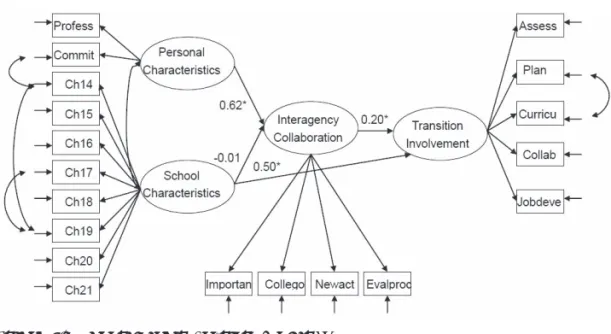
The second supplemental analysis was conducted to further examine the relationship between interagency collaboration and transition involvement. The results indicated that the path from interagency collaboration to transition involvement would be significant if the structural model did not include the path directly from personal and professional characteristics to transition involvement (t-value = 2.80, p < .05). This also indicated a spurious relationship between interagency collaboration and transition involvement in this study (see Figur6).
Figure 5.
Supplemental Analysis Model INote. Profess: Transition professional background; Dynamic: Interpersonal dynamics; Commit:
of special educators; Importan: Importance of interdisciplinary collaboration; Collego:
Collective ownership of goals; Newact: Newly creative professional activities; Evalproc:
Evaluation on collaborative process; Assess: Transition assessment; Plan: Transition planning; Curricu: Transition instruction & curriculum; Collab: Program evaluation and interagency collaboration; Jobdeve: Job development. CH14-CH21: question items of school characteristics.
Discussion
This study offers an approach of structural analysis (structural equation modeling) to facilitate an understanding of the critical components for transition practice in secondary schools. The guiding principle of this study is that an effective transition practice can be enhanced after a better understanding of the relationship among the factors. This study integrated theoretical and empirical evidence about the structural relationships among the following constructs: (a) personal and professional characteristics, (b) school characteristics, (c) perceptions of interagency collaboration, and (d) transition involvement. The perceptions of secondary school special educators were investigated concerning interagency collaboration at their respective schools.
Figure 6.
Supplemental Analysis Model IINote. Profess: Transition professional background; Dynamic: Interpersonal dynamics; Commit:
of special educators; Importan: Importance of interdisciplinary collaboration; Collego:
Collective ownership of goals; Newact: Newly creative professional activities; Evalproc:
Evaluation on collaborative process; Assess: Transition assessment; Plan: Transition planning; Curricu: Transition instruction & curriculum; Collab: Program evaluation and interagency collaboration; Jobdeve: Job development. CH14-CH21: question items of school characteristics.
Their personal and professional characteristics, school characteristics, perceptions of interagency collaboration, and transition involvement were assessed as critical sources of testing the proposed structural model in this study.
Five hypotheses were proposed to examine the relationships among the four constructs in the model. The findings of the structural analysis supported Hypotheses 1 and 3 (see Table 1), and revealed that personal and professional characteristics have a strong relationship with both educators’ perceptions of interagency collaboration and their transition involvement (γ = .70 and .59, respectively). These results indicated that personal and professional characteristics are key to educators’ involvement in transition practice and their understanding of interagency collaboration. However, this study did not support Hypotheses 2, 4, and 5. There is no positive relationship between school characteristics and educators’ perceptions of interagency collaboration, nor
between school characteristics and educators’ transition involvement, when personal and professional characteristics are taken into account. Additionally, there is no positive relationship between educators’ perceptions of interagency collaboration and their transition involvement.
Specifically, this study demonstrated that the more the educators perceive adequacy of transition professional training and commitment of special education, the more they are likely to be involved in transition practice. For example, positive perceptions of adequate training in terms of transition assessment, planning, and organizing instruction for facilitating students’ post-school activities, and interagency collaboration make educators more involved in a variety of activities in their transition practice. Also, as educators have a stronger commitment to special education’s role in the transition process, they tend to be more involved in transition practice. These results are consistent with previous studies that suggested that lack of adequate training background of educators might be a reason for their self-perceived professional weakness and low level of involvement in some transition activities (deFur & Taymans, 1995; Foley & Mundschenck, 1997; Foley, Mundschenck, & Miller, 1993; Knott &
Asselin, 1999; Wasburn-Moses, 2006). Many educators are learning on the job how to develop and execute transition related activities as they did not receive training for transition practice (Blalock et al., 2003; Morningstar & Clark, 2003); thus, a stronger commitment to special education training for transition services may assist special educators to be more involved in transition practice.
The other hypothesis supported by the study was that educators’ perceptions of interagency collaboration is a function of their personal and professional characteristics.
As previous studies discussed (deFur & Taymans, 1995; Foley & Mundschenck, 1997;
Foley et al., 1993; Knott & Asselin, 1999), inadequate professional preparation either at the preservice or inservice levels leads to educators’ self-perceived professional weaknesses in interagency collaboration. Educators with higher levels of professional preparation perceived more importance for interagency collaboration, and are more likely to be involved in activities of interagency collaboration. On the contrary,
educators with lower levels of professional preparation may limit their attempts at meaningful collaboration activities, and ultimately diminish to mere sharing of information with their collaborators (Foley & Mundschenck, 1997). This finding validates the 2003 position statement of the Division on Career Development and Transition (Blalock et al., 2003) and illustrates the need for teacher preparation programs to place greater emphasis on development of interagency collaboration competency for secondary special educators in view of increased importance of roles of schools and special educators in today’s comprehensive service delivery system for students with disabilities.
With regard to the relationship between interagency collaboration and transition involvement, the findings of this study did not support hypothesis 5 and indicated that there is no significant relationship between these two variables in the model.
However, the results of the supplemental analyses indicated that relationship between educators’ interagency collaboration and transition involvement found in previous studies (Kohler, 1993; Kohler, DeStefano, Wermuth, Grayson, & McGinty, 1994;
Morningstar & Kleinhammer-Tramill, 1999; Rusch, Kohler, & Hughes, 1992) may have been spurious. The previous studies failed to control for personal and professional characteristics, which appear to be the factor largely responsible for the apparent relationship between special educators’ perceived interagency collaboration and their transition involvement. In the present study, educators’ transition involvement was significantly affected by educators’ perceptions of interagency collaboration. Once the effect of educators’ personal and professional characteristics on their transition involvement was considered (statistically controlled), the significant relationship between educators’ transition involvement and perceptions of interagency vanished.
Therefore, the relationship between educators’ perceptions of interagency collaboration and educators’ transition involvement is overshadowed by the impact of personal and professional characteristics, which is a key factor to educators’ transition practice.
This finding is informative and expands on the understanding of recommended best transition practice that researchers have studied. Professional preparation can
be seen as the major factor to the success of a transition program, and moreover, to the success of special education services. The ultimate goal of special education is assist in positive post-school outcomes for students with disabilities. Current literature in special education continues to advocate for the success of students and presents multiple factors contributing to a student’s successful post-school outcome. However, the truth may be masked by the fragmented information provided in previous studies and the field requires for more in-depth investigation reflecting the complex interplay of multiple determinants of the success of transition practice.
The findings of the structural analysis did not support Hypotheses 2 and 4, indicating that school characteristics did not have direct relationships with educators’
perceptions of interagency collaboration and their transition involvement. Again, the supplemental analyses revealed that spurious relationships may have existed in the prior research that found school characteristics to be an important factor (Benz et al., 2000;
Foley & Lewis, 1999). These relationships are overshadowed by educators’ personal and professional characteristics, including their transition professional training and commitment of special education in the transition process. Although characteristics of secondary schools did challenge the development and implementation of collaborative- based structures and findings of previous studies suggested that administrative support contributes to the success of programs (Foley & Lewis, 1999), educators on the front line are still the primary reason for successful transition practices. It would be overwhelming for educators if they were not well prepared for involvement in this comprehensive service delivery system; school leaders and staff must consistently facilitate the process of transition practice.
Implications of Research Findings Theoretical implications
One of the significant contributions of this study is the verification of transition practice by examining various components of the hypothesized latent variable model of transition involvement, including the construct meaning of each latent trait and their
bivariate relationships; meanwhile, overall dynamics among the four latent variables were also investigated in the structural model of transition involvement. Too often, researchers in special education view teacher knowledge as effective teaching that is content specific and can be evaluated and validated as a single element. In such narrow and assumed direct relationships, important factors could be left out and a spurious relationship could mask the truth. The methodology applied in this study opens a new possibility in the transition research community to approach what researchers intend to examine. Perhaps most importantly, the findings of this study demonstrated that factors that influence educators’ transition involvement are multi-dimensional and dynamic.
This study established the theoretical construct for each latent trait in the model and examined these four latent traits empirically, as very few studies have documented the reliability and validity information of instruments administered in the field of transition. This study also demonstrated how educators’ personal and professional characteristics positively influence their perceptions of interagency collaboration and their transition involvement through a certain relationship with school characteristics.
The effects of school characteristics on both educators’ perceptions of interagency collaboration and transition involvement are associated with the effects of personal and professional characteristics on these two variables. Spurious relationships existed between school characteristics and educators’ perceptions of interagency collaboration, as well as educators’ transition involvement. When considering or controlling for the effects of personal and professional characteristics on both educators’
perceptions of interagency collaboration and transition involvement, the effects of school characteristics on these two variables vanished. A spurious relationship existed as well between educators’ perceptions of interagency collaboration and their transition involvement when the direct effect of educators’ personal and professional characteristics on their transition involvement was not included. The results of these analyses distinguished the effects of personal and professional characteristics from the effects of school characteristics and educators’ perceptions of interagency collaboration on these relationships to be more important and influential.
While findings in prior research have demonstrated that the role of interagency collaboration has an influential impact on successful outcomes of transition programs (Kohler, 1993; Kohler et al., 1994; Morningstar & Kleinhammer-Tramill, 1999; Rusch et al., 1992), this study empirically revealed that educators’ personal and professional characteristics, including their transition professional background and special education commitment, play a more significant role in educators’ perceptions of interagency collaboration and their involvement in these transition programs. The results of this study should not be construed that school characteristics are not important to assist educators’ interagency collaboration or that educators’ perceptions of interagency collaboration is not important to impact educators’ transition involvement, but the relationships among these factors are dominated by educators’ personal and professional characteristics, which demonstrated a stronger impacts on educators’
perceptions of interagency collaboration as well as their transition involvement. The discovery of this study expands on the findings of previous studies and provides information concerning the powerful influence of educators’ personal perspectives on the success of transition programs.
This study contributes to the theoretical advancement in the field of transition by expanding on the findings that have been proposed in previous studies, explaining the success of transition practice. Personal characteristics, an important element to educators’ transition involvement, were identified as a critical factor overshadowing the relationship between educators’ perceptions of interagency collaboration and transition involvement. When educators perceive higher levels of transition professional training, they have higher levels of understanding of interagency collaboration and are more competent to be involved in collaborative activities and, finally, may demonstrate better practice in providing transition services for students with disabilities. The findings demonstrate that personal and professional characteristics are key in contributing to educators’ recommended best transition practice.
The model developed and tested in this research provides a theoretical enrichment for the study of recommended best transition practice. Many factors contributing
to the success of transition programming emerged from several investigations, both empirically and theoretically. This model can be utilized to examine different mediating factors and compare their commonalities to determine changes in the interplay among elements in transition involvement. For example, the Taxonomy for Transition Programming revealed five important indicators to “best” transition practice (Kohler, 1996), including interagency collaboration, student-focused planning, student development, family involvement, and program evaluation. Like the factor of interagency collaboration examined in this study, the other four factors can be investigated by using this model. The theoretical model may be helpful in directing future research in two aspects. First, each element relates to components in the model that should be examined and evaluated to provide reliability and validity information;
once these are identified and provided, then the research may further proceed to investigate the dynamic relationships among components, including their roles and influences in the model.
Practical implications
The other implications for practice in secondary schools and personnel preparation programs are addressed in this section. First of all, this study revealed that secondary special educators surveyed only participated in the activities of interagency collaboration occasionally and slightly agreed that they have had adequate training in interagency collaboration. Through respondents’ demographic information, some participants reported their positions as consultants. A special educator usually plays the role of consultant in the school-based team and works cooperatively with regular classroom teachers to develop interventions for educational problems. In such a consultation model, special educators provide their expertise to assist in problem solving.
However, as illustrated by Halpern (1994), transition for students with disabilities involves a variety of changing roles that is in need of many resources and expertise from different professionals. Special educators involved in transition practice not only provide their expertise as consultants but also seek expertise from a variety of sources
and coordinate the application of such expertise across systems, including school and non-school systems. The role of the special educator as a consultant is expanded when the special educator is involved in interagency collaboration in the transition process.
As a result, educators must become knowledgeable about the services and expertise each system can provide, and how to access and coordinate the services, and expertise from different systems. Many participants, by writing supplemental notes on their surveys, indicated that they were learning by doing, and their transition competencies were the results of on-the-job training as well as engagement in conferences and workshops. Obviously, with the complex nature of interagency collaboration, lack of adequate training may explain educators’ low involvement in activities of interagency collaboration. The results suggest that special educators continue to develop their knowledge and skills in interagency collaboration. Besides in- service training activities such as conferences and workshops, schools may encourage educators to pursue advanced degrees or training (e.g., endorsements, transition specialist certificates, masters, and doctorate degrees).
In addition to in-service training, the findings of this study also indicated a need for special educators’ pre-service training. Personnel preparation programs need to provide more professional training on both collaboration knowledge and skills for special educators. Unfortunately, the professional preparation of special educators has been found not to focus on development of collaboration skills and knowledge (Anderson et al., 2003; Beard, 1991; Bull, Montgomery, Beard, & Az, 1994; Mellard
& Clark, 1993). With the recognition of the importance of collaborative work in educational practice, researchers continue to advocate the enhancement of collaboration knowledge and skills in professional preparation programs (Foley & Mundschenck, 1997; Morningstar & Clark, 2003; Simpson et al., 1993). The results of this study echo the views of prior research and suggest that pre-service special educators may benefit from coursework that emphasizes prerequisite knowledge and skills, such as the purpose of interagency collaboration, types of structure for collaboration, barriers to effective interagency collaboration, resource exploring skills, and communication skills.