
台灣學生語言行為「感激」之中介語研究
203
0
0
全文
(2) ACKNOWLEDGEMENTS The thesis is a product of the Chinese-English Interlanguage Speech Acts Project (NSC 93-2411-H-017-011; NSC 94-2411-H-110-010; NSC 95-2411-H-110-005), sponsored by National Science Council and National Sun Yat-sen University. I would like to express my deepest gratitude to my advisor, Prof. Yuh-Huey Lin, not only for her including me to the project but also for her consistent support and guidance. But for her encouragement and confidence in me, the thesis would not have been completed. She was always generous in providing help, insightful suggestions and comments which kept inspiring me new ideas. I would also like to express my special thanks to Prof. Shu-ing Shyu, who was also the committee member, for she was always generous in helping me with both academic and non-academic issues all the time; to Prof. Hsiu-min Yu for her generous offer of the data needed for the study, and the other two committee members, Prof. Feng-fu Tsao and Prof. Shu-chen Ou for their concrete and valuable suggestions which were beneficial to the thesis and insightful to my future studies. My gratitude extends to all the other professors, Prof. Mei-Zhi Tsai, Prof. Ming-yu Tseng, Prof. Yu-Feng Yang. Their inspiring instruction not only broadened my vision in different fields of applied linguistics but also motivated me to explore new research topics. I am also grateful to all the participants for their generous help and positive feedbacks; to the group members, Hong-Wei Lin for his help in collecting and dealing with the data; Yi-Ting Tsai and Chia-Hui Lee for their advises on the study; to Ya-Li Hsieh and Shu-Ping Huang for their encouragement when I was under pressure, and to all the classmates whoever gave me suggestions and helped me. Last but not least, I want to thank my family, especially my dearest mother. Without her support, love and patience, I would not have had the opportunity to pursue the advanced study. ii.
(3) 摘要. 感激行為的表達在社交互動上有其重要的功能。Eisenstein & Bodman (1993) 提 到,適當地表達出感激行為的功能「可以在交談者間產生溫馨及親近的感受 (“can it engender feelings of warmth and solidarity among interlocutors.”)」(p. 167)。 然而,相較於其它廣被研究討論的言談行為,例如「道歉」及「請求」,「感激」 言談行為的研究相對較少被提及。本研究旨在探討台灣英語學習者在感激行為中 介語(interlanguage)的表現,涵蓋「語言感知 (perception)」以及「語言行為表現 (production)」。研究語料來自:60 位美國大學生英語基準語料 (English baseline data)、60 位台灣大學生中文基準語料 (Chinese baseline data)以及 60 位台灣大學 生英語中介語語料,各組男女受試者各半,其中台灣英語學習者又分為英語主修 以及非英語主修兩組。語料收集工具為言談情境填充問卷 (Discourse Completion Test) 以及五點尺度量表 (Five-point Scale Response Questionnaires),藉以收集受 試者情境變數 (contextual factors): 「施惠者社會地位 (social status)」 、 「與施惠者 的社會距離 (social distance)」、「情境困擾程度 (imposition)」以及「施惠者性別 (interlocutor gender)」對「感激程度 (degree of gratefulness)」 、 「困擾程度 (degree of imposition)」、「施惠者期待感激的可能性 (likelihood of gratitude expectation)」 的語言感知以及感激語言行為表現語料。語言感知結果顯示兩組母語受試者均呈 現相同的趨勢:越是覺得對施惠者帶來更大的困擾、對施惠者的感激程度越高、 施惠者期待其表達感激的可能性更高。美國大學生在「困擾程度」 、 「施惠者期待 感激的可能性」兩項的感知明顯高於台灣大學生。以情境變數而言,「施惠者社 會地位」對台灣學生的語言感知有較明顯的影響;「與施惠者的社會距離」則對 美國學生有較顯著的影響。言談情境填充問卷的分析結果顯示,兩組母語受試者 所使用的主要感激策略大致相同,差異主要在次策略的分布以及其語意特徵。以 策略數目而言,兩組人均在困擾程度較高的情境裡使用較多的策略,但整體而. iii.
(4) 言,美國大學生使用較多感激策略。兩組英語學習者在感激策略的使用上大致與 兩組母語人士相同,兩組學習者甚少出現社會語用的負面遷移(negative sociopragmatic transfer),唯非英語主修組在語言使用的正確程度(linguistic accuracy)、策略使用數目以及說話長度低於英語主修組。由於本研究僅著重在受 惠者的單向反應,建議將來進一步分析情境扮演語料、與受試者訪談另收集自然 語料等以對感激行為有較全面性的了解。. 關鍵字:感激、中介語、言談行為. iv.
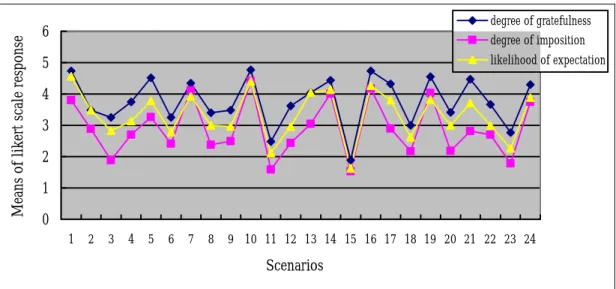
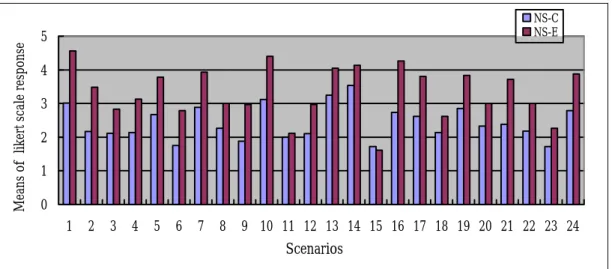
(5) ABSTRACT. Expressing gratitude has a significant function in societal interaction. As Eisenstein and Bodman (1993) suggested, only when the function of gratitude is expressed appropriately can it “engender feelings of warmth and solidarity among interlocutors” (p.167). However, compared with other widely discussed speech acts such as apology and request, the speech act of expressions of gratitude seldom drew researchers’ attention. The present study hence focuses on investigating EFL (English as foreign language) learners’ behavior in realizing expressions of gratitude on the basis of cross-cultural comparison of NS-Cs (Native speakers of Chinese) and NS-Es (Native speakers of English) in terms of perception and production performances. Data used for analysis cover 60 NS-E, 60 NS-C, and 60 EFL speakers’ data elicited from Discourse-Completion-Task (DCT) questionnaire which consisted of 24 scenarios in which four contextual factors, comprising social distance, social status, gender of interlocutor and severity of the situation were embedded. Scale-Response questionnaire (SRQ) was designed to obtain two cultural groups’ perception in terms of degree of imposition, degree of gratefulness, and likelihood of the expectation of benefactors. The EFL group was further categorized into two groups on the basis of proficiency level. Among each group, the number of male and female participants was even. The result of SRQ shows that both cultural groups generated the same tendency, that is, the greater imposition the informant felt s/he caused to the benefactor, the more grateful s/he felt and the more likely s/he thought the benefactor would expect receiving expressions of gratitude. NS-Es’ perceptions on the likelihood of gratitude expectation and degree of imposition were significantly higher than NS-C group’s. In terms of the contextual factors, NS-C participants were found to be more sensitive to relative social status while NS-E participants were more sensitive to relative social v.
(6) distance. The analysis of DCT data shows that NS-Cs and NS-Es generated similar strategies in gratitude-provoking situations and NS-E group generated greater amount of strategy use. Both groups generated more strategies and lengthier utterances in situations bearing greater imposition. EFL groups were found to generate similar strategy uses as the two cultural groups did. Accordingly, the occurrence of negative sociopragmatic transfer was rare while negative pragmalinguistic transfer was more observable. Some linguistic properties of transfer reflected the cultural orientation. Instead of pragmatic performance, proficiency level seemed to be influential in linguistic accuracy, amount of strategy use and length of utterances. The limitation of the study suggests future study conduct on natural utterances, oral DCT, introspective interview with the informants and further discussion on role-play data to get a more comprehensive understanding of the behavior of expressions of gratitude realized by NS-Cs, NS-Es and EFL learners.. KEYWORDS: expressions of gratitude, interlanguage, speech act. vi.
(7) TABLE OF CONTENTS. ACKNOWLEDGEMENTS ........................................................................................ii ABSTRACT..................................................................................................................v TABLE OF CONTENTS...........................................................................................vii LIST OF TABLES........................................................................................................x LIST OF FIGURES ...................................................................................................xii LIST OF ABBRIVIATIONS ....................................................................................xiv CHAPTER 1. INTRODUCTION .............................................................................1. 1.1. Background and Motivation ......................................................................1. 1.2. Purpose of the Study ...................................................................................4. 1.3. Overview of the Chapters...........................................................................5. CHAPTER 2. LITERATURE REVIEW .................................................................6. 2.1. Speech Act Theory ......................................................................................7. 2.2. Politeness Principle ...................................................................................10 2.2.1. 2.3. The Notion of Face ..........................................................................11. Collectivism vs. Individualism .................................................................12 2.3.1 High-Context Communication vs. Low-Context Communication .....14. 2.4 Miscommunication....................................................................................15 2.4.1 Communicative Competence ..............................................................16 2.5. Pragmatics .................................................................................................17 2.5.1 Interlanguage Pragmatics.................................................................18 2.5.2 Pragmatic Failure/Transfer ..............................................................19. 2.6. The Speech Act of Expressions of Gratitude ..........................................22 2.6.1 2.6.2. CHAPTER 3. Thanking in Chinese ........................................................................27 Previous Studies on Gratitude Behavior ..........................................28 METHOD.........................................................................................38 vii.
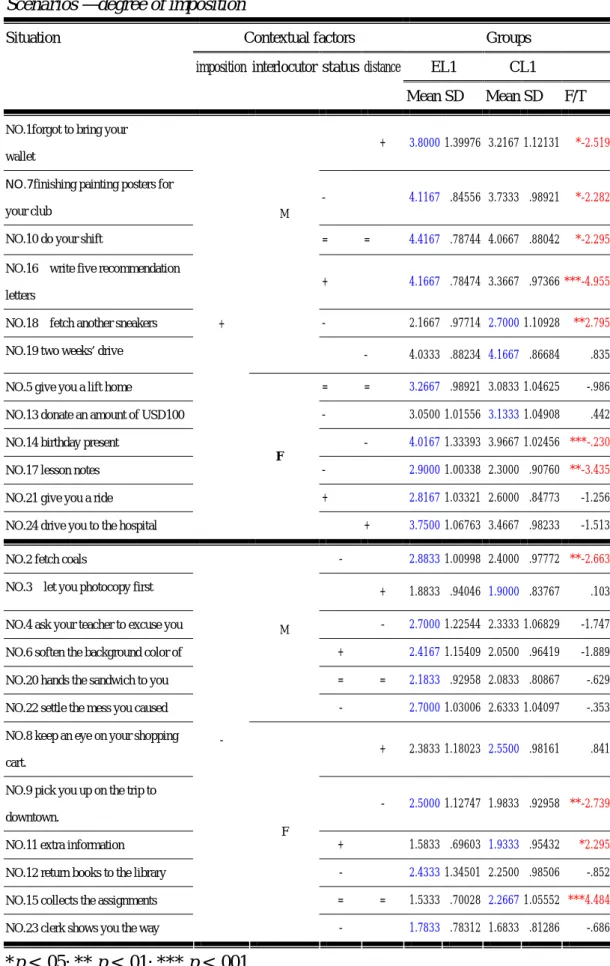
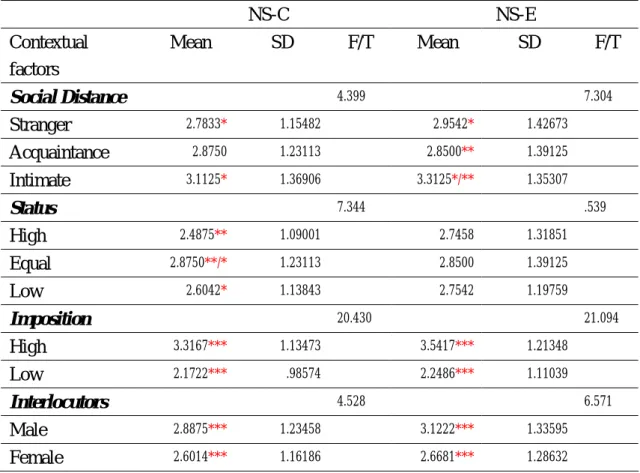
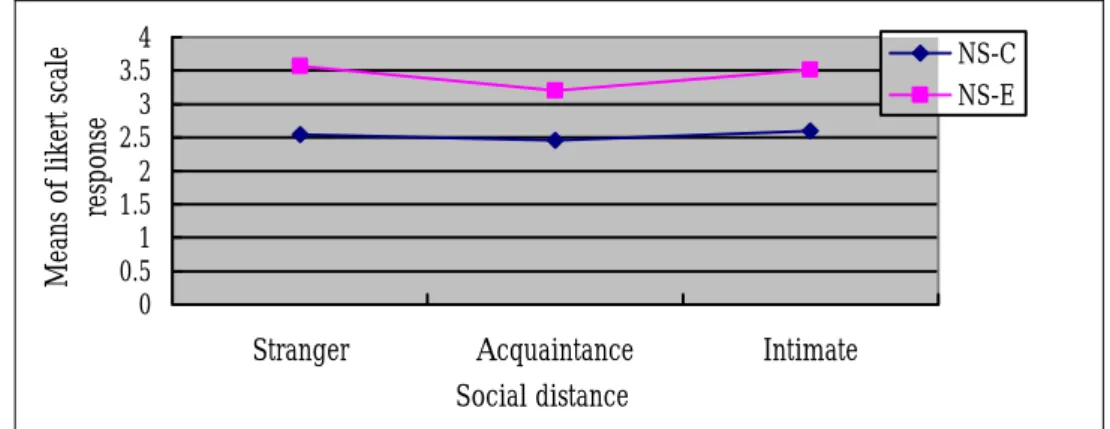
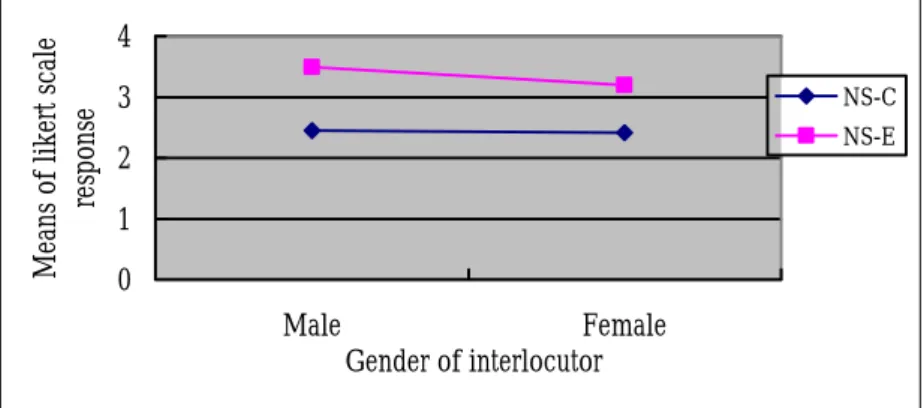
(8) 3.1. Participants................................................................................................39. 3.2. Instruments................................................................................................40 3.2.1 Discourse Completion Tasks (DCTs)...............................................40 3.2.2 Scaled-Response Questionnaire (SRQ) ...........................................43. 3.3. Procedure of Data Collection ...................................................................47. 3.4. Coding System and Data Analysis...........................................................47 3.4.1 Coding System of the Present Study................................................50 3.4.1.1 Stra. A: Explicit Expression of Thanking/Gratitude .............50 3.4.1.2 Stra.B: Suggesting Indebtedness...........................................53 3.4.1.3 Stra. C: Showing the Intention to Repay/Reciprocate ..........55 3.4.1.4 Stra.D: Indicating Caring .....................................................59 3.4.1.5 Stra.E: Implying Request ......................................................60 3.4.1.6 Star. F: Asking Questions......................................................61 3.4.1.7 Stra.G: Complimenting .........................................................63 3.4.1.8 Stra.H: Value Judgment ........................................................64 3.4.1.9 Stra.I: Terms of Calling.........................................................64 3.4.1.10 Stra.J: Suggesting Affection ................................................66 3.4.1.11 Stra.K: Expressing Relief ....................................................68 3.4.1.12 Stra.: L: Further Talk ..........................................................69 3.4.1.13 Stra. M: Promising..............................................................71 3.4.1.14 Stra. N: Pause Filler ...........................................................71 3.4.1.15 Stra. O: Accepting the Offer................................................71 3.4.1.16 Stra. P: Nonverbal Communication....................................72 3.4.1.17 Stra Q: Opt-Out ..................................................................72 3.4.1.18 Stra.R: refusal .....................................................................72 3.4.1.19 Stra.S: Avoiding ..................................................................73 3.4.1.20 Stra. T: Warning/Criticizing ................................................73. CHAPTER 4 4.1. RESULTS & DISCUSSION ...........................................................74. Result of SRQ ............................................................................................74 4.1.1 Degree of Gratefulness ....................................................................84 i. Social Distance .................................................................................84 ii. Status................................................................................................85 iii. Imposition .......................................................................................86 iv. Interlocutor......................................................................................87 v. Summary ...........................................................................................88 viii.
(9) 4.1.2 Degree of Imposition .......................................................................88 i. Social Distance .................................................................................89 ii. Status................................................................................................90 iii. Imposition .......................................................................................91 iv. Interlocutor......................................................................................91 v. Summary ...........................................................................................92 4.1.3 Likelihood of Gratitude Expectation ...............................................93 i. Distance ............................................................................................93 ii. Status................................................................................................94 iii. Imposition .......................................................................................95 iv. Interlocutor......................................................................................95 v. Summary ...........................................................................................96 4.2. The Number of Gratitude Strategies & Length of Utterances .............97. 4.3. The Realization of Gratitude Strategy ..................................................103. 4.4. EFL Interlanguage Expressions of Gratitude ......................................135 4.4.1 Pragmatic Transfer .........................................................................136 4.4.1.1 Summary of the realization of EFL Groups’ Expressions of Gratitude: Negative Sociopragmatic Transfer ...................................145 4.4.1.2 Summary of the realization of EFL Groups’ Expressions of Gratitude: Negative Pragmalinguistic Transfer .................................146 4.4.2 Pragmatic Overgeneralization........................................................147 4.4.3 Teaching-induced Errors ................................................................148. CHAPTER 5. CONCLUSION..............................................................................150. 5.1. Summary of the Findings .......................................................................150. 5.2. Pedagogical Implications........................................................................153. 5.3. Limitations of the Study and Suggestions for Further Study .............154. REFERENCES.........................................................................................................156 APPENDIX...............................................................................................................163 APPENDIX A: Questionnaire: Chinese Version for NS-C...........................163 APPENDIX B: Questionnaire: English Version............................................174 APPENDIX C: Transcription from Koutlaki (2002) ....................................187. ix.
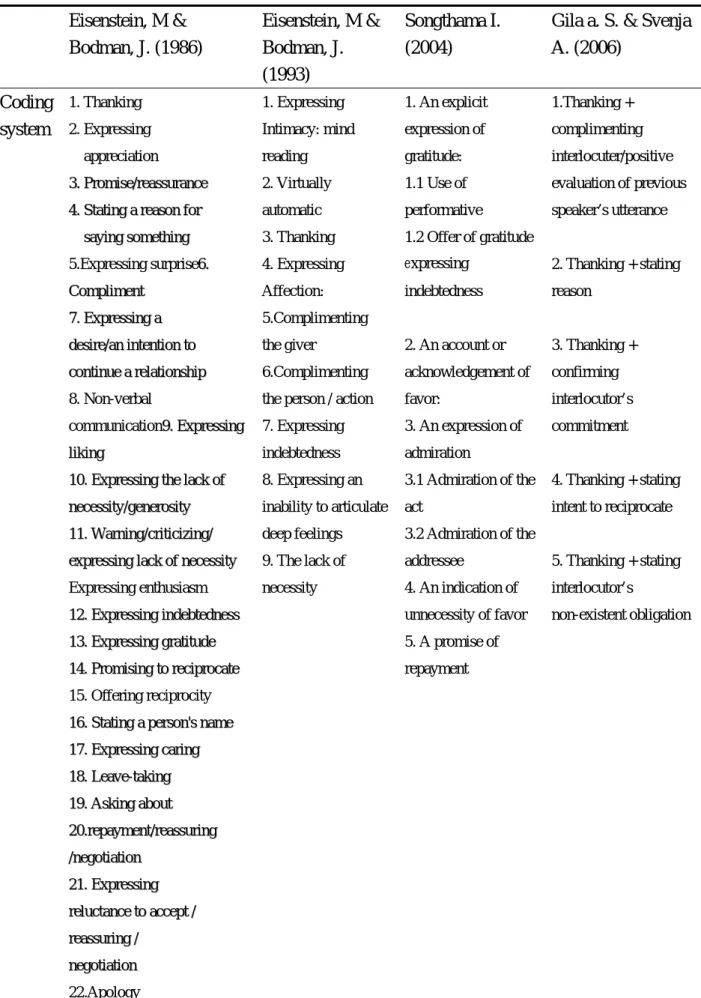
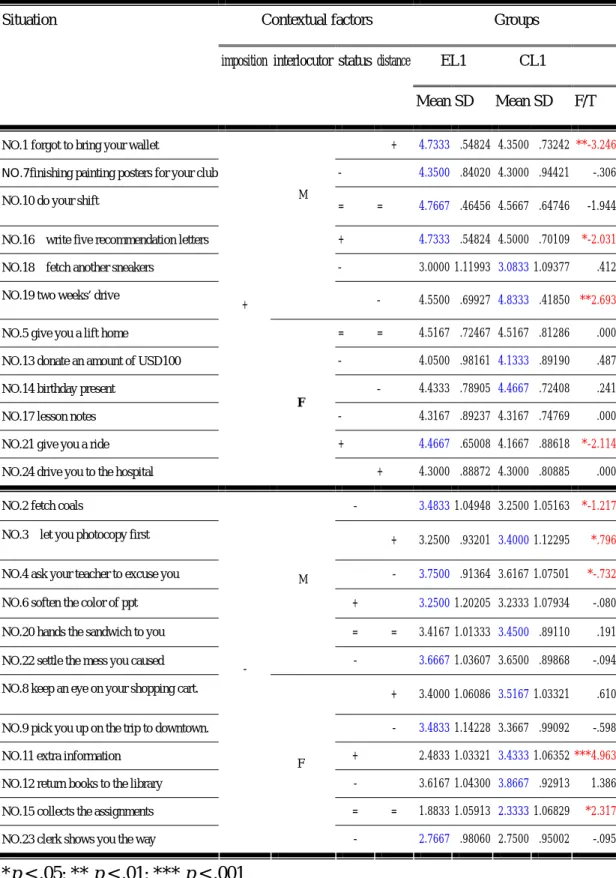
(10) LIST OF TABLES. Table 3.1 Distribution of Data Source .........................................................................39 Table 3.2 The Distribution of Contextual Factors in 24 Scenarios of the Questionnaire ......................................................................................................................................45 Table 3.3 Coding System Developed in Previous Studies ...........................................49. Table 4.1 Means and Standard Deviations for NS-C vs. NS-E Responses to degree of indebtedness, degree of imposition, and likelihood to expected gratitude ..................77 Table 4.2 Means and Standard Deviations for the Two Groups According to 24 Scenarios—degree of gratefulness ...............................................................................81 Table 4.3 Means and Standard Deviations for the Two Groups According to 24 Scenarios —degree of imposition ................................................................................82 Table 4.4 Means and Standard Deviations for the Two Groups According to 24 Scenarios—likelihood of expectation...........................................................................83 Table 4.5 Means and Standard Deviations for NS-C’s & NS-E’s Responses to the Contextual Factors-Degree of Gratefulness.................................................................84 Table 4.6 Means and Standard Deviations for NS-C’s & NS-E’s Responses to the Contextual Factors-Degree of Imposition....................................................................89 Table 4.7 Means and Standard Deviations for NS-C’s & NS-E’s Responses to the Contextual Factors-Likelihood of Gratitude Expectation ............................................93 Table 4.8 Numbers of gratitude strategies used by NS-E, NS-C, English Major, and Non-English Major Groups..........................................................................................99 Table 4.9 Length of Utterances x Contextual Factors Generated by the Four Groups ....................................................................................................................................102 Table 4.10 Overall occurrence number and mean occurrence of the 20 gratitude strategies used by NS-C, NS-E, English Major and Non-English Major Groups .....105 Table 4.11 Occurrence number and mean occurrence of the sub-strategies distributed under Strategy A ........................................................................................................108 Table 4.12 Occurrence number and mean occurrence of the sub-strategies distributed under Strategy B ........................................................................................................112 Table 4.13 Occurrence number and mean occurrence of the sub-strategies distributed under Strategy C ........................................................................................................117 Table 4.14 Occurrence number and mean occurrence of the sub-strategies distributed under Strategy D ........................................................................................................119 x.
(11) Table 4.15 Occurrence number and mean occurrence of the sub-strategies distributed under Strategy E.........................................................................................................121 Table 4.16 Occurrence number and mean occurrence of the sub-strategies distributed under Strategy F .........................................................................................................123 Table 4.17 Occurrence number and mean occurrence of the sub-strategies distributed under Strategy G ........................................................................................................125 Table 4.18 Occurrence number and mean occurrence of the sub-strategies distributed under Strategy H ........................................................................................................127 Table 4.19 Occurrence number and mean occurrence of the sub-strategies distributed under Strategy I..........................................................................................................130 Table 4.20 Occurrence number andmean occurrence of the sub-strategies distributed under Strategy J..........................................................................................................131 Table 4.21 Occurrence number and mean occurrence of the sub-strategies distributed under Strategy L.........................................................................................................133 Table 4.22 The mean occurrence of strategies indicating specific information.........137. xi.
(12) LIST OF FIGURES. Figure 4. 1 NS-C’s Overall Relationship among the Three Perceptional Questions 75 Figure 4. 2 NS-E’s Overall Relationship among the Three Perceptional Questions ...76 Figure 4. 3 Means of NS-C’s & NS-E’s responses to degree of gratefulness, degree of imposition and likelihood of gratitude expectation .....................................................77 Figure 4.4 Perception on Degree of Gratefulness in Each Scenario............................79 Figure 4.5 Perception on Degree of Imposition in Each Scenario...............................79 Figure 4.6 Perception on Likelihood of Gratitude Expectation in Each Scenari.........80 Figure 4.7 Cultural Group x Social Distance on Degree of Gratefulness....................85 Figure 4.8 Cultural Group x Status on Degree of Gratefulness ...................................86 Figure 4.9 Cultural Group x Imposition on Degree of Gratefulness ...........................87 Figure 4.10 Cultural Group x Interlocutor Gender on Degree of Gratefulness ...........88 Figure 4.11 Cultural Group x Social Distance on Degree of Imposition.....................90 Figure 4.12 Cultural Group x Status on Degree of Imposition....................................91 Figure 4.13 Cultural Group x Imposition on Degree of Imposition ............................91 Figure 4.14 Cultural Group x Interlocutor Gender on Degree of Imposition..............92 Figure 4.15 Cultural Group x Social Distance on Likelihood of Gratitude Expectation ......................................................................................................................................94 Figure 4.16 Cultural Group x Status on Likelihood of Gratitude Expectation ............95 Figure 4.17 Cultural Group x Imposition on likelihood of Gratitude Expectation......95 Figure 4.18 Cultural Group x Interlocutor Gender on likelihood of Gratitude Expectation ..................................................................................................................96 Figure 4.19 Average Length of Utterances Generated by NS-E, English Major and Non-English Major Groups..........................................................................................99 Figure 4.20 The Overall Distribution of Strategies among the Four Situational Categories ..................................................................................................................102 Figure 4.21 The Overall Distribution of Length of Utterances among the Four Situational Categories ................................................................................................103 Figure 4.22 The distribution of mean occurrence of the twenty main strategies among NS-C, NS-E, English Major and Non-English Major Groups...................................105 Figure 4.23 The distribution of mean occurrence of Sub-A stra. among NS-C, NS-E, English Major and Non-English Major Groups.........................................................109 Figure 4.24 The distribution mean occurrence of Sub-B Stra. among NS-C, NS-E, English Major and Non-English Major Groups.........................................................112 Figure 4.25 The distribution of mean occurrence of Sub-C stra. Among NS-C, NS-E, xii.
(13) English Major, and Non English Major Groups ........................................................117 Figure 4.26 The distribution of mean occurrence of Sub-D stra. among NS-C, NS-E, English Major, Non-English Major Groups...............................................................119 Figure 4.27 The distribution of mean occurrence of Sub-E stra. among NS-C, NS-E, English Major, and Non-English Major Groups ........................................................121 Figure 4.28 The distribution of mean occurrence of Sub-F stra. among NS-C, NS-E, English Major and Non-English Major Groups.........................................................123 Figure 4.29 The distribution of mean occurrenceof Sub-G stra. among NS-C, NS-E, English Major and Non-English Major Groups.........................................................126 Figure 4.30 The distribution of mean occurrence of Sub-H stra. among NS-C, NS-E, English Major and Non-English Major Groups.........................................................127 Figure 4.31 The distribution of mean occurrence of Sub-I stra. among NS-C, NS-E, English Major and Non-English Major Groups.........................................................130 Figure 4.32 The distribution of mean occurrence of Sub-J stra. among NS-C, NS-E, English Major and Non-English Major Groups.........................................................132 Figure 4.33 The distribution of mean occurrence of Sub-L stra. among NS-C, NS-E, English Major and Non-English Major Groups.........................................................133 Figure 4.34 The distribution of mean occurrence of strategies indicating specific information.................................................................................................................137. xiii.
(14) LIST OF ABBRIVIATIONS. L1: First language L2: Second Language NS-C: Native speakers of Chinese NS-E: Native speakers of English EFL: English as foreign language F: female M: male SRQ: Scaled-response questionnaires DCT: Discourse Completion Tests CP: Cooperative Principles PP: Politeness Principles FTA: Face-threatening act CCSARP: the Cross-cultural speech act realization project. xiv.
(15) CHAPTER 1. 1.1. INTRODUCTION1. Background and Motivation. Expressing gratitude has a significant function in societal interaction. As Eisenstein and Boadman (1993) suggested, only when the function of gratitude is expressed appropriately can it “engender feelings of warmth and solidarity among interlocutors” (p. 64). They further suggested that “Expressing gratitude might not be merely a language function that existed as a response to beneficial event, but might, be a negotiated and interactive event that had greater social significance” (p. 71). Intachakra (2004) also mentioned that expressions of gratitude satisfy both the speaker’s and the hearer’s face wants. On the contrary, failure to express thanking takes risk on being regarded as being rude. Hence, compared with other speech acts, expressing thanking is explicitly introduced at the early stage of life (Bates, 1981; Becker & Smenner, 1986; Eisenstein & Bodman, 1986, 1993; Gleason, 1987; Hinkel, 1994; Lin & Yu, 2006). Though it seems that expressing gratitude has the universal function; however, on the other hand, cultural differences contribute to an in-depth discrepancy among cultures with respect to expressing gratitude. Apte (1974) did research on expressions of gratitude in South Asian language, say Hindi and Marathi. The result indicated that “any verbalization of gratitude is considered taboo, and it is insulting or looked down upon when family members or close friends interact with each other” (p. 79). This is due to the fact that among the participants’ value system, offer providers would think it is their duty to provide offers to their family or close friends. Coulmas (1981a). 1. Part of the results of the present study was presented at the Workshop on Interface Language Studies: Theory and Practice, 2007 (Lin & Chang, 2007) & ACTFL 2007 (Lin & Chang, 2007). 1.
(16) observed how Japanese express gratitude. The result of the observation showed that instead of ‘arigato’, equivalent to ‘thank’ in English, Japanese uses ‘sumimasen’, equivalent to ‘I’m sorry’ in English, more frequently when expressing gratitude. This could result from the fact that Japanese are more “debt-sensitive” (Brown & Levinson, 1987; Coulmas, 1981a; Eisenstein & Bodman, 1993: 70). For Japanese, the individuals receiving favors from others usually think they must have intruded on the interlocutors; therefore, they tend to express their indebtedness in situations where expressions of gratitude are expected in other cultures. Besides different interpretations or perceptions on beneficial acts, the difference could either be expressions of gratitude which derives from culture-specific background or parallel expressions used among different situations. Columas (1981), for example, mentioned that the problem in contrastive analysis in the speech act of apologies is the relation between form and function. “If we know how to say I’m sorry in another language we still don’t know when and to whom we should say it according to the norms of interaction of the respective community” (p. 69). Accordingly, it is applicable to the study on expressions of gratitude (Clankie, 1993). Tames (1981) conducted research on the comparison of British’s and Japanese’s expressions of gratitude and found that “Where the English say I’m sorry, Japanese say ‘I can never repay’; the Japanese ‘Hello’ is literally ‘Excuse me’ and ‘Thank you’ is ‘I feel ashamed’” (p.109). Hymes (1971) also found that ‘thank you’ is a formulaic expression of gratitude in American English whereas in British English, it is less significant in terms of expression of thanking. Though expressions of gratitude are encountered frequently in daily life, however, native speakers are usually unaware of the underlying rules of expressing thanking (Eisenstein & Bodman, 1993). It is so natural that for second language learners, it doesn’t seem problematic applying L1 rule to L2 hence communication 2.
(17) breakdown induces (Hinkel, 1994). In the process of second language learning, it is usually the grammatical features that are being emphasized rather than the pragmatic ones (Wolfson, 1989). However, knowing ‘how to say it correctly’ doesn’t guarantee knowing ‘how to say it properly’ (Asher, & Simpson, 1994; Blum-Kulka, 1982, 1983; Cohen, 1996; Coulmas, 1981; Rintell, 1981; Thomas, 1983). To interact successfully with L2 native speakers, besides the grammatical rules, learners also have to learn the rules of speaking of L2 native speakers (Wolfson, 1989: 14). Miscommunications happening among speech communities usually result form the fact that L2 learners apply the rules of speaking of L1 to L2 without considering the culture diversity (Barron, 2003; Takahashi, 1996; Thomas, 1983; Wolfson, 1989). Pragmatic failure could induce consequences more serious than grammatical errors do, for pragmatic failure could be attributed to personality defects instead of linguistic deficiency (Thomas, 1983). Since expressions of gratitude has its societal function, it is necessary for learners to acquire the rules of expressing thanks of the target language. However, compared with other speech acts, such as apologies, requests, complaints, study on expressions of gratitude seldom drew researcher’s attention, up to date, studies on expressions of gratitude are limited to Columas’s (1981) comparison between Japanese and English, Eisenstein and Bodman’s (1986, 1993) comparison among several cultural groups, Clankie’s (1993) between Japanese and English, Hinkel’s (1994) study on different cultural groups’ behaviors on English expressions of gratitude, Intachakra’s (2004) on British English and Thai, Cheng’s (2005) on interlanguage development of expressions of gratitude of Chinese learners of English, Lin & Yu’s (2006) gender difference on Mandarin Chinese expressions of gratitude. Theories proposed to explain various strategies across cultures mainly focus on Brown and Levinson’s (1987) Politeness theory, Hofsteds’s (1991) explanation in 3.
(18) terms of Individualism-Collectivism. However, those who discussed the discrepancies with those theories usually held macro perspective with respect to universal assumption without taking the influence of context/setting on language use into account. Except Intachakra’s (2004), neither did the studies compare the semantic features of expressions of gratitude of respective groups. Besides, studies of language learners’ realization of expressions of gratitude usually focused only on the interlanguage part without working on data of both native languages, which could serve as the research baseline. It is thus the aim of the study to make an in-depth comparison of expressions of gratitude produced by Chinese native speakers in Taiwan and English native speakers in the U.S to investigate EFL learners’ interlanguage realization of expressions of gratitude in Taiwan. In order to further interpret participants’ linguistic production, participants’ language production and perception on the beneficial acts were both included in the present study. In the hope that the result of the preliminary analysis could not only provide a reliable knowledge of language use in expressing gratitude among the NS-Cs and NS-Es but also be applied to language instruction.. 1.2. Purpose of the Study. The purpose of the study is to investigate the expressions of gratitude that English learners in Taiwan use on the basis of the cross-cultural comparison between American English and Taiwan Mandarin Chinese by means of analyzing the collected data, comprising DCT and SRQ to answer the following questions: (1) Do the contextual factors have influence on the participants’ perception of degree of imposition, degree of gratefulness and likelihood of gratitude expectation regarding the beneficial acts and their responses? (2) To what extent does participants’ perception influence their responses? 4.
(19) (3) What are the formulaic expressions of gratitude NS-C and NS-E groups prefer to adopt? (4) What features of strategy use are more transferable?. 1.3. Overview of the Chapters. The thesis covers five feature chapters. Chapter 2 reviews the theoretical framework in terms of speech act theory, politeness theory, collectivism versus individualism; interlanguage pragmatics, and studies on speech act of expressions of gratitude. Chapter 3 describes the methodology, including description of the participants and tasks, research procedure, and coding schema. Chapter 4 presents the results of the study and discusses the findings in relation to the research questions. Chapter 5 summarizes the main findings of the study and concludes with pedagogical implication and possible future research.. 5.
(20) CHAPTER 2. LITERATURE REVIEW. Searle (1979) pointed out the weakness of Austin’s (1962) taxonomy of illocutionary acts and suggested an alternative taxonomy which consists of assertives, directives, commissives, expressives, and declarations and thanking is classified into the expressive speech act. Another influential framework is Leech’s (1983) Politeness Principles. In responding to Grice’s (1975) cooperative principle, Leech (ibid) suggested that interactants would violate the cooperative principle to obey the principle of politeness with respect to face-saving behavior (Brown & Levinson, 1987). Holfdted’s (1991) notion of individualism & collectivism also holds the macro-perspective view on cultural diversity. In terms of language teaching/learning, the introduction of communicative competence (Hymes, 1972) directed the focus of language teaching/learning to function-oriented aspect (as cited in Barron, 2003: 8). Following Hymes (1972), Canale (1983) proposed a framework of communicative competence and Bachman (1990) further developed the communicative concept entailing pragmatic competence (Barron, ibid: 8-9). In elaborating the notion of pragmatic failure, Thomas (1983) further differentiated two kinds of pragmatic failure. Cohen (1996) proposed the distinction of two abilities in terms of sociocultural choices and sociolinguistic forms. The introduction of speech act theory (1979) triggered studies of pragmatics (as cited in Barron, 2003: 11). Following the project of Cross-Cultural Speech Act Realization Project led by Blum-Kulka, House & Kasper (1989), numerous studies on cross-cultural and interlanguage pragmatics were inspired (Chen, 2006). For the fact that expressions of gratitude is part of the speech act units, besides the empirical study of thanking, the theoretical framework in relation to interlanguage/cross-cultural pragmatics will be reviewed.. 6.
(21) 2.1. Speech Act Theory. Austin (1969: 223) differentiated utterances in terms of constative utterance, which concerns the truth condition of an utterance and performative utterance, which concerns the effects an utterance brings about. According to Austin (1962), “the uttering of the sentence is, or is a part of, the doing of an action” (p. 5). Out of the notion of performative utterance, Austin (1962) suggested that people always “doing things with words” (Barron, 2003: 11). The concept of speech as an act hence derives. Austin (1962) characterized an utterance with respect to the locutionary act, the illocutionary act and the perlocutionary act. Among the three acts, it is illocutionary act which refers to “the speaker’s (S) intention realised in producing an utterance” that interrelates to the notion of speech act theory later proposed by Searle (1972) (as cited in Barron, 2003:12). Searle (1972) also proposed types of differences between different illocutionary acts based on his “distinction between illocutionary force of an utterance and its propositional content” (p. 261) as presented in the following.. (2.1) Different Types of Differences Between Different Types of Illocutionary Acts: 1. Differences in the point (or purpose) of the (type of) the act 2. Differences in the direction of fit between words and the world 3. Differences in expressed psychological states. 4. Differences in the force or strength with which the illocutionary point is presented. 5. Differences in the status or position of the speaker and hearer as these bear on the illocutionary force of the utterance. 6. Differences in the way the utterance relates to the interests of the speaker and the hearer. 7.
(22) 7. Differences in relations to the rest of the discourse. 8. Differences in propositional content that are determined by illocutionary force indicating devices. 9. Differences between those acts that must always be speech acts, and those can be, but need not be performed as speech acts. 10. Differences between those acts that require extra-linguistic institutions for their performance and those that do not. 11. Differences between those acts where the corresponding illocutionary verb has a performative use and those where it does not. 12. Differences in the style of performance of the illocutionary act. (Searle 1979: 261-267) Searle (1979) further suggested that “the illocutionary act is the minimal unit of linguistic communication” (p. 238). In examining Austin’s (1962) taxonomy of illocutionary acts2, Searle (1979) suggested an alternative taxonomy which consists of assertives, directives, commissives, expressives, and declarations. The definition of each is presented as follows.. (2.2) The Alternative Taxonomy of Illocutionary Acts (i) Representatives (or assertives), which commit the speaker to the truth of something (i.e., asserting, claiming, reporting) (ii) Directives, which are attempts of the speaker to get the hearer to do. 2. Verdictives: “consist in the delivering of a finding , official or unofficial, upon evidence or reason as to value or fact so far as these are distinguishable.” Exercitives: “ a decision that something is to be so, as distinct from a judgment that it is so.” Commisives: “to commit the speaker to a certain course of action” Expositives: “are used in acts of exposition involving the expounding of views, the conducting of arguments and the clarifying of usages and references.” Behabitives: “includes the notion of reaction to other people’s behavior and fortunes and of attitudes and expressions of attitudes to someone else’s past conduct of imminent conduct.” (as cited in Searle, 1979: 268-269) 8.
(23) something (i.e., ordering, commanding, requesting, begging) (iii) Commissives, which commit the speaker to do some future action (i.e., promising,offering, threatening) (iv) Expressives, which express a psychological state (i.e., thanking, apologizing, complimenting) (v) Declarations, which bring out the correspondence between the propositional content and reality (i.e., appointing a chairman, nominating a candidate, marrying a person, christening) (Searle, 1979: 272-281, as cited in Cheng, 2005: 10) Grice’s (1975) proposal of Cooperative Principle is related to the speech act theory. According to Grice (1975), in order to organize and interpret the interlocutors’ utterance, a code of cooperative behavior is shared by the interactants. The code is presented in terms of conversational maxims: quantity, quality, relation and manner.. (2.3) Conversational Maxims Quantity: Make your contribution as informative as is required (for the current purpose of the exchange). Do not make your contribution more informative than is required.) Quality: Be truthful. Do not say what you believe to be false. Do not say that for which you lack adequate evidence. Relation: Be relevant. Manner: Be brief and orderly. Avoid obscurity and ambiguity. (Grice 1975, as cited in Wolfson, 1989: 58). 9.
(24) 2.2. Politeness Principle. Grice’s (1975) Cooperative Principle provides a framework depicting how people organize and interpret utterances; however, the principle is insufficient in accounting for the phenomenon that people would interact indirectly (Leech, 1983). To extend Grice’s CP, Leech (1983) thus proposed Politeness Principle which explains why people usually violate CP in interactions. Politeness Principle encompasses two dimensions, namely, “minimize the expression of impolite beliefs; maximize the expressions of polite beliefs” (Leech, 1983: 83). He then suggested six maxims of politeness of the PP. In examining the six maxims, Leech concluded that politeness is more other-oriented than self-oriented and negative politeness which refers to avoidance of discord weighs more than positive face (Leech, 1983: 536). (2.4) Maxims of Politeness (Ⅰ) TACT MAXIM (in impositives and commssives) (a) Minimize cost to other [ (b) Maximize benefit to other] (Ⅱ) GENOROSITY MAXIM (in impositives and commissives) (a) Minimize benefit to self [ (b) Maximize cost to self] (Ⅲ) APPROBATION MAXIM (in expressives and assertives) (a) Minimize dispraise of other [(b) Maximize praise of other] (Ⅳ) MODESTY MAXIM (in expressives and assertives) (a) Minimize praise of self [(b) Maximize dispraise of self] (Ⅴ) AGGREMENT MAXIM (in assertives) (a) Minimize disagreement between self and other [(b) Maximize agreement between self and other] (Ⅵ) SYMPATHY MAXIM (in assertives) (a). Minimize antipathy between self and other [ (b) Maximize sympathy. 10.
(25) between self and other] (Leech, 1983: 534-535). 2.2.1. The Notion of Face. Brown and Levinson (1978) differentiated face (Goffman, 1967), which refers to “the public self-image that every member wants to claim for himself” (p. 562) in two aspects, say negative face and positive face.. (2.5) Negative and Positive Face (a) negative face: the basic claim to territories, personal preserves, rights to non-distraction — i.e., to freedom of action and freedom from imposition (b) positive face: the positive consistent self-image or “personality” (crucially including the desire that this self-image be appreciated and approved of) claimed by interactants (Brown and Levinson, 1978: 562). Instead of treating the two aspects as social norms or values shared by members of a society, Brown and Levinson (1978) treated them as universally basic wants., which refer to what “every member knows every other member desires and in the interest of every member to partially satisfy” (p. 563). They thus redefined the two aspects of faces.. (2.6) Face As Wants Negative face: the want of every “competent adult member” that his actions be unimpeded by others. 11.
(26) Positive Face: the want of every member that his wants be desirable to at least some others. (Brown and Levinson, 1978: 564). Following the distinction, Brown and Levinson classified two major kinds of face threat. One consists of “those acts that primarily threaten the addressee’s (H’s) negative-face want, by indicating (potentially) that the speaker (S) does not intend to avoid impeding H’s freedom of action” and the other consists of “those acts that threaten the positive-face want, by indicating (potentially) that the speaker does not care about the addressee’s feeling, wants, etc. – that in some important respect he doesn’t want H’s wants ” (Brown & Levinson, 1978: 569-570). For both kinds, there are sub-categories which overlap each other. In assessing the weight of a face-threatening act, the social distance of the interactants, the relevant power of interactants, and the absolute ranking of imposition are the factors to consider. According to Brown and Levinson, not only the demand of face wants is universal but also the social variables in judging the seriousness of an FTA. Brown & Levinson’s (1978) and Leech’s (1983) frameworks of universal assumption have been challenged. Mao (1994) for example, pointed out that Brown & Levinson’s. argument. was. addressed. to. Western. cultures. which. are. individualism-oriented when it was firstly introduced to literature. Their argument may work in explaining the behaviors of cultures of individualism but fail in cultures of collectivism.. 2.3. Collectivism vs. Individualism. As Gass & Varonis (1991) pointed out, No natural speech utterance is ever made in a linguistic vacuum. Each is 12.
(27) enriched and empowered by a social history that considers the relationships of class, status, power, and solidarity, and a linguistic theory that includes a culturally specific rules of discourse, politeness, conversational maxims, conversational inference, and patterns of interpretation. (as cited in Barron, 2003: 121).. In other words, an utterance is not linguistic exclusive but culturally profuse. When interactants encounter without awareness of the cultural variability beyond utterances of each other, miscommunication induces. According to Gumperz & Tannen (1979), the likelihood of miscommunication could be determined by the degree of mutual understanding when interactants from different cultures meet. In explaining cultural variability, collectivism and individualism are widely adopted (cf. Gudykunst, Matsumoto, Ting-Toomey, Nishida, Kim & Heyman, 1996). Hofstede’s (1991) definition on the two dimensions has been cited widely.. ..Individualism pertains to societies in which ties between individuals are loose: everyone is expected to look after himself or herself and his or her immediate family. Collectivism as its opposite pertains to societies in which people from birth onwards are integrated into strong, cohesive in-groups. (Hofstede, 1991: 51, as cited in Chen, 2006: 33). In individualistic cultures, individual’s goal is prior to group goals while in collectivistic cultures, the emphasis reverses (Triandis, 1988, as cited in Gudykunst et al. 1996: 513-514). Hence, members of individualistic culture concern more about their freedom of activity, whereas members of collectivistic culture concern more about the consequences of their actions on the groups they belong to (Scollon, R. &. 13.
(28) Scollon, S.W., 1995: 133-4). In short, people from collective culture value the concept of we while the concept of I prevails in individualistic cultures (Samovar, L.A., Porter, R.E. & Stefani, L.A., 1998). Triandis (1988) further indicated that, compared with people of individualistic cultures, people of collectivistic cultures distinctly differentiate members of in-groups and out-groups (as cited in Gudykunst et al. 1996: 513-514). That is, though people of collectivistic cultures concern the “feeling of oneness” (Lebra, 1976: 25, as cited in Gudykunst et al. 1996: 513), it is limited among members of in-groups. Hofstede surveyed workers in forty countries during 1980s on the four value dimensions he proposed, say individualism-collectivism, uncertainty avoidance, power distance, and masculinity & femininity. According to Hofstede’s observation, while America is individualism-oriented, Taiwan tends toward culture of collectivism (as cited in Samovar et al. 1998). It should be noted that neither I-C is isolated in one culture. I-C could coexist in one culture but one tends to prevail another (cf. Gudykunst et al. 1996; Samovar, 1998).. 2.3.1 High-Context Communication vs. Low-Context Communication Hall (1976) proposed a differentiation of two communication styles, namely lowand high-context communication which offers another view in examining cultural variability. In Hall, E. T., & Hall, M. R.’s term, the two styles could be defined as:. A high context (HC) communication or messages is one in which most of the information is already in the person, while very little is in the coded, explicitly transmitted part of the message. A low context (LC) communication is just the opposite; i.e., the mass of the information is vested in the explicit codes. (Hall, 1979: 76) 14.
(29) According to Hall (1976), in low-context communication settings, meanings get crossed via explicit and direct codes of messages while in high-context communication settings, messages are expressed via implicit and indirect codes and interpretations of messages largely depend on the context. Gudykunst and Ting-Toomey (1988) contends that low-context and high-context is used predominantly in collectivistic and individualistic cultures respectively. As mentioned previously, I-C could coexist in one culture; accordingly, low- and high- context could coexist in one culture. Cultures preferring low-context communication show preference to detailed, clear-cut, and definite messages, feeling uncomfortable with the vagueness and ambiguity whereas cultures preferring high-context communication style tend to accept vagueness in interaction (Samovar et al, 1998: 81). Integrating the notion of I-C and high-context & low-context communication, Gudykunst et al. (1996) concluded that “Members of individualistic cultures are more concerned with clarity in conversations and view clarity as necessary for effective communication more than do members of collectivistic cultures” (p.517-8).. 2.4 Miscommunication Wolfson (1989) suggested that it is nontraslatibility of illocutionary force of indirect speech act that induces communication problems. Searle (1972) had noted that “to perform illocutionary act is to engage in a rule-governed form of behavior” (p.239). Rule-governed form of behavior could be interpreted as rules of speaking which entailing cultural variability. Interpreting illocutionary force in conversation requires the knowledge of the rules of speaking of the given context. Without mutual understanding of the rules of speaking, people tend to apply the norms of their culture/community to interpret the interlocutor’s intention, and miscommunication easily induces. The consequence is particularly serious in cross-cultural 15.
(30) communication. Gass & Varonis (1991) indicated that without sharing the same native language or the same sociocultural rules of speaking, it is highly possible that miscommunication would occur and breakdown of cross-cultural communication could result in negative stereotype of respective culture (as cited in Barron, 2003: 122). Since rules of speaking are acquired through the socialization process, native speakers can almost spontaneously respond to a given context in proper way. However, it usually becomes problematic in context of another culture. Hymes (1972) suggested that different speech communities have their preferred expressions in expressing ideas and the expressions reflect the language conventions shared by members of the same speech community. Those expressions are what Coulmas (1981) terms as routine formulae (p.70) which is a serious issue for non-native speakers. Hence in dealing the issue of miscommunication, language learners’ communicative competence (Hymes, 1972) is emphasized.. 2.4.1 Communicative Competence It has been widely argued that language acquisition involves both linguistic competence and communicative competence (Wholfson, 1989). Knowing how to produce correct sentences doesn’t mean possessing the knowledge of language (Wholfson, ibid). The notion of competence derives from Chomsky’s (1965) distinction between competence and performance. According to Chomsky, competence involves knowledge of rules of linguistic systems while performance involves individual’s actual speech production. Because Chomsky’s definition on competence is restricted in domains of linguistic system, Hymes (1972) proposed the notion of communicative competence in reaction to Chomsky’s limited definition of competence. According to Hymes, communicative competence is a competence an individual possesses to determine “when to speak, when not, and as to what to talk 16.
(31) about with whom, when, where, in what manner” (p. 277). It should be noted that Hymes didn’t exclude linguistic competence from communicative competence. Instead, he recognized the knowledge of linguistic systems is the source to perform communicative competence properly in a given context because it is through the linguistic codes that individuals make the communicative competence shown ( as cited in Cheng, 2005). Cohen (1996) also differentiated two types of ability speakers possess to realize effective communication, namely sociocultural choices and sociolinguistic ability. According to him, sociocultural ability enables speakers to determine whether it is acceptable to realize specific speech act in a given context and sociolinguistic ability enables speakers to determine the language form that is acceptable to realize the speech act. Since communicative competence is associated with proper use of language with respect to sociocultural knowledge, the domain of pragmatics is involved.. 2.5. Pragmatics. There are various definitions of pragmatics. To name a few from Levsion (1983), pragmatics is defined as: 1. Pragmatics is the study of those relations between language and context that are grammaticalized, or encoded in the structure of a language. 2. Pragmatics is the study of all those aspects of meaning not captured in a semantic theory. 3. Pragmatics is the study of the relations between language and context that are basic to an account of language understanding. 4. Pragmatics is the study of the ability of language users to pair sentences with the contexts in which they would be appropriate. 17.
(32) 5. Pragmatics is the study of deixis (at least in part), implicature, presupposition, speech acts, and aspects of discourse structure. (Levinson, 1983: 6-9) In short, with regard to the relationship among language and context, grammar involves “the context-free assignment of meaning to linguistic forms”, while pragmatics involves “the further interpretation of those forms in a context” (Levinson, 1983: 6). Thomas (1983: 679) also stated that pragmatics refers to language in use. It is the domain that “speakers’ knowledge of grammar comes into contact with his/her knowledge are filtered through systems of beliefs—beliefs about language and beliefs about the world” (Thomas, ibid: 695). May (1993) concluded that “pragmatics is the study of the conditions of human language uses as these are determined by the context of society” (p. 74).. 2.5.1. Interlanguage Pragmatics. That Columas (1981) indicated that routine formulae is a weighty issue for nonnative speakers has been supported by nearly every interlanguage pragmatics study (cf. Kasper & Blum-Kulka, 1993: 725). The term interlanguage was firstly employed in L2 acquisition by Selinker (1972) (as cited in Barron, 2003: 35). However, it was widely adopted in interlanguage studies on linguistic perspectives such as L2 syntax acquisition. It is the notion of communicative competence that triggered the field of study of language in use from learners’ perspective (Thomas, 1983).. As. interlanguage refers to “a transitional system reflects the learner’s current L2 knowledge” (Ellis, 1998: 16) and pragmatics is briefly defined as “language in use”, interlanguage pragmatics thus can be defined as the study of L2 learners’ language in use. According to Kasper & Blum-Kulka (1993), interlanguage pragmatics has focused on “the illocutionary and politeness dimensions of speech act performance” 18.
(33) (p. 715). It implies that the study of interlanguage pragmatics mainly derives from cross-cultural pragmatics. Kasper (1981) suggested three factors that are particularly important. for. interlanguage. pragmatics:. pragmatic. transfer,. pragmatic. overgeneralization and teaching-induced errors (as cited in Barron, 2003: 36). Among the three factors, pragmatic transfer has drawn the most attention of studies in L2 pragmatics.. 3. 2.5.2 Pragmatic Failure/Transfer Thomas (1983) identified pragmatic failure as “the inability to understand what is meant by what is said” (p. 677).. She further differentiated two dimensions of. pragmatic failure, say pragmalinguistic and sociopragmatic failure.. (2.7) Pragmalinguistic Failure & Sociopragmatic Failure a. Pragmalinguistic failure, which occurs when the pragmatic force by S onto a given utterance is systematically different from the force most frequently assigned to it by native speakers of the target language, or when speech act strategies are inappropriately transferred from L1 to L2 b. Sociopragmatic failure, a term I have appropriated from Leech (1983: 10-11), which I use to refer to the social conditions placed on language in use. (Thomas, 1983: 693) In other words, pragmalinguistic failure is associated with proper form and force of an utterance while sociopragmatic failure involves the rules of speaking in the given context. For example, if L2 learners of English fail to interpret the utterance of ‘We must meet sometime” as a ritual utterance instead of a sincere invitation, it could be 3. Pragmatic overgeneralization result from strategy of least effort, ‘play -it-safe’ strategy and metalinguistic motives (Barron, 2003). 19.
(34) attributed to pragmalinguistic failure. If L2 learners of Japanese fail to differentiate the proper honorific forms in a given context out of unawareness of the social constraints in Japanese society, it is attributed to sociopragmatic failure. According to Thomas (1983), sociopragmatic failure stems from size of imposition, taboos, cross-culturally different assessments of relative power or social distance. Hence, compared with the pragmalinguistic failure, sociopragmatic failure is more difficult to deal with, for it encompasses the learners’ “systems of beliefs” (Thomas, 1983: 677). Compared with Thomas’s (1983) distinction which focuses on the negative outcomes, Kasper’s (1992) classification of pragmalinguistic and sociopragmatic transfers is more comprehensive, for she suggests both positive and negative transfers (as cited in Barron, 2003: 36). According to Kasper (1992), pragmatic transfer is “the influence exerted by learners’ pragmatic knowledge of language and cultures other than L2 on their comprehension, production and learning of L2 pragmatic information” (Kasper, 1992: 207, as cited in Barron, 2003: 36). Applying the definition and Thomas’s differentiation of two kinds of pragmatics failure, Kasper’s definition of the two kinds of pragmatic transfer is presented as follows:. (2.8) Pragmalinguistic Transfer & Sociopragmatic Transfer Pragmalinguistic transfer is “the process whereby the illocutionary force or politeness value assigned to particular linguistic material in L1 influences learners’ perception and production of form-function mappings in L2.”. Sociopragmatic transfer is “…the influence of the social perceptions underlying languages users’ interpretation and performance of linguistic action in L1 on their assessment of subjectively equivalent L2 contexts.” (Kasper, 1992: 209, as cited in Barron, 2003: 36-37). 20.
(35) The differentiation suggests that pragmalinguistic transfer encompasses the idea of both linguistic features and illocutionary force transfer from L1 to L2, while sociopragmatic transfer entails the idea of assessment of contextual factors such as relative power, social distance and size of imposition transfer from L1 to L2. Transfer could be either positive or negative. Maeshiba, N., Yoshinaga, N., Kasper, G., & Ross, S. (1996) made the distinction among positive and negative pragmatic transfer.. (2.9) Positive Pragmatic Transfer & Negative Pragmatic Transfer Positive pragmatic transfer: …the projection of first language-based sociopragmatic and pragmalinguistic knowledge where such projections result in perceptions and behaviours consistent with those of second language users,… Negative pragmatic transfer: … the projection of first language-based sociopragmatic and pragmalinguistic knowledge onto second language contexts where such projections result in perceptions and behaviors different from those of second language users.” (Maeshiba et al., 1996: 155, as cited in Barron, 2003: 37) In short, if the projection of L1 pragmatics results in consistent perception and behaviors with native speakers’, it is attributed to positive transfer; on the contrary, if the projection results in inconsistent perceptions and behaviors from native speakers’, it is attributed to negative transfer. Selinker’s (1969) design has been widely adopted to investigate interlanguage pragmatic transfer (Chen, 2006). Data of learners’ language production of both native language and target language are collected and production of native speakers of the target language is collected too. The two sets of data of native language are treated as. 21.
(36) the baseline for interlanguage analysis. The present study also followed the design.. 2.6. The Speech Act of Expressions of Gratitude. In the review of pragmatics and the theoretical framework with regard to speech acts, it has been suggested that the styles or rules of speaking speakers employ to communicate vary cross-culturally and intra-culturally (Gudykunst et al. 1996). There is no exception in the styles individuals use to express thanking. There are preferred routine formulae or styles to express gratitude in individual cultures. Leech (1983) discussed thanking from socially oriented perspective. He suggested that the illocutionary goal of thanking is to establish and maintain a harmonious social atmosphere. Eisenstein and Boadman (1993) also suggested the significance of expressing gratitude in societal interaction. When appropriately expressed, expressions of gratitude can “engender feelings of warmth and solidarity among interlocutors” (p.64).. On the contrary, failing to express gratitude in a proper. manner would be attributed to impoliteness or imperfect personality. Because of its importance in societal interaction, compared with other units of speech acts, it is the speech act that is introduced at the early stage of life (Bates, 1981; Becker & Smenner, 1986; Eisenstein & Bodman, 1986, 1993; Grief & Gleason, 1980; Hinkel, 1994; Lin & Yu, 2006). Accordingly, for native speakers, deciding the forms and force in expressing gratitude in a given context could be a spontaneous behavior. However, for nonnative speakers, it turns out to be a serious issue because L2 learners may fail to perceive the difference. In orther words, it doesn’t seem problematic for L2 learners to apply L1 rule to L2 and hence communication breakdown induces. Besides, in the process of second language learning, it is usually the grammatical features being emphasized rather than the pragmatic ones (Wolfson, 1989). Clankie (1993) adapted from Columas’s (1981) and suggested that knowing how to say thank you in another 22.
(37) language doesn’t mean knowing when and to whom we should say it according to the norms of interaction of the respective community. Studies have shown that even advanced L2 learners have difficulty in effectively showing thanking in the target language due to socio-pragmatic limitations (Eisenstein & Bodman, 1986, 1993). Brown and Levinson (1979) categorize thanking as an FTA (face-threatening act) because it implies that the speaker acknowledges a debt to the hearer in which threatens the speaker’s negative face (as cited in Eisenstein & Bodman, 1993: 65). According to Searle’s (1979) taxonomy, thanking is classified as expressive speech acts whose paradigms of expressive verbs include thank, congratulate, apologize, deplore, welcome, and condole. In Searle’s words, expressive speech acts express speakers’ actual psychological state toward a state of affairs or a person specified in the propositional content. It is not the speaker’s intention to match his/her words to the physical context nor his/her intention to get the context match his/her words but the “truth of the expressed proposition is presupposed” (Searle, 1979: 275). Interestingly, it is reflected in English syntactical presentation. Expressive verbs will not take that clause in performative occurrences but requires a gerundive nominalization transformation. Here are the examples Searle used to account for the traits.. •. *I apologize that I stepped on your toe.. •. I apologize for stepping on your toe.. •. *I thank you that you paid me the money.. •. I thank you for paying me the money. (Searle, 1979: 276) Searle elaborated the examples by saying that in apologizing, it is not the. speaker’s purpose to claim what he has caused. Similarly, in expressing thanking, it is 23.
(38) neither the speaker’s purpose to claim what the interlocutor has done for him/her. Searle’s analysis of thanking implies that the illocutionary point of the expressive speech acts underlying two points, namely, to express attitude and the proposition content is factive. Expressing attitude corresponds to Van Ek’s (1977) categorization, “thank you” is used to express emotional attitude (as cited in Eisenstein & Bodman, 1986: 168). The two points also underlie in Coulmas’s (1981) statement that “every. sincere verbalization of gratitude is directed to some action (or actions) of a benefactor’ or to a result of this action” (p. 74). Sincerity and actions of benefactors or result of the actions echo attitude and factive propositional content respectively. Coulmas (1981) called the elements the object of gratitude (p. 74) and believes that it can vary in a wide scale. He also provided four distinctions that seem to be particularly important. He also noted that the eight classes are not mutually exclusive.. (2.10) The object of Gratitude. (Coulmas, 1981: 74). (i) -thanks ex ante (for a promise, offer, invitation) -thanks ex post (for a favor, invitation afterwards) (ii) - thanks for material goods (gifts, services) -thanks for immaterial goods (wishes, compliments congratulations, information) (iii) - thanks for some action initiated by the benefactor - thanks for some action resulting from a request/wish/order by the beneficiary (iv) - thanks that imply indebtedness - thanks that do not imply indebtedness According to Coulmas (1981), the eight classes could be classified in terms of real vs. potential, material vs. immaterial, requested vs. not requested, indebting vs. 24.
(39) not indebting. Though strategies for expressing gratitude and appropriate responses vary depending on the type of object of gratitude, the interpersonal relationship between the speakers is influential. For example, Chinese speakers may thank more to friends than to family members. Also, the length of the expressions of gratitude is determined by the degree to which the speaker perceives indebted (Wholfson, 1989). Nevertheless, the assessment of the weight of object of gratitude and assessment of the interpersonal relationship vary cross-culturally. The following displays Searle’s (1969: 63) criteria of thanking (as cited in Aijmer, 1996: 34).. (2.11) Criteria of Thanking Thank (for) Propositional content rule: Past act A done by H (the hearer). Preparatory rule: A benefits S (the speaker) and S believes A benefits S. Sincerity rule: S feels grateful or appreciative for A. Essential rule: Counts as an expression of gratitude or appreciation. (Searle, 1969: 63, as cited in Aijmer, 1996: 34). Aijmer (1996: 34) concluded that thanking has the following features.. • • •. Factivity, i.e. the truth of the state of affairs is presupposed by the speaker to be true a psychological state is expressed the propositional content expresses some property ascribed to the speaker or the hearer. (Aijmer, 1996: 34) Aijmer (1996) summarized from Searle’s criteria, stating that “the act for which. the speaker expresses gratitude must be a past act done by the addressee, which 25.
(40) benefits the speaker; the speaker feels grateful for the act (or behaves as if he does), and the utterance counts as an expression of gratitude” (p. 35). However, it has been suggested that the function of gratitude expressions is not limited to expressing thanking to a past event that is beneficial to the speaker (Norrick, 1978, as cited in Aijmer, 1996: 52). For example, thanking can be used as conversational closings (Aston, 1995). It can also be used to thank the hearer in advance for a coming beneficial event whose propositional content may not be realized afterwards. For example, in Chinese, ma-fan-ni-le, xie-xie/麻煩你了,謝謝 is the expression usually adopted either before or after a beneficial event is done. Aijmer (1996) summarized the functions thank you or thanks can have.. (2.12) Functions of Thank you/Thanks in English Thank you/thanks: i.. Acknowledging a major favour. ii.. Acknowledging a favor such as being handed something. iii.. Assuring a person of one’s future attitude. iv.. Dismissing a person or a person’s service. v.. Accepting a proposal that the conversation should end. vi.. Closing the conversation. vii.. Accepting an offer. viii.. Making the hearer feel good (‘phatic’ function) when an offer is rejected (‘no thanks’) or one answer an enquiry about one’s health (‘fine thanks’). ix.. Irony, sarcasm, brusqueness. x.. Negative request (‘thank you for not…) ( Aijmer, 1996: 52) 26.
(41) The review of the concept of thanking is mainly from western perspective. In the following section, thanking in Chinese will be covered so that in later discussion the cross-cultural differences can be shown.. 2.6.1. Thanking in Chinese. Due to the fact that the concept of caring interactants’ mutual faces and of reciprocity of etiquette are carried out pervasively in Chinese culture, expressing gratitude adequately both verbally and nonverbally is highly valued (Lin & Yu, 2006). It can be observed from the phenomenon that babbling kids are instructed to express thanking by nodding heads when the beneficial act is recognized (Lin & Yu, 2006). However, in traditional Chinese societies, gratitude is relatively rarely expressed among family members. For example, a mother may not say thank you for the new dress the kid bought for her. Instead, the price is to blame. “Don’t you ever waste your money on it again!” But afterwards, the mother may wear it happily and show off to her friends by saying, “This is my kid bought for me.” In other words, it is nonverbal gratitude that is shown. It should be noted that in Modern Chinese society, people are encouraged to verbalize their gratitude to family members (Shih, 1986, as cited in Cheng 2005: 16). The most common expressions of thanking in Chinese are Xie-xie/謝謝/Thanks and xie-xie-ni/ 謝謝你 /Thank you. Variations include Xie-xie-nin/ 謝謝您/Thank you-honorific form, duo-xie/ 多謝/Many thanks, Gan-xie / 感謝/appreciate, and Gan-ji /感激/grateful (Shin, 1986). It should be noted that in Chinese, Bu-hao-yi-si /. 不 好 意 思 which is not translatable in English, is also frequently used in gratitude-elicit situations. Bu-hao-yi-si means I feel embarrassed and don’t deserve for the beneficial acts (Shih, 1986). It can be counted as what Coulmas (1981) terms as apologetic thanks (p73). According to Coulmas (1981), apology and gratitude share common properties. To name a few: 27.
數據
+7


相關文件
七、考生除必備文具、無色透明無文字墊板、手錶外,不得攜帶其他任何妨害考試公平
In digital systems, a register transfer operation is a basic operation that consists of a transfer of binary information from one set of registers into another set of
Working Group on Trade and Transfer of Technology - Fourth Session - Note on the Meeting of 28 November 2002, WT/WGTTT/M/4. Working Group on Trade and Transfer of Technology
□Documents verifying technology (such as a domestic or foreign patent certificate, etc.), proof of technology transfer (such as a technology transfer contract,
畫分語言範疇(language categories),分析學者由於對語言的研究,發現
Transfer of training: A review and directions for future research. (1992).“Formal and
營建工程系 不限系科 工業工程與管理系 不限系科 應用化學系 不限系科 環境工程與管理系 不限系科 工業設計系 不限系科. 景觀及都市設計系
• The particles of the atom are the negative electron, the positive proton, and the uncharged neutron.. • Protons and neutrons make up the tiny dense nucleus
