國 立 交 通 大 學
電信工程學系
博 士 論 文
混合型分碼多工蜂巢網路中
下行鏈路軟性遞移機制及細胞重組規劃之研究
Downlink Soft Handoff Mechanisms and
Cell Reconfiguration Planning in
Mixed-Size CDMA Cellular Networks
研究生:廖青毓
指導教授:張仲儒 博士
混合型分碼多工蜂巢網路中
下行鏈路軟性遞移機制及細胞重組規劃之研究
Downlink Soft Handoff Mechanisms and
Cell Reconfiguration Planning in
Mixed-Size CDMA Cellular Networks
研究生:廖青毓 Student: Ching-Yu Liao
指導教授:張仲儒 博士 Advisor: Chung-Ju Chang
國 立 交 通 大 學
電信工程學系
博 士 論 文
A Dissertation
Submitted to Institute of Communication Engineering
College of Electrical Engineering and Computer Science
National Chiao Tung University
in Partial Fulfillment of the Requirements
for the Degree of Doctor of Philosophy
in Communication Engineering
Hsinchu, Taiwan
2004, December
混合型分碼多工蜂巢網路中
下行鏈路軟性遞移機制及細胞重組規劃之研究
研究生:廖青毓
指導教授:張仲儒
國立交通大學電信工程學系
摘要
考慮分碼多工無線行動通訊系統,為了在負載非平均分佈的細胞中有效率的利用無線 頻譜資源,利用不同大小細胞來建構混合型蜂巢網路是一可行架構。在此種混合型蜂巢網 路中,系統容量與細胞服務涵蓋範圍兩者間的互相消長特性,是系統設計中配置無線頻譜 所面臨的嚴峻挑戰。此外,由於多媒體訊務的非對稱特性,下行鏈路成為系統容量的限制 鏈路。因此,在本論文中,我們特別針對混合型分碼多工蜂巢網路之下行鏈路,設計軟性 遞移機制的功率與速率配置方法,以及重新規劃細胞結構,來達成細胞間負載平衡的目 標,並抑制系統容量與細胞服務涵蓋範圍的互相消長問題。 首先,我們探討軟性遞移機制對混合型分碼多工蜂巢網路的影響。根據具有不同細胞 大小的雙細胞簡化模型,我們分析計算細胞近似容量。分析結果發現,在混合型分碼多工 蜂巢系統中,傳統軟性遞移機制的『等量式功率配置法』會導致微細胞功率耗盡的問題, 造成系統容量降低。對此,我們提出軟性遞移機制的『連線品質等比例式功率配置法』。 我們利用具有多個巨細胞與微細胞的混合型蜂巢網路模擬模型來檢驗系統容量效能。相較 於其他軟性遞移機制之功率配置法,模擬結果顯示,『連線品質等比例式功率配置法』可 有效達成細胞間功率負載平衡,進而提供較佳的系統容量。此外,若在選擇連線組合時發 生量測錯誤,相較於單方傳輸的遞移機制,多方傳輸的軟性遞移機制配合『連線品質等比 例式功率配置法』較不易因較差的連線組合而浪費功率而造成大量干擾,系統容量的增益 將更加顯著。 接著,我們考慮能提供多速率傳輸的混合型寬頻分碼多工蜂巢網路。由於在細胞邊緣 活動的軟性遞移使用者相較於一般使用者通常必須配置較多的功率資源,因此針對多速率 軟性遞移之資源配置問題,我們提出了一功率與速率配置法的最佳化機制。設計上,我們 將此配置問題定義為一有限制條件的離散整數的最佳化問題,並且提出『結合功率與速率 配置機制』。此機制包含了前述所提的『連線品質等比例式功率配置法』及『演進計算之 速率配置法』。此配置方式能夠有效簡化計算複雜度過高問題,因此,在真實系統中是可 實現的機制。我們利用具有多個巨細胞與微細胞的混合型蜂巢網路模擬模型來檢驗系統容 量效能。相較於傳統的功率與速率配置法,此『結合功率與速率配置機制』確實能夠有效 i降低遞移失敗率,達成較佳的細胞涵蓋率,並且改善系統容量。 此外,由於多樣化多媒體服務活動率與使用者隨機移動的特性,訊務分佈將具有高度 的時變特性,下一代蜂巢系統將必須能夠適應此高度時變訊務特性所造成的不均勻細胞負 載,且能依據細胞負載狀態重組細胞涵蓋範圍,來動態的建構混合型蜂巢網路,以容納多 媒體服務所需的系統容量;然而,若僅藉由調整導向訊號功率來改變細胞涵蓋範圍會有造 成系統效能降低的問題。因此我們設計一新型『動態細胞重組配合無線頻譜資源管理』機 制來解決此問題,包括:導向訊號功率配置,最大連線功率配置,軟性遞移機制與訊務允 諾機制。我們首先將導向訊號功率配置問題模型化約為一馬可夫決策鍊過程,最大化系統 容量,並運用『強化學習技術』的『乏析 Q-learning』演算法,提出『乏析 Q-learning 式 動態細胞重組機制』,精確估算各個細胞的導向訊號功率準位,並配合連線功率預算分析 來動態調整無線頻譜資源管理參數。模擬結果顯示,與固定細胞結構相比,此『動態細胞 重組配合無線頻譜資源管理』機制可提供較高的系統容量與細胞涵蓋率。 針對本論文所提出在混合型分碼多工蜂巢網路中的軟性遞移及細胞重組規劃機制,模 擬結果顯示『動態細胞重組配合無線頻譜資源管理』機制配合軟性遞移機制的『連線品質 等比例式功率配置法』,將可在系統具有高度不均勻細胞負載狀態時達成最佳的功率負載 平衡和系統效能。 ii
Downlink Soft Handoff Mechanisms and
Cell Reconfiguration Planning in
Mixed-Size CDMA Cellular Networks
Student: Ching-Yu Liao
Advisor: Dr. Chung-Ju Chang
Institute of Communication Engineering
National Chiao Tung University
Abstract
To utilize radio resources efficiently, the cellular system may deploy mixed-size cells in cel-lular systems when there exist non-uniform traffic loads among cells. This mixed-size celcel-lular architecture raises some challenging and crucial issues about the radio resource management, in which the system design faces the dilemma between system capacity and service cover-age, especially in CDMA cellular networks. Because of abundance multimedia traffics in the downlink, the downlink transmission is generally the capacity-limited direction. In this dissertation, we specialize in the downlink soft handoff mechanisms and cell reconfiguration planning in terms of power balance characteristics to tackle tradeoffs between coverage and capacity in mixed-size CDMA cellular systems.
We first investigate impacts of the soft handoff in the CDMA system with mixed-size cells because the soft handoff mechanism directly affects the system capacity and coverage via multi-site transmission. Based on a simple analytic approximation for user capacity in a simplified model of two mixed-size cells, results show that unequal power allocation and maximum link power constraint for each active connection of soft handoff in mixed-size CDMA cellular systems are necessary, otherwise the power exhausting problem may occur in congested microcells, in which the microcell has stringent power budget. To tackle this prob-lem, a downlink power allocation mechanism for soft handoff in mixed-size CDMA cellular systems is proposed. It is based on the concept of power balance by unequal power alloca-tion for active links in proporalloca-tional to the link qualities, which is link proporalloca-tional power
allocation (LPPA) scheme. A simulation model of mixed-size CDMA cellular environment is adopted, and simulation results show that the LPPA scheme outperforms existing schemes because of its excellent capability of power balance. Besides, it shows that the LPPA scheme offers better resistance to occurrences of measurement errors during active set selection.
Next, a soft handoff mechanism in multirate mixed-size WCDMA cellular systems is proposed. Most of previous studies focus on joint power and rate allocation for all users in the homogeneous system with the same-size cells, whereas the possible combinatorial numbers of the solutions are too large to be tractable for optimal allocations. To make system implementation feasible, we emphasize the optimization for multirate soft handoffs by a joint power and rate assignment (JPRA) algorithm to accomplish power balance among cells. The JPRA algorithm contains a LPPA scheme and an evolutionary computing rate assignment (ECRA) method. Compared to existing power allocation schemes with best-effort rate allocation, simulation results show that the JPRA algorithm can reduce the handoff forced termination probability and improve the total throughput, resulting in better cell coverage and higher system capacity.
Finally, to balance traffic loads over cells when there are time-varying traffic load dis-tributions among cells, it is crucial for future multimedia cellular networks to be aware of system situations and to configure mixed-size cells dynamically. The problem of dynamic cell configuration is addressed by observing that dynamically adjusting pilot power alone while not changing other radio resource management algorithms can result in performance degradation. We then propose a novel dynamic cell configuration (DCC) scheme with radio resource management for multimedia CDMA networks via reinforcement-learning technolo-gies. The DCC scheme takes into account pilot allocation, maximum link power allocation, call admission control as well as soft handoff mechanisms. Simulation results demonstrate that the DCC scheme is effective in next-generation situation-aware CDMA networks.
Acknowledgements
Along the long journey to accomplish this dissertation, there are profound appreciations springing up from the bottom of my heart.
My first and sincerely gratitude go to my advisor, Dr. Chung-Ju Chang, for his pro-fessional guidance and patient advising. Also, special thanks to Dr. Victor Leung, Dr. Li-Chun Wang, Dr. Fei Yu, and Dr. Yih-Shen Chen for the fruitful collaboration and as co-authors. Moreover, many thanks to the committee of my dissertation defense. Their insightful suggestions greatly contribute to the presentation of this dissertation.
Next, I would undoubtedly express my heartfelt thanks to my considerate colleagues of Broadband Network Lab. in NCTU and all my dear friends, who accompany me through thousands of days with a mixture of laughs and tears. Were not their friendship, it would be tough for me to wind up this program. Furthermore, I especially would like to thank my friends at St. John’s College in UBC, for their encouragements mustering my courage to get over the last year of the PhD program. This is going to be a memorial year in my life definitely.
At last but not the least, I am deeply indebted to my dearest parents and family for their wholehearted love, care, and understanding. Without their full inspiration and support, it’s impossible for me to accomplish this work and explore my life freely.
This dissertation is dedicated to my dearest parents and in memory of this bittersweet and worthwhile journey.
Contents
Mandarin Abstract i
English Abstract iii
Acknowledgements v
Contents vi
List of Figures ix
List of Tables xiii
Notation Table xiv
1 Introduction 1
1.1 Motivation . . . . 2
1.2 Paper Survey . . . . 5
1.3 Dissertation Organization . . . . 9
2 A Downlink Power Allocation Mechanism for Soft Handoff in Mixed-Size
CDMA Cellular Systems 11
2.1 Introduction . . . . 12
2.2 System Model . . . . 15
2.2.1 Signal Model . . . . 15
2.2.2 A Simplified Capacity Approximation for Two Mix-Sized Cells . . . . 17
2.3 The Problem of the Mixed-Size Cellular System . . . . 21
2.3.1 Related Works for Soft Handoff Power Allocations . . . . 21
2.3.2 The Problem of Soft Handoff Power Allocation Mechanisms . . . . . 23
2.4 Downlink Power Resource Allocation Mechanisms . . . . 25
2.4.1 Soft Handoff Algorithm . . . . 26
2.4.2 The Downlink Power Allocation Algorithm for Soft Handoff Users . . 27
2.4.3 The Downlink Power Allocation Algorithm for Non-Handoff Users . . 30
2.4.4 Removal Algorithm . . . . 33
2.5 Simulation Results and Discussions . . . . 33
2.5.1 The Same-Size Cellular Case . . . . 35
2.5.2 The Mixed-Size Cellular Case . . . . 37
2.6 Concluding Remarks . . . . 41
3 A Joint Power And Rate Allocation mechanism for Multirate Soft Handoff in Mixed-Size WCDMA Cellular Systems 43 3.1 Introduction . . . . 44
3.2 System Operation . . . . 48
3.2.1 System Model . . . . 48
3.2.2 The MQBPA algorithm . . . . 49
3.2.3 The MRV algorithm . . . . 51
3.3 The JPRA Algorithm . . . . 52
3.3.1 The LPPA Scheme . . . . 52
3.3.2 The ECRA Method . . . . 53
3.4 Simulation Results and Discussion . . . . 56
3.4.1 Simulation Model . . . . 56
3.4.2 Results and Discussion . . . . 59
3.5 Conclusions . . . . 65 4 Dynamic Cell Configuration with Radio Resource Management in
Next-Generation Situation-Aware Mobile Networks 66
4.1 Introduction . . . . 67
4.2 Dynamic Cell Configuration (DCC) Issues . . . . 70
4.2.1 Effects of Pilot Power Allocation Schemes . . . . 70
4.2.2 Effects of Soft Handoff Power Allocation Schemes . . . . 71
4.2.3 Simulation Examples of Adjusting Pilot Power Only . . . . 72
4.2.4 Our Approach . . . . 74
4.3 System Model . . . . 74
4.3.1 Signal Model . . . . 74
4.3.2 Handoff Power Allocation Schemes . . . . 76
4.3.3 Link Budget Analysis . . . . 78
4.3.4 DCC Problems . . . . 80
4.3.5 Solving DCC Problems by Reinforcement-Learning . . . . 81
4.4 DCC Design . . . . 82
4.4.1 Problem Formulation as a Markov Decision Process (MDP) . . . . 83
4.4.2 Reinforcement-Learning-Based Solutions . . . . 84
4.4.3 FQ-DCC Scheme . . . . 85
4.4.4 Dynamic Maximum Link Power Constraint Design . . . . 90
4.4.5 Call Admission Controller . . . . 91
4.5 Simulation Results and Discussions . . . . 92
4.5.1 Simulation Model . . . . 92
4.5.2 Performance Measurements and Discussions . . . . 94
4.6 Concluding Remarks . . . 101
5 Conclusions and Future Works 103
Bibliography 106
List of Figures
1.1 The mixed-size cellular model . . . 3
2.1 A simplified mixed-size cellular model with two mixed-size cells . . . 15
2.2 The capacity of (a) the equal power allocation (EPA) and (b) the unequal
power allocation (UPA) for soft handoff against the cell radius size ratio ρ. . 20
2.3 Total capacity of the equal power allocation (EPA) and the unequal power allocation (UPA) schemes for soft handoff with and without power constraint. 21 2.4 Examples for different soft handoff downlink power allocation schemes. (a)
The same-size cellular system and (b) the mixed-size cellular system. . . 23
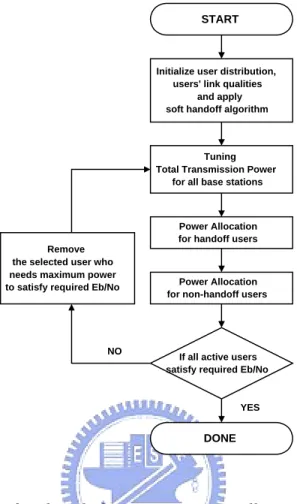
2.5 The flowchart of a downlink power resource allocation mechanism integrating four key techniques: 1) the soft handoff algorithm, 2) the downlink power allocation for handoff users, 3) the downlink power allocation for non-handoff
users, and 4) the removal algorithm. . . 26
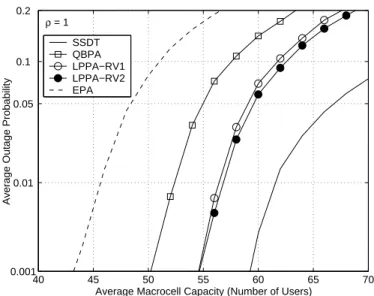
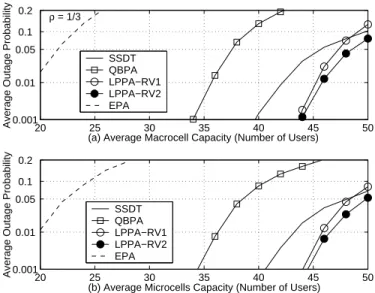
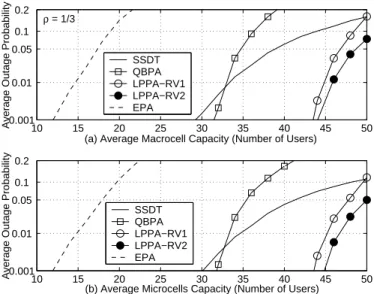
2.6 Simulation models of the CDMA mixed-size cellular network with (a) ρ = 1/2, (b) ρ = 1/3. . . . 34 2.7 Averaged outage probablity of the same-size cellular systems with ρ = 1.0 for
EPA, QBPA, SSDT, LPPA-RV1 and LPPA-RV2 schemes. . . 36
2.8 Averaged outage probability of the same-size cellular systems with ρ = 1.0 subject to measurement errors for EPA, QBPA, SSDT, RV1 and
LPPA-RV2 schemes. . . 37
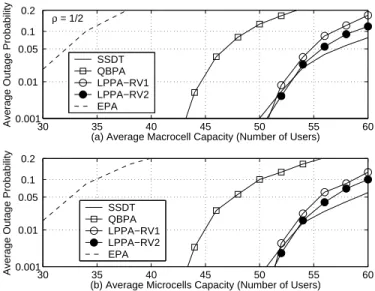
2.9 Averaged outage probability of the mixed-size cellular systems with ρ = 1/2
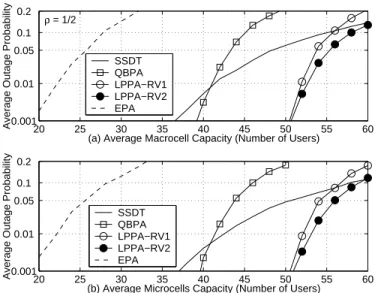
2.10 Averaged outage probability of the mixed-size cellular systems with ρ = 1/2 subject to measurement errors for EPA, QBPA, SSDT, RV1 and
LPPA-RV2 schemes. . . 39
2.11 Averaged outage probability of the mixed-size cellular systems with ρ = 1/3
for EPA, QBPA, SSDT, LPPA-RV1 and LPPA-RV2 schemes. . . 40
2.12 Averaged outage probability of the mixed-size cellular systems with ρ = 1/3 subject to measurement errors for EPA, QBPA, SSDT, RV1 and
LPPA-RV2 schemes. . . 41
2.13 Total capacity with and without measurement errors for EPA, QBPA, SSDT, LPPA-RV1 and LPPA-RV2 schemes of (a) the same-size cellular system, (b) the mixed-size cellular system with ρ = 1/2, (c) the mixed-size cellular system
with ρ = 1/3. . . . 42
3.1 The system operation of downlink power and rate assignment . . . 47
3.2 The flowchart of the MRV algorithm . . . 51
3.3 The mixed-size cellular model (ρ = 1/2) with an example of mobility trajectory. 56 3.4 Averaged handoff forced termination probability without measurement errors
(ME) and with 1.5 dB measurement errors (ME). . . 59
3.5 Total handoff throughput versus the number of data users per cell without
measurement errors (ME) and with 1.5 dB measurement errors (ME). . . 61
3.6 The average call dropping probability versus the number of data users per cell without measurement errors (ME) and with 1.5 dB measurement errors (ME). 62 3.7 The total throughput gain, which is referred to SSDT, versus the number
of data users per cell without measurement errors (ME) and with 1.5 dB
measurement errors (ME). . . 63
3.8 The user satisfaction index (USI) versus the number of data users per cell for
(a) USI of voice users (USIv) and (b) USI of data users (USId), respectively. 64
4.1 Diagram of total power allocation of the base station in downlink CDMA
4.2 Diagram of the soft handoff power allocation in downlink CDMA systems with (a) soft handoff in two mixed-size cell model, (b) before soft handoff, and (c)
during soft handoff. . . 71
4.3 Capacity results of the fixed pilot power design by applying SSDT and LPPA schemes under cases with (a) uniform (ρ = 1) and (b) non-uniform (ρ = 4) cell loads. . . 73
4.4 System block diagram of the proposed dynamic cell configuration (DCC) scheme with radio resource management. . . 75
4.5 Service coverage with different service rates. . . 80
4.6 Fuzzy Q-learning-based dynamic cell configuration (FQ-DCC) scheme. . . 86
4.7 The structure of the fuzzy inference system (FIS). . . 87
4.8 For fixed pilot power design, capacity results by applying SSDT and LPPA schemes in terms of different referenced service coverage under uniform (ρ = 1) and non-uniform (ρ = 4) cell load cases. . . . 95
4.9 The average pilot power of hotspot, 1st-tier, and 2nd-tier cells for the fixed pilot (FIX) with SSDT (FIX-SSDT) and LPPA (FIX-LPPA), and pilot power allocation for dynamic cell configuration (DCC) with SSDT (DCC-SSDT) and LPPA (DCC-LPPA) schemes. . . 96
4.10 The average blocking probability of (a) real-time and (b) non-real-time ser-vices for FIX-SSDT, FIX-LPPA, DCC-SSDT, and DCC-LPPA schemes, re-spectively. . . 97
4.11 The average handoff forced termination probability for FIX-SSDT, FIX-LPPA, DCC-SSDT, and DCC-LPPA schemes. . . 98
4.12 The average total throughput of systems for FIX-SSDT, FIX-LPPA, DCC-SSDT, and DCC-LPPA schemes. . . 99
4.13 The average frame error probability for FIX-SSDT, FIX-LPPA, DCC-SSDT, and DCC-LPPA schemes. . . 99
4.14 The average size of the active set for FIX-SSDT, FIX-LPPA, DCC-SSDT, and DCC-LPPA schemes. . . 100
List of Tables
2.1 System parameters of the simulation model for the mixed-size
CDMA cellular system . . . 35
3.1 Service classes . . . 58
4.1 Link budget in the multimedia WCDMA system . . . 93
Notation Table
W : bandwidth PI
b: pilot power of base station b for the pilot channel
PT
b : total transmission power of base station b for the traffic channel
e
Pb: maximum transmission power of base station b
e
pb: maximum link power constraint of the mobile station in base station b
pb,m: transmission power from base station b to mobile station m
pb,m(r): transmission power from base station b to mobile station m with service rate r
p∗
h: required transmission power for handoff user h
Lb,m: link quality between base station b and mobile station m
fα: orthogonality factor
db,m: distance between base station b and mobile station m
dcorr: decorrelation distance
zb: breaking point of base station b
CL: constant of the channel model
ξb: shadowing effect of base station b
σ1, σ2: standard deviation of the 2-step shadowing model
λ: wavelength
hm: antenna height of the mobile station
hb: antenna height of the base station
αb, βb: pathloss exponent of base station b
Ib,m: received total interference for user m in cell b
GP(r): processing gain of service rate r
GI
P: processing gain of the pilot signal
γb,m: received signal quality of mobile station m from base station b
γb,m(r): received signal quality of mobile station m with service rate r from base station b
γ∗: required signal quality of bit-energy-to-noise ratio (E
b/Io) for single service
γ∗(r): required signal quality of bit-energy-to-noise ratio (E
b/Io) for service rate r
γh: received signal quality of handoff user h
γh(r): received signal quality of handoff user h with service rate r
υb,m: received chip-energy-to-interference ratio (Ec/Io)
ηo: background noise
r : service rate
rmin: minimum service rate
rmax: maximum service rate
r∗: referenced service rate
Dh: active set of user h
ρ : cell radius size ratio between the macrocell and the microcell; traffic load ratio between the hotspot cell and the adjacent cell
Ab: total transmission power of non-handoff users of base station b
Bb: total transmission power of handoff users of base station b
e
Bb: maximum transmission power constraint base station b for all handoff users
Jm(r): removal index for user m with service rate r
Jm: removal index for user m (single service)
fmin: minimum pilot power fraction of the maximum transmission power
fmax: maximum pilot power fraction of the maximum transmission power
φm: allocated power ratio of the traffic channel power for mobile station m
Ub: set of all mobile stations served by base station b.
ωb,m: weighting factor of the power allocation algorithm
ϕh: tuning factor of required power for handoff user h by the LPPA algorithm
η : threshold of the soft handoff algorithm
O(x): objective function of the allocation rate vector x in the ECRA algorithm s(x): decoder function of the allocation rate vector x in the ECRA algorithm X(x): violation function of the allocation rate vector x in the ECRA algorithm pc: crossover rate
pu: mutation rate
T : maximum number of generations
KP: number of populations
NS: number of service class
Nv: number of handoff voice users in each cell
Nd: number of handoff data users in each cell
Nb: number of base stations in the system
EP: equivalent isotropic radiated power (EIRP)
GB: antenna gain of the base station
LC: cable loss
GS: soft handoff gain
GM: antenna gain of the mobile station
LD: body loss of the downlink receiver
ET: total EIRP
ΩI: interference margin
HS(r): required signal-to-interference ratio (SIR) of service rate r
HR(r): receiver sensitivity of the mobile station with service rate r
ΩL: log-normal fading margin
P L(r): maximum allowable pathloss of service rate r R(r): cell radius of service rate r
LC: cable loss
Υ: received chip-energy-to-interference ratio (Ec/Io)
s : system state for the DCC scheme
$M, $V: state vector includes sample mean and sample variance
a(s): action of state s for the DCC scheme A: action set
S: system state set
µ(s, a(s)): reward function with state-action pair {s, a(s)} rm: service rate of user m
Vπ(s): value function of state s with policy π
Qπ(s, a(s)): Q-function of state-action pair {s, a(s)} with policy π
Q∗(s, a(s)): optimal Q-function of state-action pair {s, a(s)}
∆Q: temporal difference error of Q-function U(s, π(s)): mean reward function
Pr(s0|s, a(s)): transition probability from state s to state s0
γd: discount factor
λL: learning rate of the Q-function
Sk: state of rule k
ak(j): action value of rule k with rule action j
π∗: optimal policy
ek(j): replace eligibility of possible action ak(j) in rule k
qk(j): q-value of rule action j in rule k
αk(x): truth value of each rule for the input vector x
ϕSk,i(xi): membership degree to the different fuzzy sets T (x), T (y): input/output linguistic terms
Sk,z: fuzzy label for z-th input variable in rule k
As: feasible action set
fΘ: cutting value of the action set
K: total number of elementary rules J: overall action set
Z: size of the input vector
Chapter 1
Introduction
In recent years, the evolution of wireless mobile communication systems have experienced tremendous growth. To utilize the radio spectrum efficiently, the cellular architecture is used in wireless mobile networks, and code division multiple access (CDMA) has been a promising technique for the third or beyond third generation wireless mobile cellular systems. In the CDMA cellular networks, base stations density and the associated cell configuration are primarily determined by the service coverage and system capacity objectives. Generally, in interference-limited CDMA cellular systems, system designs of the service coverage and system capacity are deemed to be challenging issues.
In CDMA cellular networks, capacity and coverage can be limited by the uplink and downlink interference which comes from other mobile stations and from adjacent base sta-tions, respectively. It is generally regarded that service coverage is uplink-limited because of transmission power constraint of mobile equipments. On the other hand, the system ca-pacity may be either uplink or downlink limited depending upon the cell configuration or traffic profile. The uplink capacity-limited scenario may occur in a rural environment where the service coverage of the network is planned with lower uplink cell load and interference margin. Besides, the downlink capacity-limited scenario may occur in suburban or urban environments where the service coverage of the network is planned with a higher uplink load. Therefore, a cell is uplink or downlink capacity limited when it exceeds the predefined interference margin or when it reaches its maximum total transmission power, respectively. For the initial systems deployment, to afford capacity upgrades without extra efforts and investments, it is necessary to take into account the present and future coverage and
capac-ity requirements, i.e. by including additional carriers, adding new base stations or adding additional sectorization [1].
1.1
Motivation
Nowadays, the enormous demands of internet services drive multimedia services becoming necessary for future cellular networks. The versatile multimedia traffic activity makes the interrelation between the service coverage and system capacity bond closer because service coverage have to be reduced to offer higher capacity for multimedia traffics with higher service rates. Moreover, because the multimedia traffic is generally asymmetric with a greater amount of traffic on the downkink, the cellular network tends to the downlink capacity-limited scenario, in which improving service coverage will lead to a loss in system capacity, and vice versa. Therefore, system designs of the service coverage and cell capacity turn into a thorny problem.
Due to random user mobility and diverse multimedia activity, cell loads will distribute non-uniformly. Since the system capacity depends on the amount of interference, the CDMA system work best when the traffic patterns are uniform [2]-[4]. There are many techniques developed for improving system capacity. For example, setting up hierarchical cellular struc-ture by adding more carriers can upgrade more than double the system capacity. However, because of scarce frequency resource, there may be no available carriers. Other techniques should be further considered such as transmitting diversity, beamforming, and adding sec-torization or microcells.
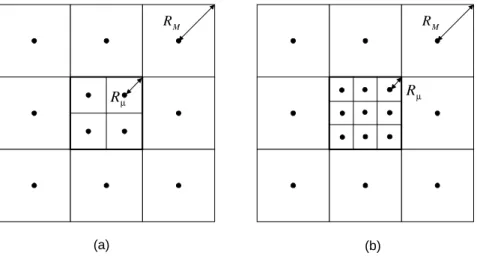
Assume the same carrier frequency is used at different layers of the cellular network, to enhance system capacity for the cellular network with non-uniform cell loads, a mixed-size cellular network with mixed-mixed-size cells may be deployed as shown in Fig. 1.1. First, to maintain service coverage, a small microcell may be installed at the boundary of surrounding macrocells. Second, to increase the system capacity, a marcocell may be split up into a cluster of microcells. However, in the cellular system with mixed-size cells, a macrocell easily blocks a nearby microcell due to near-far effect. This is because higher transmission
Figure 1.1: The mixed-size cellular model
power is needed to compensate higher pathloss to macrocell whereas more interference is induced to interfere the adjacent microcell. Moreover, since a microcell’s base station usually owns capability of low transmission power, the stringent power budget on the downlink results in downlink capacity-limited scenarios. As aforementioned, in view of the system capacity, the CDMA cellular system works best when cell loads are uniformly distributed. Therefore, power balance becomes a vital characteristic to tackle the problem of downlink radio recourse management arisen by the CDMA mixed-size cellular system. To afford the necessity for future capacity upgrades, in this dissertation, we consider CDMA mixed-size cellular systems with mixed-size cells and specialize in downlink soft handoff mechanisms and cell reconfiguration planning in terms of power balance characteristics to tackle problems between service coverage and system capacity.
In CDMA cellular systems, soft handoff is one of the most important techniques to balance traffic loads between cells. When mobile users move from one cell to another cell, the soft handoff technique applies multi-site transmission mechanism to support seamless connections and better signal qualities for users near cell boundaries. However, base stations often have to consume more power to serve soft handoff users than that to serve non-handoff users. Therefore, congested microcells, which are with stringent power budget for maximum total transmission power, may easily exhaust their total transmission power because of serving soft handoff users in the downlink, and then there is no extra power resource to serve other users in the system. This raises the issue of tradeoffs between the service coverage and system capacity. For example, if a base station fails to serve handoff users near cell boundaries,
the cell’s service coverage is shrunk whereas there are more power applicable to non-handoff users. Therefore, soft handoff technique plays an important role for downlink radio resource management, and it will make a significant impact on system performance. However, most of conventional radio resource management techniques of soft handoff are designed for the homogeneous cellular system, which is assumed as uniform traffic loads and with the same-size cells. Therefore, in future CDMA heterogenous cellular networks, the advanced soft handoff techniques for radio resource management are necessary .
For the narrowband CDMA system supporting voice service only, system performance will be determined by power allocation algorithms. To achieve power balance among cells, multi-site transmission mechanism is adopted to satisfy a handoff user’s quality of service (QoS) by distributing required transmission power among active links in its active set. Furthermore, consider the wideband CDMA (WCDMA) system supporting multirate services, power and rate allocations impact on system capacity and cell’s service coverage dramatically. Most of previous studies focus on joint power and rate allocations for all users in the CDMA system. However, the possible combinatorial numbers of the solutions are too huge to be tractable for global optimal allocations. To make system implementation feasible, we propose an effective idea providing optimal joint power and rate allocations for soft handoffs. This way can not only reduce computation complexity but also specialize in the characteristic of the power balance through optimizing radio resource for soft handoffs. However, when system loads is heavy or handoff rate is high, the computation complexity will be increased. To further scale down the computation complexity, applying statistical optimization techniques are necessary, such as genetic algorithm, evolutional algorithm, simulated annealing algorithm, etc.
Currently, in CDMA cellular networks, the cell coverage and capacity of a network are planned in the pre-deployment stage according to pre-defined traffic patterns. That is, the pilot power allocation is fixed. In practice, however, traffic patterns are changing with time due to random user mobility and versatile service activity. The planned cellular mobile networks may not utilize radio resources optimally under the varying traffic patterns. In next-generation CDMA cellular networks, this problem becomes more severe. The sophisticated
techniques of radio resource management are necessary for future multimedia cellular systems to be adaptive to the emerging multimedia services.
Dynamic cell configuration is an advanced technique to balance traffic load by controlling pilot power dynamically. Since each base station has finite power resource, the pilot channel and traffic channels have to share the total power resource. This explains the interdependence of coverage and capacity in CDMA systems. Pilot power can be adjusted between them based on various traffic situations. When the required traffic power is low, the pilot power can be increased to extend cell coverage so as to accommodate more users around the adjacent cells. On the other hand, when the required traffic power is too high to have risks of degrading system performance, the pilot power can be decreased to shrink cell coverage. Therefore, to utilize radio resources efficiently, it is crucial for next-generation CDMA cellular networks to be aware of system situations and configures cell coverage and system capacity dynamically to balance traffic loads over all cells. That is, the mixed-size cell configuration can be formed dynamically by being aware and adaptive to system situations. Tradeoffs between the coverage and capacity motives us that pilot power allocation and other radio resource management schemes, such as soft handoff power and maximum link power allocations as well as call admission control mechanisms, should be highly coupled in situation awareness CDMA cellular networks.
In this dissertation, to accomplish power balance features for future CDMA mixed-size cellular systems, we are motivated to design soft handoff mechanisms and to plan cell con-figurations.
1.2
Paper Survey
Due to non-uniform traffic load distribution, using the same frequency band and mixed-size cells has been a necessary network architecture to form CDMA mixed-size cellular systems. References [5]-[7] considered capacity issues in mixed-size cellular systems with mixed-size cells. Both [5] and [6] only focused on the reverse link. On the other hand, Kishore, et al, [7] concluded that uplink and downlink directions are equivalent in size
mixed-size cellular systems. However, it does not consider soft handoff mechanisms and multirate services which are both regarded as highly resource-exhausting traffics.
The major challenge of the CDMA mixed-size cellular system is that link qualities from a macrocell and a microcell to the handoff user are quite unequal, so most of handoff users near cell boundaries easily choose the microcell with less pathloss for the target cell to handoff. Under the downlink capacity-limited scenario, a microcell with low pilot power (small coverage) and high traffic loads (high capacity) may thus exhaust its stringent power resource, which is addressed as power exhausting problem. This problem makes the power allocation for soft handoff with multirate services becoming a more critical issue because most of previous studies of radio resource management focus on homogeneous cellular systems only [1], [8].
Moreover, the previous works about downlink power allocation for soft handoff in CDMA systems can be summarized as follows. Viterbi et. al. [9] examined the impact of soft hand-off on downlink capacity of the CDMA system in a homogeneous cellular structure with the same-size cells, in which all the serving base stations in the active set allocate the same amount of power to a user, it is called equal power allocation (EPA) scheme. However, [10]−[12] showed that EPA-based downlink power allocation of soft handoff may decrease system capacity due to unequal path gains from a handoff user to the serving base stations. Moreover, Kim [13] proposed a simple quality balancing algorithm by adjusting cell-site transmitter power to balance quality to a common level so that all users can receive equal signal quality. However, the quality balancing power allocation (QBPA) strategy is suitable for non-handoff but not handoff users because more power will be wasted. Furthermore, Fu-rukawa et al. [14] proposed a site selection diversity transmission (SSDT) scheme for CDMA downlink transmissions, in which transmission diversity is provided by dynamically selecting one base station with best link quality in the active set. However, due to the maximum link power constraint, SSDT sometimes could not afford enough power to multirate soft handoff users. Moreover, since SSDT is a single-site transmission mechanism at one time, it may select the wrong link resulting in wasting more power for handoffs when suffering
measure-ment errors during active set selection. The advantage of the power saving characteristic for SSDT would disappear. To combat the occurrence of the measurement errors, the au-thors in [15] suggested multi-site transmission mechanism to enhance conventional SSDT scheme. The multi-site transmission schemes are also proposed to balance power loads in reference [16] and [17]. The former presented a a cost-function-based differentiated power control scheme to determine different power levels of each radio link from two base stations to the handoff user. Also, the latter proposed two proportional power allocation methods for soft handoff in terms of transmission power and target signal quality. However, none of the aforementioned downlink power allocation for soft handoff have been evaluated in a mixed-size cellular system.
Furthermore, consider multirate CDMA cellular systems, many literatures discussed the topic of joint power and rate allocation for all users in the sense of global optimization problem [18], [19]. However, they focused on the reverse link. References [20] and [21] pro-posed joint power and rate allocation algorithms in the downlink WCDMA homogeneous cellular systems. The former proposed two sub-optimal algorithms based on fairness consid-eration, and the latter adopted dynamic programming technique to optimize total through-put. Moreover, Kim [22] dealt with rate-regulated power control in the reverse link without concerning handoff. Reference [23] discussed radio resource management in multiple-chip-rate direct sequence CDMA systems supporting multiclass services, in which inter-system or inter-frequency handoff had been taken into account. Kim and Sung [24] proposed a handoff management scheme for multirate services using guard channels and reservation on demand queue control. All the aforementioned joint power and rate allocation schemes considered homogeneous CDMA cellular systems without soft handoff mechanisms.
To obtain an overall evaluation, in addition to radio resource management of soft handoff, there are two important algorithms considered for the downlink radio resource management, including downlink power allocation for non-handoff users and removal algorithm. Zander [25] proposed quality balancing power allocation techniques for downlink power allocation, in which all users in the same cell can obtain the same quality level. Based on the concept
of quality balancing in [25], Kim [13] further proposed a simple scheme to balance signal quality to the same required level for each user in each cell by adjusting total power of each base station. Both [25] and [13] were studied only for a single service rate with unique required signal quality, and both took all users into quality balancing procedures of power allocation. Furthermore, in order to find a convergent solution for downlink power allocation, the removal algorithm is designed to remove some users who owns weaker link quality for transmission [26], [27]. However, the link-based and received signal-strength based removal algorithms were only suitable for single service. Besides, the prioritized removal algorithm in [28], based on predefined service priority, did not consider service rate tuning for users in the reverse link of a multiservice cellular system.
The preceding previous works all focus on the fixed cell configuration by fix pilot power allocation. In order to make pilot power adaptive to the traffic load variation due to random mobility and diverse multimedia services, it is crucial for next-generation CDMA cellular networks to be aware of system situations and configures cell coverage and capacity dynam-ically to balance traffic loads over all cells [29], [30]. Several schemes have recently been proposed for dynamic cell configuration in cellular networks [31]−[37]. In [31], the optimiza-tion of pilot power and the planning procedures of downlink capacity and cell coverage were proposed. In [32], authors used analytical methods to study the competitive characteris-tics of network coverage and capacity in a simple network. Only one class of service was considered in [31] and [32], and it may be difficult to extend these schemes to a network with multi-classes of services. There are also some heuristic-rule-based techniques in the literature for dynamic pilot control to balance downlink traffic load while assuring service coverage [33]−[35]. However, these schemes may cause some “coverage failure regions” be-tween cells where all the received pilot signals are too weak to serve a mobile station [36], [37]. The common shortcomings of the previous work [31]−[37] are that only pilot power is adjusted and other radio resource management schemes are not taken into account in the time-varying environment.
are highly coupled. For example, [4] was showed that signal quality degradation can be prevented by configuring cell areas adaptively and setting transmission power levels appro-priately. Also, authors in [38] and [39] showed that soft handoff has significant impacts on the system capacity and service coverage.
1.3
Dissertation Organization
In this dissertation, we specialize in the downlink soft handoff mechanisms and cell re-configuration planning in terms of power balance characteristics to tackle tradeoffs between service coverage and system capacity in CDMA mixed-size cellular systems.
In Chapter 2, we explore impacts of soft handoff mechanism in the mixed-size cellular system. A power exhausting problem is addressed by a simple analytic approximation of user capacity based on a simplified two cell model. To deal with this problem, a novel link proportional power allocation (LPPA) scheme for soft handoff is proposed, which is a multi-site transmission mechanism. The LPPA scheme distributes the required power in proportion to the link qualities between a soft handoff user and all base stations in its active set. The proof of the convergence of the LPPA is also provided. In simulations, the LPPA scheme is compared with several existing power allocation schemes of soft handoff in the narrowband CDMA mixed-size cellular system with multiple mixed-size cells supporting voice service only. It is shown that LPPA can alleviate the power exhausting power for the CDMA mixed-size cellular system with or without measurement errors during active set selection.
In Chapter 3, based on the power allocation of soft handoff in Chapter 2, consider mutlirate WCDMA mixed-size cellular systems, we propose a joint power and rate alloca-tions (JPRA) for soft handoff, which accomplishes power balance among cells by multi-site transmission mechanisms using LPPA and evolutionary computing rate assignment (ECRA) method. Both of them can aid in distributing the required power of the soft handoff user to all base stations in its active set. The optimization of the soft handoff can be formulated by an integer and discrete optimization problem under a predefined total power constraint
for soft handoffs in each cell. It is well known that conventional optimization methods can hardly cope with problems with integer and discrete variables, whereas evolutionary com-puting methods are very efficient for these problems to reduce the searching complexity [40], in which evolutionary computing is known for the efficiency of the optimization problem. In simulations, the JPRA scheme is compared with the existing power allocation schemes with best-effort rate allocation in the mutlirate mixed-size celluar system with multiple mixed-size cells. As a result, JPRA can dynamically adapt to changes of non-uniform load situations in the mixed-size cellular environment.
Furthermore, in order to specialize radio resource management of handoff, we differentiate handoff users from all users, and propose a modified quality balancing power allocation only for non-handoff users in Chapter 2. Besides, in Chapter 3, a new multi-quality balancing power allocation (MQBPA) algorithm for non-handoff users for multiple service rates with multiple quality requirements is developed. Also, the multirate removal (MRV) algorithm is proposed to pick out a user who consumes system resource most and to reduce its service rate or even block it when the system resource is insufficient.
In Chapter 4, we further consider pilot power control to form dynamic cell configura-tion for the cellular system with non-uniform traffic load distribuconfigura-tion. The dynamic cell configuration (DCC) scheme can form size cellular networks with irregular mixed-size cells automatically. We address the problem of dynamic cell configuration by observing that dynamically adjusting pilot power alone while not changing other radio resource man-agement algorithms can result in performance degradation. We then propose a novel DCC scheme with radio resource management in multimedia CDMA networks via a reinforcement-learning technique, which takes into account pilot, soft handoff, and maximum link power allocations as well as call admission control mechanisms. Simulation results demonstrate the effectiveness of the proposed scheme in situation-aware CDMA networks.
Chapter 2
A Downlink Power Allocation
Mechanism for Soft Handoff in
Mixed-Size CDMA Cellular Systems
In this Chapter, we investigate impacts of soft handoff in CDMA system with mixed-size cells because soft handoff mechanism directly affects system capacity and coverage. Based on a simple analytic approximation of user ca-pacity for a simplified model of two mixed-size cells, it is found that a power exhausting problem may occur in microcells of mixed-size cellular systems. This is because a congested microcell has more stringent constraints of the maximum total power and link power than a macrocell. To tackle the prob-lem, we develop a novel link proportional power allocation (LPPA) scheme, which is based on the concept of unequal power allocation for active links in proportional to the link quality. Many existing power allocation schemes for soft handoff, including site-selection diversity transmission (SSDT), qual-ity balancing power allocation (QBPA), and equal power allocation (EPA) schemes, have been taken into comparison. Simulation results show that the LPPA scheme outperforms all existing schemes because of its excellent capa-bility of power balance. Besides, it shows that the LPPA scheme offers better resistent to occurrences of measurement errors during active set selection.2.1
Introduction
Soft handoff is an important technique for the code division multiple access (CDMA) cellular system. Traditional soft handoff algorithms are mainly developed for the same-size cellular system which has same-same-size cells. Although soft handoff technique has been extensively discussed in the literature, fewer works have concentrated on the design for the soft handoff technique in mixed-size cellular systems. As mentioned in Chapter 1, the major challenge of the mixed-size cells is that link qualities from a macrocell and a microcell to the soft handoff user are quite unequal, so most of handoff users near cell boundaries add the microcell with better link quality of the connection into their active set for transmission. The microcell with stringent power budget of total power may thus exhaust its stringent power resources. We address this issue as a “power exhausting problem”. This problem also illustrate the importance of the soft handoff power allocation in the mixed-size cellular system because soft handoff users generally need more power than non-handoff users. To specializing in the radio resource management of soft handoff for mixed-size cellular system, the key concept to enhance system performance is to achieve power balance among macrocells and microcells. Therefore, the ultimate goal of this chapter is to design a novel power allocation algorithm for soft handoff to achieve power balance among cells, which is suitable for using in the mixed-size cellular system.
The previous works about power allocation for soft handoff in downlink CDMA systems can be summarized as follows. In [9], authors examined the impact of soft handoff on downlink capacity of the CDMA system in a same-size cellular structure. It was mentioned that soft handoff can maximize the diversity gain when the involved serving base stations allocate the same amount of power to a user. In this chapter, if the serving base stations allocate the same amount of power to the handoff user, we call it the equal power allocation (EPA) method. In [12], it was shown that EPA-based downlink soft handoff may decrease system capacity due to unequal path gains from a handoff user to the two serving base stations. In [13], a simple quality balancing algorithm was proposed to adjust cell-site transmitter power for non-handoff and handoff users in the downlink. We call the power
allocation method of [13] as the quality balancing power allocation (QBPA) method in this chapter. Furukawa [14] proposed a site selection diversity transmission (SSDT) technique for CDMA downlink transmissions to select a serving base station with the best link quality among the active set. In [15], the author proposed an enhanced SSDT technique to allow more than one base station to transmit signals to the handoff user. Reference [16] presented a a cost-function based differentiated power control technique to determine different power levels of each radio link from two base stations to the handoff user. Reference [17] proposed two proportional power allocation methods in terms of the transmission power and the target signal quality.
With respect to the performance of mixed-size CDMA cellular systems, some works have been reported in the literature [41]−[42]. In [41], it was concluded that the capacity of a hierarchical cellular system can be improved by integrating downlink power control of microcells and uplink power control of a macrocell. In [5] it was found that for a CDMA system with mixed-size cells, the interference from adjacent macrocell may decrease the uplink capacity improvements resulting from cell splitting. In [6] the authors suggested tier selection algorithms to improve the uplink capacity of a microcell/macrocell overlaying system. In [42], a macrodiversity scheme was proposed to enable a hierarchical CDMA system to share the same spectrum between the macrocell and the microcell by adopting the SSDT technique in the downlink and the maximal ratio combining technique in the uplink. To our knowledge, in an environment with a cluster of microcells surrounded by macrocells, the downlink capacity of such a CDMA system considering both handoff and power control has not been fully addressed in the literature.
Aiming to resolve the power exhausting problem for the CDMA mixed-size system, we propose a novel link proportional power allocation (LPPA) scheme. The LPPA scheme adopts multi-site transmission mechanism to distribute transmission power in proportional to link qualities between the user and the base stations under the constrain of maximum link power. Furthermore, to obtain an overall evaluation for system performance, in addition to radio resource management of soft handoff, there are two important algorithms
consid-ered for the downlink radio resource management, including downlink power allocation for non-handoff users and removal algorithm. Zander [25] proposed quality balancing power allocation techniques for downlink power allocation, in which all users in the same cell can obtain the same quality level. Based on the concept of quality balancing in [25], Kim [13] further proposed a simple scheme to balance signal quality to the same required level for each user in each cell by adjusting total power of each base station. In this chapter, in order to specialize radio resource management of handoff, we differentiate handoff users from all users, and propose a modified quality balancing power allocation only for non-handoff users. Also, to achieve convergent solution for downlink power allocation, [26], [27] proposed re-moval algorithms to remove some users who owns weaker link quality for transmission. In this chapter, we further design two removal schemes to provide priority for soft handoff users who need seamless transmission.
Consider CDMA heterogenous cellular systems with mixed-size cells supporting voice service only, our simulation compares LPPA with many existing soft handoff power allocation scheme, such as SSDT, QBPA, and EPA schemes. The simulation results show that our proposed LPPA scheme can alleviate the power exhausting problem and deliver higher system capacity in a CDMA system with mixed-size cells than other existing schemes. Besides, it shows that the LPPA scheme offers better resistent to occurrences of measurement errors during active set selection.
The rest of this chapter is organized as follows. section 2.2 describes the system model for a simplified case of two mixed-size cells. Also, the power exhausting problem is addressed by a simple analytic approximation of user capacity based on a simplified two cell model. Section 2.3 discusses the related handoff power allocation algorithms. Section 2.4 propose a novel LPPA scheme for soft handoff power allocation and prove its convergence characteristic. Also, this section illustrates details the designs of the CDMA mixed-size cellular system integrating soft handoff and non-handoff power allocations as well as removal procedures. Simulation model and results are discussed in section 2.5. Section 2.6 provides concluding remarks.
2.2
System Model
In this section, we demonstrate a simplified model with two mixed-size cells and then address the power exhausting problem that is arisen by the soft handoff power allocation analytically.
2.2.1
Signal Model
Consider a simplified mixed-size cellular model with a single microcell adjacent to a
macrocell as shown in Fig. 2.1. Denote RM and Rµ as the radii of the macrocell M and the
microcell µ, respectively. Assume a handoff user is located at H.
H
R
µ MR
µ
Mr
Mr
µFigure 2.1: A simplified mixed-size cellular model with two mixed-size cells
Denote pb,m as the transmission power from base station b to user m. The received
interference, Ib,m, of user m served by base station b is
Ib,m = (1 − fα)(PbT − pb,m)Lb,m+
X
k6=b
PT
kLk,m+ ηo, (2.1)
where fα is the orthogonality factor; PkT =
P
m
pk,m is the downlink total transmission power
of the traffic channel in cell k; Lb,m is the link quality from cell b to user m; ηo is the
background noise. Note that the first and second terms in (2.1) mean intra-cell and inter-cell interferences, respectively, in which the first term is caused by imperfect orthogonality of channel codes.
Let γb,m be the downlink received bit energy-to-noise density ratio (Eb/No). Then γb,m
can be written by
γb,m =
pb,m· Lb,m· GP
Ib,m
where GP is the processing gain, and γ∗ is the required Eb/No. By including effects of both
pathloss and shadowing, Lb,m can be expressed by [43], [44]
Lb,m = CL dαb b,m(1 + ( db,m zb ) βb) × 10ξb/10 , (2.3)
where αb and βb are the pathloss exponents of base station b, db,m is the distance from user
m to the base station b, zb is the break point in cell b, and CL is a constant of the channel
model. In (2.3), the standard deviation of the shadowing ξb is described by a distance
de-pendent variable [45], i.e.,
σb(db,m) =
½
σ1 , db,m ≤ zb
σ2 , db,m > zb . (2.4)
Also, the breakpoint zb is given by
zb =
4 hb hm
λ , (2.5)
where hb is the antenna height of base station b, hm the antenna height at the user side, and
λ the wavelength. We define the cell boundary as the point at which user m receives the same signal strength from both adjacent cells M and µ first [44]. Then at the cell boundary, we have
PMI × LM,m= PµI× Lµ,m , (2.6)
where PI
M and PµI represent pilot power emitting from the base stations of the macrocell and
the microcell, respectively. For simplicity, we only consider the effect of pathloss in (2.6) first. Then, combining (2.3) and (2.6), we have
PI M PI µ = Lµ,m LM,m = R αb M(1 + (RzMM) βb) Rαb µ (1 + (Rzµµ)βb) ∝ (RM Rµ )αb+βb × (hµ hM )βb . (2.7)
When considering only the microcell interference in (1), we have pb,m ≥ γ∗ · (PT M · LM,m+ PµTLµ,m) (GP + γ∗) · LM,m , = γ∗ (GP + γ∗) · (PT M + PµT Lµ,m LM,m ) , = γ ∗ (GP + γ∗) ·©PMT + PµT Xm10(ξµ−ξM)/10 ª , (2.8) where Xm = d−αµ µ (1 + dzµµ)−βµ d−αM M (1 + dzMM) −βM. (2.9)
To make macrocell users receive required Eb/No, the maximum link power epM can be obtained
by substituting the maximum total power ePM and ePµ in (2.8). Then, we have the maximum
link power of macrocell M e
pM =
γ∗
(GP + γ∗)
( ePM + ePµ· Xm), (2.10)
where Xm is given in (2.9). For simplicity, we only consider the effect of pathloss in (2.6).
Note that the total power of the base station is dependent on the summation of the allocated power for each user. From (2.7) and (2.10), the maximum link power of microcell µ can be obtained as e pµ= epM · LM,m Lµ,m . (2.11)
As for the soft handoff users, the maximum ratio combining (MRC) method is adopted to combine received signal from each active link for the soft handoff [46]. Thus, the received Eb/No for soft handoff user h, denoted as γh, is given by
γh =
X
b∈Dh
γb,h, (2.12)
where Dh is the action set of user h, in which |Dh| > 1 means the user is in the soft handoff
mode.
2.2.2
A Simplified Capacity Approximation for Two Mix-Sized Cells
In this section, to address the power exhausting problem analytically, we evaluate the capacity for the CDMA mixed-size cellular system with two mixed-size cells case, as shown
in Fig. 2.1. Consider user h at location H. Let M → µ represent the event of soft handoff when user h moves from the originally serving macrocell M to adjacent microcell µ. Assume soft handoff is initiated for a user when the following condition is satisfied:
PMI · LM,m− PµI· Lµ,m ≤ η , (2.13)
where LM,m and Lµ,m are the link qualities from user m to base stations M and µ,
respec-tively; η is the handoff threshold.
In this section, we consider two strategies of soft handoff power allocation, including equal power allocation (EPA) and unequal power allocation (UPA) schemes. According to the EPA scheme, base stations in the active set transmit the same power level. Thus, the serving base station M will allocate power for user h according to (2.8) with an upper constraint defined in (2.10). Denote p0
µ,h and p0M,has the transmission power for handoff user h from macrocell
M and microcell µ, respectively. Then, p0
µ,h and p0M,h can be written as
p0
M,h= p0µ,h = 12min ( pM,h, epM ), for M → µ. (2.14)
Note that pM,h and p0M,h indicate the allocated power before and during soft handoff mode,
respectively. The factor of 1
2 in (2.14) is related to the number of base stations involved in
soft handoff, i.e. two base stations in this case.
If the UPA scheme is used, the two serving base stations will allocate power at different levels according to (2.8) and (2.10). That is,
p0
M,h = 12min( pM,h, epM ) for M → µ p0
µ,h = 12min( pµ,h, epµ) for M → µ
(2.15) For a microcell user moving into a macrocell, i.e. µ → M, we can simply swap M and µ in (2.14) and (2.15) to obtain the allocated power from the macrocell and the microcell during soft handoff mode.
In [9], the downlink outage probability is defined as the probability of transmitted total power of a base station exceeding its constraint of maximum total power. That is,
Potg(M ) = Prob{ PT
Denote NM and Nµ as the number of users in the macrocell and microcell, respectively.
Let NH
M and NµH be the number of soft handoff users in the macrocell M and microcell µ,
respectively. Thus, the total transmission power of mactocell M in (2.16) can be calculated as PMT = NMX−NMH m=1 pM,j + NH M X m=1 p0M,h+ NH µ X m=1 p0µ,h , (2.17)
where the sum of the second and the third terms (denoted as PH
M) is equal to the total
transmission power for soft handoff users . From (2.14) and (2.15) we can obtain PH
M. We
further substitute (2.8) for pM,m in (2.17), and obtain
YM =
NMX−NMH
m=1
Xm· 10(ξµ−ξM)/10 , (2.18)
where Dm is defined in (2.9). Let
χ = PeM − KC· P
T
M · (NM − NMH) − PMH
KC · PµT
, (2.19)
where KC = γ∗/(GP + γ∗). Then Potg(M ) in (2.16) becomes
Potg(M ) = Prob à YM > e PM − KPMT(NM − NMH) − PMH KPµ ! , (2.20) = Q µ χ − mY σY ¶ , (2.21) where Q(x) = 1 2 R∞ x e−t 2/2
dt. Note that since YM is a sum of independent log-normal random
variables, it can be approximated by a new log-normal random variable YM with mean mY
and standard deviation σY by using the Yeh’s approximation method in [47]. The outage
probability for the microcell users in the downlink can be also obtained by using the same method.
2.2.3
The Power Exhausting Problem
Assume that mobile stations are uniformly distributed in both macrocell and microcell. The system capacity is defined as the maximal number of users subject to the constraint of outage probability less than a certain value, say Potg(M ) < 0.05. Thus we can obtain the capacity of macrocell and microcell. The analysis results of the user capacity for the two mixed-size cell model are presented.
0 0.1 0.3 0.5 0.7 0.9 1 20 24 28 32 36 40 No power constraint Power constraint
Cell radius ratio ( ρ )
Capacity (number of users) microcell
macrocell 0 0.1 0.3 0.5 0.7 0.9 1 15 20 25 30 35 40 No power constraint Power constraint
Cell radius ratio ( ρ )
macrocell
microcell
(a) EPA (b) UPA
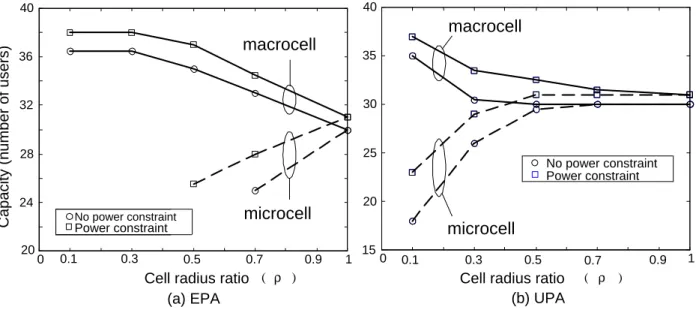
Figure 2.2: The capacity of (a) the equal power allocation (EPA) and (b) the unequal power allocation (UPA) for soft handoff against the cell radius size ratio ρ.
Figure 2.2(a) shows the capacity by using EPA for soft handoff against the cell radius ratio ρ. In the figure, the capacity is defined as the maximum number of users subject to the constraint of outage probability less than 0.05. To get some insights through analysis, we consider a simplified two cell model in Fig. 2.1 and apply (2.20) to calculate the system capacity. We observe that the power exhausting problem occurs in the microcell when ρ < 0.7 without constraint of maximum link power and when ρ < 0.5 with the constraint of maximum link power. One can see that the smaller the value of ρ, the higher the macrocell capacity will be. The increase of the macrocell capacity as the value of ρ decreases is mainly because interference from the microcell is reduced. Constraining the maximum link power can relieve the power exhausting problem in the microcell slightly although the improvement is not significant. Fig. 2.2(b) demonstrates the capacity of a system using the UPA scheme for soft handoff against the cell radius ratio. Unlike the EPA scheme, the UPA scheme can maintain a good capacity for both microcell and macrocell from ρ = 0.5 − 1.0. The power exhausting problem does not occur even with ρ = 0.1. It is also noted that the power constraint can improve the capacity, especially when ρ is small. For ρ = 0.1, the capacity for the constrained UPA scheme increases microcell capacity about 30%.
(a) (b) 0 0.1 0.3 0.5 0.7 0.9 1 30 35 40 45 50 55 60 65
Cell radius ratio ( ρ )
Capacity (number of users)
EPA 0 0.1 0.3 0.5 0.7 0.9 1 50 55 60 65
Cell radius ratio ( ρ )
UPA
No power constraint Power constraint
No power constraint Power constraint
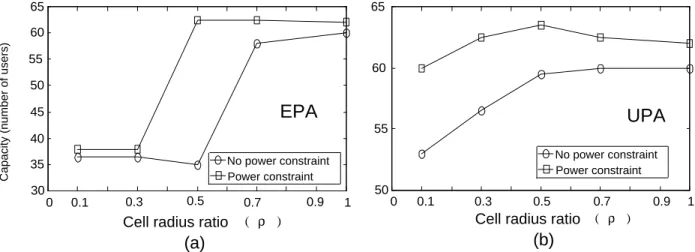
Figure 2.3: Total capacity of the equal power allocation (EPA) and the unequal power allocation (UPA) schemes for soft handoff with and without power constraint.
Furthermore, Fig. 2.3 shows the total capacity of EPA and UPA methods. The total capacity here is the summation of a macrocell capacity and a microcell capacity in Figure 2.2. The above analytical results demonstrate that the constrained UPA scheme for soft handoff can ease power exhausting problem [48]. In next section, we discuss related work and propose an effective power allocation of soft handoff for the CDMA mixed-size cellular system.
2.3
The Problem of the Mixed-Size Cellular System
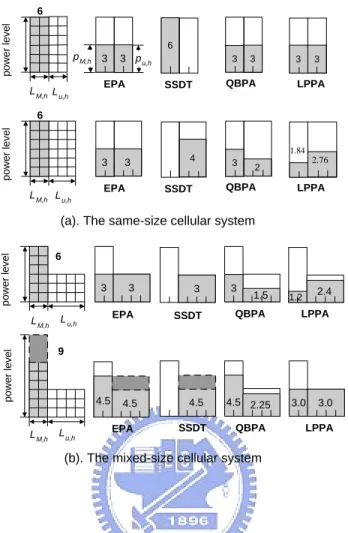
Consider single service transmission, to manage resources for soft handoff is actually the issue of allocating power from multiple cells to a user in the CDMA system [49]. Many previous works about techniques of handoff power allocation have been proposed, such as EPA [9], QBPA [13], and SSDT [14]. Moreover, we propose a novel link proportional power
allocation (LPPA) scheme. In the following, represent |Dh| as the size of the active set Dh
of handoff user h and γ∗ as the required signal quality for a handoff user.
2.3.1
Related Works for Soft Handoff Power Allocations
• Equal Power Allocation (EPA): Based on the EPA scheme, base stations allocate power to a handoff user according to the following principle: All the base stations in active