行政院國家科學委員會專題研究計畫成果報告
波分多工被動光纖網路和光纖微波系統中的瑞利背向散射噪音模
型,分析,及緩和研究
Rayleigh Backscattering Noise Modeling, Analysis and Mitigation
for DWDM Passive Optical Networks and Radio-over-Fiber
Networks
計畫編號:97-2221-E-009-038-MY3
執行期限:97 年 8 月 1 日至 98 年 7 月 31 日
主持人:鄒志偉助理教授 交通大學 光電工程系(所)
一、中文摘要 爲跟上帶寬增長的需要,現存的接取 網路需要一個很大的升級。這些網路還應 該提供雙向,易安裝並且低成本的服務給 每一位顧客。當前的有綫網路基於光纖到 戶(FTTH)技術可以給用戶提供巨大的帶寬 服務,但是對於漫遊連接就不夠靈活。從 另一方面來看,雖然無綫網路具有移動 性,但是並不能滿足高清電視(HDTV)和互 動多媒體應用的大量帶寬要求。因此,結 合有綫和無綫服務在單一未來高帶寬接取 網路可以使成本減低,同時滿足固定用戶 和移動用戶的需求。這種混合接取網路可 以由光纖微波(ROF)和波分復用被動光網 路(WDM-PON)來實現無綫和有綫的應用。 本報告將分成三部分: (1) 瑞利背向 散射(Rayleigh backscattering)干擾噪音 被認爲是載波分佈混合光接取網路的重要 限制因素之一。由於之前的瑞利背向噪音 模型具有不同的限制,我們成功地研究一 個易實現,可有效操作的新型模型。我們 已經進行了瑞利反向散射所產生的干涉噪 音作理論分析。不同的噪音先由光信號的 功率譜密度(PSD)導出,我們再對其特性進 行分析。(2)由於正交頻分複用(OFDM) 技 術可有效減少光纖中的色散以及有高頻譜 效率,我們進行 OFDM 訊號的瑞利背向散射 干擾噪音的實驗分析,成功獲得 OFDM 信號 在載波瑞利噪音(Carrier-RB)及信號瑞利 噪音(Signal-RB)之下的特性。(3) 通過再 調變下行訊號以產生上行信號,可以實現 波長重用,並且進一步減少接取網路的成 本。因為 OFDM 信號頗受信號瑞利噪音的影 響,我們利用雙重生源光纖(dual-feeder fiber) 成功展示一個不受瑞利背向散射噪 音影響的 OFDM 波長重用長距離接取網路。 關鍵詞:瑞利背向散射噪音緩和,被動光 網路,光纖微波 AbstractA strong upgrade of existing access network is required in order to cope with the exponential increase of bandwidth demand. These networks should and also provide bi-directionality, feasibility, ease of installation, and lower cost per customer. Today’s wired networks based on fiber to the home (FTTH) access technologies provide huge bandwidth to users but are not flexible enough to allow roaming connections. On the other hand, wireless networks offer mobility to users, but do not possess abundant bandwidth to meet the ultimate demand for high definition television (HDTV) distribution and interactive multimedia applications. Therefore, integration of wired and wireless services for future access networks will lead to convergence of ultimate high bandwidth for both fixed and
mobile users in a single, low cost platform. This can be accomplished by using radio-over-fiber (ROF) systems and wavelength division multiplexed passive optical network (WDM-PON) to provide wireless and wired applications.
This report is divided into 3 sections: (1) Rayleigh backscattering (RB) interferometric beat noise is considered as one of the most limiting factors for the cost effective carrier-distributed FTTH and ROF access networks. Due to different limitations of previous Rayleigh noise modeling, a novel modeling approach that can be easily realized and used efficiently to study the performance of noise mitigation has been successfully developed. The various noise contributions are derived from the power spectral densities (PSDs) of the optical signals and the performance of the scheme is then modeled analytically. (2) Since orthogonal frequency division multiplexed (OFDM) signal has the advantages of effectively mitigation of fiber chromatic dispersion and high spectral efficiency, we experimental analyze the RB performance of OFDM signal. We have characterized the Carrier-RB and Signal-RB performances of the OFDM signal. (3) Remodulation of downstream signal to generate upstream signal in the colorless ONU further reduces the cost by wavelength reuse. Since OFDM signal can be affected by the Signal-RB, we use dual-feeder fiber architecture to successfully demonstrate a signal remodulation OFDM long reach (LR)-PON.
Keywords: Rayleigh noise mitigation, Passive optical network, Radio-over-fiber 二、緣由與目的
Rayleigh backscattering (RB) interferometric beat noise is considered as one of the most limiting factors for the cost effective carrier-distributed access networks. Due to different limitations of previous Rayleigh noise modeling, a novel modeling approach is highly required. Recently, OFDM signal has been extensively studied, and is considered as a promising candidate for future access network due to the high
fiber chromatic dispersion tolerance and high spectral-efficiency. However, the research and the characterization of the OFDM signal when subjected to the RB interferometric beat noise in carrier distributed access network is missing. We quantify, for the first time, the performance of the OFDM signal when subjected to the noise generated by the two different components of RB that are present in the carrier distributed access network. We also studied the possibility of using OFDM for signal remodulation in the LR-PON. We demonstrated, for the first time, a carrier distributed OFDM LR-PON using dual-feeder fiber architecture to mitigate RB noise. Three different colorless optical networking unit (ONU) architectures are tested and compared. The overall research project will also identify the requirements of access networks for Taiwan in order to provide cost-effective PON deployment.
三、研究成果
Recent achievement of LR-PON using OFDM signal to mitigate fiber chromatic dispersion and achieve high split-ratio has been accepted in CLEO’08 post-deadline
paperin USA [1]. There are a total of 24
post-deadline papers in this CLEO conference, and we are the only Taiwan research team among them. The achievements of the project have generated invited paper, invited talks and book chapter. We are invited to present our research achievements and impact of the FTTH for Taiwan in the Special Issue of the IEEE
LEOS Newsletter about FTTx [2]. We has
also been invited to contribute a Book
Chapter in “Optical Access Networks and
Advanced Photonics: Technologies and Deployment Strategies,” edited by I. P. Chochliouros and G. A. Heliotis, IGI Global Publishing [3]. It presents a comprehensive overview of emerging optical access network solutions to efficiently meet the anticipated growth in bandwidth demand. We are also invited to present the FTTx of Taiwan in international conferences, such as Photonic
West 2009 (USA) [4] and OECC 2009 (Hong Kong)[5].
We have summarized our main achievements in the first year of the project by the following points:
(1) Rayleigh backscattering modeling using power spectral density.
(2) Rayleigh backscattering analysis of OFDM signal.
(3) OFDM signal remodulation LR-PON using dual-feeder fiber architecture to mitigate Rayleigh backscattering.
We then present our detailed description according to the above three main achievements:
(1) Rayleigh backscattering modeling using power spectral density
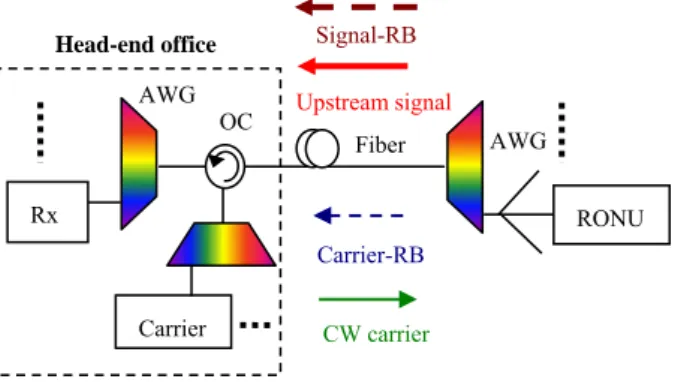
Carrier distributed WDM-PONs provide many attractive features, however, when a single drop fiber is used to reach the customer, the carrier distributed from the head-end office and the upstream signal must share the same path, giving rise to interferometric beat noise caused by RB. The maximum split ratio achievable in the PON is limited by the levels of RB and back reflection present in the system. RB is generated by the distributed reflections caused by the random index fluctuation along the silica optical fiber. The RB noise is partially polarized in nature, with a colored power spectral density (PSD) proportional to the PSD of the generating input signal. This is different from the ASE, which is typically assumed to be a white noise. In the project, we identified two main contributions to the RB noise. Fig. 1 shows the two dominant contributions to the RB in the carrier distributed PONs, which interfere with the upstream signal at the receiver (Rx). The first contribution, Carrier-RB, is generated by the backscatter of the continuous wave (CW) carrier being delivered to the reflective ONU (RONU). The second contribution, Signal-RB, is generated by the modulated upstream signal at the output of the RONU. Backscattered light from this upstream signal re-enters the RONU, where it is re-modulated and reflected towards the Rx. The RB noise is partially polarized in nature, with a colored PSD proportional to the PSD of the input signal. Hence, the spectra of
Carrier-RB and the CW carrier are the same, while the Signal-RB is modulated twice by the RONU and has a broader spectrum. The relative impact of the two components depends on the exact network configuration and hence, for a full understanding, separate analysis of each effect is needed.
A theoretical derivation of the RB properties and of the interferometric noise that it generates have been successfully achieved [6]. The actual spectrum of the high speed modulated signal needs to be considered in order to obtain an accurate prediction of the system performance. The noise generated by the beating of signal and RB:
[
( )* ( ) ( )* ( )]
, ) ( 2 2 2 ,b He f kSs f Sb f Sb f Ss f df s =ℜ∫
+ +∞ ∞ − σwhere Ss(f) and Sb(f) are the PSD of upstream
and backscattering signal respectively. They may be reshaped by the optical filter inside the Rx and the AWGs. * denotes deterministic cross-correlation, ℜ is the
photodetector responsivity, He(f) is the photodetector normalized frequency response, such that He(0) = 1. The noise generated by the RB beating with itself
, ) ( * ) ( 2 1 ) ( 2 2 2 2 , S f S f df p f He b b b b
∫
∞ + ∞ − + ℜ = σwhere k and p are the polarization coefficients, with p=2k-1. The polarization coefficient k equals to 1 for completely polarized backscattering (p=1) aligned with
Rx Carrier Head-end office CW carrier Carrier-RB Upstream signal
Fig. 1. Schematic of WDM PON using centralized light source. AWG: arrayed waveguide grating, OC: optical circulator, Rx: receiver, Carrier-RB and Signal-RB: carrier and signal generated Rayleigh backscattering. AWG AWG RONU OC Signal-RB Fiber
the signal polarization and k =0.5 for a completely depolarized backscattered field (p=0). In practice, roughly 1/3 of the RB light is polarized, giving k≈0.667 and k≈0.333, respectively for signal co- and cross-polarized with respect to backscattering. Results from the model are in good agreement with the experiments [7, 8], showing that we can use the RB model to predict the network performance.
(2) Rayleigh backscattering analysis of OFDM signal
Recently, PON using OFDM is a subject of many research works [9]. Due to the high spectral efficiency of the M-quadrature amplitude modulation (QAM) used in the OFDM signal; low bandwidth optical components can be used. Additionally, the inherent advantage of OFDM frequency diversity transmission enables simple equalization of frequency response by baseband digital signal processing. The OFDM signal has a high tolerance to chromatic dispersion. This high tolerance is especially useful in PONs since distances between the head-end office and different ONUs cannot be fully dispersion compensated. Furthermore, it offers the prospect of integrating forward error correction (FEC) to improve transmission. However, previous works show that carrier-distributed OFDM-PON suffers form interferometric beat noise generated by RB. In this project, we quantify, for the first time, the performance of the OFDM-QAM signal when subjected to the noise generated by the two different components of RB that are present in the carrier-distributed OFDM PON.
We proposed two setups to analyze and quantify the Carrier-RB and Signal-RB tolerance of the OFDM-QAM upstream signal, as shown in Fig. 2 (a) and (b) respectively. They emulated the impairments of a real PON by generating two interfering signals in the upper and lower arms of the interferometer.
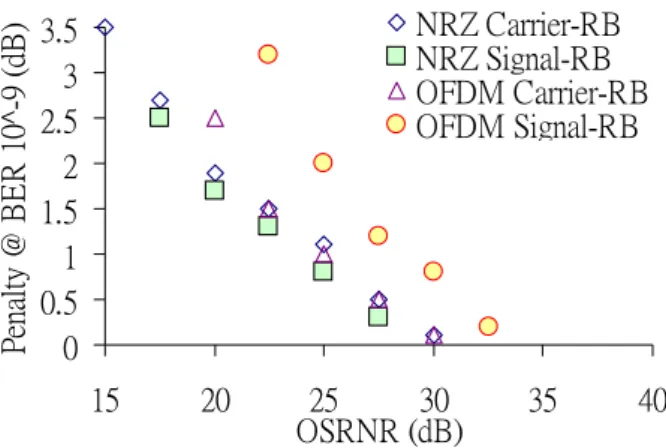
The RB performance depends on the interferometric beat noise falling within the receiver bandwidth [10]. Fig. 3 shows the measured RB performances [11] by comparing the power penalties at bit-error-rate (BER) of 10-9, as a function of optical signal to Rayleigh noise ratios (OSRNRs), which is defined as the ratio of total signal and total RB power at the input to the head-end (point “A”). The result shows that the Carrier-RB performance of OFDM-QAM is better than its Signal-RB performance. This is due to the fact that Carrier-RB beat noise is low frequency in nature, and the OFDM is frequency up-converted, as can be seem in Fig. 4. Hence, the beat noise mainly falls within the Bgap. The signal-RB has a wider spectrum
than the OFDM signal due to the double modulation, and locates at the same
CW 25km SMF PC1 PC2 OC Polarizer VOA
Fig. 2. Experimental setup to emulate (a) Carrier-RB and (b) Signal-RB. EAM: electro-absorption modulator, VOA: variable optical attenuator, PC: polarization controller, PM: power meter. Inset: Rx architecture, AWG: arrayed waveguide grating.
25km SMF PC1 PC2 Polarizer VOA (a) (b) EAM1 Rx PM EAM2 Rx PM “A” “A” Tx PIN Rx EDFA AWG
Fig. 3. RB noise performance at OFDM-QAM when compared with conventional NRZ formats.
0 0.5 1 1.5 2 2.5 3 3.5 15 20 25 30 35 40 OSRNR (dB) P en alty @ B E R 1 0^ -9 (d B ) NRZ Carrier-RB NRZ Signal-RB OFDM Carrier-RB OFDM Signal-RB
frequency band as the OFDM signal; hence this generates much higher beat noise due to the complete spectral overlap. The RB performance of NRZ signal was also included. Results show that OFDM-QAM has similar Carrier-RB performance to NRZ, but poorer Signal-RB performance than NRZ. Fig. 4 shows the schematic RF spectra of the Carrier-RB and the Signal-RB of the OFDM-QAM signal, showing the low frequency nature of the Carrier-RB and the broad Signal-RB spectrum occupying the same frequency band as the upstream signal.
(3) OFDM signal remodulation LR-PON using dual-feeder fiber architecture to
mitigate Rayleigh backscattering
Signal remodulation has attracted a lot of researches for the past few years as one of the promising candidate for next generation PON [12-17]. Expensive transmitter (Tx) inside the ONU with distinct and specific wavelength has hindered the PON deployment. Network architectures with signal remodulation on the downstream channel for the upstream channel can reduce the cost of wavelength referencing, control and stabilization at the cost-sensitive ONU. A single wavelength is needed for both downstream and upstream signals, since wavelength is reused. Besides, the same colorless ONU can be used for all the customers.
In this project, we study, for the first time, the possibility of using OFDM for signal remodulation in the LR-PON. According to the analysis described in Section 2 of this mid-term report, RB noise can degrade the performance of a carrier-distributed PON using OFDM signal. Hence dual-feeder fiber architecture has been used to mitigate the RB noise in a carrier-distributed PON. Three different
colorless ONU architectures: electro- absorption modulator (EAM)-based, reflective semiconductor optical amplifier (RSOA)-based and injection-locked Fabry-Perot laser diode (FP-LD)-based ONUs, are tested and compared.
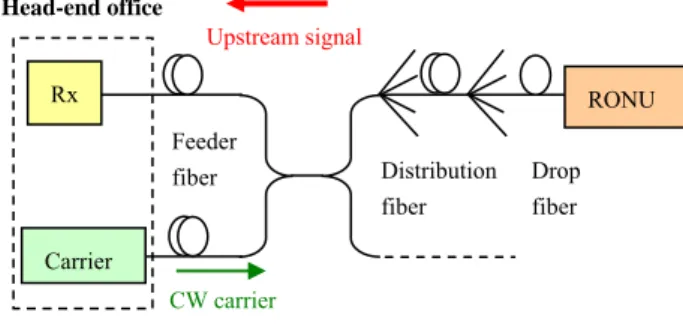
If we consider a carrier-distributed PON with two stages of splitters such as the one in Fig. 5, where for clarity the arrayed waveguide grating (AWGs) are not shown, we can see clearly that most of the Carrier-RB power is generated by the optical carrier in the fiber before the first splitter, conventionally called feeder fiber. This is mainly due to the loss introduced by the first splitter and also because the feeder fiber usually accounts for most of the access length. The Carrier-RB generated before the first splitter cannot reach the Rx and thus it cannot interfere with the upstream signal. Although the Carrier-RB generated in the distribution and drop sections, and the Signal-RB still propagates to the Rx, the overall power is greatly reduced compared with a system with a single feeder fiber [18]. This scheme maintains the benefit of a single drop and distribution fiber in the path to each ONU, which could reduce the cost of fiber and fiber connections in the network. The circulator, normally used to inject the carrier in single-feeder schemes, is also not required, since the optical splitter employed to combine the two feeder fibers performs this function.
Fig. 6 shows the demonstration of a signal remodulation LR-PON. The downstream OFDM signal was applied to the EAM. The signal was then propagating through 90 km and 10 km of feeder and distribution/drop fibers respectively. At the ONU, 10% of
Fig. 4. Schematic RF spectra indicating the carrier-RB, signal-RB of OFDM signal.
Carrier-RB Signal-RB OFDM signal f Bgap Rx Head-end office CW carrier Upstream signal
Fig. 5. Schematic of a carrier distributed PON using dual-feeder fiber architecture.
RONU Feeder fiber Carrier Distribution fiber Drop fiber
downstream power was tapped out and detected by an optically pre-amplified Rx. The remain of the downstream signal was then launched into the colorless modulator at the ONU. We analyzed three different kinds of colorless modulators: EAM, RSOA and FP-LD. In each case, a 2.5 Gb/s non-return-to-zero (NRZ) data, pseudo random binary sequence (PRBS) pattern length of 231−1, was used to directly modulate the colorless modulator.
We studied the optimum extinction ratio (ER) of the downstream OFDM-QAM signal for both downstream and upstream links. As shown in Fig. 7, by decreasing the ER of the OFDM signal, higher residual background light can be provided for the upstream remodulation. When an EAM-based ONU is used, the intercepting point is at the position where the ER of OFDM is equal to ~3.7 dB, and it means 4 dB of power penalty will be introduced to both the upstream and downstream signals. We can see that RSOA-based and FP-LD-based ONUs performed better. By using the gain-saturation property of the RSOA or the injection locking property of the FP-LD, the downstream OFDM signal can be significantly suppressed, and these can increase the intercepting point to ~4.7 dB. This shows a power penalty improvement of 1 dB in the OFDM signal.
Since each modulator has its optimum condition, in the comparison, we selected the ER = 3.7 dB for the downstream OFDM signal. Fig. 8 shows the BER measurements of each signal at back-to-back (B2B) and after the 100 km LR transmission [19]. Insets
show the constellation diagrams of OFDM signal at ER = 3.7 dB, output remodulated NRZ eye diagrams of FP-LD and RSOA when downstream OFDM at ER = 3.7 dB. We can observe clear open eyes after 100 km SMF transmission without dispersion compensation in each case. Error-free BER operation can be achieved for the proposed remodulation LR system.
四、結論
The above researches have fruitful achievements and results have been published in several international journal and conference papers, invited papers and talks. The project mid-term report was divided into three sections: (1) A novel RB modeling derived from the PSDs of the optical signals was successfully established. We also
OFDM Isolator 10km SMF Rx Head-end ONU 90km SMF CW Feeder fiber Downstream Upstream Distribution/drop fiber EAM Rx EAM/RSOA /FP-LD NRZ λ1 λ2 EDFA Wavelength mux/demux
Fig. 6. Experimental setup of signal remodulation DWDM-PON. EAM: electro-absorption modulator, SMF: single mode fiber, EDFA: erbium-doped fiber amplifier, RSOA: reflective semiconductor optical amplifier, FP-LD: Fabry-Perot laser diode.
0 1 2 3 4 5 6 7 8 9 10 0 1 2 3 4 5 6 7 8 9 10 11 12 13 14 ER of OFDM (dB) P o w e r P enal ty ( d B ) OFDM downstream EAM-based ONU FP-LD-based ONU RSOA-based ONU
Fig. 7. Power penalties of downstream OFDM and upstream NRZ signals generated by different kinds of ONUs against different extinction ratio (ER) of the downstream OFDM signal.
-10 -9 -8 -7 -6 -5 -32 -28 -24 -20 -16 -12 -8 -4 0 receiver power (dBm) lo g ( B ER) RSOA (B2B) RSOA (100km) FP-LD (B2B) FP-LD (100km) OFDM (B2B) OFDM (100km) (a) (b) (c) (d) (e) (f)
Fig. 8. BER measurements of different signals. Insets: constellation diagrams of OFDM signal at ER = 3.7 dB at (a) B2B, (b) 100km, output remodulated NRZ eye diagrams of FP-LD at (c) B2B, (d) 100km; and RSOA at (e) B2B, (f) 100km, when downstream OFDM at ER = 3.7 dB.
identified two main contributions to the RB noise: Carrier-RB and Signal-RB. There is a good match between the experimental and modeling results in the Carrier-RB and Signal-RB analysis, showing the model is accurate. (2) Previous researches show that carrier-distributed OFDM-PON suffers form interferometric beat noise generated by RB. We quantified, for the first time, the performance of OFDM signal when subjected to the noise generated by the Carrier-RB and Signal-RB that are present in the carrier-distributed PON. The result shows that the Carrier-RB performance of OFDM-QAM is better than its Signal-RB performance. (3) We studied the possibility of using OFDM for signal remodulation in the LR-PON. We demonstrated a carrier distributed OFDM LR-PON using dual-feeder fiber architecture to mitigate RB noise. Three different colorless ONU architectures: EAM-based, RSOA-based and FP-LD-based, were tested and compared, showing that despite the polarization controlling issue, FP-LD can provide a greater downstream OFDM suppression and produce a better upstream data.
The above results will provide a solid foundation for the second and third year research project.
五、發表文獻
[1] C. W. Chow, et al., “Demonstration of High Spectral Efficient Long Reach Passive Optical Networks using OFDM-QAM,” CLEO, Postdeadline
Paper, CPDB7, San Jose, USA, 2008
[2] C. H. Yeh, C. W. Chow, Y. M. Lin, D. Z. Hsu, and S. Chi “Recent Research on Fiber Access Systems for FTTH Networks in Taiwan” Invited paper,
IEEE LEOS Newsletter, vol. 22, no. 2,
pp. 15-19, 2008
[3] C. W. Chow, Chapter V: “Broadband Optical Access using Centralized Carrier Distribution,” Optical Access Networks
and Advanced Photonics: Technologies and Deployment Strategies, edited by I.
P. Chochliouros and G. A. Heliotis, IGI
Global Publishing (ISBN:
978-1-60566-707-2).
[4] S. Chi, C. H. Yeh, C. W. Chow, “Broadband access technology for passive optical network,” Proc. of SPIE, vol. 7234, 723408-1, 2009 (Invited Paper)
[5] C. W. Chow, “Long Reach WDM- PON,” Invited Workshop Speaker,
OptoElectronics and Communications Conference (OECC’09), Hong Kong
(July 13, 2009)
[6] G. Talli, C. W. Chow, P. D. Townsend, “Modeling of modulation formats for interferometric noise mitigation,”
Journal of Lightwave Technology, vol.
26, pp. 3190-3198, 2008 (SCI)
[7] C. W. Chow, G. Talli, A. D. Ellis, and P. D. Townsend, “Rayleigh noise mitigation in DWDM LR-PONs using carrier suppressed subcarrier-amplitude modulated phase shift keying,” Optics
Express, vol. 16, pp. 1860-1866, 2008
(SCI)
[8] C. W. Chow, C. H. Yeh, “Characterization of Phase Modulated Non-return-to-zero (PM-NRZ) Format for DWDM Long Reach PONs,” Optics
Communications, accepted, 2009 (SCI)
[9] C. W. Chow, C. H. Yeh, C. H. Wang, F. Y. Shih, C. L. Pan, and S. Chi, “WDM extended reach passive optical networks using OFDM-QAM,” Optics Express, vol. 16, pp. 12096-12101, 2008 (SCI) [10] C. W. Chow, G. Talli, and P. D.
Townsend, “Rayleigh Noise Reduction in 10-Gb/s DWDM-PONs by Wavelength Detuning and Phase Modulation Induced Spectral Broadening,” IEEE Photonics Technology Letters, vol. 19, no. 6, pp.
423, 2007 (SCI)
[11] C. W. Chow, C. H. Yeh, C. H. Wang, F. Y. Shih, and S. Chi “Rayleigh Backscattering Performance of OFDM-QAM in Carrier Distributed Passive Optical Networks,” IEEE
Photonics Technology Letters, vol. 20,
pp. 1848-1850, 2008 (SCI)
[12] C. W. Chow, “Wavelength Remodulation Using DPSK Down-and-Upstream With High Extinction Ratio for 10-Gb/s
DWDM-Passive Optical Networks,”
IEEE Photonics Technology Letters, vol.
20, pp.12-14, 2008 (SCI)
[13] C. W. Chow, C. H. Yeh, “Signal remodulation without power sacrifice for carrier distributed hybrid WDM-TDM PONs using PolSK,” Optics
Communications, vol. 282, pp.
1294-1297, 2009 (SCI)
[14] C. H. Yeh, C. W. Chow and S. Chi, “Using 10 Gb/s remodulation DPSK signal in self-restored colorless WDM-PON system,” Optical Fiber
Technology, in press, 2009 (SCI)
[15] C. H. Yeh, C. W. Chow, C. H. Wang, F. Y. Shih, C. H. Chien, and S. Chi, “A self-protected colorless WDM-PON with 2.5 Gb/s upstream signal based on RSOA,” Optics Express, vol. 16, pp. 12296-12301, 2008 (SCI)
[16] C. H. Wang, F. Y. Shih, C. H. Yeh, C.
W. Chow and S. Chi, “10 Gb/s TDM
passive optical networks using four wavelengths multiplexed channels,”
Optics Communications, vol. 282, pp.
2476-2479, 2009 (SCI)
[17] C. H. Yeh and C. W. Chow, “Utilization of Four WDM Channels with Signal Remodulation of OFDM-QAM for 10-Gb/s Uplink Passive Optical Networks,” Optics Communications, accepted, 2009 (SCI)
[18] G. Talli, C. W. Chow, E. K. MacHale, and P. D. Townsend, “Rayleigh noise mitigation in long-reach hybrid DWDM-TDM PONs,” OSA Journal of
Optical Networking, vol. 6, no. 6, pp.
765-776, June, 2007 (SCI)
[19] C. W. Chow, C. H. Yeh, C. H. Wang, F. Y. Shih and S. Chi, “Signal remodulation of OFDM-QAM for long reach carrier distributed passive optical networks,” IEEE Photonics Technology
9
可供推廣之研發成果資料表
■ 可申請專利 □ 可技術移轉 日期:98 年 5 月 30 日國科會補助計畫
計畫:波分多工被動光纖網路和光纖微波系統中的瑞利背向散射噪 音模型,分析,及緩和研究 計畫主持人:鄒志偉
計畫編號:NSC 97-2221-E-009-038-MY3 學門領域:光電技術/創作名稱
室溫下利用 Fabry-Perot etalon 之多波長摻鉺光纖環型雷射發明人/創作人
C. W. Chow, C. H. Yeh, C. H. Wang, F. Y. Shih, Y. F. Wu and S. Chi 此研究中,我們在線性共振腔內利用一個Fabry-Perot etalon 並且在 室溫下使用一段長度可滿足多波長產生於 C-band 條件之最小公倍 數的光纖共振腔,運用此方式提出並驗證一個簡單且具成本效益的 摻鉺光纖(erbium-doped fiber, EDF)環型雷射。此外輸出波段的中心 波長可分別調整在 1541.02、1551.32 和 1562.03 nm 上,而各別波 段的波長間距為0.34 nm。另外也有分析討論此多波長雷射的輸出 穩定度。技術說明
In this investigation, we propose and demonstrate a simple and cost-effective erbium-doped fiber (EDF) ring laser using a Fabry-Perotetalon inside a linear cavity and employing the accurate fiber cavity length to satisfy the least common multiple number for generating multiwavelength in C-band at room temperature. Furthermore, the centre wavelength of the lasing wavelength bands can be adjusted to 1541.02, 1551.32 and 1562.03 nm, respectively. The wavelength separation in each wavelength band is 0.34 nm. Moreover, the output stability of the multiwavelength laser has also been discussed and analyzed.