
在尼加拉瓜馬那瓜市建立機場與市區間之捷運服務的商業企劃書 - 政大學術集成
66
0
0
全文
(2) 在尼加拉瓜馬那瓜市建立機場與市區間之捷運服務的商業企 劃書 Business plan for a shuttle service between the airport and city downtown in Managua, Nicaragua. 研究生:梁克成. Student: Christian Largaespada. 立. 治 Professor Jack Wu 政 Advisor: 大 國立政治大學. 學. ‧ 國. 指導教授:吳文傑. ‧. 商學院國際經營管理英語碩士學位學程. y. A Thesis. n. a. er. io. sit. Nat. 碩士論文. v. i l to Submitted C International MBAnProgram. i U. h. e n g c hUniversity National Chengchi. in partial fulfillment of the Requirements for the degree of Master in Business Administration. 中華民國一〇三年六月 June 2014.
(3) Acknowledgments To Professor Jack Wu, my advisor, for his support throughout the writing of this thesis. To IMBA Office, especially Lichi Ho and Frank Chang for their kindness and support that goes beyond the duties. I wouldn’t have achieved this goal without their support. Thank you as well to ICDF for the opportunity I was provided to come to Taiwan. To the 2011-entering class: Amazing people from all over the world whom I had the pleasure of sharing my two years at IMBA. I’ve learned so much from each and every one of them. 謝 謝! To all my friends in Taiwan who have become my family, who have supported me through the toughest of times, and who have joined me to celebrate successes. You will always have a place in my heart.. 立. 政 治 大. ‧ 國. 學. To the all the amazing people at SKKU, Korea, who showed the strongest bonds can surge even in the shortest of times. We will always have Seoul!. ‧. To my family in Nicaragua, as well as my friends, for showing me that there are bonds that time and distance simply can’t erase. Gracias!. sit. y. Nat. Finally, to the most important people in my life: their faith in me is what keeps me moving every day. To Rodrigo, Ana and Mamá: this is yours!. n. al. er. io. This thesis is the culmination of a life-changing adventure which brought me to Asia almost three years ago. I just can say, to all of those who have accepted to walk it with me, thank you!. Christian Largaespada. Ch. engchi. i. i n U. v.
(4) Executive Summary This business plan will cover the design and implementation of a shuttle service in Managua, Nicaragua. Once implemented, such service will connect the airport and different hubs throughout the city, in comfortable units at an affordable price. The inspiration for this business plan comes from the author’s experience using the different airport shuttle services which connect Taoyuan International Airport and Taipei City. The author has witnessed the increase on traffic in Managua City, where the he is native from, as well as the lack of a quality service which can satisfy the need for a convenient and affordable mode. His objective is to disrupt the market with a new business idea: Aerobus. This service will be a first-mover. 政 治 大. and will be focused on a market segment which has been barely covered: Nicaraguan travelers.. 立. This business plan starts by describing Nicaragua’s current socio-economical situation,. ‧ 國. 學. including recent economic growth, change in population distribution, as well as the key role of tourism in the country’s economy. A special emphasis will be put into describing Managua,. ‧. the city where the business plan will be developed, particularly information regarding Managua International Airport and passengers’ traffic data.. y. Nat. sit. A key component of this business plan is the market survey the author performed, which was. n. al. er. io. answered by 141 people, and which provided key information regarding customers’ opinion. i n U. v. about the attractiveness of Aerobus service, as well as a description of travelling patterns among Nicaraguan consumers.. Ch. engchi. Aerobus uses technology to develop a strategy which will maximize revenues from year 1: the use of buses run by alternative fuels, specifically liquid propane gas. This element will be fundamental for the financial success of the company. Finally, the financial projections for the Company will be performed, showing Aerobus is a profitable business idea which can achieve break-even point from Year 1, with a 41% CAGR on revenues until Year 4, as well as 35% CAGR on the company’s net worth on Year 4 as well. For all the Company’s financial projections, the author has utilized the most conservative approach, considering a small market share which will slowly increase throughout 4 years.. ii.
(5) TABLE OF CONTENTS 1. Nicaragua ....................................................................................................... 1 1.1.. Population ........................................................................................................................ 2. 1.2.. Economy .......................................................................................................................... 3. 1.3.. Tourism............................................................................................................................ 5. 1.4.. The city of Managua ........................................................................................................ 6. 1.4.1.. Urban Planning ............................................................................................................ 6. 1.4.2.. Public Transportation ................................................................................................... 8. 1.4.3.. Managua International Airport .................................................................................... 9. 政 治 大. 2. Market Analysis .......................................................................................... 15. 立. Business Opportunity .................................................................................................... 15. 2.2.. Target Market Segmentation Strategy ........................................................................... 15. 2.3.. Market Size .................................................................................................................... 17. 2.4.. Market Survey ............................................................................................................... 18. 2.5.. Competition Analysis .................................................................................................... 19. 2.6.. SWOT Analysis ............................................................................................................. 21. ‧. ‧ 國. 學. 2.1.. sit. y. Nat. al. er. io. 3. The Company .............................................................................................. 23 Ownership and legal representation .............................................................................. 23. 3.2.. Location and Facilities................................................................................................... 23. 3.3.. Hours of Operation ........................................................................................................ 24. 3.4.. Start-Up Summary ......................................................................................................... 25. n. 3.1.. Ch. engchi. i n U. v. 4. Aerobus Service ........................................................................................... 26 4.1.. Description .................................................................................................................... 26. 4.1.1.. Process Flowchart ...................................................................................................... 26. 4.1.2.. Routes ........................................................................................................................ 27. 4.1.3.. Timetable ................................................................................................................... 27. 4.1.4.. Fleet ........................................................................................................................... 28. 4.1.5.. Payment Methods ...................................................................................................... 28. 4.2.. Competitive Comparison ............................................................................................... 29. 4.3.. Sourcing and Fulfillment ............................................................................................... 30 iii.
(6) 4.4. 4.4.1. 4.5.. Technology .................................................................................................................... 31 Maintenance ............................................................................................................... 32 Further Services and Alliances ...................................................................................... 33. 5. Strategy Implementation and Summary .................................................. 35 5.1.. Value Proposition .......................................................................................................... 36. 5.2.. Competitive Edge .......................................................................................................... 36. 5.3.. Marketing Strategy ........................................................................................................ 37. 5.3.1.. Positioning Statement ................................................................................................ 37. 5.3.2.. Pricing Strategy.......................................................................................................... 37. 5.3.3.. Promotion Strategy .................................................................................................... 39. 政 治 大 5.4. Sales and Distribution Strategy ..................................................................................... 40 立 5.4.1. Sales Forecast ............................................................................................................ 41. ‧ 國. 學. 6. Management Summary .............................................................................. 43 Organizational Chart...................................................................................................... 43. 6.2.. Management Team ........................................................................................................ 43 Payroll, Headcount and Projections ........................................................................... 45. y. Nat. 6.2.1.. ‧. 6.1.. io. sit. 7. Financial Plan .............................................................................................. 46 Break-Even Point........................................................................................................... 46. 7.2.. Projected Profit and Loss ............................................................................................... 48. 7.4.. al. v i n Ch Projected Balance Sheet ................................................................................................ 49 engchi U n. 7.3.. er. 7.1.. Projected Cash Flow ...................................................................................................... 50. Appendixes ......................................................................................................... 51 References .......................................................................................................... 59. iv.
(7) Figures and Tables Figures Figure 1 Managua International Airport passengers traffic, by terminal (2011-2013) ............ 10 Figure 2 Seat Availability by hour (International Terminal Only) ........................................... 13 Figure 3 Managua Airport passengers market segmentation ................................................... 16 Figure 4 Aerobus Corporate Values ......................................................................................... 35 Figure 5 Market survey results: Price willing to pay ............................................................... 38 Figure 6 Annual Sales (Year 1 – Year 4) ................................................................................. 42. 政 治 大 Figure 8 Break-even Point ........................................................................................................ 47 立 Figure 7 Organizational Chart .................................................................................................. 43. ‧ 國. 學. Tables. ‧. Table 1 Airlines serving Managua International Airport ......................................................... 11 Table 2 Market size (2012) ....................................................................................................... 17. y. Nat. sit. Table 3 Optimistic and Conservative Growth Scenarios (2014-2018)..................................... 18. al. er. io. Table 4 Aerobus SWOT Analysis ............................................................................................ 22. n. Table 5 Start-up Requirements ................................................................................................. 25. Ch. i n U. v. Table 6 Aerobus Service Flowchart ......................................................................................... 27. engchi. Table 7 Aerobus routes ............................................................................................................. 27 Table 8 Aerobus services’ timetable ........................................................................................ 28 Table 9 Aerobus Competitive Advantage vs. Substitute Services ........................................... 30 Table 10 Fuel costs’ savings projections .................................................................................. 31 Table 11 Substitute services’ prices ......................................................................................... 37 Table 12 Market survey results: Ranking of Factors ................................................................ 38 Table 13 Market Share Growth (Year 1 – Year 4) ................................................................... 41 Table 14 Payroll projections ..................................................................................................... 45. v.
(8) 1. Nicaragua Located in the center of the American continent, Nicaragua is the largest country of the Central American isthmus, a key geographic body which connects North and South America. With over 130,000 Kms2, the country is about 3.5 times the size of Taiwan. On its east and west borders, Nicaragua is surrounded by the Atlantic and Pacific Oceans, respectively. Its northern frontier borders with Honduras, while the south one does it with Costa Rica. The country is physically divided into three major zones: the Pacific flatlands, the country’s most populated area; the Central mountain range, where the country highest peak (Mount Mogoton,. 政 治 大. 2,107m) is located; and the Caribbean lowlands, the largest yet least populated region.. 立. Nicaragua’s recent history has been convulsive, with a left-wing revolution, a civil war and a. ‧ 國. 學. US-sponsored economic embargo all occurring in less than 15 years. However, since the first democratic elections in 1990, Nicaragua started a pacification process which has transformed. ‧. it into one of the safest in the hemisphere, as well as one of the fastest-growing economies on the region 1 . The country has experienced sustained economic growth as a result of the. sit. y. Nat. disciplined management of its fiscal, financial, monetary and exchange policies. Pro-business legislations and administrative procedures have contributed to a strong inflow of foreign. io. n. al. er. investment in recent years, especially into Free Zones which have mostly attracted textiles and clothing industries.. Ch. engchi. i n U. v. Economic growth, high levels of public safety, investment incentives and quality of life have all made Nicaragua an internationally recognized destination for foreign investment as well as retirement. The 2014 Doing Business Report, published by the World Bank, provides a quantitative measure of business climate in countries around the world. This report, ranked Nicaragua as number one in the Central American region in its indicators for investor protection, enforcing contracts and insolvency resolution. Various international media have also recognized Nicaragua as a premier destination for Americans, Canadians, and Europeans thinking about retiring overseas.. 1. Nearshore, Executive Alliance, “Latin America Site Intelligence Report: Nicaragua Report”, http://www.nearshoreexecutives.com/wp-content/uploads/2012/11/LASIR.Nicaragua.FINAL_.110612.pdf. 1.
(9) 1.1. Population With an estimated population of 5,900,000 people in 2014 (about ¼ of Taiwan’s population), Nicaragua is the 4th most populated country in Central America, with an unequal distribution between the three main geographic areas: the Pacific region concentrates about 50% of the total population, while the Atlantic flatlands only account for about 12% of the population. 57% of Nicaraguans live in urban areas with Managua, the capital city, standing as the country’s most populated city with about 2 million people living in its metropolitan area2. The country has continuously improved its vital statistics over the last 20 years, with a. 政 治 大 reduction in child mortality 立 rate from 66 per 1,000 in 1990 to 24 per 1,000 in 2012. However,. sustainable increase on life expectancy from 64.1 in 1990 to 74.5 in 2012, as well as a. ‧ 國. 學. poverty is still Nicaragua’s major challenge. UNICEF estimates 11.9% of Nicaraguans live. with less than US$1.25 per day, with large disparities between the rich and the poor. The richest 20% of the population receives 47% of the overall income3.. ‧. Nicaragua has a young population with almost 52% under the age of 25. Along with. y. Nat. sit. decreasing birth rates, which in 2014 was 1.99 births/woman, Nicaragua has recently. al. er. io. experienced a phenomenon known as “demographic bonus”, when the proportion of. n. population of working age group is particularly prominent. Nicaragua’s population pyramid in. Ch. 2010 can be found on Appendix 1.. engchi. i n U. v. According to the Social Security statistic, in 2013, the economic activities which generated more jobs were social and personal services, manufacturing industry, commerce, hotels and restaurants 4 . The official unemployment figure for the third quarter of 2013 was 5.3%. However, underemployment is still a large burden for the country’s economy, with 48.3% of the working age group being underemployed. Political turmoil and adverse economic conditions have forced many Nicaraguans to migrate. In 2010, the World Bank estimated that about 728,000 Nicaraguans or about 12% of the 2. Managua City Government website, http://www.managua.gob.ni UNICEF, http://www.unicef.org/infobycountry/nicaragua_statistics.html 4 Central Bank of Nicaragua, “2013 Annual Report”, March 2014 3. 2.
(10) country’s population lived abroad, mostly in Costa Rica, the United States and Spain. This number only includes those legally living abroad. Different media have reported the total number (including illegal immigrants) could reach up to 1.5 million.. 1.2. Economy Undermined by years of political turmoil, Nicaragua is still one of Latin America’s least developed country, with a GDP of US$ 10.51 billion in 2012 (compared to Taiwan 474 billion), and a GDP per capita of US$ 1,650 also in 2012. This value classifies Nicaragua as a lower middle income level, according to the World Bank. Nicaragua’s currency is called. 政 治 大. Córdoba (C$), and exchange rate at the end of 2013 was C$ 25.06 per US$ 1.. 立. Despite these dark indicators, Nicaragua “has remained a bright spot in an otherwise mixed. ‧ 國. 學. scenario for Central America’s economies”. The macroeconomic policies implemented in recent years have focused on fiscal discipline, expansion of exports and FDI and control of. ‧. inflation. These factors helped the country to quickly rebound from the 2009 crisis, when the economy sank a 2.8%. Since then, real GDP has grown 5.7% in 2011, 5.0% in 2012 and 4.6%. y. Nat. sit. in 20135. For 2014, the World Bank forecasts a GDP growth of 4.2%, above Latin America. al. er. io. average of 2.9%. Although it has been decreasing continuously, inflation rate is still very high. n. in Nicaragua, oscillating between 6% and 9% in 2009-2013.. Ch. engchi. i n U. v. Nicaragua is still an export-oriented economy, with US$ 4.94 billion in exports in 2013. Out of this total, US$ 2.40 billion represent merchandise exports. The main FOB export products in 2013 were gold, beef, coffee, sugar and peanut, representing about 64% of the total value. Nicaragua’s most important export partners are: United States (18.8%), Canada (8.4%) and Venezuela (7.4%). The country’s external position still remains still remains vulnerable, with a current account deficit for 2011-2013 around 13% of GDP. The Free Zone regimen is a key component of Nicaraguan economy, with total exports adding up to US$ 2.56 billion. It comprises a total of 223 companies and employs more than 100,000. 5. International Monetary Fund (IMF), “Staff Report, Press Release on the Executive Board Discussion, Statement by the Executive Director for Nicaragua”, December 2013. 3.
(11) people. The main sectors under Free Zone regimen are textile and apparel, automotive harnesses, tobacco, agribusiness and outsourcing services6. Foreign-direct investment has grown steadily in recent years and reached a US$ 1.5 billion record in 2013, a 16% increase compared to 2012. The FDI/GDP ratio is 13.5%, the highest for all Central America. Industries, goods and services, mines and free zones accounted for about 77% of all FDI flows. During 2012, the most important countries of origins for FDI were Venezuela, Panama (due to holding companies registered in this country), United States, Mexico and Canada. Nicaragua’s commercial openness is reflected on its more than 7 Free Trade Agreements, 3 Preferential Access Agreements, and other 2 FTA’s under negotiation 7.. 政 治 大 Given the large numbers of Nicaraguan living abroad, remittances also play an important role 立 in the country’s economy. In 2013, Nicaragua received over US$ 1.1 billion in remittances, or. ‧ 國. 學. about 10% of GDP8.. ‧. Minimum salary is reviewed by the government on yearly basis, and is set for nine different economic sectors. On the most recent review on March 2014, it ranges from US$ 153 for the. y. Nat. sit. agricultural sector to US$ 345 for construction and financial services. For transportation. n. al. er. io. services, minimum salary is US$ 2829.. i n U. v. In order to boost economy and solve the impeding problem of lack of housing, in 2010 the. Ch. engchi. government authorized a US$ 45 million fund from the Social Security (INSS) to be used to subsidize interest rates on mortgage loans for homes under US$ 20,000. This measure caused an immediate impact on the construction industry, which experienced a 30% growth in 2012. 3,500 new homes were built in both 2012 and 2013, most of them in the capital city, Managua.. 6. Promotion Investment Agency of Nicaragua (ProNicaragua), http://www.pronicaragua.org Ibid 8 International Monetary Fund (IMF), “Staff Report, Press Release on the Executive Board Discussion, Statement by the Executive Director for Nicaragua”, December 2013 9 Promotion Investment Agency of Nicaragua (ProNicaragua), http://www.pronicaragua.org 7. 4.
(12) Macroeconomic stability has also positively influenced new car sales, with a strong growth since 2012. That year, 12,200 new vehicles were sold, 14,500 in 2013 and it is expected that 15,200 new cars will be sold in 201410.. 1.3. Tourism With over 800 kilometers of coastline on both the Pacific and Atlantic Ocean, 22,000 km2 of natural reserves, the oldest city in the American continent and three Biosphere reserves recognized by UNESCO, the Nicaragua’s touristic offer has been recently acknowledge by international media. Nicaragua’s privileged location; biodiversity, historical heritage, as well. 政 治 大 In 2013, 1.27 million tourists 立visited Nicaragua (3.3% increase to 2012); tourism revenues as high levels of public safety have all contributed to a continuous growth in tourist arrivals.. ‧ 國. 學. reached US$ 417.2 million, making tourism the second largest industry in the country. Regarding country of origin, Central Americans account for 60.3% of all tourists, followed by. ‧. North Americans (26.5%). Despite the positive growth, Nicaragua still faces the challenge of increasing tourism revenues as well as average expenditure per tourist (US$ 42.5 a day in. y. Nat. sit. 2013) 11 . The growth in tourism has spillover effect on other economic sector such as. er. io. commercial, financial and construction industry. In this last, in particular, the Ministry of. al. v i n C hmost important ofUthese, is the US$ 250 million Mukul . The engchi. n. Tourism of Nicaragua (INTUR) approved private touristic development projects for a total of US$ 326.7 million in 2013 Hotel on the Pacific Coast.. 12. Small hotels have experienced a significant growth as well. Nicaragua’s Association of Small Hotels (HOPEN) has 84 members with an estimated offer of 900 rooms all over the country13. 25 of these hotels are located in Managua, with rates generally lower that chain hotels, but without services like airport shuttle.. 10. La Prensa, “Venta de autos nuevos mejora un 11%”, Instituto Nicaraguense de Turismo (INTUR), “Boletín de Estadísticas de Turísticas 2012”, 12 Ibid 13 Small Hotels Association of Nicaragua (HOPEN), http://www.hotelesdenicaragua.co 11. 5.
(13) 1.4. The city of Managua Located on the south shore of Lake Managua, at 56 meters above sea level, Managua was founded in 1819. Historically, the cities of León and Granada were Nicaragua’s most important towns and rivalry between them in order to become the country’s capital led in many occasions to war. As a solution, Managua was declared capital of the country in 1852. Managua city area extends about 544 km2, from the south shore of Lake Managua, towards Sierras de Managua hills, where altitude can reach up to 700 meters. The city is located on a seismic area, with 4 small lagoons of volcanic origin inside the city limits. During the 20th. 政 治 大 permanent damage into the city’s 立 development.. century, Managua experienced 2 devastating earthquakes which killed thousands and caused a. ‧ 國. 學. The municipality of Managua has an estimated population of 1.2 million people, but its metropolitan area, which extends to the adjacent municipalities of Ciudad Sandino, Nindirí. ‧. and Tipitapa, reaches up to 2.2 million inhabitants. Managua is not only Nicaragua’s capital, but its largest city and the center of its economic activity. There are around 200,000 vehicles. y. Nat. sit. running through Managua’s streets14, not including foreign cargo trucks which destination is. al. er. io. not the capital, but are forced to enter the city because of the lack of a ring road around. v. n. Managua. A map of all the municipalities which constitute Managua Metropolitan Area can be found on Appendix 2.. Ch. engchi. i n U. 1.4.1. Urban Planning Between 1852 and 1930, Managua underwent extensive urbanization; becoming a base of governance, infrastructure and services. In 1931, Managua suffered a 6.0-magnitude earthquake which killed over 2,000 people. Under the Somoza dictatorship which lasted over 40 years, Managua recovered from the 1931 earthquake and became of Central America’s most developed cities. However, the city’s seismic nature was not considered in this development process, and then again, in December 1972, a 6.2-magnitude earthquake hit the. 14. La Prensa, “Managua explota sobre ruedas”, http://m.laprensa.com.ni/reportajes-especiales/177860. 6.
(14) city leaving 6,000 casualties and the center of the city completely destroyed. An estimated 53,000 homes in the city were affected. Physical and psychological scars of the 1972 earthquake remain present in the city and its people, with scarcely developed downtown and residential and commercial buildings on the outskirts of the city. Although recent efforts have been set to reactivate the touristic attractiveness of the city downtown, commercial activity is still low in the area. In the city’s inhabitants jargon, is still very common to hear references to “La Vieja Managua” (Old Managua), meaning the city destroyed by the 1972 earthquake.. 政 治 大 but without a master plan providing a global framework for the city’s future development. A 立 Today, Managua has become a wide spread city growing around certain development axes,. map of these axes can be found on Appendix 3. These axes of development are the four major. ‧ 國. 學. highways which serve as the entries to the city. Masaya Highway: it leads towards the touristic cities of Masaya and Granada, south-. ‧. . east of Managua. It was upgraded into 3-lane dual carriageway in 2000, and since then,. y. Nat. sit. it has become the most important development axis for new residential areas, with an. al. er. io. estimation of 83 new gated communities built in about 10 kilometers of highway.. n. Today, it is the most transited road in the city, with more than 26,500 vehicles running. Ch. i n U. v. through it every day15. Masaya Highway connects with another important road, Jean. engchi. Paul Genie Avenue, which has evolved into one of the most important commercial roads in the city, hosting several offices, international organization and the IDB building. . North Highway: With around 14,000 vehicles crossing through it every day, it is the second most important point of entry to the city. Residential development has been more limited than compared to Masaya Highway, but North Highway hosts many large industries, as well as two of the country’s largest Free Zone Parks. Also, the North Highways goes to the central region, which is an important agricultural production area, and several trucks carrying coffee and rice drive through this road every day. Managua International Airport is located in this road.. 15. La Prensa, “Managua explota sobre ruedas”, http://m.laprensa.com.ni/reportajes-especiales/177860. 7.
(15) . Leon Highways (New and Old): this road, which divides into two branches before entering Managua, connects the capital with the second largest city in the country, Leon; as well as one of Managua’s most important satellites cities, Ciudad Sandino. It has recently seen an increase in traffic because of the construction of subsidized homes, particularly because of the cheap price of land. According to the National Police, there are 11,700 and 9,600 vehicles driving through the New Leon and Old Leon Highway, respectively.. . South Highway: this is the least transited road among the four major highways in the city. Its steeped terrain and high land prices have restrain further residential. 政 治 大 Highway, which crosses Nicaragua from north to south, and is a mandatory route for 立 international cargo trucks. When one of these heavy trucks has an accident or breaks. developments. Challenges arise because this road is part of the Pan-American. ‧ 國. 學. down, the whole road collapses.. ‧. The lack of a ring road around Managua has been identified by the Government as a key issue on the National Transportation Plan, which was developed with the assistance of the Japan. Nat. sit. y. International Cooperation Agency (JICA). However, up to date, no funds for the construction of such project have been committed.. n. er. io. al 1.4.2. Public Transportation. Ch. engchi. i n U. v. With more than 2 million inhabitants in its metropolitan area, quality public transportation is among the most important challenges Managua faces. Recent efforts to improve the quality on public transportation have been led by the Government, with the introduction of new units to replace all the 855 units that make up the public buses of Managua. Buses are not government-owned, but rather belong to transportation cooperatives. Public transportation in the city is ruled by the Institute for Transportation Regulation on the Managua Municipality (IRTRAMMA) which, along with Managua City Government, must develop, promote, regulate and control public transportation services in the city. Among its most important duties, IRTRAMMA determines the price for bus tickets, which is currently set at C$ 2.50 (about US$ 0.10), regardless of the distance. There are no discount prices for. 8.
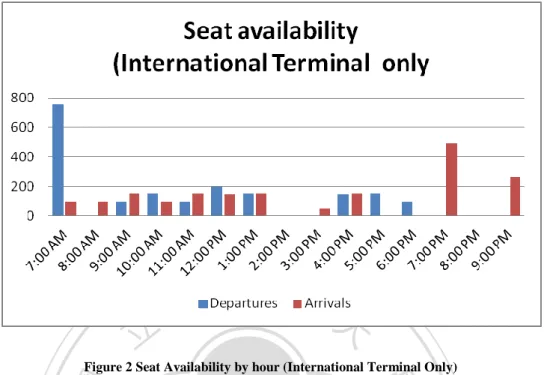
(16) students or senior citizens, nor bundle prices for connecting with other buses. The ticket price is heavily subsidized by the government via discounts on fuel prices for cooperatives, through the cooperation agreement between Nicaragua and Venezuela. In 2013, a new payment method was introduced: the MPeso card, a contactless smartcard (similar to Taipei’s EasyCard). Originally, the system was planned to completely substitute cash payment on all the city buses. However, general public reacted adversely to the system, and the government decided to change to a 60-40 mix, this is 60% of the buses will only accept payment through the MPeso card, and the remaining 40% will accept both cash and. 政 治 大 There are about 10,000 taxis in Managua. Their operation, as well as new concessions, is also 立 card. This system is only limited to buses and is not accepted as payment in taxis.. regulated by IRTRAMMA, given that taxi cooperatives also receive fuel subsidies from. ‧ 國. 學. government. Most taxis in Managua are colectivos, which pick up passengers as you go. There is no use of fare meter, and price must be arranged between driver and user before. ‧. boarding the taxi. These factors generate insecurity and reluctance towards the use of taxis,. y. Nat. especially by foreigners or people traveling with luggage. There are also more expensive. n. a. l CAirport 1.4.3. Managua International. hengchi. er. io. International Airport to downtown Managua costs US$ 20.. sit. private taxis based at the airport, malls and touristic markets. A private taxi from Managua. i n U. v. Nicaragua’s only international airport is located on Km. 11 North Highway, on the eastern exit of the capital. It serves both international and domestic flights, and in 2013 it serves 1.2 million passengers. The airport is currently the fifth busiest airport in Central America, and it serves as a focus city for Panamanian airline Copa Airlines. The airport has a single runway with over 3,000 meters length, which is able to receive large aircrafts like Boeing 747s. The airport dates back to 1942, when the Nicaraguan Government and Pan American Airways signed a contract to construct an airport at Las Mercedes estate which inspired the name for Las Mercedes Airport, the aerodrome original name. The facility was never provided adequate proper maintenance, and its condition suffered greatly during the civil. 9.
(17) unrest of the 1980’s. A large expansion program was underway by 2003 and as of July 2006 the final phase was completed with 11 gates equipped with jetways, and room for 20 airplanes to park. The total investment was about US$52M. The airport is managed through the International Airports Management Company (EAAI), a semi-public company created in 1982 to manage all of Nicaragua’s airport facilities, including domestic airfields. EAAI’s Board of Directors is constituted by both high-level government officials and private sector representatives. The airport employs around 300 people, including EAAI and airlines staff. EAAI is currently funded by a terminal usage fee, which is currently. 政 治 大 In 2013, Managua International Airport served 1,206,172 passengers in both domestic and 立 US$35 for international flights. The fee is charged directly by the airline to the ticket price.. international terminals. This is a 3.8% CAGR since 2011. The international terminal served. ‧ 國. 學. the majority of the passengers with 88% of total passengers, or around 1.06M passengers. According to Nicaragua’s Ministry of Tourism (INTUR), the total amount of Nicaraguan. ‧. citizens using the airport’s international terminal were 333,820, or about 30% of all. n. al. er. io. sit. y. Nat. passengers in 2012. Historical data from 2011 to 2013 can be seen in Figure 1.. Ch. engchi. i n U. v. Figure 1 Managua International Airport passengers traffic, by terminal (2011-2013). 10.
(18) The airport is served currently served by 9 airlines with destinations in North, Central and South America. Most served destinations are Miami, USA (2 airlines); San José, Costa Rica (2 airlines) and Panama City, Panama (2 airlines). Given its low altitude and runway length, Managua airport is technically capable of receiving any commercial aircraft, currently it is only served by narrow-body short- to medium- range planes. The largest aircraft currently serving Managua (according to a research on airlines’ website) is United Airlines’ Boeing 737-900, with seat capacity of 167 passengers. Table 1 shows the airlines currently serving Managua airport and their destination: Airline. 立. Aero Caribbean. Destinations 政Havana,治Cuba 大 San Pedro Sula, Honduras. American Airlines. Miami, USA. ‧ 國. Montreal, Canada (charter). 學. Air Transat. Avianca. ‧. San Salvador, El Salvador Miami, USA. Nat. Panama City, Panama. n. al. er. io. sit. Caracas, Venezuela. Conviasa. Copa Airlines. y. San José, Costa Rica. Ch. i n U. v. Guatemala City, Guatemala. i Rica eSan n gJosé, c hCosta. Panama City, Panama Delta Air Lines. Atlanta, USA. Spirit Airlines. Fort Lauderdale, USA. United Airlines. Houston, USA. Table 1 Airlines serving Managua International Airport. Incoming international passengers were 391,584 in 2012, a 2.4% CAGR since 2008. About 51% of these passengers were United States nationals (198,742), followed by Nicaraguan nationals living abroad (51,576), or 13.2%. European nationals totaled 8.5% of incoming international passengers with 33,131.. 11.
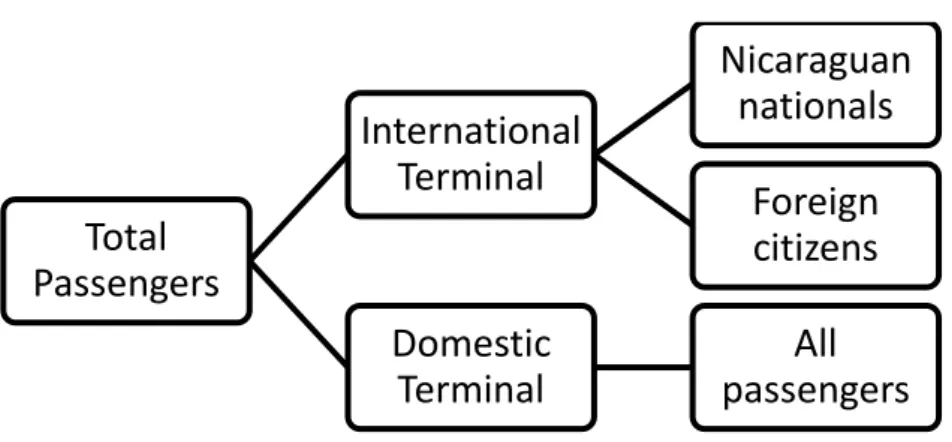
(19) Out of the 175,000 Nicaraguans citizens who departed from the country through Managua Airport in 2012, the most popular destination was the United States, with over 100,000, or around 62% of the total, followed at a distant second place by Panama, with over 13,000 passengers or around 7%. Nicaragua has direct air connection with 4 cities in the United States (Miami, Fort Lauderdale, Atlanta and Houston) and 1 city in Panama (Panama City). Domestic service at the airport is limited to one airline: Avianca Nicaragua, formerly known as La Costeña. The service connects the capital with the Atlantic Coast region’s two most important cities: Bluefields and Puerto Cabezas, and also the touristic destination of Corn. 政 治 大. Island. Domestic terminal is located next to the international terminal and usage fee is currently US$1.50. Domestic routes are served with ATR 72, a turboprop short-haul airliner.. 立. According to EAAI, almost 145,000 passengers used the domestic terminal in 2013.. ‧ 國. 學. There is no data available regarding peak hours by day at Managua airport. However, based on itineraries provided by the airport website and cross examining such information with. ‧. airlines’ websites to confirm the aircraft type used in such service, we can estimate the. y. Nat. amount of available seats per hour, which serves as a base line to estimate peak hours. Figure. sit. 2 shows the largest amount of available seats is in the early morning (7:00AM) and late night. n. al. er. io. (7:00 – 9:00PM). This estimation reflects the country’s lack of connectivity, given that. i n U. v. passengers need to flight to larger airports in Central or North America to connect towards their final destination.. Ch. engchi. 12.
(20) 立. 政 治 大. Figure 2 Seat Availability by hour (International Terminal Only). ‧ 國. 學. Lack of air connectivity has been extensively discussed in Nicaragua by both government officials and private sector. Although airlines have increased frequencies, or upgrade the. ‧. aircraft serving these routes to cope with increasing demand, no new routes have been opened.. y. Nat. In 2012, Italian airline Blue Panorama opened a route between Rome and Managua, but it. io. sit. reduced to a 4-months seasonal flight due to low demand. Compared to other countries in the. er. region, Nicaragua (along with Honduras) is the only country in Central America without a. al. n. v i n C h connections to Europe Advisor recognized the lack of direct e n g c h i U is still a big bottleneck neck and. direct flight connection to western United States or Europe. Recently, the President Economic that “we’re conversations with some airlines in order to change this”. The Spanish airline. Iberia is the largest European operator in the region with 17 weekly flights between Central America and Madrid. Ground transportation in Managua airport is limited to private taxis and hotel shuttles. Parking is located in front of the international terminal, with a minimum one-hour charge of C$20 (US$ 0.80) and C$10 (US$ 0.40) per every 30 extra minutes. Over-night parking fee is C$150 (or about US$5) per night. The airport also has various rental car agencies located in the international terminal. There is a bus stop located in front of the airport, which is served by public buses. Many hotels offer shuttle service to their arriving and departing guests, as well as travel agencies offering ground transportation to touristic destinations outside of. 13.
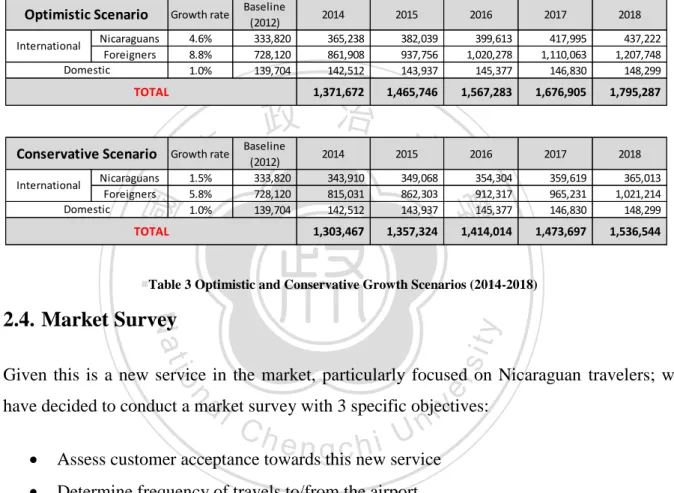
(21) Managua. Adelante Express, a travel agency based in San Juan del Sur, charges US$45 for a single trip between the airport and San Juan del Sur, which is located 140 Km. south of Managua.. 立. 政 治 大. ‧. ‧ 國. 學. n. er. io. sit. y. Nat. al. Ch. engchi. 14. i n U. v.
(22) 2. Market Analysis 2.1. Business Opportunity The analysis previously presented shows favorable conditions to invest in Nicaragua’s transportation industry. Growing tourists inflow, combined with an expanding economy, as well as increase in traffic congestion in the city are positive factors that support the viability and profitability of our business idea: Aerobus. In order to quantify the market size and determine the profitability potential of our proposal,. 治 政 Managua International Airport. For such analyses purpose, 大we will refer to Nicaragua citizens 立Nicaraguan nationals. All other foreign visitors, as well as who live in the country as we will analyze information from both INTUR and EAAI regarding passenger traffic at. ‧ 國. 學. Nicaraguans who live abroad on a permanent basis, are considered by Nicaragua’s Immigration Service as foreigners. Given information for 2013 is still limitedly available,. y. sit. Nat. 2.2. Target Market Segmentation Strategy. ‧. most of our forecasting will be calculated with a 2012 baseline.. er. io. Aerobus aims to satisfy transportation needs for passengers travelling between Managua. al. n. v i n tour and who need a convenientC and to travel independently towards their haffordable e n g c service hi U International Airport and the capital as well as its metropolitan area, without a prearranged. destination. With this focus, we have divided our target universe into two large categories: International Terminal passengers, and Domestic Terminal Passengers. Figure 3 shows the target universe division.. 15.
(23) Nicaraguan nationals. International Terminal. Foreign citizens. Total Passengers Domestic Terminal. All passengers. Figure 3 Managua Airport passengers market segmentation. International Terminal passengers: these are all the travelers, regardless of their nationality,. 政 治 大. who are traveling from/to outside Nicaragua through Managua’s airport. They represent the. 立. largest portion of traffic at the airport, about 88% in 2012. This category has been subdivided. ‧ 國. . 學. into two segments:. Nicaraguan nationals – this will be our most important target market. It is composed. ‧. by citizens of Nicaragua, currently residing in the country; that are travelling from/to. y. Nat. outside Nicaragua, regardless of their travel purpose. In 2012, this category. sit. represented almost 30% of total passengers. We divided them into two different. er. io. categories, based on residency:. al. v i n Csource. important customer look to U serve travelers who can’t or don’t want h e nWe i h gc n. o Living in Managua and metropolitan area: this will be our core and most. to depend on other person to take them or pick them up at the airport, and who are not willing to pay for a private taxi. o Living outside of Managua: we will also serve Nicaraguan nationals who live outside of the capital. However, we consider customer inflow from this subgroup won’t be significant. . Foreign citizens – this segment represents the largest amount of passengers, with about 60% of total. We also aim to serve them, but we understand such customers might be travelling with pre-arranged tours, or will utilize their hotel’s shuttle service. This will be a secondary market for us. Competition in this market will be more analyzed further ahead. 16.
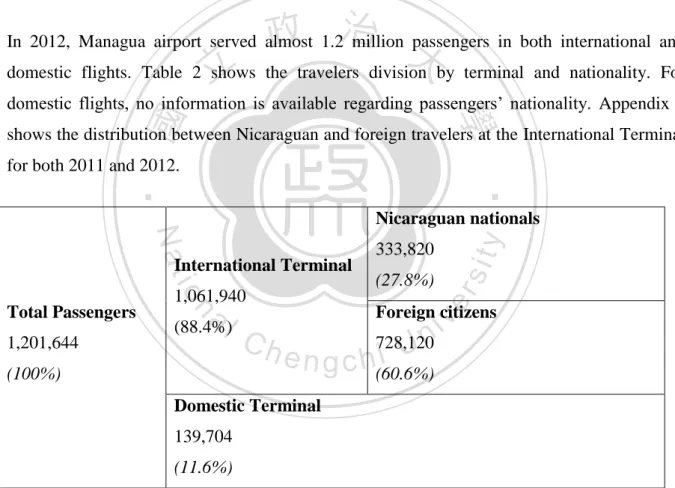
(24) Domestic Terminal Passengers: these are all the travelers, regardless of their nationality, who are flying inside the country through Managua’s airport. They represent a small fraction of total passengers, with only around 12% in 2012. Given that passengers in this terminal do not go through passport control, no information is available regarding the proportion of Nicaraguans nationals and foreign citizens travelling through the domestic terminal. Along with foreign citizens travelling internationally, all passengers from the Domestic Terminal will be our secondary market.. 2.3. Market Size. 政 治 大 domestic flights. Table 2 立 shows the travelers division by terminal and nationality. For In 2012, Managua airport served almost 1.2 million passengers in both international and. ‧ 國. 學. domestic flights, no information is available regarding passengers’ nationality. Appendix 4 shows the distribution between Nicaraguan and foreign travelers at the International Terminal for both 2011 and 2012.. ‧. io. 1,201,644. al. n. Total Passengers. 1,061,940 (88.4%). (100%). y. 333,820 (27.8%). sit. International Terminal. er. Nat. Nicaraguan nationals. v. Foreign citizens. i n Ch 728,120 engchi U (60.6%). Domestic Terminal 139,704 (11.6%) Table 2 Market size (2012). Starting from this baseline, we have developed two scenarios to forecast market growth. In an optimistic scenario, foreigners travelling internationally will grow at 8.8% CAGR, based on WTTC forecasts. Nicaraguans traveling international will grow at a 4.6% rate, based on historic performance between 2006 and 2012. Domestic Terminal passengers will grow at a 1% CAGR, based on historic performance between 2011 and 2013.. 17.
(25) In a conservative scenario, foreigners travelling internationally will grow at a 5.8% CAGR, based on historic performance between 2006 and 2012. Nicaraguans travelling internationally will grow at a 1.5% rate, based on the country’s annual population growth rate. Domestic Terminal passengers will grow at a 1% CAGR, based on historic performance between 2011 and 2013. Optimistic Scenario. Baseline (2012) 333,820 728,120 139,704. Growth rate. Nicaraguans Foreigners Domestic. 4.6% 8.8% 1.0%. International. TOTAL. Nicaraguans Foreigners Domestic. ‧ 國. 1.5% 5.8% 1.0%. TOTAL. 2016. 2017. 2018. 365,238 861,908 142,512. 382,039 937,756 143,937. 399,613 1,020,278 145,377. 417,995 1,110,063 146,830. 437,222 1,207,748 148,299. 1,371,672. 1,465,746. 1,567,283. 1,676,905. 1,795,287. 2014. 2015. 343,910 815,031 142,512. 349,068 862,303 143,937. 1,303,467. 1,357,324. 2016. 2017. 2018. 354,304 912,317 145,377. 359,619 965,231 146,830. 365,013 1,021,214 148,299. 1,414,014. 1,473,697. 1,536,544. 學. Baseline (2012) 333,820 728,120 139,704. Growth rate. International. 2015. 政 治 大. 立. Conservative Scenario. 2014. ‧. Table 3 Optimistic and Conservative Growth Scenarios (2014-2018). io. sit. y. Nat. 2.4. Market Survey. n. al. er. Given this is a new service in the market, particularly focused on Nicaraguan travelers; we. i n U. v. have decided to conduct a market survey with 3 specific objectives:. Ch. engchi. . Assess customer acceptance towards this new service. . Determine frequency of travels to/from the airport. . Determine adequate price according to customer’s expectations. The survey was conducted online throughout a week and it was answered by 140 people. It consisted of a maximum of 25 questions divided into 5 parts: demographic, use of the airport (here the survey is divided into different questions for those who have and those who have never been at the airport), perceptions regarding transportation and traffic (for those who have never been at the airport), information regarding their last time in the airport (for those who have been), questions specifically about Aerobus service, and finally a set of questions about customers’ location in Managua.. 18.
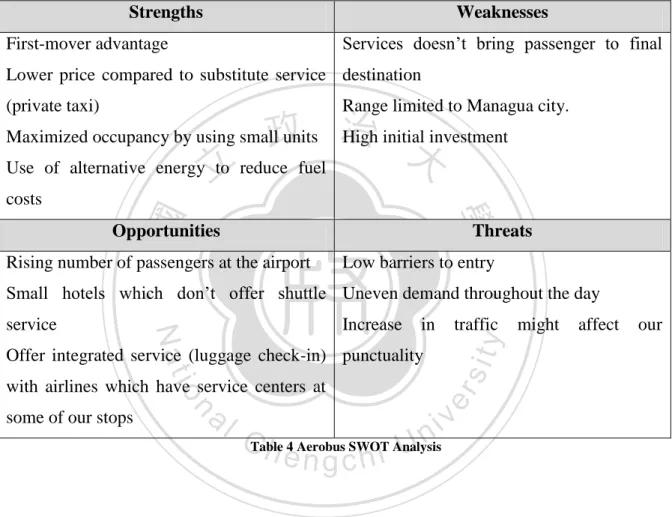
(26) Survey results are mentioned throughout this business plan. Main results summary is available on Appendix 5.. 2.5. Competition Analysis The market currently has some participants, but none of them is focused on Aerobus’ target, Nicaraguan travelers living in Managua; nor offers a service like ours. Based on our target universe distribution, we will analyze substitute services based on market segmentation: Nicaraguan nationals - we have identified three possible competitors in this segment:. 學. of them are located in Managua city, so the availability is high.. ‧ 國. o Strengths. ‧. Travelling by private provides flexibility regarding time, and it will transport the passenger until their final destination, regardless whether this is in. Nat. sit. y. Managua or outside the city. Parking fees at the airport are relatively inexpensive, as long as it doesn’t involve overnight stay. Pick-up trucks are. io. er. . 治 政 Private vehicles: the most common transportation 大method to travel to/from the airport, 立(79%). There are about 300,000 vehicles in Nicaragua and 2/3 according to our survey. very popular vehicle model in Nicaragua, and they provide enough space to. n. al. Ch. transport luggage. o Weaknesses. engchi. i n U. v. Travelers depend on some other person for pick-up or drop-off. The airport is located in the outskirts of the city, making it inconvenient for those who have to take travelers to the airport and then return to the city, especially considering increasing traffic. Depending on the time of the day, and where in the city the trip starts, a round trip to the airport might take up to 2 hours. Overnight stay parking fee at the airport is expensive (around US$5 per night), which could discourage travelers planning to go to the airport with their own vehicles.. 19.
(27) Taxis: This alternative is utilized by 15% of travelers, according to our survey. Two different types of services must be identified in this category: regular taxis, and private taxis. Given their differences, we will analyze their strengths and weaknesses separately. . Regular taxis: they are the most common service on the city. They are usually owned by cooperatives and receive government subsidies, particularly through fuel prices. o Strengths Regular taxis are widely available in Managua (about 10,000 units). Although they are allowed to run 24 hours a day, availability is severely reduced at night.. 政 治 大. Given they don’t use fare meters, price are arranged based on trip distance, but their prices are considered low. o Weaknesses. 立. ‧ 國. 學. Their quality service is very low. Old vehicles, generally without enough space to carry luggage. Safety has also become an important issue, with many reports. ‧. of robbery especially to foreigners taking regular taxis outside of the airport. Drivers do not speak English.. Private taxis: they are generally privately-owned units which don’t belong to any. sit. y. Nat. cooperative. They generally do not receive government subsidies. This type of service. io. er. . also focuses on foreign travelers.. al. n. o Strengths. Ch. engchi. i n U. v. Their quality service is higher. Vehicles are generally newer, and their availability at the airport is high. Generally, prices are already fixed for trips from the airport to the city, with prices averaging US$20. They are generally perceived as safer than regular cabs. There is one company, Taxi Managua, which has a website in English and accepts online payments. o Weaknesses Their cost is high, compared to other services. Although they are available at the airport, picking up a private taxi somewhere else in the city is very difficult, given they are generally based at the airport. This limits the available options for travelers going to the airport.. 20.
(28) Foreign citizens - we believe that competition in the foreign citizens segment is higher, given the growing number of tourists. This segment is served by competitors who don’t focus on the nationals customers. . Travel Agencies: They organize transportation logistics for their customers, especially when they are large groups. There are many travel agencies operating in Nicaragua and their logistic networks are solid. Given they’re focused on foreign travelers; their service staff is generally bilingual. o Strengths. 政 治 大. Good logistics network, bilingual staff and generally offering transportation towards final destinations are some of the strength of the service offered by. 立. travel agencies. Comfortable units.. ‧ 國. 學. o Weaknesses. Travelers who haven’t booked their trip with a specific travel agency can’t. ‧. apply while they are at the airport. Their service is mostly focus on transportation outside of Managua, particularly towards beach resorts on the. sit er. io. Hotel Shuttles: Their service is similar to the one provided by travel agencies, but it is. al. n. . y. Nat. Pacific coastline. Service is scarcely used by Nicaraguans.. usually free of charge for hotel customers. o Strengths. Ch. engchi. i n U. v. Free of charge service and transportation towards customer’s final destination. Comfortable units and high levels of safety. o Weakness Likewise, service is limited to those customers who have a reservation at the given hotel. Also, customers need to inform of their arrival or departing information in order for the hotel to arrange their pick-up or drop-off. Service is limited to larger chain hotels. As previously mentioned, foreign travelers are also served by private taxis.. 2.6. SWOT Analysis 21.
(29) Based on our competition research, and comparing with Aerobus planned service, we developed the following SWOT analysis, which will allow us to create strategies based on our strengths and weaknesses, as well as market opportunities and threats.. Strengths. Weaknesses Services doesn’t bring passenger to final. First-mover advantage. Lower price compared to substitute service destination (private taxi). Range limited to Managua city.. High initial investment 政 治 大 Use of alternative energy 立 to reduce fuel Maximized occupancy by using small units. costs. ‧ 國. 學. Opportunities. Threats. Rising number of passengers at the airport. Low barriers to entry. ‧. Small hotels which don’t offer shuttle Uneven demand throughout the day in. traffic. y. Increase. Nat. service. al. n. some of our stops. er. io. with airlines which have service centers at. sit. Offer integrated service (luggage check-in) punctuality. i n CTable SWOT Analysis h e4 Aerobus ngchi U. 22. v. might. affect. our.
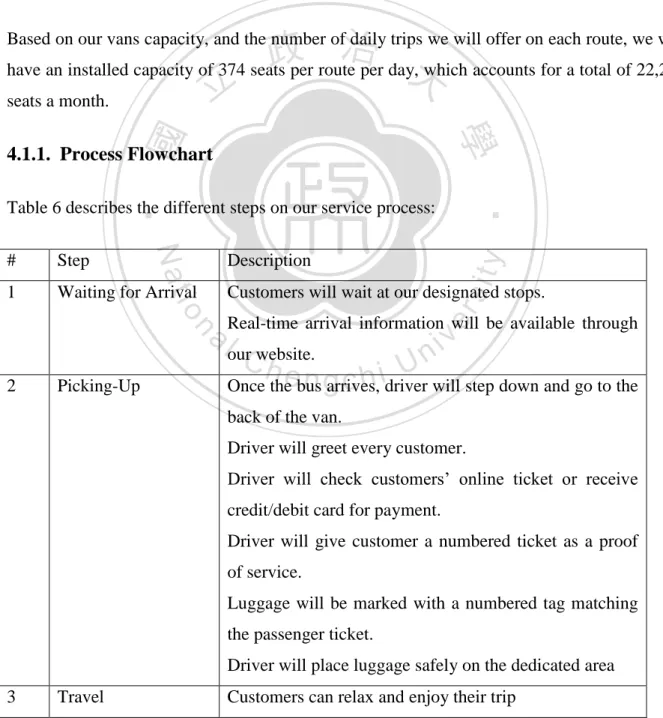
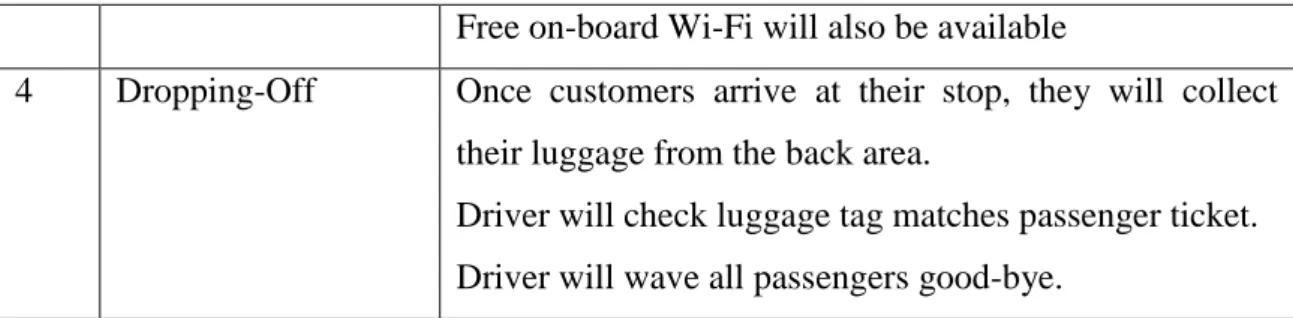
(30) 3. The Company Aerobus will be a new private company owned by its founder and investors, located in Managua, Nicaragua. The airport shuttle service model is implemented in many locations throughout the world, offering travelers many benefits. Aerobus business model will focus on providing local and international travelers with: . Convenient transportation method which allows for independent mobility for outbound and inbound passengers.. . 政 治 大. An affordable alternative to private taxis; a safe alternative to regular taxis; and a comfortable alternative to public transportation.. 立. ‧ 國. 學. 3.1. Ownership and legal representation. The Company will be will be created as a private limited company, fully-owned by its. ‧. founder and investors. The Company will be registered as a touristic organization, dedicated. y. Nat. to transporting tourist from the airport to their destination inside Managua and its. sit. metropolitan area. It is very important that the Company is registered under the “touristic. er. io. organization” category, in order to enjoy the benefits of Nicaragua’s Law 306 “General. al. v i n C h related to the Company’s exemptions of importing of vehicles operation. Aerobus’ founder engchi U n. Tourism Law”, which includes several tax benefits for touristic companies, including tax. will act as legal representative and General Manager.. 3.2. Location and Facilities Aerobus will operate from a small office located in Managua International Airport, which will also be its operations hub. This office will be dedicated to both administration and management as well as ticket sales. This space will be rented to EAAI on a year-to-year lease, and it will also include the right to install information signs for inbound passenger regarding Aerobus Service. According to EAAI, this lease includes one parking spot at the airport employees’ parking lot.. 23.
(31) As for Aerobus network, the Company will have 2 routes with 2 stops each. On each of these stops, we will install a bus stop facility with information regarding routes, timetables and price. Customers will be able to buy their tickets directly at the bus, once this arrives at the stop. More information regarding our sales channels, as well as routes and timetables will be discussed ahead. Aerobus will acquire 2 shuttle vans with a capacity for ten passengers and rear luggage compartment. These units will have a modify fuel system which will allow them to run on alternative fuels. The vehicles will be bought in the United States and will be imported to. 政 治 大. Nicaragua free of importation taxes, because of the tax exemption the Company will enjoy due to its touristic activity condition. More information on sourcing and fulfillment will be. 立. discussed ahead.. ‧ 國. 學. The Company’s website (www.aerobus.com.ni) will be a key asset for our operation, working as both a virtual sales point, as well as well as providing location information for each of our. ‧. units, and arrival time for customers waiting at our bus stops. Ticket sales through our website. sit. y. Nat. will be verified by PayPal to provide security to our customers.. er. io. As for our buses’ safety and security, the Company will also rent 2 extra parking spots on the airport employees’ parking lot, which will serve to keep our units after service.. n. al. 3.3. Hours of Operation. Ch. engchi. i n U. v. Aerobus routes will run from 05:00AM to 10:00PM, while the office located in the airport will operate from 06:00AM to 09:00PM, Monday to Sunday. At the beginning of the day, both vans will leave the airport employee’s parking lot and will make a positioning trip towards the first stop of their route, towards the airport. At 05:00AM, both vans will start their first trip of the day, arriving at the airport one hour later. At the end of the day, vans will make their last trip towards the airport, departing from the first station on the route at 09:00PM, arriving at the airport at 10:00PM. Once last passengers have been dropped off, vans will be securely park at the airport employees’ parking lot. More information on routes and timetables is discussed in the next chapter.. 24.
(32) 3.4. Start-Up Summary Aerobus will have 4 investors. 3 of them will contribute with an initial investment of US$70,000 each, and the 4th investor, who will also serve as the Company’s General Manager will contribute US$ 6,938.71. Along with the invested capital, the Company will engage in a long-term bank loan which will be paid in 6 years at a 7% annual rate. For our start-up summary, we have forecasted cash requirements to cover 6 months of operational expenses. Based on our conservative sales forecast, we project we will achieve break-even point at this point of our first year of operations. Our total start-up requirements. ‧ 國. 10,000.00 5,000.00 12,000.00 10,000.00 9,000.00 8,000.00 30,000.00 84,000.00. n. er. io. $ $ $ $ $ $ $ $. ‧. Nat. al. 學. Start-up Requirements Start-up Expenses Legal Fees Professional Services Launching Event Webpage Buses Preparation Stops Facilities Shipping 3 Buses Total Start-up Expenses Start-Up Assets Current Assets Cash Required (Operational expenses for 6 months) Long-Term Assets 3 hybrid-fueled buses Bus equipment Office Equipment Total Start-up Long Term Assets Total Start-up Assets Liabilities Long-Term Liabilites Total Liabilities Required Capital Capital Investor 1 Investor 2 Investor 4 Investor 5. y. 立. 政 治 大. sit. are as following:. Ch. engchi. i n U. Table 5 Start-up Requirements. 25. v. $ 221,938.71 $ 225,000.00 $ 15,000.00 $ 5,000.00 $ 245,000.00 $ 466,938.71 $ 250,000.00 $ 250,000.00 $ 216,938.71 $ $ $ $. 70,000.00 70,000.00 70,000.00 6,938.71.
(33) 4. Aerobus Service 4.1. Description Aerobus will offer shuttle service between Managua International Airport and different locations in the city, providing convenience, comfort and safety to our travelers at an affordable price. Our operation hub will be Managua Airport, and we will offer 2 routes which will start at the most important shopping centers in the city, where customer can easily access other means of transportation or take their own cars towards their final destination.. 治 政 have an installed capacity of 374 seats per route per day, 大which accounts for a total of 22,240 立 seats a month. Based on our vans capacity, and the number of daily trips we will offer on each route, we will. ‧ 國. 學. 4.1.1. Process Flowchart. ‧. Nat. Waiting for Arrival. sit. 1. Description. Customers will wait at our designated stops.. er. Step. io. #. y. Table 6 describes the different steps on our service process:. n. a lReal-time arrival informationi vwill be available through our Cwebsite. hengchi Un Once the bus arrives, driver will step down and go to the. 2. Picking-Up. back of the van. Driver will greet every customer. Driver will check customers’ online ticket or receive credit/debit card for payment. Driver will give customer a numbered ticket as a proof of service. Luggage will be marked with a numbered tag matching the passenger ticket. Driver will place luggage safely on the dedicated area 3. Travel. Customers can relax and enjoy their trip. 26.
(34) Free on-board Wi-Fi will also be available 4. Dropping-Off. Once customers arrive at their stop, they will collect their luggage from the back area. Driver will check luggage tag matches passenger ticket. Driver will wave all passengers good-bye. Table 6 Aerobus Service Flowchart. 4.1.2. Routes Aerobus has designed its service network aiming to move our customers from the airport to. 政 治 大. the city’s most popular shopping malls, where other transportation means are more accessible, or a more convenient pick-up/drop-off location. Our routes will be:. 立. Estimated Travel Time. Galerías Mall. 17 km.. 22 mins.. 20 km. 25 mins.. ‧ 國. Distance. 學. Route 1. Stops. Multicentro Mall. ‧ sit. Union Supermarket. Nat. Route 2. y. Airport. io. Airport. n. al. er. Metrocentro Mall. i n C h eonn Appendix A full map with our routes can be found g c h i 6.U Table 7 Aerobus routes. v. 4.1.3. Timetable Our service will start at 5:00AM departing from each route’s first stop towards the airport, completing a full round trip, back to their first stop in about one hour. The full service timetable is the following:. 27.
(35) ROUTE 1. ROUTE 2. Galerias. Multicentro. Airport. Multicentro. Galerias. 05:00. 05:12. 05:27. 05:45. 05:59. 05:00. 05:11. 05:27. 05:45. 05:59. 06:00. 06:12. 06:27. 06:45. 06:59. 06:00. 06:11. 06:27. 06:45. 06:59. 07:00. 07:12. 07:27. 07:45. 07:59. 07:00. 07:11. 07:27. 07:45. 07:59. 08:00. 08:12. 08:27. 08:45. 08:59. 08:00. 08:11. 08:27. 08:45. 08:59. 09:00. 09:12. 09:27. 09:45. 09:59. 09:00. 09:11. 09:27. 09:45. 09:59. 10:00. 10:12. 10:27. 10:45. 10:59. 10:00. 10:11. 10:27. 10:45. 10:59. 11:00. 11:12. 11:27. 11:45. 11:59. 11:00. 11:11. 11:27. 11:45. 11:59. 12:00. 12:12. 12:27. 12:45. 12:59. 12:00. 12:11. 12:27. 12:45. 12:59. 13:00. 13:12. 13:27. 13:45. 13:59. 13:00. 13:11. 13:27. 13:45. 13:59. 14:00. 14:12. 14:27. 14:45. 14:59. 14:00. 14:11. 14:27. 14:45. 14:59. 15:00. 15:12. 15:27. 15:45. 15:59. 15:00. 15:11. 15:27. 15:45. 15:59. 16:00. 16:12. 16:27. 16:45. 16:59. 16:00. 16:11. 16:27. 16:45. 16:59. 17:00. 17:12. 17:27. 17:45. 17:59. 17:00. 17:11. 17:27. 17:45. 17:59. 18:00. 18:12. 18:27. 18:45. 18:59. 18:00. 18:11. 18:27. 18:45. 18:59. 19:00. 19:12. 19:27. 19:45. 19:59. 19:00. 19:11. 19:27. 19:45. 19:59. 20:00. 20:12. 20:27. 20:59. 20:00. 20:11. 20:27. 20:45. 20:59. 21:00. 21:12. 21:27. 21:59. 21:00. 21:11. 21:27. 21:45. 21:59. 立. 20:45. 政 治 大. Table 8 Aerobus services’ timetable. Airport. Metrocentro Supermarket. 學. ‧ 國. 21:45. Supermarket Metrocentro. Both routes will include a positioning trip (without passengers) at the beginning of their. ‧. operations from our base at Managua Airport, towards the beginning of the route.. er. io. sit. y. Nat. 4.1.4. Fleet. Aerobus will offer its service with 2 brand new Starcraft Xpress shuttle vans with 11-. n. al. Ch. i n U. v. passengers capacity and dedicated luggage area on the rear, A/C and high back passenger. engchi. seats. The Starcraft Xpress is built on a Ford E-350 chassis. Passengers will also enjoy free on-board Wi-Fi, as well as a flat-screen TV with information about arrival/departures at the airport, weather forecast, as well as advertisement from our partners. For our customers’ convenience and safety, our units will have a GPS installed which will provide real-life information on their location. Such information will be accessible through our website. The GPS will also allow for remote control of the engine, which means our staff will be able to remotely turn off the engine in case of an emergency, such as an assault. More information on our shuttle vans, pictures and floor plans can be found on Appendix 7.. 4.1.5. Payment Methods. 28.
(36) Customer will have two alternatives to buy their Aerobus tickets. . Online payment: customers can access our website (www.aerobus.com.ni) and buy their tickets online without pre-registration needed. A barcode will be sent to their emails or mobile phone numbers and this will serve as their ticket.. . Directly on the bus: travelers can also pay their ticket directly to our buses’ drivers who will carry wireless POS to accept credit/debit card payments. For security reasons, and in order to speed up picking-up process. 4.2. Competitive Comparison. 政 治 大 As previously mentioned, Aerobus will be a first-mover into the Nicaraguan travelers market, 立 where we will not have any direct competition. However, there are some substitute services. ‧ 國. 學. against which we will offer the following competitive advantage:. Service. ‧. Substitute. Competitive Advantage. Nat. sit. y. Independent traveling: No need for other person to pick-up/drop-off. Vehicle. er. Price: our service will be cheaper than over-night parking at the. al. n. Private. io. passenger at the airport.. Ch. i n U. v. airport. Parking at malls where we will stop is free.. engchi. Comfort: Customer can relax because they won’t have to drive through traffic. Service Network: Aerobus will be available at designated stops Private taxi. throughout the city, versus a service that is mostly concentrated at the airport. Price: Our service will be cheaper than a private taxi. Comfort: our units will offer A/C, large space for luggage and other. Regular taxi. on-board amenities. Security: only travelers who buy a ticket can enter our buses.. Public. Comfort: our units will offer A/C, large space for luggage and other. 29.
(37) Transportation. on-board amenities. Security: only travelers who buy a ticket can enter our buses. Our buses will not make any other stops other than designated ones. Table 9 Aerobus Competitive Advantage vs. Substitute Services. 4.3. Sourcing and Fulfillment Buses will be the key asset of our operation, and when choosing a bus model, our Company must not only consider price but also another very important aspect: fuel efficiency. When it comes to sourcing and fulfillment, our Company must determine the best and most reliable. 政 治 大. supplier and choose the model which offers the best price/fuel efficiency relation.. 立. Given the tax benefit provided by the General Tourism Law, which will provide us with tax. ‧ 國. 學. exemptions for importing vehicles related to our transportation operation, we have decided to look for vendors in the United States, where we estimate offer is greater and we can find the best model.. ‧. y. Nat. In our search for maximum fuel efficiency, we considered alternative fuels as an option to. sit. reduce operational costs. We opted for propane, given their price in the market compared to. er. io. gasoline or diesel is lower, and propane prices are regulated in Nicaragua, compared to other. al. v i n C h According to U costs by converting our units to propane. e n g c h i Nicaragua’s Institute for Energy (INE), n. fuels which are not. According to our estimations, we can obtain up to 40% savings on fuel. propane prices grew 13% in 201316. Table 10 shows our estimation for fuel savings using propane-fueled buses. 16. Instituto Nicaragüense de Energía, “Precios Máximos Oficiales al Consumidor de GLP”, http://www.ine.gob.ni/DGH/estadisticas/2014/RES_precios_2014.pdf. 30.
(38) Liquid Gas Petroleum (LGP) Cylinder Capacity Lbs Gal. 100.00 23.81 Gasoline Equivalent. Gasoline Gallons Equivalent (GGE) for Propane GGE / Cylinder. 0.74 17.71. Price 50.00 政 治 大2.82 4.93. Price Cylinder $ Price GGE $ Gasoline Galon Price $. 立Difference. -43%. ‧ 國. 學. Table 10 Fuel costs’ savings projections. ‧. We have identified 3 suppliers in the United States which are able to offer us an integrated service, including the manufacturing of the van, based on our capacity request, as well as the. Nat. . Creative Bus Sales (Jacksonville, Florida). . Ameritrans Bus (Elkhart, Indiana). . El Dorado National (Salina, Kansas). n. al. Ch. engchi. er. io. sit. y. conversion to propane fuel. The vendors are:. i n U. v. We requested quotes to all suppliers, and we estimated the most convenient in terms of price and logistics is Creative Bus Sales. The information they provided will serve as key input to estimate our initial investment.. 4.4. Technology Our Company will invest heavily on technology to create a competitive advantage and to provide a quality service to our customer which will provide us with high customer loyalty. Among the technological features Aerobus will provide are:. 31.
(39) . Online ticket sales: This service will have good acceptance among customers (34%, according to our survey, are willing to use this payment method), and will allow for both good demand planning and quick collection of passengers at every stop. Customer will have the option to buy their tickets though our website, which will be PayPal verified to provide security to our customers, and will receive a bar code which will serve as their ticket.. . Use of wireless POS for credit/debit card payments: By only accepting credit/debit cards for on-board payments, we will provide security to our customers and drivers by ensuring no cash will be carried inside the buses. Also, customers will not have to. 政 治 大 Online travel information: We understand how important punctuality is for our 立 customers, especially when it comes to arriving on time to catch a flight. In order to. worry about having the local currency. We will accept major credit card brands.. 學. ‧ 國. . provide the best service, our buses will be equipped with GPS, and tracking information will be available on our website, providing information about arrival time . ‧. to each stop.. On-Board amenities: to provide the best service for our customers, our units will be. y. Nat. er. al. v i n C h by a certified company conversion will be performed in the United States to ensure U i e h n c our fuel operational expenses will be maximum quality and safety. As g a result,. Alternative Fuels: ours buses will be converted units running on propane gas. This. n. . io. about arrival time, weather, news and advertising.. sit. equipped with free on-board Wi-Fi, as well as electronic screen to provide information. permanently reduced, ensuring higher profits. Using propane versus other alternative fuels also provides convenience, given this is a fuel widely used in Nicaragua. We have confirmed with EAAI and the airport has propane tanks installations which are used by the restaurants inside the airport.. 4.4.1. Maintenance In order to achieve an efficient use of our units, preventive maintenance will be scheduled regularly for our buses. Based on the continuous survey we will perform, we will establish low demand days to program the maintenance to one of the units, while routes will be merged. 32.
(40) and served by the other bus. On such days, we will inform our customers of changes on the timetables through our website.. 4.5. Further Services and Alliances Aerobus service will be a first-mover in the market, offering quality service to a segment that hasn’t been served by any competitor before. Once we are able to establish our positioning on customers’ mindset, we will focus on developing strategic alliances with key partner with whom our Company can engage into win-win deals. Some of these partners are:. 政 治 大 Association of Small Hotels (HOPEN), and most of this facilities do not offer shuttle 立 service to their customers. By becoming entering a strategic alliance with them,. Small Hotels: Managua has at a least 25 small hotels belonging to the Nicaragua’s. 學. ‧ 國. . Aerobus can enter the foreign travelers market, which is more competitive, and the small hotels can increase their service quality.. ‧. . Airlines: they are our ideal partner, given our operations will be highly connected. On. y. Nat. the medium term (2-3 years), we will work towards establishing a strategic alliance. sit. that can result into our customers being able to go through their check-in process at. er. io. locations where our bus stops will be located and check-in their luggage. We are. al. n. v i n achieve it on the mediumC term, we are able to position our brand in the market. h eonce ngchi U. aware of the security challenges this strategy faces, which is why we have decided to. There other areas where we can further expand our business. Some they are: Expansion of our routes inside Managua: we will continuously survey our customers to assess their needs and determine which routes are more demanded. Based on our findings, we will determine the feasibility of establishing new routes. Developing new routes out of Managua: this decision will also be taken based on our market surveys. However, routes of the city pose higher logistical challenges, and this decision will be taken on the long term.. 33.
(41) Commercial alliances: Given this market is highly price-sensitive, we will focus into establishing commercial alliance that can turn into discounts for our customer. For example, offering 5% discount on ticket price to customers who pay with certain credit card brand; or to members of a frequent-flyer program of an airline who is willing to buy advertising space on our media.. 立. 政 治 大. ‧. ‧ 國. 學. n. er. io. sit. y. Nat. al. Ch. engchi. 34. i n U. v.
數據


+7

相關文件
(五) 「公約」:指 1944 年 12 月 7 日在芝加哥開放簽署之國
In Chapter 2, this research first briefly introduces different kinds of international classifications of service trade, and then presents the definitions of service industries
六、 屬關鍵基礎設施提供者,且業務經中央目的事 業主管機關考量其提供或維運關鍵基礎設施服
流程(包括中央/縣市政府/民間機 構的各種職業重建服務,如:就業 資訊與諮詢、居家就業、創業補 助、職務再設計、各種就業服務方
為了解人力市場供需情況,在此將探討本分署轄區求職民眾及企業廠商於 各工作地點之需求狀況。本分署轄區縣市 103
本區之商業與服務業場所單位在台南縣之比重,自 1971 年的 6.01% 至 1991 年的 7.54%
印刷術的成熟,不只推動了宗教改革,並使歐洲 近代早期能利用此項技術,大量出版了不同地區的服 飾書與地圖集。在英格蘭地區之外,
Efficient Solution for More Driving Comfort and Safety, Robert
