國 立 交 通 大 學
企業管理碩士
學位
學程
碩 士 論 文
Cross-Straits Economic Cooperation Framework Agreement (ECFA)
Is it Panacea or Poisons Pill to Taiwan Economy?
A Comparison Based on Closer Economic Partnership Agreement (CEPA)
Between Hong Kong and China
兩岸經濟合作框架協議(ECFA)
它是振興台灣經濟的萬靈丹還是毒藥丸?
基於內地與香港關於建立更緊密經貿關係的安排(CEPA)做比較
研 究 生:高嘉鴻
指導教授:唐瓔璋
中
華
民
國
一
百
零 一
年
七
月
Cross-Straits Economic Cooperation Framework Agreement (ECFA)
Is it Panacea or Poisons Pill to Taiwan Economy?
A Comparison Based on Closer Economic Partnership Agreement (CEPA)
Between Hong Kong and China
研 究 生:高嘉鴻
Student: Charlie Kao
指導教授:唐瓔璋
Advisor: Professor Edwin Tang
國 立 交 通 大 學
管理學院
企業管理碩士學位學程
碩 士 論 文
A Thesis
Submitted to Master Degree Program of Global Business Administration College of Management
National Chiao Tung University In partial Fulfillment of the Requirements
For the Degree of Master
in
Business Administration 2012
Hsinchu, Taiwan, Republic of China
i
Abstract
Ever since United States and Canada had signed U.S.-Canada Free Trade Agreement on 1988, the development of regional free trade agreements (FTA) has been widely spread. Over the past two decades, unprecedented proliferation of FTA to promote regional economic integration has been observed. The formation of FTA was aimed for economic integration between the parties that’s involved. Benefits of FTA include secure markets and providing export opportunities for domestic companies by dismantling the trade barriers between the participating nations. The importance of secure markets as a motive for participating in FTAs has become even greater as regionalism has expanded. This because the greater tendency towards, regionalism means the potential loss of market opportunity as a result of being excluded from a regional free trade agreement, also known as the marginalization effect, has become an increasing serious issue.
Taiwan is an island with economy that’s heavily depends on exports for economic development and growth. Since its accession to WTO in January 2002, Taiwan has begun to conduct FTA
negotiation with other WTO members. However, Taiwan was unable to secure FTA with any of its major partners, such as U.S., EU, and ASEAN. Even though Taiwan tried to conclude or to begin negotiation with other countries and other trade areas, Taiwan is suffering from China’s political isolation policy. Thus, in the East Asia region, Taiwan and North Korea are the only two Asian countries that are excluded from the regional economic integration.
On June 29, 2010, Taiwan and China have finally come to an agreement and signed their version of FTA. It is so called the Cross-Straits Economic Cooperation Framework Agreement (ECFA). The ECFA is a landmark agreement between the two political rivals since the end of the Chinese Civil War in 1949. Nevertheless, the focal point for Taiwan is its attempt to prevent itself from marginalization with the composition of FTAs within its neighboring region. With ECFA signed and become effective, Taiwan is facing new opportunities and challenges in the regional integration as well as global trade.
The objective of this case study is to evaluate the implications of ECFA based on the comparison and contrast with CEPA, the FTA signed between Hong Kong and China. Further, an analysis of what ECFA had (not) achieved on Taiwan economy thus far. Finally, since ECFA is part of the East Asian regional economic integration trend that started off by the formation of ASEAN FTA, the marginalization effect based on trade figures with ASEAN will also be analyzed.
ii
Acknowledgement
First of all, thank members of my family, especially my mother who always supported me in pursuit for knowledge since my childhood. Sincerely appreciate all the professors in the Global MBA program of NCTU who deliver their knowledge and share their valuable experience, especially my thesis advisor, Professor Edwin Tang who offer sufficient guidance during the course of Global MBA program. The classmates who interact and assisted me during the course of Global MBA program in NCTU. I simply could not have the ability to achieve MBA degree without their support.
iii
List of Tables
Table 1 Summary to Supplement to CEPA……….…19
Table 2 Tariff Reduction Schedule for China………23
Table 3 Tariff Reduction Schedule for Taiwan………….………..………23
Table 4 Early Harvest Concession by China………...………25
Table 5 Early Harvest Concession by Taiwan….………….………...………26
Table 6 Early Harvest Commitments in Service by Both Taiwan and China………27
iv
List of Figures
Figure 1 Levels of Economic Integration……….……10
Figure 2 Hong Kong Unemployment Rate………..40
Figure 3 Change in NTD Exchange Against USD………...………43
Figure 4 Taiwan Foreign Trade Since 1981…..……….…….………….47
Figure 5 Taiwan GDP Since1981………..48
Figure 6 Map of ASEAN States………60
Figure 7 Extra Export and Intra Exports of ASEAN……….64
Figure 8 Ratio of Extra Export and Intra Exports of ASEAN………...….…….……….65
Figure 9 Share of ASEAN Import Before and After FTA terms of Import………69
- 1 -
Table of Contents
Abstract………i Acknowledgement……….….……….……...ii List of Tables……….……….……iii List of Figures………iv 1. Introduction………..……….…………...………....41.1 Case Study Backgrounds………....……….…...………5
1.2 Case Study Objective………..…6
1.3 Importance of this Study………7
1.4 Framework of the Study………8
2. Literature Review………..……….……..10
2.1 Levels of Economic Integration and why Countries Pursuit Them...10
2.2 Evaluation of Free Trade Agreements and Marginalization Effect………….12
3. Comparison between CEPA and ECFA……..………..……….16
3.1 CEPA Overview………...……….………16
3.1.1 Development of CEPA………..……...……..………...20
3.2 ECFA Overview……….……….………...…..…….20
3.2.1 Content of ECFA……….………...…………21
3.2.2 The Annexes of ECFA ……….………..……...22
3.2.3 The Early Harvest Program of ECFA….…….…………...………...25
3.2.4 CEPA vs. ECFA………..29
3.2.4.1 Overall Comparison………….………...………….29
3.2.4.2 Investment Facilitation………..….….………32
3.2.4.3 Trade Remedies……….………..….………33
3.2.4.4 Trade Dispute Resolving Mechanism….……...………….35
3.2.4.5 Rule of Origin………...……...……….36
4. Implementation of CEPA and ECFA……….………...…...……...38
4.1 Implication of CEPA to Hong Kong Since 2003…….………..…………...38
4.2 Taiwan Economic Development Prior to WTO Membership……...………42
4.3 Backgrounds and Policies on Trade and Investment with China………48
4.4 Trade and Investment Development from 1991~2010………..………....50
- 2 -
4.5.1 Trade in Goods……….….………….…….54
4.5.2 Trade in Service……….……….……….……..…….56
4.5.3 Trade Dispute Mechanism………….………...…………..……..….57
5. The Trend in Regional Integrations (FTAs) ………...…….………..59
5.1 Formation of the ASEAN Free Trade Area…………..……….……….60
5.2 ASEAN Plus One(s) and ASEAN Plus Three……….62
5.3 ASEAN International Trade Structure………...63
5.4 Marginalization Effect……….………...………..66
6. Concluding Remarks……….……….…….……....……….………71
6.1 CEPA, the Hong Kong Experience……….…..….…....……….………..71
6.2 Suggestion for Future Cross-Strait Negotiations………...72
6.3 Outlook on Regional Integration……….75
References………..77
Internet Resources………79
Appendix I Source of Statistical Data……….82
Appendix II List of Statistical Tables……….83
Table 1 Gross Domestic Product (GDP) of Hong Kong………...…….83
Table 2 Domestic Product (GDP) by Economic Activity of Hong Kong………...84
Table 3 Gross Domestic Product (GDP) by Economic Activity of Hong Kong………..85
Table 4 Domestic Exports to Ten Main Destinations for Hong Kong ...86
Table 5 Domestic Exports to Ten Main Destinations for Hong Kong (%)……….87
Table 6 Statistics on Labour Force, Unemployment and Underemployment for Hong Kong……….88
Table 7 Four Key Industries in the Hong Kong Economy……….…………..89
Table 8 Inward Direct Investment (DI) of Hong Kong……….……….…...90
Table 9 Number of Factories Registered in Taiwan………..91
Table 10 Composition of Gross Domestic Product by Kind of Activity for Taiwan………..92
Table 11 Value of Principal Exports for Taiwan………...93
Table 11-1 Value of Principal Exports of Taiwan (Continued)…….……….……..94
Table 12 GDP and GDP Growth of Taiwan Economy………..95
Table 13 Foreign Trade and Foreign Trade Balance of Taiwan……….….……96
Table 14 Principal Statistics on Approved Indirect Investment in China……..………97 Table 14-1 Principal Statistics on Approved Indirect Investment in China (Continued)….98
- 3 -
Table 14-2 Principal Statistics on Approved Indirect Investment in China (Continued)….99
Table 15 Trade and Investment Across the Taiwan Strait……….100
Table 16 Total Global Trade with and without China for Taiwan………101
Table 17 Structure of Gross Domestic Product by Industry for Major Countries………..102
Table 18 Unemployment Rate in Major Countries……….………103
Table 19 Annual Growth Rate for Major Export Partners of Taiwan………...104
Table 19-1 Major Export Partners of Taiwan……….105
Table 19-2 Major Export Destination Share of Taiwan Export………106
Table 20 Annual Growth Rate for Major Import Partners of Taiwan……….107
Table 20-1 Major Import Partners of Taiwan………...108
Table 20-2 Major Import Source Share of Taiwan Import………109
Table 21 List of East Asian Regional Free Trade Agreement………...….…110
Table 22 List of FATs Under Negotiation or Early Announcement………..………111
Table 23 Intra and Extra-ASEAN Trade, 2010………...……112
Table 24 Top Ten ASEAN Export Destination and Import Origins, 2010…………...……113
Table 25 Import and Export Data and Intra-Extra Trade Relationship of ASEAN……...114
Table 26 Share of EU in the World Trade………..…….115
Table 27 Extra-EU Trade by Member State (Imports)………..………116
Table 28 Extra-EU Trade by Member State (Exports)………..………….……117
Table 29 Intra and Extra Trade for ASEAN FTA, 2010………118
Table 30 Top ten Export Markets and Import Origins for ASEAN, 2009………119
Table 31 Top Ten ASEAN Trade Partner Countries, 2010……….…….……..………120
- 4 -
1.
Introduction
Ever since United States and Canada had signed U.S.-Canada Free Trade Agreement on 1988, the development of regional free trade agreements (FTA) has been widely spread. Over the past two decades, unprecedented proliferation of FTA to promote regional economic integration has been observed. As of January 15, 2012, by requirement of World Trade Organization (WTO), some 511 notifications of Regional Trade Agreements (RTA or FTAs, counting goods and
services separately) had been received by the WTO, of these, 319 were in force [1]. All RTAs in the WTO are reciprocal trade agreements between two or more partners, that is, bilateral or multilateral.
The formation of FTA was aimed for economic integration between the parties which involved. In a free trade area, all barriers to the trade in goods and service among member
countries are removed; no discriminatory tariffs, quotas, subsidies, or administrative impediments are allowed to distort trade between members. Each country, however, is allowed to determine its own trade policies with regard to nonmembers (Hill 2011, page 267). Benefits of FTA include secure markets and providing export opportunities for domestic companies by dismantling the trade barriers between the participating nations. The importance of secure markets as a motive for participating in FTAs has become even greater as regionalism has expanded. This because the greater tendency towards, regionalism means the potential loss of market opportunity as a result of being excluded from a regional free trade agreement, also known as the marginalization effect, has become an increasing serious issue. The FTA also enhances economic cooperation, access to market and resources, and to create a favorable economic framework for promotion of cross border trade among the member countries. As there are more and more countries
conducting the free trade agreement with other countries, trade areas the context of international trade has been changed.
- 5 -
1.1 Case Study Background
Taiwan is an island with economy that’s heavily depends on exports for economic
development and growth. Shifting from agriculture economy to manufacture economy in the 1970s, Taiwan begins to switching from exporting agricultural goods to manufacturing goods for GDP growth (Tsai 2007). Since its accession to WTO in January 2002, Taiwan has begun to conduct FTA negotiation with other WTO members. However, Taiwan had failed to conclude FTA with any of its major trading partners, such as the United States, the European Union, and Association of South East Asian Nations (ASEAN). Instead, Taiwan only signed FTAs with five of its Central American diplomatic allies: Panama, Guatemala, Nicaragua, El Salvador and Honduras. Yet, bilateral trade with these Central American nations constitutes merely 0.187% of Taiwan’s total exports (Hsieh 2011). Although Taiwan also tried to conclude or to begin
negotiation with other countries and other trade areas, Taiwan is suffering from China’s political
isolation policy. In practice, China simply denied that Taiwan possess the “right” to conclude FTA with any one. For example, by considering an FTA with China, Mercado Común del Sur (MERCOSUR) prohibits its members from signing unilateral agreement with other economies, particularly Taiwan (Hsieh 2011). So, in the East Asia region, Taiwan and the North Korea are the only two Asian countries that are excluded from the regional economic integration.
On June 29, 2010, Republic of China (Taiwan) and People’s Republic of China (Mainland
China) have finallycome to an agreement and signed their version of FTA. It is so called the Cross-Straits Economic Cooperation Framework Agreement, ECFA [2]. The ECFA is a landmark free trade agreement. It marked the most important agreement between the two political rivals since the end of the Chinese Civil War in 1949 and intended to legally transform the cross-straits economic link (Hsieh 2011). This agreement is also significant within WTO since it is the first bilateral free trade agreement concluded between the WTO members with
- 6 -
long-lasting sovereign disputes, but also accelerates the “domino effect” in East Asian economic integration (Hsieh 2011).
1.2 Case Study Objective
Now with ECFA signed and become effective, Taiwan is facing new opportunities and challenges in the regional integration as well as global trade. The first object of this study will compare and contrast the similarities between ECFA and Closer Economic Partnership
Arrangement (CEPA), the free trade agreement that is preferential in nature and signed between Hong Kong and China under the WTO terms. Second objective of, this study will evaluate and analyze the implication of how CEPA had effect on Hong Kong economy, and based on that what will be the effect of ECFA on Taiwan economy. Finally, since ECFA is part of the East Asian regional economic integration trend that started off by the formation of ASEAN free trade area, the presence of marginalization effect based on trade figures with ASEAN will also be evaluated. The main questions of this thesis are:
1. Based on the impact that CEPA had to Hong Kong economy, what are the implications of ECFA to Taiwan economy?
2. How will ECFA benefit or dis-benefit to Taiwanese industries, particularly the manufacturing industry?
3. By integrating Taiwan economy with China under the terms of ECFA, how does it or does not promote foreign investment in Taiwan?
4. By signing ECFA with China, will it help promote Taiwan's accession to the
regional economic integration as to begin negotiation on free trade agreements with other countries in the region as well as with other members of WTO?
5. Is Taiwan really under the marginalization effect of not being part of the regional economic integration trend?
- 7 -
1.3 Importance of this Study
This case study was conducted for a number of reasons. First of all, Taiwan depends on the growth of export for its GDP growth. Ever since Taiwan began its indirect trade and indirect investment with mainland China, as a market, China has become a major trading partner and investment destination for firms that are based in Taiwan. Just like Hong Kong, much of Taiwan’s export and investment destination is China. It is worth the effort to understand the
implication on economic integration of Hong Kong with China, especially before and after the implementation of CEPA on January 1, 2003. In order to understand the impact, background and implication of CEPA that revive Hong Kong economy to its current state will be in the
examination.
Secondly, for the national security and commerce reason, Taiwan imposes strict restrictions on goods that are imported from China as well as restrictive investment policies toward China while China imposes little. The main obstacle is that Taiwan and China are still under serious sovereignty dispute. As ECFA become effective on Jan 1, 2011, a step for Taiwan to integrate economy with China, this study in attempt to foresee the opportunities and threats that are forthcoming. There will be profound issues and challenges that are going to be faced by the Taiwan economy.
Thirdly, although Taiwanese was not involved in the regional economic integration trend in East Asia, Taiwan is still an important trading country in the region. By sign the ECFA with China, Taiwan has begun to integrate with regional economies in East Asia. This study will examine, without being involved in the regional economic integration in East Asia, the existence of marginalization on Taiwan export within the region, particularly with ASEAN free trade area. The extension of this question is to identify the potential and target FTA candidate that Taiwan should work on in the future.
- 8 -
1.4 Framework of the Study
This study is a case analysis of how ECFA will impact on Taiwan economy particularly on the export manufacturing industry as a whole and Taiwan’s standing on regional economic
integration.
The first section presents a background of this study followed by explanation of the objectives and the importance of this study. The second chapter contains a review of relevant theoretical papers, which will elaborate explain how free trade agreement may benefit the countries that’s involved and how the benefits were measured. The second section contains
review of the relevant international trade theories regarding the regional integration and the evaluation of regional integration. This section will also present a brief description of levels of economic integration and the reason behind them. The third section will investigate and compare the similarity and difference between CEPA and ECFA. This section will offer an overview on both CEPA and ECFA and follow up with their development, content, supplement and major topics. For comparison purpose, both context of CEPA and ECFA will examined and compared. The fourth section will evaluate the implication of CEPA on Hong Kong after CEPA had become
effective. The implication of ECFA on Taiwan thus far will also be evaluated. Important event that is relevant to economic development to both Hong Kong and Taiwan will be reviewed. The comparison purpose, relevant economic performance with before and after the implementation of CEPA based on macroeconomic data and trade indicators that provided by the Censes and
Statistic Department of Hong Kong Special Administrative Region of People’s republic of China statistical department will be evaluated. Statistical data from statistical departments of Taiwan government will be analyzed. The fifth section will survey the trends in regional integrations or regional free trade agreement that began with the formation of ASEAN and its FTA. The purpose of ASEAN plus one and ASEAN plus three will be accessed. The international trade structure of ASEAN will be evaluated. Additionally, based on recent years of trade data between
- 9 -
Taiwan and the ASEAN countries, evaluation of marginalization within the East Asia economic integration will be evaluated. The sixth section will be the concluding remark of this case study.
This section will address the issues uncovered by this study, and will offer suggestion for future cross-strait ECFA related negotiations as well as outlook on regional integration for Taiwan economy
- 10 -
2.
Literature Review
2.1 Levels of Economic Integration and why Countries Pursuit Them
There are several levels of economic integrations possible in theory and they can be broadly divided into five categories: 1) Economic Union, 2) Common Market, 3) Customs Union, 4) Free Trade Area (FTA), and 5) Preferential Trade Agreements (PTA) (Pal, 2004). The
relationship between the various levels of regional agreements is depicted graphically in figure 1. Figure 1, Levels of Economic Integration
Source: Pal 2004
For the purpose of this will only preferential trade area and free trade area will be emphasis on. A preferential tread area (PTA) is a union in which member countries impose lower trade barriers on goods produced within the union, with some flexibility for each member country on the extent of the reduction. A Free Trade area is a special case of PTA where member countries completely abolish trade barriers (both tariff barriers and non-tariff barriers) for goods origination within the member countries (Pal, 2004). All levels of economic integration under the WTO are reciprocal agreements between two or more partners, that is, bilateral or multilateral. The reason behind the formation of these integrations was, according to Pal, there are 1) the
- 11 -
Bandwagon Effect of Regionalism, which also known as the marginalization effect, and 4) The Other Factors.
First of all under the welfare impact of RTAs, RTA enhances efficiency and increases welfare (Pal, 2004). The traditional theory of gains from trade suggests that removal of trade barriers allows consumers and producers to purchase from the cheapest and most competitive source of supply. This enhances efficiency and increases welfare.
As with dissatisfaction with the current multilateral trade regime, there is an emerging consensus among economists that frustration with the multilateral trading system is one of the prime reasons behind the current growth of regionalism (Pal, 2004). Krugman suggested that countries find regionalism an easier alternative because large number of participants in multilateral trade negotiations reduces the cost of non-cooperation and creates rigidity in the system. Also according to Krugman, modern trade barriers are much more complicated to negotiate in a multilateral forum and most countries find it easier to deal with these issues on bilateral or regional level (Krugman 1993).
For the bandwagon effect of regionalism, according to, that many big developed countries like the Unites States and the European Union are increasingly getting involved in FTAs with developing countries on a bilateral or regional level (Bhagwati 1993). This has encouraged many developing countries to seek participation in FTAs with developed countries as a defensive necessity against a possible exclusion from these markets (Pal, 2004). The
motivation to go for an FTA with a developed country will be particularly strong for a developing country if other countries which it is competing to supply similar goods to the developed market, are part of a preferential trade agreement with the developed country. If these non-member countries unable to form a free trade area with the developed country, they attempt to create their own market by joining a regional trade agreement among excluded members. This creates a bandwagon effect where no countries want to be left of some major regional groupings (Pal,
- 12 -
2004); such phenomenon is also known as the marginalization effect.
On the situation of other factors-Among other important economic factors are foreign direct investment (FDI) and the advantages associated with economies of scale. According to the World Trade Report 2003 (WTR 2003) access to large regional markets is one of the key
determinants of FDI in developing countries. As FDI has become the most important source of foreign capital inflow for developing countries, the WTR 2003 suggests that countries join regional agreement to attract FDI. On somewhat similar reasons, it has also been suggested that smaller countries join regional trade agreements because it can offer domestic firms the
advantage of economies of scale (Pal, 2004).
Political factors also motivate countries to join regional trade agreements. Trade linkages between economies can increase the cost of conflict and improve cross border cooperation. For this reason, regional trade agreements are used as a strategic move to consolidate peace and increase regional security among member countries. Regional trade agreements are often used by developed countries to forge geopolitical alliances and build up diplomatic ties. By providing increased discriminatory access to a larger market, these countries seek to garner increased support on political front. It is apparent that most political regional trade agreements are not driven by economics, however, in the political regional trade agreement arrangements, particularly where a large developed is involved, there is always the possibility that the interests of smaller countries would be of secondary concern (Pal, 2004).
2.2 Evaluation of Free Trade Agreements and Marginalization Effect
Plummer, Cheong and Hamanaka offered Methods for Ex-Ante Economic Evaluation of Free Trade Agreements on their paper for Asia Development Bank Methodology for Impact Assessment of Free Trade Agreements. They provided practical methods to policy makers for evaluating the potential economic effects of an FTA, defined as the preferential liberalization of
- 13 -
trade within a group of countries. They discusses how to apply three methods: trade indicators, SMART (software for market analysis and restrictions on trade) in WITS (world integrated trade solution), and the GTAP (Global Trade Analysis Project) model.
According to Plummer, Cheong and Hamanaka, the main strengths of using trade
indicators is that they are relatively easy to understand, their data requirements are easily satisfied, and their computation is straightforward. However, their main limitation is that, since these indicators are atheoretical, interpretation of the results may be difficult. In addition, for the indicators presented in the trade indicators section, the results may be meaningless if the
indicators are computed for trade categories that are too aggregated or unsuitably classified. To obtain more relevant information from these trade indicators, trade data could be reclassified according to a country’s production structure and the computations could be performed at a more
disaggregated level (Plummer, Cheong & Hamanaka, 2010).
On the same paper by Plummer, Cheong and Hamanaka, the strengths of the SMART model are that it is easily learned and implemented together with the WITS database, it yields important quantitative results on the trade and tariff revenue effects of an FTA, and the analysis can be performed at the most disaggregated level of trade data. However, the main limitation of the SMART model is that it is a partial equilibrium model, which means the results of the model are limited to the direct effects of a trade policy change only in one market (Plummer, Cheong & Hamanaka, 2010). The model, therefore, ignores the indirect effects of trade policy changes in other markets (inter industry effects) and feedback effects (the effects due to a trade policy change in a particular market that spill over to related markets and return to affect the original market). In addition, SMART does not return results on an FTA’s effects on domestic production,
which may be of interest to policy makers, nor does it consider the possibility of new foreign exporting countries serving the domestic market. Finally, SMART’s results may be sensitive to
- 14 -
built-in sensitivity analysis, users may perform this manually by changing parameter values over a reasonable range (Plummer, Cheong & Hamanaka, 2010).
The Global Trade Analysis Project (GTAP) model, originally formulated by Hertel (1997), is the most widely used CGE model for analyzing trade policy which was developed by Dixon (Dixon, Parmente & Vincent 1982). The theory underlying the GTAP model was based on the ORANI model of the Australian economy. The model is multi-market, with markets for final goods, intermediate goods, traded goods, and factors of production. It is also multiregional, with a region representing a country or a group of countries. The quantity of endowments—land, skilled labor, unskilled labor, natural resources, and initial capital—in each region is fixed exogenously within the GTAP model (Plummer, Cheong & Hamanaka, 2010). The main agents in this model are producers, consumers, and the government. These agents are styled according to standard neoclassical axioms, but the GTAP model contains particular production and utility functions (Hertel 1997). Furthermore, the model assumes perfect competition, and that prices will adjust to clear all markets. As the labor supply within each region is fixed and not mobile across regions, market clearing implies that there is no unemployment (Plummer, Cheong & Hamanaka, 2010).
The strengths of the GTAP model include (i) as a general equilibrium model, it accounts for economic changes in all sectors; (ii) it is relatively accessible compared to other CGE models; (iii) it comes with a peer-reviewed and fully documented database and software suite; and (iv) it is widely used by trade policy researchers, who can easily try to replicate and verify the results of any GTAP study. On the other hand, the GTAP model faces the same limitations as other CGE models of trade policy: (i) it is constrained by the availability of data, and a lack of data may severely compromise the scope and relevance of a study and the researcher’s ability to model
certain trade policies; (ii) it involves many parameters, which may be difficult to estimate and validate; and (iii) it contains assumptions or characteristics that may not reflect real-world
- 15 -
features. For instance, in analyzing FTAs, the GTAP model’s use of the Armington assumption
creates a bias against findings of trade diversion and, therefore, a bias in favor of FTAs (Lloyd & Maclaren 2004).
- 16 -
3.
Comparison Between CEPA and ECFA
3.1 CEPA Overview
On June 29th 2003 the Special Administrative Region (SAR) of Hong Kong and mainland China signed a bilateral trade agreement, known as Closer Economic Partnership Arrangement (CEPA). This agreement is the result of an initiative on the part of business circles and more particularly by the Hong Kong General Chamber of Commerce (HKGCC), in response to anxieties about the future of the SAR as a gateway between China and the rest of the world, which were caused by the economic slowdown since the unification of 1997. Despite its reservations, the government of Hong Kong backed the initiative and obtained, in December 2001, an agreement in principle from the central government. The CEPA conforms to Article 24 of the GATT (General Agreement on Tariffs and Trade) on bilateral agreements and is
compatible with the rules of the WTO, which was an essential condition of its application, since both parties are separate members of the WTO. This is the first bilateral agreement to be signed by Hong Kong and the first to be signed by mainland China with member of the WTO [3].
It took eighteen months to conclude the CEPA. The CEPA was made up of three major sections: 1) tariff reductions on 273 categories of goods that Hong Kong exports to China; 2) a preferential opening of Chinese market to Hong Kong service providers in 17 sectors; and 3) a series of measures aimed at facilitating bilateral exchanges of goods capitals and people. Also there are 6 Annexes signed to complement the CEPA. The Annex I to III deals with trade in goods and defines, in particular, related rules, the origin of the goods and the procedures for registration and verification of certificates of origin (Cabrillac 2004).
- 17 -
Annex II defines the definition of the “rules of origin” of products. There are about 67% of the 273 products covered by the agreement (including jewelry, textiles, clothing, cosmetics, paper, and plastics) are covered by the criteria of origin currently in force in Hong Kong, in conformity with Article VII of the GATT which requires “substantial transformation,” defined
case by case. In 17% of categories, among them chemical and metal products and certain electronic products, this “substantial transformation” must be significant enough to lead to a change in tariff heading, according to the international four-digit nomenclature. The agreement thus uses the provision, which is fairly widespread in matters of product origin, of Change in Tariff Heading. Finally, for the remaining 16% of categories (among them watch and optical components) the production or transformation costs in Hong Kong (including product
development costs) must represent at least 30% of the FOB (Free on Board) export price. While Hong Kong had to make concessions to the Chinese on this percentage (their objective had been to set this at 25%), they were nevertheless successful in having development costs included in the calculation (Cabrillac 2004).
The Annex IV and V deal with the second section of the arrangement, with the addition of the telecommunications sector and define the term “Hong Kong service provider.” Annex VI
defined six fields for special co-operation between Hong Kong and China.
CEPA includes trade in goods, services and trade and investment facilitation. To China and Hong Kong, compared with other free trade agreements, the category of goods covered are wide and tariff rate reduction are fast, including wide field of trade in services, trade and comprehensive investment facilitation, multifaceted cooperation on the bilateral economic and trade fields to develop the institutional measures, expanding the field of a free trade agreement. In all account, CEPA is a comprehensive free trade arrangement.
- 18 -
Hong Kong being a duty-free region, by the content of CEPA are agreed to by China are of a unilateral in character. Although China and Hong Kong are formally linked, in this
arrangement, Hong Kong agrees not to impose any restrictions on imports coming from the China. In addition, both parties also agreed not to take any mutual protective measures nor engage in antidumping procedures.
CEPA has created a new stage of economic and trade cooperation between Hong Kong and China. CEPA is not a fixed arrangement, it still contains flexibility, that, according to the provisions of Article III of CEPA that “The two sides will continue to expand each other's open, increase and enrich the CEPA content.” Thus, with the continuous development of the two
economies, the China’s “Reform and Opening Up” process will continue further and will deepen the relationship between the two parties.
CEPA as an “arrangement” was reached in a relatively short time. Mainland China and Hong Kong to achieve complementary advantages and common development, fully embodies the “one country” advantage. Both sides maintain their own economic systems and institutions.
Under the CEPA the gradual elimination of institutional barriers in the economic and trade field, highlighting the characteristics of “two systems.” CEPA is a vivid exhibition of the “One Country, Two System” principle and development.
As of December 13, 2011, in order to further liberalize trade in goods and trade in
services in the Mainland China for Hong Kong, both parties signed 8th supplements to the CEPA [4]. The aim of these supplements was to clarify and complete the original provisions of the CEPA and further reduce tariffs on goods that produced in Hong Kong and liberates mainland China market in trade in services so that firms based in Hong Kong may gain access to. The schedule and the implementation of the 8 supplements are as Table 1:
- 19 -
Table 1, Summary to Supplement of CEPA
Supplement
Number Date Signed
Effective
Date Summary of Trade Liberation
I October 24, 2004
January 1, 2005
1. The second batch of Hong Kong origin products for
Implementation of zero import tariffs by the mainland which contains 529 product categories (Annex 1).
2. Define schedule on rules of origin of the second batch of Hong Kong goods which contains 713 product categories (Annex 2). 3. List on 17 specific commitments on Liberalization of trade in
services of mainland market for Hong Kong (Annex 3). II October,18
2005
January 1, 2006
1. Schedule on Rules of Origin of 261 Hong Kong Goods Subject to Tariff Preference for Trade in Goods in 2006 (Annex 1). 2. Provide preferential treatment to Hong Kong service suppliers in
27 services in 10 areas (Annex 2).
III June, 27 2006
January 1, 2007
1. Schedule on Rules of Origin of 37 Hong Kong Goods Subject to Tariff Preference for Trade in Goods in 2006 (Annex 1) from 1,370 to total of 1,407.
2. Provide preferential treatment to Hong Kong service suppliers in 10 services in 10 areas (Annex 1). Included areas: legal,
construction, tourism, and air transport. IV June, 29
2007
January 1, 2008
1. Provide preferential treatment to Hong Kong service suppliers 40 liberalization measures covering 28 services areas, including 17 existing CEPA services areas and 11 new services areas.
V July 29, 2008,
January 1, 2009
1. Provide preferential treatment to Hong Kong service suppliers a total of 29 liberalization measures covering 17 services sectors, including 15 existing CEPA services sectors and two new services sectors. As a result, the total number of services sectors covered by CEPA will be expanded from 38 to 40.
2. Specifically include “Branding” as a new area of cooperation under Trade and Investment Facilitation (TIF), bringing the total number of TIF cooperation areas to nine.
VI May 9, 2009,
October 1, 2009
1. Provide preferential treatment to Hong Kong service suppliers a total of 29 liberalization measures, covering 20 service sectors, including 18 existing CEPA service sectors and two new service sectors. As a result, the total number of service sectors covered by CEPA will expand from 40 to 42.
2. Specific mutual recognition of professional qualifications on 7 professional qualifications, and liberate Certified Public Accountants on or before 31 March 2009 of Hon Kong to be exempted from the "Finance and Accounting" paper when sitting for Mainland's Certified Tax Agent qualification examination.
VII May 27, 2010,
January 1, 2011
1. Provides for 35 market liberalization and trade and investment facilitation measures in 19 sectors. Among them, 27 are liberalization measures in 14 service sectors and of which eight are measures for “early and pilot implementation”.
2. To enhance trade and investment facilitation, in addition to strengthening the cooperation in testing and certification, agree to cooperate in the cultural, environmental, innovation and technology industries, as well as cooperation on education.
VIII December 13, 2011
April 1, 2012
1. Provides for a total of 32 services liberalization and trade and investment facilitation measures, which include 23 liberalization measures in 16 service sectors, and strengthen cooperation in areas of finance, tourism, innovation and technology.
2. The two sides have so far announced 301 liberalization measures under 47 service sectors.
- 20 -
3.1.1 Development of CEPA
As to the result to the initial effect of CEPA, by January 1, 2004, 273 categories of
products of Hong Kong origin are no longer subject to import duties to mainland China. Included are many of products related to watches, jewelry, textiles and clothing, chemicals,
pharmaceuticals, cosmetics, and the electrical and electronics industries. China import duties remain high on some of these products: from 27% to 35% for jewelry, from 18% to 22% for cosmetics, from 14% to 23% for watches, and from 5% to 30% for electrical and electronic products. The arrangement is to be extended from January 1, 2005 to further categories of products as proposed by Hong Kong exporters and approved by the Hong Kong and Chinese authorities. As of January 1, 2006, all exports products of Hong Kong origin are exempted from import duties to China (Article 1, Paragraph 3), and by April 1, 2012, as the Supplement VIII become effective the two sides have liberalize 301 measures under 47 service sectors [5].
3.2 ECFA Overview
The Cross-Straits Economic Cooperation Framework Agreement (ECFA), a landmark agreement that is the most important agreement between the two political rivals since the end of Chinese Civil War in 1949. ECFA is intended to form an economic integration cross Taiwan Strait with a framework agreement. The ECFA not only serves as the first bilateral trade
agreement concluded between WTO members with decades of sovereignty disputes in the world but also an framework agreement symbolize the that Taiwan recognizes the need to establish a for institutionalized cooperation platform with its biggest trading partner, the mainland China, and an attempt of anti-marginalization in the East Asian regional integration that started off by the formation of ASEAN Free Trade Area in 1992.
- 21 -
3.2.1 Content of ECFA
The ECFA is comprised of five chapters and five Annexes. The fives chapters includes the general principle (Chapter 1), trade and investment (Chapter 2), economic Cooperation (Chapter 3), early harvest (Chapter 4), and other provisions (Chapter 5). The five annexes of the agreement are product list and tariff reduction arrangements under the Early Harvest for Trade in Goods (Annex I), provisional rules of origin applicable to products under the Early Harvest for Trade in Goods (Annex II), safeguard measures between the two parties applicable to products under the Early Harvest for Trade in Goods (Annex III), sectors and liberalization measures under the Early Harvest for Trade in Services (Annex IV), and definitions of service suppliers applicable to sectors and liberalization measures under the Early Harvest for Trade in Services (Annex V).
The General Principle section outlines the objective of the agreement and the range of economic cooperation measures of trade liberalization. There are three objective enlisted in the ECFA: 1) To strengthen and advance the economic, trade and investment cooperation, 2) To promote further liberalization of trade in god and services and gradually establish fair, transparent and facilitative investment and investment protection mechanisms; and 3) To expand areas of economic cooperation and establish a cooperation mechanism (Article1).
Trade and Investment section sets the scope as well as the range for future negotiations over agreements on trade in goods and services, investment; including modalities for tariff reduction or elimination, rules of origin, custom procedures, non-tariff measures, including measures set forth in the Agreement on Implementation of Article VI of GATT 1994, the Agreement on Subsidies and Countervailing Measures and the Agreement on Safeguards of the WTO.
- 22 -
Economic Cooperation section, a major component of the agreement, sets the parameter for intellectual property rights protection and cooperation, financial cooperation, e-commerce cooperation, industrial cooperation, promotion of small and medium-sized enterprise cooperation, customs cooperation, and trade facilitation.
Early Harvest section, an important component of the agreement, identifies and list goods eligible for early tariff reductions (Annex 1) and service trade liberated (Annex 4) for early market access that will become in effect within six month as the framework agreement become officially effective. The detail of the Early Harvest will be discussed later in this case study.
The last section, the Other Provision, which is the final section of the agreement, includes Exceptions, Dispute Settlement, Institutional Arrangements, Annexes and Subsequent
Agreements, Amendments, Date of Entry into force, and mostly importantly the Termination clause.
Within six months after the agreement officially signed, as ratify by the legislature body Taiwan on Sep. 12, 2010 [6] and become effective on January 1, 2011. Taiwan will gradually reduce tariffs to zero within three years on 267 products that’s import from China and vice versa for 539 products that’s export from Taiwan to China (Annex 1). Further, Taiwan shall reduce or
eliminate the restrictive measures in force affecting the services and services suppliers on 9 categories of trade in service and vice versa on 11 categories for China (Annex V).
3.2.2 The Annexes of ECFA
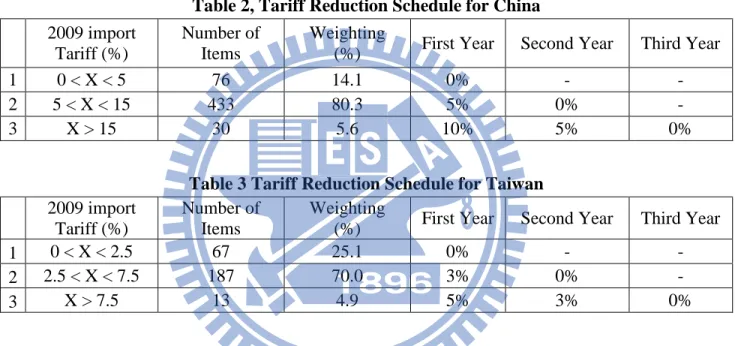
Annex I defines list of goods and tariff reduction arrangements under the Early Harvest for Trade in Goods and the provisional rules of origin applicable for both parties. Within three years Taiwan shall gradually reduce tariff on 267 products that is imported from China to zero, and vice versa for 539 products that is imported from Taiwan to China. For Taiwan, the tariff on goods that is lower than 2.5% shall reduce to zero within the first year; tariff on goods that is
- 23 -
between 2.5% and 7.5% shall reduce to 2.5 % within the first year and zero within the second year; and tariff on good that is over 7.5% shall reduce to 5% with in the first year, 2.5% within the second year, and zero within the third year. For China, the tariff on goods that is lower than 5% shall reduce to zero within the first year; tariff on goods that is between 5% and 15% shall reduce to 5 % within the first year and zero within the second year; and tariff on good that is over 15% shall reduce to 10% with in the first year, 5% within the second year, and zero within the third year.
Table 2, Tariff Reduction Schedule for China 2009 import
Tariff (%)
Number of Items
Weighting
(%) First Year Second Year Third Year
1 0 < X < 5 76 14.1 0% - -
2 5 < X < 15 433 80.3 5% 0% -
3 X > 15 30 5.6 10% 5% 0%
Table 3 Tariff Reduction Schedule for Taiwan 2009 import Tariff (%) Number of Items Weighting
(%) First Year Second Year Third Year
1 0 < X < 2.5 67 25.1 0% - -
2 2.5 < X < 7.5 187 70.0 3% 0% -
3 X > 7.5 13 4.9 5% 3% 0%
Annex II provides provision of rules of origin applicable to goods under the Early Harvest for the Trade in Goods. It contains 17 Articles and the contents of these covers the definition of terms and detail on rules of origin, Product Specific Rules, Change in Tariff Classification, Regional Value Content, Processing Operations, Accumulation Rule, Minimal Operations or Processes, De Minimis, Fungible Materials, 12 Neutral Elements, Sets, Packaging Materials and Containers, Accessories, Spare Parts and Tools, Direct Consignment, and Operational Procedures Related to Rules of Origin. This Annex stipulates Customs Valuation Agreement means the Agreement on Implementation of Article VII of the GATT 1994, which is part of the Marrakesh Agreement Establishing, the WTO.
- 24 -
However the most important issue under the provision of rules of origin is the local content rule stipulated on the Article 10 of this Annex that value of all non-originating materials, determined pursuant to Article 6, that fail to meet the criterion of change in tariff classification, does not exceed ten percent (10%) of the FOB value of the given good. In another word, require local content as high as 90% to qualify as “Made in Taiwan,” which is very strict by international
standard or usual FTA standard.
Annex III lists the safeguard measures between Taiwan and China applicable to products under the Early Harvest for Trade for Trade in Goods. It addresses that the duration of a
safeguard measure between the two parties shall be as short as possible. The maximum duration of the safeguard measure is one year. The Party that imposing the safeguard measure may increase the tariff rate applicable to the product concerned up to the level of non-interim tariff rate generally applied to the members of the WTO at the time when such a safeguard measure between the two parties is taken. When a safeguard measure between the two Parties is taken, in the event of rules not stipulated in this Annex, the Agreement on Safeguards of the WTO shall be applied mutatis mutandis, except the quantitative restriction measures set forth in Article 5, as well as Article 9, 13 and 14 of the Agreement on Safeguards of the WTO. Where the Agreement on Safeguards of the WTO is applied mutatis mutandis under this Annex, the “Council for Trade in Goods” or the “Committee on Safeguards” mentioned in the Agreement on Safeguards of the WTO refers to the “Straits Economic Cooperation Committee, (CSECC)” under the
Cross-Straits Economic Cooperation Framework Agreement. Finally, neither Party may simultaneously take the following measures on a product from the other Party.
1. Safeguard measure between the two Parties;
2. Measure set forth in Article XIX of the GATT1994 and the Agreement on Safeguards of the WTO.
- 25 -
Annex IV deals with sectors and liberalization measures under the Early Harvest for Trade in Service. Taiwan shall reduce or eliminate the restrictive measures that are affecting the services and services suppliers of 9 categories of trade in service, and vice versa 11 categories for China. Annex V defined definitions of service suppliers applicable to sectors and liberalization measures under the Early Harvest for Trade in Services.
3.2.3 The Early Harvest Program of ECFA
According to the Annex I, which displays the list of Early Harvest for trade in goods for Taiwan and China, Taiwan shall gradually reduce tariff on 267 products that is imported from China, and China shall reduce tariff on 539 products that is imported from Taiwan. Within three years, the tariff on these listed items shall gradually reduce to zero. Table 5 and Table 6 present the detail of the 539 Early Harvest concessions by both parties. Based on the 2009 trade data, the aggregate value of the 539 Early Harvest concessions by China items accounts for 13,837.54 million in U.S. dollar or 16.15% of total import from Taiwan to China, while the 267 Early Harvest concessions by Taiwan to China accounts for 2,857.76 million in U.S. dollar or 10.54% of total import from China to Taiwan.
Table 4, Early Harvest Concession by China in million U.S. dollar
Sector Subsector Items 2009 Import from Taiwan Share of Total Import form Taiwan Petrochemical 88 $ 5,944.08 6.93% Machineries 107 $ 1,143.39 1.33% Textile 136 $ 1,588.34 1.85% Transportation 50 $ 148.44 0.18% Others 140 $ 4,997.21 5.84% Steel 22 $ 1,078.56 1.26% Metal works 26 $ 1,818.13 2.12% Hand tools 5 $ 13.16 2.00% Electronics 14 $ 614.65 0.72% Agriculture 18 $ 16.08 0.02% Total 539 $ 13,837.54 16.15%
- 26 -
Table 5, Early Harvest Concession by Taiwan in million U.S. dollar
Sector Subsector Items 2009 Import from China Share of Total Import From China Petrochemical 42 $ 328.69 1.21% Machineries 69 $ 473.97 1.75% Textile 22 $ 124.24 0.46% Transportation 17 $ 408.94 1.51% Others 117 $ 1,521.92 5.61% Chemicals 51 $ 450.09 1.66% Dyes 12 $ 37.51 0.14% Electrical Equipment 17 $ 319.36 1.18% Electronics 10 $ 431.21 1.59% Total 267 $ 2,857.76 10.54%
Source: Chung Hua Institution for Economic Research, Taiwan [20]
The percentage of liberalization of trade in goods is substantial; particularly the unilateral concession on the agricultural sector on 18 items by China is noteworthy. While China agreed to accord preferential tariffs of 18 Taiwanese agricultural products, Taiwan will continue its ban on the importation of 865 Chinese agricultural products and will not lower tariffs on 1,377 industrial products (Liu 2010). The ratio of trade in goods liberalization between commitments made by Taiwan and China under the Early Harvest Program is about 1:202, and nearly 1:4.84 in
monetary value. Both sides agreed to gradually eliminate tariffs on Early Harvest Program items over two years, depending on existing tariffs as so mentioned earlier.
In terms of goods liberalization, the most apparent beneficiaries for Taiwanese are
manufacturers of petrochemical products followed by textile and machineries, machine tools and textiles. For China, the most significant beneficiaries are machineries followed by transportation and petrochemical products.
- 27 -
Annex IV, which deals with liberalization measures under the Early Harvest of Trade in Service. Taiwan shall reduce or eliminate the restrictive measures that are affecting the services and services suppliers of 9 categories of trade in service, and China shall reduce or eliminate the restrictive measures that are affecting the services and services suppliers of 11 categories of trade in service categories for Taiwan. Table 7 displays the detail of service that is liberated from both Parties.
Table 6, Early Harvest Commitments in Service by Both Taiwan and China
Commitments from China Commitments from Taiwan
Business Services
1. Accounting, Auditing and Bookkeeping 2. Software Implementation and Data
Processing
3. Research & Development 4. Convention
5. Special Design 6. Audiovisual Services 7. Hospital
8. Aircraft Repair and Maintenance
1. Research & Development 2. Convention
3. Exhibition 4. Special Design 5. Motion Picture
6. Commission Agents' Service 7. Sporting and Other Recreational
Services
8. Computer Reservation System
Financial Sector
1. Banking and Other Financial Services 2. Insurance and Related Services 3. Securities, Futures and Other Related
Services
1. Banking and Other Financial Services
Source: ECFA Annex IV
The scope of liberalization on the Early Harvest of Trade in Service was somewhat limited. The banking industry seems benefits most. Banks from both sides are now allowed to establish branches in on the other side. Noting that for Taiwan, banks from China which have been permitted to incorporate representative offices for one full year, may then apply for incorporation of branches in Taiwan. In China, banks from Taiwan shall have representative offices in the China for more than one year before application may apply for incorporation of branches further, shall have been operating in the China for more than two years and be profitable in the preceding year before application to conduct Renminbi (RMB) business.
- 28 -
And noticing that, for the insurance and insurance related services, Taiwan insurance companies through integration or strategic mergers shall be allowed to apply for entry into the Mainland insurance market with reference of total assets held by the group of over 5 billion U.S. dollar; more than 30 years of establishment experience and a representative office established in the Mainland for over 2 years by any one of the Taiwan insurance companies in the group.
The conclusion of the ECFA negotiations provides an impressive demonstration of both Taiwan and China the ability to reach meaningful agreements on difficult issues affecting real trade interests. The imbalance of tariff reductions is in favor of Taiwan despite the fact that Taiwan already enjoys a large trade surplus with the China. As its name suggests, the ECFA is a framework agreement that, for the first time since 1978 of “Reform and Opening Up” on China,
and lift of martial law of Taiwan on July 15, 1987, provides a legal and institutional framework for the exciting private cross-strait economic ties that have developed over the past three decades. The 5-Chapter, 16-article agreement which includes a Cross-Strait Economic Cooperation
Committee charged with implementing the agreement and serving as an interim dispute settlement mechanism. While the short-term benefits embodied in the “Early Harvest” tariff reductions have attracted the most attention, the creation of the new institutional framework should have long-term implications and contribute to stabilizing cross-Strait relations (Brown 2012).
- 29 -
3.2.4 CEPA vs. ECFA 3.2.4.1 Overall Comparison
CEPA is a free trade agreement under the WTO framework between the China and its territory of Hong Kong with separate WTO membership. The model of CEPA is parallel with the “One country, Two System” policy of China, and it seeks to establish between a free trade zone
between Hong Kong and China, by abolish tariff and non-tariff measures in mutual trade in goods, the gradual elimination of various restrictions on trade in services, trade and investment facilitation, and promote the growth of mutual trade and investment. CEPA is in line with the WTO under the relevant provisions of the 1994 GATT and the Trade in Services General
Agreement (TGAS). The Mainland and Hong Kong submitted a join notification of the CEPA to the WTO on Dec 27, 2003. The English translation of the CEPA text submitted was posed on the webpage of the Trade and Industry Department of Hong Kong. The CEPA was signed in the Chinese Language, and only the Chinese text is authentic [21].
Mirroring the CEPA, ECFA is negotiated and signed under the WTO framework in between China and a separate custom territory under WTO called “Chinese Taipei,” in which
covers custom territorial area of Taiwan, Penghu, Kinmen and Matsu, which have long-term sovereignty dispute with China. ECFA is aimed to establish a free trade framework between Taiwan and China by abolish tariff and non-tariff measures in mutual trade in goods, the gradual elimination of various restrictions on trade in services, trade and investment facilitation, promote mutual trade and investment growth adhering to the principles of equality, reciprocity and progressiveness and with a view to strengthening cross-straits trade and economic relations. ECFA is also consistent with the relevant provisions of the 1994 GATT and the TGAS. As ECFA officially become an effective framework agreement, Taiwan and China had finally established an official platform for further development in economic and trade exchanges and cooperation [22].
- 30 -
There are many similarities and differences between the ECFA and CEPA, and their summary are presented in the Table 7.
Table 7, ECFA vs. CEPA
ECFA CEPA
Principle To strengthening trade and economic relations
To promote the joint economic prosperity and development of the China and the Hong Kong Special Administrative Region
Model Based on Equality, Reciprocity and Progressiveness, Bilateral in Nature
Under the “One Country, Two System,” Unilateral in Nature
Signatories
Taiwan:
Chairman of Straits Exchange Foundation
Hong Kong:
Financial Secretary Hong Kong Special Administrative Region of the People’s Republic of China
China:
President of Association for Relations Across the Taiwan Straits
China:
Vice Minister of Commerce People's Republic of China
Notification to WTO "Early Announcement" Yet to be
received by WTO by May 16, 2012 Dec. 24, 2003 (WTO)
WTO Provisions GATT Art. XXIV & GATS Art. V GATT Art. XXIV & GATS Art. V
Termination Clause Yes No
Date Becoming Effective January 1, 2011 January 1, 2004 (Article 4)
Trade Remedies Under Negotiation No Anti-Dumping or Countervailing Measures, but with Safeguards Dispute Settlement Mechanism Yes, by the Cross-Straits Economic
Cooperation Committee Yes, by the Joint Steering Committee Local Content Requirement (by
Rule of Origin)
Relatively Strict with
X ≥ 90% FOB value on Material
Relatively Liberal with X ≥ 30% base on VIM Mutual Recognition of
Professional Qualifications No Yes
Supplements Under Negotiation 8 Supplements to Date Goods Free of Tariffs to Date Taiwan Lift Tariffs on 67 items China
Lift Tariff on 76 Items All Goods for Both Sides Service Sectors
Liberated to Date
Taiwan Liberates 8 Business Services and 1 Financial Sector
China Liberates 8 Business Services and 3 Financial Sectors
China Liberates 301 Business Services Under 47 Service Sectors to Hong Kong
- 31 -
Since CEPA involves only China and its separate customs territories of Hong Kong to signed a free trade agreement the title full name highlights the ”arrangement” is the textual representation of the central government and the local government. This highlights the “CEPA”
as the central government initiative undertaken in the regional economic cooperation of the local special administrative region (SAR) of the WTO membership to internal arrangements. In addition, the use of “Arrangement,” rather than with the treaty of color “Agreement,” shows such
an arrangement is not an independent status instead of the agreement of the two economies. Thus, the arrangement was signed without the requirement going through the legislature approval and took effect immediately on the date of signing. Also, there is no termination clause in CEPA. Given the fact that it is an “arrangement” between the central and special administrative local
governments, the absence of such clause demonstrates certain degree of unity between the two levels of government body. The signatory from the China side is Vice Minister of Commerce People's Republic of China; and the signatory from the Hong Kong side is Financial Secretary Hong Kong Special Administrative Region of the People’s Republic of China.
CFA involves only Taiwan and China, technically the two separate customs territories under the WTO. Although the two parties are with long term sovereignty dispute, the title “Agreement” highlights the principle of equality and reciprocity, and thus “bilateral” in nature.
The termination clause was included for the final safeguard section and may be terminate by either party, a rare clause under the usual FTA. The agreement was negotiated and signed and subsequently went through the legislature ratification process. The ECFA was approved by the Taiwan legislature on September 12, 2010 and went into effect on the January 1, 2011. The signatory from the Taiwan side was, the semiofficial representative, the Chairman of Straits Exchange Foundation; and the signatory from the China side was, also a semiofficial representative, the President of Association for Relations Across the Taiwan Straits.
- 32 -
Although ECFA and CEPA are both consider preferential FTAs under GATT Article XXIV & GATS Article V, the CEPA is unilateral nature and the ECFA is bilateral nature. This due to the fact that Hong Kong is a free port and Hong Kong imposes no tariff on goods its imports. It was China that imposes tariff and non-tariffs barriers on goods and services that imported from Hong Kong. Consequently, the tariff and non-tariff barrier measure that liberates in CEPA are all on China side and thus made it a unilateral and preferential arrangement. ECFA on the other hand, both sides agree to take measures liberates non-tariff barriers on services and agree gradually reduce tariff on goods and services based on the Early Harvest Program,
therefore the ECFA is bilateral in nature. Further, by degree of tariff on goods reduced and service trade liberated, apparently, there are more preferential trade measures made by China to Taiwan.
3.2.4.2 Investment Facilitation
By objective, CEPA was designed for promoting trade and investment facilitation
between Hong Kong and China. The agreement stipulates that two sides shall promote trade and investment facilitation through greater transparency, standard conformity and enhanced
information exchange (Article 16), and the two sides may expand the scope and content of trade and investment facilitation through consultation (Article 17, 3).
ECFA was designed, by objective, to promote further liberalization of trade in goods and services between the two parties, Taiwan and China, the agreement outline such target by
gradually establish fair, transparent and facilitative investment and investment protection
mechanisms. The aim was to expand areas of economic cooperation and establish a cooperation mechanism (Objective). The Article 5 specifically outlines that the two parties have agreed to conduct consultations and expeditiously to reach an agreement on the matters as 1) establishing an investment protection mechanism; 2) increasing transparency on investment-related
- 33 -
regulations; 3) gradually reducing restrictions on mutual investments between the Taiwan and China; and 4) promoting investment facilitation.
Since the colonial era, Hong Kong has already possessed strong investment in China. Given the relationship between Hong Kong and China after the unification of 1997, the relationship essentially became central government and local government. Thus the term “facilitation through consultation” gives China more power to decide “what to facilitate,” yet
another evidence of unilateral nature of CEPA. In contrast to CEPA, the two parties involved in the ECFA, Taiwan and China, the investment facilitation clause opens a new ear to cross-straits investment, whereas Taiwan imposes stringent restrictions on both outbound and inbound cross-straits investments, and China imposes little. In Taiwan’s trade regime, foreign investments are subject to the “negative list” that excludes only industries with security or environmental
concerns. Whereas in China, foreign investments are nonetheless confined to the “positive list” of 192 items, which explains why there is less than 1 billion U.S. dollar of Chinese investments in Taiwan in contrast to more than 50 billion U.S. dollar of Taiwanese investments in China (Hsieh 2011). The main issue here is mutual trust under the ground rule of WTO with commerce and peaceful intention. Since both sides are still under severe sovereignty dispute, by approval of ECFA, it is an implicit motion that both sides are agreed to disregard the sovereignty issue and continues to cooperate with each other on economic and trade topics.
3.2.4.3 Trade Remedies
Both China and Hong Kong agree not to impose anti-dumping (Article 7) or
countervailing measure (Article 8) on each other. Further, for the safeguard measure, should the implementation of the arrangement causes sharp increase in the import of a product included in Annex I, which has caused or threatened to cause serious injury to the affected side’s domestic