
從眼動證據探究閱聽中文形聲字之音形映照 - 政大學術集成
111
0
0
全文
(2) EYE MOVEMENT EVIDENCE FOR PHONOLOGICAL TO ORTHOGRAPHIC MAPPING WHEN READING AND LISTENING CHINESE PHONOGRAMS. 學. ‧ 國. 立. 政 治 大 BY Tzu-Hsing Yu. ‧ er. io. sit. y. Nat. n. a l A Thesis Submitted to the i v n C hInstitute of Linguistics Graduate U engchi in Partial Fulfillment of the Requirements for the Degree of Master of Arts. June 2013. II.
(3) The members of the Committee approve the thesis ofYu, Tzu-Hsing. Defended on June 13 th , 2013.. ~L' Jie-Li Tsai (~1r Jr.) Advisor. ~~d7 ). Committee Member. r1i.~k. Chia-Ying Lee (f 11 lA) Committee Member. Approved: Kawai Chui. (1t.lf. ~), Director, Graduate Institute of Linguistics.
(4) 立. 政 治 大. ‧. ‧ 國. 學. n. er. io. sit. y. Nat. al. Ch. engchi. Copyright © 2013 Tzu-Hsing Yu All Rights Reserved III. i n U. v.
(5) Acknowledgements. 這篇致謝讓我終於可以好好認真地回想從踏入校門的第一天起,我遇到的妳 你祢們。在這段漫漫長路不只有笑有淚,更多的是感動和感謝。 在決定跨領域寫論文,投入有口皆碑人才濟濟的 EMR 眼動實驗室後,便從 零開始接觸跑統計數據、寫電腦程式、操作眼動儀器等等的事物,學習這些技術 的過程真的是一關又一關的艱難挑戰,也讓我不禁開始懷疑自己的能力和能耐。 首先最要感謝我的指導教授蔡介立老師,老師是我看過最會輔導諮商也最走在科 技資訊尖端的全方位天神教授。還記得有一次在老師辦公室 meeting,老師對我 說: 「我知道很辛苦,但我覺得妳可以做到。」聽完這句後我好像就開始浪費老 師桌上的衛生紙了。謝謝幽默的老師總是包容我的無厘頭,也總是適時鼓勵和提 點我,讓我越來越成長。雖然常和老師開玩笑,但沒有說出口的是我真的非常非 常感謝老師。謝謝老師願意帶領著我走到這個里程碑,不只是指導我完成了論文,. 立. 政 治 大. ‧ 國. 學. 更讓我了解任何事只要不怕困難,只要有心和努力,再辛苦也會是值得!對老師 的感恩我一定會好好放在心底。另外還要感謝兩位口試委員:李佳穎老師和黃瓊. ‧. 之老師。謝謝仙女瓊之老師在口試時總是給我微笑和鼓勵,讓我在報告時備感安 心;感謝親切的佳穎老師提供好多專業的意見和厲害的想法,讓論文的觀點更深 更廣。最後更要謝謝兩位口委老師給我給我寶貴的意見以及美麗的成績,讓我相 信自己原來可以做到比想像中的更好。還有感謝語言所親切的教授們:蕭宇超老 師、何萬順老師、萬依萍老師、徐嘉慧老師、賴惠玲老師,所上老師們各個都是 學術界的菁英,更拓展我的視野,幫助我深入探索語言學的神奇。 這些日子裡,最捨不得的就是 EMR Lab 裡的大家!是妳們的陪伴讓我的論文 人生充滿歡樂和美好。感謝美麗博士婉雲常常關心我,陪我解決問題,和我一起 分享好多好多有趣開心的事情; 感謝家興學長的幫忙;感謝柏亨常陪我吃芥藍牛 肉蓋飯、喝越南毒茶飲料、邊波乓邊做無止盡的 meeting ppt,一起在實驗室裡奮. n. er. io. sit. y. Nat. al. Ch. engchi. i n U. v. 鬥的日子真開心; 感謝雅嵐總是像媽媽一樣溫馨地關照我,讓面黃肌不瘦,狂趕 論文進度的我常常在桌上收到各種愛心食物,還有滷牛肉真的好好吃喔!另外我 要特別感謝的就是宛柔,真的好謝謝妳這個天使,每每在我遇到困難的時候常常 不顧自己也很忙,總是全力以赴地幫助我,不管是課業上或是心靈上,妳總是給 我很多鼓勵和安定的力量。我想我上輩子一定做了很多好事才會遇到這麼善良的 妳,真的好愛妳噢!謝謝妳!還有感謝已從實驗室光榮畢業的妙璇、翠屏、佩如、 怡璇、靜儀,妳們的關心總是讓我感到溫暖;還有感謝媛媜,妳畢業後還是時常 關心幫助我,在我卡關時妳常常都比我還緊張,真開心研究人生有妳這麼一個貼 心的立體重低音好姊妹!另外我還要特別感謝從中研院跨刀來幫忙的漂亮薇帆, 謝謝妳常義不容辭幫助我,給我好多資料和鼓勵,妳是我論文的大貴人!還有感 IV.
(6) 謝參與我實驗的 92 位受試者 baby,每次做完實驗常有人問我神秘的實驗目的是 什麼,希望你們可以在這本論文中找到解答並看到我對你們的感謝。真的謝謝所 有在這裡遇見的大家,心腦學中心二樓左轉第二間的小小眼動實驗室給了我大大 的美好回憶。另外,還要感謝在季陶樓一起奮鬥的語言所朋友們:感謝貼心的琬 婷,想到我們一起住的日子嘴角還是會上揚;感謝總是散發正面能量的侃彧,妳 的愛心綠豆湯讓我身心靈都滿足了;感謝修課好夥伴曉貞,妳的兒子真的好可愛! 感謝聰明第一名的心綸大師兄,真懷念和你一起垃圾話的時間;感謝神機妙算曾 柏溫,讓我晚了一學期才修到教程,但也讓我因此認識更多可愛的教程新朋友; 還有感謝音韻小天王書豪、親和可愛美杏、美魔女晉瑋、氣質淑禎、皇上婉君, 真開心能在語言所認識到大家,那些和你們一起有過的快樂都是無可取代的。還 有特別感謝在客家庄很照顧我的詩敏學姊和秋杏學姊,每次看到妳們都想抱抱妳 們,和妳們在一起的時候真的好開心!另外也好感謝助教惠鈴學姊每次的叮嚀和 關懷,謝謝妳! 最後感謝陪我多年,VIP 等級的東廷、翊軒、亞君、妍妏、煜軒,謝謝你們 總是時時刻刻不忘關心我,鼓勵我,陪我走過大事小事所有事,給我用不完的開 心和力量。還有感謝壢中的甜八寶,中教大的九妞妞,可愛的妳們是我生活中快 樂的來源。在此更要感謝我的爸爸余金水,媽媽劉素琴,哥哥余尚儒,謝謝你們 總是支持我的任何決定,做我最堅強的後盾,Love you!. 立. 政 治 大. ‧. ‧ 國. 學. n. er. io. sit. y. Nat. al. Ch. engchi. V. i n U. v.
(7) TABLE OF CONTENTS Acknowledgements………………………………………………………………………….IV List of Tables………………………………………………………………………………...IX List of Figures………………………………………………………………………………...X Chinese Abstract…………………………………………………………………………….XI English Abstract…………………………………………………………………………..XIII Chapter 1 Introduction ............................................................................................................1 1.1 General Background ....................................................................................................1. 政 治 大 Chapter 2 Literature Review 立.................................................................................................10 1.2 Research Questions......................................................................................................8. ‧ 國. 學. 2.1 Two-way mapping between orthographic and phonological representations ............10 2.1.1 The bidirectional nature of consistency ...........................................................10. ‧. 2.1.2 Construction of P-O consistency effect ...........................................................12. y. Nat. io. sit. 2.1.2.1 P-O consistency in visual modality ....................................................12. n. al. er. 2.1.2.2 P-O consistency in auditory modality ................................................18. Ch. i n U. v. 2.2 The Processing of word recognition - Bimodal interaction activation model ...........22. engchi. 2.3 O-P and P-O consistency effects in Chinese..............................................................25 2.4 Eye movement recording technique ..........................................................................33 Chapter 3 Experiment One: P-O mappings of Chinese character in sentence reading ...41 3.1 Method .......................................................................................................................42 3.1.1 Participants.......................................................................................................42 3.1.2 Materials and Design .......................................................................................43 3.1.3 Apparatus .........................................................................................................46 3.1.4 Procedure .........................................................................................................47 VI.
(8) 3.2 Data analysis of eye movements................................................................................48 3.3 Result .........................................................................................................................49 3.3.1 Target word region ...........................................................................................49 3.3.2 Pre-target region...............................................................................................51 3.3.3 Post-target region .............................................................................................53 3.4 Discussion..................................................................................................................54 Chapter 4 Experiment Two: P-O mappings of Chinese character in spoken word recognition.............................................................................................................................. 58. 政 治 大. 4.1 Method .......................................................................................................................60. 立. 4.1.1 Participants.......................................................................................................60. ‧ 國. 學. 4.1.2 Material and Design .........................................................................................60. ‧. 4.1.2.1 Recording ...........................................................................................62 4.1.2.2 Recognition pretest .............................................................................62. y. Nat. er. io. sit. 4.1.3 Layout of visual stimuli ...................................................................................63. al. 4.1.4 Apparatus .........................................................................................................63. n. v i n Ch 4.1.5 Procedure .........................................................................................................64 engchi U 4.2 Results .......................................................................................................................65 4.3 Discussion..................................................................................................................70 Chapter 5 General Discussion ...............................................................................................74 5.1 Interactivity between phonology and orthography ....................................................74 5.1.1 The role of P-O mapping in visual ...................................................................74 5.1.2 The role of P-O mappings in auditory .............................................................76 5.2 Dynamic nature of P-O mappings in visual modality and auditory modality ...........78 5.3 Suggestions for future research .................................................................................80 VII.
(9) Reference .................................................................................................................................88 Appendixes ..............................................................................................................................88 A.. Experiment materials of Experiment 1 ............................................................................88. B.. Experiment materials of Experiment 2 ............................................................................91. 立. 政 治 大. ‧. ‧ 國. 學. n. er. io. sit. y. Nat. al. Ch. engchi. VIII. i n U. v.
(10) List of Tables Table 1. Example words for Experiment 2 (Stone et al., 1997) …………....………..13 Table 2. Phonology - Orthography correspondence in Chinese characters (陳薇帆, 2011) ……………………………………..…………………………………32 Table 3. Means and standard errors (in parentheses) of P-O value, HD value, stroke, frequency and NS1 for target characters in Experiment 1………....……….44 Table 4. Examples of sentence display in Experiment 1…………………………......46 Table 5. Means and standard errors (in parentheses) of fixation durations and probability measures on three types of target words in Experiment 1……...51. 立. 政 治 大. Table 6. Means and standard errors (in parentheses) of fixation durations and. ‧ 國. 學. probability measures on three types of pre-target words in Experiment 1.....52. ‧. Table 7. Means and standard errors (in parentheses) of fixation durations and probability measures on three types of post-target words in Experiment 1…………………………………………………………………………......53. sit. y. Nat. n. al. er. io. Table 8. Means and standard errors (in parentheses) of the spoken target characters in each experimental condition…………………………………...…………... 61. Ch. engchi. i n U. v. Table 9. Means and standard errors (in parentheses) of fixation proportions on target and unrelated distractors in 100-ms time interval for three conditions from 0 ms to 1300 ms after acoustic target onset…………………….…….……67 Table 10. Statistics of P-O effects and HD effects of fixation probability on targets at each 100 ms time bin from 0 ms to 1299 ms after the acoustic target onset……………………………………………………………………….69. IX.
(11) List of Figures Figure 1. Schematic description of the resonance model from Ziegler, Petrova & Ferrand (2008)…………………………………………………………....…2 Figure 2. Architecture of bimodal interactive activation model from Grainger & Ferrand (1994)…………………………………..………………………....24 Figure 3. Examples of consistent and inconsistent Chinese phonograms (Lee et al., 2004)…………………………………………………….…………......…..26 Figure 4. Example of a visual display (Salverda, 2010)………………...……….…..37. 政 治 大. Figure 5. Proportion of fixations to the target, the competitor, and the averaged distractor in the lower orthographic-overlap condition and the higher orthographic-overlap condition in Experiment 2………………...…….….39. 立. ‧ 國. 學. Figure 6. A diagram for the procedure of Experiment 1…………………..…….…...48. ‧. Figure 7. Predictions of fixations proportions to targets in each condition……….....59. sit. y. Nat. n. al. er. io. Figure 8. A sample display containing pictures of a target item (/ljɑŋ2/ ‘cool’) and three unrelated distractors (/tɕʰjɑw3/ ‘ingenious’, /piən1 / ‘areca’ and /kʰɤ4/ ‘lesson’)………………………………………………………………........63. Ch. engchi. i n U. v. Figure 9. Experimental procedure and examples of a visual stimulus used in Experiment Two. The display contained character of a target item (/ljɑŋ2/ ‘cool’) and three unrelated distractors (/tɕʰjɑw3/ ‘ingenious’, /piən1 / ‘areca’ and /kʰɤ4/ ‘lesson’)…………………………………………………..…….64 Figure 10. Mean fixation proportions to targets and unrelated distractors for three conditions in Experiment 2. The x-axis shows time in milliseconds from visual display onset, 200 ms before target acoustic onset, to the 1200 ms period………………………………………………………………...…….66 Figure 11. Time course of fixation proportions on different character types in three experimental conditions from -200 ms to 1300 ms…………..……………69 X.
(12) 國. 立. 政. 治. 大. 學. 研. 究. 所. 碩. 士. 論. 文. 提. 要. 研究所別:語言學研究所 論文名稱:從眼動證據探究閱聽中文形聲字之音形映照 指導教授:蔡介立 研究生:余姿幸 論文提要內容:(共一冊,24,840 字,分 5 章 16 節) 語言系統中,形音之間的映照關係為一持續受到探討的議題。本篇論文旨在. 政 治 大 利用眼動閱讀實驗以及口語理解─視覺典範深入探究閱聽中文形聲字時, 音形映 立. ‧ 國. 學. 照之存在性及其時序歷程。. ‧. 本文進行兩個眼動實驗。實驗一旨在探究視覺的閱讀歷程中,中文的音形映. sit. y. Nat. 照於詞彙層次和次詞彙層次之歷程及影響。結果顯示,同音字密度效果未達顯著,. n. al. er. io. 但音形對應一致性效果於晚期眼動指標中顯著呈現。顯示出音形映照於視覺詞彙. Ch. i n U. v. 辨識的晚期產生影響,並證實語音表徵和字形表徵於視覺處理中是互為雙向影響. engchi. 之觀點,實驗一結果並支持音至形的反向連結映照於視覺模式中具有其重要性。 實驗二主要使用口語理解─視覺典範,進一步探究並檢驗音形映照於口語詞彙辨 識過程中之時序及歷程。結果顯示,音形對應一致性效果於早期眼動指標中顯著 呈現,隨後同音字密度效果於晚期眼動指標中顯著呈現。此研究結果支持 雙向交互激發模型(BIAM)之假設,顯示詞彙辨識機制中,存在字音和字形表徵 之間的動態交互連結;並證實字形表徵於口語詞彙辨識過程中時序性的影響。. XI.
(13) 整體而論,本研究整合形音映照之概念所衍生出的形音一致性效果及同音字 密度效果,就視、聽兩種模式之眼動實驗,檢視音形映照歷程,並進一步提供音 形映照的實驗證據,探究其於中文語言系統的文字辨識歷程中之影響力與重要 性。. 立. 政 治 大. ‧. ‧ 國. 學. n. er. io. sit. y. Nat. al. Ch. engchi. XII. i n U. v.
(14) Abstract The present study aims to examine the states of phonological to orthographic (P-O) mappings when reading and listening Chinese phonograms. Two eye tracking experiments regarding to visual and auditory modalities were conducted to explore the intrinsic nature and the temporal dynamics of P-O mappings in Chinese word recognition.. 政 治 大. Experiment 1 manipulated homophone density and P-O consistency to. 立. investigate the involvement of P-O mappings at lexical and sublexical levels during. ‧ 國. 學. the reading process. The result of Experiment 1 revealed that the P-O consistency. ‧. effect was evident in second-pass eye movement indices of total viewing time (TVT). Nat. io. sit. y. and rereading rate (RRR), demonstrating a late occurrence of P-O consistency effect. n. al. accordance with the view. er. at a the verification stage in reading. The occurrence of P-O consistency is in. v i n C hthe phonological Uinformation that engchi. and orthographic. representation are activated in a bidirectional flow, which implies that the mappings from phonology to orthography were guaranteed during the reading process. Experiment 2 utilizes visual world paradigm to explore the P-O mappings in auditory modality and further inspect the temporal dynamic in listening Chinese spoken characters. The result demonstrated that the P-O consistency effect emerged approximately 300 ms earlier than the homophone density effect, reflecting the early XIII.
(15) P-O consistency effect and the relatively late HD effect during the temporal stage of spoken word recognition. The result also supports the bidirectional activation of orthographic and phonological codes during word recognition, demonstrating the notion that the dynamic influences of orthography representation on spoken word recognition are ubiquitous at both sub-lexical and lexical levels.. 立. 政 治 大. ‧. ‧ 國. 學. n. er. io. sit. y. Nat. al. Ch. engchi. XIV. i n U. v.
(16) 1. Chapter 1. Introduction. Beware of heard, a dreadful word, That looks like beard and sounds like bird. And dead, it’s said like bed, not bead; For goodness sake, don’t call it deed.. 立. 政 治Anonymous 大 (Fromkin, 2010). ‧ 國. 學 ‧. 1.1 General Background. Nat. io. sit. y. In literate cultures, linguistic abilities encompass not only perception, production,. al. er. and comprehension of speech, but also elegantly involve the elements of reading and. n. v i n writing of print. The author of C theh doggerel was trifled e n g c h i Uwith a unique property of the creative human language system which imposes double jeopardy: Spelling patterns can have more than one pronunciation, and sound patterns can be spelled in more than one way (Peereman, Content, & Bonin, 1998; Stone & Van Orden, 1994). Hence, it is considerably essential to cognize that processing of a word can be influenced by knowledge of the pronunciation as well as spelling of other words. These interweaving mappings between spelling and sound consistency give reflective insight.
(17) 2. into the organization of the mental lexicon which closely interconnect with several essential theories of word identification. Specifically, identifying the circumstances under which sound-to-spelling consistency arises is crucial to obtain profounder consideration concerning how internal lexical architecture reconstructs or adjusts to accommodate word processing from both visual and auditory inputs. From a traditional information processing view, during the course of reading, it is. 政 治 大. generally assumed that the activation produced over spelling units feeds forward to. 立. sound units. The recognition routes flow from simply downstream, as from. ‧ 國. 學. orthography to phonology. More than a decade ago, a fascinating hypothesis. ‧. concerning the visual word recognition was put forward by Stone and Van Orden. Nat. io. sit. y. (1994). The novelty conception of Stone and Van Orden (1994) specified the. n. al. phonology and orthography.. er. significance regarding to the bidirectional mappings between the representations of. v i n Caddition, In h e n gthec hbidirectional i U consistency. effect was. predicted in the context of a recurrent network theory of word perception.. Figure 1. Schematic description of the resonance model (J. C. Ziegler, Petrova, & Ferrand, 2008).
(18) 3. According to basic notion of recurrent network theory, the flow of activation is inherently bidirectional. The construction of visual word recognition is not only influenced by the feedforward mapping from spelling to sound (i.e., whether orthography is pronounced consistently) but also genuinely influenced by the feedback mapping from sound to spelling (i.e., whether phonology is spelled consistently). In reference to this model, orthography-to-phonology (O-P) consistency. 政 治 大. was called feedforward consistency; on the other hand, the feedback consistency refers. 立. to the phonology-to-orthography (P-O) mappings. Both in the visual as well as the. ‧ 國. 學. auditory modality, P-O consistency is defined as the mappings from phonology to. ‧. orthography (Ziegler, 2008) . Consistent symmetrical relations between sounds and. Nat. io. sit. y. spellings result in stable and fast activation, whereas inconsistent and asymmetrical. n. al. er. relations slow down the system on its course to equilibrium (Tuller, 1994; Ziegler, Van Orden, & Jacobs, 1997).. Ch. engchi. i n U. v. The assertion in relation to the noticeable presence of a P-O consistency effect was surprising among the earlier theories of visual word recognition, which held the view that phonology should not matter in the visual processing stage. The concept of P-O consistency effect was also originally perceived as a major theoretical challenge to the traditional bottom-up theories of word recognition (Norris, McQueen, & Cutler, 2000). Stone, Vanhoy, and Van Orden (1997) were the first to demonstrate the.
(19) 4. bidirectional consistency perspective in reading. Their statement of “phonologic coherence hypothesis” suggested that the resonance which emerges between phonological and visual features was a coherent foundation for building “higher level” resonances. In addition, phonology mediates word perception through the early local coherence, the primacy of visual-phonologic dynamics is guaranteed. The aptitude to employ the correspondent relations between phonology and. 政 治 大. orthography information plays a significant role not only in the construction of. 立. reading stages, but also in the mechanism of spoken word recognition. Several. ‧ 國. 學. researches have reported the influence of P-O consistency in the auditory modality.. ‧. Ziegler (2008) pointed out that, in contrast to the visual processing, P-O consistency. Nat. io. sit. y. effect in the auditory modality appears relatively robust. There have been a number of. al. er. studies demonstrating that orthographic information is activated during auditory word. n. v i n recognition. One of the clearestC demonstrations was originally reported by Seidenberg hengch i U (1979). In the experiment, Seidenberg (1979) had listeners monitor a short list of spoken words for a word that rhymed with a prior cue word. The results demonstrated that the reaction time taken to decide that two spoken words rhyme was shorter when their spellings are similar (e.g., TOAST - ROAST) than when they had different spelling forms (e.g., TOAST - GHOST), and that the opposite effect holds for negative decisions (e.g., which are faster for LEAF - REAF than for LEAF - DEAF)..
(20) 5. These findings established the notion that orthographic presentations to some extent generate. influence. upon. the. cognitive. processing. in. auditory. modality. (Donnenwerth-Nolan, 1981; Taft, 1985). Plentiful significant empirical evidences from previous researches had conveyed the critical notion that the mapping relation from phonology to orthography is essential during visual and the auditory word recognition in alphabetic writing system.. 政 治 大. Nevertheless, it is noteworthy for us to ponder this issue by further investigate. 立. whether P-O mapping takes place in the logographic language system like Chinese.. ‧ 國. 學. Theoretically, writing systems differ in the manner in which they represent. ‧. phonological information as well as orthographic information. There are variations. Nat. io. sit. y. between orthographies in the extent to which written words represent their. al. v i n MitchumC(1987), of all English h e nhalf gchi U n. Berndt, Reggia, and. er. pronunciations among different language systems. According to the statement of words can be spelled. accurately on the basis of sound-spelling correspondences alone, meaning that the letters used to spell these words predictably represent their sound patterns. On the other hand, the prominent linguistic trait for Chinese is that it belongs to the logographic writing system with relatively deep orthography, having a more opaque and arbitrary script-speech correspondence. In contrast with English, sound-spelling correspondence in Chinese is not generally solitary one-to-one mapping. Several.
(21) 6. characters can be phonologically similar but visually dissimilar; on the other hand, some orthographically similar characters may have different pronunciations. Nevertheless, there are some valid clues for pronunciation in the constituents of Chinese characters. DeFrancis (1989) pointed out that Chinese orthography is a speech-based script due to the fact that more than 85% of Chinese characters are phonograms, in which the clues to its pronunciation were embedded in a part of the. 政 治 大. character. Basically, phonograms are complex characters which typically composed of. 立. a semantic radical and phonetic radical. For example, in the character “媽”(/ma1/),. ‧ 國. 學. the core formation of this phonogram is constructed by a semantic radical “女”and a. ‧. phonetic radical “ 馬 ”(/ma3/). The composed phonetic radicals are often. Nat. io. sit. y. characterized as being an essential clue to specify the pronunciation of the entire. n. al. meaning (Lee, Tsai, Su,. er. character; the semantic radicals on the other hand offer a hint to the character’s. v i n C h & Hung, 2005).U Increasing Tzeng, engchi. researches have. demonstrated that reading a complex character might necessarily involves the processing of its radical (Yeh & Li, 2004). Therefore, the associations between radicals as well as the sound-spelling correspondences in phonograms are gradually regarding as a critical and discussible issue which relates to not only the visual word but also spoken word recognition. The interlaced mappings between representations of Chinese phonology and.
(22) 7. orthography had been investigated in several studies. Lee et al. (2005) suggested that the concept of “consistency” is a better index for describing the intricate relations between sounds and spellings in Chinese language system. The various degrees of connections between phonograms and their radical parts can be addressed through the theoretical concept of consistency, which refers to whether the pronunciation of a character agrees with its orthographic neighbors. There has been a great deal of. 政 治 大. research investigating the processing relations between word recognition and the. 立. orthography-to-phonology (O-P) consistency in different languages and with different. ‧ 國. 學. manipulations of orthographic information (Pattamadilok, Morais, Ventura, &. ‧. Kolinsky, 2007; Ventura, 2004; Ziegler, Petrova, & Ferrand, 2008). Furthermore, the. Nat. sit. al. v i n view C of hO-P consistency, U e n g c h i theoretically,. n Different from the. er. io. spellings to sounds.. y. flow of O-P consistency is essentially focusing on the mapping direction from. the definition of. “phonology-to-orthography consistency” (P-O consistency) is a statistical indication of the mappings from phonetic sound to orthographic spelling in a Chinese character. P-O inconsistent words possess the characteristics that their pronunciation is capable of being orthographically represented in multiple ways with different phonetic radicals (e.g., /jan2/ sounds can be orthographically represented by “研”, “顏” and “延”). In contrary, the P-O consistent characters have a greater possibility that the.
(23) 8. sounds could be mapped to specific phonetic radicals (e.g., /nɑw3/ sounds can be orthographically represented by “腦”, “瑙” and “惱” with the same phonetic radical). The investigation concerning the mappings from phonologic codes to orthographic codes in non-alphabetic writing system such as Chinese is rather limited and lacking of a wide range of supplementary researches from other various perspectives and empirical evidences.. 立. 政 治 大. ‧ 國. 學. 1.2 Research Questions. ‧. The primary research goal of the present study is to conduct two eye movement. sit. y. Nat. io. n. al. er. experiments to investigate whether the mappings between phonology and orthography. i n U. v. influences the visual word recognition as well as spoken word recognition. In addition,. Ch. engchi. through the utilization of different paradigms, we are capable of getting further insight into how the patterns of mappings from phonology to orthography affect the processing from the aspect of different input modalities in human’s cognitive mechanism. From inspecting the P-O consistency effect and homophone density effect in processing Chinese phonogram characters, two eye movement experiments were conducted to investigate the phonological-to-orthographic mappings in Chinese from.
(24) 9. both visual and auditory modality. In addition, time course of P-O consistency effect and homophone density effect were further prudently examined through the employment of visual world paradigm. Specific research questions of two experiments to be addressed are as follows:. (1) In Chinese writing system, whether P-O mappings take place at the stage of. 政 治 大. lexical processing in visual and auditory modality?. 立. ‧ 國. 學. (2) If P-O mappings certainly make active in the Chinese word recognition. ‧. Nat. n. al. er. io. sit. recognition differentially for reading and listening process?. y. mechanism, whether this orthographic activation from phonology influences word. Ch. engchi. i n U. v.
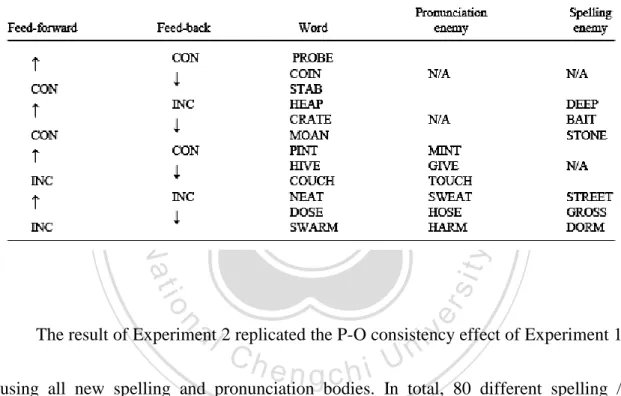
(25) 10. Chapter 2. Literature Review. 2.1 Two-way mapping between orthographic and phonological representations. 2.1.1 The bidirectional nature of consistency. 政 治 大. In traditional information processing models, research often placed focus. 立. exclusively on the one-way consistency effect. In this traditional genre of framework,. ‧ 國. 學. information simply flows in the manner of “downstream”, as from orthography to. ‧. phonology. This kind of orthography-to-phonology (O-P) mappings is generally titled. Nat. er. io. sit. y. as “feedforward consistency”. The theoretical issue of feedforward consistency concerns whether there exists more than one way to pronounce a spelling body (e.g.,. al. n. v i n C hEAP as in HEAP and INT as in HINT and PINT versus e n g c h i U LEAP). Inconsistency in the mapping between spelling and sound arises when a spelling has more than one possible pronunciation (e.g., _INT can be pronounced as in PINT or MINT). In English, a number of inconsistent spelling bodies may approximately have up to five possible pronunciations (e.g., _OUGH in COUGH, DOUGH, THROUGH, BOUGH, TOUGH) (Ziegler, Van Orden, & Jacobs, 1997). In many behavioral studies, the property of O-P consistency effect has been evidenced in several empirical.
(26) 11. investigations. The inconsistency words in general had longer reaction time and are more error-prone when making lexical decision and naming tasks. On the other hand, the consistency words usually consume shorter reaction time, which reflect the relatively rapid connection between spellings and sounds in consistent condition (Andrews, 1982; Glushko, 1979; Lee et al., 2005; Van Orden, 1990). In addition to the consistency from spelling to sound, accumulating researches. 政 治 大. had pointed out the bidirectional portrait of the intrinsic nature of consistency between. 立. phonological and orthographic representations. For both visual and auditory. ‧ 國. 學. modalities, the fundamental pattern of phonology-to-orthography (P-O) consistency is. ‧. referring to the consistency relations of mapping from phonology to orthography,. Nat. io. sit. y. which is occasionally named as “feedback consistency”. In the construction of P-O. al. er. mapping, spelling enemies are words with the same pronunciation body but different. n. v i n C h are the “enemies” spelling bodies. These false rhymes e n g c h i U from the P-O consistency literature. On the other hand, “friends” refer to words which share the same pronunciation and the same spelling pattern (e.g., /_Ob/ as in PROBE and GLOBE). The cross-code consistency flow of activation is gradually turning out to be a major determinant in the word recognition system. Accordingly, the interactivity between consistency leads to the prediction that word recognition should not simply depend on the characteristics of the mapping and consistency from the direction of.
(27) 12. orthography-to-phonology, but also hinge on the correspondent associations from phonology-to-orthography.. 2.1.2 Construction of P-O consistency effect. 2.1.2.1 P-O consistency in visual modality. Supporting the interactive view of word recognition, Stone et al. (1997) claimed. 立. that phonological activation. 政 治 大 reverberates to orthographic. processing units and. ‧ 國. 學. consequently constrains orthographic encoding. They conducted two experiments and. ‧. demonstrated a robust phonological effect in visual lexical decision. Experiment 1. sit. y. Nat. tested for consistency effect of spelling to pronunciation correspondence (e.g., HEAP. n. al. er. io. vs. PROBE) on correct ‘‘yes’’ responses to words, in which all experiment stimuli. Ch. i n U. v. were low-frequency, O-P consistent words. The usage of only O-P consistent words. engchi. for experimental material allowed a constricted focus on the P-O consistency effect. The experiment result contradicted the unidirectional feedforward models that P-O consistency should not affect performance. It suggested that the O-P consistent pronunciation bodies of the stimuli could have been generated by another spelling body make the information flow backward from phonology to orthography. By factorially manipulating O-P and P-O consistency, Experiment 2 tested the artifact.
(28) 13. hypothesis which stated that, when fully consistent (O-P and P-O consistent) words was used, the feedforward O-P consistency effect was robust and reliable. Nevertheless, when the value of P-O consistent was ignored, the unreliable O-P consistency effect was replicated.. Table 1. Example words for Experiment 2 (Stone et al., 1997). 立. 政 治 大. ‧. ‧ 國. 學. n. er. io. sit. y. Nat. al. i n U. v. The result of Experiment 2 replicated the P-O consistency effect of Experiment 1. Ch. engchi. using all new spelling and pronunciation bodies. In total, 80 different spelling / pronunciation bodies were tested for a P-O consistency effect, given O-P consistent of the spelling bodies. The P-O consistency effect appeared to be robust. Stone et al. (1997) furthermore tested three possible confounds: orthographic neighborhood, body neighborhood, and vowel ambiguity. The statistical analysis confirmed that there was a significant P-O consistency effect. The substantial differences between reaction time as well as error rate of consistent and inconsistent words cannot be attributed to.
(29) 14. confounding with other lexical properties. In sum, the experimental result revealed that when the proper contrast with consistent words was used, both O-P consistency and P-O consistency effect were reliably obtained. This suggested that previous research proposed that phonology only weakly influenced performance in visual word perception tasks may have resulted from the failing to control the property of P-O consistency. Stone et al. (1997) lined out the broad issue of feedforward versus. 政 治 大. feedback perspectives on the perception regarding to the visual word recognition. 立. mechanism.. ‧ 國. 學. Ziegler, Montant, and Jacobs (1997) concentrated on the subject of the P-O. ‧. consistency effect in French, which mapping sound to spelling is less inconsistent. Nat. io. sit. y. than English. In order to identify whether the P-O consistency effect was capable of. al. er. generalizing to different language and to further examine the importance of. n. v i n bidirectional consistency effect,Cahreplication and extension of Stone et al. (1997) engchi U experiment in French was conducted. The experiments used a factorial design to investigate the effects of O-P and P-O consistency effect in a lexical decision task, an immediate naming task and a delayed naming task. Four types of stimuli were manipulated: (1) words that were both O-P and P-O consistent, (2) words that were O-P consistent but P-O inconsistent, (3) words that were O-P inconsistent but P-O consistent, and (4) words that were both O-P and P-O inconsistent. The experiment.
(30) 15. result replicated the classic O-P consistency effect: ambiguity in the mapping between spelling and phonology slows down naming latencies and increased error rates. The research analyses further supported the concept that P-O consistency effect is generally consistent with the idea that reading is a dynamically interactive system (Van Orden & Goldinger, 1994; J. C. Ziegler, Van Orden, et al., 1997). However, certain research raised question regarding to the P-O consistency effect. 政 治 大. in the visual word recognition. Peereman, Ronald, Content, Alain, Bonin and Patrick. 立. (1998) challenged the P-O consistency hypothesis for potential familiarity and. ‧ 國. 學. frequency confounds. They conducted several experiments to investigate whether. ‧. sound-to-print consistency influence lexical decision in French. The same sets of. Nat. io. sit. y. consistent and inconsistent words matched on word frequency were used in three. al. er. different tasks. In the result, they observed P-O consistency effects in the task of. n. v i n C hauditory delivered.UHowever, no significant effect writing down the word which was engchi. was found in lexical decision or in naming tasks, except for a small effect on error rates, which was significant only by subject. The same stimuli were used in a following experiment under degraded visual conditions with a stricter criterion for stimulus selection in order to enhance the contribution of reverberating activation from phonology to orthography. However, the pattern of result did not reveal a stable P-O consistency effect. Peereman et al. (1998) cast doubt on the existence of.
(31) 16. reciprocal constraints between phonology and orthography at pre-lexical stage of processing. In addition, they pointed out that although the cross-linguistic differences and task specific decision strategies might explain the absence of a robust P-O consistency effect, further studies are still needed to ascertain the P-O mapping consistency in visual modality. Nonetheless, the findings of Peereman et al. (1998) have been criticized by Perry. 政 治 大. (2003) for poor item selection when inspecting the P-O consistency effect. In order to. 立. investigate whether there would be an robust effect of P-O consistency at the. ‧ 國. 學. phoneme-grapheme level, Perry (2003) conducted the experiment with a new set of. ‧. items. Three groups of word items were used for the experiment stimuli: an O-P. Nat. io. sit. y. consistent group that contained a vowel that was the most common spelling of that. al. er. vowel (C-C); an O-P consistent group that contained a vowel correspondence that was. n. v i n not the most common spelling C for h that vowel (C-I); and e n g c h i U a O-P irregular vowel group that therefore contained a vowel that was not the most common spelling (I-I). The results reported that, a significant P-O consistency effects revealed at least at the phoneme-grapheme level in English with frequency and subjective familiarity being controlled in a normal lexical decision task. Furthermore, the strong interactivity between phonology and orthography during reading process are positively suggested. Lacruz (2004) investigated O-P and P-O consistency effects for both high- and.
(32) 17. low-frequency words in the lexical decision and naming tasks. The experiment items were either O-P inconsistent, P-O inconsistent, or both. The three groups were controlled not only for frequency but also for subjective familiarity and a number of other lexical properties, including word length, orthographic neighborhood, bigram frequency, and summed frequency of friends. For naming latencies, there was a main effect of frequency, as subjects named high frequency words significantly faster than. 政 治 大. low frequency words. In addition, there was a main effect of consistency as O-P. 立. inconsistent words were named significantly more slowly than their consistent. ‧ 國. 學. controls. The interaction between consistency and frequency was not significant.. ‧. The experiment outcomes provided the evidence that both O-P and P-O. Nat. io. sit. y. consistency relations were involved in the processing of monosyllabic words in the. al. er. lexical decision and naming tasks. In addition, the experimental result also. n. v i n C h effects for bothUhigh and low frequency words. demonstrated a robust P-O consistency engchi Lacruz (2004) proposed that the interactivity from phonology to orthography was in accordance with several theories of word recognition which considered the existence of intimate relations between a word’s sound and spelling. The information do not merely flow from spelling patterns to sounds in visual word recognition, but also back from phonetic sounds to spelling representations (Colheart et al., 2001; Van Orden, 1990; Van Orden & Goldinger, 1994). Together, these results supported that P-O.
(33) 18. effects are representative of a general principle in the reading system.. 2.1.2.2 P-O consistency in auditory modality. Previous research has shown that literacy (i.e., the ability of reading and spelling) affects spoken language process. Word recognition is important for the reason that acquiring this skill is among the first task confronted by beginning readers during. 治 政 their learning stage. Ziegler and Muneaux (2007) conducted 大 a developmental study to 立 ‧ 國. 學. investigate the extent to which learning to read and write affects spoken word recognition. They reported that, prior to literacy; the spellings of spoken words will. ‧. not influence the auditory lexical decisions. Once literacy is acquired, the. sit. y. Nat. io. n. al. er. orthographic influences on spoken word recognition and the acquisition of literacy. i n U. v. were tightly linking with each other. Spoken word recognition is gradually affected by. Ch. engchi. orthographic consistency of spoken words as literacy is developing. In addition, as early as Grade 1, the size of the P-O consistency effect was predicted by the reading level of a child. It revealed that the orthographic effects on spoken language were not artifact of the uncontrolled spoken language properties, but demonstrated the orthography influences on the mechanism of spoken word recognition. The evidence supported the view that word recognition involves a dynamic as well as interactive coupling between spoken and written words of various grain sizes (Frost, 1989; Stone.
(34) 19. et al., 1997; Van Orden & Goldinger, 1994). However, there are a number of on-going theoretical and empirical discussions regarding to the intrinsic influence of P-O consistency in relation to the associations between orthography and phonology. Ziegler and Ferrand (1998) manipulated the P-O consistency of the rime in an auditory lexical decision task in French. By analogy with previous visual word perception experiments (Stone et al., 1997; Ziegler et al.,. 政 治 大. 1997), the essential prediction was that performing lexical decision to spoken words. 立. would be worse if the stimuli were P-O inconsistent (i.e., rimes could be spelled in. ‧ 國. 學. multiple ways) than if their rimes were P-O consistent (i.e., rimes could be spelled. ‧. only one way). All the P-O consistent and P-O inconsistent words were matched for a. Nat. io. sit. y. number of properties, including word frequency, familiarity, number of phonological. al. er. neighbors, uniqueness point, and number of phonemes. Ziegler and Ferrand (1998). n. v i n found that the auditory lexical C decisions words took longer reaction h e n tog inconsistent chi U. time and yield higher error rates than did those to consistent words. The experimental result was in accordance with several research of auditory consistency effects for English (Frost, 1998), which implied that it seems unlikely that the P-O consistency effect was due to the particularities of French. The presence of P-O consistency effect confirmed a bidirectional flow of activation, which generates a coupling between phonology and orthography at various grain sizes (Frost, 1989; Stone et al., 1997; Van.
(35) 20. Orden & Goldinger, 1994). Not only in English and French, Ventura, Morais, Pattamadilok, and Kolinsky (2004) examined Portuguese in the auditory modality to determine the locus of the P-O consistency effect in speech processing. They found that words in the inconsistent condition produced longer auditory lexical decision latencies and higher error rates than did consistent words. However, the P-O consistency effect was not. 政 治 大. obtained in the shadowing task; the task difference could reflect the confinement of. 立. orthographic influences to either decisional or lexical processes. They also indicated. ‧ 國. 學. that the consistency effect reflected the involvement of lexical but not sublexical. ‧. processes in Portuguese. Furthermore, this study demonstrated that the P-O. Nat. sit. al. v i n C hmanipulation, Ziegler consistency e n g c h i U (2004) n. With a graded. er. io. linguistic feature.. y. consistency effect is not a language specific phenomenon constrained by particular. replicated the P-O. consistency effect in the auditory lexical decision, rime detection, and naming tasks. In order to make sure that the auditory consistency effect did not confound with phonetic differences between consistent and inconsistent items, he manipulated the degree of inconsistency of words sharing the same phonological rime. The stimuli mainly contained pairs of inconsistent monosyllabic words that possessed the same phonological rime but differed in the probability with which their phonology maps.
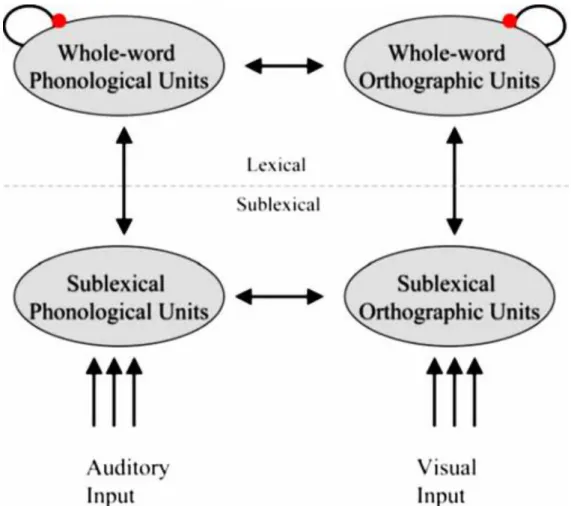
(36) 21. onto spelling. For example, the words sign and wine have the same phonological rime: /-ain/ in English. The “-ine” spelling is dominant, it occurs in most monosyllabic words of this particular rime family (e.g., fine, nine, line, mine). On the other hand, the “-ign” spelling is subdominant, it occurs in few or no other monosyllabic words. Both sign and wine are inconsistent due to the fact that their phonological rimes map onto multiple various spellings. However, wine contains the dominant spelling,. 政 治 大. whereas sign contains the subdominant spelling. Ziegler (2004) confirmed that. 立. response to words with subdominant spellings took longer and were more error-prone. ‧ 國. 學. than words with dominant spellings in the lexical decision tasks. Several empirical. ‧. conclusions were made according to their findings. First, the P-O consistency effects. Nat. io. sit. y. were not the artifacts of phonological or phonotactic properties of the stimuli. Second,. al. er. the influences of orthographic codes in auditory modality were not restricted to the. n. v i n C h effect in theUmapping from phonology to lexical decision tasks; the orthography engchi orthography was strongest in lexical decision, intermediate in rime detection, and weakest in auditory naming tasks. The research finding overall indicated that acquiring the knowledge of orthography in point of fact alters the manner of processing spoken language..
(37) 22. 2.2 The Processing of word recognition - Bimodal interaction activation model. In recent modeling approaches, capturing the intricate spelling-to-sound interactions of consistency has gradually turning out to be a major preoccupation. The construction of word recognition model in point of fact precisely related to the inherent mapping phase regarding to phonology and orthography, in addition, it also provides a way for us to get further insight into the fundamental nature of visual and spoken word identification.. 立. 政 治 大. ‧ 國. 學. Varying principles concerning the diversity in writing systems may mean for the different mental processes involved in word recognition process. The earliest version. ‧. of model which tested on the bidirectional flow of consistency effect in visual and. sit. y. Nat. io. n. al. er. auditory word recognition was first proposed by Frost (1989). He pointed out the. i n U. v. important concept of orthographic depth and suggested that it is an essential element. Ch. engchi. in determining the processing relationship between orthographic and phonologic systems. The orthographic system of Serbo-Croatian is an example of shallow orthography. Each letter represents only one phoneme and each phoneme is represented by only one letter, the relation between letters and phonemes is isomorphic and exhaustive. Morphemic variations in the language due to inflection and derivation do not often produce alterations in the phonemic structure of word stems. In contrast to the Serbo-Croatian, language system of English belongs to the.
(38) 23. deep orthography. Different degrees of consistency and completeness between letter and phoneme are capable of reflecting the forms of the deep orthography in English. Frost (1989) directly examined the cross-linguistics framework concerning the interactive processing of print and speech by the method of visual or auditory degradation in the matching task. Native speakers of English and Serbo-Croatian were presented with simultaneous printed and spoken verbal stimuli. Visual degradation. 政 治 大. was achieved by overlying a pattern of random dots on each word. Thus the whole. 立. word was embedded in a dotted background that obscured the graphemic structure.. ‧ 國. 學. Auditory degradation was achieved by masking each spoken stimulus with. ‧. signal-correlated noise with the same amplitude envelope as the spoken stimulus.. Nat. io. sit. y. Subjects had to decide whether the stimuli were equivalent and the decision reaction. al. er. time was measured. The experiment result exhibited that both effects of degradation. n. v i n were much stronger in EnglishCthan Accordingly, Frost (1989) h einnSerbo-Croatian. gchi U suggests a lexical structure which rationalizes the relationship between the orthography and phonology systems in terms of lateral connections between the constructions at all of their levels. Furthermore, different degrees of orthographic depth between spelling and phonology in the languages systems are capable of demonstrating influences on the lateral connections: in shallow orthographies there exist simple isomorphic connections between graphemes and phonemes, but more.
(39) 24. complex, many-to-one connections in deep orthographies. Grainger and Ferrand (1994) developed a more detailed and systematic architecture addressing the interconnected features of the bimodal interactive activation model (Figure 2).. 立. 政 治 大. ‧. ‧ 國. 學. n. er. io. sit. y. Nat. al. Ch. engchi. i n U. v. Figure 2. Architecture of bimodal interactive activation model (Grainger & Ferrand, 1994). In BIA model, orthography and phonology are connected in a mutually bi-directional manner at sublexical as well as lexical processing level. The main.
(40) 25. notion of this modal is that when a printed word activates a sublexical orthographic code (O-units), this early orthographic code will then sends activation onto the interface from orthography to phonology (O-P), this central O-P interface allows sublexical orthographic representations to be mapped onto their corresponding phonological representations, and vice versa. Through the bidirectional flow of interaction, a printed word is capable of rapidly activating a set of sublexical. 政 治 大. phonological representation that influence the course of visual word recognition via. 立. their interaction with sublexical orthographic representations, or via the activation of. ‧ 國. 學. whole-word phonological representations. The essential concept of BIA modal. ‧. predicts orthographic effects on spoken word recognition that should mirror. Nat. io. sit. y. phonological effects in visual word recognition through the symmetrical structure. n. al. er. across different modalities and the bi-directional flow of interaction in this architecture.. Ch. engchi. i n U. v. 2.3 O-P and P-O consistency effects in Chinese. A number of researches had explicitly identified the role of O-P consistency in Chinese language system. The basic theoretical construction of O-P consistency mainly described the phonological relationship between phonogram and phonetic.
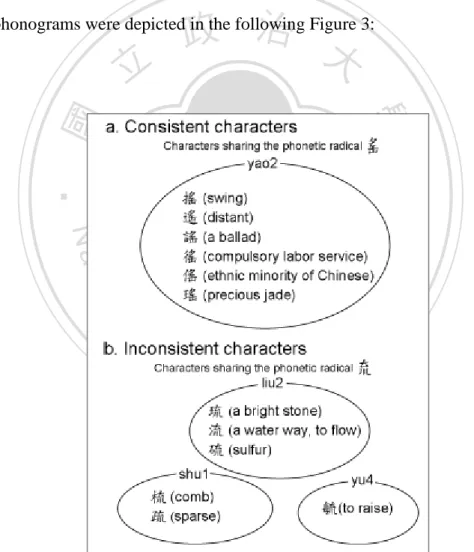
(41) 26. radical in the character. According to Lee et al. (2004) , the O-P consistency value of a phonogram can be calculated from the relative ratio of number of characters having the same pronunciation to the whole group of characters sharing the same phonetic radical. A consistent character is defines as its pronunciation agrees with those of its orthographic neighbors (characters containing the same phonetic radical), otherwise, it is defines as inconsistent. The examples of O-P consistent and O-P inconsistent. 政 治 大. Chinese phonograms were depicted in the following Figure 3:. 立. ‧. ‧ 國. 學. n. er. io. sit. y. Nat. al. Ch. engchi. i n U. v. Figure 3. Examples of consistent and inconsistent Chinese phonograms (Lee et al., 2004). Lee et al. (2004) utilized the event-related functional magnetic resonance.
(42) 27. imaging (fMRI) to examine the central representations of Chinese orthography - to phonology transformation (OPT) by simultaneously manipulating frequency and consistency of the characters. The result reported that as compared to O-P consistent characters, the brain images of bilateral inferior frontal cortices, left temporoparietal region and the left temporal-occipital junction exhibited greater activation when naming O-P inconsistent characters. These converging evidences suggested that the. 政 治 大. sublexical conversion of orthographic input into phonological codes in naming. 立. Chinese were intimately involve with these regions. In addition, this study also. ‧ 國. 學. suggested portrait of universal phenomenon concerning the neuronal mechanisms for. ‧. orthography-to-phonology transformation across different writing systems.. Nat. io. sit. y. In order to further investigate the Chinese O-P transformation and its neural. al. er. correlates, Lee et al. (2010) conducted the behavioral study and the event-related. n. v i n C h imaging) studyU to probe into the underlying fMRI (functional magnetic resonance engchi. cognitive mechanism of the consistency and lexicality effects in reading Chinese. The result demonstrated that the phonetic radical can be utilized to signify the pronunciations of pseudocharacters in Chinese. The higher brain activations in the left inferior and middle frontal gyrus, the left temporoparietal region, and the left temporooccipital junction for reading low consistent characters was observed when reading pseudocharacters and characters, which uncovering the neural correlates in.
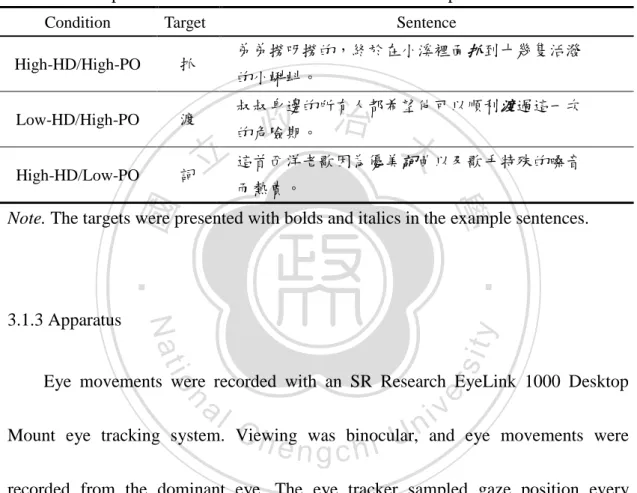
(43) 28. the transformation process in Chinese O-P representations. A large amount of theoretical as well as empirical efforts toward investigating of cognitive processing for Chinese characters laid substantively concentration on the existence of O-P consistency effect in the word recognition framework. Until recently, the focus deliberating upon the phonology-to-orthography (P-O) consistency effect in Chinese had been gradually being brought into the curriculum in progress. Basically,. 政 治 大. the P-O consistency value of a character is defined as the ratio of phonograms with. 立. the same phonetic radical within a set of phonograms sharing the same pronunciation.. ‧ 國. 學. For example, five Chinese characters (e.g., “剛”, “鋼”, “崗”, “缸”, “肛”) have the. ‧. same pronunciation (“ /kɑŋ1/”). Three of them (“剛”, “鋼”, “崗”) have the same. Nat. io. sit. y. phonetic radical “岡” , which called “friends”; and the other two (“缸”, “肛”) have. al. er. different radical, which are so called “enemies”. Then the P-O consistency value for. n. v i n C hbe 0.6 (3/5), for theU enemies the P-O consistency characters in the “岡” group will engchi value will be 0.4 (2/5). The P-O consistency ratio by token is the summed frequency of a word's friends relative to the summed frequency of a word's friends plus enemies. Statistically, consistency ratio greater than 0.5 indicates that a word has more or stronger friends than enemies, consistency ratio smaller than 0.5 indicates that a word has less or weaker enemies than friends. 汪舒韻 (2009) conducted four experiments of character naming and recognition.
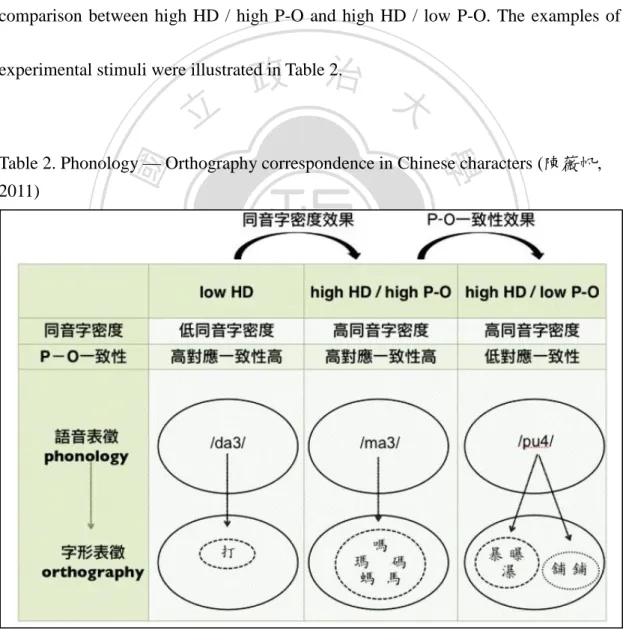
(44) 29. tasks to examine the O-P consistency effect through controlling the P-O consistency value in Chinese character recognition. Experiment 1 manipulated the O-P consistency and P-O consistency in visual lexical decision task. Four types of Chinese characters were generated: (1) high O-P consistency and high P-O consistency, (2) high O-P consistency and low P-O consistency, (3) low O-P consistency and high P-O consistency, (4) low O-P consistency and low P-O consistency. The results showed a. 政 治 大. P-O consistency effect for high O-P consistency characters in lexical decision task.. 立. However, a smaller O-P consistency effect was found for high P-O consistency. ‧ 國. 學. characters. Experiment 2 adopted the same set of stimuli in a naming task. The result. ‧. illustrated a strong O-P consistency effect, whereas no robust P-O consistency effect. Nat. io. sit. y. was found. In order to further examine the P-O consistency effect, Experiment 3. al. er. manipulated homophone density and P-O consistency in a lexical decision task. The. n. v i n C h effect and it interacted results illustrated the P-O consistency e n g c h i U with homophone density. Experiment 4 used the same stimuli of Experiment 3 in a naming task. However, no interaction was found for homophone density and P-O consistency. The author suggested that, compared to naming, the P-O consistency effect was more robust in lexical decision task. In summary, 汪舒韻 (2009) demonstrated the existence of the connections from phonological lexicon to orthographic lexicon in Chinese lexical decision task..
(45) 30. The issue of Chinese homophone is fundamentally related to the concept of P-O consistency due to the fact that homophone reflect a kind of mapping from phonology to orthography at the lexical level. According to whether the phonetic radical is the same or not, a set of homophone can be further divided into different subgroups, which is capable of being theoretically presented through the concept of P-O consistency. In Chinese, a large amount of single characters are homophones. The. 政 治 大. number of homophones was defined as homophone density. In the visual lexical. 立. decision and naming tasks, Wu and Chen (2000) found that the facilitation effect of. ‧ 國. 學. homophonic priming was reliably obtained from the naming task only. They. ‧. suggested that phonological processing does not sustenance an obligatory role in. Nat. io. sit. y. Chinese character identification. However, Chen, Vaid and Wu (2009) reappraised the. al. er. role of phonology in Chinese visual word recognition by varying homophone density. n. v i n C hresults showed a Ufacilitative homophone density and phonological frequency. The engchi effect and only low visual frequency characters revealed phonological frequency effects, suggesting that homophone density effect in Chinese could be facilitative if competition among similar orthographic representations was reduced. They also. argued that the facilitative homophone density effect could reflect the excitatory feedback and feedforward connections between the orthographic and phonological lexicons..
(46) 31. 連育吟 (2010) further explored the Chinese homophone density effect on spoken word recognition in the auditory decision and semantic categorization task by utilizing the behavioral and event-related potential approaches. In Experiment 1, the homophone density was manipulated in an auditory decision task. The results showed that the reaction time was faster for words with high homophone density than those with low homophone density. In Experiment 2, participants were asked to decide. 政 治 大. whether a spoken word was the name of animal. Opposite to Experiment 1, an. 立. inhibition effect of Chinese homophone density was observed for those trials with “no”. ‧ 國. 學. judgments. The author explained the inconsistent results of two experiments by task. ‧. demand. Nonetheless, the homophone density effects of spoken words could be. Nat. sit. al. er. io. recognition.. y. considered as the evidence for the orthographic activation during spoken word. n. v i n C h of P-O consistency To assess the potential influence e n g c h i U effect in Chinese, 陳薇帆. (2011) simultaneously manipulated P-O consistency and homophone density size to investigate the neurophysiological basis of the auditory P-O consistency effect. Through the utilization of event-related potentials (ERPs), auditory semantic judgment task and rime judgment task were used to probe into the question regarding to the P-O mappings of spoken character recognition. The characters for experiment were manipulated in three conditions: (1) low homophone density / high.
(47) 32. phonology-orthography consistency (low HD), (2) high homophone density / high phonology-orthography consistency (high HD / high P-O), (3) high homophone density / low phonology-orthography consistency (high HD / low P-O). The homophone density effect was examined through the comparison between low HD and high HD / high P-O; the P-O consistency effect was demonstrated through the comparison between high HD / high P-O and high HD / low P-O. The examples of. 政 治 大. experimental stimuli were illustrated in Table 2.. 立. ‧. ‧ 國. 2011). 學. Table 2. Phonology — Orthography correspondence in Chinese characters (陳薇帆,. n. er. io. sit. y. Nat. al. Ch. engchi. i n U. v. The analysis of Experiment 1 showed that the Chinese P-O consistency effect.
(48) 33. occurred in the N400 component with a frontal central distribution. In addition, the homophone density effect was also observed in the late positive component of LPC during the process of experiment tasks. In general, this study demonstrated that ERPs is sensitive to orthographic congruency in spoken Chinese character recognition. In accordance with the view of Grainger and Ferrand (1994), 陳薇帆 (2011) supported the cross-code consistency which emphasize the importance of bi-directional. 政 治 大. interaction concerning the presentations of phonology and orthography.. 學. ‧ 國. 立. 2.4 Eye movement recording technique. ‧. The general characteristics of eye movements during reading have been studied. sit. y. Nat. io. n. al. er. in great depth over century (Rayner, 1995). Researchers have employed eye. i n U. v. movement techniques to show that listeners are remarkably sensitive to subtle aspects. Ch. engchi. of language, and engage the information in directing their gaze around a visual display (Rayner, 1998). In addition, numerous eye movement measurements fundamentally lead researchers to develop further analyze with a variety of indices. Eye movements are generally viewed as a fundamental and essential role to the operation of sentence reading in visual system. With the eye movement recording technique, readers are settled to read sentences in a normal and natural circumstance. The indexes of eye movements during reading such as gaze durations, saccade lengths,.
(49) 34. occurrence of regressions, and a number of variations on these measures can furthermore be employed to infer moment-by-moment cognitive processing of a text by the reader (Rayner, Sereno, Morris, Schmauder, & Clifton, 1989). In general, the first-pass measures reflect the initial word recognition process, while the second-pass measures entail the time of the later stage of semantic or syntactic integration. Some typical first-pass and second-pass eye movement measures for the analyses are listed as following:. 立. 政 治 大. (1) First-pass duration and probability:. ‧ 國. 學. a. First fixation duration (FFD): the duration of the first forward fixation in. ‧. the ROI.. Nat. sit. io. within the ROI.. y. Single fixation duration (SFD): the duration of only one first-pass fixation. al. v i n Ch Gaze duration (GD): the sum of all the first-pass e n g c h i U fixations before moving n. c.. er. b.. out the ROI. d.. Skipping rate (Skip): the probability of skipping the ROI in the first-pass reading.. e.. Refixation rate (RFR): the probability of refixating the ROI during the first-pass gaze..
(50) 35. (2) Second-pass duration and probability: a. Total viewing time (TVT): the sum duration of all fixations in the ROI, regardless of the forward or backward eye movements. b.. Rereading rate (RRR): the probability of returning to the ROI after the first-pass reading.. By the utilization of eye-movement-contingent display technique to investigate. 政 治 大. the application of phonological and orthographic information from parafovea in. 立. Chinese characters identifications, Tsai et al. (2004) examined the possible. ‧ 國. 學. connections between phonological preview benefit and the target characters’ O-P. ‧. consistency value by two designed eye movement experiments. In Experiment 1,. Nat. io. sit. y. phonological and orthographic similarities between preview and target characters. al. er. were manipulated orthogonally, according to whether they were homophones and. n. v i n C h radical. The result whether they shared the same phonetic e n g c h i U of Experiment 1 suggested the significant phonological benefits specify that phonological coding is activated early when the character is in the parafovea. The main purpose in Experiment 2 was to determine whether the O-P consistency value of target characters would yield possible influence on phonological preview benefit. The main manipulation was that one set of target characters was with high consistency value and the other set of target characters with low consistency value. The result revealed that phonological preview.
(51) 36. benefits were reliable only with the high consistency target characters. These two experimental outcomes suggested the relatively early activation of phonological codes at lexical as well as sublexical levels. In addition, the O-P consistency of the pronunciation between characters and phonetic radicals had the initial and critical role in sublexical phonology. The conclusion of different linguistic codes contributing to character identification was in accordance with an interactive activation model during. 政 治 大. the processes of Chinese character identification.. 立. Not only for the investigation of sentence reading process, eye trackers have also. ‧ 國. 學. allowed researchers to extend the online measurement of language processing to the. ‧. perception and understanding of spoken language in a rich, naturalistic visual context. Nat. io. sit. y. (Richardson, Dale, & Spivey, 2007). When receiving the auditory input, subjects are. al. er. gradually influenced by the incremental delivery of linguistic information. The. n. v i n C h will arise during continuously activating representations e n g c h i U processing at the time course. along with eye movements. In addition, eye movements have permitted the observation of powerful interactive effects between language and vision. Thus, features of eye movements can be exploited to study several factors in the time course of speech processing and language understanding. The incremental process of language is strongly constrained by appropriate visual contexts and the moment-by-moment visual perception which driven by subtle aspects of language.
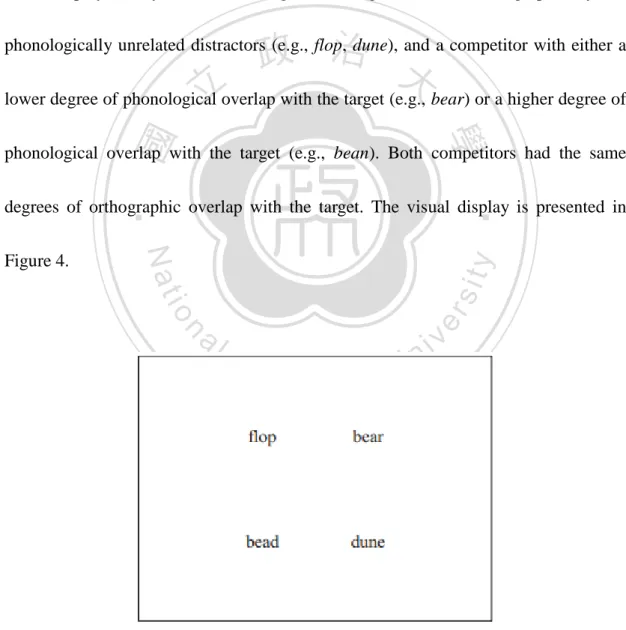
(52) 37. such as phonological and orthographic characteristics. Salverda (2010) used the visual world paradigm with eye movement recording to evaluate the retrieve of orthographic information and its time course regarding to the spoken word recognition. In Experiment 1, participants saw four words on a computer screen and listened to a spoken instruction to click on one of the words (e.g., Click on the word bead). The visual display mainly included the target word (e.g., bead), two orthographically and. 政 治 大. phonologically unrelated distractors (e.g., flop, dune), and a competitor with either a. 立. lower degree of phonological overlap with the target (e.g., bear) or a higher degree of. ‧ 國. 學. phonological overlap with the target (e.g., bean). Both competitors had the same. ‧. degrees of orthographic overlap with the target. The visual display is presented in. n. al. er. io. sit. y. Nat. Figure 4.. Ch. engchi. i n U. v. Figure 4. Example of a visual display (Salverda, 2010).
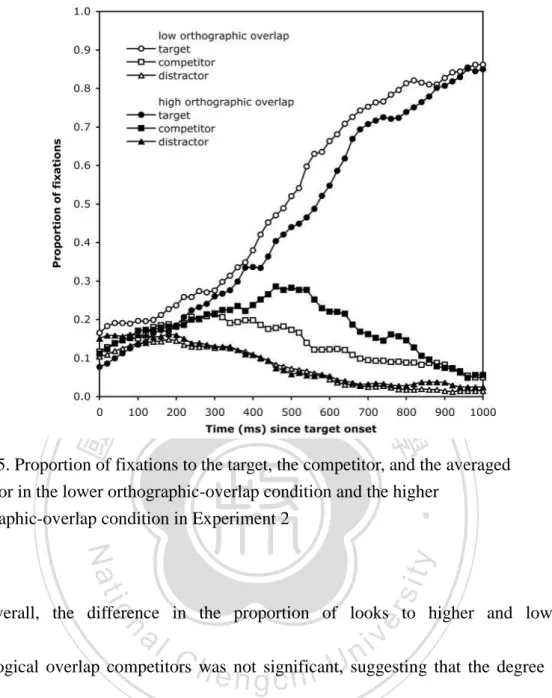
(53) 38. In Experiment 2, the degrees of orthographic overlap with the target were manipulated. Different with Experiment 1, the visual display mainly consisted of the target word and a competitor with either a higher degree of orthographic overlap with the target (e.g., bear) or a lower degree of orthographic overlap with the target (e.g., bare). Due to the fact that the lower and higher orthographic overlap competitors had the same degree of phonological overlap with the target, comparing the two. 政 治 大. conditions could examine the time course and the activation regarding to the. 立. orthographic information. The result was obtained by computing the mean proportion. ‧ 國. 學. of fixations to the competitor between 200 and 717 ms after word onset for each. ‧. participant and each item (i.e., during the acoustic length of the target word, assuming. Nat. sit. n. al. er. io. presented in Figure 5.. y. a 200 ms delay for programming an eye movement), the result of Experiment 2 is. Ch. engchi. i n U. v.
數據
+7

相關文件
• S4- 閱讀時眼睛看著文 字,細聲讀出來。學生 對文字的排列及一字一 音有鞏固的認識,能以 手指指著文字閱讀。識 字量一般,能認讀關鍵 詞語而大致理文字意思。.
‘Basic’ liberty entails the freedoms of conscience, association and expression as well as democratic rights; … Thus participants would be moved to affirm a two-part second
Then, the time series of aiming procedure is partitioned into two portions, and the first portion is designated for the main aiming trajectory as well as the second potion is
The aim of this study is to investigate students in learning in inequalities with one unknown, as well as to collect corresponding strategies and errors in problem solving..
(2)As for the attitudes towards selection autonomy, significant variations exist among teachers categorized by different ages and by different years of teaching.. (3)The similarity
Using the DMAIC approach in the CF manufacturing process, the results show that the process capability as well as the conforming rate of the color image in
The imperceptible understanding of the management process in detail design and the unclear procedures occurred from the beginning design proposal to the actual design stage
The purposes of this research was to investigate relations among learning motivation, learning strategies and satisfaction for junior high school students, as well as to identify
