i
國 立 交 通 大 學
管理學院(資訊管理學程)碩士班
碩 士 論 文
應用自然語言處理於自動化資訊擷取
--
以資訊產品規格之擷取為例
Apply Natural Language Process in Automatic Information Extraction:
The Example of IT Product Specification Extraction system
研究生:彭俊彥
指導教授:楊千
教授
ii
應用自然語言處理於自動化資訊擷取
--
以資訊產品規格之擷取為例
Apply Natural Language Process in Automatic Information Extraction: The Example of IT Product Specification Extraction system
研 究 生:彭俊彥
Student: Chun-Yen Peng
指導教授:揚千 教授
Advisor: Professor Chyan Yang
國 立 交 通 大 學
管理學院(資訊管理學程)碩士班
碩 士 論 文
A Thesis
Submitted to Institute of Information Management
College of Management
National Chiao Tung University
In Partial Fulfillment of the Requirements
For the Degree of
Master of Business Administration
in
Information Management
January 2005
Hsinchu, Taiwan, the Republic of China
iii
應用自然語言處理於自動化知訊擷取-
以資訊產品規格之擷取為例
研 究 生:彭俊彥
指導教授:揚千 教授
國立交通大學 資訊管理研究所
摘
要
經過十多年的發展,網際網路已成為一個龐大的知資載體,然而大部份的資訊 都是以自然語言的形式呈現。以自然語言所表達的資訊,雖然便於人類閱覽,但 卻無法讓電腦理解。因此如何從大量的網頁中自動擷取隱含的知識,成為目前知 識工程研究的一大課題。 資訊擷取的相關研究主要在於取得非結構化文件中的資訊片段,並轉換為較容 易為電腦處理和分析的結構化文件格式,目前大致有 Text Mining 和 Web Mining 兩種主要的方式。前者大多與自然語言處理(National Language Processing, NLP)技 術相結合,而後者則是將Data Mining的技術運用於網頁的資訊擷取上。本研究主要是試著結合自然語言處理技術和本體論(Ontology)的概念,建立一 個資訊產品規格擷取的系統,以做為自動化網頁資訊擷取的雛型研究。我們運用 自然語言處理工具對HTML文件進行適當的處理,再透過JAPE(Java Annotation Patterns Engine)語法規則來擷取文件中特定語法結構的資訊片段,最後再參考預先 定義的Ontology,將擷取到的資訊輸出為符合RDF(Resource Description Framework) 規範的檔案。 我們針對HP和IBM的網頁撰寫適當的JAPE語法規則,再從這兩家公司的個人 電腦(包含Desktop和Notebook),Unix伺服器,顯示器及印表機等四大產品線,抽 樣36個網頁進行產品規格的資訊擷取,其平均召回率(Recall)和正確率(Precision) 都超過90%以上,由此可以驗証JAPE語法規則針對特定領域的資訊擷取有相當不 錯的效能表現。 關鍵字:資訊擷取、自然語言處理、本體論
iv
Apply Natural Language Process in Automatic Information Extraction: The Example of IT Product Specification Extraction system
Student: Chun-Yen Peng Advisor: Dr. Chyan Yang
Institute of Information Management National Chiao Tung University Hsinchu, Taiwan, Republic of China
Abstract
World Wide Web (WWW) is a large repository of information that includes many resources, like text document, image, multimedia and so on. Most of information is presented in natural language and disperse in different Web sites. Natural language documents are for human reading but not computer. How to extract the information form natural language document is an important topic of knowledge engineering.
The major task of information extraction is to extract information piece from unstructured document and convert to structured document for computer processing and analysis. There are two major methodologies for information extraction, one is test mining and another is web mining. The former always link to natural language processing technology whereas the latter applies data mining to process the web contents.
Our research tries to build up a prototype system that combines the natural language process and the concept of ontology to extract IT product specification information from web page. We use NLP tools to process HTML document and extract information entities by JAPE grammar rule, then refer to predefined ontology to convert the extracted information to be DAML file that follow RDF specification.
We develop the optimal JAPE grammar rules for IBM and HP web pages that describe IT product specification and download 36 IT product web pages to test the extraction performance. The testing result show the average recall and precision are over 90%. It reveals the JAPE grammar rules have good extraction performance when optimized for specific knowledge domain.
v
誌
謝
這篇論文得以順利完成,實應歸功於各位師長及親友的協助和勉
勵。首先要感謝的是指導教授揚千博士在研究過程中的指導和啟發,
確立整體研究方向和步驟。其次要感謝口試委員李其健博士及劉敦仁
教授在口試過程中給予的寶貴的建議,使整體論文更加完整。感謝博
士班陳良駒學長和楊耿杰學長在研究過程中提供各項重要的參考資料
及行政資源上的協助,讓論文得順利進展。
另外也要感謝服務單位-台灣積體電路公司資訊系統建構處的同
仁,在我研修期間所給予工作上的支援與協助,使我能投入更多的時
間在究研工作上。由衷地感謝洪莉娜、齊玉仙等友人協助論文最後的
校稿和定稿等工作,使論文得順利付梓。
最後,謹以這篇論文獻給我敬愛的父母親和家人,感謝他們在我
研修期間所付出的關懷和鼓勵,這是支持我在繁忙工作中依然能堅持
到底的最大動力。
彭俊彥 謹致
2005 仲夏於
交通大學資訊管理研究所
vi
Contents
摘 要...iii Abstract ...iv 誌 謝...v 1. Introduction ...1 1.1 Background ...11.2 Motivation and Objectives ...3
1.3 Research Methodology and progress...6
1.4 Research Scope and Limitation...8
2. Literature review...9
2.1 Natural Language Processing...9
2.2 Information Extraction ...10
2.2.1 Text Mining ...12
2.2.2 Web mining ...15
2.3 Semantic Web and Ontology...16
2.3.1 Semantic Web...16
2.3.2 Ontology ...18
2.3.3 Ontology Language ...20
2.4 Ontology-Base knowledge management...24
3. System architecture and work flow ...27
3.1 Developing environment ...27
3.1.1 System configuration...27
3.1.2 Web page collector: Teleport Pro ...27
3.1.3 Natural Language Processing Tools: GATE...28
3.1.4 JAPE grammar language ...30
3.2 System Architecture ...32
3.3 Web page collection ...34
3.4 ANNIE annotation process flow ...34
3.5 Ontology and JAPE extraction rule...37
3.6 DAML+OIL Exporter ...43
4. Analysis and Comparison ...45
4.1 Extraction Result...45
vii
4.3 Performance index for other company: ... 56
5. Conclusion and Contribution ...59
6. Reference...62
7. Appendix ...64
7.1 JAPE Grammar Rule for personal computer...64
7.2 JAPE Grammar Rule for Unix Server...68
7.3 JAPE Grammar Rule for Monitor ...73
viii
Table List
Table 1: Extraction result of HP and IBM Personal computer ...47
Table 2: Extraction result of HP and IBM Unix Server...47
Table 3: Extraction result of HP and IBM monitor ...48
Table 4: Extraction result of HP and IBM printer ...48
Table 5: Extraction result of Sony and ASUS personal computer...49
Table 6: Extraction result of Sun Unix Server...49
Table 7: Extraction result of BenQ and Acer monitor...49
Table 8: Extraction result of Epson and Canon Printer ...50
Table 9: Recall and Precision of personal computer extraction result...53
Table 10: Recall and Precision of Unix server extraction result...54
Table 11: Recall and Precision of monitor product extraction result ...54
Table 12: Recall and Precision of personal computer extraction result...55
Table 13: Summary table of recall and precision ...55
Table 14: Recall and Precision of personal computer extraction result...56
Table 15: Recall and Precision of Unix server extraction result...57
Table 16: Recall and Precision of monitor product extraction result ...57
Table 17: Recall and Precision of personal computer extraction result...58
ix
Figure List
Figure 1: Research flow and progress ...7
Figure 2: Architecture for an Information-Extraction System...12
Figure 3: The overview of IE base text mining framework...13
Figure 4: The process flow for text mining ...15
Figure 5: Taxonomy of Web mining ...16
Figure 6: The layer of Semantic Web...17
Figure 7: The intended models of a logical language reflect its commitment to a conceptualization ...20
Figure 8: The Artequakt Architecture...25
Figure 9: The overview of ontology-base information retrieval...26
Figure 10: Web page collector—Teleport Pro...28
Figure 11:The user interface of GATE...29
Figure 12: JAPE Grammar rule example...31
Figure 13: System architecture and workflow...32
Figure 14: Architecture of IT product application...33
Figure 15: ANNIE process pipeline in GATE 3.0...35
Figure 16: Selected ANNIE processing resource ...35
Figure 17: ANNIE process flow in IT specification extraction system...36
Figure 18: Ontology Example- Ontology of Personal Computer specification...39
Figure 19: Example of GATE build-in ontology developing ...40
Figure 20: DAML example: Ontology of Personal computer ...41
Figure 21: Example of JAPE grammar rule segment ...42
Figure 22: Example of DAML output file...44
Figure 23: Annotation result...45
Figure 24: Information Entity marked up by JAPE transducer ...46
1
1. Introduction
1.1 Background
The economy age evolve from farm economics to industrial economics. Today, most people agree we are entering the knowledge economy age. Michio Kaku claims that “knowledge and technology” will become the only determining factor in a nation’s competitiveness [1]
The concept of knowledge economic changes the management of enterprise and makes knowledge management become one of the main competitiveness of business. For business view, information technology plays a crucial role that enhances the performance of knowledge management, such as knowledge retrieval, knowledge store, especially knowledge sharing.
With the dynamic environment and the knowledge economy coming, knowledge has been treated as one of the most important assets that can enhance competitive advantages. For a company to lead among competitors, it is important to ensure that the best corporate knowledge must be available and applied to the needs of the clients in the right places at the right times [2]. Thus, how to creating and sharing knowledge to keep high competition of enterprise is a critical mission of IT managers.
The knowledge/information extraction and presentation are important process in knowledge management. Information Extraction (IE) is an important approach to automated information management. IE is the task of converting documents containing fragments of structured information embedded in other extraneous material into a structured template or database-like representation [3]. The major concern of IE is how
2
to address specific pieces of data in natural language document and extracting structured information from unstructured text.
World Wide Web (WWW) is a large repository of information. Include many resources, like text document, image, multimedia and so on. All of resources can be retrieved by anyone who connects to Internet. Most of information is presented by unstructured text document in natural language and disperse on different site. Since most of web documents are presented by natural language, it is unreadable for computer to extract knowledge from web page, we need an efficient approach to convert natural language document to be computer readable format.
The traditional way to extract information form web page is through search engine to select related document and annotate these documents by manual, much time and effort is needed for information extraction. How to extract information from Internet efficiently is the major concern of our research.
However, recent advances in natural language processing (NLP) open the new choose to perform document annotation and information extraction task. Through the customized and pre-defined process flow, NLP tools could extract information accurately form web page in specific domain [4].
In other and, the concept of Semantic Web and Ontology provide new thinking model about information presentation. Semantic Web is the representation of data on the World Wide Web. It is a collaborative effort led by W3C with participation from a large number of researchers and industrial partners.
Traditional Web language focus on web page presentation, most of information content still descript in natural language. Although WWW provide a user friendly and
3
platform independent client for information exchange, it can’t meet the requirement for automatic process of software agent. The key point is software agent can’t understand the information content of web page.
Building computer readable Web pages is one of the terminal goals of the W3C Semantic Web. The idea is first mentioned by Tim-Berner’s Lee at the original proposal of WWW at CERN when 1989. The proposal includes a figure showing how information about a web of relationships amongst named objects could unify a number of information management tasks.[5]
An ontology is a description (like a formal specification of a program) of the concepts and relationships that can exist for an agent or a community of agents. An ontology defines the common words and concepts used to describe and represent an area of knowledge. This definition is consistent with the usage of ontology as set-of-concept-definitions, but more general. And it is certainly a different sense of the word than its use in philosophy [6].
After more than 10 years developing, WWW accumulate millions web page that contain very large information. How to extract the information and translate to be computer readable data format is a key process for Semantic Web promotion, it is also major concern of our research.
1.2 Motivation
and
Objectives
For most of company and individual, to collect product specification for comparison and evaluation is necessary before IT product purchasing. Generally, the life cycle of IT product is very short, the product specification always changed with new product
4
release.
Although it is easy to get IT product specification form WWW, this kind of information usually disperse in many different web sites. Traditionally, to collect the IT product specification such as desktop computer, one needs to search the related web pages by using search engines, either yahoo or google, then browse these web pages manually to collect the information we need. It takes large effort for information collection.
Most of product specifications are described with specific format and embedded in web page. Due to browser or software agent can’t identify the production specification form natural language document, it cause the simple job like “product specification collection” can’t be automated. The advance in natural language process technology makes it is possible to extract specific information piece from web page that describe in natural language.
In other hand, the concept of Semantic Web and ontology provide a new model for information presentation. Through the ontology, information could be produce, exchange or analysis by automatic process to enhance the efficiency of knowledge management.
So that, our research try to build up a automatic process that link the natural language process technology and ontology concept, and apply this process to extract IT product specification form Web page. The objectives of research are show as following: 1. Build up a prototype system for automatic IT product specification extraction that can extract information formation form web page efficiently and accurately
5
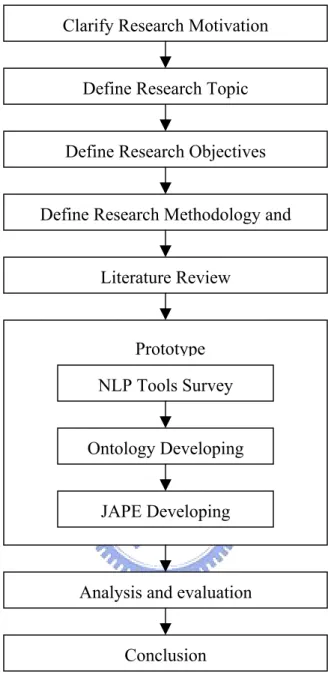
6
1.3 Research Methodology and progress
We build up a prototype system to research the automatic information extraction process that combined with natural language process and ontology concept. Our research steps are:
1. Define the research topic, objective and scope:
At first, we define the research topic, objective and scope to guide the whole research progress.
2. Literature review:
Base on research topic, objective and scope, one of major task is to build up a prototype to extract IT product specification information. So we must select an extraction methodology to meet our requirement.
We review the literatures about knowledge management, natural language process, information extraction, semantic web and ontology to understand current status of related research and decide use text mining and grammar rule to extract IT product specification information.
3. Build up prototype:
The construction of prototype could be separated 3 tasks:
1. NLP tools survey: Review current NLP tools to select a NLP platform
2. Ontology Developing: Define the scope and relation of IT product specification that we want to extract.
3. JAPE grammar rule developing: Develop optimal JAPE grammar rule for IT product specification.
4. Analysis and evaluation:
We select and download 36 web page for system testing and evaluate the extraction performance.
5. Conclusion:
Base on the extraction result and performance evaluation, we summarize the advantage and disadvantage of rule base extraction methodology.
7
Figure 1: Research flow and progress
Clarify Research Motivation Define Research Topic Define Research Objectives Define Research Methodology and
Literature Review
Prototype NLP Tools Survey
JAPE Developing Ontology Developing
Analysis and evaluation Conclusion
8
1.4 Research Scope and Limitation
To extract specification information from Web page, we have to developing information extraction pattern for specific domain knowledge. The IT product is a wide set that difficult to develop a general pattern for all IT product, so we select part of IT product for prototype developing. The target IT product as following:
● Personal Computer ● Unix Server
● Monitor ● Printer
Although product specification has common format, the little difference are exist in different web site. To enhance the precision of information extraction, we aim HP and IBM web site as target template to develop optimize information extraction rule for IT product of HP and IBM. The information extraction rule also can apply to other Web site, but the precision of information extraction maybe down. We will compare and discuss this issue in chapter 5.
9
2. Literature review
2.1 Natural
Language Processing
Natural language processing (NLP) is the area of study that focuses on techniques that enable machines to work with human language. This involves not only the “understanding” or analysis of language, but also the generation or production of language [7].
A “natural language” (NL) is any of the languages naturally used by humans, i.e. not an artificial or man-made language such as a programming language. The “Natural language processing” (NLP) is a convenient description for all attempts to use computers to process natural language [8]. NLP includes:
• Speech synthesis:
Although this may not at first sight appear very 'intelligent', the synthesis of natural-sounding speech is technically complex and almost certainly requires some 'understanding' of what is being spoken to ensure, for example, correct intonation.
• Speech recognition:
Recognize of continuous sound waves to discrete words.
• Natural language understanding:
Here treated as moving from isolated words (either written or determined via speech recognition) to 'meaning'. This may involve complete model systems or 'front-ends', driving other programs by NL commands.
10
Generating appropriate NL responses to unpredictable inputs.
• Machine translation (MT):
Translating one NL into another.
NLP for information extraction has been started for a long time. In 1992, Tomek Strzalkowski and Barbara Vautheyl tried to build up a prototype of information retrieval system which uses advanced natural language processing techniques to enhance the effectiveness of traditional key-word based document retrieval [9]. The information retrieval system consists of a traditional statistical backbone (Harman and Candela, 1989) augmented with various natural language processing components that assist the system in database processing and translate a user's information request into an effective query.
To enhance the information extraction in natural language processing, Cynthia A. Thompson’s research team try to apply the active learning to reduce annotation effort in
1999.They developed a system that learns rules for information extraction. The goal of
an IE system is to find specific pieces of information in a natural-language document [10].
2.2 Information
Extraction
Information extraction is the task of converting documents containing fragments of structured information embedded in other extraneous material into a structured template or database-like representation [3]. Since WWW is a large information repository, our major concern is the approach to extract information for web document.
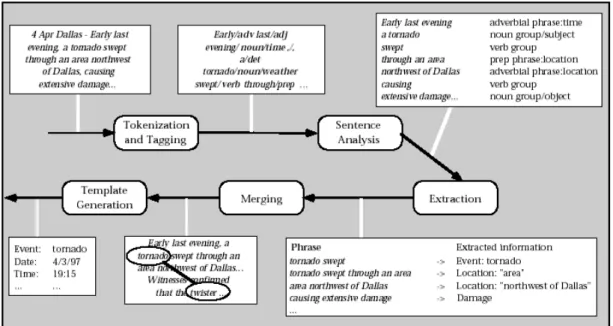
Claire Cardie had provided a architecture for information extraction system in 1997. The architecture defines 5 steps to extract information from natural language document
11
[11].
1. Tokenization and Tagging:
Each input text is first divided into sentences and words in a tokenization and tagging step.
2. Sentence Analysis:
It comprises one or more stages of syntactic analysis, or parsing, that together identify noun groups, verb groups, prepositional phrases, and other simple constructs.
3. Extraction:
The extraction phase is the first entirely domain specific component of the system. During extraction, the extraction phase identifies domain specific relations among relevant entities in the text.
4. Merging:
The main job of the merging phase is co-reference resolution, or anaphora resolution: The system examines each entity encountered in the text and determines whether it refers to an existing entity or whether it is new and must be added to the system's discourse-level representation of the text.
5. Template generation:
The template generation phase determines the number of distinct events in the text, maps the individually extracted pieces of information onto each event and produces output templates.
12
Figure 2: Architecture for an Information-Extraction System
Generally, there are tow major approaches to extract information form WWW, one is text mining and another is Web mining.
2.2.1 Text Mining
Text mining should not be confused with the better known Internet search engine tools or database management capabilities. Analogous to data mining, which extracts useful information from any type of data with large quantities, text mining is a procedure applied to large volumes of free unstructured text. After a traditional search for documents is completed, such as in format of full text, abstracts, or indexed terms, text mining explores the complex relationship among documents [12].
Text mining is about looking for patterns in natural language text, and may be defined as the process of analyzing text to extract information from it for particular purposes. There are three major concerns about text mining [13,14,15]:
13
of relevant records from the source technical literatures or text databases for further processing.
(2) Information Processing, the extraction of patterns from the retrieved data obtained in the previous step. According to Kostoff, it has three components: bibliometrics, computational linguistics and clustering techniques. This step typically provides ordering, classification and quantification to the formerly unstructured material.
(3) Information Integration. It is the combination of the information processing computer output with the human cognitive processes.
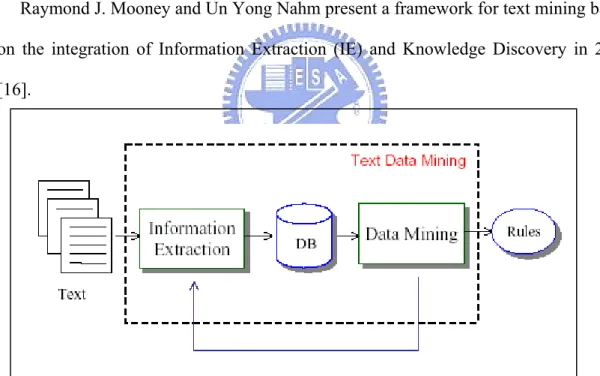
Raymond J. Mooney and Un Yong Nahm present a framework for text mining based on the integration of Information Extraction (IE) and Knowledge Discovery in 2002 [16].
Figure 3: The overview of IE base text mining framework
They use the application of data mining techniques to automated discovery of useful or interesting information from unstructured text. Several techniques have been proposed for text mining, including conceptual structure, association rule mining, episode rule mining, decision trees, and rule induction methods.
14
Claire Grover’s research team provides another methodology for test mining in 2004. They propose a framework for text mining services that apply NLP tools to annotate XML document and extract information from natural language document. The Workflow involves four major steps:
1. Tokenization: Identifying and marking up words and sentences in the input text. 2. Location Tagging with a classifier: Using a trained maximum entropy classifier to
mark up location names.
3. Location Tagging by Lexicon: Using a lexicon of location names to mark up
additional locations not identifier by the tagger.
4. Gazetteer Query: Sending location names extracted from the text to a gazetteer
resource, and presenting the query results in an application-appropriate form. Weiguo Fan’s research team describes a generic process model for a text mining application in 2005. Their process starting with a collection of documents, a text mining tool would retrieve a particular document and preprocess it by checking format and character sets. Then it would go through a text analysis phase, sometimes repeating techniques until information is extracted. Three text analysis techniques are shown in the example, but many other combinations of techniques could be used depending on the goals of the organization. The resulting information can be placed in a management information system, yielding an abundant amount of knowledge for the user of that system [17].
15
Figure 4: The process flow for text mining
2.2.2 Web mining
Two important and active areas of current research are data mining and the World Wide Web. The web mining is the combination of these two areas, has been the focus of several recent research projects and papers.
Web mining is the use of data mining techniques to automatically discovery and extract information from Web document and services. Web mining can be broadly defined as the discovery and analysis of useful information from the World Wide Web. This broad definition on the one hand describes the automatic search and retrieval of information and resources available from millions of sites and on-line databases, i.e., Web content mining, and on the other hand, the discovery and analysis of user access patterns from one or more Web servers or on-line services, i.e., Web usage mining.
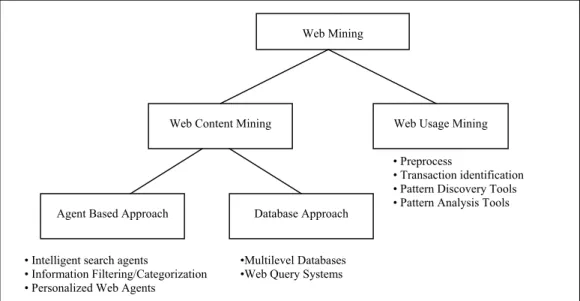
The taxonomy of Web mining along its two primary dimensions, namely Web content mining and Web usage mining. We also describe and categorize some of the recent work and the related tools or techniques in each area. This taxonomy is depicted in Figure 5 [18]
16
Figure 5: Taxonomy of Web mining
To mining web content, agent-base tools and database mining techniques are two major approaches. Agent base approach to Web mining involves the development of sophisticated AI systems that can act autonomously or semi-autonomously on behalf of a particular user, to discover and organize Web-based information. The database approaches to Web mining have generally focused on techniques for integrating and organizing the heterogeneous and semi-structured data on the Web into more structured and high-level collections of resources, such as in relational databases, and using standard database querying mechanisms and data mining techniques to access and analyze this information.
2.3 Semantic
Web and Ontology
2.3.1 Semantic Web
The Semantic Web is the representation of data on the World Wide Web. It is a collaborative effort led by W3C with participation from a large number of researchers and industrial partners. It is based on the Resource Description Framework (RDF),
Web Mining
Web Content Mining Web Usage Mining
Agent Based Approach Database Approach
• Intelligent search agents
• Information Filtering/Categorization • Personalized Web Agents
•Multilevel Databases •Web Query Systems
• Preprocess
• Transaction identification • Pattern Discovery Tools • Pattern Analysis Tools
17
which integrates a variety of applications using XML for syntax and URIs for naming.
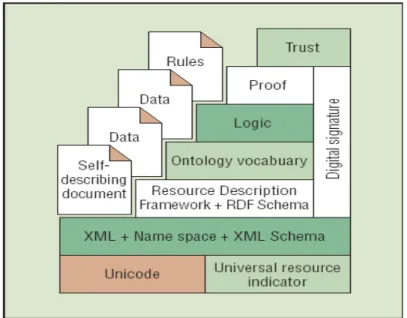
Semantic Web tries to build a universal schema to unify the different knowledge schemas on the web. Semantic Web proposes an architecture that consists of multiple layers to construct a universal schema framework. The figure 6 shows the layer structure of Semantic Web.
Figure 6: The layer of Semantic Web
The basis of the architecture is RDF. It provides a special format for every semantic statement on the web: (Subject, Predicate, Object). It is the basic syntax for the whole web; that is, all programs can recognize this format.
RDF is the first step (and hence the basis) of the Semantic Web architecture. But, constructing a universal schema for the web is not easy. RDF itself can’t be the universal schema because the semantics of data encoded in it are not specified yet. Hence there are RDF Schema, Ontology, and Rules Layers that help to specify the
18
meanings of the subjects, predicates, and objects used in RDF statements. Together they can precisely define the semantics of RDF statements. Finally the Logic Framework Layer is needed to define the working mechanism of machines and these portions. Search on Semantic Web should follow this mechanism. Using Semantic Web’s approach, all machines can understand data on the web by first recognizing RDF statements, and finding the semantic definitions in the specified URIs (they may be linked to RDF Schema documents, ontology documents, or documents about rules), then the machines can perform search or provide services more smoothly since they can really recognize all the data on the web. There will be only one schema on the web then.
2.3.2 Ontology
Ontology is an explicit formal specification of how to represent the objects, concepts, and other entities that are assumed to exist in some area of interest and the relationships that hold among them. An ontology define the common words and concepts that used to describe and represent an area of knowledge. Ontology models the vocabulary and meaning of domains of interests in a computer-usable form that computer can understand and share domain knowledge for each other.
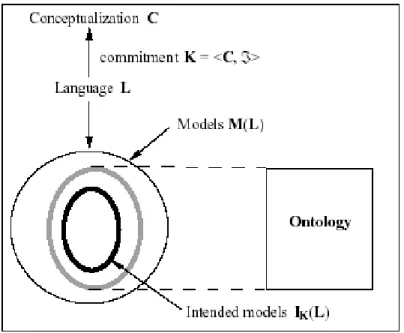
We can now clarify the role of an ontology that considered as a set of logical axioms designed to account for the intended meaning of a vocabulary. Given a language L with ontological commitment K, an ontology for L is a set of axioms designed in a way such that the set of its models approximates as best as possible the set of intended models of L according to K (see figure 7). In general, it is not easy to find the right set of axioms, so that an ontology will admit other models besides the intended ones. Therefore, an ontology can “specify” a conceptualization only in a very indirect way, since
19
(i) It can only approximate a set of intended models;
(ii) Such a set of intended models is only a weak characterization of
a conceptualization.
We shall say that an ontology O for a language L approximates a conceptualization C
if there exists an ontological commitment K = <C, ℑ> , where C = <D, W, ℜ> is a
conceptualization and ℑ: V→D∪ℜ is a function assigning elements of D to vocabulary V, and elements of ℜ to predicate vocabulary V. The symbol D is a domain and W is a set of relevant states of affairs of such domain and  is a set of conceptual relations on <D, W>. Such that the intended models of L according to K are included in the models of O .
An ontology commits to C if:
(iii) It has been designed with the purpose of characterizing C, and
(iv) It approximates C.
A language L commits to an ontology O if it commits to some conceptualization C such that O agrees on C. With these clarifications, we come up to the following definition, which refines Gruber’s definition by making clear the difference between an ontology and a conceptualization [19]:
20
Figure 7: The intended models of a logical language reflect its commitment to a conceptualization
An ontology is a logical theory accounting for the intended meaning of a formal vocabulary, i.e. its ontological commitment to a particular conceptualization of the world. The intended models of a logical language using such a vocabulary are constrained by its ontological commitment. An ontology indirectly reflects this commitment (and the underlying conceptualization) by approximating these intended models.
The relationships between vocabulary, conceptualization, ontological commitment and ontology are illustrated in Figure 2. It is important to stress that an ontology is language-dependent, while a conceptualization is language-independent.
2.3.3 Ontology Language
21
will surely become ontology languages in the context of the Semantic Web. Some of them are based on XML syntax, such as Ontology Exchange Language (XOL), SHOE (which was previously based on HTML), and Ontology Markup Language (OML), whereas Resource Description Framework (RDF) and RDF Schema are languages created by Word Wide Web Consortium (W3C) working groups. Finally, two additional languages are being built on top of RDF(S), the union of RDF and RDF Schema to improve its features: Ontology Inference Layer (OIL) and DAML+OIL. Other languages have also been used, traditionally, for building ontologies, but that analysis is out of the scope of this article.
● XML-based Ontology Exchange Language (XOL)
The US bioinformatics community designed XOL for the exchange of ontology definitions among a heterogeneous set of software systems in their domain. Researchers created it after studying the representational needs of experts in bioinformatics. They selected Ontolingua and OML as the basis for creating XOL, merging the high expressiveness of OKBC-Lite, a subset of the Open Knowledge Based Connectivity protocol, and the syntax of OML, based on XML. There are no tools that allow the development of ontologies using XOL. However, since XOL files use XML syntax, we can use an XML editor to author XOL files
● Simple HTML Ontology Extension (SHOE)
SHOE, developed at the University on Maryland and used to develop OML, was created as an extension of HTML, incorporating machine-readable semantic knowledge in HTML documents or other Web documents [20]. Recently, the University of Maryland has adapted the SHOE syntax to XML. SHOE makes it possible for agents to
22
gather meaningful information about Web pages and documents, improving search mechanisms, and knowledge gathering. This process consists of three phases: Define an ontology, annotate HTML pages with ontological information to describe themselves and other pages, and have an agent semantically retrieve information by searching all the existing pages and keeping information updated. The Knowledge Annotator annotates ontological information in HTML pages.
● Ontology Markup Language (OML)
OML, developed at the University of Washington, is partially based on SHOE. In fact, it was first considered an XML serialization of SHOE. Hence, OML and SHOE share many features.
Four different levels of OML exist: OML Core is related to logical aspects of the language and is included by the rest of the layers; Simple OML maps directly to RDF(S); Abbreviated OML includes conceptual graphs features; and Standard OML is the most expressive version of OML. We selected Simple OML, because the higher layers don’t provide more components than the ones identified in our framework. These higher layers are tightly related to the representation of conceptual graphs.
There are no other tools for authoring OML ontologies other than existing general-purpose XML edition tools
● Resource Description Framework (RDF) and RDF Schema (RDFS)
RDF, developed by the W3C for describing Web resources, allows the specification of the semantics of data based on XML in a standardized, interoperable manner. It also provides mechanisms to explicitly represent services, processes, and business models, while allowing recognition of non-explicit information.
23
The RDF data model is equivalent to the semantic networks formalism. It consists of three object types: resources are described by RDF expressions and are always named by URIs plus optional anchor IDs; properties define specific aspects, characteristics, attributes, or relations used to describe a resource; and statements assign a value for a property in a specific resource.
The RDF data model does not provide mechanisms for defining the relationships between properties (attributes) and resources. This is the role of RDFS. RDFS offers primitives for defining knowledge models that are closer to frame-based approaches. RDF(S) is widely used as a representation format in many tools and projects, such as Amaya, Protégé, Mozilla, SilRI, and so on.
● Ontology Interchange Language (OIL)
OIL, developed in the OntoKnowledge project (www.ontoknowledge.org/OIL), permits semantic interoperability between Web resources. Its syntax and semantics are based on existing proposals (OKBC, XOL, and RDF(S)), providing modeling primitives commonly used in frame-based approaches to ontological engineering (concepts, taxonomies of concepts, relations, and so on), and formal semantics and reasoning support found in description logic approaches (a subset of first order logic that maintains a high expressive power, together with decidability and an efficient inference mechanism).
OIL, built on top of RDF(S), has the following layers: Core OIL groups the OIL primitives that have a direct mapping to RDF(S) primitives; Standard OIL is the complete OIL model, using more primitives than the ones defined in RDF(S); Instance OIL adds instances of concepts and roles to the previous model; and Heavy OIL is the
24
layer for future extensions of OIL.
OILEd, Protégé2000, and WebODE can be used to author OIL ontologies. OIL’s syntax is not only expressed in XML but can also be presented in ASCII.
● DARPA Agent Markup Language (DAML) + OIL
DAML+OIL has been developed by a joint committee from the US and the European Union (IST) in the context of DAML, a DARPA project for allowing semantic interoperability in XML [21]. Hence, DAML+OIL shares the same objective as OIL.
DAML+OIL is built on RDF(S). Its name implicitly suggests that there is a tight relationship with OIL. It replaces the initial specification, which was called DAML-ONT, and was also based on the OIL language. OILEd, OntoEdit, Protégé2000, and WebODE are tools that can author DAML+OIL ontologies.
2.4 Ontology-Base knowledge management
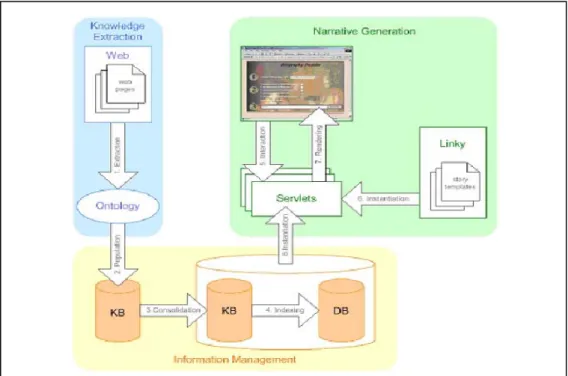
About ontology base knowledge extraction process, Harith Alani’s research team takes Artequakt project which seeks to automatically extract knowledge about artists from web, populate a knowledge base, and use it to generate personalized narrative biographies [22]. The system architecture of Artequakt system is composed by three key sub-systems that include “knowledge extraction”, “Information management” and “Narrative Generation”. Figure 8 shows the architecture of Artequakt system.
25
Figure 8: The Artequakt Architecture
The system use ontology and lexical tools to identifying knowledge fragment from web page. The fragments of information are passed to the ontology server along with metadata derived from the vocabulary of the ontology. Artequakt system stores the information by the ontology server and consolidated into a knowledge base that can be queried via an inference engine. The final sub-system is the narrative generation. The Artequakt server takes requests from simple Web interface and generates biography of artist base on user’s requirement.
David Vallet, Miriam Fernández, and Pablo Castells also provided an Ontology-Based Information Retrieval Model in 2004. They propose an ontology-based retrieval model for the exploitation of full-fledged domain ontology and knowledge bases, to support semantic search in document repositories. In David’s research team view, semantic retrieval problem is very close to the latest proposals in knowledge information management. While KIM focuses on automatic population and annotation
26
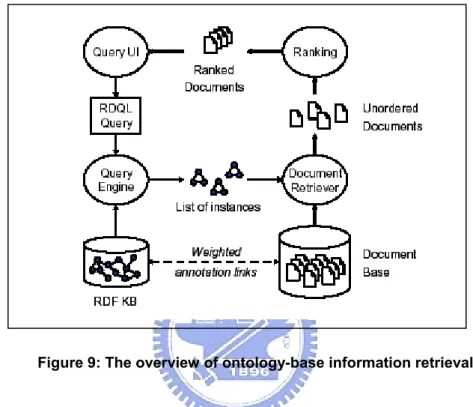
of documents, their work focuses on the ranking algorithms for semantic search. [23] The approach of ontology-based information retrieval can be seen as an evolution of classic keyword-based retrieval techniques. The keyword-based index is replaced by a semantic knowledge base. The overall retrieval process is illustrated in figure 9.
Figure 9: The overview of ontology-base information retrieval
The system takes as input a formal RDQL query. This query could be generated from a keyword query, as in e.g. a natural language query. The RDQL query is executed against the knowledge base, which returns a list of instance that meet the query. Finally, the documents that are annotated with these instances are retrieved, ranked, and presented to the user.
27
3. System architecture and work flow
3.1 Developing
environment
3.1.1 System configuration
We developed IT specification extraction system under Microsoft platform. The hardware and software environment are show as following:
Hardware:
CPU: AMD Athlon 1G Memory: 256 MB DRAM Hard disk: 80GB
OS: Windows 2000 Software Tools:
Web page collector: Teleport Pro Ver. 1.29 NLP developing platform: GATE 3.0 build 1846 Ontology Editor: SemTalk Ver 1.2.5
NLP tools (GATE 3.0) need much computing resource for natural language processing, especially the memory size. Our hardware configuration just allow a corpus that includes 9~11 web documents, depend on total tokens amount, for processing at same time. It is an unexpected limitation. Due to documents limitation of corpus, we separate IT specification extraction system into 4 applications. Please refer to chapter 3.2 for detail system architecture.
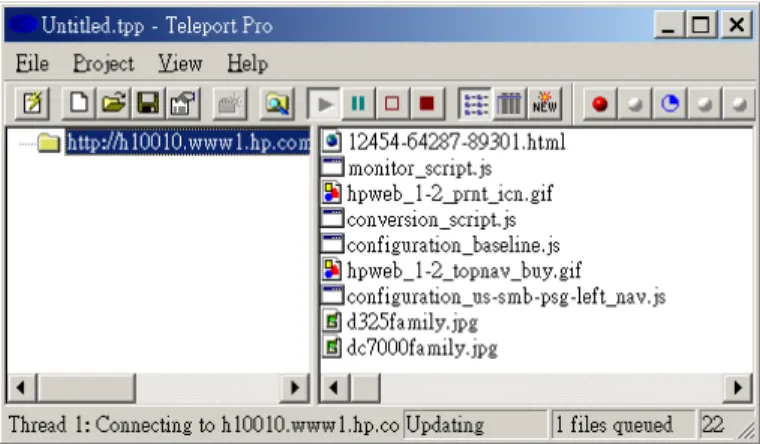
3.1.2 Web page collector: Teleport Pro
Teleport Pro is an offline browsing tool for getting data from the Internet. Input the URL, teleport can download all component of web page and save into local hard disk.
28
Figure 10: Web page collector—Teleport Pro
3.1.3 Natural Language Processing Tools: GATE
GATE is famous NLP tool that has been built over the past eight years in the Sheffield University NLP group. It comprises an architecture, framework (or SDK) and graphical development environment. The system has been used for many natural language processing projects, in particular for Information Extraction. The system supports the full lifecycle of language processing components, from corpus collection and annotation through system evaluation.
GATE as an architecture suggests that the elements of software systems that process natural language can usefully be broken down into various types of component. Components are reusable software chunks with well-defined interfaces (see figure 11), and are a popular architectural form, used in Sun’s Java Beans and Microsoft’s .Net, for example. GATE components are specialized types of Java Bean, and come in three Resources [24]:
˙Language Resources (LRs) represent entities such as lexicons, corpora or ontologies; ˙Processing Resources (PRs) represent entities that are primarily algorithmic, such as
29
˙Visual Resources (VRs) represent visualisation and editing components that
participate in GUIs.
When using GATE to develop language process functionality for an application, the developer uses the development environment and the framework to construct resources of the three types. This may involve programming, or the development of Language Resources such as grammars that are used by existing Processing Resources, or a mixture of both. The development environment is used for visualization of the data structures produced and consumed during processing, and for debugging, performance measurement and so on.
Figure 11:The user interface of GATE
GATE can be used for many things, but one of the most typical uses is to annotate pages with it. This means that we have a collection of pages and a number of concepts (Annotation Schema) that supposedly occur in these pages. GATE provides an easy to use interface for indicating which pieces of text denote which of your concepts. GATE also can annotate all HTML tags that find in text page.
30
3.1.4 JAPE grammar language
JAPE (Java Annotation Patterns Engine) provides finite state transduction over annotations based on regular expressions. JAPE is a version of CPSL - Common Pattern Specification Language. It allows you to recognize regular expressions in annotations on documents. Typically, regular expressions are applied to character strings, a simple linear sequence of items, JAPE applying them to a much more complex data structure. The result is that in certain cases the matching process in non-deterministic, for example, the results are dependent on random factors like the addresses at which data is stored in the virtual machine, when there is structure in the graph being matched that requires more than the power of a regular automaton to recognise, JAPE chooses an alternative arbitrarily.
A JAPE grammar consists of a set of phases, each of which consists of a set of pattern/action rules. The phases run sequentially and constitute a cascade of finite state transducers over annotations. A JAPE rule is combined with LHS (left-hand-side) and RHS (right-hand-side). The LHS of the rules consist of an annotation pattern that may contain regular expression operators. The RHS consists of annotation manipulation statements. Annotations matched on the LHS of a rule may be referred to on the RHS by means of labels that are attached to pattern elements.
For LHS, there are 3 main ways in which the pattern can be specified: ˙specify a string of text,
e.g. {Token.string == “of”}
˙specify an annotation previously assigned from a gazetteer, tokeniser, or other module,
31
˙specify the attributes (and values) of an annotation),
e.g. {Token.kind == number}
The RHS of the rule contains information about the annotation. Information about the annotation is transferred from the LHS of the rule using the label just described, and annotated with the entity type. Finally, attributes and their corresponding values are added to the annotation. Alternatively, the RHS of the rule can contain Java code to create or manipulate annotations
For example, a single rule is sufficient to identify an IP address, because there is only one basic format - a series of numbers, each set connected by a dot. The rule for this is given below:
Rule: IPAddress ( {Token.kind == number} {Token.string == "."} {Token.kind == number} {Token.string == "."} {Token.kind == number} {Token.string == "."} {Token.kind == number} ) :ipAddress -->
:ipAddress.Address = {kind = "ipAddress"} Figure 12: JAPE Grammar rule example
GATE supports ontology aware grammar transduction, this allows a JAPE transducer to match not only those features on the left hand side of a rule that match it exactly, but also to match any features that are subclasses of those specified in the
32
JAPE rule. For example, if the ontology specifies that a BMW is a car, and that a car is a vehicle, then a rule that specifies vehicle will match when it finds an instance of BMW or car.
3.2 System
Architecture
The IT product specification extraction system is composed of web page collection tool and NLP tools. The system architecture and work flow show as figure 13:
Figure 13: System architecture and workflow
This system can be segmented to 4 IT applications that are “Personal Computer Application”, “Unix Server application”, “Monitor application” and “Printer application”. Each IT application is independent sub-system to extract information from
33
specific knowledge domain. The application has related language resource (such as Web corpus, ontology) and process resource (such as “English Tokeniser”, “Sentence Splitter”). Every application includes 3 major processes that are “Web document annotation”, “JAPE transduction” and “DAML+OIL exporter”. Figure 14 shows the architecture of IT application.
Figure 14: Architecture of IT product application
The system collects web document base on pre-defined web list and save it into specific path as a corpus by different IT product. NLP tools (GATE) will load the corpuses to annotate these documents, than JAPE transducer will load JAPE grammar rule to mark up product specification. Finally, DAM+OIL exporter generate output file of specification in DAML document format.
34
3.3 Web
page
collection
The major task of web page collector is download web document base on pre-define web list and save these document in specific path by different IT product. We choose “Teleport Pro” to be the web page collector, Teleport Pro is a widely used offline browsing Web-spider.
To limit the scope, we just down load web page from IBM and HP web site, because IBM and HP have rich product lines to meet our requirement. We also limit the IT product scope to be Unix Server, Desktop, Notebook, Monitor and Printer. We randomly select 2~3 products from HP and IBM per product line, total 34 web pages be down load for prototype system developing. We load the related web documents into GATE as a “corpus”. Corpus is a language resource of GATE that includes several documents for batch process.
3.4 ANNIE annotation process flow
GATE provides a baseline set of reusable and extendable language processing components for common NLP tasks, known collectively as ANNIE (A Nearly New Information Extraction System). ANNIE currently produces precision and recall figures
for named entity recognition of around 90%, depending on the text type. [25] ANNIE
relies on finite state algorithms and the JAPE language. ANNIE components form a pipeline that show as figure 15:
35
Figure 15: ANNIE process pipeline in GATE 3.0
ANNIE includes many companies like Unicode Tokeniser, Sentence Splitter, POS Tagger, ANNIE Gazetteer, Semantic Tagger, Nominal coreferencer and pronominal coreferencer … and so on. To enhance system performance, we just apply part of component in our prototype system for natural language processing. The ANNIE process flow of IT specification extraction system show as figure 16 and figure 17
36
Figure 17: ANNIE process flow in IT specification extraction system
1. Document Reset: The document reset resource enables the document to be reset to its original state, by removing all the annotation sets and their contents, apart from the one containing the document format analysis (Original Markups). This resource is normally added to the beginning of an application, so that a document is reset before an application is rerun on that document.
2. ANNIE English Tokeniser: The tokeniser splits the text into very simple tokens such as numbers, punctuation and words of different types. The aim is to limit the work of the tokeniser to maximize efficiency, and enable greater flexibility by processing with build-in grammar rules. The English Tokeniser should always be used on English texts that need to be processed afterwards by the POS Tagger.
3. ANNIE Gazetteer: The gazetteer lists used are plain text files with one entry
per line. Each list represents a set of names, such as names of cities, organizations, days of the week, etc.
Web document corpus
Document Reset
ANNIE English
ANNIE Gazetteer
ANNIE Sentence
ANNIE POS Tagger
37
4. ANNIE Sentence Splitter: The sentence splitter is a cascade of finite-state
transducers that segments the text into sentences. This module is required for the tagger. The splitter uses a gazetteer list of abbreviations to help distinguish sentence-marking full stops from other kinds.
5. ANNIE POS Tagger: POS Tagger is an external program, passing gate
documents as input, and adding some features to the existing Tokens.
6. ANNIE OrthoMatcher: The Orthomatcher module adds identity relations between named entities found by the semantic tagger, in order to perform coreference. It does not find new named entities as such, but it may assign a type to an unclassified proper name, using the type of a matching name.
In IT specification extraction system, the major task of ANNIE process is to separate a web document into tokens and add related attributes to these tokens. It is important for following process. We don’t expect ANNIE to extract IT specification because the default IE function of ANNIE just can identify “name”, “address”, “date”, “organization”. To extract information from specific domain knowledge, customization is necessary. Basically, There are two ways to develop customized extraction rule, one is adding new Gazetteer another is to employ JAPE grammar rules. Consider the flexibility and integration with ontology model, we choose JAPE to be the developing tools.
3.5 Ontology
and
JAPE extraction rule
The general disadvantage of use NLP technology to extract information is need customized extraction rule for specific knowledge domain. Since build-in IE system
38
can’t extract information from specific know domain, we have to construct extraction rule for IT specification extraction.
As the introduction of section 3.1.4, JAPE (Java Annotation Patterns Engine) provides powerful and flexibility annotation grammar, it also provides ontology aware grammar transduction. In IT product specification extraction system, JAPE transducer is the major process to extract information form specific IT product.
We plan to extract the product specification show as following:
• Personal Computer: Model Name CPU model CPU Speed Memory Type Memory Size Hard Disk Type Hard Disk Size
• Unix Server
Server Model CPU Model CPU Speed
Cache Memory Size Memory Type Memory Size Max. Memory Size O.S version
Hard Disk Type
• Monitor Model Name Monitor Type Monitor Size Pixel Pitch Resolution Mode
39
Max Resolution Mode
Recommend Resolution Mode Refresh Rate Web Price • Printer Model Name Print Speed Print Quality Memory Size
To enable the ontology aware grammar feature, we have to develop ontology for IT product specification. The ontology of IT product specification describes the relation and structure of information that we plan to extract. Figure 18 is an example about ontology of personal computer. In figure 18, Desktop and notebook are sub-class of personal computer, and “Brand”, “CPU”, “Memory” and “Hard disk” are part of desktop or notebook. “CPU model”, “CPU speed”…. and so on are related information of components.
Figure 18: Ontology Example- Ontology of Personal Computer specification Personal_Computer
Desktop Notebook
Brand CPU Memory Hrad_Disk
PC_Model CPU_Model CPU_Speed Memory_Type Memory_Size
part_of part_of
part_of
HD_Type HD_Size part_of
part_of part_of part_of part_of
40
Gate provide a build-in ontology editor for ontology developing, it is a simple developing environment. The build-in ontology just provides “sub-class” relation between parent class and son class. We also tried to create ontology by SemTalk which provide more property and export these ontology to be DAML files. But GATE JAPE transducer seems can’t recognize these properties. Consider the compatibility and precision, we developing ontology with GATE build-in tools. Figure 19 is an example of personal computer ontology developing.
Figure 19: Example of GATE build-in ontology developing
GATE will save the ontology as DAML files. The ontology file must load into GATE as a language resource and refer by JAPE transducer and DAML exporter. Figure 20 is an example of DAML output file, it is ontology of personal computer.
<?xml version='1.0'?> <rdf:RDF xmlns:rdf='http://www.w3.org/1999/02/22-rdf-syntax-ns#' xmlns:rdfs='http://www.w3.org/2000/01/rdf-schema#' xmlns:daml='http://www.daml.org/2001/03/daml+oil#'> <daml:Ontology rdf:about='' rdfs:label='' rdfs:comment=''>
<daml:versionInfo>$Id: iswc.daml,v 1.0 2002/04/15 16:51:40 meh Exp $</daml:versionInfo> </daml:Ontology>
<rdfs:Class rdf:about='file:/C:/Rick/Thesis/Ontology/Personal_Computer.daml#Memory' rdfs:label='Memory'
rdfs:comment=''/>
41 rdfs:label='Memory_Size' rdfs:comment=''> <rdfs:subClassOf>file:/C:/Rick/Thesis/Ontology/Personal_Computer.daml#Memory</rdfs:subClassOf> </rdfs:Class> <rdfs:Class rdf:about='file:/C:/Rick/Thesis/Ontology/Personal_Computer.daml#CPU_Model' rdfs:label='CPU_Model' rdfs:comment=''> <rdfs:subClassOf>file:/C:/Rick/Thesis/Ontology/Personal_Computer.daml#CPU</rdfs:subClassOf> </rdfs:Class> <rdfs:Class rdf:about='file:/C:/Rick/Thesis/Ontology/Personal_Computer.daml#CPU_Speed' rdfs:label='CPU_Speed' rdfs:comment=''> <rdfs:subClassOf>file:/C:/Rick/Thesis/Ontology/Personal_Computer.daml#CPU</rdfs:subClassOf> </rdfs:Class> <rdfs:Class rdf:about='file:/C:/Rick/Thesis/Ontology/Personal_Computer.daml#HD_Size' rdfs:label='HD_Size' rdfs:comment=''> <rdfs:subClassOf>file:/C:/Rick/Thesis/Ontology/Personal_Computer.daml#Hard_Disk</rdfs:subClassOf> </rdfs:Class> <rdfs:Class rdf:about='file:/C:/Rick/Thesis/Ontology/Personal_Computer.daml#CPU' rdfs:label='CPU' rdfs:comment=''/> <rdfs:Class rdf:about='file:/C:/Rick/Thesis/Ontology/Personal_Computer.daml#Memory_Type' rdfs:label='Memory_Type' rdfs:comment=''> <rdfs:subClassOf>file:/C:/Rick/Thesis/Ontology/Personal_Computer.daml#Memory</rdfs:subClassOf> </rdfs:Class> <rdfs:Class rdf:about='file:/C:/Rick/Thesis/Ontology/Personal_Computer.daml#Hard_Disk' rdfs:label='Hard_Disk' rdfs:comment=''/> <rdfs:Class rdf:about='file:/C:/Rick/Thesis/Ontology/Personal_Computer.daml#HD_Type' rdfs:label='HD_Type' rdfs:comment=''> <rdfs:subClassOf>file:/C:/Rick/Thesis/Ontology/Personal_Computer.daml#Hard_Disk</rdfs:subClassOf> </rdfs:Class> <rdfs:Class rdf:about='file:/C:/Rick/Thesis/Ontology/Personal_Computer.daml#Prod_Model' rdfs:label='Prod_Model' rdfs:comment=''/> </rdf:RDF>
Figure 20: DAML example: Ontology of Personal computer
For performance issue, we develop JAPE grammar rules by difference IT product base on section 1.4. To extract specification information correctly, the customization for JAPE rules to match the text format is necessary. Some times, different web site present same information type in different text format. For example, the CPU cache, IBM web documents show the CPU cache information as “Level1 cache: 4MB” or “L1 cache: 4MB”, but HP web document show as “4MB Level1 cache” or “4MB L1 cache”, it need different JAPE rule to match these information. Figure 21 is an segment of
42
JAPE code that extract from UNIX server JAPE grammar rule. Rule: CPU_Cache1 ( ( {Token.string =~ "[Ll]evel?" } | {Token.string =~ "[Ll]?" } ) {Token.kind == number} ( {Token.string == "("} {Token.kind == word} {Token.kind == number} {Token.string == ")"} )? {Token.string =~ "[Cc]ache?" } ( {Token.kind == punctuation}| {Token.kind == word} | {Token.kind == number} ) ? {Token.kind == number} ( {Token.string == "."} {Token.kind == number} ) ? ( {Token.string == "KB"} | {Token.string == "MB"} ) ) :CPU -->
:CPU.CPU_Cache = {kind = CPU, rule = CPU_Cache1}
Rule: CPU_Cache2 ( {Token.kind == number} ( {Token.string == "."} {Token.kind == number} ) ? ( {Token.string == "KB"} | {Token.string == "MB"} ) ( {Token.string == "shared"} | {Token.string == "combined"} ) ? ( {Token.string =~ "[Ll]evel?" } | {Token.string =~ "[Ll]?" } ) {Token.kind == number} {Token.string =~ "[Cc]ache?" } ) :CPU -->
:CPU.CPU_Cache = {kind = CPU, rule = CPU_Cache2}
Figure 21: Example of JAPE grammar rule segment
The JAPE example uses 2 JAPE rules to extract the information of CPU cache memory. The rule “CPU_cache1” is designed for IBM web document that can match
43
the text format like “Level1 cache: 4MB” or “L1 cache: 4MB”. And the rule “CPU_cache2” is designed for HP web document that can match the text format like “4MB Level1 cache” or “4MB L1 cache”.
To develop JAPE code for specific web page will enhance the extraction precision, but lost the common usage. We don’t expect the JAPE rule CPU_cache1 and CPU_cache2 can extract cache information for the web page of Dell computer. With the extension of web source, the fine tune for JAPE rule to meet new text format is necessary.
3.6 DAML+OIL
Exporter
The DAML+OIL Export is a GATE process resource that allows the information segment found in documents to be exported as instances of a specified ontology in DAML+OIL format. When a corpus is processed with ANNIE and JAPE transducer, GATE will mark up the information that we want to extract. When the DAML+OIL exporter processes the corpus, for each information segment found that is of some type (such as CPU_type), if a corresponding concept with the same name as the information type (such as CPU_type) exists in the ontology then a new DAML instance will be generated in the export file. Figure 22 shows the example of DAML output file:
<?xml version='1.0'?> <rdf:RDF xmlns:gate='file:/C:/Rick/Thesis/Ontology/Personal_Computer.daml#' xmlns:rdf='http://www.w3.org/1999/02/22-rdf-syntax-ns#' xmlns:daml='http://www.daml.org/2001/03/daml+oil#'> <daml:Ontology rdf:about='' daml:versionInfo='1.0'>
44
</daml:Ontology>
<daml:Property rdf:about='http://www.daml.org/2001/03/daml+oil#versionInfo'/> <daml:Property rdf:about='http://www.daml.org/2001/03/daml+oil#comment'/>
<gate:Memory_Size rdf:about='512MB'/> <gate:HD_Type rdf:about='Enhanced IDE'/> <gate:Memory_Size rdf:about='1024MB'/> <gate:CPU_Model rdf:about='Pentium簧 M'/> <gate:Memory_Size rdf:about='2048MB'/> <gate:HD_Size rdf:about='100GB'/>
<gate:Memory_Type rdf:about='DDR SDRAM'/>
<gate:Prod_Model rdf:about='Pavilion dv4040us'/> <gate:CPU_Speed rdf:about='1.73GHz'/>
</rdf:RDF>
45
4. Analysis and Comparison
4.1 Extraction
Result
After annotate processing, web corpus are separated into thousands tokens. Every token has attribute like token type, length, position … and so on. Figure 23 shows the annotation result
Figure 23: Annotation result
Then, JAPE transducer tries to match information entity, which may be composed by several tokens, base on JAPE grammar rule. Figure 24 show the process screen that JAPE transducer mark information entity up when the text format is matched with the JAPE grammar rule.
46
Figure 24: Information Entity marked up by JAPE transducer
An information entity is one of product specification that may be composed by several tokens, like the monitor resolution mode used to present as “1024x768 @75Mhz”. The goal of IT specification extraction system is to extract these information entities from selected web page. We collect total 32 web pages from IBM and HP web site for system test, the extraction result show as following. The extraction results show that JAPE grammar rule can extract finite information entities form these tokens.
47
• Personal computer corpus (include desktop and notebook):
Table 1: Extraction result of HP and IBM Personal computer
Web Site
Product Name Total
tokens
Extracted information entities
HP Pavilion dv4030us Notebook 5190 11
HP Pavilion zv6010us Notebook 4900 10
HP Media Center zd8110us Notebook 5215 12
HP Pavilion a1040n Desktop 5104 9
HP Media Center m7070n Photosmart PC 5103 10
IBM ThinkPad T42 Notebook 2128 11
IBM ThinkPad X41Tablet 1806 10
IBM ThinkPad R50e Notebook 1812 10
IBM ThinkCentre S50 Desktop 1816 10
IBM ThinkCentre M51 Desktop 1851 10
• Unix server corpus
Table 2: Extraction result of HP and IBM Unix Server
Web Site Product Name Total
tokens Extracted Information entities HP RX8620 892 18 HP RX7620 860 16 HP RX4640 1079 25 HP RP8420 1120 16 HP RP7420 1230 18 IBM p5 590 1016 13 IBM p5 570 1080 18 IBM p5 550 1017 11 IBM p5 520 1031 11 IBM p5 510 772 11
48
• Monitor corpus
Table 3: Extraction result of HP and IBM monitor
Web Site Product Name Total tokens Extracted
Information entities HP vs1717 Flat-Panel LCD Monitor 4932 11 HP f1905 19 LCD Flat-Panel Monitor 4928 11 HP Pavilion mx704 17 Flat-Screen CRT Monitor 4903 11 HP s7540 CRT Monitor 527 11
IBM ThinkVision L170p Monitor 1117 27
IBM ThinkVision L150 Monito 1050 19
IBM E74M 17 inch CRT Monitor 1108 25
IBM E54 15'' Monitor MPRII 809 10
•
• Printer corpus
Table 4: Extraction result of HP and IBM printer
Web Site Product Name Total
tokens
Extracted information entities
IBM Infoprint Color 1357 Printer 782 5
IBM Infoprint 1412 Printer 807 9
IBM Infoprint 1352 Printer 889 8
HP Inkjet 1200dn printer 3766 19
HP Deskjet 3845 Printer 4905 4
HP Color LaserJet 2600n Printer 3431 10
We also collect 24 web pages from other company such Sony, ASU, SUN… to compare the extraction result of JAPE rules. The extraction result show as following tables