S
ome 2,000 Form Seven students recently attended nine information sessions organized by the HKUST Business School Undergraduate (UG) Programs. These students are hoping to continue their education at a tertiary institution.Out of the nine sessions, six were on Business Administration Programs and three were on
ISSUE 2
MAY 1998
1
INFORMATION SESSIONS DRAW 2,000
POTENTIAL UG APPLICANTS
Clear Water Bay, Kowloon, Hong Kong
I
mportant changes haveb e e n i n t r o d u c e d t o the HKUST MBA program curriculum.
Two new concentration options – Financial Services and Information Technology – will be made available to MBA students. These are in addition to the existing concentration in China Business.
To increase the competitive-ness of the Busicompetitive-ness School’s part-time MBA program, the School will be introducing a “ze-roth summer” (meaning that the summer will be used as a learn-ing season rather than holidays
MBA CURRICULUM OFFERS MORE OPTIONS
I
n a report dated 13 April1 9 9 8 t h e International Herald Tribune named HKUST as one of the seven elite graduate business schools in Asia.
According to the report, the seven Asian business schools are gaining regional and global recognition for offering high-quality management education, in English, in state-of-the-art facilities.
T
he HKUST BBA (Hons) inA c c o u n t i n g h a s b e e n accredited unconditionally as an approved accountancy degree p r o g r a m u n d e r t h e n e w Professional Accreditation System of the Hong Kong Society of Accountants (HKSA).
Graduates of the program commencing in September 1998 and thereafter will be eligible to e n t e r t h e S o c i e t y ’ s n e w
HKSA ACCREDITS HKUST ACCOUNTING PROGRAM
INTERNATIONAL PRESS
NAMES HKUST BUSINESS
SCHOOL AN ELITE ASIAN
INSTITUTION
Professional Program leading to examination for CPA certification. T h e n e w I n d e p e n d e n t Examination will replace the c u r r e n t H K S A / A C C A J o i n t Examination beginning March 1999.
Prof. Gary Biddle, Head of A c c o u n t i n g , s a i d , “ t h e unconditional accreditation by HKSA is testimonial to the high quality of the HKUST Accounting
program. At HKUST we provide students with thorough preparation for their professional qualification. We also broaden their knowledge in business as well as non-business subjects and give t h e m t r a i n i n g i n l a n g u a g e , communications and career skills plus perspectives on China and international practices. We are extremely proud of our all-around training, which is unique in Hong
Kong. It is what students and employers are now looking for.”
The accreditation exercise was carried out by the Assessment Team of the HKSA’s Accountancy Accreditation Board in March 1998. The six-member Team consisted of three Accreditation B o a r d m e m b e r s a n d t h r e e members of the HKSA Secretariat including HKSA’s Director of Education & Training.
The Team reviewed a detailed r e p o r t s u b m i t t e d b y t h e Department and spent a full day on campus meeting with faculty and students and observing classes.
The accreditation exercise w a s a n i n t e g r a l p a r t o f t h e transition of the HKSA from a paper-based to a degree-based p r o f e s s i o n a l q u a l i f i c a t i o n assessment system.
for students) arrangement as an option for those part-time students who want to speed up their study. With this new arrangement, part-time MBA students will be able to complete their studies in two calendar years instead of the original three years.
T h e H K U S T B u s i n e s s School will also be offering part-time MBA/MSc dual degree p r o g r a m s i n I n v e s t m e n t Management and Information Systems Management. The dual d e g r e e p r o g r a m s m a y b e considered as an extension of one of the new concentrations.
The new duration of study for a part-time MBA degree is two years; a third year study is required for the dual degree program and focuses on MSc topics.
These changes will be effective from September 1998. Some of them, including the
HKUST Business School, pro-vide students with international exposure by offering exchange programs with top U.S. business schools, as well as the type of business knowledge that is needed in Asia.
In addition, the HKUST MBA program has recently been r a n k e d a m o n g t h e b e s t international programs in Asia by the World Executive’s Digest.
Accounting.
The sessions are organized annually by the Business School to provide potential applicants with information on the UG programs, the admission criteria and other related issues. All sessions were held on the HKUST campus.
Attendees were also given opportunities to talk to faculty members and current undergraduate students.
Tsang Chiu-keung of Clementi Secondary School said, “overall the session has provided me with a clear picture of HKUST and its Business School, it will help me make my choice.” Mui Wai-yin of SKH Bishop Mok Sau Tseng Secondary School said, “the session is very informative. I am especially interested in the double majors and exchange program.”
The students are due to make a decision on which school they would apply for by early July.
2
STUDY 1: EARNINGS MANAGEMENT AND THE LONG-RUN MARKET
PERFORMANCE OF INITIAL PUBLIC OFFERINGS
by Siew Hong Teoh (University of Michigan), Ivo Welch (University of California/Los Angeles) and T.J. Wong (HKUST) The Hong Kong University of Science & Technology
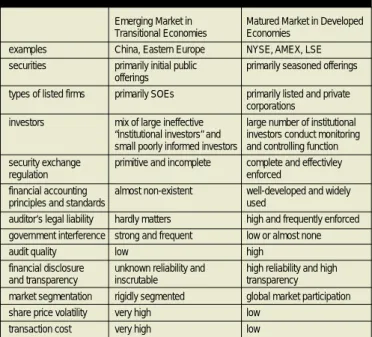
Two recently released studies show that earnings management is common among both domestic U.S. and Chinese state-owned companies before they go for initial public offerings (IPOs) regardless of the sophistication of the stock markets (Table 1). The study using American samples indicates that the greater the earnings management at the time of offering, the larger the ultimate price correction will be. The other study documents that median return on assets of Chinese state-owned IPO firms started to rise two years before the IPO, peaked in the IPO year and declined over the subsequent three years. Below are summaries of the findings.
BUSINESS FORUM
STUDIES SHOW U.S. AND CHINA FIRMS MANAGE EARNINGS BEFORE IPOS
The study included 1,649 domestic U.S. IPO firms from 1980 to 1992. The focus was to examine the relation between the long-run post-IPO return underperformance and the IPO firms’ earnings management.
It was found that discretionary current accruals – a variable under the control of management (such a variable can be accelerated revenues or delayed expenses) – are high around the time of an IPO relative to non-issuers. Issuers with higher discretionary accruals have poorer stock return performance in the subsequent three years. A firm that is classified to be in the most aggressive quartile of IPO earnings management experiences on average a
STUDY 2: FINANCIAL PACKAGING OF IPO FIRMS IN A TRANSITIONAL
ECONOMY: THE CASE OF B-SHARES AND H-SHARES IN CHINA
by Joseph Aharony (Tel Aviv University and HKUST), Chi-Wen Jevons Lee (HKUST and Tulane University) and T.J. Wong (HKUST) This study examines the earnings
performances and manager’s accounting decisions in the process of financial packaging for an IPO in the emerging stock m a r k e t s o f t r a n s i t i o n a l economies.
The analysis is based on the case of China’s B-Shares and H-Shares, two types of securities that allow foreign investors to buy shares in state-owned enterprises
(SOEs) that were previously wholly-owned by the state. B-Shares are available to foreign investors on the two domestic stock exchanges on the Chinese mainland whereas H-Shares are available on the Stock Exchange of Hong Kong. In order to be listed on the stock market, an SOE has to go through financial packaging, including business restructuring and conversion of its Russian
Still under a state-controlled economy, the central government has favored certain priority indus-tries such as petrochemicals, en-ergy and raw materials. The firms in these industries, termed pro-tected firms, had no need to boost short-term earnings to increase their chances of being selected for listing. On the other hand, the firms that were not in these industries, termed unprotected firms, did not receive such pre-ferential treatment. Even if the protected firms had managed earnings, they could sustain the high earnings after the IPO through political connections. The results of the study show that the post-issue decline in earnings performance was statistically sig-nificant in the unprotected firms, but not in the protected firms. (Figure 1).
The authors point out that the decline in the post-issue earnings among the unprotected industries could have been a result of the austerity measures implemented
Inquiries on Study 1 can be directed to Ivo Welch at [email protected] and Study 2 to T.J. Wong at
[email protected] 15%-30% worse three-year performance after its earnings
report than a firm that is classified to be in the most conservative quartile.
These results are robust with respect to the inclusion of alternative test specifications and controls (e.g., for market, size, book/market, expected return benchmark, holding period and cumulation method effects).
The conservative quartile of IPO issuers also return to the capital market for a seasoned equity offering about 20% more frequently over a five year period than do those in the aggressive quartile, indicating a potential post-issue benefit to less aggressive IPO earnings management.
There are a few possible implications of the study for investors, firms, and accounting standard setters:
• Investors may want to use information contained in the pre-offering accounting accruals to discriminate among issuers.
• Entrepreneurs may want to consider how perfectly legal accounting choices can lower the firm’s cost of equity capital or increase their own welfare. • Accounting standard setters may want to reconsider
permitting discretion in accrual choices, especially when there is high asymmetry of information between investors and the firm.
accounting system to the Western accounting system. The state maintains control of the IPO process by selecting which firms are to be listed and on which stock exchanges they are allowed to be listed.
The study uses the entire population of B-Share and H-Share IPOs between 1992 and 1995 (83 companies in total). The authors hold that while the SOE manager has no ownership of the firm, unlike most of their American counterparts who may have shares or options in the company before it seeks an IPO, he/she has strong incentive to manage e a r n i n g s o p p o r t u n i s t i c a l l y , increasing the chance of the firm to be selected by the state for listing, which in turn, may give him/her higher prestige and other benefits. The results of the study document that the IPO firms’ median ROA (return on assets) started to rise two years before the IPO, peaked in the IPO year and declined over the subsequent three years.
However, earnings manage-ment may not be a universal phe-nomenon throughout the PRC.
between 1993 and 1995, but there was a significant decline in earn-ings for 1994 IPOs in 1995 even after controlling for macroeco-nomics conditions. This suggests that the post-issue earnings de-cline is not entirely caused by the austerity measures, but may also be a result of the issuers’ earn-ings management. The authors have also documented a post-issue decline in an accrual item as measured by the change in ac-counts receivable (short-term debt owed to a company). This is consistent with new issuers who accelerate credit sales to boost earnings in the IPO year.
Figure 1: Earnings performance surrounding the IPO year
0% 2% 4% 6% 8% 10% -2 -1 0 1 2 3 Protected Unprotected Protected vs. unprotected firms
Year relative to IPO
RO
A
Table 1: Stock market and the economy
Emerging Market in Matured Market in Developed Transitional Economies Economies
examples China, Eastern Europe NYSE, AMEX, LSE securities primarily initial public primarily seasoned offerings
offerings
types of listed firms primarily SOEs primarily listed and private corporations
investors mix of large ineffective large number of institutional “institutional investors” and investors conduct monitoring small poorly informed investors and controlling function security exchange primitive and incomplete complete and effectivley
regulation enforced
financial accounting almost non-existent well-developed and widely
principles and standards used
auditor’s legal liability hardly matters high and frequently enforced government interference strong and frequent low or almost none
audit quality low high
financial disclosure unknown reliability and high reliability and high and transparency inscrutable transparency
market segmentation rigidly segmented global market participation share price volatility very high low
3
HKUST BUSINESS SCHOOL – Newsletter
PROFESSORS APPOINTED TO NEW
GOVERNMENT ADVISORY BODIES
T
he HKSAR’s Financial Secretary Donald Tsang recently appointed Dean Yuk-Shee Chan andProf. Leonard Cheng, Head of the Economics Department to two new government advisory bodies. Dean Chan was appointed a member of the Steering Committee of the Feasibility Study on the Financial Services Institute (FSI). The Committee is a cross-sector group of financial and educational professionals. It will consider the need for and feasibility of the establishment of the FSI which aims to co-ordinate training for the financial services sector. The study, supported by the Chief Executive in his Policy Address, has received warm response from the financial sector.
Prof. Leonard Cheng has been appointed to be a member of the Hong Kong Committee for Pacific Economic Cooperation Council (PECC). PECC is a tripartite partnership of business, government and academic representatives from 23 Asia-Pacific economies who work on practical government and business policy issues to increase trade, investment and economic development in the region.
Dean Yuk-Shee Chan
Suggestions and comments on this newsletter are welcome. Please contact us by email at: [email protected] (May Hung) or [email protected] (Elaine Chu) or by fax (852) 2358 1467.
HANG LUNG CENTER FORMS CORPORATE
ADVISORY BOARD
T
he Hang Lung Center for Organizational Research has formed a corporate advisory board in a move to strengthen its links with the business community.The Board consists of leading businessmen from Asia (see table below). Its role is to provide industry perspectives on China-related management issues and facilitate the work and progress of the Center.
C
harles Plott, Edward S. Harkness Professor ofEconomics and Political Science at the California Institute of Technology (Caltech), and Gary Bolton, Associate Professor of Management Science in the Smeal College of Business, Pennsylvania University, each made presentations at HKUST on how laboratory methods can be used to test the effectiveness of a theory or a government policy.
The events were organized jointly by Dr Soo Hong Chew of the Economics Department and Dr Rami Zwick of the Marketing
Department. These lectures reflect the on-going efforts of the HKUST Business School in bringing world-renowned aca-demics to Hong Kong to share their expertise and re-search findings with members of HKUST as well
EXPERIMENTAL ECONOMISTS TALK ABOUT
TESTING THEORIES IN THE LABORATORY
as the public.
Prof. Charles Plott is a pioneer economist who started testing eco-nomic theories by using laboratory methods in 1970. He is the founder and director of the Caltech Labo-ratory for Experimental Econo-mics and Political Science. His multi-media presentation fo-cused on “Smart Markets: Replac-ing Bureaucratic Decision Processes with Decentralized and
Competitive Allocative Mechanisms using Experi-mental Economic Testbeds”.
Prof. Gary Bolton is a pre-eminent researcher in bargaining and dispute resolution and in experimental economics. He talked about “Designing Experiments to Separate Hypotheses: Three Instructive Studies in Bargaining”.
Charles Plott
Gary Bolton
FROM THE DEAN
Ronnie Chan, Hang Lung Development (Chairman of the Board)
Robert Chan, New China Hong Kong Group Linus Cheung, Hong Kong Telecom Lily Chiang, Chen Hsong Holdings Henry Chow, IBM Greater China Group
Yei Ching Chow, Chevalier International Holdings Herman Hu, Ryoden Holdings
Chun Ying Leung, CY Leung & Co. David Lie, Newpower Group
Bill Lui, Hewlett Packard Asia Pacific Daniel Ng, McDonald’s Restaurants (HK) William Overholt, Bank Boston
David Pong, Shui Wing Steel Steven Poon, Bright World Enterprise Helmut Sohmen, World-Wide Shipping Group Michael Tien, G2000 (Apparel)
Wilfred Y.W. Wong, China Investment Group Marjorie Yang, Esquel Enterprise
Kent Yeh, Tai Ping Carpets Int’l
Hang Lung Center for Organizational Research Corporate Advisory Board Members
T
he month of May is probably the most hectic month for our students. Many of them are now busy preparing for their final examinations or completing their reports and team projects. Our 678 graduating BBA/ BSc students are even more busy as they have to make time for their i n t e r v i e w s f o r p r o s p e c t i v e employment or plans for further study.It is expected that the job markets for new graduates will be difficult this year due to the recent Asian economic downturn. However, some of the news for our students has been encouraging. Accounting majors, in particular, have been doing very well – more than half of the class have job offers from the Big-6 accounting firms. This represents an over 130% increase in only two years.
The last few months have seen the formation of new cabinets for our various student unions. Activities such as recreational gatherings, study trips, alumni events and skills enhancement workshops have been organized. All these are part and parcel of the overall development that our students gain here as they prepare for their future.
Recruitment for new students for the coming academic year also gathered pace in May. Six information sessions on BBA and three on Accounting have been held on the campus for the university-bound students. Over 2,000 participants in total were drawn to the sessions. At the same time a special team of the School has been visiting high school principals and teachers since April. The team was charged with the responsibilities of updating the high schools that they visited with the HKUST Business School’s latest developments and also bringing back suggestions on how to strengthen the relationship between the Business School and the high school sector.
At the postgraduate level, rounds of interviews have been conducted for prospective MBA students. So far there have been 500 applicants for our part-time program, a 5% increase over last year, indicating a growing demand for our MBA programs. The specialized master’s programs – the MSc programs in Economics, Information Systems Management, and Investment Management – have also seen substantial increase in applications, which we expect will yield a larger enrollment of experienced managers and professionals.
Responding to market needs, the Business School has continued to improve its program offerings. A new BSc degree in economics and finance has been approved for the academic year 1999/2000. The new program aims to prepare students, with a strong quantitative training, for careers in economic research, and in banking and finance. We have also reformed the MBA programs to offer more flexibility to our students. The changes include the introduction of the dual MBA/MSc degree program as well as the option to shorten the part-time MBA study from three to two years by taking advantage of the summer course offerings.
All areas of the Business School have been undergoing healthy development in the midst of our rapidly changing business environment. For every change we believe there will be an opportunity and by being proactive and versatile, our School will continue to provide students with the training to prepare themselves for the challenges and opportunities in their careers.
4
The Hong Kong University of Science & Technology HKUST Business SCHOOL – Newsletter
P
rofessor K.C. Chan, Head of the Department of Finance and Dr. Takeshi Yamada, Assistant Professor of Finance, together with Prof. Stephen Brown from New York University, and William Goetzmann from Yale University, spoke to a group of 150 Japanese mutual fund managers and investment analysts during a mutual fund conference organized by International University of Japan in Tokyo in March.The conference followed the publication of a research paper on Japanese mutual fund performance by Chan and Yamada in Review of Financial Studies, Summer 1997.
The research shows that the performance of Japanese mutual fund managers has been far from satisfactory. The conference was organized to discuss these findings and explore alternative explanations for the under-performance.
Associate Professor of Finance, Dr Jin-Chuan Duan, spoke on volatility and option pricing to a group of investment bankers at a training course, “Forecasting, hedging and trading volatility,” in Hong Kong. The course was organized by Risk publication.
V
isiting Professor of Finance Ronald Anderson announced publication of a new book: Transition Banking: Financial Development of Central and Eastern Europe. Written by Prof. Anderson and Prof. Chantal Kegels, the book assesses the efforts since 1989 to develop financial sectors in the economies of Central and Eastern Europe. Above all, the principles of the central planned systems were radically opposed to those of capitalism in finance, and moving from one system to the other required totally new institutionsA
group of 53 Kelloggstudents, led by their advisors Prof. Wally Scott, Prof. Beth Keegan and Prof. Marc Ventresca, visited the HKUST in March as part of their 1998 Global Initiatives in Manage-ment (GIM) program.
The theme of this year’s GIM program was to study China. Before coming to Hong Kong, the group traveled to Shanghai and Beijing to meet with government and business leaders to discuss issues relat-ing to marketrelat-ing, finance,
tech-nology and entrepreneurship. INTERNATIONAL MANAGEMENT
SYMPOSIUM
MBA year-1 students Christopher Kinnan and Brian Shen won a prize to join the 28th International Management Symposium at University of St. Gallen in May. The essays which they entered for the International Students’ Competition were selected among the top 250 entries worldwide. The award was the free participation in the Symposium where t h e y w o u l d m e e t l e a d i n g s c i e n t i s t s , industrialists, bankers and economists from different parts of the world to exchange ideas on issues of common concern. This was the first time students from Hong Kong entered the competition.
NEW YORK APPOINTMENT
Pascale Brunet is preparing to move again in July this year when she has to report duty to
FINANCE PROFESSORS GIVE
TALKS TO FUND MANAGERS
AND BANKERS
KELLOGG
GIM TEAM
VISITS HKUST
D
r Patrick Chau, Associate Dean and Director of Undergraduate(UG) Programs, and Iris Lam, Executive Officer, UG Programs visited some of the Business School’s exchange program partners in California earlier this year. The objective of the trip was to strengthen the connection between the Business School and its partner universities and to explore opportunities of further cooperation.
Dr Patrick Chau noted, “the visits allowed us to have a more direct and effective communication with our exchange partners. One of the accomplishments of this trip was we successfully convinced the UC System including UC Berkeley, UC Los Angeles, UC Santa Barbara, UC Irvine, and UC Riverside to review their language requirement imposed on HKUST students on exchange program.” The UC System
SCHOOL STRENGTHENS COOPERATION WITH EXCHANGE
PARTNERS
is the only exchange partner that requires HKUST students to submit their TOEFL/IELTS scores as proof of language ability before they embark on the exchange program with schools under the System.
“We were also encouraged to learn from the schools that the popularity of the HKUST Business School exchange program has grown tremendously in recent years. It is expected that the number of UC students who will come to study at HKUST Business School this Fall will be almost five times that of last Fall,” Dr Chau added.
The HKUST Business School’s undergraduate programs currently have 25 exchange partners and are planning to expand the exchange program network further, especially in Europe, Australia and New Zealand.
NEW BOOK ON FINANCIAL DEVELOPMENT IN
CENTRAL AND EASTERN EUROPE
and skills. Financial development is crucial to growth and to full partnership with the West.
The book treats such key questions as state retreat from allocating savings, banking competition, corporate governance, securities markets, and fi-nancial stability. It documents the important progress in institution building to date and pin-points the areas where the region remains vulnerable.
The book was published by Oxford University Press in February 1998 and is expected to be foundation reading for business students.
MBA STUDENTS ON INTERNATIONAL TRAIL
KPMG in New York, her first job after completing her full-time MBA study at HKUST. Pascale has been moving around North America, China and Hong Kong since she s t a r t e d h e r s t u d y i n F r e n c h - G e r m a n translation in Montreal, Canada in 1990. Since then, she has spent a few years in McGill University where she studied political science, East Asian studies and international business. But what brings her to HKUST is her interests in Asian business. “It is very natural to study here if I want to embark on a career in Asia,” she said. “I visited McGill and Columbia and talked to the professors there. And they recommended HKUST to me because of its strengths in faculty quality and international exchange program.”
Pascale said at HKUST students can have direct contact with local business entities and be well aware of what is going on in the region.
Last summer, she worked as a research assistant to Prof Vanhonacker, Department Head of Marketing. “I interviewed senior executives of major companies in Beijing and wrote business cases.” This gave her a precious opportunity to look into the business practices of Chinese companies and familiarize herself with the local culture.
When asked about her future career development , Pascale said she would probably spend a few years in the finance sector. “Serving as a financial services consultant at KPMG New York would provide me excellent training and exposure in the financial field. The job would definitely open up lots of opportunities for my career advancement.” She said, “I would come back to Asia again, helping companies to expand their business in the region. I may even start up my own consulting business sometime.” Kellogg graduate, 91, C.K. Tsang,
Director of Planning and Business Development, Asia Pacific, Walt Disney Imagineering; addressed the GIM team at a reception held at the HKUST University Center.