台灣市售果汁之主要成分與其自由基清除能力分析
劉 昀 達 姚 賢 宗* 中國醫藥大學營養學系 *通訊作者:姚賢宗 博士 聯絡地址:台中市北區學士路 91 號中國醫藥大學營養學系 聯絡電話:04-22053366 轉 7526 傳真:04-22062891 E-mail:[email protected] 1 2 3 4 5 6 7 8 9 10 11 12台灣市售果汁之主要成分與其自由基清除能力分析
劉 昀 達 姚 賢 宗* 中國醫藥大學營養學系 摘 要 本研究評估 17 種市售包裝果汁,包含 100%純果汁及非 100%果汁之主要成份 含量與其抗氧化能力。果汁的抗氧化能力則利用捕捉 2,2-diphenyl-1-picrylhy-drazyl (DPPH) 與 2,2'-azino-bis(3-ethylbenzothiazoline-6-sulphonic acid)(ABTS) 自 由基方法來評估並探討主要成分與抗氧化能力之關係。總酚含量的排序依次為 100%葡萄汁>100%柳橙汁>非 100%果汁。相較於其他果汁,100%柳橙汁則含 有高濃度的維生素 C。全部果汁樣品之 DPPH 和 ABTS 清除能力與總酚含量有 較高的相關性(r>0.8)。100%柳橙汁中維生素 C 含量對 DPPH 和 ABTS 清除能力 則有較高的相關性(r>0.95)。在糖類方面,100%柳橙汁以蔗糖含量最高,葡萄 糖及果糖含量接近。相反地,100%葡萄汁則以葡萄糖與果糖較高,蔗糖含量較 低。此外,在游離胺基酸方面,100%柳橙汁及葡萄汁比非 100%果汁有較高之 總游離胺基酸含量。本研究結果顯示, 100%果汁比非 100%果汁有較高的自由 基清除率,可能與果汁中含有較高濃度的總酚及維生素 C 含量有關。 關鍵字:果汁,總酚,糖,維生素 C,自由基清除能力 1 2 3 4 5 6 7 8 9 10 11 12 13 14 15 16 17 18 19 20 21Correlation of Major Components and Radical Scavenging Activity
of Commercial Fruit Juices in Taiwan
Yun-Ta Liu and Hsien-Tsung Yao*
Department of Nutrition, China Medical University, 91, Hsueh-shih Road, Taichung 404, Taiwan
Abstract
The contents of major components and antioxidant properties of 17 commercial fruit juices including 100% fruit juices and non-100% fruit juice were investigated. Antioxidant activity of the fruit juices were determined by scavenging ability on 1,1-diphenyl-2-picrylhydrazyl (DPPH) and 2,2'-azino-bis(3-ethylbenzthia- zoline-6-sulphonic acid) (ABTS) radicals and their correlations to the total phenolics, ascorbic acid, sugars and free amino acids were also evaluated. The rank order of total phenolics were 100% grape juices > 100% orange juices > non-100% fruits juices. Higher ascorbic acid concentration was found in 100% orange juices. The concentration of total phenolics in all fruit juices significantly (r>0.8) correlated with scavenging ability on DPPH and ABTS. However, the concentration of ascorbic acid (r>0.95) in 100% orange juice had higher correlation with the scavenging ability on DPPH and ABTS. Higher sucrose contents but comparable glucose and fructose levels were found in 100% orange juices than that of other fruit juices. In contrast, higher glucose and fructose levels but lower sucrose levels were found in 100% grape fruit juices. In addition, 100% orange and grape fruit juices had higher total free amino acid concentration than non-100% fruit juices. Our results show that 100% fruit juices had higher free radical scavenging activity than that of non-100% fruit juices may be related to their high levels of total phenolics and ascorbic acid.
Key words: Fruit juices, Total phenolics, Sugars, Ascorbic acid, Free radical
scavenging activity 1 2 3 4 5 6 7 8 9 10 11 12 13 14 15 16 17 18 19 20 21 22 23 24 25 26 27 28 29 30
前 言
流行病學研究顯示經常攝取水果可以減少氧化損傷及各種疾病的風險,增 加老化相關疾病的發展,例如癌症和心血管等疾病(1-3)。水果中的多酚類及維生 素 C 具有明顯抗氧化能力,被認為是預防這些慢性病之有效成分(4)。為方便攝 取水果中的營養成分,市售包裝果汁是目前世界各國最流行的飲料形式之一, 近年來國人重視養生保健觀念,果汁同時有香甜的口感並且能夠提供大量多酚 類與維生素,因此市售包裝果汁在台灣消費市場上佔有重要的角色。市售包裝 果汁,包括純果汁、稀釋果汁、清淡果汁及混合果汁,就純度方面可分為 100% 純果汁及非 100%純果汁。在 2012 年的消費量僅次於茶飲料和軟性飲料,並達 到 1.8 億公升(5)。在眾多種類果汁中以柳橙汁為消費量最高的市售包裝果汁,同 時也被認為是較好的維生素 C 來源(6)。在台灣大部份的包裝柳橙汁是 100%純果 汁。果汁中含糖量豐富,包含有一定比例的蔗糖、葡萄糖及果糖,但攝取過量 的糖類在人體會快速提高血糖並囤積過多的脂肪而造成健康負擔(7),因此果汁 之含糖量亦是消費者注意的營養標示之一。另一方面,各類果汁亦有其特殊的 游離胺基酸組成與含量,因此除了果汁中所含之糖分外,游離胺基酸含量與種 類是分析果汁品質的方法之一,含量不達標準或種類差異過大即有摻假的可能 (8)。在本研究中,我們調查台灣市售 17 種果汁飲料,包含 100%純果汁和非 100%純果汁之主要成分,例如:總酚含量、維生素 C、游離胺基酸及含糖量, 並評估其清除自由基能力與果汁成分的關係。 1 2 3 4 5 6 7 8 9 10 11 12 13 14 15 16 17 18 19 20 21 22材 料 與 方 法
一、
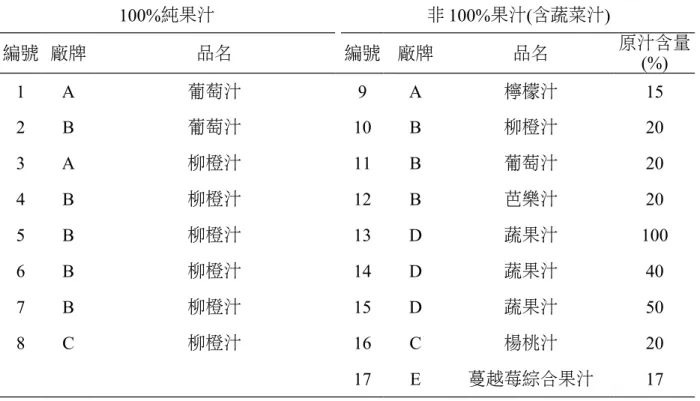
果汁來源 樣品收集時間為民國 101 年 2 月份,製造日期介於 1 月份 17 – 24 日之間的 台灣市售包裝果蔬汁 17 個樣本。如表一所示,其中含有 7 種柳橙汁(1 種非 100%果汁),3 種葡萄汁(1 種非 100%果汁),其他類蔬果汁 6 種。17 個樣本中 100%純果汁有 10 種,非 100%果汁有 7 種。二、
樣品分析 1. 總酚(total phenols)含量測定 參考 Kujala 等人(9)之試驗方法:於 96 孔盤中依序加入 75 μL 的二次水、試驗樣品 20 μL 和 15 μL 之 2 N 磷鉬酸酚試劑(Folin-Ciocalteu’s phenol reagent)混合
均勻後靜置 3 分鐘。再加入 7.5% Na2CO3後於室溫下靜置 30 分鐘。以分光光度
計測其 750 nm 之吸光值(ELISA reader)(μ-Quant, Bio-Tek instruments, INC.)。總 酚含量之計算方式是以沒食子酸(Gallic acid)之標準曲線作為對照,計算出樣 品中沒食子酸相對量(Gallic acid equivalent;GAE),並以此表示樣品中總酚 類化合物含量。
2. 維生素 C
果汁樣品先利用 0.45 μm 之過濾膜過濾後,再參考 de Quirós 等人(10)之方
法分析維生素 C 的含量。將過濾後的樣品濾液注入配備有紫外光偵測器的 Hitachi- L7400 Series LC System (Tokyo, Japan) ,偵測波長設定為 254 nm,以 Supelco C18 column (5 μm, 250 mm × 4.6 mm)作為分析管柱。移動相則使用含有 0.5%甲酸的 10 mM 乙酸銨溶液(Solvent A)和含有 0.5%甲酸的甲醇溶液(Solvent B) 。 梯 度 設 定 為 10% B (0-3 min) , 10% B 到 90% B (3-4 min) , 90% B (4-6
min),90% B 到 10% B (6-7 min),10% B (7-16 min),流速為 0.8 mL/min,分析
時間為 16 分鐘。維生素 C 的滯留時間為 3.1 分鐘,維生素 C 濃度則利用波峰下 面積比對標準曲線計算而得。
3. DPPH(1,1-Diphenyl-2-picrylhydrazyl)與 ABTS(2, 2-azino-bis(3-ethylbenzo-thiazoline-6-sulfonic acid)自由基清除能力測定
參考 Gyamfi 等人(11)之試驗方法測試 DPPH 清除能力:取 125 μM 的 DPPH
甲醇溶液 230 μL 和 20 μL 之樣品加入 96-well 盤中,震盪混合均勻後於室溫下避 光靜置 30 分鐘,以 ELISA reader (μ-Quant, Bio-Tek instruments, INC.)測其 517
nm 之吸光值。用去離子水加入 DPPH 反應液當作控制組,以及使用樣品 20 μL 加入 230 μL 甲醇溶液當作空白組,藉由控制組、空白組與樣品吸光值的差異計 算出抑制百分比。 根 據 Ozgen 等 人(12)的 方 法 測 試 ABTS 之 清 除 能 力 : 先 配 置 出 含 7 mM ABTS,2.45 mM 過硫酸鉀與 20 mM 醋酸水溶液,置於室溫避光反應 16 小時, 再使用 20 mM 醋酸水溶液進行稀釋,當 734 nm 波長之吸光值達到 0.7 時即為測 定 ABTS 自由基之反應液。取 ABTS 反應液 230 μL 和 20 μL 樣品加入 96-well 盤 中,避光靜置 30 分鐘後,以 ELISA reader (μ-Quant, Bio-Tek instruments, INC.) 測其 734 nm 吸光值。用去離子水加入 ABTS 反應液當作控制組,以及使用樣品 20 μL 加入 230 μL 醋酸水溶液當作空白組,藉由控制組、空白組與樣品吸光值 的差計算出抑制百分比。 DPPH 和 ABTS 抑制百分比由以下公式計算而得: 1 2 3 4 5 6 7 8 9 10 11 12 13 14 15 16 17 18 19 20 21 22 23 24 25 26 27 28 29 30 31 32 33 34 35 36 37 38 39 40 41 42 43 44 45 46
抑制百分比(%) = [1- (樣品吸光值-空白組吸光值)/控制組吸光值] × 100
4. 游離胺基酸組成分析
取適量樣品加入 1 mL 之 3% sulfosalicylin 溶液後濃縮至乾,用 0.02 N HCl 定量至 10 mL 後,用 0.2 μm 濾膜過濾後即為受測樣品。將樣品以 1:1 之比例加 入 OPA (o-phthaldialdehyde)試劑,混和均勻後避光放置一分鐘,再將樣品注入 配備有螢光偵測器的 Hitachi- L7400 Series LC System (Tokyo, Japan)中,激發光 波長為 345 nm,吸收光波長為 455 nm,以 LiCrospher C18 HPLC column (250
mm × 4.6 mm)作為分析管柱。移動相則使用 6.25 mM 之磷酸緩衝溶液(pH 7.2)
(Solvent A),和 6.25 mM 之磷酸緩衝溶液(pH 7.2)、乙腈和甲醇以 5:3:2 比例混和 之溶液(Solvent B)。梯度設定為 10% B 到 30% B (0-20 min),30% B 到 40% B (20-45 min),40% B 到 56%B (45-55 min),56% B 到 60% B (55-59 min),60% B (59-64 min),60% B 到 70% B (64-80 min),100% B (80-83 min)。流速設定為 1
mL/min。胺基酸之濃度則利用的波峰下面積比對胺基酸標準品中之標準曲線計 算而得。 1 2 3 4 5 6 7 8 9 10 11 12 13 14 15
結 果 與 討 論
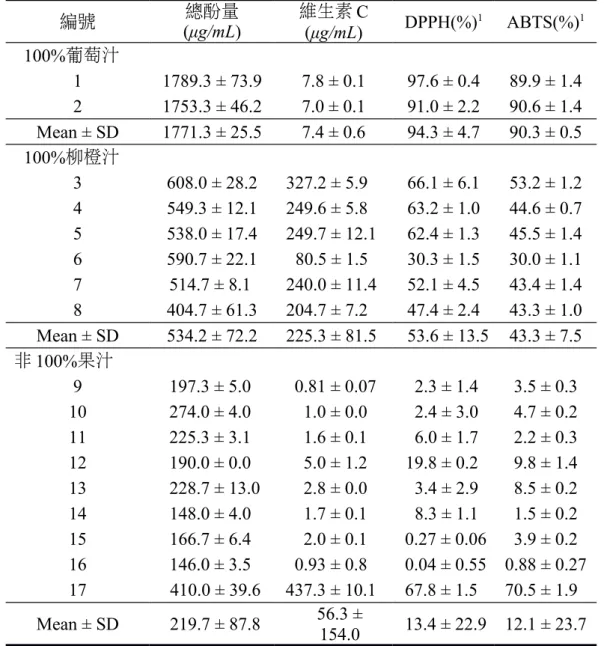
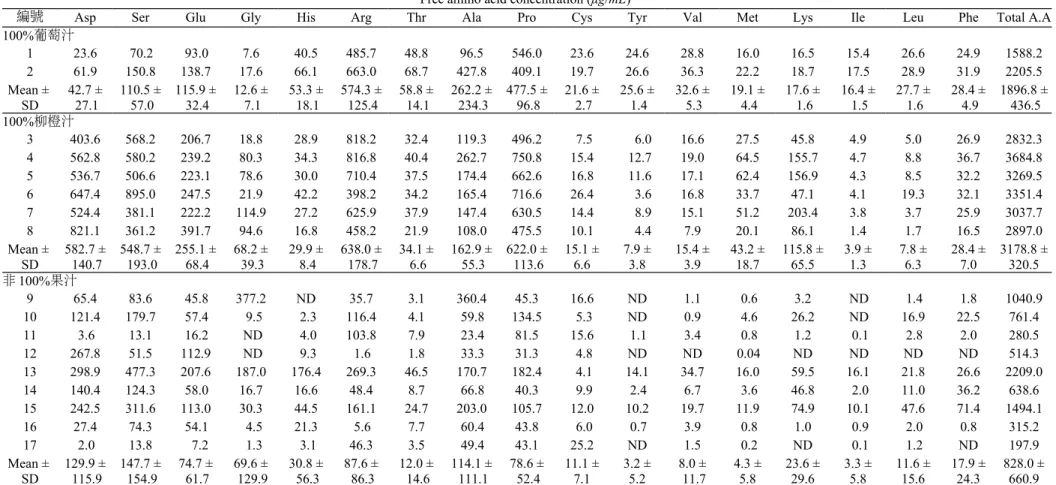
一、果汁之總酚、維生素 C 含量及自由基清除能力分析 如表二所示,在本次評估的 17 種市售果汁中,有 7 種柳橙汁(含 1 種非 100%果汁),及 3 種葡萄汁(含 1 種非 100%果汁),其他非 100%果汁則有 7 種。 在總酚量方面,100%果汁與非 100%果汁範圍分別為 404.7 – 1789.3 μg/mL 和 146.0 – 410.0 μg/mL,100%柳橙汁平均為 534.2 ± 72.2 μg/mL,100%葡萄汁平均 為 1771.3 ± 25.5 μg/mL。總酚含量由高至低依序為 100%葡萄汁>100%柳橙汁> 非 100%果汁。而值得注意的是,100%葡萄汁的平均總酚含量比 100%柳橙汁高 出兩倍以上,明顯高於其他果汁。100%柳橙汁平均總酚含量高於非 100%柳橙 汁約有 2 倍之多(100%果汁: 534.2 ± 72.2 μg/mL; 非 100%果汁(編號 10): 274.0 ± 4.0 μg/mL)。而 100%葡萄汁平均總酚含量則高於非 100%葡萄汁約有 7 倍之多 (100%果汁: 1771.3± 25.5 μg/mL; 非 100%果汁(編號 11): 225.3 ± 3.1 μg/mL)。維生 素 C 含量方面,則以 100%柳橙汁含有高濃度的維生素 C,平均為 225.3 ± 81.5 μg/mL,遠高於其他果汁的 維生素 C 含量,扣除編號 17(含量為 437.3 ± 10.1 μg/mL)後,排序依次為 100%柳橙汁>100%葡萄汁>非 100%果汁。在 DPPH 和 ABTS 自由基清除能力方面以 100%葡萄汁具有較好的自由基清除能力,排序依 次為 100%葡萄汁>100%柳橙汁>非 100%果汁(扣除編號 17)。另外,非 100% 果汁中,非 100%柳橙汁(編號 10)的原汁含量為 20%,其總酚含量應為同廠牌 100%柳橙汁(編號 4、5、6 和 7)之 20% (102.8 – 118.14 μg/mL),而其總分含量則高 於此範圍甚多(274.0 ± 4.0 μg/mL),可能是製程中有添加其他香料或抗氧化劑之影 響。非 100%柳橙汁(編號 10)之維生素 C(1.0 ± 0.0 μg/mL)則遠低於同廠牌 100%柳 橙汁(編號 4、5、6 和 7)之 20% (16.1 – 49.9 μg/mL),可能與原料來源和製程不同 有關。同廠牌三種蔬果汁進行比較,原汁含量 100%之商品(編號 13),總酚含量 (228.7 ± 13.0 μg/mL)及維生素 C(2.8 ± 0.0 μg/mL)皆明顯較其他蔬果汁高(總酚含 量:148.0 – 166.7 μg/mL;維生素 C:1.7 – 2.0 μg/mL)。 由文獻顯示葡萄汁是具有高量多酚化合物,例如花青素等植化素,其優異 的抗氧化能力也可以降低心血管疾病與癌症的風險(13)。100%葡萄汁比 100%柳 橙汁或非 100%果汁有較高之自由基清除能力可能與其有較高之總酚含量有關。 根據美國健康均衡飲食,每日多酚類的建議攝取量為 1 公克,較維生素 C、E 等 抗氧化營養素為高(14)。根據本研究結果,一罐 400 mL 之 100%葡萄汁含有 708 mg 之多酚類,即可達到每日多酚類建議攝取量之 70%,而 400 mL 的 100%柳橙 汁也可達到 20%建議攝取量。另外,400 mL 的 100%柳橙汁可提供 90 mg 的維 生素 C,可達到衛生署公布成人每日維生素 C 建議攝取量 100 mg(15)之 90%,是 攝取維生素 C 的良好來源。因此多攝取 100%果汁可以補充多量之多酚類及維生 素 C,可能有助於降低罹患心血管疾病與癌症的風險。 二、含糖量分析: 在平均總糖量方面(如表三),100%果汁與非 100%果汁範圍分別為 82.2 – 146.3 g/L,其中 100%葡萄汁(141.8 ± 6.4 g/L)>100%柳橙汁(91.5 ± 7.5 g/L)>非 100%果汁(73.2 ± 22.9 g/L),顯示葡萄汁因其本身水果就含大量的葡萄糖及果糖, 所以有較多的糖份。與文獻中總糖量相比,較甜及較酸的柳橙汁的總糖量分別 為 79.3 – 123.8 g/L 和 54.9 – 122.5 g/L(16)。本研究中柳橙汁含糖量皆在兩者範圍 內。值得注意的是,100%純果汁的平均總糖量比非 100%果汁平均總含糖量高。 編號 10 號非 100%柳橙汁之總糖量(91.3 ± 3.1 g/L) 接近與同廠牌編號 4、5、6 和 7 號 100%柳橙汁之總糖量(82.2 – 102.1 g/L),而非原汁含量之 20% (16.4 – 20.4 g/L),因此可能是額外添加糖分所致。編號 13、14 和 15 三種果菜汁相互比較, 其中以編號 13 標榜 100%果菜汁總糖量(71.0 ± 2.4 g/L)較高,編號 15 標榜低卡果 1 2 3 4 5 6 7 8 9 10 11 12 13 14 15 16 17 18 19 20 21 22 23 24 25 26 27 28 29 30 31 32 33 34 35 36 37 38 39 40 41 42 43 44 45 46 47菜汁的含糖量(25.7 ± 0.6 g/L)較低。 在糖類分佈方面,本研究分析果汁中葡萄糖、蔗糖及果糖的含量,100%柳橙 汁中以蔗糖平均含量最高,而葡萄糖及果糖平均含量接近。此結果符合一般柳 橙汁的糖類分佈。在 100%葡萄汁方面,葡萄糖比果糖稍高,蔗糖含量最低,符 合葡萄汁糖類分佈。研究指出,柳橙汁中之葡萄糖、蔗糖及果糖的比例應為 1:2:1,且葡萄糖和果糖含量應接近,或是果糖稍多(17) 。葡萄糖對果糖的比值一 般應高於 0.85,且上限部分應不超過 1(18),而荷蘭及德國的上限標準則分別為 1.03 及 1.02(19) 。柳橙汁中葡萄糖對果糖的比值,可以做為判斷柳橙汁真實性的 關鍵指標(19) 。若柳橙汁糖類分佈(葡萄糖:蔗糖:果糖)不依照 1:2:1 之比例或不符 合葡萄糖對果糖比值 0.85 – 1 之標準,則可能有額外加糖,即為非 100%果汁。 本研究中以 100%柳橙汁(編號 10)為例,雖然葡萄糖對果糖比值介於 0.85 – 1 之 間,但是其糖類分佈卻不符合 1:2:1,因此可確定此兩種驗證模式可以有效分辨 出柳橙汁之真實性。而在 100%柳橙汁的糖類分佈方面,有 3 種樣本接近 1:2:1 之比例(編號 3、4、7)。在葡萄糖對果糖的比值方面,則有 2 種樣本比值在合理 範圍(編號 3、5),以果糖稍多,較符合真實柳橙汁;有 4 種比值偏高(編號 4、6、7、8),且是以葡萄糖稍多。 三、游離胺基酸分析: 果汁中含有多種游離胺基酸,且各類果汁有其特殊的游離胺基酸組成。文 獻指出脯胺酸 (proline)、天門冬胺酸 (aspartic acid)、絲胺酸 (serine)、麩胺酸 (glutamic acid)、精胺酸(arginine)及丙胺酸(alanine)是柳橙果汁中含量豐富的胺基 酸,可用於評估果汁是否摻假(8, 20)。例如柑橘類水果中脯胺酸(proline)含量常會 受到加工型態、產地與成熟度的影響,未成熟的柑橘類水果脯胺酸含量有降低 的現象。若排除上述影響,相同品種之柑橘類水果其脯胺酸含量幾乎維持固定 但精胺酸的含量則變化不定。因此,脯胺酸的含量亦可作為柳橙汁是否真實的 指標(8) 。另外指出,總胺基酸含量也是一項柳橙汁是否有稀釋或添加糖漿的指 標,而總胺基酸含量也會隨著新鮮度含量降低(21)。本研究胺基酸含量標示如表 四,其中 100%柳橙汁(編號 3-9),其總胺基酸含量介於 2209 – 3685 μg/mL 之間, 非 100%柳橙汁總胺基酸含量為 761.4 μg/mL,以及 100%柳橙汁個別胺基酸含量 皆比非 100%柳橙汁高,其中 B 廠牌非 100%柳橙汁(編號 10)之脯胺酸(134.5 μg/mL)、天門冬胺酸(121.4 μg/mL)、麩胺酸(57.4 μg/mL)含量大約為 100%柳橙汁 (編號 4、5、6 和 7)含量之 20% (脯胺酸:126.1 – 150.2 μg/mL;天門冬胺酸: 104.9 – 129.5 μg/mL;44.4 – 49.5 μg/mL),可作為判定非 100%柳橙汁原汁含量的 標準。100%葡萄汁的總胺基酸含量為 1588 μg/mL(編號 1)及 2205 μg/mL(編號 2),比非 100%葡萄汁的 280 μg/mL 高(編號 11)。由此可見,非 100%果汁可能被 稀釋導致胺基酸濃度大幅降低。100%柳橙汁一般正常脯胺酸含量介於 450-2500 μg/mL 之間(8),本研究中 6 種 100%柳橙汁樣本中,脯胺酸含量介於 475 – 750 μg/mL 之間,含量偏低,但仍符合正常標準含量。值得注意的是,本研究中 100%柳橙汁脯胺酸含量(622 ± 114 μg/mL)與文獻中含量(790 ± 100 μg/mL)很接近, 但精胺酸(638 ± 179 μg/mL)和總胺基酸(3179 ± 320 μg/mL)與文獻中(Arg: 177 ± 4.8 μg/mL; Total free amino acids: 1538 ± 48 μg/mL)差距很大(21),其原因可能與柳
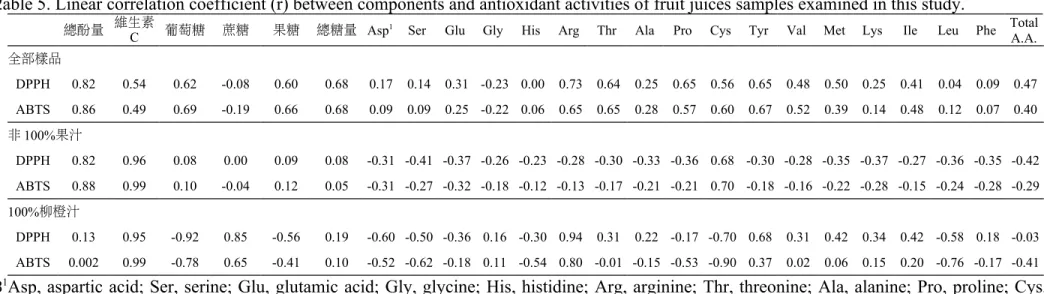
橙汁的加工型態、產地與成熟度的不同有關(8)。 四、果汁抗氧化能力與主要成分之相關性 果汁中總酚及維生素 C 含量與自由基清除能力之間的相互關係如表五所示。 結果發現總酚含量與全部樣品之 DPPH 和 ABTS 清除能力有較高的相關性 (r>0.8)。但是以 100%柳橙汁而言,柳橙汁中總酚含量對 DPPH 和 ABTS 清除能 1 2 3 4 5 6 7 8 9 10 11 12 13 14 15 16 17 18 19 20 21 22 23 24 25 26 27 28 29 30 31 32 33 34 35 36 37 38 39 40 41 42 43 44 45 46 47
力相關性較低(r<0.13),而維生素 C 含量與自由基掃除能力則有較高的相關性 (r>0.9)。此結果與 Xu 等人(13)之研究結果相符合,證明維生素 C 含量對 100%柳 橙汁的抗氧化能力有高度相關性(r=0.99)。因此推測造成 100%柳橙汁之間自由 基清除能力差異之成份可能是維生素 C。有趣的是,此次研究中發現 100%柳橙 汁中,精胺酸含量與抗氧化能力有較高相關性(r>0.8),可能與精胺酸具有抗氧 化能力(23)且其在果汁中含量較高(458 – 818 μg/mL)有關。
結 論
本研究評估的 17 種市售果汁之抗氧化(清除自由基)能力為 100%葡萄汁> 100%柳橙汁>非 100%果汁,而 100%柳橙汁中抗氧化能力最主要來源可能為維 生素 C,100%葡萄汁之抗氧化能力主要來源則可能為總酚含量。100%果汁其總 糖量與總胺基酸含量比非 100%果汁明顯較高。總而言之,100%果汁有優良的 抗氧化能力可能與其總酚量及維生素 C 含量較高有關。 1 2 3 4 5 6 7 8 9 10 11 12 13表一、市售 100%和非 100%果汁編號
Table 1. Product numbers of 100% and non-100% fruit juices.
100%純果汁 非 100%果汁(含蔬菜汁) 編號 廠牌 品名 編號 廠牌 品名 原汁含量(%) 1 A 葡萄汁 9 A 檸檬汁 15 2 B 葡萄汁 10 B 柳橙汁 20 3 A 柳橙汁 11 B 葡萄汁 20 4 B 柳橙汁 12 B 芭樂汁 20 5 B 柳橙汁 13 D 蔬果汁 100 6 B 柳橙汁 14 D 蔬果汁 40 7 B 柳橙汁 15 D 蔬果汁 50 8 C 柳橙汁 16 C 楊桃汁 20 17 E 蔓越莓綜合果汁 17 1 2 4
表二、市售 17 種果汁之總酚量、維生素 C 及抗氧化能力
Table 2. Total phenols, ascorbic acid and antioxidant activities of 17 commercial fruit juices examined in this study.
1 Fruit juices were diluted 5 and 10-folds with de-ionized water for the DPPH and
ABTS assays, respectively. Data are expressed as the mean ± standard derivation (n=3). 編號 (μg/mL)總酚量 維生素 C (μg/mL) DPPH(%)1 ABTS(%)1 100%葡萄汁 1 1789.3 ± 73.9 7.8 ± 0.1 97.6 ± 0.4 89.9 ± 1.4 2 1753.3 ± 46.2 7.0 ± 0.1 91.0 ± 2.2 90.6 ± 1.4 Mean ± SD 1771.3 ± 25.5 7.4 ± 0.6 94.3 ± 4.7 90.3 ± 0.5 100%柳橙汁 3 608.0 ± 28.2 327.2 ± 5.9 66.1 ± 6.1 53.2 ± 1.2 4 549.3 ± 12.1 249.6 ± 5.8 63.2 ± 1.0 44.6 ± 0.7 5 538.0 ± 17.4 249.7 ± 12.1 62.4 ± 1.3 45.5 ± 1.4 6 590.7 ± 22.1 80.5 ± 1.5 30.3 ± 1.5 30.0 ± 1.1 7 514.7 ± 8.1 240.0 ± 11.4 52.1 ± 4.5 43.4 ± 1.4 8 404.7 ± 61.3 204.7 ± 7.2 47.4 ± 2.4 43.3 ± 1.0 Mean ± SD 534.2 ± 72.2 225.3 ± 81.5 53.6 ± 13.5 43.3 ± 7.5 非 100%果汁 9 197.3 ± 5.0 0.81 ± 0.07 2.3 ± 1.4 3.5 ± 0.3 10 274.0 ± 4.0 1.0 ± 0.0 2.4 ± 3.0 4.7 ± 0.2 11 225.3 ± 3.1 1.6 ± 0.1 6.0 ± 1.7 2.2 ± 0.3 12 190.0 ± 0.0 5.0 ± 1.2 19.8 ± 0.2 9.8 ± 1.4 13 228.7 ± 13.0 2.8 ± 0.0 3.4 ± 2.9 8.5 ± 0.2 14 148.0 ± 4.0 1.7 ± 0.1 8.3 ± 1.1 1.5 ± 0.2 15 166.7 ± 6.4 2.0 ± 0.1 0.27 ± 0.06 3.9 ± 0.2 16 146.0 ± 3.5 0.93 ± 0.8 0.04 ± 0.55 0.88 ± 0.27 17 410.0 ± 39.6 437.3 ± 10.1 67.8 ± 1.5 70.5 ± 1.9 Mean ± SD 219.7 ± 87.8 56.3 ±154.0 13.4 ± 22.9 12.1 ± 23.7 1 2 3 4 5 6
表三、果汁中葡萄糖、蔗糖及果糖含量 編號 葡萄糖(g/L) 蔗糖(g/L) (g/L)果糖 總糖量(g/L) 葡萄糖/果糖 100%葡萄汁 1 71.2 ± 0.6 6.2 ± 1.4 69.4 ± 0.6 146.3 ± 1.4 1.03 ± 0.02 2 67.3 ± 0.6 3.1 ± 0.0 66.8 ± 0.6 137.2 ± 1.3 1.01 ± 0.00 Mean ± SD 69.3 ± 2.8 4.7 ± 2.2 68.1 ± 1.8 141.8 ± 6.4 1.02 ± 0.01 100%柳橙汁 3 24.1 ± 1.1 47.1 ± 1.2 25.5 ± 0.6 96.6 ± 1.0 0.95 ± 0.06 4 21.1 ± 0.6 46.8 ± 0.0 18.5 ± 1.7 87.2 ± 0.8 1.15 ± 0.11 5 21.2 ± 2.2 57.2 ± 1.2 23.6 ± 2.3 102.1 ± 3.5 0.90 ± 0.13 6 35.2 ± 2.7 31.0 ± 0.0 28.8 ± 1.7 94.4 ± 2.3 1.23 ± 0.16 7 22.9 ± 0.0 39.5 ± 2.0 19.8 ± 0.8 82.2 ± 2.0 1.16 ± 0.05 8 27.6 ± 1.7 34.3 ± 3.0 23.6 ± 0.0 86.2 ± 2.2 1.13 ± 0.03 Mean ± SD 25.4 ± 5.4 42.7 ± 9.6 23.3 ± 3.8 91.5 ± 7.5 1.09 ± 0.13 非 100%果汁 9 14.5 ± 1.1 74.0 ± 1.2 19.9 ± 0.6 108.5 ± 1.2 0.73 ± 0.06 10 31.2 ± 1.3 25.7 ± 2.3 34.4 ± 1.3 91.3 ± 3.1 0.91 ± 0.06 11 36.7 ± 0.6 13.2 ± 1.1 36.2 ± 0.6 86.0 ± 1.6 1.01 ± 0.02 12 20.7 ± 1.1 31.0 ± 1.1 22.2 ± 0.6 73.8 ± 1.8 0.93 ± 0.07 13 24.0 ± 0.0 21.7 ± 0.0 25.9 ± 1.9 71.0 ± 2.4 0.93 ± 0.07 14 10.3 ± 0.8 45.5 ± 3.0 5.9 ± 0.0 63.4 ± 2.2 1.75 ± 0.13 15 14.2 ± 0.0 2.0 ± 0.0 9.6 ± 0.6 25.7 ± 0.6 1.48 ± 0.09 16 20.0 ± 0.6 21.7 ± 1.1 21.4 ± 0.0 63.1 ± 1.0 0.93 ± 0.03 17 23.6 ± 0.6 27.3 ± 1.4 24.8 ± 0.0 76.1 ± 1.4 0.95 ± 0.03 Mean ± SD 21.7 ± 8.4 29.1 ± 20.6 22.3 ± 10.0 73.2 ± 22.9 1.07 ± 0.33 Table 3. Glucose, sucrose and fructose contents in fruit juice samples.
Values are expressed as mean ± standard derivation (n=3). 1
2 3
表四、果汁樣品中游離胺基酸之含量
Table 4. Free amino acid concentration in fruit juice samples.
Free amino acid concentration (μg/mL)1
編號 Asp Ser Glu Gly His Arg Thr Ala Pro Cys Tyr Val Met Lys Ile Leu Phe Total A.A 100%葡萄汁 1 23.6 70.2 93.0 7.6 40.5 485.7 48.8 96.5 546.0 23.6 24.6 28.8 16.0 16.5 15.4 26.6 24.9 1588.2 2 61.9 150.8 138.7 17.6 66.1 663.0 68.7 427.8 409.1 19.7 26.6 36.3 22.2 18.7 17.5 28.9 31.9 2205.5 Mean ± SD 42.7 ± 27.1 110.5 ± 57.0 115.9 ± 32.4 12.6 ± 7.1 53.3 ± 18.1 574.3 ± 125.4 58.8 ± 14.1 262.2 ± 234.3 477.5 ± 96.8 21.6 ± 2.7 25.6 ± 1.4 32.6 ± 5.3 19.1 ± 4.4 17.6 ± 1.6 16.4 ± 1.5 27.7 ± 1.6 28.4 ± 4.9 1896.8 ± 436.5 100%柳橙汁 3 403.6 568.2 206.7 18.8 28.9 818.2 32.4 119.3 496.2 7.5 6.0 16.6 27.5 45.8 4.9 5.0 26.9 2832.3 4 562.8 580.2 239.2 80.3 34.3 816.8 40.4 262.7 750.8 15.4 12.7 19.0 64.5 155.7 4.7 8.8 36.7 3684.8 5 536.7 506.6 223.1 78.6 30.0 710.4 37.5 174.4 662.6 16.8 11.6 17.1 62.4 156.9 4.3 8.5 32.2 3269.5 6 647.4 895.0 247.5 21.9 42.2 398.2 34.2 165.4 716.6 26.4 3.6 16.8 33.7 47.1 4.1 19.3 32.1 3351.4 7 524.4 381.1 222.2 114.9 27.2 625.9 37.9 147.4 630.5 14.4 8.9 15.1 51.2 203.4 3.8 3.7 25.9 3037.7 8 821.1 361.2 391.7 94.6 16.8 458.2 21.9 108.0 475.5 10.1 4.4 7.9 20.1 86.1 1.4 1.7 16.5 2897.0 Mean ± SD 582.7 ± 140.7 548.7 ± 193.0 255.1 ± 68.4 68.2 ± 39.3 29.9 ± 8.4 638.0 ± 178.7 34.1 ± 6.6 162.9 ± 55.3 622.0 ± 113.6 15.1 ±6.6 7.9 ±3.8 15.4 ±3.9 43.2 ±18.7 115.8 ±65.5 3.9 ±1.3 7.8 ±6.3 28.4 ±7.0 3178.8 ±320.5 非 100%果汁 9 65.4 83.6 45.8 377.2 ND 35.7 3.1 360.4 45.3 16.6 ND 1.1 0.6 3.2 ND 1.4 1.8 1040.9 10 121.4 179.7 57.4 9.5 2.3 116.4 4.1 59.8 134.5 5.3 ND 0.9 4.6 26.2 ND 16.9 22.5 761.4 11 3.6 13.1 16.2 ND 4.0 103.8 7.9 23.4 81.5 15.6 1.1 3.4 0.8 1.2 0.1 2.8 2.0 280.5 12 267.8 51.5 112.9 ND 9.3 1.6 1.8 33.3 31.3 4.8 ND ND 0.04 ND ND ND ND 514.3 13 298.9 477.3 207.6 187.0 176.4 269.3 46.5 170.7 182.4 4.1 14.1 34.7 16.0 59.5 16.1 21.8 26.6 2209.0 14 140.4 124.3 58.0 16.7 16.6 48.4 8.7 66.8 40.3 9.9 2.4 6.7 3.6 46.8 2.0 11.0 36.2 638.6 15 242.5 311.6 113.0 30.3 44.5 161.1 24.7 203.0 105.7 12.0 10.2 19.7 11.9 74.9 10.1 47.6 71.4 1494.1 16 27.4 74.3 54.1 4.5 21.3 5.6 7.7 60.4 43.8 6.0 0.7 3.9 0.8 1.0 0.9 2.0 0.8 315.2 17 2.0 13.8 7.2 1.3 3.1 46.3 3.5 49.4 43.1 25.2 ND 1.5 0.2 ND 0.1 1.2 ND 197.9 Mean ± SD 129.9 ± 115.9 147.7 ± 154.9 74.7 ± 61.7 69.6 ± 129.9 30.8 ± 56.3 87.6 ± 86.3 12.0 ± 14.6 114.1 ± 111.1 78.6 ± 52.4 11.1 ±7.1 3.2 ±5.2 8.0 ± 11.7 4.3 ±5.8 23.6 ±29.6 3.3 ±5.8 11.6 ±15.6 17.9 ±24.3 828.0 ±660.9 1Asp, aspartic acid; Ser, serine; Glu, glutamic acid; Gly, glycine; His, histidine; Arg, arginine; Thr, threonine; Ala, alanine; Pro, proline; Cys,
cysteine; Tyr, tyrosine; Val, valine; Met, methionine; Lys, lysine; Ile, isoleucine; Leu, leucine; Phe, phenylalanine. Total A.A= sum of all amino acid determined in this study. Values are expressed as mean of duplicate (n=2).
1 2
3 4 5
表五、抗氧化能力與果汁主要成份含量之相關性(r)
Table 5. Linear correlation coefficient (r) between components and antioxidant activities of fruit juices samples examined in this study.
1Asp, aspartic acid; Ser, serine; Glu, glutamic acid; Gly, glycine; His, histidine; Arg, arginine; Thr, threonine; Ala, alanine; Pro, proline; Cys,
cysteine; Tyr, tyrosine; Val, valine; Met, methionine; Lys, lysine; Ile, isoleucine; Leu, leucine; Phe, phenylalanine. Total A.A= sum of all amino acids determined in this study.
總酚量 維生素C 葡萄糖 蔗糖 果糖 總糖量 Asp1 Ser Glu Gly His Arg Thr Ala Pro Cys Tyr Val Met Lys Ile Leu Phe Total
A.A. 全部樣品 DPPH 0.82 0.54 0.62 -0.08 0.60 0.68 0.17 0.14 0.31 -0.23 0.00 0.73 0.64 0.25 0.65 0.56 0.65 0.48 0.50 0.25 0.41 0.04 0.09 0.47 ABTS 0.86 0.49 0.69 -0.19 0.66 0.68 0.09 0.09 0.25 -0.22 0.06 0.65 0.65 0.28 0.57 0.60 0.67 0.52 0.39 0.14 0.48 0.12 0.07 0.40 非 100%果汁 DPPH 0.82 0.96 0.08 0.00 0.09 0.08 -0.31 -0.41 -0.37 -0.26 -0.23 -0.28 -0.30 -0.33 -0.36 0.68 -0.30 -0.28 -0.35 -0.37 -0.27 -0.36 -0.35 -0.42 ABTS 0.88 0.99 0.10 -0.04 0.12 0.05 -0.31 -0.27 -0.32 -0.18 -0.12 -0.13 -0.17 -0.21 -0.21 0.70 -0.18 -0.16 -0.22 -0.28 -0.15 -0.24 -0.28 -0.29 100%柳橙汁 DPPH 0.13 0.95 -0.92 0.85 -0.56 0.19 -0.60 -0.50 -0.36 0.16 -0.30 0.94 0.31 0.22 -0.17 -0.70 0.68 0.31 0.42 0.34 0.42 -0.58 0.18 -0.03 ABTS 0.002 0.99 -0.78 0.65 -0.41 0.10 -0.52 -0.62 -0.18 0.11 -0.54 0.80 -0.01 -0.15 -0.53 -0.90 0.37 0.02 0.06 0.15 0.20 -0.76 -0.17 -0.41 1 2 3 4 5
參考文獻
(1) A. Trichopoulou, A. Naska, A. Antoniou, S. Friel, K. Trygg and A. Turrini: Vegetable and fruit: the evidence in their favour and the public health perspective. Int. J. Vitam. Nutr. Res., 73: 63-69 (2003).
(2) H.-C. Hung, K. J. Joshipura, R. Jiang, F.-B. Hu, D. Hunter, S. A. Smith-Warner, G. A. Colditz, B. Rosner, D. Spiegelman and W. C. Willett: Fruit and vegetable intake and risk of major chronic disease. J. Natl. Cancer Inst., 96: 1577-1584 (2004).
(3) M. Tobias, M. Turley, N. Stefanogiannis, S. Vander Hoorn, C. Lawes, C. N. Mhurchu and A. Rodgers: Vegetable and fruit intake and mortality from chronic
disease in New Zealand. Aust. N. Z. J. Public Health., 30: 26-31 (2006).
(4) J. J. Dupont, W. B. Farquhar, R. R. Townsend and D. G. Edwards: Ascorbic acid or L-arginine improves cutaneous microvascular function in chronic kidney disease. J. Appl. Physiol., 111: 1561-1567 (2011).
(5) 台灣區飲料工業同業公會(http://www.bia.org.tw)。101 年度會員工廠各類飲
料銷售數量統計表。台北市,台灣(2013)。
(6) A. J. Melendez-Martinez, I. M. Vicario and F. J. Heredia: Carotenoids, color, and ascorbic acid content of a novel frozen-marketed orange juice. J. Agric.
Food Chem., 55: 1347-1355 (2007).
(7) 田金平、林阿洋:市售飲料中含糖量及甘味料之調查。藥物食品檢驗局調
查研究年報,15:197-204 (1997)。
(8) 周俐齡:果汁之胺基酸分析。食品工業,36: 25-32 (2004)。
(9) T. S. Kujala, J. M. Loponen, K. D. Klika and K. Pihlaja: Phenolics and betacyanins in red beetroot (Beta vulgaris) root: distribution and effect of cold storage on the content of total phenolics and three individual compounds. J.
Agric. Food Chem., 48: 5338-5342 (2000).
(10) A. R. B. de Quirós, M. Fernandez-Arias and J. A. Lopez-Hernandez: Screening
method for the determination of ascorbic acid in fruit juices and soft drinks.
Food Chem., 116: 509-512 (2009).
(11) M. A. Gyamfi, M. Yonamine and Y. Aniya: Free-radical scavenging action of
medicinal herbs from Ghana Thonningia sanguinea on experimentally-induce 1 2 3 4 5 6 7 8 9 10 11 12 13 14 15 16 17 18 19 20 21 22 23 24 25 26 27 28 29 30 31
liver injuries. Gen. Pharmacol., 32: 661-667 (1999).
(12) M. Ozgen, R. N. Reese, A. Z. Jr. Tulio, J. C. Scheerens and A.R. Miller: Modified 2, 2-azino-bis-3-ethylbenzothiazoline-6-sulfonic acid (ABTS) method to measure antioxidant capacity of Selected small fruits and comparison to ferric reducing antioxidant power (FRAP) and 2, 2'-diphenyl-1-picrylhydrazyl (DPPH) methods. J. Agric. Food Chem., 54: 1151-1157 (2006).
(13) P. Engelfriet, J. Hoekstra, R. Hoogenveen, F. Büchner, C. Van Rossum and M.
Verschuren: Food and vessels: the importance of a healthy diet to prevent cardiovascular disease.Eur. J. Cardiovasc. Prev. Rehabil., 17: 50-55 (2010).
(14) L. Bravo: Polyphenols: chemistry, dietary sources, metabolism, and nutritional
significance. Nutr. Rev., 56: 317-333 (1998).
(15) 行政院衛生署食品藥物管理局(http://www.fda.gov.tw)。國人膳食營養素參
考攝取量。台北市。台灣(2011)。
(16) S. Moufida and B. Marzouk: Biochemical characterization of blood orange,
sweet orange, lemon, bergamot and bitter orange. Phytochemistry, 62: 1283-1289 (2003).
(17) H. S. Lee and G. A. Coates: Quantitative study of free sugars and myoinositol in
citrus juices by HPLC and literature compilation. J. Liq. Chromatogr. Relat.
Technol., 14: 2123-2141 (2000).
(18) R. L. Rouseff and S. F. Martin: Sugar levels in canned single strength grapefruit
juice from Florida. Proc. Florida State Hortic Soc., 98: 198-200 (1985).
(19) H. Kelebek and S. Selli: Determination of volatile, phenolic, organic acid and
sugar components in a Turkish cv. Dortyol (Citrus sinensis L. Osbeck) orange juice.J. Sci. Food Agric., 91: 1855-1862 (2011).
(20) 饒瑩華、林萬順、吳嘉琳、張惠淑:鮮榨葡萄汁品質指標之探討。臺灣農
業化學與食品科學,48: 270-280 (2004)。
(21) J. L. Gómez-Ariza, M. J. Villegas-Portero and V. Bernal-Da: Characterization
and analysis of amino acids in orange juice by HPLC–MS/MS for authenticity assessment. Anal. Chim. Acta., 540: 221-230 (2005).
(22) G. H. Xu, D. H. Liu, J. C. Chen, X. Q. Ye, Y. Q. Ma and J. Shi: Juice 1 2 3 4 5 6 7 8 9 10 11 12 13 14 15 16 17 18 19 20 21 22 23 24 25 26 27 28 29 30
components and antioxidant capacity of citrus varieties cultivated in China.
Food Chem., 106: 545-551 (2008).
(23) W. Wang and E. G. De Mejia: A new frontier in soy bioactive peptides that may
prevent age-related chronic diseases. Compr. Rev. Food Sci. Food Saf., 4: 63-78 (2005). 1 2 3 4 5