行政院國家科學委員會補助專題研究計畫
5 成 果 報 告
□期中進度報告
中共的多邊外交研究:以中共參與亞太多邊安全機制為例
計畫類別:5 個別型計畫 □ 整合型計畫
計畫編號:NSC 94-2414-H-110-004-
執行期間: 94 年 8 月 1 日至 95 年 7 月 31 日
計畫主持人:林文程教授
共同主持人:
計畫參與人員:
成果報告類型(依經費核定清單規定繳交):□精簡報告 5完整報告
本成果報告包括以下應繳交之附件:
□赴國外出差或研習心得報告一份
□赴大陸地區出差或研習心得報告一份
□出席國際學術會議心得報告及發表之論文各一份
□國際合作研究計畫國外研究報告書一份
處理方式:除產學合作研究計畫、提升產業技術及人才培育研究計畫、
列管計畫及下列情形者外,得立即公開查詢
□涉及專利或其他智慧財產權,□一年□二年後可公開查詢
執行單位:國立中山大學大陸研究所
中 華 民 國 95 年 12 月 31 日
附件一目 錄
中、英文摘要及關鍵詞 Ⅱ
報告內容
I. Introduction 1
II. Purposes of this study 2
III. Findings 2
IV. Conclusion 20
中文摘要 本文以中共參與亞太多邊安全機制為例,來研究中共的多邊外交,它首先探討中國對亞太 多邊安全機制的政策之演進。首先本文首先說明亞太地區多邊安全機制的發展過程,指出 多邊安全機制可分成第一軌和第二軌兩種,並說明亞太地區因為文化、政治、和社會經濟 發展之分歧以及小國擔心大國之主宰、亞太亞國家對威脅認知之不同、美國在冷戰期間不 支持多邊主義等因素之阻擾、亞太多邊安全機制之發展並不順利。但是進入後冷戰時期之 後,美國轉而支持多邊主義、亞太國家關切該區域的和平與穩定、亞太國家相互依賴程度 增加等因素之鼓勵,多邊安全機制紛紛成立,重要的第一軌多邊安全機制包括東協區域論 壇、東南亞國家協會、六方會談、香格里拉對話會等。本研究發現中國對參與多邊安全機 制原本採取消極被動態度,但是近幾年轉變成積極主動,甚至推動成立上海合作組織,原 因在於北京發現積極參加多邊安全機制有利於其國家利益。 關鍵字:亞太地區、多邊安全機制、東協區域論壇、中國多邊外交 Abstract
This report uses China’s participation in the Asia-Pacific multilateral security mechanism as a case to study China multilateral diplomacy. It analyzes the evolution of China’s policy toward multilateral security mechanisms in the Asia Pacific. It begins with an introduction of the development of the Asia-Pacific multilateral security mechanism. It points out that multilateral security mechanisms can be divided into two categories, namely track I and track II mechanisms. The report suggests that the following factors stymied the development of the Asia-Pacific multilateral security mechanisms: (1) Asia-Pacific countries are quite diversified in terms of political systems, socio-economic development, and culture; (2) small states in this region have feared that the great powers, such as the United States, Japan, Russia, or the PRC, might
dominate the multilateral security system; (3) Asia-Pacific countries quite differently perceive the threat to their national security; (4) the United states did not support multilateralism in the Asia Pacific during the Cold War era. However, the Asia-Pacific countries are able to overcome the above-mentioned negative factors. Multilateral security mechanisms have mushroomed after the collapse of the Soviet Union in late 1991. The most important track I Asia-Pacific
multilateral security mechanisms include ASEAN Regional Forum, the Association of Southeast Asian Nations, and the Six Party Talks. This report points out that Beijing’s attitude toward multilateral security mechanisms was passive in the 1990s. But China has become very actively participating in those multilateral security mechanisms in recent years. China even initiated to establish the Shanghai Cooperation Organization in 2001. Beijing changes its policy because it realizes that to actively participate in multilateral security mechanisms serves China’s national interest.
Keywords: Asia Pacific, multilateral security mechanisms, ASEAN Regional Forum, China’s
I. Introduction
China is regarded as both the source of and the solution to problems related to the maintenance of the current world order because it is one of the five permanent members in the United Nations Security Council, a nuclear power, and a superpower candidate.1 To East Asian countries, China’s importance is even more apparent. China is a party or a key player in the three flashpoints which might trigger a war in the region—the Taiwan Strait, the South China Sea, and the Korean Peninsula. China has unsettled territorial disputes with Brunei, India, Japan, Malaysia, Taiwan, Vietnam, and the Philippines. Those countries are concerned with China’s future development and are very carefully monitoring its security strategy. Other countries in this region also face the same challenge, i.e. how to deal with a rising China.
Whether China will support the status quo or become a responsible great power it is still a question mark to many observers.2 Those who belong to the realist school argue that after China rises as a global power, it will not be satisfied with the existing international system and will challenge the United States, the current global hegemon.3 Those who analyze Beijing’s diplomatic behavior from its traditional world view suggest that China has never changed its thinking when regarding itself as the center of the world.4 In particular, they point out that China views East Asia as its sphere of influence and wants to resume the dominant role in the region that it enjoyed throughout much of history.
If Beijing’s long-term goal is to compete with Washington for world hegemony, and its short-term goal is to dominate East Asia, the Asia-Pacific countries will face increasing pressure from a rising China. In fact, since the People’s Republic of China (PRC) was established in 1949, China has been a concern for the Asia-Pacific countries. Beijing supported communist rebellions and tried to export revolution to its neighbors from the 1950s through the 1970s, jeopardizing the stability of those countries. Starting from 1978, China turned to develop its economy. Its power has been increasing and the balance of power in the Asia Pacific continues to loose its equilibrium, especially since 1989 when China began its dramatic military buildup. The Asia-Pacific countries are afraid that China which traditionally regarded the region as its sphere of influence might try to regain its dominant role.
Many Asia-Pacific countries believe that integrating China into the international system is an important way to maintain peace and stability in the region. Encouraging China to participate
1
Samuel S. Kim, “China and the United Nations,” in Elizabeth Economy and Michel Oksenberg (eds.), China Joins
the World: Progress and Prospects (New York: Council on Foreign Relations Press, 1999), p. 44.
2
Alastair Iain Johnston, “Is China a Status Quo Power?” International Security, Vol. 27, No. 4 (Spring 2003), pp. 5-56.
3
Zalmay M. Khalizad et al., The United States and a Rising China: Strategic and Military Implications (Santa Monica: RAND Corporation, 1999), pp. 63-75.
4
Samuel S. Kim, “China and the World in Theory and Practice,” in Samuel S. Kim (ed.), China and the World:
Chinese Foreign Relations in the Post-Cold War Era, 3rd edition (Boulder, Colorado: Westview Press, 1994), pp. 12-16.
in multilateral security mechanisms in the region, and thereby constraining its power, is a part of this strategy.
II. Purposes of this study
This research project studies (1) the development of the Asia-Pacific multilateral security mechanisms; and (2) the evolution of its policy the evolution of China’s multilateral diplomacy policy toward the Asia-Pacific multilateral security mechanisms, analyzing its thinking, purpose, and strategy toward those organizations.
III. Findings
1. Development of Asia-Pacific multilateral security mechanisms
Robert O. Keohane defines multilateralism as “the practice of coordinating national policies in groups of three or more states, through ad hoc arrangements or by means of institutions.”5 John Gerald Ruggie argues that “multilateralism refers to coordinating relations among three or more states in accordance with certain principles.”6 A multilateral security mechanism can be an international organization, regime, conference, or arrangement which coordinates security relations among three or more states in accordance with certain norms, principles, or regulations. Those norms, principles, or regulations reduce a member state’s freedom or flexibility to act. Joining a multilateral security mechanism is believed to weaken a country’s sovereignty. Therefore, great powers are usually reluctant to participate in multilateral institutions unless they can control those mechanisms.
Multilateral security mechanisms can be divided into two major categories: (1) first track mechanism whose members are independent sovereign states; and (2) second track mechanisms composed of individuals or non-governmental organizations.
The Asia Pacific is not a friendly region for multilateral security mechanisms. First, Asia-Pacific countries were quite diversified in terms of political systems, socio-economic development, and culture. Samuel P. Huntington suggests that there are eight civilizations in the world and the clash of civilizations will be the fundamental source for future conflict.7 There are at least six civilizations, Western, Confucian, Japanese, Islamic, Hindu, and Slavic-Orthodox, coexisting in the region. We may not accept Huntington’s controversial argument that the clash of civilizations will dominate global politics in the future, but the diversification of cultures has indeed stymied the cooperation or integration of this region.
Second, small states in this region have feared that the great powers, such as the United States, Japan, Russia, or the PRC, might dominate the multilateral security system. Many
5
Robert O. Keohane, “Multilateralism: An Agenda for Research,” International Journal, Vol. XLV, No. 4 (Autumn 1990), p. 731.
6
John Gerald Ruggie, “Multilateralism: The Anatomy of an Institution,” International Organization, Vol. 46, No. 3 (Summer 1992), p. 568.
7
Asia-Pacific countries at some point in history were colonies of Western powers or were invaded by Japan or China. They do not feel comfortable with any multilateral security system which might be controlled by these powers.
Third, the Asia-Pacific countries quite differently perceive the threat to their national security. The lack of a common threat is the main reason why the Southeast Asia Treaty Organization (SEATO) failed. SEATO was established in 1954 as a collective security organization to cope with the communist expansion. But some of its members such as India and Pakistan did not consider the Soviet Union or China a threat to their security. Therefore, SEATO never really achieved its original goals and was dismantled in 1977.
Fourth and maybe most important, the Asia-Pacific security system was constrained by East-West competition in the Cold War era. Washington preferred bilateralism to multilateralism, with the Asia-Pacific region basically set up as a US-led alliance system. In the 1950s, the United States signed mutual defense treaties with Japan, South Korea, the Philippines, Thailand, and Taiwan, and signed a triangular treaty with Australia and New Zealand. Washington viewed with suspicion any multilateral security system in the Asia-Pacific region, and feared that a multilateral security organization could potentially weaken its traditional bilateral ties and provide Moscow with a stage to expand Soviet influence in the region.8
As a result, proposals made by some political leaders to establish a multilateral security system in this region during the Cold War were ignored. For example, in 1969 Leonid Brezhnev suggested the establishment of an Asian Collective System; Mikhail Gorbachev at least twice advocated the establishment of a system in Asia modeling the Conference on Security Cooperation in Europe (CSCE); South Korea’s President Roh Tae Woo proposed establishing a consultative conference consisting of South and North Korea, the United States, the Soviet Union, Japan, and the PRC;9 Australia’s Foreign Minister Gareth Evans promoted the idea of forming a Conference on Security and Cooperation in 1990; and Canada’s Foreign Minister Joe Clark suggested to establish a North Pacific Cooperative Security in Asia in 1990.10 Those proposals were not widely accepted because the United States did not support a multilateral security system in Asia and most East Asian countries were not ready to accept it. The Association of Southeast Asian Nations (ASEAN), which was established in 1967, was the only international governmental organization focusing on political or security issues that was able to survive and grow in the Cold War period. But ASEAN is only a sub-regional organization which aims at promoting economic cooperation and managing conflicts among its members. ASEAN does not deal with the problems of the Asia-Pacific region.
In spite of these negative factors, the Asia-Pacific countries were able to overcome their
8
Sheldon W. Simon, “Security Prospects in Southeast Asia: Collaborative Efforts and the ASEAN Regional Forum,”
The Pacific Review, Vol. 11, No. 2 (1998), p. 205.
9
Ralph A. Cossa, “Asian Multilateralism Gets a Lift,” Taipei Times, August 2, 2002, in http://www.iiss.org/confPress-more.php?confID=176, accessed on 2004/11/19 10
Andrew Mack, “Security Cooperation in Northeast Asia Studies,” Journal of Northeast Asia Studies (Summer 1992), pp. 21-34.
difficulties and establish some multilateral security mechanisms in the 1990s. First, regionalism and multilateralism gained momentum in the region because of the increasing interdependence among the Asia-Pacific countries. Although Asia Pacific was sterile for nurturing multilateral security organizations in the Cold War period, it provided a much more generous environment for regional economic cooperation. Multilateral economic organizations, especially non-governmental organizations (NGOs), mushroomed in the region in the past four decades. In addition to ASEAN, the Pacific Basin Economic Council (PBEC) was also established in 1967 by business leaders from the US, Japan, Canada, Australia, and New Zealand; the Pacific Trade and Development Conference was formed by economists in the region in 1968; and the Pacific Economic Cooperation Conference (PECC) was founded in 1980. These experiences led to the founding of the Asia-Pacific Economic Cooperation (APEC) in 1989. The fact that APEC members are economic entities not sovereign states paved the way for Taiwan and Hong Kong to become members in 1992. APEC however, can be regarded as a first-track organization. The Asia Pacific followed the approach of functionalism wherein economic and non-governmental cooperation would spill over to include security and governmental cooperation.
Moreover, the collapse of the Soviet Union in 1991 removed Washington’s concern with multilateralism. Hurt economically by the arms race with the Soviet Union in the 1980s, the United States decided not to continue to serve as the world’s only policeman to protect the Asia-Pacific region in the early 1990s. Washington no longer opposed to the idea of building a multilateral security system in Asia-Pacific region. On the contrary, it began to support the development of a multilateral forum for security consultation in the region.11
The Asia-Pacific countries were concerned with the problem of peace and security in the region. Although East-West confrontation was over, the Asia Pacific especially East Asia did not enjoy the peace dividend. On the contrary, the region was threatened by potential conflicts and a growing arms race in late 1980s and early 1990s.12 There are still many unresolved land and maritime borders as well as overlapping maritime exclusive economic zones. As mentioned above, the South China Sea, Korean Peninsula, and the Taiwan Strait are regarded as three flashpoints. In addition, several countries in this region face the threat of secessionism and domestic instability. For example, the Philippines has Muslim insurgencies in the south; Malaysia suffers from the separatist movement in Sabah; and Papua New Guinea has been challenged by the Bougainville movement. These disputes might spill over their boundaries, thereby affecting the peace of the whole region.
Moreover, many Asia-Pacific countries are in the process of democratic transformation. Social forces, which often gain strength with economic development, have emerged to challenge the authoritarian regimes, thereby disturbing stability in those countries. Indonesia which is the world’s fourth most populous country and the biggest Moslem state is a typical case. The country
11
Statement of Winston Lord, Assistant-designate for East Asian and Pacific Affairs, before the Senate Foreign Relations Committee, Washington D.C., March 31, 1993.
12
has been struggling to maintain domestic stability and integrity in the process of democratization. If the archipelagic state fails to keep order and falls into parts, peace and stability in Southeast Asia will be endangered.
In addition to traditional security issues, the Asia-Pacific countries are concerned with non-traditional security problems which either emerged or became worse after the end of the Cold War. For instance, international terrorism, environmental deterioration, drug and small arms trafficking, and illegal immigration, to name only a few, are more imminent for many countries than a foreign military invasion. Solving these problems, which is beyond any individual country’s capability, encourages international cooperation.
Therefore, after the end of the Cold War, multilateral security mechanisms were created one after another in the Asia-Pacific region. Currently, there are at least six first-track security mechanisms in the region: the ASEAN Regional Forum (ARF), the Western Pacific Naval Symposium (WPNS), 13 the Six Party Talks, 14 the Conference on Interaction and Confidence-Building Measures in Asia (CICBMA), 15 the Shanghai Cooperation Organization (SCO), and the Shangri-La Dialogue.16 In addition, the Workshop on Managing Potential Conflict in the South China Sea (WMPCSCS),17 the Northeast Asia Cooperation Dialogue (NEACD),18 and the Council for Security Cooperation in the Asia Pacific (CSCAP) are important track II security mechanisms in the region.19
13
The first WPNS was held in Australia in 1988. Its members now include Australia, Brunei, Cambodia, China, Indonesia, Japan, Malaysia, New Zealand, Papua New Guinea, the Philippines, Russia, Singapore, South Korea, Thailand, Tonga, United States, and Vietnam. Canada, Chile, France, and India are observers.
14
The predecessor of the Six Party Talks was the Four Party Talks whose participants were China, North Korea, South Korea, and the United States. Its first meeting was held in Geneva in December 1997in order to establish peace in the Korean Peninsula. The nuclear problem in North Korean got worse in 2002. In late August 2003, China, Japan North Korea, Russia, South Korea, and the United States held the first Six Party Talks in Beijing to deal with North Korea’s nuclear weapon problem.
15
The establishment of the CICBMA was proposed by Kazakhstan’s president to the United Nations General Assembly in 1992. Its first meeting of foreign ministers was held in Kazakhstan in 1999 and passed a common declaration supporting the founding of this security dialogue mechanism. The CICBMA’s purpose is to enhance cooperation through elaborating multilateral approaches towards promoting peace, security and stability in Asia. Afghanistan, Azerbaijan, China, India, Iran, Israel, Kazakhstan, Kyrgyzstan, Mongolia, Pakistan, Palestinian Liberation Organization, Russia, Tajikistan Turkey, and Uzbekistan are its members. Eleven other countries including Japan, South Korea, and the United States, and four international organizations are observers.
16
In late May 2002, Singapore’s International Institute for Strategic Studies (IISS) hosted a meeting inviting defense officials to discuss security issues in the Shangri-La Hotel. Among those senior defense officials were defense ministers from Australia, India, Indonesia, Japan, and Singapore, and U.S. Deputy Defense Secretary Paul Wolfowitz. At the request of defense ministers, the Shangri-La Dialogue becomes an annual event. In addition to those countries, defense ministers from Brunei, Cambodia, Malaysia, South Korea, United Kingdom, Thailand, Myanmar, and New Zealand attended the 2004 Shangri-La Dialogue. http://www.iiss.org/shangri-la.php, accessed 2004/11/29
17
The Workshop on Managing Potential Conflict in the South China Sea, which has been held since 1990, was financially sponsored by Canada and organized by Indonesia. Canada stopped its financial support in late 1990s. The Workshop aims at solving the Couth China Sea conflict by dialogue and consultation. Nine ASEAN members (Burma is excluded) participate, plus Taiwan and China.
18
The Northeast Asia Cooperation Dialogue was initiated by the Institute on Global Conflict and Cooperation of the California University, inviting China, Japan, North Korea, Russia, South Korea, and the United States to discuss the issues about the reduction of danger and promotion of cooperation in Northeast Asia.
19
The Council for Security Cooperation in the Asia Pacific was established in 1993 by more than twenty think tanks from ten countries including Japan, China, South Korea, and the United States to discuss the security issues in Asia
Of course, some of the first-track regional economic organizations also discuss political and security issues. For example, APEC, the Asia-Europe Meeting (ASEM),20 and the Asia Cooperation Dialogue (ACD),21 which all aim at promoting economic cooperation among their members, discussed issues about terrorism and urged their members to expand political dialogue in order to solve conflicts and maintain peace in the region.
In summary, smaller Asian countries in particular are overshadowed by the emergence of the People’s Republic of China as a potential superpower to fill the power vacuum if the United States withdraws from Asia. The “China threat” has loomed large as the PRC’s economy continues to grow, thus supporting its military buildup of the past decade. Unless the PRC is brought into the Asia-Pacific multilateral security system as a status quo power or its ambition to dominate the region is contained, the region will experience increasing instability.
2. China’s participation in the Asia-Pacific security mechanisms
China is a country with no tradition in multilateral diplomacy. Before the UN General Assembly adopted Resolution 2758 in October 1971, admitting the PRC into the UN, Beijing had very rare experiences in multilateral diplomacy. China was invited to the Geneva Conference on Indochina in 1954 and was an important player in the 1955 Asia-African Conference of Bandung. Other than that, China’s multilateral diplomacy was confined within the socialist camp and the opportunity became even more limited after the Moscow-Beijing split publicized in 1960. Beijing did fight for membership in the UN and other international organizations such as World Health Organization from 1949 to 1971, but the purpose was mainly to increase its legitimacy as representing China. Even after China joined the United Nations and was seated in the Security Council as one of the five permanent members, Beijing’s attitude toward the UN and other international organizations was still very passive. China joined only twenty-one Inter-governmental organizations (IGOs) by 1977.22 From November 23, 1971 when China made her debut in the Security Council to the end of 1981, there were two hundred and thirty-eight draft resolutions up for vote. China cast 160 yes, two veto, and six abstention votes, and did not participate as many as seventy times.23 In particular, Beijing did not support any
Pacific.
20
The first Asia-Europe Meeting was held on March 1, 1996 in Bangkok. Its purpose is to increase dialogue, understanding, and cooperation between Asia and Europe in order to create favorable condition for socio-economic development. Brunei, China, Indonesia, Japan, Malaysia, the Philippines, Singapore, South Korea, Thailand, and Vietnam from Asia, and EU’s fifteen members—Austria, Belgium, Denmark, Finland, France, Germany, Greece, Ireland, Luxembourg, Netherlands, Portugal, Spain, Sweden, United Kingdom, and the EU Committee are its members.
21
The Asia Cooperation Dialogue, which aims at integrating sub-regional cooperation in Asia to promote dialogue and cooperation in whole Asia, held its first informal foreign ministers meeting in Thailand in June 2002. It currently has twenty two members: Bahrain, Bangladesh, Brunei, Burma, Cambodia, China, India, Indonesia, Japan, Kazakhstan, Kuwait, Laos, Malaysia, Oman, Pakistan, the Philippines, Qatar, Singapore, South Korea, Sri Lanka, Thailand, and Vietnam.
22
Kim, “China and the United Nations,” p. 47. 23
Anjali V. Patil, The UN Veto in World Affairs 1946-1990: A Complete Record and Case Histories of the Security
Council’s Veto (London: Mansell, 1992); and Karel C. Wellens (ed.), Resolutions and Statements of the United Nations Security Council (1946-1992) (Boston: Martinus Nijhoff Publishers, 1993).
UN’s peacekeeping operations in this period. Before the end of the Cold War, China was not an important player in international organizations.
However, China has now joined almost all of the major IGOs and its attitude toward the international organizations has changed dramatically.24 Currently, Beijing seems to be a firm supporter of the UN and actively promotes multilateralism. For instance, China’s Vice Foreign Minister Wang Yi stressed in his speech to the 14th Ministerial Conference of the Non-Aligned Movement on August 19, 2004, that “multilateralism is the sole solution to world’s problems.”25 Foreign Minister Li Zhaoxing also mentioned that “China supports multilateralism and is committed to multilateral cooperation.”26 Both Li and Wang criticize “unilateralist behavior, represented by the pre-emptive strategy,” a direct reference to US policy.
Why does Beijing dramatically change its diplomatic behavior? Some observers place more emphasis on the impact of China’s internal factors on its foreign policy. Factors like the leadership change, decision makers’ perception, and China’s adjustment of strategy for national development.27 Others focus more on the changed international setting which they believe encourages Beijing to adjust its diplomatic strategy.28 In fact, neither domestic nor external factor alone can explain China’s diplomatic behavior. Domestic factors always intertwine with external factors to shape Beijing’s foreign policy.
Domestically, the 3rd Plenum of the 11th Chinese Communist Party (CCP) Central Committee in December 1978 was a watershed in China’s domestic politics and foreign policy. Reformers headed by Deng Xiaoping gained an upper hand vis-à-vis conservatives in the power struggle. In this crucial meeting, the CCP adopted a new policy of “reform and opening.” The reformers downplayed the factor of ideology in China’s foreign affairs. Before the plenum, ideological considerations dominated China’s foreign policy. Beijing regarded the United Nations and other international organizations as tools used by the two superpowers to control the world and to suppress the third world countries. China chose to side with the developing countries against the two superpowers. Even when the threat from Russia was imminent in the 1970s, pushing Beijing to improve its relations with Washington, support for the third world was
24
In 2001, China had joined two hundred and forty-three IGOs in the following four categories: (1) one federation of international organizations; (2) thirty-five universal membership organizations; (3) thirty-four intercontinental membership organizations; and (4) one hundred and seventy-three regionally oriented membership organizations. Yearbook International Organizations, 2001/2002.
25
“China Urges Multilateralism in Maintaining World Peace,” People’s Daily Online, August 19, 2004, in http://english.people.com.cn/200408/19/eng20040819_153840.html, accessed 2004/11/19
26
“FM Slams Unilateralism, Favors Multilateralism,” Beijing Time, March 7, 2004, in http://english.people.com.cn/200403/06/eng20040306 _136733.shtml, accessed 2004/11/19 27
See, for example, Wang Mingjin, “Zhongguo dui duobian Waijiao de renshi ji canyu” (China’s Understanding of and Participation in Multilateral Diplomacy), Jiaoxue yu yanjiu (Teaching and Research), No. 5 (2004), pp. 41-46; Su Changhe, Zhongguo yu guoji (China and International Regimes),Shijie jingji yu zhengzhi (World Economy and Politics), No. 10, (2002), pp. 5-10; and Avery Goldstein, “The Diplomatic Face of China’s Grand Strategy: A Rising Power’s Emerging Choice,” The China Quarterly, No. 168 (December 2001), pp. 842-845.
28
See, for example, Fang Changping, “Duobian zhuyi yu zhongguo zhoubian anquan zhanlue” (Multilateralism and China’s Strategy toward the Neighboring Areas), Jiaoxue yu yanjiu (Teaching and Research),No. 5, 2004, pp. 47-52.
still a priority in China’s diplomatic agenda. After the plenum, China’s main goal was to realize the four modernizations (agriculture, industry, science and technology, and national defense). Only the United States and other industrialized countries were able to provide China with the needed capital, market, and technology for economic development. Therefore, China turned to those countries, and the third world lost its importance in China’s diplomatic agenda in the 1980s. Beijing’s increasingly cooperative behavior in the UN and other international organizations was conducive to improving China’s image and its relations with the industrialized countries.
As far as the international setting is concerned, it has changed in favor of China in the past two decades. The Soviet Union, which faced succession and economic problems in the early 1980s, began to make efforts for a rapprochement with China. The reduction of threat from the Soviet Union made it possible for Beijing to take a so called “independent foreign policy of peace” at the CCP’s 12th Party Congress in 1982. After the Soviet Union collapsed in 1991, threat from the north decreased further and ushered China’s national security environment into its “golden age.”29
However, there are new challenges to China. First, China has become the main target in the post-Cold War era for containment or peaceful evolution by the Western countries with the United States as their leader Deng Xiaoping pointed out in late 1989 that “the Western countries are fighting a third world war without smoke. That is to peacefully evolve the socialist countries.”30
Second, although China believes that it is unlikely to have a major war in a long time, minor wars are inevitable.31 As mentioned above, China has conflicts on territory, territorial sea, or exclusive economic zone with many neighboring countries. Those conflicts might result in wars.
Third, a power vacuum emerged in Central Asia after the collapse of the Soviet Union. If a great power such as the United States controls this region, it will threaten the security of China’s western gateway. Beijing is alerted by the military presence of the United States in this region after the 9/11 terrorist attack on the World Trade Center in New York in 2001. In addition, Central Asian countries share blood and culture with some minority ethnic groups in China’s Xinjiang. Xinjiang’s secessionism could be encouraged by the political development in Central Asia, thereby endangering China’s integrity and national security.32
Fourth, the Sino-American relationship is very fragile. Both Washington and Beijing regard
29
It is a common view among many Chinese scholars that China’s international security environment has entered its golden age since the regime was established in 1949. See for example, Yan Xuetong, “An Study of China’s
Security,” in Yan Xuetong et al., China and Asia-Pacific Security (Beijing: Shi-shi Chubanshe, 1999), p. 251. 30
Deng Xiaoping, Deng Xiaopin Wenxuan (Selected Works of Deng Xiaoping), Vol. 3 (Beijing: Renmin Chubanshe, 1993), p. 344.
31
Ibid., p. 319. 32
Gregory Gleason, The Central Asian States: Discovering Independence (Boulder, Colorado: Westview Press, 1997), Chapter 5.
each other as a potential rival. Beijing is afraid that if anti-Chinese forces become the mainstream in the United States, Washington will become more hostile toward China. Although relations between the two countries have improved a great deal after the 9/11 incident, Beijing believes that the United States has not changed its strategy to contain China or to prevent China from rising. Beijing watches with concern while the United States strengthens its bilateral defense arrangements with East Asian countries such as Japan, the Philippines, Australia, and Singapore, intensifies security cooperation with Taiwan, and expands the line of containment from East Asia to South Asia and Central Asia.
Fifth, there is no mutual trust between China and Japan. Beijing is highly concerned with Japan’s military buildup and attempt to become “a normal country” or “a political big power”.33
Sixth, the momentum for independence has been increasing in Taiwan. Unification seems to have become a remote dream. Beijing would like to stop the momentum and reverse the trend on the island. Beijing has toughened its war of words against Taiwan since Chen Shui-bian won reelection in Taiwan’s presidential election on March 20, 2004. China enacted an anti-secession law on March 14, 2005 to provide the People’s Liberation Army a legal basis to invade the island. The Taiwan Strait has become the most likely area to have war in the Asia-Pacific region.
Seventh, both India and Vietnam still regard China as a threat to their national security. Finally, China is concerned with international terrorism and religious extremism as well as non-traditional security problems such as international financial crisis, the spread of cross-border epidemics, drug trafficking, and international terrorism. To cope with those problems, Beijing needs to cooperate with other countries.
As China’s power continued to increase in the 1990s, it became a concern to its neighbors. Although Beijing reiterated its policy of no alliance, not to seek hegemony, and to forever be a third world member, the Asia-Pacific countries perceived a rising China which had strong intentions to pursue a superpower status. If the theme of “China threat” prevailed, the Asia-Pacific countries might cooperate with the United States to contain China. Beijing realized that its power still lagged behind that of the United States by a very big margin. Therefore, China needed to maintain a peaceful environment in order to concentrate on developing its national power. To improve relations with the neighboring countries was the top priority in China’s diplomatic agenda in 1990s.
After the end of the Cold War, China has tried to demarcate its boundaries with neighboring countries and to conduct confidence-building measures (CBMs) with potential enemies. The purposes are to reduce the fear of China among its neighbors and to create an image of China as
33
Some Chinese scholars believe that Japan’s military capability has gone beyond its need of self- defense. To them, the question is not whether militarism would resurge in Japan but when Japan will become a military giant. See for example, Li Chung-chen, “The International Political Environment for China’s Rise,” in Yan Xuetong et al, China’s Rise—An Estimation of the International Environment (Tianjin: Tianjin Remin Chubanshe, 1998), p. 262.
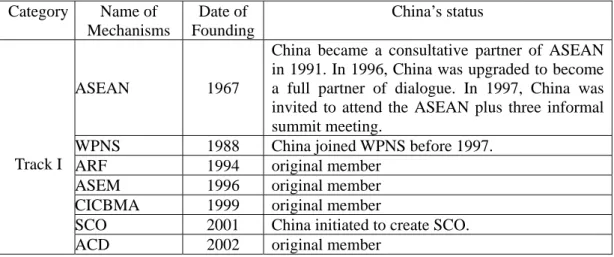
a support, not a threat, to the status quo in East Asia.34 China has at least four purposes for joining multilateral security mechanisms in East Asia. First, China hopes to weaken Washington’s bilateral alliance system in the region.35 Beijing believes that Washington’s purpose in maintaining alliances and continuing its military presence in East Asia after the collapse of the Soviet Union is to contain China. Therefore, Beijing supports multilateralism to replace the US-led alliance system which is based on bilateral military alliances. Second, Beijing wants to make sure that multilateral mechanisms will not pass any resolution against China.36 China can not ignore the fact that multilateral security mechanisms have mushroomed in East Asia in the post-Cold War era. It realizes that multilateral diplomacy has become more important than ever.37 Beijing is afraid that it will become more isolated if it is excluded from these mechanisms. By joining these organizations, China is able to participate in making the rules of game and prevent hostile countries from forming a united front against China. Third, China believes that the “unfair and irrational old international political and economic order has not been fundamentally changed.”38 To actively participate in multilateral diplomacy is a means for China to establish a “fair and reasonable international political and economic new order.”39 Fourth, Beijing would like to increase its diplomatic influence and to reduce the China threat theme among the states in the region. Currently, China has already joined all of the multilateral security mechanisms in the Asia Pacific (see Table 1).
Table 1: China’s participation in the Asia-Pacific security mechanisms
Category Name of Mechanisms Date of Founding China’s status ASEAN 1967
China became a consultative partner of ASEAN in 1991. In 1996, China was upgraded to become a full partner of dialogue. In 1997, China was invited to attend the ASEAN plus three informal summit meeting.
WPNS 1988 China joined WPNS before 1997.
ARF 1994 original member
ASEM 1996 original member
CICBMA 1999 original member
SCO 2001 China initiated to create SCO.
Track I
ACD 2002 original member
34
Zhao Xiaochun, “The Impact of the China Threat Theory on Our Country’s Surrounding Environment and Our Policy,” School of International Relations Journal (Beijing), February 1995, p. 13.
35
Bates Gill, “China’s New Security Multilateralism and Its Implications for the Asia-Pacific Region,” in SIPRI
Yearbook 2004: Armaments, Disarmament and International Security (Oxford: Oxford University Press, 2004),
Chapter 6. 36
Banning Garret and Bonnie Glaser, "Multilateral Security in the Asia-Pacific Region and Its Impact on Chinese Interests: Views from Beijing," Contemporary Southeast Asia, Vol. 16, No. 1 (July 1994), p. 15.
37
Liu Hua-qiu (Director of the Central Committee’s Foreign Affairs Offixingshi he woquo de duiwai gongzuo” (Independent foreign policy of peace has a strong life— international situation and our country’s work with other countries), Qiushi Journal, No. 1, 2005.
38
Ministry of Foreign Affairs of the People’s Republic of China, “China’s Views on the Current international Situation,” September 19, 2003, in http://www.fmprc.cn/eng/wjb/zzjg/zcyjs/xgxw/t24940.htm, accessed on 2004/11/10.
39
“Waijiaobu fayanren tan 2000 nian zhongguo waijiao” (Foreign Ministry’s Spokesman Talks about China’s Foreign Relations in 2000), accessed on 2000/11/07.
Six Party Talks 2003 China is its original member. China has so far hosted all of its meetings.
Shangri-La Dialogue
2002 Sent a lieutenant general to attend the 2002
Shangri-La Dialogue
WMPCSCS 1990 China joined it in 1991.
NEACD 1993 original member
Track II
CSCAP 1993 China formally joined it in December 1996.
3. Beijing’s position toward the Asia-Pacific security mechanisms
Generally, China still sticks to traditional concept of sovereignty, and is afraid that multilateral mechanisms might intrude into its domestic affairs.40 Similarly, Beijing is afraid that the issues of Taiwan and the South China Sea conflict might be brought to those security mechanisms for discussion and China might be forced to compromise under pressure from the majority. Beijing prefers bilateralism to multilateralism in dealing with conflicts with its counterparts. It believes that bilateral talks are more effective than multilateral dialogues to solve conflicts. It emphasizes that most conflicts are bilateral in nature, and discussing conflicts in multilateral mechanisms is not helpful in finding a solution. On the contrary, it will complicate the problems. More importantly, Beijing believes that multilateral security mechanisms will provide channels for western countries to intervene in China’s domestic affairs or become a tool for certain great powers to suppress China.41
China began to feel comfortable with multilateralism after 1997. Earlier it perceived that East Asian multilateral security organizations were created to constrain China, and Beijing was also concerned that those mechanisms might be dominated by the United States. Beijing at the beginning was not enthusiastic to participate in the Asia-Pacific multilateral security mechanisms. It insisted on two conditions for participating in those mechanisms:
• Those organizations should not intervene in domestic affairs. The issues of Taiwan, Tibet, and China’s human rights should be excluded from discussion or dialogues. On July 25, 1994, China’s Foreign Minister Qian Qichen pointed out in his speech to the ARF’s annual meeting in Bangkok that CBMs and preventive diplomacy can not be used to solve a country’s domestic problems.42 CBMs and preventive diplomacy are pushed by the ARF to reduce tension and maintain stability in the region. Qian wanted to make sure that the Taiwan issue would not be included on ARF’s agenda in the future. Due to Beijing’s opposition, Taiwan is excluded from all of the first-track multilateral security mechanisms in the region.
• Beijing supports the principles of gradualism, consensus, and minimum institutionalization. For instance, Qian Qichen mentioned in his speech at the second annual meeting of ARF in
40
Michael Leifer, "China in Southeast Asia: Interdependence and Accommodation," in David S. G. Goodman and Gerald Segal (eds.), China Rising: Nationalism and Interdependence (London: Roultedge, 1997), p. 165. 41
Qian Wenrong, “Alliance and Alignments in the Asia Pacific: Foundations for Stability or Seeds of Disaster?” paper presented to the 12th Asia-Pacific Roundtable, May 31-June 4, 1998, Kuala Lumpur, p. 12.
42
Brunei on August 1, 1995 that “China supports the promotion of regional security cooperation in different stages based on the spirit of beginning with the easier one and seeking similarity and retaining the difference.”43 China’s defense white paper in 2000 also pointed out that “China supports conducting multi-pattern, multi-level, and multi-channel regional security dialogues and cooperation based on the principles of equal participation, consensus building, seeking similarity and retaining the difference, and gradualism.”44
However, Beijing’s attitude toward participating in multilateral security mechanisms has changed from passive to active. For instance, China’s president Jiang Zemin mentioned in his report to the CCP’s 15th Party Congress that China “will actively participate in multilateral diplomacy.” In his report to CCP’s 16th Party Congress, Jiang Zemin again listed “the active participation in multilateral activities” as the fourth priority in China’s foreign affairs.45 With the change of its diplomatic thinking, China took the initiative to co-host with the Philippines the ARF’s intersessional support group on CBMs meeting in Beijing in early March 1997. This was the first time that China hosted a multilateral security meeting. China even took the initiative to launch the “Shanghai Process” for confidence building measures with central Asian countries and Russia leading to the creation of the Shanghai Cooperation Organization in June 2001. In addition, China is the most active player in the “Six-Party Talks.” It coordinates among the participating countries, the United States, two Koreas, Russia, and Japan, and has hosted every round of the talks aimed at peacefully solving North Korea’s nuclear issue.
Beijing changed its attitude because it found that it could use multilateral mechanisms to serve China’s national interest. As Harry Harding points out, “China remained skeptical of multilateralism, especially in the security realm… Increasingly, however, Beijing’s seems to be aware of the benefits of various kinds of multilateral organizations.”46 First, the way the mechanisms operate meets the principles set by Beijing.
Second, they provide China with important forums for international propaganda. On one hand, Beijing can use the forums to promote a peace-loving image of China, while at the same time it can use the meetings to criticize the United States’ alliance system in this region and to isolate Taiwan. China’s representatives to international meetings emphasize the five principles for coexistence as their basis for conducting diplomacy, the defensive nature of China’s military strategy, and China’s peaceful rise, while indirectly criticizing Washington’s Cold War thinking (including the military alliance system in the region, interventionism, and the containment strategy against China).
Third, participation in multilateral mechanisms can increase China’s international influence and strengthen China’s great power status. That the United State sidelined the United Nations in
43
People’s Daily, August 2, 1995, p. 6.
44
“China Defense White Paper 2000,” in http://www.china.org.cn/ch-book/2000guo6.htm 45
http://www.fmorc.gov.cn/chn/zibao/wzzt/2319/t10855.htm 46
Harry Harding, “China and the International Order,” remarks to the Open Forum, Washington, D.C. on April 3, 2002, in http://www.state.gov/s/p/of/proc/tr/11589.htm, accessed on 2004/11/29
order to use force against Iraq in 2003 reminded Beijing that outside the international organizations, in particular the UN, China will lose its influence on many international issues. International mechanisms, especially the UN, can check Washington’s unilateralism and interventionism. China seems to become the leading advocate of multilateralism in the 21st century, especially after the second Gulf War in 2003. For example, China’s foreign minister Lee Zhaoxing mentioned in his talks to the 58th UN General Assembly on September 25, 2003 the importance of “walking the road of multilateralism” in maintaining world peace.47
Fourth, Beijing cannot ignore the surge of multilateralism in the region. For instance, there were more than eighty multilateral conferences, symposiums, and workshops scheduled in 1996 to discuss Asia-Pacific security issues.48 If China rejected joining these mechanisms, it would have risked in being isolated and losing diplomatic influence.
Finally, as Evelyn Goh and Amitav Acharya point out, to conduct multilateral diplomacy helps Beijing understand how other countries think about China. 49 It helps China internationalize its diplomacy and make correct policies.
4. China’s participation in the ARF and the SCO
A study of China’s participation in the ARF and the SCO is helpful to understand the evolution of its attitude toward multilateralism. In January 1992, ASEAN’s fourth summit meeting was held in Singapore and it passed the Singapore Declaration, supporting the idea of using the ASEAN Post-Ministerial Conference (ASEAN-PMC) as the forum for political and security dialogue. In July, ASEAN held its 26th Ministerial Conference in Singapore and it passed a resolution to affirm the use of ASEAN-PMC as the forum for security dialogue and named it the ARF. The use of ASEAN-PMC as a vehicle to discuss security issues was a convenient choice and a compromise between different countries in the region.
The ASEAN-PMC was the only mechanism to include all of the big powers in the region. The United States and Japan had been ASEAN’s dialogue partners since the 1970s, and Russia and the PRC became consultative partners to ASEAN in 1991. The United States had expressed its support of ASEAN-PMC as a forum for security dialogue and promised that it would fully participate.50 ASEAN-PMC was acceptable to the PRC because it was not dominated by the western powers. As far as ASEAN was concerned, the group could enhance its influence in the
47
“Lee Zhaoxing lienda fayan shushing jiachian lianheguo zuoyung bing wi wuda jianyi (Lee Zhaoxing spoke at the UN General Assembly suggesting to strengthen the function of the United Nations and making five major
suggestions,” September 25, 2003, http://www.chinanews.com.cn/n/2003-09-25/26/350504.html, accessed 2005/2/14.
48
Ralph A. Cossa, “Multilateralism, Regional Security, and the Prospects for Track II in East Asia,” NBR Analysis (The National Bureau of Asian Research), Vol. 7, No. 5 (December 1996), p. 25.
49
Evelyn Goh and Amitav Acharya, “The ASEAN Regional Forum and US-China Relations: Comparing Chinese and American Positions,” paper prepared for the Fifth China-ASEAN Research Institutes Roundtable on
“Regionalism and Community Building in East Asia,” organized by University of Hong Kong on October 17-19, 2002.
50
Winston Lord’s statement before the Senate Foreign Relations Committee on March 31, 1993; and Pauline Kerr, “The Security Dialogue in the Asia-Pacific,” The Pacific Review, Vol. 7, No. 4 (1994), p. 402.
region by gaining control over the ARF’s agenda and administration. In the past ten years, the number of ARF’s members has increased from eighteen to twenty-three.51 Cambodia joined in 1995, India and Burma in 1996, Mongolia in 1999, North Korea in 2000, and Pakistan in 2004. Taiwan is the only East Asian country excluded from the organization.
ARF meetings are held annually in late July or early August and are conducted at the foreign minister level. The ASEAN members take turns hosting the annual meeting. The principal ARF documents are the Chairman’s statements issued after every ARF meeting. The ARF is supported by the ARF Senior Officials Meeting (ARF-SOM) which meets in May every year. In the second ARF Ministerial Meeting, the participants agreed to establish Inter-sessional Meetings (ISMs) and the Inter-sessional Support Group (ISG) to support the ARF-SOM. The former focuses on confidence building, in particular, dialogue on security perceptions and defense policy papers; the latter focuses on cooperative activities. The ISG and the ISMs are co-chaired by ASEAN and non-ASEAN members. However, the Concept Paper that was attached to the first ARF chairman’s statement pointed out that “in the initial phase of ARF no institutionalization is expected nor should a secretariat be established in the near future.”52 ASEAN will provide the necessary support to sustain ARF activities.
The operation of ARF is based on the ASEAN Way which has the following six features: (1) it is unstructured, with no clear format for decision-making or implementation; (2) it often lacks a formal agenda, issues are negotiated as and when they arise; (3) it is an exercise in consensus-building; (4) decisions are made on the basis of unanimity; (5) decision-making can be a lengthy process without a fixed timetable because of the need for consensus; (6) it is closed and lacks transparency.53
ARF’s strategy to promote peace and security in the region is based on the following four principles: (1) A comprehensive concept of security. The topics for discussion have been expanded to include both military, political, economic, and social issues.54 (2) A gradual evolutionary approach. ARF divides its task into three stages: promotion of confidence-building measures, development of preventive diplomacy mechanisms, and development of
51
The original eighteen members are Australia, Brunei, Canada, China, European Union (Presidency), Indonesia, Japan, Laos, Malaysia, New Zealand, Papua New Guinea, Philippines, South Korea, Russia, Singapore, Thailand, United States, and Vietnam.
52
The ASEAN Regional Forum: A concept Paper. 53
Mak Jun Nom, “The ASEAN Process (`Way’) of Multilateral Cooperation and Cooperative Security: The Road to a Regional Arms Register?” paper prepared to the MIMA-SIPRI Workshop, Kuala Lumpur, October 2-3, 1995. Quoted in Paul M. Evans, “Assessing the ARF and CSCAP,” paper presented to the Inaugural Conference of Asia-Pacific Security Forum, sponsored by Institute for National Policy Research and the Pacific Forum CSIS, Taipei, September 1-3, 1997, p. 4.
54
For instance, in the third ARF meeting in Jakarta on July 23, 1996, the Foreign Ministers agreed to consider at the next ARF meetings the question of drug trafficking and other trans-national issues, such as money laundering. In the fifth ARF meeting in Manila on July 27, 1998, the East Asian financial crisis was discussed. After the September 11, 2001 terrorist attack of the World Trade Center in New York, counter-terrorism has become a primary issue for discussion in ARF ministerial meetings. See Chairman’s Statement, The Second ASEAN Regional Forum, Brunei Darussalam, 1 August 1995; Chairman’s Statement, The Third ASEAN Regional Forum, Jakarta, 23 July 1996; Chairman’s Statement, The Fifth Meeting of The ASEAN Regional Forum, Manila, 27 July 1998; and Chairman’s Statement, The Eleventh Meeting of ASEAN Regional Forum, Jakarta, July 2, 2004.
conflict-resolution mechanisms.55 It emphasizes that it should progress at a pace comfortable to all participants and should not move “too fast for those who want to go slow and not too slow for those who want to go fast”.56 (3) The principle of consensus. The Chairman’s Statement at the 2nd ARF meeting emphasized that “decisions of the ARF shall be made through consensus after careful and extensive consultations among its entire participant.”57 In other words, every member has power to veto any resolution proposed to ARF. (4) The principle of volunteerism. ARF encourages its participants to engage in dialogues and consultations on political and security cooperation, to submit an annual statement of their defense policy to ARF, to increase high level contacts and exchanges between military academies, staff colleges and training, and to increase participation in the UN conventional Arms Register.58 However, ARF does not have power to force its members to carry out those policies.
Beijing should feel quite comfortable with those ARF principles because without its agreement, ARF is unlikely to pass any resolution to hurt China’s national interest. Even if ARF passes a resolution, China still has the free choice whether it wants to carry it out and ARF has no power to force China to do so.
China promised that it would take an active part in ARF,59 and indeed, its participation in the organization has been increasing. In the beginning, China took a cautious approach to ARF, not hosting any meeting in its first three years, but from its first in March 1997 to the end of 2004, it had hosted nine ARF meetings in Beijing.60 Beijing supports ARF because ARF’s way of operation, namely informal dialogue, no interference in domestic affairs, consultation and consensus, volunteerism, gradual expansion, and minimum institutionalization, perfectly meets China’s principles. In addition, China uses ARF as a forum to promote its diplomatic thinking. For instance, at the ARF annual meeting in Singapore on July 26, 1999, China’s foreign minister Qian Qichen sent Taiwan and East Asian countries a warning that China would not set idly by should the island try to secede from China following President Lee Teng-hui’s July 9th remarks that “the relationship between Taiwan and China is a state to state, at least a special state-to-state relationship.”61 Qian also made use of this occasion to win support and sympathy for China regarding the United States’ accidental bombing of the Chinese embassy in Belgrade on May 8, 1999.
ARF has been criticized as a “talk shop” because it is not institutionalized and it lacks the power of enforcement. For instance, Michael Leifer argued that ARF would not be able to fulfill its basic role to enhance peace in the region;62 Sheldon W. Simon suggested that ARF was just a
55
The ASEAN Regional Forum: A Concept Paper, p. 2. 56
Ibid., p. 7. 57
Chairman’s Statement, The Second ASEAN Regional Forum, Brunei Darussalam, 1 August 1995. 58
Ibid. 59
People’s Daily, August 1, 2002.
60
http://www.aseansec.org/16290.htm, accessed 2004/11/30. 61
People’s Daily, July 27, 199, p. 6.
62
“talk shop;”63 and Robyn Lim stated that ARF was built on sand.64 Some ARF members such as Japan, Australia, and Canada want a better-institutionalized mechanism that can effectively deal with regional contingencies. But China has opposed a fast-track approach and any measure which could entail interference in its domestic affairs.65 Although Beijing has discovered that ARF can be used to serve China’s interest, it has no intention of strengthening ARF’s function.
China’s participation in the ARF mirrors the change of its position from passive to active toward the multilateral security mechanisms. But, China’s attitude toward the Shanghai Cooperation Organization is quite different.
The SCO is the first international security organization named with a Chinese city. It was created on June 15, 2001 by China, Russia, Kazakhstan, Kyrgyzstan, Tajikistan, and Uzbekistan. The SCO’s predecessor, the “Shanghai Five,” was formed on April 26, 1996 when the heads of state of China, Russia, Kazakhstan, Kyrgyzstan, and Tajikistan met in Shanghai. The Shanghai Five was originally a confidence-building measure to delimit military deployment or demilitarize among China and the other four member states in the border areas, thereby preventing conflict. For instance, the five states reached agreements to regulate military exercises, to promote military exchanges, and to reduce military forces in the border areas.66 But, the function of the Shanghai Five was expanded to cover economic cooperation and the fight against secessionism, religious extremism, and terrorism. The Shanghai Five became the SCO when Uzbekistan joined as a new member. According to the “Declaration on the Establishment of the Shanghai Cooperation Organization,” the SCO’s purposes are: to strengthen mutual trust and good relations among member states; to promote cooperation in economy, trade, and other areas, scientific-technical, cultural, and educational; to preserve and safeguard regional peace, security, and stability; and to establish a new international political and economic order.67 The Declaration also makes it clear that the member states will cooperate to combat terrorism, separatism, and extremism. Extremism is defined as “an act aimed at seizing or keeping power through the use of violence or changing violently the constitutional regime of a state, as well as a violent encroachment upon public security, including organization, for the above purposes, of illegal armed formations and participation in them, criminally prosecuted in conformity with the national laws of the parties.”68 The extremism here mainly refers to Moslem fundamentalism.
63
Sheldon W. Simon, “ASEAN Regional Forum,” in William M. Carpenter and David G. Wiencek (eds.) Asian
Security Handbook: An Assessment of Political-Security Issues in the Asia-Pacific Region (Armonk, New York:
M.E.Sharpe, 1996), p. 48. 64
Robyn Lim, “The ASEAN Regional Forum: Building on Sand,” Contemporary Southeast Asia, Vol. 20, No. 2 (August 1998), pp. 115-136.
65
Tan See Seng, Ralf Emmers, and Mely Caballero-Anthony, “Multilateralism Matters in the Asia Pacific:
Presenting a New Agenda for the ASEAN Regional Forum,” Journal of the Singapore Armed Forces, Vol. 28, No. 4 (October-December 2002), in http://www.mindef.gov.sg/safti/pointer/back/journals/2002/Vol28_4/3.htm, accessed 2004/11/19
66
Qingguo Jia, “The Success of the Shanghai Five: Interests, Norms and Pragmatism,” in http://www.ndu.edu/inss/symposia/ pacfic2001/jiafinal.htm, accessed 2005/3/7.
67
“Declaration on the Establishment of the Shanghai Cooperation Organization,” June 15, 2001, in http://www.sectsco.org/news_detail.asp?id=88&LanguageID=2, accessed 2005/3/7.
68 Ibid.
It is well-known that China faces the challenge from the ethnic Islamic self-determination movement in Xinjiang. The SCO is a tool for China to crush the militant Islamic secessionist movement and prevent its external support from neighboring Central Asian states. The SCO also increases China’s influence in the region and helps China secure the oil supply from Central Asian states and the pipeline from Russia. Some observers believe that one of the purposes of the Shanghai Five or the SCO is “to counter U.S. influence in Asia.”69 Beijing perceives that Washington’s strategy is to contain China and to prevent China from becoming a superpower. To Beijing, the SCO, if well developed, can be an important mechanism to confront “American hegemony and its expansion” in Central Asia.70
However, U.S. military presence and its new ties with Kyrgyzstan, Tajikistan, and especially Uzbekistan after the 9/11 attacks have been regarded as a new challenge to the SCO and “a hindrance” to China’s strategic objectives of dominating Central Asia.71 Therefore, China has made great efforts to keep the organization more coherent. For instance, Beijing supported the SCO establishment of an anti-terrorist center in Bishkek of Kyrgyzstan in 2001, proposed setting up an SCO free trade zone, and pushed for the creation of a Beijing-based secretariat in 2004. In addition, the SCO members except Uzbekistan held anti-terrorism exercises and shared intelligence about terrorism.
Clearly, Beijing adopts different policies toward the ARF and the SCO. It does not support the institutionalization of the ARF, but it initiated the creation of a secretariat for the SCO. Moreover, as mentioned above, Beijing does not intend to strengthen the ARF’s function, but pushed to transfer the SCO into a semi-alliance. ARF belongs to the category of international organizations in which China’s participation tends “to be reluctant and defensive;”72 because, Beijing has no control over the ARF’s agenda and is still suspicious of the organization. In addition, the United States which is a much stronger power than China is a member of ARF and attracts more attention from other members. The SCO was created based on China’s idea, and is a quite different case. The United States is not a member. Russia is China’s peer as a power and the two countries have developed a semi-allied relationship in the past decade. Beijing has played a dominant role in setting the SCO’s agenda, and has a clear idea to use the SCO to pursue its national security goals. The SCO case shows that Beijing can be very active and supportive in multilateral security mechanisms and even take the initiative to create new mechanisms or to push for their institutionalizations, if these can really serve China’s national
69
See, for example, Bates Gill, “Shanghai Five: An Attempt to Counter U.S. Influence in Asia?” Newsweek Korea, May 4, 2001; and Andrew Higgins, “Bloc Including China, Russia Challenges U.S. in Central Asia: Members Agree to Combat Militant Islamic Groups and Share Intelligence,”
The Wall Street Journal, June 18, 2001.
70
Sean L. Yom, “Power Politics in Central Asia: The Future of the Shanghai Cooperation Organization,” Harvard
Asia Quarterly, Vol. VI, No. 4 (Autumn 2003), in http://www.fas.harvard.edu/~asiactr/haq/200204/0204a003.htm,
accessed 3/8/2005. 71
Robert M. Cutler, “U.S. Intervention in Afghanistan: Implications for Central Asia,” Foreign Policy in Focus, November 21, 2001.
72
Ok-Nim Chung, “Solving the Security Puzzle in Northeast Asia: A Multilateral Security Regime,” CNAPS Working
interest.
5. China’s multilateralism and the Asia-Pacific security
China is still the most uncertain factor in Asia-Pacific security because, as mentioned above, it is a party in the three major conflicts in the region. In addition, China might challenge the status quo in the region as its power increases. Beijing’s cooperative behavior in the multilateral security mechanisms surely helps reduce East Asian countries’ fear of China. However, to many observers and most Asia-Pacific countries, it is still uncertain whether China can act in accordance with the norms of international organizations and become a responsible regional power.73
Some scholars point out that China’s foreign behavior has changed. For instance, Samuel S. Kim who studies China’s attitude toward the United Nations suggests that China’s attitude has changed from a system-transforming approach in the 1960s when it was excluded from the UN to a system-reforming approach in the 1970s.74 China’s position further changed into a system-maintaining approach in the 1980s. The process evolved from negating the UN in the 1960s, to alienating and selectively participating in the UN in the 1970s, to completely cooperating with the UN in the 1980s. Sydney D. Bailey and Sam Daws also suggest that China become a normal UN member in the mid-1980s.75 Today, one can also say that China has become a normal participant in all of the Asia-Pacific multilateral security mechanisms.
China has made great efforts to improve its image. For instance, Beijing proposed a new security concept to the ARF in July 2002. It emphasized that the core of this new security concept includes “mutual trust, mutual benefit, equality and coordination”,76 and suggested that “all countries should seek peaceful settlement of their disputes through negotiation and carry out wide-range cooperation on security issues of mutual concern so as to remove any potential dangers and prevent the outbreak of wars and conflicts.”77 In addition, it advocates a good neighbor policy. It provided aid to Thailand in the 1997 financial crisis in East Asia, cancelled Cambodia’s debt to China, and is working on the establishment of a free trade zone with the ASEAN.
Nevertheless, most of the Asia-Pacific countries still lack confidence in China. Some scholars suggest that China’s adjustment is only a strategy to buy time before it becomes a real superpower. They argue that the nature of China’s behavior has not changed for the following reasons. First, China still pursues national interest at the expense of world peace and stability. A
73
Rosemary Foot, “China in the ASEAN Regional Forum: Organizational Processes and Domestic Modes of Thought,” Asian Survey, Vol. XXXVIII, No. 5 (May 1998), p. 426.
74
Samuel S. Kim, “China and the United Nations,” in Elizabeth Economy and Michel Oksenberg (eds.), China Joins
the World: Progress and Prospects (New York: Council on Foreign Relations Press, 1999), pp. 45-46.
75
Sydney D. Bailey and Sam Daws, The Procedure of the UN Security Council, 3rd edition (Oxford: Clarendon Press, 1998), p. 186.
76
People’s Daily, August 1, 2002.
77 Ibid.
study of China’s voting behavior at the United Nations shows that China did not support three kinds of UN peacekeeping operations (PKOs): (1) PKOs in countries diplomatically recognizing Taiwan; (2) PKOs about humanitarian assistance; and (3) PKOs that Beijing views as intervention in domestic affairs.78 China even vetoed some of the PKOs.
Second, Beijing still stubbornly sticks to the concept of traditional sovereignty. In addition, China’s nationalism soars, not declines, as Beijing speeds up its economic development. China’s hardened its position on Taiwan is an example. China believes that it can delink its peaceful rise with the use of force to solve the Taiwan issue. The rise of nationalism has pushed China to take a hard-line diplomatic policy when facing an external threat. If it is necessary, China will not hesitate to enter a war.
Third, China has continued its military buildup during a time of peace. China’s defense budget has increased by double digits in almost every year since 1989. In addition, China currently emphasizes the buildup of its air force and second artillery and is trying to transform itself into both a land and sea power. Some Chinese scholars point out that China must take over Taiwan because the island is strategically important if China is to become a real sea power. If China successfully becomes a sea power, it will challenge the United States and endanger Japan’s national security.
Fourth, China is still an authoritarian communist country, but social forces, which have been gaining their strength because of the continuing economic development, might challenge the regime in the future. In order for the CCP to remain in power, the Chinese communist regime needs to make sure that the military are loyal to the party and support the state. The civilian leaders of the third and fourth generations, who have no strong military ties, tend to make concessions to the military. [[The PLA, whose influence is increasing in the decision making process has successfully pushed the Chinese leadership to harden its policy toward Taiwan. That Beijing refuses to renounce the use of force to solve the Taiwan issue dilutes its efforts to crate an image of a status-quo and peace-loving power.
Fifth, multilateral security mechanisms have little impact on China’s behavior because those mechanisms can not enforce their resolutions and frequently succumb to China’s pressure. For instance, those mechanisms shy away from discussing China’s human rights and the Taiwan issue. China remains a major human rights abuser, uninterested in democratic reforms, and an increasing military threat to Taiwan as demonstrated by the new “anti-secession law”.79
Therefore, East Asian countries, especially China’s neighbors, do not rely on multilateral security mechanisms for their national security because these mechanisms lack the power of enforcement. If China chooses to ignore any resolution passed by security mechanisms, it will be free of punishment. Asia-Pacific countries adopt traditional strategy—military buildup and
78
Wen-cheng Lin, “China’s Participation in the United Nations’ Peacekeeping Operations,” Cross-Strait and
International Affairs Quarterly, Vol. 1, No. 1 (January 2004), pp. 1-30.
79