行政院國家科學委員會專題研究計畫 成果報告
不完全語意偏好群體決策模式提升決策品質之建構
研究成果報告(精簡版)
計 畫 類 別 : 個別型
計 畫 編 號 : NSC 99-2410-H-151-020-
執 行 期 間 : 99 年 08 月 01 日至 100 年 07 月 31 日
執 行 單 位 : 國立高雄應用科技大學國際企業系
計 畫 主 持 人 : 王天津
計畫參與人員: 碩士班研究生-兼任助理人員:郭淑惠
博士班研究生-兼任助理人員:彭淑珍
報 告 附 件 : 出席國際會議研究心得報告及發表論文
處 理 方 式 : 本計畫涉及專利或其他智慧財產權,2 年後可公開查詢
中 華 民 國 100 年 10 月 30 日
行政院國家科學委員會補助專題研究計畫
;
成 果 報 告
□期中進度報告
不完全語意偏好群體決策模式提升決策品質之建構
計畫類別:
;
個別型計畫 □整合型計畫
計畫編號:
NSC 99-2410-H-151 -020
執行期間:
99 年 08 月 01 日至 100 年 07 月 31 日
執行機構及系所:
國立高雄應用科技大學
計畫主持人:
王天津
共同主持人:
計畫參與人員:
成果報告類型(依經費核定清單規定繳交):
;
精簡報告 □完整報告
本計畫除繳交成果報告外,另須繳交以下出國心得報告:
□赴國外出差或研習心得報告
□赴大陸地區出差或研習心得報告
;
出席國際學術會議心得報告
□國際合作研究計畫國外研究報告
處理方式:
除列管計畫及下列情形者外,得立即公開查詢
□涉及專利或其他智慧財產權,□一年□二年後可公開查詢
中 華 民 國
100 年 10 月 30 日
國科會補助專題研究計畫成果報告自評表
請就研究內容與原計畫相符程度、達成預期目標情況、研究成果之學術或應用價
值(簡要敘述成果所代表之意義、價值、影響或進一步發展之可能性)
、是否適
合在學術期刊發表或申請專利、主要發現或其他有關價值等,作一綜合評估。
1. 請就研究內容與原計畫相符程度、達成預期目標情況作一綜合評估
□
;
達成目標
□ 未達成目標(請說明,以
100 字為限)
□ 實驗失敗
□ 因故實驗中斷
□ 其他原因
說明:
本研究之成果及貢獻:
1、 建構一個模糊不完全語意偏好群體決策模式:可以適合實際生活,避免決策者做成對比較時可 能因時間壓力、欠缺完整資料、或並非具備此專業知識甚至決策過程中提供的資訊不確實等問 題。 2、 應用此模式策略可以群體決策專家群組與專家數可以彈性選擇,符合複雜多變的環境。 3、 應用此模式策略評估準則權重及進行方案最佳化評估。 4、 使用AHP方法比較若有n
個因素,需比較n n
(
−
1) 2
,建構不完全語意偏好群體決策模式只要1
n
−
,可以增進效率,提升決策品質。 5、 使決策領域添增一項評估模式,讓多元複雜的社會有更科學的決策模式可以提供更多元化、廣 泛性的決策工具。2. 研究成果在學術期刊發表或申請專利等情形:
論文:
;
已發表 □未發表之文稿 □撰寫中 □無
專利:□已獲得 □申請中
;
無
技轉:□已技轉 □洽談中
;
無
其他:(以
100 字為限)
Ying-Hsiu Chen, Tien-Chin Wang and Chao-Yen Wu (2011), “Strategic decisions using the fuzzy PROMETHEE for IS outsourcing,” Expert Systems with Applications, Vol.38, pp.13216-13222.
(SCI,EI)
<NSC 99-2410-H-151-020>Tien-Chin Wang and Ying-Hsiu Chen (2011), “Fuzzy multi-criteria selection among transportation companies
with fuzzy linguistic preference relations,” Expert Systems with Applications, Vol.38, pp.11884-11890.
(SCI,EI)
<NSC 99-2410-H-151-020>Tien-Chin Wang, Su-Hui Kuo, Truong Ngoc Anh and Li Li (2011), “Forecast the foreign exchange rate between Rupiah and US Dollar by applying Grey Method,” 2011 International Conference on Data Engineering and Internet Technology (DEIT 2011), 15-17 March 2011, Bali, Indonesia, pp.550-553.
(EI)
(NSC99-2410-H-151-020) (擔任研討會主持人)
W.T. Chen, F.C. Lu, J. C. Tsai, T.C.Wang and S.M.Lin (2010), “Measuring the success possibility of implementing the Oceanographic & Meteorologic Integration Orchestrator,” 2010 International Conference on Remote Sensing (ICRS 2010), Hangzhou, China, October 5-6, 2010, pp.311-314.
(EI)
3. 請依學術成就、技術創新、社會影響等方面,評估研究成果之學術或應用價
值(簡要敘述成果所代表之意義、價值、影響或進一步發展之可能性)(以
500 字為限)
本研究旨在利用不完全語意偏好群體決策模式提升全面決策品質,使決策者於選擇準則權重、方案優 先順序時可以彈性選擇群組與人數,並於矩陣成對比較時,可以透過不確定語意偏好相加關係快速轉 換為明確決策矩陣,避免決策過程中決策者(單位)可能由於時間壓力、欠缺完整資料、或並非具備此 專業知識甚至提供的資訊不確實難以取得資訊的問題,更可以彈性運用直向 (Horizontal)、橫向 (Vertical)、斜向 (Oblique)三種演算規則。決策矩陣成對比較(pairwise comparison) 時不需如層級分析 法 (AHP)必須針對偏好決策矩陣三角形上半部做兩兩比較,此模式容許每位決策專家自由選擇一個明確指標進行兩兩比較,當有
n
個準則時,只需透過n
−
1
次成對比較即可快速求得完整矩陣,比傳統AHP 需比較
n n
(
−
1) 2
次大大增進了效率,避免當層級數增加,導致效率降低及不一致性等問題,大大提升決策品質。本研究所建構之不完全語意偏好群體決策模式之建構可以廣泛應用到各領域作為後 續研究者之參考依據。
國科會補助專題研究計畫項下出席國際學術會議心得報告
日期:100 年 10 月 30 日一、參加會議經過:
參加在
Indonesia 的 Bali 舉辦的研討會,該研討會為 EI 引用,
有多國學者發表論文。
二、與會心得:
三、考察參觀活動(無是項活動者略)
四、建議:
國內大學應該模仿該研討會在國內舉辦。
五、攜回資料名稱及內容:
論文集與論文光碟。
六、其他
計畫編號
NSC 99-2410-H-151 -020
計畫名稱
不完全語意偏好群體決策模式提升決策品質之建構
出國人員
姓名
王天津
服務機構
及職稱
國立高雄應用科技大學
會議時間
2011 年 3 月 15 日至2011 年 3 月 17 日會議地點
Bali, Indonesia
會議名稱
(中文)
(英文)
2011 International Conference on Data Engineering and Internet Technology (DEIT 2011),發表論文
題目
(中文)
(英文)
Forecast the foreign exchange rate between Rupiah and US Dollar by applying Grey MethodA framework for decision quality enhancement under group decision making
with incomplete linguistic preference relations
Tien-Chin Wang (
王天津)
計畫編號:
NSC 99-2410-H-151 -020
執行期間:
99 年 08 月 01 日至 100 年 07 月 31 日
Abstract - This study proposes an incomplete linguistic
preference relation approach to help the decision makers determine the importance weights of criteria, select the optimal alternative and improve the decision making quality under an environment where the decision makers can choose groups and experts with flexibility. This study not only applies Multi-Criteria Decision Making with Incomplete Linguistic model and uses horizontal, vertical and oblique pairwise comparison algorithms to construct but also expansion group
decision making model. This method considers only n− 1
judgments, whereas the traditional analytic hierarchy approach
(AHP) takes n n( −1) / 2 judgments in a preference matrix
with n elements. Experts obtain the matrix by choosing a
finite and fixed set of alternatives and perform a pairwise comparison based on their different preferences and knowledge; it is easily led to the reduction of efficiency and the result of inconsistency. This paper Decision Matrix of Preference Relation includes independent and group decision making. Uses uncertain additive linguistic preference relations to transform Group decision making Matrix. When the decision maker is carrying out the pairwise comparison, the following problems can be avoided: time pressure, lack of complete information, the decision maker is lack of this professional knowledge, or the information provided is unreal and thus it is difficult to obtain information. This study uses the group decision making Matrix to select business location. The decision making assessment model that is established by this study can be extensively applied to every field of decision science and served as the reference basis for the follow-up scholars.
Keywords: Incomplete Linguistic Preference Relations, InlinPreRa, Group Decision Making, Restaurant location.
I. INTRODUCTION
Food is considered as far more important than anything else, and that the attributes of food and beverage include quality, portion size, presentation, taste, and variety of choices [1]. A restaurant is a place where provides food as well as provides service to individual customers [2]. To maximize the customer number and benefit, restaurant owners invest in various marketing expenditures, such as menu development, advertising, and customer relationship management. Customer expectation and service-quality perception in the restaurant service industry have revealed certain important attributes, such as low price, food quality, value for money, service, location, brand name, and image [3]. During the decision-making process, the good and bad alternatives can only be chosen through
comparison, since the things that need to be considered always have many complicated and uncertain factors, and there exist too many factors, in Incomplete Linguistic Preference Relations that is addressed by Xu [4], even through the decision-makers can have more choices and flexibility during the comparison process, the multi-criteria, multi-alternatives, and multi-decision-makers of decision making problems have not been included. Wang et al. [5] use horizontal, vertical and oblique pairwise comparison algorithms to construct a Multi-Criteria Decision Making with Incomplete Linguistic Preference Relations model. This even allows every decision expert to choose an explicit criterion or alternative for index unrestrictedly. When there are n th criteria, only n−1 times of pairwise
comparisons need to be carried out, then one can rest on Incomplete Linguistic For the sake of conforming to the general and actual decision making more, this paper purpose Multi-Criteria Decision Making with Incomplete Linguistic Preference Relations, one hopes to establish a reasonable and objective evaluation model that can be fit in the actual problems, so that the application scope can be more extensive, and it can serve as the reference and basis for the relevant evaluation group decision making model. There are many critical factors to be considered in the restaurant location selection; therefore this study applies the group decision making matrix preference relations to solve this multiple criteria decision making problem.
II. LITERATURE REVIEW
2.1 Multi-Criteria Decision Making with Incomplete Linguistic model
Xu introduced some basic notations and operational laws of linguistic variables in [6, 7, 8, 9]. The Algorithm Rules of Three Different Kinds of Pairwise Comparison Decision Making Matrices and the relevant definitions are as follows:
(1) Incomplete Linguistic Preference Additive Relation
Let A=(aij n n) × be linguistic preference relation, if A
is an incomplete linguistic preference relation, it counters the fact that decision makers can carry out pairwise comparison for attributes so as to satisfy Eq. (1)
0 0
, ,
ij ij ji ii
a ∈S a ⊕a =S a =S (1)
(2) Incomplete Linguistic Consistent Additive Preference Relation:
Let A=(aij n n) × be complete consistent additive
preference relation, which counters all of the i j k, ,
decision makers for pairwise comparison, if a >Sik 0
represents xi is better than xk ; while a >Skj 0
represents xk is better than xj, then a >Sij 0 can be derived the equation of xi better than xj is
=
ij ik kj
a a ⊕ a (2)
If a =Sij 0 , aij=0 represents xi and xj are the same, both of them can satisfy a =a =a =Sik kj ij 0.
(3) Decision Making Matrix Steps for Multi-Criteria Incomplete Linguistic Preference Relations Wang et al. introduced Multi-Criteria Decision Making with Incomplete Linguistic model. There are seven proceeding of steps.
Step 1: Confirm the evaluation criteria, decision making experts, and number of alternatives.
Step 2: Select the appropriate linguistic variables, their mapping values between [-t, t].
Xu(2006) in his evaluation process, which is shown in Table 1.
Table 1 Evaluation of linguistic variable
Linguistic value Linguistic value Extremely poor(EP) S−4 Extremely good(EG) S 4
Very poor(VP) S−3 Very good(VG) S3 Poor(P) S−2 Good(G) S 2 Slightly poor(SP) S−1 Slightly good(SG) S 1 Fair(F) S0
Step 3: Construct decision making group to sift evaluation criterion weight out
1w w,2 ,...,kw ,rw∈[0,1], and 1 1 k r r w = =
∑
(3) Step 4: Determine the weight of decision making expert(1), (2),..., ( )n w w w ,w( )e ∈[0,1], and ( ) 1 1 n e e w = =
∑
(4)Step 5: Utilize the algorithm rules of the preference relation’s pairwise comparison to integrate all of the decision makers’ evaluations towards all of the alternatives under each criterion.
Step 6: Integrate all of the alternatives’ evaluation values that are appraised by all of the decision making experts. Multiply the average preference matrix
( )
De of each expert by its corresponding expert weightw( )e , derives the decision making matrix are integration, which is represented by D :
(1) (1) (2) (2) ( ) ( ) ( ) ( ) 1 1 D D D ... D 1 D n n n e e e w w w n w n = ⎡ ⎤ = ⊗ + ⊗ + + ⊗ ⎣ ⎦ ⎡ ⎤ = ⎢ ⊗ ⎥ ⎣
∑
⎦ (5)Step 7: Rank all of the alternatives’ evaluation values so as to select the best evaluation result.
III. Research
3.1 Construct the Incomplete Linguistic Preference Relations based on Group Decision Making Matrix Pattern under A Fuzzy Environment
First, construct the general formula of decision making matrix. Given n decision making experts, where Eeis used to represent ( e=1,2,...,n ); with k evaluation criteria, where Cr is used to represent (r=1, 2,...,k); with m alternatives, where Ai is used to represent (i=1,2,...,m) in the evaluation process. Under this matrix, use rC( )e to represent the criterion weight, and use rD( )e to represent the decision making matrix. According to the above-mentioned, the first expert under rth criterion, the decision making matrix that is carried out for the mth alternative isrD( )1 r(1)
ij m m = a
× ⎡ ⎤
⎣ ⎦ ; and the expert under the rth criterion, the decision making matrix that is
carried out for mth alternative isrD( )n r n( ) ij m m
= a
×
⎡ ⎤
⎣ ⎦ ; therefore,
any expert e under rth criterion, the decision making matrix is carries out for mth alternative isrD( )e :
13 1 12 14 1 23 2 21 24 2 31 32 34 3 43 4 41 42 1 ( ) ( ) 1 2 3 4 ( ) ( ) ( ) ( ) 0 ( ) ( ) ( ) ( ) 0 ( ) ( ) ( ) ( ) 0 3 ( ) ( ) ( ) ( ) 4 0 ( 6 D A A A A A A ... A ... A ... A ... ... ... ... ... ... ... ... A m m m m m r e r e ij m m m r e r e r e r e r e r e r e r e r e r e r e r e r e r e r e r e r a a a a a S a a a S a a a S a a a a a a S a × ⎡ ⎤ = ⎣ ⎦ = L 2 3 4 ) ( ) ( ) ( ) 0 ... m m m e r e r e r e m m a a a S × ⎡ ⎤ ⎢ ⎥ ⎢ ⎥ ⎢ ⎥ ⎢ ⎥ ⎢ ⎥ ⎢ ⎥ ⎢ ⎥ ⎢ ⎥ ⎢ ⎥ ⎣ ⎦ (6) In the matrix, the weight of each expert is as follows
respectively: (1), (2),..., ( )n w w w ,w( )e ∈[0,1] and ( ) 1 1 n e e w = =
∑
1w w,2 ,...,kw ,rw∈[0,1] and 1 1 k r r w = =
∑
(8)3.2 The definitions of the algorithm rules for the specific and the groups.
During the real decision making process, the decision maker use linguistic variables to represent preference relations matrix frequently; nevertheless, the formulation decision making is coming from the specific expert or the group decision makers. For this reason, Xu[22] proposed if the matrix is composed of specific experts; then the explicit value, which can be got through additive linguistic preference relations, will be carried out. On the other hand, since the number of the decision makers is unknown, the group decision making matrix will be derived from the uncertain additive linguistic preference relations. The additive preference relations expected value ( )=
(
( )%)
ij n n E A E a × is defined as follows: % ( ) ( ) ( )=(1- )ij l u ij ij E a θ a ⊕θa (9) % % ( ji)= - ( )ij E a E a (10)The index of the risk that the decision maker undertakes is shown with θ . As θ >0.5, the index that the decision maker undertakes is too high; as θ =0.5, the index that the decision maker undertakes is consistent; as θ <0.5, the index that the decision maker undertakes is acceptable. Generally speaking, the decision maker may offer the risk index by himself. According to the algorithm rules of additive linguistic preference relations and Eq.(8), the definitions are shown as follows:
(
( ) ( ) ( ) ( ))
( ) ( ) 0 0 ( ) ( ) = ( ) +(- ( ) ) = (1- ) ) (( -1) (- ) =(1- + -1) ( - ) = + ~ ~ ~ ~ ij ji ij ij l u l u ij ij ij ij l u ij ij E a E a E a E a a a a a a a S S θ θ θ θ θ θ θ θ ⊕ ⊕ ⊕ ⊕ ⊕ 0 = for all , =1,2,..., , S i j n (11)(
( ) ( ))
i 0 0 0 0 ( ) (1- ) (1- ) (1- + ) = for all , =1,2,..., , ~ l u ii ii i E a a a S S S S i j n θ θ θ θ θ θ = ⊕ = ⊕ = (12) IV. Illustrative Description of question:Suppose when an enterprise chooses the restaurant location, it has to consider four criteria dimensions, which are economic, transportation, competition, commercial area, and the expert questionnaire is used to be directed against three decision experts (information unit, financial unit, and the owner of enterprise), and five locations (represent by A, B, C, D, and E) are countered for evaluation.
(1) Select the appropriate linguistic variables as Table 1. (2) Construct decision making group to sift evaluation
weight out. The purpose of this study is to verify the model. In order to make the procedures simpler in the model, we directly appoint the criterion weights as convenient search weight 1w=0.2, elastic price
weight 2w=0.4, fast delivery weight 3w=0.2, and safe payment weight 4w=0.2 respectively.
(3) Determine the weight of decision making experts. This model’s adopted decision making expert weights which we directly appoint are the supervisor’s weight w(1)=0.3, the line manager’s
weightw(2)=0.5, and the weight of the owner of
enterprise w(3)=0.2 respectively.
(4) Utilize the algorithm rules of preference relations pairwise comparisons to integrate all of the decision makers’ evaluations towards all of the alternatives under each criterion. First, direct against three decision making experts (information unit, financial unit, and the owner of enterprise) through assumed expert questionnaires, they choose a definite criterion according to their own preference, under four criteria ( economic, transportation, competition, commercial area), five locations (represent by A, B, C, D, and E) are evaluated, and then pairwise comparisons are carried out, thus four original linguistic preference values are produced, and the 12 matrices are as follows:
{
} {
}
1 (1) 1 (1) 12 13 14 15 -4 2 -1 -1 D = aij = a ,a ,a ,a = S S S S, , ,{
}
{
}
1 (2) 1 (2) 12 23 34 45 3 1 -2 1 -2 1 1 1 D , , , [ , ],[ , ],[ , ],[ , ] ij a a a a a S S− S S S S− S S = = ={
} {
}
1 (3) 1 (3) 14 24 34 54 2 -1 3 1 D = aij = a a, ,a ,a = S S S S, , , −{
} {
}
2 (1) 2 (1) 12 32 42 52 1 3 -1 2 D = aij = a a, ,a ,a = S S S S, , ,{
}
{
}
2 (2) 2 (2) 15 25 35 45 1 2 -2 3 -1 -1 1 3 D , , , [ , ],[ , ],[ , ],[ , ] ij a a a a a S S S S S S S S = = ={
} {
}
2 (3) 2 (3) 51 52 53 54 -1 2 3 1 D = aij = a a, ,a ,a = S S, − ,S− ,S{
} {
}
3 (1) 3 (1) 13 23 43 53 3 -2 -2 1 D = aij = a a, ,a ,a = S S S S, , ,{
}
{
}
3 (2) 3 (2) 31 32 34 35 1 2 0 1 -1 3 2 1 D , , , = [ , ],[ , ],[ , ],[ , ] ij a a a a a S S S S− S S S S = ={
} {
}
3 (3) 3 (3) 15 25 35 45 1 3 2 4 D = aij = a a, ,a ,a = S S S S, , ,{
} {
}
4 (1) 4 (1) 12 23 34 45 3 -1 2 -1 D = aij = a a, ,a ,a = S S, ,[ ,S S{
}
{
}
4 (2) 4 (2) 21 23 24 25 -1 -1 1 -1 3 -1 -1 4 D , , , [ , ],[ , ],[ , ],[ , ] ij a a a a a S S S S S S S S = = ={
} {
}
4 (3) 4 (3) 14 24 34 54 3 2 1 4 D = aij = a a, ,a ,a = S S S S, , , The complete matrix is derived from Eq.(1), Eq.(2), Eq.(9), and Eq.(11), then multiply the complete matrix by criterion weight rw, and get average preference matrix, which is represented by D( )e of each expert.
(1) 1 (1) 1 2 (1) 2 (1) 1 (1) 2 (1) 3 (1) 4 (1) 1 D D D ... D 1 D 0.1 D 0.4 D 0.3 D 0.2 4 k r w w w k⎡ ⎤ = ⎣ ⊗ + ⊗ + + ⊗ ⎦ ⎡ ⎤ = ⎣ ⊗ + ⊗ + ⊗ + ⊗ ⎦ 1 2 3 4 5 1 2 (1) 3 4 5 A A A A A 0.000 0.300 0.150 0.400 0.200 A -0.300 0.000 -0.150 0.100 -0.150 A D A -0.150 0.150 0.000 0.250 0.050 -0.400 -0.100 -0.250 0.000 -0.200 A -0.200 0.150 -0.050 0.200 0.000 A ⎡ ⎤ ⎢ ⎥ ⎢ ⎥ = ⎢ ⎢ ⎢ ⎢⎣ ⎦ ⎥ ⎥ ⎥ ⎥ 1 2 3 4 5 1 2 (2) 3 4 5 A A A A A 0.000 0.000 -0.060 -0.070 -0.030 A 0.000 0.000 0.100 0.090 0.120 A D A 0.060 -0.100 0.000 -0.010 0.020 A 0.070 -0.090 0.010 0.000 0.030 A 0.030 -0.120 -0.020 -0.030 0.00 = 0 ⎡ ⎤ ⎢ ⎥ ⎢ ⎥ ⎢ ⎥ ⎢ ⎥ ⎢ ⎥ ⎢ ⎥ ⎣ ⎦ 1 2 3 4 5 1 2 (3) 3 4 5 A A A A A 0.000 -0.300 -0.300 0.100 -0.200 A 0.300 0.000 0.200 0.400 0.250 A D A 0.300 -0.200 0.000 0.200 0.050 -0.100 -0.400 -0.200 0.000 -0.150 A 0.200 -0.250 -0.050 0.150 0.000 A ⎡ ⎢ ⎢ = ⎢ ⎢ ⎣ ⎤ ⎥ ⎥ ⎥ ⎥ ⎢ ⎥ ⎢ ⎥⎦
(5) Integrate the alternatives’ evaluation values
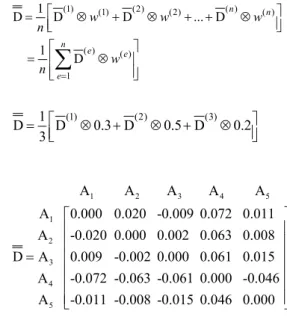
After integrating steps above-mentioned, multiply the matrix by its corresponding expert weightw( )e , then get a matrix as follows: (1) (1) (2) (2) ( ) ( ) ( ) ( ) 1 1 D D D ... D 1 D n n n e e e w w w n w n = ⎡ ⎤ = ⎢ ⊗ + ⊗ + + ⊗ ⎥ ⎣ ⎦ ⎡ ⎤ = ⎢ ⊗ ⎥ ⎢ ⎥ ⎣
∑
⎦ (1) (2) (3) 1 D D 0.3 D 0.5 D 0.2 3 ⎡ ⎤ = ⎢ ⊗ + ⊗ + ⊗ ⎥ ⎣ ⎦ 1 2 3 4 5 1 2 3 4 5 A A A A A 0.000 0.020 -0.009 0.072 0.011 A -0.020 0.000 0.002 0.063 0.008 A D A 0.009 -0.002 0.000 0.061 0.015 -0.072 -0.063 -0.061 0.000 -0.046 A -0.011 -0.008 -0.015 0.046 0.000 A ⎡ ⎤ ⎢ ⎥ ⎢ ⎥ = ⎢ ⎥ ⎢ ⎥ ⎢ ⎥ ⎢ ⎥ ⎣ ⎦(6) Rank all the alternatives’ evaluation values
All of the alternatives’ evaluation values are averaged so as to obtain the preference values and sequence for all alternatives, which are shown in Table2; then rank the preference value of each alternative, the rankings are:
Af C f B f E f D , Alternative A is the best
restaurant location.
Table 2 The average preference values and rankings of sequence for all alternatives
A B C D E Average Rank A 0.000 0.020 -0.009 0.072 0.011 0.094 1 B -0.020 0.000 0.002 0.063 0.008 0.052 3 C 0.009 -0.002 0.000 0.061 0.015 0.083 2 D -0.072 -0.063 -0.061 0.000 -0.046 -0.242 5 E -0.011 -0.008 -0.015 0.046 0.000 0.012 4
V. Conclusion
The Incomplete Linguistic Preference Relations based on group decision making model under a fuzzy environment that this study established only need to compare n− 1 times if it is for n n× matrix. Compared with the AHP method which the matrix is n n× and it is necessary to compare n n( −1) 2 times in order to obtain the complete matrix, the InLinPreRa based on MCDM model not only can derive out fast but also will not produce the inconsistent problems so that the decision making process can be more efficient and allows the unit of decision making to be either the specific or the group. Each expert can select the explicit index unrestrictedly for pairwise comparisons, which are the so-called horizontal, vertical, and oblique comparisons; for the remaining unknown variables, they can be derived out by adjoining addition and their corresponding opposite relations, then the complete matrix can be produced quickly.
VI. Acknowledgements
The authors would like to thank the National Science Council of the Republic of China, Taiwan for financially supporting this research under Project NSC 99-2410-H-151-020.
VII. References
[1] R. Law, et al., “How do Mainland Chinese travelers choose restaurants in Hong Kong?: An exploratory study of individual visit scheme travelers and packaged travelers,” International Journal of Hospitality Management, vol. 27, pp. 346-354, 2008.
[2] Y. L. Lee and N. Hing, “Measuring quality in restaurant operations: an application of the SERVQUAL instrument,” International Journal of Hospitality Management, vol. 14, pp. 293-310. [3] I. Hau-siu Chow, et al., “Service quality in
restaurant operations in China: Decision- and experiential-oriented perspectives,” International Journal of Hospitality Management, vol. 26, pp. 698-710, 2007.
[4] Z.S. Xu , “Incomplete linguistic preference relations and their fusion,” Information Fusion, vol. 7, no. 3, pp. 331-337, 2006.
[5] T.C. Wang, S.C. Hsu, Y.C. Chiang, “Multi-Criteria Decision Making with Expansion of Incomplete Linguistic Preference Relations,” WSEAS Transactions on Mathematics, vol. 6, no. 9, pp 817-823, 2007.
[6] Z.S. Xu, “EOWA and EOWG operators for aggregating linguistic labels based on linguistic preference relations, International Journal of Uncertainty,” Fussiness and Knowledge-Based Systems, vol. 12, no.6, pp. 791-810, 2004.
[7] Z.S. Xu, “Deviation measures of linguistic preference relations in group decision making,” Omega, vol. 33, pp. 249-254,
[8] Z.S. Xu, “Group decision making based on multiple types of linguistic preference relations”, Information Sciences, vol. 178, pp 452-467,2008.
[9] Z.S. Xu, “A method based on linguistic aggregation operators for group decision making with linguistic preference relations,” Information Sciences, vo1.66 , pp. 19-30, 2004.
行政院國家科學委員會補助專題研究計畫
;
成 果 報 告
□期中進度報告
不完全語意偏好群體決策模式提升決策品質之建構
計畫類別:
;
個別型計畫 □整合型計畫
計畫編號:
NSC 99-2410-H-151 -020
執行期間:
99 年 08 月 01 日至 100 年 07 月 31 日
執行機構及系所:
國立高雄應用科技大學
計畫主持人:
王天津
共同主持人:
計畫參與人員:
成果報告類型(依經費核定清單規定繳交):
;
精簡報告 □完整報告
本計畫除繳交成果報告外,另須繳交以下出國心得報告:
□赴國外出差或研習心得報告
□赴大陸地區出差或研習心得報告
;
出席國際學術會議心得報告
□國際合作研究計畫國外研究報告
處理方式:
除列管計畫及下列情形者外,得立即公開查詢
□涉及專利或其他智慧財產權,□一年□二年後可公開查詢
中 華 民 國
100 年 10 月 30 日
國科會補助專題研究計畫成果報告自評表
請就研究內容與原計畫相符程度、達成預期目標情況、研究成果之學術或應用價
值(簡要敘述成果所代表之意義、價值、影響或進一步發展之可能性)
、是否適
合在學術期刊發表或申請專利、主要發現或其他有關價值等,作一綜合評估。
1. 請就研究內容與原計畫相符程度、達成預期目標情況作一綜合評估
□
;
達成目標
□ 未達成目標(請說明,以
100 字為限)
□ 實驗失敗
□ 因故實驗中斷
□ 其他原因
說明:
本研究之成果及貢獻:
1、 建構一個模糊不完全語意偏好群體決策模式:可以適合實際生活,避免決策者做成
對比較時可能因時間壓力、欠缺完整資料、或並非具備此專業知識甚至決策過程中
提供的資訊不確實等問題。
2、 應用此模式策略可以群體決策專家群組與專家數可以彈性選擇,符合複雜多變的環
境。
3、 應用此模式策略評估準則權重及進行方案最佳化評估。
4、 使用AHP方法比較若有
n
個因素,需比較
n n
(
−
1) 2
,建構不完全語意偏好群體決策
模式只要
n
−
1
,可以增進效率,提升決策品質。
5、 使決策領域添增一項評估模式,讓多元複雜的社會有更科學的決策模式可以提供更
多元化、廣泛性的決策工具。
2. 研究成果在學術期刊發表或申請專利等情形:
論文:
;
已發表 □未發表之文稿 □撰寫中 □無
專利:□已獲得 □申請中
;
無
技轉:□已技轉 □洽談中
;
無
其他:(以
100 字為限)
Ying-Hsiu Chen,
Tien-Chin Wang
and Chao-Yen Wu (2011), “Strategic decisions using the fuzzy
PROMETHEE for IS outsourcing,” Expert Systems with Applications, Vol.38, pp.13216-13222.
(SCI,EI)
<NSC 99-2410-H-151-020>
Tien-Chin Wang and Ying-Hsiu Chen (2011), “Fuzzy multi-criteria selection among transportation
companies with fuzzy linguistic preference relations,” Expert Systems with Applications, Vol.38,
pp.11884-11890.
(SCI,EI)
<NSC 99-2410-H-151-020>
Tien-Chin Wang
, Su-Hui Kuo, Truong Ngoc Anh and Li Li (2011), “Forecast the foreign exchange
rate between Rupiah and US Dollar by applying Grey Method,” 2011 International Conference on
Data Engineering and Internet Technology (DEIT 2011)
,15-17 March 2011, Bali, Indonesia,
pp.550-553.
(EI)
(NSC99-2410-H-151-020)
(擔任研討會主持人)
W.T. Chen, F.C. Lu, J. C. Tsai,
T.C.Wang
and S.M.Lin (2010), “Measuring the success possibility
of implementing the Oceanographic & Meteorologic Integration Orchestrator,” 2010 International
Conference on Remote Sensing (ICRS 2010), Hangzhou, China, October 5-6, 2010, pp.311-314.
(EI)
(NSC99-2410-H-151-020)
3. 請依學術成就、技術創新、社會影響等方面,評估研究成果之學術或應用價
值(簡要敘述成果所代表之意義、價值、影響或進一步發展之可能性)(以
500 字為限)
本研究旨在利用不完全語意偏好群體決策模式提升全面決策品質,使決策者於選擇準則
權重、方案優先順序時可以彈性選擇群組與人數,並於矩陣成對比較時,可以透過不確
定語意偏好相加關係快速轉換為明確決策矩陣,避免決策過程中決策者(單位)可能由於時
間壓力、欠缺完整資料、或並非具備此專業知識甚至提供的資訊不確實難以取得資訊的
問題,更可以彈性運用直向 (Horizontal)、橫向(Vertical)、斜向 (Oblique)三種演算規則。
決策矩陣成對比較(pairwise comparison) 時不需如層級分析法 (AHP)必須針對偏好決策
矩陣三角形上半部做兩兩比較,此模式容許每位決策專家自由選擇一個明確指標進行兩
兩比較,當有
n
個準則時,只需透過
n
−
1
次成對比較即可快速求得完整矩陣,比傳統
AHP
需比較
n n
(
−
1) 2
次大大增進了效率,避免當層級數增加,導致效率降低及不一致性等問
題,大大提升決策品質。本研究所建構之不完全語意偏好群體決策模式之建構可以廣泛
應用到各領域作為後續研究者之參考依據。
國科會補助專題研究計畫項下出席國際學術會議心得報告
日期:100 年 10 月 30 日
一、參加會議經過:
參加在
Indonesia 的 Bali 舉辦的研討會,該研討會為 EI 引用,
有多國學者發表論文。
二、與會心得:
三、考察參觀活動(無是項活動者略)
四、建議:
國內大學應該模仿該研討會在國內舉辦。
五、攜回資料名稱及內容:
論文集與論文光碟。
六、其他
計畫編號
NSC 99-2410-H-151 -020
計畫名稱
不完全語意偏好群體決策模式提升決策品質之建構
出國人員
姓名
王天津
服務機構
及職稱
國立高雄應用科技大學
會議時間
2011 年 3 月 15 日至
2011 年 3 月 17 日
會議地點
Bali, Indonesia
會議名稱
(中文)
(英文)
2011 International Conference on Data Engineering and Internet Technology
(DEIT 2011),
發表論文
題目
(中文)
(英文)
Forecast the foreign exchange rate between Rupiah and US Dollar by
applying Grey Method
國科會補助計畫衍生研發成果推廣資料表
日期:2011/10/30國科會補助計畫
計畫名稱: 不完全語意偏好群體決策模式提升決策品質之建構 計畫主持人: 王天津 計畫編號: 99-2410-H-151-020- 學門領域: 作業研究/數量方法無研發成果推廣資料
99 年度專題研究計畫研究成果彙整表
計畫主持人:
王天津
計畫編號:
99-2410-H-151-020-計畫名稱:
不完全語意偏好群體決策模式提升決策品質之建構
量化
成果項目
實際已達 成數(被接 受或已發 表) 預期總達成 數(含實際 已達成數)本計畫
實際貢
獻百分
比
單位
備註
(質 化 說 明 : 如 數
個 計 畫 共 同 成 果 、 成
果 列 為 該 期 刊 之 封 面
故 事 ...等
)期刊論文
0
0
100%
研 究 報 告 / 技 術 報 告0
0
100%
研討會論文
0
0
100%
篇
論文著作
專書
0
0
100%
申請中件數
0
0
100%
專利
已獲得件數
0
0
100%
件
件數
0
0
100%
件
技術移轉
權利金
0
0
100%
千元
碩士生
1
0
100%
博士生
1
0
100%
博士後研究員
0
0
100%
國內
參與計畫人力
(本國籍)
專任助理
0
0
100%
人次
國外
論文著作
期刊論文
2
0
100%
篇
Ying-Hsiu
Chen,
Tien-Chin
Wang
and
Chao-Yen
Wu
(2011),
’Strategic
decisions using the
fuzzy PROMETHEE for IS
outsourcing,’ Expert
Systems
with
Applications, Vol.38,
pp.13216-13222.
(SCI,EI) <NSC
99-2410-H-151-020>
Tien-Chin
Wang
and
Ying-Hsiu
Chen
(2011),
’Fuzzy
(SCI,EI)
<NSC
99-2410-H-151-020>
研 究 報 告 / 技 術 報
告