
補救教學對技專院校新生英語表達能力之效益研究
112
0
0
全文
(2) Effects of a Remedial Program for English Productive Skills on Technological Institute Freshmen. Advisor: Dr. Shih-Chung Lin By: Yu-Hsin Chen. A Thesis Submitted to the Graduate Program of Applied English In Partial Fulfillment of the Requirements For the Degree of Master of Arts National Pingtung Institute of Commerce. Pingtung, Taiwan, R.O.C. June, 2010.
(3)
(4)
(5) 摘要. 台灣教育當局一直致力於提升高等教育學生的英語能力,尤其是技專院校的學 生。因此,教育部要求各技專院校制定以英語能力為衡量標準的畢業門檻;這項要求 使得學生正視到提升英語能力的重要性,特別是英語的表達能力﹙口說與寫作﹚。雖 然補救教學已被證實對提升學生的英語能力有顯著的效益,不過在台灣的高等教育範 疇中,補救教學的實施不是採用線上教學,就是缺乏給學生充分的面對面練習的機 會。同時,也少有研究談到學生對補救教學的觀點,與補救教學對學生英語表達能力 的影響程度。有鑑於此,本研究將探究補救教學對技專院校新生英語表達能力的影 響,及其對補救教學的看法。因此本研究針對南台灣一所技專院校三系所的 40 位新 生進行補救教學。同時,經由問卷調查與訪談,本研究有幾項重要的發現。首先,學 生參加補救教學之後的英語口說與寫作表現,較能力相仿但沒參加補救教學的同學明 顯進步。第二,參加學生在期中與期末考的口說與寫作表現均較前測明顯進步。第三, 參加學生的後測寫作內容,在字數、句數、正確動詞的使用、與完整句等數量,均有 顯著的進步。第四,參加學生均認同補救教學對英語表達能力的助益。第五,參加學 生認同補救教學應該被納入學校正規課程﹙英語或其他專業科目﹚。最後,本研究提 出補救教學對英語教學與未來研究上的建議為研究做總結。. 關鍵字:畢業門檻,英語表達能力,補救教學,學習表現相仿的學生. -i-.
(6) Abstract Currently, Taiwan’s educational authority has made a significant effort to improve students’ proficiency of English in higher education; in particular, they have paid much more attention to technological institute students because investigations indicated that technological institute students in Taiwan have not demonstrated sufficient English proficiency. In order to improve students’ English proficiency, Ministry of Education, Taiwan, has required technological institutes to set up high standards of English proficiency as graduation threshold. This requirement of English proficiency directly impacts students’ realization that they should positively improve in their English competence, especially in their speaking and writing abilities before they graduate. Although the remedial program has significant effects on students’ English competence, the remedial program in Taiwan higher education system is either online writing programs or non- face-to-face speaking and writing practices. Besides, no study was on these issues that are to what extent participants’ speaking and writing abilities have been enhanced by remedial English programs and what viewpoints the participants have on the remedial program and explored specifically. The study was hence proposed to explore the effects of a remedial English program on the productive skills of freshmen in one of the technological institutes in southern Taiwan and to realize the participants’ viewpoints on the remedial program. Forty participants (5 high-level, 21 intermediate-level, and 14. - ii -.
(7) low-level participants) were recruited from different departments (International Trade, Business Management, Finance and Banking) to participate in the remedial English program, and a comparison of the participants’ productive performances was made with those equivalent non-participants. In addition, the comparison of the participants’ productive performance of the pretest was made with those of the midterm, the final, and the posttest. Several significant results were reported. First of all, the participants performed significantly better than the equivalent non-participants after the remedial English program. Secondly, the participants had much better speaking and writing performances on the midterm and the final test than they did on the pretest, and scored better on the posttest. Third, the participants had significant writing improvement in the number of words, sentences, correct verbs, and complete sentences. Fourth, the participants agreed with the effects of the remedial English program on their speaking and writing competences, and they expected to participate in the remedial programs, including English and other professional subjects learning, in the future. Lastly, the participants recommended that the remedial program should be integrated into regular EFL classrooms. Pedagogical implications on how to conduct a remedial English program and suggestions for future researches were presented at the end of the study. Keywords: graduation threshold, productive skills, remedial English program, equivalent group. - iii -.
(8) Acknowledgements To begin with, I would like to acknowledge Dr. Shih-Chung Lin with my sincere gratitude for his patience and inspired suggestions. Dr. Lin has equipped me with the appropriate and insightful guides that help immerse me in completing the thesis. In addition, I am grateful to have Dr. Mei-Chen Chen and Dr. Shu-Chiao Tsai who help me make the thesis be more meaningful and worthy. Their feedbacks on the thesis make me gain more other than literature review. Likewise, I am deeply appreciated for the support by my friend, Marie. Without her support, the thesis would not be so outstanding. Special thanks are extended to my classmates and those students who participated in the study. More importantly, I would like to acknowledge my dear family with gratitude for accompanying me all the time. Without my dear family, the thesis might not be achieved. Finally, I have to congratulate myself on the unique study. May I succeed in the future learning.. - iv -.
(9) Table of Contents. Abstract (Chinese)…………………………………………………………………………. i Abstract…………..…………………………………………………………………………ii Table of Contents……………………………………………………………………………v Figures……………………………………………………………………………………...ix Tables………………………………………………………………………………………ix CHAPTER 1………………………………………………………………………………...1 Introduction……………………………………………………………………………1 Background of the Study……………………………………………………….1 Problem Statement ………………….…………………………………………...3 Purpose of the Study……………………………………………………………..3 R e s e a r ch Q u e s t i o n s … … … … … … … … . … … … … … … … … … … … . . 4 .. Significance of the Stud y……….……………………………………..5 Definition of Terms……….……….……………………………………..5. CHAPTER 2………………………………………………………………………………...8 Literature Review…………………………………………………………………8 Language Comprehension and Production………………………………….8 Productive Skills Toward EFL Learners………………………………10. -v-.
(10) Remedial Education Program…………..………………………………….12 Background Knowledge of Remedial Education Program…………….12 Difference Between Regular Class and Remedial Program………...14 Previous Researches of Remedial Education Program…………….14 Reasons for Implementing the Remedial Education Program……….15 Remedial Education Program in Taiwan………………...…………………….17 Remedial English Program in Taiwan Higher Education……………….18 Summary……...…………………………………………………...…...……...20 CHAPTER 3……………………………………………………………………………….21 Methodology…………………………………………………………………………21 Participants…………………………………………………………………...22 The Experimental Group……………..………………………………..22 The Equivalent Group..………..………………………………………23 Instruments…………………….……..………………………………………24 Teaching Materials…....……………………..……...…………………24 Questionnaire…...............……………………...………………………24 Interview……………………………..……………...…………………26 Examinations over the Semester...…………………...………….……..27 Procedures……………...…………………………………………………….28. - vi -.
(11) Teaching Process….…………………………………………………...28 Process of Questionnaire Collection………………………………..…30 Interview Process….……………………..…………………………....30 Data Analysis………...……………………………………………………….30 CHAPTER 4………………………………………………………………………………32 Results……..…………………………………………………………………………33 Result of the Independent-Samples T-test……………………………………32 Result of the Factorial ANOVA ……………………………………….……..38 Result of the Repeated ANOVA……………………………………….……..46 Result of the Paired-Samples T-test…………………...………………….…..49 Results of the Questionnaire…………………..……...……………….….…..53 Reliability of the Questionnaire……………………...……….….……53 Descriptive Statistics of the Questionnaire.…..……...………………..54 Results of the Open-Ended Questions…….…..……………….….…..61 Interview Result…………………………..…..………………..….…..63 Summary of Important Results……………..……...………………….….…..69 CHAPTER 5………………………………………………………………………………70 C o n cl us io n s… .. … … …… … …… … …… … … …… … …… …… … … …… 70 Discussion on Significant Findings…………………………………..………70. - vii -.
(12) The Effect of the Remedial English Program on Technological Institute Freshmen’s Speaking Skill…..…………..…..……………….70 The Effect of the Remedial English Program on Technological Institute Freshmen’s Writing Skill…………………..………………...71 Significant Effects of Remedial English Program on Productive Skills Among Different Proficiency-Level Freshmen…….……….......72 The Participants’ Viewpoints on the Remedial English Program….….74 The Effects of Emotional Support on Technological Institute Freshmen’s Productive Performance……….……..……………….......76 Multiple Teaching Approaches in Remedial English Program Design..77 Pedagogical Implications…………………………………………………….78 Limitations of the Study……………………………………..……………….79 Suggestions for Future Researches…………………………..……………….80 References……………………………………………………………………………….82 Appendix A: Reference Books……………………………………………………………89. Appendix B: Questionnaire of the Remedial English Program (English)…………………91. Appendix C: Questionnaire of the Remedial English Program (Chinese)………………...95. - viii -.
(13) Figures Figure 1 Speaking Score Comparisons on the four tests over the semester……………41 Figure 2 Writing Score Comparisons on the four tests over the semester..…………….….45. Tables Table 1 Crucial Ingredients of Successful Design for the Remedial Education Program....13 Table 2 Contrast Between Regular Class and Remedial Program of Higher Education…..14 Table 3 Compare and Contrast of the Remedial Education Program…………………...…18 Table 4 Specific Features of the Participants…………………………………………...…22 Table 5 Sample Questions of the Participants’ Viewpoints on the Remedial Program…....25 Table 6 The Interview Questions of the Participants’ Viewpoints on the Remedial English Program…………………………………………………………...…..…26 Table 7 Step-by-Step Presentations of the Teaching Process………………...……………29 Table 8 Speaking Performance Comparisons Between two Groups by Independent-Samples T-test. ……………..………………………………...…. ..33 Table 9 Writing Performance Comparisons Between two Groups by Independent-Samples T-test………………………………………………..…….35 Table 10 Detail Results of Independent-Samples T-test………………………..………....37 Table 11 Main Effects of Factorial ANOVA on Speaking Performance……………….....38 Table 12 Multiple Comparisons of Speaking Scores Among Three-Level and Four-Test..40. - ix -.
(14) Table 13 The Presentations of Speaking Scores and Standard Deviation Among Different Proficiency-Level Participants…………………………………….....41 Table 14 Main Effects of Factorial ANOVA on Writing Performance…………………...42 Table 15 Multiple Comparisons of Writing Scores Among Three-Level and Four-Test…44 Table 16 The Presentations of Writing Scores and Standard Deviation Among Different Proficiency-Level Participants………………….………………..…...46 Table 17 Mauchly’s Test of Sphericity for Multiple-Period Speaking Performance……...47 Table 18 Tests of Within-Subjects Effects……………..…….………………….……..….48 Table 19 Pair Wise Comparisons of Speaking Performance on the Four Tests…………...48 Table 20 Mauchly’s Test of Sphericity for Multiple-Period Writing Performance……….49 Table 21 Statistics of Paired-Samples T-test………………………………….…………...50 Table 22 Integrated Explanations of Four Paired-Samples T-tests Toward Writing Performance…………………………………………………………………..….50 Table 23 Details of Reliability Statistics………………………………………………..…53 Table 24 Result of the Participants Viewpoint on Lesson Planning Section……………....55 Table 25 Result of the Participants Viewpoint on Writing Development Section………...56 Table 26 Result of the Participants Viewpoint on Speaking Development Section……….57 Table 27 Result of the Participants Viewpoint on Learning Attitude Section……………..59 Table 28 Summary of the Participants’ Viewpoints on the Remedial English Program…..60 Table 29 Summaries of the Interview Result ……………………………………………..68. -x-.
(15) CHAPTER 1 Introduction Background of the Study Currently, Taiwan’s educational authority has made a significant effort to improve students’ proficiency of English in higher education; in particular, they have paid much more attention to technological institute students because investigations indicated that technological institute students in Taiwan have not demonstrated sufficient English proficiency (Chang & Tu, 2007; Chou, 2002; Lin, 2009; Wang, 2009). Although these students have been offered more English curricula in beneficial learning settings, their English competence still requires significant improvement (Chang & Tu, 2007; Lin, 2009). The authority has discerned this problem, and, in response, they have introduced proactive policies to ensure desired outcomes. In order to improve students’ English proficiency, Ministry of Education, Taiwan, has required technological institutes to set up high standards of English proficiency as graduation threshold (MOE, 2008). This requirement of English proficiency directly impacts students’ realization that they should positively improve in their English competence, especially in their speaking and writing abilities before they graduate. However, students in Taiwan have insufficient experiences and opportunities to practice their productive skills in speaking and writing English because the class size limits the. -1-.
(16) instructor’s ability to spend sufficient time completing each teaching plan smoothly and considering every student fully (Chen, 2009). In the meantime, the traditional teaching style tends to be a teacher-centered lecture instead of task-based interaction, and students have difficulty in receiving feedback on their productive performances (Sue, 2004). In addition, students do not need to utilize productive skills when taking entrance examinations of both high schools and technological institutes. Instead, students are accustomed to filling in reading comprehensive questions on entrance examinations, and consequently, reading skill contributes much more than other language skills (Chang, 2006; Chang & Tu, 2007). Therefore, productive skills have not been emphasized and improved adequately in Taiwan English education. Unfortunately, the main tools adopted as the graduation threshold, or benchmarks, such as the Test of English as a Foreign Language (TOEFL) and the General English Proficiency Test (GEPT), need test-takers to be proficient in both receptive (reading and listening) and productive (speaking and writing) abilities to pass those tests. Large English classes do not adequately equip students with those abilities, especially productive speaking and writing. Even though some technological institutes have divided regular English classes into smaller classes (20-30 students each class), students still need extra assistance with speaking and writing skills. As a result, the. -2-.
(17) remedial English program is needed to help students with their speaking and writing performances and to further equip students for the graduation threshold, or benchmark proficiency level.. Problem Statement Most technological institute students do not have sufficient English proficiency, especially in speaking and writing skills, to pass the requirement for the graduation threshold. To enhance students’ English productive skills, many technological institutes in Taiwan provide students with remedial programs which are either online writing programs or non-face-to-face speaking and writing practices (Li, 2002). However, no study on the issue that to what extent participants’ speaking and writing abilities have been enhanced by remedial English programs has been specifically explored. Likewise, the participants’ viewpoints on the remedial program could provide beneficial information regarding extended or related programs, instead of being silently ignored. More research findings are needed to illustrate current problems and tease out underlying issues. Purpose of the Study The purpose of the current study was first to explore whether the remedial English program effectively enhanced the participants’ English speaking and writing abilities at different English proficiency levels. Next, this study aimed to make -3-.
(18) comparisons between writing and speaking performances among the participants. Lastly, the participants’ viewpoints on the remedial program were also probed examined, and discussed in the present study. Research Questions Based on the three-part purpose of the study, the research questions are presented as follows: 1. Are there any significant differences in the English speaking performance between the experimental group with and the equivalent contrastive group without such remedial program? 2. Are there any significant differences in the English writing performance between the experimental group and the equivalent contrastive group? 3. What are the effects of the remedial English program on the speaking performance for the participants at different English proficiency levels? 4. What are the effects of the remedial English program on the writing performance for the participants at different English proficiency levels? 5. Is there a significant difference between the speaking and writing performances of those participants in the remedial English program? 6. How do the participants perceive the remedial program? What suggestions do they make to improve the program?. -4-.
(19) Significance of the Study The current study attempted to assess college freshmen’s English productive competence. Few studies have addressed the effects of face-to-face practices of speaking and writing with related feedback provided by the instructor. In addition, comparing the participants’ productive performances receiving the remedial programs with the equivalent non-participants would offer the educational authority an insight of the significance of remedial program on these students’ speaking and writing skills. Also, the results of the participants’ viewpoints on the remedial program would provide English instructors with information and recommendations for future design and practice of Freshman English classes. Definition of Terms Remedial Program Remedial instruction is one kind of supplementary educational activity, designed for lower achievers. In the present study, the remedial program is a smaller ratio size English class which provides the participants with speaking and writing practice opportunities. Furthermore, the instructor provides the participants with individual feedback on speaking and writing performances. That is, the remedial program equips the participants with constructive academic and inter-individual, affective, or emotional, support.. -5-.
(20) English Proficiency English proficiency refers to the degree of skill with which a person can use English, such as how well a person can read, write, speak, or understand English language. Proficiency of English language may be measured through an English proficiency test (Richards, John, and Heidi, 2007). Productive Performance Productive performance, also called learning production of a foreign language, is direct language output such as speaking and writing. In contrast with comprehensive competence (reading and listening), productive performance is observable (Brown, 2000). Graduation Thresholds or Benchmarks In order to enhance or maintain students’ English proficiency effectively before graduation, the Ministry of Education, Taiwan, (2009) set graduation thresholds regulating that college students pass certain levels of standardized English proficiency tests: GEPT intermediate level, which means students have proper English ability of daily communication, Test of English as a Foreign Language: computer-based test (TOEFL-CBT), and paper-based test (TOEFL-PBT) 500; non-English majors have to pass one of followings: GEPT elementary level, which refers students to have fundamental English competence, CBT 90, PBT 390, and Test of English for International Communication (TOEIC) 350. -6-.
(21) Emotional Support With differentiated meanings, emotional support is referred to as the effect of interventions of remedial teaching program on students’ emotional development of the affect which could be a positive factor in improving students’ academic performance (Bridget & Robert, 2005).. -7-.
(22) CHAPTER 2 Literature Review Effective language learning achieves both language comprehension and production toward a first or second language. However, language production is not easy to achieve by second language learners for contextual and cultural differences (Liao, 2007). It is beneficial that learners participate in remedial programs to decrease learning difficulties and increase learning effectiveness. This chapter will introduce language comprehension and production, as well as review what effect remedial English programs would have on learners by examining previous researches and articles. Language Comprehension and Production The perception of language comprehension involves language receiving which includes two interactive models defined as ‘spoken word recognition’ (listening comprehension) and ‘printed word recognition’ (reading comprehension) by Treiman, Clifton, Meyer, and Wurm (2003). One is how listeners perceive a sequence of discrete units even though the acoustic process is continuous; the other is what visual representations provided through printing are received and switched to phonological and linguistic structure by readers. Language comprehension requires a complex and subtle combination of understanding individual words in sentences and discourse, and. -8-.
(23) how those messages and perceptions are interpreted in one’s mental lexicon. In terms of language production, language production involves the processes that explain how people produce single words and turn those words into longer utterances and sentences. During the productive process, one combines spoken language production and written language production. Next, language comprehension and production rely heavily on each other at times, but language comprehension differs from language production for following reasons. First, language comprehension is not observable and not obvious, whereas language production can be observed and measured. For instance, whether language learners understand what they read or listen is not easy to tell; however, realizing what language learners develop in their acquisition of language competence is measurable by their spoken language or written language. Second, comprehending perceived information does not mean that people can produce specific speaking or writing language; conversely, proficient language production indicates that language producers comprehend and interact with the information properly (Brown, 2000; Treiman et al., 2003). Therefore, language comprehension is also called ‘language input,’ and language production is viewed as ‘language output.’ However, there are similarities between language comprehension and production. Obviously, both of them are involved in linguistic knowledge. Niels and Antje (2003) stated that whether language learners learn a first or second language,. -9-.
(24) comprehensive and productive skills develop at the same time. It is what Treiman et al. (2003) pointed out that language comprehension and production rely heavily on each other at times. Therefore, both language comprehension and production are necessary in developing language learners’ proficiency in acquiring and interacting competently in a language. Productive Skills Toward EFL Learners Previous literatures have pointed out that English learners in the context of English as a Foreign Language (EFL) usually suffer interlingua errors and overgeneralizations (Li, 2004; Liao, 2007; Wang, 2009). Most EFL learners begin to learn English with an unfamiliarity in the English language and its cultural background. They base learning on their own native linguistic knowledge, i.e. syntax and pronunciation, to attempt to execute English competently. Commonly, EFL learners tend to be influenced by interference unconsciously in the beginning. With regard to the role of productive skills, EFL learners interact with others through their productive skills rather than received skills. That is, how well EFL learners develop English proficiency could be predicted by their productive skills during interpersonal interactions. Nevertheless, Peng (2009) found that most EFL learners were afraid of using productive skills in public, especially with speaking skills. Peng recommended that EFL learners should utilize speaking or writing skill as frequently as possible. - 10 -.
(25) because even native English language-users could not perform written or spoken English at a high level. As a result, to be English proficient, EFL learners should be courageous in attempting productive skills instead of being shy or fearful. In terms of productive skills in EFL instructional context, Li (2002) mentioned that English learners’ individual thoughts and productive skills should be emphasized and developed in English instruction of EFL context. Whether their target or native language, the main purpose of language learning is to interact with others and convey their personal opinions properly. English learners should integrate individual opinions and experiences into interaction in English. Under such presupposition, so called ‘standard answers’ or ‘reference answers’ should not be presented in advance in instructional context; otherwise, learners might memorize and imitate those standard answers, and their English competence hardly improves. Taking Taiwan students’ learning process as example, they have insufficient opportunity to practice spoken English than listening English, and hence typical English instruction has been teacher-centered and test-oriented in the past decades. That kind of English instruction is hard to meet EFL students’ needs of developing proficient English productive skills (Chang, 2009; Chang & Tu, 2007; Chou, 2002; Liao, 2007).. - 11 -.
(26) Remedial Education Program Background Knowledge of Remedial Education Program The remedial program was also called ‘developmental education course,’ ‘remedial education course,’ or ‘linked course,’ and rooted in one of national mandates of America in early 1800s, and placed within the missions of community colleges and universities. Most of the colleges and institutions in America have provided students with remedial programs which were defined as courses in reading, writing, and mathematics for higher education students lacking those skills required to be successful in colleges or universities. Gradually, the remedial education programs seemed to be the most common application to help students get into all academic activities in higher education (Barnett, 2002; Basmat & Laurie, 2003; Crews & Aragon, 2004; Juan & Henry, 2007; Perin, 2006; Phipps, 1998). More specific integrated ingredients of the remedial education program are presented below in order to exemplify what a successful design of the remedial education program could be (see Table 1).. - 12 -.
(27) Table 1 Crucial Ingredients of Successful Design for the Remedial Education Program Ingredients Objectives. Descriptions Being clearly defined and understood objectives of the remedial education program.. Motivation. Building on students’ interests and learning goals and providing institutional credit toward degrees or certificates.. Substance. Building skills within a real-world context rather than an abstract approach.. Exploration. Inquiring students’ requirements to help them achieve learning goals.. Independence. Encouraging students to do independent thinking to integrate their own ideas and understandings into applications.. Multiple. Using peer-collaboration, technology, tutoring, tailored curriculum. Approaches. design, and ongoing assessment to suit student needs.. Problem-. Viewing learning more as a way of determining what needs to be learned. Solving. and how, and then implementing “the how.”. Connection. Emphasizing further links among different subjects and how they can contribute to learning rather than seeing them as isolated and independent.. Supportive. Recognizing learning is a social activity that thrives on healthy social. Context. interaction, encouragement, and support.. Note. Information in Table 1 was integrated from previous studies by Barnett (2002), Juan and Henry (2007), and Phipps (1998). - 13 -.
(28) Difference Between Regular Class and Remedial Program Based on results of previous researches, there are many differences between the regular class and the remedial program. The next integrations present what differences exist between the regular class and the remedial program (see Table 2). Table 2 Contrast Between Regular Class and Remedial Program of Higher Education Items Subject. Regular Class. Remedial Program. Freshmen of higher education. Students who get lower scores than cut-off score on placement test. Instructor. Professors, assistant professors, or. Tutors mostly. lecturers Expense. Lower than remedial program. Additional expense which is higher than regular class. Credit. Credit-oriented. Non-credit. Effect. Enabling students to learn. Bridging a gap of under-prepared. college-level coursework and. students. complete degree Category. Including required and selective. Unforced. Note. Information of Table 2 was integrated from previous studies (Barnett, 2002; Hunter, 2009; Juan & Henry, 2007; Phipps, 1998).. - 14 -.
(29) Previous Researches of Remedial Education Program The remedial education program has been defined as a series of remedial ingredients of helping higher education students come up to speed in order to get rid of under-prepared ones (Barnett, 2002; Phipps, 1998). However, the remedial education program costs students more and also consumes more of the society’s public resources. Due to several debatable problems such as significant costs and no college credit, there is very little rigorous research to analyze the effectiveness of the remedial education program. One significant issue is the expense of the remedial education program without conferring credit which indirectly leads remedial students to spend more time completing the college or university degree. Those are the most difficult barriers for students to enroll in the remedial education programs or complete the overall program (Barnett, 2002; Hunter, 2009; Juan & Henry, 2007; Juan & Bridget, 2008; Thomas, 2009). Even if some debates appear with the remedial education program, many previous studies found that there are still a number of benefits to students suffering the additional length from the remedial educational program. Reasons for Implementing the Remedial Education Program Juan and Bridget (2008) and Phipps (1998) stated, although the remedial education program has drawbacks such as frequent dropout for costly expense, the. - 15 -.
(30) accompanying effects on remedial students could not be denied. First of all, participants of the remedial education program could be more effective in integrating themselves into current learning materials and contents by the remedial education program. Moreover, most students enrolling in higher education institutions still have no capability to deal with college-level coursework well. Participating in the remedial education program equips students with more capability of completing academic degree and obtaining a job after completing degree. Juan and Henry (2007) support the idea that more significant effects on remedial students are that instructors or tutors of the remedial education program provide participants with extra assistance in helping remedial participants overcome difficulties. That phenomenon could not be achieved in the big class-size context. Thus, the remedial education program is designed to gap the bridge of students’ insufficient academic proficiency. As a result of taking part in the remedial education program, participants have significantly better grades in English language than the equivalent comparison group made up of students who need the remedial program, but do not enroll in it. It is hence that students participating in the remedial program have more opportunities to remedy their fundamental English language skills that are not proficient enough over students’ previous learning experiences. In addition, participants of remedial education program would also perform better in other learning subjects when finishing the remedial. - 16 -.
(31) program. Concretely, effects that come with the remedial education program are earning power, quality of life, self-esteem, and so on (Barnett, 2002; Crews & Aragon, 2004; Juan & Bridget, 2008; Leak & Lesik, 2007). Furthermore, such effects of the remedial education program cause tangible influence to the society as well. Particularly, educated citizens would be more able to contribute themselves to society and global market in effective ways such as serving on boards and commissions and supporting school activities; those citizens are capable of increasing national tax income easily. That is what Phipps (1998) claimed that remedial education program is a core function of higher education so that the remedial education program is a good investment for higher education and the society. Remedial Education Program in Taiwan The remedial education program in Taiwan is not as costly as in America, and usually the expenses are supported by the Ministry of Education. Also, the remedial education program of higher education in Taiwan is not as common as in America. In addition, the conception of remedial education program towards most people in Taiwan is that remedial education program is an additional course and used to assist students, low-level students especially, in improving coursework. Hence, the remedial education program of higher education in Taiwan is designed for English learners mostly. The following shows the comparisons and contrasts of the remedial education program between Taiwan and America (see Table 3). - 17 -.
(32) Table 3 Compare and Contrast of the Remedial Education Program Items. Remedial Program in America. Participant Students who get lower scores. Remedial Program in Taiwan Students who get lower scores than. than cut-off score on. cut-off score on placement test or are. placement test. volunteers to participate in the program. Instructor. Tutors mostly. Expense. Additional expense which is. No additional expense because of the. higher than regular class and. supportive foundation from the. paid by the participants. Ministry of Education. Credit. Non-credit. Effect. Bridging a gap of under-prepared students. Category. Unforced. Remedial English Program in Taiwan Higher Education Shu and Kao (2008) reported that many students, especially low-level students, attend in the regular English class with lower learning motivation because the English subject is a required one. The instructor has to think about what factors cause learners to learn English with difficulties, and then provide learners with individual remedies for enhancing learning motivation and achievement. Once the instructor supports those who learn English with lower learning motivation and achievement with - 18 -.
(33) warmness and attention, and that influence their learning achievement much more than academic supports. Moreover, participants in the research of remedial English program by Shu and Kao responded that they have more opportunities to utilize interactive skills in English, and the instructor pays much attention to them. Hence, remedial participants found they are more willing to spend time on English learning and ask the instructors for assistance and explanations when meeting learning difficulties among remedial classes; they also thought they are more confident of further English learning and application to academic and occupational fields. Likewise, Yu (2006) reported that remedial program help English learners improve learning achievement, low-level learners especially. Yu also recommended that remedial program design takes individual into consideration; to make remedial program have more effects on participants, teacher-designed materials, ability grouping, and multiple technology were recommended. Further, Li (2004) stated that because of insufficient English competence, non-English majors have got used to learn English with Chinese syntax even if they write a composition. As a result, the remedial English program is worth executing in technological institutions in particular; issues such as pronunciation, appropriate feedback, and students’ errors in learning process should be considered when the teacher designed a remedial program. To sum up, instructors teaching English of higher education in Taiwan recommended that the. - 19 -.
(34) remedial English program is necessary in enhancing students’ English proficiency. Especially for lower-level students who study in technological institutions, the remedial English program benefits them significantly. Summary Based on previous researches, the remedial education program is used to provide higher education students mostly with reading, writing, and mathematics courses in America. With regard to remedial education program in Taiwan, the remedial education program is designed to enhance students’ English proficiency, non-English majors of technological institutes especially. On the whole, the remedial English program in Taiwan helps students improve English performance significantly. Therefore according to literature review, many reasons show that the remedial English program is effective for enhancing English proficiency. First of all, the remedial English program was used to be designed as a smaller class which is more helpful for EFL students to get personalized feedback from the instructor. Furthermore, students have more opportunities to apply their productive skills in small-size remedial classes. Next, the instructor of remedial English program consciously realizes students’ learning difficulties and requirements and offers additional explanations and guides to deal with their learning difficulties so that students could bridge the gap of English proficiency between themselves and those who are English proficient.. - 20 -.
(35) CHAPTER 3 Methodology The current study was designed as a causal comparative study to explore the effects of a remedial English program on English productive skills of technological institute freshmen, and the viewpoints of the participants after the remedial program would be discussed. The participants’ productive performances in the current study were aimed to answer research question one and two, and the participants’ speaking and writing performance on the pretest and the later three examinations (midterm, posttest, and final) would reply to research questions three, four, and five. In addition, the viewpoints of the participants in the experimental group on the remedial program would act in response to research question six. Based on the pretest, the participants’ writing and speaking performances on the later three examinations would be compared with those performances by the equivalent or comparable control group. Finally, the participants’ viewpoints on the remedial program were examined by a following questionnaire and interview. Consequently, the following four sections including the participants, the instruments, the procedure, and the data analysis are exposed in this chapter.. - 21 -.
(36) Participants The participants in the present study were divided into two groups. One group was recruited and named the experimental group, and the other control group or comparable, equivalent group was formed by corresponding non-participants. The Experimental Group The participants in this current study were all freshmen and were recruited from a suitable sampling in spring 2009 from one of the technological institutes in southern Taiwan. The participants in the present study were 40 freshmen, from 5 classes of 3 departments, out of 642 freshmen by 12 departments except for the Department of Applied English in the target institute. Next, according to the pretest, the participants of the experimental group were grouped into three levels: high, intermediate, and low (see Table 4) Table 4 Specific Features of the Participants Regular Class. Department. Gender. Remedial Class. Male Female Class 1. International Trade B. 1. 9. Class 2. Business Management A. 0. 2. Class 3. Business Management B. 0. 2. Class 4. Finance and Banking A. 6. 9. Class B. Class 5. Finance and Banking B. 3. 8. Class C. - 22 -. Class A.
(37) Further, the participants in the study had several similarities; first of all, they are non-English majors. Second, the participants’ expectations of enough practice opportunity and individualized feedback on productive performance were hard to meet as a result. Third, the participants took the same required English course for one academic year. Finally, they had to pass the graduation threshold before graduation. Briefly, the participants had several similarities and the same learning purposes that were improving English productive skill and passing graduation threshold. The Equivalent Group The equivalent group was formed by those whose scores on the pretest both were just higher and lower than the participants of the experimental group. Thomas (2009) viewed this kind group of subjects as ‘similar students.’ Therefore, the number of the participants in the experimental group was 40, and those who were in the equivalent group were 80. To distinguish between the experimental group and the equivalent group, the equivalent non-participants did not experience the remedial English program, give the interview, and answer the questionnaire. In addition to the pretest, the participants had additional three tests: the midterm, the posttest, and the final over the semester. Therefore, the participants’ performances between pretest and later three examinations were adopted as the basis for analysis. The design of the current study is similar to previous researches (Bridget & Robert,. - 23 -.
(38) 2005; Hunter, 2009; Leake & Lesik, 2007) to discuss if the participants perform better after taking the remedial English program. Instruments Teaching Materials In addition to the textbooks, Chuan min ying chien yi lu tung chu chi ke shin ban: Ting shuo tu shieh mo ning shih ti. [Formed exercises of GEPT elementary level (Essential format): Listening, speaking, reading, and writing] and the GLOBAL EYES, of the regular English class, further six related books supplementary compact discs were also integrated into teaching design to assist the participants in speaking and writing practice (see Appendix A). Questionnaire The questionnaire in the current study was divided into four sections: lesson planning, writing development, speaking development, and learning attitude, along with discussion of the participants’ viewpoints on the remedial English program. Table 5 exemplifies 2 items in each section, and the complete questionnaire is presented in Appendix B (English version) and Appendix C (Chinese version).. - 24 -.
(39) Table 5 Sample Questions of the Participants’ Viewpoints on the Remedial Program 4 Sections Lesson planning (item 1-16). Sample Questions Q1. The contents of this course satisfy my expectation. Q3. The supplementary materials aid in my studies.. Writing development Q17. Writing practices are helpful to my English application. (item 17-25). Q 21. Writing feedbacks help me recognize my writing error.. Speaking development Q 27. Speaking practices help me express my ideas. (item 26-34) Learning attitude (item 35-44 ). Q 32. Speaking feedbacks help me focus on oral expression. Q 36. Compared to before, I am more confident of my writing. Q 44. Overall, I am satisfied with the remedial program.. The Likert scale with five measures was presented: strongly agree (= 5 points), agree (= 4 points), not sure (= 3 points), disagree (= 2 points), and strongly disagree (= 1 point). Furthermore, a structured interview involving three open-ended questions was conducted to discern and elicit the participants’ deeper opinions. For example, In addition to the questions above, what other benefits have you received from the remedial program? All responses, including 44 items and 3 open-ended questions, were the sources of data analysis. - 25 -.
(40) Interview The interview was designed and carried out to elicit profound viewpoints from the participants of taking part in the remedial English program. In order to keep balance on gender and major, five participants of each remedial class gave the interview. As a result, 15 participants gave the interview. The interview questions were listed in Table 6. Table 6 The Interview Questions of the Participants’ Viewpoints on the Remedial English Program Q1. What was your expectation of this remedial program? (請問你原先參加這計畫課程的需求為何?) Q2. Were your expectations met from participating in the remedial program? (請問在教學計畫結束後,是否滿足當初抱持的需求?) Q3. Which part of English competence do you improve the most from the remedial program? (請問你覺得自己參與本教學計畫後有哪些成長? 哪一方面成長最多?) Q4. Which activity of the remedial program did you like the most? In what way did it influence you? (請問你最喜歡教學活動中的哪一部分? 它對你有哪些影響?) Q5. Is there any difference between the remedial program and the regular English course? What is your opinion on the difference? (請問你覺得本計畫與英文選讀的上課方式有哪些差異? 你個人喜歡這些差異嗎?) Q6. Do you have any suggestion for the continuation of this remedial program in the future semester? such as time, teaching design and materials, and so on. (如果本計畫在下學期可能延續執行,你希望有什麼改變嗎?如:教學內容與時間等。). - 26 -.
(41) Examinations over the Semester The participants of the target institute took four tests which have been described above. As to the pretest and posttest, an electronic learning platform named E-touch was used to conduct these two tests which were utilized as a simulation test by following the GEPT design to test the participants’ speaking and writing abilities. On writing test, the participants had to answer two types of written requirements: single-sentence writing (sentence rewrite, combination, and restructuring) and short-essay writing. On the other hand, the participants took speaking test by repeating spoken sentences, reading aloud, and answering questions. The participants’ writing and speaking performances on the pretest were scored by two trained English instructors so that all participants got two scores in writing and speaking performance on the pretest. Furthermore, these two scores were averaged and ranked to obtain the criteria to group the participants’ English proficiency levels. Based on the total student number of regular English classes, the top 33% were grouped into the high-level participants, the middle 33% were intermediate-level, and the rest were the low-level participants. The midterm and the final were conducted and scored by the instructors of the regular English class. As a consequence, the participants in the current study took four tests on speaking and writing competence.. - 27 -.
(42) Procedure The procedure of the current study was constructed by three aspects which are the teaching process, the process of questionnaire collection, and interview process, and presented next. Teaching Process The remedial English program was conducted during the available period in the participants’ school schedule. The remedial program was designed as twelve remedial classes among twelve weeks, per hour a week, and teaching topics included 12 different topics. Next, the instructor talked with the participants after each remedial class to realize more about their learning requirements. The participants stated that they have a few opportunities to do well due to student numbers and insufficient confidence. To equip the participants with sufficient practice opportunity, the sizes of the remedial classes were limited to 15 participants at most (referring to Table 4, p. 21). Moreover, the instructor integrated reference books into power-point as teaching medium to instruct the participants for instrumental support. After the lecture, the participants had target topics for practicing speaking and writing skills. Therefore, the participants had six writing and speaking tasks over the remedial English program, and the instructor would provide each with individual feedback on the productive performance. More specific details of the teaching process are shown next (see Table 7). - 28 -.
(43) Table 7 Step-by-Step Presentations of the Teaching Process Date. Teaching Topic. Descriptions 1. Clarifying the participants’. Writing Topic. misunderstanding of sentence 3/30~4/03 1. Topic 1 & Confused sentence patterns. pattern. 2. Guiding them to make use of. 4/13~4/17 2. Topic 2 & Irregular verbs regular and irregular verbs instead 4/27~5/01 3. Topic 3 & Nine sentence pattern. of adding a suffix “-ed” always. 3. Realizing the participants’ current. 5/11~5/15 4. Topic 4 & Tense. learning condition. 4. Completing each writing task in. 5/25~5/29 5. Topic 5 & Relative clause. the remedial class. 6/08~6/12 6. Topic 6 & Inverted sentence. 5. Providing explanations and feedback next week.. Speaking Topic 1. Instructing the participants in. 4/06~4/10 1. Pronunciation & Minimal pairs. minimal pairs. 4/20~4/24 2. Verb tense & Abbreviation. 2. Helping them notice pronunciation errors.. 5/04~5/08 3. Tense & Answer questions. 3. Making them be aware of speaking 5/18~5/22 4. Subjunctive & Answer questions. performance; for instance, regular verbs ending with “-d” and “-t”. 6/01~6/05 5. Relative clause & Answer questions 6/15~6/16 6. Adjective clause & Answer questions. pronounced /- ag/. 4. Equipping them with feedback and guides right after speaking practice.. - 29 -.
(44) Process of Questionnaire Collection A questionnaire was designed to explore the participants’ viewpoints on the remedial program, thus the questionnaire was conducted on the last week of the remedial program. Interview Process Fifteen participants in the current study were given the interview, and those out of the same regular English class were interviewed simultaneously. The interview was conducted in the time period discussed by the instructor and the 15 participants during the last week of the remedial program. Each of them could have equal amounts of time to respond. Data Analysis Data analyses were both qualitatively and quantitatively. As to quantitative analysis, the independent-samples t-test of the Statistical Package for the Social Sciences (SPSS) system would be applied to explore if there was any difference in the speaking and writing performances between the participants of the experimental and the equivalent or control groups. Further, the factorial analysis of variance (factorial ANOVA) of the SPSS system would be used to make an intra-participant comparison between non-intervention and intervention of remedial program. To realize speaking and writing improvement, the repeated analysis of variance (repeated ANOVA) and. - 30 -.
(45) paired-samples t-test would be used to explore the improvement of English in speaking and writing. Lastly, the descriptive statistics of SPSS system would be used to discuss the participants’ viewpoints on the remedial program, and the Likert Scale would be used to decipher. On the other hand, the participants’ particular responses to interview and open-ended questions of questionnaire would be interpreted and incorporated in the qualitative analysis.. - 31 -.
(46) CHAPTER 4 Results In this chapter, the effects of the remedial English program on productive skills for technological institute students and the students’ viewpoints of the remedial program are discussed. For this reason, the results of the independent-samples and paired-samples t-test, factorial ANOVA, repeated ANOVA are shown first, and then the results of the questionnaire and the interviews are discussed next. Results of the Independent-Samples T-test The independent-samples t-test was used to examine whether the participants in the experimental group (N = 40) perform better than the equivalent group (N = 80) after the remedial English program, and the results are applied to answer research question 1 and 2. Research Question 1: Are there any significant differences in the English speaking performance between the experimental group with the remedial program and the equivalent contrastive group without such remedial program?. - 32 -.
(47) Table 8 Speaking Performance Comparisons Between two Groups by Independent-Samples T-test Levene's Test for. t-test for Equality. Test. of Equality of Variances F value. Sig.. t value. Means df. Sig. (2-tailed). Pretest-. Equal variances assumed. Speaking. Equal variances not assumed. Midterm- Equal variances assumed Speaking. Equal variances not assumed. Posttest -. Equal variances assumed. Speaking. Equal variances not assumed. Final -. Equal variances assumed. Speaking. Equal variances not assumed. 1.300. .297. .974. .525. .257. .587. .326. .470. -.304. 118. .762. -.322. 91.483. .748. 2.420. 118. .017*. 2.364. 73.422. .021. 2.100. 118. .038*. 2.256. 94.505. .026. 2.403. 118. .018*. 2.425. 79.964. .018. With the independent-samples t-test, Table 8 indicated that the speaking performances of these two groups on the pretest were not significant by the Levene test (F value = 1.300 at Sig. = .257 > .05), which mean that the participants of the experimental group and the equivalent or control group had approximately comparable performance on the pretest. The next comparisons between these two groups were derived from this baseline. Next, according to Table 10, the mean of the. - 33 -.
(48) experimental group on the midterm = 76.375, the posttest = 60.875, the final = 77.850, and their SD in turn are 11.141, 15.016, 11.162; the mean of the equivalent group on the midterm = 71. 387 and its SD = 10.388, the posttest = 53.750 and its SD = 18.632, and the final = 72.562 and its SD = 11.458; t value of the midterm = 2.420 (118) at P value (2-tailed) = .017 < .05, the t value of the posttest = 2.100 (118) at P value (2-tailed) = .038 < .05, the t value of the final = 2.403 (118) at P value (2-tailed) = .018 < .05. There was a significant difference between the two groups; in other words, the participants had significantly better speaking performances than the equivalent non-participants after the remedial English program. Research Question 2: Are there any significant differences in the English writing performance between the experimental group and the equivalent contrastive group?. - 34 -.
(49) Table 9 Writing Performance Comparisons Between two Groups by Independent-Samples T-test Levene's Test for. t-test for Equality. Test. of Equality of Variances F value. Sig.. t value. Means df. Sig. (2-tailed). Pretest-. Equal variances assumed. Writing. Equal variances not assumed. Midterm- Equal variances assumed Writing. Equal variances not assumed. Posttest-. Equal variances assumed. Writing. Equal variances not assumed. Final-. Equal variances assumed. Writing. Equal variances not assumed. 1.510. 2.052. 2.829. .056. .222. .155. .095. .813. .067. 118. .947. .071. 90.650. .944. 2.061. 118. .041*. 2.134. 85.692. .036. 2.009. 118. .047*. 2.149. 93.483. .034. 1.961. 118. .052. 1.976. 79.626. .052. Based on the result of independent-samples t-test on Table 9, the Levene test showed no significance (F value = .151 at Sig. = .222 > .05), which signifies that the participants in these two groups had approximately the same writing competence. Moreover, the mean of the experimental group on the midterm = 68.825, the posttest = 61.750, and the final = 70.525, and each SD of those three tests in turn are 15.397, 11.958, 18.878; the mean of the equivalent group on the midterm = 62.225 and its SD. - 35 -.
(50) is 17.070, the posttest = 56.375 and its SD is 14.647, and the final = 63.250 and its SD is 19.288. As a result, the t value of the midterm = 2.061 (118) at P value (2-tailed) = .041 < .05, the t value of the posttest = 2.009 (118) at P value (2-tailed) = .047 < .05, the t value of the final = 1.961 (118) at P value (2-tailed) = .052 > .05. The result showed that the participants of the remedial English program had significantly better writing performances on the midterm and the posttest than those who did not participate in the remedial English program. However, they had only marginal significantly better writing performance on the final. The details of speaking and writing performances between these two groups by independent-samples t-test are presented on Table 10.. - 36 -.
(51) Table 10 Detail Results of Independent-Samples T-test Test. Group. Mean. SD. Pretest-. Experimental 55.750 15.002. Speaking. Equivalent. Pretest-. Experimental 57.000 17.126. Writing. Equivalent. F. Equivalent. df. Sig.. Mean Diff. 1.300. -.304. 118. .762. -1.000. 1.510. .067. 118. .947. -1.000. .297. 2.420. 118. .017*. 4.987. 2.052. 2.061. 118. .041*. 6.600. .974. 2.100. 118. .038*. 7.125. 2.829. 2.009. 118. .047*. 5.375. .525. 2.403. 118. .018*. 5.287. .056. 1.961. 118. .052. 7.275. 56.750 17.915. 56.750 20.237. Midterm- Experimental 76.375 11.141 Speaking. t. 71.387 10.388. Midterm- Experimental 68.825 15.397 Writing. Equivalent. Posttest-. Experimental 60.875 15.016. Speaking. Equivalent. Posttest-. Experimental 61.750 11.958. Writing. Equivalent. Final-. Experimental 77.850 11.162. Speaking. Equivalent. Final-. Experimental 70.525 18.878. Writing. Equivalent. 62.225 17.070. 53.750 18.632. 56.375 14.647. 72.562 11.458. 63.250 19.288. Note. Both Sig. values of F value in Levene test were > .05 (speaking performance on the pretest is 1.300 and writing is 1.510) which means two groups are homogeneity and just F value, t value, df, and Sig. are presented above. - 37 -.
(52) Results of the Factorial ANOVA The following discussions are used to answer research questions three and four with the statistical results of the factorial ANOVA. Research question 3: What are the effects of the remedial English program on the speaking performance for the participants at different English proficiency levels? Factorial ANOVA in the current study was used to determine if there were interactions between the participants’ academic level (high-, intermediate-, and low-level) and productive performances (speaking and writing performance). Hence, two pairs of presentations of factorial ANOVA would be shown to discuss speaking and writing developments of the participants with different proficiency levels. Table 11 Main Effects of Factorial ANOVA on Speaking Performance Source. Type III Sum of. Mean. Partial Eta. Squares. df. Square. F. Sig.. Squared. 21305.014(b). 11. 1936.819. 14.767. .000. .523. Level. 5491.373. 2. 2745.686. 20.935. .000. .221. Test. 7537.270. 3. 2512.423. 19.156. .000. .280. Level * Test. 2240.592. 6. 373.432. 2.847. .012. .103. Error. 19410.986. 148. 131.155. Total. 780556.000. 160. Corrected Model. Note. Computed using alpha = .05 and R Squared = .523 (Adjusted R Squared = .488) - 38 -.
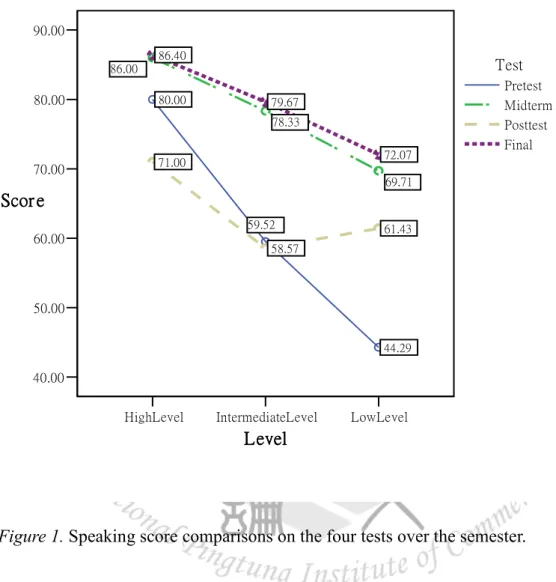
(53) As indicated in Table 11, there was a significant main effect of the level factor (F (2, 148)) = 20.935, P = .000 < .05 which means the participants among three proficient levels had significantly different speaking performances from the remedial English program. Likewise, the main effect of the test factor (F (3, 148)) = 19.156, P = .000 < .05 which shows that the participants performed significantly different among four English speaking tests. As a result, there is a significant main effect of the interaction between level and test (F (6, 148) = 2.847, P = .012 <.05). That is, the high-, intermediate-, and low-level participants had more significant speaking performances among four tests. More specifically, the participants with different English proficiency levels performed notably significant on the speaking tests. Among the four tests, the participants had significantly better speaking performances on the midterm and the final than the pretest; nevertheless, the participants scored better on the posttest, but not significantly better than the pretest. On the midterm, the participants had a significantly better speaking performance than the pretest and the posttest; however, the participants scored better on the final than the midterm without it being statistically significant. Additionally, the participants had a significant speaking improvement on the final in contrast to the pretest and the posttest (see Table 12). More specifically, the statistical comparisons between the speaking scores are presented (see Figure 1 and Table 13).. - 39 -.
(54) Table 12 Multiple Comparisons of Speaking Scores Among Three-Level and Four-Test (I) Level. (J) Level. Mean Difference (I-J). Sig.. Highlevel. Intermediate. 11.826(*). .000. Lowlevel. 18.975(*). .000. Highlevel. -11.826(*). .000. Lowlevel. 7.148(*). .001. Highlevel. -18.975(*). .000. Intermediate. -7.148(*). .001. (I) Test. (J) Test. Mean Difference (I-J). Sig.. Pretest. Midterm. -19.525(*). .000. Posttest. -4.375. .323. Final. -21.100(*). .000. Pretest. 19.525(*). .000. Posttest. 15.150(*). .000. Final. -1.575. .927. Pretest. 4.375. .323. Midterm. -15.150(*). .000. Final. -16.725(*). .000. Pretest. 21.100(*). .000. Midterm. 1.575. .927. Posttest. 16.725(*). .000. Intermediate. Lowlevel. Midterm. Posttest. Final. Note. * presents the mean difference is significant at the .05 level.. - 40 -.
(55) 90.00 86.40. Test. 86.00. 80.00. 80.00. 79.67 78.33 72.07. 71.00. 70.00. Pretest Midterm Posttest Final. 69.71. Scor e 59.52. 60.00. 61.43. 58.57. 50.00 44.29. 40.00 HighLevel. IntermediateLevel. LowLevel. Level. Figure 1. Speaking score comparisons on the four tests over the semester. Table 13 The Presentations of Speaking Scores and Standard Deviation Among Different Proficiency-Level Participants Level. Pretest. Midterm. Posttest. Final. (Increased Score). (Increased Score). (Increased Score). High (N=5). 80.000. 86.000 (6.000). 71.000 (-9.000). 86.400 (6.400). SD. 12.247. 7.382. 14.317. 8.443. Intermediate (N=21). 59.524. SD. 8.047. 10.224. 16.212. 10.818. Low (N=14). 44.286. 69.718 (25.432). 61.429 (17.143). 72.071 (27.785). SD. 12.838. 9.840. 11.673. 10.118. 78.333 (18.809). - 41 -. 58.751 (-0.773). 79.667 (20.143).
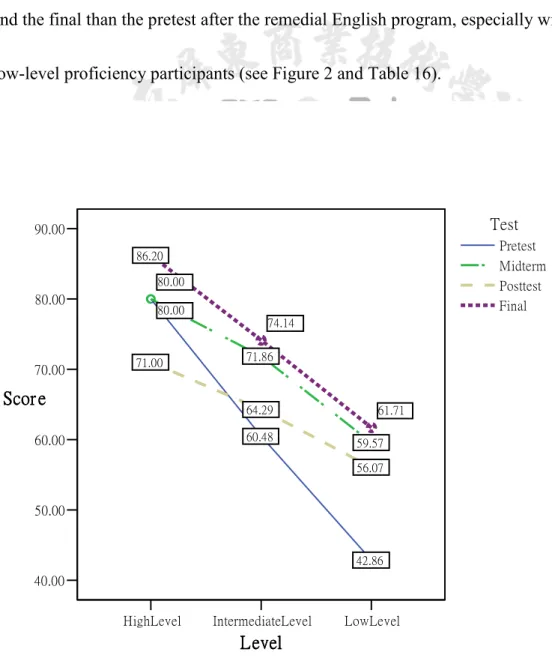
(56) Research question 4: What are the effects of the remedial English program on the writing performance for the participants at different English proficiency levels? Table 14 Main Effects of Factorial ANOVA on Writing Performance Source. Type III Sum. Mean. Partial Eta. of Squares. df. Square. F. Sig.. Squared. 16391.949(b). 11. 1490.177. 8.096. .000. .376. Level. 10225.352. 2. 5112.676. 27.776. .000. .273. Test. 2986.683. 3. 995.561. 5.409. .001. .099. Level * Test. 1055.428. 6. 175.905. .956. .458. .037. Error. 27242.395. 148. 184.070. Total. 713797.000. 160. Corrected Model. Note. Computed using alpha = .05 and R Squared = .376 (Adjusted R Squared = .329).. To examine English writing performance among the three-level-proficiency participants, the data analysis of the factorial ANOVA was presented. By referring to Table 14, there was a significant effect of level (F (2, 148) = 27.776), P = .000 < .05, and also a significant main effect of test (F (3, 148) = 5.409), P = .001 <.05. These two main effects present the participants with different proficient level had significantly different writing performance among all four tests. However, there was no significant interaction between two factors of level and test (F (6, 148) = .956), P = .458 > .05.. - 42 -.
數據
相關文件
Making use of the Learning Progression Framework (LPF) for Reading in the design of post- reading activities to help students develop reading skills and strategies that support their
Developing Students’ Multimodal Literacy in the Secondary English Language Classroom is a resource package produced by the English Language Education Section,
To help students appreciate stories related to the theme and consolidate their knowledge and language skills in writing stories, the English Club has organised a workshop on story
Task: Writing an article to the school newspaper arguing either for or against the proposal which requires students to undertake 50 hours of community service, in addition to
本校為一科技大學,學生之來源大多屬技職體系之職業高中及專科學
There are existing learning resources that cater for different learning abilities, styles and interests. Teachers can easily create differentiated learning resources/tasks for CLD and
(b) Write a program (Turing machine, Lisp, C, or other programs) to simulate this expression, the input of the program is these six Boolean variables, the output of the program
The internationalization of Japanese higher education: Policy debates and realities[M]//Higher education in the Asia-Pacific... 国家。学术与科研能力也显著提高,目前
