CHAPTER III. METHODOLOGY
In this chapter, five dimensions of methodology are presented: research framework, subjects, research methods and instruments, data collection and analysis process, and research procedure.
Research Framework
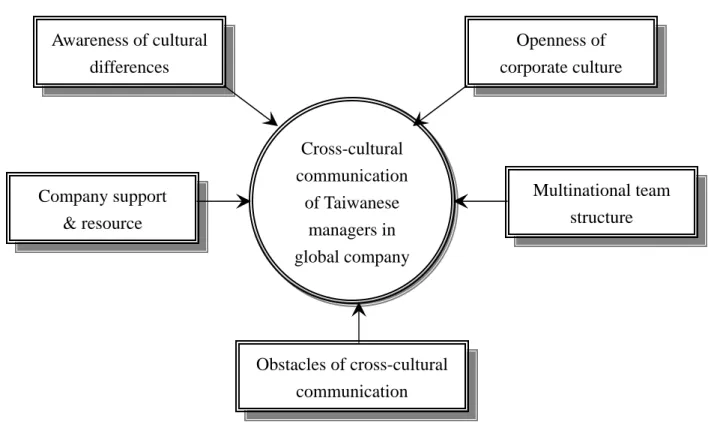
The research framework is formed to realize the core concept of the study. This thesis aims to understand five key factors that influence managers’ cross-cultural communication style: national culture diversity awareness, openness of corporate culture & multicultural team structure. Furthermore, the obstacles of cross-cultural communication and company’s support to facilitate communication also influence communication of managers. All the five key influence factors are discussed in this thesis (shown as Figure 3.1). The researcher assumes that:
Openness of corporate culture will enhance diversity integration and open communication with multinational workforce. Multinational team structure will positively increase managers’ cultural awareness and acceptance of cultural diversity through long-term cooperation. National cultural differences that Taiwanese managers are aware will also influence their communication style with diverse workers. Managers will have positive
Taiwanese managers’ communication. The obstacles will directly impact work efficiency and increase cost of communication.
Figure 3.1 Research framework
Cross-cultural communication
of Taiwanese managers in global company Awareness of cultural
differences
Multinational team structure Openness of corporate culture
Obstacles of cross-cultural communication Company support
& resource
Research Subjects
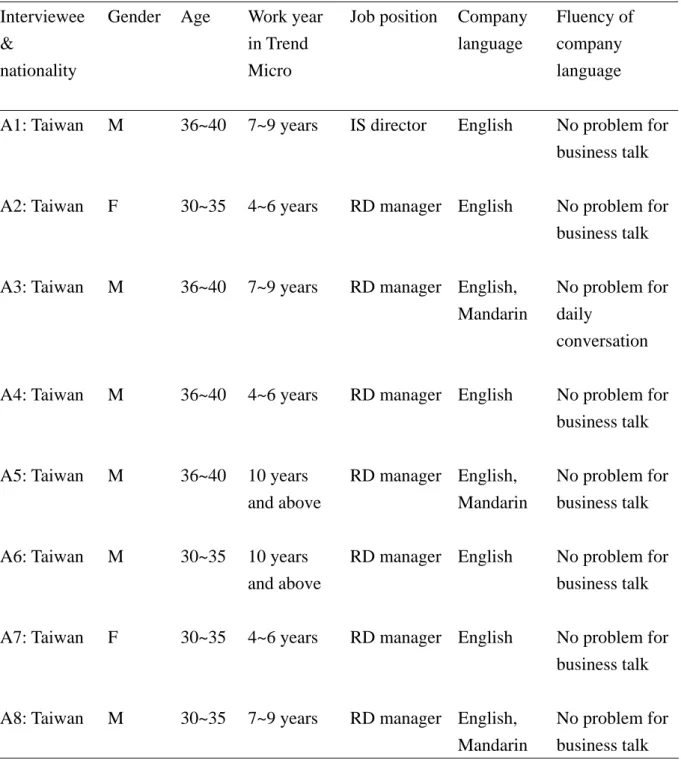
Research subjects of the study are mid-level Taiwanese managers of Trend Micro.
Background information of the interviewees is shown as Table 3.1. Most of the Taiwanese managers work on cross-national projects in R&D field because of the global functionality of Taiwan site (R&D center).
Snowball strategy was applied to find the target interviewees. Through introduction of one manager, target 10 interviewees were invited and 8 of them joined the interview. Bias might occur due to same source of interviewees (all introduced by one manager).
Interviewees might have very similar concepts and ways of working.
According to pre-interview questionnaire and interview results, average age of interviewees is 36 years old, which reflects young management in Trend Micro. Through semi-structured interview questions, 4~8 year experience on cross-cultural communication of the interviewees were also recognized. Related background information of interviewees including age, gender, belonged department, work experience in Trend Micro, etc. are collected from pre-interview questionnaire and further discussed during the interview.
Table 3.1 Background information of interviewees Interviewee
&
nationality
Gender Age Work year in Trend Micro
Job position Company language
Fluency of company language
A1: Taiwan M 36~40 7~9 years IS director English No problem for business talk
A2: Taiwan F 30~35 4~6 years RD manager English No problem for business talk
A3: Taiwan M 36~40 7~9 years RD manager English, Mandarin
No problem for daily
conversation
A4: Taiwan M 36~40 4~6 years RD manager English No problem for business talk
A5: Taiwan M 36~40 10 years and above
RD manager English, Mandarin
No problem for business talk
A6: Taiwan M 30~35 10 years and above
RD manager English No problem for business talk
A7: Taiwan F 30~35 4~6 years RD manager English No problem for business talk
A8: Taiwan M 30~35 7~9 years RD manager English, Mandarin
No problem for business talk
Research Method & Instrument
Case study
A case study approach on Trend Micro Inc. was employed in this study to develop an in-depth analysis of a single case and provide specific example in business than just general study on paper. Trend Micro Inc. is successful in multicultural management and was erected as the No. 1 international brand of Taiwan from year 2002~2005 (黃淑芳, 2006). Experience of summer intern in Trend Micro also helped the researcher gain resources for case study and in-depth interviews more smoothly.
Interview
Interview was also conducted as primary data resource. Interview questions were designed according to research framework, and were semi-structured. Certain questions were extended from interviewees’ feedback/ experience sharing. Some responses were further clarified by interviewees to get clear answers. Comparison and contrast questions were also included in interview questions to clarify different influencing factors of managers’
cross-cultural communication. The interview contents were recorded and transcripts were sent to the interviewees for ensuring content validity. Process of data coding is shown respectively as appendix C.
during the interview. Both interview questions and pre-interview questionnaire were pre-examined by peers and professors to ensure the validity.
Secondary data were collected from three published books about the development and globalization process of Trend Micro Inc., and related websites/ magazines.
Data analysis
In this section, process of data analysis was explained to form core findings in coding list. Interview content, as mentioned, were recorded and written as transcripts. All of questionnaire and interview results were collected and analyzed as following six steps:
In step 1, each completed transcript (in Chinese) was put in right column and marked the important parts/ concepts of research questions. The important parts might include opinions agree or disagree with interview questions or reasons of responses in pre-interview questionnaire. Complete paragraph or sentences were underlined or highlight for identification. In step 2, the marked parts of transcripts were copied to the left column and briefed the concepts. In step 3, ideas copied and briefed in the lefts column were coded as A1-03-08. A1 stands for priority of interviewees; -03- refers to page number of transcript; -8 means the 8th coded idea of all in the transcript. In step 4, coding list was formed and separated into four columns: topic, category, item, and key concepts. Under the same category, similar ideas from each transcript were clustered. Original codes were kept and put in column
“item.” In step 5, key concepts were formed from clustered ideas. Another set of codes were arranged for all key concepts base upon the priorities of topic, category and key concepts. E.g 1-1-2 (topic- category-key concept). In step 6, the coding data was translated into English for further finding discussions.
Research Procedure
In the research procedure, six steps were proceeded (shown as Figure 3.2):
In step 1, first literature review was proceeded to search possible thesis topic and directions. Interested topics such as globalization, international mergers and acquisitions, and cross-cultural issues were collected and had further discussions with thesis advisor.
In step 2, thesis topic and directions were confirmed after several discussions with thesis advisor. Cross-cultural issues were selected due to urgent need and frequent global interactions in business. Understanding about cultural diversity and cross-cultural communication helped business achieve globalization more smoothly.
In step 3, second literature review was proceeded to expand concepts and values of cross-cultural communication. Influencing factors such as national cultural differences, openness of corporate culture and structure, company resources/ supports to cross-cultural communication, communication obstacles/ barriers were reviewed in the second literature review. The process of literature review helps to clarify and strengthen concepts of each discussed area. Some useful guidance and related research formed the foundation of this study.
In step 4, data collection was proceeded. Primary data collections were mostly done through qualitative method: interview and case study. Interview contents were recorded in transcripts and reviewed by the interviewees to ensure content validity. Secondary data
Finally, conclusion and suggestions of the study results were provided for further research on related topics.
First literature review (search for interested directions)
Confirm thesis direction and focus
Second literature review (focus on thesis topic)
Data collection through case study and in-depth interview
Data analysis and discussion
Conclusion and suggestions
Figure 3.2 Research procedure