
利用鈾-235/鈾-238探討古海洋磷酸鹽循環及其氧化還原變化(Ⅱ)
34
0
0
全文
(2) 中 文 摘 要 : 待填 中 文 關 鍵 詞 : 待填 英 文 摘 要 : As a key biological limiting nutrient for marine primary productivity, marine phosphorous fluctuation cycle is thought to be highly associated with the global carbon cycle, early atmospheric oxygenation events, and further the bloom of biological evolution. This study aims to improve our knowledge regarding the redox conditions in the Neoproterozoic marine sedimentary environment by analyzing the 238U/235U, 87Sr/86Sr, and δ88/86Sr isotopic compositions from Doushantuo phosphorites. In first fiscal year, a high precision U isotope analytical method was established, and sampling preparation procedures were settled. In the second fiscal year, samples have been collected and series of mineralogical observation, major and trace elemental analyses, and sequential extraction procedure have been evaluated. The summaries of works done in the current fiscal year were (1) Analyses of triple Sr isotopes (87Sr/86Sr, and δ88/86Sr) of several geochemical fraction of the phosphorite rock specimens; (2) Development of 233U-236U double spike correction procedure using a Newton Raphson method. The ongoing works, we will continue to evaluate and determine the 238U/235U isotopic ratios of the phosphorite samples. We will focus our effort on (1) tracing the potential P source in the shallow water zone of the outer shelf sedimentary environment, i.e. either continental sources, or upwelled bottom water masses, using radiogenic Sr isotopic ratios from the Weng'an phosphorite and (2) understanding the redox conditions and transition process near Precambrian/Cambrian transition using newly developed 238U/235U isotopic approach and coupled with other redox sensitive elemental concentration (i.e. U, V, Mo and S) or isotopic indicators (i.e. S and Mo isotopes) from the Weng'an phosphorites. 英文關鍵詞: X.
(3) 附件一. 科技部補助專題研究計畫成果報告 (□期中進度報告/■期末報告). 利用鈾-235/鈾-238 探討古海洋磷酸鹽循環及其氧化還原變化(Ⅱ) 計畫類別:■個別型計畫 □整合型計畫 計畫編號:MOST 107-2611-M-006-001- 執行期間:107 年 8 月 1 日至 108 年 7 月 31 日 執行機構及系所:國立成功大學地球科學系 計畫主持人:游鎮烽 計畫參與人員:碩士級-專任助理:王子豪 學士級-專任助理:陳大鵬. 中. 華. 民. 國. 年 1. 月. 日.
(4) Exploring Neoproterozoic oceanic phosphorous cycling and redox transition by. 238. Sr/86Sr, and δ88/86Sr isotopic. U/235U,. 87. tracers from Doushantuo phosphorites. 1. Abstract As a key biological limiting nutrient for marine primary productivity, marine phosphorous fluctuation cycle is thought to be highly associated with the global carbon cycle, early atmospheric oxygenation events, and further the bloom of biological evolution. This study aims to improve our knowledge regarding the redox conditions in the Neoproterozoic marine sedimentary environment by analyzing the. 238. U/235U,. 87. Sr/86Sr, and. δ88/86Sr isotopic compositions from Doushantuo phosphorites. In first fiscal year, a high precision U isotope analytical method was established, and sampling preparation procedures were settled. In the second fiscal year, samples have been collected and series of mineralogical observation, major and trace elemental analyses, and sequential extraction procedure have been evaluated. The summaries of works done in the current fiscal year were (1) Analyses of triple Sr isotopes (87Sr/86Sr, and δ88/86Sr) of several geochemical fraction of the phosphorite rock specimens; (2) Development of 233U-236U double spike correction procedure using a Newton Raphson method. The ongoing works, we will continue to evaluate and determine the 238U/235U isotopic ratios of the phosphorite samples. We will focus our effort on (1) tracing the potential P source in the shallow water zone of the outer shelf sedimentary environment, i.e. either continental sources, or upwelled bottom water masses, using radiogenic Sr isotopic ratios from the Weng'an phosphorite and (2) understanding the redox conditions and transition process near Precambrian/Cambrian transition using newly developed. 238. U/235U. isotopic approach and coupled with other redox sensitive elemental concentration (i.e. U, V, Mo and S) or isotopic indicators (i.e. S and Mo isotopes) from the Weng'an phosphorites.. 2.
(5) 2. Research background and motivation Phosphorous (P) is a key biological limiting nutrient for marine primary productivity (Tyrrell, 1999). Fluctuations in marine phosphorous cycling on geological time scales are thought to be highly associated with the global carbon cycle, early atmospheric oxygenation events, and further the bloom of biological evolution (Filippelli, 2008; Planavsky et al., 2010; Saltzman, 2005). The Precambrian and Cambrian transition period is one of the largest phosphogenic events in Earth history, and the phosphorite deposits are worldwide distributed (Muscente et al., 2015). Numbers of studies in the south China sites reported that multiple specimens of microfossils, including acritarchs (Zhou et al., 2001), multicellular algae (Xiao et al., 2004) and putative animals (Yin et al., 2015), had been found from the Ediacaran phosphorites of the Doushantuo Formation, Guizhou Province. Thus, a better understanding of Ediacaran phosphogenesis and corresponding paleo-environmental changes aims for shaping the origin of the early life and the Neoproterozoic oxygenation events (Filippelli, 2008; Mort et al., 2007; Paytan and McLaughlin, 2007). The marine phosphorous cycling is strongly associated with the redox conditions of the water columns (Muscente et al., 2015). Phosphate in the shallow and oxic water zone could be either sourced from the continental riverine input or upwelled water masses, and then efficiently adsorbed onto the iron oxyhydroxide (FeOOH) as Fe-bound phosphorous (FeOOH・PO4) (Feely et al., 1998; Poulton and Canfield, 2006). The transport of the Fe-bound phosphorous into the marine sediments is thought as the main mechanism of phosphorous burial (Shen et al., 2000). While, in euxinic environments abundant free sulfide reacts with the iron oxyhydroxide, forming ferrous iron and elemental sulfur, and restricts the fixation of dissolved phosphorous (März et al., 2008). Once the Fe-bound phosphorous is transported into the marine sediments, microbial sulfate and iron reduction processes and organic matter degradation could lead to the libration of Fe-bound phosphorous and organic phosphate concentrating in the bottom seawater masses or pore waters, which are the major sources for later phosphogenesis either in the in situ anoxic authigenic or shallow oxic environments (Filippelli, 2008, 2001). Most of the phosphorites deposited in the south China are preserved in shallow shelf environments (Muscente et al., 2015), while the deeper section of intra-shelf and slope are lack of significant deposits (Jiang 3.
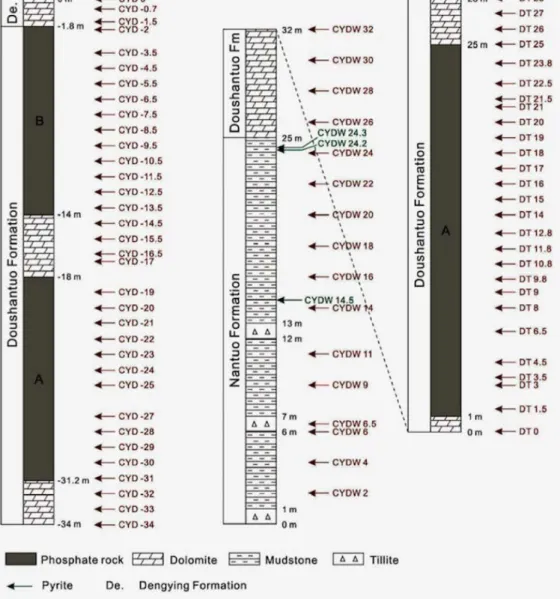
(6) et al., 2011; She et al., 2014). Such a pattern across the south China sedimentary basin show a distinct depthand redox-dependent distributions in the water column (Cui et al., 2016; Muscente et al., 2015). Multilines of evidences suggest that the upper Doushantuo Formation was deposited during a period with enhanced chemical weathering and increased flux of the continental fresh waters, that potentially leaded to a strong redox stratified ocean (Cui et al., 2015; Fike et al., 2006; Kaufman et al., 2007). The δ34S and δ13C isotopic data support that the ocean in that period was stratified, with oxic surface waters and underlying anoxic bottom waters (Cui et al., 2015; Shen et al., 2000). On the basis of 87Sr/86Sr isotopic and sedimentological data, it was likely that episodes of overturn during the Varangian deglaciation by vertical mixing of the water column transporting the P-rich bottom waters to the oxic shallow zone for facilitating the Doushantuo phosphogenesis (Cui et al., 2015; Kaufman et al., 1993). It has been proposed that this upwelling model and redox-dependent mechanism can explain the deposition of Doushantuo phosphorites. However, phosphorite Ce/Ce* data from the Doushantuo outer shelf sections revealed a redox transition toward to reducing environments (Cui et al., 2015). This discrepancy behind the geochemical data emphasizes the fact that although the depositional water column was likely to be oxidized, the authigenic environment at the seafloor or in pore waters can be anoxic due to aerobic remineralization of abundant organic matter formed by water column photosynthesis (Cui et al., 2016). Thus, the critical driving forces controlling the redox transformation in sedimentary environments are still remind of interest. To discriminate the mechanisms, either abiotic physical processes or via the activity of living microorganisms, controlling the redox conditions of the phosphogenesis are of importance to realize the biogeochemical events associated with the life evolution during the early Earth. Uranium isotopic ratio of. 238. U/235U (normally expressed as δ. 238. U) has been suggested as a useful. redox tracer for the paleo-oxygenation event and the ocean redox conditions relying on its isotopic fractionation during redox transitions (Andersen et al., 2014; Bopp et al., 2010; Stylo et al., 2015). The althigenically enriched U deposits are typically formed under anoxic conditions, and hence common in many sedimentary environments, i.e. marine sediments and shales (Bopp et al., 2009; Brennecka et al., 2010). The deposited U typically shows enrichment of 238U, which is attributed to the U(VI)-U(IV) transition (Bopp et al., 2009; Brennecka et al., 2010; Montoya-Pino et al., 2010; Weyer et al., 2008). Laboratory batch experimental studies demonstrated that the uranium isotopic signatures associated with microbial reduction of hexavalent U, 4.
(7) that preferentially accumulates isotopically heavy U (238U) in the reduced form of tetravalent U, is readably distinguishable from that of generated by the abiotic reduction process (Dang et al., 2016; Stylo et al., 2015). This biologically driven. 238. U/235U fractionation is majorly dominated by the. 238. U-favoring nuclear field shift. effect during the U(VI) reduction (Moynier et al., 2013). Accordingly, the heavily δ238U in the authigenic U relative to the pore waters or bottom waters indicates that the U reduction in the sediment of euxinic basins is dominantly biotic (Noordmann et al., 2015). Meanwhile, negligible 238U/235U fractionation (Stylo et al., 2015) or preferential uptake of. 235. U (Dang et al., 2016) was observed during U adsorption/desorption processes.. These specific differences in the U isotopic signatures serves as an appropriate indicator for distinguishing between U biotic and abiotic redox transformations. Besides, based on the laboratory experiments, U precipitation with phosphate does not induce isotope fractionation (Dang et al., 2016), hence the phosphorite U isotopic compositions can fairly record redox transitions at the authigenic environment. In this study, to improve our knowledge regarding the redox conditions in the Neoproterozoic marine sedimentary environment, we will establish a new approach by precisely analyzing the 238U/235U compositions coupled with redox sensitive trace element concentration, and Sr isotopic ratios (87Sr/86Sr and δ88/86Sr) in the phosphorites from the Doushantuo formation. Series of the Doushantuo phosphorite samples were sampled in Weng'an, where located in the shallow zone of the outer shelf of the Yangtze sedimentary basin and sensitive to the redox transformation of the Neoproterozoic ocean. The depth profile of the geochemical data provides a perspective in the context of: (1) potential source of phosphorous in the shallow water column, (2) the sedimentary redox conditions of the Neoproterozoic ocean, and (3) cause and consequence of phosphorite deposition at that time. According to the results of the first two years, the phosphate samples collected were not purely textured. Most samples were dominated by apatite and dolomite, and the minor minerals were quartz and clay minerals of muscovite and illite. Either the interlayers of apatite-rich and dolomite-rich bands or apatite grains surrounded by dolomites were observed in the sample thin sections. Furthermore, some apatite grains were found with the inclusion of quartz, muscovite, and rutile. Hence, total digestion of the bulk specimens would hamper our research purpose, because of the chemical or isotopic compositions of the samples will not simply reflect the temporal variation in oceanic environmental condition. Accordingly, in the current fiscal year, we 5.
(8) had put much of efforts on an evaluation of complete removal of the carbonate phase from the phosphate specimens, and then establishments of the temporal variation of the triple Sr isotope variability through the de-carbonate phases. Finally, a mass-balance model has been applied to calculate the triple Sr isotopic compositions in the authigenic phase of the phosphate rocks, which potentially reflects the isotopic composition of the paleo-seawater at that time. In brief, our. 87. Sr/86Sr displayed a comparable result with the. literature data, for the first time, we established the first data set of δ88/86Sr of the phosphorites from the Doushantuo Formation. Those data coupled with the δ235/238U data, still under process, will shed new lights on the P sources and its formation mechanisms.. 3. Study area and sampling strategy The Doushantuo Formation was thought deposited on a southeast-facing passive continental margin on the Yangtze Craton (Jiang et al., 2011). Following the terminal Cryogenian glaciation and soon after deposition of the cap carbonate unit at the base of the Doushantuo Formation, the Yangtze Platform quickly evolved from a ramp with mixed carbonate and fine-grained siliciclastic rocks to a rimmed-shelf with mudstone-dominated shelf lagoon facies and carbonate grainstone-dominated outer shelf facies (Jiang et al., 2011). Weng'an locates at the outer shelf of the Yangtze Gorges sedimentary basin and is one of the major phosphorite developed units of the Doushantuo Formation (Fig. 1). The Weng'an section typically contains five units (Xiao et al. 2014). The first unit (~5-10 m) of the section is dominated by a cap dolostone. Overlain above it, the unit 2 (~8-15 m) is the lower phosphorite bed (Phosphorite unit A), which is a thin-bedded phosphorite with interbedded dolostone and siltstone. The unit 3 (~2-4 m) is a massive dolostone topped by a prominent karstification surface. The unit 4 (~3-10 m) is the upper phosphorite bed (Phosphorite unit B). This layer contains two sub-units of phosphorite, which the bottom layer is an intraclastic organic carbon-rich phosphorite, and the upper layer is dolomitic phosphorite (Dornbos, 2011). Meanwhile, this unit contains abundant multicellular biota, also well-known as "Weng'an biota", and is therefore the major phosphatized fossils of the Doushantuo Formation. The unit 5 (~10 m) is dominated by phosphatic dolostone (Jiang et al., 2011; Zhu et al., 2007). Here in this study, series of Dousantuo phosphorite specimens had been sampled in 6.
(9) 2015 at two studying sites in Weng'an County, one is an outcrop in Chuanyangong and the other one is a mine in Datang (Fig. 2). The geochemical data of the two profiles of Dousantuo phosphorites will aims at reconstructing the redox transition at that time of the Neoproterozoic ocean and shaping the biogeochemical events during the period of the Precambrian and Cambrian transition.. Fig. 1. Paleogeographic reconstruction and stratified redox ocean model of the Yangtze sedimentary basin, showing the approximate locations of Doushantuo sections marked on the diagrams, where WA presents the abbreviation of Weng'an. (Figure adapted from (Muscente et al., 2015)). 7.
(10) Fig. 2. Representative stratigraphic columns of Doushantuo sections of Weng'an. Doushantuo phosphorites had been sampled in 2015 at the outcrop in Chuanyandong and the mine in Datang, respectively.. 8.
(11) 4. Methodology 4.1.. Determinations of some major elements, Sr, and U concentration using XRF and ICP-OES Major element compositions were measured on fused glass beads, following standard XRF methods at. the Tohoku University and calibrated with RGM-1 and BHVO-2 standard (Shinjo et al., 2000). 4.2. Sequential extraction method for de-carbonate fraction of the Doushantuo phosphate rocks Three dolostone samples (CYD-8.5, CYD-28 and CYD-31) from the Doushantuo Formation were selected to establish the leaching procedure and to check for the reliability of leaching data. Sediment samples (~50 mg) were weighed out in 1.5 mL Centrifuge tube. Leaching is in the following order (Lv et al., 2018): 2 steps of 1 mol L-1 ammonium acetate (N1 and N2; removing adsorbed Zn on mineral surfaces and/or exchangeable ions in clays), 2 steps of 0.27 vol.% acetic acid (S1 and S2; removing secondary calcite), 2 steps of 1 vol.% acetic acid (S3 and S4), 5 steps of 5 vol.% acetic acid (S5–S9) and 2 steps of 10 vol.% acetic acid (S10 and S11). At each step, samples were treated with the supersonic treatment for 10 min, heating at 65 ℃ for 20 min and centrifugation at 3600 rpm for 5 min. The leachates after step S2 (S3-S9) are taken to represent the composition of the primary carbonates. The de-carbonate fractions were then acid digested and following previously reported methods (Rolison et al., 2018). The residuals of sequential extraction were digested in a mixture of concentrated HNO3 and HF acids (1:8 ratio) for ~96 h at ~120 ℃. The samples were then dried down and then refluxed in concentrated HNO3 at ~120 ℃ for 24 h. Samples were again dried down and then refluxed in 0.3M HNO3 at ~90 ℃ for ~ 4 h. After appropriate dilution, elemental concentrations were measured via ICP-OES. 4.3.. Matrix separation and triple Sr isotopic analyses The Sr resin (Eichrom Technologies, United States) was applied for sample matrix separation and Sr. purification. The procedure for the matrix separation is given in Liu et al. (2012a). The elution curve of the column chemistry and Sr recovery was carefully examined by a variety of sample matrices, i.e., seawater (IAPSO), carbonates (Jcp-1), and rocks (BHVO-2, BCR-2 and AGV-2). Matrix elements, Rb and Zr were efficiently removed, and the Sr recovery was evaluated to be ~99% (from 98.8% to 100.1%) by comparing the Sr content prior to and post the matrix separation. The full procedure was performed in a class-10 air flow working bench. The total procedure blank was assessed to be <100 pg, corresponding to <0.02% of the total 9.
(12) loaded Sr. The collected Sr fraction was evaporated dryness at 90℃ and then re-dissolved to obtain a 150 ng g-1 Sr solution in 5% HNO3, which was spiked with a high purity Zr standard (300 ng g-1, High-Purity Standards, United States) for Sr isotopic analyses. The Sr isotopic ratios, 87Sr/86Sr and δ88/86Sr, were measured using multi-collector inductively coupled plasma mass spectrometry (Neptune, Thermo-Fisher Scientific, Germany) at the Earth Dynamic System Research Center (EDSRC), NCKU. A static mode was applied to monitor the intensities of 83Kr, 85Rb, 86Sr, 87Sr, 88Sr, 90Zr, 91Zr and 92Zr. The intensities of 83Kr and 85Rb were used for potential isobaric interference correction of 86Kr (83Kr/86Kr = 0.664740, De Laeter et al., 2003) and 87. Rb (87Rb/85Rb = 0.385617, De Laeter et al., 2003) on 86Sr and 87Sr, respectively. These isobaric interferences. were automatically corrected by Neptune software using an exponential fractionation law. A conventional internal normalization procedure was applied to correct the mass bias effect on the measured 87Sr/86Sr ratios by using a constant. 88. Sr/86Sr ratio of 8.375209 (Nier, 1938). For stable Sr isotopes, a Zr empirical external. normalization coupled with the standard sample bracketing technique was employed for δ88/86Sr mass bias correction (Liu et al., 2016). All the instrumentally raised mass discrimination corrections were conducted off-line using a mass-dependent exponential equation (Liu et al., 2016). The typical operating conditions and the detailed mass bias correction protocol are given in Liu et al. (2016). NIST SRM 987 (National Institute of Standards and Technology, United States) and an additional seawater standard (IAPSO, Batch #P137, Ocean Scientific International Ltd., United Kingdom) were used for Sr isotope analytical quality assurance and quality control. At least five sets of IAPSO seawater closely bracketed with NIST SRM 987 were performed prior to sample measurements. Another carbonate standard, Jcp-1 (Geological Survey of Japan), was further measured in the sample sequence to ensure data quality. These data demonstrate a reproducibility of 0.71025 ± 0.00002 (2S.D., n = 75) for NIST SRM 987 87Sr/86Sr ratios, 0.70917 ± 0.00002 (2SD, n = 25) for IAPSO 87. Sr/86Sr ratios, and 0.70920 ± 0.00002 (2SD, n = 3) for Jcp-187Sr/86Sr ratios. The variation of unknown. sample 88Sr/86Sr was normalized to the NIST SRM 987 as δ-notation (Eq. 1).. (Eq. 1) The internal precision (2S.E.) for the δ88/86Sr measurements was in the range of 0.02‰ to 0.05‰ for the IAPSO seawater standard (n=25) and 0.02‰ to 0.06‰ for the phosphate specimens. The reproducibilities 10.
(13) were 0.39‰ ± 0.03‰ (2S.D., n = 25) for IAPSO δ88/86Sr, and 0.20‰ ± 0.05‰ (2S.D., n = 3) for Jcp-1 δ88/86Sr, consistent with literature values (e.g., Fietzke and Eisenhauer, 2006; Krabbenhöft et al., 2009). 4.4.. Matrix separation and stable U isotopic analyses UTEVA resin (Eichrom Technologies, United Stastes) has been widely used for U and some other. tetravalent actinides (Th, Pu and Np) purification. The chromatography majorly follows the procedure proposed by (Wang and You, 2013). Approximately 1 ml UTEVA resin was packed into an acid-cleaned polypropylene column (i.d. 5.0-5.5 mm). The resin was washed using 4 ml 3 mol L-1 HNO3, 4 ml 3 mol L-1 HCl, 4 ml 1 mol L-1 HCl, and 4 ml Milli-Q water in sequence, and then conditioned using 3 ml 3 mol L-1 HNO3. 500 ng U from samples was evaporated to dryness at 90°C and redissolved in 1 ml 3 mol L-1 HNO3. The sample solution was loaded into the column, then the matrix elements were removed by 8 ml 3 mol L-1 HNO3, and Th was eluted by another 6 ml 3 mol L-1 HCl. Finally, U was collected using 6 ml 1 mol L-1 HCl. The U fraction was evaporated to dryness, and re-dissolved to the concentration of 500 ng g-1 in 0.3 mol L-1 HNO3 for MC-ICP-MS analyses. This protocol had been evaluated under various matrices of seawater, river waters, and carbonates. For carbonate specimens, U recovery was estimated to be 99%, and successfully separated from Th; and the total procedure blank was at the level of 2 pg (Wang and You, 2013). U isotopic determination will be conducted using a multi-collector inductivity coupled plasma spectrometer (MC-ICP-MS; Neptune, Thermo-Fisher, Germany) coupled with Cetec Aridus II desolvent system at Department of Earth Sciences, National Cheng Kung University (NCKU). The instrument contains one fixed central and eight moveable Faraday detectors, and the amplifiers equip with nine 1011Ω resistors and one additional 1010Ω resistor. A static mode will be employed to collect the intensity of 234U, 235U and 238U, in which the ion beam of 238U is detected using the 1010Ω resistor. The instrumental settings and data acquisition parameters mainly follow the setups of (Wang and You, 2013). Daily operating conditions will be optimized for maximum signal stability of U ion beam. The U concentration will be fixed at 500 ng g-1 in all the processed samples, hence, the maximum 238U intensity will be at the range between 70 to 80 volts. Sequences of sample measurement start with stability and quality control evaluation using IRMM-3184, CRM-U010, and in-house U standard solutions. A standard-sample bracketing (SSB) technique will apply for correction. The data are expressed as the δ-notation: 11. 235. U/238U mass bias.
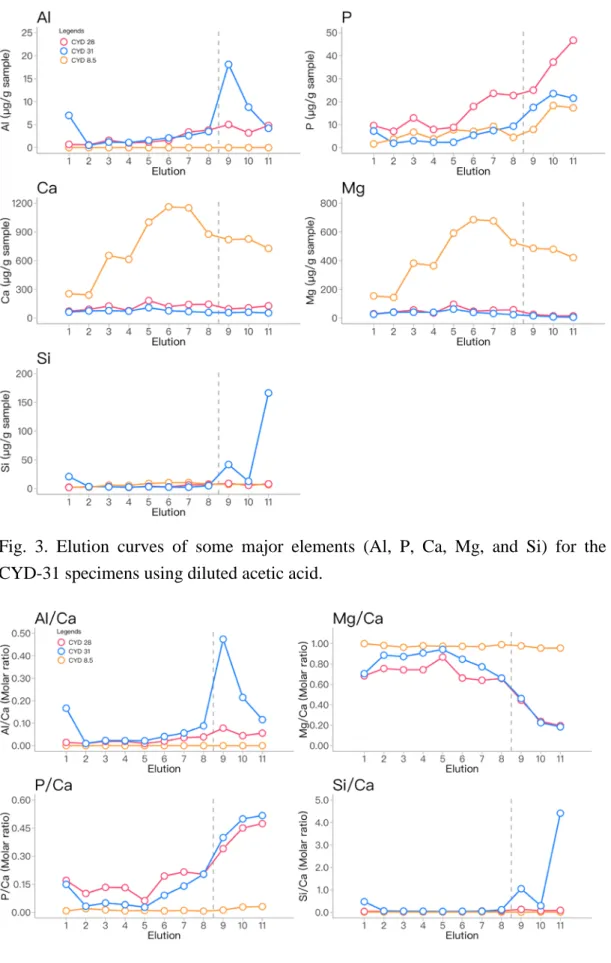
(14) (Eq. 2) The reproducibility of δ238U determinations were better than 0.15‰ (2SD, n = 6). 5. Preliminary results. 5.1. Evaluation of the sequential extraction procedure under various extracting conditions for removal of the carbonate fraction One of the principal targets of this study is that reconstruct the paleo-redox condition of the early oceanography by the redox-sensitive elements and their isotopic compositions. However, based on our scanning electron microscope (SEM) observation, carbonate species (i.e., calcite and dolomite) do exist in the Doushantuo phosphate rocks. Therefore, the carbonate fraction, especially in various proportions, may hamper the purpose of this study. Hence, three of the phosphate rocks, namely CYD-8.5 (carbonate accounts roughly 90% w.t.), CYD-28 (~30% w.t.), and CYD-31 (~15% w.t.), were selected to test the sequential extraction for the carbonate removal. Fig. 3 shows some major elements (i.e., Al, P, Ca, Mg, and Si) extracted in each diluted acetic acid fraction. Significant increases in P and Si were observed after the 8th extracted fraction, suggesting the potential dissolution of non-carbonate materials. Fig. 4 shows the element/Ca molar ratios in each extracted fraction. The data suggest a similar extraction systematic as Fig. 3. Exception for the CYD-8.5, which has a high carbonate content, the diluted acetic acid may attach non-carbonate materials after the 8th extraction. Hence, samples with carbonate content lower than 30% wt, eight repeated diluted acetic acid extraction can successfully remove the carbonate fraction. However, for samples with higher carbonate content, repeated extraction procedures may be required. Monitoring of the element/Ca in the extraction fractions serve as a useful and efficient approach to ensure the fully extraction of carbonate in the phosphate rocks.. 12.
(15) Fig. 3. Elution curves of some major elements (Al, P, Ca, Mg, and Si) for the CYD-8.5, CYD-28, and CYD-31 specimens using diluted acetic acid.. Fig. 4. Elemental ratios of Al/Ca, Mg/Ca, P/Ca, and Si/Ca in each eluted fraction for the CYD-8.5, CYD-28, and CYD-31 specimens using diluted acetic acid.. 13.
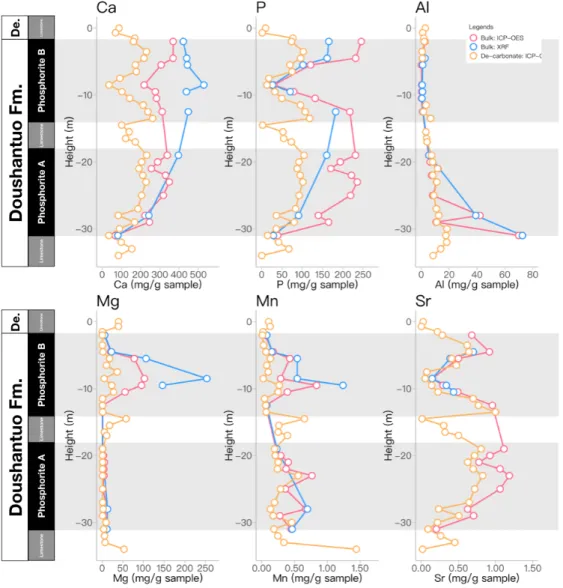
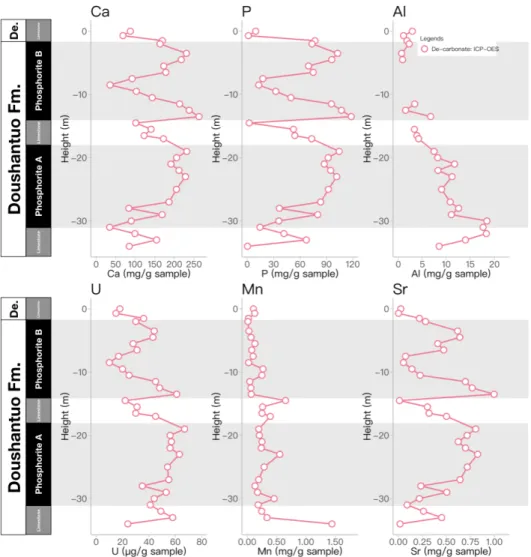
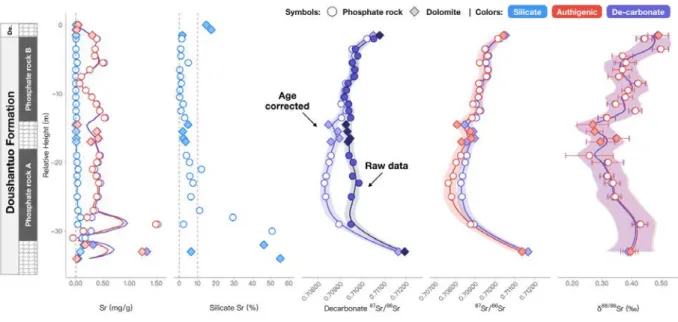
(16) 5.2. Temporal changes in some major and trace elements in the Doushantuo Weng'an section Fig. 5 represents some major and Sr concentration in bulk and de-carbonate specimens of the Doushantuo phosphate rocks, respectively. In brief, our data suggest that some elements, such as Al, Mn, and Sr, were dominated in the phosphate fraction instead of the carbonate fraction. In contrast, at least 70% to 80% of Ca and P were dominated in the carbonate fraction. Hence, the dynamic of carbonates in the phosphate rocks may have significant influences on the element/Ca ratios of the bulk samples. This implies the importance of the extraction method (mentioned in section 5.1) on entirely isolating the carbonate fraction from the phosphate samples. Fig. 6 shows the temporal changes in the elemental contents in the de-carbonate samples in the Doushantuo Weng’an section. The data suggest that concentrations of Ca, Mg, Sr, and U generally showed higher in the phosphate units and lower in the limestone units. However, a remarkable lower peak reveals within the phosphate B unit. The profound fluctuation of these elements may imply the significant changes in the oceanic environments during the second phosphate precipitation event (unit B) in compared with the early phosphate precipitation event (unit A). The newly developed. 238. U/235U isotopic. approach (the analytical method has been established and evaluated in the last fiscal year) and coupled with other redox sensitive elemental concentration (i.e. U, V, Mo and S) or isotopic indicators (i.e. S and Mo isotopes) will shed some light on understanding the redox conditions and transition process near Precambrian/Cambrian transition.. 14.
(17) Fig. 5. Temporal variations in some major elements (Ca, P, Al, Mg, Mn, and Sr) for the Doushantuo phosphate rocks. The red and blue curves represent the element contents of the bulk samples obtained using ICP-OES and XRF, respectively; while the orange curve stands for the element content of the de-carbonated fraction obtained using ICP-OES.. 15.
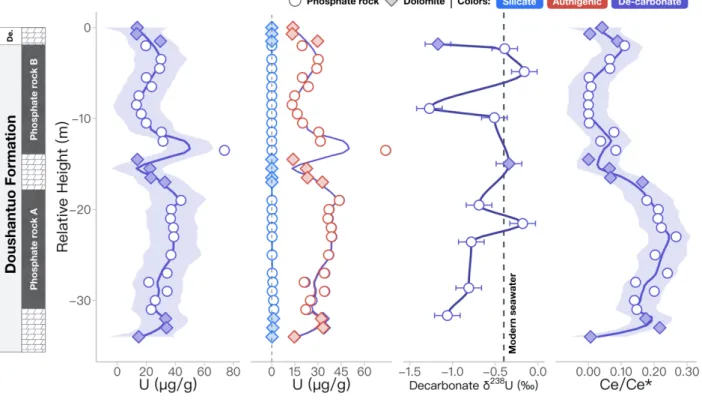
(18) Fig. 6. Temporal variations in some major elements (Ca, P, Al, Mg, Mn, and Sr) for the Doushantuo phosphate rock de-carbonated fraction obtained using ICP-OES.. 5.3. Temporal changes in triple Sr isotopic compositions in the Doushantuo Weng'an section To faithfully reconstruct the triple Sr isotopic compositions of the paleo-seawater, Sr-bearing detrital minerals (silicates) in the phosphate rocks may affect the authigenic phase 87Sr/86Sr and δ88/86Sr compositions if Sr in authigenic phases are low. A simple calculation has been applied to estimate the proportion of silicate bound Sr using an Al-normalized enrichment factor with the average composition of the upper continental crust (Eq. 3).. (Eq. 3). 16.
(19) Hence, we can estimate the element concentrations in both the authigenic and the detrital fractions on the basis of the de-carbonate fractions. For Sr, most of the samples have silicate-bound Sr estimated to be lower than 10%, with the exception of some samples at the bottom of the Wengan section (Fig. 7). Therefore, the samples with silicate-bound Sr >10% were ignored in the further calculation in this study. For one hand, after the age correction, the 87Sr/86Sr of the authigenic fractions were calculated using the following equation (Eq. 4, modified from Asael et al., 2013):. (Eq. 4) On the other hand, δ88/86Sr for the authigenic fractions were calculated using the similar equation (Eq. 5):. (Eq. 5) Fig. 7 presents the temporal variations of the 87Sr/86Sr and δ88/86Sr compositions in the authigenic fraction of the phosphate rocks. Basically, the Weng’an section has a gradual increasing trend in 87Sr/86Sr ratios from the bottom section to the top section with the values from ~0.708 to ~0.711, indicating the significance of isotopically radiogenic Sr sources. Three significantly heavier δ88/86Sr were detected in the Weng’an section which was potentially in coupled with the P concentration variations (refers to Fig. 6). At this stage, the preliminary results of the triple Sr isotopes in the authigenic fraction of the phosphate rocks suggests that the source of P of the is highly associated with the continental weathering, instead of the hydrothermal flux. The heavier δ88/86Sr of the authigenic fraction may possible imply the incongruent silicate weathering at that time. The triple Sr isotopic data coupled with the δ235/238U may aim for better constrain the P source and the transition process of the phosphate rocks near Precambrian/Cambrian transition.. 17.
(20) Fig. 7. Temporal variations in Sr concentration, 87Sr/86Sr, and δ88/86Sr compositions of various geochemical fractions, including de-carbonate, authigenic, and detrital (silicate), for the Doushantuo phosphate rocks.. 5.4. Temporal changes in U concentration and its stable isotopes in the Doushantuo Weng'an section Uranium concentration and δ238U of the Weng’an specimens are given in Fig. 8. Based on our sequential extraction results, U mostly concentrated in the authigenic phase, while a very tiny amount of U was detected in the silicate fraction at the lower section of the Weng’an profile (at depths <30 m). Thus, U concentration and δ238U performed from the de-carbonate phase may faithfully reflect their geochemical compositions of the authigenic phase. Our U concentration data fits well with Ca and P concentrations (referring to Fig. 6), indicating the enrichment of U is highly associated with the phosphate rock formation. Accordingly, δ238U may further imply environmental conditions during the precipitation of phosphate minerals, e.g., redox variation. In this study, we have processed 12 δ238U analyses, the samples were selected based on the high and low peaks of U concentration throughout the profile. The preliminary results showed that δ238U values varied from -1.2‰ to -0.1‰ with a mean value of -0.6‰. δ238U values in the phosphate rock unit B (up to 1.1‰) revealed a higher variability than unit A (~0.9‰). In brief, δ238U in unit A showed a slightly increasing trend from the bottom section to the upper section, with a significantly heavier peak (-0.2‰) detected at the depth of 21 m. In contrast, δ238U in unit B showed a huge variation coupling with U concentration. Thus, δ238U showed a lower value at the depth of the lowest U concentration and higher at depths with higher U concentration. Uranium occurs in two redox states in natural water, U(VI) and U(IV). Within anoxic condition, U(VI) is reduced to U(IV), which is relatively insoluble. Within this reaction, 238U is preferentially incorporated to the authigenic phase of sediments. Thus, higher U concentration and heavier δ238U in sediments is ideally expected in the anoxic environment. To examine whether redox variation can explain the observed δ238U in the Weng’an section, we used rare earth element anomaly, i.e., Ce/Ce* (Ce anomaly, Eq. 6), as an approximate index for reflecting the redox conditions of paleo-oceanography:. 18.
(21) (Eq. 6). where SN represents concentration normalized to Post-Archean Australian Shale values (Ling et al., 2013). In the sediments, higher Ce/Ce* values usually mean anoxic conditions, and vice versa. In our data, Ce/Ce* values were much higher in unit A than unit B, apparently suggesting a more anoxic condition in unit A. δ238U values in unit B show a good correlation with the Ce/Ce* ratios, suggesting the δ238U variability was highly attributed to changes in redox conditions. However, δ238U in unit A does not have a good correlation with Ce/Ce*. This could be explained in several ways. First, Ce/Ce* in unit A cannot faithfully reflect the redox conditions because based on our phase separation experiment REEs existed in both authigenic and silicate phases (Fig. 9). Thus, the Ce/Ce* ratios in the lower section of unit A may be biased by the silicate bound REEs. Thus, δ238U values in unit A, at least the upper section of unit A, can still be explained by redox variation. Secondly, as our Sr isotopic data suggested weathering sources are an important factor controlling the chemical composition of seawater at that time, variability in δ238U of the continental weathering flux (the major U source to the ocean) may affect the δ238U of seawater and further the precipitated phosphate minerals. At this stage, we have limited knowledge of how the seawater δ238U changed at that time. Thus, if we assume the long residence time of U making the seawater δ238U remaining constant at that time, δ238U of the authigenic fraction may imply changes in redox conditions. Consequently, our δ238U data suggest that redox fluctuations in unit B are significantly larger than in unit A. Our preliminary results also suggest that redox may largely change within the unit of phosphate formation.. 19.
(22) Fig. 8. Temporal variations in U concentration, δ238U, and Ce/Ce* ratios for the Doushantuo phosphate rocks. The dashed line represents the mean δ238U value of the modern seawater. Error bars represent the external precision of replicated measurements of CRM145 (2S.D., n = 6).. Fig. 9. Temporal variations in Ce/Ce* ratios of the decarbonate fraction and Pr, Ce, and Nd concentration of various geochemical fraction, including de-carbonate, authigenic, and detrital (silicate), for the Doushantuo phosphate rocks.. 20.
(23) 6. Expected key performance indicators 1. to trace the potential P source in the shallow water zone of the outer shelf sedimentary environment, i.e. either continental sources, or upwelled bottom water masses, using radiogenic Sr isotopic ratios from the Weng'an phosphorite. 2.. to understand the redox conditions and transition process near Precambrian/Cambrian transition using newly developed. 238. U/235U isotopic approach and coupled with other redox sensitive. elemental concentration (i.e. U, V, Mo and S) or isotopic indicators (i.e. S and Mo isotopes) from the Weng'an phosphorites.. 7. References Andersen, M.B., Romaniello, S., Vance, D., Little, S.H., Herdman, R., Lyons, T.W., 2014. A modern framework for the interpretation of. 238. U/235U in studies of ancient ocean redox. Earth and Planetary Science. Letters 400, 184–194. doi:10.1016/j.epsl.2014.05.051 Asael, D., Tissot, F.L.H., Reinhard, C.T., Rouxel, O., Dauphas, N., Lyons, T.W., Ponzevera, E., Liorzou, C., Chéron, S., 2013. Coupled molybdenum, iron and uranium stable isotopes as oceanic paleoredox proxies during the Paleoproterozoic Shunga Event. Chem. Geol. 362, 193–210. Bopp, C.J., Lundstrom, C.C., Johnson, T.M., Glessner, J.J.G., 2009. Variations in. 238. U/235U in uranium ore. deposits: Isotopic signatures of the U reduction process? Geology 37, 611–614. doi:10.1130/G25550A.1 Bopp, C.J., Lundstrom, C.C., Johnson, T.M., Sanford, R.A., Long, P.E., Williams, K.H., 2010. Uranium 238. U/235U Isotope Ratios as Indicators of Reduction: Results from an in situ Biostimulation Experiment at. Rifle, Colorado, U.S.A. … science & technology 44, 5927–5933. doi:10.1021/es100643v Brennecka, G.A., Borg, L.E., Hutcheon, I.D., Sharp, M.A., Anbar, A.D., 2010. Natural variations in uranium isotope ratios of uranium ore concentrates: Understanding the. 238. U/235U fractionation mechanism. Earth and. Planetary Science Letters 291, 228–233. doi:10.1016/j.epsl.2010.01.023. 21.
(24) Cui, H., Kaufman, A.J., Xiao, S., Zhu, M., Zhou, C., Liu, X.-M., 2015. Redox architecture of an Ediacaran ocean margin: Integrated chemostratigraphic (δ13C–δ34S–87Sr/86Sr–Ce/Ce*) correlation of the Doushantuo Formation, South China. Chemical Geology 405, 48–62. doi:10.1016/j.chemgeo.2015.04.009 Cui, H., Xiao, S., Zhou, C., Peng, Y., Kaufman, A.J., Plummer, R.E., 2016. Sedimentary Geology 341, 134–146. doi:10.1016/j.sedgeo.2016.05.008 Dang, D.H., Novotnik, B., Wang, W., Georg, R.B., Evans, R.D., 2016. Uranium isotope fractionation during adsorption, (co)precipitation and biotic reduction. Environmental Science & Technology acs.est.6b01459. doi:10.1021/acs.est.6b01459 De Laeter, J.R., Bohlke, J.K., De Bievre, P., Hidaka, H., Peiser, H.S., Rosman, K.J.R., Taylor, P.D.P., 2003. Atomic weights of the elements: Review 2000 - (IUPAC technical report). Pure and Applied Chemistry 75, 683–800. doi:10.1351/pac200375060683 Dornbos,. S.Q.,. 2011.. Phosphatization. Through. the. Phanerozoic.. Taphonomy. 435–456.. doi:10.1007/978-90-481-8643-3_12 Feely, R.A., Trefry, J.H., Lebon, G.T., German, C.R., 1998. The relationship between P/Fe and V/Fe ratios in hydrothermal precipitates and dissolved phosphate in seawater. Geophysical Research Letters 25, 2253–2256. doi:10.1029/98GL01546 Fietzke J., and Eisenhauer A. 2006. Determination of temperature-dependent stable strontium isotope (88Sr/86Sr) fractionation via bracketing standard MC-ICP-MS. Geochemistry, Geophysics, Geosystems 7. doi:10.1029/2006GC001243. Fike, D.A., Grotzinger, J.P., Pratt, L.M., Summons, R.E., 2006. Oxidation of the Ediacaran Ocean. Nature 444, 744–747. doi:10.1038/nature05345 Filippelli, G.M., 2008. The Global Phosphorus Cycle: Past, Present, and Future. Elements 4, 89–95. doi:10.2113/GSELEMENTS.4.2.89. 22.
(25) Filippelli, G.M., 2001. Carbon and phosphorus cycling in anoxic sediments of the Saanich Inlet, British Columbia. Marine Geology 174, 307–321. doi:10.1016/S0025-3227(00)00157-2 Jiang, G., Shi, X., Zhang, S., Wang, Y., Xiao, S., 2011. Stratigraphy and paleogeography of the Ediacaran Doushantuo Formation. (ca. 635–551Ma) in South China. Gondwana Research 19,. 831–849.. doi:10.1016/j.gr.2011.01.006 Kaufman, A.J., Corsetti, F.A., Varni, M.A., 2007. The effect of rising atmospheric oxygen on carbon and sulfur isotope anomalies in the Neoproterozoic Johnnie Formation, Death Valley, USA. Chemical Geology 237, 47–63. doi:10.1016/j.chemgeo.2006.06.023 Kaufman, A.J., Jacobsen, S.B., Knoll, A.H., 1993. The Vendian record of Sr and C isotopic variations in seawater: Implications for tectonics and paleoclimate. Earth and Planetary Science Letters 120, 409–430. doi:10.1016/0012-821X(93)90254-7 Krabbenhöft A., Fietzke J., Eisenhauer A., Liebetrau V., Böhm F. and Vollstaedt H. 2009. Determination of radiogenic and stable strontium isotope ratios (87Sr/86Sr; δ88/86Sr) by thermal ionization mass spectrometry applying an 87Sr/84Sr double spike. Journal of Analytical Atomic Spectrometry 24, 1267. Ling, H.-F., Feng, H.-Z., Pan, J.-Y., Jiang, S.-Y., Chen, Y.-Q., Chen, X., 2007. Carbon isotope variation through the Neoproterozoic Doushantuo and Dengying Formations, South China: Implications for chemostratigraphy and paleoenvironmental change. Palaeogeography, Palaeoclimatology, Palaeoecology 254, 158–174. doi:10.1016/j.palaeo.2007.03.023 Liu, H.-C., Chung, C.-H., You, C.-F., Chiang, Y.H., 2016. Determination of 87Sr/86Sr and δ88/86Sr ratios in plant materials using MC-ICP-MS. Analytical and Bioanalytical Chemistry. doi:10.2307/4393857 Liu, H.-C., You, C.-F., Huang, K.-F., Chung, C.-H., 2012. Precise determination of triple Sr isotopes (δ87Sr and δ88Sr) using MC-ICP-MS. Talanta 88, 338–344. doi:10.1016/j.talanta.2011.10.050 März, C., Poulton, S.W., Beckmann, B., Küster, K., Wagner, T., Kasten, S., 2008. Redox sensitivity of P cycling during marine black shale formation: Dynamics of sulfidic and anoxic, non-sulfidic bottom waters. Geochimica et Cosmochimica Acta 72, 3703–3717. doi:10.1016/j.gca.2008.04.025 23.
(26) Montoya-Pino, C., Weyer, S., Anbar, A.D., Pross, J., Oschmann, W., van de Schootbrugge, B., Arz, H.W., 2010. Global enhancement of ocean anoxia during Oceanic Anoxic Event 2: A quantitative approach using U isotopes. Geology 38, 315–318. doi:10.1130/G30652.1 Mort, H.P., Adatte, T., Föllmi, K.B., Keller, G., Steinmann, P., Matera, V., Berner, Z., Stüben, D., 2007. Phosphorus and the roles of productivity and nutrient recycling during oceanic anoxic event 2. Geology 35, 483–486. doi:10.1130/G23475A.1 Moynier, F., Fujii, T., Brennecka, G.A., Nielsen, S.G., 2013. Nuclear field shift in natural environments. Comptes Rendus Geoscience 345, 150–159. doi:10.1016/j.crte.2013.01.004 Muscente, A.D., Hawkins, A.D., Xiao, S., 2015. Fossil preservation through phosphatization and silicification in the Ediacaran Doushantuo Formation (South China): a comparative synthesis. Palaeogeography, Palaeoclimatology, Palaeoecology 434, 46–62. doi:10.1016/j.palaeo.2014.10.013 Nier A.O. 1938. The isotopic constitution of strontium, barium, bismuth, thallium and mercury. Physical Review 54, 275-278. doi: 10.1103/PhysRev.54.275 Noordmann, J., Weyer, S., Montoya-Pino, C., Dellwig, O., Neubert, N., Eckert, S., Paetzel, M., Böttcher, M.E., 2015. Uranium and molybdenum isotope systematics in modern euxinic basins: Case studies from the central. Baltic. Sea. and. the. Kyllaren. fjord. (Norway).. Chemical. Geology. 396,. 182–195.. doi:10.1016/j.chemgeo.2014.12.012 Paytan, A., McLaughlin, K., 2007. The Oceanic Phosphorus Cycle. Chemical reviews 107, 563–576. doi:10.1021/cr0503613 Planavsky, N.J., Rouxel, O.J., Bekker, A., Lalonde, S.V., Konhauser, K.O., Reinhard, C.T., Lyons, T.W., 2010. The evolution of the marine phosphate reservoir. Nature 467, 1088–1090. doi:10.1038/nature09485 Poulton, S.W., Canfield, D.E., 2006. Co-diagenesis of iron and phosphorus in hydrothermal sediments from the southern East Pacific Rise: Implications for the evaluation of paleoseawater phosphate concentrations. Geochimica et Cosmochimica Acta. doi:10.1016/j.gca.2006.01.030. 24.
(27) Saltzman, M.R., 2005. Phosphorus, nitrogen, and the redox evolution of the Paleozoic oceans. Geology 33, 573. doi:10.1130/G21535.1 Shen, Y., Schidlowski, M., Chu, X., 2000. Biogeochemical approach to understanding phosphogenic events of the terminal Proterozoic to Cambrian. Palaeogeography, Palaeoclimatology, Palaeoecology 158, 99–108. doi:10.1016/S0031-0182(00)00033-X She, Z.-B., Strother, P., Papineau, D., 2014. Terminal Proterozoic cyanobacterial blooms and phosphogenesis documented by the Doushantuo granular phosphorites II: Microbial diversity and C isotopes. Precambrian Research 251, 62–79. doi:10.1016/j.precamres.2014.06.004 Stylo, M., Neubert, N., Wang, Y., Monga, N., Romaniello, S.J., Weyer, S., Bernier-Latmani, R., 2015. Uranium isotopes fingerprint biotic reduction. Proceedings of the National Academy of Sciences 112, 5619–5624. doi:10.1073/pnas.1421841112 Tyrrell, T., 1999. The relative influences of nitrogen and phosphorus on oceanic primary production : Abstract : Nature. Nature 400, 525–531. doi:10.1038/22941 Wang, R.-M., You, C.-F., 2013. Precise determination of U isotopic compositions in low concentration carbonate samples by MC-ICP-MS. Talanta 107, 67–73. doi:10.1016/j.talanta.2012.12.044 Weyer, S., Anbar, A.D., Gerdes, A., Gordon, G.W., Algeo, T.J., Boyle, E.A., 2008. Natural fractionation of 238U/235U. Geochimica et Cosmochimica Acta 72, 345–359. doi:10.1016/j.gca.2007.11.012 Xiao, S., Knoll, A.H., Yuan, X., Pueschel, C.M., 2004. Phosphatized multicellular algae in the Neoproterozoic Doushantuo Formation, China, and the early evolution of florideophyte red algae. American Journal of Botany 91, 214–227. doi:10.3732/ajb.91.2.214 Yin, Z., Zhu, M., Davidson, E.H., Bottjer, D.J., Zhao, F., Tafforeau, P., 2015. Sponge grade body fossil with cellular resolution dating 60 Myr before the Cambrian. Proceedings of the National Academy of Sciences 112, E1453. doi:10.1073/pnas.1414577112. 25.
(28) Zhou, C., Brasier, M.D., Xue, Y., 2001. Three‐Dimensional Phosphatic Preservation Of Giant Acritarchs From The Terminal Proterozoic Doushantuo Formation In Guizhou And Hubei Provinces, South China. Palaeontology 44, 1157–1178. doi:10.1111/1475-4983.00219 Zhu, M., Zhang, J., Yang, A., 2007. Integrated Ediacaran (Sinian) chronostratigraphy of South China. Palaeogeography, Palaeoclimatology, Palaeoecology 254, 7–61. doi:10.1016/j.palaeo.2007.03.025 Publications: 2018. 2018. 2018. 2018. 2018. 2018. 2019. 2019. K. J. Meyer, A. E. Carey, C.F. You (2017) Typhoon impacts on chemical weathering source provenance of a high standing island watershed, Taiwan, Geochimica et Cosmochimica Acta 215, 404-420. (SCI, IF 4.61, 5/83) in GEOCHEMISTRY & GEOPHYSICS). H.C. Liu and C.F. You* (2018) Geochemical speciation and risk assessment of heavy metals in Taiwan coastal sediments. Sediment Watch: Monitoring, Ecological Risk Assessment and Environmental Management (ISBN: 978-1-53613-856-6). New York, USA: NOVA Science Publishers. May, 2018: 227-250. C.H. Chung , C.F.You* and C.S. Horng (2018) Nd isotopic signature in sedimentary Mn/Fe oxides: tracer of Kuroshio Current variation in the last 27ka. Sediment Watch: Monitoring, Ecological Risk Assessment and Environmental Management (ISBN: 978-1-53613-856-6). New York, USA: NOVA Science Publishers. May. Y.P. Lin, Y.C. Chen, C.F You*, HC Liu, CH Chung and TH Wang (2018) Isotopic compositions of Pb in river water and sediments in the Erren River, SW Taiwan Sediment Watch: Monitoring, Ecological Risk Assessment and Environmental Management (ISBN: 978-1-53613-856-6). New York, USA: NOVA Science Publishers. May. Chee Kong Yap*, Hisham Isak,Wan Hee Cheng, Koe Wei Wong, Hishamuddin Omar, Rosimah Nulit, Shamarina Shohaimi, Moslem Sharifinia, Chen-Feng You, Feng Ye, Alireza Riyahi Bakhtiari and Salman Abdo Al-Sham (2018) Ecological risk assessment of heavy metals in polluted drainage sediments from Malacca Industrial Area and Malacca River, Malaysia. Sediment Watch: Monitoring, Ecological Risk Assessment and Environmental Management (ISBN: 978-1-53613-856-6). New York, USA: NOVA Science Publishers. May. Laifeng Li, Jun Chen, Tianyu Chen, Yang Chen, David William Hedding, Gen Li, Le Li, Tao Li, Laura F. Robinson, A. Joshua West, Weihua Wu, Chen-Feng You, Liang Zhao, Gaojun Li (2018) Weathering dynamics reflected by the response of riverine uranium isotope disequilibrium to changes in denudation rate, Earth and Planetary Science Letters Volume 500, 136-144. Ju-Lien Pi, Chen-Feng You*, Huai-Jen Yang and Chorng-Shern Horng (2019) The B isotopic behavior in metapelite during low-grade metamorphism: observations in the Central Range, Taiwan, Chemical Geology 520, 1–10 S. K. Aggarwal, T.H. Wang, C.F. You and C.H. Chung (2017) Experimental evaluation and minimization of memory effect in isotope ratio determination of boron with high resolution 26.
(29) 2019. 2019. 2019. multi-collector inductively coupled plasma source mass spectrometry (MC-ICPMS) (submitted to AC) C.Y. Chen, S.K. Aggarwal, CH Chung and C.F. You* (2020) Advanced Mass Spectrometry for Beverage Safety and Forensics, Chapter 7, 223-268. Emerging trends and developments in beverage science, Volume 18, Edited by Alexandru Grumezescu and Alina Maria Holban (the “Editor”), published by Elsevier Inc. (the “Publisher”), Elsevier publisher. Fei Zhang, Zhangdong Jin, A. Joshua West, Zhisheng An, Robert G. Hilton, Jin Wang, Gen Li, Alexander L. Densmore, Jimin Yu, Xiaoke Qiang, Youbin Sun, Liangbo Li, Longfei Gou, Yang Xu, Xinwen Xu, Xingxing Liu, Yanhui Pan & Chen-Feng You (2019) Monsoonal control on a delayed sedimentation response to the 2008 Wenchuan earthquake, Science Advances 5:eaav 7110 (June 2019, IF 12.80, Multidisciplinary Sciences, 4/69) Yao-Jen Tu, Chen-Feng You; Sheng-Chung Lo; Ting-Shan Chan (2019) Enhanced Recovery of Neodymium from Actual Waters Using Surface Functionalized Ferrite Environmental Technique 40:12, 1592-1604(Environmental Sciences, 144/242).. 2019. Yi Liu, Shicheng Tao, Kefu Yu, Chen-Feng You, Tzu-Hao Wang, Qi Shi, ZhengguoShi, Huiling Zhang, Tegu Chen, Jianxin Zhao (2018) Interaction of the changing marine environments and the biologically modulated controls on growth of coral over past 550 years (submitted to Science) 2019 Hou-Chun Liu, Chen-Feng You*, Youbin Sun, Gaojun Li, Chorng-Shern Horng, Kuo-Fang Huang, Tao Li, Wie-Teh Jiang, Chuan-Hisung Chung, and Chia-Yu Lin (2018). Stable Strontium Isotopic Characteristics of the Pedogenic Carbonates on the Chinese Loess Plateau: Implications for in situ Weathering (revised to GCA) 2019 C.Y. Huang, Pinxin Wang, Mengming Yu, Chen-Feng You, Char-Shine Liu, Xixi Zhao and Graciano P. Yumul Jr. (2019) Mechanism and processes to open the South China Sea from the Eurasian continent (in-press to National Science Review, IF 13.22, Multidisciplinary Sciences, 3/69) 2019 Hebin Shao, Shouye Yang, Susan E. Humphris, Di Cai, Jianfeng He, Chen-Feng You (2019) Mg cycling in hydrothermal chlorite-rich sediments in the Okinawa Trough (to be submitted to GCA) 2019 YJ Tu, Chen-Feng You*, Tian-Yue Kuo (2019) Source Identification of Zn in Erren River, Taiwan: an Application of Zn Isotopic Compositions (submitted to Chemosphere) 2019 Y. Cai, C.F. You, S-F Wu, W. Cai, L.D. Guo (2019) Seasonal variations in strontium and carbon isotope systematics in the lower Mississippi River: Implications for chemical weathering (revised to GCA) 2019 R.M. Wang, C.F. You, J West and C.H. Chung (2019) Uranium isotopic variations in mountainous rivers–a weathering study of the Kaoping River in Southwestern Taiwan (to be submitted to EPSL). 2019 K. Washington; A. J. West; G. Paris; J. F. Adkins; R.M. Wang, C.H. Chung; C.F. You (2019) Hydrothermal overprint on the Li isotope signature of low-temperature weathering: Insights from southeastern Taiwan (submitted to Geology????) 2019 R.M. Wang, C.F. You, Arthur C.T. Chen, and T.R. Peng (2019) Using uranium isotopes to trace groundwater discharge activity in the southwestern Taiwan. 2019 劉靳,凃耀仁,游鎮烽,段豔平和張浩(2019) 綜述:Cu 同位素示蹤技術應用於環境領域的研究進展 (环境化学) 2019. H. Tsai, J.H. Chen, W.S. Huang, S.T. Huang, Z.Y. Hseu, C.F. You (2019) Aeolian additions on the 27.
(30) 2019. 2019. 2019. 2019. 2019. Podzolic soils of the high-altitude mountains in central Taiwan (to be submitted to Soils Sciences) TH Wang, CF You, CH Chung, HC Liu and YP Lin (2019) Macro-sublimation: purification of boron in low-concentration geological samples for isotopic determination by MC-ICPMS (revised to Microchemical Journal, Chemistry/Analytical 28/84, 3.026) CH Chung, CF You, JW Schopf, N Takahata and Y Sano (2019) NanoSIMS U-Pb dating of fossil-associated apatite crystals from Ediacaran (~570 Ma) Doushantuo Formation (Revised to PR, 3.834, Geosciences, Multidisciplinary, 32/195 YH Liu, DC Lee, CF You, N Takahata, Y Sano and CM Chou (2019) In-situ U-Pb dating of monazite, xenotime, and zircon from the Lantian black shales: time constraints on provenances, deposition, and fluid flow events (Revised to PR, 3.834, Geosciences, Multidisciplinary, 32/195) Chuan-Hsiung Chung, Chen-Feng You, Shih-Chieh Hsu, Mao-Chang Liang (2019) Sulfur isotope analysis for representative regional background atmospheric aerosols collected at Mt. Lulin, Taiwan (revised to SR) M.-T. Chung, K.-F. Huang, C.-F. You, C.-C. Chiao, C.-H. Wang (2019) Elemental ratio of cuttlebone as an indicator of growth rate in cuttlefish Sepia pharaonis (submitted to Frontiers Marine Science). 28.
(31) 107年度專題研究計畫成果彙整表 計畫主持人:游鎮烽. 計畫編號:107-2611-M-006-001-. 計畫名稱:利用鈾-235/鈾-238探討古海洋磷酸鹽循環及其氧化還原變化(Ⅱ) 成果項目. 量化. 期刊論文. 0. 研討會論文. 林彥伯, 游鎮烽, 林斐然, 鍾全雄 (2017)彭佳嶼地區氣溶膠中水溶性離子 隨季節之濃度變化與來源示蹤, 臺灣地 篇 球科學聯合學術研討, 台南, 台灣。 2 蔡敏嘉,游鎮烽,蔡衡,鍾全雄,劉厚 均,林彥伯(2017)全新世中期以來台灣 地區土壤剖面化育及其環境變遷評估初 探,臺灣地球科學聯合學術研討, 台南, 台灣。. 專書. 0 本. 專書論文. 評估高屏溪河水鋰同位素乾濕季節性變 化的影響機制 2 章 利用鎂同位素探討米羅斯島海底熱液系 統的水岩反應過程. 技術報告. 0 篇. 其他. 1 篇 成大博士生資格考報告資料_. 學術性論文. 國 內. 專利權. 發明專利. 申請中. 0. 已獲得. 0. 新型/設計專利 商標權 智慧財產權 營業秘密 及成果 積體電路電路布局權. 技術移轉. 質化 (說明:各成果項目請附佐證資料或細 單位 項說明,如期刊名稱、年份、卷期、起 訖頁數、證號...等) . 0 0 0 件 0. 著作權. 0. 品種權. 0. 其他. 0. 件數. 0 件. 收入. 0 千元. 國 學術性論文 期刊論文 外. Laifeng Li, Jun Chen, Tianyu Chen, Yang Chen, David William Hedding, Gen Li, Le Li, Tao Li, Laura F. Robinson, A. Joshua West, Weihua 2 篇 Wu, Chen-Feng You, Liang Zhao, Gaojun Li (2018) Weathering dynamics reflected by the response of riverine uranium isotope disequilibrium to changes in.
(32) denudation rate, Earth and Planetary Science Letters Volume 500, 136-144. C.Y. Huang, Pinxin Wang, Mengming Yu, Chen-Feng You, Char-Shine Liu, Xixi Zhao and Graciano P. Yumul Jr. (2019) Mechanism and processes to open the South China Sea from the Eurasian continent (in-press to National Science Review, IF 13.22, Multidisciplinary Sciences, 3/69) 研討會論文. 0. 專書. 0 本. 專書論文. 0 章. 技術報告. 0 篇. 其他. 0 篇. 專利權. 發明專利. 申請中. 0. 已獲得. 0. 新型/設計專利. 0. 商標權 智慧財產權 營業秘密 及成果 積體電路電路布局權. 0. 著作權. 0. 品種權. 0. 其他. 0. 件數. 0 件. 收入. 0 千元. 大專生. 0. 碩士生. 0. 博士生. 1. 林彥伯. 博士級研究人員. 1. 劉厚均博士. 專任人員. 2. 大專生. 0. 碩士生. 0. 博士生. 0. 博士級研究人員. 0. 專任人員. 0. 技術移轉. 本國籍 參 與 計 畫 人 力 非本國籍. 0 件 0. 王子豪 人次 陳大鵬. 其他成果 TGA 最佳碩士論文獎(王子豪) (無法以量化表達之成果如辦理學術活動 TGA 最佳博士論文獎(畢如蓮) 、獲得獎項、重要國際合作、研究成果國 際影響力及其他協助產業技術發展之具體.
(33) 效益事項等,請以文字敘述填列。) .
(34) 科技部補助專題研究計畫成果自評表 請就研究內容與原計畫相符程度、達成預期目標情況、研究成果之學術或應用價 值(簡要敘述成果所代表之意義、價值、影響或進一步發展之可能性)、是否適 合在學術期刊發表或申請專利、主要發現(簡要敘述成果是否具有政策應用參考 價值及具影響公共利益之重大發現)或其他有關價值等,作一綜合評估。 1. 請就研究內容與原計畫相符程度、達成預期目標情況作一綜合評估 ■達成目標 □未達成目標(請說明,以100字為限) □實驗失敗 □因故實驗中斷 □其他原因 說明: 2. 研究成果在學術期刊發表或申請專利等情形(請於其他欄註明專利及技轉之證 號、合約、申請及洽談等詳細資訊) 論文:□已發表 ■未發表之文稿 □撰寫中 □無 專利:□已獲得 □申請中 ■無 技轉:□已技轉 □洽談中 ■無 其他:(以200字為限) 3. 請依學術成就、技術創新、社會影響等方面,評估研究成果之學術或應用價值 (簡要敘述成果所代表之意義、價值、影響或進一步發展之可能性,以500字 為限) 本計畫充分應用國立成功大學和中研院地科所的精密同位素質譜儀等分析工具 ,發展原位微區化學及同位素精確測量及鈾-鉛定年技術,結合與日本、中國 、蘇聯和美國等國際知名跨領域專家緊密合作,可產生整合資料,提供關於埃 迪卡拉雪球地球、海洋環境和早期生命快速分異演化的相關過程。 4. 主要發現 本研究具有政策應用參考價值:■否 □是,建議提供機關 (勾選「是」者,請列舉建議可提供施政參考之業務主管機關) 本研究具影響公共利益之重大發現:□否 □是 說明:(以150字為限).
(35)
數據

+4
相關文件
「補助業界開發國際市場計畫經費編列原則(附件八)」、「受補助單位辦理推廣貿
永續科學學門本(106)年度新核定通過整合 型研究計畫共 20 個團隊,總子計畫共 74 件,補 助經費共為 97,000 千元。計畫之審查主要依據
二、 獎勵金無法補助進用臨時人力:獎勵金皆由現職人員提出各項
十一、執行單位應於核定用人單位計畫後六十日內,協助完成人力遴
除「推動身心障礙者多元化職業訓練」 、 「微型創業鳳凰貸款利息補 貼及創業協助」、 「1955 勞工諮詢申訴專線計畫」、 「入出國外籍勞
A-1-1參照課程綱要 與學生特質明定教 學目標,並研擬課 程與教學計畫或個
廠商須繳交期中進度報告及經費核銷單據等,審 查委員視計畫執行情形挑選個案進行簡報審查 或國內實地訪視或海外實地查核,以瞭解計畫執
IRB 編號 SC19109A 計畫主持人 李奕德 通報次數 4
