明新科技大學 校內專題研究計畫成果報告
計畫類別:任務型計畫 整合型計畫 ■個人計畫
計畫編號:MUST-103 電子-5
執行期間:103 年 1 月 1 日至 103 年 9 月 30 日
計畫主持人:趙守嚴
共同主持人:王派祥、溫炯亮
計畫參與人員:郭人榮、鄭志玄
處理方式:公開於校網頁
執行單位:電子工程系
中 華 民 國 103 年 10 月 31 日
LED 植物工廠自動調整系統之研究
II
Abstract
Plant factory is the trend of Taiwan’s future dedicated agriculture. The advantages of plant factory include pesticide-free, low-residual nitrate, economic water usage, and integrated cultivation for productivity increase, etc. Most of researches are focus on the efficiency of LED light. Even though the nutrient regulate is also an important factor in the plant process.
The study is using Multi-Regress analysis to quickly and correctly build the standardization of best planting process. However, the following status may be avoided that the previous experiments or instinctive planting methods were immersed the plant productivity in unsteady state.
The results is shown that the changing tendency for planting factories are similarly , but the obvious influences are Photoperiod and Light Intensity. Dial Light Integral for 24 hours may improve the expenses of power supply for LED plant factory. Reduce the consistency of nutrient is also decreasing the cost.
IV
3-8 育成實驗數據變異數分析(ANOVA)---34
V
表目錄
表2.1.1 本研究參考文獻中植株種類整理表---7
表2.1.2 本研究參考文獻中人工光源種類之整理表(依年份排序)---8
表2.1.3 Bula 等人與 Hammer 等人之萵苣比較表(Bula et al.,1991)---11
表2.1.4 Hoenecke 等人以不同光量光質整理表(Hoenecke et al.,1992)---11
表2.2.1 白鶴芋於不同光量下培育六十天比較結果(Nhut et al.,2005)---13
表2.2.2 三種不同生長光量需求之植物種類整理---14
表2.2.2 表 2.2.3 紅、藍光 LED 單位轉換常數表(Fang & Jao,2000)---14
VI
圖目錄
圖1.1.1 植物工廠系統架構圖---1 圖1.3.1 本研究自動化 LED 植物工廠的五項需求示意圖---2 圖1.3.2 植株生長空間保留產生之光源問題示意圖---4 圖1.4.1 LED 植物工廠研究架構圖---5 圖2.1.1 LED 應用於植物人工光源之演進(Morrow, 2008)---9 圖2.1.2 LED 相較於其他人工光源之效率比較(Bourget, 2008)---10 圖2.1.3 LED 相較於其他人工光源之使用壽命比較(Bourget, 2008)---10 圖2.2.1 葛氣孔傳導率光及合作用與光量趨勢圖(Tennessen et al.,1994)---12 圖2.2.2 萵苣葉片數於高、低光量培育下之比較(Yanagi et al.,1996)---12 圖2.2.3 萵苣乾重於高、低光量培育下之比較(Yanagi et al.,1996)---13 圖2.3.1 典型植物葉綠體色素吸收光譜圖---15 圖2.3.2 光透過葉綠體後,綠光之穿透及反射示意圖---15 圖2.4.1 草莓葉片上及下之光譜分佈比較圖(Takeda et al.,2008)---18圖2.4.2 紅光 LED 於草莓葉面下進行補光示意圖(Takeda et al.,2008)---18
VIII
符號說明
DAQ:數據擷取(Data Acquisition Card)
DLI:日累積光量(Daily Light Integral),單位:mole/m2 EC:電導度(Electrical Conductivity),單位:µS/cm(S=1/Ω) fc:呎燭光,照度單位 L9:田口實驗設計法其中之一種 LED:發光二極體(Light-Emitting Diode) Lux:勒克司,照度單位 nm:波長單位
- 1 - 人工光源 系統 環境調控 系統
植物工廠
一、緒論
1-1 前言
近年來植物工廠(Plant Factory)一詞已慢慢的融入我們的生活中。植物工廠係指 於密閉環境內,採用人工調控生長因子,達到高量產及高品質之作物收成。一般而 言,植物工廠組成系統可概分為三個主要架構而構成(如圖 1.1.1 所示),分別為: 1. 水耕養液系統:包含肥料濃度、酸鹼度及溶氧量…等。 2. 人工光源系統:包含光質、光量及光週期…等。 3. 環境調控系統:包含溫度、溼度及二氧化碳濃度…等。 圖1.1.1 植物工廠系統架構圖 植物工廠為台灣精緻化農業的未來趨勢,植物工廠具備了無農藥的使用需求、 低硝酸鹽殘留、循環式水資源利用、積體化種植增加產量…等優點。但多數的研究 皆著重在人工光源的部分,尤其是在LED 的部份特別顯著,事實上於植株培育的 過程中,營養液的調控也是很重要的一環。1-2 植物工廠各類型人工光源的比較
植物工廠所使用的人工光源包含白熾燈(Incandescent)、T5/T8 螢光燈管(Fluorescent)或 HPS/LPS 高強度放電燈(HID:High Intensity Discharge)…等。但目前 水耕養液
- 2 -
- 7 -
二、文獻回顧
植 物 生 長 由 十 七 世 紀 中 葉 古 希 臘 哲 學 家 亞 里 士 多(Aristoteles)提出腐植質說 (Humus Theory),認為生長的營養來自於土壤。歷經長時代的研究,終於確認光合作 用對於植物的生長作用。對此,本章將針對應用於植物培育之人工光源種類(Light Type)、光量(Light Intensity)、光質(Light Quality)以及光週期(Photoperiod)對於植物之 生長影響進行整理與探討。 近二十年來,已有許多文獻針對應用 LED 於不同植物光生理作用進行研究與探 討,經綜整後如表2.1.1 所示,依其應用目的歸納出如下列幾點整理: 1. 低光照之葉菜類作物培育,如萵苣及波菜。 2. 高技術性之幼苗培育,如草莓、白鶴芋及葡萄。 3. 利用植物光生理學特性達到提前或延後開花,如草莓及秋葵。 表2.1.1 本研究參考文獻中植株種類整理表 作者 年份 種類 作者 年份 種類
Goins et al. 1997 小麥 Jao and Fang 2004 馬鈴薯 Nhut et al. 2005 白鶴芋 Samuolienė et al. 2009 馬鬱蘭、萵苣 及青蔥 Lefsrud et al. 2008 羽衣甘藍 Avercheva et al. 2009 高麗菜 Yanagi and Okamoto 1997 波菜 Jao et al. 2005 海芋 Yorio et al. 2001 波菜、櫻桃蘿蔔及萵苣 Li et al. 2010 棉花 Nhut et al. 2002
香蕉 Bula et al. 1991
萵苣 Nhut et al. 2003 Hoenecke et al. 1992
Schuerger et al. 1997
胡椒 Yanagi et al. 1996 Brown et al. 1995 Okamoto et al. 1997 Hamamoto and Yamazaki 2009 秋葵 Johkan et al. 2010
Stutte and Edney 2009 紅葉萵苣 Poudel et al. 2008 葡萄 Nhut et al. 2003
草莓 Ying et al. 2011 櫻桃番茄 Takeda et al. 2008
- 8 -
2-1 植物人工光源種類(Light Type)之探討
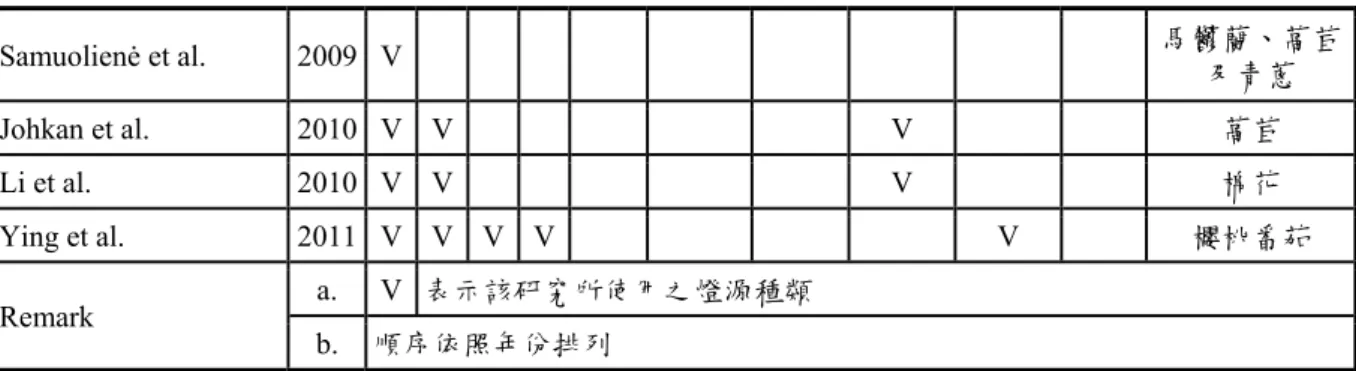
以人工光源取代陽光對植物進行培育已行之有年,本小節以參考文獻中所採用 之人工光源,依照種類按照年份排序,經整理後如表2.1.2 所示,歸納之要點如下: 1. 螢光燈及金屬鹵素燈為最普遍之植物工廠人工光源的種類。 2. 於 1996 年以前,以藍色螢光燈為藍色人工光源之來源。 3. 直至 1996 年後,藍光 LED 開始被用來成為植物工廠人工光源研究。 4. 隨 LED 技術成熟,2008 年後其他顏色,如綠光或橘光開始進行研究。 表2.1.2 本研究參考文獻中人工光源種類之整理表(依年份排序) 作者 年份 發光二極體 (LED) 其他燈源種類 種類 紅 藍 綠 橘 紅外 螢光燈藍色 白熾燈 螢光燈白色 鹵素燈金屬 三色燈管 Bula et al. 1991 V V 萵苣 Hoenecke et al. 1992 V V 萵苣 Brown et al. 1995 V V V V 胡椒 Yanagi et al. 1996 V V V 萵苣 Okamoto et al. 1997 V V 萵苣Yanagi and Okamoto 1997 V V 波菜
Schuerger et al. 1997 V V V V 胡椒 Goins et al. 1997 V V V 小麥 Yorio et al. 2001 V V V 波菜、櫻桃蘿蔔及萵苣 Nhut et al. 2002 V V V 香蕉 Nhut et al. 2003 V V V 香蕉 Nhut et al. 2003 V V V 草莓
Jao and Fang 2004 V V V 馬鈴薯
Jao et al. 2005 V V V 海芋 Nhut et al. 2005 V V V 白鶴芋 Lefsrud et al. 2008 V V V V 羽衣甘藍 Takeda et al. 2008 V 草莓 Poudel et al. 2008 V V V 葡萄 Avercheva et al. 2009 V V V 高麗菜 Hamamoto and Yamazaki 2009 V V V 秋葵
- 9 - Samuolienė et al. 2009 V 馬鬱蘭、萵苣及青蔥 Johkan et al. 2010 V V V 萵苣 Li et al. 2010 V V V 棉花 Ying et al. 2011 V V V V V 櫻桃番茄 Remark a. V 表示該研究所使用之燈源種類 b. 順序依照年份排列
Morrow(2008)將不同年代使用 LED 為植物光源之情況,整理出整個 LED 在植 物應用的演進史,如圖2.1.1 所示。Bourget(2008)以 LED 的發光效率及使用壽命為 指標,對比於一般植物人工光源如:白熾燈、螢光燈、高強度放電燈(HID:High Intensity Discharge)之效果,指出(比較結果如圖 2.1.2 及圖 2.1.3 所示),LED 具有更 佳的效率及更長的壽命。
- 10 -
圖2.1.2 LED 相較於其他人工光源之效率比較(Bourget, 2008)
圖2.1.3 LED 相較於其他人工光源之使用壽命比較(Bourget, 2008)
Bula 等人(1991)利用總光量 325µmole/m2/s(295µmole/m2/s 紅光 LED 和
- 11 -
使用螢光燈搭配白熾燈培育之萵苣比較,於鮮重、乾重及外部特徵上並無顯著的不 同,如表2.1.3 所示。但是在能源的耗用上,螢光燈搭配白熾燈系統卻是紅光 LED 搭配藍色螢光燈光源系統的兩倍。
表2.1.3 Bula 等人與 Hammer 等人之萵苣比較表(Bula et al.,1991)
Year 1991 1978 Bula et al. Hammer et al. Plant characteristic LED systemz (mean±SE) Cool-white fluorescent +
Incandescent lampsy Fresh weight (g) 19±2.76 16.7
Dry weight (g) 1.11±0.16 0.97 Stem length (mm) 9.3±0.63 10.2 Number of nodes with leaves
> 1 cm long 11.0±1.73 9.6
Length of fifth leaf (mm) 111.7±6.6 123.3 Width of fifth leaf (mm) 117.7±11.5 117.5
zData are mean values of two plants from each of three separate frowth periods.
yData from Hammer et al. (1978). SE values not available.
Hoenecke 等人(1992)利用紅光 LED 搭配藍色螢光燈調控不同的光量及光質, 成功的針對萵苣育苗的因子作研究及探討,如表2.1.4 所示﹔同時提出當未來紅、 藍光LED 價格下降且發光強度提升時,可應用在商業化行為上。
表2.1.4 Hoenecke 等人以不同光量光質整理表(Hoenecke et al.,1992)
Lamp type Spectral region(nm) Lamp type Spectral region(nm) Red LED & Blue fluorescent 400-500 600-700 Red LED & Blue fluorescent 400-500 600-700 Photosynthetic photon flux
(μmole/m2/s)z Photosynthetic photon flux (μmole/m2/s)z
- 12 -
0.0(0.0) 300.0(100.0) 4.0(2.7) 146.0(97.3)
-- -- 0.0(0.0) 150.0(100.0)
Remark zPercentage of total photosynthetic photon flux in parentheses
2-2 光量(Light Intensity)對植物生長之影響
Tennessen 等人(1994)以葛為研究對象,針對人工光源之光量作探討。結果顯示 於光飽和點以下時氣孔傳導率及光合作用速率與光量成正比(如圖 2.2.1)。
圖2.2.1 葛氣孔傳導率光及合作用與光量趨勢圖(Tennessen et al.,1994)
Yanagi 等人(1996)使用螢光燈(FL)、紅光 LED 及藍光 LED 三種光源搭配兩種 不同的光量分別為85µmole/m2/s (Low PPF; Photosynthetic Photo Flux,光合作用光
- 13 - 圖2.2.2 萵苣葉片數於高、低光量培育下之比較(Yanagi et al.,1996) 圖2.2.3 萵苣乾重於高、低光量培育下之比較(Yanagi et al.,1996) Nhut 等人(2005)使用 40、60 及 75µmole/m2/s 三種光量對白鶴芋種苗進行六十 天的培育實驗,結果顯示植株的整體鮮重以60µmole/m2/s 為最重,如表 2.2.1 所示。 由其研究結果得知,光量對於植株生長為必要之因子,但過多或不及皆會對植株的 生長有影響。 表2.2.1 白鶴芋於不同光量下培育六十天比較結果(Nhut et al.,2005) Irradiation level (μmole/m2/s) Fresh weight (mg)
- 14 - 表2.2.2 三種不同生長光量需求之植物種類整理 (資料來源:蔡尚光,室內陽台的水耕綠化,1988) 區分 光度 種類 強光作物 4 萬 Lux 以上 洋香瓜、番茄、西瓜、南瓜、胡瓜、青椒、茄子及甘藷等。 中光作物 2~4 萬 Lux 碗豆、菜豆、蕪菁、波菜、蘆筍、甘藍菜、蔥、青江菜、 芹菜類及小松菜等。 低光作物 1 萬 Lux 以上 三葉菜、香菜類、萵苣、細蔥、茼蒿及薑等。 表2.2.3 紅、藍光 LED 單位轉換常數表(Fang & Jao,2000)
Manufacturer (Color) mcd*1 mW*2 Quantum*3 ,
μmole/m2/s Photometric *4 Lux μmole/m2/s per lux mW per μmole/m2/s Hewlett Packard (Red) 3230 37 11.03 374.4 0.029 3.35 Excellence, Taiwan (Red) 5878 45.8 11.08 479.6 0.023 4.13 Everlight, Taiwan (Red) 2207 37 10.27 135.1 0.076 3.6 Hewlett Packard (Blue) 1899 64.2 10.41 195.3 0.053 6.2 Excellence, Taiwan (Blue) 1670 70.4 4.83 99.6 0.048 14.57 Everlight, Taiwan (Blue) 205.6 80 1.09 14.9 0.073 73.39 Nichia, Japan (Blue) 3460 68 6.27 188.3 0.033 10.84 Remark:
*1. Measured using photometer (J17) with J1805 LED head (TekLumaColor, Inc.). *2. Forward current at 20mA.
*3. Measured 10 cm away using LICOR 190SB quantum sensor.
*4. Measured 10 cm away using photometer (J17) with J1811 Luminance head (TekLumaColor, Inc.).
2-3 光質(Light Quality)對植物生長之影響
- 15 -
圖2.3.1 典型植物葉綠體色素吸收光譜圖
(Campbell & Reece,Biology,6th ed)
圖2.3.2 光透過葉綠體後,綠光之穿透及反射示意圖
(Campbell & Reece,Biology,6th ed)
- 16 -
表2.3.1 最佳生長條件之紅、藍光比例及相關文獻
研究種類 (優化組合)
紅光光量
- 18 -
圖2.4.1 草莓葉片上及下之光譜分佈比較圖(Takeda et al.,2008)
圖2.4.2 紅光 LED 於草莓葉面下進行補光示意圖(Takeda et al.,2008)
- 21 -
1. 田口實驗所需之實驗設備及材料,其說明如表 3.2.1 所示。 表3.2.1 田口實驗設計法中之設備及材料
- 27 -
表3.4.1 育苗 L9 實驗記錄表及實驗數據
幼苗 L9 Exp Weight(g) Fresh 第一 植株 第二 植株 第三 植株 第四 植株 第五 植株 平均值 標準偏差 1 L1 0.87 0.81 0.74 0.98 0.83 0.84 0.087 2 L2 1.60 1.18 1.31 1.44 1.47 1.40 0.161 3 L3 1.35 1.44 1.43 1.72 2.20 1.63 0.349 4 L4 0.80 0.99 1.22 1.49 1.45 1.19 0.295 5 L5 Cleaned 1.30 1.29 1.82 1.51 1.48 0.248 6 L6 1.50 2.87 3.83 2.56 2.69 2.69 0.832 7 L7 1.08 1.31 1.53 1.83 2.08 1.57 0.397 8 L8 1.13 1.46 2.08 1.97 1.74 1.67 0.384 9 L9 2.02 2.31 2.26 2.64 2.64 2.37 0.267 Remark Cleaned 因該植株生長異常因素,濾除該筆數據確保資料分析之正確性 2. 依每個因子在三種水準設定下,將濾除完之數據整理成重量因子反應表,如 表3.4.2 所示。再將因子反應值之最大與最小值差(Range)由大至小排列,依 據「一半準則」以照射週期及光量為優化育苗之兩重要因子。 表3.4.2 育苗 L9 田口實驗植株重量因子反應表 Levels/Factors 照射光量 (PPF) 照射週期 (hr/day) 營養液濃度 (μS/cm) 營養液酸鹼度 (pH值) Level-1 1.29 1.20 1.74 1.56 Level-2 1.79 1.52 1.65 1.88 Level-3 1.87 2.23 1.56 1.50 E 1-2 0.50 0.32 -0.08 0.32 E 2-3 0.09 0.71 -0.10 -0.39 Range 0.58 1.03 0.18 0.39 Rank 2 1 4 3 Significant? yes yes no no
- 30 - 圖3.5.2 依據 L9 田口實驗之設定,育成十四天之植株全貌
3-6 L9 田口育成實驗數據整理及分析
1.執行了九組的實驗十四天後,每組實驗測量各五株葉萵苣之鮮重, 其數據(單 位:公克)如表 3.6.1 所示。 表3.6.1 植株育成 L9 田口實驗記錄表及實驗數據- 31 - 2. 依每個因子在三種水準設定下,將數據整理成重量因子反應表,如表 3.6.2 所示。再將因子反應值之最大與最小值差(Range)由大至小排列,依「一半 準則」以照射週期及光量為優化育苗兩重要因子。 表3.6.2 植株成長 L9 田口實驗植株重量因子反應表 Levels/Factors 照射光量 (PPF) 照射週期 (hr/day) 營養液濃度 (μS/cm) 營養液酸鹼度 (pH值) Level-1 9.33 7.97 11.36 11.12 Level-2 11.51 7.85 11.11 11.54 Level-3 12.02 17.05 10.40 10.21 E 1-2 2.18 -0.12 -0.25 0.42 E 2-3 0.51 9.2 -0.70 -1.33 Range 2.689 9.202 0.952 1.330 Rank 2 1 4 3 Significant? yes yes no no
- 39 -
參考文獻
【1】李輝煌 (民 99)。田口方法-品質設計的原理與實務。第三版。高立圖書有限公 司。 【2】李學勇 (民 76)。基礎植物學。國立編譯館。 【3】林安秋 (民 85)。作物之光合作用。台灣商務印書館。 【4】蔡尚光 (民 77)。室內陽台的水耕綠化。百通圖書股份有限公司。 【5】鍾楊聰、張立雪、徐歷鵬、黃璧祈 (民 94)。生物學。第六版。偉明圖書有限公 司。【6】O. V. Avercheva, Yu. A. Berkovich, A. N. Erokhin, T. V. Zhigalova, S. I. Pogosyan and S. O. Smolyanina, “Growth and photosynthesis of Chinese Cabbage plants frown under light-emitting diode-based light source,” Russian Journal of Plant Physiology., vol. 56, pp. 14-21, 2009.
【7】C. M, Bourget, “An introduction to light emitting diodes," HortScience, vol. 43, pp. 1944-1946, 2008.
【8】 C. S. Brown, A. C. Schuerger and J. C. Sager, “Growth and photomorphogenesis of pepper plants under red light-emitting diodes with supplemental blue or far-red lighting," Journal of the American Society for Horticultural Science, vol. 120, pp. 808-813, 1995.
【9】R. J. Bula, R.C. Morrow, T. W. Tibbits and D. J. Barta, “Light-emitting diodes as a radiation source for plants," HortScience, vol. 26, pp. 203-205, 1991.
【10】G. D. Goins, N. C. Yorio, M. M. Sanwo and C. S. Brown, “Photomorphogenesis, photosysthesis, and seed yield of wheat plants grown under red light-emitting diodes (LEDs) with and without supplemental blue lighting," Journal of Experimental Botany, vol. 48, pp. 1407-1413, 1997.
【11】H. Hamamoto and K. Yamazaki, “Reproductive response of okra and native rosella to long-day treatment with red, blue, and green light-emitting diode lights,"
HortScience, vol. 44, pp. 1494-1497, 2009.
【12】J. Heo, C. Lee and K. Paek, “Characteristics of growth and flowering on some bedding plants grown in mixing fluorescent tube and light-emitting diode," Acta Horticulturae, no. 580, pp. 177–181,2002.
【13】M. E. Hoenecke, R. J. Bula and T. W. Tibbits, “Importance of blue photon levels for lettuce seedlings grown under red-light-emitting diodes," HortScience, vol. 27, pp. 427-430, 1992.
【14】R. C. Jao and W. Fang, “Effects of frequency and duty ratio on the growth or potato planflets in vitro using light-emitting diodes," HortScience, vol. 39, pp. 375-379, 2004.
- 40 -
of Zantedeschia plantlets in vitro and tuber formation using light-emitting diodes," HortScience, vol. 40, pp. 436-438, 2005.
【16】M. Johkan, K. Shoji, F. Goto, S. Hashida and T. Yoshihara, “Blue light-emitting diode light irradiation of seedlings improves seedling quality and growth after transplanting in red leaf lettuce," HortScience, vol. 45, pp. 1809-1814, 2010. 【17】M. G. Lefsrud, D. A. Kopsell and C. E. Sams, “Irradiance from distinct wavelength
light-emitting diodes affect secondary metabolites in Kale," HortScience, vol. 43, pp. 2243-2244, 2008.
【18】H. M. Li, Z. G. Xu and C. M. Tang, “Effect of light-emitting diodes on growth and morphogenesis of upland cotton (Gossypium hirsutum L.) plantlets in vitro," Plant Cell Tissue Organ Culuret., vol. 103, pp. 155-163, 2010.
【19】R. C. Morrow, “LED lighting in horticulture," HortScience, vol. 43, pp. 1947-1950, 2008.
【20】D. T. Nhut, L. T. A. Hong, H. Watanabe, M. Goi and M. Tanaka, “Growth of banana plantlets cultured in vitro under red and blue light-emitting diode(LED) irradiation source," Acta Horticulturae, no. 575, pp.117-124, 2002.
【21】D. T. Nhut, T. Takamura, H. Watanabe and M. Tanaka, “Efficiency of a novel culture system by using light-emitting diode (LED) on in vitro and subsequent growth of micropropagated banana plantlets," Acta Horticulturae, no. 616, pp. 121-127, 2003.
【22】D. T. Nhut, T. Takamura, H. Watanabe, K. Okamoto and M. Tanaka, “Responses of strawberry plantlets cultured in vitro under superbright red and blue light-emitting diodes (LEDs)," Plant Cell Tissue Organ Culture, vol. 73, pp. 43-52, 2003. 【23】D. T. Nhut, T. Takamura, H. Watanabe and M. Tanaka, “Artificial light source
using light-emitting diodes (LEDS) in the efficient micropropagation of spathiphyllum plantlets," Acta Horticulturae, no. 692, pp. 137-142, 2005. 【24】D. T. Nhut, T. Takamura, H. Watanabe and M. Tanaka, “Artificial light source
using light-emitting diodes (LEDS) in the efficient micropropagation of spathiphyllum plantlets," Acta Horticulturae, no. 692, pp. 137-142, 2005. 【25】K. Okamoto, T. Yanagi and S. Kondo, “Growth and morphogenesis of lettuce
seedlings raised under different combinations of red and blue light," Acta Horticulturae, no. 435, pp. 149-157, 1997.
【26】P. R. Poudel, I. Kataoka and R. Mochioka, “Effect of red- and blue-light-emitting diodes on growth and morphogenesis of grapes," Plant Cell Tissue Organ Culture, vol. 92, pp. 147-153, 2008.
- 41 -
【28】A. C. Schuerger, C. S. Brown and E. C. Stryjewski, “Anatomical features of pepper plants (Capsicum annuum L.) grown under red light-emitting diodes supplemented with blue or far-red light," Annals Botany, vol. 79, pp. 273-282, 1997.
【29】K. S. Shin, H. N. Murthy, J. W. Heo and K. Y. Paek, “Induction of betalain pigmentation in hairy roots of red beet under different radiation sources," Biologia Plantarum, vol. 47, pp. 149-152, 2003.
【30】G. W. Stutte and S. Edney, “Photoregulation of bioprotectant content of red leaf lettuce with light-emitting diodes," HortScience, vol. 44, pp. 79-82, 2009. 【31】F. Takeda, D. M. Glenn and G. W. Stutte, “Red light affects flowering under long
days in a short-day strawberry cultivar, HortScience, vol. 43, pp. 2245-2247, 2008. 【32】D. J. Tennessen, E. L. Singsaas and T. D. Sharkey, “Light-emitting diodes as a light
source for photosynthesis research," Photosynthesis research, vol. 39, pp. 85-92, 1994.
【33】T. Yanagi, K. Okamoto and S. Takita, “Effects of blue, red, and blue/red lights of two different PPF levels on growth and morphogenesis of lettuce plants," Acta Horticulturae, no. 440, pp.l17-122, 1996.
【34】T. Yanagi, and K. Okamoto, “Utilization of super-bright light emitting diodes as an artificial light source for plant growth," Acta Horticulturae, no. 418, pp. 223-228, 1997.
【35】L. X. Ying, G. S. Rong, X. Z. Gang, J. X. Lei and T. Tezuka, “Regulation of chloroplast ultrastructure, cross-section anatomy of leaves, and morphology of stomata of cherry tomato by different light irradiations of light-emitting diodes," HortScience, vol. 46, pp. 217-221, 2011.
【36】N. C. Yorio, G. D. Goins, H. R. Kagie, R. M. Wheeler and J. C. Sager, “Improving spinach, radish, and lettuce growth under red light-emitting diodes (LEDs) with blue light supplementation," HortScience, vol. 36, pp. 380-383, 2001.
- 42 -
【42】美國能源局, Solid-State Light。