The teachers’ attitudes toward and beliefs about
the role of children’s visual art in stimulating
their learning and development in Kaohsiung
City and County
Ching-Yuan Hsiao
Abstract
Children’s visual art education is one of the most important fields in early childhood education. However, little or no research has been done on teachers’ attitudes toward and beliefs about children’s art, particularly as they relate to stimulating learning and development in kindergarten in Taiwan. Thus, this research investigated early childhood teachers’ beliefs about children’s art and their understanding and use of the child-directed/teacher-directed approach. The researcher conducted quantitative data analyses in this study. The survey resulted in 260 responses out of 300 questionnaires distributed to teachers in kindergartens in Kaohsiung City and County, Taiwan.
The results of the quantitative analysis for teachers who participated in this study knew about Lowenfeld, DBAE, or a combination of both theories showed that they held more positive attitudes toward children’s art. The teachers with fewer years of teaching experience felt more favorably toward teaching art history/story before engaging in an art project. More elder teachers than young teachers agreed with the statement that physical growth is demonstrated in children’s visual and motor coordination in their artwork. Surprisingly, those with lower education degrees agreed more often with the statement that foreign culture influences children’s drawing. The teachers who worked in Kaohsiung County kindergartens agreed more often with the statement that domestic culture influenced children’s drawing than did the teachers in Kaohsiung City. Additionally, the teachers prefer conducting art activity by using both teacher-directed and child-directed methods.
The researcher wishes those findings will provide useful suggestions to children art educators.
Keywords: children’s visual art, teachers’ attitudes and beliefs, art learning and mental development
I. INTRODUCTION
According to Seefeldt and Barbour (1998, p. 386), “Art is neglected because many people are unaware of how basic art is to the growth, development, and learning of young children.” Even when teachers themselves examine children’s art, they may not be well prepared to articulate these values to others. Understanding and believing that art is basic and valuable to children in and of itself, and being knowledgeable of the role that art plays in children’s mental growth and academic achievement, makes it worthwhile to defend children’s time for art; to select goals, plan and practice art, and to articulate its value to other teachers, parents, and members of the community (Seefeldt & Barbour, 1998).
The researcher has observed Kaohsiung City and County kindergarten teachers’ art activities since 2002, and also taught art classes in a Kaohsiung County public kindergarten in 2006. There are two teachers in that class, and one had taught in Kaohsiung City kindergarten before. Moreover, they are different in ages,
education background, years of teaching, and learning about children’s art. The two teachers also have totally different teaching style. One teacher likes to conduct art activity in child-directed way, the other prefers to teacher-directed. Besides, the teacher who prefers to teacher-directed way would request me not to adapt
child-directed way too much in her classroom. It makes the researcher feel very upset and caused him want to explore the issue of teachers’ perspective of children’s art more deeply. Furthermore, the research wants to provide southern Taiwan art educators a basic notion of young children’s visual art education and do further research in this field.
Purposes of the Study
Statement of the Problem
In the context of the general and more specific purposes of this research study, little research has been done in regard to Taiwanese teachers’ background in
children’s art and how teachers interpret children’s mental growth from their artwork. Moreover, in the teachers’ colleges in Taiwan, school professors and administrators have also had no data to use in determining how much and what kind of preparation kindergarten teachers have had and what pre-service training and in-service training they will need in order to interpret children’s art in the classroom. Thus, this study was specifically designed to address one problem that evolved from the purposes of the study:
1. To examine the kindergarten teachers’ differences in interpreting children’s art by the following factors:
(1) Highest educational degree earned. (2) Numbers of years of teaching. (3) Ages of the teachers.
(4) Teaching art in the kindergartens of urban (Kaohsiung City) and rural (Kaohsiung County) settings.
(5) Prior experience / learning about children’s art: teacher-directed or child-directed.
(6) Attitude toward foreign and domestic culture.
Based on these variables, the following hypotheses, termed as assumptions, were examined in this study:
Assumption 1: The interpretation of children’s art will vary according to the teachers’ highest education degree earned.
Assumption 2: The interpretation of children’s art will vary according to the teachers’ years of experience.
Assumption 4: The interpretation of children’s art will differ between
kindergarten teachers in Kaohsiung City (urban) and in Kaohsiung County (rural). Assumption 5: The teachers who have stronger concepts of children’s art theory will value children’s art curriculum more than the teachers who have weaker such concepts.
Assumption 6: Attitudes toward the cultural impacts on children’s art will differ between Kaohsiung City and Kaohsiung County teachers.
Limitations of the Study
There were two limitations to this study:
1. This study of in-service teachers is limited to the district of Kaohsiung City and Kaohsiung County in Taiwan. Thus, the results cannot be generalized to all teachers in other geographic areas of Taiwan or external to Taiwan.
2. This study is also limited by the lack of previous studies or assessments of children’s art in the content area; especially with regard its use in kindergartens in Taiwan.
Definition of Term
Belief
A belief has been considered as unchanging, inflexible, and defying logic (Munby 1986, Nespor, 1987). People may stick to beliefs and behave in insensible ways. Hamilton (1992) thought that there are social effects on beliefs and advises that culture is influential in shaping them. Pajares (1992) referred to what Goodman (1988) and Nespor (1987) introduced as the ‘interpretation of belief’ and suggested that a belief may be inferred from what people say, intend and do (Lam, 2000).
In this research, the beliefs indicate Kaohsiung city and county teachers' ages, years of teaching, education degree, school districts, concepts of art education theory, and notions of culture those variables would impact on their interpretation of
II. REVIEW OF THE LITERATURE
Early Childhood Art Education and Visual Culture in Taiwan
These sections focus on early childhood education in Taiwan. The topics are: (a) teaching methodologies and materials, (b) art curricula in Taiwan, and (c) Cultural Impacts on Children’s Art. Each section is discussed in the following and linked with research studies and research questions.
Art Teaching Methodologies and Materials
Taiwanese kindergarten teachers often adapt a group education strategy and use commercial workbooks in their classroom. This is mostly the case with art education. Teachers like to use teacher-directed and group education methods because of the large number of students, small classrooms, and few classroom helpers. In addition, the use of these tools enables the teachers to ask students to sit quietly and follow the teachers’ procedures for learning to read and learning to write, step by step (Liau, 1996). Students need the teachers’ permission to walk around the classroom at will. Moreover, tolerance, morality, and collaboration with others are taught through a daily routine (Hsue & Aldridge, 1995). Additionally, with regard to art activities, some of the public kindergarten teachers use both teacher-directed and child-directed art approaches; some use solely teacher-directed or child-directed methods. In private kindergarten, most art specialists tend to adopt the teacher-directed methods in art instruction (Wu, 2007). In addition, private kindergartens provide clay as a regular art activity in Taiwan. Lai (2000) believes this stems from the private kindergartens’ hiring of art specialists to teach ceramic courses in the schools.
Art Curricula in Taiwan
For general foundation purposes, the art curricula in Taiwan require an
incorporated into the curriculum.
Kindergarten curriculum standards in Taiwan divide curriculum content into six fields: work, play, health, music, language, and common sense (Kindergarten
Curriculum Standards, 1987). In fact, the work curriculum does not receive attention, nor is it well expressed, although teachers and parents also prefer academic subjects such as mathematics and language. Thus, there are limitations or problems regarding the teaching of art in Taiwanese kindergarten classrooms. First, art is affiliated with work fields in Taiwan (Kindergarten Curriculum Standards, 1987). But, the definition of the work curriculum is very unclear and difficult to implement, especially with regard to providing art activity. Second, as Bresler (1995) mentions, art lessons in Taiwanese kindergarten classrooms are often related to festivals. Teachers usually assign a theme to students, such as “Moon Festival,” and everyone must work on it. Students do not have the freedom to choose a theme. It is very common for teachers to adapt workbooks or software from commercial publishers, and to design the art activity based on those models. Third, due to the academic pressure in the schools, some teachers spend considerable time on academic subjects, thus neglecting art activity with the children.
There are several significant points in this section on Early Childhood Education in Taiwan. First, early childhood education has been in place in Taiwan for more than a half century, and all of the teachers’ colleges offer courses in art or craft for early childhood educators. However, during their training, most kindergarten teachers still obtain limited art concepts and skills. Many parents in Taiwan also do not consider children’s art to be an important subject, and ask teachers to spend more time on academic subjects. Finally, to address these circumstances, the Ministry of Education must provide more art education conferences to enhance teachers’ art ability and to modify parents’ stereotyped notions of art.
Cultural Impacts on Children’s Art
A child’s drawing represents a close relationship with their cultural circumstances. Children’s art also involves an adaptation to cultural systems of symbolic communications, as seen in McFee’s (1961) study. Cultures affect
1997).
Taiwanese children encounter significant influences through image-information flow, by which many symbols, meanings, and signs are transported across culture. This idea addresses how a child adapts to such culture-changing dynamics in Taiwan! Through movies, comic books, television programs, and various other products featuring Disney characters, Disney has extended its influence to the world beyond the United States (Gomery, 1994). Taiwan is part of that world, so undoubtedly Taiwanese children are also deeply influenced by Disney. It is ironic that while many Taiwanese children are uncertain who Abraham Lincoln was, they know Cinderella, the Little Mermaid, Mickey Mouse, and many other fantasy world characters. In addition to the influence of American popular culture, Japanese cartoons, comic books, PlayStation video games, and television series are widespread in Taiwan.
Two Selected Approaches:
Lowenfeld and DBAE Art Education in Kindergartens in Taiwan
This section addresses types of curricular approaches in art education in Taiwan. The next three sections focus on Lowenfeld’s and DBAE’s curricular approaches to children’s art education. The contents include: (a) Lowenfeld’s Creative and Mental Growth, (b) Rationale for DBAE, and (c) the Four Disciplines of DBAE.
Lowenfeld’s Creative and Mental Growth
Lowenfeld introduced some psychological perceptions about children’s art development that may have resulted from his particular sensitivity to the events of his life. As a Jew, having lived through World War I and II, he was especially aware of the rise of anti-Semitism and the need for freedom and self-expression, tolerance, and the acceptance of individual differences (Cohen, 1982). Additionally, in most of Lowenfeld’s theory the more ‘naturalist’ approach has framed what came to be called child-directed art education. Those who held to this approach believed that children’s art, left ‘unsullied’ by external influences, either directly mirrored their emotional concerns or offered a road map of their inner mental life (Golomb, 1992).
self-expression and self-adjustment through art activities as personality development become an important rationale for art education” (Day, 1972, p. 63). For the first time, the teacher served as a motivator and guide in bringing out the individual responses of the child.
Thus, to Lowenfeld, two new and significant attributes were essential in teaching art: (a) teachers must be able to subordinate themselves and their desires to the needs of children, and (b) teachers must acquaint themselves with the physical and
psychological needs of children. Lowenfeld’s beliefs have had the most impact on generating new rationales for defining what comprises art education. Huang (1993) introduced the concept of creative drawing to kindergarteners in Taiwan and found that it could stir children’s imagination, creativity, and art appreciation. He stated that teachers should not ask children to imitate others’ style because doing so was not helpful in cultivating their art ability.
Lowenfeld noticed that creative expression and development were essential to art education. Moreover, he believed these principles to be closely related to other types of growth in the same youngster. The development of children’s growth is vital to promoting the development of their individuality. Lowenfeld stated that art promotes self-discovery and cumulative self-adjustment; the by-product of such increased realization is a better-adjusted child, and more competence in positive social integration (Lowenfeld & Brittain, 1970; Cohen, 1982).
Child-directed art education played a significant role in progressive education, where it often was linked with laissez-faire means and the advice that educators downplay their influence in the classroom. In spite of this advice, those following the child-directed approach claimed that studio practice was the best arena in which a youngster could express their emotional, mental and social life (Burton, 2000).
Rationale for DBAE (Discipline-based Art Education)
DBAE highly supports the general educational aims of schools, which include, for instance, the goal of cognitive development. Practitioners function in domains that are richly intellectual, featuring such cognitive operations as judgment, interpretation, analysis, and perception. The skills of problem solving and observation are directly nurtured in DBAE units of study. The practice of such higher-order thinking in art, as Dewey (1933) observed more than 70 years ago, is as profoundly “intellectual” as is the way of solving a quadratic equation. Such cognition is as ordinary and familiar to practitioners of DBAE as it is to practitioners of math and other academic disciplines (Dobbs, 1998; Kim, 2002).
The DBAE approach also values diversity and flexibility in the choice of instructional resources and curriculum content and in its respect for different
children’s backgrounds. It taps different learning manners and is consistent with the principle that there are many different means of knowing and learning. DBAE also acknowledges the contribution of art education to the psychological and behavioral well being of children, nurturing such traits as patience, rigor, and self-esteem (Kim, 2002).
In DBAE, both instrumentalist and essentialist views about the purpose of art education are respected. The instrumentalist view focuses on the contributions that art makes to attainment and success in other subject fields and to the more general aims of schooling. The essentialist view holds that art provides access to the knowledge and insights required for the education of students. “Art is important both for the distinctive and unique contributions it makes to learning and for the ways in which it serves general goals in schooling” (Dobbs, 1998, p. 10).
Four Disciplines of DBAE
The four disciplines of art education (i.e., aesthetics, art history, art criticism, and art making) provide the basic knowledge, techniques, and understanding that enable students to have liberal and abundant experiences in art (Liu, 2002). Children can achieve this through art making, and through the study of aesthetics, art history, and art criticism. Each of the four disciplines has its own concepts, terms, and
III. RESEARCH PROCEDURES AND METHODS
Design of the Research
The research design adopted quantitative research. The data were gathered using a survey questionnaire, the Children’s Art-Kindergarten Teacher Survey, designed specifically for this study by the researcher. “In terms of quantitative methodology, this study represents descriptive survey research” (Eichelberger, 1989, p. 173). The survey had 54 Likert-type items, 10 demographic items, and 1 open question. The survey was distributed to 300 teachers in early childhood settings in Kaohsiung City and Kaohsiung County. There were 260 useable responses.
Participants
A total of 260 out of the 300 questionnaires distributed for the study were returned by the public kindergarten teachers in Kaohsiung City and Kaohsiung County. These kindergarten teachers were employed in 35 kindergartens––130 teachers in Kaohsiung City kindergartens and 130 teachers in Kaohsiung County kindergartens. All of the teachers were female. Fifty-seven percent of those who responded to the survey were between the ages of 20 and 39, with 39.2% of them having taught for 1 to 10 years. Thirty-seven percent had taught for 11 to 20 years. Among these participants, 80% had obtained specialized training in early childhood education at some level, through a junior college degree, a bachelor’s degree, or a master’s degree program.
Instrumentation
response scale measuring the teachers’ attitudes and beliefs about children’s art, and their understanding of the role of children’s art in their classroom life.
The Pilot Study
A pilot study was conducted by the researcher to examine the validity of the questionnaire for this children’s art education study. Moreover, before the researcher did the pilot study, four American professors validated the questionnaire: an early childhood art education expert, an early childhood education expert, a children’s literature expert, and a research methodology and data analysis expert. After review by the four professors (see Table 1), the pilot study was ready to distribute.
Table 1 Pilot Study Revisions Based on the Professors’ Reviews
Original Question Final Question 46.) Piaget’s stages of cognitive development
explain children’s development in their artwork.
46.) Children's overall cognitive development is reflected in their artwork.
47.) Lowenfeld’s stages of children’s art development explain children’s cognitive development.
47.) Children's art is a reliable indication of cognitive development.
48.) I use DBAE theory (teacher-directed) with my student because I know enough about it.
48.) It is important for children at the kindergarten level to begin to learn about the history of art, to think about aesthetic issues, and to practice art criticism.
49.) I use Lowenfeld’s theory (child-directed) with my student because I know enough about it.
49.) A more child-directed approach is best for young children's art education.
Fifty in-service kindergarten teachers participated in the pilot study. The
researcher sent the questionnaire, informed consent form, and introductory letter to all the potential participants. They were asked to answer the questionnaire and write down suggestions, comments, and adjustments needed. The researcher then revised, added, or deleted items based on the participants’ suggestions and comments. Additionally, the researcher collected the pilot questionnaires himself and discussed them with some participants.
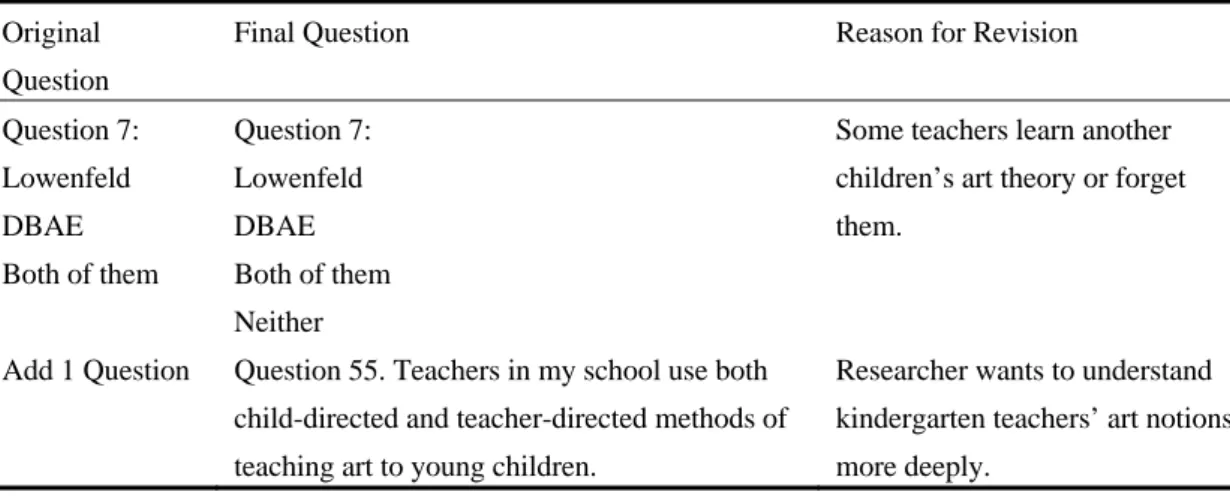
shows how the items were revised based on the in-service kindergarten teacher’s responses. The participants’ responses revealed that some questions had to be revised or added (see Table 2). The questionnaire contained 64 items after revision.
Table 2 Questionnaire Revisions Based on Teachers’ Responses to the Pilot Survey
Original Question
Final Question Reason for Revision
Question 7: Lowenfeld DBAE Both of them Question 7: Lowenfeld DBAE Both of them Neither
Some teachers learn another children’s art theory or forget them.
Add 1 Question Question 55. Teachers in my school use both child-directed and teacher-directed methods of teaching art to young children.
Researcher wants to understand kindergarten teachers’ art notions more deeply.
Procedures for the Main Study
The researcher distributed study questionnaires to public kindergarten key teachers. The researcher provided the same number of survey questionnaires to the kindergarten teachers as the number of teachers indicated in the Ministry of Education data. If the kindergarten directors also taught children, they were eligible to
participate in the study.
The researcher began to collect the questionnaires from the key teachers one week after the teachers received them and within two weeks had collected all of them. Of the 300 questionnaires distributed, 263 were returned for an 87% return rate. Borg and Gall (1989) indicate that the salience of a questionnaire’s content can
significantly affect the return rate.
Analysis of the Quantitative Data
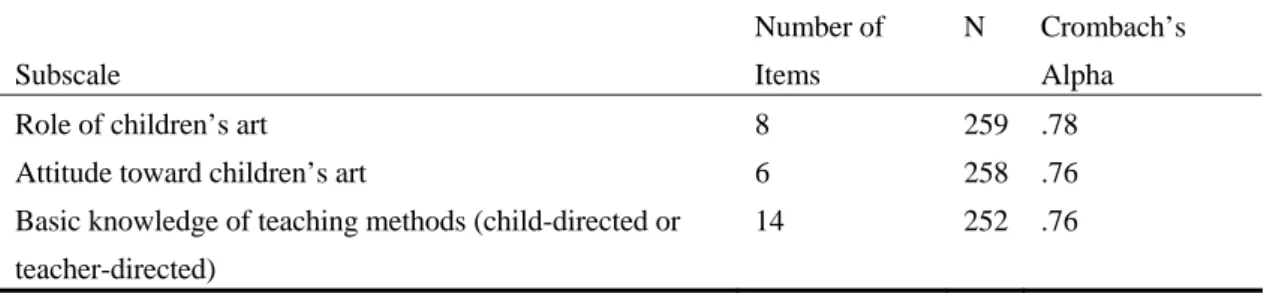
Data analysis for the quantitative part of this study was conducted using the SPSS Graduate Pack for Windows Release 11.0. For reliability, the researcher used Crombach’s alpha coefficient to determine the internal consistency of the instrument. Reliability was calculated using the data provided by the study respondents. The data in Table 3 indicate that the results were acceptable in that instruments used in basic research need to have a reliability of about .70 or better (Nunnally 1978, p. 245).
Table 3 Summary of Internal Consistency Results Reported by Subscale
Subscale
Number of Items
N Crombach’s Alpha
Role of children’s art 8 259 .78 Attitude toward children’s art 6 258 .76 Basic knowledge of teaching methods (child-directed or
teacher-directed)
14 252 .76
After analyzing descriptive data, the researcher adapts T-test /ANOVA to exam the correlation between interpretation of children’s art, concepts of children’s art, and attitude toward cultural impacts as dependent valuable and independent valuables as ages of teachers, children’s art curriculum, school district. If the questions get significance, the researcher adapts Tukey-HSD Post Hoc Test to compare them, and realize the level of significance.
Summary of the Data Analysis Procedures
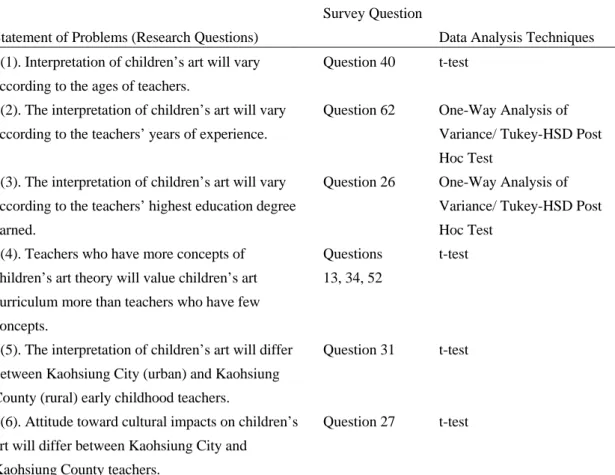
Table 4 Data Analysis Procedures
Statement of Problems (Research Questions)
Survey Question
Data Analysis Techniques 1(1). Interpretation of children’s art will vary
according to the ages of teachers.
Question 40 t-test
1(2). The interpretation of children’s art will vary according to the teachers’ years of experience.
Question 62 One-Way Analysis of Variance/ Tukey-HSD Post Hoc Test
1(3). The interpretation of children’s art will vary according to the teachers’ highest education degree earned.
Question 26 One-Way Analysis of Variance/ Tukey-HSD Post Hoc Test
1(4). Teachers who have more concepts of children’s art theory will value children’s art curriculum more than teachers who have few concepts.
Questions 13, 34, 52
t-test
1(5). The interpretation of children’s art will differ between Kaohsiung City (urban) and Kaohsiung County (rural) early childhood teachers.
Question 31 t-test
1(6). Attitude toward cultural impacts on children’s art will differ between Kaohsiung City and
Kaohsiung County teachers.
Question 27 t-test
IV. RESULTS AND FINDINGS
Seven main assumptions were developed for the quantitative component of the study. In order to determine which factors may lead teachers to express differences in interpreting children’s art, and to examine the relationships between the teachers’ variables and their scores on interpreting children’s art, One-Way ANOVA, t-test, and the Tukey-HSD Post Hoc Test results were applied to appropriate survey questions. The results of these assumptions follow.
Assumption 1
The interpretation of children’s art will vary according to the teachers’
highest education degree earned.
This assumption was tested using a One-Way ANOVA procedure. The data and results of the analysis are found in Tables 5 to 7. Descriptive statistics and the
children’s art across the three groups of teachers according to their highest educational degree appear in Tables 5 to 7.
Table 5 Teachers’ Beliefs Related to Interpretation of Children’s Art, by the Teachers’ Highest Educational Degrees
Highest Educational Degree N Mean SD Standard Error Minimum Value Maximum Value Junior College Degree 62 2.15 .70 .09 1 3 Bachelor’s 190 1.81 .67 .05 1 4 Master’s 7 1.57 .53 .20 1 2
(1=strongly agree, 2=agree, 3=disagree, 4=strongly disagree)
The mean scores of all the teachers as shown in Table 5 reveal that those with a junior college degree had the highest mean score (2.15) on interpreting children’s art, while those with a master’s degree had the lowest mean score (1.57). Figure 2
illustrates the differences in the means by the teachers’ highest education level.
Table 6 One-Way ANOVA for Teachers’ Beliefs Related to Interpretation of Children’s Art by the Teachers’ Highest Educational Degree
Source D.F. Sum of Square Mean Square F Ratio
Between Groups 2 6.09 3.04 6.76**
Within Groups 256 115.20 .45
Total 258 121.29
** p<.01
Table 6 data indicate that the total scores supported the assumption that
Table 7 The Tukey-HSD Post Hoc Test for Teachers’ Beliefs Related to Interpretation of Children’s Art by the Teachers’ Highest Educational Degree Highest Degree Mean Highest Degree Junior College Degree Bachelor’s Degree Master’s Degree 2.15 Junior College Degree * 1.81 Bachelor’s Degree * 1.57 Master’s Degree
*. The mean difference is significant at the .05 level.
The Tukey-HSD Post Hoc Test (Table 7) was used to identify where the specific differences among the groups occurred. The total scores for teachers who had a bachelor’s degree were significantly different regarding interpretation of children’s art from those who had a junior college degree.
Assumption 2
The interpretation of children’s art will vary according to the teachers’
years of experience.
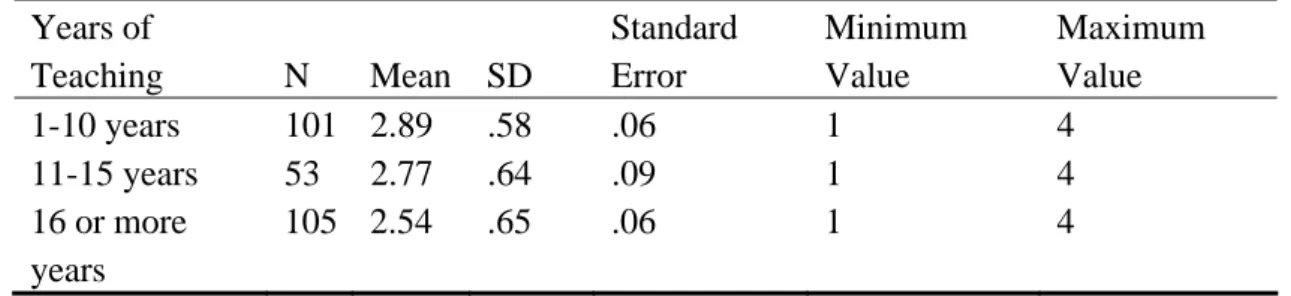
The descriptive statistics and One-Way ANOVA results for teachers’ beliefs related to their interpretation of children’s art by years of teaching appear in Tables 8, 9, and 10.
Table 8 Teachers’ Beliefs Related to Interpretation of Children’s Art, by Years of Teaching Years of Teaching N Mean SD Standard Error Minimum Value Maximum Value 1-10 years 101 2.89 .58 .06 1 4 11-15 years 53 2.77 .64 .09 1 4 16 or more years 105 2.54 .65 .06 1 4
years of teaching experience had the highest mean score (2.89), while teachers who had 16 or more years of teaching experience had the lowest mean score (2.54).
Table 9 One-Way ANOVA for Teachers’ Beliefs Related to Interpreting Children’s Art, by Three Groups’ Years of Teaching Experience
Source D.F. Sum of Square Mean Square F Ratio
Between Groups 2 6.40 3.20 8.26*** Within Groups 256 99.14 .39 Total 258 105.54 *** p<.001
Table 9 data show that the total scores on the teachers’ beliefs were significantly different among the teachers’ levels of experience [F(2, 256)=8.26, p<.001].
Table 10 The Tukey-HSD Post Hoc Test for Teachers’ Beliefs Related to Interpretation of Children’s Art, by Years of Teaching
Years of Years of Teaching
Mean Teaching 1-10 years 11-15 years 16 or more years
2.8911 1-10 years *
2.7736 11-15 years
2.5429 16 or more years *
*. The mean difference is significant at the .05 level.
Assumption 3
The interpretation of children’s art will vary according to the ages of the
teachers.
This assumption was tested using a t-test procedure. The data and results may be found in Tables 11 to 12. Descriptive statistics and t-test results for total scores regarding teachers’ interpretation of children’s art across two groups of teachers’ ages appear in Tables 11 to 12.
Table 11 Teachers’ Beliefs Related to Interpretation of Children’s Art, by Teachers’ Age Groups Teachers’ Age Group N Mean SD Standard Error Minimum Value Maximum Value 20-39 years 147 1.29 .45 .04 1 2 40 or more 113 1.47 .50 .05 1 2
Table 11 data indicate the mean scores on the teachers’ beliefs as they relate to interpretation of children’s art by teachers’ age groups. The teachers aged 20-39 had a mean score of 1.29, while those aged 40 or more had a mean score of 1.47. Figure 4 illustrates the differences in the means by the teachers' age groups.
Table 12 T-test for Teachers’ Beliefs Related to Interpretation of Children’s Art, by Teachers’ Age Groups
Teachers’ Age Groups
N Mean Standard Deviation t-value p
20-39 years 147 1.29 .45 -3.087*** .000
40 years or more 113 1.47 .50
Assumption 4
The interpretation of children’s art will differ between Kaohsiung City
(urban) and Kaohsiung County (rural) early childhood teachers.
This assumption was tested using a t-test procedure. The data and results of the analysis related to Assumption 4 may be found in Tables 13 to14. Descriptive statistics and t-test results for the total scores relating to teachers’ interpretation of children’s art across two groups of teaching areas appear in Tables 13 to 14.
Table 13 Teachers’ Beliefs Related to Interpretation of Children’s Art, by Areas
Areas N Mean SD Standard Error Minimum Value Maximum Value Kaohsiung City 130 2.85 .65 .06 1 2 Kaohsiung County 130 3.02 .50 .04 1 2
Table 13 data indicate the mean scores on the teachers’ beliefs as they relate to the interpretation of children’s art by teaching location––that is, urban or rural area. The teachers who teach in Kaohsiung City had a mean score of 2.85 while those who teach in Kaohisung County had a mean score of 3.02. Figure 5 illustrates the
differences in the means by the teachers' location.
Table 14 T-test for Teachers’ Beliefs Related to Interpretation of Children’s Art, by Area
Areas N Mean Standard Deviation t-value p
Kaohsiung City 130 2.85 .06 -2.44** .004
Kaohsiung County 130 3.02 .04
Assumption 5
Teachers who have stronger concepts of children’s art theory will value
children’s art curriculum more than teachers who have weaker concepts.
This assumption was tested using a t-test procedure. The data and results of the analysis for Assumption 5 may be found in Table 15, which compares the teachers’ valuation of children’s art according to four categories of children’s art theories that the teachers were familiar with: Lowenfeld, DBAE, a combination of both, or none.
Table 15 Teachers’ Beliefs Related to Valuation of Children’s Art, by Art Theories
Statement Mean Mean
Answer: Yes Answer: No
Lowenfeld N 5 M 1.00 SD .00 N 254 M 1.29 SD .50 t -1.29 p .001 DBAE N 67 M 1.36 SD .48 N 193 M 1.49 SD .55 -1.77 .003 Both N 4 M 1.00 SD .00 N 256 M 1.70 SD .60 -2.33 .001 None N 45 M 1.33 SD .48 N 215 M 1.47 SD .54 -1.53 .012 (1=strongly agree, 2=agree, 3=disagree, 4=strongly disagree)
Table 15 data show differences in the teachers’ attitudes toward children’s art when examined by prior experience with learning about children’s art theory. The teachers who had learned about Lowenfeld, DBAE, or a combination of both showed the most significant difference (p<0.05) in valuing children’s art than those who had not learned about any of them. The data also show that teachers who had a course in DBAE had the highest mean value (1.36) in valuing children’s art.
Assumption 6
Attitude toward cultural impact on children’s art will differ between
Kaohsiung City and Kaohsiung County teachers.
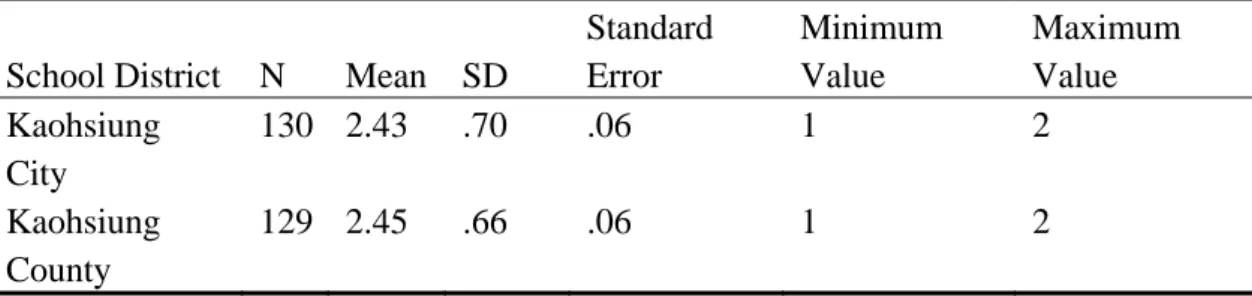
Table 16 Teachers’ Attitudes toward Interpretation of Cultural Influence, by School District
School District N Mean SD
Standard Error Minimum Value Maximum Value Kaohsiung City 130 2.43 .70 .06 1 2 Kaohsiung County 129 2.45 .66 .06 1 2
Table 16 indicates the mean value of the teachers’ attitudes toward interpreting cultural influence on children’s drawings in two different school districts. The teachers who teach in Kaohsiung City had a mean value of 2.43, while the teachers who teach in Kaohsiung County had a mean value of 2.45.
Table 17 T-test for Teachers’ Attitudes toward Interpreting Cultural Influence, by School District
School District N Mean
Standard Deviation t-value Kaohsiung City 130 2.43 .70 -.222* Kaohsiung County 129 2.45 .66 *p<.05
Discussion of the Findings
The findings from this research on the teaching children’s art in Taiwanese kindergarten provide support for previous theories and research on early childhood art education. The following findings are based on the results from this study and support other research that has examined teachers’ attitudes toward and beliefs about the role of children’s art in stimulating their learning and developments.
Finding 1: Teachers’ Educational Degree and Their Interpretation of
Children’s Art
The first finding of this study is that the teachers’ highest educational degree earned has a relationship to their interpretation of children’s art. The kindergarten teachers who had higher education degrees had a lower score on the statement that ‘foreign cultures (e.g., American culture: Disney; Japanese culture: Pokemon) influences children’s drawing.’ In other words, teachers who have lower degrees agree more with this statement. This finding is a surprise; it maybe due to the elder kindergarten teacher who received junior college degree will be lack of learning art education theory or art education practical training. Thus, they let students draw at will, and the students are strongly influenced by mess media. Then, they copy images from Japanese and American Disney cartoon and present on their artworks. Besides, it might be the counterparts had more a comprehensive learning and understanding of children’s nature stemming from their college years. From Piaget’s (1972) cognitive development theory, one may assume that a normal child may change his/her graphic expression through excessive learning or coping once approaching the Formal
Operational stage. In Goodenough (1926), Harris (1963) or Koppitz’s (1983) studies about children’s person drawings, it is beyond the age 8 that culture influence becomes more noticeable.
Finding 2: Teachers’ Years of Teaching and Their Interpretation of
Children’s Art
The second finding from this study is that the level of teaching experience is related to the teachers’ beliefs about the interpretation of children’s art. Teachers with the least teaching experience had higher scores, and teachers who had more teaching experience disagreed much more with the statement that ‘teachers need to teach art history before engaging in an art project.’ This is another surprise finding. This result is possibly related to Taiwan’s teacher education system. In 1990, in order to improve the quality of early childhood educators, the Ministry of Education in Taiwan set up a four-year early childhood program in the Taipei Municipal Teacher College. Since that time, pre-service teachers have had more opportunity to study art courses in early childhood education programs. But it wasn't until 1985, with the Getty Center’s publication of Beyond Creating, that Discipline-Based Art Education was imported to Taiwan. Teachers who had 1-10 years of teaching experience learned DBAE theory in teachers’ colleges during that period, so they valued this theory more than other teachers did. Additionally, a Kaohsiung City teacher suggested that it would be more efficient to introduce art history and aesthetics by telling art stories than by using more conventional instructional techniques. Therefore, this researcher believes that if Taiwanese early childhood teachers adopted the DBAE approach for teaching art, they would have to make some adjustments to fit the children’s needs.
Finding 3: Teachers’ Ages and Their Interpretation of Children’s Art
The third finding from this study is that the teachers’ ages have a relationship to their interpretation of children’s art. Teachers who are older had a higher score on the statement that ‘physical growth is demonstrated in his / her visual and motor
coordination in his / her artwork.’ The following is some historical background: Lowenfeld’s art theory was popular in Taiwan in the 1960s. Some of the older Taiwanese teachers had heard about his art education notions at that time. However, according to the researcher’s descriptive data, only five teachers in this study had been exposed to Lowenfeld’s art theory. The researcher believes that the older
agreed with Lowenfeld’s approach to teaching art.
Finding 4: Teachers’ School Districts and Their Interpretation of
Children’s Art
The fourth finding is that the kindergarten teachers in Kaohsiung County had much higher mean scores (3.02) than the kindergarten teachers in Kaohsiung City (2.85). This also indicates that Kaohsiung County teachers agree much more with the statement ‘boys have more talent in art than girls’ than did the Kaohsiung City teachers. This result does not support the work of Goodenough (1926), Harris (1963), and others who believe that girls are superior to boys in mental growth through art. The researcher in the present study believes that this agreement stems from traditional concepts in Taiwanese society. In traditional Taiwanese society (e.g., Kaohsiung County), the boy is always cherished (more than the girl) because he has a
responsibility to care for the family. Thus boys need to be academically successful to ensure that they can enter college and have a successful career. Some parents believe that if their sons can participate in the gifted art classes in primary and high schools, they will have a better chance of entering renowned colleges. Thus, they spend a great deal of money to send their sons to art cram courses. Under these circumstances, the boys’ art capacity might be better than the girls’. In addition, it is popular believed that art talent has little to do with one’s IQ or a child’s mental growth which is the main concern in Goodenough or Harris’s studies. Based on the researcher’s
observation since 2002, girls do also have superior performance than the boys in the mentioned drawing tasks in Taiwan. It might be the quality of “expressiveness” in children’s drawings mistaken for “art talent” by Kaohsiung public kindergarten teachers. Moreover, gender difference is obvious in how parents educate their kids at home. There used to have more requirements for girls than boys in their behaviors in Taiwanese culture. Boys as are more “natural” and physically more aggressive/active, turn their energy into drawing with expressive quality and “talent”.
Finding 5: Teachers’ Concepts of Art Education Theory and Their
Interpretation of Children’s Art
valuing children’s art from those who had not learned about either approach. First, teachers who had learned about the Lowenfeld art approach agreed more with the statement that ‘art is an effective way to develop creativeness and imagination.’ This finding supports the results of Huang’s (1992) study that art is good for Taiwanese children’s imagination, creativity, and art appreciation. Chung (1993) also claimed that art education in Taiwan is gradually making progress toward adopting the child-directed approach in conducting art activities.
Second, teachers who had learned about the DBAE theory preferred the statement that ‘teachers gain experience and knowledge of children’s art by talking with children.’ Greer (1997) stated that art criticism “seeks to inform and educate people about art by providing insights into the meaning and significance of artwork” (p. 24). In Taiwan, “art appreciation appears to be commonly used as a way of evaluating young children’s artwork” (Lai, 2000, p. 223). Most of the teachers believed that the art process is more important than the art products because teachers can observe the children’s attitude toward learning and gain an understanding of them.
Finding 6: The School Districts and the Teachers’ Attitudes toward
Cultural Impact
The sixth finding is that the teachers who work in Kaohsiung City and the teachers who work in Kaohsiung County revealed significant differences in interpreting cultural influence on children’s drawings. According to the statistical results, Kaohsiung County teachers agreed much more with the statement that ‘domestic culture (i.e., Aboriginal, Hakkanese, and Taiwanese) influences children’s drawing’ than did Kaohsiung City teachers. The researcher believes that this result is related to the social and humanistic environment, because Aboriginal and Hakkanese villages are located in Kaohsiung County. Conversely, Kaohsiung City is the major industrial city in Taiwan, and children who live there would not find it easy to relate to these traditional villages. In addition, the Taiwanese government has been
promoting aboriginal culture in recent years and has held many activities in the countryside. Thus, Kaohsiung County children would have more opportunities to attend these domestic cultural activities.
V. CONCLUSIONS AND RECOMMENDATIONS
Survey Conclusions
Firstly, teachers who had lower education degrees agreed much more with the statement that ‘foreign cultures influences children’s drawing.’ Secondly, teachers who had less teaching experience agreed much more with the statement that ‘teachers need to teach art history before engaging in an art project.’ Thirdly, teachers who are older agreed much more with the statement ‘physical growth is demonstrated in children visual and motor coordination in their artwork.’ Fourthly, Kaohsiung County teachers agree much more with the statement ‘boys have more talent in art than girls’ than did the Kaohsiung City teachers. Fifthly, teachers who had learned about
Recommendations
Early childhood teachers in Taiwan lack knowledge about children’s art. In this study, the research revealed that some kindergarten teachers still use a
teacher-directed approach in teaching children’s art in their classroom. However, teachers also play an important role not only in utilizing a teacher-directed approach but also in using a child-directed one. Thus, they need to enhance their knowledge of creative and mental growth theory related to children’s art.
In order to foster children’s art capacity and creativity, during college pre-service teachers must absorb knowledge of the varieties of children’s art before they begin their teaching career. And, they also need to learn to conduct art activities during their internship. In addition, universities should provide more art conferences, art workshops, and art courses for both pre-service and in-service early childhood educators.
REFERENCES
Borg, W. R., & Gall, M. D. (1989). Educational research. Englewood Cliffs, NJ: Prentice Hall.
Bresler, L. (1995). The case of the Easter Bunny. In C. M. Thompson (Ed.), The
Visual Arts and Early Childhood Learning (pp. 28–34). Reston, VA: The
National Art Education Association.
Brewer, J. A. (2001). Early childhood education: Preschool through primary grades. (4th Ed.). Boston: Allyn and Bacon.
Broudy, H. S. (1994). Enlightened cherishing: An essay on aesthetic education. Urbana: University of Illinois Press.
Bruner, J. (1990). Acts of meaning. Cambridge, MA: Harvard University Press. Burton, J. (2000). The configuration of meaning: Learner-centered art education
revisited. Studies in Art Education, 41(4), 330–345.
Chen, L. T. (1997). Critical examination of cultural influences on children's drawings
from mid-western United States and Taiwan. Unpublished doctoral dissertation,
Chung, C. W. (1993a). Discussing the trend of primary schools' art education in
modern life. Teachers Colleges Conference Papers, Vol. 4 (pp. 179-204). Chiayi, National Chiayi University.
Clark, G. A., Day, M. D., & Greer, W. D. (1987). Discipline-Based Art Education: Becoming students of art. The Journal of Aesthetic Education, 21(2), 129–193. Clay, M. M. (1975). What did I write? Auckland, New Zealand: Heinemann.
Cohen, S. G. (1982). Arthur Wesley Dow and Viktor Lowenfeld: Implications for
program development in art education. Unpublished doctoral dissertation,
Temple University, Philadelphia.
Day, M. (1972). Rationales for art education: Thinking through and telling why. Art
Education, 25, 17–20.
Dewey, J. (1933). How we think: A restatement of the relation of reflective thinking to
the educative process. Boston, MA: DC Heath & Co.
Dobbs, S. M. (1988). Research readings for discipline-based art education: A journey
beyond creating. Reston, VA: The National Art Education Association.
Dobbs, S. M. (1998). Learning in and through art: A guide to discipline-based art
education. The Getty Education Institute for the Arts, Los Angeles, CA.
Elchelberger, R.T. (1989). Disciplined inquiry: Understanding and doing educational
research. New York: Longman.
Gay, L. R. (1976). Educational research: Competencies for analysis and application. Columbia, OH: Merrill.
Golumb, C. (1992). The child’s creation of a pictorial world. Berkeley, CA: California University Press.
Gomery, D. (1994). Disney's business history: A reinterpretation. In E. Smoodin (Ed.),
Disney discourse: Producing the magic kingdom (pp. 71–86). New York:
Routledge.
Goodman, J. (1988). Constructing a practical philosophy of teaching: A study of pre-service teachers’ professional perspectives. Teaching and Teacher Education,
4, 121–137.
Goodenough, F. (1926). Measurement of intelligence by drawings. New York: World Book Company.
Hamilton, M. L. (1996). Think you can: The influence of culture on beliefs. In V. A. McClelland & V. Varma (Ed.), The needs of teachers. London: Cassell.
Harris, D. (1963). Children's drawing of intellectual maturity. New York: Harcourt, Brace & World, Inc.
Heberlein, T. A., & Baumgartner, R. (1978). Factors affecting response rates to mailed questionnaires: A quantitative analysis of the published literature.
American Sociological Review, 43(4), 447–462
Herberholz, B., & Hanson, L. (1995). Early childhood art. (5th Ed.). Dubuque, IA: Wm. C. Brown.
Hsu, C. H. (2001). Education yearbook of the Republic of China. Taipei: National Institute of Educational Resources and Research.
Hsue, Y., & Aldridge, J. (1995). Developmentally appropriate practice and traditional Taiwanese culture. Journal of Instructional Psychology, 22(4), 320–323.
Huang, J. L. (1993). The teaching methodologies of creative children’s art education. Taipei: Wunan.
Kim, H. G. (2002). A survey of Chung Nam primary teachers' beliefs about
discipline-based art education. Unpublished doctoral dissertation, University of
Missouri-Columbia, Columbia.
Koppitz, E. M. (1983). Psychological evaluation of human figure drawings by middle
school pupils. New York: Grune & Stratton.
Lai, P. H. (2000). Taiwanese kindergarten teachers' and principals' beliefs and
attitudes concerning developmentally appropriate art education. Unpublished
doctoral dissertation, The University of Iowa, Iowa City.
Lam, B. H. (2000). Secondary school art teachers’ concepts of teaching in Hong Kong. International Journal of Art & Design Education, 19(2), 208–216. Langer, S. (1953). Feeling and form: A theory of art. New York: Charles Scribner's
Sons.
Lee, L. H. (2004). Investigation of Art Education and Conducting Art Teaching in
Kindergartens. Taipei: NEAR
Liau, F. R. (1996). Emergent curriculum. In National Taiwan Normal University (Ed.), The footprints of opening: The implement process of the emergent
curriculum in the afflicted kindergarten of National Normal University (pp.
Liu, F. (2002). Research in Eisner’s Art Education Approaches. Taipei: Buffalo. London, P. (1998). Community, art and culture. Art Education, 51(3), 56-61.
Lowenfeld, V., & Brittain, V. L. (1970). Creative and mental growth (5th ed.). New York: Macmillan.
McFee, J. K. (1961). Preparation for art. San Francisco, CA: Wadsworth.
Ministry of Education. (1995, 2001). Educational white book. Taipei: Ministry of Education.
Ministry of Education. (1987). Kindergarten curriculum standards. Taipei: Cheng-Chung Bookstore.
Munby, H. (1986). The place of teachers’ beliefs in research on teachers’ thinking and decision making, and an alternative methodology. Instructional Science, 11, 201–225.
Nespor, J. (1987). The role of beliefs in practice of teaching. Journal of Curriculum
Studies, 18, 197–206.
Nunnally, J. C. (1978). Psychometric theory (2nd ed.). New York: McGraw-Hill. Pajares, M. F. (1992). Teachers’ beliefs and educational research: Clearing up a
messy construct. Review of Educational Research, 62(3), 307–332.
Patton, M. Q. (1990). Qualitative evaluation and research methods. Newbury Park, CA: Sage.
Piaget, J. (1972). The psychology of the child. New York: Basic Books.
Seefeldt, C., & Barbour, N. (1998). Early childhood education: An introduction. New Jersey: Prentice Hall.
Thompson, C. (1995). Transforming curriculum in the visual arts. In S. Bredekamp & T. Rosegrant (Eds.), Reaching potentials: Transforming early childhood
curriculum and assessment, Vol. 2l (pp. 81–86). Washington, DC: National
Association for the Education of Young Children.
李 洛 遜( 2004)。幼 稚 園 美 術 教 育 教 學 現 況 初 探。國 立 教 育 研 究 院 籌 備 處 九 十 二 年 度 研 究 成 果 研 討 會。台 北:國 立 教 育 研 究 院 籌 備 處。 黃 壬 來( 1993)。幼 兒 造 形 藝 術 教 學 -統 合 理 論 之 應 用。臺 北:五 南 。 許 志 賢( 主 編 )( 2001)。 中 華 民 國 教 育 年 報 。 臺 北 : 台 北 國 立 教 育