
• 沒有找到結果。

國家高等人力培育---亞洲國家短期出國留學政策之比較教育研究

N/A
N/A
Protected

Academic year: 2021

Share "國家高等人力培育---亞洲國家短期出國留學政策之比較教育研究"

Copied!
28
0
0

加載中.... (立即查看全文)

全文

(1)

Educational Internationalization in Asian Countries for Advanced Human Resource Development--- A Comparative Study of Study Abroad Policies

Regina Ju-chun Chu

1

, Anita Zi-chun Chu

2

, Natalie Shiao-Jen Jin

3

1

Assistant Professor Graduate Institute of Technological & Vocational Education, National Taiwan University of Science and Technology

2

Assistant Professor, Department of Tourism & Hospitality Management, Tamkang University

3

Associate Researcher, National Science Council

Abstract

The purpose of this study is to provide a comparative research of educational

internationalization policies in Asian countries for their outbound students. This study

compared nation’s policy of study-abroad in the view of vision and implementation,

including award application qualification, study field, scholarship content, scholarship

quota, selection method, grant period, service commitment and related authorities.

The countries included in this study are China, Japan, Malaysia, Singapore and

Taiwan. Policy suggestions were provided to the return policy of Chinese culture

origin area. The research results should be beneficial as reference to educational

policy makers to design their country’s international education policies.

(2)

Keywords: International education; Human Resource Development; Comparative

Education; Study abroad

(3)

國家高等人力培育---亞洲國家短期出國留學政策之比較教 育研究

朱如君

1

、朱子君

2

、金曉珍

3

1

國立台灣科技大學技術及職業教育研究所助理教授

2

淡江大學旅遊與旅館管理學系助理教授

3
行政院國家科學委員會副研究員

摘要

本研究的目的在於提供以比較研究為基礎之亞洲各國教育國際化政策探

討。本研究比較了中國、日本、馬來西亞、新加坡以及台灣的短期留學政策。從

政策計劃之遠景、執行面、申請資格限制、學習領域、獎學金內容、獎學金之配

額、甄選方式以及標準、獎勵期限以及服務要求等面向一一探討各國之特色。研

究發現,以華人文化為主的國家之政策制定邏輯以及方向上,有一定的相似度。

同樣要求忠誠、愛國以及菁英主義。此研究結果對於教育政策制定者再規劃國家

高級人力培育政策上具有一定程度的貢獻以及參考價值。

關鍵字:教育國際化、人力資源發展、比較教育、留學

(4)

1. Introduction

The internationalization of education is defined as the trend and process that the

education of a country develops towards the international society, i.e. the process of

fusing international, intercultural and global concepts into school education, research,

service etc. (Knight, 2004). The study theme of internationalization education also has

been stressed on the recognition of study abroad, recruitment and selection of

international students, and funding of study abroad (Kehm & Teichler, 2009). Dai and

Pan (2006) found that the regional flow rate of EU students increased from 29% to

49%, and 80% of foreign students in the Asian-Pacific area came from the same

region, and that the foreign students took on the characteristic of high regionalization.

Therefore, it is worth discussing the policies and status quo of studying-abroad in

Asian countries; and this research focuses on exploring the international education

policies of the major countries in this area.

By observing the source countries and the number of students-studying-abroad

from 1980 to 2001, it was that Mainland China was ranked first in the number of

students-studying-abroad since 1985. Malaysia also had a lot of students who chose to

study abroad, occupying second place in 1980 and 1985; and after 1990, Malaysia

was still one of the main source countries of students-studying-abroad, with numbers

(5)

implemented in Malaysia, and the fact that its higher education could not meet the

needs of its people (Dai, 2004). Table 1 shows that the number of

students-studying-abroad in Mainland China was greater than those in other countries,

while many students in both Malaysia and Japan also chose to go abroad every year to

pursue their studies. This kind of special phenomenon stimulated interest in

researching the studying-abroad policies of these countries.

Table 1

The Main Source Countries and the Numbers of Students-studying-abroad from 1980 to 2001

1980 1985 1990 1995 2001 Iran 58,204 China 53,378 China 93,347 China 121,371 China 131,138

Malaysia 32,850 Malaysia 38,980 Japan 39,258 Japan 64,284 South

Korea 70,925 Greece 30,597 Iran 37,054 Morocco 36,595 Greece 54,072 India 62,018 China 27,055 Greece 34,267 Germany 34,850 Germany 49,876 Germany 54,644 Nigeria 23,715 Morocco 29,683 South

Korea 32,986 Malaysia 49,413 Japan 55,499 Morocco 20,981 South

Korea 25,978 India 32,972 Turkey 41,901 Greece 55,076 USA 19,692 Jordan 24,410 Greece 32,184 Italy 40,663 France 47,722 Hong

Kong 19,636 Hong

Kong 24,293 Malaysia 31,497 India 40,448 Turkey 44,254 West

Germany 16,894 West

Germany 23,114 Iran 30,555 France 39,152 Morocco 43,671 Jordan 15,833 USA 20,614 Hong

Kong 28,954 Hong

Kong 36,481 Italy 41,518 India 20,389 Italy 25,647 Morocco 36,595 Malaysia 32,929 Japan 17,926 USA 24,147 USA 36,181 Indonesia 32,130 Canada 17,205 Turkey 21,460 Canada 29,643 USA 31,558 Source: Dai (2004), Internationalization of Higher Education: Comparative Analysis of International

Students Policies of Asian Pacific Countries

Researches conducted proved that overseas returning scholars now play a very

important role in the development of modern China (Li, 2004; Zhang, 2000). The

same track benefited Taiwan for the past 30 years; however, because of the domestic

(6)

development of high-level education and economic factors, the expectation of study

overseas has decreased as compared to previous years (Ministry of Education, 2005).

Taiwanese government is actively promoting study-abroad programs hoping to

enhance advanced human resources especially in higher education (Chang, 2006).

Based on the internationalization of education, this research analyzes the international

education policies in Taiwan and other regions. In view of the regionalized

characteristic represented in the flow of foreign students in the Asian-Pacific area, it is

worthwhile exploring the international education policies of the countries which have

a large number of students studying abroad; moreover, this research attempts to take

into consideration those regions which have similar conditions in this regard to

Taiwan; in other words, the number of students studying abroad in similar conditions

to Taiwan was our criteria in choosing research samples.

Studies of study abroad are mostly focus on the globalization, intercultural

sensitivity, challenges of higher education systems, student decision-making factors

(Jackson, 2008). Policy related researches tend to stress out the importance of

globalization impacts on economic development, sustaining global leadership. Few

focus on the specific region policy made by different countries which shared same

culture origin. By discussing the status of education internationalization in Taiwan

and other regions, we learned that in the whole Asian-Pacific area, Mainland China,

(7)

Malaysia, and Japan a huge number of students are studying abroad. Singapore, on the

other hand, has the same intention as Taiwan in formulating international education

policies to enhance the competitiveness, due to the similar conditions that a small area

with limited natural resources has to support a comparatively large population. In

addition, east and Southeast Asia regions have drawn growing attention from

international society for their economy and market advantages yield by their

demographical characteristics. Consequently, this research compares the international

education of study abroad policies in Taiwan, with that in China, Japan, Malaysia and

Singapore. The research results may contribute to developing countries in designing

national policies in manpower development.

2. Comparative Education Method

Firstly, this research collected studying abroad policies of related countries and

understanding measures of encouragement for studying abroad from Asia-Pacific

Region such as Mainland China, Singapore, Japan, Malaysia and Taiwan. Secondly,

we conducted a comparative analysis of the collected literature and data in accordance

with the four comparative education research steps of “description”, “interpretation”,

“juxtaposition” and “comparison” by Bereday (1964). Finally, we tried to find out the

feasible policies regarding studying abroad for Taiwan by actual analysis and

comparison.

(8)

This section compares studying abroad policies of various countries and regions

by aspects of vision and implementation. With respect to vision, the main purposes of

the studying abroad polices are compared while a country-to-country comparison by

eight indicators regarding implementation of these policies is conducted. The

indicators are as follows: application qualifications and requirements, research field,

scholarship content, scholarship quota, selection method, grant period, service

commitment and responsible organization.

2.1. Comparison of Vision on Encouraging Policies for Studying Abroad

The studying abroad policies of most countries are for the purpose of enhancing

national competitiveness and promoting international exchange. For example,

Mainland China is expecting to become a nation of innovation and creativity, thus it

takes precedence in sending out personnel of key fields relating to the future

development of the country such as energy, resources and environment as well as

strategic fields such as biology, space, ocean and nanometer technology to study

abroad (China Scholarship Council, 2005, 2006, 2007). While sticking to the concept

of ruling the country by elites, Singapore actively invited its returned overseas

students to serve in the public services. For instance, the Singapore Armed Forces

Overseas Scholarship and Singapore Police Force Overseas Scholarships were

(9)

established for this purpose (Ministry of Education, Singapore, 2008). In addition, the

studying abroad policies of Singapore also include attracting and introducing foreign

talents to Singapore, resulting in rather high percentage of non-Singaporean research

and development personnel. This is rare and also one of the main driving forces that

lead Singapore to become one of the most competitive countries in the world.

Similarly, Japan’s state-sponsored study abroad systems is also aimed at cultivating

talents for the nation, expecting the returned overseas students to make contributions

in colleges, universities and research institutes (MEXT, 2004). In summary, the

state-sponsored studying abroad systems of Mainland China, Singapore and Japan

employ the studying abroad policies to encourage and cultivate the state-needed high

level talents, expecting students going abroad to learn the advanced technologies and

knowledge of foreign countries and promote the development of the country and

society when they come back. In the case of Taiwan, the purposes of most projects

under the Elite Studying Abroad Program are aimed at building up national strength

to promote the long term development of the country (MoE, 2007). And the awarded

personnel shall come back after accomplishing studying abroad to fulfill their service

commitments to promote the development of the country. Thus, it can be learnt that

Taiwan’s studying abroad policies are mainly for the purpose of enhancing its

national competitiveness.

(10)

The studying abroad programs that are not aimed at enhancing national

competitiveness, but promoting international exchange, Japan’s policies of

encouraging short-term studying abroad, as well as the Study Abroad Beyond Project

and Study Abroad Pearl Project under Taiwan’s Elite Study Abroad Program (MoE,

2007) for college and university students. The aforementioned programs or projects

are designed to mainly provide students with opportunities to experience and get

familiar with the cultures and people of different countries to build up international

vision. Therefore, international exchange is the key point of such programs and

projects. Hence, Taiwan’s Elite Study Abroad Program may be termed as having

double purposes of enhancing national competitiveness and facilitating international

exchange.

With special preferential polices to Malays, most of scholarships for studying

abroad in Malaysia were almost privileges given to Malays in earlier times

(International Cooperation & Exchange Center for Technological &Vocational

Education, 2007). These studying abroad polices seemed to be aimed at keeping the

preferred status of Malays. Such studying abroad polices to keep the preferred status

of a specific ethnicity is rare among countries.

2.2. Comparison of Implementation on Encouraging Policies for Studying Abroad

(11)

2.2.1 Application Qualifications and Requirements

The studying abroad policies of all the countries and regions have various

requirements of scholarship applicants, which generally, are as follows: the common

requirements on scholarship applicants in Mainland China scholarship are: being in

love with the Motherland, having professional and language capabilities, having a

healthy mind and body. Re-application can only be accepted after 5 years after

returning to the country in the case of those who have been subsided. In a few cases,

limitations of education level and age may be imposed; for example, the limitations

on age vary from 35 to 55 years old (China Scholarship Council, 2007). Singapore’s

studying abroad policies especially encourage students of military and police

academies to study abroad, and the main requirement on such applicants is to serve in

the public services after returning to the country or upon graduation (Chin, 2001). The

applicants of Japan’s state-sponsored scholarship for a master’s degree shall be under

the age of 25, and under the age of 27 in case of doctorate. And those applicants shall

be willing to serve in Japan’s educational organizations or research institutes when

coming back to Japan (MEXT, 2004). Taiwan’s studying abroad policies generally

have limitations on education and age in terms of applicant’s qualifications, for

instance, the limitations on age varies from 35 years old to 45 years old 9mOe, 2007).

By summarizing the above qualification requirements, Taiwan, Mainland China, and

(12)

Japan all have age limitations as shown by comparison results of limitations on

studying abroad scholarship policies in Table 2. It can be seen from the table that

Japan has a limitation of rather young age, encouraging college students to study

abroad almost immediately after graduation. It can also be found that Taiwan has the

most relaxed limitation on the age of the applicant, granting those applicants of

working experience opportunities of state scholarship and further studying abroad.

Table 2

Comparison of Age Limitation for Studying Abroad Scholarship by Country

Taiwan Mainland China Japan

Master Under 35 Under 30 Under 25

Doctor Under 45 Under 35 Under 27

Among the countries compared, it can be concluded that Mainland China,

Singapore and Japan integrate the patriotism and willingness to serve the country of

the applicants into the qualifications or conditions for scholarships, expecting those

awarded to serve the country when coming back after completing their studies. The

scholarship offered by Singapore has the most expressly defined regulations relating

to the Public Service Commission, which is in charge of scholarships. The main

purpose of establishing this Commission was to cultivate talents for the public service

sector of the country. Hence, the primary consideration of the scholarship applicant is

the willingness to enter public services. However, one of major tasks of the National

Science Council of Taiwan is to support academic research. Under the continuous

(13)

integration of the Elite Study Abroad Program, the National Science Council

Scholarship currently supports doctors and doctorate candidates in going abroad for

academic research. It is found from the scholarships offered by the Singapore Public

Service Commission and the National Science Council of Taiwan that the

qualifications of scholarship applicants are related to the main purposes of the

scholarship providers. Namely, support is given to specific applicants by setting up

scholarships to accomplish the purposes and goals of the organizations.

2.2.2 Research Field

Regarding the research fields that are supported by scholarships in these

countries, Mainland China supports key disciplines including energy, resources,

environment, agriculture, manufacturing and information, and strategic fields such as

biology, space, ocean, nanometer, new materials as well as disciplines and fields of

humanities and applications, and social sciences (China Scholarship Council, 2007).

Singapore’s scholarships, in particular, support military and police personnel. Japan’s

state-sponsored studying abroad policies encourage personnel in fields of humanities,

social sciences, and natural sciences (MEXT, 2004). At present, Taiwan’s

state-sponsored studying abroad scholarships generally cover a wide range of

disciplines (MoE, 2007). The talents selected by colleges and universities for further

study abroad are classified into three major categories: humanities, basic sciences, and

(14)

key sciences and technologies, which is similar to the Enhanced Study Abroad Project

Scholarship offered previously by the National Science Council. While the studying

abroad scholarship offered by the Ministry of Education, in particular, specifies

covering disciplines and fields that scholarships are not provided for or not easy to get

from foreign countries or organizations. Except for Singapore, that specifically

supports some fields and disciplines, scholarships of Mainland China, Japan, and

Taiwan almost have no limitations at all, even if the fields and disciplines are

expressly stipulated, and thus cover a very wide range. The awarded applicants are

categorized after being granted the scholarship. However, Mainland China may

preferably support some specific fields and disciplines relating to the national

development plan. This is similar to the consideration regarding the contribution to

the country of the applicant’s research plan when reviewed by awarding Taiwan’s

studying abroad scholarships and the scholarships offered by National Science

Council. Therefore, regardless whether the supported research fields and disciplines

are expressly defined in a country’s studying abroad policies, the national

development or request will be taken into consideration to support specific applicants.

This is in line with the vision of studying abroad policies to enhance national

competitiveness. It seems to be common and reasonable to support related fields and

disciplines on the premise of enhancing national competitiveness.

(15)

2.2.3 Scholarship Content

Mainland China mainly provides round trip travel expenses, a scholarship, and

living expenses when staying abroad (China Scholarship Council, 2007). Singapore

mainly provides tuition or living expenses (MoE, Singapore, 2008). Japan’s

state-sponsored studying abroad scholarship includes maximum annual USD 20,000

tuition, a monthly living expense allowance ranging from USD 990 to USD 1,650,

and round trip airfare and travel expenses (MEXT, 2004). The monthly allowance in

the case of short term studying abroad is USD 750. The general state-sponsored

studying abroad subsidiary of Taiwan is maximum USD 30,000 per term, and living

expenses ranging from USD 12,000 to USD 20,000 by region. The studying abroad

scholarship is maximized at USD 12,000 for living expenses and USD 13,000 for

tuition. The scholarship subsidiary sum for talents selected by colleges and

universities is shared by the Ministry of Education at 80% and the school at 20%. The

Study Abroad Beyond Project is limited within USD 9,320 to support low income

students with tuitions, living expenses and round trip airfare. The Study Abroad Pearl

Project is limited within USD 9,320 per capita. The Study Abroad Dream Project

subsidizes the living expenses abroad and the round trip airfare. The subsidiary sum

of the National Science Council for post-doctorate research is USD 40,400. The USD

18,640 scholarship of the Maxima Project includes round trip airfare, insurance and

(16)

experimental fees of USD 2,100, book fees of USD 500 as well as a monthly living

expense allowance ranging from USD 900 to USD 1,200 by region (MoE, 2007). The

scholarships’ contents of these countries are as shown in Table 2. Scholarship

contents consist mainly of airfare, tuition, and living expenses. Taiwan, in particular,

subsidizes experimental fees and book fees for doctors going abroad for further study.

The reason for fewer items of subsidiaries in the case of some countries in the table is

due to the lack of uniform stipulation regarding the scholarship content; hence, a more

flexible method is taken. For example, Mainland China’s studying abroad applicants’

selection brief guidelines stipulates “the specific items of subsidiary and standards are

defined and confirmed when awarding.”

Table 3

Comparison of Studying Abroad Scholarship Contents

Mainland China Singapore Japan Taiwan airfare

living expenses

tuition living expenses

tuition airfare

living expenses

airfare tuition

living expenses insurance experimental fee book fee

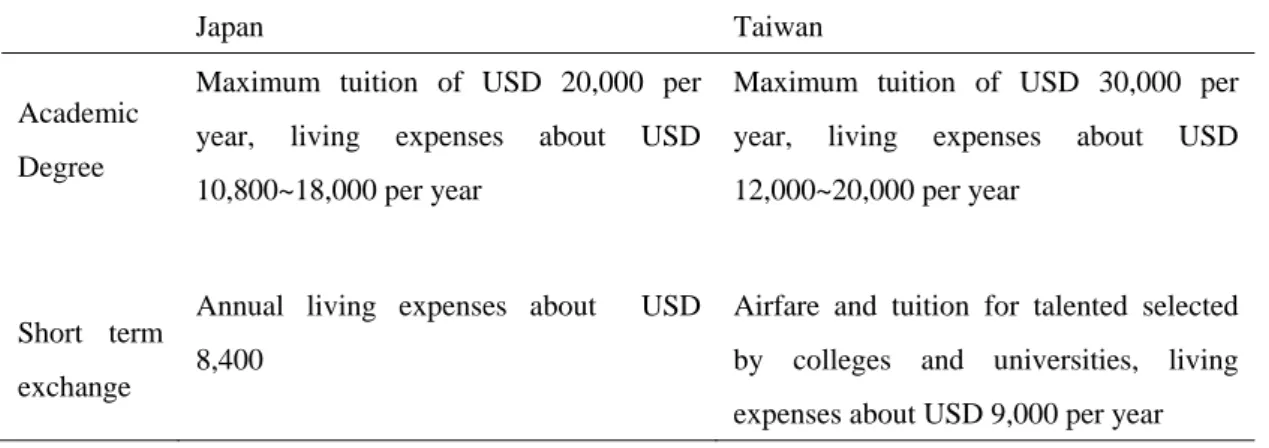
Thus, the comparison between Japan and Taiwan in terms of state-sponsored

studying abroad policies with results as shown in Table 3 is: generally, Taiwan’s

(17)

state-sponsored scholarship for a master’s degree and a doctorate includes a

maximum USD 30,000 per year for tuition, and living expenses ranging from USD

12,000 per year to USD 20,000 per year by region. Japan’s state-sponsored study

abroad scholarship includes a maximum USD 20,000 per year for tuition and USD

990 to USD 1,650 per month, which is USD 10,800 to USD 18,000 per year for living

expenses. With respect to policies encouraging students for internal exchange, Japan

supports short-term students by about USD 8,400 annually per capita. Taiwan’s Study

Abroad Pearl Project for talents selected by colleges and universities, supports about

more than USD 9,000 annually per capita. The comparison results of Japan and

Taiwan demonstrate that Taiwan’s scholarships are higher than those offered by the

Japanese government, in terms of tuition or living expenses. It can be seen that the

general state-sponsored studying abroad system offers better a scholarship package

than its Japanese counterpart.

Table 4 Comparison of Japan and Taiwan State-sponsored Studying Abroad Policies Scholarship Content

Japan Taiwan

Academic Degree

Maximum tuition of USD 20,000 per year, living expenses about USD 10,800~18,000 per year

Maximum tuition of USD 30,000 per year, living expenses about USD 12,000~20,000 per year

Short term exchange

Annual living expenses about USD 8,400

Airfare and tuition for talented selected

by colleges and universities, living

expenses about USD 9,000 per year

(18)

2.2.4 Scholarship Quota

The related commission of Mainland China will select personnel to study abroad

in numbers as many as 7,000 in 2007. It can be learnt from the large quotas of

scholarships the reason why Mainland China has been the top one in terms of the

number of students studying abroad as related to its state-sponsorship and open

studying abroad policies (China Scholarship Council, 2007). Singapore has about 50

to 60 people awarded with scholarships because of its concept of ruling the country by

elites, thus resulting in less people awarded than other countries (Chin, 2001). The

number of people winning the scholarship depends on the requirements of talents by

public services. In 2004, Japan sponsored 100 people to study abroad for academic

degrees and 635 people for short-term study (MEXT, 2004). However, the number of

people studying abroad from Malaysia dropped from 301 people in 1980 to 67 people

in 1990 (International Cooperative and Exchange Center for Technological and

Vocational Education, 2007). In Taiwan, the studying abroad system has changed

from the original support of a few people to support of more people under the Elite

Study Abroad Program. This may increase Taiwan’s state-sponsored people who

study abroad to more than 1,000 people.

The scholarship quotas vary greatly by country. The reasons may be the financial

(19)

enrolling international students, resulting in changes in scholarship sums and quotas.

For example, since Malaysia’s domestic education cannot meet the demands in the

early stage, studying abroad was encouraged and supported. However, with the

upgrading of the education levels of its domestic colleges and universities, it expects

to change from a country sending out students to study abroad to a country that

receives foreign students, resulting in a gradual decrease in scholarship quotas per

year. Japan’s policies are of mainly of enrolling international students; therefore, the

scholarship quotas for studying abroad is less than one fifth of the number of foreign

students enrolled.

2.2.5 Selection Method

Scholarships in Mainland China are granted to applicants selected by way of

“individual application, organizational recommendation, expert review and admission

of the best qualified.” The State Fund Management Committee is responsible for

reviewing the written documents for selection (China Scholarship Council, 2007). The

Public Service Commission of Singapore is in charge of the selection of applicants for

scholarships (MoE, Singapore, 2008). In Japan, the Japan Student Services

Organization under the Ministry of Education and Science is responsible for the

implementation (MEXT, 2004). Taiwan’s studying abroad policies are in the charge

of the Ministry of Economic Affairs, Ministry of Education, and National Science

(20)

Council. The selection methods are mainly via written examination, written review,

and interview. Selection methods of these countries are none other than review of

written data, mostly including certificates of education, proof of language capabilities,

health of mind and body proofs, research plans or learning plans, and so on.

2.2.6 Grant Period

Mainland China supports students studying abroad for a period ranging from 3

months to 2 years (China Scholarship Council, 2007). Japan supports those studying

abroad for a master’s degree by two years, and three years in the case of students for

doctorate (MEXT, 2004). However, the support lasts only one academic term, or a

year, in the case of short-term studying abroad. Under Taiwan’s Elite Study Abroad

Program, the shortest scholarship term is four weeks in the case of sending college

and university students for internship in foreign organizations; and the longest term is

in the case of general state-sponsored studying abroad (MoE, 2007). The support may

last for four years in the case of studying abroad in Japan and Europe (excluding

Britain), three years in Britain, the U. S. and other countries. If the student applies for

the scholarship for studying abroad, he/she may be entitled to support for two years.

The support for post-doctorate research lasts for a year. The Study Abroad Steed

Program supports doctors in studying abroad for 7 months to one year. And the

(21)

Mainland China with two years--longer than the term of Taiwan.

A comparison of the grant periods of Mainland China, Japan and Taiwan by

academic degrees reveals that Mainland China supports master degree candidates for

two years, and doctorate degree candidates for four years. Japan supports master

degree candidates for two years, doctorate degrees for three years. Taiwan supports

applicants for four years under the general state-sponsored studying abroad program,

regardless whether it is a master degree or doctorate degree; however, the term is two

years in the case of applicants who are awarded a studying abroad scholarship. It can

be summarized from Table 4 that Mainland China and Japan grant different years of

supports to applicants of different degrees, with longer periods of support in case of

doctorate degree candidates. However, Taiwan grants the same years of support to

candidates for both a master degree and a doctorate degree. However, those under the

general state-sponsored studying abroad policies have longer terms of support.

Table 5

Studying Abroad Scholarship Grant Period Comparison by Country

Mainland China Japan Singapore Taiwan

Short term exchange 3~6 months

Doctorate degree candidate half a year to 2 years

Master degree candidate 2 years Doctorate candidate

Short term exchange 1 year

Master degree 2 years Doctorate candidate 3 years

Master degree English-speakin g country 6 years Non-English speaking country 5 year University 4

Post-doctor research 1 year

Doctorate degree candidate 7 months to 1 year

Short term internship 4 weeks

General state-sponsored

(22)

Non-English speaking country 4 years English speaking country 3 years Studying abroad scholarship 2 years

Regarding the studying abroad target countries, Singapore supports one more year

for those students in advanced English-speaking countries. Taiwan’s general

state-sponsored studying abroad program supports one more year in the case of

students going to non-English speaking countries such as Japan and Europe. The two

countries are just opposite in deciding the grant period in accordance with studying

abroad target countries. It may be due to the fact that Singapore encourages studying

abroad in advanced English-speaking countries by extending the term of support.

This strategy can be regarded as on purpose.

2.2.7 Service Commitments

To avoid a situation where students studying abroad refuse to return, Mainland

China requests students pay a security deposit of RMB 10,000 to 40,000 prior to

going abroad, forcing them to return to serve the country (China Scholarship Council,

2007). The Singaporean close type scholarship receivers shall enter into public

services after returning (MoE, Singapore, 2008). Japan encourages returned staff to

teach in schools or do research work in academic institutions (MEXT, 2004). The

(23)

general studying abroad and studying abroad scholarships of Taiwan often request

receivers to serve the country for the same number of years of financial support. The

students selected from colleges and universities shall go back to the country to

complete their studies. The National Science Council has fewer restrictions on the

service commitments of those studying abroad. Whether the study should or should

not be accomplished under the Study Abroad Steed Program is up to the organization

itself. The National Science Council regulates that if the supported student issues any

research achievement in an international meeting or academic journal, the name and

program code of the National Science Council shall be added (MoE, 2007).

2.2.8 Related Authorities

Mainland China, Singapore, and Japan all have special agencies and

organizations responsible for studying abroad scholarships. The scholarship planning,

selection, and provision of information are implemented by the State Study Abroad

Fund Management in Mainland China. In Singapore, the Public Services Commission

(PSC) establishes scholarship programs to select those studying abroad and provide

information. Japan set up the studying abroad loan system in 2004 and integrated

related studying abroad services to launch the Japan Student Service Organization

(JSSO), which is responsible for encouraging studying abroad and enrolling foreign

students as well as issuing student loans. In Taiwan, the encouragement of studying

(24)

abroad is jointly implemented by the Ministry of Education and the National Science

Council. Although the Elite Study Abroad Program has been integrated in recent

years to systemize the studying abroad mechanism, the methods of selecting and

supporting students by the Ministry of Education and National Science Council by

themselves are still in force.

3. Conclusion

Altbach (1991) indicated that policy guidelines will affect the intention to study

abroad. Therefore, a comparative view of educational internationalization policy

would help education and economy development decision makers to design a better

integrated system for nation’s human resource needs.

The policies stated above revealed an interesting phenomenon that Asian

countries tend to emphasize and regulate return and repatriate service obligations. For

these Chinese culture original regions, patriotism is often taken consideration in

making study abroad policies. On one hand, these countries need high quality human

capital and advanced technologies in developing domestic economy and overall

power of the country, on the other hand, they need to strengthen the pull to the

awarded students to go back to home country. The coherence of society and the

economy development of China may be very strong pulls for Chinese exchange

(25)

students. It is also found that people who went studying abroad in the early days

tended to prolong their stay without return; yet, when they came back after several

years, they helped with the development of the country, countering the stated problem

that talented people are lost without return. It is positively correlated among the

opinions of the practical side of the studying abroad policy, vision of the policy and

intention to return to their home country. Therefore, whether it is necessary to require

scholarship candidates to return to their home country and serve is an issue deserving

of consideration. By observing the Singapore open-style and closed-style scholarships,

it is recommended to establish different rules and to have different levels of

sponsorship, according to the obligation to return and serve. Scholarship programs in

mainland China, Singapore and Japan add patriotism and obligation to serve as

qualifications and conditions. Thus, those who receive scholarships without obligation,

are not required to return and contribute to their home country while those who

receive scholarships with obligation, will have a motivation to return home. On the

other hand, overseas scholars always provide most updated and progressive opinions,

helps and connections to government. It could be another aspect of viewing return

obligations.

The study provided comparative view of regulations and experiences of Asian

countries about their education internationalization policies on outbound students.

(26)

Further studies could examine the satisfaction and needs of award recipients and a

comparative study of educational internationalization policies on inbound students is

worthy doing.

References

Altbach, P. G. (1991). Impact and adjustment:Foreign students in comparative

perspective, Higher Education, 21, 205-232.

Bereday, G. Z. F.(1964),Comparative method in education, N.Y.: Holt, Rinehart &

Winston, Inc.

Chang, C.-C. (2006). Educational internationalization policies and implementations in

Taiwan. Educational Resources and Research Bimonthly, 71, 1-16.

Chin, M.-C. (2001). Analysis of Singapore study abroad policies. Educational

Resources and Research Bimonthly, 29, 28-36.

China Scholarship Council (2005). CSC Annual Report 2005. Retrieved May 15, 2008

from http://www.csc.edu.cn

China Scholarship Council (2006). Nation sponsored study abroad programs and

application regulations. China Scholarship Council Publication, Beijing.

(27)

China Scholarship Council (2007). Government sponsored scholarships. Retrieved

February 10, 2008 from http://www.csc.edu.cn

Dai, H.-H. & Pan, H.-Y. (2006). Globalization or Regionalization? An Analysis of the

Origin of Foreign Students in Major Regions and Countries. Educational Policy

Forum, 9(4), 21-47.

International Cooperative and exchange Center for Technological and Vocational

Education (2007). Educational Systems。Retrieved March 30, 2007 from

http://ice.lhu.edu.tw/int/int.htm

Jackson, J. (2008). Globalization, internationalization, and short-term stays abroad.

International Journal of Intercultural Relations, 349-358.

Kehm, B. M. & Teichler, U. (2009). Research on internationalisation in higher

education. Journal of Studies in International Education, 11, 260-273.

Knight, J. (2004). Internationalization remodeled: Definition, approaches, and

rationales. Journal of Studies in International Education, 8(1), 5-31.

Li, X. (2004). A study by the Chinese academy of sciences on the benefits of study

abroad. Chinese Educational and Society, 37(2), 61-87.

MEXT, Ministry of Education, Culture, Sports, Science and Technology, Japan

(28)

(2004). Outline of the exchange in Japan. Retrieved February 15, 2007 from

http://www.mext.go.jp/a_menu/koutou/ryugaku/05020201/001.pdf

Ministry of Education (2007). 2006 Study abroad regulations. Retrieved March 30,

2007 from https://www.studyabroad.moe.gov.tw/96/09501773081.pdf

Ministry of Education (2005). Policy direction of 2005. Retrieved February 1

st

, 2007

from

http://www.edu.tw/EDU_WEB/EDU_MGT/SECRETARY/EDU8559001/guide/

95guide.htm

Ministry of Education, Singapore (2008). Statistics of Education Outcomes. Retrieved

September 10, 2008 from http://www.moe.gov.sg/education/desired-outcomes

Public Service Commission , Singapore (2007). PSC Scholarships, Retrieved April 5,

2007 from http://www.pscscholarships.gov.sg

Zhang, Q. (2000). Reform and development of study-abroad activities in China’s new

era. Chinese Education and Society, 33(5), 91-102.

數據

Table 4 Comparison of Japan and Taiwan State-sponsored Studying Abroad Policies  Scholarship Content

參考文獻

相關文件

編號 主持人 計畫名稱 審查結果 CF12202 許惠恒 在亞洲國家多中心隨機研究比較 Joint Asia Diabetes. Evaluation (JADE)

與其他 OECD 國家相比,澳洲的特點是 16 歲以上的青年較少繼續留 在學校,使其較缺乏能長期稳定留在職場的基本技能,因此,增加教

Asia, and the History of Philosophy: Racism in the Formation of the Philosophical Canon, 1780–1830, New York: State University of New York Press, 2013) 等人 的 研 究。Garfield

其次,幫助學生建立關聯句型的概念: 「□□……,□□……」

Mie–Gr¨uneisen equa- tion of state (1), we want to use an Eulerian formulation of the equations as in the form described in (2), and to employ a state-of-the-art shock capturing

威夷大學社會心理學博士。曾任 國家科學委員會特約研究員。榮 獲國家科學委員會優良研究獎、美國東

各國的課程綱要均強調運算的概念性了解。我國 2009 年課程綱要談到所謂

第十條 香港特別行政區應當通 過學校、社會團體、媒體、網絡 等開展國家安全教育,提高香港 特別行政區居民的國家安全意識