行政院國家科學委員會專題研究計畫 成果報告
Intelligence Agent 的科技特性應用於 Online Auction 的
任務特性之任務-科技配適度評估消費者對科技之接受度
計畫類別: 個別型計畫
計畫編號: NSC94-2416-H-006-024-
執行期間: 94 年 08 月 01 日至 95 年 07 月 31 日
執行單位: 國立成功大學企業管理學系(所)
計畫主持人: 張心馨
計畫參與人員: 張心馨. 王怡臻. 高達偉. 楊文英
報告類型: 精簡報告
處理方式: 本計畫涉及專利或其他智慧財產權,2 年後可公開查詢
中 華 民 國 95 年 7 月 31 日
行政院國家科學委員會補助專題研究計畫
-
九十四年度結案報告
Intelligence Agent 的科技特性應用於 Online Auction 的任務特
性之任務
-科技配適度評估消費者對科技之接受度
Intelligent Agent Technology Applied to an Online Auction Task:
A Critique of TTF and Consumer TAM
計畫編號: NSC94-2416-H--006-024
執行期限: 94/08/01 – 95/07/31
主持人
: 張心馨 國立成功大學 企業管理系所
1. 中文摘要
人們對資訊科技的認知不同,影響使用者對科技 的評價與期待。然智慧代理人的技術已經應用至研發 創新及知識管理等不同的領域,而透過使用者對 Internet 智慧代理人的科技特性、Online Auction 任務 特性,以及任務-科技配適度的實質接受,仍必須明 確而深入研究。準此,本文經由個案研究和計量分 析,以消費者對智慧代理人應用於 Internet 拍賣過程 之任務-科技配適度,深入探討(1)智慧代理人之科技 特性與線上拍賣網任務特性之相互關係;(2)網站經營 者對軟體代理人的科技特性、任務特性,以及任務-科技配適度之認知;(3)瞭解消費者對任務-科技配適 度的實質接受度;以及(4)消費者對資訊科技之持續使 用意願。經個案研究發現,網站經營者認為建立軟體 代理人的功能與機制,可增進拍賣網的營運效率與時 效性;而為降低拍賣網中的認知風險,導入線上拍賣 網智慧代理人之前及導入後的產品配送及付款的評 估等,皆必須建立一安全的科技代理人管理。在計量 分析呈現,若消費者已熟悉拍賣網代理人科技功能, 會對科技特性、任務-科技配適度、易用認知、有用 認知、娛樂認知,以及持續使用意願認知等六個構面 均持正面的影響,而對承擔風險能力亦有較深入的認 知。將來引領智慧代理人的重點,網站經營者應尋求 優良的智慧代理人幫助解決軟體技術的困境能力,如 此才能使業者專注於 Internet 拍賣網的規劃並擴展至 電子商務營運中,以持續創造企業經營價值網體系。 關鍵詞:智慧代理人、任務-科技配適、科技接受度Abstract
World Wide Web (WWW) Intelligent agent technology has been applied in areas such as research and development, innovation, and knowledge management. This study investigates the employment of intelligent agents in a web-based auction process, with particular reference to (1) the appropriateness of the intelligent agent software for the online auction task (Task-Technology Fit, TTF), (2) consumer perception of the value of the agent, (3) the effect of this consumer perception on the intention to use the tool, and (4) a measure of consumer acceptance. In the initial case study, both consumers and web
operators thought the use of software agents enhanced online auction efficiency and timeliness. The second phase of the investigation established that consumer familiarity with the intelligent agent functionality was positively associated with the six dimensions: intelligent technology, TTF, perceived ease of use, perceived usefulness, perceived playfulness, perceived intention to use the agent, and negatively associated with perceived risk. Intelligent agents have the potential to release skilled operator time for value-adding tasks in the planning and expansion of online auctions.
Key words: Intelligent agent technology, TTF, Technology acceptance model
2. INTRODUCTION
Online auctions are among the more successful e-commerce applications, showing continued growth even through the boom and bust period of the “dotcom bubble” (1999-2000). This success is founded on the potential for web technology to change the nature of the interaction between buyer and seller, facilitating transactions (Lin and Lu, 2000) and promoting auction based flexible pricing, which IBM (2000) forecasts will, in 20 years, largely replace the fixed price model currently dominating e-commerce transactions. Online auction sites on the web are expected to be a focal point of e-commerce development in the future (Gefen, Karahanna, and Straub, 2003).
In general, there is a price negotiation in the commodity trading process. Negotiation can be regarded as a search for a mutually advantageous compromise between buyer and seller. Interpersonal negotiation is always affected by environment, culture, and self-esteem (Beam and Segev, 1998; Bhattacherjee, 2001; Chang and Guo, 2003). “Real time” commodity trading is a famously demanding, and consequently a well rewarded activity, requiring continuous, sustained concentration and rapid decision making. This stress can be greatly reduced by the continuous
monitoring and decision making rules “built in” to automatic price negotiation by an intelligent software agent. The consequent reduction in buying or selling costs can benefit the profitability of both parties (Ba and Pavlou, 2002). User acceptance of online auction intelligent agent technology in the future will be largely determined by the extent to which it achieves this.
Successful web implementation of Intelligent agent technology is strongly influenced by user confidence in the agent (Chang, 2006a), but there has been limited investigation into the factors influencing the growth and maintenance of that confidence. Study of user perception of both intelligent agent acceptance and business performance could aid application of intelligent agents on the web (Lederer, Maupin, Sena, and Zhuang, 2000; Carayannis and Turner, 2006) with the aims of designing better systems, providing better services, raising customer satisfaction, and promoting the operational efficiency of websites. The paper proceeds as follows in the investigation of the user’s adoption of intelligent agents in the online auction process:
(1) It discusses how the fit between intelligent agent technology and the online auction task affects the user’s intention to use the technology. (2) It divides consumer participation in online
auctions into price negotiation and commodity trading.
(3) The information gained from the pilot case study interviews is then used to guide a wider questionnaire survey.
(4) This questionnaire then investigates consumer and online auction site operator’s evaluation of the usability and effectiveness of intelligent agent technology, and their perception of the fit between the online auction task and the intelligent agent technology.
3. THEORY AND HYPOTHESES
In the context of user acceptance of intelligent agent technology, this study initially collects and dissects the principal attributes of intelligent agents in general, and then analyzes specific examples of online auction applications.
3.1 Artificial Intelligent Agent
Vannebar Bush introduced the concept of the intelligent agent with the Memex machine in the 1950s. With intelligent agent assistance in browsing and information collection, the user can decrease the amount of search time needed, increasing productivity by making the decision-making process faster. Chang and Chen (1996) define the intelligent agent as “software that is designed to simulate a
series of human behaviors in times of problem solving.” Summarizing definitions by Langton
(1989), Beale and Wood (1994), Maes (1995), Russell and Norvig (1995), Wooldridge and Jennings (1995), Franklin and Graesser (1996), Caglayan and Harrison (1997), Gilbert (1997), Müller (1999), Chang and Guo (2003), Turban, McLean, and Wetherbe (2004), and Laudon and Laudon (2005), an intelligent agent is here defined as “Computer software with the abilities of autonomy, communication, and learning. Under general user control, with the assistance of sufficient knowledge or functions, and adapting to changes in its environment, an intelligent agent automatically adjusts its execution to achieve the users preset goal.”
Intelligent agents are software programs that work in the background without direct human intervention to carry out specific, repetitive, and predictable tasks for an individual user, business process, or software application (Laudon and Laudon, 2005). In a rapidly developing field, discussions have largely focused on new startup sites and enterprises. Follow-up research is desirable to establish characteristics leading to success and stability.
3.2 Online Auctions
In the early 1990’s many auctions were completed through network news groups and e-mails. Following posting of a seller’s auction information to a news group, buyers were able to look at the information and place bids by e-mail. After the seller received the bid, the news group announced the latest bid price. Since the auction sites Onsale and eBay started operation in 1995, the use of the characteristics of WWW to provide automatic bid placing, search and selection by category have dominated the online auction process, providing more convenience for the user.
Wang, Wang, and Tai (2002) define the auction as “a market institution with an explicit set of rules determining resource allocation. Online auctions enable bidders to send out their bid price online and see the bidding situation immediately.” All bidders can remotely monitor the bidding process and place their bids in real time (Chui and Zwick, 1999). Online auctions thus prevent the auction process from being confined by the spatial limitations found in traditional auctions (Beam and Segev, 1998). An outline of the different styles and target markets of online auctions, with some examples of intelligent agent implementations, follows.
(1) Auction style of online auctions: The rules determining the market mechanism for online auctions may be complex. Current web-based auctions adopt mixed mechanisms. McAfee and Mcmillan (1987), Beam and Sefev (1998) and Chui and Zwick (1999) identified seven
online auction application activities, divided into several basic styles: (a) First-price and second-price secret bidding, (b) Single-unit auction and multi-unit auction, (c) open auction and sealed-bid, (d) open reserve and sealed reserve, (e) Bid Method: call auction and double auction bid method, (f) English auction, Dutch auction, first-price sealed-bid, and second-price sealed-bid (g) traditional and reverse auction.
(2) Classification of online auctions: The classification of commercial auction services adopted from Chui and Zwick (1999) and Chang (2006a) divides them into three kinds: C2C, B2C, and B2B. Some examples of these classes of website, with products traded and auction methods used, as reported by Beam and Segev (1998), Chui and Zwick (1999), Wang et al. (2002), and Chang (2006a). A C2C is primarily intended to facilitate trading between “non-enterprise” private individuals. A B2C website facilitates trading between an enterprise and its customers, and will typically offer quality assurance and product maintenance services to the latter. The target clients of B2B sites are enterprises.
(3) Automatic online auctions: These reduce the workload on both buyers and sellers by continuous price monitoring and automated bidding (Beam and Segev, 1998; Chang, 2006a). IBeam and Segev (1998) and Chang and Guo (2003), give examples of experimental online auction systems shows online functions and mechanisms employed by the most popular online auction operators, such as eBay, uBid, Yahoo, etc.
Online auctions confer a lot of advantages, which could be enhanced using intelligent agent technology to shorten the auction time, accommodate more articles online, acquire a better and more competitive trading price, reduce operating costs, and decrease the investment require.
3.3 Technology Acceptance Model (TAM),
Intrinsic and Extrinsic Motivation, and
Task-Technology Fit (TTF)
The TAM, its relationship with motivation, and its extension by the incorporation of the TTF concept, is discussed below.
3.3.1 TAM
Based on Fishbein and Ajzen’s (1975) Theory of Reasoned Action (TRA), the Technology Acceptance Model (TAM) contends that an individual’s behavior is determined by attitudes and intentions, i.e. by his/her personal attitude and his/her evaluation of the likely outcome of his/her behavior. User acceptance of an information
technology (IT) tool can in principle be predicted from belief, attitude and intention to use the tool. Davis (1989) contends that TAM is the model currently applied most extensively to explain technology use behavior. For instance, Azjen (1991), Taylor and Todd (1995), Agarwal and Prasad (1998), Dishaw and Strong (1999), Karahanna et al. (1999), Lin and Lu (2000), Moon and Kim (2001), Hardgrave and Johnson (2003), and Gefen et al. (2003) employ this model in their research.
A conceptual limitation mentioned by Davis (1989) is the potential circularity of the relationship between these behavioral influences rendering them indistinct, so that the user’s belief affects his/her attitude, which in turn further affects intention to use the tool thus affecting actual tool use behavior. Nevertheless, the model is believed by the present author to be useful and relatively easy to use. The related definitions of this model are as follows: (1) Extrinsic variable: This refers to the factors external to the user which can affect the user’s use of IT, e.g. attributes of software system, level of training in its operation, etc. (2) Perceived usefulness (PU): This refers to the individual’s belief that the use of a special information system can promote working efficiency, such as reducing the working time required. (3) Perceived ease of use (PEU): This refers to the individual’s belief that learning to use the special information system will not take too much effort. (4) Attitude: This refers to the users overall balance of feeling (+ or -) about the system. (5) Intention to use tool (IUT): This refers to the user’s estimate of the probable amount of use, in for example, hours per week. (6) Actual tool use: This is the dependent variable, which is normally the time and frequency of utilization of the system by the user.
In addition to general work-related information systems, Moon and Kim (2001) and Legris et al. (2003) specifically examine the influence of these factors on an individual’s intention to use internet technology to assist in his/her work, and find these consistent with the TAM. Teo (1999), Dishaw and Strong (1999), and Venkatesh and Davis (2000) disagree, arguing that the IUT does not have a significant positive association with actual tool use, and that the factors of intent and attitude are not consistently associated with actual tool use and thus can be neglected. This would reduce the input variables in the TAM model to extrinsic factors, PEU and PU.
PU is a measure of the individual’s subjective assessment of the utility offered by the new IT in a specific task-related context. PEU is an indicator of the cognitive effort needed to utilize the new IT (Gefen et al., 2003). We follow Moon and Kim (2001), and Legris et al. (2003, see above) in
assigning importance to IUT as a determinant of the user’s adoption of intelligent agent technology and so the IUT is taken as the output variable in the present research model. The justification for this view is discussed further below.
3.3.2 Intrinsic and Extrinsic Motivation
Davis (1993) argues that perceived usefulness is a part of extrinsic motivation. IUT is affected by PU, and an additional variable, “playfulness”, which is a component of intrinsic motivation. Teo (1999), in a discussion of intrinsic and extrinsic motivations, argues that IUT is mainly affected by perceived usefulness but a high perceived playfulness will also have a positive effect on acceptance and IUT. According to Deci (1975), extrinsic motivation refers to anticipated valued outcomes that are distinct from the activity itself, a view supported by Defen et al., 2003. Ba and Pavlou (2002) argue that the key point here is the “supply of efficacy”. Intrinsic motivation refers to the perceived value inherent in the performance of certain actions, (e.g. perceived fun, effect of playfulness, enjoyment). (Defen et al., 2003). Chen et al. (2002) suggest that future research on user acceptance of WWW applications should consider the intrinsic motivation of perceived playfulness, which they feel further investigation will show to be significant.
3.3.3 TTF Model
TAM uses the user’s attitude and belief to predict the utilization of information systems. Although TAM is the model currently applied most extensively to explain technology use behavior, in its basic form it does not completely reflect the working environment of the user. It lacks a consideration of the effect of the user’s task on the user’s behavior (Dishaw and Strong, 1999; Moon and Kim, 2001). Models of the user uptake of new technology emphasize the influence of technology characteristics and user attitudes and beliefs, while task-technology fit (TTF) models concentrate on the appropriateness of the technology to the task (Dishaw and Strong, 1999). Since a good TTF can be expected to positively affect user attitudes, these two, individually incomplete models are not isolated, and combined models representing their interaction have been proposed (Goodhue and Thompson, 1995; Dishaw and Strong, 1999).
Intelligent agent technology can help businesses navigate through large amounts of data to locate only information that is considered important and, in some cases, act on that information on behalf of the user. The agent uses a limited built-in learned knowledge base to accomplish tasks or make decisions on the user’s behalf (Laudon and Laudon, 2005).
Caglayan and Harrison (1997) indicate that to accomplish a complete intelligent agent for online auction, techniques for defining the two dimensions
of intelligence and operational scope have to be combined. Intelligence is considered as preference, reasoning, and learning. Operational scope is considered to consist of agent, service, application, data interactivity, user representation, and asynchrony. Intelligent agents for online auctions were created to integrate the development of learning, inference, problem solving, meaning and understanding into intelligent behavior appropriate for application in a variety of auction-related contexts (Chang and Guo, 2003). In general usage, a human agent completes a preset task on behalf of one person after interaction with other persons, but in the context of artificial intelligent agents’, consensus on simple definitions is not so easily achieved, being dependent on the individual perspective of the author or commentator.
This paper explores the acceptance of intelligent agents for the automation of auction websites previously surveyed by Caglayan and Harrison (1997) and Chang and Guo (2003), examining, within a TAM/TTF framework, which aspects of user perceived agent functionality are important for user acceptance, and which are considered important by site operators. Agent technologies are becoming ubiquitous in web based search engines involved in, for example, human resource recruitment or online shopping, but there is little published research on consumer perception of their decision-making performance in the online auction context. To our knowledge an integrated TAM/TTF model has not been applied in this context.
Intelligent agents are classified by learning ability and functional complexity (Caglayan and Harrison, 1997), allowing currently deployed systems to be distinguished as follows: (1) Learning ability: This represents the ability of the intelligent agent to adjust or revise its behavior. It creates cause-and-effect relationships according to the analyses of statistical decision-making trees. An intelligent agent with strong learning ability can create and manage rules derived from an agent’s experience. (2) Functional complexity: Possession of extra functions and databases allows the agent to undertake more complex interactions. (3) Execution environment: As a further potential classification dimension, the utilization environment can be divided into personal computer, worldwide web, and the enterprise internal network.
4. RESEARCH FRAMEWORK AND
DESIGN
4.1 Research Hypotheses
This research focuses on the intelligence and operational scope of functions provided by the online auction agent for the accomplishment of tasks assigned by the investigator. Since the
literature lacks a complete list of TTF variables for online auction systems, Goodhue and Thompson‘s (1995) ten constructs, including quality of information, correctness of information, compatibility of information, ease of use of system, timeliness, reliability, system-user relationship, and also the eleven items for exploration of information integration proposed by Goodhue et al. (2000), including uniformity, educational training, helpfulness of system, reliability of system, accessibility of information, meaningfulness of information, correctness of information, ease of use of system, presentation adequacy of information, and user’s familiarity with program are used as a starting point.
The agent’s intelligence and operational scope has been described by six attributes, by Caglayan and Harrison (1997), Cavalieri, Cesarotti, and Introna (2003), Chang and Guo (2003), Hildum and Kjenstad (2003), Sadeh, Hildum, and Kjenstad (2003), and Laudon and Laudon (2005). A further description of these attributes is given below: (1) Autonomy: The system can respond to the
environment without human or other external control inputs. It may carry out repetitive work on a periodical or event-driven basis. For example, eBay and Yahoo successfully introduced an automatic bidding function which incorporates reliability of authorization, rendering the system an “adjustable autonomy” agent. The user can decide the bidding limits, and the agent will request further authorization when/if they are reached. (Caglayan and Harrison 1997; Sadeh et al., 2003)
(2) Temporal continuity: The agent effectively operates continuously in real-time, and so can respond to market changes quickly, unaffected by fatigue, and breaks or lapses in concentration. (Hildum and Kjenstad, 2003; Laudon and Laudon, 2005)
(3) Adaptivity: The agent is capable of immediate response to environmental change, such as auction prices or auction information. (Gefen et al., 2003)
(4) Goal-Orientation: The agent has built-in, pre-declared goals and will optimize its behavior in order to achieve them. (Chang and Guo, 2003; Venkatesh et al. 2003)
(5) Learning Ability: The agent can make appropriate adjustments to its behavior according to the previous experience. For example, an agent could modify its bidding behavior according to past experience of post-purchase price movements. (Caglayan and Harrison, 1997; Chang, 2006a)
(6) Communication: The agent can interact with the user according to the conditions preset by the user, including notifying the user of bid price
movements, requesting authorization for decisions, or providing the user with information of new trading opportunities. (Karahanna et al., 1999; Chang and Guo, 2003)
According to McAfee and Mcmillan (1987) and Wang et al. (2002), an auction is a market mechanism where participants bid to decide resource distribution and price. IT is deployed to assist users in this task. Specific task characteristics might require a user to rely more heavily on certain aspects of the information system. TTF is the degree to which a technology assists an individual in performing his or her specific portfolio of tasks. It describes the correspondence between task requirements and the functionality of the technology (Goodhue and Thompson, 1995). From the perspective of the primary user motivation, two kinds of tasks are considered to be under investigation here: trading item acquisition and price negotiation (Fenech, 2002; Venkatesh et al. 2003; Nysveen and Pedersen, 2004; Chang, 2006b). In the present study, a participant is viewed as either being primarily motivated by the wish to acquire an article offered (for example, some categories of “collectable” items may not be readily available through other channels) or may regard an online auction as potentially offering a cheaper price than fixed-price retail or private sale outlets. These categories are constrained by our survey to be mutually exclusive.
A summary of research hypotheses on the application of the TTF model to the intelligent agent and online auction environment follows.
Hypothesis 1a: For item acquisition: the six attributes
of intelligent agent technology (IAT), namely autonomy, temporal continuity, adaptiveness, goal-orientation, learning ability and
communication have an association with the fit between IAT and online auction task.
Hypothesis 1b: For price negotiation: the six
attributes of IAT have an association with the fit between IAT and online auction task.
This research explores user acceptance of intelligent agents on the WWW, and attempts to integrate previous research models, focusing on TTF and the TAM. Previous studies have largely concentrated on extrinsic motivations such as perceived ease of use and usefulness, but Teo (1999), Moon and Kim (2001), Tsang, Ho, and Liang (2004), and Chang (2006b) have argued for the importance of intrinsic motivations, such as playfulness, which are accordingly also incorporated into the present model. The TAM variables are explained further here, and are: (1) Perceived ease of use (PEU): The present study
bases PEU on the measurement table of Davis (1989), and also the measurement table in Moon and Kim (2001), specifically revised as
appropriate for the online auction application. (2) Perceived usefulness (PU): This may be defined
as the user’s subjective impression of the contribution made by the agent’s website to the achievement of the user’s goals. (Davis, 1993; Venkatesh et al., 2003)
(3) Perceived playfulness (PP): Moon and Kim (2001) define playfulness as “an intrinsic motivation or belief formed after the individual’s experience of an environment”. Playfulness is divided into 3 constructs: spiritual concentration, curiosity and enjoyment. Online auctions provide bidders with the attributes of entertainment, excitement, interaction, competition, and thus satisfy some of the psychological needs of human nature. The user population under study here is limited to general consumers and it is possible that this group may be more motivated by the entertainment attributes introduced by the WWW than professional traders or system operators would be, with a consequently greater effect on user acceptance of the technology.
The impact of PU on system utilization was suggested by the work of Robey (1979). PU had a significantly greater correlation with usage behavior than did PEU according to Davis (1989), Bhattacherjee (2001), and Gefen et al. (2003). Legris et al. (2003) examined the mediating role of PEU and PU in the relation between systems characteristics and the probability of system use. A summary of some possible research hypotheses on the relationship between TTF and the TAM is as follows:
Hypothesis 2: The fit between the online auction task
and IAT has an association with a user’s PEU for the website.
Hypothesis 3: The fit between the online auction task
and IAT has an association with a user’s PU for the website.
Hypothesis 4: The fit between the online auction task
and IAT has an association with user’s “PP” for the website.
Hypothesis 5: User’s PEU for the website has an
association with user’s PP.
Hypothesis 6: User’s PEU of this website has a
positive association with user’s PU.
Dishaw and Strong (1999) stated that the intention to use tool (IUT) does not have a significant and positive association with actual tool use. Other authors, however, have disagreed (Davis et al., 1989; Horton, Buck, Waterson, and Clegg, 2001; Moon and Kim, 2001; Gefen et al., 2003). Venkatesh and Davis (2000) have developed and tested the TAM to explain PU and usage intention in terms of social influence and cognitive instrumental processes. Attitude to technology use is defined as an individual’s overall
affective reaction to using a system (Venkatesh et al., 2003). Davis et al. (1989), Horton, Buck, Waterson, and Clegg (2001), Moon and Kim (2001), and Gefen et al. (2003) used the observed relationships between PU, PEU and IUT in their explanation of IT usage. There is extensive research using TAM to predict consumers’ use of new technology and confirm the relationship between intention and actual use.
Focusing on user’s utilization of agent technology, this paper takes the user’s intention as the last dependent (output) variable of the research model. The Technology Adoption Model is a useful but apparently incomplete description, and would ideally be integrated into a broader one which would include variables related to human and social change processes, and to the adoption of innovation.
Descriptions of the hypothesised relationships between these constructs follow:
Hypothesis 7: User’s PP in using the online auction
has a positive association with user’s IUT in the future for fulfillment of another online auction task.
Hypothesis 8: The user’s PEU for the online auction
website has a positive association with user’s IUT in the future for the fulfillment of another online auction task.
Hypothesis 9: The user’s PU for the online auction
website has a positive association with user’s IUT in the future for fulfillment of another online auction task.
The structure is composed of three major parts. Independent variables include task and technology. The primary task motivations (referred to as “task” below) of the online auction are divided into price negotiation and item acquisition. Agent technology covers six functional attributes: autonomy, temporal continuity, adaptive ness, goal-orientation, learning ability and communication. These attributes are explained further below. Dependent variables include TTF, PU, PEU, and IUT. In addition to these “traditional” TAM variables, the intrinsic motivation of playfulness is incorporated. Variables not under study that might affect intention to use tool or price negotiation, such as a user’s previous computer utilization or online auction experience have been controlled or randomized.
4.2 Research Design
Eisenhardt (1989) notes that the explorative case study approach is suitable for the initial description of the phenomena observed the definition of questions, and perhaps the formulation of hypotheses for testing by follow-up research. By contrast, an explanatory study mainly applies theoretical perspectives to explain the relationships within a phenomenon, and is more suitable for the construction and verification of theories. The
present paper combines these two approaches, employing a case study using relatively open, exploratory interviews with site operators, with a quantitative survey of user and site operator perceptions based on, and integrating, the theoretical framework of the TAM and TTF models established in the literature.
(1) Case study approach: A large online auction site is selected as the interviewee for development of the research model and research hypotheses.
(2) Investigative approach: Consumers familiar with online auctions are selected for questionnaire survey. Consumers were invited, via the discussion zones of various large online auction sites and other popular websites, and also the BBS of various famous schools, to fill out an online questionnaire. This has advantages of timeliness, spatial independence and coverage, and can provide automated assistance, all of which should increase the number of valid responses.
Questionnaire Design and Testing
The structure of the intelligent agent adoption model incorporates eight constructs, namely intelligent agent technology, online auction site task, TTF, PEU, PU, PP, PR, and IUT. The questionnaire was developed to explore the relative importance of these eight constructs, based on a synthesis of previously published investigations, revised and extended as appropriate for the current topic. The task of the online auction is divided into item acquisition or price negotiation. The intelligent agent’s functionality is divided into six attributes listed below. Participants rated the study website on a Likert’s 1-to-7 disagree-agree response scale for each of these functional attributes. (a) Independent variables: the task of the online auction is divided into item acquisition or price negotiation. The intelligent agent’s functionality is divided into six attributes: autonomy, temporal continuity, adaptivity, goal-orientation, learning ability, and communication. (b) Dependent variables introduced above are explained further here, and are: PEU, PU, PP, and IUT.
A panel consisting of three academics, four software engineers, 4 website developers and 30 graduate students from the faculties of Information Engineering and Information Management undertook a review of the questionnaire, with the aim of ensuring the objectivity and readability of the questions. Two questions on PEU, 1 on PU, and 1 on PP were eliminated in the review process, being considered to be not sufficiently specific in relation to the constructs. In its final form the questionnaire contained 3 questions about task, 11 questions about technology, 9 questions about TTF, 6 questions about PEU, 6 questions about PU, 9
questions about PP, 3 questions about PR, and 4 questions about IUT.
An experimental trial test was made before official commencement of the main questionnaire survey. Test subjects were given a description of, and asked if they understood, the research theme, the procedures for filling out the questionnaire, related terms, and the general functions of the agent. After confirming that the subjects completely understood the above descriptions, they carried out auction activities on the target website. After completion of all the assigned functions, subjects filled out the questionnaire about their perceptions of the online auction activities just carried out.
5. CASE STUDY
5.1 Agent’s Online Auction Site Case
The case study company was established in October 1998. Similar to the US eBay, it was the earliest C2C online auction site and the largest article trading center in Taiwan. The case website was the only Taiwanese bidding site listed in the Sparq Site (2001) guide, and there were more than 200,000 articles registered for selling by online auction. The huge number of people browsing once made the site the 24th most popular website,
between the two news sites of Today News and UDN. Apart from its C2C online auction site, the company established a B2C online auction site in 1999, and at the start of operation, made records for the highest income in a single month and the most hits. Having successfully operated the C2C and B2C websites, the case company introduced a B2B online auction site, investing in DRAMeXchange.com. This website was a DRAM B2B trading market, providing a database of current prices of articles and the relevant statistical analysis information. The website provided the buying and selling parties with an automatic auction system for registration and trading on their own.
The case website has a clear classification of articles. The procedures for selling the second hand articles online are simple and don’t require the time or effort that may be involved in searching a BBS. The transparent bidding process is the greatest protection to both parties, providing reassurance that they have achieved a true market price. Due to its outstanding performance when compared with other online auction sites, the site is a prospective target for merger with eBay, and is likely to remain among the more competitive online auction sites in Taiwan.
Following interview of four key company personnel, including the Vice-General Manager of the Marketing Department, Mr. Ho, the Chief of the Product Development Division, Mr. Yang, the Chief of Customer Relationship Management Division, Mr. Chuang, and Senior Official, Mr. Chang, we
describe the online auction site below before exploring the operator’s acceptance of agent technology, and their view of its effectiveness. (1) Current situation of the online auction market:
Although not long ago there were many websites said to have financial problems, the majority of these had advertising as their main source of income, and the case website was not greatly affected. The major impact to the company of the bursting of the “dotcom bubble” was a loss of confidence by consumers and cooperating companies, and an increased difficulty in the recruitment of good talent. These effects did slow the growth of the website. (2) Auction sites operating in C2C and B2C Modes:
The C2C model had relatively low startup costs and effort but offered the lowest returns. The logical evolution of an online auction enterprise, and the one being followed by the case study organization, was therefore to start with C2C, building market share and reputation before developing higher return B2C and ultimately B2B business. The operator felt that the most successful commercial model for online auction sites was B2B, although the attraction and integration of cooperating companies was critical to success and difficult, imposing high initial startup costs. The case website operates in the C2C and B2C modes, with the main income stream coming from B2C.
(3) Successful online auction site: The case study website has the R&D, database, popular products and good platforms which are prerequisite conditions for a successful online auction website operating in a competitive online environment. System performance was felt to be a weakness, and had been unable to fully match the expansion in demand experienced, leading to less than ideal response times, which were a matter of some concern. In order to promote quality of service, the company intended to offload article-flow and cash-flow services from the website, hopefully enhancing its online auction performance. Eventually these services would be outsourced, concentrating company operations on the core online auction service, as does eBay.
Customers can bid in online auctions relatively unaffected by time and spatial limitations and with the benefit of anonymity, which helps make the customer feel at ease. Indirectly, this affects the consumer’s behavior and accomplishes the trading of articles. If learning mechanisms, like Amazon’s book recommendation service, can be introduced to online auction sites in the future, such facilities can promote customer use and retention. The case website agent automatically emails customers with information of potential interest. Most customers
accept this service, and site operators feel this “push technology” helps sustain customer contact.
The case website agent automatically emails customers with information of potential interest. Most customers accept this service, and site operators feel this push technology helps sustain customer contact. A possible downside of this sustained consumer contact may be a need to continue to provide innovation and enhanced service via the user interface. The case study website is weak in this area, providing relatively simple functions to the user. The performance issues have already been mentioned, and the operator intends to concentrate resources on the underlying database and other services first, deferring upgrade of the user interface. As well as underlying performance, back-office services can monitor website use, providing behavior analysis to determine customer needs and transaction status. This can provide the data on which to base an agent-mediated personalized service to enhance the customer’s experience.
5.2 TTF: IA Technology and the Online
Auction Task
The essential aims of the auction task, as perceived by the users, are divided in our study into item acquisition and price negotiation. Case company staff felt that the motivations for a consumer’s use of online auctions are generally fun, product acquisition, and habit. In the process of bidding against other site users, the consumer gets fun out of the interaction with other people. The motivation of product acquisition may be based on superior availability when compared with other retail and private channels, due to the space and time limitations of “real world” shopping, especially where relatively rare items not available in the “mass market” are concerned. Anonymity may provide additional reassurance, especially for people who find face-to-face price negotiation stressful. Once a consumer accepts this way of shopping, he/she will acquire the habit of shopping at online auction sites. Considering TTF, the basic agent autonomous services are automatic notification and automatic bidding. Case company staff felt that these services could be enhanced by consumer “push” services controlled and recorded by an agent, which could, for example, continuously update the customer of changes likely to be of interest, such as price changes or article availability. A sophisticated agent may anticipate or extend the declared needs of the customer, based on monitoring and analysis of previous bidding patterns, and then mediate in any resulting auction transaction, prompting and guiding decision, avoiding breach of contract, and so promoting both the efficiency and the reputation of the service
provider.
The ability of the agent to react quickly to change is an important factor, since delay may cause a lost opportunity. The operator feels that direct, rapid communication with the bidder is a key agent attribute. Learning abilities are less important, since, although decision-support aids can be provided, consumers are resistant to fully automated bidding, preferring to retain final decision making control. Goal oriented behavior was also relatively little exploited, and was felt to be, in this context, more relevant to the seller, the implementation example given being the direct buying (“buy now) price mechanism, which allows a buyer willing to accept it, to avoid the auction process. This relatively simple suite of agent functional requirements reflects the current simplicity of the C2C online auction mission. Although outside the scope of the present study, agents developed, for example, for financial market trading support, where sophisticated “virtual” commodities such as futures and derivatives are traded, justify and require more sophisticated agent goal-oriented learning capabilities.
The results of the interview program suggest that the basic consumer tasks of item acquisition and price negotiation do not currently require sophisticated agent support, but that this is of potential future value for further personalizing the user auction experience, promoting additional services, and enhancing reputation and customer loyalty.
5.3 TTF Parameters: Perceptions and effect
of the Agent on the IUT
The impact of the perceived performance parameters are discussed below:
(1) Impact of PEU: Ease of use is a pre-requisite for site success. Without it, the customer will be unlikely to form a positive perception of usefulness or playfulness, irrespective of their motivation or role in using the site. PEU is the essential key to customer website revisits. The case site ease of use was felt to be good, with most of the agent functions easily operated by the customer.
(2) Impact of PP: If price negotiation is excessively stressed in the use of online auctions, this may reduce the fun derived from interaction with people in the price negotiation. If a website gives the user a better sense of playfulness, the user will be attracted to revisit.
(3) Impact of PU: The importance of this factor will depend to some extent on the nature of the commodity being traded. Sites offering special price-adjusting mechanisms for time sensitive commodities, such as plane tickets, (e.g. easyJet.com) will be perceived as useful in this
context by the consumer and are more likely to be monitored and revisited regularly. This may be less important for a seller of time-insensitive products, who can hold stock until sold.
The interviews revealed that site operator personnel felt that agent technology had a positive effect on PEU, PU, and PP. Some tasks have less impact on a given parameter than others, for example, transaction completion, although central to the operation of an online auction system, is largely internal to the system and so has little direct impact on the consumer experience. PP was relatively unaffected by agent functionality.
5.4 Revised Model: Following Case Study
Findings
During interview, case study auction site personnel stressed the importance of a consideration of users “Perceived Risk (PR)”, as a potentially limiting factor in user acceptance of online transactions. A subsequent literature review identified a body of published work establishing the importance of this factor. Early research focused on a consumer’s consideration of PR in the decision-making process of purchase, but it is widely felt that the consumer’s PR has significant impact on their acceptance of new services (e.g. e-payment system and e-shopping). According to Miyazaki (2001), the consumer’s PR will be the main obstacle to future electronic commerce development.
Bauer (1960) thinks that perceived risk associated with a given action is related to a belief in the possibility of unexpected, negative, outcomes. Worry over this possibility may overcome positive expectations of benefits to be derived from an online product or service (Blackwell et al., 2001). In some cases the consumer may be able to make an objective assessment of the level of risk, but in other cases quantifying the risk may be difficult or impossible, requiring decisions based on a subjective perception of risk, balanced against the anticipated benefits of the article to be purchased or the service to be accepted (Bhattacherjee, 2001; Gefen et al., 2003).
Whether subjective or objective, risk is considered to be composed of the five constructs for “effective measurement of PR” proposed by Jacoby (1972): financial, performance, entity, psychological and social. Dowling (1994) accepts and uses these five constructs. Roselius (1971) argues for the importance of time as an additional PR dimension. Combining these viewpoints, Stone and Gronhung (1993) employ six constructs to describe a consumer’s PR when purchasing a notebook computer. It is found that the psychological risk dimension is closely related to the other five constructs. These six dimensions can
account for 88.8% of the variation in a consumer’s PR. Among them, psychological risk has the highest interpretive ability.
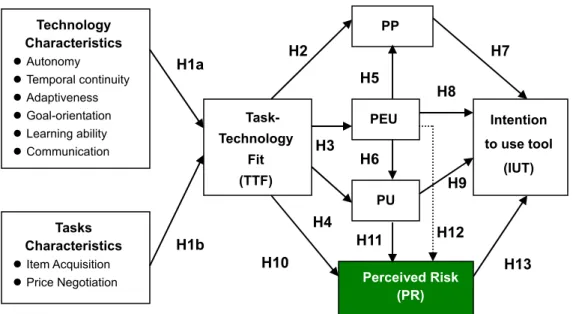
In view of the findings of this case study, a “user’s PR” component is added to the embryonic at Figure 1. In addition, the number of hypotheses is increased by four (to thirteen), listed in Table 1. Following Stone and Gronhung (1993), this
research adopts the two constructs of “psychological risk” and “financial risk” for measurement of PR. The questionnaire design refers to Stone and Gronhung (1993) and Dowling and Staelin (1994), and also incorporates questions relating to the auction task and the agent’s attributes.
Figure 1: Revised following Case Study Findings: Model of user’s Substantial Acceptance of Intelligent Agent Table 1: Summary of Revised Research Hypotheses after input from Case Study
Hypo. No.
Case Study Results: Practitioner agreement with Research Hypotheses
- Case SUPPORT: Interviewees agreed with full attributes
- Case PARTIALLY SUPPORT: Interviewees disagreed some attributes
H1a For “Item Acquisition”: The six attributes of intelligent agent technology (IAT), namely autonomy, continuity, adaptiveness, goal-orientation, learning ability and communication has an association with the fit between IA technology and the online auction task. - SUPPORTED
H1b For “Price Negotiation”. The six attributes of IAT has an association with the fit between the IAT and online auction task. – PARTIALLY SUPPORTED (Learning Ability was not felt to be important)
H2 The fit between online auction’s task and IAT has an association with user’s “PEU” of website. - SUPPORTED.
H3 The fit between online auction’s task and IAT has an association with user’s “PU” of website. - SUPPORTED
H4 The fit between online auction’s task and IA’s technological function has an association with user’s “PP” of website. – PARTIALLY SUPPORTED (PP was felt to be important, especially for “item acquisition” users, but was not felt to be addressed in current agent implementations)
H5 User’s “PEU” of website has an association with users “PP.” – PARTIALLY SUPPORTED (This was felt to be important for “item acquisition” but not “price negotiation” users)
H6 User’s “PEU” of this website has a positive association with user’s perceived usefulness. - SUPPORTED
H7 User’s “PP” in using online auction has an association with intention to use this website next time for fulfillment of another online auction’s task. - PARTIALLY SUPPORTED
(PP was felt to be important for IUT for some tasks, especially for “item acquisition” users, but was not felt to be addressed in current agent implementations)
H8 User’s “PEU” of online auction’s work undertaken by this website has an association with intention to use this website next time for fulfillment of another online auction’s task. - SUPPORTED
H9 User’s “PU” of online auction’s work undertaken by this website has an association with intention to use this website next time for fulfillment of another online auction’s task. - SUPPORTED
H10 The fit between online auction task and IAT has an association with user’s “PR” of website. - SUPPORTED
H11 User’s “PU” of website reduces user’s “PR.” - SUPPORTED
H12 User’s “PEU” of website reduces user’s “PR.” - SUPPORTED
H13 User’s “PR” of online auction’s work undertaken by this website has an association with intention to use web next time for fulfillment of another online auction’s task. - SUPPORTED
6. RESULTS OF DATA ANALYSI
5.1 Questionnaire Test
The reliability analysis results for the pilot test
are shown in Table 2. Except for PU and PR, Cronbach’s α values were above 0.7, meeting Nunnally’s (1978) criterion for reliability. This was Tasks Characteristics z Item Acquisition z Price Negotiation Technology Characteristics z Autonomy z Temporal continuity z Adaptiveness z Goal-orientation z Learning ability z Communication Task- Technology Fit (TTF) PP PEU PU Perceived Risk (PR)
H2
H1a
H1b
H5
H9
H13
H6
H11
H4
H10
H3
H8
H12
H7
Intention to use tool (IUT)felt to suggest the questionnaire was generally reliable, but a Cronbach’s α value between 0.6 and 0.7 for PU and PR suggests a problem with these questions, such as unclear meaning or inadequate replication. Discussion with the trial subjects revealed confusion between perception of a website’s overall functions, and perception of the agent’s functions. The questionnaire was revised to eliminate this confusion.
5.2 User Sample Source
Focusing on the online auction task, this research takes consumers with online auction experience as the target population. The discussion zones of various large online auction sites, popular general websites, and the bulletin boards of prominent educational institutions, were targeted for a questionnaire survey.
5.2.1 Target Website
The proposed classification of online auction agents is shown in Table 3. All the existing online auction sites mediate an interaction between database and user. The utilization of the agent’s technology in online auction websites can be classified according to the level of agent technology used to aid the price negotiation.
uBid and Yahoo were taken as representative of Type I and Type II auction sites respectively. Both are C2C online auction sites, widely familiar in Taiwan, with a huge number of members. Testees were required to take part in this questionnaire survey according to the following standardized procedures: (1) the testee was requested to choose between uBid or Yahoo websites, whichever was the more familiar to them. (2) Before filling out the questionnaire, the testee had to browse the explanation of terms appearing in the website, and also the explanation of the agent’s functions. (3) Having understood the agent’s functions, the testee was requested to link with the website, actually experiencing the agent’s function of aiding the consumer’s auction in the website. Finally, after the testee was confirmed as being familiar with these functions, they were required to return to the survey website and fill out the questionnaire.
5.2.2 Data Gathering
Computer users filled out the questionnaire on the web server installed in the laboratory. This was expected to achieve a large response sample within a short period of time, exploiting the Internet characteristics of timeliness, spatial independence and secrecy, and using a scripting language to help smooth and explain the procedures, reducing missed or misunderstood survey questions.
5.3 Data Analysis
This survey collected responses via the internet. Altogether 502 questionnaires were attempted of
which 24 were excluded from the analysis due to failure to complete, leaving a total of 478 questionnaires for data analysis 185 from the uBid website and 293 from the Yahoo website (see Table 4). 68.8% of respondents were between the ages of 21 and 30, while 56% of the case study pilot group was in this age range, implying that it forms a majority of the online auction consumer population. This research aims to test the effect of differing consumer perceptions of the auction task on website acceptance. Multiple analysis of variance (MANOVA) was used to investigate the association between task perception and website acceptance across different tasks.
The results are shown in Table 5. 53% of respondents perceived item acquisition, and 43% price negotiation, as the main auction task. Perception of auction task was significantly associated with IUT (Wilk’s Λ value is 0.94 and p-value is < 0.05), significant at the 95% probability level whereas neither the website used, nor the interaction of auction task perception and website used, are significant, so they will have no effect on IUT.
Reliability and Validity
As shown from the questionnaire information in Table 6, Cronbach’s α values of all the constructs are higher than 0.837, and the overall Cronbach’s α value is 0.959, suggesting a high standard of reliability. The approach was based on the “TTF” model proposed by Goodhue and Thompson (1995) and Dishaw and Strong (1999), but, since there were no published case studies on the acceptance of intelligent agent technology for online auctions, the questionnaire was subjected to review and testing by a panel of expert web designers, academics and graduate students to ensure its validity and relevance.
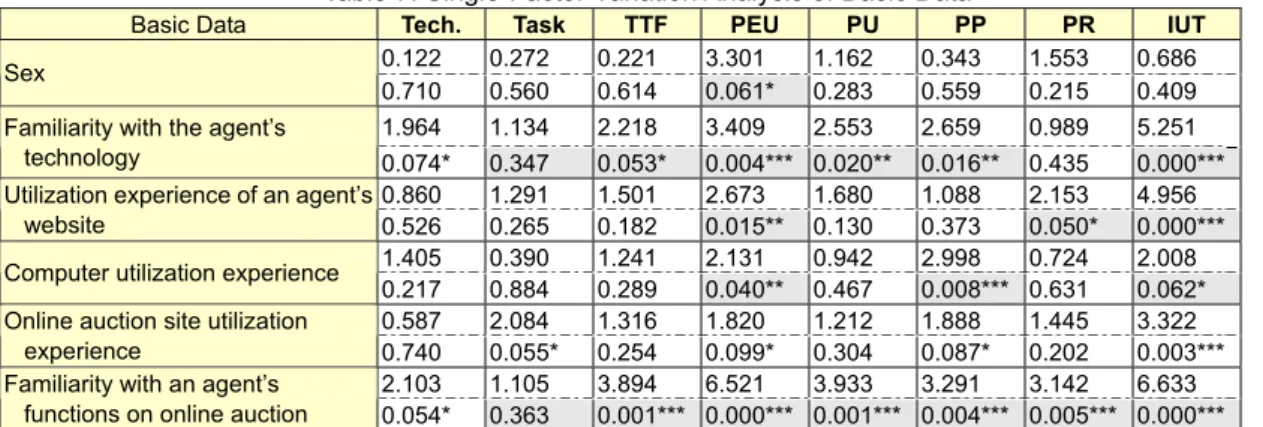
Differentiation Analysis of Basic Statistics Single-factor variation analysis was employed to study the effect of individual experience on the various perception constructs, using the experiential attributes of an individual one by one. The principal associations of an individual’s attributes are as follows (see Table 7). A male subjects perceived ease of use of an online auction site (6.2) is higher than a female’s (5.6). The higher the consumer’s familiarity with an agent’s technology, the higher the perceptions of the technology constructs TTF, PEU, PU, PP, and IUT. The more the consumer’s utilization experience of an agent’s website, the higher the consumer’s PEU and IU. PR is lower at both extremes of experience level.
High values of PEU, PP, and IUT are associated with computer use experience. Online auction experience is also associated with high PEU, PP and IUT, and additionally with consumer
recognition of the online auction task as item acquisition or price negotiation. Higher values for consumer’s perception of the six attributes of agent technology, TTF, PEU, PP, and IUT are associated with familiarity with agent functions, although PP falls at extreme levels of familiarity, perhaps due to boredom.
5.4 Examination of Hypotheses
The user perception of the auction task divides into item acquisition and price negotiation. The research hypotheses are tested by: (a) Using Pearson’s correlation coefficient to investigate the relationship among various constructs. (b) Using regression analysis to verify the significance and influence of the relationships found.
5.4.1 Relationship between TTF Perception The relationship between the different perceived agent technological attributes and the perceived task fit was analyzed using Pearson’s correlation coefficient, and the results presented in Table 8. The p-values are all smaller than 0.01 and the correlated coefficients are all higher than 0.778. This suggests that, for both perceived auction tasks, there appeared to be a significant relationship between the user’s perception of intelligent agent technology, and online auction’s task fit.
The multiple regression analysis results presented in Table 9, supports this conclusion, and Research H1, suggesting that users perceive agent technology attributes to account for 65% of the variation in auction TTF. The tolerance values are greater than 0.5, implying that there is no problem of collinearity among the various agents’ technology variables. Considering individual technology attributes, for the price negotiation task, the regression coefficient value of learning ability is 0.45, while that for temporal continuity is 0.25, implying that learning ability is perceived to account for more of the variation in auction task fit than temporal continuity. For the item acquisition task, the regression coefficient value of goal-oriented behavior is 0.51, which is higher than adaptive behavior (0.22) and learning ability (0.19), implying that goal-orientation is perceived to have the greater impact on auction agent TTF.
5.4.2 Relationship between TTF and PEU, PU, PP, and PR
The relationship between TTF and PEU, PU, PP, and PR, was investigated using Pearson correlation coefficient and the results presented in Table 10. p-values are below 0.01 irrespective of perceived auction task, and correlation coefficients are greater than 6 except for Ease of Use, (which is 0.43 for the price negotiation task.), and PR, which was only significantly correlated to TTF for the price negotiation task.
The regression analysis shown in Table 11 is
consistent with these results, suggesting TTF is significantly related to PEU, PU, and PP, and supporting H2, H3, and H4. PR is only significantly related to TTF for the price negotiation task, partially supporting H10.
5.4.3 Relationship of PEU, PU, PP, and PR with the IUT
The correlation of PEU, PU, PP, and PR with IUT is shown in Table 12. For the price negotiation task, p-values are all smaller than 0.05, and PU, PP, PR and PEU are all significantly correlated with IUT. For the item acquisition task, p-values are all smaller than 0.01, and all the parameters are significantly correlated with IUT except for PR.
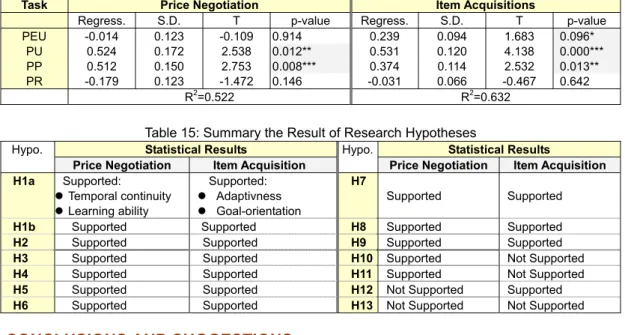
Regression analysis between selected pairs of the variables PEU, PU, PP and PR is shown in Table 13, PEU is significantly correlated with PP and PU, (but not with PR for the price negotiation task) supporting H5 and H6 respectively, and partially supporting H12. Table 14 shows regression analysis of PEU, PU, PP and PR on IUT. The overall Coefficients of Multiple Determination for IUT (R2) are 0.52 for the price negotiation task and
0.63 for the item acquisition task, equivalent to the proportion of the variation in IUT that can be explained by the PEU, PU, PP and PR variables collectively. As the tolerance values (1-R2) are
approximately 0.5, problems of multi-collinearity among the independent variables are unlikely. For the price negotiation task, the relative contribution of individual independent variables can be assessed from the regression coefficient. PP and PU with values of 0.51 and 0.52 respectively, make similar contributions to IUT, while PEU and PR make no significant contribution, consistent with H7 and H9 but not with H12.
For the item acquisition task, the regression coefficient value of PU is 0.53, which is higher than PP 0.37, in turn higher than PEU 0.24. It implies that the contribution of PU to variation in IUT is greater than that of PP and PEU. In the multiple regression analysis, the consumer’s perception of an auction’s principal task divides into item acquisition or price negotiation. Both PU and PP of an individual have significant impacts on intentions to use online auction sites. The impacts support H9 and H7. The impact of PEU on IUT only appears to be weakly significant for item acquisition, i.e. It provides partial support for H8. An individual’s PR does not have significant impact on the intention to use online auction sites. It does not support H13.
Based on the above examination of the 13 research hypotheses listed in Table 15, there are ten with significant statistical support. The hypothesized relationships of TTF, PEU, and PU respectively with PR, and of PR on IUT are partially established. PR is negatively correlated with other factors, as task fit or PEU increases, PR decreases.
Table 2: Reliability Analysis: Pre-Test of Questionnaire (N=41)
Form Cronbach’s α Form Cronbach’s α
Technology 0.818 Perceived ease of use (PEU) 0.732 Task-technology fit (TTF) 0.844 Perceived risk (PR) 0.663 Perceived playfulness (PP) 0.858 Intention to use tool (IUT) 0.966 Perceived usefulness (PU) 0.649 Total 0.822
Table 3: Classification of agent techniques for online auction site (this research)
Classification I II III
Representative website
uBid; CoolBid Yahoo; eBay AuctionBot; Kasbah
Function Interaction Interaction Interaction
Proving agent techniques
Providing autonomy, communication, and learning ability
Providing autonomy, continuity, adaptiveness, goal-orientation, and learning ability Providing autonomy, goal-orientation, and learning ability Agent’s aiding function in website
Search engine of price and acquisition information, auction management, preset of event notification
Search engine of auction information, preset of event notification, automatic bidding on item acquisition and price negotiation.
Search the possible price and acquisition
Table 4: Basic Data of Samples (N=478)
Data No. of Samples Data No. of Samples Male 312 (65.3%) Very unfamiliar 7 ( 1.5%)
Sex
Female 166 (34.7%) Unfamiliar 12 ( 2.5%) Under 20 90 (18.8%) Familiar 319 (66.7%) 21~25 237 (49.6%)
Familiar with agent’s attribute Very familiar 140 (29.3%) 26~30 92 (19.2%) 1~10 times 30 ( 6.3%) 31~40 41 ( 8.6%) 11~20 168 (35.1%) 41~50 10 ( 2.1%) 21~40 182 (38.1%) Age Over 50 8 ( 1.7%) Experience of actual utilization online action Over 41 98 (20.5%)
Table 5: MANOVA by Websites and Task
Table 6: Validity Analysis (N=478)
Form Cronbach’s α Form Cronbach’s α
Technology 0.918 Perceived playfulness (PP) 0.902 Task-Technology fit (TTF) 0.906 Perceived risk (PR) 0.837 Perceived usefulness (PU) 0.897 Intention to use tool (IUT) 0.922 Perceived ease of use (PEU) 0.939 Total 0.959
Table 7: Single-Factor Variation Analysis of Basic Data
Basic Data Tech. Task TTF PEU PU PP PR IUT
0.122 0.272 0.221 3.301 1.162 0.343 1.553 0.686 Sex
0.710 0.560 0.614 0.061* 0.283 0.559 0.215 0.409 1.964 1.134 2.218 3.409 2.553 2.659 0.989 5.251 Familiarity with the agent’s
technology 0.074* 0.347 0.053* 0.004*** 0.020** 0.016** 0.435 0.000*** 0.860 1.291 1.501 2.673 1.680 1.088 2.153 4.956 Utilization experience of an agent’s
website 0.526 0.265 0.182 0.015** 0.130 0.373 0.050* 0.000*** 1.405 0.390 1.241 2.131 0.942 2.998 0.724 2.008 Computer utilization experience
0.217 0.884 0.289 0.040** 0.467 0.008*** 0.631 0.062* 0.587 2.084 1.316 1.820 1.212 1.888 1.445 3.322 Online auction site utilization
experience 0.740 0.055* 0.254 0.099* 0.304 0.087* 0.202 0.003*** 2.103 1.105 3.894 6.521 3.933 3.291 3.142 6.633 Familiarity with an agent’s
functions on online auction 0.054* 0.363 0.001*** 0.000*** 0.001*** 0.004*** 0.005*** 0.000*** The upper part above dotted line represents F value, the lower part p–value
***:p-value<0.01; **:p-value<0.05; *:p-value<0.1
Factor No. of Samples Source of Variation Wilk’s Λ value p-value
uBid 185 Website 0.940 0.072 Website
Sample Yahoo 293 Task 0.914 0.012*
Price Negotiation 227 Interaction 0.945 0.126 Task
Table 8: Relationship between Technology and Task Fit
Task Price Negotiation Item Acquisition
Technology Agent Technology TTF Agent Technology TTF
Agent Technology 1.000 1.000
0.778*** 1.000 0.797*** 1.000
TTF
0.000 0.000
Tables 12, 14, and 16 (the upper part above dotted line represents Pearson’s correl. Coeff. the lower part the p–value) Tables 12-18, ***:p-value<0.01; **:p-value<0.05; *:p-value<0.1
Table 9: Regression Analysis of Agent’s Technology on TTF
TTF for Price Negotiation TTF for Item Acquisition
Technology Attribute
Regrss. S.D. T p-value R2 Regrss. S.D. T p-value R2
Autonomy -0.002 0.071 -0.019 0.985 0.030 0.61 0.484 0.63 Temporal continuity 0.253 0.052 4.100 0.000*** 0.026 0.64 0.408 0.685 Adaptiveness 0.018 0.074 0.243 0.809 0.218 0.8 2.213 0.03** Goal-orientation 0.055 0.083 0.662 0.510 0.514 0.95 4.352 0.000*** Learning ability 0.451 0.093 3.675 0.001*** 0.190 0.89 1.922 0.058* Communication 0.088 0.060 1.470 0.147 0.681 -0.005 0.54 -0.085 0.933 0.689 Overall 0.707 0.075 9.404 0.000*** 0.587 0.770 0.069 11.141 0.000*** 0.642
Table 10: Correlation of TTF with PE U, PU, PP, and PR
Task Price Negotiation Item Acquisition
TTF PEU PU PP PR TTF PEU PU PP PR TTF 1.000 1.000 0.442*** 1.000 0.627*** 1.000 PEU 0.000 0.000 0.775*** 0.479*** 1.000 0.762*** 0.656*** 1.000 PU 0.000 0.000 0.000 0.000 0.644*** 0.369*** 0.545*** 1.000 0.726*** 0.576*** 0.679*** 1.000 PP 0.000 0.004 0.000 0.000 0.000 0.000 -0.368*** -0.163 -0.476*** -0.237* 1.000 -0.011 -0.279** -0.012 -0.027 1.000 PR 0.005 0.188 0.000 0.064 0.923 0.039 0.913 0.811
Table 11: Regression Analysis of TTF on PEU, PU, PP, and PR
Task Price Negotiation Item Acquisitions
Regrss. S.D. T p-value R2 Regrss. S.D. T p-value R2
PEU
0.681 0.149 3.811 0.000*** 0.213 0.492 0.073 6.553 0.000*** 0.375PU
0.896 0.091 9.607 0.000*** 0.623 0.784 0.074 9.599 0.000*** 0.564PP
0.781 0.109 6.434 0.000*** 0.429 0.723 0.079 8.432 0.000*** 0.484PR
-0.497 0.151 -2.896 0.005*** 0.164 -0.014 0.148 0.097 -0.923 0.000Table 12: Relation between PEU, PU, PP, PR and IUT
Task Price Negotiation Item Acquisitions
IUT PEU PU PP PR IUT PEU PU PP PR
IUT 1.000 1.000 0.289** 1.000 0.599*** 1.000 PEU 0.018 0.000 0.586*** 0.473*** 1.000 0.718*** 0.639*** 1.000 PU 0.000 0.000 0.000 0.000 0.535*** 0.359*** 0.556*** 1.000 0.627*** 0.529*** 0.639*** 1.000 PP 0.000 0.004 0.000 0.000 0.000 0.000 -0.389*** -0.163 -0.458*** -0.227* 1.000 -0.088 -0.229** -0.012 -0.027 1.000 PR 0.001 0.188 0.000 0.064 0.434 0.029 0.913 0.811
Table 13: Regression Analysis of some independent variables on each other
Task Price Negotiation Item Acquisitions
Regrss. S.D. T p-value R2 Regrss. S.D. T p-value R2 Perceived ease of use
PU 0.457 0.094 4.332 0.000*** 0.264 0.623 0.071 7.378 0.000*** 0.475 PP 0.379 0.099 2.999 0.004*** 0.152 0.490 0.075 5.533 0.000*** 0.298 PR X X X X X -0.292 0.116 -2.100 0.039** 0.074 Perceived usefulness PP 0.653 0.103 5.168 0.000*** 0.324 0.609 0.083 7.242 0.000*** 0.423 PR -0.630 0.125 -4.135 0.000*** 0.246 X X X X X