行政院國家科學委員會專題研究計畫 成果報告
教育夥伴中的共修: 以學校本位課程為導向之專業英文課 程發展與評量(I)
研究成果報告(精簡版)
計 畫 類 別 : 個別型
計 畫 編 號 : NSC 99-2410-H-011-032-
執 行 期 間 : 99 年 08 月 01 日至 100 年 08 月 31 日 執 行 單 位 : 國立臺灣科技大學應用外語系
計 畫 主 持 人 : 駱藝瑄
計畫參與人員: 大專生-兼任助理人員:沈玳玫
報 告 附 件 : 出席國際會議研究心得報告及發表論文
公 開 資 訊 : 本計畫可公開查詢
中 華 民 國 101 年 02 月 14 日
中 文 摘 要 :
理論上,儘管專業英文的實施對象不單僅為大專院校或職場 上的學習者,應可包含中等學校的學生 (Dudley-Evans &
St. John, 1998)。但在實務運用上,國內外絕大多數的研究 皆以大專生及職場人員為研究對象,以中學學生為研究的專 業英語教學研究,相當不足。
長久以來,國內高職英語教師普遍面臨該教授實用且具功能 性的專業英文亦或是強調學生升學考試的英文基礎能力的困 擾; 加上高職英文教育長久以來不受重視,造成英語教師在 教學上倍感無力,學生學習興趣低落,英語學習成效不彰,
高職英語教師實施專業英文的意願更為降低。
為具體回應上述二大議題,本二年研究計畫案的目的試圖透 過技專院校應用外語系與高職觀光科建立教育夥伴關係 (school-university partnership),落實以學校本位課程為 導向之專業英文教學,建構適合台灣高職學生的專業英語課 程發展與評量模式。本研究有二大研究主軸: (一)為探究以 學校本位課程為導向之專業英文課程發展與評量模式對高職 學生學習專業英文的影響; (二) 為探究實施以學校本位課 程為導向之專業英文課程發展與評量模式,對職前英語教師 專業發展的影響。
參與本研究的核心成員包含: 高職部分: 35 位觀光科二年級 的學生,1 位為觀光英文教師,1 位為導覽解說教師,及 1 位 行政主管 (觀光科主任); 大學部分: 1 位大專院校應用外 語系的專任教師 (為研究者本身),1 位為外籍老師及 6 位英 語教學學程學前教師。本研究將採跨領域專業對話與工作坊 的方式,共同探討如何將在地化觀光景點導覽解說課程融入 觀光英文課程 (反之亦然),並與高職專業實習課程結合,增 進學生「做中學」的實務經驗,以強化高職學生基礎專業英 語應用技能。計畫案資料來源主要為:(1)專業對話及工作坊 言談錄音轉錄稿,(2) 教師成員的錄音訪問稿,(3) 問卷調 查結果(4)課室觀察紀錄,(5) 教材教案,(6)省思手記 及 (7) 相關文件。
英文基礎能力測驗前後測結果顯示,高職生的的基礎英文能 力,特別在聽與說的能力上有顯著的進步。另外,參與本研 究的高職生在專業英文的學習成效可由各小組共同完成的實 景/地拍攝之英語解說錄影帶可得知,透過學校與大學本位課 程計畫與合作,在大專生擔任英文小老師的協助下,高職生 可以運用解說專業教師的專業知識、高職英文老師的專業英 文解說、外籍教師所教授的口說能力、 結合他們擅長的解說 專長及技能,運用在英語的解說。
研究也顯示,職前英語教師的專業知識也有增長。透過學校
與大學本位課程計畫與合作,職前教師藉由不同角色的扮演 (如學習者、合作者、教學者、評量者)和身歷其境與參與本 計畫案之教師和學生有頻繁、深入的互動,不但在英語能 力,英語教學,在專業英語教學上,在知識及經驗有顯著的 增長。職前教師的專業成長情境不再侷限在大學課室殿堂 中,而是延伸至高職的專業課堂學習中,並擴長到社區的真 實解說情境中。每一個教學情境的轉移,都是不同的互動教 學師,帶給職前教師不同的考驗與成長,因此也增進職前教 師的專業成長與歷練。
本研究結果為二年計畫的第一年。研究案成果將提供以高職 生為研究對象之專業英文課程發展的個案研究,以彌補國內 外文獻之不足。本研究希冀透過教育夥伴的模式,提供職前 教育現場實務經驗 (early field experiences),為當前英 語教學職前教育提供不同學理和實務範例,以建構理論與實 務的橋樑;最後,本研究希冀深化學界對發展教育夥伴關係 過程中,學理的探究及實務面的理解。
中文關鍵詞: 專業英文,高職英文,學校本位課程,教育夥伴,教師專業 成展
英 文 摘 要 : Research on English for specific purposes (ESP) has been drawing a great deal of attention in English language education over the past two decades.
However, most ESP programs have been designed for language learners at the university or language
learners in the workplace. Few case studies have been implemented for learners in secondary schools. Is there a place for ESP education for VHS learners? If so, what approach can be employed to facilitate ESP learning under current VHS system in Taiwan?
This two-year school-university partnership had two major purposes: one, it was intended to create a different model of ESP teaching and learning for VHS students of tourism. Two, it aimed to provide a series of early field experiences for TESOL-track prospective teachers to enhance their professional development in ELT teaching and learning in general and ESP knowledge and experience in particular.
Grounded in the principles of school-based model for ESP curriculum and development, this two-year project went through the first run of the school-based
curriculum development (stage of situation analysis,
goal formation, program building, program
implementation, and assessment and evaluation) for the preparation for the second year of the project.
The study demonstrated that through a school-
university partnership, TESOL-track college students could gain their early field experiences beyond their college classroom. Within the real classroom context, they observed how a subject teacher, a VHS English teacher and a native English speaking teacher orchestrated and integrated content specialist knowledge into English teaching and learning. Their professional development was further extended and deepened when they facilitated VHS students’
learning in giving an on-spot English tour. This level of professional development would not been feasible without a school-university partnership that was closely tied to the need of the community that the school and university were situated.
The results would provide a potential model for subject teachers, VHS English teachers, and community professionals to work on ESP related courses for VHS students. Different school-university partnerships can also be inspired by the principles, processes, and strategies employed in the school-based ESP curriculum development.
英文關鍵詞: English for Specific Purposes (ESP), vocational high school English (VHS), VHS English education, School- based curriculum, school-university partnership, teacher professional developmen
行政院國家科學委員會補助專題研究計畫 ▉ 成 果 報 告
□期中進度報告
Co-Learning in School-University Partnership:
Towards a Model of School-Based
ESP Curriculum Development and Assessment (I)
教育夥伴中的共修:
以學校本位課程為導向之專業英文課程發展與評量(I)
計畫類別:█ 個別型計畫 □ 整合型計畫
計畫編號:NSC
99 - 2410 - H -011 -012 -執行期間: 99 年 8 月 1 日至 100 年 8 月 31 日
計畫主持人:駱藝瑄
計畫參與人員:
古郁楓、楊進興、黃馨如、Emily Hirsch黃孟熙、林于暄、李韻蘋、薛羽晴、李巧惠、沈怡燁
成果報告類型(依經費核定清單規定繳交):█精簡報告 □完整報告
本成果報告包括以下應繳交之附件:
▉出席國際學術會議心得報告及發表之論文各一份
執行單位:國立台灣科技大學
中 華 民 國 100 年 10 月 30 日
1
Co-Learning in School-University Partnership:
Towards a Model of School-Based ESP Curriculum Development and Assessment (I) Introduction
The study of English for specific purposes (ESP) has been drawing a great deal of attention in English language education over the past two decades (Hutchinson & Waters, 1987; Kennedy &
Bolitho; 1990; Dudley-Evans and St. John, 1997; Master & Brinton, 1998; Douglas, 2000; Orr, 2002; Basturkmen, 2006; Harding, 2007). One of the variable characteristics of ESP, based on Dudley-Evans and St. John ( 1998) ’ s de f i ni t i on, a s s e r t s t ha t “ ESP i s l i ke l y t o be de s i gne d f or a dul t learners, either at a tertiary level institution or in a professional work situation. It could, however, be us e d f or l ea r ne r s a t s ec onda r y s c hool l e ve l . ” ( p. 5) . Howe ve r , mos t of t he ESP pr ogr ams , both internationally and domestically, mostly, if not exclusively, are designed for language learners at the university or language learners in the workplace as demonstrated in the 12 ESP cases in Orr (2002). In Taiwan, for example, most ESP studies are conducted in university settings (e.g., Hung, 2007; Huang & Li, 2008; Tsai & Li, 2003; Xu, 2008). One question that is worth noting is that what prevents ESP programs from implementing for learners at secondary school level,
particularly for secondary learners at vocational high schools (VHSs), whose main educational goal is to help prepare students to be ready for the workplace after they graduate. To be more specific, is there a place for ESP under the current VHS educational system in Taiwan which is examination-oriented? If there is, in what way(s) can an ESP program for VHS students be effectively designed, implemented and assessed?
To respond to the abovementioned questions, a school-based curriculum development (Brady, 1995) was proposed. This proposed curriculum was designed, implemented and assessed through a school-university partnership. A school-based curriculum development approach (SBCD, Skilbeck, 1990; Print, 1998) consists of 5 phases: (1) situation analysis, (2) goal formation, (3) program building, (4) interpretation and implementation, and (5) monitoring, feedback,
assessment and reconstruction.
This study aimed to create an alternative avenue for ESP in VHSs in Taiwan employing school-university partnership. School-university partnership is widely used in initial teacher education program to provide pre-service teachers early field experiences (McLaughlin, 1998;
Myers, 1996) in order to bridge the gap between educational theory and practice (Tsui et al, 2009). However, early field experiences are not without challenges. Potential challenges include (1) unquestioned familiarity, conflicting purposes, oversimplification of apprenticeship, and isolation and silence and congruence and ineffectiveness (Feimann-Nemser & Buchmann, 1985).
Grounded in the principles, processes and practices of a school-based curriculum (situation analysis, goal formation, program building, interpretation/implementation and assessment and reconstruction) developed through a school-university partnership, this two-year research project was intended to construct an ESP model for secondary learners in order to enhance VHS students’
overall English proficiency and their ESP learning. In addition, this study aimed to facilitate
prospective teachers’professional development by providing them with a variety of off-camps
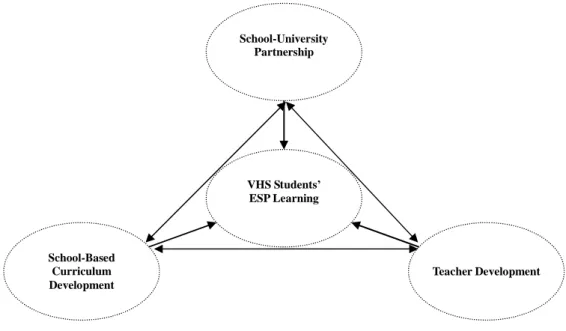
field experiences through this partnership (Figure 1). It is hoped that the outcomes of the study
can help respond to the dilemma confronting VHS English education in Taiwan, fill the gap of the
current ESP literature that lack case studies on secondary school learners as well as shorten the
distance between educational theory and practice.
2
Figure 1. Framework of the Proposed Research Project
Research Questions to be Answered
1. What is the overall English proficiency of VHS students and how can the improvement of English proficiency be assessed?
2. What ESP teaching and learning knowledge can be jointly created in the phases of Situation Analysis, Goal Formation, and Program Building?
3. In what way(s) does the prospective teachers’ engagement in the phases of Situation Analysis, Goal Formation, and Program Building) facilitate their professional development?
Methods
The major participants from the school were: one subject teacher, one English teacher, and thirty VHS students of tourism. The major participants from the university were: six TESOL-track college students and one instructor. One native English speaking teacher and one local English tour guide were also invited.
The primary data collection methods and procedures involved were pre- and post GEPT tests, questionnaires and interviews in the middle and end of the project with the VHS participants and six TESOL-track college students. Statistical data was analyzed using SPSS
School-Based Curriculum Development
Teacher Development School-University
Partnership
VHS Students’
ESP Learning
3
software. Qualitative data was analyzed using content analysis and ESP curriculum design model (input, content focus, language focus and tasks, Hutchinson and Waters, 1987).
Findings
1. What is the overall English proficiency of the VHS student-participants and how can the improvement of English proficiency be assessed?
Overall English proficiency of the VHS student-participants
The oral English proficiency can be described in two aspects: listening and speaking, as these two modes (rather than reading and writing) were the two language skills frequently used and practiced throughout the project. Both the listening and speaking proficiencies were accessed through a Basic GEPT (General English Proficiency Test). Basic GEPT test was chosen was for it was the most used English proficiency test in this high school and the VHS student-participants were most familiar with this test. In addition, Basic level (rather than other levels) of GEPT test was chosen because achieving the English proficiency level of Basic level has been the minimum of the Tourism department of this high school.
The overall English oral proficiency of the participants ranged from 56 to 112, with an average score of 85.47. With the passing score of 80, 22 participants
1(out of 30) passed the Basic GEPT listening test. The overall English speaking proficiency score ranged from 30 to 90, with an average score of 54. With the passing score of 80, only 2 participants
2(out of 30) passed the listening test (see Table 1).
Generally speaking, the participants’listening proficiency was much better than their speaking proficiency as their average listening proficiency (85.47 out of 120) was above the above the passing score (80 points) while their speaking proficiency was much lower (54 out of 120) than the passing score (80 points).
How can the improvement of English proficiency be assessed?
The participants’ improvement of English proficiency was assessed through two measurements: Basic GEPT test and their English oral tour.
To access whether the project had impact on participants’overall listening and speaking proficiency, a Basic GEPT test was given prior to the beginning of the project and the same test was given in the end of the project. In other words, a pair t-test was conducted to
determine the effectiveness of the project on participants’listening and speaking proficiencies.
In terms of participants’listening proficiency, the mean of the pre-test was 85.47 (out of 120) and the mean of the post-test is 90.20 (out of 120). The result shows that there was a significant difference between the pre- and post- listening tests (***p<.001). In terms of participants’speaking proficiency, the man of the pre-test was 54.00 (out of 120) and the mean of the post-test was 69.67 (out of 120). The result demonstrates that there was a
significant difference between the pre- and post- speaking tests (**p<01). Table 1 presents the results of the paired-t test of mean scores on listening and speaking proficiency in the pre- and post-test.
1 One participant did not participate in the pre- listening test.
2 Two participants did not participate in the pre- speaking test.
4
Table 1
Paired t-Test of Mean Scores on Listening and Speaking Proficiency in the Pre-test and Post-test
N=30 Pre-test Post-test
t-value Sig.
M SD M SD
Listening 85.47 21.946 90.20 15.945 -3.199
.003**Speaking 54.00 20.611 69.67 16.914 -5.123
.000***P*< .05; P** <.01; P*** <.001
Participant’ s improvement in oral proficiency can also be observed and assessed through their performances at different stages of the project. Right after the participants had learned the English expressions of important concepts, functions and terms of the Tien Hou Temple, the participants were required to write their oral scripts in groups (about 7-9 people) and give an oral tour using the PPT slides as their background; the participants were later asked to work individually, in pairs, or in groups of three to give their presentation in their groups without reading their written scripts, and finally, the participants were observed and assessed to give their oral English tour right on-the-spot of the Tien Hou Temple. The observational notes show that as time progressed, not only did the participants make improvements on accuracy, fluency, intonation, and pronunciation of their English oral production, the participants also demonstrated with great ease in their facial expression, body language and their interactions with their target audience.
2. What ESP teaching and learning knowledge can be jointly created by the
school-university partnership in the phases of Situation Analysis, Goal Formation, and Program Building?
Situation Analysis
Situation analysis can be divided into two parts: external situation analysis and internal situation analysis.
External situation analysis: This ESP program took place in a school-university
partnership funded by the county government of Penghu, an off-shore island of Taiwan. With recent interest in Penghu as a tourist destination, the county has been striving to attract more tourists, both domestic and international. Training tour guides with English competence for explaining the features and uniqueness of popular tourist spots is critical for boosting tourism.
Internal situation analysis: The University involved in this project is the only institution in
the county that offers a major in English. In addition to equipping English major students with essential abilities in the four skills, the Department of Applied Foreign Languages aims to train ESP professionals for the tourism industry and TESOL. Likewise, the VHS involved in this study has the only Tourism Management Department on the island, which is dedicated to enhancing the knowledge and skills VHS students need for working in the tourism industry of the county. The funding of the school-university partnership by the county indicates that the mission and
development of these educational institutions are deeply rooted in the needs of the local culture,
industry, and economy and that, as a result, all the parties involved can benefit from this
5
collaboration.
Through the school-university partnership, the project can make good use of the natural and human resources both provided by the community, the school and the university.
Goal Formation
According to the result of the situation analysis, the ultimate goal for the two-year project was two-sided. That is, on the one hand, the VHS participants were expected to give an English tour right at a local tourist spot and to gain experience in integrating Chinese knowledge on a tourist spot into an on-spot English tour. On the other hand, the college participants were expected to learn to enhance their ESP teaching and learning knowledge through various roles and engaging in various activities of teaching and learning throughout the project.
In order to help the VHS participants to achieve the ultimate goal, various sub-goals were formulated: (1) to introduce local culture through a ppt presentation, (2) to gain the knowledge of Tien-Hou Temple in Chinese, (3) to learn to know Tien-Hou Temple in English, (4) to write scripts of an English tour about Titen-Hou Temple, (5) to practice giving an English tour, (6) to give an English right on the tourist spot, and finally (7) to obtain comments on the edited video clip of the English tour.
Likewise, to facilitate TESOL-track college students to play different roles and to engage in different activities of ESP teaching and learning, several sub-goals were also formulated, which were parallel to those of the VHS participants: (1) to learn to know the learning context and the participants, (2) to gain content specialist knowledge of Tien-Hou Temple in Chinese, (3) to gain knowledge about Tien-Hou Temple in English, (3) to help revise or edit VHS s t ude nt s ’ wr i t t e n scripts of an English tour about Titen-Hou Temple, (4) to support and guide VHS s t ude nt s ’ practice/rehearsal in giving an English tour, (5) to direct VHS participants’ English tour at the tourist spot, and finally (6) to edit the video clip of the English tour.
Program Building
To achieve the two-sided goals for the two major participants involved in the study, a six-staged program (in addition to the pre-stage) was built. In the pre-stage (September-October 2011), all the participants attended a course entitled “ Tour Guiding and Interpretation Activities”
offered by the Department of Tourism of the local vocational high school who participated in the school-university partnership. During this stage, the VHS students learn to introduce their own hometown through giving a power point slide presentation. The college participants took the opportunity to learn to know the local culture and the participants, the learning context in high school, as well as the important elements needed to be taken into account when giving a tour.
In the first stage (November 2011), all the participants, including the local English high school English teacher (in addition to the two major participants) attended three-week (each week for 2 hours) classes on Tien-Hou Temple. The participants gained the historical background, the architectural features, and the critical people and events associated with this historical monument.
These three-week lectures were given by a subject teacher, Teacher Gu, who was also the lecturer of the course, “ Tour Guiding and Interpretation Activities” .
In the second stage (December 2011), another three-week lessons were offered by the local
English teacher, Teacher Emma, who attended the course offered by Teacher Gu. She integrated
her English lessons on Tien-Hou Temple with Teacher Gu’ s course. In other words, the unit of
Tien-Hou Temple was first given in Chinese by Teacher Gu, the subject teacher, and then by
Teacher Emma in English.
6
In the third stage (March-April 2012), first, both Teacher Emma and the college participants participated in an English tour at Tien-Hou Temple given by a local professional English Tour Guide, Mr. Chang, who has had much experience in giving English tours to foreign tourists coming from different countries. He also took questions from Teacher Emma and the college participants after he gave the tour. Afterwards, the VHS students were engaged in writing English scripts on their English tour with the instruction and guidance of a native English
speaking teacher, Teacher Emily. The college participants helped them the VHS participants to draw their knowledge about Tien-Hou Temple in Chinese, and express themselves in English.
They offered help to VHS students who they did not know how to get started, and when they did not have the right words or expressions for the written scripts. They also helped VHS students answered questions raised by Teacher Emily when she did not understand the written scripts.
In the fourth stage (May 2012), the VHS students first rehearsed giving their English tour to their group leaders (the college participants), and then, to the whole class. Teacher Emma pointed out the strengths and weaknesses of each tour to model good and effective strategies for giving English tours. With the experience of giving tours in English, the VHS participants then rehearsed their tour outside of their classroom with the guidance and directing of the college participants. In this way, they learned to move based on their scripts, and talk to the camcorder.
In the fifth stage (June 2012), the VHS participants finally gave their on-spot English tour at Tien-Hou Temple with the group leader, the college participant as their director and
cameraperson. The college participants then edited the tour (with an introduction of the group members), added the English subtitles and background music, and refined/finalized the video clips that were uploaded on YouTube for larger audience.
In the sixth stage (June 2012), the subject teacher, Teacher Gu, the VHS English teacher, Teacher Emma, the native English speaking teacher, Teacher Emma, and the local professional tour guide, Mr. Chang, as well as the Chairperson of Department of Tourism of the school were invited to watch, comment, and evaluate the English tours through the video clips. Best tour guide group and best tour guides were chosen based on the results of the evaluations.
After the first run of ESP teaching and learning, the TESOL-track college participants would be expected to carry on their knowledge and experience gained from the first-year of project to the second year in which the TESOL-track college participants would employ what they had gained from the first year to the second year with another group of participants.
3. In what way(s) does the prospective teachers’engagement in the phases of Situation Analysis, Goal Formation, and Program Building) facilitate their professional development?
Through engaging in playing different roles in various activities of ESP teaching and learning, the prospective teachers (the TESOL-track college participants) enhanced their professional development in different aspects. Based on the results of the interview with the college participants, being learners, collaborators, teachers, and evaluators facilitated their professional development most, which can be briefly summarized below.
The prospective teachers were learners. They learned to know the learning/teaching
context and the VHS participants through engaging in their real classroom learning. They
learned to gain the content specialist knowledge from sitting in Teacher Gu with the
participants. They learned to observe how Teacher Emma integrated content specialist
knowledge into English teaching and learning. They learned how Teacher Emma interacted
7
with the participants using English that made sense to the VHS participants. They learned from Mr. Chang how to give an English tour on the spot and interacted with the tourists not only in English but also content knowledge about temple culture. They learned how a foreign tourist would expect to see and hear about a local temple from the guidance and direction of Teacher Emily. All together, it enhanced the knowledge and experience in ESP teaching and learning.
The prospective teachers were collaborators. They learned to collaborate with Teacher
Emma about how to give a warm-up activity to open up an English lesson, and how to give an activity to review the lesson covered in the previous week; they learned to collaborate with Teacher Emily on how to help VHS students make sense of their written scripts. They also collaborated with each other to make sure what they needed to accomplish for each class with different collaborators and group members who were responsible for different parts of the tasks.
They were teachers. With the knowledge gained from Teacher Gu and Teacher Emma,
and the experience in English tours gained from observing the local professional tour guide, Mr. Chang and the experience in working with the native English speaking teacher, Teacher Emily, they were able to teach the VHS participants how to open up a tour to attract tourists, what strategies could be used to deliver an English tour, and what genre (conversation vs.
direct speech) could be used when giving an on-spot tour. They gave key words, sentence patterns and even suggestions when helping VHS students with their written scripts. Finally, they showed VHS participants how to use body language, move according to the sequence of the tour, and talk to the camera naturally.
They were evaluators. They learned to evaluate VHS students’learning outcome by
designing tasks that required VHS students to use the knowledge and vocabulary learned from Teacher Gu and Teacher Emma. Through VHS participants’response to their tasks, they were able to evaluate how much VHS participants had learned from the lessons with Teacher Gu and more importantly, from Teacher Emma. They also learned to evaluate their written scripts before sending out the written scripts to Teacher Emily for further comments and final proofreading. Finally, during the process of videotaping, the college participants also learned to evaluate how well the VHS participants had done and decided whether VHS students should redo the film making or not. Finally, through their own editing, the prospective teachers would also need to learn how to evaluate the quality of the final product—the edited video clip. The tasks given to the VHS participants did not only evaluate learning outcomes, but also provide a series of opportunities for professional development in terms of assessment and evaluation.
In sum, it was through playing the roles of learners, collaborators, teachers and
evaluators and through being engaged in the activities of situation analysis, goal formation, and program building that required their active participation and interactive response, which, in turn, enhanced the professional development of the six college participants.
Discussion
The results of the study were discussed from three aspects: a sociocultural perspective of professional development, learning in a school-university partnership, and a curriculum model for ESP teaching and learning.
A Sociocultural Perspective on ESP Professional Development
8
Johnson (2006, 2010) and Johnson and Golombek (2011) believe that what teachers learn to teach has much to do with how teachers learn to teach. This shift of the epistemological
perspectives on human learning foregrounds the fundamentally social nature of teacher learning and the activities of teaching. Hence, learning to teach from a sociocultural perspective, as Johnson sees it, is based on the premise that knowing, thinking, and understanding come from participating in the social practices of learning and teaching in specific classroom and school situations. The context for learning and professional development of the six TESOL-track college students went beyond the wall of the classroom and school setting and was extended to the shared community that both the VHS students and college students were situated.
The prospective teachers’ ESP professional development (including ELT learning and teaching) were documented and understand as growing out of participating in the social practices with the VHS participants in both classrooms (with the specialist teacher and VHS English teacher) and workplaces (in Tien Hou Temple with the native speaking teacher/tourist and local tour guide).
The results of the study confirmed the literature on the claim that what teachers learn to know and
how they use that knowledge were highly interactive, which involves knowledge of self, setting,students, curriculum, community and workplace.
ESP Learning and Professional Development through a School-University Partnership
The findings show that the prospective teachers’professional development had a great and direct impact on the VHS p ar t i c i pa nt s ’ESP learning. In other words, the greater the professional development of the prospective teachers was enhanced, the better learning outcomes of the VHS participants would be expected. By the same token, the greater learning outcomes were expected, the greater professional development was required of the
prospective teachers.
The school-university partnership (Bartholomew and Sandholtz, 2009) brought
positive learning outcomes for both VHS students and prospective teachers and that cannot be achieved with either one of them working alone. The questionnaire conducted and the
interviews with both the VHS participants and the prospective teachers confirmed the claims made in ESP literature (Hutchinson and Waters, 1987; Dudley-Evans and St. Johns, 1997; Or, 2002; Basturkmen, 2006) and professional development (Johnson, 2009; Tsui and Law, 2007).
When being interviewed, the VHS participants indicated that they would not have come to this level of achievement without the help, support, guidance and teaching of their group leaders, the TESOL-track college participants in the project. Likewise, the prospective teachers also indicated that they would not have reached this level of understanding about ESP teaching and learning without engaging in the activities of teaching/learning and interactions with their group members, the VHS participants. The prospective teachers would have not have the opportunities to play various roles (learners, collaborators, teachers and evaluators) actively without engaging in the real classroom learning experience and fulfilling the real-context learning tasks.
Although any partnership is not without its challenges and limitations, the results of the findings confirmed the positive aspects of the school-university partnership. With the participation of all the parties involved, it enhanced both the process and outcome of VHS students’ESP learning as well as TESOL-track prospective teachers’professional
development in ELT teaching and learning in general and ESP knowledge and experience in particular.
An Effective ESP Model of Learning and Teaching for VHS Students
9
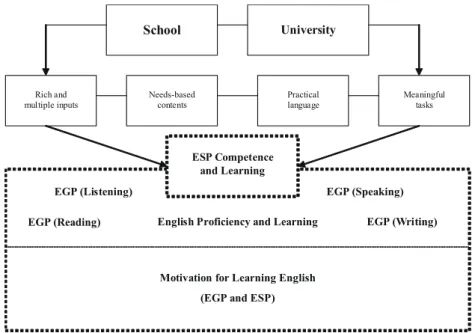
Hutchinson and Waters (1987) introduced an ESP design model, which could be used to explain the factors leading to VHS students’ positive learning outcomes as evidenced from their general English proficiency test and their video clips in the first run of the project. This ESP design model consists of four elements: input, content focus, language focus and tasks.
The sources of the input for VHS students were multiple and rich. To master’ s content specialist knowledge about Tien Hou Temple, the VHS students received input not only from their subject teacher, but also a vocational high school English teacher who knew the content
knowledge well and knew the English level of the VHS participants well. Also, the VHS students also gained input from a native English speaking teacher who could provide them with comments from a potential tourist perspective. In addition, they also gained comments from a local
professional tour guide. Altogether, the rich and multiple sources of input contributed to the positive learning experience and outcome.
The content of the English tour was relevant to the VHS students’ learning and living context.
The content of the English tour was part of their coursework. The only difference was that students were required to give a tour in English. Besides, the tour the VHS students gave was a part of the local culture that the VHS participants grew up with. Through this project, the VHS students were provided an opportunity to give a tour to integrate what they had learned in their coursework, and their professional knowledge and experiences into their ESP learning to give an English tour.
The focus of the English taught was useful and purposeful. Instead of introducing difficult terms, slogans and words for Tien-Hou temple and the temple culture, the major focus of the English teaching and learning was how to make sense to foreign tourists who visited Tien Hou Temple and would like to know more about our temple culture. These principles, ingrained in usefulness and purposefulness, were not only applied by Teacher Emma, the VHS English teacher, but also Teacher Emily, a native speaking English teacher. Their way of teaching influenced how prospective teachers supported VHS students to complete their written scripts.
Tasks were given along the way of the ESP teaching and learning. In order to facilitate the learning processes and to achieve the expected learning outcomes, several tasks were designed, carried out and completed. These tasks, for example, ranged from giving expressions to explain key words, to answering questions raised by the instructors in English, and to writing English scripts with the support of the prospective teachers. Without the tasks along the way, it would be too daunting and challenging for the VHS students to complete the expected outcomes.
Summary and Conclusion
This two-year school-university partnership had two major purposes: one, it was
intended to create a different model of ESP teaching and learning for VHS students of tourism.
Two, it aimed to provide a series of early field experiences for TESOL-track prospective teachers to enhance their professional development in ELT teaching and learning in general and ESP knowledge and experience in particular. Grounded in the principles of school-based model for ESP curriculum and development, this two-year project went through the first run of the school-based curriculum development (stage of situation analysis, goal formation, program building, program implementation, and assessment and evaluation) for the preparation for the second run of project implementation in the second year.
The first run of the program implementation shows that through school-based ESP
curriculum and development (situation analysis, both internal and external analysis, goal
10
formation, program building, program implementation, and monitoring and evaluation), the VHS students’general English proficiency, particularly in their listening and speaking was increased. Further data analysis shows that the school-university that drew significant stakeholders (a subject teacher, a VHS English teacher, a native English speaking teacher, a local professional tour guide) along with the help, guidance, and support of their group leaders enacted by six TESOL-track college students brought rich and resourceful input, relevant and interesting content, functional and purposeful language, and stimulating and meaningful tasks, which resulted in fulfilling the expected learning outcome and high learning satisfaction.
The results of the study demonstrated that through a school-university partnership, TESOL-track college students could gain their early field experiences beyond their college classroom. Within the real classroom context, they observed how a subject teacher, a VHS English teacher and a native English speaking teacher orchestrated the content specialist knowledge, English teaching and learning, and English tour to foreign tourists. Their professional development was further extended and deepened when they were required to guide the VHS students to give an on-spot English tour. This level of professional
development would not been feasible without a school-university partnership that was closely tied to the need of the community that the school and university were situated.
The results of the study would provide a potential model for subject teachers, VHS English teachers, and community professionals to work on ESP related courses for VHS students. Different school-university partnerships can also be inspired by the principles, processes, and strategies employed in the school-based ESP curriculum development.
References
Bartholomew, S. S., & Sandholtz, J. H. (2009). Competing views of teaching in a school-university partnership. Teaching and Teacher Education, 25(1), 155-165.
Basturkmen, H. (2006). Ideas And Options In English For Specific Purposes. Mahwah, New Jersey: Lawrence Erlbaum Associates.
Brady, L. (1995). School based curriculum development and national curriculum: Can they coexist?
Curriculum and Teaching, 10(1), 47-54.
Dudley-Evans, T., & St John, M. J. (1998). Developments In English For Specific Purposes: A
Multi-Disciplinary Approach. Cambridge: Cambridge University Press.Goodman, J. (1985). What student learn from Early field experiences: A case study and critical analysis.
Journal of Teacher Education, v 36, (Nov./Dec.), 42-28.Hutchinson, T., & Waters, A. (1987). English For Specific Purposes. Cambridge : University Press.
Johnson, K. E. (2006). The sociocultural turn and its challenges for second language teacher education. TESOL Quarterly, 40(1), 235-257.
Johnson, K. E. (2010). Second language teacher education: A sociocultural perspective. New York, NY: Routledge.
Johnson, K. E., & Golombek, P. R., (2011) (Eds.). Research on Second Language Teacher
Education: A Social perspective on professional development. New York, NY: Routledge.McLaughlin, D. P. (1998). How can an early f i e l d e xpe r i e nc e i nf l ue nc e pr e s e r vi ce t e ac he r s ’ conceptions of teaching? Journal of Physical Education, Recreation and Dance, 69, 6.
(References upon request)
1
國科會補助專題研究計畫項下 出席國際學術會議心得報告
日期: 100 年 10 月 25 日
一、參加會議經過
為順利完成此次論文發表,本人於 99 年 11 月 16 日申請出國參加國際會議 簽陳 (如附件一)。本人於 99 年 12 月 1 日於桃園國際機場出發至日本大阪參加 第二屆亞洲教育國際研討會。大會於 12 月 2 日開始至 5 日下午 5 結束,12 月 6
計畫編號 NSC 99 - 2410 - H -011 -012 - 計畫名稱
教育夥伴中的共修: 以學校本位課程為導向之專業英文課程發展與評量
出國人員
姓名 駱藝瑄
服務 機構 及職 稱
國立台灣技大學應用外語系 副教授
會議時間
100 年 12 月 1 日 至 6 日會議 地點
日本大阪
會議名稱
(中文) 第二屆亞洲教育國際研討會 (英文)
The Second Asian Conference on Education發表論文 題目
(中文)
地方需求 vs. 國際需要: 高職專業英文之研究(英文)
Local needs vs. global demands: A study of an ESP (English for Specific Purposes) Program for Vocational High School Students2
日返回台灣。
期間本人在大會安排的時間 (Friday, August 21, 2010, 16:00-17:30) 和 地點 (Ramada Osaka Hotel, Room Matsu) 發表論文。論文題目為: “Local Needs versus Global Demands: A Study of an ESP (English for Specific Purposes) Program for Vocational High School Learners through a School-University Partnership”(詳見附件二)。 另外,也參加多場與本年度研究主題相關,由世 界各國學者所發表的論文的場次。
二、與會心得
此行令我印象最深刻的兩場演講是由大會所安排的 Keynote speech. ㄧ場 由 Professor Sue Jackson 所主講的 “Lifelong Learning in a Globalized World: Politics, Power and Pedagogic Practices”`。藉由 Professor Jackson 的演講,我學習到如何由女性主義、批判性主義、及勞動學習參與剖析當今全球 教育思潮下的意義、省思和行動, 對於我正在探索的研究議題: domestic needs versus global demands 啟發良多。
另一場由 Professor Mary Stuart 所發表的論文,主題為: “Social Mobility and Higher Education-The Significance of after Class
Activities and their Impact on Graduate Outcomes” 演講中,Professor Stuart 也將其所專精的研究領域 (教師專業品質與學生學習策略和成效) 融入此場的主題中。台灣的教育一直離不開升學主義的枷鎖,而探究升學主 義的根本原因是來自“social mobility”,當世界各國強調全球教育,加強世 界公民素質提升,致力於多元文化的同時,如何與台灣民情下的升學主義兼 容並蓄,對於 domestic needs versus global demands 的議題有進一步的體 悟和認識。
三、建議
這是本人第一次在亞洲地區參加教育年會,由英國的 Birkbeck
University of London 的 Birkbeck Institute for Lifelong Learning 和 日本 Waseda University 的 Cross-Cultural Distance Learning Research Center 共同主辦,吸引了來自世界各國近 500 人參加。會議主題
“Globalization or internationalization” 不但是我長期關注有興趣的研 究主題,更與本年度國科會研究主題密切相關。此次參加本會議,除了發表 論文,更重要的是: 我對其他世界各國,特別是亞洲各國對此議題的相關研 究尤其是我關注的焦點。日本高等研究機構能與其他國家共同此一議題的國 際研討會,讓世界各國研究者、教育學者和第一現場的實務參與者共同發 聲、一起對共同的議題,由多元的角度切入,且深入探究,此種合作模式值
3
得台灣的高等教育借鏡學習。建議國內的年度的英語或應用語言學研討會可 以考慮與其他各國研究組織針對共同關切的議題共同主辦研討會,能在不同 國家地區輪流辦理,相信也可以吸引更多來自世界各國的相關人員的參與。
四、攜回資料名稱及內容
本次會議主要帶回研討會的會議資料 (見附件四,2010 the Second Asian Conference on Education),包含此次發表論文的發表人及論文摘要,其中包含 此次研討會論文全文 (The Asian Conference on Education Official
Conference Proceedings, ISSN: 2185-6133),此份資料除了將我更進一步掌握 所有我與會場次的內容,也讓我不會有遺珠之憾,對於同時段發表的講題,可以 透過這個研討會論文集於會後同樣也可以有機會研讀、吸收、透過電子郵件與世 界各國學者作進一步請教。
五、銘謝
感謝國科會補助出席國際學術會議,此行所發表之論文已於 Taiwan International ESP Journal,全文詳見附件五。
4
附件一
申請出國參加國際會議簽陳
5
附件二 論文接受發表通知
6
附件三
接受發文論文之摘要
Title: Local needs vs. global demands: A study of an ESP (English for Specific Purposes) program for vocational high school learners through school-university partnership
Abstract
Globalization profoundly impacts every aspect of our lives. But what does it mean for EFL (English as a foreign language) teaching and learning at local levels? How should English teachers and teacher educators respond to this global trend?
Development of English for specific purposes (ESP), one way to respond to this global trend, has been drawing a great deal of attention in English language education over the past two decades.
However, most ESP programs have been designed for language learners in the university or for those in the workplace. Few case studies have been implemented for learners in secondary schools. On the other hand, under the current global trend, one pedagogical decision that vocational high school (VHS) English teachers in Taiwan have to grapple with is the dilemma of whether or not they should emphasize English for VHS students' professional field in order to meet the global demands, or they should focus teaching the four skills of English to fulfill their local needs; that is, to help students increase their language achievement in order to continue their further academic studies in colleges or universities.
The study was intended to demonstrate how an ESP program implemented through
school-university partnership can fulfill VHS students' local needs and global demands placed upon them. The result of the study indicated that this partnership approach not only increased VHS students' overall English proficiency but also promoted their ESP competence, allowing VHS students of tourism to engage in the culture of the discipline and to make good use of their professional knowledge and skills.
Findings of the study help respond to the local-needs-versus-global-demands dilemma facing VHS English education in Taiwan and fill in the gap of the current ESP literature that lacks case studies on secondary school learners. (292 words)
7
附件四 研討會的會議資料
8
附件五 論文全文
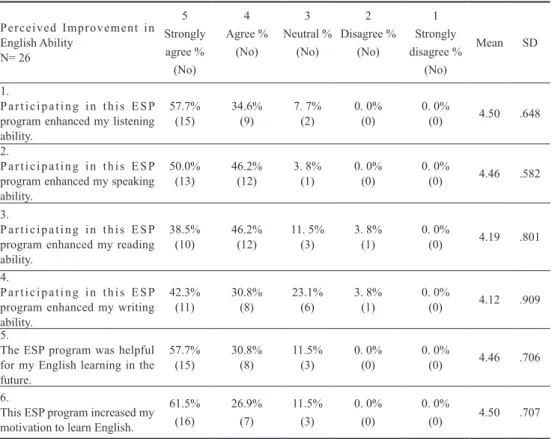
Yi-Hsuan Gloria Lo 74
1. Introduction
From the early 1960’s, English for Specific Purposes (ESP) has grown to become one of the most prominent areas of language education today. Its development is reflected in the increasing number of universities offering an MA in ESP and in the number of ESP courses offered for international students in English-speaking countries (Harding, 2007; Hyland, 2006; Orr, 2008). The growth of ESP can also be observed from the publication of international journals (e.g., English for Specific Purposes and The Asian ESP Journal) dedicated to identifying aspects of ESP needing development and areas into which the practice of ESP may be expanded. The interest in ESP is also seen worldwide in the establishment of ESP Special Interest Groups (SIGs) under professional associations (e.g., IATEFL and TESOL). Such groups have been very active at their national conferences.
In Taiwan, the growth of ESP in the past five years has been rapid and definite. In 2006, the NCKU Eagle Project, developed and implemented by the Language Center at National Chung Kung University became the first institution in Taiwan dedicated to the development of ESP materials and curricula in place of the more traditional English for General Purposes (EGP) courses offered by most colleges/universities in Taiwan to freshmen and non-English majors (for more, please refer to http://english.ncku.edu.
tw/eagle/?q=node/14). The shift of the instructional focus from EGP to ESP aims to increase students’ motivation for English learning and to help students prepare for the demands of English in their future careers.
In 2008, with a vision for the future professional development of English language education, the Taiwan ESP Association (TESPA) was established (for more, please refer to http://www.tespa.org.tw/). The goals of TESPA are to promote ESP education in Taiwan, to promote global literacy for Taiwan professionals to communicate with people worldwide, and to provide a learning platform for ESP students. To complete its mission, in December 2009 TESPA published the first academic ESP journal in Taiwan, Taiwan International ESP Journal, marking the beginning of the ESP era in mainstream Taiwan EFL. Since then both local and international scholars have
9
TIESPJ, Vol. 3: 2, 2012 75
been able to exchange their ESP research and engage in scholarly discussion through this journal.
The rapid ESP development has also caught the attention and gained the support of the Ministry of Education (MOE). With support and approval from the MOE, the Department of Applied Foreign Languages at the National Kaohsiung University of Applied Science has just offered the first ESP-based Master’s Program in Taiwan this academic year. This is considered a very significant move in Taiwanese academia in terms of the ESP movement. Likewise the conference theme of the 2011 International Conference & Workshop on ESP, organized by the Department of Applied English at Hung-Kuang University in Taiwan, is ESP in Taiwan University Settings: Teacher and learner competences. This theme shows that ESP research and education at the college/
university level have gained major attention compared to ESP at other educational levels in Taiwan (e.g., Chien & Hsu, 2010; Huang & Li, 2008; Lo & Sheu, 2008; Tsao, 2011)
In particular, Dudley-Evans and St. John’s (1998) theories on the “absolute characteristics” (p. 4) of ESP can help provide a rationale for the rapid growth of ESP worldwide and in Taiwan, particularly at tertiary institutions in Taiwan. By “absolute”
characteristics, Dudley-Evans and St. John (1998) refer to three points: (1) ESP is designed to meet the specific needs of the learner; (2) ESP makes use of the underlying methodology and activities of the disciplines it serves; and (3) ESP is centered on the language (grammar, lexis, and register), skills, discourse and genres appropriate to these activities (p. 4-5). The “absolute characteristics” illustrate that an ESP approach concerns not only learners’ language issues, but also the design of the methodology and activities related to students’ disciplines. Most importantly, ESP views students’ needs as the first priority.
The result of Tsao’s (2011) survey questionnaire of 351 students in a technological university about their attitudes toward ESP shows that (1) students favored ESP more than EGP, (2) students do not believe their English proficiency is up to a level needed to cope with the ESP course requirements, (3) ESP should focus on the training of language skills while integrating specialized terms and discipline content
10
Yi-Hsuan Gloria Lo 76
into the course, and (4) English should be the main medium of instruction. Tsao’s study also reveals that college students perceive a positive relationship between ESP courses and their future careers. They believe that the content of ESP courses is practical and helps them meet the growing English demands of the industry when they graduate from college.
Can the principles that guide ESP instruction (for more, see the ESP approach and materials design model in the Literature Review) for college level students be applied to secondary school learners in Taiwan? In addition to the “absolute” characteristics of ESP, Dudley-Evans and St. John (1998) identified “variable” characteristics of ESP as follows: (1) ESP may be related to or designed for specific disciplines; (2) ESP may use, in specific teaching situations, a different methodology from that of general English; (3) ESP is likely to be designed for adult learners, either at a tertiary institution or in a professional work situation but could, however, be used for learners at the secondary school level; and (4) ESP is generally designed for intermediate or advanced students: most ESP courses assume a basic knowledge of the language system, but it can be used with beginners (p. 5). To what extent can the variable characteristics of ESP be observed in Taiwanese secondary schools, particularly in the VHS system, which aims to prepare VHS students for professional fields? In other words, can an ESP program be designed and implemented for VHS students of a specific discipline who are not motivated to learn English and who have a low level of English proficiency?
VHS students in Taiwan are usually considered underachievers in English compared to those who enter public senior high schools (Hung, 1994, 1996a, 1996b, 1999; Shi & Lin, 1996; Lou, 2000; Liu, 2002; Chen & Lee, 2007). The reasons cited for their unsatisfactory English performance focus on the learners’ lack of interest and motivation to learn English prior to entering VHS, their low English proficiency in junior high school, and the lower expectations of society and of the learners’ families, who usually belong to lower socio-economic groups. The reasons cited for the low opinion of VHS English education have been English being a neglected subject in the VHS system and insufficient instructional time per week as well as an inappropriate teaching approach (Lin, 1995, 1996; Lou, 2000; Liu, 2002; Yu, 2007). What is worse
11
TIESPJ, Vol. 3: 2, 2012 77
is that the English test in the vocational and technological college/university entrance examination (Shi & Lin, 1996) tests only grammar knowledge and reading proficiency, neglecting speaking and listening skills. As a result, the most common teaching approach is the grammar translation method, involving Chinese translation of the text and grammar explanation and exercises (Liu, 2002; Lou, 2004).
Many VHS English teachers in Hung and Lou’s (1995) study indicated that the aim of English education and the actual practice were in conflict in the VHS system.
Their dilemma was whether to teach the English that students would need in their professional fields (ESP) or to teach the four language skills students would need in college. Almost two decades have passed since the dilemma was raised. Currently the majority of VHS students continue their studies in colleges/universities of science and technology, so preparing VHS students to succeed in the entrance examination has been the top priority. However, the fundamental question that remains unresolved is whether an ESP approach helps solve the problems facing English education in VHS. Could an ESP approach serve as an alternative for VHS students’ English instruction and improve their learning of English?
The purpose of the 6-month research project through a school-university partnership (Tsui & Law, 2007; Tsui, Edwards & Lopez-Real, 2009) was to understand whether an ESP program designed and implemented for 33 VHS students of tourism would help improve their learning of ESP as well as their learning of EGP. The results of the study provide insight into the EGP-versus-ESP dilemma facing VHS English education in Taiwan and contribute to the ESP case studies on secondary school learners.
This study addresses two questions:
1. What effect did this ESP program have on the participants’ oral interpretation competence and their overall learning of ESP?
2. What effect did this ESP program have on the participants’ overall English proficiency?
12
Yi-Hsuan Gloria Lo 78
2. Literature review
In this section, a historical perspective on ESP is provided followed by important theories and studies related to ESP course design, materials development, and a materials design model.
A Historical Perspective on ESP
Tracing the historical background of ESP, Hutchinson and Waters (1987) identified three main movements contributing to the emergence of all ESP: (1) the demands of a “brave new world,” (2) a revolution in linguistics, and (3) an increased focus on the learner.
First, since the end of the Second World War in 1945, English has become the accepted international language of technology and commerce; thus it has created a new generation of learners who must learn English to satisfy the demands of the commercially interconnected modern world. Second, the growth of English courses tailored to specific needs and language demands shifted the focus away from analyzing the formal structures of language to investigating the ways in which language is actually used in real communication. Third, new insights gained from educational psychology also contributed to the development of ESP. Instead of viewing learners as blank slates to be filled, learners were seen to have different needs and interests, differences which had a critical influence on their motivation and thereby resulted in the need for different approaches for them to achieve maximum effectiveness in their learning (Hutchinson and Waters, 1987).
Dudley-Evans and St. John’s (1998) work on developments in ESP provides another historical perspective. By examining closely the interaction between Applied Linguistics, English Language Teaching (ELT), and ESP from the 1960s to the 1990s, the authors traced four factors that contributed to the ESP development: (1) the balance between research and practice, (2) trends in English for Academic Purposes, (3) authenticity of text and authenticity of purpose, and finally (4) trends in English for occupational purposes. All these factors, as the authors observed, were greatly influenced by developments in education, business, and computer technology, whose
13
TIESPJ, Vol. 3: 2, 2012 79
impact can be seen even today.
The balance between research and practice refers to the relationship between theory and materials/teaching in ESP. ESP started its work in the area of register analysis. Swales’ influential work, Episodes in ESP (1988), prioritized certain areas for teaching and materials production, areas which formed the basis for more extensive research. In addition to register analysis, trends in English for Academic Purposes – the movements in rhetorical and discourse analysis, analysis of study skills, and analysis of learning needs – have also influenced the development of ESP. The third factor identified by Dudley-Evans and St. John (1998) states that authenticity goes hand in hand with genuineness. Authenticity of purpose is as critical as genuineness of text.
Authenticity and genuineness lie in the nature of the interaction between the reader and the text. Lastly, an understanding of the different needs of learners with various degrees of job experience has led to development of a variety of ESP materials to bridge cultural gaps and to help people communicate effectively across borders.
Orr (2008) identified three phases of ESP development, which he labeled as First Generation ESP (FirstGen ESP), Second Generation ESP (SecondGen ESP), and Next Generation ESP (NextGen ESP). By FirstGen ESP, Orr (2008) refers to the middle of the 20th century, after the close of World War II. This phase is characterized by the English language instruction for academic and occupational purposes that began when large numbers of nonnative speakers of English immigrated to English-speaking countries, settled in areas where the majority were English-speaking people, and therefore needed to learn English in order to obtain opportunities for higher education and better employment.
The SecondGen ESP started in the second half of the 20th century and still exists.
Its features are needs-based, purpose-driven English language instruction; significant growth in research, publishing, and professional events; and growth in the number of language educators identifying themselves as ESP professionals.
NextGen ESP, according to Orr, began in the 1990s. The initial impetus for its development lay in rapid changes in technology, economics, and culture. NextGen ESP is characterized by (1) changes in ESP locations, moving ESP training out of English
14
Yi-Hsuan Gloria Lo 80
departments to locations that can best meet the needs of learners; (2) changes in ESP staffing, including staff with degrees not only in applied linguistics but also other professional fields to fulfill the requirements set by the language company; (3) changes in ESP content, changing from content designed for general language teaching to materials for specialists who need high levels of discipline-specific understanding; and (4) changes in ESP delivery, delivering materials not only through human beings but also technology.
ESP Course design
Hutchinson and Waters (1987) identified three approaches to ESP course design.
Language-centered course design draws a direct connection between the analysis of the target situation and the content of the ESP course. The learning needs of the students are not accounted for at every stage of the course design process. Skills-centered course design tries to build on the positive factors learners bring to the ESP course, enabling learners to achieve on their own paths. This approach focuses more on language use than on language learning. A learning-centered approach is based on the principle that learning is totally determined by the learner. Learning is viewed as a process by which the learners use what knowledge or skills they have in order to make sense of the new information. This approach concerns not only what competence a learner acquires but also how this particular competence is acquired.
Dudley-Evans and St. John (1998) pointed out a number of parameters that need to be considered in approaching ESP course design: (1) Should the course be intensive or extensive? (2) Should the learners’ performance be assessed or non-assessed? (3) Should the course deal with immediate needs or with delayed needs? (4) Should the role of the teacher be the provider of knowledge or should it be as a facilitator? (5) Should the course have a broad or narrow focus? (6) Should the course be pre-study or pre-experience or run parallel with that study or experience? (7) Should the materials be common-core or specific to learners’ study or work? (8) Should the learners be homogeneous or heterogeneous? (9) Should the course design be worked out by the language teacher or should it be subject to a process of negotiation with the learners?
15
TIESPJ, Vol. 3: 2, 2012 81
(p. 145-146).
In discussing approaches to ESP course design, Basturkmen (2006) investigated four important topics: (1) varieties of language, (2) needs analysis, (3) types of syllabuses, and (4) narrative and wide-angle course designs. In terms of varieties of language, there are two perspectives. Should there be a specific-purpose language based on and extending from a basic core of general language? Or does language exist as one variety or another with no basic core language? Different types of syllabuses can emerge during the design process. Specifying and ordering the content of an ESP course involves a number of theoretical stances (e.g., synthetic vs. analytic) and reveals the course designer’s beliefs about the nature of teaching and learning. Finally, the principles of course designs suggest that when needs are specific, a narrow-angled course may be appropriate, whereas when the needs are more general, a wide-angle course may be more suitable.
An ESP Materials Design Model
Chen (2006) stated three possible ways of obtaining materials for ESP programs:
(1) using existing materials, (2) writing materials, and (3) adapting materials. For example, in Gao’s (2007) study of Chinese students of business, one existing textbook was used, but this textbook was supplemented by in-house materials. Robertson’s (2005) examination of materials for improving flight attendants’ English skills in Korea showed that the materials lacked principles of English grammar and structure. Thus, appropriate materials needed to be created. In a project for training tour guides, Lo &
Sheu (2008) also indicated that there were no suitable textbooks and thus ESP materials needed to be adapted from existing materials.
Hutchinson and Waters (1987) introduced an ESP materials design model, consisting of four elements: input, content focus, language focus and tasks (p. 108- 109).
Input refers to a text, dialogue, video-recording, diagram or any piece of communication data, to address the needs a teacher has defined in an analysis of the class. Input may involve (1) stimulus material for activities, (2) new language items,
16
Yi-Hsuan Gloria Lo 82
(3) correct models of language use, (4) a topic for communication, (5) opportunities for learners to use their information processing skills, and (6) opportunities for learners to use their existing knowledge both of the language and the subject matter.
Content focus addresses the mindset that language is not an end in itself, but a means of conveying information and feeling. Non-linguistic content should be exploited to generate meaningful communication in the classroom.
Language focus refers to the idea that the teachers’ aim is to enable learners to use language, but giving learners communicative tasks and activities for which they do not have the necessary language knowledge is unfair. Good materials should involve both opportunities for analysis and synthesis. In a language focus, learners have the opportunity to take the language apart, study how it works, and practice putting it back together again.
Tasks reflect the idea that the ultimate purpose of language learning is language use. Following this reasoning, materials should be designed to lead towards a communicative task in which learners use the content and language knowledge they have built up through the unit.
Historical studies of ESP enable us to understand current ESP developments both in Taiwan and worldwide. The theories and important studies that underpin the essential principles of ESP course design and materials development have served as an important foundation for the design and implementation of the ESP program for the VHS students of tourism in this study.
3. The context of the study
This section introduces the context of the study, which includes the school- university partnership, the materials development process, the ESP approach taken in the program design, and various stages of the program implementation.
The School-University Partnership
This ESP program took place in a school-university partnership funded by the
17