行政院國家科學委員會專題研究計畫 成果報告
引進駕駛行為自我評估手冊評估本國高齡者駕駛安全(2/2)
計畫類別: 個別型計畫
計畫編號: NSC94-2213-E-006-023-
執行期間: 94 年 08 月 01 日至 95 年 07 月 31 日 執行單位: 國立成功大學工業與資訊管理學系(所)
計畫主持人: 李再長
計畫參與人員: 李再長、 黃愛黎、黃琬珺
報告類型: 完整報告
報告附件: 出席國際會議研究心得報告及發表論文 處理方式: 本計畫可公開查詢
中 華 民 國 95 年 10 月 24 日
行政院國家科學委員會補助專題研究計畫
▓ 成 果 報 告□期中進度報告
引進駕駛行為自我評估手冊評估本國高齡者駕駛行為 (2/2)
計畫類別:□ˇ 個別型計畫 □ 整合型計畫 計畫編號:NSC 94-2213-E-066-023
執行期間:中華民國94 年8 月1 日至95 年7 月31 日
計畫主持人:李再長 共同主持人:
計畫參與人員:黃愛黎(兼任助理)、黃琬珺(兼任助理)
成果報告類型(依經費核定清單規定繳交):□精簡報告 □ˇ完整 報告
本成果報告包括以下應繳交之附件:
□赴國外出差或研習心得報告一份
□赴大陸地區出差或研習心得報告一份
□ˇ出席國際學術會議心得報告及發表之論文各一份
□國際合作研究計畫國外研究報告書一份
處理方式:除產學合作研究計畫、提升產業技術及人才培育研究 計畫、列管計畫及下列情形者外,得立即公開查詢
□涉及專利或其他智慧財產權,□一年□二年後可公 開查詢
執行單位:國立成功大學工業與資訊管理系(所)
中 華 民 國 95 年 10 月 3 日
行政院國家科學委員會 行政院國家科學委員會行政院國家科學委員會
行政院國家科學委員會專題研究計畫成果報告專題研究計畫成果報告專題研究計畫成果報告 專題研究計畫成果報告
計畫題目:引進駕駛自我評估手冊評估本國高齡駕駛者駕駛安全(2/2)
計畫編號:NSC 93-2213-E-006-077
執行期限:中華民國93 年8 月1 日至94 年7 月31 日 主持人:李再長 國立成功大學工業與資訊管理系(所)
摘 摘摘
摘 要要要 要
由相關統計資料顯示,我國人口結構將日趨老化,高齡者駕駛的相關議題也 日益重要。高齡者在健康、身心狀況上的衰退,使得其駕駛之安全性也相對降低;
然而,與其消極地全面禁止高齡者開車,我們應該以更積極的方式,培養高齡者 對駕駛的正確觀念,以及對其本身駕駛行為和駕駛能力的自覺。
根據 Eby 等人在 2003 年的研究結果顯示,使用駕駛行為自我評估手冊( Driving Decisions Workbook)( Eby et al., 2000),對高齡者的駕駛行為之自我察覺與一般知識 有顯著的助益。因此,本研究引進駕駛行為自我評估手冊,並以使用者、醫學專 家、交通專家和人因工程專家的角度,檢視翻譯之適切性,以編譯中文版之駕駛 行為自我評估手冊。
本研究主要包括三大目標。第一,調查台灣地區高齡駕駛者的駕駛狀況、駕 駛習慣以及駕駛行為;第二,檢視人格特質中的衝動性、冒險性和同理心對於高 齡駕駛者及其駕駛行為影響;第三,探討駕駛決策手冊的效用以及實用性。本研 究的實驗受測者為台灣地區 65 歲以上的高齡駕駛者,其人格特質、駕駛習慣以及 駕駛行為之相關資料將由問卷方式取得。在駕駛決策手冊效用評估方面,受測者 會先進行評估問卷前測、閱讀駕駛行為問卷、再進行評估問卷後測,以檢視閱讀 手冊前後評估問卷答項的差異。
研究結果顯示,人格特質中衝動性程度高的受測者,容易出現駕駛行為中的 錯誤、失誤和違犯。經過統計分析,我們可以發現駕駛決策手冊對於改善高齡駕 駛安全的確是有效且實用的。
關鍵詞:高齡者、駕駛行為自我評估手冊、駕駛行為、駕駛安全、人格特質
Abstract
According to the related statistical data, elderly population is expending in our country. Driving behavior of the elderly has become an important issue to discuss. As their health, physical and mental conditions declined of the aging people, also did their driving safety. Instead of completely forbidding the elderly to drive, we ought to positively bring up the correct knowledge of driving to them, and increase their self-awareness of the driving conditions.
The Driving Decisions Workbook (DDW, Eby et al, 2000a), a self-assessed instrument for aging people, could increase self-awareness and general knowledge of driving. This research introduced the DDW to elder drivers in Taiwan. We translated the DDW into Chinese, and discuss the translation with the users, medical experts, transportation experts and ergonomics experts, to build up the Chinese version of the DDW.
The study mainly has three objectives. First, investigate Taiwanese elder drivers’
driving condition, driving habits and driving behavior. Second, discover the impact of impulsiveness-veturesomeness-empathy characteristics of the elder drivers on their driving behavior. Third, examine the effectiveness and usefulness of DDW. The subjects of the experiment are drivers over 65 ye0ars old in Taiwan. Data of personal characteristics, driving habits and driving behavior was selected through a questionnaire.
For the DDW evaluation, subjects were asked to do a pretest, read the DDW and then do the posttest to see the difference between the pretest and the posttest of the evaluation questionnaire.
The result showed that subjects with high impulsiveness level would have more driving errors, driving lapses and driving violations. By doing the statistical analysis, we concluded that DDW is indeed effective and useful for improving elder driving safety.
Key words: elder people, Driving Decisions Workbook, driving behavior, driving safety, personality characteristics.
Contents
報告書 ... I 摘 要 ... III Abstract ... IV Contents ... V List of Tables ... VII List of Figures ... VIII
Chapter 1 Introduction ... 1
1.1 Background and Motivation ... 1
1.2 Research Objectives ... 3
1.3 Research Procedure ... 3
1.4 Limitations... 3
Chapter 2 Literature Review ... 5
2.1 Limits on Elder Drivers and Their Driving Abilities... 5
2.1.1 Visual Abilities ... 5
2.1.2 Reaction ... 6
2.1.3 Medications, Diseases and Cognition... 7
2.2 Driving Habits and Driving Safety of the Elder Drivers ... 8
2.3 Traffic Accidents and Driving Safety in Taiwan ... 9
2.4 Driving Assessments for Elder Drivers ... 12
2.5 Development and Research of DDW ... 14
Chapter 3 Methodology ... 17
3.1 Conceptual Framework... 17
3.2 Research Propositions and Hypotheses ... 18
3.3 Subjects... 18
3.4 Study Procedure... 19
3.5 Relation between IVE and DBQ ... 20
3.5.1 Procedure ... 20
3.5.2 Materials ... 21
3.5.3 Data Analysis... 23
3.6 DDW Evaluation ... 24
3.6.1 Procedure ... 24
3.6.2 Materials ... 25
3.6.3 Data Analysis... 29
Chapter 4 Results ... 31
4.1 Subjects Profile... 31
4.2 Driving Habits ... 32
4.3 IVE Personality Characteristics and Driving Behavior... 34
4.3.1 IVE versus Error Score... 34
4.3.2 IVE versus Lapse Score... 36
4.3.3 IVE versus Violation Score ... 37
4.3.4 IVE versus DBQ Score... 38
4.4 Evaluation of DDW ... 39
4.4.1 Reliability Analysis of the DDW Evaluation Questionnaire ... 40
4.4.2 Paired t-test of the DDW Evaluation Questionnaire ... 40
4.4.3 Subjective Opinion on DDW... 42
Chapter 5 Conclusions ... 45
5.1 Discussion... 45
5.1.1 Elder Drivers’ Driving Habits... 45
5.1.2 The Relation between IVE Characteristics and Driving Behavior... 45
5.1.3 DDW Evaluation ... 46
5.2 Suggestions... 46
5.2.1 Suggestions for Transportation and Motor Vehicle Organizations... 46
5.2.2 Suggestions for Future Studies ... 47
References ... 49
Appendices ... 53
Appendix1 Questionnaire І (Administrated before DDW)... 54
Appendix2 Questionnaire Ⅱ (Administrated after DDW) ... 61
List of Tables
Table 3.1 Experts of DDW Translation Checking... 26
Table 3.2 Contents of DDW ... 28
Table 3.3 Comparison of the Evaluation Questions and Research Hypotheses ... 30
Table 4.1 Descriptive Statistics of Subject Profile ... 31
Table 4.2 Driving Habits of the Subjects... 32
Table 4.3 Experimental Set of IVE versus Error Score... 35
Table 4.4 ANOVA Result of IVE versus Error Score ... 35
Table 4.5 Comparison of Error Score of Different Impulsiveness Level... 35
Table 4.6 Experimental Set of IVE versus Lapse Score... 36
Table 4.7 ANOVA Result of IVE versus Lapse Score ... 36
Table 4.8 Comparison of Lapse Score of Different Impulsiveness Level... 37
Table 4.9 Experimental Set of IVE versus Violation Score ... 37
Table 4.10 ANOVA Result of IVE versusViolation Score ... 37
Table 4.11 Comparison of Violation Score of Different Impulsiveness Level... 38
Table 4.12 Experimental Set of IVE versus DBQ Score ... 38
Table 4.13 ANOVA Result of IVE versus DBQ Score... 39
Table 4.14 Comparison of DBQ Score of Different Impulsiveness Level ... 39
Table 4.15 Paired t-test of the Evaluation Questionnaire ... 41
Table 4.16 Frequency of the Pre-post Answers of Evaluation Question18 ... 42
Table 4.17 Frequency of the Pre-post Answers of Evaluation Question16 ... 42
Table 4.18 Percentages of Subjects Answering “Yes” to Questions about Self-awareness and General Knowledge ... 43
Table 4.19 Percentages of Subjects Answering “Yes” to Questions about Workbook Usefulness and Overall Ratings of Usefulness... 44
List of Figures
Figure 1.1 Research Procedure... 4
Figure 2.1 Procedure of Human Reaction ... 7
Figure 2.2 Age Distribution of Death in Traffic Accidents (1987-2000) ... 11
Figure 2.3 Framework for Developing the DDW... 16
Figure 3.1 Conceptual Framework ... 17
Figure 3.2 Study Procedure ... 20
Figure 3.3 Study Procedure of the Part to Discover the Relation between IVE and DBQ ... 21
Figure 3.4 Study Procedure of DDW Evaluation ... 24
Figure 3.5 Transit Procedure of DDW ... 25
Figure 3.6 Layout of the DDW... 27
Introduction
Aging drivers are common in many foreign countries, while most of the drivers in Taiwan now are still in their prime of lives. Statistical data of aging drivers in Taiwan are seldom collected or reported; thus, only few researches have done in this area. For the aged, physical and mental changes limit their driving abilities more or less.
Therefore, the safety of the aged who are still driving is being questioned. As the demographic structure becomes aged, the issue of the security of the elder drivers has been concerned more rapidly.
Driving Decisions Workbook (DDW, Eby et al., 2000a) is a self–assessment instrument for elder drivers. Researches had shown that DDW could help people increase their self-awareness and general knowledge of driving abilities (Eby et al., 2003).The main purpose of this study is to introduce DDW to Taiwanese aging drivers, in order to improve their driving quality and driving safety.
1.1 Background and Motivation
As the improvement of hygienic and medical conditions, the average life expectancy of human has increased. Since the mid-twentieth century, a demographic revolution has been underway throughout the world. Based upon the definition of World Health Organization (WHO), it becomes an aged society if the population of people over 65 years old reached a proportion of 7%. Taiwan had become aged by 1993 while the population of the elderly reached to 7.1% of the total population. The population over 65 in Taiwan was 9.48% at the end of 2004, and was projected to reach about 10% by 2111, which is about 2.38 million (Directorate-General of Budget, Accounting and Statistics [DGBAS], Executive Yuan, R.O.C., 2003; Manpower Planning Department, Council for Economic Planning and Development [CEPD], Executive Yuan, R.O.C., 2001). According to these data, we can see that our demographic trend is becoming aged.
As the growing population of older people, their life quality has been concerned.
One of the key points we need to make effort on is the safety and efficiency of their mobility. Besides the mass transportation, driving a car is a basic and convenient way to
improve older people’s mobility. Researches of aging in the U.S. have concluded that besides the health problem, the biggest risk older people have to face is being isolated.
For the elderly, owning driving licenses also represents their independence.
However, the safety of older people’s driving is an issue worthy to discuss.
According to the statistics of accident in the U.S., elder drivers had the higher rate involved in fatalities than most of the age groups (National Highway Traffic Safety Administration [NHTSA], 2004). Similarly in Taiwan, in the data of accident involvement of the pass years, people over 65 years old had a fatality rate that was higher than for all other age groups (Lin and Lai, 2001b). Many researches have shown that the elevation in crash rate of older people is most likely linked to declining of vision, mobility, cognitive, reaction and other abilities related to driving. The sharp decline of these abilities affects the driving behavior of the elderly as well.
According to the research of Eby et al. in 2003, they suggested that after completing DDW, most of the older people were more aware of the changes that could affect their driving. The responses of the DDW were correlated to the driving performance, moreover, DDW is helpful to evaluate the driving condition of elder drivers, and consequentially improve the traffic safety.
On the other hand, researches had found that among personality characteristics, impulsiveness may be a critical factor that affects one’s driving behavior (Lawton et al.
1997; Renner and Anderle, 2000). Owsley (2003) also examined the relation between impulsiveness-venturesomeness-empathy (hereafter IVE) and driving behavior, and suggested that these characteristics would affect elder drivers’ driving.
Aging driving is common in the U.S. and other countries. Researches on driving exposure or driving behavior of elder drivers have done in these countries. In Taiwan, most of the drivers are young and middle aged adults, few statistic data of elder drivers has been collected. Therefore, problems of older driving are seldom discussed in Taiwan. However, this main population of the drivers in their middle ages will grow old.
As the demographic trend of increasing aging population, researches on driving behavior and driving safety of the elderly in Taiwan are urgently needed. Therefore, this study aims at introducing DDW to Taiwan in order to help the elder drivers.
1.2 Research Objectives
For the wellbeing for the elder drivers in Taiwan, this study introduced the DDW developed by Eby et al. (2000) to Taiwan, translated it to Chinese and tested it on Taiwanese elder drivers. The main objectives of this study are the following:
1. Through literature review, summarizing the elements that influence the driving performance and safety of elder driver.
2. Investigating the driving behavior and driving exposure of elder drivers in Taiwan.
3. Examining the impact of impulsiveness, venturesomeness and empathy on elder driving.
4. Exploring how effective DDW is to help aging drivers in Taiwan.
1.3 Research Procedure
Based on the results of foreign researches, after reading the DDW, elder drivers could improve their self awareness and general knowledge of driving. This study introduces the DDW to Taiwan, in order to reform the driving safety of the elderly.
Figure 1.1 shows the research procedure of this study. After confirming the study issue, literature review was done and data related to the research was collected as well.
After constructed the Chinese version of DDW and the required questionnaires, they were used to administer on the elder drivers in Taiwan. Subsequently, we tested the effectiveness of DDW on evaluating aging driving and the relation between the IVE personality characteristics and elder drivers’ driving behavior by statistical analysis.
Finally, conclusion was drawn and suggestions were proposed.
1.4 Limitations
The limitations of this study are listed as below:
1. Health condition, driving condition and subjective perspective about driving might be different from one to another.
2. Subjects of the study could not be chosen randomly:
The experiment of the study took more than one hour for each subject, in order to complete the experiment, subjects of the study could not be chosen randomly.
However, the completeness of the experiment process would apply more useful data of elder driving.
Literature Review
In this chapter, a review on literature was done to discuss limits on elder drivers and their driving abilities, driving habits and driving safety of the elder drivers, traffic accidents and driving safety in Taiwan, driving assessments for elder drivers and development and research of DDW.
1.5 Limits on Elder Drivers and Their Driving Abilities
Age-related illness problem and illness-related functional impairment are the main causes that affect elder driver’s ability (Hakamies-Blomqvist and Wahlström, 1998;
Waller 1992). On the dimension of road safety or driving ability, the characters related to the person are sight range, reaction ability, eyesight and light (Committee of Traffic Safety Supervision, Ministry of Transportation and Communications [MOTC], R.O.C., 1994). Many researches have also proved that the decline in visual or reaction abilities of elder drivers may impact or moreover limit their driving. The raising crash rates associated with increasing age usually linked to declining abilities related to driving, as well as medications that cause functional deficits and impair driving (Eby et al., 2003).
Moreover, increasing age can lead to declining cognitive, psychomotor and perceptual abilities as well. This section discusses the changes or limits of the older people, including visual abilities, reaction, medications, diseases and cognition, which might affect their abilities and safety of driving.
1.5.1 Visual Abilities
In the aspect of vision ability, the changes of older people that affect their driving include night vision, legibility distance, presbyopia, side vision, and color recognition.
The first problem elder drivers have to face is night time vision. Elder drivers need greater brightness contrast to see when driving at night (Mortimer, 1989). Those changes are due to the slower reaction to light of older people’s retinae. “Wolf (1960) showed that the contrast threshold of persons aged 20 about one tenth that of persons aged 60 and about one thirtieth of that of 80 year old persons”, quoted Mortimer in 1989.
Elder drivers have lower tolerance to glare, therefore, night time acuity becomes a serious problem for them (Yanik, 1989). Yanik indicated in the research in 1989,
“When older adults reach the age of 60, they required at least three times as much light
on an object to see it as clearly as they did at 20”, that is, it is a challenge for them reading road signs at night or finding unlit controls in the dark car.
Compared to the young and middle aged drivers, it was found that elder drivers usually had shorter “legibility distance” or longer “legibility time”. In Schieber and Kline’s (1994) research, experiments were done to conclude that elder driver’s average legibility distance is always shorter, in the conditions of daytime, nighttime and
“nighttime with glare”. Greene et al. (1994) also suggested that elder drivers had shorter legibility distance seeing all the traffic signs in the experiments both of the field study and the laboratory study. “Elder driver’s legibility distance were 65% those of the younger drivers. Age differences in the object detection task ranged from 20% to 45%
reduction of the younger drivers”, Chrysler et al. (1996) concluded in their research.
Those results may due to the decline of visual system or reaction of the elderly.
Another obvious change of older people’s visual process is presbyopia, or loss of accommodation, which means one’s disability to see things close clearly (Yanik, 1989).
It makes elder drivers moving their heads back and forth while driving to adjust the distance to read the display or control labels clearly. Furthermore, side vision reduces as people aged (Eby et al., 2000b). The decreased side vision may affect the ability of safe driving, and raise the chance of getting involved in an accident. Finally, yellow, orange and white are the colors that attract older people more and suitable for label colors, while blue is less attractive and may be excellent as a background color (Yanik, 1989).
In this section, we can conclude that changes of elder drivers’ visual condition might cause an effect on their driving. Therefore, as one aged, he should consult a doctor regularly to check if there is a visual problem, and make related changes when driving, for an example, avoiding driving at night.
1.5.2 Reaction
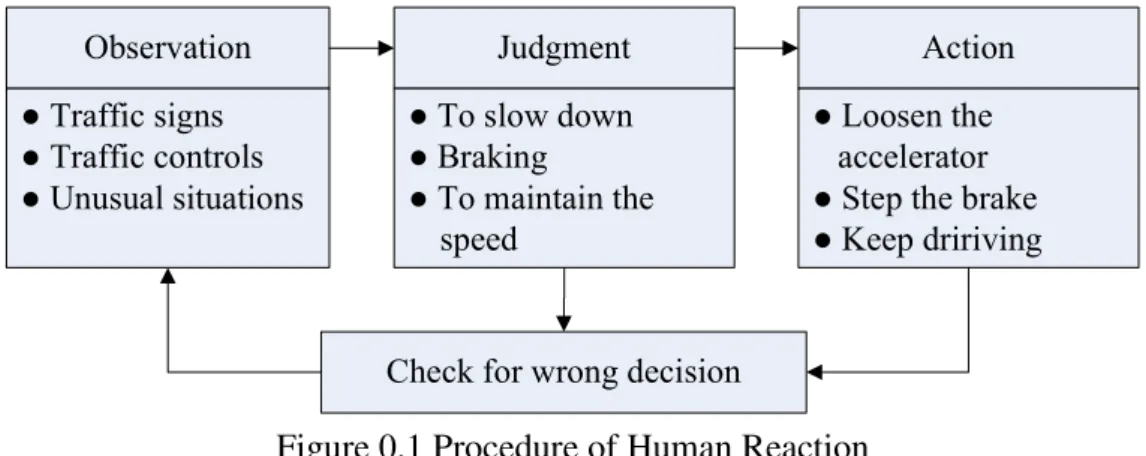
In the aspect of physiology, the definition of reaction time is the time between someone sees stimulations and makes an action to it (Committee of Traffic Safety Supervision, Ministry of Transportation and Communications [MOTC], R.O.C., 1994).
Observation
● Traffic signs
● Traffic controls
● Unusual situations
Judgment
● To slow down
● Braking
● To maintain the speed
Action
● Loosen the accelerator
● Step the brake
● Keep dririving
Check for wrong decision
Figure 0.1 Procedure of Human Reaction
(Source: Committee of Traffic Safety Supervision, MOTC, R.O.C., 1994)
Figure 2.1 is the procedure of human reaction. Generally speaking, the ability of reaction relates to driver’s visual and movement conditions. Boren and Chiang measured the braking response time through the driving simulator in their research in 1996. The result showed that older people need longer time for reacting to unexpected obstacle. Moreover, according to the experimental result of Schlag in 1993, elder drivers, compared to other age groups, need longer time tracking and reacting. Ranney and Pulling (1989) proposed, “The slowing of reaction time associated with aging has effects on driving skills related to vehicle control.” As people aged, their reaction to emergency is slower, that might cause the higher rate for them to get into traffic accidents.
1.5.3 Medications, Diseases and Cognition
Some chronic diseases appear as people aged. Lyman et al. (2001) proposed that kidney disease, high blood pressure and other diseases might change the driving habits of the elderly. Some medicine they took regularly might cause dizziness, sleepiness or loss of attention. These side effects could put them into dangerous situations while driving.
Elder drivers have declined abilities of cognition or psychomotor (Guerrire et al., 1995). While age relates significantly to cognitive characteristics, distinct characteristics relate to particular tasks. Elder drivers significantly higher estimated the car velocity and the car distance (Scialfa et al., 1987), and when making decisions in the driving task, they needed more time and might have difficulty locating targets in visual searching (Ranney and Simmons, 1992).
Changes and limits of elder drivers were reviewed in the previous sections. In the following section, some characters of elder driver’s driving habits and driving safety were discussed.
1.6 Driving Habits and Driving Safety of the Elder Drivers
Based on the statistics of traffic accidents in the U.S., elder drivers had the higher rate involved in fatalities than most of the age groups (National Highway Traffic Safety Administration [NHTSA], 2004). Elder drivers’ crash rate per mile was twice that of middle-aged drivers, and as they involved in a crash, the chance they experience serious or fatal injury was three or four times of that of other age groups. Examined the vehicle crash data, the crash rate as well as mortality also increased among drivers aged 55 to 70 (Kostyniuk and Shope, 2003). Similarly in Taiwan, the statistics of traffic accidents from 1987 to 2000 showed that people over 65 contributed the highest proportion to fatalities. (Lin and Lai, 2001a)
Kostyniuk and Shope (2003) did a telephone survey on elder drivers in Michigan to check their reliance on private automobile and their plan for future mobility. The survey responses showed that most of the elder drivers hadn’t planned for driving cessation. “Over half the drivers who perceived a likelihood of driving problems within five years expected to keep driving beyond five years”, Kostyniuk and Shope concluded.
The study of Hakamies-Blomqvist and Wahlström (1998) did mail survey and telephone interview to explore the driving habits of elder drivers in Finland. The result showed that there are more male older vehicle users than female. The essential reason elder drivers stop driving was the decline of health. Another reason was the stress they felt while driving, especially in certain situations such as at night or during rush hours.
It was reported that elder drivers made fewer trips, drove fewer miles and drove less in certain situations, such as nighttime, in bad weather or during rush hours (Chu, 1995). The main reasons elder drivers stopped driving are discomfort during driving, scruple of driving techniques or some health problems. Lyman et al. (2001) studied the relationship between factors as functional limitations, visual and cognitive functions
and chronic medical conditions and elder drivers’ driving habits such as estimated annual mileage, self reported quality of driving, driving speed, number of days per week driven and level of difficulty in certain driving situations. The result showed that a history of falls, kidney disease and visual impairment heighten the difficulty of their driving, and their expected driving days per week were lower. Moreover, cognitive impairment and lifestyle difference would also affect their driving exposure.
Driving Behavior Questionnaire (DBQ, Lawten et al., 1997) divided the specific driving behavior into subgroups of violations, errors and lapses. Parker et al. (2000) tried to use the DBQ as a prediction of accident involvement of elder drivers. Result showed that active accident was associated with high scores on error factors and passive accident was associated with high scores on lapse factors.
Owsley et al. (2003) administered the IVE (Eysenck and Eysenck, 1978), a questionnaire to check impulsiveness, venturesomeness and empathy characteristics, the shortened form of DBQ and Driving Habits Questionnaire (DHQ, Owsley et al., 1999) on elder drivers in Alabama to explore the relationship between elder drivers’
personality characteristics and their driving safety. The result of the study concluded that:
1. Subject who reported four or more driving errors had higher impulsive and empathy scores and lower venturesomeness scores.
2. Subjects reporting driving violations were more likely to have high impulsivity scores.
3. Driving six or more places a week was associated with lower level of impulsivity.
This section introduced many researches to discover elder drivers’ driving safety, driving behavior and driving habits. However, few similar researches or surveys had been done in Taiwan.
1.7 Traffic Accidents and Driving Safety in Taiwan
The cause of accidents can be classified into the following five factors (Lin and Lai, 2001a):
1. Vehicle drivers;
2. Machine parts;
3. Pedestrians and passengers;
4. Traffic control and facilities; and 5. Unexpected disaster.
Based on the statistics of traffic accident in Taiwan from 1987 to 2000, the cause of those accidents related to “vehicle drivers” reached a proportion of 95%, takes the first place of the five factors. Among these accidents, the component factor “drivers”
was the most serious, reached a proportion of 80%. The main reasons of the accidents were “ignoring to pay attention to the condition in front of the car” and “exceeding the speed limit and losing control of the speed”. Since 1993, the reason of “drunk driving”
was becoming more serious (Lin and Lai, 2001a).
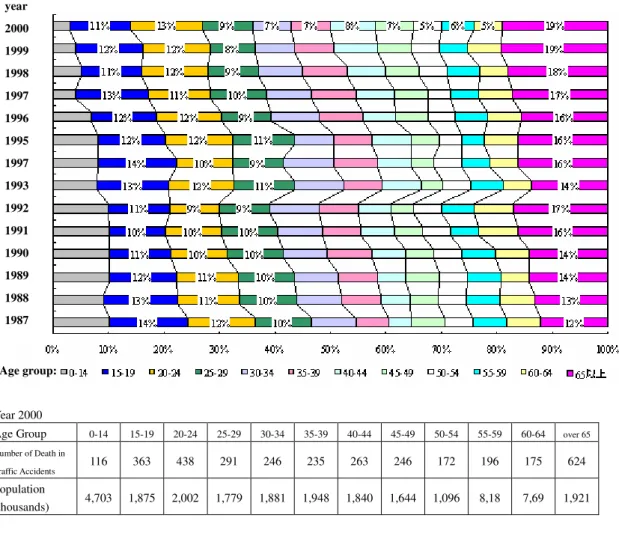
Viewing the age distribution of death in traffic accidents (shown in Figure 2.2), for the passing years, people over 65 had the biggest proportion (Lin and Lai, 2001b). It could be concluded that older people are significantly in danger of getting seriously involved into traffic accidents.
Tsai (2003) analyzed the reason of traffic accidents and regulation violation in his research. He discovered that traffic accidents strongly related to the driver’s behavior.
Based on the definition of psychologists, violation behavior is caused by the changes of environmental attribute of a person, the changes of the real world condition and the cognition of behavior origin (Hou, 1982). Forming drivers’ habits to observe the law, placing importance on the education of traffic safety and having sane psychology characteristics are the essential factors to avoid driving violations.
Tsai (2003) suggested that traffic safety can be improved through the following:
1. Enhancing educations on drivers;
2. Cumulating regulation penalty;
3. Establishing driving morality;
4. Training up for correct driving techniques;
5. Giving the correct concept of road authority;
Proportion of Death in Traffic Accidents / Proportion of Population
Age 1987 1988 1989 1990 1991 1992 1993 1994 1995 1996 1997 1998 1999 2000 14 down 0.36 0.32 0.37 0.37 0.38 0.38 0.32 0.33 0.33 0.30 0.17 0.23 0.19 0.14
15-19 1.56 1.44 1.33 1.22 1.11 1.22 1.44 1.56 1.33 1.33 1.44 1.22 1.33 1.38 20-24 1.20 1.10 1.10 1.11 1.11 1.00 1.33 1.11 1.50 1.50 1.22 1.33 1.33 1.44 25-29 1.00 1.00 1.00 1.00 1.00 1.00 1.22 1.00 1.22 1.00 1.25 1.13 1.00 1.13 30-34 0.89 0.89 0.89 0.89 0.89 1.00 1.00 1.00 0.78 1.00 0.89 0.89 0.78 0.88 35-39 0.86 0.88 0.88 1.00 0.88 0.88 0.78 0.89 0.78 0.89 0.89 0.89 0.78 0.78 40-44 0.80 1.00 1.00 1.00 1.00 0.86 1.00 0.75 0.88 0.75 0.88 0.88 1.00 1.00 45-49 1.20 1.00 1.20 1.25 1.25 1.00 1.00 0.80 1.00 1.00 1.00 0.86 0.86 1.00 50-54 1.25 1.25 1.25 1.25 1.25 1.25 1.25 1.25 1.00 1.25 1.00 1.25 1.25 1.00 55-59 1.50 1.50 1.50 1.50 1.25 1.50 1.50 1.25 1.00 1.50 1.25 1.50 1.25 1.50 60-64 2.00 2.00 1.25 1.50 1.75 1.75 1.67 1.67 2.00 2.00 2.00 1.67 2.00 1.67 65 up 2.00 2.17 2.33 2.33 2.29 2.43 2.00 2.29 2.00 2.00 2.13 2.25 2.38 2.11
ps: ≤1.00 1.50-1.99
1.00-1.49 ≥2.00
Figure 0.2 Age Distribution of Death in Traffic Accidents (1987-2000) (Source: Lin and Lai, 2001b)
6. Raising the efficiency of the police;
7. Improving the traffic safety of the intersection;
Year 2000
Age Group 0-14 15-19 20-24 25-29 30-34 35-39 40-44 45-49 50-54 55-59 60-64 over 65 Number of Death in
Traffic Accidents 116 363 438 291 246 235 263 246 172 196 175 624
Population
(thousands) 4,703 1,875 2,002 1,779 1,881 1,948 1,840 1,644 1,096 8,18 7,69 1,921 year
2000 1999 1998 1997 1996 1995 1997 1993 1992 1991 1990 1989 1988 1987
Age group:
8. Enhancing the ability of handling the case;
9. Carrying out the policy of “cars and motorcycles on the different lanes”; and 10. Complete facilities for traffic safety.
Researches suggested that education is an essential way to improve traffic safety.
In Taiwan, most of the education on traffic safety is implemented on children or at school. There is seldom reeducation on traffic safety for elder drivers.
1.8 Driving Assessments for Elder Drivers
In the previous sections, the problem of elder drivers’ safety was discussed. Some of the ways to solve this problem are elder driver education or driving assessments.
Educational intervention could make elder drivers avoid challenging driving situations, and increase their self-regulation and decrease their driving exposure (Owsley et al., 2004). In Taiwan, seldom was planned in this category. This section is going to introduce some assessment plans in the United States.
Assessment instruments for older driving include clinical assessments, on road tests, simulator-based tests and automatic psychophysical tests (Eby et al., 1998). One of the clinical assessment is a list named “SAFE DRIVE” that provides physicians to identify if the elder drivers should continue, curtail or stop driving (Wiseman and Souder, 1996). It recommends the physician:
1. Review the person’s safety record from the state department of motor vehicles;
2. Be on alert for signals of attention problems (patients who continually repeat questions or answers, lose track of conversation, appear quite confused);
3. Obtain family observations of driving ability and behavior, including any self restrictions;
4. Identify discrepancies between family/care-giving rating of driving ability and the patient’s self-rating;
5. Screen for problematic alcohol use;
6. Inquire about use of prescription and over-the-counter drugs associated with psychomotor impairment and driving problems;
7. Test reaction time;
8. Test for intellectual impairment (dementia) through tests of cognition or activities of daily living;
9. Assess vision and visuospatial function, visual acuity;
10. Inquire into the patient’s executive functions, or the ability to plan and sequence activities, self-monitor, and self-regulate behavior, and to make decisions (look for impulsivity, social inappropriateness, consistent in ability to follow directions).
On road test is a direct way to evaluate driving ability and safety. Base on the result of Stutts and Wilkins’ study in 2003, it was concluded that on road driving is especially helpful for elder drivers to decide continuing or stopping driving. However, it may not be sufficient to show mildly drivers’ real driving condition, or to predict future driving capability (Eby et al., 1998). Simulation-based test is another evaluation tool many investigators used, but it cost highly and lack of proven validity in evaluating driving. Automatic psychophysical test (APT) was designed to test some abilities related to driving (McKnight and McKnight, 1994). It accesses sensory, attention, perceptual, cognitive and motor abilities.
However, elder drivers may seek for tools to independently examine their own skills, or to do the assessment by the encouragement of family members (Eby, 1998).
Self-assessment instruments allow them to evaluate their driving skills privately, but there are few available. “The two most wildly distributed self-assessment instruments are Drivers 55 Plus: Check Your Own Performance (based upon research by Malfetti and Winter, 1987, conducted for the AAA Foundation for traffic Safety, 1994) and the Older driver Skill Assessment and Resource Guide: Creating Mobility Choices (American Association of Retired Persons [AARP], 1992)” (Eby et al., 2003). The following briefly introduces these two instruments.
Drivers 55 Plus: Check Your Own Performance
It is a 16-page booklet composed of three sections. The first section is a self-reported survey with questions in the following areas (Eby et al., 1998):
1. Signaling and checking when changing lanes;
2. Seat belt use;
3. Keeping updated on changes in driving and highway regulations;
4. Difficulty joining traffic on busy interstate highways;
5. Speed in reacting to dangerous driving situations;
6. Showing upset feelings in driving;
7. Wandering thought when driving;
8. Getting angry in traffic situations;
9. Getting regular eye checks for sharp vision;
10. Checking with doctor/pharmacist about impact of medication on driving;
11. Keeping updated on current health practices and habits; and
12. Concern among family and friends about the person’s driving ability.
The second section calculates the score for the survey and explains that if the driver can “go” or needs to “caution” or “stop” their driving. The third section is discussions of related safety tips and suggestions to help the elder drivers improving their driving performances.
Older Driver Skill Assessment and Resource Guide: Creating Mobility Choices
This 24-page guide is composed with self-assessment tests on reaction time, attention, vision, near-crash experiences and driving behavior (Eby et al., 1998).
Intersperse the sections are educational statements to inform the elder drivers about tips for driving safety.
Driving Decisions workbook (DDW, Eby et al., 2000a) is also a self-assessment instrument for elder drivers. “The intent of developing a new self-assessment instrument, …, was to improve upon exiting instruments”, expressed Eby et al.. In the next section, the development and research of DDW would be introduced in detail.
1.9 Development and Research of DDW
This section introduces the development and structure of DDW (Eby et al., 2000a), and review the applied research of DDW. The objectives of DDW are the following (Eby et al., 2003):
1. Expand the scope. DDW includes domains of vision, cognition, reaction time, crashes traffic citations, medical conditions, medication use and details on driving-related issues.
2. Simplify the format. DDW avoids the needs to calculate scores or self-administer diagnostic. Readers can answer the questions and get feedback immediately.
3. Organize the questions. The questions related to the same assessment area are grouped together in order to let the readers discover the potential problem easily.
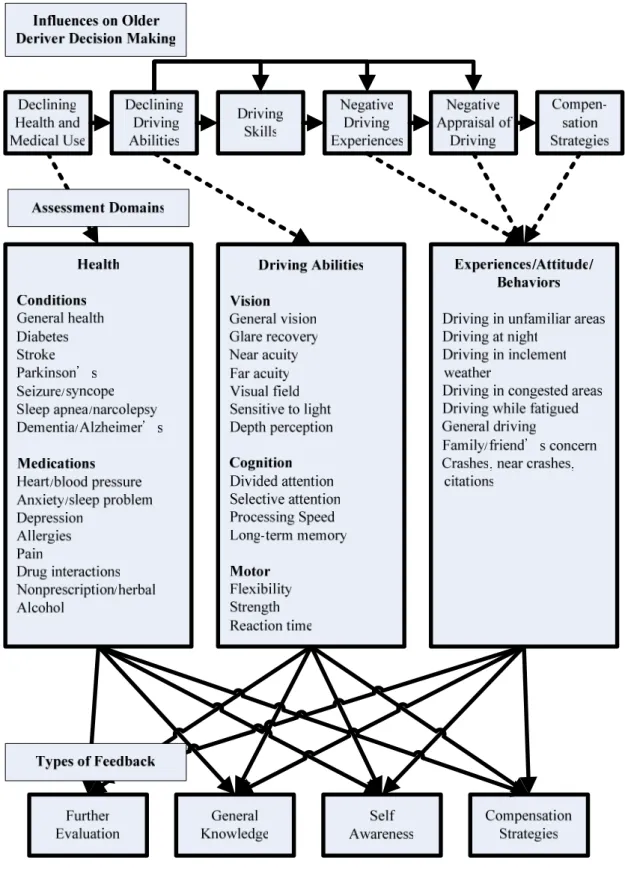
To develop the DDW, a series of focus groups was conducted (Eby et al., 2003), panel of experts was also convened to identify and specify assessment method, and discuss feedback and appropriate format of the work book.
Figure 2.3 is the framework to develop the DDW. We can see in the framework that DDW is a complete assessment instrument that contains the dimension of health (including health condition and medication condition), driving abilities (including visual ability, cognitive ability and motor ability) and driving experiences, attitude and behavior. In each dimension, it also provides feedback on further evaluation, general knowledge, self awareness and compensation strategies.
Eby et al. (2003) found out that DDW responses were positively correlated to their road test scores. After completing the DDW, most of the elder drivers regarded it a useful tool, three fourth were more aware of changes affected their driving and fourteen percents reported that they discovered changes that they hadn’t been aware of previously. Therefore, the DDW is indeed a complete and convenient instrument for assessing driving of the elderly.
Limits on elder drivers and their abilities, driving habits and driving safety of the elder drivers, traffic accidents and driving safety in Taiwan, driving assessments for elder drivers and development and research of DDW have been discussed by literature review in this chapter. Investigation and research of elder driving are needed in Taiwan.
The main purpose of this study is to improve elder drivers’ driving safety. The structure and study procedure would be introduced in the next chapter.
Figure 0.3 Framework for Developing the DDW.
(Source: Eby et al., 2003)
Methodology
Base on the research objectives and literature review, this chapter introduces the research method used in this study. First, the conceptual framework and hypothesis were constructed. Then, the procedure of the study and the materials would be introduced in detail. Finally, the analysis method used in the study would be revealed.
1.10 Conceptual Framework
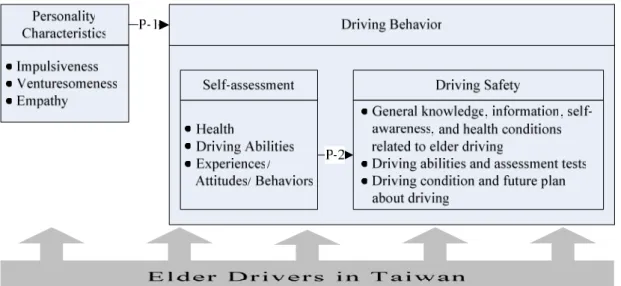
In order to discover the relation between elder drivers’ personality characteristics and driving behavior, and to evaluate the effectiveness of self-assessment on further evaluation, general knowledge, self awareness and compensation strategies of driving of the aged, the conceptual framework of the study is sown as Figure 3.1.
There are mainly two parts in the study. The first part examines the impact of impulsiveness, venturesomeness and empathy characteristics on elder drivers’ driving behavior. The second part evaluates the effectiveness of DDW, and finds out the impact of self-assessment on further evaluation, general knowledge, self awareness and compensation strategies. The subjects of this study are elder drivers over 65 years old in Taiwan.
Figure 0.1 Conceptual Framework
1.11 Research Propositions and Hypotheses
The purpose of this study is to explore the relationship among personality characteristics, self-assessment and driving behavior of the elder drivers in Taiwan.
Base on the purpose, the propositions and hypotheses are offered as following:
Proposition 1 Elder drivers’ personality characteristics have significant influence on driving.
H1-1: Different level on impulsiveness characteristics has significant influence on driving behavior.
H1-2: Different level on venturesomeness characteristics has significant influence on driving behavior.
H1-3: Different level on empathy characteristics has significant influence on driving behavior.
Proposition 2 Self-assessment has significant influence on improving driving safety of the elder drivers.
H2-1: Self-assessment has significant influence on general knowledge, information, awareness and the subjects’ future plans about their health conditions related to driving.
H2-2: Self-assessment has significant influence on information or concept about elder drivers’ driving abilities and subjects’ future plans on taking some assessment tests.
H2-3: Self-assessment has significant influence on self-reported driving condition and future plan about driving.
1.12 Subjects
The subjects in this study were elder drivers in Taiwan. The requirements of the subjects are listed below:
1. Over 65 years old;
Has a valid driver’s license; and
3. Having driving practice.
The experiment includes reading the DDW and answering two questionnaire of a total of more than 150 questions, each subjects needs more than one hour to complete the experiment. Moreover, drivers over 65 years old are not very popular in Taiwan.
Therefore, this complicated experiment is not suitable for numerously sending out of questionnaire via mail. For these considerations, the minimum sample size of this our experiment is 30. After taking out the uncompleted data, the final number of the subjects is 50.
1.13 Study Procedure
According to the conceptual framework, the study procedure is shown as Figure 3.2. First, the study is designed and planned. After the plan completed, we developed the materials needed in the study. DBQ, DHQ, IVE and DDW were translated to Chinese. Some content of them might not be appropriate, thus, we modified them as well. The questions used to evaluate the DDW are also designed. Then, we implemented the study by administering questionnaires and DDW, collecting the responses and analyzing the data. By the result of data analysis, we could conclude if the DDW is an efficient tool to improve older driving or not, and explore the relation between personality characteristics and driving behavior.
As Figure 3.2 shown, there are two parts of the study. The fist part was finding the relation between IVE and DBQ scores; the second part was introducing DDW to elder drivers in Taiwan and evaluated its effectiveness. These two parts would be described in detail in section 3.5 and 3.6.
Figure 0.2 Study Procedure
1.14 Relation between IVE and DBQ
This part asked the driving condition of elder drivers in Taiwan. The implement procedure, materials and analysis methods would be described in this section.
1.14.1 Procedure
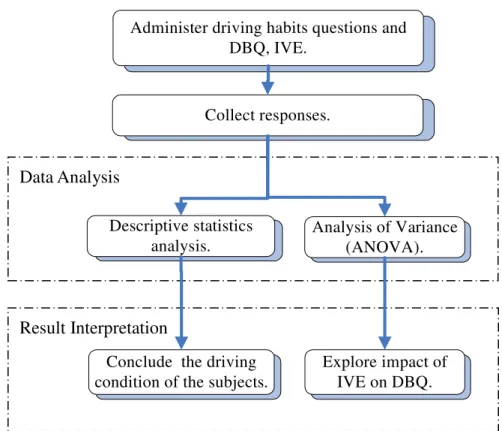
Figure 3.3 shows the implement procedure and analysis methods of the part to DDW evaluation
IVE v.s. DBQ
Study design
Obtain DHQ, DBQ
and IVE Obtain DDW
Translation and modification
Develop the evaluation questions
Administer IVE and DBQ
Evaluation posttest Administer DDW Evaluation pretest
Data Analysis
Result Interpretation Material development.
Implementation and data collection.
Figure 0.3 Study Procedure of the Part to Discover the Relation between IVE and DBQ
discover the relationship between IVE characteristics and driving behavior of the elder drivers. Questions of driving habits, DBQ, IVE are administered. After collecting the data, descriptive statistics analysis were done to summarize the driving condition of the subjects. Analysis of variance (ANOVA) was used to explore the relation between elder drivers’ personality characteristics and their driving behavior based on their responses to IVE and DBQ.
1.14.2 Materials
The complete questionnaire has two parts, as shown in appendix 2 and appendix3.
The translation of the questions were checked and modified by some transportation and ergonomics experts to avoid cultural or language differences.
The first part includes questions of driving habits, driving behavior and the first part of the evaluation questions. The second part includes the second part of the evaluation questions and subject profiles (age, gender and living place). Moreover, to
Data Analysis
Result Interpretation
Administer driving habits questions and DBQ, IVE.
Collect responses.
Explore impact of IVE on DBQ.
Descriptive statistics analysis.
Analysis of Variance (ANOVA).
Conclude the driving condition of the subjects.
avoid the subjects’ impatience at first, the 61-item IVE test is put in the second part of the questionnaire. The following sections would describe the content of the questionnaire.
The questionnaire of this part includes mainly four parts, subject profiles, IVE personality characteristics test, driving habits and driving behavior. Besides the profile part, the design of other tree parts of the questionnaire is described as following.
1.14.2.1 Questions of Driving Habits
Questions to collect drivers’ driving habits came from two sources. Some were adopted from the Driving Habits Questionnaire (DHQ, Owsley, et al., 1999) and others from the research of Lyman et al. in 2001. There are 14 questions in this part, included:
1. Average days, trips and places traveled per week;
2. Self-reported quality of driving;
3. Driving speed compared with the general flow of traffic; and
4. Difficulty of driving with certain driving situations: at night, in the rain, while along, on the freeway, with children, during rush hours, when change lanes, when making left hand turns at interactions, and parallel parking.
1.14.2.2 Driving Behavior Questionnaire (DBQ)
The 24-questione DBQ (Lawten et al., 1997) was used to check the driving behavior of elder drivers. Questions in DBQ could be classified to subgroups of errors, lapses and violations. Responses to each question, based on the frequency, are measured on a 6-point scale from 1=never to 6=nearly all the time.
1.14.2.3 IVE Characteristics Questionnaire
In this part, the IVE questionnaire developed by Eysenck and Eysenck is used.
After deleting 2 questions that couldn’t be clearly classified into one of the IVE dimensions, there are 61 yes/no questions to score the impulsiveness, venturesome- ness and empathy characteristics of the subjects.
1.14.3 Data Analysis
This part got the responses by questionnaires. Questions were mainly adopted from the referred questionnaires. The data were coded and analyzed by Microsoft Office Excel 2003 and SPSS 10.0.
1.14.3.1 Data Calculation
After collecting the data, the IVE and DBQ scores needed to be calculated.
For the DBQ, the questions were subgrouped into driving errors, driving lapses and driving violations. The relevant items were summed to create the scores of each subgroup.
For the purpose of the study, each IVE dimension will be categorized into two groups. First, the scores of impulsiveness, venturesomeness and empathy were summed.
Subjects in the higher 1/3 of each dimension were referred to as having high level of impulsiveness, venturesomeness and empathy, whereas those in the lower 1/3 were referred to as having low level in each dimension.
After calculating these scores, statistical analysis would be done to accomplish the research objectives. The analysis methods used in the study are introduced in the next section.
1.14.3.2 Analysis Methods
The statistical analysis methods used in this part are introduced as follow:
1. Descriptive Statistics Analysis:
Examine the frequent distribution, mean, variation and percentage distribution of the variable, and get the information of the subjects’ driving habits.
2. Analysis of Variance (ANOVA):
ANOVA is used to test the hypotheses to see if there is a significant difference. It is used here to explore the relation between elder drivers’
personality characteristics and their driving behavior of errors, lapses and violations, and to see if different level of impulsiveness, venturesomeness and empathy has significant impact on the elder drivers’ driving behavior.
1.15 DDW Evaluation
This part is mainly an experiment to examine the effectiveness of DDW. The implement procedure, materials and analysis methods used in this part would be described in this section.
1.15.1 Procedure
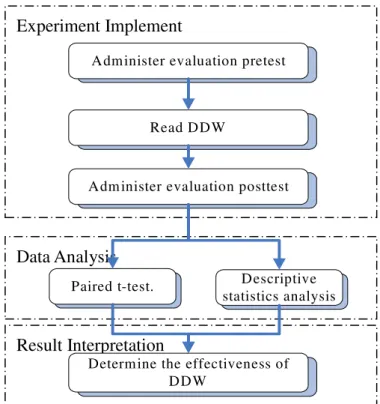
Figure 3.4 shows the implement procedure of the examination experiment on the effectiveness of DDW. First, the pretest of the evaluation questions was administered.
After completing the questions, the subjects were told to read the DDW. There was no time limit for them to read it. Finally, the posttest of the evaluation questions would be done after reading the DDW. ANOVA test was used to examine the difference of the answers to the evaluation questions before and after reading DDW. Descriptive statistics analysis was also used to see the subjective opinions of the subjects on the
Figure 0.4 Study Procedure of DDW Evaluation Data Analysis
Result Interpretation
Adm inister evaluation pretest
Paired t-test.
Determ ine the effectiveness of DDW
Read DDW
Adm inister evaluation posttest
Descriptive statistics analysis
Experiment Implement
usefulness of the DDW. Through the data analysis, the effectiveness of DDW in improving the driving safety of the elderly was examined.
1.15.2 Materials
Materials used in this part include DDW and the evaluation questionnaire, which are described as following.
1.15.2.1 Driving Decisions Workbook (DDW)
DDW is the main instrument used for elder drivers to assess their driving in this study. We obtained the DDW developed by Eby et al. and translated it to Chinese.
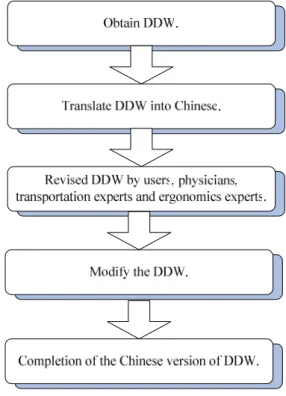
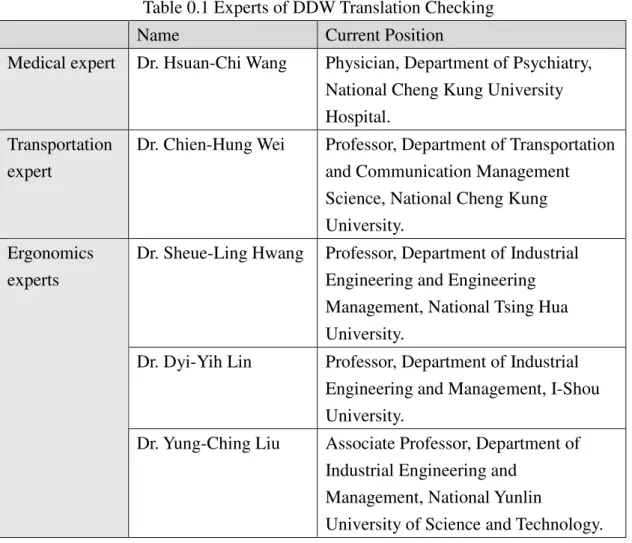
Figure 3.5 is the transit procedure of the DDW. After obtaining the DDW, we translated it to Chinese and modified some of the terms to make it appropriate to the situation in Taiwan. This first edition of DDW was given to users (drivers over 65 years old), physicians, transportation experts and ergonomics experts, and their opinion and suggestion would be the basis of modification. The experts helped the translation modification are listed in Table 3.1.
Figure 0.5 Transit Procedure of DDW
Table 0.1 Experts of DDW Translation Checking
Name Current Position
Medical expert Dr. Hsuan-Chi Wang Physician, Department of Psychiatry, National Cheng Kung University Hospital.
Transportation expert
Dr. Chien-Hung Wei Professor, Department of Transportation and Communication Management Science, National Cheng Kung University.
Dr. Sheue-Ling Hwang Professor, Department of Industrial Engineering and Engineering Management, National Tsing Hua University.
Dr. Dyi-Yih Lin Professor, Department of Industrial Engineering and Management, I-Shou University.
Ergonomics experts
Dr. Yung-Ching Liu Associate Professor, Department of Industrial Engineering and
Management, National Yunlin
University of Science and Technology.
The development and researches about DDW was introduced in section 2.5. There are five sections in the DDW, as following:
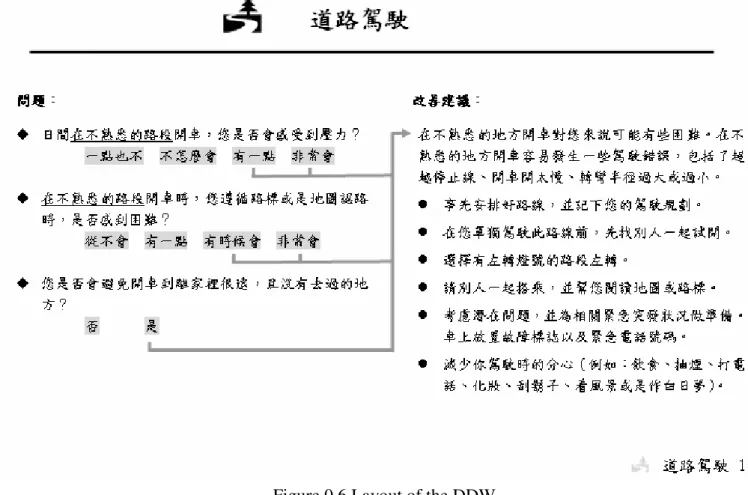
1. On the Road: This part examines driving experiences of the elderly. There are eight sets of questions in this part, including driving in unfamiliar areas, driving at night, driving in bad weather, driving in heavy traffic and some other driving condition of the elderly.
2. Seeing: This part examine the vision problem of the elder drivers. There are seven sets of questions in this part, including glare recovery, eyesight, sensitive to light and depth perception.
3. Thinking: There are four question sets in this part, including the examination of divided attention, selective attention, speed of decision making and memory.