行政院國家科學委員會專題研究計畫 期末報告
全球化下專業英語師資培育: 知識建構、課程發展與實踐 之研究
計 畫 類 別 : 個別型
計 畫 編 號 : NSC 101-2410-H-011-019-
執 行 期 間 : 101 年 08 月 01 日至 102 年 09 月 30 日 執 行 單 位 : 國立臺灣科技大學應用外語系
計 畫 主 持 人 : 駱藝瑄
計畫參與人員: 學士級-專任助理人員:葉旂妍
碩士班研究生-兼任助理人員:李畹琪
報 告 附 件 : 出席國際會議研究心得報告及發表論文
公 開 資 訊 : 本計畫可公開查詢
中 華 民 國 103 年 01 月 10 日
中 文 摘 要 : 在台灣,有關專業英文的研究甚多,但是,如何有效培養專 業英語師資的研究卻很少見。如何建構一套適合台灣現行社 會文化和教育體系的專業英文知識體系? 如何培養培養第二 外語教師學習者 (L2 teacher-learners) 具備教授自己不熟 悉的專業領域? 本研究旨在探究五位教師學習者學習教授專 業英文的歷程,並進一步深究探索-行動-反思的循環歷程對 建構專業英文知識系統和其對理論、研究、實踐的影響。本 研究主要成果有三: (一) 建構專業英文系統,(二) 提供專 業背景知識與英語教學的實證研究,(三) 加強專業英文理 論、研究、和實踐的認識,並建構理論和實務兼備的專業英 文教學知識系統。
中文關鍵詞: 專業英文, 高職生, 高職英文, 知識基礎
英 文 摘 要 : In Taiwan, the growth of English for Specific
Purposes (ESP, hereafter) in the past years has been rapid and prominent. However, research on ESP teacher education and professional development situated in Taiwanese higher education has been scant. What constitutes a theoretically and pedagogically sound knowledge base for ESP teacher education and
professional development situated in the Taiwanese sociocultural, institutional and educational context?
How does the L2 teacher education program help ESP teacher-learners to get prepared to teach English with content-knowledge that may be unfamiliar or even strange to teacher-learners (Belcher, 2011)? The purpose of the study was to investigate the processes of five teacher-learners' learning to teach and to explore the impact of inquiry-action-reflection cycle on the construction of ESP knowledge, and its
interrelationships between theory, research and, practice. The outcomes of the study can be discussed in three aspects. First, it bridges the missing link between L2 teacher education and ESP knowledge base.
Second, it enriches the literature that lacks empirical studies on the interaction between
specialist content knowledge and ESP instructional practice. Third, the study enhances our understanding of the interrelationships between ESP theory,
research, and practice, so as to create a
theoretically and pedagogically sound ESP knowledge base
英文關鍵詞: English for Specific Purposes (ESP), vocational high school (VHS), VHS English, knowledge base
行政院國家科學委員會補助專題研究計畫 ▉ 成 果 報 告
□期中進度報告
ESP Teacher Education in the Era of Globalization:
Knowledge Base, Curriculum Development and Implementation
全球化下專業英語師資培育:
知識建構、課程發展與實踐之研究
計畫類別:█ 個別型計畫 □ 整合型計畫
計畫編號:NSC 101 - 2410 - H -011 -019 - 執行期間: 101 年 8 月 1 日至 102 年 12 月 31 日
計畫主持人:駱藝瑄
計畫參與人員:蔡宜庭、沈玳玫、洪韻涵、徐念筠、柯承佑
成果報告類型(依經費核定清單規定繳交):█精簡報告 □完整報告
本成果報告包括以下應繳交之附件:
▉出席國際學術會議心得報告 (I)
▉出席國際學術會議心得報告 (II) 執行單位:國立台灣科技大學
中 華 民 國 102 年 12 月 31 日
ESP Teacher Education in the Era of Globalization:
Knowledge Base, Curriculum Development and Implementation
Abstract
In Taiwan, the growth of English for Specific Purposes (ESP, hereafter) in the past years has been rapid and prominent. However, research on ESP teacher education and professional development situated in Taiwanese higher education has been scant. What constitutes a theoretically and pedagogically sound knowledge base for ESP teacher education and professional development situated in the Taiwanese sociocultural, institutional and educational context? How does the L2 teacher education program help ESP teacher-learners to get prepared to teach English with content-knowledge that may be unfamiliar or even strange to teacher-learners (Belcher, 2011)?
The purpose of the study was to investigate the processes of five teacher-learners’ learning to teach and to explore the impact of inquiry-action-reflection cycle on the construction of ESP knowledge, and its interrelationships between theory, research and, practice. The outcomes of the study can be discussed in three aspects. First, it bridges the missing link between L2 teacher education and ESP knowledge base. Second, it enriches the literature that lacks empirical studies on the interaction between specialist content knowledge and ESP instructional practice. Third, the study enhances our understanding of the interrelationships between ESP theory, research, and practice, so as to create a theoretically and pedagogically sound ESP knowledge base
Keywords: English for Specific Purposes (ESP), vocational high school (VHS), VHS English, knowledge base
摘要
在台灣,有關專業英文的研究甚多,但是,如何有效培養專業英語師資的研究卻很少見。
如何建構一套適合台灣現行社會文化和教育體系的專業英文知識體系? 如何培養培養第二 外語教師學習者 (L2 teacher-learners) 具備教授自己不熟悉的專業領域? 本研究旨在 探究五位教師學習者學習教授專業英文的歷程,並進一步深究探索-行動-反思的循環歷程 對建構專業英文知識系統和其對理論、研究、實踐的影響。本研究主要成果有三: (一) 建 構專業英文系統,(二) 提供專業背景知識與英語教學的實證研究,(三) 加強專業英文理 論、研究、和實踐的認識,並建構理論和實務兼備的專業英文教學知識系統。
關鍵字:專業英文, 高職生, 高職英文, 知識基礎
INTRODUCTION
In Taiwan, the growth of English for Specific Purposes (ESP, hereafter) in the past years has been rapid and prominent. For example, in 2006, the National Chung Kung University (NCKU) Eagle Project, developed and implemented by the Center at NCKU, became the first institution in Taiwan dedicated to the development of ESP materials and curricula in place of the more
traditional English for General Purposes (EGP) courses offered by most colleges/universities in Taiwan to freshmen and non-English majors. The shift of the instructional focus from EGP to ESP aims to increase students’ motivation for English learning and to help students prepare for the demands of English in their future careers. Studies on ESP teaching and learning, particularly at the college/university level (e.g., Chien & Hsu, 2010; Huang & Li, 2008; Lo & Sheu, 2008;
Tsao, 2011) have gained major attention. However, research on ESP teacher education and professional development situated in Taiwanese higher education has been scant.
The dearth of ESP teacher education research in EFL contexts leads us L2 teacher educators to ask a series of legitimate questions: What knowledge base is required in order to respond to the call for a re-conceptualization for ESP (English for Specific Purposes) teacher education in the era of globalization? To be more specific, how does the L2 teacher education program help ESP teacher-learners to get prepared to teach English with content-knowledge that may be unfamiliar or even strange to teacher-learners (Belcher, 2011)? What instructional strategies can be drawn from a sociocultural theoretical perspective on professional development (Johnson & Golombek, 2010) to address various forms of “encountering” between content knowledge and English teaching? Finally, what constitutes a theoretically and pedagogically sound knowledge base for ESP teacher education and professional development situated in the Taiwanese sociocultural, institutional and educational context?
The results show that the processes of the teacher-learners’ went through to achieved their expected outcome including five stages: Stage I: Learning from a CI group, Stage II: An intensive workshop, Stage III: the 10-day intensive ESP program, Stage IV: giving PowerPoint presentation to the workshop supervisors, and Stage V: Reexamining ESP theory through ESP research and practice. The cycle of inquiry-action-reflection serves as mediation to contract teacher-learners’
knowledge about (1) content, (2) general pedagogical, (3) curriculum, (4) pedagogical content , (5) learners and their characteristics, (6) educational contexts, (7) educational ends, (8) competent (ESP) teachers’ characteristics, (9) the impact of learning to teach for workplace purposes.
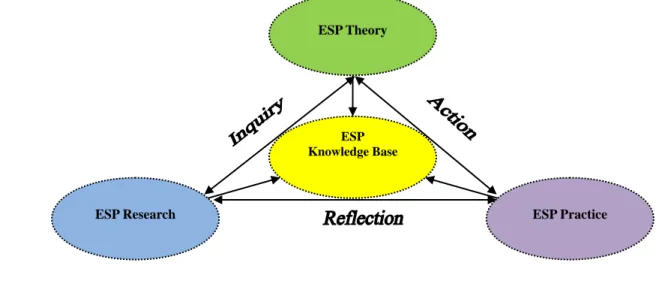
The outcomes of the study can be discussed in three aspects. First, it bridges the missing link between L2 teacher education and ESP knowledge base. Second, it enriches the literature that lacks empirical studies on the interaction between specialist content knowledge and ESP instructional practice. Third, the study enhances our understanding of the interrelationships between ESP theory, research, and practice, so as to create a theoretically and pedagogically sound ESP knowledge base (see Figure 1).
Research Questions
The study intended to answer two questions:
1. What processes did the teacher-learners go through to achieve the expected outcome of the project?
2. From a SCT perspective, what do the processes inform us about the knowledge base for ESP theory, ESP research, and ESP practice?
LITERATURE REVIEW
The important theories and concepts underpinning this study include a sociocultural theory (SCT) perspective of teacher learning, ESP course design, specialist content knowledge and ways of ESP instructional practice, the knowledge base required for effective teaching.
Understanding Teacher Learning from a Sociocultural Theory (SCT) Perspective
A sociocultural perspective of teacher learning suggests that what teachers learn to teach has much to do with how teachers learn to teach (Johnson, 2006, 2009). This shift of the
epistemological perspectives on human learning foregrounds the fundamentally social nature of teacher learning and the activities of teaching. Hence, learning to teach from a SCT perspective, as Johnson sees it, is based on the premise that knowing, thinking, and understanding come from participating in the social practices of learning and teaching in specific classroom and school situations. Teacher learning and the activities of teaching are documented and understood as growing out of participating in the social practices in classrooms, and what teachers know and how they use that knowledge in classrooms in highly interactive manner that involves knowledge of self, setting, students, curriculum, and community.
What does a SCT perspective of teacher learning tell us about teacher cognition? Teachers’
knowledge and beliefs are constructed through and by ways of thinking, talking, and acting that have been historically and culturally ingrained in the communities of practice in which they participate. This alternative perspective opens up the possibility of documenting how teachers come to know, how different concepts develop over time and function in teachers’ consciousness, and how this internal activity transforms teachers’ understanding of themselves as teachers, of their students, and of the activities of teaching.
A SCT perspective recognizes that teacher learning is not merely a process of enculturation into the existing social practices involved in teaching and learning but also a dynamic process of reconstructing and transforming those practices to be responsive to both individual and local needs. In the process of learning to teach, teachers actively connect theoretical knowledge to their own experiential knowledge as they describe and interpret the lived experiences gained from their previous years of schooling. This interactive process emphasizes how the new understanding helps teachers reorganize their experiential knowledge and how this reconstruction of knowledge creates a new lens for interpreting their understanding of themselves and their classroom
practices.
Informed by the SCT perspective of teacher learning, the notion of strategic mediation in
learning to teach proposed by Johnson & Arshavskaya (2011) was helpful for getting the five
teacher-learners prepared because they did not only conduct their microteaching with their peers in university setting but also transformed their practice of teaching to a group of VHS students in a real context.ESP Course design
Hutchinson and Waters (1987) identified three approaches to ESP course design.
Language-centered course design draws a direct connection between the analysis of the target
situation and the content of the ESP course. The learning needs of the students are not accountedfor at every stage of the course design process. Skills-centered course design tries to build on the positive factors learners bring to the ESP course, enabling learners to achieve on their own paths.
This approach focuses more on language use than on language learning. A learning-centered
approach is based on the principle that learning is totally determined by the learner. Learning is
viewed as a process by which the learners use what knowledge or skills they have in order to make sense of the new information. This approach concerns not only what competence a learner acquires but also how this particular competence is acquired.Dudley-Evans and St. John (1998) pointed out a number of parameters that need to be
considered in approaching ESP course design: (1) Should the course be intensive or extensive? (2) Should the learners’ performance be assessed or non-assessed? (3) Should the course deal with immediate needs or with delayed needs? (4) Should the role of the teacher be the provider of knowledge or should it be as a facilitator? (5) Should the course have a broad or narrow focus? (6) Should the course be pre-study or pre-experience or run parallel with that study or experience? (7) Should the materials be common-core or specific to learners’ study or work? (8) Should the
learners be homogeneous or heterogeneous? (9) Should the course design be worked out by the language teacher or should it be subject to a process of negotiation with the learners? (p.
145-146).
In discussing approaches to ESP course design, Basturkmen (2006) investigated four important topics: (1) varieties of language, (2) needs analysis, (3) types of syllabuses, and (4) narrative and wide-angle course designs. In terms of varieties of language, there are two perspectives. Should there be a specific-purpose language based on and extending from a basic core of general language? Or does language exist as one variety or another with no basic core language? Different types of syllabuses can emerge during the design process. Specifying and ordering the content of an ESP course involves a number of theoretical stances (e.g., synthetic vs.
analytic) and reveals the course designer’s beliefs about the nature of teaching and learning.
Finally, the principles of course designs suggest that when needs are specific, a narrow-angled course may be appropriate, whereas when the needs are more general, a wide-angle course may be
Specialist Content Knowledge and Ways of ESP Instructional Practice
Belcher (2009) has laid out different relationships between content-area specialists and language teachers (ESP practitioners), suggesting different degrees of specialist knowledge an ESP practitioner needs in order to accomplish to be needs-knowledgeable ESP instructors (pp.
11-13).
It is suggested that ESP practitioners may not really need as specialist knowledge as has been assumed. What ESP practitioners actually need is knowledge about an area, particularly its values and preferred genres, rather than in-depth knowledge of an area. In many EAP situations, knowledge about academic literacies in general may serve instructors well, especially with respect to equipping students with rhetorical flexibility, ability to move with relative ease from the literacy demands to one subject area to another.
Another way of keeping the subject matter (content knowledge) at manageable levels, for both students and ESP practitioners, is the sustained content-based approach instruction (SCBI) or subject-area course simulation. SCBI classes focus on a limited range of closely related topics for an entire term, with materials taken from actual subject-area textbooks, usually at a lower grade level (e.g., introductory course) than that of the students. In this way, specialist knowledge demands on the instructor and language (ESP) demands on the students are kept at less than overwhelming levels. There are times when a more narrow-angled approach would seem to serve
students best. In such cases, increasing one’s own content-area knowledge may be essential, and dipping into actually texts that one’s students are coping with may be helpful. However, ESP practitioners should not see themselves working in isolation. They can found solutions in the ESP research literature (e.g., English for Specific Purposes, the Journal of English for Academic purposes, etc.) or other professional resources (e.g., the British Association of Lecturers in English for Academic Purposes).
As such, content-area specialists can serve as specialist mentors or significant resources for more narrow-angled approaches. The specialist informants can serve as sources of support, sharing sample documents and recommending authentic communicative tasks. Subject-area specialists can also collaborate even more extensively by team-teaching courses with ESP practitioners, through which giving students access to subject and language experts
simultaneously. Lastly, another type of subject-area and ESP specialist collaboration is in the form of “learning communities”. Members of a learning community take the same cluster of classes and instructors of the clustered classes can easily consult with each other on the needs of the language learners. Finally, ideally, students in learning communities also become sources of content knowledge, linguistic knowledge and emotional support for each other.
The Knowledge Base for Teaching
Shulman (1987) defined seven categories of knowledge that form a base for teaching. He maintained that if teacher knowledge were organized into a handbook, the categories would include the following (p. 8):
1. Content knowledge
2. General pedagogical knowledge, with special reference to those broad principles and strategies of classroom management and organization that appear to transcend subject matter;
3. Curriculum knowledge, with particular grasp of the materials and programs that serve as
“tools of the trade” for teachers;
4. Pedagogical content knowledge, that special amalgam of content and pedagogy that is uniquely the province of teachers, their own special form of professional understanding;
5. Knowledge of learners and their characteristics;
6. Knowledge of educational contexts ranging from the workings of the group of classrooms and the governance and financing of school districts to the character of communities and cultures; and
7. Knowledge of educational ends, purposes, and values and their philosophical and historical grounds.
METHOGOLOGY
The Major and Secondary Participants
Five teacher-learners1 were the primary participants of the study, who were to-be certified secondary EFL teachers in a university of science and technology. All of them had an educational background in VHS and ideally would like to become an English teacher after they were certified.
“Secondary participants” refer to twenty-four VHS students of international trade in a public VHS school in Taipei city.
Data Collection and Analysis
The major data sets under investigation are from three sources: interviews with the five teacher-learners, their reflection papers, and field notes throughout the project. The data analysis went through two stages. In the first stage, the notion of collaborative inquiry-action-reflection cycle (Bray, Lee, Smith, & Yorks, 2000) serves as both a theoretical framework for
conceptualizing the experience that the five teacher-learners gained in the study during data collection, and an analytical framework for analyzing questions of importance to the
teacher-learners, actions taken to respond to their collaborative inquiry (CI), and how they
responded to their action through reflection. In the second stage, the knowledge base proposed by Shulman (1987) was employed as a framework for analyzing different types of knowledge base that teacher-learners gained through the repeated cycles of inquiry-action-reflection experience and meaning making process.
FINDINGS
1. What processes did the teacher-learners go through in order to achieve the expected
outcome of the project (teaching VHS students to be able to give PowerPoint
presentations to workplace supervisors at the workplace)?
The processes of the teacher-learners’ went through to achieve their expected outcome including five stages: Stage I: Learning from a CI group, Stage II: An intensive workshop for teacher-learners, Stage III: the 10-day intensive ESP program for VHS students, Stage IV: giving PowerPoint presentation to the workshop supervisors, and Stage V: Reexamining ESP theory through ESP research and practice
Stage I: Learning from a CI Group
In the first stage, the teacher-learners initiated a CI group among five of them with the aim to familiarize themselves with the content knowledge they would be teaching. With the
recommendations of a specialist teacher of International Trade, they planned to study
“Introduction of Marketing” and “Basic International Trade in English” through the CI group.
1 Two terms, teacher-learners and learner-teachers are used interchangeably in this paper to refer to the five to-be certified secondary English teachers. They are teacher-learners because they learn to teach ESP to VHS students in this project. They are learner-teachers because for VHS students they are teachers although they are still students in college.
This is my first time to learn some lessons regarding marketing by study group [CI].
Through team members’ sharing I have more motives for learning. We start from knowing nothing to get lots of marketing concepts. Although we don’t have any background
information about marketing, we still can understand the ideas by the process of discussing and searching for some data on the Net. (Jessica, 03/26/2012)
Rather than cramming themselves with the contents through lecturing and rote
memorization, they decided to distribute the contents to each other and to learn the contents through each other’s teaching. With detailed curriculum planning and lesson plan, they started to learn to teach to real target audience with an authentic purpose.
In this week, I found another function of study group. We can develop our teaching
skills through paying more attention on the methods each member adopts to teach the rest of us; it’s very crucial since we all need to teach students in the summer program.
Without experienced teaching skills, the difficulties for us to successfully complete the program will increase. Therefore, observing the performance of each member while conducting the study group is win-win strategy, because we can learn the specialist knowledge and teaching skills at the same time. What can be better than that? (Lucas, 04/02/2012)
In addition, during this stage, some team members also conducted some classroom
observations in VHS English classroom to get a sense of who their target learners were, how the students interacted with their English teacher, and how they learned in the class. Although all the teacher-learners were VHS students before they were quite familiar with the contents introduced and the way of how the contents were delivered in class. However, to their surprise, they found that the students were not afraid of their English teacher. Students liked to chat with each other.
They voiced their opinions without politeness. This posted a class management issue for them.
One of them reflected:
This never happened when I was in vocational high school so it was like a cultural shock for me. We were a little worried about the participants in our 10-day program; however, I still have confidence that the participants won’t behave like this if we build good
relationship right from the beginning. Furthermore, my assumption was that the instructor was in their mother’s age, and maybe that’s why it wasn’t easy for her to control them.
(Rainy, 06/18/2012)
Stage II: An Intensive Workshop for Teacher-Learners
The intensive workshop lasted for one week (6/16-6/22, 2012). There were three purposes of the workshop. First, the teacher-learners were assigned ESP readings to understand the updated studies, theories and concepts that inform ESP teaching and learning. For example, one of the assigned readings was by Belcher (2009): What ESP is and Can be: An introduction. They were required to preview assigned articles, write a summary, highlight the important concepts and quotations for them, and raise their questions in regards to what they would be conducting in the ten-day intensive program in the VHS. Then, a member of the team was asked to give a
PowerPoint presentation on the journal article to the CI group and the instructor (the researcher).
Second, as they would conduct classroom research for their graduation project, they needed
to get their research instruments ready in the workshop. As the teacher-learners decided to
investigate whether the VHS students’ general and ESP proficiencies would be improved through the ESP program, they would need to discuss what instruments they needed to employ and what procedures they needed to go through for data collection. Cheng (2009)’s article: ESP classroom research: Basic consideration and future research questions was used to situate teacher-learners in ESP research and to bring up questions and issues regarding ESP research prior to their project.
Third, the intensive workshop was also a place and time for the teacher-learners to go through a micro-teaching cycle proposed by Johnson and Arshakaya (2011) prior to their actual teaching in the ESP program in the VHS, which includes: (1) collaborative lesson planning, (2) practice-teach, and (3) collaborative lesson planning: post-practice teach. The five
teacher-learners were divided into two groups: two of them took care of teaching Business Writing in the morning, and three of them were in charge of PowerPoint Presentation in the afternoon. These two groups implemented their collaborative lesson planning through
“practice-teach” and gained feedback and suggestions from their team members and the instructor, based on which they revised their lesson planning, materials, and handouts.
Stage III: The 10-Day Intensive ESP Program for VHS
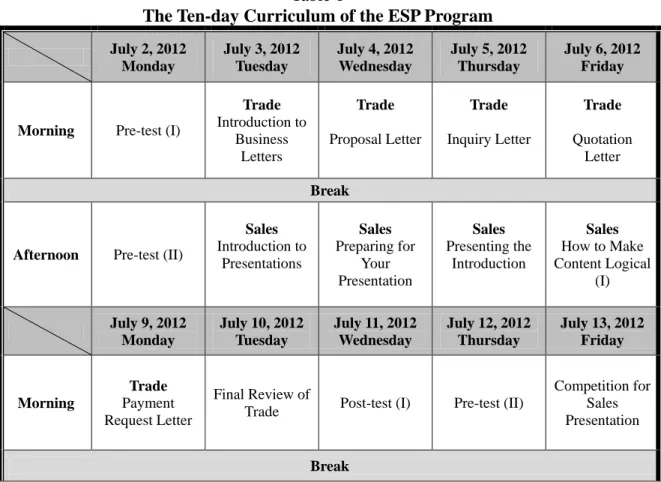
Table 1 gives an overview of the contents covered in the 10-day intensive program for VHS.
Except the pre-test (I) and (II) on the first day, and the post-test (I) and (II) on the last day, the morning sessions focused on teaching business writing, and the afternoon sessions centered on teaching the knowledge and on promoting the skills for giving a PowerPoint Presentation.
Table 1
The Ten-day Curriculum of the ESP Program
July 2, 2012 Monday
July 3, 2012 Tuesday
July 4, 2012 Wednesday
July 5, 2012 Thursday
July 6, 2012 Friday
Morning Pre-test (I)
Trade Introduction to
Business Letters
Trade Proposal Letter
Trade Inquiry Letter
Trade Quotation
Letter
Break
Afternoon Pre-test (II)
Sales Introduction to
Presentations
Sales Preparing for
Your Presentation
Sales Presenting the
Introduction
Sales How to Make Content Logical
(I)
July 9, 2012 Monday
July 10, 2012 Tuesday
July 11, 2012 Wednesday
July 12, 2012 Thursday
July 13, 2012 Friday
Morning
Trade Payment Request Letter
Final Review of
Trade Post-test (I) Pre-test (II)
Competition for Sales Presentation
Break
The major difficulties that teacher-learners encountered at this stage were two: first, the VHS students were not familiar with the new way of teaching in terms of the contents and teaching methods. Second, there was a wide gap between VHs students’ English proficiencies and their required English proficiencies for giving PowerPoint presentations required in the program. To overcome the challenges, they asked help from their peers to give assistance while all the group members were engaged in group work. Those who were slow learners would get extra scaffolding from other college students.
The teacher-learners’ actual teaching was videotaped. They conducted a recall session with the instructor to discuss their teaching. This was an insightful experience for all the
teacher-learners as they did not have much experience in teach actual learners, nor did they have a chance to observe their own teaching, learning from what their peers and instructor said about their teaching, and expressing their thought while teaching at the moment. The recall session had a great impact on their subsequent teaching. One made a remark:
After the recall session on Thursday night, I realized there were still too many flaws in our course design. This was why I decided to sit down with Gina to prepare for the next day’s lesson. (Demi, 07/06/2012)
IV: Giving a PowerPoint Presentation to the Supervisors at the Workplace
Prior to the 10-day program, each of the four teacher-learners asked permission from the supervisor of a workplace (for which their VHS group would make PowerPoint presentation) for offering the VHS group a space and time to listening to their PowerPoint presentation prepared for the designated workplace. For example, one VHS group who made a PowerPoint presentation from the perspective of Studio Classroom. After they completed the presentation, they went to the company of the Studio Classroom and gave the PowerPoint presentation to their supervisors and listened to what the supervisors would comment on their presentation.
This experience of giving PowerPoint presentations to the workplace supervisors and listening to their comments had a profound impact on how teacher-learners thought about interrelationships between text, genre, professional practice, and professional culture. One of them felt that the PowerPoint presentation should have been made from the perspective of the company. She remarked:
I would go to the workplace in person before the ESP summer program started and have an interview with the staff. I have learned that it is important for me to be familiar with the episodes in “Emotional Code” before I teach my students about making a presentation based on it. So I can tell my students the purpose of this presentation based on the company’s perspective.” (Reflection, Demi, 11/26/2012)
One teacher-learner believed it was important to understand professional culture prior to engaging VHS students in making PowerPoint presentation. Besides, she also believed giving a PowerPoint presentation to the workplace supervisors at the workplace was a great way to motivate students’ learning. She said:
If I had chance to do it next time, I will definitely go deeper to the professional culture first to ensure that I know things well in this company. Secondly, I will make sure that what we present is the things necessary or useful in certain workplaces so that my students will not do presentations in the wrong direction. However, most of the people in the companies might not have much time to connect to us, so the practicality of this plan still depends on how much they are willing to cooperate with us. However, I still think that it is a great chance for students to go deeper into a specific workplace to broaden their horizons and trigger their learning motivations.” (Reflection, Gloria, 11/26/2012)
To understand the company’s professional culture, one teacher-learner suggested that they should conduct interviews with the supervisors prior to their development of materials and their teaching. She explained:
I will understand deeply about the company’s culture, that is, what the purpose of the
presentation is or how English is applied to in the field. Therefore, I think I can interview the manager first or if possible, I would like to observe what’s really going on at workplaces and take some notes. Besides, I just wonder whether the students are able to observe by
themselves, and maybe they will have better ideas how to do the presentation.” (Reflection, Jessica, 11/26/2012)
Another teacher-learner suggested that conducting an internship in the workplace from which his VHS students would prepare a PowerPoint presentation was an alternative to bridge the gap between the audience and the purpose that the teacher-learners imagined together with their VHs students and the actual audience and purpose in a workplace context.
I will decide which company we are going to cooperate with first. Then start to investigate the workplace culture and knowledge related to English. If it’s allowed, I want to have an opportunity to do internship for a certain period, for me to experience using English in the company, to see how they use English. After collecting data, course design and material development are followed. In the end, I still hope students are allowed to have a chance to show what they learned to the workplace specialist, and receive comments by them.
(Reflection, Lucas, 11/27/2012)
Stage V: Re-examining ESP Theory through ESP Research and Practice
‘Practice’ here at Stage V refers to the experiences teacher-learners gained in the previous four stages. This stage was set because it was intended to invite the teacher-learners to
re-examine ESP theory through the experience they gained throughout the project. The six articles were chosen at the first place because they could be used to inform their ESP research and practice in the 10-day intensive ESP program, the theories discussed in the literature also were used to inform their practice in their CI group prior to their implementation of the ESP program, their practice during the ESP program, and the practice at the workplace. The only difference between the two times of reading was that when they were first assigned to read the articles they did not have the experience of Stage III (the 10-day intensive ESP program) and Stage IV (giving PowerPoint presentations to workplace supervisors). Table 2 outlines the schedules and assigned articles at the Stage V.
Tab le 2
Schedules and Assigned Articles for Re-visiting ESP Theory
Date Articles
10/8 Discussion on reading article:
Disciplinary Specificity by Ken Hyland (2011) 10/15 Discussion on reading article:
Products, processes and practitioners: A critical look at the importance of specificity in ESP1 by Laurence Anthony (2011)
10/22 Discussion on reading article:
Current perspectives on teaching world Englishes English as Lingua Franca by Jenkins (2006)
11/5 Discussion on reading article: Genre analysis, ESP and professional practice by Vijay K. Bhatia (2009)
11/12 Discussion on reading article:
Strategic Mediation in Learning to Teach by Johnson & Arshavskaya (2011) 11/19 Discussion on reading article:
ESP classroom research by Cheng (2009)
With the diverse experiences that the teacher-learners gained through their learning from CL group, through their ESP research and practice from their 10-day intensive ESP program, and through the practice and comments they gained from their workplace supervisors,
teacher-learners, they gained a deep understanding of the ESP theories and what they meant to them. Instead of being concerned with their lack of specified ESP knowledge in the beginning of the project, they understood Belcher’s point (2006), not from ESP theory that conceptualizes the relationship between ESP teacher, specialist knowledge and ESP learners, but also from their practice with the actual students in authentic contexts. They learned from the experience that their ESP learners, who possess professional background that they did not have, could serve as “most readily available sources” for their teaching. As one teacher-learner reflected:
… How much knowledge of the content-field should ESP specialists be
equipped with? That has been the question all along. “ESP practitioners may not really need as much specialist knowledge as has been assumed.” (p. 11) Yes, after the program, I
realized that I haven’t been equipped with as much knowledge as the students of the area but we have taught them ESP. However, if we had absolutely no knowledge of their field, we wouldn’t have been able to teach them how to write “international trading letters.” We did come across being less knowledgeable about the specialist-area than the students, but we learned that this isn’t something to be afraid of. After all, students are our “most readily available sources.
Furthermore, with the actual teaching-experience with the VHS students, in addressing students’ needs, teacher-learners came to realize that they was much to be considered given the different sociocultural and educational circumstances facing ESP teaching and learning in Taiwan.
One teacher-learned commented after his second reading on Anthony’s article (2011).
“
‘Now, many ESP courses are composed of a heterogeneous group of learners from multiple professions.’ Although the students in our summer camp were all from the department of international trade, they weren’t all determined to take their major as career goals. Then, what did our teaching goal mean? The fact that students were to write business letters was because their major, or because that’s what they wanted to learn? Setting a teaching goal is difficult. Should we take students’ learning needs as precede or should we take students’
expected ability as main goal? (Lucas, 10/26/2012)
2. What a SCT perspective, what do the processes inform us about the knowledge base for ESP theory, ESP research, and ESP practice?
From a SCT perspective, what teacher-learners learned to teach in this study had much to do with how they learn to teach. Teacher-learners initiated their journey of inquiry from forming an inquiry group, through asking questions of importance at each stage, they proposed action plans and put them into practice. Then, they made sense of the actions and reflected upon the process and the experience. For each stage, there are several activities conducted based to different inquires proposed. These activities served as mediation to help teacher-learners see how different action plans helped construct their knowledge about (1) content, (2) general pedagogical, (3) curriculum, (4) pedagogical content , (5) learners and their characteristics, (6) educational contexts, (7) educational ends, (8) competent (ESP) teachers’ characteristics, (9) the impact of learning to teach for workplace purposes. Not every action that teacher-learner took during the process would contribute to all the aspects of knowledge. However, each activity embedded in each stage, contributed a great deal to many aspects of teacher-learners’ understanding of ESP research, ESP theory, and ESP practice, which in turn, reinforced the building of knowledge base for ESP teaching and learning for teacher learners.
Table 3 illustrates how each stage contributes to teacher-learners’ understanding of different types of knowledge. Although giving PowerPoint presentation to workplace supervisors served mainly for teacher-learners to gain the knowledge of the importance of understanding the workplace culture and practice when teaching ESP for workplace purposes, it did provide profound impact on teacher-learners’ perception of ESP teaching and learning, and on their perception of how to get themselves prepared for teaching ESP in general and ESP for workplace purposes in particular.
Table 3
Five Stages and Teacher-Learners’ Gains in Different Types of Knowledge
Stages Stage I Stage II Stage III Stage IV Stage V
Types ofKnowledge
Learning from the CI group
The intensive workshop for teacher-learners
The 10-day intensive
ESP program for VHS
Giving PowerPoint presentation
to workplace supervisors
Re-examining ESP theory, practice and research
1. Content
knowledge V V V V
2. General pedagogical
knowledge V V
V V
3. Curriculum
knowledge V V V V
4. Pedagogical content
knowledge V V V V
5. Knowledge of learners and their
characteristics
V V V V
6. Knowledge of educational
contexts V V V V
7. Knowledge of educational
ends V
8. Knowledge of competent (ESP) teachers’
characteristics
V V V V
9. Knowledge of the impact of learning to teach for workplace purposes
V V
DISCUSSION
The results of the study are discussed from two aspects: learning to teach ESP from a SCT perspective, and the interrelationships between knowledge base, ESP theory, research and practice.
Learning to Teach ESP from a SCT Perspective
In this study, teacher-learners’ learning to teach was conceptualized by the notion of CI-action-reflection cycle (Bray, Lee, Smith, & Yorks, 2000) along with the notion of strategic mediation in learning to teach proposed by Johnson & Arshakaya (2011). The former notion was used to capture how teacher-learners learned to teach ESP through five-stage of repeated cycles of activities. The latter notion was employed to depict particularly how the eight mediational teaching-to-teach activities (1) classroom observation, (2) tutoring assignments, (3) collaborative lesson planning: pre-practice teach, (4) practice-teach, (5) collaborative lesson planning:
post-practice teaching, (6) actual teaching, (7) stimulated recall session, and (8) reflection paper were supported by the CI-action-reflection notion and how the intensity of eight actions enhanced the overall broad cycle of learning.
A sociocultural perspective of teacher learning suggests that what teachers learn to teach has much to do with how teachers learn to teach (Johnson, 2006, 2009). In this study, teacher-learners learned to understand cognitive constructs required for ESP teaching and learning from raising important questions through collaborative inquiry, transform the inquires into feasible action plans, and carry them out through the five stages of activities. Teacher-learners’ way of learning to teach ESP was based on the premise that knowing, thinking, and understanding came from participating in the social practices of learning and teaching in specific classroom (a public VHS classroom in this case) and school situations (a public VHS school in this case). Teacher learning and activities of teaching were documented through keeping reflection papers, and were
understood as growing out of participating in the social practices in classrooms. What
teacher-learners learned to know and how they used that knowledge in classroom from their CI group and university classroom to the ESP research and practice in VHS classrooms
foregrounded the fundamentally social nature of teacher learning, which involves of knowledge of self, students, curriculum, and community.
However, Johnson’s social nature of teacher learning focuses on the natural interaction in classroom between the teacher, the learners, and the learners themselves. Non-classroom setting was not particularly addressed in her notion of strategic mediation in learning to teach. In this study, teacher-learners had to a group leader to guide the VHS students to accomplish a PowerPoint presentation for a workplace to which they would give a presentation.
Teacher-learners’ knowledge about the importance of getting to know the workplace practice and culture pointed out the importance of extending the knowledge base to non-classroom settings if teacher learners are required to be informed about the professional culture and practice of a workplace.
Interrelationships between ESP Knowledge Base, Theory, Research and Practice
Schulman (1986)’s theoretical constructs of knowledge base for teaching has been proposed about three decades ago. Over the years, research about getting to know different base for
different subject matters of teaching was conducted. However, few studies were conducted from a SCT’s perspective to understand the knowledge base for learning to teach ESP. This is, the study
intended to understand how teacher-learners came to know ESP, including ESP research, ESP theory, and ESP practice (teaching and learning), how different concepts about ESP developed over time and functioned in teacher-learners’ consciousness, and how this internal activity
transformed teacher-learners’ understanding of themselves as potential ESP practitioners in VHS, of their VHs students, and of the activities of ESP teaching and learning both in the classroom, and in the workplace.
The interrelationships shown in this study demonstrates that teacher learning is not merely a process of enculturation into the existing EFL practices involved in VHS English teaching and learning, but also a dynamic process of reconstructing and transforming the general EFL practices in VHS English classroom to ESP practice that both teacher-learners and their target learners have not experienced before. In the process of learning to teach, teacher-learners actively connected theoretical knowledge they gained through their ESP program in university, to their own experiential knowledge that they created for themselves through various stages of
actualizations and reflections. With the internalized knowledge they gained through externalizing their new understanding, teacher-learners were able to describe and interpret their lived
experiences gained from the various stages of the project. This interactive process emphasizes how the new understanding helps teachers reorganize their experiential knowledge, how this reconstruction of knowledge creates a new lens for interpreting their understanding of themselves and their classroom practices, and most importantly, how their reconstruction of knowledge and their new lens of understanding through an inquiry-action-reflection cycle helps reshape a brand new interrelationships between knowledge base for ESP theory, research, and practice (see Figure 1).
Figure 1 Interrelationships between ESP Knowledge Base, Theory, Research and Practice
through Inquiry-Action-Reflection Cycle
ESP Research ESP Practice
ESP Theory
ESP Knowledge Base
CONCLUSION AND IMPLICATIONS
How did teacher-learners learn to teach ESP while they were prepared to be ESP teachers for VHS students in Taiwan? How can they be better prepared through the construction of ESP knowledge base? This study concludes that to learn to be ESP
practitioners in general and teaching ESP in particular, teacher-learners need to be prepared to equip with different types of knowledge including knowledge about (1) content, (2) general pedagogy (3) curriculum knowledge, (4) pedagogical content, (5) learners and their characteristics, (6) educational contexts, (7) educational ends, (8) competent (ESP) teachers’
characteristics, (9) the impact of learning to teach for workplace purposes.
The results of the study also suggest that (1) teacher-learners’ learning and
understanding of ESP theory through ESP literature provided in the university, (2) their research in VHS classroom and workplaces, and (3) their practice in implementing a ten-day ESP program to VHS students, and (4) giving PowerPoint presentations to workplace supervisors broaden and deepen their knowledge base for ESP teaching and Learning.
Informed by a STC perspective, this study also concludes that an
inquiry-action-reflection cycle mediates the interactions between the knowledge-base and ESP theory- research-and-practice. This discursive cycle, in turns, strengthens the
interrelationships within, between and among each of the components.
Three implications are made. For teacher education programs, in addition to genre-based, corpus-based ESP approaches, an ethnographic approach, such as conducting in-depth
interviews with workplace supervisors, and employing longitudinal on-site observation should also be incorporated as part of the ESP teacher education program, so that
teacher-learners can also learn the particularities and complexities involved in learning to teach EFL in general and ESP for workplace purposes in particular.
Second, conventionally, learning to teach involves micro-teaching mainly in the university teaching in which university peers serve as target learners. It is suggested that micro-teaching should involve actual learners in authentic contexts and settings. In addition, the context should be expanded from school settings to workplace settings if ESP
teacher-learners are prepared to teach ESP for workplace purposes.
Third, relevant stakeholders, such as VHS English teachers, subject teachers from VHS system, and workplace professionals can be invited to engage in the process of preparing ESP teacher-learners. With the feedback and comments on the PowerPoint presentations in the process of implementation from relevant stakeholders, teacher-learners learn engage in diverse cycles of inquiry-action-reflection, so as to enhance their professional growth in ESP teaching and learning.
REFERENCES English
Allwright, D., & Hanks, J. (2009). The developing language learner: An introduction to
exploratory practice. UK: Palgrave Macmillan.
Bray, J., Lee, J., Smith, L., & Yorks, L (2000). Collaborative inquiry practice: Action, reflection,
and making meaning. Thousand Oaks, CA: Sage Publications, Inc.
Banda, F. (2007). Global issues in language, education and development: Perspectives from postcolonial countries. Language, Culture and Curriculum, 20(3), 236-239.
Basturkmen, H. (2006). Ideas and options in English for Specific Purposes. Mahwah, NJ:
Lawrence Erlbaum Associates.
Bateman, J. A. (2008). Multimodality and genre: A foundation for the systematic analysis of
multimodal documents. New York, NY: Palgrave Macmillan.
Barton, D. & Tusting, K. (2005) (Eds). Beyond communities of practice: Language, power and
social context. New York, NY: Cambridge University Press.
Beckett, G. H., & Miller, P. C. (2006) (Eds.). Project-based second and foreign language
education: Past, present, and future. Information Age Publishing.
Belcher, D. (2009) (Ed.) English for specific purposes in theory and practice. The University of Michigan Press.
Belcher, D. (2006). English for specific purposes: Teaching to perceived needs and imagined futures in worlds of work, study, and everyday life. TESOL Quarterly, 40(1), 133-156.
Brown, J. D. (2001). Using surveys in language programs. Cambridge University Press.
Burns, A., & Richards, J. C. (2009) (Eds.). The Cambridge guide to second language teacher
education. New York, NY: Cambrdige University Press.
Canagarajah, A. S. (2006). TESOL at forty: What are the issues? TESOL Quarterly, 40(1), 9-34.
Canagarajah, A. S. (2008) (Ed.). Reclaiming the local in language policy and practice. New York, NY: Routledge.
Casanave, C. P., & Vandrick, S. (2003) (Eds). Writing for scholarly publication: Behind the
scenes in language education. Mahwah, New Jersey: Lawrence Erlbaum Associates,
Publishers.Chen, Y. (2006). From common core to specific. The Asian ESP Journal, 1, 24-50.
Chen, Y. (2011). The institutional turn and the crisis of ESP pedagogy in Taiwan. Taiwan
International ESP Journal, 3(1). 17-30.
Chien, C., & Hsu, M. (2010). A study of incorporating ESP instruction into university English courses. Precedia-Social & Behavioral Sciences, 9, 1885-1888.
Coupland, N. (2010) (Ed.). The handbook of language and globalization. UK: Blackwell Publishing.
Dubin, F., & Olshtain, E. (1986). Course design: Developing programs and materials for
language learning. New York: Cambridge University Press.
Dogancay-Aktuna, S. (2008). Expanding the socio-cultural knowledge base of TESOL teacher education. Language, Culture and Curriculum, 19(3), 278-295.
Douglas, D. (2000). Assessing languages for specific purposes. Cambridge: Cambridge University Press.
Dudley-Evans, T., & St John, M. J. (1998). Developments in English for Specific Purposes: A
multi-disciplinary approach. Cambridge: Cambridge University Press.
Earl, L. M., & Timperley, H. (2009) (Eds.). Professional learning conversations. Springer.
Ellis, V., Edwards, A., & Smagorinsky, P. (2010) (Eds.). Cultual-historical perspective on teacher
education and development: Learning teaching. New York, NY: Routlegde.
Gao, J. J. (2007). Designing an ESP course for Chinese university students of business. The Asian
ESP Journal, 3(1), 98-107.
Glazer, E. M., & Hannafin, M. J. (2006). The collaborative apprenticeship model: Situated professional development within school settings. Teaching and Teacher Education, 22, 179-193.
Graves, K. (1996) (Ed.). Teachers as course developers. New York, NY: Cambridge University Press.
Ha, P. L. (2008) Teaching English as an international language: Identity, resistance and
negotiation. Bristol, UK: Multilingual Matters.
Harding, K. (2007). English for Specific Purposes. New York: Oxford.
Hamid, M. O. (2011). Globalisation, English for everyone and English teacher capacity:
Language policy discourses and realities in Bangladesh. Current Issues in Language
Planning, 11(4), 289-310.
He, C., & Yan, C. (2010). Transforming the existing model of teaching practicum: A study of Chinese EFL student teachers’ perceptions. Journal of Education for Teaching, 36(1), 57-73.
Huang, L. M., & Li, L. (2008) (Eds.). English Education and English for Specific Purposes. Shih Chien University, Taipei: Crane Publishing Co., Ltd.
Hutchinson, T., & Waters, A. (1987). English for Specific Purposes. Cambridge : Cambridge University Press.
Hyland, K. (2006). English for Academic Purposes: An advanced resource book. London, UK:
Routledge, Taylor & Francis Group.
Johnson, K. E. (2006). The sociocultural turn and its challenges for second language teacher education. TESOL Quarterly, 40(1), 235-257.
Johnson, K. E. (2010). Second language teacher education: A sociocultural perspective. New York, NY: Routledge.
Johnson, K. E., & Golombek, P. R., (2011) (Eds.). Research on Second Language Teacher
Education: A Social perspective on professional development. New York, NY: Routledge.
Kachru, B. B. (1986). The alchemy of English: The spread, functions, and models of non-native English, Oxford: Pergamon.
Lave, J., & Wenger, E. (1991). Situated learning: Legitimate peripheral participation. Cambridge University Press.
Lier, L. V. (2010). The ecology of language learning: Practice to theory, theory to practice.
Procedia Social and Behavioral Sciences, 3, 2-6.
Lo, Y. F., & Sheu, C. M. (2008). The design, implementation, and evaluation of an English tour guide project. The Asian ESP Journal, 4(2), 79-94.
Lo, Y. G. (2005) (Ed.). Let’s talk about Penghu: Supplemental EFL materials for learners in
Penghu. Penghu, Taiwan: Department of Applied Foreign Languages, National Penghu
University & Penghu English Advisory Committee (ISBN: 986-00-3414-1).Lo, Y. G. (2008) (Ed.). Manual for English tour guides. Penghu, Taiwan: Penghu Tourism Department, Penghu County Government (ISBN: 986-4627-6).
McDonough, J., & Shaw, C. (2003). Materials and methods in ELT: A teacher’s guide. UK:
Blackwell Publishing.
McKay, S. L. (2002). Teaching English as an international language: Rethinking goals and
approaches. Oxford, UK: Oxford University Press.
McKinney, K. (2007). Enhancing learning through the scholarship of teaching and learning: The
challenges and joys of juggling.Anker Publishing.
Miller, E. R., & Zuengler, J. (2006). Cognitive and sociocultural perspectives: Two parallel SLA worlds? TESOL Quarterly, 40(1), 35-58.
Nault, D. (2006). Going global: Rethinking culture teaching in ELT contexts. Language, Culture,
and Curriculum, 19(3), 314-328.
Ngwaru, J. M. (2011). Transforming classroom discourse and pedagogy in rural Zimbabwe classrooms: The place of local culture and mother tongue use. Language, Culture, and