為專業人士提供特殊領域的資料,因此,設計深淺不同的教材,供使用者選擇, 讓各年齡層的使用者都能體驗到本系統的獨到之處。
參考文獻
[1] S. Weiss, Handheld Usability, John Wiley & Sons, New Jersey, 2002.
[2] Y.-P. Huang and T.-W. Tsai, “A fuzzy semantic approach to retrieving bird information using handheld devices,” IEEE Intelligent Systems, pp.16-23, Jan. 2005.
[3] N. Mamoulis, D. W. Cheung, and L. Wang, “Similarity search in sets and categorical data using the signature tree,” IEEE Int. Conf. on Data Engineering, pp.75-86, 2003.
[4] Y.-W. Chen, Z.-J. Yan, J.-C. Huang, I-H. Peng, and J.-W. Zhan, “Implementation of a PDA/GPS based development platform and its applications in native education,” IEEE Int. Conf. on Communications, Circuits and Systems and West Sino Expositions, vol. 2, pp.1556-1560, 2002.
[5] N. Davies, K. Cheverst, K. Mitchell, and A. Efrat, “Using and determining location in a context-sensitive tour guide,” IEEE Computer, vol. 34, issue 8, pp.35-41, Aug. 2001.
[6] S. Poslad, H. Laamanen, R. Malaka, A. Nick, P. Buckle, and A. Zipl, “Creation of user-friendly mobile services personalized for tourism,” Second Int. Conf. on 3G Mobile Communication Technologies, pp.28-32, 2001.
[7] K. Cheverst, K. Mitchell and N. Davies, “Exploring context-aware information push,” Personal and Ubiquitous Computing, ACM Press, vol. 6, issue 4, pp.276-281, Jan. 2002.
[8] J. Han and M. Kamber, Data Mining: Concepts and Techniques, Morgan Kaufmann Publishers, San Francisco, CA, 2001.
[9] B. Schilit, N. Adams and R.Want, “Context-aware computing applications,” Proceedings on Mobile Computing Systems and Applications, pp.85-90, 1994. [10] P.J. Brown, J.D. Bovey and X. Chen, “Context-aware applications: from the
laboratory to the market place,” IEEE Personal Comm., vol. 4, pp.58-64, 1997. [11] C. Y. Kim, J. K. Lee, Y. H. Cho, and D. H. Kim, “VISCORS: A visual content
recommender for the mobile web,” IEEE Intelligent Systems, vol. 19, issue 6, pp.32-39, Nov. 2004.
The Design of Interactive Intelligent Bird Searching System
and Recommend Model
Yo-Ping Huang, Wei-Po Chuang, and Chih-Liang Lin Department of Computer Science and Engineering
Tatung University [email protected]
Abstract
An interactive intelligent bird information retrieval system is proposed with the use of mobile devices, such as PDAs, mobile phones and Tablet PCs. A user-friendly interface is designed for users to accomplish the search command only by clicking the icons, entering keywords or using RFID guiding mode. The system provides bird information in detail, including texts for introduction, photos, sound of the birds, notes for ecology, etc.
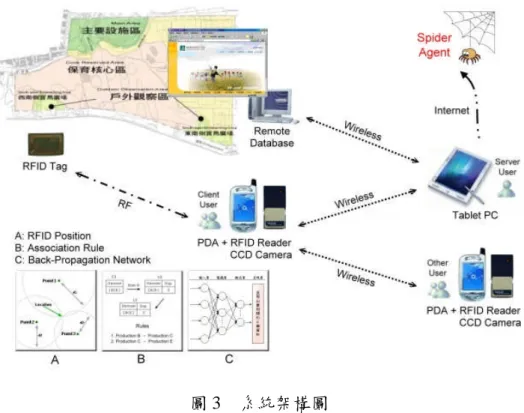
Different from conventional teaching and guiding system, we add intelligent searching mechanism, data mining and retrieval techniques (neural networks, relational rule, etc) into our system with the integration of wireless networks. It can achieve the interactive functions such as whiteboard sharing, instant messages, video streaming, quizzes, etc. The RFID technique is also applied to providing interactive learning modes. Take a natural park for example. We put RFID tags in each demonstration site and build corresponding indices for all birds in the park. The bird information indices are all stored into the tags. Users can read the index by RFID reader, retrieve much more related information by wireless networks, and even integrate whiteboard sharing to take interactive quizzes.
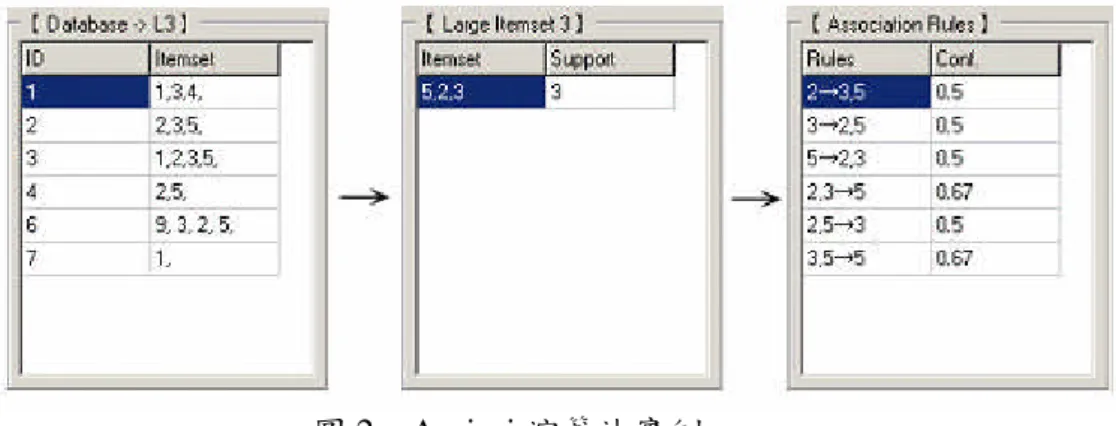
We exploit collaborative filtering and Apriori-like algorithm to analyze the using records, and build recommendation mechanism to help users enjoy the trip with other birds’ information in the same habitat. Furthermore, we also solve the problems that users may meet, i.e., excluding the possibilities to find out no information with the wrong characteristics. This assists the users easily search the bird information from the system.
Although mobile learning is a pretty good idea, it is also very important to have good digital materials. New and creative digital contents with education and recreation can provide different perception to users. Therefore, the future maintenance and design of the system will emphasize on topic-oriented classification of teaching materials.