行政院國家科學委員會專題研究計畫 成果報告
兆赫波波導及波導型感測器之特性研究 研究成果報告(精簡版)
計 畫 類 別 : 個別型
計 畫 編 號 : NSC 97-2218-E-006-013-
執 行 期 間 : 97 年 03 月 01 日至 98 年 10 月 31 日 執 行 單 位 : 國立成功大學光電科學與工程研究所
計 畫 主 持 人 : 呂佳諭
計畫參與人員: 助理教授-主持人(含共同主持人):呂佳諭
報 告 附 件 : 出席國際會議研究心得報告及發表論文
處 理 方 式 : 本計畫可公開查詢
中 華 民 國 98 年 10 月 30 日
行政院國家科學委員會補助專題研究計畫 ■ 成 果 報 告
□期中進度報告 兆赫波波導及波導型感測器之特性研究
Characterization of terahertz waveguide and waveguide-based biosensing chip
計畫類別:■ 個別型計畫 □ 整合型計畫 計畫編號:NSC 97-2218-E-006-013
執行期間: 97 年 3 月 1 日至 98 年 7 月 31 日
計畫主持人:呂佳諭 共同主持人:
計畫參與人員:
碩士班研究生-兼任助理人員:陳豪志 博士班研究生-兼任助理人員:游博文
成果報告類型(依經費核定清單規定繳交):■精簡報告 □完整報告
本成果報告包括以下應繳交之附件:
□赴國外出差或研習心得報告一份
□赴大陸地區出差或研習心得報告一份
■出席國際學術會議心得報告及發表之論文各一份
□國際合作研究計畫國外研究報告書一份
處理方式:除產學合作研究計畫、提升產業技術及人才培育研究計畫、
列管計畫及下列情形者外,得立即公開查詢
□涉及專利或其他智慧財產權,□一年□二年後可公開查詢
執行單位:成功大學光電科學與工程研究所
中 華 民 國 98 年 10 月 30 日
行政院國家科學委員會專題研究計畫進度報告 兆赫波波導及波導型感測器之特性研究
Characterization of terahertz waveguide and waveguide-based biosensing chip
計畫編號:NSC 97-2218-E-006-013
執行期限:97 年3 月1 日至98 年7 月31 日
主持人:呂佳諭
執行機構及單位名稱:成功大學光電科學與工程研究所 E-mail: [email protected]
一、 中文摘要
兆赫波是指頻率在0.1~10THz 範圍內的電磁波,近來由於該頻段的產生和偵測技術上的進 步,使的各國給予極大的關注形成一股研究熱潮。本研究主要目標是積極投入創新研發低 損耗、可色散控制、高耦合效率的兆赫波光纖和波導,並將此波導應用於微量分子偵測,
發展各種小體積、高靈敏度之兆赫波波導型感測器和光纖感測技術。
原三年計畫目標是購買反波震盪器(BWO)作為兆赫波光源,建立一寬頻可調之 CW 兆赫波 頻譜和影像系統,可以快速的掃描出待測樣品之頻譜以及同時獲得其相位,來進行以上的 研究和發展兆赫波光纖光譜偵測技術。原三年計劃之主要目標條列如下:
1. 建立一室溫操作、寬頻可調和可快速掃瞄之 BWO‐based 穿透式和一反射式兆赫波 頻域頻譜系統。
2. 建立一 BWO-based 兆赫波影像系統,可以反映出在 THz fiber 或 waveguide 截面 (cross-section)之兆赫波電磁場分布。
3. 發展各種低損耗、可色散控制、和高耦合率之次波長塑膠光纖。
4. 發展兆赫波光纖相關之光電子元件。
5. 完成不同結構之空心微結構光纖之兆赫波傳輸特性研究。
6. 開發兆赫波波導型微量分子偵測晶片和兆赫波光纖感測技術。
由於計畫僅被核准一年半,並且目標1 和 2 的經費被全部刪除,因此已將該目標於計畫中
排除。為達成上述其它目的,我們跟新竹工研院量測中心合作,利用其超快雷射激發之兆 赫波頻譜系統,已完成下列工作項目:
1. 完成次波長塑膠光纖之色散特性研究。
2. 完成利用消逝波偵測之次波長塑膠光纖感測器用以偵測微量分子。
關鍵詞:兆赫波、次毫米波、兆赫波光纖、光纖感測器。
Abstract:
Terahertz (THz) electromagnetic waves lie between microwave and infrared with spectral range form 0.3THz to 10THz, which is also called it “T-ray”. Recent years, much attention has been paid on THz and a fast development on THz science and technology has been achieved. The aims of this research are development THz fibers and waveguides with low loss, low dispersion, and high free-space directed coupling efficiency capabilities, as well as development of various kinds of high sensitive THz waveguide-based biosensors and THz fiber sensing technology for minute biomolecular detection. In the original three-year program, we plan to purchase a backward wave oscillator (BWO) for construction of a BWO based widely-tunable CW THz spectrometer and imaging system. The BWO-based spectroscopic system could both acquire the transmission spectrum and phase of sample for investigation of waveguide dispersion of THz subwavelength fiber and development fiber sensing technique. The specific aims of the research program are:
1. To establish a room temperature, widely-tunable, and fast-scan BWO based transmittive/
reflective THz frequency-domain spectrometer.
2. To establish a BWO-based THz imaging system to acquire the cross-section of power distribution at the output end of the THz fiber.
3. To develop various low loss and dispersion controllable subwavelength plastic fibers with high coupling efficiency.
4. To develop various THz fiber based optoelectronic devices.
5. To develop various hollow core microstructure fibers and investigate their THz transmission properties.
6. To develop THz waveguide based sensing chip and fiber sensing technique for minute material detection.
Due to the fact that the funding related to the 1st and 2nd aim is not approved by the NSC, this project will not pursue the development of a BWO based T-ray spectrometer and imaging system.
In this project, we have accomplished the following results:
1. We have successfully demonstrated a low loss and dispersion controllable subwavelength plastic fibers with high coupling efficiency.
2. We have successfully demonstrated a THz plastic wire based evanescent field sensor for high sensitivity minute molecules detection.
Keywords: Terahertz wave, sub-millimeter wave, terahertz fiber, fiber sensor.
二、 計畫緣由與目的
目前國際關於兆赫波的研究主要集中在產生、探測、成像、傳輸、和頻譜等方面。在傳輸
方面,目前兆赫波仍依賴在自由空間中靠著面鏡間反射傳播,但是兆赫波在大氣中的損耗 很大,並且面鏡導波系統不但體積龐大也對某些應用,例遙測、通訊和內視鏡等,造成限 制。因此研發兆赫波波導或光纖就成為兆赫波傳輸的基礎,也是兆赫波能否廣泛應用的關 鍵。在成像和偵測方面,許多生物大分子之豐富的轉動和振動能階落在兆赫頻段,這些分 子共振吸收峰形成該分子的特徵辨識指紋,因此利用這些指紋兆赫波得以非侵入式的、且 不需外加染劑的探測各種物質。而光纖或波導型元件具有小體積、使用更具彈性方便、可 遙測等優點。若能結合兆赫波之無損傷探測物質能力和光纖元件之優點,發展一個在臨床 上能準確快速且非侵入式的分辨出分子之技術,在 DNA 和基因檢測、藥物篩選、新藥測試、
法醫鑑定和毒物辨識等方面將有很大的應用潛力。本研究主要目標即積極投入創新研發低 損耗、可色散控制、高耦合效率的兆赫波光纖和波導,並將此波導應用於微量分子偵測,
發展小體積、高靈敏度之兆赫波波導型感測器和光纖感測技術。
本計劃第一部分將研究次波長兆赫波塑膠光纖之色散行為,將對不同材質、線徑、和長度 之次波長塑膠光纖,分別分析它們對不同頻率的兆赫波之波導色散(waveguide dispersion) 和傳輸損耗,並且找出其色散機制以及進而控制其色散。
第二部份主要發展兆赫波波導型微量分子感測器,主要是利用消逝波偵測之次波長塑膠光 纖感測器。原計畫是購買反波震盪器(BWO)作為兆赫波光源,建立一寬頻可調之 CW 兆赫波 頻譜和影像系統,可以快速的掃描出待測樣品之頻譜以及同時獲得其相位,來進行以上的 研究和發展兆赫波光纖光譜偵測技術。由於這部分經費被刪,因此我們和新竹工研院量測 中心合作,利用其超快雷射建立一寬頻兆赫波頻譜系統,以達成上述目的。
三、 結果與討論
該計畫已完成下列工作項目:
1. 建立寬頻兆赫波時域頻譜儀
為了量測次波長塑膠光纖的傳輸特性,我們首先建立量測工具-寬頻兆赫波時域頻譜 儀,該頻譜儀需要超快雷射激發,因此我們跟新竹工研院量測中心合作,借用其雷射,
將頻譜儀建構在量測中心。其系統架構及操作原理簡述如下:
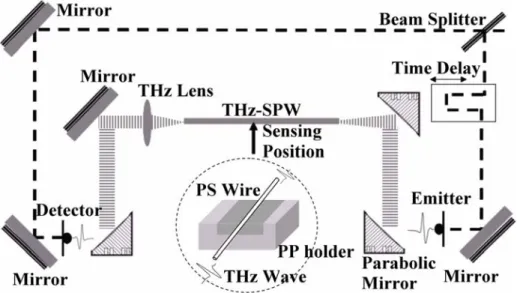
Fig.1 是用以量測次波長塑膠光纖之兆赫波時域解析光譜儀系統,此系統是利用超短脈 衝雷射光來激發兆赫波的產生與偵測,並利用時間延遲(time-dealy)的方式來解析出兆 赫波波形。脈衝雷射光束被分成兩道光線,一個由反射鏡導引至兆赫波產生原件(THz Emitter)上來激發兆赫波輻射,兆赫波再被拋物面鏡引導至偵測元件上。另一道脈衝雷 射光由反射鏡導引至偵測元件上(THz Detector),使的兆赫波與脈衝雷射光可以同時在 偵測元件上,並利用時間延遲的方式將兆赫波脈衝在偵測器上被解析出電壓或是電流訊 號,其中捷波器(chopper)與鎖相放大器(lock-in amplier)可以將系統雜訊濾除並同時 提高兆赫波的訊噪比(SN ratio),整體系統目的為提高訊噪比與得到更寬頻域的兆赫 波。目前此系統是利用低溫成長砷化鎵(LT-GaAs)製作之光導天線產生和偵測兆赫波 [1-2]。
As shown in Fig.1, the THz emitter was optically excited using a mode-locked Ti:sapphire
laser with a central wavelength of 800nm, a pulse width of 100fs, and a repetition rate of 82MHz. The generated THz pulse was collected and directly coupled into the subwavelength plastic wire (SPW) using a pair of parabolic mirrors. By means of direct optical coupling, a SPW typically delivers over 60% of the THz energy (including the coupling loss and the propagation loss) along a 30cm-long wire, with a THz transmission spectrum centered at the wavelength of 1mm (λ=1mm). THz waves on the SPW propagated to the output end of the plastic wire, were collected and focused onto a photoconductive switch receiver using a PE lens (f=6cm) and a parabolic mirror. From the optical time-delay between the THz pump and the probe beams, we can obtain the time-domain waveform of the THz pulse propagated through an SPW, and information on both the phase and amplitude of the transmitted THz pulse could also be thus extracted. Typically, the signal-to-noise-ratio of an SPW-based THz time-domain spectrometer exceeds 105.
Fig.1 Terahertz time-domain spectrometer for characterization of subwavelength plastic wire 2. 次波長塑膠光纖之色散特性研究
The dispersion property of the SPW is experimentally and theoretically investigated via a transmission-type THz time-domain spectroscopy (THz-TDS) system. Transmission spectroscopy indicated that the SPW exhibits low and controllable waveguide dispersions, which can be tuned by changing the core diameter, the core index, and the cladding index of the wire. This fact is consistent with theoretical predictions. By measuring the variation in the waveguide dispersion of an SPW with various molecules deposited in the wire cladding region, the demonstrated SPW-based THz time-domain spectrometer can identify two similar white powders. These results imply that SPWs can potentially be applied in future THz communication and the sensing of minute molecules. This part of results has been submitted to Applied Physics Letters [3] and reported in Photonic West 2009 [4]. Please refer to appendix I.
3. 次波長塑膠光纖微量分子感測器
THz transmission via subwavelength plastic wire has been demonstrated, in which more than
90% of the THz power is guided outside the wire core [5]. Besides decreasing the THz propagation loss incurred by wire absorption, the enhanced evanescent wave increases the overlapped interaction between sample and THz wave, possibly increasing the sensitivity and decreasing required amounts of the sample placed around the plastic wire. THz subwavelength plastic wire is characterized by its easy availability, low loss, low dispersion [6] and efficient coupling by quasi-optics [5], which is highly promising for biomedical imaging [7, 8], remote sensing, and biochip applications.
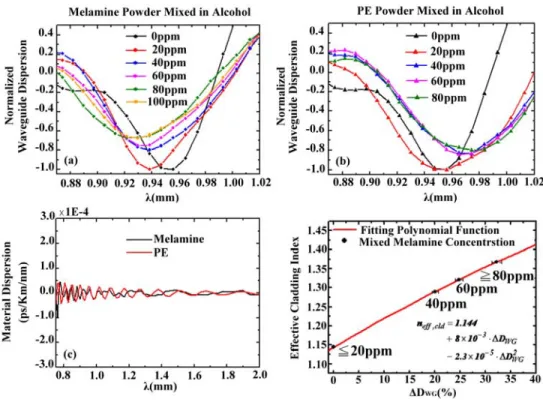
We have demonstrated a highly sensitive detection method based on the evanescent wave of a terahertz subwavelength plastic wire for liquid sensing. The enhanced evanescent wave sensitizes waveguide dispersion of wire to the refractive index of wire cladding. Slightly varying the cladding index can significantly change waveguide dispersion. The dispersion deviation of guided THz wave is evaluated, and two liquids, i.e. water and alcohol, are easily distinguished between each other, which is consistent with theoretical predictions. A melamine alcohol solution with different concentrations is then identified successfully with a detection limit of 20ppm, implying that detection of index variation is on the order of 0.01. The proposed sensing method is highly promising for food quality control, illicit drugs or explosives detection, as well as molecular dynamic characterization in living cell specimens. This part of results has been published in Optics Express [4, 9]. Please refer to appendix II.
四、 計畫成果自評
本計畫研究內容與原計畫相符,預期目標大致達成。我們已經完成了兆赫波次波長塑膠光 纖的色散特性研究,結果顯示次波長兆赫波光纖不但具有極低損耗(<0.01cm-1)並且其波導 色散可經由調整光纖之線徑和折射率來控制,在選定的波段達成零色散,實驗量測結果和 理論模擬有很好的吻合性。該結果對未來兆赫波光纖通訊和非線性應用具有相當不錯的應 用潛力。我們也利用次波長兆赫波塑膠光纖之波導色散對fiber cladding折射率相當敏感的特 性,將此塑膠光纖應用於微量分子感測上。經由分析波導色散之低峰值的改變量,我們成 功地辨識出兩種外觀相近的白色粉末並符合理論推估。該兆赫波光纖感測技術也應用於偵 測高損耗液體中的分子濃度,成功分辨出不同低濃度的三聚氰胺在酒精中的溶解情形,其 中最低濃度辨識能力可以到達20ppm,相當於可以以分辨出0.01的折射率差異之物質。利用 兆號波次波長光纖的消逝波來感測微量物質的技術,可以廣泛運用在各種低劑量物質感測 上,例如違禁毒品、爆裂物或是動態性偵測分子在物理或是化學反應中的生成物情況。因 本計畫所發表之文章如下:
(1) Borwen You, Tze-An Liu, Jin-Long Peng, Ci-Ling Pan, Ja-Yu Lu, “Subwavelength Plastic Wire Terahertz Time-domain Spectroscopy,” submitted to Applied Physics Letters. (Under review)
(2) Borwen You, Tze-An Liu, Jin-Long Peng, Ci-Ling Pan, and Ja-Yu Lu, "A terahertz plastic wire based evanescent field sensor for high sensitivity liquid detection," Opt. Express 17,
20675-20683 (2009).
(3) Borwen You, Tze-An Liu, Jin-Long Peng, Ci-Ling Pan, Ja-Yu Lu,” Characterization of Subwavelength Plastic Fiber Utilizing Terahertz Time-Domain Spectroscopy”, presented at the Photonics West 2009, San Jose, California, USA, Jan. 24-29, (2009), published as Proceedings of SPIE, Vol. 7215, 72150B (2009).
(4) Borwen You, Tze-An Liu, Jin-Long Peng, Ci-Ling Pan, Ja-Yu Lu,” Characterization of Subwavelength Terahertz Plastic Fiber Utilizing Terahertz Time-Domain Spectroscopy”, Optics and Photonics Taiwan 2008, Section Sat-S10, Taipei, Taiwan(2008) (最佳學生論文 獎)
五、 參考資料
1. http://www.delmarphotonics.com/PCA_web.pdf
2. Jiangquan Zhang and D. Grischkowsky, OPTICS LETTERS July 15, 2004 Vol. 29, No. 14, PP1617
3. Borwen You, Tze-An Liu, Jin-Long Peng, Ci-Ling Pan, Ja-Yu Lu, “Subwavelength Plastic Wire Terahertz Time-domain Spectroscopy,” submitted to Applied Physics Letters. (Under reviewed)
4. Borwen You, Tze-An Liu, Jin-Long Peng, Ci-Ling Pan, Ja-Yu Lu,” Characterization of Subwavelength Plastic Fiber Utilizing Terahertz Time-Domain Spectroscopy”, presented at the Photonics West 2009, San Jose, California, USA, Jan. 24-29, (2009), published as Proceedings of SPIE, Vol. 7215, 72150B (2009).
5. Li-Jin Chen, Hung-Wen Chen, Tzeng-Fu Kao, Ja-Yu Lu, and Chi-Kuang Sun, “Low-loss subwavelength plastic fiber for terahertz waveguiding,” Opt. Lett. 31, 308-310 (2006).
6. A. Dupuis, J.-F. Allard, D. Morris, K. Stoeffler, C. Dubois, and M. Skorobogatiy, “Fabrication and THz loss measurements of porous subwavelength fibers using a directional coupler method,” Opt. Express 17, 8012-8028 (2009).
7. Ja-Yu Lu, Chui-Min Chiu, Chung-Chiu Kuo, Chih-Hsien Lai, Hung-Chung Chang, Yuh-Jing Hwang, Ci-Ling Pan and Chi-Kuang Sun, ”Terahertz scanning imaging with a subwavelength plastic fiber,” Appl. Phys. Lett. 92, 084102 (2008).
8. Chui-Min Chiu, Hung-Wen Chen, Yu-Ru Huang, Yuh-Jing Hwang, Wen-Jeng Lee, Hsin-Yi Huang, and Chi-Kuang Sun, “All-terahertz fiber-scanning near-field microscopy,” Opt. Lett.
34, 1084-1086 (2009).
9. Borwen You, Tze-An Liu, Jin-Long Peng, Ci-Ling Pan, and Ja-Yu Lu, "A terahertz plastic wire based evanescent field sensor for high sensitivity liquid detection," Opt. Express 17, 20675-20683 (2009).
Appendix I Submitted to Applied Physics Letters
Subwavelength Plastic Wire Terahertz Time-domain Spectroscopy
Borwen You and Ja-Yu Lu a)
Institute of Electro-Optical Science and Engineering, National Cheng Kung University, 1
Ta-Hsueh Road, Tainan 70101, Taiwan, R.O.C.
Tze-An Liu and Jin-Long Peng
Center for Measurement Standards, Industrial Technology Research Institute, 321, Section 2,
Kuang Fu Road, Hsinchu 30011, Taiwan, R.O.C.
Ci-Ling Pan
Department of Photonics and Institute of Electro-Optical Engineering, National Chiao Tung
University, 1001 University Road, Hsinchu 30010, Taiwan, R.O.C.
a) Author to whom correspondence should be addressed; electronic mail:
PACS: 84.40.-x, 07.57.-c, 87.80.-y
Abstract
This work demonstrates the feasibility of a terahertz time-domain spectrometer based on a
subwavelength-diameter plastic wire (SPW) for sensing applications. The dispersion property of
the SPW is experimentally and theoretically studied. The SPW exhibits a low and controllable
waveguide dispersion, which can be engineered by changing the core diameter, the core index,
and the cladding index of the wire. Two white powders, tryptophan and polyethylene, deposited
on the bottom of the wire can be successfully distinguished based on the waveguide dispersion of
SPW. The SPW would be a promising candidate for combination with biochips for sensing
minute molecules.
Various terahertz (THz) waveguides have been developed for efficient transmission of THz waves and successfully applied in numerous fields, such as spectroscopy1,2, sensing3,4, and near field imaging5. However, the proposed waveguides either have low coupling efficiency or high propagation loss and high dispersion, subsequently shortening the THz propagation distance and reducing the capability for detecting strongly absorbed materials. Among the merits of the simple THz subwavelength plastic wire (THz-SPW) include single mode sustentation, a high coupling efficiency, a low propagation loss6 (on the order of 0.01cm-1), as well as theoretically low dispersion in the transmission band7. THz-SPW has been successfully adopted in directional couplers8, endoscopic imaging9, and microscopy10. To our knowledge, the dispersion feature of THz-SPW has not been experimentally measured or analyzed.
Because the core has a low index of refraction, the extended electric field of an evanescent wave on a THz-SPW6 is enhanced much more than an optical nanowire11, causing THz waves on the SPW to interfere easily with the surrounding medium, supporting remote sensing and the detection of molecules in biochips or microfludic channels. Dispersion shifts in optical nanowires with thin dielectric coatings have been theoretically demonstrated12, revealing that the waveguide dispersion of a weakly guiding fiber is very sensitive to the refraction index of cladding. In this letter, the dispersion property of THz-SPW is experimentally and theoretically investigated and the feasibility of integrating SPW with a THz time-domain spectroscopy (THz-TDS) system for molecular sensing applications is demonstrated. Transmission spectroscopy indicated that the SPW exhibits low and controllable waveguide dispersions, which can be tuned by changing the core diameter, the core index, and the cladding index of the wire. This fact is consistent with theoretical predictions. By measuring the variation in the waveguide dispersion of an SPW with various molecules deposited in the wire cladding region, the demonstrated SPW-based THz time-domain spectrometer can identify two similar white powders. These results imply that SPWs can potentially be applied in future THz communication and the sensing of minute molecules.
In this study, we used two SPWs, whose cores were made of polyethylene (PE) and polystyrene (PS) with refractive indices13 of 1.5 and 1.59, respectively, and an air cladding, were adopted. Dispersion in a THz-SPW is dominated by material dispersion and waveguide dispersion. The modal dispersion can be neglected because SPW is associated with the single-mode wave-guiding. Since the refractive indices of both PE and PS are almost constant at THz frequencies14, the material dispersion in SPW can also be neglected. The main contribution of dispersion in a THz-SPW is waveguide dispersion. In this experiment, the waveguide dispersion in an SPW was measured using a transmission-type THz time-domain spectrometer, which is schematically depicted in Fig. 1, and consists of a pair of LT-GaAs-based photoconductive antennas as the THz emitter and receiver. The THz emitter was optically excited using a mode-locked Ti:sapphire laser with a central wavelength of 800nm, a pulse width of 100fs, and a repetition rate of 82MHz. The generated THz pulse was collected and directly coupled into the SPW using a pair of parabolic mirrors. By means of direct optical coupling, a 300μm-diameter PE wire delivers over 60% of the THz energy (including the coupling loss and the propagation loss) along a 30cm-long wire, with a THz transmission spectrum centered at the wavelength of 1mm (λ=1mm). To measure the THz waveguide dispersion and propagation loss in an SPW, a standard cutback method was employed with a fixed input coupling efficiency. In the sensing experiment, a sample holder that was made of polypropylene (PP) on which was a 6mm-wide and 0.5mm-deep channel, filled with the test sample, was placed on the bottom of a THz-SPW oriented parallel to the length direction of a PP holder, as presented in the inset in Fig.1. Two PP holders with lengths of 5mm and 8mm were adopted to determine the phase difference between the THz pulses transmitted through the sample for dispersion calculation. The SPW was slightly contact with the sample to ensure overlap between the THz evanescent wave and the sample. As demonstrated, two white powders, with similar appearances, tryptophan (T8941 L-Tryptophan, Sigma-Aldrich Inc.) and polyethylene (434272 Polyethylene, Sigma-Aldrich Inc.), were
employed as test samples. THz waves on the SPW, transmitted through the powder sample and propagated to the output end of the plastic wire, were collected and focused onto a photoconductive switch receiver using a PE lens (f=6cm) and a parabolic mirror. From the optical time-delay between the THz pump and the probe beams, we can obtain the time-domain waveform of the THz pulse propagated through an SPW, and information on both the phase and amplitude of the transmitted THz pulse could also be thus extracted. Typically, the signal-to-noise-ratio of an SPW-based THz time-domain spectrometer exceeds 105.
Maxwell’s equations are used to determine the theoretical group velocity Vg and the waveguide dispersion Dwg of THz-SPW. In Figs. 2 (a) and (b), the theoretical group velocities, Vg, (solid and dashed lines) of PS and PE wires approach to the speed of light (C) in a vacuum at long wavelengths since a large fraction of the THz waves are propagated in air. As the wavelength becomes shorter, more THz energy enters the wire core and thus declines Vg to a value C/ncore, which is the group velocity of THz waves in the bulk material. At a particular wavelength, a thinner SPW has a larger Vg because the THz energy is less confined, as displayed in Fig. 2(a). In contrast, the Vg of PS wire is less than that of PE wire, as shown in Fig. 2(b) since the higher core index of the wire causes the THz wave to be strongly confined within the wire core. The theoretical waveguide dispersion, Dwg, (solid and dashed lines) of SPW reaches a minimum value at the curve in Figs. 2(c) and (d), and slowly approaches zero as the wavelength increases. For a weakly guiding wire waveguide, a smaller diameter or a lower core index causes the deep of the theoretical Dwg curve to shift to the short wavelengths, as shown in both Figs. 2(c) and (d). The minimum of Dwg is more negative in a thinner SPW (PS wire with a 300μm-diameter core), as shown in Fig. 2(c), and becomes less negative as the core index decreases (PE wire), as plotted in Fig. 2(d).
By comparing the two measured THz waveforms that pass through SPWs of different lengths, we can obtain the THz effective index neff of SPW by the relation, neff = 1+λφ/(2πL),
where L and φ are the length and phase differences between two SPWs, and λ is the THz wavelength. The measured group velocity11, Vg =-2πC(dβ/dλ)/(λ2), and the measured waveguide dispersion11, Dwg=d(1/Vg)/dλ, can thus be calculated in an SPW, where C is speed of light in a vacuum and β is the effective propagation constant given by β=2πneff/λ. The waveguide dispersion Dwg, group velocity Vg, propagation constant β, and effective index of SPW neff are all functions of THz wavelength. In Figs. 2(a) and (b), the measured wavelength-dependent Vg of THz-SPWs follows a trend that is consistent with theory. As described above, at a particular wavelength, the measured group velocities in a weakly guiding wire waveguide, the 300μm-thick PS wire shown in Fig. 2(a) and the 300μm-thick PE wire shown in Fig. 2(b), exceed that of 400μm-thick PS and 300μm-thick PS wires, respectively.
The measured wavelength-dependent Dwg of the THz-SPWs exhibits a trend that is consistent with the theoretical result, as shown in Figs. 2(c) and (d), indicating the Dwg can be positive, zero, or negative at a particular wavelength as determined by the chosen wire diameter and core index. Manipulating waveguide dispersion to control the properties of THz wave propagation is important in many fields, including communication and nonlinear optics.
Given a geometry in which one portion of the THz evanescent field6 interacts with the sample and the other portion leaks into the air, as shown in the inset in Fig. 1, the THz evanescent wave resembles to be immersed in a new cladding with an effective refractive index that differs from that of air. The effective refractive index of the new cladding is determined by both the air and the sample, and is given by nclad=nairσ+nsample(1-σ), where σ is the power percentage of the evanescent wave in the air. The index of air, nair, equals 1 and nsample is the refractive index of the sample in the THz frequency range. In this experiment, the average THz refractive index of tryptophan and PE powder are 1.17 and 1.50, respectively13,15. From the geometric parameters of the wire and the PP channel that contained powders, we can calculate that 60% of the THz energy was in the air while 40% was in the powder. From the above relation, the effective cladding indexes for PE and tryptophan powders are calculated as 1.2 and
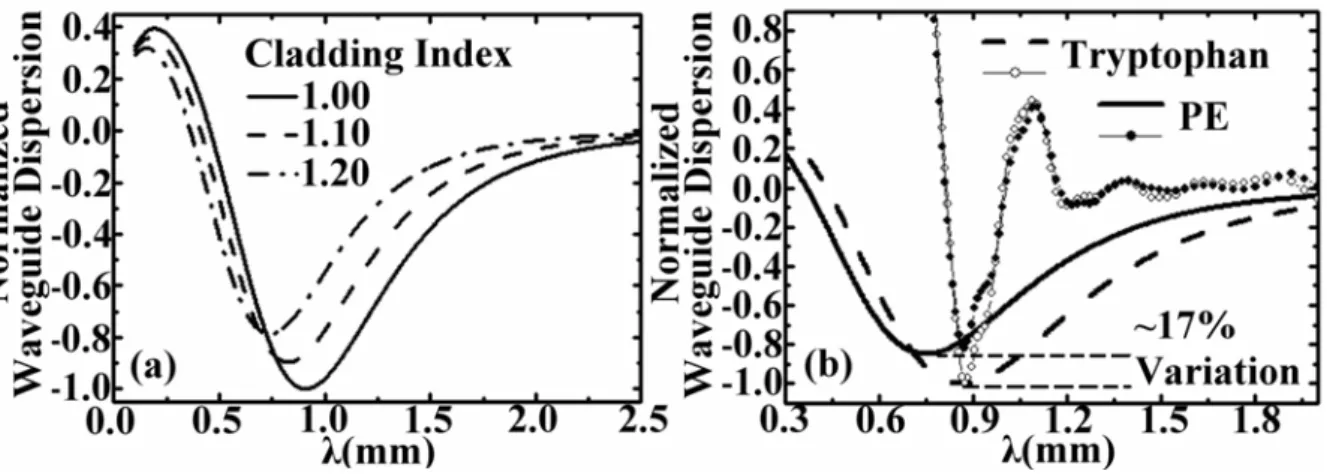
1.068, respectively. Different cladding indices of the PS wire would differently affect the propagation characteristics of the THz evanescent wave, including effective index of refraction and propagation constant, thereby modifying the waveguide dispersion curve. Figure 3(a) plots the theoretically normalized waveguide dispersion of THz-SPWs with different cladding indices, and indicates the deep of the waveguide dispersion curve shifts toward the short wavelength range and becomes less negative when an SPW turns into a weakly guiding waveguide with a small index difference between the core and the cladding. The trend plotted in Fig. 3(a) is similar to that in Fig. 2(d), suggesting that the waveguide dispersion of SPW can also be manipulated by changing the cladding index of the wire. Figure 3(b) plots the normalized measured wavelength-dependent waveguide dispersion curves of the THz pulse transmitted through PE and tryptophan powder, indicating that SPW immersed in PE powder has a smaller negative Dwg at the deep of curve, because the refractive index of the PE powder is higher than that of tryptophan powder, so the former less strongly confines THz waves that pass through it, which result is consistent with the simulated results, plotted in Fig. 3(a).
Notably, a 17% variation of the measured waveguide dispersions between PE and tryptophan powders is observed at the deepest point, which finding is consistent with that estimated from the aforementioned effective cladding indices. The preliminary sensing result in Fig. 3(b) indicates that the THz-SPW can be used to identify two materials with similar appearances by characterizing their measured waveguide dispersions. The sensing scheme can potentially be applied for monitoring the quality of food, detection illicit drugs or explosives, and characterizing molecular dynamics in living cell specimens.
The dispersion property of an SPW was experimentally and theoretically investigated using transmission spectroscopy. The SPW has a low and controllable waveguide dispersion, which can be engineered by changing the core diameter, the core index, and the cladding index of the wire, in a manner consistent with theoretical predictions. Characterizing the waveguide dispersion variations in SPW reveals that the demonstrated SPW-based THz time-domain
spectrometer can identify two similar white powders. These results imply that SPW has potential for use in communication applications and for combination with biochips or micro-fluidic channels for sensing minute molecules.
This work was supported by the Advanced Optoelectronic Technology Center, National Cheng Kung University, under projects from the Ministry of Education and the National Science Council (NSC 97-2218-E-006-013) of Taiwan. The authors are grateful for the preparation of plastic wires by the researcher, J.L Kuo, in department of nanofiber materials, Industrial Technology Research Institute.
References
1 M. Walther, M. R. Freeman, and F. A. Hegmann, Appl. Phys. Lett. 87, 261107 (2005).
2 N. Laman, S. Sree Harsha, D. Grischkowsky, and Joseph S. Melinger, Opt. Express 16,
4094 (2008).
3 T. Hasek, H. Kurt, D. S. Citrin, and M. Koch, Appl. Phys. Lett. 89, 173508 (2006).
4 H. Kurt and D. S. Citrin, Appl. Phys. Lett. 87, 241119 (2005).
5 H.-T. Chen, S. Kraatz, G.C. Cho, and R. Kersting, Phys. Rev. Lett. 93, 267401 (2004).
6 L.-J. Chen, H.-W. Chen, T.-F. Kao, J.-Y. Lu, and C.-K. Sun, Opt. Lett. 31, 308 (2006).
7 A. Dupuis, J.-F. Allard, D. Morris, K. Stoeffler, C. Dubois, and M. Skorobogatiy, Opt.
Express 17, 8012 (2009).
8 Hung-Wen Chen, Chui-Min Chiu, Chih-Hsien Lai, Jeng-Liang Kuo, Po-Jui Chiang,
Yuh-Jing Hwang, Hung-Chun Chang, and Chi-Kuang Sun, J. Lightwave Technol. 27, 11,
1489 (2008).
9 J.-Y. Lu, C.-M. Chiu, C.-C. Kuo, C.-H. Lai, H.-C. Chang, Y.-J. Hwang, C.-L. Pan, and
C.-K. Sun, Opt. Express 16, 2494 (2008).
10 Chui-Min Chiu, Hung-Wen Chen, Yu-Ru Huang, Yuh-Jing Hwang, Wen-Jeng Lee,
Hsin-Yi Huang, and Chi-Kuang Sun, Opt. Lett. 34, 1084 (2009).
11 L. Tong, J. Lou, and E. Mazur, Opt. Express 12, 1025 (2004).
12 J. Y. Lou, L. M. Tong, and Z. Z. Ye, Opt. Express 14, 6993 (2006).
13 James W. Lamb, Int. J. Infrared Millimeter Waves 17, 1997(1996).
14 R. Piesiewicz, C. Jansen, S. Wietzke, D. Mittleman, M. Koch and T. Kürner, Int. J.
Infrared Millimeter Waves 28, 363 (2007).
15 B. Yu, F. Zeng, Y. Yang, Q. Xing, A. Chechin,y X. Xin, I. Zeylikovich and R. R. Alfano,
Biophys. J. 86, 1649 (2004).
Figure 1 THz time-domain spectrometer based on subwavelength-diameter plastic wire (SPW).
Inset shows THz pulse on an SPW propagated through powder materials in the PP channel.
Figure 2 (a) Measured and theoretical group velocities, Vg, of the THz pulse on the PS wire with various core diameters. At short wavelengths, Vg approaches 0.63C for a PS wire. (b) Measured and theoretical group velocities of THz pulse on 300μm-thick PS and PE wires. (c) Measured and theoretical waveguide dispersions, DWG, of THz pulse on PS wire with various core diameters. (d) Measured and theoretical waveguide dispersions of THz pulse on 300μm-thick PS and PE wires.
Figure 3 (a) Theoretical normalized waveguide dispersions of 300μm-thick PS wire with various cladding indices. (b) Measured (solid and dashed lines) and simulated (solid and open circles) waveguide dispersions of PS wire with PE and tryptophan powders in wire cladding regions.
A terahertz plastic wire based evanescent field sensor for high sensitivity liquid detection
Borwen You1, Tze-An Liu2, Jin-Long Peng2, Ci-Ling Pan3 and Ja-Yu Lu1*
1 Institute of Electro-Optical Science and Engineering and Advanced Optoelectronic Technology Center, National Cheng Kung University, 1 University Road, Tainan 70101, Taiwan, R.O.C.
2 Center for Measurement Standards, Industrial Technology Research Institute, 321, Section 2, Kuang Fu Road, Hsinchu 30011, Taiwan, R.O.C.
3 Department of Photonics and Institute of Electro-Optical Engineering, National Chiao Tung University, 1001 University Road, Hsinchu 30010, Taiwan, R.O.C.
Abstract: A highly sensitive detection method based on the evanescent wave of a terahertz subwavelength plastic wire was demonstrated for liquid sensing. Terahertz power spreading outside the wire core makes the waveguide dispersion sensitive to the cladding index variation, resulting in a considerable deviation of waveguide dispersion. Two liquids with transparent appearances, water and alcohol, are easily distinguished based on the waveguide dispersion, which is consistent with theoretical predictions. A melamine alcohol solution with various concentrations is identified successfully, and the detection limit is up to 20ppm, i.e.
equivalent to the index variation on the order of 0.01.
©2009 Optical Society of America
OCIS codes: (060.2370) Fiber optics sensors; (130.6010) Sensors; (230.7370) Waveguides;
(300.6495) Spectroscopy, terahertz.
References and links
1. L. Cheng, H. Shin'ichiro, A. Dobroiu, C. Otani, K. Kawase, T. Miyazawa, and Y. Ogawa, “Terahertz-wave absorption in liquids measured using the evanescent field of a silicon waveguide,” Appl. Phys. Lett. 92(18), 181104 (2008).
2. M. Walther, M. R. Freeman, and F. A. Hegmann, “Metal-wire terahertz time-domain spectroscopy,” Appl. Phys.
Lett. 87(26), 261107 (2005).
3. Y. Sun, X. Xia, H. Feng, H. Yang, C. Gu, and L. Wang, “Modulated terahertz responses of split ring resonators by nanometer thick liquid layers,” Appl. Phys. Lett. 92(22), 221101 (2008).
4. A. Ibraheem, I. Al-Naib, C. Jansen, and M. Koch, “Thin-film sensing with planar asymmetric metamaterial resonators,” Appl. Phys. Lett. 93, 083507 (2008).
5. J. F. O’Hara, R. Singh, I. Brener, E. Smirnova, J. Han, A. J. Taylor, and W. Zhang, “Thin-film sensing with planar terahertz metamaterials: sensitivity and limitations,” Opt. Express 16(3), 1786–1795 (2008).
6. H. Kur, “Coupled-resonator optical waveguides for biochemical sensing of nanoliter volumes of analyte in the terahertz region,” Appl. Phys. Lett. 87(24), 241119 (2005).
7. F. Miyamaru, S. Hayashi, C. Otani, K. Kawase, Y. Ogawa, H. Yoshida, and E. Kato, “Terahertz surface-wave resonant sensor with a metal hole array,” Opt. Lett. 31(8), 1118–1120 (2006).
8. H. Yoshida, Y. Ogawa, Y. Kawai, S. Hayashi, A. Hayashi, C. Otani, E. Kato, F. Miyamaru, and K. Kawase,
“Terahertz sensing method for protein detection using a thin metallic mesh,” Appl. Phys. Lett. 91(25), 253901 (2007).
9. S. Yoshida, E. Kato, K. Suizu, Y. Nakagomi, Y. Ogawa, and K. Kawase, “Terahertz sensing of thin poly(ethylene terephthalate) film thickness using a metallic mesh,” Appl. Phys. Express 2, 012301 (2009).
10. M. Nagel, P. Haring Bolivar, M. Brucherseifer, H. Kurz, A. Bosserhoff, and R. Bu¨ttner, “Integrated THz technology for label-free genetic diagnostics,” Appl. Phys. Lett. 80(1), 154–156 (2002).
11. A. Chakraborty, and N. Guchhait, “Inclusion complex of charge transfer probe 4-amino-3-methyl benzoic acid methyl ester (AMBME) with b-CD in aqueous and non-aqueous medium: medium dependent stoichiometry of the complex and orientation of probe molecule inside b-CD nanocavity,” J. Incl. Phenom. Macrocycl. Chem.
62(1-2), 91–97 (2008).
12. N. A. Mortensen, S. Xiao, and J. Pedersen, “Liquid-infiltrated photonic crystals: enhanced light-matter interactions for lab-on-a-chip applications,” Microfluid Nanofluid 4(1-2), 117–127 (2008).
13. L.-J. Chen, H.-W. Chen, T.-F. Kao, J.-Y. Lu, and C.-K. Sun, “Low-loss subwavelength plastic fiber for terahertz waveguiding,” Opt. Lett. 31(3), 308–310 (2006).
#117682 - $15.00 USD Received 24 Sep 2009; revised 23 Oct 2009; accepted 23 Oct 2009; published 27 Oct 2009 (C) 2009 OSA 9 November 2009 / Vol. 17, No. 23 / OPTICS EXPRESS 20675
Appendix II
14. A. Dupuis, J.-F. Allard, D. Morris, K. Stoeffler, C. Dubois, and M. Skorobogatiy, “Fabrication and THz loss measurements of porous subwavelength fibers using a directional coupler method,” Opt. Express 17(10), 8012–
8028 (2009).
15. J.-Y. Lu, C.-M. Chiu, C.-C. Kuo, C.-H. Lai, H.-C. Chang, Y.-J. Hwang, C.-L. Pan, and C.-K. Sun, “Terahertz scanning imaging with a subwavelength plastic fiber,” Appl. Phys. Lett. 92(8), 084102 (2008).
16. C.-M. Chiu, H.-W. Chen, Y.-R. Huang, Y.-J. Hwang, W.-J. Lee, H.-Y. Huang, and C.-K. Sun, “All-terahertz fiber-scanning near-field microscopy,” Opt. Lett. 34(7), 1084–1086 (2009).
17. L. Tong, J. Lou, and E. Mazur, “Single-mode guiding properties of subwavelength-diameter silica and silicon wire waveguides,” Opt. Express 12(6), 1025–1035 (2004).
18. J. W. Lamb, “Miscellancous data on materials for millimetre and submillimetre optics,” Int. J. Infrared. Milli. 17, 1996–2034 (1996).
19. J. Lou, L. Tong, and Z. Ye, “Modeling of silica nanowires for optical sensing,” Opt. Express 13(6), 2135–2140 (2005).
20. H.-W. Chen, Y.-T. Li, C.-L. Pan, J.-L. Kuo, J.-Y. Lu, L.-J. Chen, and C.-K. Sun, “Investigation on spectral loss characteristics of subwavelength terahertz fibers,” Opt. Lett. 32(9), 1017–1019 (2007).
21. B. Ferguson, and X.-C. Zhang, “Materials for terahertz science and technology,” Nat. Mater. 1(1), 26–33 (2002).
22. H. Kitahara, T. Yagi, K. Mano, and M. W. Takeda, “Dielectric characteristics of water solutions of ethanol in the terahertz region,” J. Korean Phys. Soc. 46, 82–85 (2005).
23. L. Thrane, R. H. Jacobsen, P. Uhd Jepsen, and S. R. Keiding, “THz reflection spectroscopy of liquid water,”
Chem. Phys. Lett. 240(4), 330–333 (1995).
24. B. E. A. Saleh, and M. C. Teich, fundamentals of photonics (John Wiley & Sons, New York, NY 1991).
25. J. Lou, L. Tong, and Z. Ye, “Dispersion shifts in optical nanowires with thin dielectric coatings,” Opt. Express 14(16), 6993–6998 (2006).
26. C.-L. Chen, elements of optoelectronics and fiber optics, chap.8 (Times Mirror Higher Education Group, Inc.
company, 1996).
27. A. Sano, Kawasaki, T. Kuroishi, Chiba, Y. Miyazaki, Machida, S. Yokoyama, Yokohama, K. Matsuura, “Easily soluble polyethylene powder for the preparation of fibers or films having high strength and high elastic modulus,” united states patent 4760120 (1988). http://www.freepatentsonline.com/4760120.pdf
28. IARC Monographs on the Evaluation of Carcinogenic Risks to Humans, “Some chemicals that cause tumours of the kidney or urinary bladder in rodents, and some other substances”.
http://monographs.iarc.fr/ENG/Monographs/vol73/index.php
29. R. E. N. Baozeng, L. I. Chen, Y. U. A. N. Xiaoliang, and W. A. N. G. Fu'an, “Determination and correlation of melamine solubility,” Chin. J. Chem. Eng. 54(7), 1001–1003 (2003).
1. Introduction
Minute material detection has received considerable interest in genomic engineering, lab-on- a-chip, and forensic medicine applications. Noninvasive and label-free molecular detection is easily achieved based on terahertz (THz) fingerprint spectra because their absorption bands, originating from molecular transitions between vibrational or rotational energy levels, are located in the THz frequency range. THz technology has been extensively adopted for minute material detection in the recent decade. A related method measures the relative absorption or molecular characteristic absorption spectrum, such as the silicon waveguide [1] and metal wire [2]. However, for increasing the sensitivity, it requires several milligrams of powders or a high concentration solution [1,2]. Another means of detecting a slight amount of materials is based on refractive index sensitive THz devices, such as metamaterials [3–5], coupled- resonator optical waveguide [6] and metal hole arrays [7–9]. By utilizing a thin film micro- strip line (TFMS), Nagel et al. [10] detected the deposited DNA with femto-mol level sensitivity based on the THz resonant band shift of TFMS by varying the sample indexes. A chip-based THz device with a high sensitivity is advantageous for integration with various biochips and planer arrays for multiplexing. However, the TFMS is restricted in noninvasive remote sensing due to the limited transmission length. In addition, the solvents of samples deposited on the micro-strip line waveguide should be evaporated in the process of manipulating samples, and the changed surroundings would possibly modify the intrinsic properties of samples [11]. The subwavelength plastic wire delivered the evanescent wave with low THz photon energy and allowed for non-invasive sensing without sample contact;
therefore, it could reduce the restriction mention above. In addition to its flexibility for remotely detecting a sample placed anywhere, such a scheme allows easy integration with biochip or microfludic channels for molecular sensing [12].
THz transmission via subwavelength plastic wire has been demonstrated, in which more than 90% of the THz power is guided outside the wire core [13]. Besides decreasing the THz
#117682 - $15.00 USD Received 24 Sep 2009; revised 23 Oct 2009; accepted 23 Oct 2009; published 27 Oct 2009 (C) 2009 OSA 9 November 2009 / Vol. 17, No. 23 / OPTICS EXPRESS 20676
propagation loss incurred by wire absorption, the enhanced evanescent wave increases the overlapped interaction between sample and THz wave, possibly increasing the sensitivity and decreasing required amounts of the sample placed around the plastic wire. THz subwavelength plastic wire is characterized by its easy availability, low loss, low dispersion [14] and efficient coupling by quasi-optics [13], which is highly promising for biomedical imaging [15,16], remote sensing, and biochip applications.
This work demonstrates the feasibility of an evanescent wave sensor based on the subwavelength plastic wire for liquid sensing. The enhanced evanescent wave sensitizes waveguide dispersion of wire to the refractive index of wire cladding. Slightly varying the cladding index can significantly change waveguide dispersion. The dispersion deviation of guided THz wave is evaluated, and two liquids, i.e. water and alcohol, are easily distinguished between each other, which is consistent with theoretical predictions. A melamine alcohol solution with different concentrations is then identified successfully with a detection limit of 20ppm, implying that detection of index variation is on the order of 0.01. The proposed sensing method is highly promising for food quality control, illicit drugs or explosives detection, as well as molecular dynamic characterization in living cell specimens.
2. Evanescent wave of THz subwavelength plastic wire
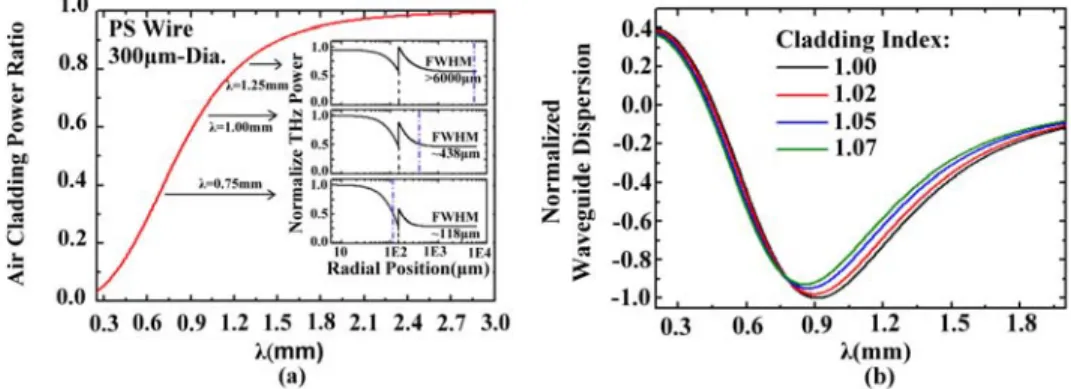
The THz subwavelength plastic wire used in this experiment has a circular cross-section, an infinite air-cladding, and a step-index profile [13,17]. The wire core is made of polystyrene (PS), in which the refractive index is 1.59 [18]. Due to the thin core and low core index, a large portion of THz power is transmitted in the air cladding [13]. It also means the power distribution profile of the THz pulse propagating on the PS wire is wavelength dependent. For instance, the calculated fractional THz power in the air cladding for a 300μm-core-diameter- PS wire exceeds 70% when the wavelength exceeds 1mm, as illustrated in Fig. 1(a). This finding implies that the long-wavelength portion of the THz pulse extends further into the air than the short-wavelength, as shown in the inset in Fig. 1(a). The long-wavelength portion possesses an enhanced evanescent wave, subsequently reducing the propagation loss [13] and allowing high sensitivity detection of a medium that surrounds the wire core [19]. Using the vector Maxwell’s Eqs. (17), the waveguide dispersion of guided THz pulse on a 300μm-core- diameter-PS wire was determined for various cladding indices. Figure 1(b) shows the calculated wavelength-dependent waveguide dispersions of a THz subwavelength wire with various cladding indices, where normalized with respect to the lowest minimum value, i.e. the case of an air cladding, such that the dispersion minimum of the cladding index of 1.00 curve is normalized to −1. The dip of normalized waveguide dispersion (deep point of curve in Fig.
1(b)) becomes less negative and shifts towards a short wavelength when the cladding index increases [17]. The percentage variation of negative waveguide dispersion, defined as ΔDWG, is approximately proportional to the increasing cladding index. For instance, a PS wire is observed to have around 1%- ΔDWG per 0.01-increase in the cladding index. For the subwavelength THz wire sensor, the deviation of dispersion dip is resulted from the evanescent THz wave transmitted along different specimens with various refractive indices.
The cladding index is changed owing to a certain volume of air in the cladding being replaced by the higher index test samples. Based on the detection mechanism, the sensitive scheme to detect refractive index is allowed to identify various specimens without broadband THz transmission which is necessary for detecting THz absorption spectrum of materials. And hence the sensing performance would not be restricted by the deliverable bandwidth even though the transmitted bandwidth of THz subwavelength fiber is typically around 200GHz, which is dependent on the wire length and core absorption loss [20]. By implementing this concept into practice, subwavelength THz wire is a promising alternative for the detection of minute index variations.
#117682 - $15.00 USD Received 24 Sep 2009; revised 23 Oct 2009; accepted 23 Oct 2009; published 27 Oct 2009 (C) 2009 OSA 9 November 2009 / Vol. 17, No. 23 / OPTICS EXPRESS 20677
3. Experimental setup and waveguide dispersion measurement
By using the THz time-domain spectroscopy (THz-TDS) [21] system, the experiment attempted to evaluate and characterize the waveguide dispersion of PS wire with various media that surrounded the wire core. The configuration in Fig. 2(a) contains a mode-locked
Fig. 1. (a) Fractional power in the air cladding for a 300μm-core-diameter-PS wire. The inset shows the THz power distribution across the PS wire. The black dash line indicates the radius of PS wire (150μm) and the blue dash dot line represents the full with of half maximum (FWHM) range of HE11 mode. (b) Normalized waveguide dispersion of 300μm-core-diameter PS wire with various cladding indexes ranging from 1.00 to 1.07.
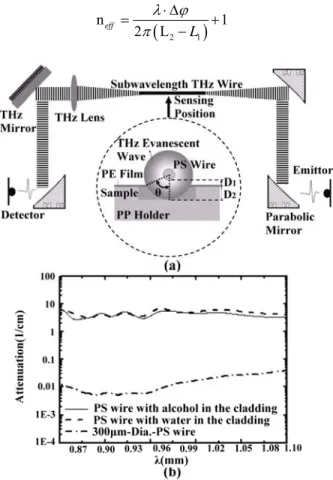
Ti:sapphire laser with a center wavelength of 800nm, 100fs-pulse duration and 100MHz- repetition rate, a THz emitter, as well as a THz detector. The THz emitter and detector are both low-temperature-GaAs-based photoconductive antennas with a 5μm electrode gap. The generated THz wave was coupled to a 300μm-core-diameter-PS wire by two off-axis parabolic mirrors, collimated by a THz lens, and focused on the THz photoconductive antenna for detection. A 300μm-core-diameter-PS wire with length of 15cm is used for liquid sensing experiment. After THz pulse propagated through a 15cm-long air-clad PS wire, the measured signal/noise ratio (SNR) is around 104. The measured attenuation constant of a 300μm-core- diameter-PS wire is illustrated in Fig. 2(b) and the minimum attenuation is as low as 0.01cm−1. A sample holder made of polypropylene (PP) contained a 6mm-wide and 0.5mm-deep channel, which was filled with the test sample. A 10 μm thick polyethylene (PE) film was attached on the top of the PP holder to prevent evaporation of the liquid sample. In the experiment, alcohol and water were used as the liquid samples with distinct THz refractive indices 2.60 and 1.45 [22,23], respectively, at 0.9mm wavelength. Two PP holders with different lengths, i.e. 1mm and 3mm respectively, were used to evaluate the waveguide dispersion in order to acquire the phase difference of THz pulse propagating along the PS wire and through the test samples. The inset in Fig. 2(a) illustrates one portion of the evanescent field interacting with the sample, and the other portion of the field is leaking into the air. Due to the high attenuation of liquid sample, a specimen was placed beneath the PS wire with a separation distance D1 of around several hundred micrometers to sustain an adequate SNR (>100) of THz wave, while insuring a good overlap between THz evanescent wave and the specimen, as shown in the inset in Fig. 2(a). As the illustration of Fig. 2(b), the attenuation of the THz wave propagated on a 300μm-core-diameter-PS wire across a 3mm-long liquid-filled PP holder is increased from 0.01 to 1cm−1 in 0.9~1.1mm-wavelength range with the separation D1 of 0.43mm. Even though the SNR is decreased from 104 to 100, it is sufficient in the work to acquire the phase information for sensing a small amount of liquids.
In the study, the phase difference for THz wave transmitted along the wire with and without liquid samples is described as follows,
( sL1 airL1) ( sL2 airL2)
ϕ ϕ ϕ ϕ ϕ
Δ ≡ − − − (1)
#117682 - $15.00 USD Received 24 Sep 2009; revised 23 Oct 2009; accepted 23 Oct 2009; published 27 Oct 2009 (C) 2009 OSA 9 November 2009 / Vol. 17, No. 23 / OPTICS EXPRESS 20678
where ϕ and sL1 ϕairL1 represent the phases accumulated by the THz pulse that passed through a L1-long PP holder with and without a sample, respectively. Similarly, ϕ and sL2 ϕairL2 refer to the phases of THz pulse propagating through L2-long PP holder with the same depth and width as L1-long PP holder. Notably, according to Eq. (1), the phase difference considered here is only contributed from the THz wave along the L1−L2 -long PS wire with the sample in the cladding region. The effective index of THz wave propagated on the wire and propagation constant, β = 2πneff/λ, can be derived by substituting Δϕ in Eq. (2).
( 2 1)
n 1
2 L
eff L
λ ϕ π
= ⋅ Δ +
− (2)
Fig. 2. (a) Experimental setup for THz evanescent wave sensing by using a subwavelength plastic wire. The inset illustrates the cross section of interaction between THz evanescent wave and the sample where D1 refers to the separation between wire and top surface of sample and D2 denotes the depth of the PP holder. (b) The attenuation of THz pulse propagated on an air- clad PS wire (thick dash dot line), and on a PS wire across an alcohol-filled (thin solid line) and a water-filled (thick dash line) PP sample holders. The core diameter of PS wire is 300μm.
The measured waveguide dispersion can be straightforwardly calculated from Eqs. (3) and (4) [24] in which Vg represents the THz group velocity along the PS wire with sample cladding. Different samples in the cladding of PS wire influence the propagation features of THz wave, such as the effective index and propagation constant, thus shifting the wavelength- dependent waveguide dispersion curve, as illustrated in Fig. 1(b).
2
2 C 1
Vg d
d π
λ β
λ
= − ⋅ (3)
#117682 - $15.00 USD Received 24 Sep 2009; revised 23 Oct 2009; accepted 23 Oct 2009; published 27 Oct 2009 (C) 2009 OSA 9 November 2009 / Vol. 17, No. 23 / OPTICS EXPRESS 20679
( g1) Dwg d Vdλ
−
= (4)
4. Sensing results and discussions
The geometrical configuration in the inset in Fig. 2(a) illustrates one portion of THz evanescent field interacting with the samples and the other leaking into the air. For the THz wave on the plastic wire, this resembles a new cladding with an effective index, as attributed to both the air and the sample, which can be defined as follows,
( )
, 1
Eff clad air sample
n =n ⋅ +σ n ⋅ −σ (5)
where σ denotes the fractional power of evanescent THz wave in the air and 1-σ is that in the sample. The index of air, nair, equals 1 and nsample refers to the refractive index of test sample in THz frequency range.
According to Eqs. (6) and (7), the power percentage in the air, σ, could be estimated from the geometric parameters, including the wire radius r, distance D1, and channel depth D2 as shown in the inset in Fig. 2(a).
1 2 360
σ = − θ (6)
1 1
1 2
cos r D
r D D
θ − ⎛ + ⎞
= ⎜⎝ + + ⎟⎠ (7)
In the liquid sensing experiment, the estimated air percentage σ is approximately 68% for D1
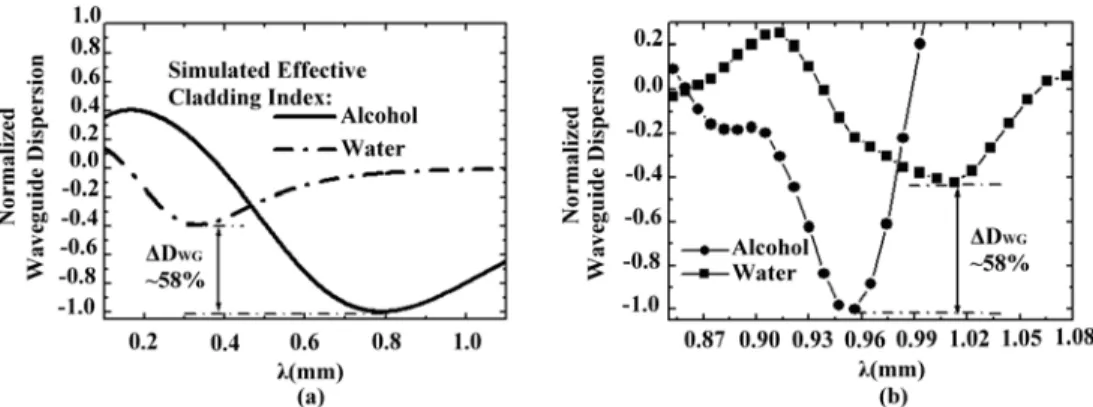
of 0.43mm, channel depth D2 of 0.5mm, and wire radius r of 0.15mm. The effective cladding index can be calculated based on Eq. (5) from the refractive index of a liquid and the air percentage in the sensing condition. Based on the estimated effective cladding index, the theoretical waveguide dispersion of THz pulse along the PS wire transmitting through a liquid sample can thus be obtained based on Eqs. (3) and (4). In the study, the refractive indices of water and alcohol in THz are considered as 2.60 and 1.45 [22,23], respectively, at 0.9mm wavelength. By incorporating 68%-σ into Eq. (5), the effective cladding indices are therefore 1.144 and 1.512 for alcohol and water, respectively. Figure 3(a) shows the simulated wavelength-dependent waveguide dispersion, indicating a 58% variation of the dip of waveguide dispersion between alcohol and water. Figure 3(b) shows the measured waveguide dispersion of THz pulse propagated on the 300μm-core-diameter-PS wire with a liquid sample in the cladding region. The dispersion dips between water and alcohol liquids also have a 58%-variation, which corresponds to the theoretical prediction in Fig. 3(a). However, there is a discrepancy in terms of the wavelength position of the waveguide dispersion dips between theory and the measured result shown in Fig. 3(a) and (b), which is more obviously for sensing of water. It could possibly be resulted from the high index of water which is larger than the PS core index to make the dip shift to long wavelength range [25]. Nevertheless, it did not affect qualitative understanding and calculation of dip-variation of waveguide dispersion induced from different cladding index. Notably, the material dispersion of water and alcohol did not be taken into account in the calculated waveguide dispersion shown in Fig. 3(a). For example, the calculated material dispersion of water [26] is on the order of 10−6 ps/Km/nm at wavelength range of 0.8~1.1 mm although the refractive index of water is obviously changed from 2.5 to 2.8 at this range [23]. Therefore, the material dispersion of water is small enough compared with the measured waveguide dispersion of PS wire with a water cladding (~-20 ps/Km/nm at dip shown in Fig. 3(b)) and the neglect is reasonable.
Based on the variation of waveguide dispersion ΔDWG, different samples can be easily distinguished, such as the water and alcohol in the experiment. According to Fig. 1(b), waveguide dispersion variations ΔDWG of several percent can be detected when the effective
#117682 - $15.00 USD Received 24 Sep 2009; revised 23 Oct 2009; accepted 23 Oct 2009; published 27 Oct 2009 (C) 2009 OSA 9 November 2009 / Vol. 17, No. 23 / OPTICS EXPRESS 20680