• 沒有找到結果。

以含油水製造節能及污染減量之乳化油品技術研發

N/A
N/A
Protected

Academic year: 2022

Share "以含油水製造節能及污染減量之乳化油品技術研發"

Copied!
26
0
0

加載中.... (立即查看全文)

全文

(1)

以含油水製造節能及污染減量之乳化油品技術研發

1

計畫編號:NSC 97-2221-E-006-106-MY3

2

計畫主持人:李文智教授

3

執行單位:國立成功大學環境工程學系

4

5

Abstract 6

Heavy fuel oil is one of the most commonly used petroleum fuel with high pollutions in boilers.

7

Emulsification is a developing technique to enhance the fuel efficiency and reduce the regulated 8

pollution emissions. In current study, the water phase of emulsified fuel contained 1 vol% methanol, 9

4 vol% isopropyl alcohol (IPA), and 95 vol% water, which were simulated to the specific industrial 10

solvent-containing wastewater (SCW). The SCW fractions in emulsified fuel were optimized by 11

thermal, centrifugal, and 14-day standing stability tests. The emulsion M1P4-10 with 10 vol% SCW 12

was found to be no separation, the smallest and the most homogeneous water in oil (W/O) droplets 13

after stability tests. In industrial boiler tests, the micro-explosion and tinder effect of solvent 14

contents improved 10~33% boiler efficiency and reduced 5~31% fuel consumptions by using 15

M1P4-10. The emissions of traditional pollutant SO x , PM, CO, HC, and NO x were decreased by 16

3.3~7.1, 41~85, 89~93, 91~60, and 3.3~23%, respectively. Additionally, the emission levels of total 17

PAHs and total BaP eq were also reduced 37.7 and 61.8%, respectively, by the use of M1P4-10.

18

Consequently, the solvent-containing wastewater emulsified heavy fuel oil could effectively 19

promote the boiler efficiency and reduce the pollutant emissions.

20

Keywords: emulsification; heavy fuel oil; thermal efficiency; emissions; PAHs 21

22

摘 要

23

台灣目前有約 6700 座鍋爐運行,其中重油鍋爐占近 50%,而重油為一種高

24

污染之石化染燃料,針對其污染之源頭之減量與節能技術值得研究。乳化油品

25

為一發展中之油品改質技術,以提高燃料效率和減少污染排放為目的。本計畫

26

中乳化燃料之水相包含 1%甲醇、4%異丙醇(IPA)及 95%的自來水,此配比用以

27

(2)

模擬工業含特定溶劑之廢水。乳化油水相之選擇乃透過加熱、離心及兩週靜置

28

觀察,挑選出其中較低分離率、較均質之乳化油品水相配比,作為工業鍋爐測

29

試油品。其中 10%水相添加之乳化油 M1P4-10 具有最低之分離率、最小之油包

30

水(W/O)滴。本計畫針對實廠運用廢溶劑回收製成乳化重油技術之開發,完成一

31

套自動化乳化系統,包含水相進料、油相進料、乳化劑進料、預混槽、均質系

32

統、回流預混槽管路、成品採樣口及成品出料等元件,其產能可達 8 ton/工作天

33

(8hr)。並已成功開發本土之乳化劑,可經上述設備產出 14 天靜置及離心測試後

34

穩定不分層之乳化油品。此外,本研究中建立了透過顯微照相 (

OLYMPUS BX51TF, 35

TOKYO, JAPAN)

及油滴掃描軟體(

Image-Pro Plus version 5.0.2.9)

之油包水滴粒徑分析

36

技術驗證乳化油品質之方法。並整合後端乳化油品成品貯存、運送及鍋爐參數

37

調控,順利達成乳化重油於 10 噸鍋爐之試驗。於 10 噸鍋爐測試中,使用 M1P4-10

38

時之微爆效應和溶劑助燃效果使得鍋爐效率提高 10-33%,並降低 5-31%的燃料

39

消耗使用。傳統的污染物排放中,因水相取代降低了 10%油品硫含量及微爆效

40

應之再霧化效果,使得油品燃燒更加完全,分別降低及 SO

2

、PM、CO 及 HC 分

41

別降低 3.3-7.1、41-85、89-93 及 91-60 排放。同時,因乳化油具有較低燃燒溫

42

度使得 NOx 形成受到抑制並降低 3.3-23%,此結果突破一般燃燒控制較難與降

43

低 CO、HC 及 PM 同時達成之處。此外,總多環芳烴及總 BaP

eq

排放分別減少了

44

37.7 和 61.8%。由以上測試結果可得知,溶劑廢水乳化重油可有效促進鍋爐效率

45

並減少污染物排放。
46

Keywords:

乳化,重油,熱效率,排放,多環芳香烴

47

(3)

48

1. Introduction 49

The limit petroleum energy and global warming are two major crises around the world today. In 50

some small countries, such as Taiwan, over 99% of energy is imported [1] since the lack of natural 51

energy resources. Reducing the petro-fuel consumption is the most direct and effective way to deal 52

with these problems. Thus, the investigation of sustainable and self-productively alternative fuel 53

becomes essential. There are over 6700 boilers used as heating devices in Taiwan [2]. The three 54

major fuels of boiler are coal, heavy fuel-oil (HFO), and natural gas while HFO-fueled boilers are 55

almost 50% of total sets. The annual HFO consumption in Taiwan was over 15 mega kiloliter (MkL) 56

during 1991 to 2008. Moreover, the annual emission of carbon dioxide (CO 2 ), the most 57

considerable green house gas (GHG), from industrial boiler could be estimated as 44.3 mega metric 58

ton by multiplying the HFO consumption (kL) with CO 2 emission factor of HFO (2.98 metric ton 59

kL -1 -HFO) [3]. Additionally, the high viscosity and sulfur content of HFO resulted in a incomplete 60

combustion and leaded to emit various pollutants, including sulfur dioxide (SO 2 ), particulate matter 61

(PM), carbon monoxide (CO), unburned hydrocarbon (HC), nitrogen oxide (NO x ), and polycyclic 62

aromatic hydrocarbon (PAHs) [4, 5, 6]. In the other word, the pollutant emissions will be 63

expectably decreased if the combustion efficiency of the boiler can be improved.

64

The water-in-oil (W/O) emulsification was used as an alternative fuel technology to approach a 65

more completely combustion and a less pollutant reduction [7]. The micro-explosion (M-E) 66

phenomenon is the major mechanism of emulsified fuel. The water phase was first dispersed 67

uniformly by external forces, such as mechanical stirring or ultrasonic. The specific surfactant was 68

then added into the mixture during emulsification process to stabilize the W/O droplet. In the 69

beginning of the combustion, the water droplets wrapped by oil were heated and transformed into 70

water vapor. Furthermore, the vapor which has a volume that about 1000 times of liquid phase 71

water would explode through the surrounding oil and separated the W/O droplet into much smaller 72

droplets that increased the total contact area to the air. Thus, the combustion efficiency was 73

improved, and the CO, HC, and PM emissions were further reduced at the same time [8]. In 74

addition, the water vapor could react with CO by water-shift reaction (CO + H 2 O CO 2 + H 2 ) to 75

reduce the CO emission and form hydrogen (H 2 ). Nevertheless, using emulsified fuel also could

76

(4)

decrease the temperature of metal units and increase the thermal load of a device [9, 10]. The water 77

emulsified heavy fuel-oil (WEHFO) technique should be more evaluated for industrial boiler.

78

The stability and W/O droplet size of emulsion affected the strength of micro-explosion. All the 79

fuel type, water content, density, dispersed phase fraction, surfactant type, and dispersion technique 80

had been optimized for stable emulsion in that past study [11]. However, the high water fractions of 81

WEHFO decreased the fuel economy because the high latent heat of water consumed more enthalpy 82

when the fuel droplet was heated in the beginning of combustion.

83

Chen [12] showed a breakthrough 14% boiler efficiency improvement by using oily wastewater 84

emulsified with heavy fuel-oil in 2008. There were very few studies which focused on the content 85

and concentration of dispersed phase of an emulsion. In Taiwan, not only oily but also high 86

chemical-containing wastewater, such as solvent-containing wastewater, lubricant wastewater, and 87

cutting oil wastewater, leaded to environmental problems. The high organic contents in such water 88

would harm the natural water body and pollute the water resource. The biodegradation and 89

incineration were the most conventional treatment processes to deal with these specific wastewater.

90

However, those end-of-pipe (EOP) treatment processes had several disadvantages: (1) high capital 91

cost of treating equipments; (2) extra energy and operation cost were demanded; (3) generation of 92

secondary hazardous pollutant, such as active sludge waste and air pollutants.

93

Gong [13] indicated that the addition of the more volatile component could significantly shorten 94

the ignition delay of the emulsified oil. In other word, the solvent-containing water might improve 95

the ignitability of emulsified fuel. Refers to of Chen’s and Gong’s researches, replacing the 96

dispersed phase of emulsified heavy fuel oil by solvent-containing wastewater might be a feasible 97

way to deal with pollutants. In the other words, the organics in the wastewater could be considered 98

as “energy” and be “recovered” by emulsified with HFO as a boiler fuel.

99

In this study, the methanol and isopropyl alcohol (IPA) were blended with water to simulate the 100

specific solvent-containing wastewater. The wastewater emulsified heavy fuel-oil (WWEHFO) was 101

produces by a mechanical stirring emulsification system. Furthermore, three 3.6 ton h -1 steam 102

capacity boilers and one 10 ton h -1 boiler are tested by using both traditional HFO and WWEHFO.

103

The goals of this study are as follow: (1) better stability of emulsion by narrower the density gap 104

between dispersed phase and continuous phase; (2) better fuel economy by more homogeneous

105

(5)

emulsion and less latent heat of water phase by lower boiling point of methanol contained; (3) 106

reduction of pollutant emission by more completely combustion. Consequently, a WWEHFO is 107

expected to improve the boiler efficiency, reduce the pollutions, as well as reuse the energy 108

contained in industrial wastewater.

109

2. Experimental section 110

2.1 Preparation of emulsified heavy fuel oil 111

Heavy fuel oil (HFO) produced by Chinese Petroleum Corporation (CPC) was used in this study 112

as a base fuel. Sulfur content, viscosity at 50 o C, and pour point of base fuel are 0.5 wt%, 110 cSt, 113

and 15 o C, respectively. The solvent-containing water (SCW) was prepared by blending 1 vol%

114

methanol (M, purity >99.9%, LiChrosolv.) and 4 vol% IPA (P, purity >99.5%, J.T. Baker) with 95 115

vol% tap water to simulate the compositions of a specific wastewater from chemical processes. A 116

surfactant was added to form stable emulsions, M1P4-N (N = 10, 20, and 30 vol% water phases) for 117

retarding the flocculation, coalescence, and creaming [14]. The surfactant used in current study 118

comprises the chemicals which refer to Lin’s research [15] and would not be described in this 119

article. The emulsified heavy fuel oil were produced by employing a typical emulsion technology as 120

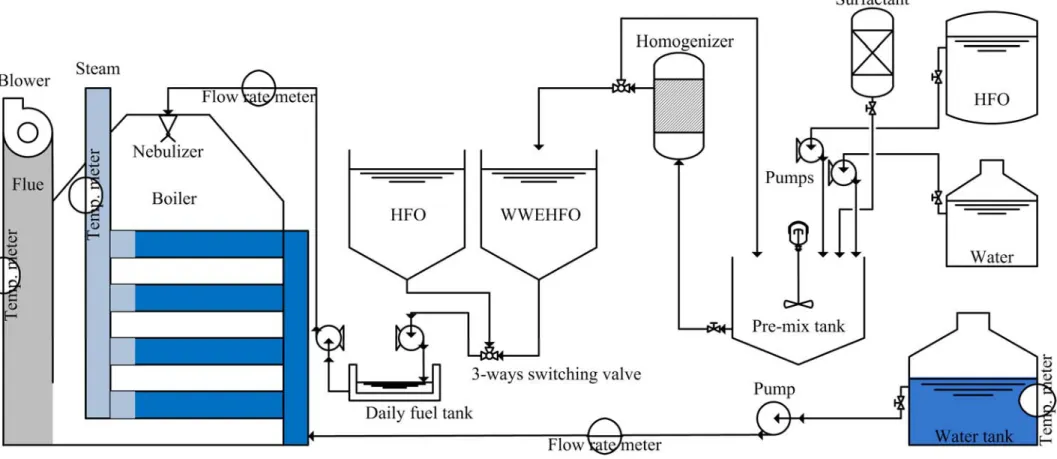
shown in Figure 1. First, HFO, surfactant, and SCW were added by a specific fraction into a 121

pre-mixing tank under 180 rpm stirring velocity to make each content spread uniformly before 122

emulsification. The tested SCW ratios in M1P4-N were 9, 19, and 29 vol% with 1 vol% surfactant 123

and 90, 80, and 70 vol% HFO, respectively. The contents were then emulsified by an inline 124

emulsifier (Tokoshu, Osaka, Japan) at 3600 rpm resulting for small W/O droplets. The medium 125

product was recycled to the pre-mix tank until the fuel stability approach the acceptable level. A 126

valve at the outlet of homogenizer could provide a sample to check on fuel stability. Depending on 127

residence time and motor speed, this emulsification equipment could produce stable emulsified fuel 128

around 1 to 3 metric ton h -1 with 6 cycles per hour.

129

2.2 Fuel properties and stability tests 130

For optimizing the feasible ratio of SCW in emulsions, the centrifugal tests were taken in three 131

conditions to simulate the temperature of delivery, preheated for petroleum gas ignition, and for 132

electrode ignition as 25, 80, and 120 o C, respectively. Each emulsified fuel was centrifuged in a 15 133

mL tube at 5000 rpm for 15 min. The ratios of the unstable separate layers (water) in the

134

(6)

centrifuged tubes were recorded to quantify the emulsion stability after centrifugation. The less 135

volume of a separate layer in tubes represents to a more stable condition. Additionally, two 136

following methods were employed to characterize the stability of emulsion: (1) a two-week (14 137

days) continuous record of fuel daily changes; (2) observation and analysis of W/O droplet sizes by 138

an optical microscope (OLYMPUS BX51TF, TOKYO, JAPAN) accompanied with 400x 139

amplification factor and a charge-coupled device video camera (OLYMPUS DP20). The count 140

mean diameter (CMD), and count median diameter (CM d D) of W/O droplet were calculated by the 141

software Image-Pro Plus version 5.0.2.9 for Windows 2000/XP Professional. After the stable blends 142

were found, the viscosities were further measured by an analog rotary viscometer (NDJ-1) with the 143

measurement rang around 0.1 to 10,000 cP and ±5% error. The heating values of fuels were 144

measured by a calorimeter (IKA C2000 basic) with a cooling water supplier (IKA KV600).

145

2.3 Boiler test 146

Four boilers A, B, C, D with 3.6, 3.6, 3.6, and 10 ton h -1 steam capacities, respectively, were 147

utilized to test with M1P4-N. The boiler system used in this study is showed in Figure 1. The flow 148

rates and temperatures of both fed fuel and flue gas were monitored by flow rate meters and 149

thermometers. The boilers were equipped with pressure gauges and thermometers to measure the 150

produced steam condition. Boiler efficiencies (η) were defined as the ratio of output steam energy to 151

input fuel energy as followed equation (Eq.1).

152

HB h h W

(

v

l

)

(Eq.1)

153

In, (Eq.1), h v and h l are enthalpy of produced steam and water fed, respectively (kJ kg -1 ), W is the 154

mass of produced steam (kg), H is the calorific value of fed fuel (kJ kg -1 ), and B is the fuel 155

consumption (kg).

156

The gaseous pollutants in exhaust were monitored by the standard methods of National Institute 157

Environmental Analysis (NIEA). Specifically, carbon monoxide (CO) and carbon dioxide (CO 2 ) 158

were measured by a non-dispersive infrared (NDIR) analyzer in the measurement range of 0-10 and 159

0-20 vol%, while nitrogen oxides (NOx) and sulfur dioxide (SO 2 ) were measured by an 160

electro-chemical detector (ECD). An automatic stack sampler (AST) was used to collect the 161

particulate matter (PM) on a silicon glass fiber filter. The PM mass on each filter was determined

162

(7)

gravimetrically by a electronic analytical microbalance (Sartorius ME 5-F) with an accuracy of 0.01 163

mg. Sampling and analysis of PAHs were conducted according to the method NIEA A730.70C 164

promulgated by the Environmental Analysis Laboratory, EPA of Taiwan (R.O.C.). This method 165

quantifies both gaseous- and particulate- PAHs in the exhaust gas through a standard processes 166

including flue gas collection, Soxhlet extraction, nitrogen purging concentration, cleanup, 167

re-concentration, and a gas chromatograph/mass spectrometer (GC/MS) quantification. More 168

experimental details could refer to NIEA method. PAHs were quantified by using the selective ion 169

monitoring (SIM) mode. According to the molecular weight, the 21 PAH homologues were divided 170

into three categories: low molecular weights (LM-PAHs, containing two- and three-ring PAHs), 171

middle molecular weights (MM-PAHs, containing four-ring PAHs), and high molecular weights 172

(HM-PAHs, containing five-, six-, and seven-ring PAHs). The total-PAH level of the flue gas from 173

boiler were the summation of 21 individual PAHs. Additionally, the total equivalent toxicity of 174

PAHs is defined as total BaP eq , which is the summation of the products by multiplying individual 175

21 PAHs toxic equivalency factors (TEFs) with their own emission concentrations.

176

3. Results and discussion 177

3.1 Fuel stability 178

After centrifugal test, the higher temperature induced the separation significantly (Table 1) 179

because the increase of temperature effectively reduced the viscosity, and the water phase with 180

higher density tends to separate from emulsion. Table 1 also show that the separate layer increased 181

with increasing SCW ratio. At 120 o C, the separate layer significantly increased from 0 to 8.47 vol%

182

with 10 to 30 vol% water phase. The emulsified fuel with 10 vol% water phase additive (M1P4-10) 183

has almost no separate layer in all temperature condition after centrifugation, which means 10 vol%

184

water phase emulsion have the best stability among three additive fractions.

185

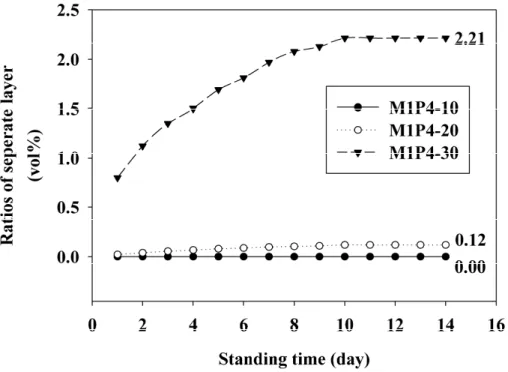
After two-weeks (14 days) standing test, M1P4-30, which had the highest 30 vol% SCW 186

addition, leaded to the highest ratio of separate layer while M1P4-10 had no separate layer (Figure 187

2). Both M1P4-20 and M1P4-30 destabilized during 10 days and then separated into two stable 188

phases after 11 to 14 days. The final separate fractions of M1P4-10, M1P4-20, and M1P4-30 are 189

0.00, 0.12, and 2.21 vol%, respectively. The relatively lower separate fraction of M1P4-10 indicated 190

the better stability it had, which supported the aforementioned centrifugal results. Therefore,

191

(8)

M1P4-10 would be the most stable and feasible fuel among these emulsions to be further tested in 192

industrial boilers.

193

The W/O size distribution could level the homogeneities of different fuel, and the smaller 194

droplet diameter leaded to the lager reaction surface per volume of fuel and promote the complete 195

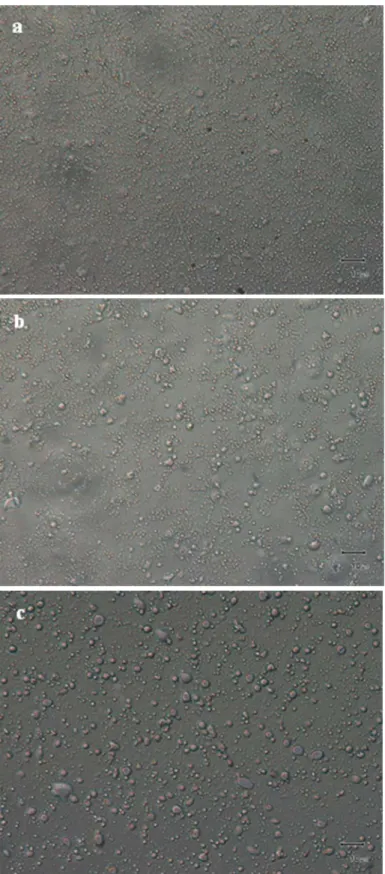
combustion [16,17]. Figure 3a, 3b, and 3c display the droplet appearances, sizes and homogeneities 196

of three different SCW emulsified fuel under 400x optical microscope. Obviously, M1P4-10 had 197

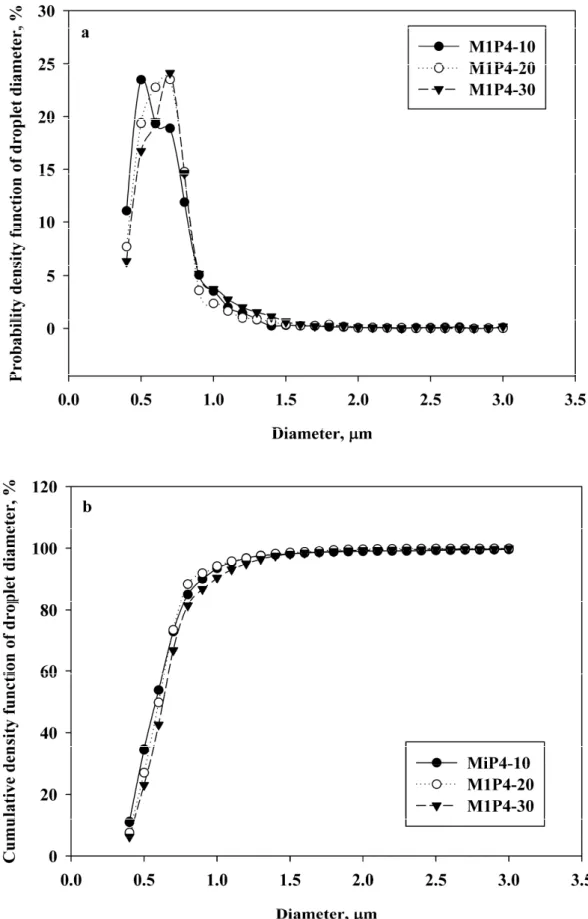
the smallest, most homogeneous distributing droplets. For the statistical analysis, Figure 4a and 4b 198

shows the probability density function (PDF) and cumulative density function (CDF) of W/O 199

droplet sizes. PDF curves indicate that different SCW containing-ratios leaded to different peak 200

diameters which were in the order of M1P4-10, M1P4-20, and M1P4-30 from low to high. In CDF 201

illustrations, the sharpest slope existed in the diameter range from 0.5 to 1 m, meaning the droplet 202

sizes were highly precise and fine. Additionally, the CMDs of M1P4-10, M1P4-20, and M1P4-30 203

were 0.674, 0.684, and 0.730 m while the CM d Ds were 0.589, 0.601, and 0.633 m, respectively.

204

The above results showed that the less SCW in emulsified fuel leaded to form smaller W/O droplets 205

which could also support the trends of PDF. In comparison, the droplet size of M1P4-10 was 206

significantly lower than oily wastewater and water emulsified heavy oil fuel, which were presented 207

between 2 and 3 m by using pilot-scale mechanical homogenizer in Chen’s research [12].

208

Nevertheless, the W/O droplet size of M1P4-10 is even close to that of lab-impeller produced 209

emulsified diesel fuel, which has a high stability in [18]. For another disadvantage of high water 210

content in emulsified fuel, Tarlet et al. indicated that the M-E delay increased by the increasing 211

water contents while 30% water phase increases nearly 100 ms M-E delay, which relatively inhibits 212

the propagation reaction in emulsified fuel combustion [19]. Thus, the good stability and small 213

droplet size of M1P4-10 could enhance the micro-explosion by increasing reaction surface of oil 214

drops and shortening the M-E delay.

215

3.2 Viscosities and energy performances 216

As shown in Table 2, thermal efficiencies of four boilers are enhanced 10.4, 11.7, 32.9, and 217

10.8% by using M1P4-10. At the same time, the equivalent HFO consumption reduces 12.3, 6.2, 218

31.2, and 5.0% in four boilers, respectively, by using M1P4-10. These improvements were due to 219

several property changes of emulsified fuel. Kinematic viscosity was the most effective factor of

220

(9)

spray combustion. The viscosities of emulsified heavy fuel oils have been reported as a higher value 221

than that of regulated heavy fuel oil [7]. No exceptions, the viscosities of emulsified fuel in this 222

study increased with increasing SCW fractions and significantly decrease with the increasing 223

temperature (Figure 5). Generally, the more viscous fuel results in higher surface tension and being 224

hardly nebulized, which further produces coarse droplets, incomplete combustion, and reduction of 225

energy efficiency [7]; however, the performances of four boilers showed significant improvements 226

by using more viscous M1P4-10 emulsion. This conflicting result bases on the effect of 227

micro-explosion. Ikegami et al. [20] indicated that the fuel would be less splashing, but a higher 228

tendency to micro-explode, for the heavier and more viscous fuels. Additionally, the solvent 229

contents with lower boiling points and activation energies would be first ignited and produced 230

radicals as tinders in the initial combustion. Furthermore, the oil drops extracted the heat, reacted 231

with the radicals from pre-combusted solvents and were then ignited. Thus, the chain-propagation 232

combustion reactions were provoked more rapidly than a traditional heavy fuel oil. The lower stack 233

temperatures after using M1P4-10 also reported the decrease of heat loss with the flue gas. Notably, 234

the HFO based efficiency of boiler C was relatively lower than the other three boilers because of the 235

lower preheating temperature and higher viscosity of fuel in daily tank. However, the performance 236

of boiler C was even improved nearly 30% after using M1P4-10. This result again support the better 237

M-E hypothesis of Ikegami [20] and explain why a little more viscous emulsified heavy fuel oil 238

leads to a better nebulization and higher thermal efficiency. The preheating temperature is 239

suggested to be set at 60 o C while this adjustment could both provide a suitable viscosity for 240

nebulization and inhibit the early evaporation of water phase, which would break the fuel supply.

241

Consequently, the M1P4-10 with suitable preheating temperature promotes the micro-explosion and 242

combustion even the initial fuel droplets are coarser near the nozzle than those of HFO.

243

For the social effect of using M1P4-10 as an alternative heavy fuel oil, the estimation could 244

based on the annual HFO consumption. The water to fuel volume ratio (W/F) is a commonly used 245

parameter to estimate the boiler efficiency in practical boiler operation. In current study, M1P4-10 246

could reduce 11.2~16.5% water to equivalent HFO ratio (W/HFO) in 3.6 ton-steam h -1 boiler, as 247

well as reduce 6.1% W/HFO in 10 ton-steam h -1 boiler. According to the 15 mega kL annual 248

consumption of HFO in Taiwan, the 6.1~16.5% reduction of W/HFO can save 915~2,475×10 3 kL

249

(10)

HFO annually. Estimated by US$525/kL-HFO [21], the improvement of boiler efficiency might 250

save US$48~129 million per year in Taiwan. Nevertheless, the equivalent fuel consumption was 251

directly related to the CO 2 emission. The annual CO 2 emission in Taiwan could decrease 252

2,726~7,376 metric ton which estimated by the CO 2 emission factor of HFO (2.98 metric ton 253

kL -1 -HFO).

254

3.3 SO 2 and PM emissions 255

High sulfur content (~5,000 ppm) was one of the air pollution-inducing properties of HFO. By 256

using M1P4-10, the SO 2 concentration was reduced 5.6, 7.9, 7.1, and 6.2% in four boiler flue gases, 257

respectively (Table 3). This result could be simply described by the reductions of 10% sulfur 258

content which was resulted from the 10% alternative volume by water phase in emulsified fuel.

259

Many researchers focus on the emission of particulate matter because of its harmful effect to human 260

respiratory system. It is also a major problem of boiler emission by incomplete combustion. Three 261

main mechanisms of PM formation are nucleation mode (10-100 nm), accumulation/condensation 262

mode (0.1-1 m), and coarsening mode (1-10 m), especially the condensation is the major path to 263

increase the particle mass in combustion [22, 23]. In four boiler rests, the PM emission were 264

reduced 55, 79, 85, and 41% by using alternative M1P4-10 in four boilers (Table 3). The above 265

results indicated that micro-explosion (M-E) significantly improves the droplet nebulization. Thus, 266

the emulsified fuel could react more completely with the oxidants and further decreases the 267

nucleation process of soot. In addition, the presence of sulfur in fuel leads to form the sulfuric acid 268

(H 2 SO 4 ) in the stack flue gases at a lower temperature than that in the combustor. The lower 269

temperature further promotes the condensation of sulfuric acid on the soot and metallic ash to gain 270

the mass of PM in flue gases [24]. Thus, the 10% lower of sulfur content in M1P4-10 and the M-E 271

could reduce the level of PM emission by inhibiting the condensation and nucleation pathways, 272

respectively. Additionally, the emission factors of PM (EF PM ) are calculated by the mass of PM 273

emitted divided by the fuel consumption in sampling duration. EF PM are 184 and 118 mg L -1 -fuel 274

for HFO and M1P4-10, respectively in 10 ton-steam h -1 boiler. The annul emissions of PM in 275

Taiwan can be further estimated by multiplying EF PM with the HFO annual consumption and get 1 276

ton PM reduction.

277

3.4 CO, HC, and NO x emissions

278

(11)

Although the CO and HC emissions by HFO fuel-lean combustion were much lower than the 279

stationary source regulated standards in Taiwan (2000 ppm for CO and no regulated level for HC), 280

they still could be used to determine the combustion condition of boiler. In 3.6 ton-steam h -1 boilers, 281

the CO emissions werrre obviously reduced 90, 98, and 93%, and the HC emissions were reduced 282

60, 46, and 9% (Table 3) by using M1P4-10 while both CO and HC emitted from 10 ton-steamh -1 283

boiler were not significantly decreased. These reductions were resulted from the micro-explosion 284

mechanism and more complete combustion. Furthermore, the solvents contained in SCW could be 285

the key to initiate the chain-combustion reactions as above discussions. Additionally, the slightly 286

higher viscosity of M1P4-10 might affect the spreading angle of nebulizing jet by following 287

equation (Eq.2) and (Eq.3) [25], while r 1/2 is the jet half-width;  is the absolute viscosity; ρ is the 288

density of fuel; v e is the axial velocity; R is the radius of nozzle. R ej is the Reynolds number of the 289

jet flow.

290

1 2

1 2 . 97   2 . 97

 

  e

j

e

R R x

r 

 (Eq.2)

291

r 1 2 x

tan 1

 

(Eq.3) 292

According to (Eq.2) and (Eq.3), the emulsified fuel with higher viscosity leaded to a wider 293

spreading angle and a shorter fuel-air reaction zone in boiler. The flame would be highly 294

concentrated to oxidize most of HC, CO, and organic compounds and further to release more 295

potential energy from pollutants. However, the higher viscosity came up with the disadvantage of 296

worse quality nebulization. Fortunately, the M-E mechanism could provide a second atomization to 297

form much finer fuel droplets. Thus, the CO and HC emission tended to decrease by using 298

M1P4-10. In comparison of the uses of M1P4-10 in different scale boilers, the reductions of CO 299

were more significant in the small boilers while the baselines of CO and HC in 10 ton-steam h -1 300

boiler were initially very low. Notably, the boiler C had relatively higher CO and HC baselines of 301

HFO than those of the other. These results could be also explained by the lowest preheating 302

temperature in daily fuel tank of boiler C. Again, the M-E overcame the more viscous fuel effect in 303

lower temperature.

304

Generally, NO x is mainly formed by Zeldovich mechanism that the nitrogen (N 2 ) reacts with 305

oxygen (O 2 ) in a high temperature condition in combustion. The temperature, duration time of

306

(12)

reactants, and O 2 concentration in combustor might affect the NO x formation. The use of M1P4-10 307

reduces the NO x emission by 11.0, 12.7, 14.4, and 37.4% in four boilers, respectively (Table 3). The 308

reductions of flue gas temperature (Table 2) explained the inhibition of thermal NO x emission 309

because that both lower heating value of M1P4-10 and extra latent heat of water content could 310

slightly quench the combustor. Traditional end-of-pipe (EOP) methods to reduce NO x emission 311

were energy and material consumed, such as the staged combustion process and selective catalytic 312

reduction (SCR). Additionally, the emission of NO x was hard to be reduced while the CO and HC 313

reduction were requested. For example, the staged combustion, might inhibit the thermal NO x

314

formation but increase the potential to form CO, HC, and PM. On the other hand, the emulsified 315

M1P4-10 was an effective alternative to reduce the CO, HC, and NO x at the same time.

316

3.5 PAH emissions 317

Polycyclic aromatic hydrocarbons (PAHs) are considered as a carcinogenic chemical group.

318

PAH could be mainly form by the incomplete combustion, especially by combusting petroleum 319

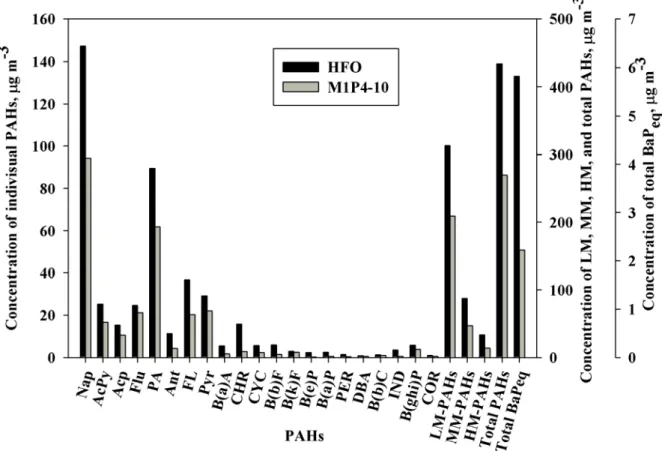
fuels. The total PAH concentration (gaseous + solid PAHs) by using M1P4-10 was 270 g Nm -3 , 320

representing 37.7% reduction from HFO (434 g Nm -3 ) 10 ton-steam h -1 boiler (Figure 6). Several 321

researchers reported that the emitted PAHs by fuel combustion are usually resulted from the directly 322

emission of unburned aromatic hydrocarbons which contained in fuels [26, 27, 28].The total content 323

of aromatic hydrocarbon in M1P4-10 was 10% lower than those in original HFO. Thus, the total 324

PAH emissions were reduced by the amount of sources. In addition, the more complete combustion 325

by M-E mechanism also tends to decrease PAH emissions. The total BaP eq emission of M1P4-10 326

(2.22 g Nm -3 ) was 61.8% lower than that of HFO (5.82 g Nm -3 ). The contributions of LM-, MM-, 327

and HM-PAHs in total PAH were 72, 20, and 7.7% for HFO and 77, 74, and 52% for M1P4-10.

328

Obviously, the LMW-PAHs dominate the total PAH emission, especially naphthalene (34.0 and 329

34.9% by HFO and M1P4-10, respectively); however, the toxic equivalent factors (TEFs) of 330

LM-PAHs, such as Nap (0.001), was much lower than those of MM- and HM-PAHs, especially 331

benzo[a]pyrene (BaP, 1.0) and Dibenz(a,h)anthracene (DBA, 1.0). Thus, the relatively large 332

concentration of Nap was not the most contributive to total BaP eq . In the other hand, the summation 333

of BaP and DBA emissions were reduced 63% from the use of HFO (3.32 g Nm -3 ) to M1P4-10 334

(1.23 g Nm -3 ), and the total BaP eq was further decreased reasonably. These reductions of BaP and

335

(13)

DBA due to the sharply decrease of PM, which was considered as an adsorbent of low volatile 336

HM-PAHs, by using M1P4-10 [28]. The emission factors of total PAHs were calculated as 6.70 and 337

4.45 mg L -1 -fuel for HFO and M1P4-10 in 10 ton-steamh -1 boiler while 89.9 and 36.6 mg L -1 -fuel 338

are the EF of total BaP eq for two kinds of fuels, respectively. The reduction of EF total PAH and EF total

339

BaPeq were 34 and 59% from using conventional HFO. Consequently, M1P4-10 was an alternative 340

that could reduce total PAHs and total PAH toxicity.

341

4. Conclusion 342

1. Among 10, 20 and 30 vol% of total water phase, M1P4-10 has the best stability with no 343

separate layer after thermal, centrifugal, and 14-day standing tests. The CMD and CM d D of 344

M1P4-10 droplets were smaller than those of M1P4-20 and M1P4-30.

345

2. The viscosity increases with the increasing water phase (SCW) after emulsifying; however, the 346

micro-explosion of M1P4-10 can overcome the poor nebulizing problem from its slightly 347

increasing viscosity.

348

3. Micro-explosion mechanism and tinder effect of containing-solvents in water phase 349

significantly improve 10~33% boiler efficiency and decrease 5~31% fuel consumptions in four 350

boiler tests.

351

4. According to the Intergovernmental Panel on Climate Change (IPCC) estimation rules, the 352

equivalent fuel consumption is directly related to the CO 2 emission. The annual CO 2 emission 353

in Taiwan could decrease 2,726~7,376 metric ton.

354

5. The 10% lower of sulfur content in M1P4-10 and the M-E mechanism could directly reduce 355

3.3~7.1 SO 2 emission and further lowered 41~85% PM emissions by inhibiting the 356

condensation and nucleation.

357

6. The emissions of CO and HC were decreased 89~93 and 91~60, respectively, which caused by 358

M-E mechanism and more complete combustion. At the same time, NOx emissions reduced 359

3.3~23% because the lower combustion temperatures of M1P4-10 combustion hindered the 360

thermal NOx formation.

361

7. The total PAHs and total BaP eq were reduced 37.7 and 61.8, respectively, by the use of 362

M1P4-10 because of the reductions of aromatic content in original fuel and the lower level of 363

PM, which was the major adsorbent of HM-PAHs with high toxicities. Consequently,

364

(14)

M1P4-10 is an ideal alternative heavy fuel that can save the energy and reduce the pollution 365

emissions.

366

Acknowledgments 367

368

This research was supported in part by National Science Council in Taiwan, Grant Number 369

NSC 97-2221-E-006-106-MY3. The authors thank Mr. Simon Tu, Dr. H. T. Loong, Mr. H. M.

370

Wang, Mr. M. T. Chien, Mr. T. J. Lu, Ms. S. Y. Yu, Mr. W. T. Wang, Ms. L. P. Chang, Ms. T. Y.

371

Hsieh for their insightful discussions and great helps in experimental work.

372

References 373

1. Energy statistics, Website of Bureau of Energy, Ministry of Economic Affairs, R.O.C., 2008.

374

http://www.moeaboe.gov.tw/opengovinfo/Plan/all/WorkStatisticsAll.aspx/

375

2. Boiler and high pressure container statistics, Council of Labor Affairs, 2008.

376

http://www.cla.gov.tw/

377

3. Nian-Ching Shih. The characteristic analysis of energy consumption and SOx, NOx, CO 2 road 378

transportation sector in Taiwan, Master Degree Thesis, Department of Environmental 379

Engineering, National Cheng Kung University, R.O.C., 2001.

380

4. Wen-Jhy Lee, Ming-Chu Liow, Perng-Jy Tsai, Lien-Te Hsieh. PAH emission from the 381

industrial boilers. Atmos. Environ. 36; 2002: 781-790.

382

5. Habib MA, Elshafei M, Dajani M. Influence of combustion parameters on NOx production in 383

an industrial boiler. Comput. Fluids 37; 2008: 12-23.

384

6. Hay MD, Beck L, Barfield P, Lavrich RJ, Dong YJ, Vander Wal RL. Physical and chemical 385

characterization of residential oil boiler emissions. Environ. Sci. Technol. 42(7); 2008:

386

2496-2502.

387

7. Ballester, J., Fueyo, N., Daopazo, C., Combustion characteristics of heavy oil-water emulsions.

388

Fuel 75; 1996: 695-705.

389

8. Fu WB, Hou LY, Wang L, Ma FH. A Unified Model for the Micro-Explosion of Emulsified 390

Droplets of Oil and Water. Fuel Process. Technol. 79(2); 2002: 107-119.

391

9. Selim MYE, and Elfeky SMS. Effects of Diesel/Water Emulsion on Heat Flow and Thermal 392

Loading in a Precombustion Chamber Diesel Engine. Appl. Therm. Eng. 21(15); 2001:

393

1565-1582.

394

(15)

10. Abu Z M. Performance of Single Cylinder, Direct Injection Diesel Engine Using Water Fuel 395

Emulsions. Energy Convers. Manage. 45(5); 2004: 697-705.

396

11. Lin CY, Chen LW. Comparison of fuel properties and emission characteristics of two- and 397

three-phase emulsions prepared by ultrasonically vibrating and mechanically homogenizing 398

emulsification methods, Fuel 2008; 87: 2154-2161.

399

12. Chen CC, Lee WJ. Using Oily Wastewater Emulsified Fuel in Boiler Energy Saving and 400

Reduction of Air Pollutant Emissions, Environ. Sci. Technol. 2008; 42: 270–275.

401

13. Gong JS, Fu WB. A study on the effect of more volatile fuel on evaporation and ignition for 402

emulsified oil. Fuel 2001; 80(3): 437-445.

403

14. Walstra P., Formation of emulsions, Encyclopedia of Emulsion Technology, Vol.1, basic theory, 404

Becher P. eds, Marcel Dekker, Inc., New York, 1983, 369-404.

405

15. Lin YC, Lee WJ, Chen CC, Saving energy and reducing emissions of both polycyclic aromatic 406

hydrocarbons and particulate matter by adding bio-solution to emulsified diesel. Environ. Sci.

407

Technol. 2006; 40(17): 5553-5559.

408

16. Kimoto K, Namba K, Owashi Y. Observation of combustion behavior for single droplets of 409

water-in-oil emulsified fuels. Proc. Jpn. Mech. Soc. 1995; 61: 738-43.

410

17. Kadota T, Yamasaki H. Recent Advances in the Combustion of Water Fuel Emulsion. Prog.

411

Energy Combust. Sci. 2002; 28: 385-404.

412

18. Wu P, Yang Y, Colucci JA, Grulke EA. Effect of Ultrasonication on Droplet Size in Biodiesel 413

Mixtures. J. Am. Oil Chem. Soc. 2007; 84: 877-884.

414

19. Tarlet D, Bellettre J, Tazerout M, Rahmouni C. Prediction of micro-explosion delay of 415

emulsified fuel droplets. Int. J. Therm. Sci. 2009; 48: 449–460.

416

20. Ikegami M, Xu G, Ikeda K, Honma S, Nagaishi H, Dietrich DL, Takeshita Y. Distinctive 417

combustion stages of single heavy oil droplet under microgravity. Fuel 2003; 82: 293-304.

418

21. Prices of Major Fuels, Website of Bureau of Energy, Ministry of Economic Affairs, R.O.C., 419

2010. http://www.moeaboe.gov.tw/oil102/

420

22. Maricq MM, Chase RE, Xu N, Podsiadlik DH. The effects of the catalytic converter and fuel 421

sulfur level on motor vehicle particulate matter emissions: gasoline vehicles. Environ. Sci.

422

Technol. 2002; 36(2): 276-82.

423

(16)

23. Vogt R, Kirchner U, Scheer V, Hinz KP, Trimborn A, Spengler B. Identification of diesel 424

exhaust particles at an autobahn, urban and rural location using single-particle mass 425

spectrometry. J. Aerosol Sci. 2003; 34(3): 319-37.

426

24. Lyyränen J, Jokiniemi J, Kauppinen E. The effect of Mg-based additive on aerosol 427

characteristics in medium-speed diesel engines operating with residual fuel oils. J. Aerosol Sci.

428

2002; 33(7): 967-81.

429

25. Turns SR. An Introduction to Combustion-Concepts and Applications, 2nd Ed. McGraw-Hill 430

2006: 308-312.

431

26. Williams PT, Abbass MK, Andrews GE. Diesel particulate emission: the role of unburned fuel.

432

Combust. Flame 1989; 75(1): 1-24.

433

27. Mi HH, Lee WJ, Chen CB, Yang HH, Wu SJ. Effect of fuel aromatic content on PAH emission 434

from a heavy-duty diesel engine. Chemosphere 2000; 41(11): 1783-90.

435

28. Emissions in the exhaust of fishing boats after adding viscous agents into fuel oils. Sci. Total 436

Environ. 408(2); 2009: 233-241.

437

438

439

(17)

440 441 442

Figure Captions 443

Figure 1 Emulsification and boiler systems 444

Figure 2 Separate fractions of three emulsified fuels during 14-days standing test 445

Figure 3 W/O dropelts of M1P4-10 (a), M1P4-20 (b), and M1P4-30 (c) under 400x microscope 446

Figure 4 Probability density function of various W/O droplet diameter (a) and cumulative Partial 447

fraction of various W/O droplet diameter (b) 448

Figure 5 Kinematic viscosities of fuels at various temperatures 449

Figure 6 PAH emissions of HFO and M1P4-10 in 10 ton steam h -1 boiler 450

451

Table Caption 452

Table 1 Stabilities of test M1P4-N after centrifugal test with various temperatures 453

Table 2 Energy performance of boiler by using HFO and M1P4-10 454

Table 3 Traditional pollutant emissions of boiler by using HFO and M1P4-10

455

(18)

456 457 458

459

Figure 1 Emulsification and boiler systems

460

(19)

461 462 463 464 465

466

Figure 2 Separate fractions of three emulsified fuels during 14-days standing test 467

468

(20)

469 470

471

472

473

Figure 3 W/O dropelts of M1P4-10 (a), M1P4-20 (b), and M1P4-30 (c) under 400x microscope 474

475

(21)

476

477

Figure 4 Probability density functions of various W/O droplet diameter (a) and cumulative 478

density fractions of various W/O droplet diameter (b)

479

(22)

480 481 482 483

484

Figure 5 Kinematic viscosities of fuels at various temperatures 485

486

487

(23)

488 489 490 491

492

Figure 6 PAH emissions of HFO and M1P4-10 in 10 ton steam h -1 boiler 493

494

(24)

495 496 497 498

Table 1 Stabilities of test M1P4-N after centrifugal test with various temperatures 499

Water fraction in emulsion, %

Separated layer, %

N =10 N =20 N =30

25 o C 0.00 0.11 2.13

80 o C 0.00 0.58 5.76

120 o C 0.00 0.89 8.47

N: Percentages of water phase

500

(25)

501

502

Table 2 Energy performance of boiler by using HFO and M1P4-10 503

Items

(A) 3.6 ton steam h -1 (B) 3.6 ton steam h -1 (C) 3.6 ton steam h -1 (D) 10 ton steam h -1

HFO M1P4-10 Increase

% HFO M1P4-10 Increase

% HFO M1P4-10 Increase

% HFO M1P4-10 Increase

% Thermal efficiency, % 87.4 96.5 +10.4 85.7 95.7 +11.7 73.8 98.1 +32.9 76.2 84.4 +10.8 Fuel consumption,

mL-fuel MJ -1 -steam 27.6 27.2 -1.45 28.0 28.8 2.9 34.3 26.5 -22.7 31.9 33.7 +5.6 HFO equivalent

mL-HFO MJ -1 -steam 27.6 24.2 -12.3 27.3 25.7 -6.2 34.3 23.6 -31.2 31.9 30.3 -5.0 Water to fuel ratio,

L-water/L-fuel 14.3 14.6 +2.10 13.9 14.3 -1.6 11.8 14.7 +24.6 12.6 12.0 -4.8 HFO equivalent

L-water/L-HFO 14.3 16.4 +14.7 14.3 15.9 +11.2 11.8 16.5 +39.8 12.6 13.3 +6.1

Daily oil tank temp. o C 85 65 - 85 60 - 70 55 - 85 70 -

Flue gas temp., o C 189 176 - 116 112 - 175 169 - 225 215 -

504

(26)

505

506

507

Table 3 Traditional pollutant emissions of boiler by using HFO and M1P4-10 508

Items

(A) 3.6 ton steam h -1 (B) 3.6 ton steam h -1 (C) 3.6 ton steam h -1 (D) 10 ton steam h -1

HFO M1P4-10 Increase % HFO M1P4-10 Increase % HFO M1P4-10 Increase % HFO M1P4-10 Increase %

SO 2 (ppm) 125 118 -5.6 121 117 -3.3 99 92 -7.1 129 121 -6.2

PM (mg Nm -3 ) 167 76 -54 163 35 -79 400 61 -85 11.9 7.0 -41

CO (ppm) 208 20 -90 301 20 -93 320 34 -89 0.13 0.13 0.0

HC (ppm) 50 20 -60 13 7 -46 22 20 -9.1 2.4 1.5 -38

NO x (ppm) 100 89 -11 102 89 -13 92 89 -3.3 190 147 -23

509

數據

Figure 1 Emulsification and boiler systems 460
Figure 2 Separate fractions of three emulsified fuels during 14-days standing test 467
Figure 3 W/O dropelts of M1P4-10 (a), M1P4-20 (b), and M1P4-30 (c) under 400x microscope 474
Figure 4 Probability density functions of various W/O droplet diameter (a) and cumulative 478
+3

參考文獻

相關文件

在進口指數方面,按經濟貨物大類(CGCE)計算,包括消費品、原料及半製成品、燃料及潤滑油和

准許 本項貨品同意開放進口,中英文貨品名稱為「飼料用植物或植物提取物之添加物﹙斯 里蘭卡桂皮油、甘牛至油、生薑油、菊苣根提取物、維生素E、甘油蓖麻醇酸酯及 純水﹚Additives of

According to the information of the 10 exhibitions provided by the organisers in the second quarter, their receipts totalled MOP 74.47 million, which were generated primarily

Let T ⇤ be the temperature at which the GWs are produced from the cosmological phase transition. Without significant reheating, this temperature can be approximated by the

Rising prices in new arrivals of winter clothing and footwear, coupled with surging international oil prices that resulted in upward adjustment of the fuel clause of electricity

The difference resulted from the co- existence of two kinds of words in Buddhist scriptures a foreign words in which di- syllabic words are dominant, and most of them are the

最適合製作鮮奶油蛋糕及冰淇淋蛋糕是(A)麵糊類蛋糕(B) 乳沫類蛋糕(C)

The study of water transferring from agricultural section to other sections was emphasized by the government and scholars form the 1985. Industrial section operationally