Chapter 2
Literature Review and Methodology
The aim of this chapter is to review the relevant studies about response tokens, and describe what framework of analysis we take for the response tokens in Mandarin MSN talk. The organization of this chapter is as follows. In section 2.1, we first introduce different terms for response tokens and their functions from previous studies, and discuss their similarities and differences. In section 2.2, studies on English oh are reviewed, since it has most bearing on the functions of the Mandarin response tokens in question. Section 2.3 and 2.4 discuss functions of shi and o respectively. Section 2.5 reviews the studies on Mandarin Chinese shi-o. After reviewing the relevant studies from section 2.1 to section 2.5, we will give the characteristics of MSN, the information of the data and participants in section 2.6.
The framework of analysis will be presented in section 2.7.
2.1 Terminology 2.1.1 Response Tokens
When conversationalists partake in conversation, each of them routinely makes
some contribution. During the extended telling, various brief responses can be
selected by recipients at apt moment to indicate that a piece of talk has been registered
(Fishman 1983; Jefferson 1984; Drummond and Hopper 1993; Fellegy 1995; Stubbe
1998; Gardner 2001). Some of these brief tokens do not seek conversational floor
but encourage the speaker to continue the telling while some may mark a shift and
assume the floor. Still others may involve both of the two functions. However,
there has been no agreement on how to name these brief tokens. These short
utterances are usually labeled as backchannels (White 1989; Clancy et al. 1996), acknowledgement tokens (Jefferson 1984; Drummond and Hopper 1993), minimal responses (Fishman 1983; Coates 1989; Fellegy 1995; Reid 1995; Stubbe 1998), reactive tokens (Clancy et al. 1996), or more recently as response tokens (Gardner 2001).
White (1989) adopts Yngve’s (1970) term ‘backchannel,’ which implies there are typically two channels operating in the conversation. A speaker holds the floor and conveys the message through one channel whereas the recipient receives the information and cedes the floor back to the speaker through the “back channel”
(White 1989: 59). White (1989) categorizes verbal and nonverbal forms into backchannels, such as oh, yeah, mmhm, hmm, and uh-huh. While Clancy et al.
(1996) narrow down backchannels to ‘non-lexical vocalic form’ displaying interest and classify them into a subclass of reactive tokens (Clancy et al. 1996: 359), for example, the English mmhm, uh-huh, hmm, oh and Mandarin mhm, a, ao, ai, en, eh, hum, mhm/mh, which are typical of interjections in earlier studies (Chao 1968; L.
Wang 1987). According to Clancy et al, the token yeah is not defined as a backchannel whereas it is in White’s study.
Intriguingly, some researchers term the collection of tokens, including yeah, mm hm, or uh huh, as ‘acknowledgement token’ (Jefferson 1984; Drummond and Hopper
1993; Gardner 2001). They argue that the set of words is used mainly to indicate the listener’s understanding or agreement during the interactional talk.
Among the diverse terms, minimal responses may be used most frequently to
refer to these discourse organizing objects. For example, Fishman (1983) treats the
items such as yeah, umm, and huh as minimal response tokens, although she does not
give a clear definition of minimal responses. Nor does Coates (1989), except that
she roughly mentions that minimal responses are used to do support work and indicate
recipient’s active involvement. Fellegy (1995:188) and Reid (1995:495), however, lay out the definitions of minimal responses in their article, emphasizing that minimal responses should be brief, one word or two words and serve as indicators of participation in the conversation, such as yeah, hmm, right and so on. Reid (1995) further lists more specific criteria to control restricted group of minimal responses.
For instance, minimal response must be made in response to other interlocutors with little semantic content, constituting ‘a completed or continuing intonation unit’ (Reid 1995: 495). The interactant who uses minimal response is not going to take over the floor, which contrasts with the opinion that some response tokens appear to be able to end a recipient role and assume the role of primary speaker (Drummond and Hopper 1993). In addition, Reid maintains that minimal responses are systematically used and usually do not intervene during the flow of a speaker’s speech, which is also supported by many researchers (Coates 1989; White 1989; Fellegy 1995; Clancy et al.
1996; Stubbe 1998).
Note, however, that Stubbe (1998) takes a more general term “verbal feedback”
to include minimal responses and cooperative overlaps, which functions principally to
ensure the alignment between speaker and listener and ratifies that “speaker and
listener share a common frame of reference”(p.258). She holds that a variety of
verbal feedbacks that the recipients can use involve a “functional continuum,” from
low involvement with neutral affect, e.g. mm, uhuh, and yeah, to high involvement
with positive affect, e.g. brief interjection, repetition, echoes, and sentence completion,
to reflect their degree of involvement in the conversation (p.259, p.266). Once
recipients use the positive verbal feedback to indicate their interactional listenership,
they concurrently can signal a range of affective meanings, such as sympathy, interest,
surprise or difference, according to the contexts and participants’ different goals
(p.259).
In addition to the debate over the terms for response tokens, the position where they occur is controversial as well. Fishman (1983) briefly mentions that “minimal responses occur between the breaths of a speaker” (Fishman 1983: 96) without providing substantial examples whereas Coates (1989:106) states that they are produced at the end of an information unit timely. Example (2.1) is extracted from her analysis (p.103).
(2.1) C: (.) 18 months old + and it would have been rather A: mm……….
C: difficult and this kind of thing = A: yes+ yes+
White (1989) roughly notes that minimal responses usually occur at phrase boundaries, which is not clearly defined; Fellegy (1995:191) further states that minimal responses occur “at boundaries in the predicates where there is some level of semantic completion.” One specific example is taken from her study, as shown in (2.2):
(2.2) I think that
S[that was[
NPa big revelation][
PPto her]]
mm mm hmm
Among these researchers, Clancy et al. are the ones who unravel where a response token occurs most specifically. They argue that RTs occur immediately after
‘Complex Transition Relevance’ (CTRP), which is defined as ‘a point of grammatical and intonational completion’ (p.372). Nevertheless, they do not provide a specific example.
Much document evidence indicates that different genders have different
interactional strategies. Since RTs are one of the interaction strategies, findings on
the relationship between gender and RTs have started to draw some researchers’
attention. Maltz and Borker (1982) hypothesize that positive minimal responses are used by women to signal that they are listening to the speaker while by men to signify agreement. Fishman (1983) claims that the use of minimal responses by male participants’ often display lack of interest while females do the support work.
Coates’ (1989) study centering around all-female conversation do not provide the different uses of response tokens by different genders, but she observes that RTs occur less frequently in narrative interaction, i.e. information-focused, while they are used in a supportive manner in interaction-focused conversation.
Although different uses of response tokens by different genders are mentioned by previous findings, however, whether the overall production of response tokens has to do with gender is still on the debate. Fellegy’s (1995) study reveals that statistical data do not prove there are significant differences on the dimension of gender in the overall production of minimal responses; by contrast, some studies indicate that there is definitely a relationship between the gender and the number of response tokens (Reid 1995; Stubbe 1998). However, it seems that there have been no studies on the relationship between age and RTs.
The latest and perhaps the most complete work so far on response tokens goes to Gardener (2001) book, When Listeners Talk: Response tokens and listener stance.
He discusses almost every related study on this conversational object and uses a general term ‘response token’ to include different uses, such as continuer, acknowledgement, newsmarker and change-of-activity uses. Each of them accomplishes different tasks based on the sequential contexts and the participants’
goals. Additionally, he attempts to systematically provide the ‘core interactional meaning’ of the common response tokens (Gardner 2001: 20), such as mm hm and uh huh, yeah and mm, in accordance with where it occurs and what it responds to.
Besides, Gardner points out some similar and different characteristics of discourse
markers (DM) and response tokens (RT). He argues that DMs involve procedural meaning and can typically accomplish the function such as linking utterances by the
“same” speaker since they usually occur in the middle of a turn while RTs concentrate more on recipients who claim the talk from a speaker that has been heard and acknowledged, although both of them are considered discourse organizing objects and their primary functions are not “to make reference to the world, but to provide some information on the course the talk is talking” (Gardner 2001:14).
On the whole, different terms are named after characteristics of RTs.
Backchannels present the feature that some RTs do not take the primary speaker’s floor but cede it back to him/her. Acknowledgement tokens seem to demonstrate that some RTs imply the speaker’s agreement or reserve their judgment. Regarding minimal responses, it targets the feature of that RTs are often short and brief. The terms, reactive tokens and response tokens, emphasize the feature of the interaction among interlocutors. That is, not only the speaker is doing the interaction work, but also the listener is sharing the responsibility. In spite of their diverse terminology, the common characteristic of RTs involves that they are brief and short tokens, used to signal the speaker’s participation. However, response tokens are sometimes defined as discourse markers, such as Miracle’s (1991) analysis on hao and Schiffrin’s (1987) oh. In order to more precisely unravel the relation between discourse markers (DMs)
and response tokens (RTs), it is necessary to review studies in discourse markers, especially how they are different in the literature.
2.1.2 Discourse Markers and Response Tokens
Fraser (1999) restricts a DM as one with a core meaning typically used by the
same speaker and signaling the relationship between the utterance it introduces and
the foregoing utterance (p.936). Additionally, he maintains that typical DMs are the
grammatical categories such as conjunctions, adverbs, and prepositional phrases.
As a result, based on Fraser’s definition, RTs cannot be included in DMs since RTs are primarily used by a listener, not by the same speaker and they do not belong to a specific grammatical category. Another famous researcher, Schourup (1999:232) draws a conclusion from a number of previous researchers’ opinions and states
“connectivity, optionality, and non-truth-conditionality are all frequently taken together to be necessary attributes of DMs.” The most prominent feature is connectivity, which is to “relate utterances or other discourse units” (Schourup 1999:
230). Optionality is thought to be that the deletion of a DM will not influence the grammaticality of a sentence. The requirement non-truth-conditionality refers to the fact that DMs do not contribute to the truth-condition of a proposition. The three attributes of DMs, however, cannot distinguish the difference between DMs and RTs on the ground that RTs have similar features as DMs do.
Intriguingly, however we feel that DMs are not equal to RTs if we look at the interactional function of DMs. For example, Schiffrin (1987) argues that DMs are used for discourse coherence and proposes five planes of the discourse model.
Among the planes, the concept of ‘participation framework’ seems to suggest that RTs can be classified as a subclass of DMs. Participation framework reflects “the ways in which the speakers and hearers can be related to their utterances - to their propositions, acts, and turns…” (p.27). Furthermore, she takes well as an example, arguing that it is a ‘response marker’ anchoring its user in an interaction and gaining coherence in a local fashion (p.102-103). Schiffrin’s statements show that the definition of DMs is broader and overlaps with that of RTs.
Compared with DM, which is the most common term to name those items,
Erman (2001) uses the term, pragmatic marker, the definition of which is more
extensive. That is, DMs only belong to one function of pragmatic markers. RTs
are also found in the definition of pragmatic markers since RTs are response-oriented and partial characteristics of a pragmatic marker reflect this singular feature.
According to Erman’s definition (2001), pragmatic markers involve three functions.
DMs are textual monitors, which are used to “create coherence,” including editing or hesitation markers, such as however and I mean. Another function of a pragmatic marker is to serve as a social monitor containing ‘interactive markers’ and
‘comprehension-securing markers’ (p.1341). To put it more precisely, in the social domain, a pragmatic marker signals participants’ attitudes and understandings during a conversation (p.1345). Some pragmatic markers are good candidates for the job, signaling the messages such as “You can go on speaking and I’m still listening,” “Can I butt into the conversation here,” or “Could you listen to me, please” and so on (p.1345). The other monitor is a metalinguistic one and it provides the speaker to check whether the addressee understand his/her messages.
As Gardner (2001) states that both DMs and RTs are ‘discourse organizing objects,’ they are certain to have some similarity. Both of them have little semantic meaning and may not contribute to the truth-conditionality of a proposition.
Regarding connectivity, the subtlety is that DMs can add global or local coherence to discourse. Finally, they are indicators of participation with a turn-taking function in the conversation and serve as ‘turn regulators’ (Erman 2001:1341). However, Gardner does not unravel clearly the similarities and differences concerning the definitions of RTs and DMs.
After examining the definitions of DMs and RTs, when taking a closer look at
the behavior of shi-o, o, zhende o and zhende ma, we find out that they can anchor a
speaker in a conversation and his/her utterance can be related to immediately prior
utterance of the other speaker. They have little semantic meaning and do not
contribute to the truth-conditionality of a proposition. Roughly speaking, shi-o can
be a pragmatic/discourse marker, as indicated in the previous studies of Y. Lin (2002) and S. Lin (2004). More specifically, shi-o is regularly used in response to indicate that a listener is attending to what is being said with concomitant affective feedback from time to time during the stream of talk. Hence, we will follow Schifrrin’s and Erman’s definitions on DMs and recognize RTs are part of DMs. RTs, therefore, can be referred to one kind of discourse markers functioning in participation framework/social domain, which particularly ascertain or elicit participants’
involvement. The token shi-o and the other three tokens which are the target of the present thesis are hereafter called a response token, which is ‘semantically transparent’ (Gardner 2001:14), and can best capture the response-oriented nature of these tokens.
In the next section, we will continue to discuss the investigations on English oh, which appears to correspond to shi-o in Mandarin.
2.2 Oh in English
Among the studies on oh, Heritage (1984) is probably the first scholar to provide an in-depth analysis of the functions of oh and its core interactional meaning. He proposes that oh is a ‘change-of-state token’ produced to assert the change of the producer’s prior and current state of knowledge. He recognizes two major environments where oh occurs. First, it is implemented in response to informings.
Thus, oh can be used in response to the answer elicited from a prior question in a question-answer sequence, and to show his/her acceptance of the prior speaker’s position when the current speaker receives counterinformings. Example (2.3) and (2.4) are instantiations:
(2.3) (Heritage, 1984:308)
J: When d’z Sus’n go back.=
M: .hhhh J:=
M: u-She: goes back on Satisda:y=
J: =O h:
M: A:n ‘ Stev’n w’z here (.) all las’week…
(2.4) (Heritage, 1984:312) B: It looks like beef’n bean curd.
(1.0)
J: Well I was’ lots of beef.
D: I think it’s port.
B: Oh. Pork.
D: Mm hm.
The second major environment where oh emerges is after previous complete information or repair, where oh is produced to display understanding. Example (2.5) can demonstrate this function.
(2.5) (Heritage, 1984:312) J: Derek’s ho:me?
(0.5) I: Yo:ur Derek.
J: Ye:s m m I: Oh.
In spite of the variety of oh and its placement in a range of sequence types, it has a core function to show that the speaker experiences a change of knowledge state and that the information is transferred from an informed party to an uninformed party.
Interestingly, oh appears to be frequently used to confirm the alignment between
speakers. Heritage (1984) observes that oh usually occurs with other additional
components, such as assessments, to treat the prior informing as complete and with
additional inquiries for further information. Free-standing oh rarely occurs singly
but frequently with additional turn components in his data. Free-standing oh itself is topic-curtailing, not inviting the announcer to further any informing in that it occurs commonly after a complete chunk of information. Therefore, it is inadequate to be placed after a new topic is going to be elaborated.
Schiffrin (1987) targets oh in great research effort as well. Similar to what Heritage (1984) holds, Schiffrin argues that oh displays functions that operate on the plane of ‘information management tasks’ (p.74). That is to say, “…oh pulls from the flow of information in discourse a temporary focus of attention which is the target of self and/or other management” (p.74). To some extent, oh has a function of displaying the transition of information state because it can be an indicator of speaker’s focus and also addressee’s attention, which echoes Heritage’s term, ‘a change-of-state token.’
What Heritage’s and Schiffrin’s analyses differ is that Schiffrin further illustrates
the pervasive characteristics of oh as a DM in ‘participation framework’, elaborating
on oh in repairs and in question-answer pairs, and explores the attributes of oh as a
discourse marker and a backchannel. Take repairs for example. Oh can initiate a
repair by the speaker himself/herself or by others and can preface self- and
other-completion when the repairs are completely revised. Moreover, with respect
to the sequence of (Q-A-oh), Schiffrin argues that a questioner could imply his receipt
of new information from the speaker by responding with oh on the one hand and
request clarification or elaboration which is prefaced by oh on the other hand. By
comparison with Heritage’s statement that oh does not necessarily respond to
unexpected answer, Schiffrin lays special emphasis on the fact that oh does occur
more after unexpected answers when the preceding proposition is completed in a way
that has been differently anticipated. To sum up, Schiffrin reaches a conclusion that
oh is a marker which ensures the producer’s ongoing information management on the
information management plane and ratifies the division of participants’ labor in the conversation on participation framework plane. Although Schiffrin canvasses the functions of oh, she nevertheless does not differentiate the disparity between oh as a discourse marker and as a response token. The two primary functions seem to be lumped together.
Another study on oh is conducted by Aijmer (1987). She compares the functions of oh and ah and identifies myriads of functions of oh in line with previous researches (Heritage 1984; Schiffrin 1987). Based on Aijmer’s observation, oh can be occasioned when the information in the prior turn is new and surprising to the producer while ah conveys not only what the speaker has been expecting but his/her pleasure to the information. Furthermore, Aijmer states that when the marker oh is together with other components, speakers can express a variety of affective feedback such as disappointment, annoyance, and frustration and the like. On the contrary, ah usually expresses positive evaluation. It seems that all the phenomena can be reduced to regularities. However, no substantial explanations are provided to interpret the question such as why ah can co-occur only with positive evaluation but oh is not the case.
Based on previous researches on functions of oh, Fox Tree and Schrock (1999) express their interest in the use of oh as a DM in the circumstances of repair and test directly how it influences the addressee’s comprehension by means of word monitoring task and semantic verification task (Fox Tree and Schrock 1999: 284-85).
The two tasks are employed to test whether listeners can recognize faster a word
before oh and after oh in comparison with the word occurring in the environment
where oh is absent. They hypothesize that oh can contribute to the listener’s
understanding in the conversation by proposing two concepts, ‘disjuncture
mechanism’ as well as the ‘expectation mechanism’ (p.283). As a marker of
disjuncture, “oh informs listeners to halt integrative processes across adjacent utterances” (p.283-84). In terms of expectation, “oh might cause listeners to expect a change of state in the upcoming speech” (p.284). The result of their experiments corresponds to the mechanisms that Fox Tree and Schrock propose. That is, oh as a DM does offer information to the overall discourse and may help listeners process the information in the conversation.
To summarize, English oh is a change-of-state token, marking the speaker’s information state, showing speaker’s understanding and assuring the alignment between speakers and listeners. It can co-occur with other additional moves such as assessments and questions to build different topical development.
In the above section, we have reviewed relevant studies on the receipt oh in English. In the following two sections, we first concentrate on the functions of the two morphemes shi and o in RT shi-o. Then, we review the preliminary findings on shi-o as an RT in Mandarin Chinese.
2.3 Shi in Mandarin Chinese
All of the previous studies on shi have an agreement that shi is a copular verb as a link between a referential subject noun phrase and a non-referential noun phrase (Chao 1968; Li and Thompson 1981; Liu et al. 1983; C. Wang 1984; L. Wang 1987).
Analogously, a relevant account is proposed by Chen (1995:443), who argues that within the sentence, the basic function of Taiwanese si is “relational to assert equivalence A and B, where A precedes B and also serves as the point of reference for B.” Example (2.6) and (2.7) show the basic function of the Chinese copular verb.
(2.6) (Li and Thompson, 1981:149)
ta fuqin shi waijiao buzhang
他 父親
是外交 部長 3sg father be foreign affair minister ‘His/Her father is the foreign minster.’
(2.7) (Chen, 1995: 442) I si isieng 他
是醫生 3sg be doctor ‘She’s a doctor.’
A Mandarin copula can denote an emphatic tone as well when it is used to affirm what has been suspected or when it occurs before a subject to emphasize the subject (Chao 1968; Li and Thompson 1981; Liu et al. 1983; C. Wang 1984; L. Wang 1987), such as the following examples.
(2.8) (Li and Thompson, 1981: 151) ta shi mei qian 他
是沒 錢。
‘It’s true that s/he doesn’t have any money.’
(2.9) (C. Wang, 1984: 161)
shi zewei hao qingnian ba luoshui de haizi cong jiangli
是這位 好 青年, 把 落水 的 孩子 從 江裡 jiu qilai
救 起來
‘It’s the good young man that saved the child from the river.’
The function of emphasis on the subject by means of Mandarin shi can be found in the one of Taiwanese si. Chen (1995) states that when two elements linked by a Taiwanese copula si are less similar, the more salient emphatic/contrastive function emerges, as exemplified in example (2.10) which may take place when people order a meal.
(2.10) (Chen, 1995: 443)
I si kapi; gua si te.
伊
是咖啡 我
是茶 3sg be coffee; 1sg be tea
‘He is [the one who ordered] coffee; I am [the one who ordered] tea.’
Chen holds that the ‘extra-sentential’ equivalence between the elements linked by si needs more context information to make logic out of non-logic.
Besides, Chao holds that shi can occur between two identical actions to imply
‘concession’ and the following sentence regularly starts with words, such as dan ‘but,’
que ‘but,’ and so on. This is the same as the reiterate use of si in Chen’s study.
(2.11) (Chao, 1968:361)
chifan shi chifan keshi bu he jiu 吃飯
是吃飯, 可是 不 喝 酒。
‘Though we had a meal, we didn’t drink.’
However, a free-standing shi can be used by people of lower social status as an
‘affirmative response’ to people of higher status (Chao 1968; Liu et al. 1983).
(2.12) A: ba ze ge na zou 把 這 個 拿 走
‘Take this away.’
B: shi
是‘Yes, sir.’
Chen (1995) explains that the agreement/confirmation found in the Taiwanese copula is due to the fact that it links two elements inter-sententially. This may be related to Mandarin shi, which is entitled with the meaning of confirmation.
Observe the Taiwanese example (2.13).
(2.13) Lin bo beh khi, kam-m-si ?
恁 無 欲 去 敢-m-是 2PL NEG want go can-m-be ‘You’re not going, are you?’
Si, guan bo beh khi
是1PL NEG want go ‘Yes, we’re not going.’
Among so many promiscuous usages of the Taiwanese copular verb si, Chen (1995: 444) states that the major function of it is to encode the speaker’s determinant opinion or attitude, unlike most main verbs expressing the grammatical Subject/Agent’s will. Therefore, the copula si is frequently used whenever there is need for emphasis or contrast.
The studies reviewed above on Taiwanese si and Mandarin shi give us insight into the following analyses on functions of shi-o. It is suggested that the copular verb in Chinese represents a concept of equivalence bridging two elements intra-, inter-, or extra-sententially. Besides, the major pragmatic function of it is to signal
‘personal assertive flavor.’ In the next section, we deal with o in Chinese.
2.4 O in Mandarin Chinese
The majority of earlier studies on Mandarin o define it as an interjection and only make very brief comments on the functions of o (Chao 1968; C. Wang 1984; L. Wang 1987). These researchers offer that o in general can indicate that the speaker knows something but o with rising tone can indicate surprise, which is as synonymous as the utterance ‘really.’ These can be exemplified by examples (2.14) and (2.15), which are excerpted from Hongloumeng “Dream of the Red Chamber” by Wang (1987:329).
(2.14) o ta xiaozi jing hui he jiu bu cheng ren ma
哦!他 小子 竟 會 喝 酒 不 成 人 嗎?
‘Oh, will this guy overdrink?’
(2.15) jiayueng xiao dao qiu shushu de shi shenniang bie ti wo zheli 賈芸 笑 道:「求 叔叔 的 事,嬸娘 別 提,我 這裡 zheng houhui ne zao zhi zheyang wo yi qitou er jiu qiu shenniang 正 後悔 呢。早 知 這樣, 我 一 起頭 兒 就 求 嬸娘,
zhehuizi ye zao wan le shei chengwang shushu jign bunen de 這會子 也 早 完 了。誰 承望 叔叔 竟 不能 的!」
fengjie xiao dao o ni na bian mei cheng er zuo er you lai zhao 鳳姐 笑 道:「
哦! 你 那 邊 沒 成 兒,昨 兒 又 來 找 wo le
我了!」
‘Jiayueng laughed and said, “Don’t mention the matter I asked my uncle about, Aunt. I am regretting. If I had known the result, I would have requested Aunt. The problem could have been solved. Who would know that Uncle cannot help me.” Fengjie laughed and said, “oh, you failed to ask for a favor (from your uncle) and you visited me again yesterday.”’
L. Wang (1987) holds that o in example (2.14) expresses the speaker’s surprise whereas in example (2.15) Fengjie suddenly realizes the reason why Jiayuen visited her by producing o. Besides, C. Wang (1984:128) particularly notes that o can be used to make a promise, e.g. o, wo yiding zhao ni de hua qu zuo ‘Ok, I promise I will do what you want me to do.’
Li and Thompson (1981:311-12), unlike previous researchers who hold that Mandarin o serves as an interjection, argues that o as a sentence-final particle shows a speaker’s friendly warning and is frequently used to ‘soften a command,’ for instance, bie shengqi o ‘Say, don’t get angry, OK!’
Shie (1991:169-86), in the same vein, recognizes three functions of Mandarin o
as an utterance final particle (UFP). Basically, o serves as a marker of “warning or
reminding of some undesirable consequences.” Second, it can be attached to
descriptive words to express a speaker’s viewpoint about a certain matter. Third, it
serves as a marker of request for confirmation or a mitigator of an assertion. (2.16),
(2.17), and (2.18) below show his examples of the three uses respectively (Shie
1991:170,175,179).
(2.16) zei: laoban ni de binshi che ye zai wo men shousheng ne 賊: 老闆 你 的 賓士 車 也 在 我 們 手上 呢
dageda: na shi zengche ni yao jiu song ge ni buguo xiaoxin 大哥大: 那 是 贓車 你要 就 送 給 你 不過 小心 o
哦
che huai le xiuli hen gui o 車 壞 了 修理 很 貴
哦!
(2.17) shanzei:hao qiguai o tianmocheng chuan baiyi de na ge 山賊: 好 奇怪
喔天魔城 穿 白衣 的 那 個 toutou shou fang le wo men jiu fang le wo men ye
頭頭 說 放 了 我 們 就 放 了 我 們 耶
‘This is strange. (with o) The chief of Tianmo City did as he said: he set us free.’
(2.18) nan: ze shi yi shou xiangdang bucuo de gequ o 男: 這是一 首 相當 不錯 的 歌曲
噢?
‘This is a quite good song (with o)?’
nu: e 女:恩 ‘Yeah.’
The brief review above is concerned with Mandarin o. The study on Taiwanese o can give us insight into the functions of Mandarin o. Li (1999) examines in great
depth Taiwanese o and holds that it is a marker for introduction/reception of new information. She recognizes the usages of o from two aspects: UFP o and free-standing o (without a head utterance). UFP o can further be classified into two categories based on different pitches. That is, o7/o1/o5
1signals
1 O1 takes a high-level [55] pitch, resembling the first tone; o7 takes a mid-level [33] pitch, resembling the 7th tone; o5 takes a [35] rising pitch, similar in contour to the low rising 5th tone but higher in pitch value (Li 1999:142).
‘addressee-orientation’ while o3
2‘speaker-orientation’ (p.177). The former marks the introduction of new information to the addressee while the latter the reception of new information by the speaker. Since RTs are the main focus in the present thesis, we put more emphasis on the latter one which centers on responses. The following example demonstrates that Taiwanese o3 signal the speaker’s receipt of new information from others (p.157-58).
(2.19) H1: Goa piaN kau to khi li chai m?
我 拼 到 叨 去 你 知 m 1SG strive t o where go 2SG know not 2 Seng-chu-set Song Chhu-ju hoNh 省主席 宋楚瑜 hoNh Province-governor Song Chhy-ju UFP 3 to goa piaN kau hia khi
就 我 拼 到 遐 去 just 1SG strive to there go
A1: An-ne o3?
按呢 o3 like-this UFP
H4: HeN. Goa kha tian-oe ho I hoNh heN 我 敲 電話 與 伊 hoNh right 1SG make phone-call to 3SG UFP
H1-3: You know where I managed to reach? Province Governor Song Chhu-ju, that’s where I managed to reach.
A1: Is that so?
H4-5: Right, I made a phone call to him.
Besides, in this example, Li (1999) discusses the confirmation heN in H4. Unlike Shie (1991), who holds that Mandarin o is a marker of request for confirmation, Li (1999:158) argues that this function is derived from conversational inference since the speaker signals his/her receipt of new information with o, and this implies that he/she is not sure of the information. Thus, this verbalization may invite reconfirmation
2 O3 takes a [21] low-falling pitch, roughly equivalent to the 3rd tone (Li 1999:142).
from the informed party, as indicated in H4.
Another context in which o3 is used is when the speaker wants to clarify the misunderstanding of some facts or even to refute the listener’s viewpoint (p.164).
(2.20) A1: Goa kong taN taN ho tng a3 我講旦旦好轉矣
1SG say now now well go-back CRS 2 Lau-hoe-a chiN hong koai beh liau a3
老伙仔 錢 與人 拐 欲 了 矣 Old-man money PASS trick want finished CRS 3 Het-le siau-lian e knog
彼個少年的講
4 siau-len e to ho koai khi o3 少年 的 就 與 拐 去 o3 Young ASSC just PASS trick go UFP 5 lau-hoe-a
老伙仔 old man
A1-5: I said, “now it’s time for to go back. The old men have been tricked and lost their money.” That young said, “Even the young men have been cheated of their money, not to mention the old men.”
Regarding free-standing o, it is analogous to o3 attached to a head utterance.
That is, it assures that the addressee has received the message conveyed by the speaker. However, when the pitch for o rises, such as oh
3, o2
4and o5, it signals not only receipt of new information but also surprise (p.170), as exemplified in (2.21).
(2.21) C1: Hit pai kong kai-siao chit-e kong seN Go 彼 擺 講 介紹 一個 講 姓 吳 that time say introduce one-M say surname Go 2 Goa kong seN Go m-hoN la
我 講 姓 吳 m 好 la 1SG say surname Go not-good UFP
3 Oh takes a [32] mid-falling pitch, often followed by a glottal stop, similar to 4th tone.
4 O2 takes a [51] high falling pitch, equivalent to the 2rd tone.
D1: Lan, bo kah seN Go e cho-chhin hioh?
咱 無 及 姓 吳 的 做親 hioh 1PL1 NEG with surname Go NOM make-marriage UFP C3: U cho-chhin,… ke-chhut beh la, chhoa-jip m la
有 做親 嫁出 欲 la 娶入 m la have make-marriage marry-out want UFP marry-in NEG UFP D2: Oh!
UFP
3 E-iong ke-chhut, be-iong chhoa-jip hioh?
會容 嫁出 炔容 娶入 hioh may marry-out may-not marry-in UFP C4: HeN a7
right UFP D4: O2 UFP
C1-2: Last time they introduced one surnamed Go, I said those surnamed Go were not suitable.
D1: We, don’t allow marriage with the Go’s?
C3: We do have marriage (with them),…(we) can marry our girls to the Go’s (but we) can’t marry the Go’s girls.
D2-3: Oh! Marrying our girls to the Go family is OK, but marrying a Go girl is not allowed, right?
C4: Right.
D4: Oh.
Another usage of o is that the speaker can use it to shift to a new topic (p.171), as illustrated in example (2.22).
(2.22) (D was talking to others about how an electric massaging machine works, and when he turned, he saw E yearning and walking toward his bedroom.)
D1: O3.
UFP
2 A, A-ku li beh khun hioh?
a 阿舅 你 欲 睏 hioh
DM uncle 2SG want sleep UFP
D1-2: Oh. Uncle, you are going to bed?
D recognizes the fact that E seems to be ready to go to bed and she shifts to topic whether E is going to bed.
Li’s (1999) study can be generalized as follows. First, the core pragmatic function of UFP o serves as a marker of receiving and introducing new information.
The derived functions include the signaling of warnings and refutations after a head utterance. Second, the core function of free-standing o, which corresponds to the term RT o in the present study, is to mark the receipt of information. Besides, o with higher pitch can indicate surprise and speaker’s higher involvement while low pitch shows the speaker’s ‘detachment’ or ‘indifference’, i.e. low involvement.
While Li’s study provides us with a comprehensive account of Taiwanese o, by contrast, the functions of Mandarin o leaves much room to be improved since the previous studies have not provided us with systematic analyses but merely various functions of it are enumerated. We will endeavor to proffer a core meaning of o and proffer the functions of it in detail. In the next section, we review the preliminary studies on functions of shi-o.
2.5 Shi-o in Mandarin Chinese
There have been only two studies on Mandarin Chinese shi-o, one of which is found in Y. Lin (2002), who draws on data from daily life and BBS conversation and discusses shi-o as a ‘pragmatic marker.’ Working from the framework proposed by Erman (2001), Lin proposes different uses of shi-o in three domains, namely textual, social, and metalinguistic domains. She points out that it is an expression serving as a ‘transition marker’ when the topic in discourse is about to change (p.8). Example (2.23) is adopted from her analysis.
(2.23)
A: 可 ke
是 shi
definition definition
和 han
short answer short answer
都 dou
要 yao
背?
bei?
but definition and short answer all need memorize 不
bu 知 zhi
背 bei
啥 sha
耶!
ye!
not know memorize what RF
‘But do we have to memorize both definition and short answer? I don’t know what to memorize!’
B: 大 da
概 gai
是 shi
講 jiang
義 yi
上 shang
的 de
粗 cu
體 ti
字 zi
吧!
ba maybe is handouts on ASSOC bold-faced words SA
可 ke
是 shi
他 ta
講 jiang
義 yi
寫 xie
得 de
非 fei
常 chang
簡 jian
略 luu but 3SG handouts write ADV very brief
‘Maybe what we have to memorize is the bold-faced typed words on the handouts. However, what is written on the handout is very brief.’
A: 對 dui
呀!
ya right RF ‘Right!’
B: 要 yao
自 zi
己 ji
去 qu
查 cha
資 zi
料,
liao 很 hen
煩 fan
耶!
ye need self to look up information very troubling RF
‘We need to look them up by ourselves. That’s troubling!’
A: 沒 mei
錯,
cuo 我 wo
都 dou
沒 mei
查 cha
耶!
ye right 1SG all not look up RF
‘Right! I haven’t look them up!’
B: 我 wo
發 fa
現 xian
線 xian
上 shang
的 de
大 da
英 ying
百 bai
科 ke 1SG found online GEN Great Britian encyclopedia
很 hen
好 hao
用,
yong 在 zei
www.eb.com www.eb.com
very useful on www.eb.com
‘I found a very useful website. It’s www.eb.com.
A: www.eb.com www.eb.com
就 jiu
這 zhe
樣?
yang
www.eb.com is this
‘www.eb.com that’s all?’
B: 對 dui
啊!
a
你 ni
去 qu
申 shen
請 qing
free for 14 days free for 14 days
就 jiu
可 ke
以 yi
用 yong
了。
le yes RF
2SGgo apply free for 14 days to able use
PFV‘Yes. You could apply for free use for 14 days and then you can access to it.’
A:
是喔! shiou
你 ni
有 you
xxx xxx
的 de
Email Email
嗎?
Ma
yeah 2SG have xxx GEN Email Q
‘Yeah. Do you have xxx’s email?
B: 沒 mei
有 you
耶!
ye 你 ni
要 yao
他 ta
的 de
Email email
幹 gan
嘛 ma
啊?
a no RF 2SG want 3SG GEN eamil for what RF
‘No. Why do you want his email?’
A: 要 yao
寄 ji
東 dong
西 xi
給 gei
他 ta
啊!
a
want mail something to 3SG RF
‘I want to mail something to him.’
In addition, she claims that shi-o involves three more functions in the textual domain, where it serves as a type of ‘discourse marker’: (i) it functions as relating interlocutors’ different knowledge while they are sharing the same topic; (ii) it elicits further questions in the following utterances; (iii) it indexes two speech acts, disagreement and refusal. On the other hand, she contends that shi-o serves as the
“minimal response to the addressee” in social domain (p.25), and as “approximators, hedges, or emphasisers” in metalinguistic domain (p.27). Example (2.24), (2.25), and (2.26) are extracted from Y. Lin’s analysis to illustrate shi-o in textual domain.
(2.24) A: 你 知道 嗎? 我們 XX
ni zhi-dao ma wo-men xx
2SG know Q 1 PL xx
系 我們 班 班版 已經 xi wo-men ban ban-ban yi- jing department 2PL classboard has
荒廢 了, 沒有 人 huanf-fei le mei-you ren abandoned PFV nobody
在 PO 文章。 (笑)
zai PO wen-zhang (laugh) still post particles (laugh)
‘You know what? The bulletin board of our class in our department has been abandoned. Nobody wants to post articles now.’
B: (笑) 我們 系.. 我們 班版 現在 (laugh) wo-men xi wo-men ban-ban shian-zai (lauge) 2PL Dept. 2PL class board now 大部分 都 是 在 講 那
da-bu-fen dou shi zai jiang na mostly al l is now talk that
種, 要 不 然 就是 教學
zhong yao-bu-ran jiu-shi jiao-xue kind whatever is teaching 的 事情 啊,學生 怎麼樣。
de shi-qing a xue-sheng zen-mo-yang ASSOC things RF students whatever
‘Our class board in our department now is full of articles about teaching and things about students.’
A: 我們 班 連 實習 的 事情 都 wo-men ban lian shi-xi de shi-qing dou 2PL class even intern ASSOC things all
沒有 人 PO。
mei-you ren PO nobody post
‘In our class, we don’t even have articles about internship.’
B:
是喔! Shi-ou Yeah ‘Yeah!’
A: 其實 我 覺得.. 我 覺得 跟 一
qi-shi wo jue-de wo jue-de gen yi In fact 1SG think 1SG think with a
班 的 風氣 有 關 耶。
ban de feng-qi you guan ye class GEN atmosphere has relation RF
‘In fact I think this is related to the atmosphere of a class.’
B: 我們 班 還 算 蠻 團結,
wo-men ban hai suan man t uan-jie 2PL class still as some united
可是 我們 班 其實 上站 的 ke-shi wo-men ban qi-shi shang-zhan de but 2PL class in fact hop on GEN 人 不 多, 就是 不一定 會 ren bu duo jiu-shi bu-yi-ding hei people not many that is not necessary can
用 BBS 聯絡, 而且 自從 大家 在
yong BBS lian-luo er-qie zi-cong da-jia zai use BBS contact and from everyone at 實習 之後, 能 PO 文章 的 shi-xi zhi-hou neng PO wen-zhang de intern after can post articles ASSOC 時間 越來越少 了。
shi-jian yue-lai-yue-shao le time less and less PFV
‘Our class is still united but actually there are not many people hopping this station. They don’t necessarily use BBS to contact each other.
Since everybody has internship, they have less and less time to post articles.’
(2.25) A: 我 跟 你 說 喔! 魔戒 wo gen ni shuo ou mo-jie
1SG to 2SG say FW Lord of the Ring 好 難看。
hao nan-kan very boring
‘Let me tell you one thing. The movie ‘The Lord of the Ring’ is very boring.’
B:
是喔! 為什麼?
shi-ou wei-she-mo Yeah why
‘Yeah, why?’
A: 剛 開始 看 還 覺得 蠻 刺激
gang kai-shi kan hai jue-de man ci-ji de just begin watch still feel some exciting
的, 到 中間 有 點 無聊 我
de dao zhong-jian you dian wu-liao wo
ASSOC till middle has little boring 1SG
就 不 想 看 了。
jiu bu xiang kan le then not want watch PFV
‘It’s very exciting at the beginning, but in the middle part, it’s kind of boring. So since then I don’t feel like watching it.’
B:
是喔! 你 在 幹嘛?
shi-ou ni zai gan-ma yeah 2SG at what
‘Yeah. What are you doing now?’
(2.26) A: 最近 有沒有 去 看 電影?
zui-jin you-mei-you qu kan dian-ying recently ever go see movie ‘Have you seen any movies recently?’
B: 貓狗大戰, 有點 小 後悔, 花 了 280。
Mao-gou-da-zhan you-dien shiao hou-hui hua le 280 Cat and Dog a little bit regret spend PFV 280 ‘Cat and Dog. I regret that I spend 280 seeing that movie.’
A: 那 應該 很 好笑 吧! 我 同學 na ying-gai hen hao-shiao ba wo tong-xue That shoud very funny SA 1SG classmate
看 了 侏儸紀三, 聽說 比 kan le zhu-luo-ji-san tinh-shuo bi see PFV Jurassic Park 3hear compared 第二集 好看 耶!
di-er-ji hao-kan ye eposide 2 good RF
‘That should be funny. My classmate went to see Jurassic Park 3 and
she said that it is better than episode 2.’
B:
是喔! 聽 劇評 說 蠻 爛 的。
Shi-ou ting ju-ping shuo man lan de really hear film critic say some boring ASSOC
‘Yeah…Film critics said that it is boring.’
From Lin’s research, we can obtain a brief sketch of the characteristics of the marker shi-o. However, the role of shi-o in metalinguistic domain is not lucid since only
two occurrences of this function can be found in her data. Furthermore, the definition of shi-o as a pragmatic marker and what occurs before shi-o to solicit its occurrence are not clearly discussed.
Following Y. Lin (2002), S. Lin (2004) approaches the functions of shi-o from two perspectives, the attitudes expressed by shi-o and the speech acts it introduces.
The attitudes expressed by shi-o involve passive ones and active ones. Passive attitudes indicated by shi-o show that shi-o is a minimal response for the addressee to signal his/her attention during the conversation. As for active attitudes expressed by shi-o, they refer to various affective evaluations which accompany shi-o, ranging
from surprise, irony, pity and through to comment. It is particularly noted that shi-o is produced together with a surprised tone especially when the previous facts contrast with the producer’s assumption. Considering the speech acts it introduces, shi-o functions as a face-saving device to introduce the opposite opinion of the listener.
However, S. Lin’s study suffers from some incompleteness. First, it may not be appropriate to classify shi-o as one type of marker expressing passive attitude when it serves a transition marker. Second, when it comes to discussing that shi-o can introduce a refusal and a further question in the conversation, there are no concrete interpretations provided to explain why shi-o occurs with the two additional moves.
Besides functions, S. Lin also points out that women tend to use more shi-o than
men do, based on raw frequency of the data. She attributes the result to the possible
interpretation that women belong to the cooperative conversationalists, offering more
‘encouraging feedback’ to their partner (cf. Holmes 1992). Yet the pitfall is that such claim on the basis of raw scores is not solid enough to present meaningful comparison between different gender groups.
Although the two preliminary investigations on shi-o do not identify the primary function of shi-o systematically or compare the nuances between shi-o and o, zhende o, and zhende ma, they do provide some possible directions to be analyzed and shed
light on this current study. Rather than merely their various discourse functions, we aim to analyze the preceding and following components after shi-o, o, zhende o, and zhende ma. Besides, we will provide possible explanations for why some
components co-occur with some RTs.
Before we probe into the functions of shi-o and other response tokens, in the following section, we will present the methodology and the framework of analysis implemented in the present thesis.
2.6 Methodology
In this section, the methodology employed and the information of the data analyzed in this study will be presented. In the following, the characteristics of MSN will be briefly discussed first. Then we will present the background information about participants and the analytic unit of the MSN talk.
2.6.1 Characteristics of MSN Talk
MSN Messenger is an instant messaging program that allows one to have an
instant on-line conversation with a group of friends simultaneously. Basically, it
differs from natural talk in several dimensions. First of all, MSN talk takes a
text-based form whereas natural talk a form of verbal communication. Thus, more
than one topic can proceed simultaneously in MSN while this rarely happens in natural talk due to the limit of human memory. Second, despite the fact that MSN is an instant system for people to communicate with one another, users can have more time to plan and construct their ideas before sending messages to others compared with speakers’ verbalization in natural talk. Third, few sound or visual clues are involved in the MSN talk while natural talk takes the form of face-to-face interaction, except the symbols of a variety of conventionalized facial expressions such as those
‘smiley
5’ to compensate for the lack of visual clues to some extent (cf. Mey 1993).
Besides, many words with unfamiliar look (e.g.ㄛ as 喔 and 降子 as 這樣子) are derived from abbreviations and colloquial elisions. Fourth, people who use MSN will not be interrupted by others since previous words can be tracked back on the system whereas natural talk is ephemeral and overlapping talk occurs frequently.
Fifth, the limitation of computer-mediated communication and participants’ different typing rates may sometime lead to delays in message transmission and thus sometimes result in the violation of turn-taking rules (Herring 1999). For instance, in oral conversation, an answer is usually elicited a question. Thereby the question commonly occurs first and then the answerer provides the answer. However, it is possible that in MSN talk, an answer may appear before the question is raised on the screen when a conversational clue may signal the answerer that the other chatter may have doubt.
The discussion above shows that MSN talk is one communication means between oral form and written form, which can be termed as ‘an amalgam of spoken and written language’ (Greenfield and Subrahmanyam 2003). Such kind of computer-mediated communication is considered a synchronous form by which chatters communicate with each other in real time (Crystal 2001; Greenfield and
5 Common smiley includes ☺, , and so on.
Subrahmanyam 2003), in contrast with BBS system which is more asynchronous since people nowadays tend to only leave messages on BBS for others to discuss and browse through. Therefore, MSN talk still holds partial features of face-to-face conversations, and the previous studies based on oral conversations are referable.
Since MSN talk possesses these distinguished characteristics, it is worth researching on how RTs work within the new communicative environment and how conversationalists still can understand one another’s intended meanings in such a system without verbal clues.
2.6.2 Data and Participants
The data used in this study were all drawn from MSN conversations which were naturally occurring among friends or family members during the year of 2004 and 2005. The subject-matter in the conversation centers on various topics happening in daily life. A total of 126,462 morphemes were included in this data and each conversation was measured on the basis of ‘turn-constructional units’ (Sacks et al.
1974:702). Different from face-to-face interaction, pressing “enter” on the keyboard is the default full stop in the chat register (Greenfield and Subrahmanyam 2003), and thus one “enter” constitutes one turn. The total of turn units in our databank is 11,258.
The data mainly came from two sources: donation and purchase. The donated data originated from those anonymous kind-hearted people who emailed me their MSN conversations. These donated data were also collected from my family members and friends and they were “natural occurring talk” during the last two years.
That is, the subjects who are used to saving their history of on-line conversations in
their computers were subsequently requested to donate their conversations and they
assented to my research into their talk. On the other hand, purchased data came
from strangers in response to my posting on BBS that every 500KB-talk would be purchased at my own expense of NT$250. The posting was intended to recruit MSN talks contributed by people from a wider range of ages. The subjects were required to provide personal information such as age, gender, job, and relationship between the chatters. Since all the data were for the purpose of research, all the information about speakers would be kept confidential in the subsequent analysis and discussion.
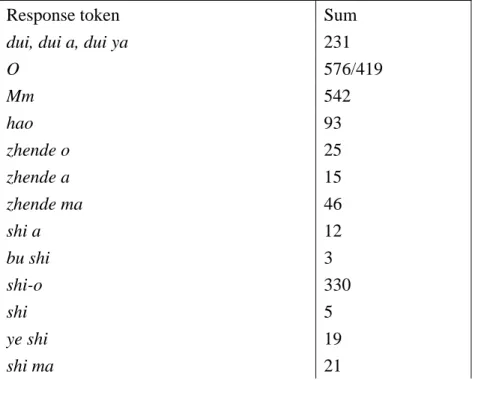
Before introducing the information of participants, we list the table about the occurrences of common response tokens in our databank first. Table1 is shown as follows:
Table 1. Occurrences of the Common Response Tokens in MSN Talk
Response token Sum
dui, dui a, dui ya 231
O 576/419
Mm 542
hao 93
zhende o 25
zhende a 15
zhende ma 46
shi a 12
bu shi 3
shi-o 330
shi 5
ye shi 19
shi ma 21
According to the occurrences of the common response tokens, we select the most
common response tokens, including shi-o, o, zhende o, and zhende ma, all of which
seem to involve similar discourse functions as well, to be the targets we are going to
discuss in the following chapters. Although Mm also has high frequency, based on
our initial observation, it seems to serve as a backchannel to encourage the prior
speaker to continue the talk. This appears not to be similar to the functions of shi-o, o, zhende o, and zhende ma. On the other hand, dui and hao also show high
frequency, but both of their functions have been investigated thoroughly in the previous studies (cf. Miracle 1991 on hao; Tsai 2001 on dui; Wang 2005 on hao).
Hence, the present thesis only includes shi-o, o, zhende o, and zhende ma in the discussion.
There were 42 Chinese chatters as participants whose age ranged from 15 to 39 due to the fact that most MSN users nowadays are young people. The age groupings correspond to the different school levels in Taiwan (cf. Okamoto 1995:306;
Tagliamonte 2005:1899). The first group was primarily young teenagers who were 15 or 16 years old, studying in junior or senior high schools (8 persons). The second came from college students whose age ranged from 18 to 22 years old (11 persons).
The third consisted of graduate students and some intern teachers, their age ranging from 24 to 26 (15 persons). The final group was made up of general nine-to-fivers whose age ranged from 31 to 39 (8 persons). Since most of the subjects in the present study are students (34/42), the variable occupation will not be taken into account.
Fragmentary data from subjects order than 39 were excluded since they were too
few to be significant. Besides, when we choose the data to be analyzed, some data
were excluded as well. For instance, it was difficult to categorize 30-year-old
speakers in that we were not certain they should be in the third or fourth group. On
top of this case, a speaker who used much more tokens than others was discarded
(about 6.0/100 lines) as result of the fact that shi-o might become one of the speaker’s
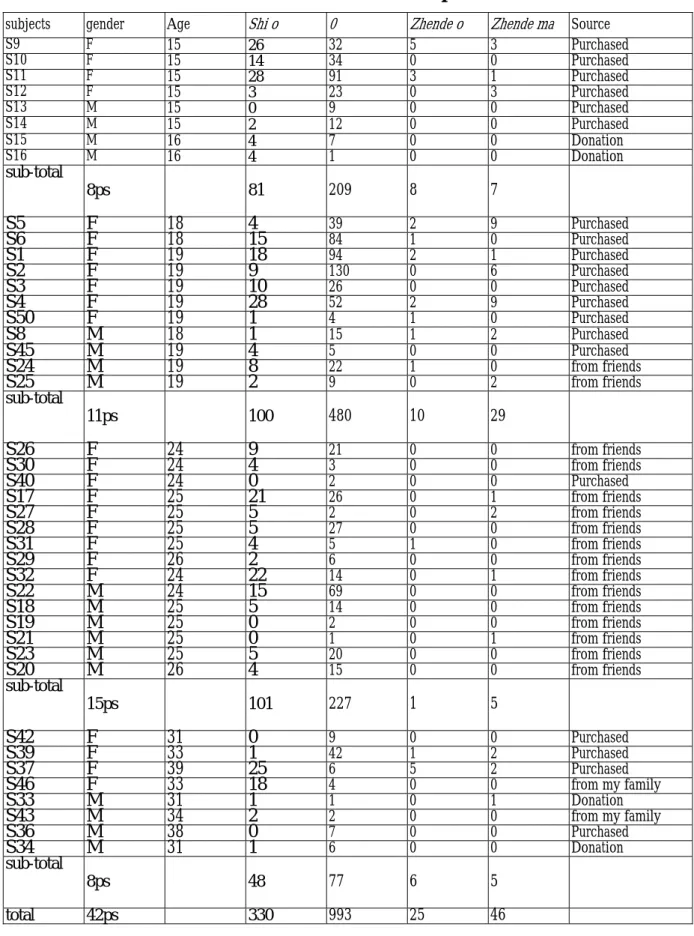
bleached tokens. The information about the participants is listed in Table 2 below
including their age, gender, the number of each response token and sources.
Table 2. Information about the Participants
subjects gender Age Shi o 0 Zhende o Zhende ma Source
S9 F 15 26 32 5 3 Purchased S10 F 15 14 34 0 0 Purchased S11 F 15 28 91 3 1 Purchased S12 F 15 3 23 0 3 Purchased S13 M 15 0 9 0 0 Purchased S14 M 15 2 12 0 0 Purchased
S15 M 16 4 7 0 0 Donation
S16 M 16 4 1 0 0 Donation
sub-total
8ps 81 209 8 7
S5 F 18 4
39 2 9 PurchasedS6 F 18 15
84 1 0 PurchasedS1 F 19 18
94 2 1 PurchasedS2 F 19 9
130 0 6 PurchasedS3 F 19 10
26 0 0 PurchasedS4 F 19 28
52 2 9 PurchasedS50 F 19 1
4 1 0 PurchasedS8 M 18 1
15 1 2 PurchasedS45 M 19 4
5 0 0 PurchasedS24 M 19 8
22 1 0 from friendsS25 M 19 2
9 0 2 from friendssub-total
11ps 100 480 10 29
S26 F 24 9
21 0 0 from friendsS30 F 24 4
3 0 0 from friendsS40 F 24 0
2 0 0 PurchasedS17 F 25 21
26 0 1 from friendsS27 F 25 5
2 0 2 from friendsS28 F 25 5
27 0 0 from friendsS31 F 25 4
5 1 0 from friendsS29 F 26 2
6 0 0 from friendsS32 F 24 22
14 0 1 from friendsS22 M 24 15
69 0 0 from friendsS18 M 25 5
14 0 0 from friendsS19 M 25 0
2 0 0 from friendsS21 M 25 0
1 0 1 from friendsS23 M 25 5
20 0 0 from friendsS20 M 26 4
15 0 0 from friendssub-total
15ps 101 227 1 5
S42 F 31 0
9 0 0 PurchasedS39 F 33 1
42 1 2 PurchasedS37 F 39 25
6 5 2 PurchasedS46 F 33 18
4 0 0 from my familyS33 M 31 1
1 0 1 DonationS43 M 34 2
2 0 0 from my familyS36 M 38 0
7 0 0 PurchasedS34 M 31 1
6 0 0 Donationsub-total
8ps 48 77 6 5
total 42ps 330 993 25 46