
Research Express@NCKU - Articles Digest
Research Express@NCKU Volume 21 Issue 6 - February 24, 2012 [ http://research.ncku.edu.tw/re/articles/e/20120224/2.html ]
Long-Term Operations of Polymeric Thin-Film
Transistors: Electric Field-Induced Intrachain Order
and Charge Transport Enhancements of Conjugated
Poly(3-hexylthiophene)
Horng-Long Cheng
1,*, Jr-Wei Lin
1, Ming-Feng Jang
1, Fu-Chiao Wu
1, Wei-Yang Chou
1, Ming-
Hua Chang
1and Ching-Hsun Chao
2Associate Professor of Institute of Electro-Optical Science and Engineering, College of Sciences, National Cheng Kung University
Macromolecules, 42, pp. 8251-8259 (2009)
P
olymeric thin-film transistors (TFTs) hold the promise of flexible displays and inexpensive organic electronics. For real applications, it is important to understand any changes in microstructural and electronic properties of polymer semiconductors during the operating cycle and over the lifetimes of devices. In this study, we show an improvement in microstructural and charge transport properties of regioregular poly(3-hexylthiophene) (rrP3HT) within active channel of TFTs after long-time operations. By using polarizedabsorption and microRaman spectroscopy to direct probe the microstructural changes of rr-P3HT within the channel (Fig. 1), the variation of exciton bandwidth, interchain electronic coupling, and effective conjugation length (Leff) of rrP3HT before and after device operations were discussed.
Fig. 1. Schematic diagram of the TFT device and polarized spectra measurements setup. Right panel: Self- assembled lamellar-like crystal orientations of P3HT within the active channel.
The present P3HT devices exhibited good electrical properties as shown in Fig. 2. After long-term operations, the device still showed higher output current, improved mobility, and sharper subthreshold swing than that of the initial state. After additional prolonged storage, the device continued to work properly. These results suggest that polymeric TFTs can exhibit device stability and reliability. Then, we used the polarized absorption and
microRaman spectra to trace the microstructural changes of rrP3HT within the TFT, justifying the improved
1 of 3
Research Express@NCKU - Articles Digest
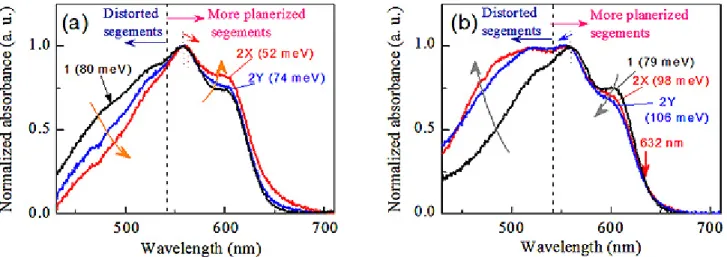
electrical properties. Even when only applying the source-to-drain field ( ) (Fig. 3a) or gate field ( ) (Fig.
3b), the changes of the corresponding absorption spectra are easily observed (Fig. 3). We observed a large
increment of Leff in the direction parallel to the field, thus indicating that the field dominates the increase in Leff and produces anisotropic structural properties of rrP3HT films. Interestingly, only applying the , the absorption spectra exhibit an opposite tendency, thus suggesting that the field will reduce the extent of conjugation and the Leff of chains and then increase the disorder/amorphous portion in the films. Results from Raman spectra also demonstrate that the field would create structural defects in the chains and reducing the Leff (data not shown).
Figure 2. Typical electrical characteristics of rrP3HT-based TFTs before and after long-term operations. (a) Output curves at the selected effective gate bias (VGS’= VGS-Vth). The thin lines indicate the device at the initial
state. After long-term operations, the device then performed a “full scan” nine times during nine hours and the curves within the fill area indicate the observed curves at selected VGS’. (b) Linear and (c) saturated transfer
curves, respectively. Symbols: (■) initial state, (●) after first-time and (▲) after second-time of four hours continuous operations, respectively, and (▼) after second round of continuous operations and then after nine full scans during nine hours. (d) Comparison of first-time and second-time output current curves as a function of time.
Figure 3. Comparison of absorption spectra of the rrP3HT films within TFTs before (trace 1) and after (trace 2) the prolong operations of applying the (a) drain bias (VDS = -60 V for 103 sec) and (b) gate bias (VGS = -40 V for 104
sec), respectively. X and Y are the directions parallel and perpendicular to the active channel, respectively. The numbers in parentheses are the calculated values of the exciton bandwidth. The dashed lines serve as guidelines.
In summary, we have demonstrated that the intrachain order of rrP3HT chains can be enhanced by applying an electric field during the operations of polymeric TFTs. Using the electric field-dipole interaction model, we can explain the evolution of the conformation of the polymer chains under the and fields. This gives new
2 of 3
Research Express@NCKU - Articles Digest
insight into the gate-bias stress-induced instability of polymer-based TFTs from the viewpoint of structural properties of polymer active layer. Consequently, the concept of electric field-induced orientation can provide an efficient approach to align polymeric chains with high degree of orientation and therefore anisotropic structural properties.
3 of 3

![HPSH [ 分子間作用力 - 凡得瓦力 ]](data:image/gif;base64,R0lGODlhAQABAIAAAP///wAAACH5BAEAAAAALAAAAAABAAEAAAICRAEAOw==)