Chapter 47
Cardiac and Pulmonary Diseases
Incidence of Cardiac and Pulmonary Disease Incidence of Cardiac and Pulmonary Disease
• Heart disease is the leading cause of death in the United States.
Ch i b t ti l di i
• Chronic obstructive pulmonary disease is
the fourth leading killer of Americans.
Cardiac Diseases Cardiac Diseases
1. Myocardial Infarction
2. Congestive Heart Failure (鬱血性心衰竭 ) g (鬱血性心衰竭 ) 3. Cardiomyopathy
4 A i P t i
4. Angina Pectoris
1 Myocardial Infarction (MI) 1. Myocardial Infarction (MI)
• MI
• MI
– Heart attack (MI) is death of the heart muscle caused by lack of blood flow due to an obstruction of a coronary artery by plaque or spasm
• Acute Coronary syndrome (ACS)
– Indicate acute MI – Symptoms Symptoms
• Chest pain/ pressure radiate to teeth, jaw, ear, arm, midback
• Diaphoresis(冒汗), short of breath (SOB), nausea(噁心), vomiting(嘔吐)/
fatigue fatigue
• A drug called thrombolytic agent (抗凝劑)must be given quickly and are most effective within 1 hr post symptoms
Left ventricle is usually the first area to suffer from perfusion deficiency
– Left ventricle is usually the first area to suffer from perfusion deficiency
2 Congestive Heart Failure
2. Congestive Heart Failure
CHF 鬱血性心衰竭
• CHF, 鬱血性心衰竭
– Inability of the heart to function as an effective pump – Caused by…
• Hypertension
• Hypertension
• Multiple MIs
• Incompetent valves
• Cardiomyopathy
• Cardiomyopathy – Signs and symptoms
• Increase in weight of 2-5 pounds or more over several days
• Inability to sleep
• Persistent dry hacking cough
• Shortness of breath with normal activity
• Shortness of breath with normal activity
• Swelling in ankles and feet
• fatigue
Cont.
3. Cardiomyopathy – CM, 心肌症 CM, 心肌症
• Disease of cardiac muscle
– Three main types
• 擴張型心肌症(Dilated Cardiomyopathy)(較嚴重,最常見)
• 肥厚性心肌症(Hypertrophic Cardiomyopathy)
• 窄縮性心肌症(Restrictive Cardiomyopathy),較少見的 窄縮性心肌症( y p y) 較少見的
http://w3.csmu.edu.tw/~lcs/a2.htm
4. Angina Pectoris
– Heart pain caused by temporary inadequate supply of blood to heart muscle – Heart pain caused by temporary inadequate supply of blood to heart muscle – Angina is relieved with rest
– Nitroglycerin, taken by pill or spray under tongue relives angina quickly
– An indication of coronary a. disease
Cardiac rehabilitation Cardiac rehabilitation
1. Controllable risk factors for heart disease 2. Inpatient Cardiac Rehabilitation -- Phase I p 3. Outpatient Cardiac Rehabilitation -- Phase II 4 Community-Based Cardiac Rehabilitation -- 4. Community-Based Cardiac Rehabilitation --
Phase III
1 Controllable risk factors for heart disease 1. Controllable risk factors for heart disease
• 10 Factors that increase risk for heart disease:
• 10 Factors that increase risk for heart disease:
1) Age
2) Family History 2) Family History
3) Gender………..↑ uncontrollable 4) Smoking ) g
5) Hyperlipidemia (高脂血症) 6) Hypertension
7) Sedentary Lifestyle 8) Obesity
9) Diabetes
10) Psychological Stress ………..↑ controllable
2. Inpatient Cardiac Rehabilitation -- Phase I p
• 當個案狀況穩定時,即可介入,一般約入院後24- 48hr
48hr
• Goals:
– Prevent muscle loss from bedrest
– Monitor and assess patient’s ability to function – Instruct in appropriate home activities Instruct in appropriate home activities
– Education about risk factors and methods to reduce them
them
I t ti
• Intervention
– During exercise, occupational therapist monitors heart rate , blood pressure, and EKG responses
– Individual and Group Treatment
¾ Program
¾ Program
¾ 2-minute bouts with 1-munite rest (total 4-8 minutes, depending on the patient’s tolerance)
¾ Gradually progress to 8 10 minutes in total
¾ Gradually progress to 8-10 minutes in total
• Modalities
c Calisthenics (體操) d Stair climbing
e Treadmill
¾ at 1-1.5 mph or less than 3-5 minutes, with progression p p g based on patient’s tolerance
f Bicycle ergometer
g Hall walking
Meas ring Blood Press re
• Measuring Blood Pressure
– To be considered normal, blood pressure must be under 140/90 at rest. (140-收 縮壓, 90-舒張壓)
– Systolic blood pressure (收縮壓) should rise with exercise Systolic blood pressure (收縮壓) should rise with exercise.
– With exercise, diastolic blood pressure (舒張壓) should not increase more than 10 mm of mercury compared with resting.
• Pulse Taking g
– A normal heart rate (HR) range at rest is between 60-100 beats per minute (bpm).
– After open heart surgery, a patient often has a heart rate in the low 100s.
i i i h fi k f l (恢復期) h h
– During exercise in the first 2 weeks of convalescence(恢復期), the heart rate should not increase more than
• 20 bpm above resting for a patient with an MI and
• about 30 bpm for a patient after surgery about 30 bpm for a patient after surgery (ACSM, 2000). (ACSM, 2000).
– If the patient’s HR is uncontrolled and is 120 bpm or higher at rest, exercise is
contraindicated.
• Signs and Symptoms of Exercise Intolerance
– Chest pain or pain referred to the teeth, jaw, ear, or arm
– Excessive fatigue – Shortness of breath
– Lightheadedness or dizziness – Nausea or vomiting
– Unusual weight gain of 3-5 lbs in a 1- to 3-day period
H
• Home program
– 每一位個案在出院前,治療師都應該提供一份 individualized home program
individualized home program
– General component in Individualized home program
• Activity and exercise guideline Activity and exercise guideline
• Work simplification
• Pacing
S i l i i
• Social activity
• Signs and symptoms of exercise intolerance
• Discussion of risk factors
– 提供建議時,需同時考量個案的lifestyle, favorite
activities, work, hobbies…
2 METs (Metabolic equivalent) 2. METs (Metabolic equivalent)
METs, 運動代謝當量
– a unit of measure used to describe the amount of oxygen the body
d f i i i
needs for a given activity
– One MET = oxygen consumption at rest or 3.5ml of O
2/kg/weight/min
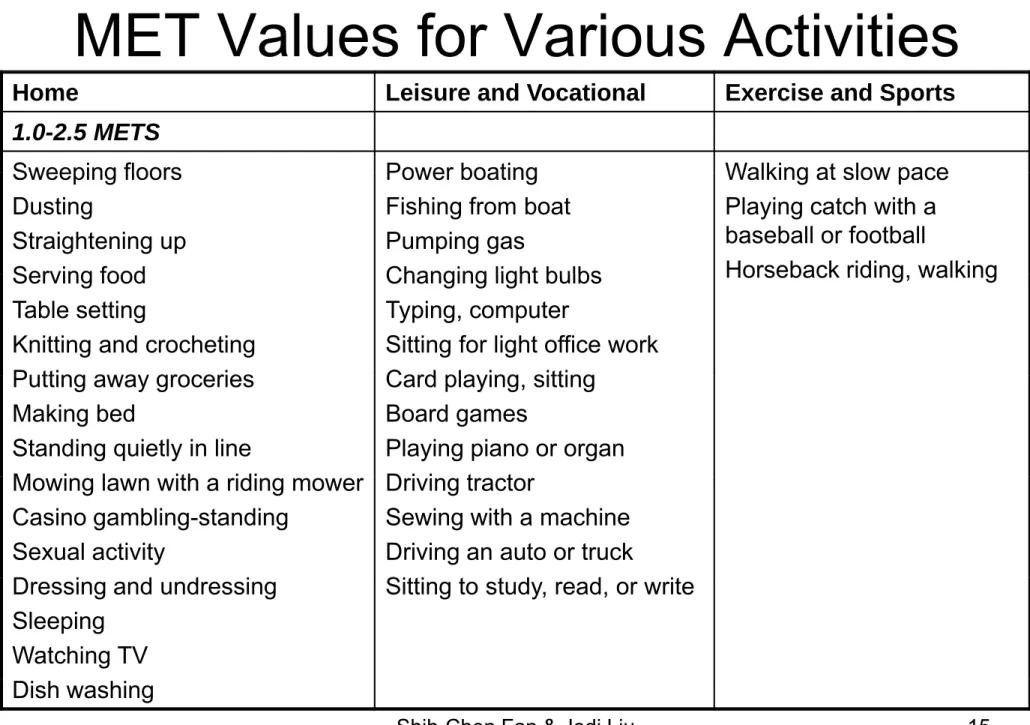
– Table 4-7 MET Values for Various Activities Table 4 7 MET Values for Various Activities
MET Values for Various Activities
Home Leisure and Vocational Exercise and Sports
1.0-2.5 METS
Sweeping floors Power boating Walking at slow pace
Sweeping floors Dusting
Straightening up Serving food
Power boating Fishing from boat Pumping gas
Changing light bulbs
Walking at slow pace Playing catch with a baseball or football
Horseback riding walking Serving food
Table setting
Knitting and crocheting Putting away groceries
Changing light bulbs Typing, computer
Sitting for light office work Card playing sitting
Horseback riding, walking
Putting away groceries Making bed
Standing quietly in line
M i l ith idi
Card playing, sitting Board games
Playing piano or organ D i i t t
Mowing lawn with a riding mower Casino gambling-standing
Sexual activity
D i d d i
Driving tractor
Sewing with a machine Driving an auto or truck
Sitti t t d d it
Dressing and undressing Sleeping
Watching TV
Sitting to study, read, or write
Home Leisure and Vocational Exercise and Sports Home Leisure and Vocational Exercise and Sports 2.6-4.0 METS
Child care bathing and Pitching horseshoes Very light stationary Child care, bathing, and
grooming
Walk, run, and play with
hild ( d )
Pitching horseshoes Home auto repair
Planting seedlings and
Very light stationary biking
Weight lifting of light
d ff
children (moderate)
General house cleaning Walking downstairs
shrubs
Playing the drums Home wiring or
to moderate effort Stretching, yoga Golf using a cart Walking downstairs
Sweeping garage or sidewalk
Home wiring or plumbing
Feeding small farm
Golf using a cart Snowmobiling
Walking at moderate Raking lawn
Walking and carrying load of 15 lbs
animals
Standing to pack light to moderate boxes
speed
Water aerobics
of 15 lbs moderate boxes
Bartending-standing
Walking and picking up
Home Leisure and Vocational Exercise and Sports
>4.0-6.0 METS
Major house cleaning, such as washing
windows vigorous effort
Laying carpet or tile Slow wood chopping
F i f di ttl
General calisthenics, moderate effort
Shooting hoops windows, vigorous effort
Moving furniture
Scrubbing floors on
Farming, feeding cattle Carpentry on outside of house
Shooting hoops Golf, carrying clubs Softball, fast or slow hands and knees
Cleaning gutters
Painting the outside of
Carpentry, refinishing surfaces
H ti l
, pitch
Low-impact or dance aerobics
Painting the outside of house
Painting and wallpapering
Hunting-general
Road building, carrying heavy loads
aerobics
Dodgeball or hopscotch inside of house
Weeding or cultivating
y
Roofing Bicycling at 10-11.9
mph
Home Leisure and Vocational Exercise and Sports
<6.0-10 METS
C i i F i b lli h Hi h i t
Carrying groceries upstairs
Moving household
Farming, balling hay Concrete masonry
Moving heavy objects such
High-impact
aerobicsRunning 10- 12 min/mileBasketball g
items in boxes
Shoveling more than 16 lbs per minute
Moving heavy objects such as furniture
Firefighter carrying hoses
gameJump ropingRace
walkingSwimming 16 lbs per minute
(heavy)
Walking or standing
laps at a moderate paceBicycling at moderate pace >12 with objects weighing
50-74 lbs
moderate pace 12
mph
3 Home Program 3. Home Program
HP i l di
• HP including
– Activity & exercise guidelines – Work simplification
– Work simplification – Pacing
– Temperature precautions p p – Social activity
– Sexuality
Si & t f i i t l
– Signs & symptoms of exercise intolerance – Discussion of risk factors
• Clinical pathway 專科診療途徑
• Clinical pathway 專科診療途徑
– MI pathway, CHF pathway….
• Home programs for MI Home programs for MI
– Healing of heart muscle takes about 4-8 weeks depending on the amount of damage sustained
Restrict patient’s activities to the 2 4 MET range during 4 8 – Restrict patient s activities to the 2-4 MET range during 4-8
weeks
– walking or biking exercise schedule
W lki d d
• Walking at moderate speed
• Walking at moderate speed – Home activities
• Child care, bathing, and grooming
• Walk, run, and play with child
• Walking downstairs g
• Sweeping garage or sidewalk
• Walking and carrying load of 15 lbs
O H t S H P
• Open Heart Surgery Home Program
– Given information on stretches and mild exercise to assist in incision pain management
assist in incision pain management
– Surgical patients are avoid lifting, pushing, or pulling, especially one-sided lifting or pulling, of greater than p y g p g, g 10lbs for 6-12 weeks
• Example
P lling open a hea door it is desirable to se t o hands – Pulling open a heavy door, it is desirable to use two hands – Picking up a heavy coffeepot, put one hand & the other hand
on the handle
P ti t h l i f f li t l hifti li ki
• Patient who complain of feeling sternal shifting or clicking, should avoid activity that causes it
• Walking schedule per patient tolerance are given
CHF h
• CHF home program
– inability: limit in endurance – Intervention: Intervention:
• Pacing
• work simplification
• Mild exercise program
• Mild exercise program
• Angioplasty (動脈氣球擴張術) Home Program
– Goal: to teach risk factor recognition, the ways to modify these risk
– Aerobic exercise program, walking…
– How to assess their physical response to exercise using Borg How to assess their physical response to exercise using Borg Rating of Perceived Exertion Scale (RPE) (ACSM, 2000)
– Review signs and symptoms of exercise intolerance
B R f P i d
6 完全沒有用力的感覺(no exertion at all)• Borg Rate of Perceived Exertion (RPE) Scale
( )
7 極之輕鬆(extremely light)
8
‧ RPE 評量表
‧ 讓參與者藉運動時的自身感覺
(心跳 呼吸 排汗 肌肉疲
9 非常輕鬆(very light)
10
11 輕鬆(light)
(心跳、呼吸、排汗、肌肉疲 勞等),來估計運動時的強度
‧ RPE評量表的數值範圍: 6 至
12
13 有點辛苦(somewhat hard)
20
1414 15 辛苦(hard/heavy)16
17 非常辛苦(very hard)
17 非常辛苦(very hard)
18
19 極之辛苦(extremely hard)
盡最大努力( )
20 盡最大努力(maximal exertion)
Outpatient Cardiac Rehabilitation Phase II Outpatient Cardiac Rehabilitation --Phase II
• Goals:
c Continued medical surveillance (監督) and c Continued medical surveillance (監督) and
assessment of an individual’s cardiovascular response to exercise
d Limit the physiological and psychological effects of heart disease.
e Instruct on risk factors for heart disease and how to reduce their impact.
f Maximize psychological and vocational status.
T d t i th i t i i t it
• To determine the appropriate exercise intensity
– Reach 50 ~ 85% of maximum age-adjusted heart rate (MAHR)
• MARA= 220- age g
• 50 ~ 85% of MAHR for the 50-year-old patient
= 0.5 x MAHR ~ 0.85 x MAHR
» (220-50)x0.5~(220-50)x0.85 ( ) ( )
» 85~149 (bpm)
– Borg RPE Scale
• For patient is on a beta blocker medication For patient is on a beta blocker medication
• Initial stage: Scale 11 ~ 13
• Rehabilitation stage: Æ Scale 12 ~ 15
Final exercise tolerance goal:
• Final exercise tolerance goal:
– 5 ~ 6 METs
– Home activities ~ major house cleansing (washing windows) j g ( g )
8. Intervention---Phase II
(Outpatient Rehabilitation) (Cont’d)
Two methods
• Two methods
1) Continuous exercise
• Short bouts of exercise on one pieces of equipment followed by a short rest 1 2 minutes
short rest 1-2 minutes
• 20-40 minute (total duration of exercise)
• Increasing intensity gradually
• Advantage: mimics home exercise
• Advantage: mimics home exercise
• Disadvantage: only certain muscle groups are targeted 2) Discontinuous exercise
• Amount of time staying on a piece of equipment remains the same
• Amount of time staying on a piece of equipment remains the same, but intensity gradually increases
• After finishing allotted time on one equipment, then switch to another
• This process is repeated several times
• Advantage: multiple muscle groups are used/ boredom is minimized
Disadvantage: takes a lot of space & equipment/ does not reflect
• Disadvantage: takes a lot of space & equipment/ does not reflect
Community Based Rehabilitation Phase III Community-Based Rehabilitation -- Phase III
• Cardiac rehabilitation with larger groups of patients
• Cardiac rehabilitation with larger groups of patients and fewer staff members per participant
• Often located in community centres, school gyms, and y , gy , YMCAs.
• Generally not covered by insurance
• Requires physician referral
• Trained personnel monitor the following:
– Blood pressure response – Heart rate
– EKG once per month
– Goal setting for risk management
Pulmonary Diseases
1. Chronic Obstructive Pulmonary Disease (COPD) y ( )
• Combination of
• Combination of
emphysema (肺氣腫)
and bronchitis (支氣管
炎)
Emphysema
• Emphysema
– Progressive and irreversible destruction of alveoli walls El ti fibb f l li ll d t d
– Elastic fibbers of alveoli wall are destroyed
– Lungs lose elasticity Æ air trapped in lung ÆÈ lung shrink during exhalation Æ decreased air inhaled with next breath g
• Chronic bronchitis
– excessive sputum production and cough of at least 3 months
• Disease Process:
Dyspnea (呼吸困難), Fatigue, Cough, Sputum Production
z Without enough energy to do their daily tasks (ADL,
leisure, vocation..)
• Pulmonary function tests
(1)FEV1(1秒鐘的空氣呼出量 ) 氣
To exhale forcefully as much air as possible in 1 second into a
肺 y 計 p
spirometer (肺量計 ).
高榮