行政院國家科學委員會專題研究計畫 成果報告
深探網路自我效能在學習扮演的角色(團隊計畫)(第 3 年) 研究成果報告(完整版)
計 畫 類 別 : 整合型
計 畫 編 號 : NSC 96-2511-S-011-002-MY3
執 行 期 間 : 98 年 08 月 01 日至 99 年 07 月 31 日 執 行 單 位 : 國立臺灣科技大學數位學習與教育研究所
計 畫 主 持 人 : 蔡今中
共 同 主 持 人 : 朱如君、梁至中、陳秀玲、楊懷恩 計畫參與人員: 碩士級-專任助理人員:林怡君
學士級-專任助理人員:黃怡甄
碩士班研究生-兼任助理人員:黃瑞君 碩士班研究生-兼任助理人員:連玟雅 碩士班研究生-兼任助理人員:游凱翔 碩士班研究生-兼任助理人員:黃千芳 碩士班研究生-兼任助理人員:王雅玲 碩士班研究生-兼任助理人員:白家禎 碩士班研究生-兼任助理人員:王玉華 博士班研究生-兼任助理人員:樊學良 博士班研究生-兼任助理人員:費聿明 博士班研究生-兼任助理人員:林峰名 博士班研究生-兼任助理人員:周典緯 博士班研究生-兼任助理人員:王鴻原 博士班研究生-兼任助理人員:林宗進 博士班研究生-兼任助理人員:陳旭源 博士後研究:黃騰
博士後研究:王舒民 博士後研究:許衷源
其他-兼任助理人員:蔡承岳
報 告 附 件 : 國外研究心得報告
出席國際會議研究心得報告及發表論文
處 理 方 式 : 本計畫涉及專利或其他智慧財產權,2 年後可公開查詢
中 華 民 國 99 年 10 月 29 日
行政院國家科學委員會補助專題研究計畫 5 成 果 報 告
□期中進度報告 深探網路自我效能在學習扮演的角色(團隊計畫)
計畫類別:□個別型計畫 5 整合型計畫
計畫編號:NSC 96-2511-S-011-002-MY3 執行期間:96 年 8 月 1 日至 99 年 7 月 31 日
執行機構及系所:國立臺灣科技大學數位學習與教育研究所、師資培育中心、
工程技術研究所
計畫主持人:蔡今中教授
共同主持人:朱如君助理教授、陳秀玲助理教授、翁楊絲茜助理教授、梁至中 助理教授
計畫參與人員:博士後研究黃騰、王舒民、許衷源、專任助理林怡君、黃怡甄、
兼任助理林峰名、
周典緯、王鴻原、
林宗進、
陳旭源、
黃瑞君、
連玟雅、
游凱翔、
費聿明、
樊學良、
黃千芳、
王雅玲、
白家禎、
王玉華、
蔡承岳成果報告類型(依經費核定清單規定繳交):□精簡報告 5 完整報告
本計畫除繳交成果報告外,另須繳交以下出國心得報告:
□赴國外出差或研習心得報告
□赴大陸地區出差或研習心得報告
5 出席國際學術會議心得報告
□國際合作研究計畫國外研究報告
處理方式:除列管計畫及下列情形者外,得立即公開查詢
□涉及專利或其他智慧財產權,□一年□二年後可公開查詢
中 華 民 國 年 月 日
深探網路自我效能在學習扮演的角色(團隊計畫)第三年成果報告 總計畫 (蔡今中)
本計畫的重點是瞭解網路自我效能扮演的角色。總計畫除了輔助各子計畫的順利進行外,強化網路自 我效能的研究工具也是重要任務之一。此外,總計畫計畫也試著瞭解網路自我效能與其他變因的關 係。尤其總計畫也與老師網路進修、TPCK 連結,總計畫也延伸到學生使用 PDA 用於學習的自我效 能,這是很前瞻的議題。總計畫共發表 4 篇 SSCI 及的論文,條列如下:
(註:第四篇是利用本計畫經費所進行的科教研究回顧,其結果對於科教研究社群及國科會科教處皆 有很高的參考價值)
1. Kao, C.-P., Wu, Y.-T., & Tsai, C.-C. (in press). Elementary school teachers’ motivation toward
web-based professional development, and the relationship with Internet self-efficacy and belief about web-based learning. Teaching & Teacher Education. (SSCI)
2. Lee, M.-H., & Tsai, C.-C. (2010). Exploring teachers’ perceived self efficacy and technological pedagogical content knowledge with respect to educational use of the World Wide Web. Instructional Science, 38, 1-21. (SSCI)
3. Tsai, P.-S., Tsai, C.-C., & Hwang, G.-H. (2010). Elementary school students’ attitudes and self-efficacy of using PDAs in a ubiquitous learning context. Australasian Journal of Educational Technology, 26, 297-308. (SSCI)
4. Lee, M.-H., Wu, Y.-T., & Tsai, C.-C. (2009). Research trends in science education from 2003 to 2007: a content analysis of publications in selected journals. International Journal of Science Education, 31, 1999-2020. (SSCI)
上述四篇文章的主要發現如下:
Elementary school teachers’ motivation toward web-based professional development, and the relationship with Internet self-efficacy and belief about web-based learning. Teaching & Teacher Education.
Study description: This study was conducted to explore the relationships between teachers’ motivation toward web-based professional development, Internet self-efficacy, and beliefs about web-based learning.
By gathering questionnaire data from 484 elementary school teachers, this study identified that the teachers’ Internet self-efficacy and behavioral beliefs about web-based learning are significant predictors of their motivation toward web-based professional development. The teachers with higher Internet self-efficacy and stronger beliefs about the positive consequences of web-based learning tend to express higher motivation toward web-based professional development.
Exploring teachers’ perceived self efficacy and technological pedagogical content knowledge with respect to educational use of the World Wide Web. Instructional Science, 38, 1-21.
Study description: Research in the area of educational technology has claimed that Web technology has
Furthermore, contemporary educational researchers have highlighted the significance of teachers’
self-efficacy, conceptualized as the teachers’ perceptions of their own competence at teaching, and related to instructional strategies as well as teaching effectiveness. The major purpose of this study was to investigate teachers’ perceived self-efficacy in terms of their TPCK-W. This study aimed to develop a new questionnaire, namely the Technological Pedagogical Content Knowledge-Web (TPCK-W) Survey to explore teachers’ self-efficacy in terms of their TPCK-W, and additionally to assess their attitudes toward Web-based instruction. The participants in this study were 558 teachers from elementary school to high school level in Taiwan. Both exploratory and confirmatory factor analyses indicated that the TPCK-W survey developed in this study has satisfactory validity and reliability characteristics. The results indicate a lack of general knowledge about Web-related pedagogy amongst the teachers surveyed.
The correlations between teachers’ self-efficacy in terms of their TPCK-W, their attitudes regarding Web-based instruction, and their background variables were also examined. Correlations were found between self-efficacy and positive attitudes to web-based instruction. Older and more experienced teachers were found to have lower levels of self-efficacy with respect to TPCK-W, though teachers with more experience of using the web (including for instruction) had higher levels of self-efficacy with respect to TPCK-W.
Elementary school students’ attitudes and self-efficacy of using PDAs in a ubiquitous learning context.
Australasian Journal of Educational Technology, 26, 297-308.
Study description: The purpose of this study was to develop an attitude and a self-efficacy survey of using PDAs in ubiquitous learning (u-learning) environments for elementary school students. The
sample of this study included 414 third-grade to sixth-grade students (age 9-12 years) in Taiwan who had experience using PDAs for u-learning. The results indicate that the students, in general, had positive attitudes and adequate self-efficacy in terms of using PDAs for u-learning. Gender differences existed only in the students’ self-efficacy of using PDAs for Internet-related functions, with the male students expressing higher confidence in using PDAs for Internet-related functions than the female students. In addition, the students in lower grades (third- and fourth-graders; age 9-10 years) tended to use PDAs more frequently and to have more positive perspectives of PDAs than the higher-grade students (fifth- and sixth-graders; age 11-12 years). Furthermore, for predicting students’ attitudes toward using PDAs for u-learning, students’ confidence in using PDAs for general purposes was more important than their confidence in using PDAs to perform Internet functions.
Research trends in science education from 2003 to 2007: a content analysis of publications in selected journals. International Journal of Science Education, 31, 1999-2020.
This study was a follow-up to Tsai and Wen’s (2005) research, in which 802 articles published in the International Journal of Science Education, Science Education, and the Journal of Research in Science Teaching from 1998 to 2002 were analyzed in terms of author’s nationality, research type, and research topic. In this study, a total of 869 papers published in the three journals from 2003-2007 were analyzed, and the results were compared with those of Tsai and Wen (2005). Moreover, this study also identified 31 highly-cited papers published during 1998-2002 and 20 highly-cited papers published during 2003-2007. The results showed that authors from countries other than the four major English-speaking
last decade. During these five years (2003-2007), science educators showed relatively more interest in research topics involving the context of student learning. Besides, science educators have changed some of their research interests during 1998-2007, with a shift in the research topics from student conception learning and conceptual change (1998-2002) to student learning contexts (2003-2007). Moreover, the investigation of highly-cited papers in the last decade revealed that studies on argumentation have gained significant attention among science educators.
子計畫一:教師網路自我效能對資訊科技融入教學之影響 (陳秀玲)
自 2007 年 8 月至今本計劃已投稿五篇國際研討會論文、八篇國內研討會論文,一篇 EI 國際論文,以 及兩篇期刊論文 working in progress,茲列舉如下:
研討會論文
1. Chen, H.-L. (2011). The Influence of Internet-dependent Coping Strategy upon Integrating the Internet into Instruction of elementary school teachers. 13th Annual International Conference on Education. Athens, Greece. May 23-26, 2011.
2. Chen, H.-L. (2010). Identifying teachers’ Internet copying strategies through factor analysis. The KSET 2010 conference: Ecological Integration of Learning, Technology, and Environment. Seoul, Korea. May 7-8, 2010.
3. Chen, H. L., Chu, R. J., Fei, Y.-M. & Chu, L.-J. (2009). Elementary school teachers’ perceptions and behaviour in integrating the Internet into instruction. CAL 09’: Learning in Digital Worlds.
Brighton, UK. March 23-March 25, 2009.
4. Chen, H.-L. (2009). Internet Self-efficacy and Behavior in Integrating the Internet into Instruction:
A Study of Vocational High School Teachers in Taiwan. Fourth European Conference on Technology Enhanced Learning. Nice, France. September 29-October 2, 2009.
5. Chu, R. J., Chen, H.-L., Lee, H.-Y. & Lin, C.-C. (2008). Learning Influences of Family Support and Self-directed upon the Internet Self-efficacy of Middle Aged and Old Adults. Technology Enhanced Learning Conference 2008. Hanoi, Vietnam, December 4-6, 2008.
6. 陳秀玲、謝庭育、簡林伶(2010). 高中職教師資訊科技融入教學及社會互動之歷程。2010電 腦與網路科技在教育上的應用研討會。新竹市,2010 年 4 月 29 日。
7. 陳秀玲、王玉華(2009). 高職教師搜尋策略及其資訊評判標準。2009 台灣教育研究學術研討 會。高雄市,2009 年 12 月 25 日。
8. 陳秀玲、朱麗蓉(2009). 準備好了嗎? 未來學校與未來教師—資訊科技融入中學公民課程之 現況探討。2009數位學習創新與應用學術研討會。高雄市,2009 年 6 月 19 日。
9. 陳秀玲、費聿明、陳怡璇(2008). 高職教師網路自我效能與網路融入教學行為之調查研究。
2008科技與學習學術研討會。台灣屏東,2008 年 11 月 25 日。
10. 陳秀玲、陳怡璇(2008). 高職教師網路因應策略與網路融入教學行為之調查研究。2008IETAC 資訊教育與科技應用研討會。台灣台中,2008 年 11 月 7 日。
11. 陳秀玲、陳瑩芝(2008). 以 TAM 擴充模式探討臺北市國民小學教師網路科技融入教學行為之 初探性研究。2008數位科技與創新管理研討會。台灣台北,2008 年 6 月 28 日。
12. 陳秀玲、簡林伶、謝庭育(2008). 老師,伸出操縱滑鼠的魔力吧! 探討高中職教師網路自我 效能在網路科技融入教學歷程之角色。2008數位落差國際學術研討會。台灣雲林,2008 年 6 月 4-5 日。
1. Chen, H.-L. (2009).Internet self-efficacy and behavior in integrating the Internet into instruction: A study of vocational high school teachers in Taiwan. Lecture Notes in Computer Science, 5794, 706-711.
(EI)
2. Chen, H.-L. (working in progress). Exploring the structural relationships between elementary school teachers' Internet self-efficacy and Behavior in integrating the Internet into Instruction. Computers in Human Behavior
3. Chen, H.-L. (working in progress). Development and validation of teachers’ Internet copying strategy Inventory. Computer and Education
研究成果一:以科技接受模式探討高中職教師資訊科技融入教學之歷程
本研究以目的性取樣的方式,訪談了十二位不同年資、教學科別、學校的現職高中職教 師。Huges(2005)將參與訪談的受訪者依年資分為三類:新手教師(Novice)─年資為一至三年;
中生代教師(Mid-career)─年資為四至六年;資深教師(Vateran)─年資為七年以上。本研究採 用 Huges(2005)的分類,訪談新手教師、中生代教師及資深教師各四位。在使用資訊科技融入 教學的情況,受訪教師大致皆有使用 DVD 播放器、Office 軟體當中的 Power Point 和 Word 文 書處理軟體和網際網路的資訊科技。在教室的 e 化設備上,大部分受訪教師的任教學校都架 有白幕,但有一半的受訪者任教學校的電腦和單槍設備則需要借調才能於課堂上使用。
完成十二位受訪教師的訪談後,研究者根據訪談分析的結果,並從各受訪教師資訊科技 融入教學歷程跳脫,歸結出四項共同主軸:認知有用性、認知易用性、認知娛樂性和外在因 素。並將教師使用的歷程,和教師提出的 e 點思維等因素,歸納成「以科技接受模式探討高 中職教師資訊科技融入教學之歷程圖」。
圖 1 以科技接受模式探討高中職教師資訊科技融入教學之歷程
資訊科技融入學科領域教學知識模式(TPCK),希望教師借由資訊科技的輔助,發展教學 知識和素養,而非教師是否具有超高的電腦技術。有資訊能力的教師不一定願意使用資訊科 技融入教學,但熱衷於資訊科技融入教學的教師不一定是使用資訊的能手(Cuban, 2001)。一 次成功的資訊科技融入教學模式需要將科技知識(TK)、學科知識(CK)、教育學知識(PK)三者 成功整合,且三者皆重(Koehler et al., 2004 ; Margerum-leys, & Marx, 2002)。換句話說,懂得如 何將 T.P.C 三者結合,不迷信科技,善用多媒體的特性,將其用在適當的教學內容,以符合學 生特質和教學目標,如此才是適當的資訊科技融入教學(林佳蓉,2006)。國外的研究中結果顯 示能真正在教育現場中將科技知識(TK)、學科知識(CK)、教育學知識(PK)三者達到高層次融 入的教學,其實較少(Russel et al,, 2000 ; Williams et al., 2000)。
回到本研究的受訪教師身上,研究者發現受訪教師在資訊科技融入教學的行為上,有真 正將科技知識(TK)、學科知識(CK)、教育學知識(PK)三者融合,且在選擇科技軟體時,有將 課程特性考慮進去。十二位受訪教師在實施資訊科技融入教學的過程中,雖然都能將 T.P.C 三者融合,但在融入程度上,最高只達到融入(等級 3)和整合(等級 4)的等級,是屬於中度融入,
在受訪紀錄中,研究者未能發現受訪教師的融入程度達到擴充或是精緻化的高層次融入。此 現象和 Russel 等人( 2000)及 Williams 等人(2000)的研究相符,代表教師現階段使用資訊科技 融入教學雖然已達到將 T.P.C 三者融入的層次,但這樣仍不足夠,未來教師應朝擴充和精緻化 的層級邁進。
在教師資訊科技融入教學的歷程中,認知有用性是教師們起而行的濫觴,因為對教師來 說對教學有幫助的教學方法,是最重要的。也就是說,教師嘗試不同的教學方法或是教學媒 介,首要的考量是這樣的使用方式對自身的教學成效是否有助益,因為影響數位學習的成果 是教師和學生使用科技的方式(邱玉菁,2004)。從對教學有幫助的四個成效出發,加上自身在 準備教材過程中,所感到的愉悅、好奇,並從中獲得滿足;外在環境的支持和教師主宰自身 資訊科技融入教學之行動權;教師對於使用軟體的習慣和喜好,在在都影響著教師在教育現 場中的資訊科技融入教學之行為。
資訊科技是教學的一種工具,不能取代教師教學,回到本質科技是輔助教師的角色,教 師和學生才是學習的主角。透過科技的輔助,增加教學現場趣味性、多元性和豐富性,並在 教師體認到科技對於自身教學的助益的情況下,教師才能有效的使用資訊科技,以提供適當 的鷹架給予學生思考和學習的機會。另一方面,教師是教育的實踐家,因為投入其中,反思
志業,所以教師從已出發,除了觀照自己在使用資訊科技融入教學上的不足外,更懂得轉化 經驗,進而創新。
研究成果二: 高中職教師網路自我效能與網路融入教學之研究—以資訊判準為中介變項
本研究旨在探討高中職教師網路自我效能、資訊判準與網路融入教學之關係,繼之分析 個人背景變項在網路自我效能、資訊判準與網路融入教學間的差異情形。本研究以 98 學年度 全國 272 所公立高中職學校(教育部,2009)為母群體,依北、中、南地理劃分,立意取樣 抽選各區高中及高職 3 至 4 所學校,施測校數共 20 所。總計發出 549 份問卷,回收 475 份,
回收率為 86.5%,篩選出遺漏值過多與填答規律之無效問卷 13 份後,有效問卷共 462 份,有 效樣本率為 97.3%。
本研究透過 t 檢定、單因子變異數、Pearson 積差相關與多元迴歸等統計方法進行資料分 析。結果顯示,高中職教師網路自我效能為中上程度,會使用混合的資訊評判標準與精密的 搜尋策略,最常在課前準備與教學活動階段使用網路融入教學。教師的背景變項與各構面間 具有顯著差異,尤其女性教師同意採用多重出處與道德的評判標準,也常在課前準備使用網 路融入教學;資淺教師之網路自我效能與網路融入教學表現較佳;職業類科教師較傾向採用 權威與道德的資訊評判標準,也常在各教學階段使用網路融入教學;使用電腦或網路時間愈 長、使用網路資源融入教學頻率愈高的教師,其網路自我效能與網路融入教學的程度也會愈 高,愈會使用不同的資訊評判標準與精密的搜尋策略。
此外,各構面間具有顯著正相關(見表 1),表示當教師的網路自我效能愈高時,愈會使用 不同的資訊評判標準與精密的搜尋策略,也愈容易在教學歷程中使用網路融入教學,反之亦 然。進一步根據中介效果的驗證,得知網路自我效能會透過多重出處、內容、娛樂的資訊評 判標準與精密的搜尋策略中介影響教師網路融入教學的頻率。顯示當教師擁有較高的網路自 我效能,且採用精密搜尋策略與多重出處、內容、娛樂標準進行網路資訊的評判,那麼教師 網路融入教學的行為也將較為頻繁。綜言之,網路自我效能及資訊判準類型可預測教師之網 路融入教學行為,且資訊判準會對網路自我效能與網路融入教學行為產生中介影響,如圖 2 所示。
表 1 各構面之相關分析
資訊判準 網路自我
效能 一般 搜尋 溝通
多重出處 權威 內容 技術 娛樂 道德 精密 相配
網路融入
教學 課前準備 教學活動 學習輔導 成績評量 成果分享
網路自我效能 1.000
一般 .825*** 1.000
搜尋 .714*** .626*** 1.000
溝通 .861*** .503*** .346*** 1.000
多重出處 .312*** .245*** .361*** .207*** 1.000
權威 .093* .125** .103* .034 .087 1.000
內容 .181*** .219*** .323*** .016 .420*** .221*** 1.000 技術 .061 .064 .116* .008 .152*** .159*** .402*** 1.000 娛樂 .110* .083 .119* .079 .094* .187*** .213*** .602*** 1.000 道德 .127** .192*** .173*** .016 .207*** .212*** .187*** .263*** .405*** 1.000 精密 .399*** .356*** .504*** .217*** .534*** .117* .415*** .219*** .246*** .329*** 1.000 資
訊 判 準
相配 -.142** -.089 -.139** -.120** -.197*** .228*** -.123** .153*** .203*** .109* -.221*** 1.000 網路融入教學 .385*** .256*** .275*** .369*** .288*** .092* .163*** .062 .170*** .096* .343*** -.024 1.000 課前準備 .393*** .322*** .383*** .289*** .409*** .171*** .344*** .110* .081 .131** .448*** -.153*** .659*** 1.000 教學活動 .361*** .246*** .244*** .349*** .243*** .059 .154*** .083 .197*** .097* .291*** -.020 .896*** .591*** 1.000 學習輔導 .252*** .151*** .173*** .255*** .203*** .014 .081 -.006 .122** .044 .251*** -.040 .846*** .371*** .654*** 1.000
成績評量 .237*** .151*** .146** .242*** .111* .060 .030 .019 .114* .095* .144** .131** .769*** .262*** .597*** .658*** 1.000 成果分享 .266*** .121** .112* .327*** .139** .063 -.008 .027 .153*** .004 .191*** .034 .811*** .296*** .654*** .704*** .664*** 1.000
TPCK、網路自我效能、網路融入教學、資訊判準、網 多重出處
圖 2 資訊判準之部分中介效果模型 內容
娛樂
道德
精密
網路自我效能 網路融入教學
相配
0.186***
0.312***
0.181*** 0.097*
0.11* 0.129**
0.127** 0.048n.s.
0.399*** 0.225***
-0.142** 0.032n.s.
***
關鍵字:資訊科技融入教學、科技接受模式、
路因應策略
子計畫二
網路自我效能、建構主義式網路環境偏好與網路學習策略關係之研究 (梁至中)
本研究經過經過大規模的問卷調查,獲得幼兒保育科系學生 (包含全職學生及在職幼教師) 之網路 自我效能、建構主義式網路環境偏好之量化相關性資料,並進一步探討其網路自我效能與建構主義式 網路學習環境偏好之間的關連性,進而提供建議以改善目前此一族群之網路學習環境。
主要論文已經發表在:
Liang, J.-C., & Tsai, C.-C. (2008). Internet self-efficacy and preferences toward constructivist Internet-based learning environments: A study of pre-school teachers in Taiwan. Educational Technology & Society, 11, 226-237. (SSCI)
其他相關論文發表在:
Liang, J.-C., & Tsai, C.-C. (Accepted). Learning through science writing via online peer assessment in a college biology course. The Internet and Higher Education. (SSCI)
Liang, J.-C., & Tsai, C.-C. (2009). The information commitments toward web information among medical students in Taiwan. Educational Technology & Society, 12(1), 162-172. (SSCI)
Liang J.-C., Wu S.-H. Nurses’ motivations for web-based continuing learning and the role of Internet self-efficacy. (2010). Innovations in Education and Teaching International. 47(1), 25-37. (SSCI) 研討會論文:
Lin, Y. -C. & Liang, J.-C. (2009). The relationships between epistemological beliefs in biology and
approaches to learning biology among biology-majored university students in Taiwan. Personal Epistemology and Learning (PEL) Conference. (Taipei, Taiwan).
Liang, J.-C., & Tsai, C.-C. (2009). Learning through writing in biology by an online peer assessment activity.
International Science Education Conference 2009, (Singapore).
Liang, J.-C., & Tsai, C.-C. (2009). The relationships between university students’ epistemological beliefs in biology and conceptions of learning biology. European Science Education Research Association. (Istanbul, Turkey)
Liang, J.-C., Tsai, C.-C., Lee, M,-H., & Wu, S.-H. (2009). The Relationships between College Students' Epistemological Beliefs of Science and Conceptions of Learning Science. National Association for Research in Science Teaching. (Garden Grove, America).
Lee, M,-H., Tsai, C.-C., Chang, C.-Y. & Liang, J.-C. (2009). The relationships between Taiwanese high school science teachers' conceptions of learning science and their approaches to teaching science. The Association for Science Teacher Education, ASTE 2009 International Conference. (Connecticut, USA)
Enhanced Learning Conference 2008, TELearn 2008. (Hanoi, Vietnam)
A study of pre-school teachers in Taiwan about their Internet self-efficacy and preferences toward constructivist Internet-based learning environments
Major finding
This study was conducted to explore the relationship between Internet self-efficacy and preferences toward constructivist Internet-based learning environments.
Internet self-efficacy indicated the self-perceived confidence and expectation of using Internet. There were ten items in this questionnaire and were divided into two factors (scales), the first one addressed students’ Internet self-efficacy in general (called General Internet Self-Efficacy scale, 6 items, abbreviated as GISE), while the second one probed their efficacy for Internet-based communication or interaction (called Communicative Internet Self-Efficacy scale, 4 items, abbreviated as CISE).
The other questionnaire for exploring student preferences toward constructivist Internet-based learning environments in this study was modified from Constructivist Internet Learning Environment Survey, called CILES.
Descriptive data
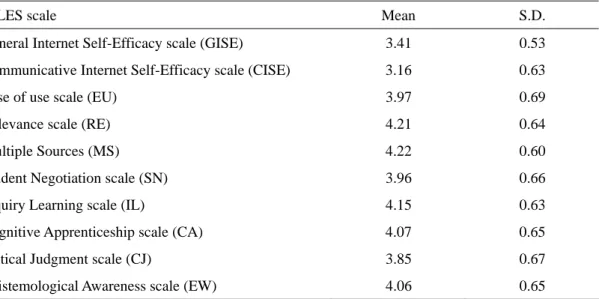
In this study, Table 1 presents descriptive data for students’ responses on Internet self-efficacy and CILES. We found that these students, on average, expressed better general Internet self-efficacy than communicative Internet self-efficacy (mean score 3.41 versus 3.16).
Moreover, they displayed relatively stronger preferences for all aspects of constructivist Internet-based learning environments (all larger than 3.85 in 1-5 Likert scale).
They showed particular attentions to the relevance and multiple sources as provided by the Internet-based learning environments (4.21 and 4.22 respectively).
Table 1: Descriptive data for respondents’ Internet self-efficacy and scores on CILES
CILES scale Mean S.D.
General Internet Self-Efficacy scale (GISE) 3.41 0.53
Communicative Internet Self-Efficacy scale (CISE) 3.16 0.63
Ease of use scale (EU) 3.97 0.69
Relevance scale (RE) 4.21 0.64
Multiple Sources (MS) 4.22 0.60
Student Negotiation scale (SN) 3.96 0.66
Inquiry Learning scale (IL) 4.15 0.63
Cognitive Apprenticeship scale (CA) 4.07 0.65
Critical Judgment scale (CJ) 3.85 0.67
Epistemological Awareness scale (EW) 4.06 0.65
The correlation between Internet self-efficacy and preferences toward constructivist Internet-based learning environments
Table 2 shows the (Pearson) correlation analysis between student Internet self-efficacy and their responses on CILES.
It was found that students’ general Internet self-efficacy and their scores on each scale of CILES were all significantly positively correlated. That is, students with higher general self-efficacy tended to demonstrate stronger preferences for all aspects of
constructivist Internet-based learning environments. The generally high Internet self-efficacy may foster the preferences of constructivist Internet-based learning environments.
However, students’ communicative Internet self-efficacy was significantly related to their responses only on selected CILES scales, such as “ease of use,” “relevance”, “multiple sources,” and “epistemological awareness,” and the correlation coefficients were low (less than r = 0.16). The communicative Internet self-efficacy seemed not to play a very important role on students’ preferences toward constructivist Internet-based learning environments.
Table 2: The correlation between Internet self-efficacy and responses on CILES
EU RE MS SN IL CA CJ EW
GISE 0.30*** 0.31*** 0.36*** 0.19*** 0.30*** 0.27*** 0.14** 0.31***
CISE 0.16** 0.13* 0.15** 0.09 0.10 0.07 0.04 0.12*
***p<0.001, **p<0.01, *p<0.05
Table 3 further presents the data about how student Internet usage (on-line hours per week) and age may be related to their Internet self-efficacy and their Internet learning environment preferences.
First, student Internet usage was positively related to their Internet self-efficacy (both general and communicative), but Internet usage was not significantly correlated with preferences toward Internet-based learning environments, except that there was a significant but low correlation between Internet usage and preferences of “multiple sources” (r = 0.11, p<.05).
Table 3 also reveals that elder students tended to have significantly lower communicative Internet self-efficacy (r = -0.18, p<0.01).
However, elder students tended to exhibit stronger preferences toward many aspects of constructivist Internet-based learning environments. That is, the students with more developmental maturation seemed to place higher standards on Internet-based learning environments.
Table 3: The correlation between Internet usage, age and responses on Internet self-efficacy and CILES
GISE CISE EU RE MS SN IL CA CJ EW
Internet
usage 0.20*** 0.21*** 0.03 0.05 0.11* 0.02 0.09 0.00 0.00 0.05 Age -0.03 -0.18*** 0.17** 0.14** 0.06 0.14** 0.07 0.21*** 0.12* 0.18***
***p<0.001, **p<0.01, *p<0.05
The comparison between preservice teachers and in-services teachers
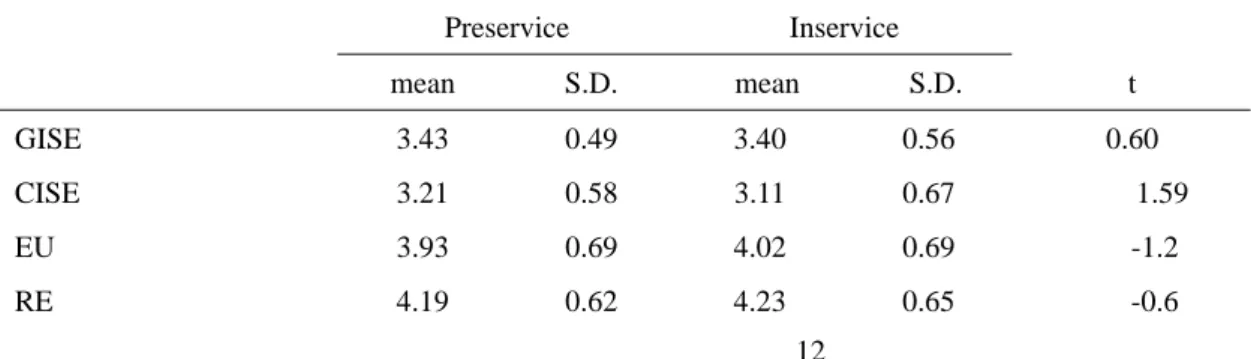
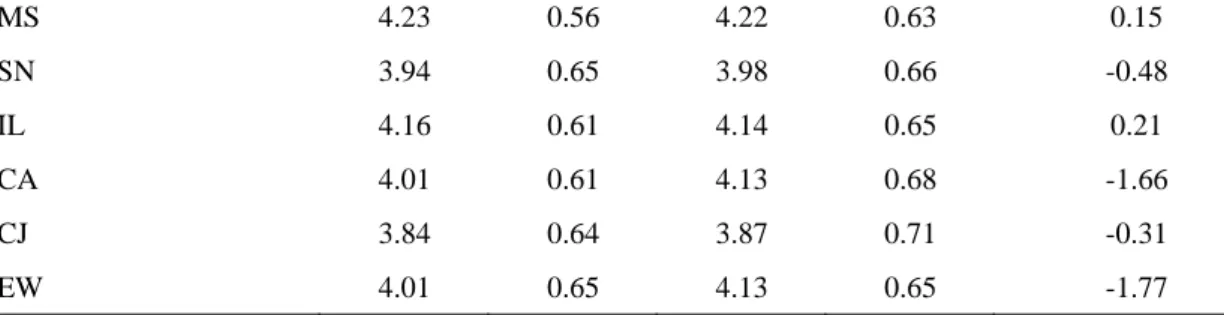
The results indicated that there were no statistically significant differences between preservice and inservice teachers in terms of their Internet self-efficacy and preferences toward Internet-based learning environments.
Table 4: The differences between preservice and inservice teachers on Internet-self-efficacy and CILES
Preservice Inservice
mean S.D. mean S.D. t
GISE 3.43 0.49 3.40 0.56 0.60
CISE 3.21 0.58 3.11 0.67 1.59
MS 4.23 0.56 4.22 0.63 0.15
SN 3.94 0.65 3.98 0.66 -0.48
IL 4.16 0.61 4.14 0.65 0.21
CA 4.01 0.61 4.13 0.68 -1.66
CJ 3.84 0.64 3.87 0.71 -0.31
EW 4.01 0.65 4.13 0.65 -1.77
Structural model: the causal relation between age, Internet usage, Internet self-efficacy and preferences toward Internet-based learning environments
Through the structural equation modeling (SEM) analysis with Linear Structure RELationships (LISREL), the causal relationships for the variables considered in this study were explored. The student age, Internet usage and Internet self-efficacy were deemed as the predictor (exogenous) variables, while the preferences toward constructivist Internet-based learning environments were viewed as outcome (endogenous) variables. The structural model is presented in Figure 1.
IL Usage
RE EU
CISE GISE
MS
EW CA SN
-0.01*
0.45*
0.14*
0.18*
0.02*
0.02*
0.04*
0.25*
0.02*
CJ Age
* p<.05
Figure 1: The structurally causal relationships between age, Internet usage, Internet self-efficacy and preferences toward constructivist Internet-based learning environments
According to Figure 1, student age had a positive effect on their preferences for constructivist Internet-based learning environments
with ease-of-use, cognitive apprenticeship, and epistemological awareness.
Student Internet usage seemed not to play an explicitly important role on student Internet learning environment preferences, similar to the correlation analysis presented in Table 3, suggesting the more Internet usage did not directly guide them to develop stronger preferences toward constructivist Internet learning environments.
More importantly, the structural model suggested that general Internet self-efficacy had positive effects on the preferences of many aspects of Internet-based learning environments, such as ease-of-use, relevance, multiple sources, inquiry learning, and
epistemological awareness.
The SEM model also showed that student communicative Internet self-efficacy had no effects on all variables related to the Internet learning environment preferences, except the inquiry learning scale. Nevertheless, the structural relationship between
communicative Internet self-efficacy and the inquiry learning preferences was negative.
Conclusions
1. This study asserted that to effectively implement constructivist Internet-based learning environments for pre-school education, a better understanding about pre-school teachers’ preferences toward these environments is quite essential.
2. SEM analysis in this study showed that students’ (or pre-school teachers’) age had a positive effect on their preferences toward a few aspects of Internet-based learning environments. More importantly, their general Internet self-efficacy, but probably not communicative Internet self-efficacy, affected their preferences toward many aspects of Internet-based learning environments.
Higher general Internet self-efficacy has enhanced students’ preferences toward constructivist Internet-based learning environments.
3. The results derived from the present study also indicated that Internet usage was positively related to their Internet self-efficacy (presented in Table 3). Therefore, more appropriate experiences of using Internet may greatly enhance Internet self-efficacy.
4. Higher Internet self-efficacy may not only foster student preferences about Internet-based instruction, but also better attitudes, searching strategies and learning outcomes toward using Internet. Therefore, the enhancement of Internet self-efficacy is an important task for educators.
4. This study can be viewed as a pioneering study exploring pre-school teachers’ views about Internet-based learning environments by SEM method. As Internet-based instruction becomes more and more prevalent across all levels of education, educational researchers are encouraged to conduct more research about pre-school teachers’ views and usages regarding Internet-based instruction.
子計畫三:中高齡者網路自我效能之研究 (朱如君)
本計劃研究成果自 2007 年 8 月至 2010 年 7 月已獲接受刊登於四篇 SSCI 國際論文,一篇國內論文,以 及八篇國際研討會,茲分述如下:
期刊論文:
1. Chu, A. Z. & Chu, R. J. (accepted). Intranet to Newcomer Socialization in Hotel Industry in Taiwan–
Technology Acceptance Model Analysis. International Journal of Human Resource Management. (SSCI) 2. Chu, R. J. (2010). How family support and Internet self-efficacy influence e-learning outcomes among
higher aged adults-Analysis of gender and age differences. Computers & Education, 55(1), 255-264.
(SSCI)
3. Chu, R. J. & Chu, A. Z. (2010). Multi-level analysis of peer support, Internet self-efficacy and e-learning outcomes – The contextual effects of collectivism and group potency. Computers & Education, 55(1), 145-154. (SSCI)
4. Chu, R. J. & Tsai, C. C. (2009). Self-directed learning readiness, Internet self-efficacy, and preferences toward constructivist Internet-based learning environments among adult learners. Journal of Computer Assisted Learning, 25, 489-501. (SSCI)
5. 朱如君、朱子君、林嘉純 (2009) 部落格與成人學習---女性主義教育學的觀點。教學科技與媒體,
89 期。頁 55-68。
發表之國際研討會
1. Chu, R. J., Chu, A.Z., Weng, C. & Weng, A. (2009). Adult learners’ perceptions of peer support, Internet self-efficacy and e-learning outcomes – The group level effects of collectivism. Technology Enhanced Learning Conference 2009. Taipei, Taiwan, October 6-8, 2009.
2. Chu, A. Z. & Chu, R. J. (2009). Socialization by intranet system in the hotel industries. International Journal of Arts and Sciences' Conference, Gottenheim, Germany, Nov. 9-13, 2009.
3. Chu, R. J. (2009). Transformative Learning, Self-directed Learning Readiness and Constructivist Internet-based Learning Environment Preference for Middle Aged and Older Adults: A Developmental View. International Journal of Arts and Sciences' Conference, Gottenheim, Germany, Nov. 9-13, 2009.
4. Wang, S.-L. & Chu, R.J. (2009). The Role of Collective Efficacy and Collaborative Learning Behavior in Learning Computer Science through CSCL, ITiCSE 2009, Paris, France, July 5-9, 2009.
5. Chu, R. J., Tsai, C.-C., & Weng, C. (2009). Internet self-efficacy and preferences toward constructivist Internet-based learning environments among adult learners. ED-MEDIA 2009--World Conference on Educational Multimedia, Hypermedia & Telecommunications, Honolulu, HI, USA, June 22-26, 2009.
6. Chen, H.-L., Chu, R. J., Fei, Y.-M., Chu, L. J. (2009). Elementary school teachers’ perceptions and
behaviour in integrating the Internet into instruction. CAL 09’: Learning in Digital Worlds. Brighton, UK.
March 23-March 25, 2009.
7. Chu, R. J., Chen, H.-L., Lee, H. & Lin, C. (2008). Learning Influences of Family Support and Self-directed upon the Internet Self-efficacy of Middle Aged and Old Adults. Technology Enhanced Learning Conference 2008. Hanoi, Vietnam, December 4-6, 2008.
8. Chu, R. J., Weng, C. & Chu, A. Z. (2008). Can Social Supports in the Classroom Overcome
Disadvantaged Backgrounds of Middle Aged and Older adults in Internet Learning? World Conference on
E-Learning in Corporate, Government, Healthcare, and Higher Education. Las Vegas, Nevada, USA, November 17-21, 2008.
研究發現
中高齡學習者之數位學習中的性別以及年齡差距包括學生的滿意度、網路自我效能等已經在先前的研 究得到驗證,而較為被探討的是到底這些差異是如何形成的。本計劃分析家庭支持〈實質支持以及情 緒支持〉以及網路自我效能〈一般效能以及溝通效能〉在數位學習上的影響。研究將中齡〈50 至 64 歲〉以及高齡〈65 歲以上〉以及性別分別分析理論架構,是其架構中的相互關係中所呈現的不同。分 析對象為 290 個參加社區大學或長青學院的中高齡學習者。
網路自我效能 網路學習
成效
圖一、 家庭支持、網路自我效能以及網路學習成效之研究架構圖
結構方程模式以及恆等性分析的結果顯示情緒支持扮演了主要預測網路學習效果的角色。其中一 般網路以及溝通網路自我效能在兩者關係中則扮演了中介的角色。情緒支持具有直接以及間接的雙重 效果,足見家庭情緒支持對於中高齡學習者之網路學習成效具有重大影響。相對的,家庭實質支持對 學習成效只具有間接的影響,還是要藉由提昇網路自我效能來達成。相對於男性學習者,女性學習者 更加依賴實質的家庭支持來增加其自我效能,比如使用時的指導。類似的模式也呈現在高齡的學習者。
女性以及高齡學習者的相似性顯示了性別差異並非是性別本身所造成的,更有關於社會結構中弱勢學 習者的學習型態。研究結果可供成人教育研究者以及教育家在進行中高齡成人網路學習時的積極建議。
家庭支持
實質支持
情緒支持
一般網路自我 效能 溝通網路自我
效能
知覺到的學習
持續學習 的意願 滿意度 性別
性別 年齡
年齡
M= .14** 一般網路 自我效能
F = .24**
實質支持 M= .26**
F = .36**
M= .03
圖二、男性 (M) 與女性 (F) 之各路徑係數 * p < .05, ** p < .01
圖三、高齡 (O) 與中高齡 (MA) 之各路徑係數 * p < .05, ** p < .0
另一研究主題嘗試探討中高齡成人在團隊學習的環境中的表現。研究架構中納入了文化上的集體 主義以及團體效能在組織層次上對於網路學習成效的預測能力,並檢驗網路自我效能以及同儕支持對 於網路學習成效的預測能力。團隊合作學習已經在網路學習中廣為討論,但是比較少研究探討到團隊 價值以及團隊能力對於個別學習者的學習決策,尤其用更為精確的階層線性模式(Hierarchical linear modeling, HLM)技術來分析團體層次以及個人層次的研究更是付之闕如。此研究檢驗網路自我 效能在同儕支持與網路學習成效間的中介關係,並探討團體效能的脈絡效果以及其和集體主義在網路 學習上的調節效果。研究架構如下:
網路學習成效
溝通網路 自我效能 情緒支持
M= .24**
F = .10 F = .29**
M= .39**
F = .05 M= .36**
F = .37**
M= .09 F = .11
M= .31**
F = .35**
O= .25**
MA = .18**
TFS GISE O= .59**
MA = .24**
O=.01
Effects of E-learning
CISE EFS
O= .15 MA = .22**
MA = .21**
O= .22**
MA = .19**
O= .36**
MA = .39**
O= .11 MA = .13
O= .37**
MA= .37**
圖四、 中高齡網路學習成效的多層次分析圖
本計劃研究結果顯示網路自我效能完全中介了同儕支持以及學習者的網路學習持續度,部分中介 了自我覺知學習成效以及滿意度。與假設不同的,我們發現團體效能並沒有發揮直接影響網路學習成 效的脈絡效果,相反地,研究結果發現團體效能調節了學習者網路自我效能對學習結果的滿意度以及 堅持度。此外,集體主義在同儕支持以及網路自我效能關係中扮演了調節效果。亦即愈高的集體主義 傾向,加強了同儕支持對於網路自我效能的正向預測能力。這個研究強調了團體層次的效果,並建議 從事中高齡網路學習的研究者或教育現場專家,在設計教學活動時要注意團體過程的重要。
網路自我效能 學習成效 持續學習 滿意度 個人層次 t 係數 t 係數 t 係數 t 係數 主要效果
性別γ10 -.05 -1.66 .04 0.85 -.10* -2.31 -.06 -1.45
年齡γ20 -.31** -8.00 -.02 -0.52 .03 0.58 -.01 -0.12
同儕支持γ30 .36** 9.49 .40** 10.23 .34** 8.30 .30** 7.30 網路自我效能γ40 .43** 10.94 .39** 9.75 .36** 8.98 中介效果
同儕支持γ30 .19* 2.68 .11 1.34 .19** 4.43 網路自我效能γ40 .41** 10.38 .36** 8.9 .28** 6.73
cR2 .24 .25 .19 .16
團體層次 脈絡效果
團體效能γ01 .02 0.47 .02 1.03 .01 0.66
bR2 .00 .01 .00
調節效果
集體主義γ31 .27** 4.06
團體效能γ41 .16* 2.39 .01 0.25 .14* 2.17
eR2 .02** .08** .01 .06**
* p < .05; ** p < .01
本計劃另針對建構取向之網路學習環境進行研究。檢視中高齡者對於不同的網路學習環境面向的 偏好,其自變項包括網路使用、網路自我效能、年齡以及成人的自我導向學習準備度。結構方程式模 型分析結果確認了十個面向的建構取向網路學習環境量表(Constructivist Internet-based Learning
Environments scale, CILES)及其令人滿意的信效度,並顯示網路使用時間影響成人學習者的網路自我效 能,進而影響其對於網路學習環境的偏好。研究結果確定了網路自我效能的中介角色,同時,網路自 我效能也扮演決定成人網路學習環境偏好的主要預測變項,尤其是一般性網路自我效能。在建構主義 取向之網路學習環境中,成人最偏好網路學習環境提供其生活相關知識,以及反思的環境;最不偏好 批判知識的環境、易於使用以及學生溝通的環境。本計劃另針對建構取向之網路學習環境進行研究。
檢視中高齡者對於不同的網路學習環境面向的偏好,其自變項包括網路使用、網路自我效能、年齡以 及成人的自我導向學習準備度。結構方程式模型分析結果顯示網路使用時間影響成人學習者的網路自 我效能,進而影響其對於網路學習環境的偏好。研究結果確定了網路自我效能的中介角色,同時,網 路自我效能也扮演決定成人網路學習環境偏好的主要預測變項,尤其是一般性網路自我效能。在建構 主義取向之網路學習環境中,成人最偏好網路學習環境提供其生活相關知識,以及反思的環境;最不 偏好批判知識的環境、易於使用以及學生溝通的環境。
圖五 各面向間關連之標準化係數 * p < .05, ** p < .01
關鍵字:成人學習、建構主義、同儕支持、網路自我效能、集體效能、文化、集體主義、自我導向學 習
子計畫四:網路化企業訓練員工的網路自我效能、科技接受度、與學習成效關係之研究 (翁楊絲茜)
本計劃自 2008 年 8 月至今有三篇期刊論文 submitted 及五篇國際研討會論文,茲分述如下:
期刊論文:
1. Weng, C.., Weng, D., Tsai, C.-C., & Weng, A. (2010) A neglected e-learning motivator affecting trainees’
decisions of continuous intention of usage, Information and Management. (Submitted).
2. Chu, R., Chu., A., Weng, A., & Tsai, C.-C. (2010) Transformation for adults in an Internet-based learning environment-is it necessary to be self-directed? British Journal of Educational Technology. (Under revision).
3. Weng, C., & Weng, A. (2010) Teaching Evaluation for Higher Quality Education: Strategies to Increase University Students' Participation, Educational Evaluation and Policy Analysis. (Submitted).
國際研討會論文發表
1. Weng, C. & Weng, A. (2010). Achieving a successful e-learning result from the perspectives of employees. Asia-Pacific Conference on Technology Enhanced Learning 2010, (APTEL2010), Osaka, Japan, September 24-26.
2. Chu, R., Chu, A., Weng, C. & Weng, A. (2010). A voice from weblogs: the development of a scale for feminist learning strategy. Asia-Pacific Conference on Technology Enhanced Learning 2010
(APTEL2010), Osaka, Japan, September 24-26.
3. Weng, C. & Weng, A. (2009). Do school restrictions promote student’s intention to use end of semester online evaluation of teaching? Technology Enhanced Learning Conference 2009. Taipei, Taiwan, October 6-8.
4. Chu, R. J., Chu, A.Z., Weng, C., & Weng, A. (2009). Adult learners’ perceptions of peer support, Internet self-efficacy and e-learning outcomes – The group level effects of collectivism. Technology Enhanced Learning Conference 2009. Taipei, Taiwan, October 6-8.
5. Chu, R. J. & Weng, C. (2009). Transformative Learning and Constructivist Internet-based Learning Environment Preference for Older Adults. 19th IAGG World Conference of Gerontology & Geriatrics, Paris, France, July 5-9.
6. Chu, R. J., Tsai, C.-C., & Weng, C. (2009). Internet self-efficacy and preferences toward constructivist Internet-based learning environments among adult learners. ED-MEDIA 2009--World Conference on Educational Multimedia, Hypermedia & Telecommunications, Honolulu, HI, USA, June 22-26.) 7. Chu, R. J., Weng, C. & Chu, A. Z. (2008). Can Social Supports in the Classroom Overcome
Disadvantaged Backgrounds of Middle Aged and Older adults in Internet Learning? World Conference on E-Learning in Corporate, Government, Healthcare, and Higher Education. Las Vegas, Nevada, USA, November 17-21, 2008.
重要研究發現
本研究主要目的係透過問卷調查的方式,探索企業員工在數位學習環境下的學習滿意度,並提供 原則性的建議,以期企業在使用數位學習方式訓練員工時會更為有效,其所花費訓練經費亦更有價值。
因此本研究係以曾經使用過數位學習課程的員工為研究對象,問卷發放分為委託發放及網路問卷,其 中委託發放的部份共發出 800 份,回收 722 份,回收率 90.2%,扣除無效問卷 55 份,得有效問卷 667 份;網路問卷共回收到 143 份,扣除無效問卷 3 份,得有效問卷 140 份。遂委託發放問卷與網路發放 問卷共得到 807 有效問卷。
本研究之正式問卷經由信度分析之結果,各量表其 Cronbachα係數均在.70 以上,顯示其內部一 致性水準相當高。研究之各量表信度值整理如下表。
表1 本研究問卷之信度分析摘要表
變項名稱 分量表 題數 Cronbachα 值(構面) Cronbachα(變項)
電腦學習焦慮 6 .861 電腦學習自我效能 7 .858 數位學習態度
電腦學習有用性 8 .784
.918
主管 9 .912
同事與朋友 10 .930 社會支持來源
家人 9 .920
情感性支持 9 .892 工具性支持 10 .866 社會支持種類
訊息性支持 9 .900
.959
學習環境 7 .911
人際關係 3 .710
數位學習滿意度
學習成果 8 .889
.946
問卷整體信度 77 .954
為了進一步了解各因素與數位學習滿意度的關係,本研究以多元迴歸分析來探討電腦學習態度及 社會支持對數位學習滿意度的預測力,透過迴歸方程式的建立與考驗,來檢測變項的關係。此研究以 三個自變項的九個層面作為預測變項,並以依變項的三個層面作為效標變項,即以自變項中的「電腦 學習焦慮」、「電腦學習信心」、「電腦學習有用性」、「情感性支持」、「工具性支持」、「訊息性支持」、「主 管支持」、「同事朋友支持」、「家人支持」等層面作為預測變項;數位學習滿意度中的「學習環境」、「人 際支持」、「學習成果」作為效標變項。
一、以自變項九個層面預測數位學習滿意度的「整體層面」
分析結果顯示,選入迴歸方程式的顯著預測變項依序為「情感性支持」、「電腦學習信心」、「訊息 性支持」,整體解釋力為49.2%,表示自變項可以解釋學習環境的49.2%解釋力。統計結果如表2,而 得知回歸方程式為:
數位學習滿意度「整體層面」=.302×情感性支持+.247×電腦學習信心+.306×訊息性支持+ε 表2 自變項各層面預測數位學習滿意度之「整體層面」迴歸分析
R平方 改變量 係數β值 F改變 情感性支持 .646(a) .416 .417 575.948 .302 .000 電腦學習自我效能 .685(b) .469 .053 80.114 .247 .000 訊息性支持 .703(c) .492 .024 37.935 .306 .000
***p<.001
二、以自變項九個層面預測數位學習滿意度的「學習環境」
分析結果顯示,逐步迴歸方程式的顯著預測變項依序為「情感性支持」、「工具性支持」、「訊息性 支持」、「電腦學習有用性」,整體解釋力為45.5%,表示自變項可以解釋學習環境的45.5%解釋力。統 計結果如表3,且得知回歸方程式為:
數位學習滿意度「學習環境」=.209×情感性支持+.233×工具性支持+.328×訊息性支持+ε 表3 自變項各層面預測數位學習滿意度之「學習環境」迴歸分析
進入變數 R值
決定係 數R平
方
R平方
改變量 F值
標準化 係數β
值
顯著性 F改變 情感性支持 .603(a) .362 .363 458.952 .209 .000 工具性支持 .657(b) .431 .069 305.664 .233 .000 訊息性支持 .676(c) .455 .025 225.643 .328 .000
***p<.001
三、以自變項九個層面預測數位學習滿意度的「人際支持」
分析結果顯示如表4,進入逐步迴歸方程式的顯著預測變項依序為「同事朋友支持」、「電腦學習信 心」、「家人支持」,整體解釋力為29.4%,表示自變項可以解釋學習環境的29.4%解釋力。得知回歸方 程式為:
數位學習滿意度「人際支持」=.375×同事朋友支持+.137×電腦學習信心+.152×家人支持+ε 表4 自變項各層面預測數位學習滿意度之「人際支持」迴歸分析
進入變數 R值 決定係數
R平方
R平方 改變
量
F值
標準化 係數β
值
顯著性 F改變 同事朋友支持 .512(a) .262 .263 286.714 .375 .000 電腦學習自我效能 .533(b) .283 .022 159.924 .137 .000 家人支持 .544(c) .294 .012 112.631 .152 .000
***p<.001
四、以自變項九個層面預測數位學習滿意度的「學習成果」
分析結果顯示,選入迴歸方程式的顯著預測變項依序為「情感性支持」、「工具性支持」、「訊息性
支持」、「電腦學習有用性」,整體解釋力為42.2%,表示自變項可以解釋學習環境的42.2%解釋力。統 計結果如表5 ,且得知回歸方程式為:
數位學習滿意度「學習成果」=.283×情感性支持+.146×電腦學習信心+.251×訊息性支持+.130×電 腦學習有用性+ε
表5 自變項各層面預測數位學習滿意度之「學習成果」迴歸分析
進入變數 R值 決定係數
R平方
R平方
改變量 F值
標準 化 係數 β值
顯著性 F改變
情感性支持 .600(a) .360 .360 453.646 .283 .000 電腦學習自我效能 .634(b) .401 .042 270.467 .146 .000 訊息性支持 .645(c) .414 .014 190.703 .251 .000 電腦有用性 .652(d) .422 .009 148.349 .130 .000
***p<.001
過去有關於學習滿意度的研究都曾顯示,學習者的態度是一個最重要且有影響力的變項。但本研 究結果卻發現,企業在使用數位學習方式訓練員工時,影響員工學習滿意度最有影響力及重要的變項 並非學習者的態度,而是員工所感受到的社會支持。其中在數位學習滿意度之「整體層面」及「學習 成果」上,雖然電腦學習自我效能仍保留其一慣性的影響力,但學員們感受社會支持中的訊息性支持 及情感性支持都是最重要的影響。而在分析數位學習滿意度之「學習環境」時,學習者的電腦學習自 我效能變項,完全被排除在所有能解釋及預測其變異量之自變項外。由此可知,如慾提高企業員工在 數位學習環境下的學習滿意度,企業必須特別注重員工所能感受到的社會支持。而除了一般大眾所認 知的情感性支持外,訊息性支持也是同樣的重要。
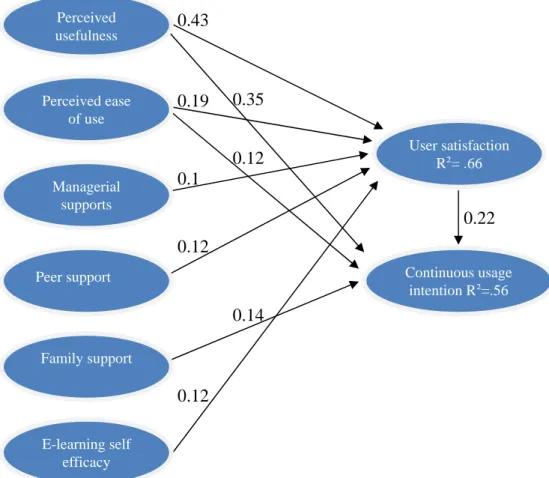
另外,由以下之圖表的另一部份研究結果得知,對於學習者未來的學習意願而言,數位學習滿意度是 一個很重要的中介因子。同事間的社會支持及網路學習自我效能都必須間接得經由學習者滿意度對未 來的學習意願有顯著的影響。雖然網路學習自我效能一直扮演者很重要的角色,但在此其對於學習者 未來的學習意願並無直接影響,反而由家庭來源的社會支持對於它有顯著及直接的影響。 因此,在進 行數位學習的過程中,對於企業員工而言,社會支持來源是很重要的一環。感受到越多社會支持,其 數位學習滿意度也隨之增加,尤其是屬於「同事朋友支持」的部分,提供了實質、訊息與情感上的支 持,更能夠增加學習的滿意度,因為個人若擁有正向的社會關係,可以使個人在心理上較平衡,繼而 減少了負向的心理狀態(如沮喪等),且經由這些社會關係的網路,員工不但可以提供個人情緒及經濟 上的支持,更肯定讓學習者肯定自我的價值;反之,若擁有不佳的社會關係,種種的生活壓力會使學 習者的情緒受到干擾而呈現不穩定的狀態,產生易於對他人攻擊及不友善的態度,進而影響到學習的 效果。根據 Widoff(1999)的研究指出成人學習者的家庭支持會影響學習者的學習滿意度,尤以配偶 的支持最重要。其原因可能是因為企業員工若在家進行數位學習,家人的陪伴可以使學習者的情緒較 穩定,若家人也協助分擔家務,會讓學習者更能專心於學習。且當學習者面臨學習壓力時,亦需要配
過去的研究多是強調學習者個人特質對數位學習成效或滿意度之影響,較少探討社會支持對於學習成 效之影響,但經由本研究結果發現,社會支持無論是其來源或種類,對於企業員工之學習成效都是一 個很重要的影響因素,並有預測學習滿意度之能力,是以,如果政府機構、企業組織、成人電腦學習 者、成人電腦學習機構、成人教師在規劃或推動數位學習時能將此一因素列入評估,對於提昇員工訓 練或學習的成效應有相當的助益。
User satisfaction R²= .66
Continuous usage intention R²=.56
0.14 0.12 0.35 0.43
0.12 0.12 0.1 0.19
Perceived ease of use
Managerial supports
Peer support
Family support Perceived usefulness
E-learning self efficacy
0.22
Figure 1. Summary of the significant research model
附件一
行政院國家科學委員會補助國內專家學者出席國際學術會議報告
97 年 5 月 20 日 報告人姓名
蔡今中 服務機構
及職稱 國立台灣科技大學教授 時間
會議 地點
97 年 8 月 28 日起至 97 年9 月 1 日止
Budapest, Hungary
本會核定 補助文號
NSC 96-2511-S-011-002-MY3
會議 名稱
(中文) 歐洲教學研究學會年會
(英文) European Association for Research on Learning and Instruction 發表
論文 題目
非制式情境中科學推理之知識論架構
An Epistemic Framework for Scientific Reasoning in Informal Contexts 報告內容應包括下列各項:
一、參加會議經過
八月二十八日至九月一日三天的會議中,本人除了與楊芳瑩教授共同發表論文: An epistemic model for scientific reasoning in the informal context,並參加主題工作坊、聆聽 了每日的Keynote Address 以及不同場次的 paper sessions 外。
更重要的是,這三天還跟與會相關領域的學者共同籌備了一本知識論研究的專書:
Personal epistemology in the classroom: theory, research and implications for practice. 該書 目前已由知名的學術出版社Cambridge University Press 出版發行,本人與楊芳瑩教授這 次發表的論文亦收錄在該書中。
二、與會心得
這次的研討會除了是發表之前與楊芳瑩教授所合作之研究成果,內容主要為建構
一個能夠解釋個人在非制式情境中科學推理能力的知識論架構。在當代的科學教育研究 中,除了概念知識學習的相關研究外,學生運用科學思考建構知識的歷程,已成為新的 重要研究方向。
值得一提的是,本人與知識論研究的許多著名學者,如美國 Middlebury College 的 Barbara K. Hofer、University of Nevada 的Lisa D. Bendixn、德國Carl von Ossietzky University 的Florian C. Haerle,被安排在同一場次發表,本人也藉此機會與他們就認識 論的相關研究進行討論、交流,還成功地邀請了上述學者於明後年來台灣進行學術上的 訪問、交流,日後若能成行,必能對台灣學術界在知識論上的研究有相當大的提升。
三、建議
台灣的國際學術交流,主要以英美日為對象,藉由這次的研討會與歐洲的學者交
流,在來自各國不同學術脈絡的討論中,也激盪出許多研究的視野與靈感。感謝國科會
四、攜回資料名稱及內容
會議中所發表的論文摘要、數十篇論文、proceedings