This ambiguity of the sign of change in the national prosperity of the participating countries is an expression of the Theory of the Second Best. A loss requires large negative income impacts due to an adverse movement in the terms of trade or, less likely, reduced trading volume. The shock of the formation of an RTA is felt by non-participating countries through a change in the terms on which they trade.
A small number of authors have analyzed the effects of the formation of an RTA on terms of trade in models in which there are three countries and three goods, the 3x3 models. In all cases, Mundell (1964) proved that foreign trade conditions had to deteriorate. These effects can offset negative price effects and improve the third country's terms of trade.
Riezman divides the effects on the terms of trade of the participating countries into the two components, the intra-area and extra-area terms of trade. He finds that the sign of the change in the intra-union terms of trade is ambiguous, but for both countries the extra-union terms of trade should increase. Such changes in tariff rates will then change the values of the endogenous variables (perhaps several thousands) in the model.
Another consequence of the Armington assumption along with CES functions is that the terms of trade effects of a change in trade policy may be implausibly large.
Hubs and spokes and the recent evolution of RTAs
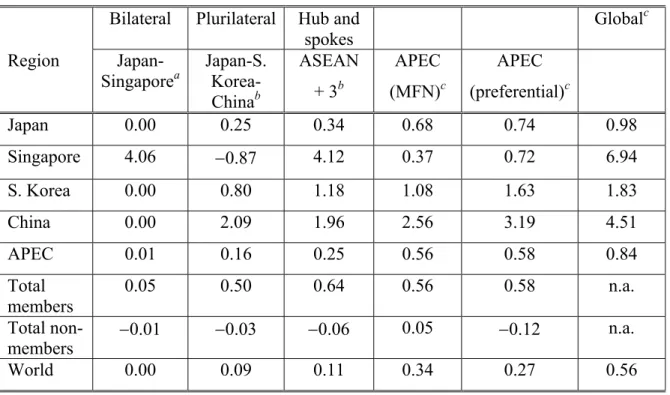
Finally, multilateral global liberalization leads to the greatest gains for each of the countries and RTA groupings listed in Table 1, as well as for the global economy. Third, the magnitude of the figures produced in these models depends on the time period of the database, the underlying economic theory used and the design of the trade liberalization experiment, i.e. the elements being liberalized. Fourth, with the exception of APEC liberalization on an MFN basis, countries that are not members of the RTA in the simulation lose overall.
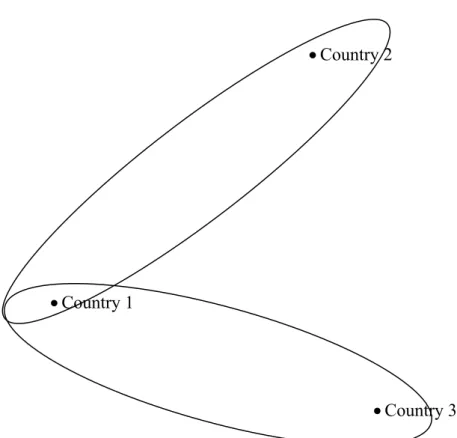
This conclusion would indicate that RTAs do not provide a Pareto improvement for at least some of the countries/regions that are not parties to the RTA, as our theory predicted. Fifth, the larger the RTA, the larger the welfare loss for non-members. The natural way to depict these intersections is to use Venn diagrams that show the intersections between sets of country membership in each RTA.
In this area, most APEC countries are centers or will be centers if the current negotiations are concluded. None of the centers are plurilateral, however, ASEAN as a party is now holding formal discussions with China, Japan and Korea - the so-called ASEAN+3 proposal. More countries are joining RTAs, more hubs are emerging, the average number of nests is increasing, and some of the nests are plurilateral.
It is also notable that many of the partners in bilateral agreements currently under negotiation or under negotiation are countries that have a strategy of seeking bilateral agreements with significant willing trading partners. The large number of countries within each pool would significantly reduce Arctic members' concerns about trade diversion. Any country that remains outside the Poles would face severe discrimination and a deterioration in trading conditions.
Similarly, any country in one of the poles, but with large markets in another pole, will also suffer. Most of the plurilateral RTAs with a larger number of members involve only developed countries and most are bilateral. When considering the larger size of the markets in developed countries and especially the US and the EU, there is no doubt that the increase in market access due to RTAs is overwhelmingly na.
Effects of RTAs on Multilateral Trade Liberalisation
This picture will change substantially if and when the FTAA and EU-EU negotiations take place. The answer generally given by previous studies is that the formation of RTAs has not slowed down multilateral liberalization. However, it is possible that the recent explosion of RTAs and the new patterns emerging could change this relationship.
After the WTO Ministerial Conference in Cancun, both the US and the EU stated that their priority now is to conclude bilateral and regional trade negotiations. There is also evidence that the formation of larger continental-based RTA groups is changing the stance countries adopt on some issues in multilateral negotiations. As an example, a group of 22 developing countries (G-22) played a major role in the multilateral negotiations in Cancun.
They insisted on measures that would benefit developing countries as a group and in particular took a very tough stance towards the EU and the US on farm support and protection. Similarly, at the APEC Economic Leaders' Meeting in Bangkok later in October, Australia supported the resolution agreeing to the use of the framework text tabled in Cancún by the President of the General Council, the so-called Debrez text. It contains words derived from the EU-US agreement on agriculture which would achieve very limited liberalization of agricultural trade and which appears to be at odds with Australia's previously strong position on agricultural trade reform.
At the time, Australia entered the critical phase of negotiations with the US on a free trade agreement. Regarding possible new areas of rules such as investment, competition and preferential rules of origin, many of these have been pioneered by RTAs, whose scope of rules goes far beyond that of the WTO, i.e. they are WTO-plus. There is increasing evidence that the EU and the US are using their growing networks of EU- and US-linked RTAs to form coalitions to advance EU and US views of the forms these new rules might take in the WTO.
It contains the rule that “duties and other trade rules… may not be higher or more restrictive.” The economic models discussed in section 1 above clearly show that the relevant variable is not the level of MFN barriers, but the volume of trade with third countries that arises after the formation of an RTA. The ASEAN countries and the CER countries have engaged in substantial unilateral trade liberalization during the period of trade barrier reduction within their RTAs.
Concluding remarks
1There is a partial equilibrium diagram that is still widely used to explain the economic effects of trade diversion and trade creation; see for example Pomfret (1997, pp. 182-185) and Schiff and Winters (2003, pp.). However, the 'trade creation' effect is the sum of a production and a consumption effect, and there is no outside -union effect. change in terms of trade by assumption. This Johnsonian interpretation of the “trade creation” effect cannot be considered a terms of trade effect or a trade volume effect.
5 For a complete overview of the widely used global database, GTAP, see Dimaranan and McDougall (2002). 7 However, it is possible to divide the welfare change into a terms of trade effect and an allocative efficiency effect, in order to get an idea of the importance of the terms of trade effect in the total welfare change. 9 These are the ten accession countries plus the three countries that have not joined; Twelve agreements with developing countries in the Mediterranean and Africa are already in force or under negotiation.
Moreover, the RTAs they have formed have been much less extensive in terms of commodity coverage and instrument coverage, although this has changed recently in some areas, notably Latin America. Rogoff (ed), Handbook of International Economics, Volume III, North Holland, Amsterdam. 2001 revised) A graphical presentation of the GTAP model, GTAP. Production: The GTAP 5 database, Center for Global Trade Analysis, Department of Agricultural Economics, Purdue University.
2002), "Traditional Market Access Issues in RTAs: An Unfinished Agenda in the Americas?", paper presented at the WTO Seminar on Regionalism and the WTO, Geneva, 26 April 2002. Itakura (2001) "Dynamic Effects of the 'New Age'" Japan-Singapore Free Trade Agreement”, GTAP Working Paper No. Wan (1976), “An Elementary Proposition Concerning the Formation of Customs Unions”, Journal of International Economics, 6, February, 95-98.
Schweinberger (1988), "Trade Expenditure Functions and the Gains from Trade", Journal of International Economics The Theory of Customs Unions, Noord-Holland, Amsterdam. Organisasie vir Ekonomiese Samewerking en Ontwikkeling (OESO) (1995), Streeksintegrasie en die multilaterale handelstelsel: sinergie en divergensie, OESO, Parys. 1997), "The Meade Model of Preferential Trading: History, Analytics and Policy Implications", in B. Krishna (2002), "On Necessarily Welfare-enhancing Free Trade Areas", Journal of International Economics The Economics of Regional Trading Arrangements, Clarendon Press, Oxford.
Gilbert (2001), New Regional Trading Arrangements in the Asia Pacific?, Institute for International Economics, Washington, D. 1950), The Customs Union Issue, Carnegie Endowment, New York. Mexico, in NAFTA with representatives of Nicaragua, Costa Rica, Bolivia, Chile, Israel, EU*, EFTA*, CACM*, Group of Three*.