中 華 大 學
碩 士 論 文
透過企業社會責任分析對台灣永續能源政策框架
之企業回應:以華碩個案為例
“Analyzing the Corporate response to the
Taiwan Sustainable Energy Policy Framework
through Corporate Social Responsibility: The
AsusTek case.”
系 所 別:行政管理學系碩士班
學號姓名:M09717021 卜拉克
ARISTOTLE MATIAS BULACLAC
指導教授:陳春山博士
柯志昌博士
摘要
摘要
摘要
摘要
公部門與私部門的合作是國家一種發展的方式。除了經濟及社會發展影響以 外,公部門與私部門的合作也是測量,評估和分析公共政策的方法。這種夥伴關 係的公共及私人部門引導到什麼叫企業社會責任。 其中一個緊迫的社會問題,現在是氣候變化。溫室氣體排放推動了聯合國發 起的聯合國全球的影響,鼓勵國家和私人公司在努力減少溫室氣體排放和碳排放 是造成全球變暖,由於氣候的變化。 中華民國在台灣,不是聯合國的成員在努力參與這個社會環境的努力,推出 了台灣永續能源政策框架。該研究主要集中在私營部門如何回應市民的政策,以 及如何可用於分析和評估政策。這項研究將利用台灣再生能源政策框架作為政策 模式和華碩電腦有限公司作為模型為私營部門。 關鍵詞 關鍵詞 關鍵詞 關鍵詞:::企業社會責任,公共和私營部門的合作,氣候變化,可持續能源政策框: 架
Abstract
The partnership of the Public and Private sector has been one of the pillars of State development. This doesn’t only contribute to the growth of the State’s economy and social development but also a means in measuring, assessing and analyzing public policy. Analyzing policies has been important in the development of a State and also in improving the way authorities govern.
The partnership of the Public and Private sector is channeled to what is called Corporate Social Responsibility (CSR) wherein the corporate and industrial sector contributes in the development and governance procedure of the government by contributing financially, procuring and creating projects in developing the community or responding to the governments call through compliance and participating in enforcing public policies in solving societal problems and social issues.
One of the pressing social issues now is Climate Change. The fast meltdown of the Arctic glaciers and the high level of the Greenhouse Gas (GHF) emission drove the United Nation to launch the UN Global Impact to encourage countries and private firms in the effort of reducing the GHG emission and carbon emission that contributes to global warming due to climate change.
The Republic of China in Taiwan, not a member of the UN Global Compact, in effort to participate in this socio-environmental endeavor, launched the Taiwan Sustainable Energy Policy Framework. The object of the policy is to reduce carbon; the government started the Carbon Footprint Label system. Early January 2010, Taiwan’s Environmental Protection Administration, first applied the labeling to PET-bottled beverages, candles, CDs and cookies. The corporate reception on the Carbon Footprint policy was characterized by companies striving to have their products labeled with Carbon Footprint (CFP). Among the big Taiwanese companies,
AsusTek Computer, Ltd. Receives the world’s first carbon footprint label for notebook computer in 2009 and received the Taiwan Carbon Footprint label following its global success. This is through the company’s green policy for its Corporate Social Responsibility. In answering to the government’s policy on environmental protection, AsusTek used its Corporate Social Responsibility to perform its task in helping the government realize its goal for a better and carbon free Taiwan.
The research focuses on how the private sector response to public policy and how it can be used in analyzing and evaluating policies. The study will attempt to measure the level of responsiveness of the private sector and how it affects public policy especially in realization of the policy implementation. The research will use Taiwan Renewable Energy Policy Framework as a policy model and AsusTek Computer Ltd. as model for private sector.
The research will attempt to create a new concept on how to measure and analyze policy responsiveness through the Corporate Social Responsibility (CSR) and how it would help in developing a new form of Participatory Governance through Social Responsible Investment (SRI) and Environment Social Governance (ESG) which are a CSR system. With these, private sector can participate in governance as a stakeholder in the public affairs and government and society as stakeholders in the corporate affairs.
Keywords: Corporate Social Responsibility, public-private cooperation, climate change, Sustainable Energy Framework Policy
Table of Contents
Abstract---I Table of Contents---IV List of Figures---VI Acknowledgement---VII Chapter I Introduction---11.1 Background Information: Corporate Social Responsibility---1
1.2 The Research Issue: Climate Change and the Government---4
1.3 The Corporate Response: ASUSTek’s Green CSR ---7
1.4 Purpose of the Study ---9
1.5 Definition of Terms ---9
Chapter II Review of Related Literature---11
2.1 Taiwan Sustainable Energy Framework: In Quest for Security or Sustainability? ---11
2.2 Public and Private Partnership through Corporate Social Responsibility and Inter-Organizational Cooperation---24
Chapter III
Methodology---37
Chapter IV Data Analysis---46
4.1 ASUS Eco Product and Its Labelling---47
The ASUS CSR Comparison---53
Acer---54
Toshiba---57
Dell---60
Apple---62
Comparison Matrix---65
Green ASUS and its impact---67
Chapter V Suggestion and Conclusion---72
List of Figures
Fig. 1.1 Corporate Social Responsibility Framework---3
Fig. 2.1 Framework of Indicator of Taiwan Sustainability---23
Fig. 3.1 The Roots of Competitive Advantage---38
Fig. 3.2 Dimension of Research Design---41
Fig. 3.3 Dimension of Research Concept ---42
Fig. 3.4 Research Process Flow---43
Fig. 3.5 The Factors that Affect ASUS CSR---44
Fig. 5.1 Development Progress of Renewable Energy of President’s Committee of Advisors on Science and Technology---75
Table 4.1 ASUS Product with EPEAT Gold (Taiwan) ---48
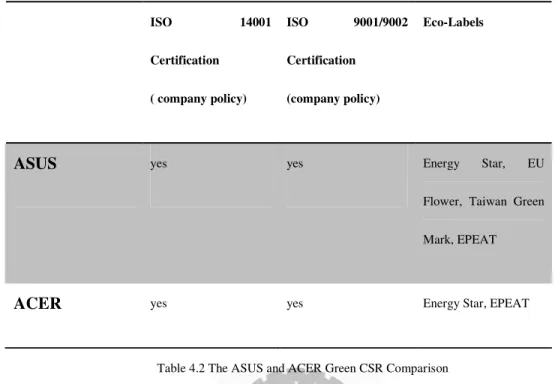
Table 4.2 The ASUS and ACER Green CSR Comparison---56
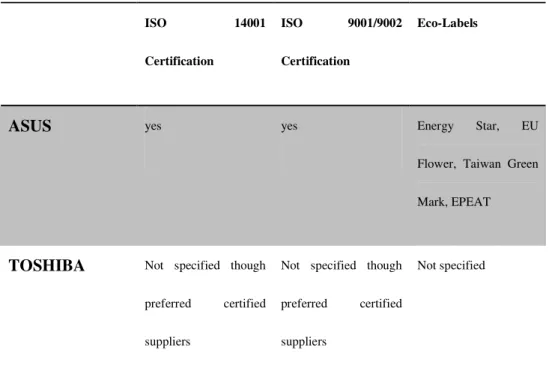
Table 4.3 The ASUS and Toshiba Green CSR Comparison---59
Table 4.4 The ASUS and Dell Green CSR Comparison---61
Table 4.5 The ASUS and Apple Green CSR Comparison---64
Acknowledgement
First and above all, I would like to thank the Divine Providence for giving me His Divine Guidance and wisdom to write this thesis. He knows that this is in effort to make a difference to this world that He created and the world we are called to love and cherish. I would like to thank my family for all the support despite of my distance. To my thesis advisers, Prof. Louis Chun-shan Chen, Ph.D. and Prof. Chi-chang Ko, Ph.D.,for their unceasing guidance and for imparting a lot for me. To our department head, Prof. Tai-jing Li, Ph.D, who gives all his support to graduate students in our department. To Prof. Chien-yuan Tseng, who supported me and made it possible to have a part of this work published and presented in the 2011 North America Taiwan Studies Conference at the University of Pittsburgh, USA. To all the professors of Department of Public Administration and its staff for moral support. To Prof. Tai-kuo Cheng, who served as one of the committee for my oral defense. To Mr. Frank Lin of ASUS for giving me a glimpse of how the company’s CSR works. To Business Council for Sustainable Development of Taiwan (BCSD) for accepting me as their intern. To my colleagues in the North America Taiwan Studies Association (NATSA). To my Yuliya, who in a way lessened my stress.
This thesis is for the people of Taiwan and for all who wishes to make this world, a better place.
Chapter I
Introduction
1.1
General Background Information: Corporate
Social Responsibility
The partnership of the Public and Private sector has been one of the pillars of State development. In partnership, private sector performs some programs and projects the government wishes to create for the betterment of the society in addressing societal concerns. Partnership, ergo, is more holistic in terms of public-private dynamics, wherein private sector is deemed as a part of the governance process, as a stakeholder not just a mere compliant to the governmental enactments that is more commonly viewed as public and private cooperation. With the public-private partnership, the relationship of the two sector revolves in the idea that everybody is a part and responsible to the affairs of the State and everyone must participate in the socio-political process, thus participatory governance emerges. The partnership of the Public and Private sector is channeled to what is called Corporate Social Responsibility (CSR) wherein the corporate and industrial sector contributes in the development and governance procedure of the government. Corporate Social Responsibility or CSR for short is a form of corporate self-regulation integrated into a business model. It functions as a built-in, self-regulating mechanism whereby business monitors and ensures its active compliance with the spirit of the law, ethical standards, and international norms. The goal of CSR is to embrace responsibility for the company's actions and encourage a positive impact through its activities on the environment, consumers, employees, communities, stakeholders and all other
members of the public sphere. It aids the government by contributing financially, procuring and creating projects in developing the community or responding to the governments call through compliance and participating in enforcing public policies in solving societal problems and social issues. It would promote the public interest by encouraging community growth and development, and voluntarily eliminating practices that harm the public sphere, regardless of legality. CSR is the deliberate inclusion of public interest into corporate decision-making, that is, the core business of the company or firm, and the honoring of a triple bottom line: people, planet, profit.
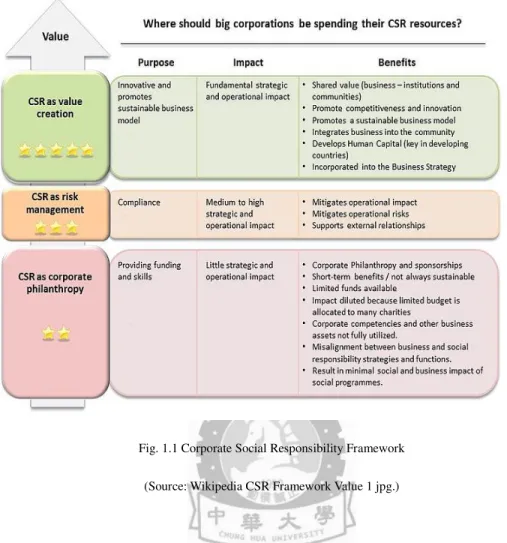
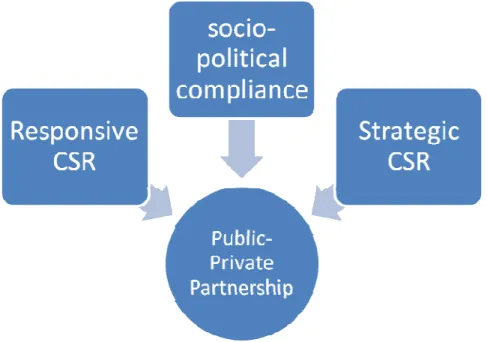
A more common approach of CSR is philanthropy. This includes monetary donations and aid given to local organizations and impoverished communities in developing countries. Another approach to CSR is to incorporate the CSR strategy directly into the business strategy of an organization. Another approach is garnering increasing corporate responsibility interest. This is called Creating Shared Value, or CSV. The shared value model is based on the idea that corporate success and social welfare are interdependent. (See Fig. 1.1)
Fig. 1.1 Corporate Social Responsibility Framework (Source: Wikipedia CSR Framework Value 1 jpg.)
This research revolves on the parameter of the government and corporate partnership through a channel known as the corporate social responsibility. The issues of which the paper considered the notion that in analyzing the partnership of public and private sector, we can analyze the private compliance to the public policy or shall we say the establishment of business ethics to promote to foster a harmonious business environment within the realm of the State. CSR then is a mean of corporate sector to participate in the State affairs through their corporate policy. Corporations are called to participate actively in helping to address societal issues such as human development, literacy, livelihood, social justice and environmental protection. CSR then became an agora or meeting place for the public realm which manages the state and the corporate realm which controls the behavior of the market. CSR became the
aid of the government in serving the society as well as the aid of companies to create favorable corporate image as well as an avenue for “giving back the profit to the people”. These may be in terms of social services, service improvement or the most urgent environmental concerns.
1.2 The Research Issue: Climate Change and the
Government Response
One of the pressing social issues now is Climate Change. The fast meltdown of the Arctic glaciers and the high level of the Greenhouse Gas (GHF) emission drove the United Nation to launch the UN Global Impact to encourage countries and private firms in the effort of reducing the GHG emission and carbon emission that contributes to global warming due to climate change. Climate change usually refers to changes in modern climate. It may be qualified as anthropogenic climate change, more generally known as global warming or anthropogenic global warming (AGW) which is the increase in the average temperature of Earth's near-surface air and oceans.
According to Karl TR, et. al. (2003), Greenhouse gases greatly affect the temperature of the Earth; without them, Earth's surface would be on average about 33 °C (59 °F) colder than at present. Note that the greenhouse effect produces a temperature increase of about 33 °C (59 °F) with respect to black body predictions and not a surface temperature of 33 °C (91 °F) which is 32 °F higher. The average surface temperature is about 14 °C (57 °F). Due to the high greenhouse producing greenhouse effect, sudden increase of temperature occurs that produces the so called Climate Change. Since the rapid increase of industry, the burning of fossil fuels which are of great importance because they can be burned (oxidized to carbon dioxide and
water), producing significant amounts of energy per unit weight, and deforestation leading to higher carbon dioxide concentrations in the air, the rate of carbon emission increases contributing to the high amount of greenhouse gas (GHG).
The issue then is the carbon emission level usually high on industries that consumes high energy. In order to sustain the high requirement of energy for production, the demand for the combustion of fossil fuel is high creating a high level of carbon emission. Taiwan, being one of the economies that are laid on high technology and industries, has a high demand for energy consumption to sustain its industry based economy. Per capita energy use in Taiwan is on par with several of its neighboring countries in Asia. However, energy intensity levels in Taiwan compared to other developed countries tend to be relatively high. This is due primarily to the country's heavy concentration of energy-intensive manufacturing industries. Taiwan's per capita carbon dioxide emissions have been increasing, and in 2003 represented more than four and a half times the amount of per capita carbon dioxide emissions in China (12.4 compared to 2.7 metric tons). Taipei has the most obvious air pollution, primary caused by the motorbikes and scooters used by millions of the city's residents.
The Fifth Six-Year Plan that was passed by Taiwan's Executive Yuan states that Taiwan's major environmental problems will be addressed, which was enacted by year 1997. Population density, high energy consumption due to big industries, industrial wastes and rapid conversion of lands into industrialized zones are issues contributing to the increase of Green House Gas Emission and the increase of carbon that contributes to the climate change and the vulnerability of Taiwan in facing natural disasters. In a report of the U.S. Energy Information Administration states that:
Taiwan is grappling with the environmental ramifications of building one of Asia's richest economies through a decades-long commitment to economic growth. Environmental issues include the pollution of air and water in urban areas, stores of nuclear and toxic wastes, loss of fisheries and coastal ecosystems, and an overall degradation of the country's natural landscape.
In order to create a win-win-win solution in energy, environment, and economy, sustainable energy policies should support the efficient use of limited energy resources, the development of clean energy, and the security of energy supply. Passed on June 5, 2008 by the Executive Yuan, the Sustainable Energy Policy Framework will answer Taiwan’s energy problem given the fact that Taiwan is insufficient in natural resources, and constrained by limited environment carrying capacity.
According to the Taiwan Sustainable Energy Policy Framework, Sustainable energy development should balance the objectives of energy security, economic development and environment protection, and consider the need of future generations.
It aims to: 1.) Improve energy efficiency 2.) Developing clean energy 3.) Securing energy supply. The policy aims to reduce the carbon emission of
Taiwan to 2000 level by year 2025. In the efforts to achieve the 2000 level of carbon reduction target of Taiwan by 2025, the Cabinet-level Environmental Protection Administration (EPA) worked on a system to label the carbon footprints of consumption products as part of efforts to reduce greenhouse gas emissions. This paved way to the many Carbon footprint labels on most of Taiwan’s products mostly from the IT-based such as electronic devices, gaming consoles and computers.
1.3 The Corporate Response: ASUSTek’s Green
CSR
ASUSTeK Computer Incorporated (華碩電腦股份有限公司) is a multinational computer product manufacturer headquartered in Taipei, Taiwan. Its product range includes motherboards, laptops, servers and mobile phones. The company also produces components for other manufacturers, including Dell, Falcon Northwest, Hewlett-Packard and Apple Inc.
1ASUS appears in Business Week’s "InfoTech 100" and "Asia’s Top 10 IT
Companies" rankings. Wall Street Journal Asia ranks it number one in quality and service, and it leads the IT Hardware category of the 2008 Taiwan Top 10 Global Brands survey with a total brand value of US$1.324 billion.
Using the case of ASUSTek, a Taiwan based computer company, as a model for corporate response using CSR; the paper was able analyze how the Carbon Footprint Label System on ASUS products, specifically computers contributed to the Sustainable Energy Policy Framework. The so called “Green Corporate Social Responsibility” (Green CSR) of ASUS led the company to create the branding “Green ASUS”.
2
According to the declaration of Policy by Social and Environmental Responsibility Policy of ASUS (SERAsus), which was establish 2006, though the first report on Environment, Health and Safety was first published on 2005, the company shall:
1
Retrieved from 2008 Top Taiwan Global Brands announced today (2008/10/23)". Brandingtaiwan.org. 2008-10-23. June 1, 2010
2
1. Abide by all environmental protection, labor, and safety and health laws.
2. Conserve natural resources and endeavor to prevent pollution. 3. Reduce environmental impacts and safety risks.
4. Satisfy customer requirements and aim to become an entirely green enterprise.
5. Facilitate a company-wide promotion of corporate responsibility particularly social and environmental aspects.
6. 3Encourage all employees to participate in the program and continuously improve it.
The corporate policy states that the company is committed to abide by environmental and labor protection laws, regulations to meet related demands issued by the government, and vouch to support the global environmental protection, labor rights and occupational hazard control.
The research tried to address this primary question especially focusing on the corporate side of the stakeholders and how the corporate sector reaction on the Taiwan Sustainable Energy Policy Framework. Using ASUSTek as an example, the research was able discuss the different programs of ASUSTek on its effort to fulfill its duty as government’s partner in policy action particularly in sustainable development through Corporate Social Responsibility.
3
To wrap up, the research simply analyzed on how the corporate sector reacts on a certain policy using the avenue so called Corporate Social Responsibility. The thesis used ASUS to represent the corporate sector and Sustainable Energy Policy Framework which covers the Carbon Reduction program as a representative for policy. Specifying CSR, the thesis will look upon the outstanding compliance of ASUS in having their computers Carbon Footprint Labeled in compliance to the policy.
1.4 Purpose of the Study
The study focused on Policy Response analysis, public-private cooperation, Corporate Social Responsibility. Therefore this aims to:
1. To analyze the responsiveness of the private sector to public policy 2. To evaluate the nature of public-private cooperation
3. To investigate the social and corporate implication of the Taiwan Sustainable Energy Policy Framework
1.5 Definition of Terms
This study operated on the following definition of term:
Corporate Response, in this study refers to actions done by the corporate sector in response to a public policy.
Corporate Social Responsibility, refers in this study as the methodology where the corporate sector produces programs or schemes either in complying with a public regulation, collaborative action for social development or as a business model as sort of marketing or improving the corporate image.
Sustainable Energy Policy Framework is a policy passed by the Executive Yuan of the Republic of China to improve energy efficiency by more than 2% per
annum, so that when compared with the level in 2005, energy intensity will decrease 20% by 2015 and to reduce Carbon and Green House Gas emission. In this paper, the Sustainable Energy Policy Framework will be the basis for public policy that will be the independent variable and will be used as the basis of testing the Green CSR of Asustek.
Green CSR of ASUSTek, refers to the CSR of ASUSTek specifically for environmental protection.
Carbon Reduction/Offset refers to reduction in emissions of carbon or greenhouse gases made in order to compensate for or to offset an emission made elsewhere.
Sustainable Development is a pattern of resource use that aims to meet human needs while preserving the environment so that these needs can be met not only in the present, but also for generations to come.
Participatory Governance, in this study refers to inter-organizational participation particularly non-government sector specifically, corporate or business sector in participating with the government in implementing, complying and or collaborating to the policy for social or state development.
Chapter II
Review of Related Literature
This study discusses two main issues of literature review. The first is about pertaining to sustainability, sustainable and renewal energy policy, carbon reduction and Green House Gas Emission. The second is how both public and private sector creates a cooperation through corporate social responsibility.
2.1 The Taiwan Sustainable Energy Policy
Framework: In Quest for Security or Sustainability?
Since the 1970s when the world suffered from the Oil Crisis of 1970’s, Taiwan lacks energy resources and highly depends on import, so it is a top priority to develop clean, sustainable, and independent energy and achieve the balance among energy security, environmental, and industrial competitiveness, and reduce CO2 emissions
through various strategies. Taiwan relies on imports for more than 98 percent of its energy, which leaves the island's energy supply vulnerable to external disruption. In order to reduce this dependence, the Ministry of Economic Affairs' Bureau of Energy has been actively promoting energy research at several since the 1990s.
4
As of 2010, in Taiwan, oil accounts for 49.0% of the total energy consumption. Coal comes next with 32.1%, followed by nuclear energy with 8.3%, natural gas (indigenous and liquefied) with 10.2%, and energy from renewable sources with 0.5%. Taiwan has 6 reactors and two under construction.
4
The Taiwan government has been active in promoting energy efficiency, and set a target of energy efficiency of 33% by 2025. This target is higher than Japan's commitment to APEC with the target of 25%-26% efficiency. The government is currently assisting 200 major energy users (companies and organizations) in implementing energy-saving measures.
Taiwan is preparing for the age of high oil prices, and is proactively developing clean energy, such as solar and wind power and biofuels. The efforts would help reduce Taiwan's reliance on imported oil, while contributing to the reduction of greenhouse gases.
The government aims for renewable energy to account for 15% of the nation's energy by 2025. It would amount to 8.45 million kilowatts, capable of producing 28.7 billion kilowatt hours of electricity. Wind-generated power could create as much as 8.9 billion kilowatt hours of electricity by 2025, comparable to 2.3 times the capacity of Linkou's thermal power plants. Many domestic companies are now beginning to work on the development of solar energy, and conservative estimates are projecting that 1.2 billion kilowatt hours of electricity will be produced through solar power by 2025.
Under the Energy Management Law and the underlying Implementing Regulations and related measures, companies are encouraged to improve the energy efficiency of their operations and products. Mandatory programs have been established for the purpose of energy conservation, including energy audit and energy efficiency standards for certain electrical and electronic products.
The Energy Commission under the Ministry of Economic Affairs is responsible for formulating and implementing energy policy and laws, including the programs
instituted under the Energy Management Law. The principal responsibilities of the Energy Commission include:
(1) Supervising general affairs related to energy management to assure the stability of energy supply;
(2) Accelerating the rationalization of energy pricing; (3) Promoting the effectiveness of energy utilization; (4) Preventing energy-related environmental pollution; and (5) Enhancing energy research and development.
According to Chen, et.al (2007), to promote the development and application of renewable energy, under the planning and execution of Bureau of Energy of Ministry of Economical Affairs (BOEMOEA), Taiwan has implemented many measures for subsidizing the installation of RE apparatus since 2000. Besides subsidizing the installing expenses, Taiwanese government also provides incentive measures of finance/tax, such as investment deduction and accelerating depreciation. The successive growth of the amount of installing cases has apparently constructed the base of promotion and application of renewable energy; on the other hand, many barriers to be overcome were continuously discovered during the executing processes. To effectively remove these promoting barriers, the Energy Commission (the pre-BOE) issued “Renewable Energy Development Plan” through the endorsement of Executive Yuan in January 2002. The purpose of this plan is to establish an inter-ministerial coordinating mechanism of a higher administrative level, which may focus all resources to be functioned as a working team. In the meantime, to further establish a systematically promoting mechanism, the Bureau of Energy then pushes
the legislation of “Renewable Energy Development Bill”. According to the drafted plan of this law, the power capacity of renewable energies will be 12% share of the national power installation capacity by 2020. Furthermore, in the Nuclear-free Homeland National Conference held in June 2003, government planned that the power capacity of renewable energy must reach 10% of the total power capacity in the nation by 2010. However, the share of the power capacity of renewable energy to the national power installation capacity is only 6.17%, currently, so there is still a lot of growing space for the development of renewable energy in Taiwan.
According to Chen and Hou(2008), since June 5, 2008, the Executive Yuan approved the Framework of Taiwan’s Sustainable Energy Policy. It aims to: 1.) Improve energy efficiency 2.) Developing clean energy 3.) Securing energy supply. The policy aims to reduce the carbon emission of Taiwan to 2000 level by year 2025.The goal is to improve energy efficiency by more than 2% per annum, so that when compared with the level in 2005, energy intensity will decrease 20% by 2015. Supplemented by further technological breakthroughs and proper administrative measures, energy intensity will decrease 30% by 2025. The carbon emission target is to reduce nationwide CO2 emission, so that total emission could return to its 2008 level between 2016 ~ 2020, and further reduced to the 2000 level in 2025. The green energy application is to achieve the share of zero carbon renewable energy in electricity generation system up to 8% in 2025.
In order to achieve the preset goals and targets, government agencies were requested to formulate concrete action plans in accordance with the framework. To ensure the implementation of the proposed Energy Saving and Carbon Reduction Action Plans would meet reporting, monitoring, and verification requirements, the
authorities required that:
1. Quantitative objectives should be established for each task to measure its performance and facilitate implementation.
2. Carbon reduction targets should be clearly set in all action plans.
3. Monitoring and follow-up mechanisms should be built to regularly review the effectiveness and performances of the said action plans.
The Taiwan Sustainable Energy Policy Framework can be viewed in a two way perception basing on which ground the policy was really made for. 5In the article written in the blog “Taiwan Sustainable Cities”, a blog on Taiwan’s green urban development, the author reports that Taiwan’s 99 percent dependence on energy imports is complicated further by dual vulnerabilities to Middle East instability and fragile cross-strait relations. He further states that as China upgrades its naval fleet with the goal of obtaining blue-water capabilities -- Taiwan should be increasingly worried about the likelihood of continued unfettered ocean supply routes around both the Taiwan and Malacca Straits that, he viewed as China chocking off Taiwan’s oil supply that Taiwan’s one month sufficient supply would be insufficient to keep its economy working. Adding to oil, coal, another source of Taiwan’s energy source, a quarter of its total coal imports, currently, is now relying to China’s increasing coal imports. The author, concludes, that in order to secure and improve energy situation, the Executive Yuan made the Sustainable Energy Framework. Whether the rationale of this policy is to secure Taiwan’s energy source, the bottom-line is that the government is working towards not only to improve and to produce sustainable energy but also to protect and conserve Taiwan’s environmental situation hastened by
5
Retrieved from:
carbon emission.
Once Chan, et.al (1998) stated that in the 21st Century, Taiwan will encounter further environmental challenges at the local, regional and international levels. Post-Kyoto concerns for climate change will create international pressures to reduce green house gases (carbon dioxide, methane). The environment and energy are important domestic and international issues that are now national security concerns for Taiwan.
The strategic plan is offered for transforming the Taiwan Environmental Protection Agency (TEPA) to an organization that spearheads the government’s effort to create a sustainable future. As the “environment” is defined as energy and material flows in commerce, not just waste, it must be brought to a central function in government. Therefore, we recommend the formation of a Ministry for Environment and Resources. However, it is critical that resources explicitly include responsibilities to affect energy and materials utilized in construction, agriculture, transportation and industry.
Government needs to apply a new modality to its environmental management programs. While strict enforcement at all levels of governance establishes integrity, a new modality uses public persuasion and cooperative negotiations with industrial sectors. Management personnel will need to enhance their skills in environmental risk assessment, economic impact assessment, and environmental negotiation to be ready to implement a new government-industry-citizen partnership era.
The effort of the Taiwan government to achieve its goal, that is reducing carbon emission to the 2000 level in 2025, Drs. Chen and Hou, in the paper emphasized the enthusiastic action of the government by requesting government agencies to formulate concrete action plans in accordance with the Sustainable Energy Framework. The
paper clearly shows the sincerity of the government in participating in this global endeavor of Carbon Reduction especially, that Taiwan is not a member of the UN Global Compact due to its current status in the United Nations.
Nevertheless, Taiwan is very eager to contribute in this global endeavor. The idea then is, since Taiwan, technically, cannot involve directly or formally to this international agenda, Taiwan, using its globalized industries through private firms, Taiwan’s corporate and industrial sector can serve as a liaison and also a model for call for carbon reduction compliance through the private participation to the national policy, Sustainable Energy Policy Framework.
Taiwan, contributed globally through its local policy that contributes to this international call. We can say, through Taiwan’s local policy that is based on the global agenda in answering global issue, Taiwan was able to do her share in this collective action. In order for her to involve the nation’s dynamic yet diverse sector, Taiwan must encourage sectors to participate in policy implementation wherein for the corporate sector, through the use of Corporate Social Responsibility. Whether the Sustainable Energy Policy Framework is more sincere in sustainable development rather in political and energy security, the effort of the government should, in principle for the best of its people which is the primary responsibility of the State. The policy therefore should not only be viewed as a response to economic challenge from external pressure and natural resource reality but also as a positive and dynamic response of the government to a global endeavor.
The March 2010 issue of PCF World Forum features Taiwan’s Carbon Footprint Level reaching the Taiwanese Market. The Taiwan Electrical and Electronic Manufacturer’s Association (TEEMA) came up with its own carbon labeling for electronic sector. Taiwan is the latest nation to float a plan to label the carbon footprint of common consumer packaged goods, following in the footsteps of the UK and Sweden. The labeling program, from Taiwan’s Environmental Protection Administration, was at first applied to PET-bottled beverages, candles, CDs and cookies.
In response to the government’s policy on environment, the corporate sector started their own initiative to create an environment based production and environment based quality control through carbon footprint labeling on their own respective products. This simply manifests a positive and active response from the corporate sector to the public policy.
Since the aim of this paper is to assess and investigate on the corporate response through CSR, it is very substantial to study how corporation formulate their own respective CSR programs and how these programs go with the policy and regulations by the government and societal issues. This will lead on how to corporation and industries behaves in a given point of issue or agenda. We can conclude then that the policy is a scenario for a corporate social responsibility taking the philanthropic approach of CSR as a model. Or, was it a business strategy to answer policy making it a mere compliance? Ideally, CSR should work as a value formation for business that means in making or developing business success level is also improving the society and in hand-in-hand with the government in addressing a societal issue thus creating a means of a new participatory governance.
With the issue of sustainable energy source amidst the scarcity of energy resources, Taiwan uses energy alternatives that perceived to be efficient yet sustainable. According to Lee (2006), energy conservation and greenhouse gas reductions are the major components of the present energy policy in Taiwan. The production of electricity from nuclear source has resulted in a significant reduction in atmospheric emissions and in the consumption of conventional fossil fuels from what otherwise would have occurred.
Over the period 1977-2007, electricity generated by Taiwan's nuclear power plants averted the following cumulative greenhouse gas emissions: 828 million tonnes of CO2, 2.3 million tonnes of NOx, 14 thousand tonnes of VOCs, and 5 thousand tonnes of CH4. In addition, nuclear energy production displaced 330 million tonnes of coal that would otherwise have been burned to produce electricity by electric utility.
In the paper of Lee, he presented that the use of nuclear energy could reduce carbon emission. Atomic energy offers a clean energy alternative that frees us from the shackles of fossil fuel dependence. Nuclear power costs about the same as coal, so it's not expensive to make. It does not produce smoke or carbon dioxide, so it does not contribute to the greenhouse effect. It produces huge amounts of energy from small amounts of fuel. It produces small amounts of waste and nuclear power is reliable.
Although not much waste is produced, it is very, very dangerous.
It must be sealed up and buried for many thousands of years to allow the radioactivity to die away. For all that time it must be kept safe from earthquakes, flooding, terrorists and everything else. This is difficult. Nuclear power is reliable, but a lot of money has to be spent on safety - if it does go wrong, a nuclear accident can be a major disaster. People are increasingly concerned about this - in the 1990's nuclear
power was the fastest-growing source of power in much of the world. In 2005 it was the second slowest-growing. But, as the price of oil and global warming concerns both continue to rise steadily, a renewed interest in the clean-burning properties of nuclear power are becoming much more attractive. The rise of global warming concerns throughout the world over the last ten years has led to a renewed interest in what was once considered a dead market.
Will nuclear power answer to the challenge of the current climate change and the call of the Sustainable Energy Policy Framework? The fact to consider is that will it suits Taiwan’s present condition and the necessity for it to sustain the nation’s demand for energy. Taiwan currently has 4884 MWe of nuclear power capacity by means of 3 active plants and 6 reactors, which makes up around 8.1% of its national energy consumption. This makes Taiwan the 15th largest user of nuclear power in the world. Given a very limited source of sustainable energy for its fast and dynamic economy, it is very inevitable for the nation to seek a more long term yet sustainable and clean source of energy. Nuclear power may answer this concern yet safety and precaution should also be considered. Considering that Taiwan is prone to natural disaster often frequented by typhoons, earthquakes and landslides, it also summons images of disaster.
In this course of issue, two agenda then occurs, the issue of development and the issue of sustainability. In the course of development, the issue of environment is often complimentary. Since the industrial revolution in the western world, the issue of environmental problems started to sprout. Industrialization, which is a means of development, is often acquainted with the term “pollution” or environmental degradation. Here comes the question on how these two “opposing” idea of development and sustainability can be complementary in the lighter side. Can it be
possible to attain development without putting sustainability at stake? The object is to create a well developed economy yet sustainable in nature hence we call sustainable development. Boulanger (2004) states that social indicators, and therefore sustainable development indicators also, are scientific constructs whose principal objective is to inform public policy-making. Their usefulness is dependant on trade-offs between scientific soundness and rigor, political effectiveness and democratic legitimacy. The paper considers in this perspective three important stages in the building of sustainable development indicators: the identification of the various dimensions underlying the concept of sustainable development, the process of aggregating lower dimension indicators in higher level composite indices and the attribution of weights at various levels of the indicators hierarchy. More specifically, it assesses the relative fruitfulness for indicators construction of the four most widespread conceptions of sustainable development, in terms of domains or pillars (economy, society, and environment), in terms of resources and productive assets (manufactured, natural, human and social capitals), in terms of human well-being (needs, capabilities) or in terms of norms (efficiency, fairness, prudence…). It concludes with a plea for the construction of synthetic indices able to compete with and complement the GNP as an indicator of development.
In the research by Chen, et.al (2008), they tried to establish a standard indicator in measuring sustainability. The study written by Chen, et.al (2008), utilizes the method of Material Flow, Ecological Footprint Model and other related indicators to establish the Indicator System of Sustainable Development. Principal Component Analysis is used to abstract the representative factors in order to estimate the indicators of ecological sustainable development during 1998~2005 in Taiwan, as well as to make policy recommendations. The research indicates following results: (1) The Direct Material Input (DMI) of Taiwan shows constant instability and depends on
heavy import activity. The annual increase of considerable greenhouse gas emission leads to a comparative growth of the Domestic Process Output (DOP). The both material consumption and inventory formation of the economy are unsteady. In addition, the Physical Trade Balance (PTB) indicates that supply exceeds demand, as well as the occasional shortage of building materials. (2) The 2005 per capita Ecological Demand footprint in Taiwan is 6.5392 hm2, making the Ecological Deficit per capita 4.8569 hm2. The figures reflect that productivity and life intensity of residents have exceeded the carrying capacity of Taiwan’s ecological economic system. (3) The overall Synthetic Trend Indicators of Sustainable Development in Taiwan are decreasing. Therefore, if proper measures are not adopted in time, the current weak sustainability will lead into the vicious circle which departs from sustainable development.
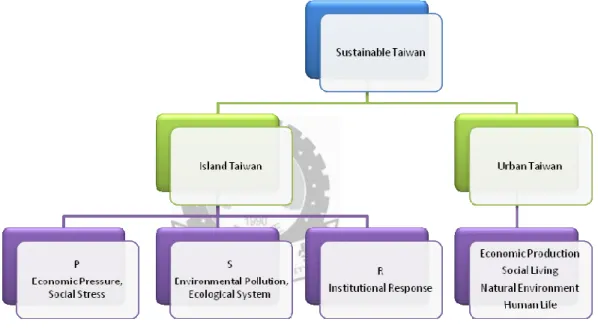
Since about 1970, economic growth ceased to be considered the most important criterion for measuring urban development. Instead “development” has come to encompass other aspects such as environmental quality and the provision of public service. Sustainable urban development must be more than merely “protecting” the environment; it requires socioeconomic adjustment in order to reduce the need for environmental remediation (OECD, 1990). According to Huang, et.al (2001), urbanization in rapidly industrialized countries has been particularly unsustainable. Evidence of progress in urban sustainability is important in justifying urban management policies. To assess the trend of Taiwan’s sustainability, a research team from various disciplines was organized by the National Science Council of the Republic of China to develop a system of indicators for measuring Taiwan’s sustainable development. To emphasize the intensity of urbanization, and its significance for Taiwan’s sustainability, the framework indicators are divided into
“Island-Taiwan” and “Urban-Taiwan” (Fig. 2.1). Following the concept of pressure-state-response (P-S-R), the indicators of “Island-Taiwan” are categorized into economic pressure (P), social stress (P), environmental pollution (S), ecological system (S), and institutional response (R). The development of the P-S-R indicators are based on island-wide statistics, while the “Urban-Taiwan” indicators are based mainly on the three metropolitan regions of Taiwan only and that those urban areas account for 56 percent of the population and 13 percent of the island’s area.
Fig. 2.1 Framework of Indicators of Taiwan Sustainability (Source: Huang, et.al , 2001)
The NCSD reached consensus on the Taiwan Sustainable Development Indicators (SDI) during their 16th Assembly on 5 June 2003. The indicators help assess the progress of sustainable development in Taiwan and respond to the United Nations' request for each country to establish an indicator system that can be used to assess each country's efforts toward sustainable development. Taiwan's SDI system is based on an extended Pressure-State-Response (PSR) framework that is divided into two systems to address the unique situations of Island Taiwan and Urban Taiwan. A
total of 42 core indicators are categorized under the following six dimensions: environmental pollution, ecological resources, social pressure, economic pressure, institutional response, and urban sustainable development.
The issue of sustainable energy involves society, government and private sectors as stakeholders. Public opinions made by the society are vital in formulating a policy to be enforced by the government wherein to be enhanced though corporate aid through corporate social responsibility thus creating a participatory governance. To accurately achieve this, one must take into consideration, social indicator to create basis for policy formulation and also sustainable development indicator to complement it.
2.2 Public and Private Partnership through
fostering
Corporate Social
Responsibility and
Inter-Organizational Cooperation
O’ Toole (2004) emphasized that in fostering inter-organization cooperation, first, a common interest should be build and used. Secondly, using exchange, cooperation can be facilitated. Recognizing the significance of different inter-organizational patterns is one step toward effective implementation. In addition, skillful implementation managers need to find ways of getting organizations to work together toward policy success. Inducing implementation success via inter-organizational ties
typically requires some combination of generating and tapping common interests, on the one hand, and/or utilizing exchanges to link units in productive ways for purposes of policy. Each of these themes deserves attention.
Companies in order to response to governments calling would use corporate social responsibility as a means. CSR is related to the Values of the corporation, which endow its management with a sense of identity, stronger stability, give directions to important issues and guidance for managerial decisions (Deal & Kennedy 2000). Therefore, Values are the core culture of a company, affecting its activities and relationships with stakeholders (Valentine & Barnett 2003). Values regulate the owners’ actions, product quality and also improve trust, loyalty and effectiveness resulting from enhanced organizational culture (Engelbrecht et al., 2005).
The World Business Council for Sustainable Development (WBCSD, 1999) defines CSR as a commitment to improve quality of life for its stakeholders by conducting ethical business while devoting itself to financial performance. The World Business Council for Sustainable Development (2003) has further explanations that CSR initiatives refer to business commitment devoted to sustainable economic development management with employees, their families, the local community and society by improving their life quality.
CSR focuses on the need for corporations to go beyond the interests of their shareholders and address the impact their activities have on a broader social and environmental spectrum. CSR attempts to counteract any negative effects that
corporations have on society and replace them with constructive influence. It has four components namely employment, customer, environment and society
The treatment of employees by large corporations has often come under scrutiny by political organizations and human rights groups. Particularly in developing countries, where many resource extraction industries have extensive operations, there are ongoing questions about just how equitable working conditions and pay levels are. CSR seeks to assist corporations in treating both domestic and foreign employees equitably by providing safe and comfortable working conditions and a fair wage. This approach continues the ongoing transformation of a corporate mentality that was common in the nineteenth century, in which the rights of employees barely registered among the concerns of company owners.
Corporations have an obligation to provide safe, effective and good-quality products and services to their customers. A purely free-market analysis of this responsibility would state that these requirements will be met by the dictates of the market. The philosophy of CSR questions the truth of this belief, and advocates more proactive intervention into the relationship between corporations and their customers. Consumer protection initiatives, such as those advocated by Ralph Nader, help to provide the legal backing under which consumers can challenge what they see as questionable practices on the part of corporations
Growing public awareness of environmental challenges involving toxins, resource depletion and climate change is forcing corporations to reconsider the traditional corporate view of the natural world as an unending cornucopia of resources. Environmental aspects of CSR encourage corporations to consider the finite nature of the natural world, and to take much more stringent measures to reduce waste, address
polluting or destructive practices and integrate alternative energy systems and innovative waste-reduction programs. This shift in attitude is particularly critical in areas of South America and Africa, where corporations have extensive operations but are not subject to strict oversight and regulation.
In addition to their responsibilities to employees, customers and the natural world, corporations are responsible for their impact on human society. Many millions of people who are not employed by a corporation and who do not purchase its products are nevertheless affected by its activities. CSR recognizes the interrelated nature of society, and acknowledges that no individual or company can exist totally isolated from the rest of society. Therefore, corporations need to critically analyze what impact their activities have, for good or ill, on surrounding communities, and take steps to maximize the good and minimize the ill.
Will CSR then answers the question on how and how far is the corporate response to the public policy? As the pressuring issue of sustainability, any corporation in Taiwan has the duty to take its own social responsibility to help mitigating the environmental and societal problems while striving for the financial performance. As stated by Huang (2010), CSR development in Taiwan has been burgeoning and growing, it is still mostly deemed a random or casual activity rather than an imperative commitment to corporate value and culture. She elaborated that As CSR initiatives and their context in Taiwan are still at its preliminary stage, there is very limited literature and data for reference and study.
Nowadays, as declared by Stainer (2006), organizations are required to be responsible by formulating, implementing and monitoring strategic policies, not just
related to globalization, sustainability, demographics and technology but also to social responsibility. Most of the companies are merely using CSR as strategy for a business model or just performing their philanthropic duties. Ideally, CSR should be done to serve the corporate stakeholders, the society and addressing pressing societal issue in a long term. Investing in business or programs that would serve the stakeholders best, would eventually create a value based CSR that is not a temporary solution to societal issue that philanthropic approach. Therefore, a good relationship with stakeholders should be established and CSR performance should be evaluated. As noted by Moskowitz in 1972, corporate Social Responsibility Performance can help attract, retain and motivate employees, resulting in higher productivity and performance. The Instrumental stakeholder theory also claims that effective management when starting, developing or maintaining stakeholder relationships will enhance financial performance (Jones, 1995).
Corporate Social Performance can also contribute to the function of product differentiation and will attract socially conscious consumers or socially responsive investors (Kapstein, 2001). In recent years for instance, Social Responsible Investment (SRI), an investment strategy which seeks to maximize both financial return and social good, became a booming market in both the US and Europe. Assets in socially screened portfolios climbed to $2.71 trillion in 2007, an increase over the $2.16 trillion counted in 2003 according to the Social Investment Forum's 2007 Report on Socially Responsible Investing Trends in the United States. From 2005-2007 alone, SRI assets increased more than 18 percent while the broader universe of professionally managed assets increased less than 3 percent.As of 2007 about one out of every nine dollars under professional management in the United States is involved in socially responsible investing—11 percent of the $25.1 trillion in
total assets under management tracked in Nelson Information’s Directory of Investment Managers. Research estimates by financial consultancy Celent predict that the SRI market in the US will reach $3 trillion by this year, 2011. The European SRI market grew from €1 trillion in 2005 to €1.6 trillion in 2007.
From approximately 1990 on, the concept of CSR became almost universally sanctioned and promoted by all constituents in society from governments and corporations to non-governmental organizations and individual consumers. Even international organizations (e.g. The United Nations, World Bank, Organization for Economic Corporation and Development, International Labor Organization) fully supported and aggressively established guidelines to continue the movement. According to a study held by US Fortune magazine, of the Fortune 500 companies traded in 1977, less than half of these companies embraced CSR as an essential component in their annual reports. However, at the end of 1990, it was discovered that nearly 90% of the Fortune 500 companies listed CSR as one of the basic elements of their organizational goals, actively reporting the CSR events held by these corporations in their annual reports. From this, it is evident that CSR has received widespread recognition in many large corporations in the USA. In Taiwan, based on the results of a 2005 study conducted by Global Views Monthly magazine, merely 27.6% of public listed companies released information on their CSR programs. In 2006, this figure rose to 55.3%; as to foreign companies with branch offices in Taiwan, the number is 64.3%. From these figures, it is evident that CSR has become an important factor for Taiwanese and foreign corporations and has become the global trend. Corporate response strategy to CSR or topics in society can be categorized as reactive, accommodative, defensive and proactive (Carroll, 1979).
As strategy signifies the set of opportunities for creating value and deploying dynamic capabilities to obtain a competitive advantage (Oliver and Holzinger, 2008), therefore when a company has motives for value creation or maintenance that drive the decision to undertake stakeholders’ management, there are two ways to receive the opportunity advantage in managing stakeholder relations; either to aggressively influence the stake-holder’s demands and expectations, or to respond to the stakeholder’s demands to create more opportunities for a win-win situation (Oliver and Holzinger, 2008). Also, some scholars state that CSR performance can be evaluated by a corporation’s management of stakeholders, because through the valuable investment made in these stakeholders, a corporation can increase results and accumulate a competitive advantage (Clarkson, 1995).
The CSR strategies in this paper are based on value perspective (maintain or creating value) and strategic orientation (aggressively influencing or responding to a stakeholder’s demands). The motive for a corporate manager is to maintain or create organizational value, to place policies and response protocols of social responsibility in order to obtain opportunities for the development of relationships between organizations and stakeholders (Wood, 1991). Furthermore, organizations with specific dynamic capability can further increase the effectiveness of CSR strategies and improve its organizational performance.
Both sustaining the society and environment, and sustaining the enterprise require balancing acts between long and short-term strategies and among influential stakeholders (Roberts, 1992; Pirsch et al., 2007). In these days of rapid pace of technology advances, and uncertain and changing environment of the global market, business leaders realize that the strategies in the past are becoming less rewarding
(Holliday et al., 2002). Therefore, thinking of new ways to grow and prosper becomes an important issue among the companies which are keen on sustainable development. Corporate responsibility represents the way for a firm to engage the process of the sustainable development that aligns the self-interest of the firm with the greater public good (Hutton et al., 2007). According to Caroll’s dimensions (1981), the foundation of a responsible company is to be profitable, but not at any cost. Meanwhile, the society also demands that the company obeys the law, acts in an ethical manner toward all stakeholders and be a good corporate citizen. The critical question is how a corporation can integrate sustainable development strategies into the overall strategy in order to create the core values and as well to enhance its sustainability. Before studying the “How” question, the “What” question should be answered- “what are the key factors affecting the sustainability strategies adoption?”(Law, 2010)
In regards to environment, how environmental issues affect the company’s behavior especially to its profitability especially when CSR is merely a business model not as a value creation or participatory governance? Klassen and McLaughlin (1966) mentioned that environmental management has an important influence on a firm’s financial performance. Stock market performance is one measure how environmental management improves financial performance. Furthermore, some believe that environmental management,for example, eliminating waste will reduce manufacturing cost (Allen 1992, Schmidheiny 1992).
In contrast, poor environmental management, such as pollution problems will hurt the firm’s stock price, meaning that the market, shareholders or investors expect its profitability to be lessened (Shane and Spicer 1983). When the market expects high future costs for pollution management, a negative impact arises (Stevens 1984). As declared also in the SRA (Sector Risk Analysis) conducted by CoreRating,
environmental problems cause the most serious value impact on the company’s reputation, branding, morale of employees and competencies. Huang (2010) concluded that environmental management is important and has an influence on the financial performance of a firm. It creates profits through either market gains or cost savings. Sustainable development was initially referring to environmental concerns, and now also compassing social, ethical and economically issues. Sustainability is a composite of social, economical and environmental issues (Carroll, 1981, 1999; DJSI, 2006). Sustainable development has been defined as “development that meets the needs of the present without compromising the ability of the future generations to meet their own needs”.
A growing number of organizations or firms have begun to adopt corporate responsibility strategies to contribute to sustainable development goals. These strategies are aimed at aligning the self-interest of the firms with the greater public good in ways that add value to both the firms and the society. Asian organizations are far lagging behind those in the West in having supportive policies and sustainable development strategies (Welford, 2005). Some Asian countries have moved towards sustainable development (Mental et al., 2007). Asia has been developing itself in many areas, within the context of sustainable society, new institutions and collaborations are formed to drive changes. Facing the challenges from the external environment, namely the market competition and changing needs on sustainability, companies in the industry also have internal forces driving them towards sustainable development. These internal forces involve corporate willingness and the mindset of being socially responsible by taking sustainability into serious consideration. Both these internal and external forces definitely promote the propagation of the sustainable development in the industry. (Law, 2009)
2.3 Why CSR? : CSR in Taiwan Perspective
An organization is a dynamic social system of cooperative interactions and relationships. At different stages of the life cycle, these relationships change depending on the combination of relations, bringing the organization opportunities and threats for survival (Jawahar and McLaughlin, 2001). The resource dependence theory states that an organization must rely on valuable resources provided by its environment to ensure continuous operations, therefore the organization will develop dependence on stakeholders who can provide vital resources and affect its resource allocation strategy (Gioia, 1999; Jawahar and McLaughlin, 2001). Furthermore, an organization’s capability of satisfying major stakeholders’ demands is a key factor that determines whether an organization can constantly survive and maintain its competitive advantages (Clarkson, 1995). Due to limited resources, corporations must identify their major stakeholders in the current life cycle (Agle et al.,1999; Jawahar and McLaughlin, 2001) and take the step to form an aggressive response strategy (Jawahar and McLaughlin, 2001). In other words, when an organization’s resource dependence on certain groups increases, their influence on the company also increases (Frooman, 1999), hence managers will give greater attention and priority to resource allocation (Agle et al.,1999).
The high-end electronic market in Asia has been growing in recent years. For instance, in 2006, the consumer electronics market has grown by has grown by 15.3%, reaching $54 billion in the Asia Pacific region and by 5%, reaching $3.2 billion in Taiwan alone. The Asia Pacific region comprises developed and emerging countries such as Australia, China, Japan, India, Singapore, South Korea, Thailand, Vietnam and Taiwan, etc. The market values are forecasted to continue to grow (Taiwan by
21% and China by 55%), (Datamonitor Industry Profile, 2007). In terms of production value, Taiwan ranked among the top three producers worldwide for more than 30 products in 2002. The annual change in unit percentage of high-tech manufacturing (computer-related 27%, components and electronics 19%) shows the prominent and continual growth of high-tech manufacturing as at 2008 (Department of Statistics, Ministry of Economic Affairs, Taiwan). The overall production value of the country’s IC design houses makes up 28 percent of the world share, slightly behind that of the United States. Meanwhile, leading international firms including Apple, Dell, Fujitsu, Hewlett Packard, IBM, Siemens, Sony, and Toshiba have all fostered close partnerships with Taiwan’s enterprises. In addition to their outsourcing and components procurement businesses, many of them have moved to set up research and development (R&D) centers in Taiwan.
Taiwan’s industrial development model has mainly focused on original equipment manufacturing (OEM) and original design manufacturing (ODM). The OEM or ODM business, rather than producing brand-name products weakens its competitiveness in the global market. In face of growing market competition, many domestic high-tech companies are recognizing the importance of innovation by increasing their investments in related activities. Increasing competition due to trade globalization forces firms either to put more effort in reducing production costs or improving productivity. High-tech manufacturers must be able to advance in response of these fast-pace changes in technology and demand. The operation in the high-tech industry requires highly sophisticated technologies, skilled labour force and knowledge in specific technology. The existing practice and know-how of staff may not fit well into the new environment (Ruigrok and Wagner, 2003). These high-tech companies need to provide supportive resources and infrastructure to cope with these changing needs (Silva, 2008). Supportive initiatives and measures are required for
both sustainability and competitiveness.
Sustainable development continues to arouse attentions from business leaders. By definition, sustainable development is to meet the needs of the present without compromising the ability of the future generations to meet their own needs (Hutton et al., 2007; World Commission on Environment and Development, 1987; World Business Council for Sustainable Development, 2002). Business leaders have to strike a balance between sustaining the planet, society, and sustaining the business.
A company has an obligation to provide a short-term and a long-term value to shareholders. Corporate social responsibility (CSR) is an obligation both now and into the future (Hutton et al., 2007). However, business leaders who pay too much attention to philanthropy or social issues may neglect the primary reason for their existence and profitability (Murphy, 1994). Activities one constituency finds acceptable or appropriate may be viewed as undesirable or immoral by another. As a result, organizations need to develop a clear understanding of the multi-dimensional constructs of sustainability in order to fight for the balance between profitability and sustainable development issues.
In the case of Taiwan, for Fang, et. al (2009), they concluded in their paper that, CSR in Taiwanese society is still in its infancy. Their study has chosen local cases that have successfully executed CSR response strategies, making them instrumental examples which focus on the development of theory framework and hold conclusions that support the propositions in this paper (Creswell, 1998). In other words, using the case studies of benchmark corporations not only aids in the promotion of the budding CSR concept in a society, but also serves as a good reference point for corporations