Fluoro diphenyldiacetylene and tolane
liquid crystals for display application
Shin-Tson WuHughes Research Laboratories 3011 Malibu Canyon Road Malibu, California 90265 Chain-Shu Hsu Yee-Nan Chen Show-Ru Wang Shu-Hua Lung
National Chiao Tung University Department of Applied Chemistry 1001 Ta Hsueh Road
Hsinchu, Taiwan 30050
1 Introduction
Nematicliquid crystals (LCs) with high birefringence, high resistivity, low viscosity, low threshold voltage, and wide nematic range are particularly attractive for direct-view dis-plays using a thin-film transistor (TFT) active matrix,' large screen projection displays using photoactivated light valves,2 and polymer-dispersed LC (PDLC)3 display devices. High birefringence improves the light modulation efficiency; this feature is particularly attractive for infrared and PDLC ap-plications. High resistivity keeps the voltage holding ratio constant, which is essential for TFT-based display devices. Low viscosity shortens the response times, which is desirable for almost every LC device. Finally, low threshold voltage simplifies the driving electronics, which, in turn, leads to lower costs. Low threshold voltage is especially important for PDLC devices where the applied voltage is partially shielded by the polymer matrix4 so that the voltage dropped across the LC droplets is far less than the applied voltage. As a result, the operation voltage increases considerably.
Asymmetric dialkyl diphenyldiacetylene LC compounds5 possess a high birefringence, low viscosity, low melting tem-perature T,,7, wide nematic range, and low heat fusion enthalpy
zH. From the Shröder-van Laar equation,6 the low T10 and small H of a LC component play equally important roles in lowering the melting point of the eutectic mixture.
How-Invited paper DPT-06 received Feb. 3, 1993; accepted for publication April 7, 1993. This paper is a revision of a paper presented at the SPIE conference on Display Technologies, Dec. 1992, Taiwan. The paper presented there appears (unrefereed) tn
SPIE Proceedings Vol. 1815.
1993 Society of Photo-Optical Instrumentation Engineers. 0091-3286/93/85.00.
ever, these two parameters are difficult to predict before the compound is actually synthesized. The major drawback of these asymmetric diphenyldiacetylenes is in their small
di-electric anisotropy (LE —1).As a result, the threshold voltage becomes relatively high (V(h —3.5
Low threshold voltage can be achieved by enhancing the dielectric anisotropy, reducing the elastic constant, or a combination of both. To improve the dielectric anisotropy, polar groups with a large dipole moment [such as cyano (CN) (Refs. 5 and 7) and chloro (Ref. 5)] have been investigated. However, their melting points are so high (> 120°C) and heat fusion enthalpy LH so large that their usefulness is quite limited. To reduce the elastic constant, alkenyl or alkenyloxy side chains are useful.8°
The fluorinated LC compounds" are known for their modest dielectric anisotropy, low viscosity, high resistivity, and excellent photostability. The dielectric anisotropy of a fluoro LC is, generally speaking, in the three to eight range, which is about two to three times smaller than the cone-sponding cyano compound. This is because the dipole moment of the CN group (Ii —4.0D) is nearly three times larger15 than the fluoro group (t —1.4D). The rotational
viscosity of a LC compound is mainly determined by its molecular shape, moment of inertia, intermolecular associ-ation, activation energy, and temperature.'6"7 In general, the viscosity of a fluoro compound is about two to three times lower than the corresponding cyano mesogen.
On the optical properties, the cyano is an electron donor that contributes its four IT electrons to enhance the bire-fringence of the compound. On the contrary, the axial fluoro (which is an electron acceptor) substitution causes a blue Abstract. Several fluorinated diphenyldiacetylene and tolane liquid crys-tals are synthesized and their physical properties evaluated. These liquid crystals exhibit a high resistivity, high birefringence, low viscosity, and modest dielectric anisotropy. Some difluoro compounds show a relatively low melting temperature and small heat fusion enthalpy and are useful for formulating eutectic mixtures. The mixtures consisting of these fluor-inated compounds are particularly useful for active matrix, photoacti-vated light valve, and polymer-dispersed liquid crystal displays.
Subject terms: display technologies; fluoro diphenyldiacetylenes; tolanes; liquid crystal displays.
LIQUID CRYSTALS FOR DISPLAY APPLICATION shift in the rr electron resonance wavelengths resulting in a
reduced birefringence.'8 The major advantage of this blue shift is that the photostability is greatly enhanced because of the smaller absorption in the visible region. Photostability determines the lifetime of a LC device, which is crucial for practical display applications. The resistivity of an entirely fluorinated mixture can be as high as 1014 f cm, compared to 1010 f cm for the cyano compounds. In spite of the at-tractive features mentioned previously, the fluoro compounds do pose a serious problem: Many fluorinated compounds either exhibit no mesogenic phase or possess a wide smectic phase, which is undesirable for forming nematic mixtures.
In this paper, we report the physical properties of several novel fluoro diphenyldiacetylene and tolane LCs. Three types of polar groups and three different side chains are inves-tigated. The three polar groups studied are (1) single fluoro (F) in the axial (or 4) position, (2) difluoro (FF) in the (3,4) positions, and (3) trifluoromethyl (CF3) in the axial position. The three side chains studied are (1
)
alkyl(C,1H2,1 (2) al-koxy (C,1H2 SO), and (3) alkenyloxy (C,H2,1_ O; alal-koxy containing a carbon-carbon double bond). A more specificstructure of the alkenyloxy group is expressed as
CH2± 1CH =CH—(CH2)_2 — x and is abbreviated as
xd,1 _ , whered stands for the double bond position.8'9
2
Liquid Crystal StructuresThe structures and codes of the diphenyldiacetylene and tolane compounds we synthesized are shown here. For sim-plicity, we use the abbreviations P for a phenyl ring and T for a triple bond:
Diphenyldiacetylene series (PTTP)
EC—C Tolane series (PTP)
L
Y-ç_.C EC.—--X
where X =For CF3, L =Hor F, and Y= alkyl, alkoxy, or alkenyloxy group.
3 Physical Properties
3.1 4-Fluoro A/ky! PTTPs and PTPs
The phase transition temperatures, heat fusion enthalpy, re-fractive indices, and dielectric constants of several 4-fluoro alkyl PTTPs and PTPs are shown in Table 1. From Table 1, the fluorinated alkyl diphenyldiacetylene compounds we syn-thesized all exhibit an enantiotropic nematic phase. The melt-ing temperature 7 decreases; however, their nematic range gets narrower as the side chain length increases. Narrow nematic range implies a high reduced temperature (Tr T1I'), which makes the physical characterization of a single substance difficult. The dielectric constants, refractive in-dices, elastic constants, and viscosity are all very sensitive to the reduced temperature. Thus, we use the guest-host method to extrapolate the dielectric constants and refractive indices at room temperature (T= 22°C or T,— 0.86). In the
Table 1 Physical properties of some fluorinated alkyl (CH21) di-phenyldiacetylene (PTTP-nF) and tolane (PTP-nF) homologs;
Tm melting temperature, T = clearing temperature, T1e,o refractive indices, = dielectric constants, z H= heat fusion enthalpy, and two dashes indicate no mesogenic phase. Both refractive indices and dielectric constants are obtained by extrapolating the results from 10% samples mixed with 90% ZLI-1 1 32 (Merck, Germany).
LCs
Tm T
(OQe
(22°C, no 589 nm) C, (22°C, El 1kHz) AH (kcal/mol) PTTP-3F 94.4 102.2 4.85 PTTP-4F 85.4 87.7 1.843 1.534 8.5 3.3 4.57 PTTP-5F 85.7 89.3 6.23 PTTP-6F 76.0 80.1 7.43 PTP-3F 50.8 -- 5.77 PTP-4F 56.7 -- 1.707 1.527 8.0 3.0 4.43 PTP-5F 64.2 -- 6.12 PTP-6F 45.8 -- 5.33measurement, 10% ofthe guest LC is mixed with a 90% host nematic mixture (ZLI-1 132, from Merck). From Table 1, the extrapolated dielectric anisotropy of PTTP-4F is about 5.2 and zn '--0.31 .Underthe same conditions, the zr and n of
a dialkyl PTTP are about 1 and 0.36, respectively. The improvement in zr and the decrease in zn originate from the dipole moment and blue shift of the fluoro group, re-spectively. Although PTTP-6F has the lowest melting point among its homologs, its high LH makes it less attractive than PTTP-4F from the eutectic mixture standpoint.
On the fluoro tolane series shown in Table 1 , all the 4-fluoro alkyl tolane compounds we synthesized exhibit no mesogenic phase. The extrapolated birefringence and di-electric anisotropy of these compounds are all lower than the corresponding PTTPs. This is because the differential mo-lecular polarizability of tolanes is smaller than the cone-sponding diphenyldiacetylenes with the same chain length. However, the shorter conjugation length of tolanes also leads to two desirable features: (1) better photostability and (2) lower melting temperature, which are important for dis-play application in the visible wavelengths. The better photo-stability of tolanes results from their weaker absorption in the visible region. The melting temperature of the fluoro tolanes is about 20 to 40 deg lower than the diphenyldiacetyl-enes. Although some fluoro tolanes exhibit no LC phase, they are still useful in the mixtures.
3.2 Difluoro PTTPs and PTPs
Inthis category, the difluoro substitutions take place at the third and fourth hydrogen positions of a phenyl ring. The phase transition temperatures, heat fusion enthalpy, refractive indices, and dielectric constants of several 3,4-fluoro PTTPs and PTPs are shown in Table 2. Among the difluoro alkyl PTTPs and tolanes we synthesized, only PTTP-6FF exhibits a narrow monotropic nematic phase (from 48.5 to 36.2°C). The dielectric anisotropy of PTTP-6FF is extrapolated to be about 7.8 at T --22°C.The melting temperature ofthe difluoro compounds is, on the average, 10 deg lower than the cor-responding single fluoro compounds shown in Table 1 .The lateral fluoro substitution increases the width of the molecule
LCs Tm T0 (°O
fl
(22°C, fl0 589 nm) Ev (22°C, EJ 1kHz) zoH (kcal/mol) PTTP-2FF 89.9 -- 8.14 PTTP-3FF 70.5 -- 5.25 PTTP-4FF 67.6 -- 5.82 PTTP-5FF 81.9 -- 7.35 PTTP-6FF 65.3 (48.5) 1.779 1.515 12.0 4.2 5.95 PTTP-6OFF 96.8 -- 8.96 Od5PTrP-6OFF 91.2 -- 8.45 1d4PT7P-6OFF 91.4-
7.41 PTP-2FF 28.0 .. 3.98 PTP-3FF 37.8 -- 4.83 PTP-4FF 50.3 -- 6.05 PTP-5FF 49.9 -. 1.672 1.512 9.8 3.8 5.29 PTP-6FF 41.7 -- 5.82so that the separation between the neighboring molecules is increased. Less heat is needed to overcome the intermolecular attractions and, thus, the melting point drops. This looser molecular packing also leads to a slightly lower birefringence. Note that the melting temperature of several difluoro tolanes is very low and zH is small. PTP-2FF, PTP-3FF, and 1d4 PTP-6OFF remain liquid for days at room temperature due to the supercooling effect. Although these difluoro tolanes exhibit no mesogenic phase, they can still be used in the eutectic mixtures for enhancing the dielectric anisotropy. To evaluate the contribution of dipole moments to the dielectric constants of a LC compound, Maier and Meiert9
E,1=NhF{(cv,,) + (Fi2/3kT)[l—
(1—3 cos2O)S]} , (1)
=NhF{(a1) + (Fi2/3kT)[l+ (1/2)(1 —3 cos2O)S]} , (2) LE Nh F{(o1 —oLe) (Fi2/2kT)(1 —3 cos2O)}S , (3)
where N is the molecular packing density, h =3E/(2E+ 1) is the cavity field factor, (E,1+ 2E1)/3 is the averaged
di-electric constant, F is the Onsager reaction field, a and a are the principal elements of the molecular polarizability tensor, 0 is the angle between the dipole moment i and the principal molecular axis, and S is the order parameter of the second rank. From Eq. (3), the dielectric anisotropy of an anisotropic LC is influenced by the molecular structure, tem-perature, and the applied frequency. For a polar compound
with its dipole at 0 < 55 deg, z is positive. On the other hand, & becomes negative if 0 > 55 deg. As temperature increases, L\E decreases in proportion to SIT. In addition, at a sufficiently high frequency (-10 MHz for the cyano-biphenyls20), dielectric relaxation occurs and the dielectric
anisotropy changes sign.
The effective dipole moment of a molecule having two dipole groups (with dipole moments p. and 2)canbe
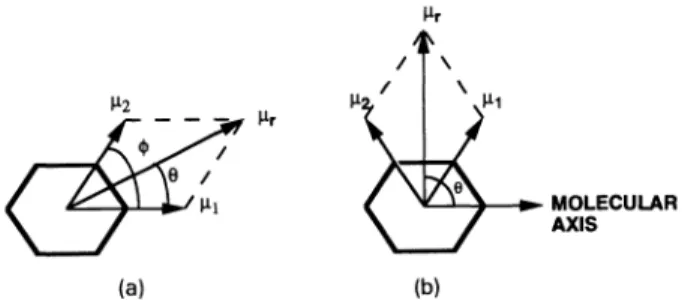
cal-Fig. 1 Illustration on how dipole moments affect the dielectric an-isotropy of a LC compound. The two dipoles and p are at an angle . The resultant dipole 5 at an angle 0 to the principal molecular axis. (a) Two dipoles are in the (3,4) positions. The di-electric anisotropy is strongly positive. (b) Two dipoles are in the (2,3) positions. The dielectric anisotropy is strongly negative. culatedby the vector addition method, as illustrated in Fig. 1. In Fig. 1(a), is along the principal molecular axis and E'2 is at an angle 4 with respect to . The resultant dipole moment Prcanbe calculated from the following equation:
r
(
2 cos)"2
. (4)From Eqs. (3) and (4), the following frequently encountered special cases can be calculated easily:
Single
polar group ():
1.
If
is in the 4 (axial) position, then 0 =0deg and z
is strongly positive.2. i1 is in the 3 position and we assume the axial group has a negligible dipole moment, then 0 =60deg and L\E is weakly negative.
3. p1 is in the 2positionand we assume the axial group has a negligible dipole moment, then 0 =120deg and ZE is weakly negative, identical to case 2.
Two polar groups (assume = l-'2 for simplicity):
1. p1 and P2arein the (3,4) positions, then 4 = 60deg,
r
VP1
,
and 0 =30deg, so that L is strongly
positive.
2.
If
F1i and p2 are in the (2,4) positions, then =120 deg, 1r P1 and 0 =60 deg, so that &t is weakly negative.3. If p and l-'2arein the (2,3) positions, then 4= 60deg, Pr
Vl , and
0 = 90 deg, so that is strongly negative.From the preceding analyses, the (3,4) difluoro substitutions should exhibit about 80% larger dielectric anisotropy than the single axial fluoro substitution at the same reduced tern-perature. This prediction is confirmed in the chloro (i
1.55D)and fluoro compounds2' where dielectric constants of single substances were measured directly, rather than the currently extrapolated results from the guest-host mixtures. The (3,4) difluoro substitution enhances both ,,and
,
but the contribution tois greater than ,
resulting in an improvement in L\E.If
the difluoro substitutions occur at the (2,3) lateral positions as shown in Fig. 1 (b), then the effective dipole is perpendicular to the principal molecular axis (0 =90 deg), and L\ becomes strongly negative, according to Eq. (3). Table 2 Physical properties of some 3,4-difluorodiphenyldiacetyl-ene and tolane homologs. Both refractive indices and dielectric con-stants are obtained by extrapolating the results from 10% samples mixed in ZLI-1132.
(a) (b)
MOLECULAR AXIS
LIQUID CRYSTALS FOR DISPLAY APPLICATION LCs with positive z are necessary for realizing the useful
electro-optic effects employing a twist or parallel-aligned cell. On the other hand, LCs with negative zc are useful for the tilted-perpendicular alignment.22 Perpendicular align-ment is known to display an excellent contrast ratio that is independent of the LC birefringence, cell thickness, wave-length, and temperature.
For a nonpolar LC compound, —0and the dielectric anisotropy is generally very small. In this case, is deter-mined entirely by the differential molecular polarizability, i.e., the first term in Eq. (3). The molecules with a larger differential polarizability in the low-frequency (kilohertz) regime often exhibit a larger birefringence in the optical fre-quency regime. Thus, the L\ofa nonpolar PTTP compound is expected to be slightly larger than the corresponding PTP with the same chain length. Within the same homologs, the one with a shorter side chain will generally exhibit a slightly larger L\cdueto the molecular packing density (N) effect. As indicated in Eq. (3), c is linearly proportional to N. 3.3 Trifluoromethyl Alkoxy PTTPs
Table3 shows the phase transition temperatures of four tn-fluoromethyl alkoxy PTTP compounds we synthesized. No mesogenic phase is found in any homolog. Although their dielectric anisotnopy is expected to be about 10 (the dipole moment of CF3 is about 2.5 D), the melting temperature of these compounds is too high. Thus, their practical usefulness is limited. To lower the melting temperature, an alkyl rather than an alkoxy side chain could be considered.
3.4 Fluoro Alkoxy and Alkenyloxy PTTPs and PTPs
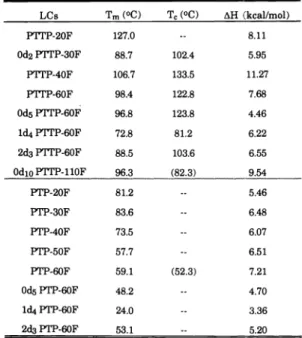
Table4 shows the phase transition temperature and heat fu-sion enthalpy of several fluoro alkoxy and alkenyloxy PTTPs and PTPs. In the 4-fluoro PTTP homologs we synthesized, all exhibit an enantiotropic nematic phase, except PTTP-20F because ofits short side chain. Generally speaking, the double bond makes three important contributions to the physical properties of a LC compound: (1) It lowers the melting tem-perature, (2) it reduces the heat fusion enthalpy, and (3) it reduces the splay elastic constant significantly.'° The detailed effects depend on the double bond position, as indicated in Table 4. On the other hand, in the fluoro tolane (PTP-nOF; n =2to 6) homologs, only PTP-60F possesses a narrow but monotropic (from 52.3 to 47.3°C) nematic phase. The rest show no mesogenic phase at all. Replacing the alkoxy side chain of PTP-60F with an alkenyloxy group suppresses the nematic phase completely. However, the melting temperature of 1d4 PTP-60F drops to 24°C and LH decreases to 3.36 kcal/mol. Thus, this homolog contributes effectively to the lowering of the melting temperature and enhances the di-electric anisotropy of the eutectic mixtures.
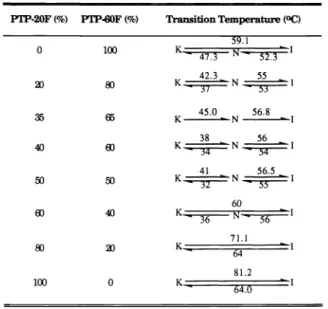
The compounds with no mesogenic phase may be added to the mixtures and become useful. One example is illustrated in Table 5. Here, binary mixtures of PTP-60F and PTP-20F are formulated. Note that PTP-60F exhibits a monotropic phase and PTP-20F shows no mesogenic phase at all. How-ever, their mixtures may exhibit an enantiotropic, a mono-tropic, or nonmesogenic phase, depending on the percentage of PTP-20F employed. At low PTP-20F concentration, the mixtures possess an enantiotropic phase with a nematic range of about 10 to 15 deg. We can convert a monotropic phase
Table 3 Phase transition behavior of the trifluoromethyl alkoxy (CH2+ O) diphenyldiacetylene (PTTP-nOCF3) homologs; T=meIting temperature, T=cIearing temperature, zH=heat fu-sion enthalpy in kilocalories per mole, and two dashes indicate no mesogenic phase. Compounds Tm (°C) T(°C) iH PTTP-20CF3 151.7 -- 7.83 PTTP-30CF3 142.7 -- 4.50 PTTP-40CF3 141.1 -- 6.07 PTTP-60CF3 121.6 -- 8.13
Table 4 Phase transition temperatures and heat fusion enthalpy of the fluoro alkoxy and alkenyloxy diphenyldiacetylene and tolane LC homologs; T=melting temperature, T=clearing temperature, ( ) = monotropic, and two dashes indicate no LC phase. The nematic
range for 0d10 PTTP-11OF is from 94.5 to 82.3°C and from 52.3 to 47.3°CforPTP-60F. LCs Tm (°C) T (°C) H (kcal/mol) PTTP-20F 127.0 -- 8.11 0d2 PTFP-30F 88.7 102.4 5.95 PTI'P-40F 106.7 133.5 11.27 PTTP-60F 98.4 122.8 7.68 0d5 PTFP-60F 96.8 123.8 4.46 1d4 PTI'P-60F 72.8 81.2 6.22 2d PTFP-60F 88.5 103.6 6.55 Od10PTI'P-llOF 96.3 (82.3) 9.54 PTP-20F 81.2 -- 5.46 PTP-30F 83.6 -- 6.48 PTP-40F 73.5 .- 6.07 PTP-50F 57.7 -- 6.51 PTP-60F 59.1 (52.3) 7.21 0d PTP-60F 48.2 .- 4.70 1d4 PTP-60F 24.0 -- 3.36 2d PTP-60F 53.1 -- 5.20
into an enantiotropic phase because the mixture decreases the melting point more significantly than the clearing point. The nematic to isotropic temperature TN! of the mixture is linearly proportional to the (TNJ) ofthe individual component i as
TNJ=Xl(TNI)l+X2(TNJ)2 (5)
where 2 the molar fraction of the individual component. In the example we demonstrate in Table 5, the TN! of PTP-60F is 52.3°C. By comparing the TN! of the mixtures with Eq. (5), we extrapolate that PTP-20F has a virtual TN! --61.5°C.As
the molar fraction of PTP-20F increases to 60%, the mixture is further away from its eutectic point (35%), the melting point is too high, and a monotropic phase takes place. As the concentration of PTP-20F exceeds —80%, the mesogenic phase of the mixture is suppressed completely. We also per-formed the binary mixtures of two monotropic mesogens. Most mixtures show an enantiotropic phase. This evidence proves that although some fluoro PTTP and tolane homologs
Table 5 Binary mixtures of PTP-20F and PTP-60F; K, N, and I rep-resent crystal, nematic, and isotropic phase, respectively. The phase transition temperatures are measured using a Mettler heating plate (at 3°C/mm) under polarizing microscope. Note that PTP-20F shows no mesogenic phase and PTP-60F shows a monotropic phase. However, their binary mixtures may exhibit either an enantiotropic, monotropic, or nonmesogenic phase, depending on the concentra-tion of PTP-60F. The calculated eutectic mixture is the one with 35%
PTP-20F and 65% PTP-60F.
PTP.20F (%) FFP.60F (%) TransilionTemperature(°C)
0 100 K_______ 59.1 N - 523 K— 42.3 37
N
55 53I
35 65 K 45.0 -N 56.8 —I K— 38 34 56 54I
K 41 32 56.5 55 I 60 40K____
36 60 N— 56 K-.. 71.164 1 100 0 K. 81.2640show no mesogenic phase, they are still quite useful for formulating the mixtures to enhance the dielectric anisotropy. The selection criteria are their low melting point and small heat fusion enthalpy.
4 Conclusion
Thefluoro diphenyldiacetylene and tolane LC homologs ex-hibit a high birefringence, high resistivity, low threshold volt-age, and low viscosity. Their phase behaviors are difficult to predict. Some fluoro compounds show reasonably low melt-ing temperatures and small heat fusion enthalpies. Generally speaking, however, their melting temperatures are too high and nematic range too narrow. They have to be mixed with different types of LC compounds to satisfy the wide nematic range requirement for practical application.
Acknowledgment
Theauthors are indebted to Elena Sherman of Hughes for formulating the binary mixtures and checking the purity of the LC compounds.
References
1 . K.Takeuchi, Y. Funazo, M. Matsudaira, S. Kishimoto, and K. Kanatani, "A 750-TV-line-resolution projector using 1.5-megapixel a-Si TET LC
modules,' 'Societyfor Information Display: Digest of Technical
Pa-pers 22, 415—422 (1991).
2.U. Efron, J. Grinberg, P. 0. Braatz, M. J. Little, P. E. Reif, and R. N. Schwartz, ''Thesilicon liquid crystal light valve,' ' J.Appl. Phys. 57,
1356—1361(1985).
3. J.W. Doane, N. A. Vaz, B. 0. Wu, and S. Zumer, ''Fieldcontrolled
light scattering from nematic microdroplets,' ' Appl. Phys. Lett. 48,
269—271(1986).
4. J. Kelly and D. Seekola, "Dielectric losses in a polymer-dispersed liquid crystal film,' 'Proc.SPIE 1257,17—28(1990).
5. 5.T.Wu,J. D. Margerum, H. B. Meng, L. R. Dalton, C. S. Hsu, and
S. H. Lung, ''Roomtemperature diphenyldiacetylene liquid crystals,"
Appl. Phys. Leo'. 61, 630—632 (1992).
6. E. C. H.Hsu and J. F. Johnson, ''Phasediagrams of binary nematic mesophase system,' 'Mol. Cryst. Liq. Cryst. 20, 177—190 (1973). 7. B. Grant, N. J. Clecak, and R. J. Cox, ''Novelliquid crystalline
ma-terials," Mol. Cryst. Liq. Cryst. 51, 209—214 (1979).
8. M.Schadt, M. Petrzilka, P. E. Gerber, and A. Villiger, "Polar alkenyls:
physical properties and correlations with molecular structure of new
nematic liquid crystals,' ' Mol. Cryst. Liq. Cryst. 122, 241—260 (1985).
9. M. Schadt, R. Buchecker, and K. Muller, ''Materialproperties, struc-tural relations with molecular ensembles and electro-optical
perfor-mance of new bicyclohexane liquid crystals in field-effect liquid crystal
displays," Liq. Cryst. 5, 293—312 (1989).
10. 5. T.Wu,C. S. Hsu, Y. N. Chen, and S. R. Wang, ''Fluorinated
di-phenyldiacetylene and tolane liquid crystals with low threshold volt-age,' 'Appl.Phys. Lett. 61, 2275 (1992).
11 . V.Reiffenrath, U. Finkenzeller, E. Poetsch, B. Rieger, and D. Coates, "Synthesis and properties of liquid crystalline materials with high op-tical anisotropy,' 'Proc. SPIE 1257, 84—94 (1990).
12. Y. Goto, T. Ogawa, S. Sawada, and S. Sugimori, ''Fluorinatedliquid
crystals for active matrix displays,' 'Mol. Cryst. Liq. Cryst. 209, 1—8
(1991).
13. A. I. Pavluchenko, N. I. Smirnova, and V. F. Petrov, ''Synthesisand
properties of liquid crystals with fluorinated terminal substituents,"
Mol. Cryst. Liq. Cryst. 209, 225—235 (1991).
14. M. Schadt, R. Buchecker, and A. Villiger, ''Synergisms,
structural-material relations and display performance of novel fluorinated alkenyl
liquid crystals," Liq. Crvst. 7, 519—536 (1990).
15. L. N. Ferguson, The Modern Structural Theory ofOrganic Chemistry, Prentice-Hall, Englewood Cliffs, New Jersey (1964).
16. M. A. Osipov and E. M. Terentjev, "Rotational diffusion and rheo-logical properties of liquid crystals,' 'Z.Natuiforsch. Teil A 44, 785— 792 (1989).
17. 5. T. Wu and C. S. Wu, "Experimental confirmation of the
Osipov-Terentjev theory on the viscosity of nematic liquid crystals,' 'Phys.Rev. A42, 2219—2227 (1990).
18.5. T. Wu, "A semi-empirical model for liquid crystal refractive index
dispersions,' 'J.Appl. Phys. 69,2080—2087(1991).
19. W. Maier and G. Meier, ''Asimple theory of the dielectric character-istics of homogeneous oriented crystalline-liquid crystal phases of the nematic type," Z. Naturforsh. Teil A 16, 262—267(1961).
20. T. K. Bose, B. Campbell, S. Yagihara, and J. Thoen,
"Dielectric-relaxation study of alkylcyanobiphenyl liquid crystals using time-domain spectroscopy,' 'Phys.Rev. A 36,5767—5773(1987).
21. 5.T.Wu,D. Coates, and E. Bartmann, "Physical properties of chlor-mated liquid crystals,' ' Liq. Cryst. 10,635—646(1991).
22. A. M. Lackner, J. D. Margerum, L. J. Miller, and W. H. Smith, Jr.,'
'Photostabilitytilted-perpendicular alignment of LC for light values," Proc. Societyfor Information Display 31, 321—326(1990).
Shin-TsonWu: Biography and photograph of author appear with the paper "Refractive index dispersions of liquid crystals" in this is-sue.
Chain-Shu Hsu received his BS degree in chemistry from the National Taiwan Nor-mal University in 1975 and the MS degree in applied chemistry from the National Tsing Hua University in 1977. He was a research chemist at the Taiwan Fertilizer Company from 1980 to 1983. Subse-quently, he studied macromolecular sci-ence at Case Western Reserve University and received a PhD in 1987. He is
cur-rently a professor in the Department of Ap-plied Chemistry at National Chiao Tung University. His research in-terests include synthesis and applications of liquid crystals and liquid-crystalline polymers.
Vee-Nan Chen received his BS degree in chemistry from Tam Kang University,
Taipei, in 1990. He was a graduate student
at Chiao Tung University, where he
worked on various synthetic aspects of liq-uid crystals and liqliq-uid-crystalline polymers and received a MS degree in 1992. He is currently on his military service.
LIQUID CRYSTALS FOR DISPLAY APPLICATION Show-Ru Wang received her BS degree
in chemistry from Tam Kang University, Taiwan, in 1990. Subsequently she was a graduate student at Chiao Tung University, where she worked on the preparation of liquid crystals and polymer-dispersed liq-uid crystals. She received a MS degree in 1992 and is currently a teaching assistant at the University.
Shu-Hua Lung received her BS degree in chemistry from the Fu Jen Catholic Uni-versity, Taiwan, in 1991. Subsequently she was a graduate student at Chiao Tung Uni-versity and performed her research on the synthesis of liquid crystals. She is currently completing her MS thesis.